




Abstract
Rather than the long-term rural–urban migration to metropolitan centres, India’s structural transformation process is characterised by complexified migrations and dispersed urbanisation. This article develops concepts of cities positioned in multiscalar power to propose a place-based, mobilities-sensitive approach and relational approach to urban theory that place smaller Indian cities within a broader narrative on migrant incorporation beyond the restrictive dichotomies of global and ordinary cities and domestic and international migration. Through two case studies, it shows how, despite low scalar positions on account of weak governance and informalised economies, smaller cities shape varied employment opportunities and generate spatially and temporally varied mobilities for domestic migrants. However, incorporation remains contingent on patronage-based social networks, creating differentiated experiences for those from different social locations; still more inclusive incorporation pathways are possible through expanding welcoming infrastructure and social fields for young migrants.
Introduction
Internal migration is intrinsic to India’s structural transformation and economic development. At the heart of this transformation are rural youth, driven off the farm by stagnant agricultural productivity and seeking economic opportunities in urban and urbanising locations. Simultaneously, youth channel ‘mobile aspirations’, that is, the desires and practices of migration, to construct future aspirations of education, work, social relationships and lifestyle (Robertson et al., 2018). Yet, policies to create economic opportunities have emphasised skill development and ignored spatial migration patterns (Upadhya and Chowdhury, 2022). Nor have Indian cities been welcoming to migrants, as recently emphasised by their mass exodus during COVID-19 (Deshingkar et al., 2022; Kundu and Ray Saraswati, 2012).
Large-scale rural–urban migration to big cities fuelled structural transformation in the Global North; in contrast, India exhibits ‘subaltern urbanisation’ that is driven significantly by economic transitions in a large number of spatially dispersed small towns (Denis and Zérah, 2017). While metropolitan cities remain significant drivers of economic growth and key sites for global integration (Kennedy and Zérah, 2008), non-metropolitan urban centres also exhibit economic dynamism by creating livelihoods through localised and largely informal economies, exhibiting growth in private consumption and demonstrating innovation, entrepreneurial energies and global linkages even without robust investments from the state and the formalised corporate sector (Harriss-White, 2016; Mukhopadhyay et al., 2020).
We build on subaltern urbanisation’s amplification of Robinson’s (2006) call to study ‘ordinary’ cities, which exhibit local specificity and agency while being potentially creative, dynamic and ‘set in multi-scalar flows’ (Denis and Zérah, 2017: 10). We focus on ‘smaller’ cities not so much because of their relatively lower demographic size relative to global or metropolitan cities but because of their weaker scalar positioning within global economic, political and cultural flows (Schiller and Çağlar, 2009; Swyngedouw, 2004), as shown by their poor governance capacities, fiscal and policy dependence on higher levels of government, illiberal social conditions, informalised economies and dependence on regional capital and labour flows (Bell and Jayne, 2006; Coelho and Vijayabaskar, 2014; Kennedy, 2017; Swerts and Denis, 2017; Vijayabaskar, 2011).
Based on their global migration research, Schiller and Çağlar (2009) propose that migrants’ entry into cities and their experiences of incorporation are a factor of ‘city scale’. Here, incorporation is defined in terms of localised economic, cultural and political linkages between migrants and host societies (Schiller and Çağlar, 2009, 2011). They posit that while globally well-connected ‘top-scale’ and ‘up-scale’ cities offer migrants plentiful and emergent economic opportunities, ‘low-scale’ and ‘down-scale’ cities offer selective or negligible opportunities for migrants. Subaltern urbanisation theory also suggests that smaller cities in India play a strictly regional role in migration as ‘transitional environments’ for migrants (Denis and Zérah, 2017: 14). This article empirically investigates how this tension between economic dynamism and weak scalar positioning impacts the migration and mobility patterns of young internal migrants as well as their incorporation into smaller cities.
This question is complicated by the nature of domestic migration in India, which is characterised by seasonal and circular patterns of migration, estimated at between 40 and 150 million (Breman, 1996; ILO, 2020; Srivastava, 2011) as compared to 450 million long-term internal migrants. Many workers also access urban jobs by commuting daily and weekly (Chandrasekhar and Sharma, 2015). The global migration literature identifies these as ‘liquid’ or complexified forms of migration (Engbersen et al., 2010, 2017). Leaning on the ‘mobilities paradigm’ (Sheller and Urry, 2006), which shows how networks and flows of people, goods, technologies and ideas produce varied outcomes (empowerment, disconnection, exclusion), we investigate how youth practice complexified mobilities and experience incorporation in smaller cities (Robertson et al., 2018; Schiller and Çağlar, 2011).
Drawing on evidence from two smaller Indian cities, Mangalore and Kishangarh, we investigate:
(i) What kinds of employment opportunities do smaller cities provide for youth, especially migrants?
(ii) What kinds of spatial mobilities do smaller city labour markets generate?
(iii) How do incorporation avenues in smaller cities shape youth mobile aspirations?
The article is organised into seven sections. This introduction is followed by a literature review and a discussion of methods used. The fourth and fifth sections describe the employment opportunities and mobility patterns observed in the case cities. The sixth section analyses the factors shaping migrant incorporation and mobile aspirations in smaller cities, while the last section offers concluding thoughts and outlines future research agendas.
Literature review
Neither cosmopolitan metropolises nor traditional villages, smaller cities are conceptualised as in-between places (Bell and Jayne, 2006) and are experienced as places of ‘enhanced promise and intensified struggle’ (De Neve, 2003: 278). They act as action spaces where rural youth can negotiate contradictions between aspirations and economic opportunities and seek pathways out of poverty (Ingelaere et al., 2018; Jeffrey and Young, 2012).
The literature describes smaller cities in India as infrastructurally deficient, closely interlinked with rural hinterlands, dependent on regional capital and labour flows and consigned to low levels of economic dynamism (Coelho and Vijayabaskar, 2014; Denis and Zérah, 2017; Raman, 2014; Vijayabaskar, 2011). Uncertain transitions further up the value chain foster demand for low-wage casual workers, keeping migrants’ lives economically precarious (Vijayabaskar, 2011). Their struggles are intensified by the co-constitution of caste, class and gender in social relations and the role of family, caste and religion in organising labour markets (Chari, 2004; De Neve, 2003; Harriss-White, 2016). Thus, elite castes access kinship networks to seek employment, whilst scheduled castes (SCs) and scheduled tribes (STs) 1 are recruited almost exclusively by labour intermediaries for poorly paid and precarious work in low-skilled sectors like agriculture, brickmaking and construction, and Other Backward Class (OBC) members 2 tend to find semi-skilled industrial work (Deshingkar, 2019; Neetha, 2002). Migrant women in cities are concentrated in poorly paid domestic or home-based work (Neetha, 2004). Access to mobility is also uneven and often built upon the exclusion of those who are less free (Ahmed, 2014; Sheller and Urry, 2006). For example, familial, cultural, religious and institutional social structures mediate the mobility aspirations of youth (Robertson et al., 2018).
Owing to casualised work opportunities, migrants in smaller cities engage in circular mobilities (Vijayabaskar, 2011). Even those who find footholds in the city remain enmeshed in rural lives through trans-local householding practices (Gidwani and Ramamurthy, 2018). Migrants utilise diverse fluid mobility strategies, including moving between the village, an affective place and the city, which is intensely experiential, to combat temporary setbacks, meet their aspirations and maximise opportunities across space (Robertson et al., 2018; Shivanand, 2019). Yet, smaller cities are not unimportant for more settled migration. About half of the long-term male internal migrant workers in India live in non-metropolitan cities, with 20% of women migrants concentrated in cities below 100,000 in population. 3
Subaltern urbanisation theorises that smaller cities are also sites for the direct entry of global capital, which does not necessarily flow top-down through metropolitan or global cities (Denis and Zérah, 2017). Benjamin (2017) shows how localised transformations in the small towns of South Canara on India’s west coast, manifested through property relations, transport infrastructures and regional and transnational trade, are contiguous to broader economic processes. Smaller cities also pursue economic development through globally influenced developmental agendas (Robinson, 2006). In India, owing to incomplete decentralisation processes, these are steered by regional state governments and not elected municipal governments (Kennedy, 2017). Additionally, elites who are bothered by an inadequate sense of ‘city-ness’ often push for localised rebranding efforts to attract private capital and funding from state and national governments, as Cook (2018) demonstrates in Mangalore.
Smaller cities can offer a ‘spatial fix’ for bringing together capital, labour, non-labour inputs and supportive services that sustain livelihoods and economic activities through a web of localised social relations (Vijayabaskar, 2017). Akin to this, Schiller and Çağlar (2009) conceptualise migrants’ social fields as place-based individual and group associations and networks driven by entrepreneurship, marriage, friendship, politics, etc. that aid incorporation by embedding social relations in localised power asymmetries. They propose that migrants’ incorporation, that is, their linkages with local economic, cultural and political networks, is a factor not of demographic size but of the city’s scalar position (Schiller and Çağlar, 2009). Here, incorporation is distinct from integrationist logics that aim to assimilate migrants into dominant cultures (Bloemraad, 2007) and may involve complexified mobilities that include living in more than one place, ‘simultaneously here and there’ (Schiller et al., 2004), without the objective or outcome of settling (Schiller and Çağlar, 2011).
Smaller cities can provide conditions to both tap into kinship-based social networks and connect outside the bonds of caste and kinship (De Neve, 2003). These may allow migrants’ social capital that transcends intra-group ‘bonding’, enabling ‘bridging’ beyond the immediate social group and ‘linking’ to key people in positions of power (Putnam, 2000; Woolcock, 2001). Though migrants’ social networks exist across space and time (Ryan et al., 2008), they may ‘emplace’ themselves by building networks of connection within the constraints and opportunities of specific cities (Schiller and Çağlar, 2011), which may vary considerably in terms of the hard (work, housing, skill and language development services, etc.) and soft (emotional support, cultural connections, etc.) welcoming infrastructures they provide (Meeus et al., 2019). In India, role models (Krishna, 2013), labour market institutions (Mitra, 2010) and housing intermediaries (Naik, 2019) play a part in aiding the incorporation of domestic migrants.
Method
The article presents findings from two years of fieldwork in two smaller Indian cities where migrants are a significant proportion of the workforce. A smaller city is understood as a non-metropolitan city, which refers to cities below 1 million people as measured through the Census of India.
To select cases, cities that lie within the population range of 0.1–1 million that Harriss-White (2016) refers to as ‘middle India’ were shortlisted from 37 ‘migration junction’ districts that experienced simultaneous in- and out-migration, identified in earlier quantitative work (Randolph and Naik, 2017) using data from Census 2001, which was the latest available in 2017 when fieldwork was being planned. From these migration junction districts, we identified 12 cities with populations below 1 million and which were not spatially contiguous to large metropolitan centres. Kishangarh (with a population of 155,000) and Mangalore (with a population of 500,000) were selected for having the highest proportion of migrant workers (24% and 32% respectively) and because youth aged 15–29 were prominent in the workforce (31.5% and 56.7% respectively). Kishangarh is a manufacturing and market town located in the relatively less developed north-western state of Rajasthan, and Mangalore is a regional administrative, industrial and services centre located in the more prosperous southern state of Karnataka. These characteristics enabled a study of domestic migrant incorporation in distinct contexts.
The article draws on fieldwork conducted in the two case cities between July 2017 and November 2019. This comprised a randomised sample household survey of 897 employed youth (397 in Kishangarh and 500 in Mangalore) as well as 27 focus group discussions (FGDs) with college-going and employed youth and 50 key informant interviews (KIIs) with government officials, employers, workers, industry experts, union leaders, residents and civil society organisations. In the survey, a migrant was defined as anyone who came to the city at the age of 15 or above, from another location. Since the survey was designed to capture diverse mobility patterns, it did not use predefined categories of migration but captured variables like source location, alternative destinations, frequencies and durations of migration, migration histories and aspirations to identify mobilities. Similarly in interviews and FGDs, no specific definitions of migration were imposed on respondents. The data is not longitudinal, and no trends can be gleaned from it.
Employed individuals aged 15–29 were surveyed in their places of residence in a randomised pattern, for example selecting every seventh house in alternate streets in select municipal wards (urban administrative units) representative of varying demographic and socio-economic characteristics. The survey was also conducted at multiple transit hubs to capture commuters. Respondents were administered a questionnaire comprising modules on household information, employment, migration and quality of life in the city. Qualitative research was open-ended, exploring themes like economy, education, employment, labour market mechanisms, urban governance and politics, state capacity and migrant incorporation. Respondents for KIIs and FGDs were initially approached via local NGOs and activists in both cities, and snowballing was used to find more respondents.
This article uses survey data to describe youth migration and employment at the city level, but most empirical findings are drawn from qualitative material, through a thematic analysis of fieldnotes.
Incorporation through labour market opportunities
This section describes how smaller city labour markets are shaped by economic activity, development agendas and branding efforts, especially since India’s economic liberalisation in 1991. It examines economic incorporation in smaller cities through the differentiated employment experiences of migrants compared to non-migrant youth.
Though a medieval town, since the 1990s Kishangarh has been an important hub for stone processing, importing raw stone from domestic sources and international sources like Italy and Turkey and supplying processed marble and granite to India and abroad. Industrial land is developed by the state-owned Rajasthan Industry and Infrastructure Corporation (RIICO) and business elites from across the state have set up manufacturing units on it. Kishangarh is located on an important logistics corridor connecting key ports on India’s western coast with production centres across north and west India. Relatively socially homogeneous, the Census 2011 shows its population as predominantly Hindu (80%) and speaking Marwari or Hindi. About 16% of the city’s population are SCs. About 40% of the youth surveyed self-identified as migrants.
A thriving trading node since the 15th century, in the 1970s Mangalore developed into an industrial cluster for petrochemical, agricultural processing and chemical industries partly triggered by the development of the New Mangalore Port as a strategic national logistics investment. Since the 1990s, the city has grown in services sectors like real estate, healthcare, education, retail, hospitality, IT and tourism. Yet, local officials and citizens see it as an ‘inferior variation’ of a larger city (Cook, 2018), and persistent deficiencies in services mark Mangalore’s governance inadequacies (Kudva, 2015). Mangalore’s trading history has made it socially and culturally diverse, comprising Hindu (69%), Muslim (17.5%) and Christian (13.2%) populations speaking a variety of regional languages. The city’s SC population is 5.6%, as per the 2011 Census. About 37% of the youth surveyed self-identified as migrants.
Though both cities are recipients of infrastructure investments by higher levels of government, they have focused on rebranding efforts to boost local economies and produce robust labour market opportunities for youth, including migrants.
Kishangarh’s branding as the ‘Marble City of India’ is reflected in interactions with local business owners, residents and bureaucrats, for example in the city’s chief planning officer’s narration of film celebrities visiting to purchase stone products (Interview, Chief Municipal Officer, Kishangarh, 16 September 2018). Yet, local state capacity has remained weak. In September 2018, over half the posts in the municipal council were vacant. At the same time, national and state governments have invested in the redevelopment of older infrastructure like markets, highways, bus and railway stations and the construction of a new airport and logistics park, creating ideal conditions for industrial development.
In this context, encouraged by RIICO’s industrial parks, elite entrepreneurs have focused on the stone-processing industry, creating a large number of labour-intensive and precarious jobs for male workers, with limited opportunities for well-paid employment. The stone-processing industry employs 35% of the youth workforce, with linked sectors like transport, logistics, hospitality and trade employing about 60% and modern services (comprising professional services, information technology, finance, real estate, creative industries etc.) less than 5% (see Table 1).
Sectoral composition of work in case cities.
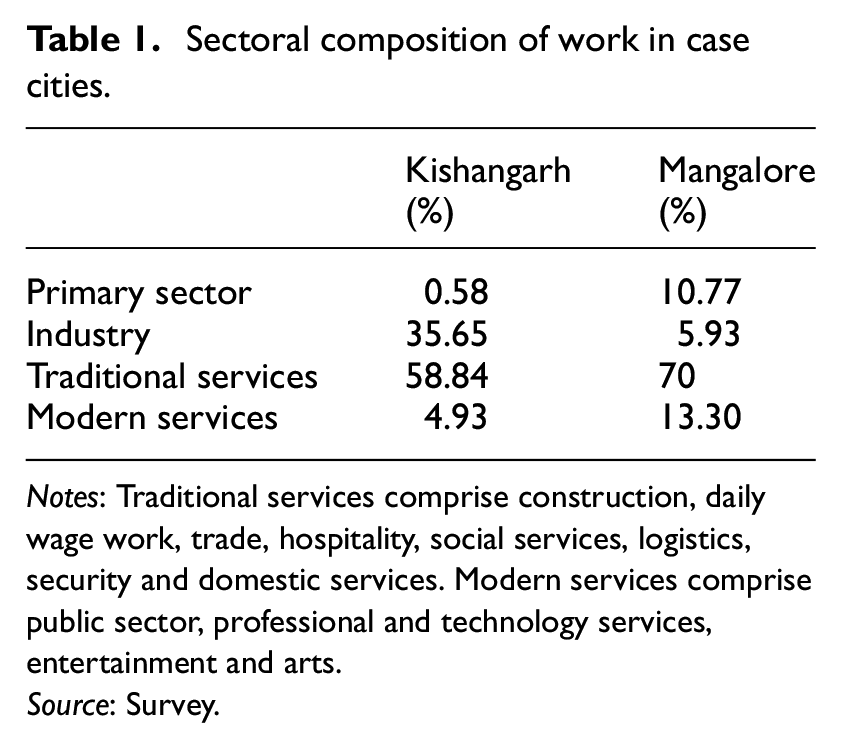
Notes: Traditional services comprise construction, daily wage work, trade, hospitality, social services, logistics, security and domestic services. Modern services comprise public sector, professional and technology services, entertainment and arts.
Source: Survey.
An abundance of young, low-skilled and highly mobile labour has supported Kishangarh’s stone industry. The city’s youth workforce is poorly educated. About 17.8% are illiterate and only 6.8% have a college degree. Among migrants, only 20% have completed high school compared to over 38% of non-migrants. Migrants comprise about half of the industrial workforce, and about 65% of those who work as cleaners, cooks and servers in the hospitality sector are also migrants. Though wage differentials are not prominent, migrants – especially those moving long distances – are differentially positioned in the industry, working as loaders, while local workers do more mechanised tasks like machine operation and polishing. Migrant workers access employment entirely through labour contractors and have negligible opportunities to negotiate or collectivise, reflecting the broader trend of migrants being a poorly paid, flexible and docile labour source (Srivastava, 2019).
In recent years, Mangalore’s labour market has somewhat deviated from its economic history. Over decades, national and state governments have invested in port infrastructure and a Special Economic Zone (SEZ) to position Mangalore as an industrial and logistics hub, building on its history as a port city. Yet, the survey evidence indicates significant de-industrialisation, with only 5.93% of youth employed in manufacturing (see Table 1). The Mangalore SEZ is largely vacant, and small and labour-intensive industries like fishing, cashew processing and tile making are losing out to global competition (Interview, labour officer, Mangalore, 16 August 2018).
Despite this, building on strong infrastructure, an educated workforce and a robust district administration, local elites – fuelled by a vision to re-invent Mangalore as a modern city – are powering a transition to the services sector by investing in education, real estate and information technology-enabled services (ITeS) (Interview, real estate developer, Mangalore, 22 May 2018). Presently, 70% of youth are employed in retail and wholesale trades, education and healthcare and 13.3% work in IT, real estate and finance. Since local firms in Mangalore lack the scale and complexity to provide career progression for knowledge workers (Interview, manager in business process outsourcing firm, Mangalore, 22 May 2018), elites and the district administration have combined forces to retain talent by setting up an incubation centre for tech entrepreneurs (Interview, District Commissioner, Mangalore, 25 October 2018).
In Mangalore too, migrant workers are low skilled and access relatively poor employment. While the non-migrant youth workforce is extremely well educated – 38% are college graduates and a further 17% finished high school – 56% of migrant workers have had only partial or no schooling. Migrants are concentrated in poorly paid sectors like fishing, agro-processing, construction, daily wage labour, domestic work and hospitality. More migrants are SCs (18%) and STs (7%) compared to non-migrants (6% and 2% respectively).
These examples exhibit how smaller city labour markets are producing significant employment opportunities for locals and migrants, but vary greatly in character, from flat to highly differentiated. In either case, migrants appear to occupy the lower segments of the labour market (see Table 2). In a post-liberalisation context, labour market opportunities are significantly shaped by the investments of local business elites. The next section investigates the kinds of (im)mobilities these smaller cities generate among young workers.
Sectors of youth employment by migration and caste status.
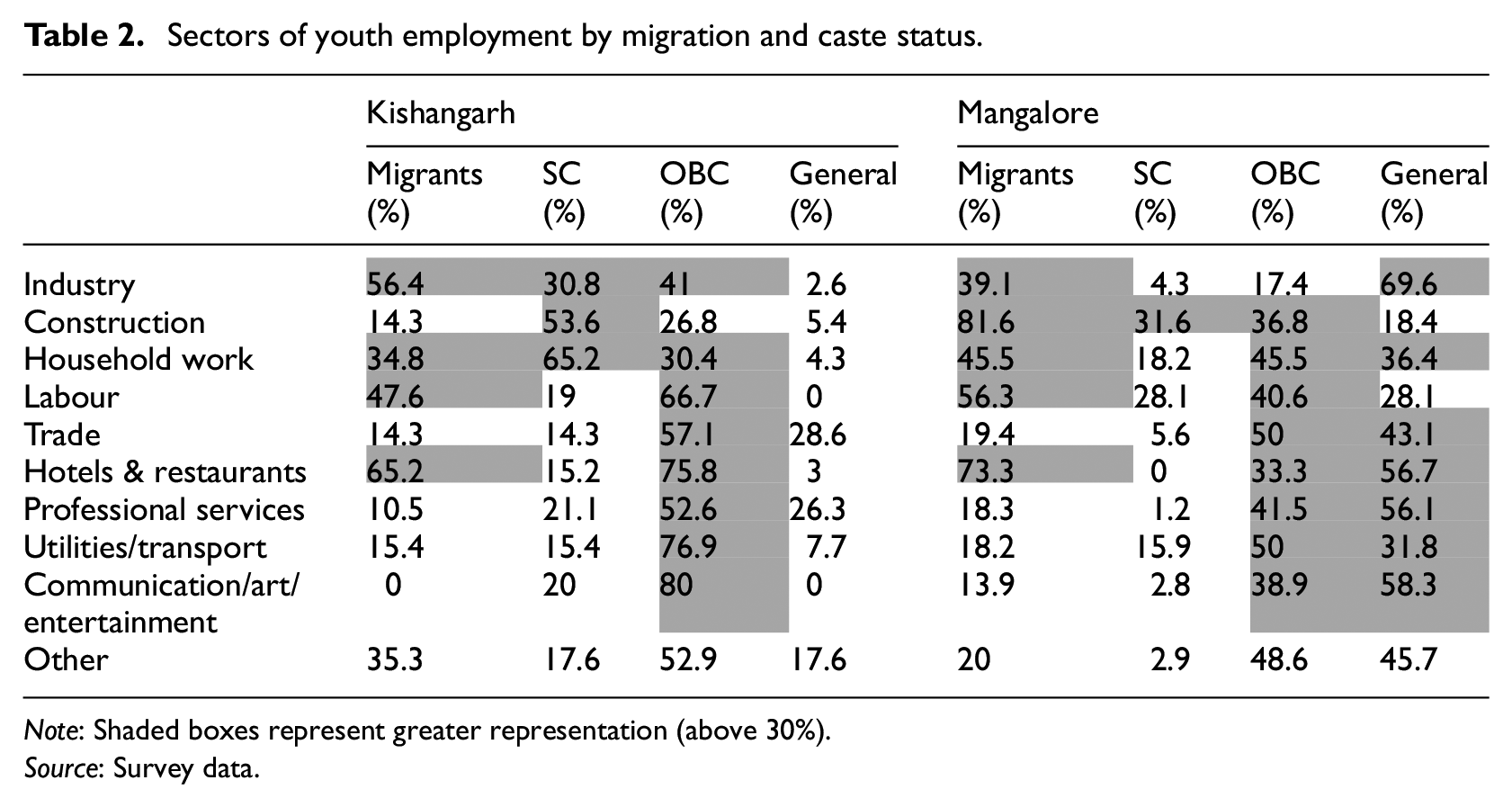
Note: Shaded boxes represent greater representation (above 30%).
Source: Survey data.
Spectrum of (im)mobilities
Intrinsically linked with their region, smaller cities like Kishangarh and Mangalore are destinations for youth migrants from nearby villages and small towns, who can leverage social networks to access work, housing and other welcoming infrastructures. Jobs in Kishangarh provide ready access to cash for impoverished rural households dependent on agriculture. About 40% of youth migrants working in Kishangarh, nearly entirely male, come from within Rajasthan; of these, over a third are from within the same district, and another 30% are from adjacent districts (see Figure 1). While four-fifths of regional migrants intend to stay in Kishangarh long term, they often express fear of failure in the city and refer to home as a place of safety and refuge, indicating long-term aspirations of return.
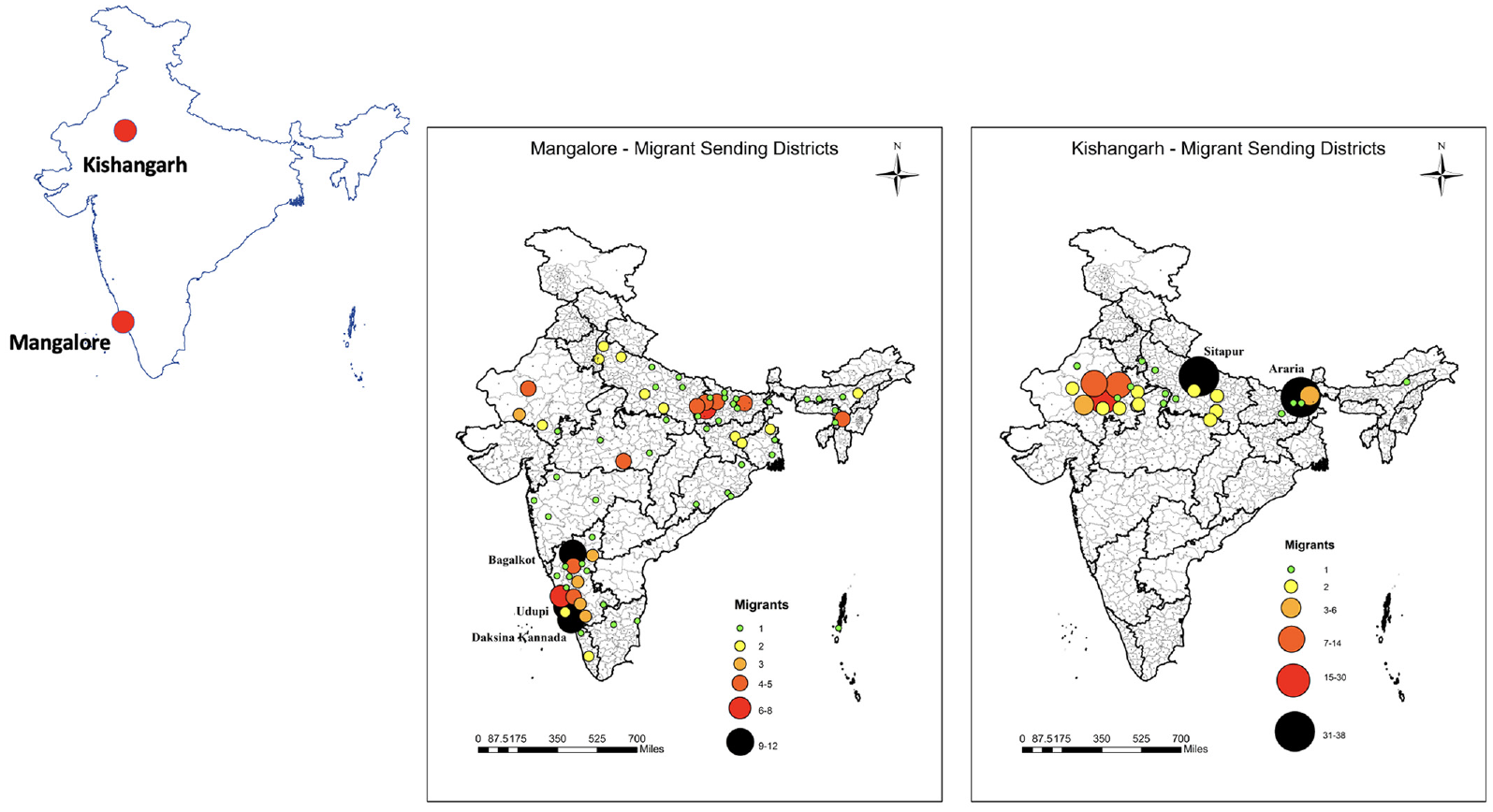
Source areas for case cities.
In Mangalore, about 47% of youth migrants are from within the region: 33% from within Karnataka, a third from within the district and another 14% from adjoining districts (see Figure 1). It draws in young workers from the northern districts of the adjacent state of Kerala (13%). Short-distance migration enables educated young men and women from the region to work in the city’s numerous education, healthcare, hospitality and retail establishments. About 14% of regional migrants are college graduates, compared with only 2% of long-distance migrants from north and east India. Well-educated and connected regional youth migrants aspire to forge stable careers in Mangalore.
Robust regional transport infrastructure has opened the possibility of commuting from villages and small towns to work in smaller cities. About 10% of Kishangarh’s survey sample and 17% of Mangalore’s reported commuting daily or weekly. Commuting is a preference for those rural youth who seek steady non-farm work without aspirations for longer-term migration, for those facing family restrictions regarding permanent mobilities and for aspirational youth struggling to access welcoming infrastructures. Bhairon, a 24-year-old factory worker who commutes two hours daily to Kishangarh, says: ‘There are few options for work in my village … but I have to earn money to educate my child. After work hours, I also help out with the livestock’ (Interview, Kotri, 8 January 2018). Kaveri, a female nurse, prefers to commute to Mangalore from a nearby town to save on housing costs and to allay her family’s concerns about her safety in the city (Interview, Mangalore, 24 May 2018). Commuting is also a way of overcoming the problem of curtailed opportunities for longer-term migration. In both Kishangarh and Mangalore, SC youth and women reported relatively fewer opportunities for out-migration, owing to a lack of resources and social norms that tethered SCs to specific occupations or saddled women with care responsibilities.
However, in contrast to the regional mobilities captured by the literature on smaller cities, the case cities attract a disproportionately high number of long-distance migrants (see Figure 1). Interstate migrants comprise 60% of the youth migrants in Kishangarh, mostly from Bihar and Uttar Pradesh. Mangalore attracts inter-state migrants from Bihar (18%), Uttar Pradesh (16%) and at least nine other states (see Figure 1). This may be attributed to India’s uneven economic geography, where poorly developed and densely populated northern and eastern regions send migrants to diverse locations across the country (MoHUA, 2017).
Vibrant smaller cities also act as springboards for aspirational non-migrant youth whose mobile aspirations are fuelled by strong social networks. Elite youth from Kishangarh and its region migrate to district headquarters at Ajmer or the state capital Jaipur for education and work (Interview, entrepreneur, Kishangarh, 8 January 2018). While the out-migration of youth from Mangalore to Bangalore, other Indian metros and abroad is often represented as a sign of inadequate city-ness – ‘We need to develop the city to retain this talent’ (Interview, real estate developer, Mangalore, 16 August 2017) – these migrations continue to be common.
Smaller cities can also be temporary waystations in longer, more complex and often multi-sited mobility trajectories, especially for enterprising youth who build strong social connections. Harish worked on a poultry farm in his village in Maharashtra, then as a computer operator in Nashik, as a salesperson in Pune and as a hotel cashier in Panvel, all cities within a 400 km radius of his village. A mentor in Panvel helped him get a better-paid job as a waiter in Mangalore, which is further away and in another state. When interviewed, he described an aspirational future that involved a move to Dubai within the hospitality sector, where he expected his income to triple, and a subsequent move to Australia, where he would ‘settle’ (FGD with hospitality workers, Mangalore, 17 April 2018).
Schiller and Çağlar (2009) posited that cities with lower scalar positions are likely to be sites of limited migration. But the empirical evidence shows that smaller cities have numerous imbricated multiscalar multi-sited flows (see Figure 2). They receive young migrants from regional and remote villages and towns with weaker economies, who exhibit a range of mobilities, including commuting, circularity and return, and nurture youth aspirations to move to more vibrant metros in India and abroad; conversely, their social illiberalism limits the mobilities of youth, especially women and those from socially disadvantaged communities. The next section highlights the local factors that shape diverse mobility trajectories, emplacement and incorporation, and for whom.
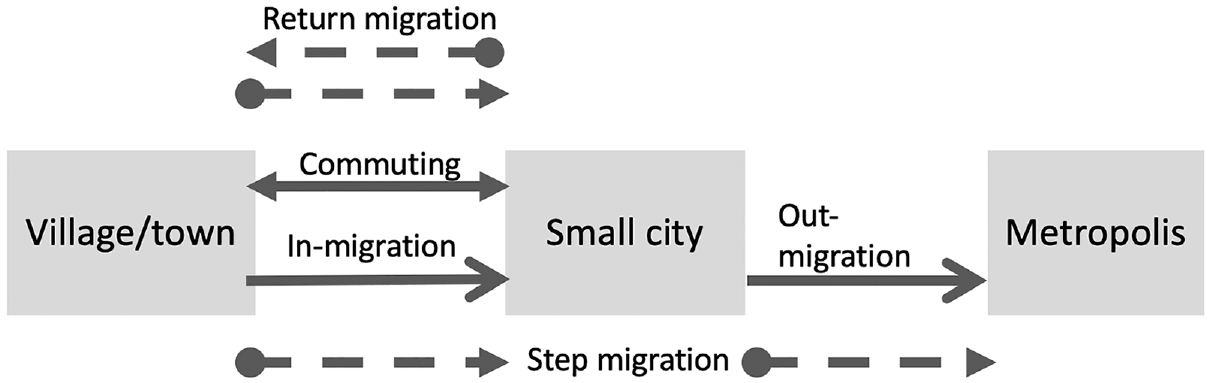
Mobility pathways in smaller cities.
Factors shaping (im)mobilities and incorporation
Though smaller cities create avenues for economic incorporation via employment, these pathways are uneven not just on account of migration status but also owing to the nature of social networks and capital. Caste-based labour recruitment networks, such as those common for recruiting OBCs for manufacturing work (Neetha, 2002), bring long-distance migrants to cities like Kishangarh and Mangalore, while regional migrants rely on caste-based social capital for incorporation. Vikas, a young migrant from a village near Kishangarh, leveraged his membership of the prosperous Jain community to start a graphics design and printing business (Interview, entrepreneur, Kishangarh, 6 January 2018). Support in the form of subsidised office space, business capital and assured patronage from Jain-owned businesses and religious organisations, including connections to powerful political actors, shaped Vikas’ mobile aspirations and encouraged him to continue growing his business over time.
But this kind of in-group social capital limited aspirations for Rajesh, who belongs to an untouchable SC community traditionally relegated to sanitation-related occupations. Rajesh could not find suitable employment in Kishangarh despite having technical qualifications. After facing caste discrimination in the state capital Jaipur (two hours away), where he tried to move to seek employment, he returned home to work for a sanitation contractor, reverting to caste-based stigmatised work (FGD with Valmiki community, Kishangarh, 13 April 2018). In Mangalore, too, educated SCs report difficulties in finding dignified work. In line with the literature on caste and labour (Chari, 2004; De Neve, 2003; Harriss-White, 2016; Neetha, 2002), survey data from the case cities shows that SC youth almost always migrate with kin or via labour contractors, that OBC youth migrate either via contractors or autonomously and that only the upper castes report using formal employment agencies.
Thus, mobility opportunities are highly contingent on caste identities, regardless of migration status. Caste affiliations have additional dimensions for women, given how Indian patriarchy uses the concept of honour to keep upper-caste women out of the labour market, entrap them in care labour, control their mobility and deny access to the public sphere (Phadke et al., 2011). In Kishangarh, dominant caste women have to negotiate aggressively within the household to be permitted to work, but SC women face few barriers to working in traditional caste-based occupations (Naik, 2022).
We find that characteristics of low-scale smaller cities like weaker governance capacities, clientelist politics, lower corporatised investments and informalised economies (Harriss-White, 2020; Shastri, 2011) contribute to the contingency of incorporation pathways. In weak governance contexts like these, local elites take a lead in creating employment and providing services like housing and transport, including social facilities and ‘third places’ that offer social and cultural connections for migrants, and leisure opportunities for youth (Robertson et al., 2018; Zhuang, 2017). Localised welcoming infrastructures can help youth find tactical ways, involving different kinds of (im)mobilities, to navigate socially imposed constraints and aspire to better futures (Vigh, 2006).
Caste identities play a role in these localised governance arrangements. In Kishangarh, where local and top-down development agendas dovetail closely, dominant caste elites like Jains, Marwaris, Jats and Rajputs control the stone industry through the Kishangarh Marble Association (KMA), creating labour-intensive jobs for young SC and OBC men and helping upper-caste migrants with resources for entrepreneurship. In Mangalore, in contrast, elite power is distributed across caste groups including Brahmins, Kshatriyas, OBCs and indigenous tribal communities, creating employment opportunities for a broader set of caste groups.
Caste-based social organisations can also provide the linking capital needed for disadvantaged regional youth to break out of rigid social constraints. In Kishangarh, SCs who are usually denied mobility have tried to organise to protect available employment in the city by urging elected city councillors to keep dominant castes out of municipal sanitation jobs. In Mangalore, SC groups enabled regional migrants to access dignified occupations. For instance, Kaveri’s involvement with an SC student activist group enabled her to obtain a scholarship to become a nurse in Mangalore (Interview, Mangalore, 24 May 2018), and regional SC activist networks introduced Lakshmi and Pravin to the social work profession (Interview, Mangalore, 30 May 2018).
However, neither city offers long-term incorporation pathways for long-distance migrants. Unable to tap into social capital, they tend to be concentrated in low-paid informal jobs and struggle to access welcoming infrastructures. In Kishangarh, long-distance migrants in the stone-processing sector, predominantly OBCs, live inside factory establishments and depend on dominant caste employers for housing and daily necessities. In Mangalore, long-distance migrants are denied membership in collectives, skilling programmes and unions because they lack local identification documents. Thus, they circulate between their home and the smaller city, their aspirations limited to eventually returning home. While this is a recognised labour market mechanism to ensure flexible labour, migrants often narrate this as a response to family social pressure, highlighting how social expectations also influence youth aspirations and mobilities. Dev, a waiter in an upmarket Mangalorean restaurant, would not consider ‘settling’ in Mangalore and wants to return to Assam (in north-east India, over 3500 km away) to care for his ageing parents (FGD with hospitality workers, Mangalore, 17 April 2018).
Beyond employment, elites are also involved in providing services like education and healthcare. In Kishangarh, the KMA runs the city hospital, a leading industrialist supports the government college and many upper-caste groups run charitable education and health facilities. The power dynamic between upper-caste investors and lower-caste workers allows elites to craft a reputation of being benevolent employers and benefactors, while turning a blind eye to exploitative working conditions and actively discouraging the collectivisation of workers (Interview, CEO, KMA, 8 September 2018).
In Mangalore, distributed elite power and relatively stronger state capacity help local workers and regional migrants to amplify their political voice. Leveraging a functional district labour department, they demand rights and address grievances through worker unions and collectives, as evident in the campaigns of anganwadi (government-run childcare centres) workers and domestic workers for better wages (Interview, union organiser, 29 April 2018). The self-help groups run by the municipal government under the National Urban Livelihood Mission have also been useful for women to access financial capital and markets (Interview, municipal employment officer, Mangalore, 23 May 2018).
Here, the district administration and local elites have co-created supportive infrastructures that have helped migrants emplace themselves. For example, the development of new tourism and infrastructure projects in Mangalore is creating more employment and the district administration’s business incubator is designed to attract skilled return migrants (Interview, real estate developer, Mangalore, 16 August 2017; FGD at incubation centre, Mangalore, 25 October 2018). Public and private companies collaborate to ensure an efficient regional bus transport system that ensures efficient labour circulation, and private employers collaborate with rental housing providers to ensure accommodation for migrant workers (Interview, transport department, 26 October 2018; Interview, BPO manager, 22 May 2018).
Welcoming infrastructures transcending caste-based networks, like group rental housing, regional transport systems and accessible and safe public spaces, allow for mobilities and social interconnections that fuel mobility aspirations for a wider range of migrants. Harish, the hospitality worker who migrated to Mangalore from rural Maharashtra, attributed his success at connecting with recruitment networks in the Middle East to Mangalore’s cosmopolitan social milieu, which enables linking capital that operates beyond the bounds of caste. ‘I make friends easily. Some of my customers who I meet outside work are helping me go to Dubai’, he said (FGD with hospitality workers, Mangalore, 17 April 2018). Upper-caste women in Kishangarh expand their available options by striking ‘patriarchal bargains’ with authority figures to gain modest freedoms (Kandiyoti, 1988); for example, they leverage educational infrastructure to delay marriage, and use skills and business ideas gained during brief educational stints in larger cities to carve an independent place within the family’s patriarchal business structure (Naik, 2022). In Mangalore, income from the plentiful service-sector jobs offers young women from nearby villages and towns opportunities to negotiate terms for education, employment and marriage. Thus, the infrastructures and experiences of various mobilities combine to enable incorporation.
Smaller cities in India offer mixed opportunities for migrant incorporation. On the one hand, social illiberalism via patriarchal and caste-based structures severely constrains mobility aspirations for socially disadvantaged migrants, especially in contexts where informal economies and poor state capacity place pathways for economic advancement largely under elite control. On the other hand, better public infrastructure and services help migrants access welcoming infrastructures and emplace themselves by widening their social fields. While not entirely devoid of bias, local institutions like labour collectives, activist groups and business incubation centres offer opportunities for migrants to pursue a broader range of mobility aspirations.
Conclusion
This article proposes the need for a place-based, mobilities-sensitive and scalar approach to urban theory. It develops the work of subaltern urbanisation scholars by delving deeper into the migrations and mobilities generated by economically vibrant smaller cities, especially for youth who remain vital to India’s structural transformation.
Responding to Denis and Zérah’s (2017) provocation on the position of smaller cities in multi-scalar flows, the article leverages the relationality of Schiller and Çağlar’s (2009) concept of city scale to study smaller cities as sites of migrant incorporation, without the restrictions imposed by demographic and functional urban categories. Migration scholarship has also recognised migrant incorporation as an area for ‘theoretical transfer’ between internal and international migration (King and Skeldon, 2010).
The article finds that while the role of low-scale smaller cities is negligible in global migration (Schiller and Çağlar, 2009), in the context of domestic migration, low-scale smaller cities are enabling employment opportunities and fostering aspirational (im)mobilities among young people. At the cusp of varied and complex mobilities, smaller cities act as origins, destinations and transit points in the mobility pathways of young men and women who navigate social worlds and economic opportunities to pursue personal aspirations. The mobility of people, ideas and resources is, therefore, the prerogative not just of metropolitan cities that are networked with each other as part of a globalised world (Sassen, 2000) but also of low-scale smaller cities.
By showing that low-scale smaller cities attract long-distance migrants, this article’s findings expand the role of smaller cities in migration pathways beyond the strictly regional role that literature has hitherto ascribed to them. In general, a strong dependence on caste- and kinship-based social networks for access to employment and welcoming infrastructures privileges the incorporation of regional migrants over long-distance migrants, engendering circular mobilities for these latter. Thus, despite their ability to foster multiple mobilities and mobile aspirations, smaller cities – as subaltern urbanisation scholars suggest – remain important transitional environments for temporary migrants. Yet, the existence of diverse mobilities and mobility aspirations in these ‘in-between’ places invites a reconsideration of linear and binary concepts like ‘push and pull’, ‘source and destination’ and ‘rural versus urban’ that persist in Indian public policy and deny smaller cities a role in structural transformation processes. The article’s preliminary insights into youth’s individual tactical approaches to pursuing mobility aspirations show that further research on the subjectivities, agency and social navigation toolkits of young migrants could nudge smaller cities to move beyond being transitional spaces and develop more robust incorporation mechanisms.
The evidence also shows that incorporation modalities can vary significantly across smaller cities, and are significantly shaped by the elite’s investment choices. Aligning private investment with the state’s development agendas, Kishangarh’s dominant caste elite create low-skilled jobs in a single industry. However, Mangalore’s economic dynamism is built on a long history of trade and multiculturism, and fuelled by private investments by elites belonging to a range of castes; thus the city produces more diverse economic opportunities, with jobs spanning across sectors and skill levels. A more diverse society, efficient services and accessible public spaces have also allowed the development of social capital beyond the confines of caste and kinship, easing emplacement and relatively broader mobility aspirations for young men and women from different backgrounds. Through these observations, the article offers a starting point to build, through future research, a theory of urban migrant incorporation that is sensitive to scale, context and localised processes of social emplacement.
Footnotes
Acknowledgements
The author would like to thank Prof. Jurian Edelenbos and Prof. PWA Scholten for their steadfast guidance while drafting this article; former colleagues Eesha Kunduri and Pranav Kuttaiah for field assistance; Urban Studies’ journal editors, especially Dr Karen Coelho, for their encouragement; and the anonymous referees for detailed reviews and comments.
Declaration of conflicting interests
The author declared no potential conflicts of interest with respect to the research, authorship, and/or publication of this article.
Funding
The author disclosed receipt of the following financial support for the research, authorship, and/or publication of this article: International Development Research Centre, Grant No. 108082-001/108283-001.
