




Abstract
In 25 years, research on reputation-based online markets has produced robust evidence on the existence of the so-called reputation effect, that is the positive relation between online traders’ reputations and these traders’ market success in terms of sales and prices. However, there is an ongoing debate on what the size of the reputation effect means. We argue that the rate of truthful feedback that traders leave after completed transactions is negatively related to the size of the reputation effect. The higher the rate of truthful feedback, the quicker will untrustworthy traders be screened and disincentivized to enter the market. With mostly trustworthy traders entering the market, buyers will demand smaller price discounts from market entrants without a good reputation. We test this mechanism empirically in two laboratory experiments. In both experiments, we systematically vary the probability with which information about sellers’ behavior in an economic trust game is recorded and shown to future interaction partners of these sellers. In the second experiment, we introduce competition among sellers by allowing buyers to choose one of two sellers in each interaction. We find that sellers give discounts to buyers to build or repair their reputation and that sellers who give discounts or have a good reputation are trusted more. However, we do not find support for our hypothesis that a higher feedback rate significantly decreases sellers’ propensity to give discounts. We argue and show in exploratory analyses that this is likely due to the high level of unconditional trust buyers exhibit towards sellers without a reputation. Yet, seller competition increases the propensity to offer discounts among sellers without a reputation the most.
Introduction
The expansion of peer-to-peer (P2P) online markets has spurred the development of reputation systems. Reputation systems help to reduce trust problems arising from information asymmetries between traders and the sequential nature of market exchanges. In a typical exchange, the buyer advances the money and the seller provides the product or service in return. Next, these traders can share their experiences in the form of numeric and textual feedback via the reputation system of the market platform. 1 In this way, reputation systems collect, aggregate, and distribute feedback information about traders, products, and services (Resnick et al., 2000). Anyone can access the shared reputation information about traders’ past exchange experiences in a particular market, even without having participated in an exchange before (Frey, 2017). Reputation systems are a particularly valuable source of information for traders who decide which trading partners to engage with and trust. As a result, a good reputation is essential for traders’ success, and there have been over one hundred empirical studies on the relation between online traders’ reputations and these traders’ market performance – the so-called reputation effect (Jiao et al., 2021).
Traders, especially sellers, need to manage their reputation, if they want to improve their selling performance. However, building a good reputation can be challenging even for trustworthy and reliable sellers because not all transaction partners would leave feedback. How the frequency of feedback in a market impacts traders’ behavior and the size of the reputation effect is a hitherto unanswered question.
Although the reputation effect has been estimated in over one hundred studies that analyze online market data obtained from different platforms and on different product categories, there is still no consensus as to how its size should be interpreted (Jiao et al., 2022; Kas et al., 2023; Snijders and Matzat, 2019). The reputation effect is often interpreted as evidence for the monetary value of reputation, which constitutes the primary incentive for online market sellers to behave cooperatively. Since many studies find a seemingly small reputation effect, it is conjectured that other than reputational incentives must promote seller cooperation in P2P online markets. However, observing a small reputation effect does not necessarily mean that an online market’s reputation system is irrelevant, ineffective or even malfunctioning (Tadelis, 2016). A small reputation effect could also mean that the reputation system is effective to an extent that makes it unprofitable for dishonest sellers to enter the market. In an online market with an effective reputation system, dishonest sellers would readily obtain negative feedback, a bad reputation, and remain unsuccessful (Diekmann et al., 2014). Once a market is populated by trustworthy and reliable sellers, reputation information becomes less relevant for buyers as a means to choose sellers. This, however, does not make the reputation system obsolete.
Hence, the size of the reputation effect can be interpreted as an indicator of the information costs that accrue on the side of the sellers due to buyers’ uncertainty about sellers’ trustworthiness (and other qualities related to sellers, their products, and services) (Akerlof, 1970; Shapiro, 1983). The frequency of truthful feedback affects these information costs as follows: Since it takes longer to screen untrustworthy sellers if the rate of truthful feedback is low, untrustworthy sellers will have a greater incentive to enter the market, and the likelihood that buyers will encounter untrustworthy sellers increases. As a result, buyers will expect higher price reductions from new sellers as interactions with them will bear higher risks. Therefore, in reputation-based online markets, the rate of truthful feedback can be expected to have a negative effect on information costs (Przepiorka, 2013). This argument has a counterintuitive implication: The better a reputation system is at identifying untrustworthy sellers, the smaller will be the reputation effect (i.e. the weaker the relationship between seller reputation and seller performance in terms of sales and prices).
This also means that the effectiveness of reputation systems to screen untrustworthy traders hinges on traders leaving truthful feedback after completed transactions. This makes reputation systems a collective good, the production of which depends on voluntary feedback provision and thus is threatened by free-riding behavior (Bolton et al., 2004; Chen et al., 2021; Lafky, 2014). Yet, in practice, traders leave feedback for a variety of reasons (Chen et al., 2017; Macanovic and Przepiorka, 2024). However, only a few studies that investigate reputation effects with online market data also report market-level feedback rates. The available evidence stems mainly from eBay and ranges between 50 and 70% of rated market transactions (Bolton et al., 2013; Diekmann et al., 2014). This makes it difficult to research the relation between market-level feedback rates, trader behavior, and the size of the reputation effect with observational data. Despite the scientific and practical relevance of the role of the feedback rate in reputation building, surprisingly few studies have been conducted on this topic.
Bolton et al. (2004) as well as Bracht and Feltovich (2009) conducted experiments with trust games and randomly changing interaction partners. In one treatment condition, the decisions of the trustees, who can honor or abuse the trust that is placed in them, are recorded and provided to subsequent interaction partners of these trustees. Their results show that this increases both trust and trustworthiness as compared to other experimental conditions. In a similar setup, Du et al. (2013) investigate the effect of mistakenly recording trustees’ decisions to abuse trust as decisions to honor trust. They find an increase in trust and trustworthiness compared to a control condition without information provision irrespective of a 20% probability of information recording mistakes. Another, related laboratory experiment left it to participants to leave information feedback about trustee trustworthiness and varied the feedback rate by means of the costs associated with leaving feedback (Abraham et al., 2016). This study finds that as the costs of leaving information feedback increases, the feedback rate decreases and so do trust and trustworthiness. However, none of these studies allowed trustees to invest in building a good reputation by lowering the stakes for the trusters.
Here we report the results from two lab experiments designed to further examine the impact of the rate of information feedback about trader trustworthiness on trader behavior and, in particular, on the size of the reputation effect. Both our experiments emulate the exchange process between buyers and sellers in an online market by means of the trust game with incomplete information (see, e.g., Raub, 2004). Participants are either in the role of a buyer or a seller. Over an indeterminate number of rounds, buyers decide in each round whether to trust the sellers they are randomly matched with. Building on the insights obtained with the first experiment, we introduce seller competition (i.e. market oversupply) in the second experiment. We do this to stimulate the strategic thinking in participants that assume a seller role and because of theoretical considerations about the interplay of market forces and the size of the reputation effect, which we outline below.
In both our experiments, feedback is provided automatically and truthfully, and we vary the feedback rate systematically in three experimental conditions. With our design, we investigate (1) to what extent sellers give discounts to build a good reputation, (2) whether buyers’ trust increases when sellers offer discounts or have a good reputation, (3) whether sellers are more frequently trustworthy when they are building their reputation or have a good reputation to lose. Most importantly, (4) we test the prediction that a lower feedback rate causes sellers to invest more in building their reputation by giving price discounts. Finally, (5) we also test the effect of seller competition on sellers’ propensity to give discounts in the second experiment.
The remainder of the paper is structured as follows: In the next section, we argue why and how sellers might develop a strategy to build their reputation by offering discounts under different experimental conditions, as well as how buyers’ behavior might change in response to sellers’ decisions. We then present the experimental design and data collection for the first experiment and report the outcomes of hypotheses tests and exploratory analyses. Thereafter, we do the same for our second experiment. Finally, we discuss how our findings correspond to our theoretical considerations, draw conclusions, and outline future research directions.
Theory and hypotheses
In reputation-based online markets, sellers’ reputations can play an important role in earning buyers’ trust. Sellers’ good reputations indicate that these sellers are more likely to be trustworthy, and sellers with a bad reputation would be perceived as dishonest and buyers would be less inclined to take the risk and trust them. Initially, sellers do not have a reputation. Therefore, obtaining a good reputation is an important stepping stone to sellers’ success in a market. However, sellers are not always rated (truthfully) after a transaction. The less frequently sellers are rated truthfully, the longer it will take to screen untrustworthy sellers and for trustworthy sellers to build their reputation. Consequently, more untrustworthy sellers will have an incentive to enter the market, which in turn will oblige trustworthy sellers to offer larger discounts for buyers to trust them. In other words, the lower the rate of truthful feedback, the higher will be the initial investment trustworthy sellers have to make to build their reputation. This can be demonstrated with the following model.
We assume a reputation-based market in which buyers and sellers interact in a sequential move game that includes up to three stages. This game is presented in extensive form in Figure 1. Note that at each end node of the game, the buyer payoffs are listed first and the seller payoffs are listed second (i.e. below the buyer payoffs). The choice set and payoffs for the buyer and the seller.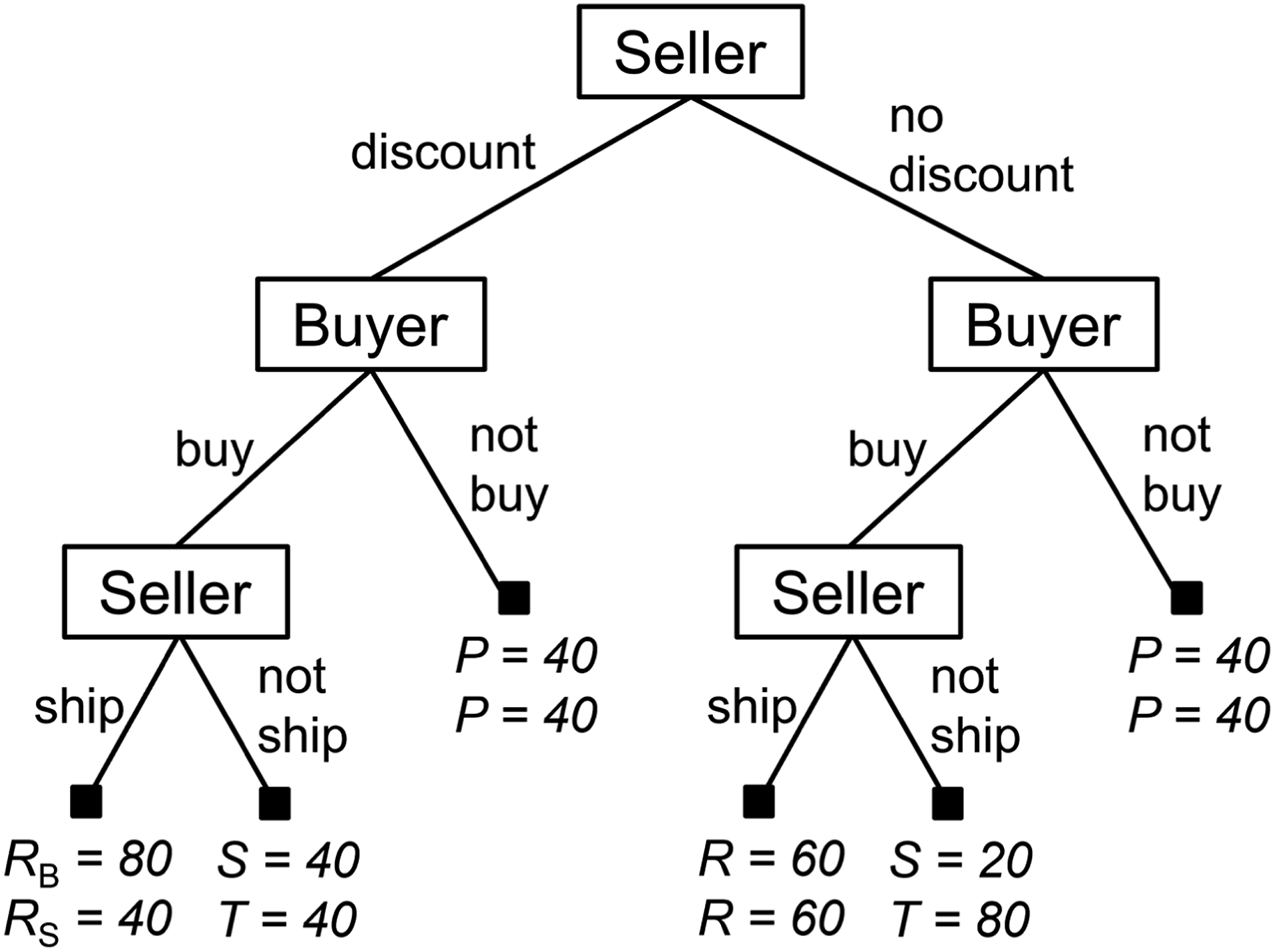
First, the seller decides whether to offer a discount to the potential buyer. By not offering a discount, the seller chooses to interact with the buyer in a trust game (TG), which corresponds to the right subgame in Figure 1. The TG payoffs are P = 40 (for both if the buyer does not buy), R = 60 (for both if the buyer buys and the seller ships), S = 20 and T = 80 (for the buyer and the seller, respectively, if the buyer buys and the seller does not ship). By offering a discount, the seller chooses to interact with the buyer in a game in which the seller is indifferent between being trustworthy or untrustworthy. We therefore call this game the indifference game (IG). The IG corresponds to the left subgame in Figure 1. The IG payoffs are P = 40 (for both if the buyer does not buy), RB = 80 and RS = 40 (for the buyer and the seller, respectively, if the buyer buys and the seller ships), and S = T = 40 (for both if the buyer buys and the seller does not ship). Note that in the IG, T = RS = 40. This implies that if buyers decide to buy, sellers who need to build (or maintain) their good reputation (see third stage) have a reason to ship and no short-term, payoff-related incentive not to ship.
Second, after having learned the seller’s first-stage decision and the seller’s reputation (if already available – see below), the buyer decides whether to buy and send money to the seller. If the seller offered a discount (i.e. in the IG), the buyer cannot lose from buying and gains 40 (RB – P) if the seller ships. If the seller did not offer a discount (i.e. in the TG), the buyer can gain 20 (R – P) or lose 20 (P – S) from buying if the seller ships or does not ship, respectively; but in this case, the buyer may anticipate that the seller will not ship (since T > R) and choose not to buy (since P > S). Irrespective of whether the seller offered a discount, if the buyer does not choose to buy, the interaction between the buyer and the seller ends, and both receive a payoff of P = 40. The interaction continues into the third stage of the game only if the buyer decides to buy.
Third, the seller decides whether to ship the merchandise the buyer paid for. If the seller did not offer a discount, they gain 20 (R – P) from shipping and 40 (T – P) from not shipping. After having offered a discount, the seller does not gain or lose anything from shipping or not shipping (RS – P = T – P = 0), so the seller will be indifferent between shipping and not shipping. However, a seller’s propensity to ship will increase once the seller can build a reputation for being trustworthy.
A seller’s reputation is updated with probability π after an interaction with a buyer who decided to buy. With probability (1 – π), a seller’s reputation is not updated. The seller’s reputation is updated to be ‘good’ if the seller chose to ship and is updated to be ‘bad’ if the seller chose not to ship. In this model, π is an exogenous parameter and does not depend on, for example, the outcome of the interaction between a buyer and a seller (Przepiorka 2013).
Conditions under which we assume buyers to be more likely to buy or more likely not to buy from sellers.
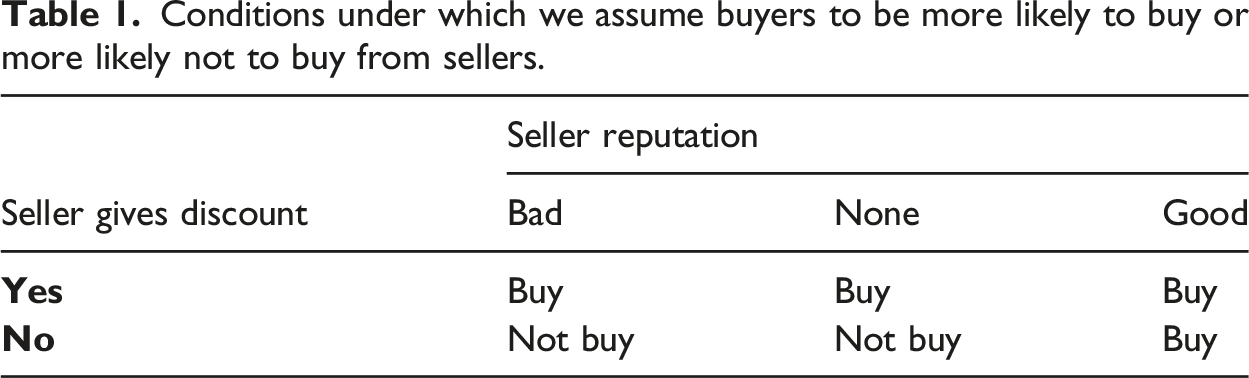
In anticipation of buyers’ behavior, sellers without a reputation will invest in building a good reputation by offering discounts. Sellers will invest in building a reputation by offering discounts because not investing and not being trusted leads to a strictly lower payoff as long as the number of expected interactions is k > 1 and the probability of receiving truthful feedback after an interaction is π > 0. For example, if k = 2, it holds that 2P < P + πR + (1 – π)P.
Based on these assumptions, we formulate hypotheses on how buyers’ preferences to buy vary across sellers’ decisions on discounts and sellers’ reputations:
Finally, because it takes longer for sellers to build their reputation as the probability of receiving truthful feedback (π) decreases, sellers need to offer more discounts if π is lower. This constitutes our fourth hypothesis:
Next, we describe the experiments we designed and conducted to test these hypotheses empirically.
Experiment 1
Experimental design and procedure
The experiment is designed based on the trust game described in the previous section. The feedback rate π is the probability that a seller’s reputation is updated at the end of an interaction with a trusting buyer. To test how the feedback rate affects seller behavior, we employed three experimental conditions: π = 0.2, π = 0.4, and π = 0.6. Conditions were systematically varied across experimental sessions. The experiment was programmed in z-Tree (Fischbacher, 2007) and conducted in the Experimental Laboratory for Sociology and Economics at Utrecht University, consisting of 12 sessions, and with 152 participants. Participants were recruited using the online recruitment system ORSEE (Greiner, 2015). Participants were mostly female (69.6%) and their mean age was 23.96 years (SD = 6.22). Each participant took part in only one session, sessions lasted for about 75 min, and participants earned €12.62 on average.
After reading the instructions (see section S1 in the Online Appendix), every participant was randomly assigned to be a seller or buyer until the end of the session. There was an equal number of sellers and buyers in each session. Participants were informed in the instructions that the experiment consisted of 20 to 40 rounds; they were not told the exact number of rounds, which was 24. 3 In every round, a seller was randomly matched with a buyer such that no seller-buyer pair interacted in two consecutive rounds.
In all experimental conditions, the experimental procedure and game payoffs are identical (see Figure 1). At the beginning of each round (starting with round 2), a seller is informed about their last recorded decision (or that none of their decisions have been recorded thus far) and chooses whether to give a discount to the buyer (i.e. choose IG or TG). The buyer is informed about the seller’s reputation and whether the seller offers a discount and then chooses whether to buy. If the buyer chooses to buy, the seller decides whether or not to ship. Both participants receive the payoff that corresponds to their combined decisions. If the buyer decided to buy, the seller’s shipping decision is recorded or updated with probability π; with probability 1 – π, information on the seller’s decision is not recorded or updated.
In our experiment, a seller’s reputation is operationalized as the information about the decision the seller made (‘ship’ or ‘not ship’) in the last round in which the seller’s decision was recorded. A seller’s reputation does not contain information on the interaction situation (IG or TG), in which the seller’s decision was recorded. Once a seller’s decision is recorded in one round, buyers interacting with the seller in subsequent rounds are informed about the seller’s reputation on their screens, when they decide whether to buy or not to buy. Before a seller’s decision is recorded for the first time, buyers interacting with the seller are informed that no record of the seller’s past behavior exists. A seller’s reputation is updated after every round in which the seller’s decision is recorded. The previous record of a seller’s decision is thereby replaced by the new record. Buyers do not know in which round a seller’s reputation information was recorded or updated.
In this experiment, we measure sellers’ decisions to offer discounts, buyers’ decisions to buy, and sellers’ decisions to ship under the three experimental conditions. The payoffs of participants in each round are summed up and converted into monetary payments at the end of the session at a rate of €1 per 120 payoff-points.
Variables
Condition is a categorical variable indicating which experimental condition the participants are in. There are 4 sessions (52 participants) under condition π = 0.2, 4 sessions (50 participants) under condition π = 0.4, and 4 sessions (50 participants) under condition π = 0.6. π denoting the probability of a seller’s decision being recorded is thus an exogenous variable manipulated in the experiment.
Descriptive statistics of variables in Experiment 1.
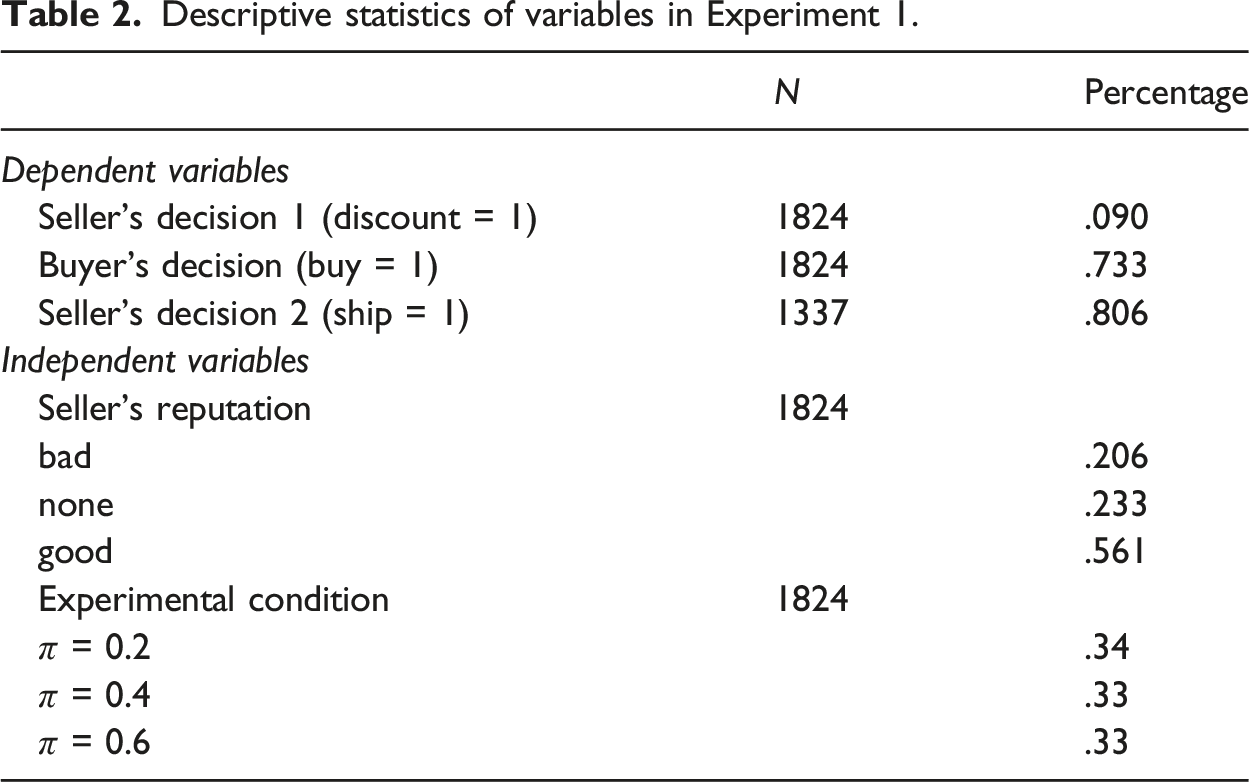
Buy is a binary variable, indicating the buyer’s decision to buy from the matched seller. Buyers chose to buy in 73% of all rounds.
Ship is a binary variable indicating a seller’s second decision to ship or not if the buyer decided to buy. Sellers chose to ship in 81% of cases in which the buyers chose to buy.
Seller’s reputation is a categorical variable denoting the seller’s last recorded decision as shown to the current matched buyer: bad (i.e. did not ship), none (i.e. not yet recorded), or good (i.e. shipped).
Analyses and results
We use STATA (version 17.0) to calculate proportions from saturated logit models 4 and test the statistical significance of the differences between the proportions of sellers’ and buyers’ decisions under various conditions to test our hypotheses. We also perform exploratory analyses using logistic regression models as all dependent variables (sellers’ and buyers’ decisions) are binary. The data and code are made available via the public data archiving services of GESIS and can be retrieved under the following link: https://doi.org/10.7802/2676.
Result 1: Sellers’ decisions to give discounts
Figure 2 shows how sellers’ decisions of giving discounts vary across experimental conditions and seller reputations.
5
More detailed analyses on the proportion of sellers giving discounts are provided in section S2 in the Online Appendix. The linear comparison between overall proportions shows that sellers without a reputation are more likely to offer discounts than sellers with a good reputation (coef. = 0.039, p = 0.008). Therefore, hypothesis one is supported. However, compared to sellers without a reputation, sellers with a bad reputation are even more likely to give discounts (coef. = 0.272, p < 0.001). Sellers with a bad reputation do not give discounts more often, the higher the chance π is that their reputation is updated. The increase observed in Figure 2 is statistically insignificant (χ2(2) = 1.96, p = 0.376). Proportion of sellers giving discounts across experimental conditions and seller reputations (Experiment 1).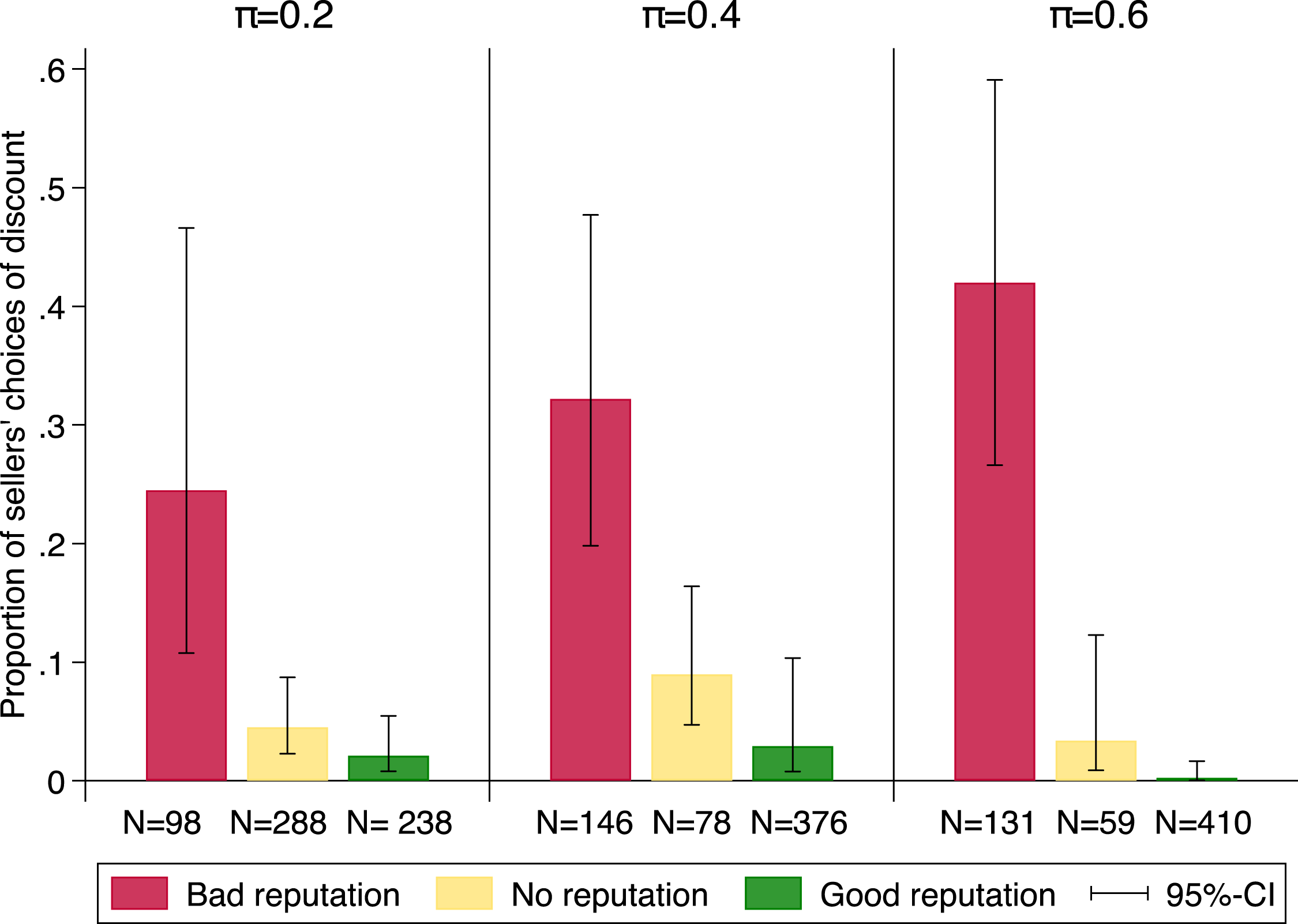
As for the experimental conditions, the joint test suggests that for sellers without a reputation, the proportion of giving discounts does not vary significantly across the three conditions (χ2(2) = 2.5, p = 0.286). Therefore, hypothesis four is not supported. We investigate additional predictors of sellers’ decisions of giving discounts in the exploratory analysis section.
Result 2: Buyers’ decisions to buy
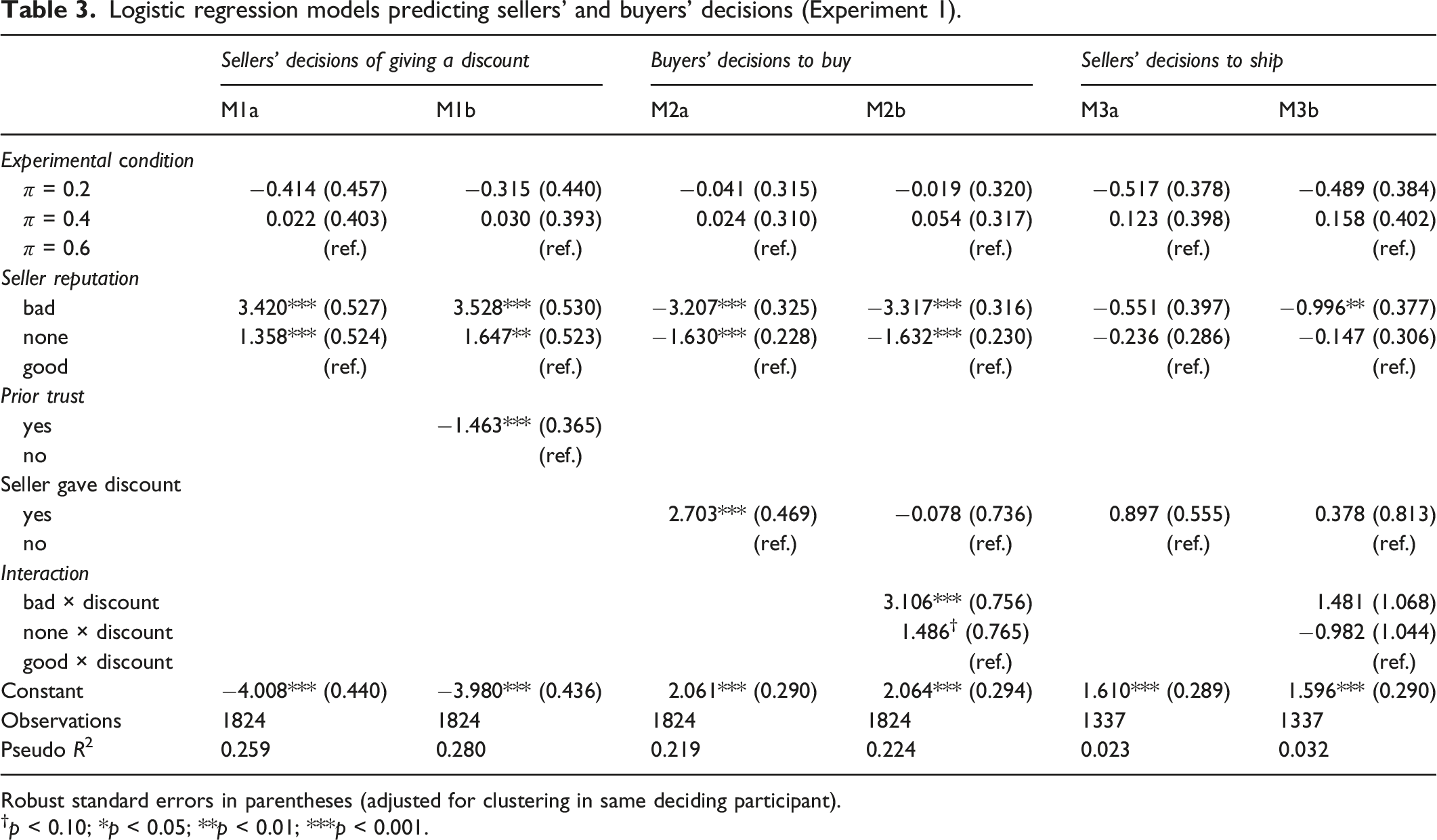
After the sellers choose whether to give a discount, buyers need to choose whether to buy from the matched sellers. Figure 3 presents how the proportion of buyers choosing to buy varies across sellers’ reputations and decisions to give a discount. More detailed analyses on the proportion of buyers deciding to buy are provided in section S3 in the Online Appendix. Overall, buyers are more likely to buy when offered a discount (coef. = 0.140, p = 0.003). This finding supports hypothesis 2a. In line with our assumptions in Table 1, Figure 3 shows that buyers choose to buy at very high rates irrespective of sellers’ reputations as long as they are offered a discount. Without a discount, buyers’ decisions to buy differ across seller reputations. In this case, buyers are more likely to buy from sellers with a good reputation than from sellers with a bad reputation (coef. = 0.664, p < 0.001), and they are more likely to buy from sellers with a good reputation than from sellers without a reputation (coef. = 0.283, p < 0.001). Therefore, hypothesis 2b is also supported. A figure showing buyers’ decisions to buy across sellers’ reputations and experimental conditions is included in section S3 in the Online Appendix. Further analyses of buyers’ decisions to buy are presented in Table 3 (models M2a and M2b) and will be discussed below. Proportion of buyers deciding to buy across seller reputations and sellers’ decisions to give a discount (Experiment 1). Logistic regression models predicting sellers’ and buyers’ decisions (Experiment 1). Robust standard errors in parentheses (adjusted for clustering in same deciding participant). †p < 0.10; *p < 0.05; **p < 0.01; ***p < 0.001.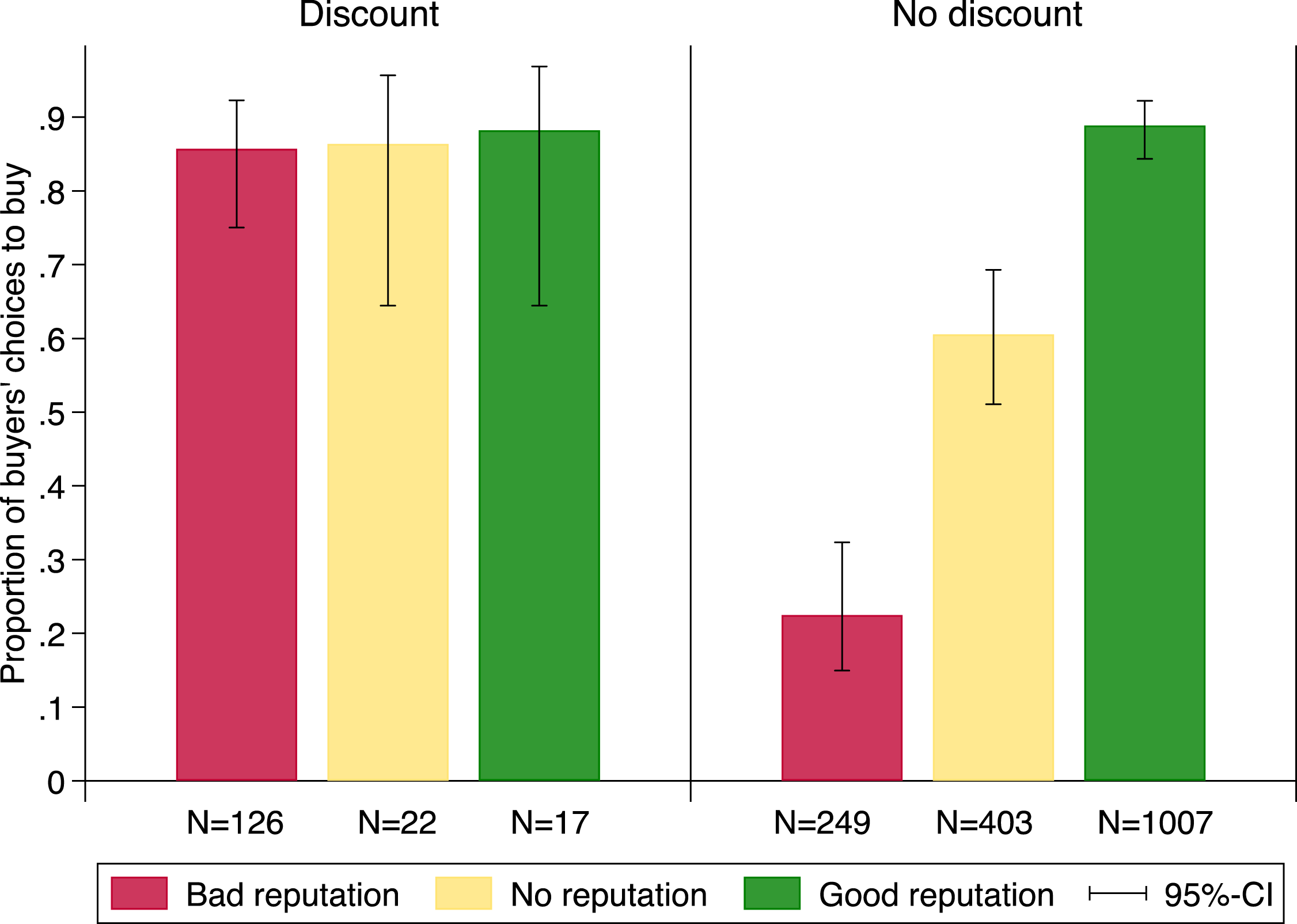
Result 3: Sellers’ decisions to ship
After a buyer chooses to buy, the matched seller gets the chance to choose whether to ship, knowing that, with a certain probability π, this decision will be recorded and presented to their interaction partner in the next round. The proportions of sellers choosing to ship across the different experimental conditions are provided in section S4 in the Online Appendix. In Figure 4, we present how the proportion of shipping decisions varies across seller reputations and sellers’ decisions to give a discount. In general, the proportion of shipping does not differ significantly depending on whether a discount was given (coef. = 0.043, p = 0.527). Furthermore, sellers with a bad reputation are significantly more likely to ship when they gave discounts than when they did not give discounts (coef. = 0.292, p = 0.003). However, there is no statistically significant difference in the proportions of shipping decisions between sellers who gave or did not give discounts, if these sellers have no reputation (coef. = −0.123, p = 0.342) or have a good reputation (coef. = 0.045, p = 0.620). Therefore, hypothesis 3 is only partly supported. An additional figure on sellers’ decisions to ship across experimental conditions is provided in section S4 in the Online Appendix, showing that the proportions of shipping are very similar across experimental conditions. Proportion of sellers deciding to ship across seller reputations and sellers’ decisions to give a discount (Experiment 1).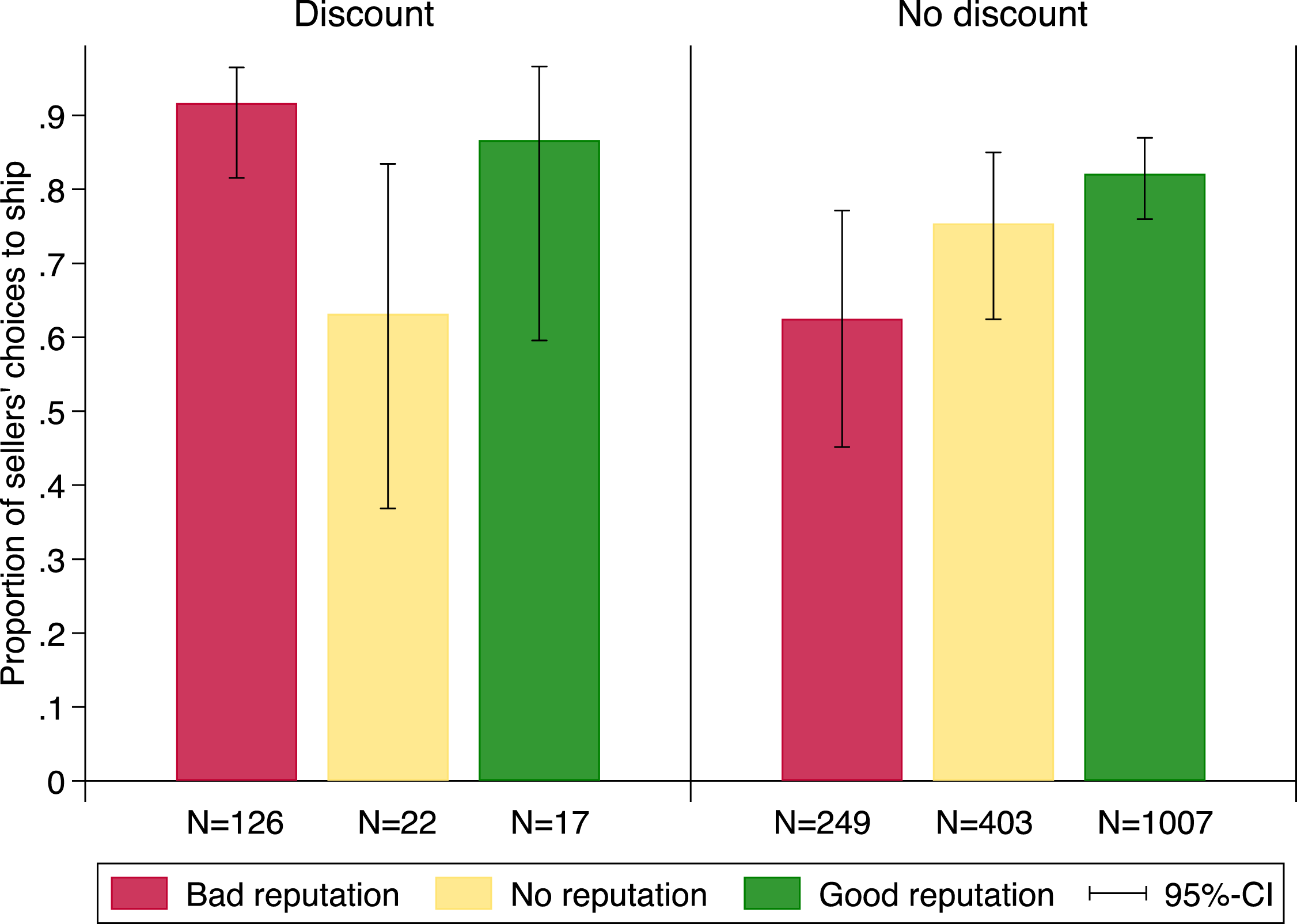
Result 4: Exploratory analysis
In this subsection, we seek to investigate the potential predictors of sellers’ decisions to give discounts, buyers’ decisions to buy, and sellers’ decisions to ship beyond what we hypothesized. Sellers with a good reputation rarely offer discounts (see Figure 2) and, in line with the expectations, there is no significant difference across conditions (coef. = −0.011, p = 0.630). Surprisingly, however, less than 10% of sellers without a reputation offer discounts. This is not in line with our expectations as these sellers should have a clear incentive to offer discounts to attract buyers and establish a reputation. How can we explain this finding?
We observe that there is a considerable proportion of buyers who choose to buy from sellers, even if these sellers lack a reputation and do not offer discounts (around 60%, see Figure 3). We, therefore, conjecture that sellers would not be sufficiently motivated to offer discounts if they are aware of or have already experienced such unconditional trust. And the same should hold for sellers with a bad reputation.
To test this conjecture, we run a set of logistic regression models with sellers’ decisions to give a discount as the dependent variable and the following predictors: (1) experimental conditions; (2) seller reputation; (3) a binary variable (‘prior trust’) indicating whether a buyer chose to buy from the seller when the seller did not have a good reputation and did not offer a discount in the previous round. The latter is to test how sellers’ prior experience with being trusted unconditionally influences their decisions to offer discounts. The outcome of our exploratory analysis is shown in models M1a and M1b in Table 3. Model M1a shows that, compared to sellers with a good reputation, sellers with a bad reputation (coef. = 3.420, p < 0.001) and sellers without a reputation (coef. = 1.358, p = 0.001) are more likely to give discounts. Moreover, the proportion of discount-offering sellers is the lowest when π = 0.2, but the coefficient estimates of experimental conditions are not significantly different from each other (χ2(2) = 1.08, p = 0.582). These results corroborate our findings thus far. In line with our new conjecture, M1b shows that sellers who experienced unconditional trust without having a good reputation and without offering a discount are less inclined to offer a discount later (coef. = −1.463, p < 0.001).
Next, we analyze buyers’ decisions to buy using logistic regression models. Model M2a shows that compared to being matched with a seller with a good reputation, buyers are less likely to buy when being matched with a seller who has a bad reputation (coef. = −3.207, p < 0.001) or a seller without a reputation (coef. = −1.630, p < 0.001), and buyers are more likely to buy when the seller offers a discount (coef. = 2.703, p < 0.001). The proportion of buying is lowest when π = 0.2, but the effect of the experimental condition is not significant (χ2 (2) = 0.04, p = 0.978). In M2b, we add the interaction between seller reputation and sellers’ decision of giving a discount and estimate the proportions of buyers’ decisions to buy in each of the six situations defined by these two factors (experimental conditions do not change these estimates). Offering discounts increases buyers’ likelihood to buy substantially more when the seller has a bad reputation (85.6% with vs 22.4% without discount) than when the seller has a good reputation (88.0% with vs 88.8% without discount); the difference in differences is statistically significant (coef. = 0.640, p < 0.001). The effect of a discount is also larger when the seller has no reputation (86.4% with vs 60.9% without discount) than when the seller has a good reputation; here too, the difference in differences is statistically significant (coef. = 0.263, p = 0.003). These interaction effects show that the effect of a discount on buyers’ decisions to buy becomes smaller the better is the reputation of the seller.
Lastly, we run logistic regression models to examine the effects of the experimental condition, seller reputation, and whether a discount was given on sellers’ decisions to ship. M3a detects no significant effects, and we include the interaction between seller reputation and whether a discount was given in model M3b. Based on model M3b, we estimate the proportions of sellers’ decisions to ship in each of the six situations defined by these sellers’ reputations and decisions to give a discount (experimental conditions do not change these estimates). Only sellers with a bad reputation ship significantly more often after giving a discount (91.0% vs 62.0%; coef. = 0.291, p = 0.003); the differences in shipping are insignificant for sellers with a good reputation (86.3% vs 81.3%; coef. = 0.050, p = 0.602) and sellers with no reputation (67.5% vs 79.0%; coef. = −0.115, p = 0.335). These results support the conjecture that sellers with a bad reputation try to repair their reputation by offering discounts.
Experiment 2
In Experiment 1, we observe that buyers’ decisions to buy are not uncommon even when sellers do not give discounts and do not have a good reputation. When no discounts are offered, buyers buy from sellers without a reputation in 61% of cases; in 23% of cases, these buyers even buy from sellers with a bad reputation (see Figure 3). We assume that this is due to the lack of alternative sellers; buyers facing only one seller at a time may want to take the risk and buy even if the information provided about the seller’s reputation indicates that they should not buy. In our second experiment, we therefore introduce competition among sellers by allowing buyers to choose one of two sellers in each round.
To our knowledge, there are no experimental studies that investigate the effect of seller competition on the reputation effect mediated by seller propensity to give discounts. One lab experimental study using trust games shows that public information about trustees’ past behavior combined with competition among trustees for being chosen and trusted by trusters leads to higher trust and trustworthiness rates compared to other experimental conditions (Huck et al., 2012). Another experimental study investigates how competition among trustees may lead to arbitrary inequality among sellers if sellers can build a reputation for being trustworthy (Frey and Van de Rijt, 2016). However, neither of these studies allows sellers to offer discounts as a means to compensate for the lack of good reputation. If buyers can choose sellers, and these sellers can beforehand decide whether to offer discounts, buyers will be better able to trade off sellers’ reputations against the discounts sellers offer (Przepiorka, 2013; Snijders and Weesie, 2009). This in turn will incentivize sellers without a good reputation to build their reputation by offering discounts (Shapiro, 1983).
In the description of Experiment 2, we focus on the differences with Experiment 1 and only briefly repeat design elements that are the same.
Experimental design and procedure
The experiment was programmed with z-Tree (Fischbacher, 2007) and conducted in the Experimental Laboratory for Sociology and Economics at Utrecht University in nine sessions and with 150 participants in total. Participants were recruited using the online recruitment system ORSEE (Greiner, 2015). The experimental conditions varied across sessions and were conducted in the same way as in Experiment 1.
Similar to Experiment 1, each participant is randomly assigned to be a seller or buyer for the duration of the session. However, in Experiment 2, each buyer is matched with two sellers at the start of every round. Hence, each group consists of three participants – one buyer and two sellers. Participants are informed that the experiment consists of 20 to 40 rounds, and they are not told that the actual number of rounds is 20 (24 in Experiment 1).
Sellers are informed about their own last recorded decision as well as that of the seller they are matched with in the current round (the competitor). This information is provided at the start of each round as from round two. If no decision has been recoded, this is also mentioned. Sellers then choose whether to offer discounts, that is play IG or TG. Next, the buyer decides which of the two sellers to interact with after being informed about these sellers’ reputations and whether they offer discounts. Figure 5 provides an example screenshot of this decision situation. Following that, the steps are the same as in Experiment 1. The instructions used for Experiment 2 are provided in section S5 in the Online Appendix. Screenshot of a buyer’s decision to choose one of two sellers.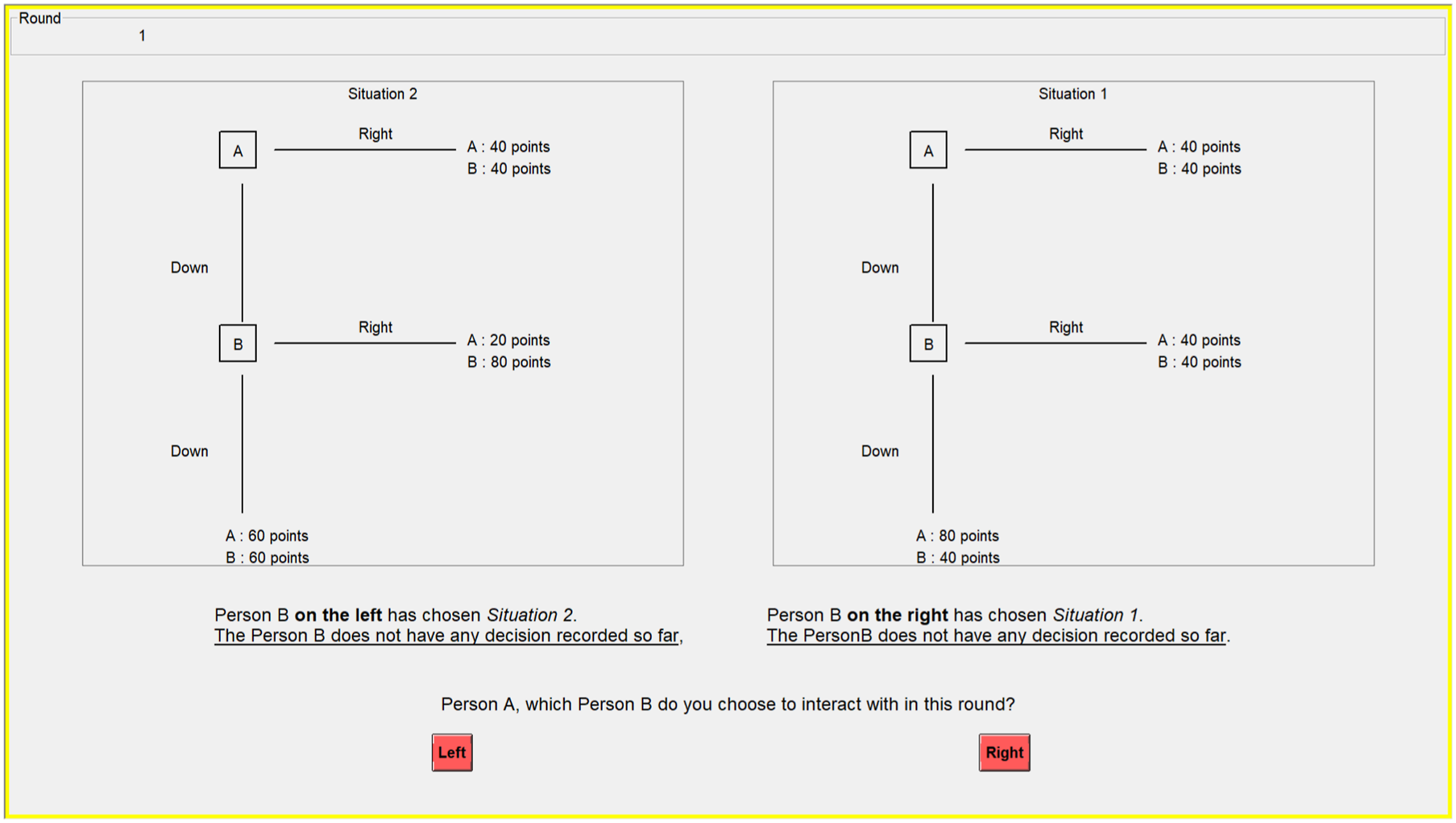
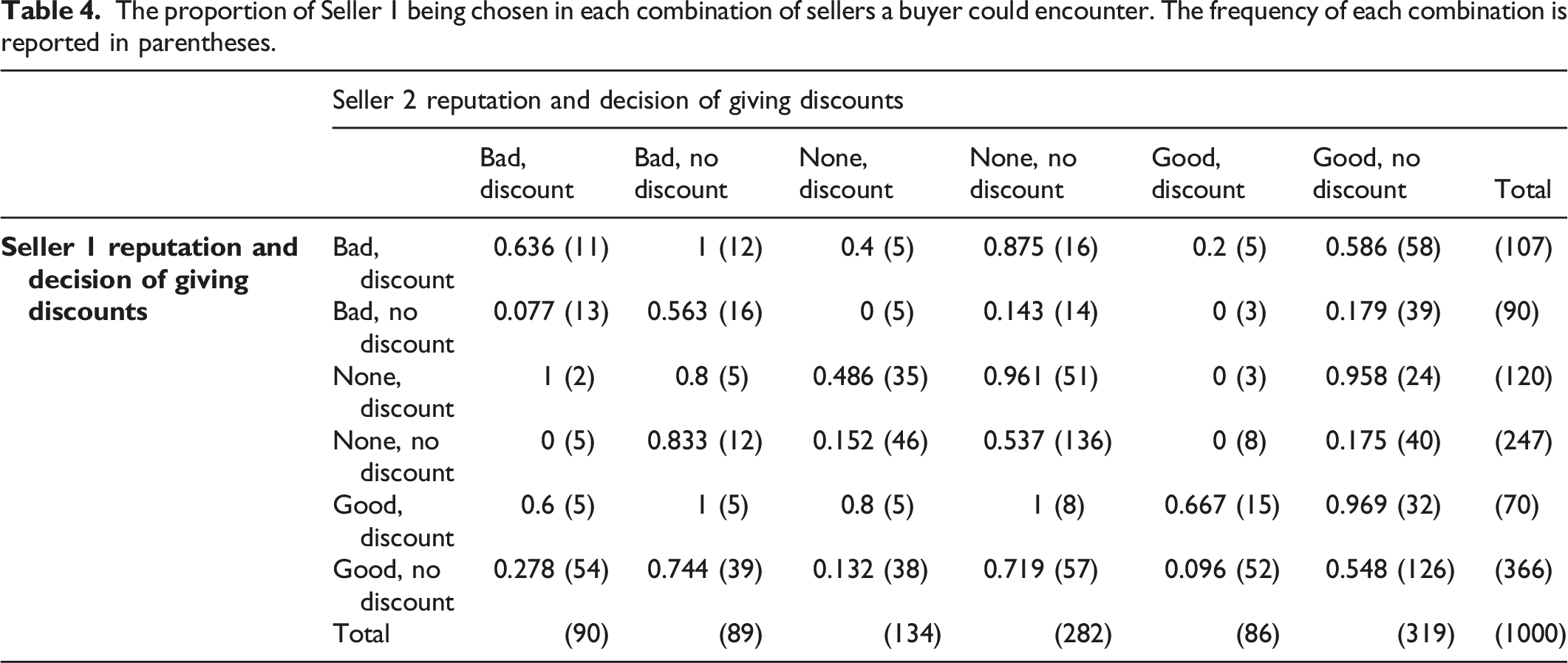
The proportion of Seller 1 being chosen in each combination of sellers a buyer could encounter. The frequency of each combination is reported in parentheses.
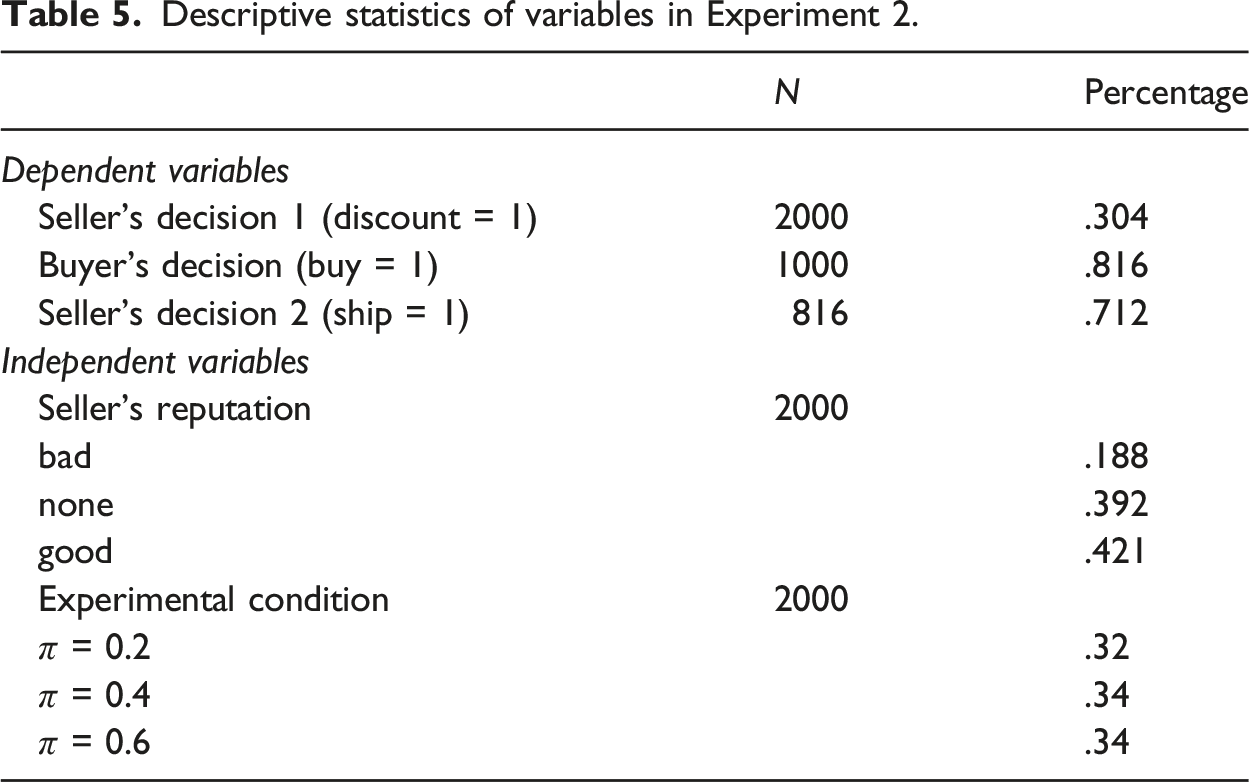
In Experiment 2, participants were mostly female (58.1%) and their mean age was 23.9 years (SD = 7.13). The payoff of participants in each round is summed up and converted into monetary payment at the end of the session at a rate of €1 per 70 payoff-points. An experimental session lasted for about 75 min and participants earned €15.74 on average.
Variables
Descriptive statistics of variables in Experiment 2.
Analyses and results
Similar to Experiment 1, our data analysis strategy is to employ linear comparisons with the proportions from saturated logit models to test hypotheses and perform logistic regressions for exploratory analyses on sellers’ decisions to offer discounts and decisions to ship. For analyzing the buyers’ decision to buy, conditional logit models based on buyers’ choice sets are more appropriate assuming that buyers’ decisions among available sellers are a function of the characteristics of the sellers rather than the buyers themselves (Hoffman and Duncan, 1988). For the conditional logit, we use a long data format in which each potential seller to be chosen by a buyer is a case in the data. The choice sets are composed of two sellers from which a buyer has to choose one in each round of the experiment. All analyses are run with STATA (version 17.0). The data and code are made available via the public data archiving services of GESIS and can be retrieved under the following link: https://doi.org/10.7802/2676.
Result 1: Sellers’ decisions to give discounts
Figure 6 shows the frequency of sellers choosing to offer discounts across seller reputations and experimental conditions. The proportion of sellers giving discounts under each condition is provided in section S6 in the Online Appendix. The linear parameter test shows that sellers without a reputation are more likely to provide a discount than sellers with a good reputation (coef. = 0.121, p = 0.004). This supports hypothesis 1. However, again, sellers with a bad reputation offer discounts even more frequently than sellers without a reputation (coef. = 0.199, p = 0.003). Moreover, in line with hypothesis 4, we observe that the proportion of sellers giving discounts while not having a reputation decreases as π increases. However, the joint significance test indicates that this decrease is not statistically significant (χ2(2) = 4.12, p = 0.128). Proportion of sellers giving discounts across experimental conditions and seller reputations (Experiment 2).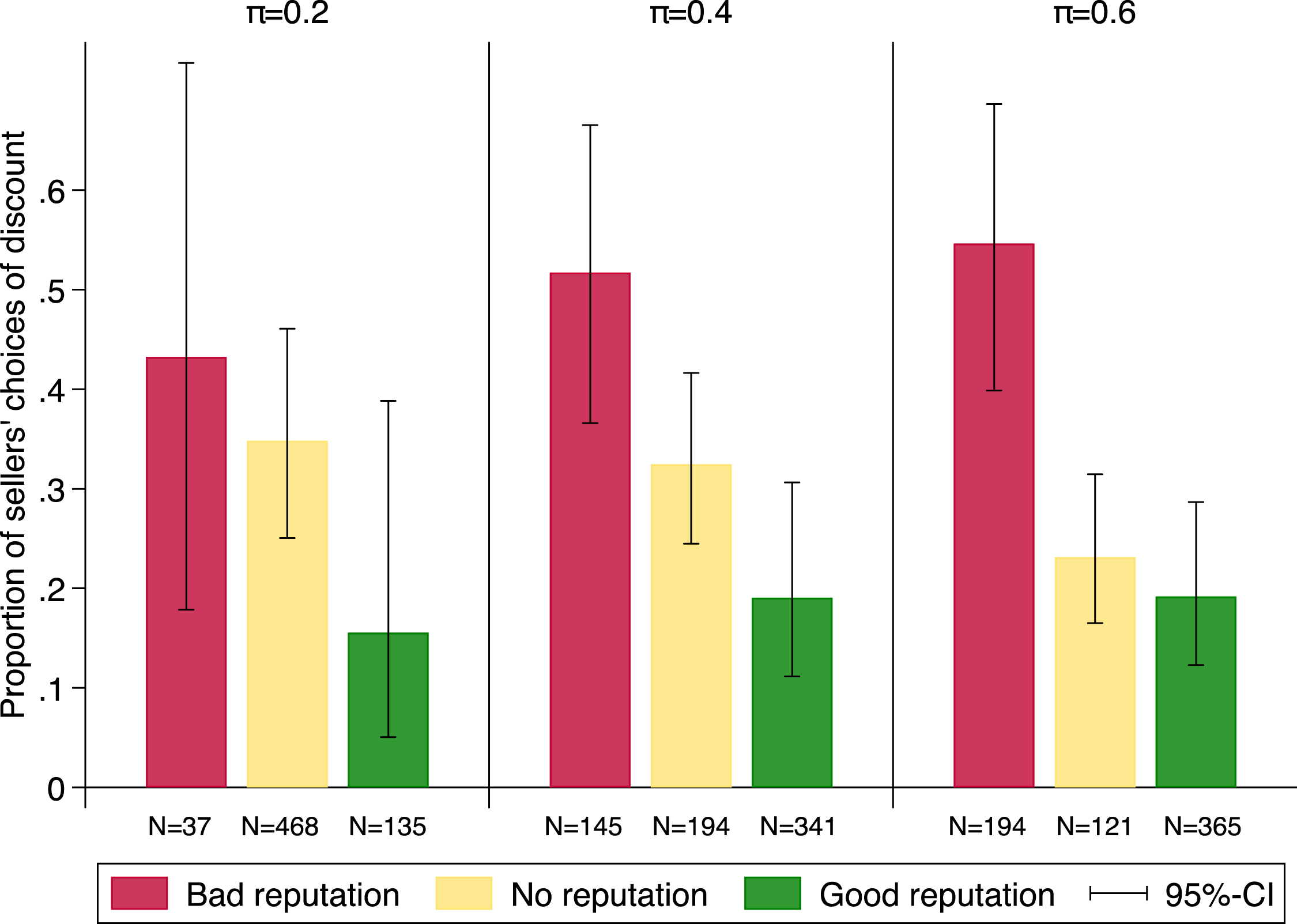
Overall, sellers give discounts more frequently in Experiment 2 (30%) than in Experiment 1 (9%). According to our hypothesis 5, this increase should be due to sellers without a reputation that invest more in building a good reputation under seller competition. In line with hypothesis 5, we find sellers who do not have a reputation offer discounts significantly more often in Experiment 2 than in Experiment 1 (coef. = 0.27, p < 0.001). However, sellers with a bad reputation and sellers with a good reputation are also more likely to offer discounts in Experiment 2 than in Experiment 1 (respectively, coef. = 0.19, p < 0.001 and coef. = 0.17, p < 0.001). While the difference in differences between sellers with no and sellers with a bad reputation is statistically insignificant (coef. = 0.08, p = 0.281), the difference in differences between sellers with no and sellers with a good reputation is statistically significant (coef. = 0.10, p = 0.029). In the exploratory analysis below we show sellers’ propensity to offer discounts is also driven by the reputation of their competitors (see Figure 9).
In Experiment 2, information about the reputation of the competitor is available while a seller is deciding whether to give a discount. As a result, we assume that to increase their chance of being chosen by the buyer, sellers will make decisions also based on the reputation of their competitors. For example, sellers should be more likely to give discounts if the competitor has a better reputation than they themselves do (see Table 4). Yet, similarly to Experiment 1, 30% - 50% of buyers decide to buy even when the chosen seller does not have a good reputation and does not offer a discount (see Figure 7). Again, we conjecture that sellers who have experienced such unconditional trust would be less inclined to give discounts. We test this conjecture as well as the role of the reputation of the competing seller in the exploratory analysis section below. Proportion of buyers deciding to buy across seller reputations and sellers’ decisions to give a discount (Experiment 2).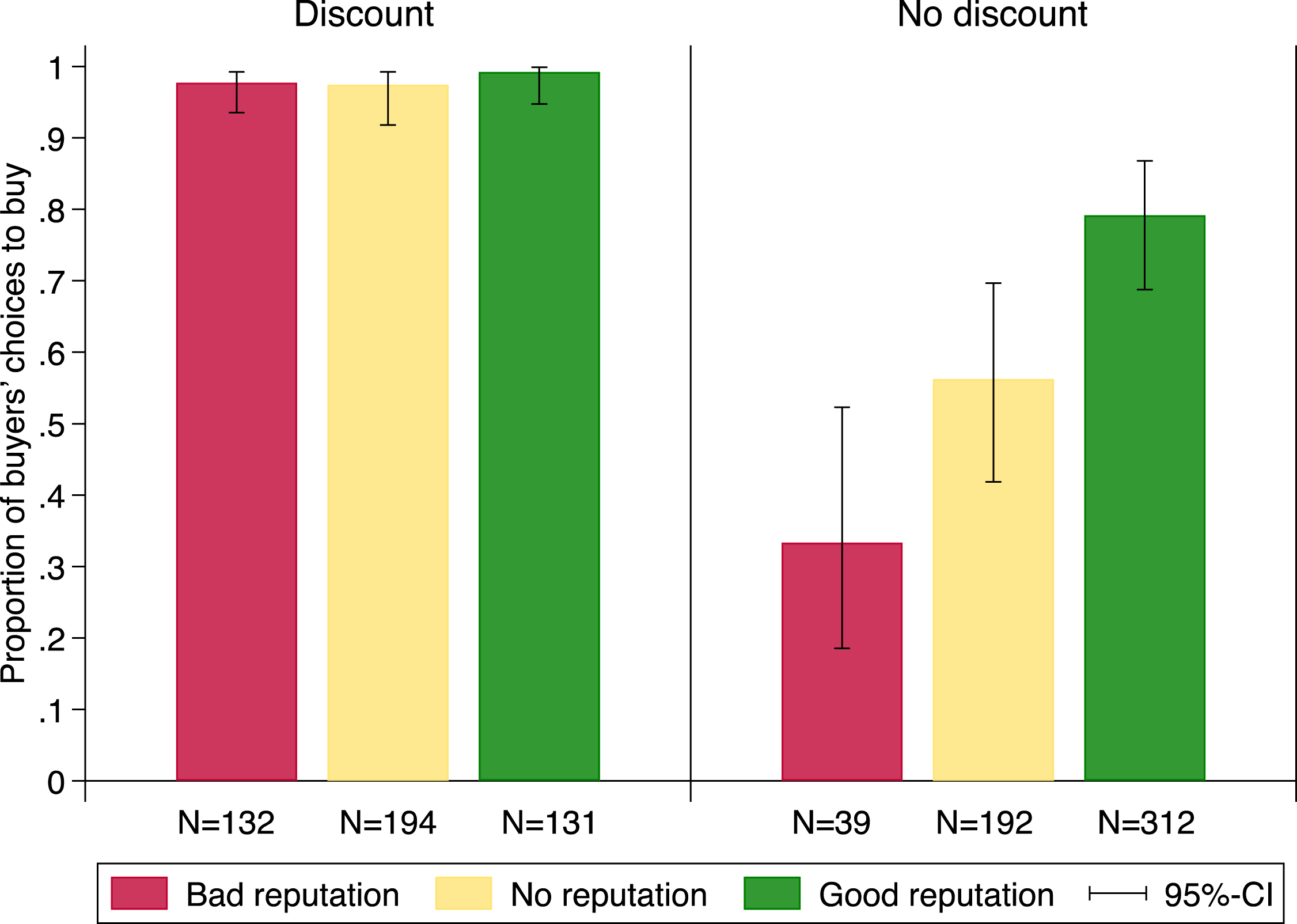
Result 2: Buyers’ decisions to buy
Table 4 above shows the frequency of sellers being chosen given their own as well as their competitors’ reputations and choices regarding discounts. Based on the numbers along the diagonal of the matrix, buyers seem to favor seller 1, whose information is shown on the left side of the computer screen. The slight preference for seller 1, however, should not have any impact on the results as the sellers’ order of appearance on buyers’ decision screens is randomly determined in every round.
The proportions of buyers choosing to buy under different conditions are provided in section S7 in the Online Appendix. Figure 7 shows how buyers’ decisions to buy vary across sellers’ reputations and experimental conditions. Along with Figures 3 and 7 demonstrates that the buying decision patterns in the two studies are similar. Without splitting by sellers’ decisions on discounts, the general level of buyers’ decisions to buy does not differ among the partners’ reputations (χ2(2) = 3.49, p = 0.175). When discounts are given, buyers almost always choose to buy, regardless of the seller’s reputation (χ2(2) = 2.47, p = 0.291), and the proportion to buy is significantly higher than if no discounts are offered (coef. = 0.303, p < 0.001). This is in support of hypothesis 2a. When there is no discount, we observe a difference in buyers’ decisions to buy across seller reputations. Buyers are more likely to buy from sellers with a good reputation than from those with a bad reputation (coef. = 2.028, p = 0.001), and from buyers with no reputation (coef. = 1.084, p = 0.004). Therefore, hypothesis 2b is supported.
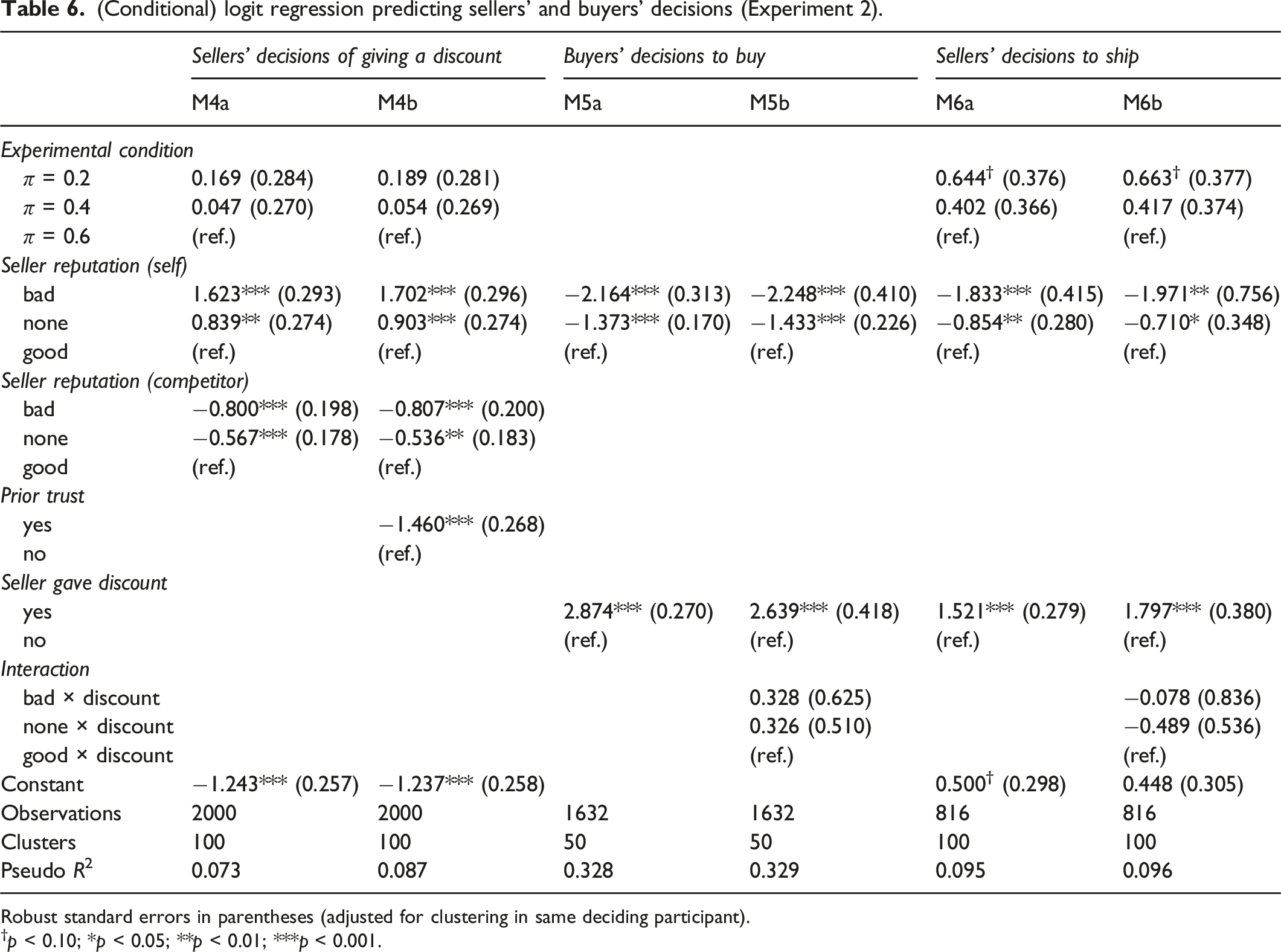
(Conditional) logit regression predicting sellers’ and buyers’ decisions (Experiment 2).
Robust standard errors in parentheses (adjusted for clustering in same deciding participant).
†p < 0.10; *p < 0.05; **p < 0.01; ***p < 0.001.
Result 3: Sellers’ decisions to ship
Of the 816 times in which a seller is chosen and bought from by a buyer, the seller chooses to ship in 581 (71%) cases. The proportions of sellers choosing to ship under different conditions are provided in section S8 in the Online Appendix. In Figure 8, we show how sellers’ decisions to ship vary depending on the situation and the reputation of these sellers. In contrast to our findings in Experiment 1, sellers are overall more likely to ship when they offer discounts (coef. = 0.281, p < 0.001). This is true for sellers who have a bad reputation (coef. = 0.366, p = 0.015), sellers who have a good reputation (coef. = 0.251, p < 0.001), as well as for sellers without a reputation (coef. = 0.279, p = 0.001). Additionally, when there is no discount, sellers with a good reputation are more likely to ship than sellers with a bad reputation (coef. = 0.441, p < 0.001). The difference with sellers without a reputation is not significant (coef. = 0.126, p = 0.132). Therefore, hypothesis 3 is partly supported. In the exploratory section, we examine the relationship between sellers’ decisions to offer discounts and decisions to ship using logistic regression models (M6, Table 6). Proportion of sellers deciding to ship across seller reputations and sellers’ decisions to give a discount (Experiment 2).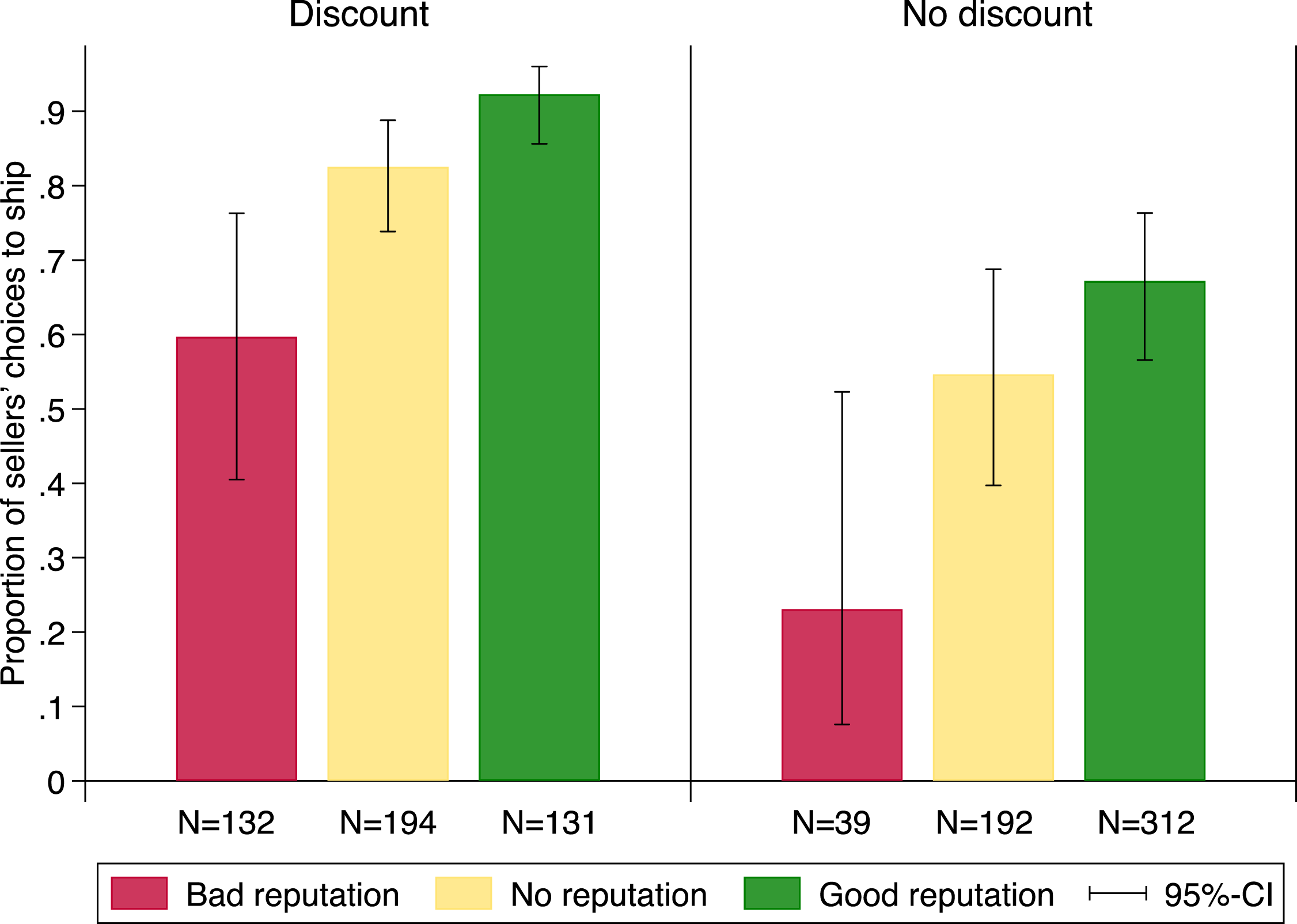
Result 4: Exploratory analysis
As discussed above, due to the existence of competition, we expect sellers to take the reputation of the competing seller into account when choosing whether to offer discounts. Figure 9 shows how frequently sellers offer discounts based on both their own reputation and the reputation of their competitors. Overall, regardless of their own reputation, sellers are most likely to offer discounts when the competitor has a good reputation. To determine how the experimental conditions, the sellers’ own reputation, prior trust experience, and the reputation of the competitors affect sellers’ decisions to give discounts, we conduct a series of logistic regression analyses (M4, Table 6). Proportion of sellers giving discounts across own and competing sellers’ reputations (Experiment 2).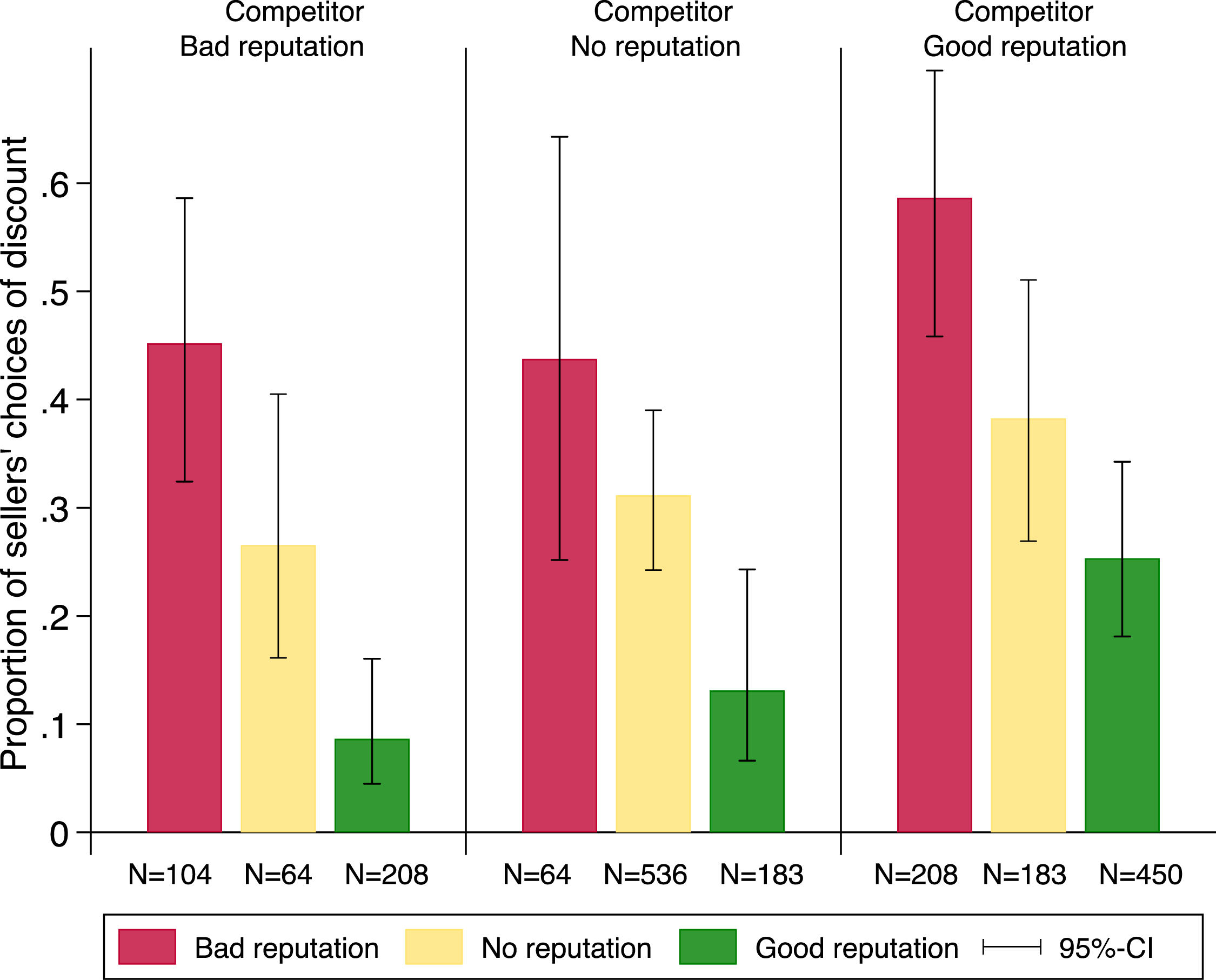
The result of M4b suggests that compared to sellers with a good reputation, sellers who have a bad reputation (coef. = 1.702, p < 0.001) and who have no reputation (coef. = 0.903, p < 0.001) are more likely to give discounts. We expect that choosing to offer a discount is more common when the competing seller has a good reputation, indicating that sellers may devise such a strategy in response to the reputation of the competitor. Compared with being matched with a competitor with a good reputation, sellers are significantly less likely to give discounts if matched with a competitor with no reputation (coef. = −0.536, p = 0.003), and less likely to give discounts if the competitor has a bad reputation (coef. = −0.807, p < 0.001). Additionally, sellers who received unconditional trust in the previous round are less likely to offer discounts (coef. = −1.460, p < 0.001). 6 Finally, the joint test suggests that the experimental conditions have no significant effects on sellers’ decisions to give discounts (χ2(2) = 0.48, p = 0.789).
To investigate how buyers’ decisions to buy are influenced by sellers’ reputations and these sellers’ decisions to offer discounts, we run conditional logit regressions with seller-pair fixed effects and estimate robust standard errors accounting for within-buyer clustering (M5, Table 6). Because the experimental condition does not vary within a seller pair, the coefficients for experimental condition cannot be estimated using this method. Moreover, 368 cases are excluded from the analysis because in these cases the buyers abstained from buying from either of the two sellers in those rounds. We also performed conditional logit analyses of whether buyers chose sellers, regardless of whether buyers decided to buy from these sellers. However, if a buyer favors one seller over the other but chooses not to buy from them, this may just indicate that the buyer does not want to buy from either of the two sellers (a choice option that was not available in the experiment). The results of this model are reported in section S9 in the Online Appendix.
The result of M5a suggests that buyers prefer to buy from sellers who offer discounts (coef. = 2.874, p < 0.001); compared to sellers who have a good reputation, buyers are less likely to buy from sellers with a bad reputation (coef. = −2.164, p < 0.001) and sellers without a reputation (coef. = −1.373, p < 0.001). M5b introduced the interaction between seller reputation and sellers’ decisions of giving discounts. Although the model fit is slightly increased, the interaction effects are statistically insignificant. Inspecting the odds ratios (also see Table 4), the results confirm that offering a discount increases the likelihood of buyers deciding to buy albeit to a slightly lesser extent for sellers with a good reputation (bad reputation: OR = 19.43, p < 0.001; no reputation: OR = 19.38, p < 0.001; good reputation: OR = 14.0, p < 0.001). This shows that a seller offering a discount almost always trumps a seller that does not offer a discount, if the two sellers have the same reputation.
Finally, we run logistic regression models of sellers’ choices to ship with seller reputation and the chosen situation as the main predictors (M6, Table 6). The result of M6a shows that compared with sellers with a good reputation, sellers who have a bad reputation (coef. = −1.833, p < 0.001) and sellers who do not have a reputation (coef. = −0.854, p = 0.002) are less likely to ship. Moreover, the likelihood to ship is higher when sellers offer discounts (coef. = 1.521, p < 0.001). Model M6a also controls for the experimental condition. Sellers appear to be more likely to ship when π is lower, but the effects are not statistically significant. We include the interaction between seller reputation and decision to give a discount in model M6b and estimate the proportions of sellers’ decisions to ship in each of the six situations defined by the two factors. Unlike in the first experiment, offering a discount significantly increases the proportion of sellers deciding to ship, irrespective of their reputations (bad reputation: coef. = 0.391, p = 0.014; no reputation: coef. = 0.277, p = 0.001; good reputation: coef. = 0.243, p < 0.001); the differences between these coefficients (i.e. differences) are statistically insignificant.
Conclusion and discussion
Previous research on reputation-based online markets has presented evidence of the existence of reputation effects, with a considerable variation in effect sizes (Jiao et al., 2021). One way to interpret this variation is that the effectiveness of reputation systems may not only impact the selling profit or volume of more reputable sellers but also the incentives for untrustworthy sellers to enter the market. In a perfectly functioning reputation-based online market, sellers would always receive truthful feedback after each transaction. As a result, untrustworthy sellers would immediately be exposed. In such a market, uncertainty about sellers’ trustworthiness would be minimal and therefore information about sellers’ reputations would not contribute much to buyers deciding on which sellers to buy from. However, because transaction partners do not always leave truthful feedback in real-world markets (Bolton et al., 2004; Chen et al., 2021), the uncertainty about sellers’ trustworthiness will be higher, and buyers will demand price discounts to mitigate their risks when dealing with market entrants without a reputation (Przepiorka, 2013).
The relationship between the rate of truthful feedback on completed market transactions and the reputation effect has received surprisingly little attention in previous research (Jiao et al., 2022). Here we conduct two lab. experiments that emulate the interactions between buyers and sellers in online markets using trust games – with buyers being the trusters and sellers being the trustees. In our experiments, we systematically vary the feedback rate through the probability of a seller’s decision being recorded and shown to future interaction partners. Our study aims to examine how sellers offer discounts as a strategy to build their reputation, as well as how buyers’ decisions to buy and sellers’ decisions to ship depend on discounts and seller reputations.
In both experiments we find that sellers base their decisions to offer discounts on their own reputation. In line with our first hypothesis, sellers are more likely to offer discounts if they do not have a reputation yet. Sellers are most likely to offer discounts if they have acquired a bad reputation and they are least likely to offer discounts if they have a good reputation. However, we do not find evidence for our main hypothesis (hypothesis 4) that sellers’ propensity to give discounts to build their reputation increases as the feedback rate decreases.
Based on the results of the first experiment, we conjectured that this lack of support for our main hypothesis is due to the lack of competition among sellers. In a market where demand exceeds supply and hence buyers cannot be choosy about sellers, buyers may be more willing to take a risk and trust sellers without a reputation even if these sellers do not offer discounts. As a result, sellers would have lower incentives to offer discounts. To test the conjecture that competition would induce sellers to offer discounts more often (hypothesis 5), we introduced seller competition in experiment 2. In each round of experiment 2, buyers could choose an interaction partner from among two sellers based on these sellers’ reputations and decisions to offer discounts.
In line with hypothesis 5, we find that under seller competition sellers’ propensity to offer discounts increases overall and in particular among sellers that do not have a reputation yet. However, experiment 2 yielded no further support for our main hypothesis that the proportion of discounts would be negatively related to the feedback rate. In exploratory analyses, we show that the unconditional trust some buyers exhibit towards sellers without a good reputation in the absence of discounts negatively influences sellers’ decisions to offer discounts in both experiments. That is, sellers who do not have a good reputation but experienced unconditional trust in previous interactions are less likely to give discounts.
Further comparing results from the two experiments, we did not find evidence that, under seller competition, buyers are less prone to buy from sellers without a reputation or sellers with a bad reputation if these sellers did not offer discounts; the respective rates are similar in both experiments. However, in line with hypotheses 2a and 2b, buyers are, respectively, more likely to buy from sellers if these sellers offer discounts (irrespective of these sellers’ reputations) and they are more likely to buy in the absence of discounts the better a seller’s reputation. We find clear support for these hypotheses in both experiments. Finally, we find partial support for hypothesis 3 that sellers who offer discounts or have a better reputation are more likely to ship. The evidence in favor of hypothesis 3 is stronger in experiment 2.
These results demonstrate that the possibility to offer discounts allows market entrants to build their reputation even in competition with market veterans. Once again, these results demonstrate that the interplay of the price mechanism and the reputation mechanism in reputation based online markets can curb cumulative advantage in the reputation-building process and mitigate the emergence of arbitrary inequalities (Frey and Van de Rijt, 2016; Przepiorka and Aksoy, 2021).
To our knowledge, this is the first study that investigates the effects of the feedback rate and seller competition on the reputation effect experimentally. Future attempts at investigating these and related potential moderators of the reputation effect (see, e.g., Jiao et al., 2022) may want to consider two important limitations of our approach.
First, the reputation system implemented in our experiment has a short “memory”. That is, buyers obtain information on a seller’s reputation only in form of the seller’s last recorded decision to ship or not to ship; recorded information on a seller’s previous decisions is erased each time a seller’s new decision is recorded. Such an implementation, although simple, potentially opens the door for sellers to alternately build their reputation by offering discounts and then “milk” their reputation by choosing not to ship in the trust game. Although the success of such a strategy is more uncertain, because even with the highest feedback rate of 0.6, rebuilding a bad reputation by offering discounts could take time, the more risk-seeking participants in our experiments may have considered such a strategy. Future research could therefore vary the “memory” of the reputation system along with a possibility to erase a bad reputation record at a certain cost (Friedman and Resnick, 2001). Such an implementation would more closely emulate the possibility for traders in anonymous online markets to build a reputation history and erase their history by reentering the market under a new identity.
Second, we explicitly informed participants about the probability with which sellers’ decisions would be recorded in each round in both experiments. That is, we treat the feedback rate as public knowledge and vary the feedback rate exogenously. However, in reputation-based online markets the feedback rate is practically never (accurately) disclosed publicly. As a consequence, traders may not pay much attention to it or not realize how important it could be for their decision-making. And even if traders considered it, they may only be able to infer the feedback rate based on their own observations and experiences. Apart from varying the public availability of information about the feedback rate, future research could also elicit participants’ beliefs about seller trustworthiness depending on these sellers’ reputations and offers of discounts. Such belief elicitations would allow for more comprehensive insights on the relative importance of discount offers and seller reputations in determining buyer expectations about seller trustworthiness.
Supplemental Material
Supplemental Material - Building a reputation for trustworthiness: Experimental evidence on the role of the feedback rate
Supplemental Material for Building a reputation for trustworthiness: Experimental evidence on the role of the feedback rate by Ruohuang Jiao, Wojtek Przepiorka, and Vincent Buskens in Rationality and Society
Footnotes
Declaration of conflicting interests
The author(s) declared no potential conflicts of interest with respect to the research, authorship, and/or publication of this article.
Funding
The author(s) disclosed receipt of the following financial support for the research, authorship, and/or publication of this article: This work was supported by the China Scholarship Council; (201707720047).

Supplemental Material
Supplemental material for this article is available online.
Notes
References
Supplementary Material
Please find the following supplemental material available below.
For Open Access articles published under a Creative Commons License, all supplemental material carries the same license as the article it is associated with.
For non-Open Access articles published, all supplemental material carries a non-exclusive license, and permission requests for re-use of supplemental material or any part of supplemental material shall be sent directly to the copyright owner as specified in the copyright notice associated with the article.
