




Abstract
Educational aspirations are of interest to scholars in several disciplines. They can affect multiple aspects of educational success and have been shown to differ between major social groups. Explanations for educational aspirations typically link to two main models of aspiration formation: the Wisconsin model (WM) and rational choice theory (RCT). Whereas the WM highlights significant others’ educational norms, RCT cites cost-benefit calculations to explain how aspirations are formed. As it is still unclear how the two approaches interrelate, we apply a third model, namely the model of frame selection (MFS), which allows the integration of both WM and RCT arguments. In short, it suggests that the importance of others’ educational norms moderates the relevance of own cost-benefit calculations. We assume that considering this interrelation is fruitful when explaining aspirations in general, and specifically when explaining immigrant students’ aspirations, who often perceive high educational obligations by their parents. Using data from the German National Educational Panel Study (NEPS), we test prognoses derived from the three theoretical models for their relevance when explaining the aspirations of Turkish and German students. Results indicate that the processes suggested by both WM and RCT shape aspirations. Consistent with the MFS, these processes also interrelate in that parents’ educational norms reduce the relevance of students’ own cost-benefit calculations. This interrelation does not only apply to Turkish students but holds for all students in the sample.
Keywords
Introduction
Educational aspirations are of interest to scholars in several disciplines, including social sciences, psychology, and economics. They can affect multiple aspects of educational success, such as school performance, track allocation, and completion (e.g., Kristen and Dollmann, 2009; Seginer and Vermulst, 2002), and have been shown to differ between major social groups. Next to aspirational differences related to social origin (e.g., Zimmermann, 2020), numerous studies indicate diverging educational aspirations between immigrant and majority students: Comparing majority and immigrant students with the same academic performance and social origin, it is the immigrant students who are more likely to have higher aspirations (e.g., Jackson, 2012; Salikutluk, 2016).
To understand the formation of educational aspirations and to explain group differences in aspirations, two theoretical models are often applied: The Wisconsin model (WM), which suggests that educational aspirations are formed by internalizing significant others’ educational norms (e.g., Sewell et al., 1969); and the rational choice theory (RCT), which suggests that educational aspirations can be understood as anticipated educational decisions (Kleine et al., 2009; Stocké, 2014) and formed based on cost-benefit calculations (e.g., Breen and Goldthorpe, 1997; Erikson and Jonsson, 1996; Esser, 1999). While commonly applied, both approaches faced criticisms and it is still unclear how the two models interrelate and under which conditions the main mechanisms of each model are more or less relevant for the formation of educational aspirations (Barone et al., 2021; Morgan, 1998, 2002; Stocké, 2007).
Against this backdrop, we propose the application of a third, overarching, model – the model of frame selection (MFS; Esser, 1999; Kroneberg, 2014), which is able to integrate the main ideas of the two previous models (see also Morgan, 1998, for early integrative approaches). The MFS thereby, in essence, postulates that individuals can make deliberate rational choices but can also ignore certain alternatives if intense emotions, normative ideas, or routines have been activated (e.g., Kroneberg, 2014). With regard to the formation of educational aspirations, this implies that undertaking cost-benefit calculations – as suggested by RCT – is less likely when prevalent educational norms and expectations of significant others – as suggested by the WM – are strongly internalized (see also Stocké, 2013).
Drawing upon data from the National Educational Panel Study 1 (NEPS; Blossfeld and Roßbach, 2019), we empirically test the prognoses that are derived from all three theoretical models of aspiration formation (WM, RCT, MFS). We thereby focus on realistic educational aspirations (or expectations) which consider crucial constraints, such as financial limitations or academic performance; idealistic aspirations, by contrast, represent educational wishes or hopes, which disregard the restrictions posed by an individual’s educational realities. Considering constraints has been explicitly linked to rational aspiration formation in terms of cost-benefit calculations (e.g., Becker, 2010: 5; Salikutluk, 2016: 584; Zimmermann, 2020: 68). If internalized norms truly override cost-benefit calculations, this might have implications for the formation of realistic aspirations.
We are specifically interested in whether the integrative MFS approach can contribute to an explanation of immigrant students’ higher educational aspirations. We thereby focus on immigrants from Turkey, as they make up one of the largest immigrant group in Western Europe (Guveli et al., 2016) and seem to have particularly high educational aspirations (e.g., Salikutluk, 2016), which persist across generations (Acar, 2018). Moreover, the intergenerational transmission of educational norms and other values seems to be a central aspect within the socialization process (Nauck, 1994; Phalet and Schönpflug, 2001), and Turkish students have been shown to internalize their parents’ educational goals and strive for intergenerational upward mobility (Salikutluk, 2016). Turkish students thus experience normative pressures, which may override cost-benefit calculations when forming educational aspirations. The integrative approach suggested by the MFS might thus be particularly fruitful to explain the higher aspirations of this group.
In sum, the article contributes to the literature on educational aspirations in the following ways: First, building on previous approaches (Morgan, 1998, 2002; Stocké, 2013), it presents a theoretical framework that allows for the integration of the main mechanisms of both, the WM and RCT. The main strength of the proposed theoretical framework (MFS) thereby lies in the modeling of interrelations between the two previous theoretical models (WM, RCT). Second, the proposed theoretical framework (i.e., MFS) allows an inclusion of the available individual arguments that have been brought forth to explain immigrants’ higher educational aspirations (e.g., immigrant optimism; Kao and Tienda, 1995) and based on these arguments enables concrete predictions when educational aspirations are more likely to be formed in terms of cost-benefit calculations (RCT) and when they are more likely to be norm-driven (WM). Third, the article empirically assesses the explanatory potential of all three theoretical models for educational aspirations (WM, RCT, MFS) and examines which of the three models is most relevant in the explanation of Turkish students’ educational aspirations in Germany.
The article is organized as follows: firstly, we present the three main theoretical models that explain the formation of educational aspirations (WM, RCT, MFS) in more detail. In this context, we also discuss why we propose the MFS as an integrative model. We then apply the three models to the situation of Turkish students in Germany and integrate the arguments that have commonly been brought forth to explain their higher educational aspirations. In line with these considerations, we then derive our hypotheses. Secondly, we describe the dataset we use to empirically test these hypotheses, alongside the specification of variables and the applied empirical strategy. Lastly, we present and discuss the main results, and lay out limitations to and conclusions from our study.
Theoretical considerations
Explaining educational aspirations
When explaining the formation of aspirations at a general level, 2 scholars typically refer to two main models, namely, the Wisconsin model of status attainment and rational choice theory. 3
The Wisconsin model of status attainment
Within the WM, educational norms and expectations of significant others are seen as core factors in shaping aspirations (e.g., Sewell et al., 1969, 1970). For students, the WM cites parents, peers, and teachers as relevant significant others (Sewell et al., 1969). Students are then assumed to either imitate the educational norms or behaviors of their relevant others (called models) or adapt to the educational expectations communicated to them (by definers; e.g., Woelfel and Haller, 1971: 76). Own educational aspirations are thus formed by attaching importance to others’ educational norms and subsequently internalizing them. While early model versions proposed that student aspirations are solely shaped by internalizing their significant others’ educational norms, later modifications suggest that students also self-reflect and consider their past performance (Sewell et al., 1970). Interrelations between norm internalization and self-reflection, however, are generally not explicitly considered. For this endeavor an additional, integrative model is necessary.
Moreover, the WM requires additional arguments to explain how significant others’ educational norms come to exist. The original version suggests that status maintenance motives are relevant here, with higher socioeconomic groups striving to keep their position in society through the attainment of academic credentials (Sewell et al., 1969). For immigrant families, however, further arguments are necessary to adequately explain how educational norms of significant others come to exist.
Rational choice theory
RCT, in turn, highlights the relevance of students’ own reflections when forming educational aspirations. The key assumption here is that educational aspirations reflect anticipated educational decisions (Kleine et al., 2009; Stocké, 2014) and are the result of active calculations applied by individuals to maximize their own utility (e.g., Breen and Goldthorpe, 1997; Breen and Yaish, 2006; Erikson and Jonsson, 1996). In these active calculations, the costs and benefits of different school tracks are compared. Potential benefits are thereby assumed to be conditional on the perceived probability of success. The perception of costs, for instance, can depend on the economic resources available within a family; benefits may be shaped by the status seen as obtainable through different school tracks and associated career paths. The anticipated success probability may, for example, be linked to grades and specific skills and abilities.
In principle, educational expectations of significant others can also be included in this framework. Fulfilling others’ educational expectations can produce well-being (e.g., Stavrova, 2014), which may increase the perceived benefits of attending a certain track. However, the notion of passively adapting to others’ educational norms is not directly compatible with the rational choice approach. Similarly, this approach cannot explain students’ conformity to educational norms that contradict their own cost-benefit calculations. Here, too, an integrative model is necessary to explain the conditions and interrelations of automatic norm-driven processes of aspiration formation and reflexively calculated aspirations.
Moreover, rational choice models also rely on additional arguments to explain why the perceptions of costs, benefits, and probability of success differ across societal groups. Thus, arguments considering the particular situation of immigrants are of specific relevance.
An integrative approach: Combining assumptions of both the WM and RCT
Throughout literature in multiple disciplines, scholars devised different theoretical models to integrate aspects of rational decision-making and norm-driven motivators, when trying to predict individual action. Social psychologists, for instance, famously introduced the theory of planned behavior (e.g., Ajzen, 1985, 1988, 1991). The main idea here is that people’s intention of taking a certain action is shaped by (a) people’s attitude toward that action, meaning people’s favorable or unfavorable evaluation of the action in question (Ajzen, 1991: 188) and (b) a social factor termed subjective norm, which refers to perceived social pressures to take up that action or not (ibid). Lastly, it includes (c) the degree of behavioral control people perceive, which refers to the estimated ease or difficulty of taking that action and which is assumed to reflect past experience as well as anticipated obstacles (ibid.). In this way, the theory includes aspects of “rational” calculations as well as norm-driven motivators that are based on social pressures. The theory of planned behavior thereby assumes an additive relationship, in which all factors simultaneously contribute to the selection of action.
In a similar way, sociological scholars consider alternative dual-process models (e.g., Petty and Cacioppo, 1986; Chaiken, 1980; Kahnemann, 2003, see also Miles et al., 2023: 119, for examples of applications) which incorporate two ways of processing information – a more automatic or intuitive mode and a deliberate or reflective mode of processing. The current debate thereby focuses on the relative weight of each of these two modes when selecting an action (Miles et al., 2023: 118).
Building on these approaches, scholars proposed the model of frame selection (Esser, 1999; Kroneberg, 2005, 2014; see also Lindenberg 2008, 2009, for elaborations of an alternative frame selection mechanism). Just like the models stated above, the MFS offers an integrative framework, which considers aspects of rational decision-making and norm-driven motivators, when trying to predict individual action. We apply this model to integrate the two key assumptions put forth by the WM (norm-driven motivators) and RCT (reflective calculations) for the following reasons: First, the MFS contains a precise rule of how the two modes of reflection interrelate and proposes concrete conditions within the “reflection threshold” of when each of these modes should be more relevant (e.g., Kroneberg, 2014). Second, while the MFS ultimately aims to explain the selection of an action, it explicitly models and formalizes all steps of preceding cognition, which allows us to derive concrete assumptions about the formation of aspirations, which are a cognitive construct in nature. Last, the MFS proved fruitful in applications that explained the generation of educational aspirations for different social origins (Stocké, 2013) and is compatible with theoretical developments in the sociological literature, while having been built against the backdrop of (social-)psychological models, such as the theory of planned behavior or dual-process models (Esser, 2001).
The model of frame selection
In essence, the MFS suggests that people can make deliberate reflected choices by undertaking cost-benefit calculations, referred to as the rc mode (reflecting-calculating mode). However, when emotions, important values or norms are activated, information is more likely to be processed in an automatic or spontaneous manner, referred to as the as mode (automatic-spontaneous mode; Esser, 1999; Kroneberg, 2014). Behind that is the idea of variable rationality in individuals, which is rooted in the dual-process theories of cognition (Esser, 1999; Kroneberg, 2014). The distinction between reflective and automatic information processing is not strictly binary but seen as a continuum, where people have different levels of reflection or automaticity in their processing or decision making (Kroneberg, 2014).
Decision-making and the selection of an appropriate action are thereby modeled as a three-step process. First, individuals define the situation. Here, they choose a mental model for what is currently going on around them (called frame selection). Within this situational frame, they then choose the most appropriate set of behaviors (called script selection). Out of this behavioral set, they choose their final action (called action selection). Each of these steps is modeled separately. Later steps, however, include the results of the previous processes, so that the selection of any action reflects a path-dependent process.
Within this framework, educational aspirations can be understood as situational frames (e.g., Stocké, 2013), representing mental models of educational paths or educational goals between which people can choose. Accordingly, we focus on this step of the model. The model here specifies concrete conditions under which people are more likely to reflect and consciously choose between different frames and under which they are more likely to automatically follow internalized norms (Kroneberg, 2014), all formalized in the reflection threshold: 4
Applied to the formation of educational aspirations, parameter m then represents the initial match of how well the educational path actors initially automatically aspire to match their objective realities or their actual life path. The model assumes that this match (m), among other things, is shaped by how mentally accessible an alternative is or, in our case, how mentally accessible a certain educational path is. The right side of the formula captures the motivation to overthink the educational path to which people, and in our case, students, intuitively and automatically aspire. This motivation is shaped by four factors: first, the benefits (Urc) they perceive to gain from reconsidering and potentially adjusting the educational paths they initially aspired to, for example completing an alternative educational degree or entering a different career path. Second, the costs (Cw) students perceive for taking a wrong educational path, like psychological stress, family conflict or potentially failing in obtaining the aspired degree. These perceived benefits and costs are weighted by the opportunities that people have to reflect (popp) and the costs associated with reflecting itself (Crc), such as the time and energy they have to spend. Put shortly, when applied to the formation of educational aspirations, the model suggests that students have an initial educational path to which they automatically aspire and reconsider this path only if it does not seem to fit their realities very well, if they perceive large benefits from other credentials or fear to fail in their current track and have the capacity to reflect on their current situation. It also implies that students are less likely to consciously reflect upon their initially selected educational path, if this path is chronically activated in their environment and thus easily accessible, if they perceive large benefits from following this educational path and see the costs of being wrong as small.
Based on the relationship of the parameters as formalized in the reflection threshold, the two modes of information processing are theoretically conceptualized as having a moderating effect on each other (e.g., Kroneberg, 2009: 175ff). Broadly speaking, the more mentally accessible an educational path is (m ↑), the lower the perceived gains of reconsidering this path (Urc ↓) and the lower the costs for taking a wrong educational path (Cw ↓) the less likely students are to “cross-over” into the rc mode and undertake their own cost-benefit calculations. Normative pressures of parents to pursue a certain educational track thereby can shape all of these parameters that make it less likely to cross over into the rc mode, as we will sketch out in more detail in the sections below. Empirically this theoretical moderation translates into an interaction effect in regression models (ibid.). In these specifications variables that indicate the normative pressures, which can determine the parameters in the reflection threshold, are interacted with variables that capture factors of rational decision-making, such as costs or the probability of success (ibid.; Stocké, 2013).
As with the other theoretical approaches, the model requires additional arguments that explain what affects the model parameters for different social groups. In our case, arguments that consider the distinct situation of immigrants are of specific relevance. In the following sections we lay out how these arguments can be integrated into WM, RCT, and the MFS.
The case of forming realistic educational aspirations
Conceptually, aspirations reflect attitudes towards different goals (Dembo, 1931). Scholars additionally distinguish between idealistic aspirations, which reflect educational hopes that disregard any potential constraints, and realistic aspirations (or expectations), which take external restrictions, such as financial burdens or school performance, into account (Haller, 1968). Both, WM and RCT have been applied to explain the formation of idealistic and realistic aspirations in the past (e.g., Andrew and Hauser, 2012; Salikutluk, 2016; Stocké, 2013), but the models themselves do not explicitly distinguish between different aspiration types. However, several scholars have linked the formation of realistic educational aspirations to rational aspiration formation in terms of cost-benefit calculations, as proposed by RCT (e.g., Becker, 2010: 5; Salikutluk, 2016: 584; Zimmermann, 2020: 68). Empirically, however, this link has not yet been fully investigated. If internalized norms can override cost-benefit calculations under certain conditions – as proposed by the MFS – then this should have implications for the way in which the formation of realistic educational aspirations is theorized. We are thus particularly interested in the process of realistic aspiration formation.
Applying the general models to the situation of Turkish immigrants in Germany
The country context
The German context is characterized by a highly stratified educational system. Students are channeled into different tracks based on their school performance at a relatively young age (e.g., Kerckhoff, 2001). They can thereby enter either upper-level secondary school (“Gymnasium”), which aims to qualify students for higher tertiary education, or intermediate-level secondary school (“Realschule”) or lower-level secondary school (“Hauptschule”), which prepare students mainly for vocational education. In recent years, there has also been a growing share of integrative schools that either contain all three tracks (“Integrierte Gesamtschule”) or only the intermediate and lower tracks (multitrack schools).
In Germany, students from immigrant families tend, on average, to be disadvantaged with regard to various educational outcomes, like achievement or attended school types, when compared to their majority peers (e.g., Diehl et al., 2016). Overall, there is variation across immigrant groups, whereby students of Turkish descent – the largest immigrant group in Germany – are among the lowest achieving groups (e.g., Olczyk et al., 2016a). A large part of these findings can be traced back to social origin (Heath and Brinbaum, 2007). Considering their disadvantages due to social origin and academic performance, families of Turkish origin, in particular, have been shown to make more ambitious transitional choices and to prefer the academic track (e.g., Kristen et al., 2008; Kristen and Dollmann, 2009). These tendencies are often assumed to be linked to the particularly high educational aspirations of this group (Kristen and Dollmann, 2009). Realistic educational aspirations of Turkish immigrants are thereby considerably higher than those of other origins (Salikutluk, 2016).
Throughout literature, there are several arguments that specifically relate to the aspiration formation of immigrants, which have also been applied to the Turkish group (Neumeyer et al., 2022). For Turkish children particularly, prior research demonstrated the relevance of so-called immigrant optimism when forming realistic aspirations (e.g., Salikutluk, 2016). Having largely immigrated as labor migrants, one of the main migration motives for Turkish immigrants in Germany should be a desire for upward mobility (Relikowski et al., 2012). For many first- and sometimes second-generation Turks, this goal cannot be fulfilled (e.g., Heath et al., 2008); thus, this aim is passed on to future generations, along with the notion that educational success is key to obtaining this social mobility. Prior research suggests that parents’ expectations towards their children regarding educational achievement and intergenerational mobility seem to be an important factor in the socialization process within Turkish families in Germany (Nauck, 1994; Phalet and Schönpflug, 2001; Stanat et al., 2010). Turkish children can feel obligated to their parents (e.g., Vedder and Oortwijn, 2009), internalize their parents’ high educational goals, and strive for intergenerational upward mobility.
Arguments on embeddedness in co-ethnic networks have also been suggested (e.g., Bankston, 2014; Coleman, 1988). The ethnic networks surrounding a family may reinforce high educational goals through shared values, social control, and the provision of resources (Zhou, 1997). The latter is seen as particularly relevant when forming realistic aspirations. Since Turkish migrants form the largest immigrant group in Germany, and oftentimes concentrate in West German urban centers due to the specific recruitment processes in the course of guest worker immigration (e.g., Drever, 2004), ethnic embedding could play a role for Turkish immigrants when forming realistic aspirations.
In addition, arguments on information deficits about the education system of a receiving country have been brought forth (e.g., Relikowski et al., 2012). It has been suggested that immigrant families may have incomplete or inaccurate perceptions of the prerequisites that are required in different school tracks and that they may be less familiar with alternative educational paths, such as vocational education. Turkish immigrants, specifically, have been shown to be less familiar with the vocational education system in Germany, as dual education is less prevalent in Turkey and thus seen as less prestigious (Kristen et al., 2008), which could contribute to the formation of realistic aspiration within Turkish families.
Further arguments relate to the anticipation of blocked opportunities. Immigrant families might fear discrimination on the labor market, which can bring about educational overcompensation and an increased hope for the protective effects of higher education (e.g., Jackson, 2012; Sue and Okazaki, 2009). For Turkish families, such fears may contribute to the formation of realistic aspirations, as the Turkish group is exposed to actual discrimination (e.g., Kaas and Manger, 2012) and negative attitudes in the German context (e.g., Steinbach, 2004).
Lastly, relative status maintenance motives have been suggested, meaning parents’ wish for intergenerational mobility in regard to their relative socioeconomic position in their origin country (e.g., Engzell, 2019). Despite the low absolute level of education of the former Turkish guest workers compared to the German majority population, recent research has shown that this immigrant group holds higher educational degrees than a large part of the remaining population in Turkey (Schmidt et al., 2021). The relative status maintenance motive may thus matter for Turkish immigrants in Germany when forming realistic aspirations.
While empirical evidence has suggested that arguments regarding immigrant optimism help to explain the higher aspirations of ethnic minorities, 5 specifically of Turkish descent, evidence on other mechanisms is mixed and partly inconclusive (e.g., Salikutluk, 2016; Teney et al., 2013). The existing studies, however, sometimes struggle to adequately measure the main mechanisms of all proposed arguments.
In sum, these arguments explain separate, individual aspects of why Turkish immigrants have high realistic educational aspirations. To understand how these processes translate into systematic differences in realistic aspiration formation between Turkish and majority students in Germany, they have to be integrated into the three general models of aspiration formation.
Integrating arguments about the situation of Turkish students into the WM
Within the WM framework, arguments on the specific situation of Turkish students are relevant only for explaining why the educational norms of students’ significant others may be different from those of the majority population. For Turkish parents, immigrant optimism should particularly foster high realistic aspirations (see above); other arguments, such as relative status maintenance, anticipated discrimination, network structures, or information deficits may additionally corroborate this tendency. The WM suggests that students attach importance to the educational norms of their significant others, like their parents and form their own aspirations by imitating or adapting to these educational goals. We thus expect that if students predominantly form their realistic aspirations as proposed by the WM, parents' aspirations for their children explain most of Turkish students’ (high) realistic aspirations (H1).
Integrating arguments about the situation of Turkish students into RCT
Within the rational choice framework, arguments about the specific situation of Turkish students explain why the results of cost-benefit calculations for different school tracks may differ between Turkish and majority students. For Turkish students, being able to achieve the upward mobility desired by their parents (immigrant optimism) should increase their perception of the benefits associated with higher school tracks. Conversely, it may also increase the perceived psychological costs for entering lower school tracks, by deviating from their parents’ ideals. Other arguments, when relevant, should also work by affecting the different model parameters. Information deficits regarding the standards required for higher school tracks, or the resources and role models available through ethnic networks should increase the perceived probability of success in higher tracks; relative status maintenance and anticipated discrimination should increase the perceived benefits associated with higher school tracks.
Based on the main assumptions of RCT, all aspects of individual realities gain relevance only by shaping one or more of the model parameters. In our case, they become relevant for the perception of the costs, benefits, and probability of success associated with different school tracks. If students, thus, predominantly form their realistic aspirations as proposed by RCT, we expect that the result of students’ own cost-benefit calculations for different school tracks explain most of Turkish students’ (high) realistic aspirations (H2). Additional normative pressures that go beyond the model parameters are not expected based on RCT.
Integrating arguments about the situation of Turkish students into the MFS
Arguments of both the WM and RCT can be integrated in the MFS. In this case, the existing, individual arguments on the specific situation of Turkish students are linked to the reflection threshold within the MFS. With this, they can explain the conditions under which Turkish students are more likely to attach importance to the educational norms of parents when forming realistic educational aspirations (WM) and when they are more likely to consciously reflect upon their educational paths (RCT). The conditions within the reflection threshold thereby suggests an interdependent relationship - the more importance students attach to the educational norms of parents, the less likely they are to cross the reflection threshold and enter the reflective-calculating mode, where they apply their own cost-benefit calculations. In sum, the existing individual arguments on the specific situation of Turkish origin students reduce the likelihood to cross over into the reflective-calculating mode, and instead increase the likelihood of forming norm-driven aspirations for Turkish origin students:
As mentioned above, striving for upward mobility seems to be prominent within the socialization process of Turkish families (Nauck, 1994; Phalet and Schönpflug, 2001). The importance of high educational credentials and school success should therefore be very present in verbal and nonverbal interactions of Turkish families. Consequently, higher educational paths should be chronically activated and hence easily accessible for Turkish students and be perceived as a part of their future realities (m ↑). In addition, compliance with or fulfillment of their parents’ expectations may be considered so important that the benefits of considering other educational paths seem small (Urc ↓). Similarly, the costs of being wrong when pursuing this path may be perceived as negligible (Cw ↓).
Other arguments specific to the situation of Turkish immigrants should corroborate this tendency: Information deficits, for instance, can decrease the notion of being wrong when choosing higher tracks (Cw ↓); relative status maintenance, anticipated labor market discrimination and embeddedness in co-ethnic networks that share high educational goals can increase the chronic accessibility of higher school tracks (m ↑). In addition, embeddedness in these networks should decrease the benefits of educational paths that deviate from the educational norms in these networks (Cw ↓).
The MFS thus provides three main implications: First, it suggests that the mechanisms of the WM and RCT are both relevant to explain Turkish students’ (high) realistic aspirations on aggregate (H3a). Second, it suggests that the mechanisms of the WM and RCT are interdependent, in that the importance that students attach to significant others’ educational aspirations moderates the likelihood of applying their own cost-benefit analyses for different school tracks (two-way interaction, H3b). Third, as Turkish children seem to perceive a particularly strong obligation to fulfil their parents’ educational expectations, we, lastly, assume that parental educational norms are more likely to overthrow students’ own cost-benefit calculations for Turkish compared to majority students (three-way interaction, H3c).
Overview of theoretical approaches and methodological implications.
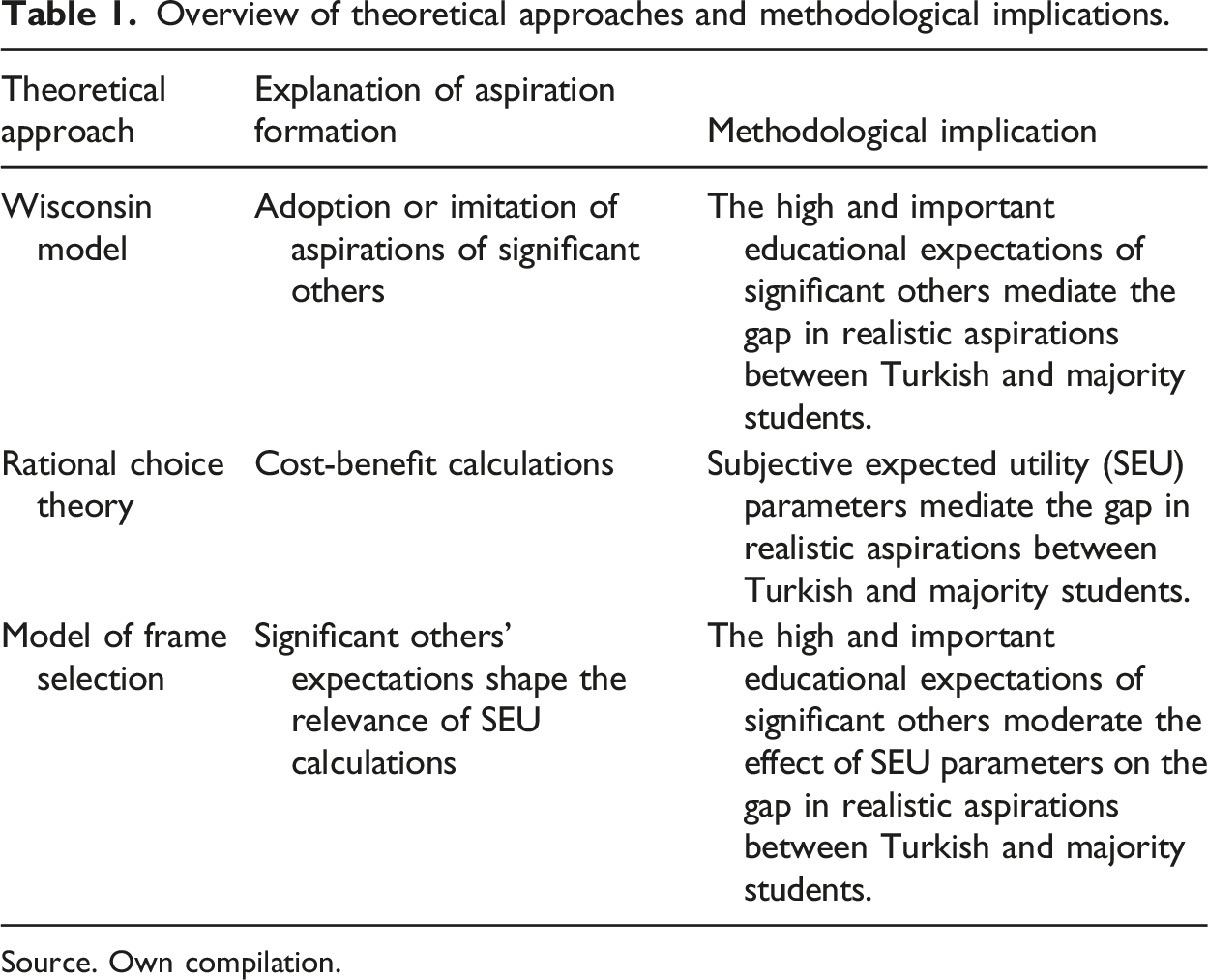
Source. Own compilation.
Methods
Data
The National Educational Panel Study
Descriptive statistics by students’ ethnic origin.
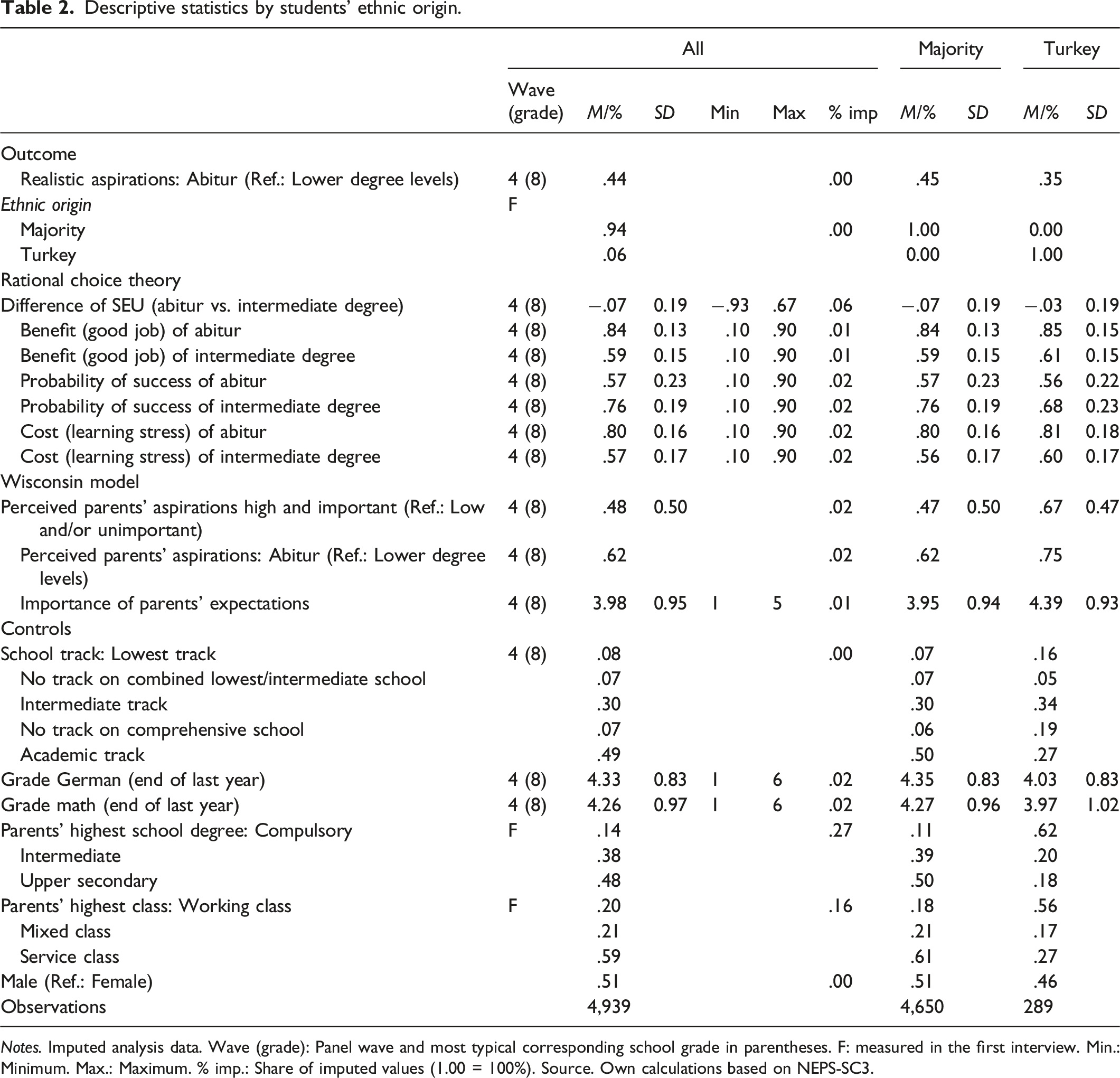
Notes. Imputed analysis data. Wave (grade): Panel wave and most typical corresponding school grade in parentheses. F: measured in the first interview. Min.: Minimum. Max.: Maximum. % imp.: Share of imputed values (1.00 = 100%). Source. Own calculations based on NEPS-SC3.
Sample selection
We excluded students from special needs institutions (“Förderschule”), as educational paths can differ for this population (n = 587); thus, their process of aspiration formation may not be fully comparable to that of other students in the sample.
Variables
Outcome: Realistic educational aspirations
Students were asked about the educational degree that they assume they can obtain given all current restrictions [Original item: Considering everything you know now: What qualification will you actually leave school with?]. Answer categories ranged from no degree and lower degrees (e.g., “Hauptschulabschluss”) through intermediate degrees (e.g., “Realschulabschluss”) to the highest degree (“Abitur”). As aspirations for no degree or lower degrees were overall rare (12.2% when taken together), we dichotomized aspirations and distinguished only between aspirations towards the highest degree (1 = “Abitur”) and aspirations towards the degrees below (0 = else).
Central explanatory variables
We captured the relevance of parental educational norms in the following way: First, we considered information on the level of parents’ idealistic educational aspirations, as perceived by the students [Original item: The following questions concern what your parents expect of you in school. Which highest school-leaving qualification do your parents wish you obtained? Highest school track (Abitur) vs. lower tracks]. Second, we considered the importance that students attach to parents’ educational expectations [Original item: How important is it to you overall what your parents expect of you in school? Response categories ranged from 1 very unimportant to 5 very important].
Based on this information, we generated a dichotomous variable that takes the value of 1 if children perceive that their parents wish them to complete the highest school track and this expectation is (rather or very) important to the student. In all other instances, it took the value of 0. We opted for this combined measure, as the associated theoretical approaches WM and MFS state that students’ own aspirations should increase only when both conditions (high and important expectations of others) are met (see the robustness section below for a discussion on this measure and alternative specifications).
We choose to construct this indicator based on the parents’ aspirations as perceived by the children, rather than using the parent’s own reports of their educational aspirations for their children. This is because we assume that the parental aspirations that children themselves perceive are more relevant in shaping their own realistic aspirations than their parents’ self-reported aspirations, which children may not always perceive as such. For a discussion of this approach, please refer to the discussion section.
To capture the results of the cost-benefit calculations for different school tracks, we calculated the difference between the subjective expected utility (SEU) weights for the highest school track (“Abitur”) and the SEU weight for the following lower track (“Realschule”), formally written as SEU = (pAbitur × UAbitur – CAbitur/2) – (pRealschule × URealschule – CRealschule/2).
Students were asked about each individual parameter. The utility parameter was measured with the following question: “How favorable would you judge your prospects of obtaining a good job if you were to pass the Abitur examination [to obtain the leaving certificate of the Realschule]?” The response options ranged from 1 not very favorable to 5 very favorable. To measure success probability, students were asked the following: “Regardless of the qualifications that you can actually obtain at your school, how likely do you think it is that you can pass the Abitur examination [obtain the leaving certificate of the Realschule]?” Answers ranged again from 1 very unlikely to 5 very likely. Finally, costs in terms of effort were measured by the question: “Different school-leaving qualifications require different amounts of effort. How much effort would it take you to acquire the Abitur [a certificate of intermediate secondary education]?” The answer options ranged from 1 very low to 5 very high.
To generate our measure, we first transformed the values on the three main variables—utility, success probability, and costs—from 1 to 5 into 0.1 to 0.9, to ease the interpretability of the final measure. Second, we generated the SEU weights for the two different school tracks. In the last step, we then calculated the difference between the two SEU weights, as specified in the formula above. Values of the final measure ranged from +1 to –1, where 0 indicated that the SEU weights were identical for the two tracks in question, values above 0 indicated a higher SEU weight for the highest track, and values below 0 indicated a higher SEU weight for the lower track. 6
Ethnic origin
Immigrant origin was identified through the country of birth of students, their parents, and grandparents (see Olczyk et al., 2016b, for an overview). We considered Turkish students up to the 2.75th generation and students of the majority population. Third generation students with one grandparent born abroad (10.1% of Turkish adolescents) were assigned as majority students.
Controls
Logistic regression results (dependent variable: Realistic expectations Abitur vs lower).
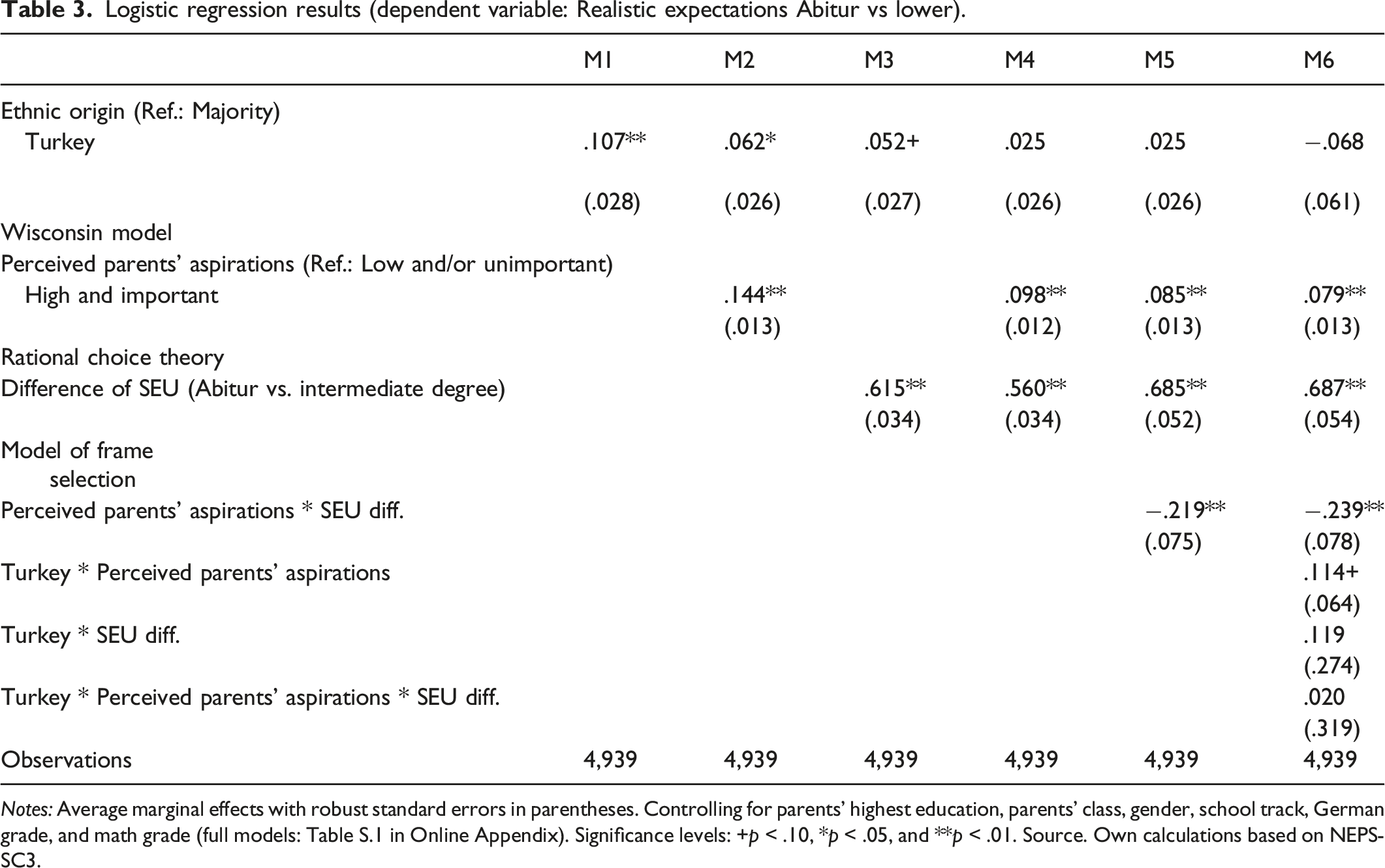
Notes: Average marginal effects with robust standard errors in parentheses. Controlling for parents’ highest education, parents’ class, gender, school track, German grade, and math grade (full models: Table S.1 in the Online Appendix). Significance levels: +p < .10, *p < .05, and **p < .01. Source: own calculations based on NEPS-SC3.
Empirical strategy
To test our theoretical assumptions, we conducted logistic regression analyses. We thereby regressed students’ realistic aspirations on the perceived relevance of their parents’ educational norms (WM, H1; Model 2), on students’ own SEU difference between the highest and lower tracks (RCT, H2; Model 3), on the additive effects between these two measures (MFS, H3a; Model 4), as well as their two-way interaction (MFS, H3b; Model 5) and three-way interaction with students’ ethnic origin (MFS, H3c; Model 6). To ensure the comparability of coefficients between nested models, we compared average marginal effects (AME; see Mood, 2010).
Missing values
To include cases with missing information, we used multiple imputation with iterated chained equations (White et al., 2011). Based on a quadratic rule and the highest fraction of missing information in our data, we generated 30 datasets (Von Hippel, 2020). We deleted imputations of the dependent variable after imputation (Von Hippel, 2007).
Results
According to the results presented in Table 3, the probability of aspiring towards the highest degree was 10.7 percentage points higher for Turkish-origin students than for majority students when controlling for current academic achievement and background characteristics (see Table 3, Model 1). This finding corresponded to results of other studies (e.g., Salikutluk, 2016).
In the following models, we examined how the three approaches of aspiration formation (i.e., WM, RCT, MFS) related to realistic aspirations and to the gap in realistic aspirations between Turkish and majority students. When considered separately, the indicators for both WM and RCT were individually relevant (Models 2 and 3). High idealistic aspirations of parents that were seen as important by their child were associated with significantly higher realistic aspirations of students themselves (Model 2). Similarly, SEU calculations favoring the highest educational degree also increased realistic aspirations (Model 3). In each of these specifications, the aspiration gap between Turkish and majority students decreased. Yet, it did not fully disappear. When simultaneously considering students’ perceptions of their parents’ aspirations for them and students’ own SEU calculations, results indicated that both processes were jointly relevant in forming realistic aspirations (Model 4). While the SEU calculations seemed to have a larger effect, the perceived aspirations of parents significantly shaped students’ realistic aspirations beyond students’ own SEU calculations. We take this as a first indication that an integrative model might be fruitful to fully capture the processes that are shaping realistic aspirations. To test this possibility in more detail, we added an interaction effect that modeled an interdependent relationship between WM and RCT indicators, as suggested by the MFS (Model 5). In line with this, Model 5 indicated that high educational aspirations of parents which are seen as important by their children significantly decreased the effect of students’ own SEU calculations on their realistic aspirations. Figure 1 illustrates the interaction in more detail. Figure 1(a) shows that the predicted probabilities of high realistic aspirations increased with the SEU calculations in favor of the Abitur. Further, the increase was steeper when perceived parents’ aspirations were low and/or unimportant to their child, and it was less steep when perceived parents’ aspirations were high and important. In Figure 1(b), we depict the AMEs of SEU calculations separately for both conditions. Note that we estimated effects of smaller SEU changes by 0.1 points as changes of SEU calculations by one unit were comparatively large and uncommon. Again, we found a significantly decreased effect of SEU calculations when perceived parents’ aspirations were high and important (0.052 or 5.2 percentage points for an increase in SEU calculations by 0.1), compared to low and/or unimportant perceived parental aspirations (0.072 or 7.2 percentage points). The three-way interaction indicated that this tendency held true for both majority and Turkish minority students (Model 6, Figure 2). While this ran counter to our last prediction (H3c), it also suggested that the theoretical specification proposed by the MFS may include a general process of aspiration formation that stretches across ethnicities. Interaction between SEU difference and perceived parents’ aspirations. Notes: Predictions and conditional effects based on logistic regressions with interaction effects (Table 3, M5). Source: own calculations based on NEPS-SC3. (a) Difference of SEU: values above zero indicate a higher SEU of the highest degree (Abitur). Values below zero indicate a higher SEU of the lower (intermediate) degree. The value 0 indicates identical SEU weights for both degrees. The depicted range of SEU values from −0.5 to 0.4 covers about 98% of the sample (predictions for the lowest and highest percent are not depicted). Interaction between SEU difference, ethnic origin, and perceived parents’ educational aspirations. Notes: Predictions and conditional effects based on logistic regressions with interaction effects (Table 3, M6). Source: own calculations based on NEPS-SC3. (a, c) Difference of SEU: values above zero indicate a higher SEU of the highest degree (Abitur). Values below zero indicate a higher SEU of the lower (intermediate) degree. The value 0 indicates identical SEU weights for both degrees. The depicted range of SEU values from −0.5 to 0.4 covers about 98% of the sample (predictions for the lowest and highest percent are not depicted).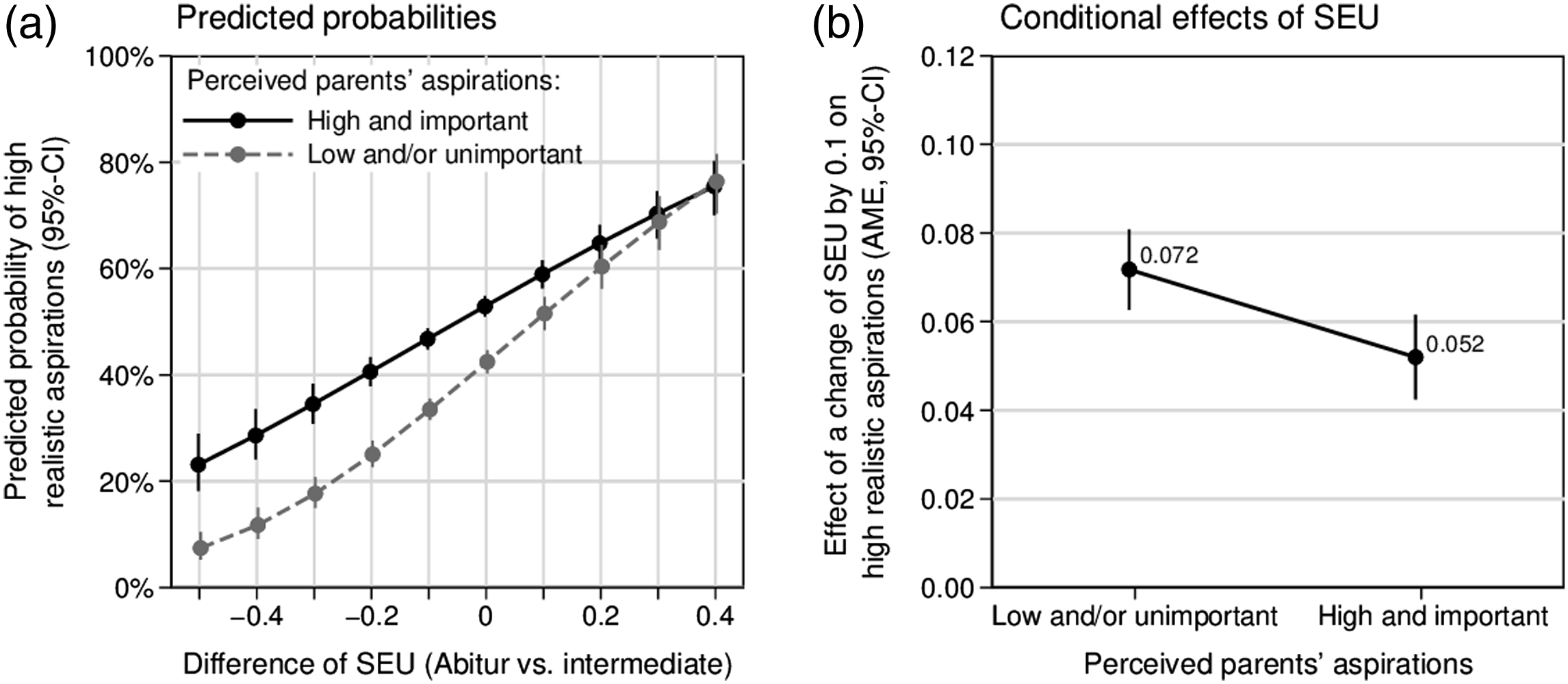
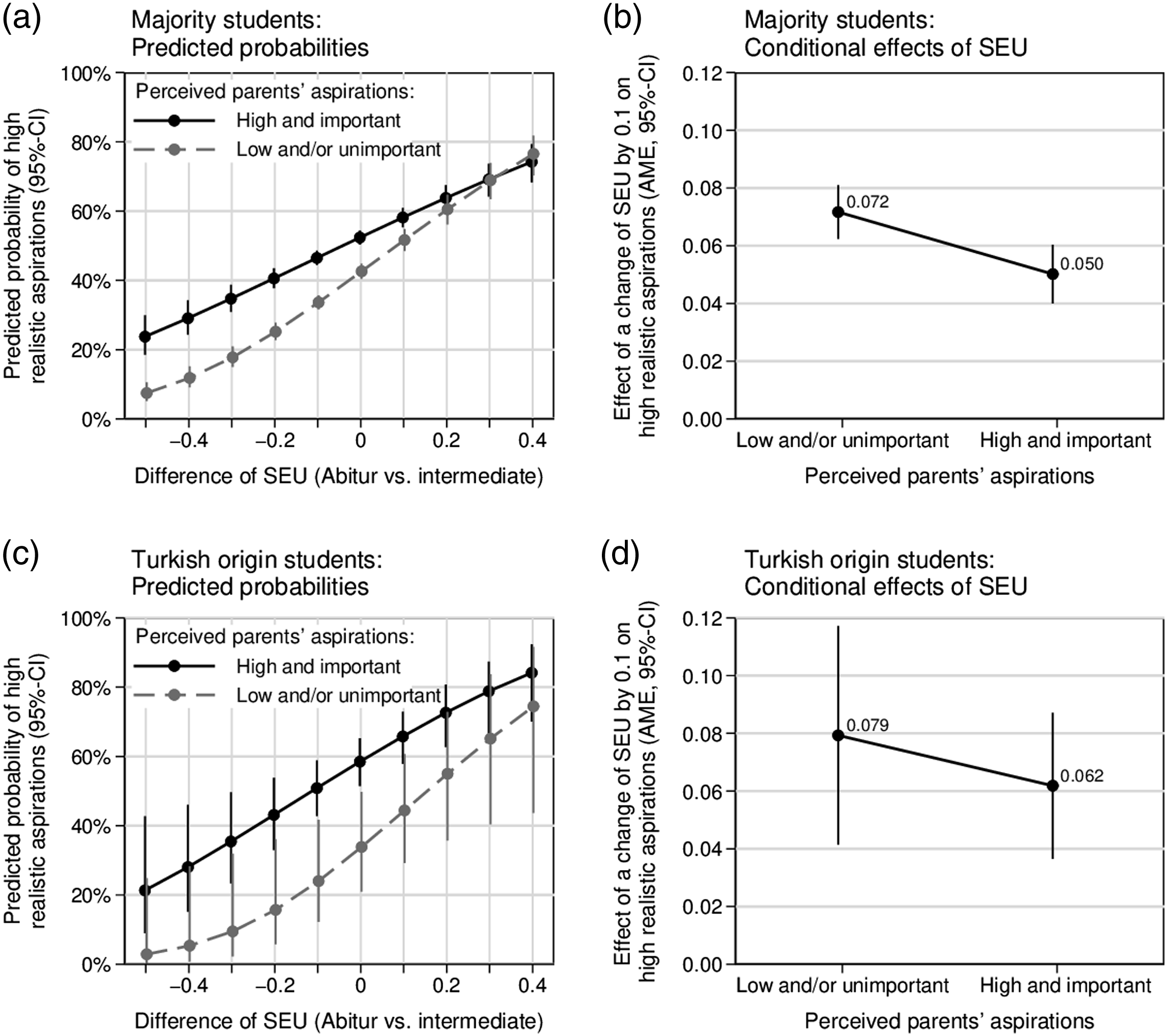
In sum, the results suggested that the processes proposed by both the WM and RCT were relevant in the explanation of Turkish students’ high educational aspirations (Models 2–4). The core contribution of the MFS was that it allowed a theoretical specification on how the two processes were conceptually interrelated and that it offered concrete predictions on whether one or the other mechanism was more or less likely to shape realistic aspirations given different external conditions. The interaction effect (Model 5) thereby highlighted the main MFS contribution by capturing the interdependent nature between parents’ educational aspirations and students’ own cost-benefit calculations in the formation of realistic aspirations. Our results also suggested that this interdependence applied to majority and (Turkish) minority students alike, suggesting a more general process of aspiration formation.
Robustness of the main results
One point of concern related to the measures that we applied to capture the educational norms of significant others. To capture the educational norms of parents, we employed a dummy variable that took a value of 1 if parents’ educational aspirations are high and parental educational expectations in general important to the child and a value of 0 in all other cases. While rooted in our theoretical assumptions, the indicator combined information on two different constructs. On the one hand, it may be that only one of the two constructs was truly relevant and driving results. On the other hand, both constructs may bring about contrasting processes that cancel each other out, and, hence, reduce effects of the combined variable. To examine these possibilities more closely, we reconducted our main analyses and separately considered both constructs that captured parents’ educational norms. While the level of perceived parental aspirations seemed to be more relevant in shaping students’ realistic aspirations, on its own, it did not suffice to alter the relevance of students’ own SEU calculations as substantially as when both constructs were combined (Online appendix, Table S.2).
A second point of concern related to the cross-sectional nature of our data, as this can allow for effects of reverse causality. In our case, it may be that the educational aspirations of parents may not shape student aspirations, but students’ own aspirations may influence the educational aspirations of their parents. To examine this possibility, we drew upon indicators of parents’ educational aspirations from an earlier panel wave (wave 2/Grade 6) that chronologically preceded the measurement of the dependent variable (i.e., students’ realistic aspirations) by 2 years. While effect sizes slightly decreased in this specification, results – by and large – remained comparable (Online appendix, Table S.3, Figures S.1 and S.2). In addition, while – on a conceptual level – reverse causality may be plausible in regard to the main effect of parents’ aspirations, it may be less likely regarding the main MFS test, namely, the interaction between parents’ educational norms and students’ own SEU calculations. It seemed less plausible that students’ own SEU calculations moderated the extent to which their realistic aspirations affected the aspirations of their parents. In addition, the tendency we found in our models, namely, that norms seemed to shape the relevance of SEU calculations, was in line with previous experimental findings, which struggled less with reverse causality (e.g., Kroneberg et al., 2010).
Against this backdrop, we assumed that our results were not solely driven by reverse causality; however, we were unable to rule out such effects altogether, so that the cross-sectional nature of our data represented one of our limitations.
Discussion and conclusions
We tested the empirical relevance of three models of aspiration formation, the WM, RCT, and the MFS. We were particularly interested in whether the MFS, as an integrative framework, is fruitful to theorize interrelations between the WM and RCT and in whether these interrelations help to explain the higher realistic aspirations of Turkish immigrants. The hypotheses derived from the three approaches have been addressed by analyses using NEPS data. We found that the processes suggested by both the WM and RCT separately shape realistic aspirations. Our most striking finding was that the importance that students attached to their parents’ educational norms (WM) moderated the relevance of students’ own SEU calculations (RCT) for their realistic educational aspirations. We take that as an indication that an integrative framework, such as the one provided by the MFS, can be fruitful to adequately model (the formation of) realistic aspirations. Our results also suggest that the identified interrelations do not specifically apply to Turkish origin students but hold true for Turkish minority and majority students alike, suggesting that the MFS may capture a more general process of aspiration formation.
Nevertheless, there are limits to our conclusions, which we want to mention. Ideally, the propositions of the MFS would have been examined within experimental settings. Such designs can be tailored to specifically capture the conditions that shape both reflexive and automatic decision-making processes, for instance, by varying the response time or stakes associated with a decision. A survey setting, such as the one implemented in the NEPS, allows only a less clear-cut distinction between the two modes of reflection. This is because respondents (here, students) are asked about both their normative pressures, and their SEU calculations of different school tracks. This is not ideal, as the strictest interpretation of the MFS suggests that individuals who are facing strong normative pressures (and thus are in as mode), do not cross over into the reflective mode and thus should not have undertaken their own SEU calculations. In the extreme, this could mean that respondents who are in as mode are “forced” to undertake SEU calculations on the spot based on the survey questions they are asked, giving ad hoc or biased answers.
While plausible, we still see merit in this way of testing our main assumptions for three main reasons: First, the arguments above most strongly apply to the “ends of the spectrum” of each mode, or, when the two modes of reflection are seen as strictly binary. The MFS, however, is based on the idea that the distinction between reflective and automatic information processing represents a continuum, where people have different levels of reflection or automaticity in their processing and decision making (Kroneberg, 2014). We thus assume that the majority of people in as mode, who build their aspirations mainly due to normative pressures, still have a rudimentary idea about SEU parameters (e.g., how likely it is that they succeed in a certain track), these ideas may just be latent, biased, and in sum less relevant for their aspiration formation. So, while not ideal, especially at the “ends of the spectrum”, we assume that this way of testing, still taps into the interrelations assumed in the MFS.
Second, interactions between indicators of normative pressures and SEU parameters based on survey data have been used in prior empirical applications of the MFS (e.g., Stocké, 2013; see also Kroneberg, 2009). Moreover, our findings are in line with those of other studies that provided indirect evidence for the MFS regarding other societal groups and other areas of society (see, e.g., Kroneberg, 2014, for a summary). They also coincide with studies indicating that while immigrants often have a higher value of education, this value does not shape the formation of idealistic and realistic aspirations substantially differently compared to the majority populations (Hadjar and Scharf, 2018).
Third, the placement of survey questions within the NEPS questionnaire is conducive to our way of testing. Within the NEPS questionnaire, items about normative pressures and educational aspirations precede the items that ask about the SEU weights of different school tracks. This should mean that even if students in as mode were “forced” by the survey setting to generate “ad hoc” SEU weights for different tracks, these newly generated SEU weights would not shape their answers about educational aspirations, as these items had already been asked.
Nevertheless, we cannot fully rule out that our findings also partly capture some sort of ad hoc effect that was due to the survey setting. Models of shifting salience, such as goal-framing theory (e.g., Lindenberg and Steg, 2007) or accessibility theory (e.g., Higgins, 2012), might be well suited when trying to explain which of the two aspects of decision-making (normative pressures or SEU calculations) is more salient when being interviewed in a survey setting and might also be applied in future specifications. Furthermore, our analyses are cross-sectional, foreclosing strong causal claims.
In addition, we choose to construct our indicator for parental educational norms based on the parents’ aspirations as perceived by the children, as we assume that children’s own perceptions are more relevant in shaping their realistic aspirations than their parents’ self-reported aspirations, which children may not always perceive as such. However, children’s perceptions may be biased through their own aspirations, as students project their own expectations onto their parents. To rule out that this is shaping our results, we re-conducted our analyses using parents’ self-reported aspirations. Results for the two-way interactions (parental educational norms and students’ own SEU calculations) were comparable to the results from our analyses. The three-way interactions (including ethnic origin) could not be reliably estimated due to data restrictions, that is very low case numbers of self-reported aspirations for Turkish parents.
Yet, when taken together, our results provide first, tentative indications that the MFS may be a useful framework to theorize interrelations between the WM and RCT when explaining realistic aspirations and that this process may apply to different ethnic groups alike. However, at least two open questions remain. While we examine realistic educational aspirations, additional questions related to the formation of idealistic aspirations remain unaddressed. Future research might, for instance, examine the conditions under which parents and students adapt their idealistic aspirations to educational realities. Furthermore, while we find indications that parents’ aspirations can shape students’ realistic aspirations, it remains open as to why parents themselves showed higher aspirations. This path dependency should be considered more thoroughly in future applications. In sum however, our results show that the formation of aspirations is a complex process that involves, to varying degrees, norms and values as well as rational calculations. Research that applies and tests integrative models that theorize interrelations between these aspects explicitly should be fruitful to fully explain the formation of educational aspirations and group differences in this process.
Supplemental Material
Supplemental Material - High realistic aspirations – Do normative pressures overthrow rational calculations? Applying the model of frame selection to the educational aspirations of immigrant and majority students in Germany
Supplemental Material for High realistic aspirations – Do normative pressures overthrow rational calculations? Applying the model of frame selection to the educational aspirations of immigrant and majority students in Germany by Miriam Schmaus, Melanie Olczyk, Sebastian Neumeyer, and Gisela Will in Rationality and Society.
Footnotes
Declaration of conflicting interests
The author(s) declared no potential conflicts of interest with respect to the research, authorship, and/or publication of this article.
Funding
The author(s) disclosed receipt of the following financial support for the research, authorship, and/or publication of this article: This work was supported by Deutsche Forschungsgemeinschaft; project numbers 335816694 and 390731161.

Supplemental Material
Supplemental material for this article is available online.
Notes
References
Supplementary Material
Please find the following supplemental material available below.
For Open Access articles published under a Creative Commons License, all supplemental material carries the same license as the article it is associated with.
For non-Open Access articles published, all supplemental material carries a non-exclusive license, and permission requests for re-use of supplemental material or any part of supplemental material shall be sent directly to the copyright owner as specified in the copyright notice associated with the article.
