




Abstract
We study the effect of lottery wins on the strength of social ties and its different types, including support networks, in the United Kingdom. On average, we find that winning more in the lottery increases the probability of meeting friends on most days, which is consistent with the complementary effect of income on the strength of social ties. The opposite is true with regards to social ties held for more instrumental reasons such as talking to neighbours. Winning more in the lottery also lessens an individual support network consistently with a substitution of income and support network. However, further robustness checks reveal that such average lottery effects are driven by individuals exhibiting very large wins only, thus suggesting that small to medium-sized wins (below £10k) may not be enough to change people’s social ties and support network in a substantial way.
Introduction
Individuals rely on social ties for both emotional and physical support in carrying out daily tasks as well as group formation. However, social ties require nurturing, or investments in terms of either effort, time, or psychological bandwidth (Dunbar, 2018). This includes time spent with neighbours which binds us to society at large (Granovetter, 1973; Christakis and Fowler, 2009) and in turn influences our wellbeing (Dunbar, 2018; Dunn et al., 2008). However, despite all social ties require investment in time and resources, not all are equally influenced by economic motivations (Wuchty, 2009), or relational reciprocity, let alone by their emotional connection.
Social ties, like other club goods, reduce within-group information costs and provide benefits in terms of support and participation in collective activities (Grief, 1993; Wuchty, 2009). Hence, it is reasonable to expect individuals seeking personal and wellbeing returns to seek out new social ties an strengthen existing ones such as friendships (see, for example, Montgomery, 1991; Knack and Keefer, 1997; Burchardi and Hassan, 2013), and other support networks. Evidence consistently shows that people are happier when they spend money on others rather than themselves (Dunn et al., 2008). Unlike other social ties, friendships that are the result of an individual’s choice and do not respond to a support network alone but by the intensity of emotional connection. However, we know little about how sensitive social ties are formed, and more specifically to what extent they can be strengthened. This paper examines how an unanticipated change in resources, namely an income shock resulting from a lottery win, affects the strength of different kinds of social ties, including friendships, neighbours, and support networks.
Nonetheless, identifying the effect of income on social ties is far from straightforward. To date, some research documents that socio-economic status (SES) can strengthen social ties such as friendship (Cohen, 1979). However, it is difficult to infer causality from such results due to the possibility of reverse causality. As Christakis and Fowler (2009) put it, “if you are rich, you can attract more friends, and if you have more friends, you can have more ways to become rich”. Hence, the effect of friends on earnings is affected by reverse causality as the potential for future earning significantly increases with the pre-existing level of social networks including friendship ties and employment related contacts (Boxman et al., 1991; Simon and Warner, 1992; Amuedo-Dorantes and Mundra, 2007). One could also imagine that omitted third variables such as time spent working and commuting to and from work muddle the relationship between income and social ties. Hence, the extent to which income can affect social ties remains imperfectly understood. The exception is a recent study by Nguyen (2021) which examines one-year cross sectional evidence form a low income setting in Vietnam, and measures lottery wins in the household rather than individual setting. 1
One hypothesis is that an exogenous rise in income substitutes social ties that are instrumentally formed to have access to information inputs and coordinate caregiving needs (e.g., child-care coordination) that otherwise would entail an actual earned income investment (Becker and Murphy, 2000). Hence, a positive income shock can give rise to the substitution of an individual’s strength of peoples contact with neighbors (and support networks) by reducing the instrumental reasons that motivate people to socialize. Given the evidence that individual well-being rises with the extent of social interactions (Powdthavee, 2008; Helliwell and Huang, 2013), a positive income shock could also increase the demand for social ties, enabling individuals to allocate more time to the close friends and social ties they are emotionally attached to. However, income shocks, when visible and large, can produce supply or attraction effects, whereby friends that otherwise might have allocated time to other individuals decide, guided by instrumental reason, to spend more time with friends who have experienced a lottery win.
We contribute to the literature as follows. First, our analysis refers to a high-income country such as the United Kingdom, and compared to Nguyen (2021), estimates are more likely relatable to other higher income countries. Second, we consider the effect of income shocks on extended support networks. This is important as it helps in understanding the effect on a wider set of social ties including friends and an individual’s support network. Third, by including individual fixed effects into the regression model, our estimate control for individuals' person-specific, time invariant variables that can influence the probability of playing the lottery. This is important as unobservable variables such as risk aversion or personality can, for instance, influence how individuals react to income shock.
This paper addresses the endogeneity issue associated with income by examining the effect of a within-person change in the amount of lottery winnings on different measures of social ties in the United Kingdom. Unlike earned income, within-person changes in the amount of lottery winnings are randomly distributed among winners, which allows us to establish causality between changes in income and changes in social ties. We exploit nationally representative longitudinal data of British households in which information on different types of social interactions and support networks was collected annually, alongside information on different sources of earned and unearned income.
Focusing on the within-person evidence of lottery winners, 2 our initial analysis finds a positive and statistically significant association between lottery winnings and meeting friends outside home on most days. We also find lottery winnings to be negatively associated with the time spent talking to neighbours on most days and the number of people in the support network, on average. These results are consistent with Kuhn et al. (2011) who find evidence of the social effects of lottery wins, including higher levels of car consumption on behalf of the neighbours of lottery winners. However, further robustness checks reveal that the observed average effects are driven mostly by the outliers of very large wins in the sample, i.e., people who won at least £10,000 in the lottery. Hence, while we have some evidence of a statistically well-determined average treatment effect that runs from an exogenous increase in income on social ties and support network, the effect is only prominent among the big winners in the sample.
This paper is organized as follows: The next section provides a background on the influence of income in the formation of social ties and social interaction outside the household; followed by further sections that contain the empirical strategy; displays the paper’s results; a final conclusion section.
Background
The building of social ties
Social ties serve as the foundation for communities and social groups, which have a significant impact on individuals' well-being (Stiglitz, Sen and Fitoussi, 2009). In their strongest form, social ties include close-knit friendships that develop over time due to within-group interactions (Wunden et al., 2008). Carley (1991) characterizes such social interactions as cyclical processes ignited by social activity resulting from “adaptation” and “motivation” (who interacts with whom). What, however, drives such social ties? Understanding the motivations behind such behaviours allows us to consider the role of potential returns to social interactions, as well as friendship and neighbourhood capital. Individuals have an unobserved desire for socialization that is limited by time and monetary constraints, as well as the existing social norms.
It is empirically well-established that socialization results in significant well-being gains. Friendships provide social and emotional support as well as pro-social behaviour (Hartup and Stevens, 1997). Friendships, in general, play an important role in promoting the formation of individuals' sense of self and satisfying their need for community (Deci and Ryan, 2002). According to the Gallup World Poll, having someone to call in times of trouble is associated with higher life satisfaction, but the effects are driven primarily by close friends (Gallup, 2005). Helliwell and Huang (2013) investigate online friendships and document that the predicted effect of doubling the number of real-life friends on wellbeing that compares to about 50% of the effect of income on subjective wellbeing. 3 Similarly, Powdthavee (2008) estimates that the wellbeing effect of an increase in the level of social interactions with friends and relatives compares to extra £85,000 per year. However, such studies often ignore the possibility of tangible returns form social ties, such as an increase in income from social interactions. Indeed, an additional income can affect an individual’s ability to meet an unsatisfied latent demand for additional social interactions.
Nonetheless, individuals may invest in social ties for purely instrumental reasons. Taylor et al. (2004) proposes that cooperation in the form of friendships and engaged neighbourhoods is frequently a response to need or stressful environments. This is especially true for weaker social ties, such as interactions with neighbours, which are an important component of community formation. Women are slightly more likely than men to identify and engage with their neighbours, according to the evidence, and education appears to be more important than income (Ferragina et al., 2011). However, in explaining volunteering labour supply, income effects remain positive and statistically significant (Menchik and Weisbrod, 1987). However, unlike friendships, social ties that are primarily useful for instrumental reasons and require little emotional investment may be substituted away with an increase in income. This assertion is consistent with the so-called “resource dependence theory”, which contends that income reduces social engagement because people become less reliant on others (Kraus and Kelter, 2009). According to experimental evidence, priming the concept of money causes people to behave more “self-sufficiently” and less pro-socially (Vohs et al., 2006).
Investment and disinvestment effects
We can explain social ties as processes of time, money, and effort investment and divestment, all of which have costs for individuals. These bonds are formed through emotional investments influenced by individual circumstances such as living space, employment, and affiliations with other support networks. Friendships are a specific type of social tie defined by strong emotional connection. Other weaker social ties are those that individuals hold with neighbours, or the wider community based on reciprocal arrangement to solve daily practical problems. However, irrespectively of its forms, social ties are thought to satisfy the evolutionary desire for interpersonal attachments (Baumeister and Leary, 1995). Social ties can be used to both sanction bad behaviour and reward kindness (Mui, 1995). These effects are significant because they reduce social distance, which is associated with cooperation and economic growth (Burchardi and Hassan, 2013). However, how are such social ties affected by changes in income? If social ties are a normal good, they should grow in proportion to an individual’s income. That is, extra money allows people to meet an unmet need for socialization.
Changes in income can have several significant consequences. First, they can have an impact on the resources (also known as the ‘resource constraint theory') available for creating and maintaining social networks (Bourdieu, 1986). Second, they have the potential to influence social consumption, which arguably ‘lubricates' social relationships. However, a friend’s reciprocal behaviour is not always predictable or expected with any precision (Leider et al., 2010). 4 Individuals are also frequently confronted daily with a variety of practical problems that necessitate the assistance of others, and specifically of their support network. As a result, unearned income may provide the resources to externalize the market and meet this requirement, resulting in a decrease in demand for such instrumental social ties.
Certain characteristics such as physical attractiveness or intelligence, both of which have been shown to influence income, can strengthen people's social ties (Anthony et al., 2007). Similarly, social ties may be motivated by the pursuit of some material or emotional reward (e.g., appreciation of an accomplishment by friends). Leider et al. (2010) test the latter motivation using a field experiment to demonstrate that people are more likely to be altruistic toward their own friends than nameless recipients, and that reciprocity is imperfect because subjects are unaware of the baseline altruism of people they know, including close friends.
The strength of social ties may be affected on the supply side by an individual’s socioeconomic status, and more specifically are likely to increase with the potential payoffs in the form of instrumental support individuals can provide (Bianchi and Vohs, 2016). However, on the demand side, higher socioeconomic status individuals may prioritize social ties that are not necessarily valuable for resources, but rather for emotional well-being. Bianchi and Vohs (2016) document that, while higher income reduces social ties, higher income individuals spend less time socializing with family and neighbours and more time socializing with friends. Consistently, Nguyen (2021) in a study of lottery winners in Vietnam document that lottery winners tend to increase the number of non-colleague or long-term friends rather than the total number of friends. Hence, it is an empirical question whether income shocks exert effects on instrumental and emotionally formed social ties.
Attraction effects
One explanation for income effects on the strength of frienships lies in the influence of attraction. If social ties are motivated by a desire for some kind kind of reward, then successful people are more likely to attract people into their social network, if others believe they can share in the individual’s success. The latter may be more prevalent among those who believe in luck as a determinant of individual success, as well as those following by insurance motivations, because social ties serve as a reciprocal source of support under adverse conditions. Similarly, wealth may have an evolutionary impact on attraction and sorting. Finally, unearned income may motivate celebration and other forms of spending, such as transfers to friends and neighbours. Lottery winnings, on the other hand, can cause envy and unhealthy social comparisons.
Employment and celebration effects
Another motivation for the strenghening of social ties includes employment opportunities, and sharing such income effects via celebrations. Indeed, one of the consequences of small social networks is the limited support which might increase the probability of an individual income to fall below the poverty line and be unemployed (Lelkes, 2010). Networks of interpersonal ties are found to influence the probability of finding employment (De Choudhury et al., 2010). Indeed, social ties are a source of long-term labour market opportunities. Consistently, Goel and Lang (2019) document that a close tie increases the likelihood of a job offer from the network rather than by altering the network wage distribution. However, income gains, especially larger ones, might be partially shared with an individuals social network, giving rise to ‘celebration effects’ which can signal investment into friendships and help strengthen social ties. These effects are likely to be short term and eventually might fade away, but they might strengthen social ties that would otherwise be weaker.
Hypotheses
Income changes might reduce the reliance on an individual’s instrumental social network. Furthermore, income shocks produce both demand and supply effects. If individuals’ previous equilibrium was defined by an unsatisfied contact with one’s emotional network (constraint resource theory), and if income gains produce attraction, employment and celebration effects, we should expect that an exogenous income gain will increase the strength of one’s social ties.
Smaller lottery wins might not be observable by others insofar as the information from lottery wins might well be kept private. In contrast, larger gains might be publicized and give rise to more significant behavioural changes. Similarly, large size income changes might produce strategically different demand and supply side in one’s social network, compared to medium and small size gains.
Data and empirical strategy
Data
The data used in the analysis comes from the British Household Panel Survey (BHPS), which is a nationally representative sample of British households containing over 25,000 unique adult individuals surveyed from 1991–2009 (Taylor et al., 2004). Respondents are interviewed in successive waves. Households who move to a new residence are interviewed at their new location; if an individual split from the original household, all adult members of their new household are also interviewed. Children are interviewed once at 16 years old. The sample has remained broadly representative of the British population since its inception.
We study the extent of social interaction and support network of lottery winners in the BHPS. Data on lottery winners were collected for the first time in September 1996 and are available until April 2009 (BHPS Waves 7–18). In the survey, respondents were asked to state whether they received windfall income from football pools/national lottery and their amount of winnings. The exact question is: “About how much in total did you receive? Win on the football pools, national lottery or other form of gambling?”
In modern Britain, the national lottery is overwhelmingly the main form of gambling relevant to this question, so for succinctness we shall refer to this as lottery win. 5 For the design of the study, the variation in the size of any gambling windfall would be suitable as a quasi-experimental income shock.
Social network and lottery win: Linear probability model with individual fixed effects.
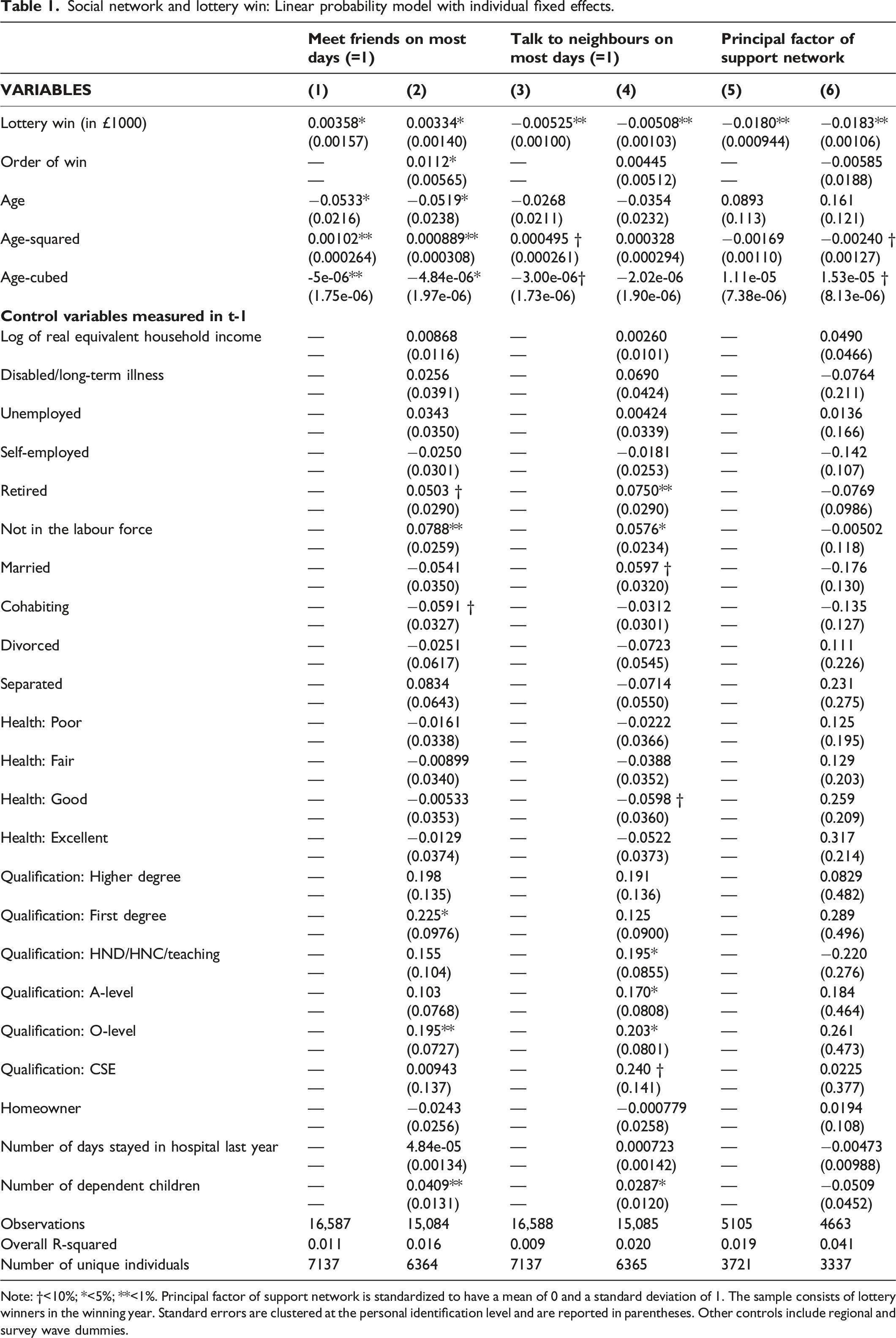
Note: †<10%; *<5%; **<1%. Principal factor of support network is standardized to have a mean of 0 and a standard deviation of 1. The sample consists of lottery winners in the winning year. Standard errors are clustered at the personal identification level and are reported in parentheses. Other controls include regional and survey wave dummies.
The average real lottery win (adjusted to consumer price index in 2000) is £217 (or US$272) with a within-person standard deviation of £1102 (US$1380). There is also a long tail in the amount of lottery win. Of 16,592 observations of lottery winners, 14,953 (90.1%) reported a win of £1-£249, 1182 (7.1%) reported a win of £250-£999, 392 (2.4%) reported a win of £1000-£4,999, 37 (0.22%) reported a win of £5000-£9,999, and 28 (0.17%) reported a win of £10,000 or more.
One limitation of the lottery data in the BHPS is that it does not contain information about the number of times (if any) the individual has played the lottery. Hence, it is impossible to distinguish non-players from unsuccessful players. Nevertheless, it has been shown that, in Britain, 57% of the entire population play the National Lottery (and almost 60% of these play at least once a week); see Wardle et al. (2007). This suggests that our lottery winners’ sample is likely to be representative of almost two-third of the British population.
The BHPS also asked their respondents the following two questions about their daily social interactions in every year since September 1996 (Wave 7): “We would like to ask how often you meet people, whether here at your home or elsewhere. How often do you meet friends or relatives who are not living with you? Is it… 1. Never, 2. Less often than once a month, 3. Once or twice a month, 4. Once or twice a week, 5. On most days.“, and “How often do you talk to any of your neighbours? Is it… 1. Never, 2. Less often than once a month, 3. Once or twice a month, 4. Once or twice a week, 5. On most days.”
Figure 1(a) and (b) illustrate the distributions of these two outcome variables. Here, we can see that most people in the UK meet up with friends and talk to their neighbours regularly; approximately 45% of the adult sample meet friends on most days, and 39% talk to their neighbours on most days. Given that we have two very highly skewed outcome variables that are ordinal in nature, our analysis will focus on estimating the effect of lottery winning on individuals reporting to be in the top category. More specifically, we will be estimating the effect of lottery win on two indicator variables: (1) ‘Meeting friends on most days’ (M = 0.45; SD = 0.49), and (2) ‘Talking to neighbours on most days’ (M = 0.39; SD = 0.49). Putting these variables into perspective, it is useful to work out that meeting friends on most days (=1) adds up to around 20–31 days of social interactions per month compared to meeting friends one or 2 days a week or less (=0), which can range between 0-8 days of social interactions per month. One potential concern is that lottery wins might be affected by recall bias, which is specifically more pervasive among small lottery wins, and as result a robustness check lies in whether the effect applies to high wins, which we discuss in section 4.2 a-b: Distribution of social interactions (a) Frequency of meeting friends. (b): Frequency of talking to neighbours. Note: Responses to the frequency of social interactions are: 1 = “Never”; 2 = “Less than once a month”; 3 = “Once or twice a month”; 4 = “Once or twice a week”; 5 = “On most days”.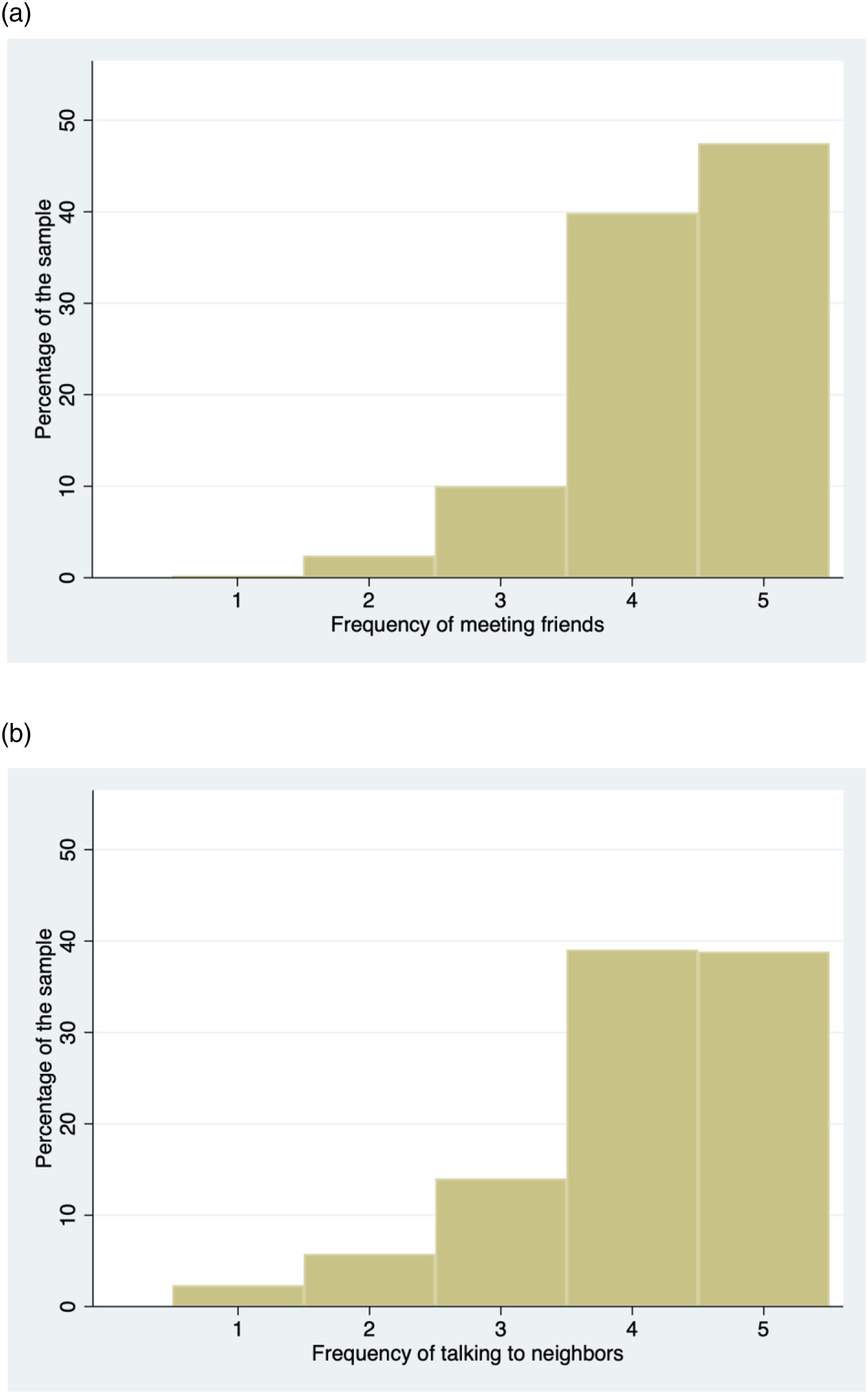
In addition to this, the BHPS also asked their respondents every 2 years the following five questions about the extent of their support network. These include “Is there someone who will listen?”, “Is there someone to help you in a crisis?”, “Is there someone you can relax with?”, “Is there anyone who really appreciates you?”, and “Is there anyone you can count on to offer comfort?”. Responses to these questions are on a 3-point scale: 0 = “No one”, 1 = “Yes, one person”, and 2 = “Yes, more than one person”. Given that responses to the five support network questions are moderately correlated (the average correlation is
Empirical strategy
We assume the following social ties regression equation
The key identification strategy is that the variation in the amount of real lottery winnings,
Results
Average effects of lottery wins on social ties
Does money buy us more time with our friends? To make a first pass at this question, Figure 2 illustrates the proportion of individuals reporting to meet their friends and talk to neighbours on most days by the size of lottery win. On average, we can see that around 50% of individuals who reported a higher lottery win, i.e., £250, and over, in the year of winning met up with their friends on most days compared to 44% of those who reported a smaller lottery win, e,g., £1-£249. However, there is statistically insignificant difference in talking to neighbours on most days between winning big or small in the lottery. Figure 2 thus provides some preliminary raw data evidence that larger wins are associated positively with the frequency of social interactions with friends but not neighbours. Simple cross-sectional evidence: Proportion of people who meet friends and talk to neighbours on most days by the size of lottery win. Note: The sample consists of only lottery winners at the year of winning. There are 14,986 observations of small win, i.e., £1-£249, and 1639 observations of medium-large win, i.e., £250+. Four standard error bars (two above, two below) – i.e., 95% confidence intervals – are presented.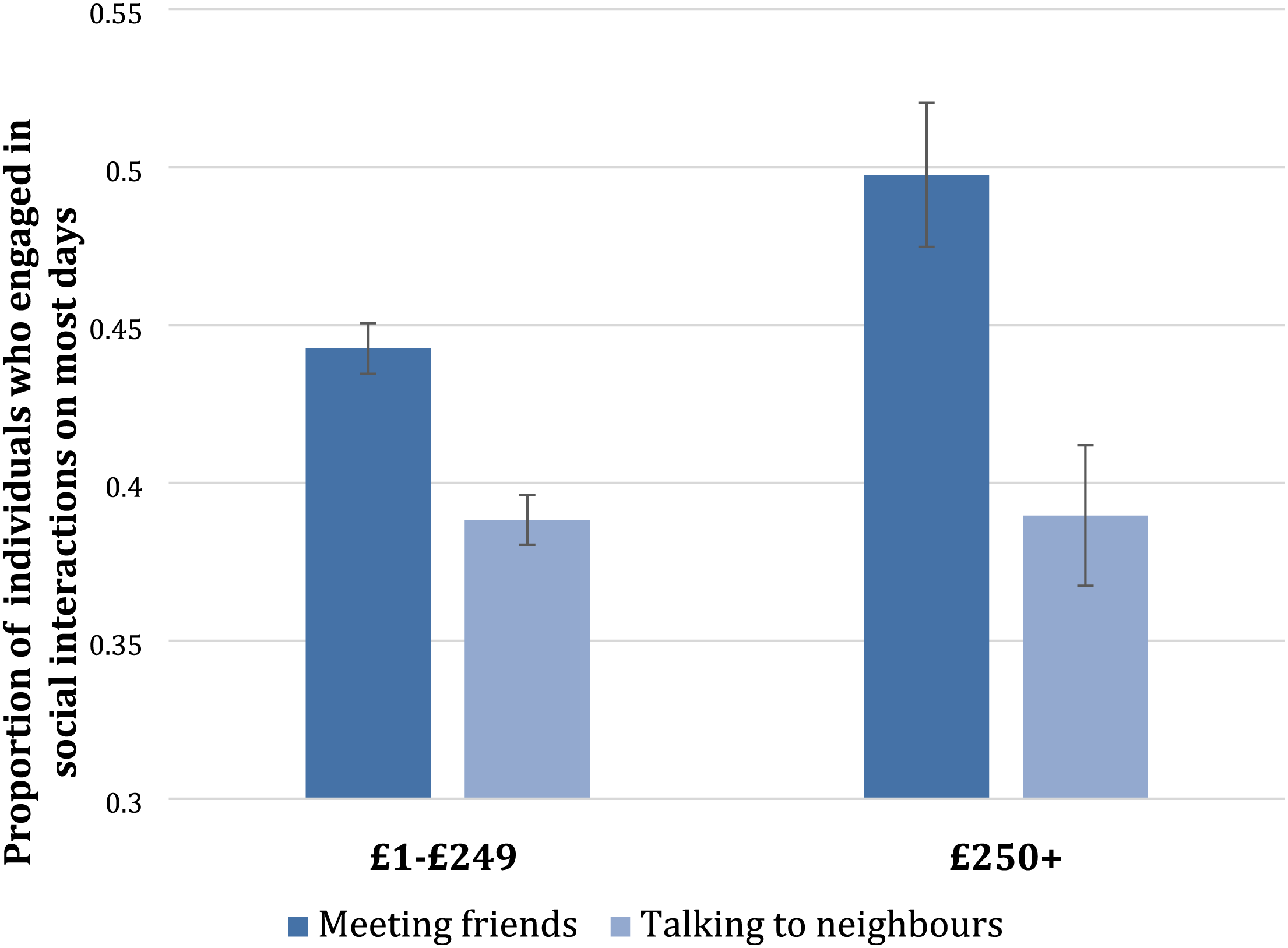
Table 1 tests for the lottery effects more systematically by estimating a linear probability model with fixed effects (FE) on the probability to meet with friends on most days, talking to neighbours on most days, and the standardized principal component of social support. We report in Columns 1, 3, and 5 the estimates with only age polynomials, regional, and survey wave dummies as the control variables, and in Columns 2, 4, and 5 the estimates with full set of controls. Looking across the columns, we can see that adding more control variables does not lead to a substantial change in the size of the estimated coefficients, thus reaffirming that the amount of winnings is exogenously determined across lottery winners in the linear probability with FE regressions.
Consistent with theories on investment and attraction effects, a lottery win exerts a positive and statistically significant effect on meeting friends on most days, but a negative and statistically significant effect on talking to neighbours on most days and the factor support network variable. On average, we find that a unit increase in the amount of winnings (= £1000) increases the probability of meeting friends on most days by 0.4 percentage points. To put this estimated effect into perspective, winning £1000 is equivalent to around 10% of the positive effect retirement has on meeting friends on most days. By contrast, a win of £1000 reduces the probability of talking to neighbours on most days by approximately the same amount; the estimated marginal effect of a £1000 win on the probability of talking to neighbours on most days is −0.5 percentage points.
A larger lottery win has a negative impact on the size of the support network. Since we use a linear model to estimate the support network equation, we can readily interpret the coefficients as marginal effects. Here, a £,1000 increase in income from a lottery win reduces the extent of support network by approximately 0.02 standard deviations. What Table 1’s results seem to suggest is that, although a positive income shock increases the time that individuals spend socializing with friends outside their home, it also reduces the extent of their social interactions with people in their local area as well as the number of support network individual's they feel they could call upon if they need help.
Table 1’s other results show that the one-year lag of real equivalent household income is not statistically significantly correlated with the frequency of meeting friends and talking to neighbours in period t. The nonsignificant coefficients are consistent with the hypothesis that the income-social ties relationship is often confounded by various omitted variables, including time spent commuting and working. The accumulating number of wins is positive and statistically significant in prediciting the probability of meeting with friends on most days’ , thus suggesting there is an important association between the accumulation of expenditure on lottery tickets with each successive lottery win and meeting friends on most days. Retired individuals, those not in the labour force, individuals with O-level qualification, and parents with dependent children spend significantly more time socializing with friends than others, on average. With respect to talking to neighbours, retired respondents, disabled and individuals outside the labour force, those who are married, and people with certain educational qualifications (HND, O-level, A-level, and CSE) are more likely to spend more time talking to their neighbours on most days. Most of the covariates in the support network regression exhibit coefficients that are not significantly different from zero.
Sub-sample analysis: Linear regression with individual fixed effects.
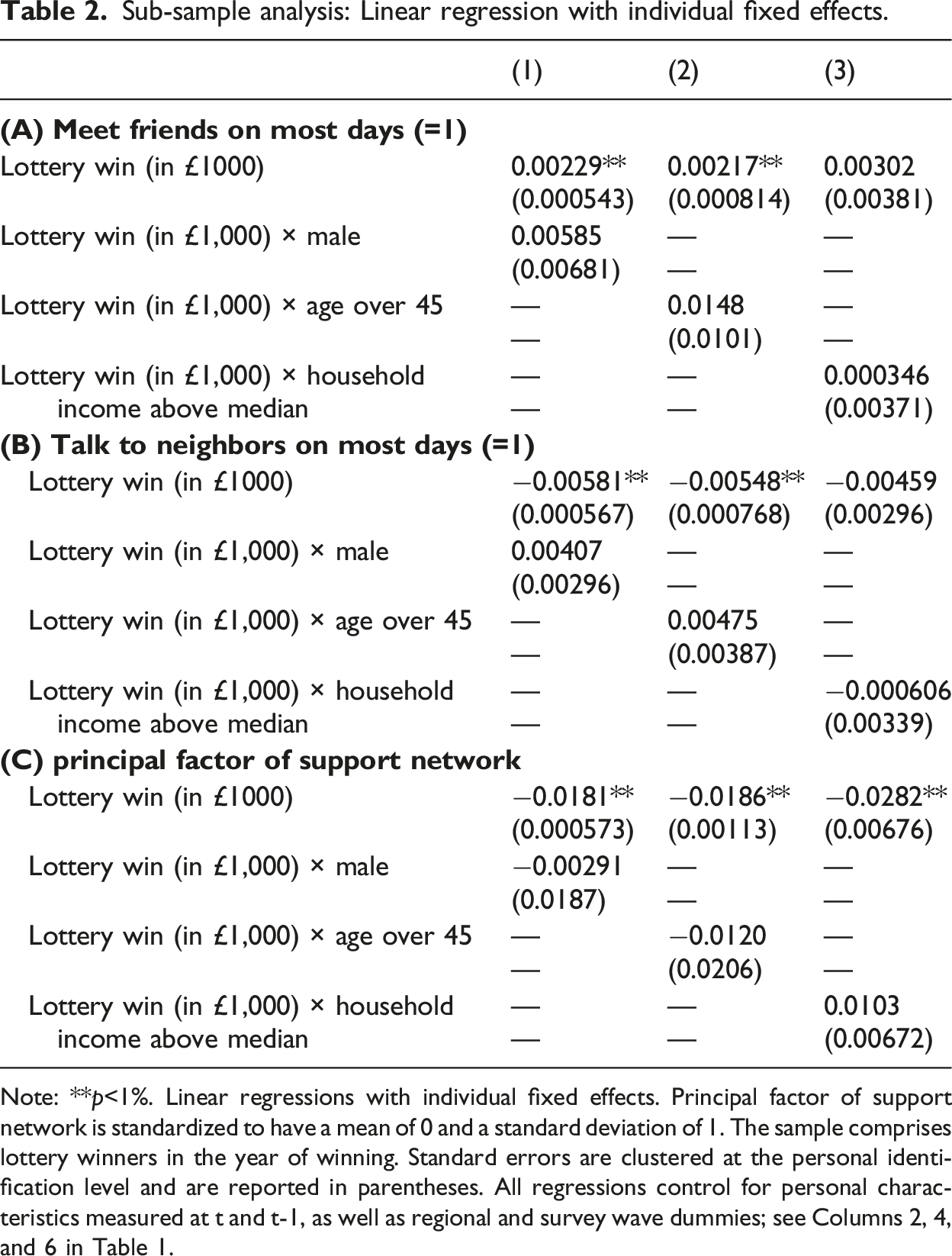
Note: **p<1%. Linear regressions with individual fixed effects. Principal factor of support network is standardized to have a mean of 0 and a standard deviation of 1. The sample comprises lottery winners in the year of winning. Standard errors are clustered at the personal identification level and are reported in parentheses. All regressions control for personal characteristics measured at t and t-1, as well as regional and survey wave dummies; see Columns 2, 4, and 6 in Table 1.
We carried out further robustness checks on the average lottery effects in Tables 3A-6A in the Online Appendix. Table 3A tests whether we can still obtain qualitatively similar results as those obtained in Table 1 by replacing the dependent variable with the 5-point scale social interaction variables with the responses range from “1. Never” to “5. On most days”. Hence, it makes empirically little differences to the overall findings whether or not we collapse the 5-point scale frequency of social interaction variables into a binary variable before running the analysis.
Table 4A checks whether the effect of lottery win on social ties is persistent over time. We do this by replacing the contemporaneous measure of lottery win with a one-year lag of the lottery win as the explanatory variable of interest in equation (2) while restricting the sample to only individuals who did not win in the lottery in year t. We find little evidence that a lottery win in year t-1 has any statistically meaningful effect on the propensity of meeting friends on most days, talking to neighbours on most days, and the extent of support networks in year t. These results suggest that, on average, the lottery win’s effect on social ties is likely to be experienced only in the year of winning.
Table 5A includes the ratio between lottery win and household income as an additional control variable to allow for the size of the lottery winnings relative to income to be considered in the estimation. However, including the lottery-income ratio covariate in the regression does little to alter the lottery income effects in any of the three social interaction regressions.
Table 6A investigates whether winning more in the lottery also has a statistically relevant average effect at reducing the extent of social isolation. We did this by estimating the lottery effects on two indicator variables: (i) meeting friends less than once a month, and (ii) talking to neighbours less than once a month. Unlike the other extreme of social interactions, we find little evidence that winning more in the lottery reduces the probability of individuals spending less time with their friends and neighbours. In other words, it appears that winning more in the lottery mainly affects those who already have a healthy social interaction with their friends and neighbours.
As a final robustness check, Table 7A tests whether social interactions in t significantly predicts winning more in the lottery in t+1. As can be seen from the table, neither meeting friends on most days nor talking to neighbours on most days significantly predict winning more in the lottery in the next survey year. The same applies to almost every other personal control variable in the fixed effects regression, which suggests that the amount won in the lottery is randomly distributed across winners. In other words, there is little evidence to suggest that there is a reverse causality that runs from social interactions to winning more in the lottery.
Are the average effects driven by the outliers of very large wins?
Given the skewness in both lottery win and social ties data, e.g., there are far fewer large wins than small wins and socially isolated than socially active individuals, it is possible that the average lottery effects observed in Table 1 are driven by a few large winners in the sample. In other words, it is highly likely that a large win will be required to make individuals even more socially active when most respondents are already meeting friends and talking to their neighbours on most days.
To formally test this hypothesis, we first plot two locally weighted scatterplot smoothing (lowess) of lottery win and social ties and present them in Figure 3. Looking at these plots, we can see that the average lottery effects on meeting friends and talking to neighbours on most days previously observed in Table 1 are driven primarily by large winners, e.g., those with a win of at least £10,000. Figure 3 thus suggests that a small to medium-sized win in the lottery might, in fact, have little to no impact on people’s social ties and support network. Locally weighted scatterplot smoothing of lottery win and social ties (a): Meeting friends on most days = 1. (b): Talking to neighbors on most days = 1. Note: Each locally weighted scatterplot smoothing is plotted using STATA’s lowess command with bandwidth = 0.8 and the adjust option, which adjusts the mean of the smoothed social tie variable to equal the mean of social tie variable by multiplying by an appropriate factor.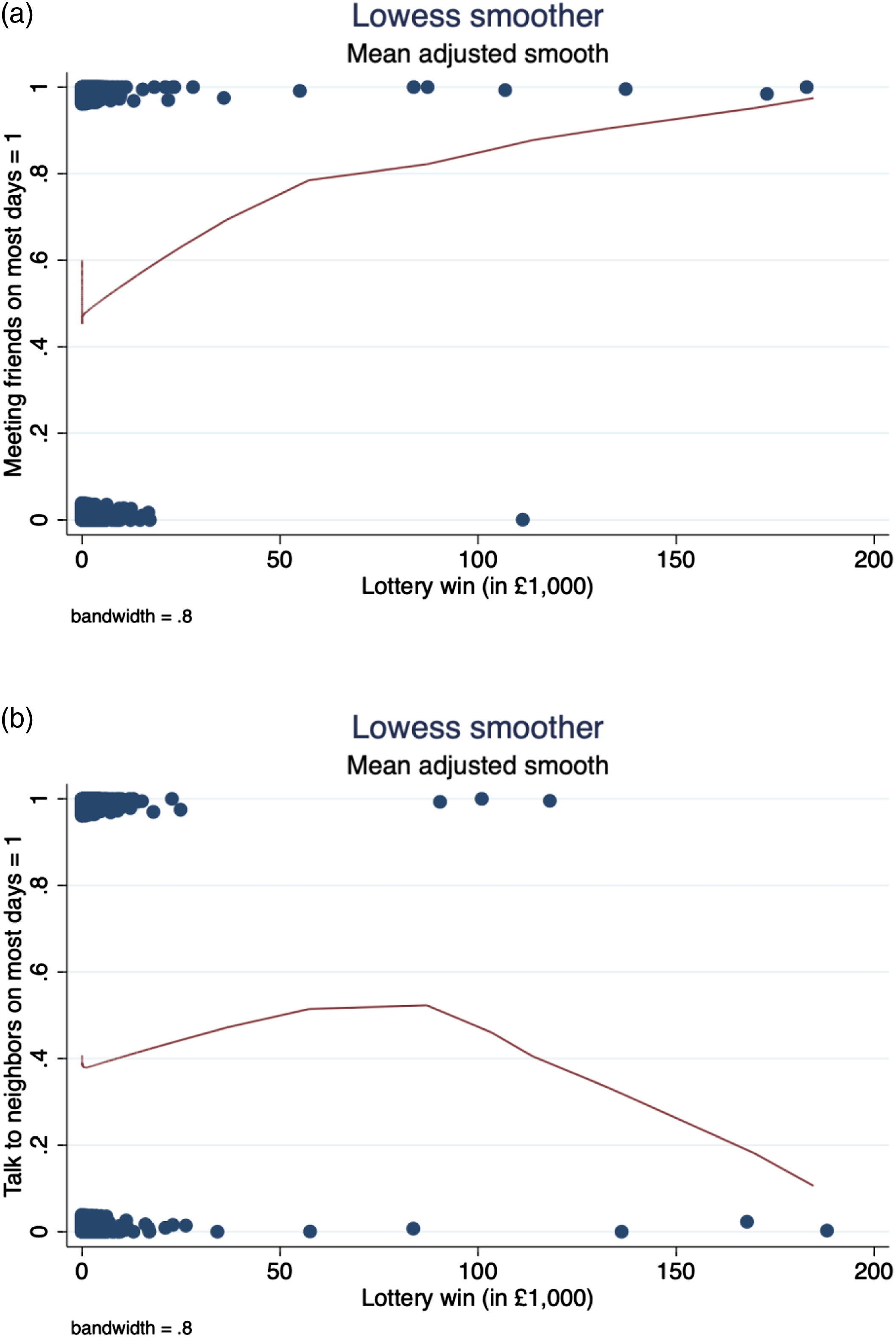
p-values of the lottery win coefficient obtained from randomization inference estimation.
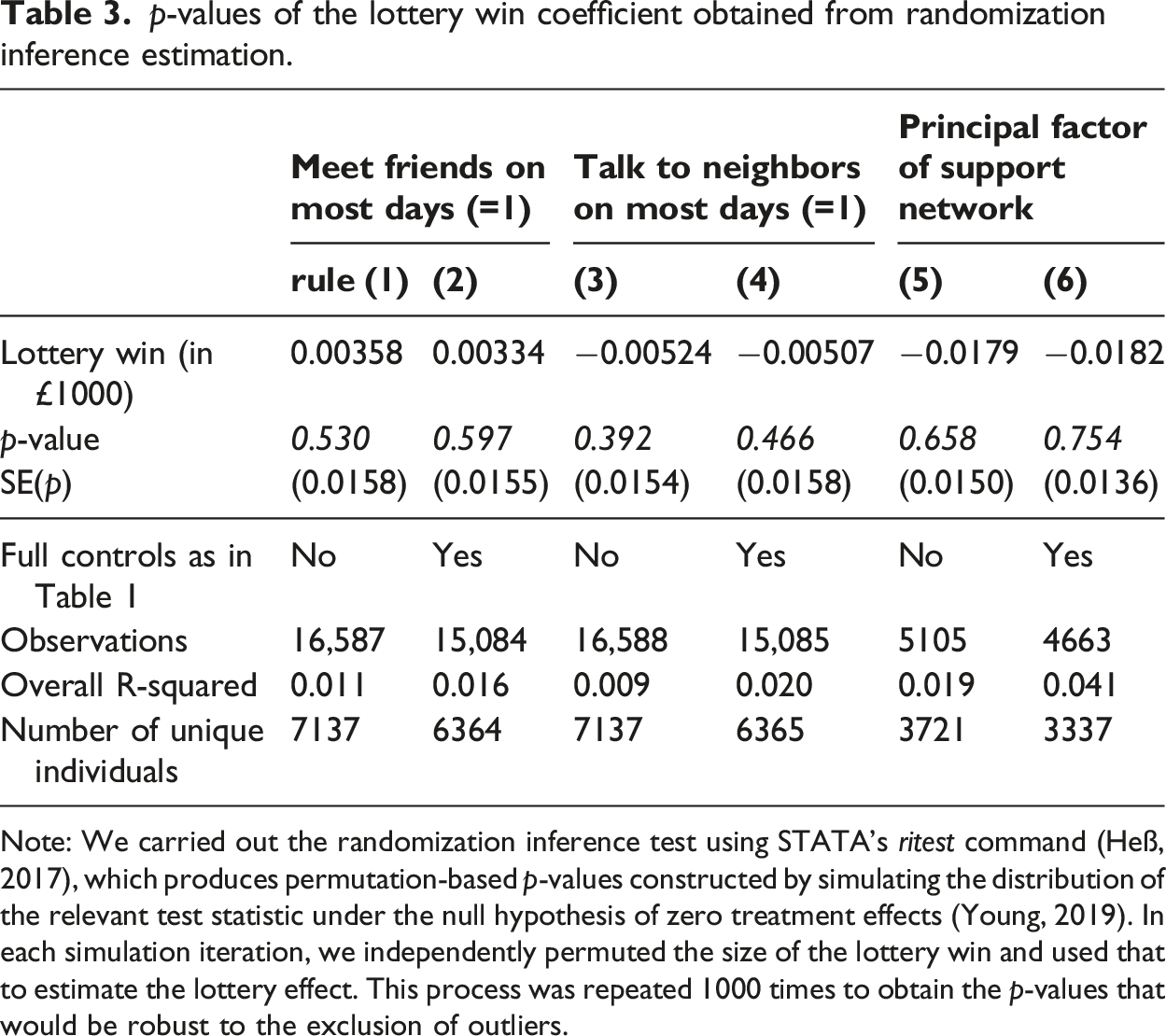
Note: We carried out the randomization inference test using STATA’s ritest command (Heß, 2017), which produces permutation-based p-values constructed by simulating the distribution of the relevant test statistic under the null hypothesis of zero treatment effects (Young, 2019). In each simulation iteration, we independently permuted the size of the lottery win and used that to estimate the lottery effect. This process was repeated 1000 times to obtain the p-values that would be robust to the exclusion of outliers.
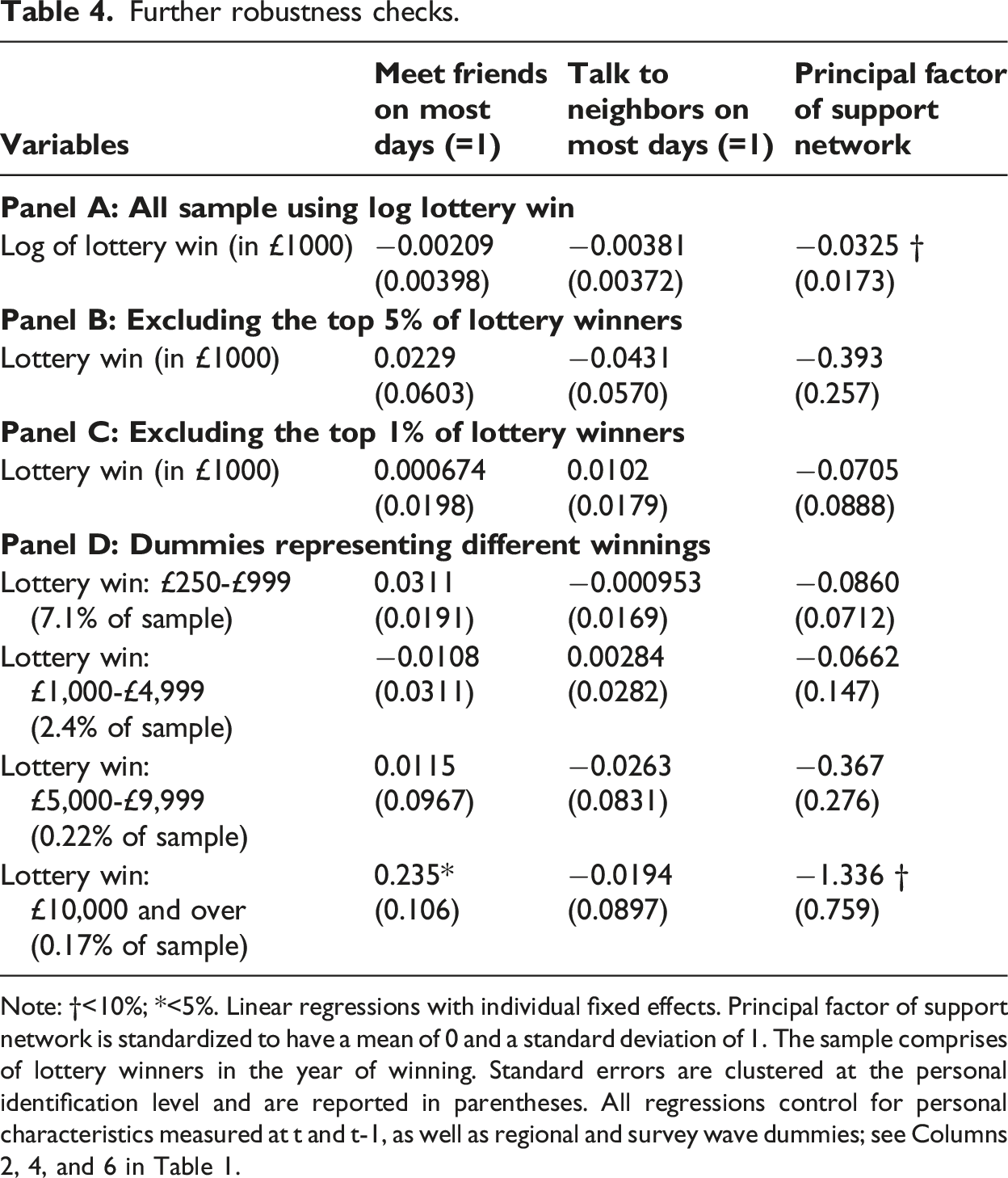
Further robustness checks.
Note: †<10%; *<5%. Linear regressions with individual fixed effects. Principal factor of support network is standardized to have a mean of 0 and a standard deviation of 1. The sample comprises of lottery winners in the year of winning. Standard errors are clustered at the personal identification level and are reported in parentheses. All regressions control for personal characteristics measured at t and t-1, as well as regional and survey wave dummies; see Columns 2, 4, and 6 in Table 1.
Table 4 provides several more checks on the outlier effects, which include (i) replacing level lottery win with log lottery win; (ii) excluding the top 5% and, subsequently, 1% of lottery winners from the estimation; and (iii) splitting lottery win into different winning categories and estimating them as dummy variables. Here, we can find in Panel A that a logarithmized lottery win, which ultimately gives less weight to the big winners in the sample, does not increase (decrease) the probability of meeting friends (talking to neighbours) on most days in a statistically meaningful way. Similarly, we find little evidence in Panels B and C that lottery wins substantially increase (decrease) the probability of meeting friends (talking to neighbours) on most days once we exclude the top 5% -- or even the top 1% -- winners from the sample. 7 Finally, Panel D shows that only individuals with a win of £10,000 or more in the lottery (0.17% of the entire lottery winner sample) report a statistically significantly higher probability of meeting friends on most days – the estimated coefficient on winning at least £10,000 in the “meet with friends on most days” equation is 0.235 with a standard error of 0.106 – and lower probability of having a good support network – the estimated coefficient on winning at least £10,000 in the factor of support network equation is −1.336 with a standard error of 0.759.
Based on these statistical tests, we have evidence to suggest that, while money buys more time with friends and less time with people who we might only maintain the relationship purely for instrumental reasons, the effects are driven by those who had just experienced a very large income shock. A small to medium-sized win (<£10k) may not be enough to change people’s social ties and support network in a substantial way. Small gains are absorbed into more common monetary allocation and do not alter in a significant way individuals’ behaviour, in fact, individuals might not even share information of small lottery wins among their networks.
Conclusions
This paper has studied the effect of a lottery win on the strength of social ties and contact with friends and neighbours, as well as reliance on informal support networks. We first document that a lottery win increases the likelihood of meeting friends on most days, which is consistent with the hypothesis that a positive income shock helps individuals strengthen their social ties (and possibly allows them to make new ones).
Our analysis, on the other hand, suggests that income replaces the strength of instrumental social ties such as neighbours, as well as an individual's reliance on their support network, which is in line with the hypothesised resource constraint theory (consistent with
Further robustness checks of the initial findings, however, indicate that the average treatment effects are primarily driven by a large winning, e.g., a win of at least £10,000. Given that most people already meet friends and talk to their neighbours on a regular basis, and/or that a small to medium-sized lottery win is unlikely to significantly alter people’s social lives. In fact, our findings can be explained by a strategically different reaction to the specific effect of lottery wins on changing one’s social network, as well as the fact that information about small lottery wins may be kept private due to insignificant variations in wealth, and only large wealth shocks are noticed due to changes in relevant consumption patterns. Nonetheless, given the very small number of big lottery winners in the nationally representative BHPS sample, future research may require a much larger sample of big lottery winners to get a better estimate of the location of the turning point.
To detect the effects of smaller wins on social ties as hypothesized (by
Supplemental Material
Supplemental Material - Does money strengthen our social ties? Longitudinal evidence of lottery winners
Supplemental Material for Does money strengthen our social ties? Longitudinal evidence of lottery winners by Joan Costa Font and Nattavudh Powdthaveez in Rationality and Society
Footnotes
Declaration of conflicting interests
The author(s) declared no potential conflicts of interest with respect to the research, authorship, and/or publication of this article.
Funding
The author(s) received no financial support for the research, authorship, and/or publication of this article.

Supplemental Material
Supplemental Material for this article is available online.
Notes
References
Supplementary Material
Please find the following supplemental material available below.
For Open Access articles published under a Creative Commons License, all supplemental material carries the same license as the article it is associated with.
For non-Open Access articles published, all supplemental material carries a non-exclusive license, and permission requests for re-use of supplemental material or any part of supplemental material shall be sent directly to the copyright owner as specified in the copyright notice associated with the article.
