




Abstract
This article offers a moral economic critique of the transition to a market economy in the post-Soviet space. In a reversal of the classical ideal of a ‘free market’ (a market free from land rent, monopoly rent and interest), neoliberalism celebrates and promotes rent extraction, sometimes over wealth creation (Hudson, 2017). In freeing markets from government regulation, neoliberalism enables powerful economic actors to extract income by mere virtue of property rights that entitle them to a stream of income from their ownership and control of scarce assets (Sayer, 2015). Neoliberalism has created and expanded the role of rent and unearned income in post-Soviet economies (Mihalyi & Szelenyi, 2017). This article will show the diversity and significance of rent in Kazakhstan and Kyrgyzstan that go beyond natural resources and illicit public and private rent-seeking. Using three case studies on finance, real estate and the judiciary in Kazakhstan and Kyrgyzstan, this article will examine how property relations, rentier activities and unearned income have been morally justified and normalized. Despite its moral legitimation, rentiership has been harmful and damaging. It has produced social inequalities and suffering, and has resulted in plutocracy and corruption.
This article offers a moral economic critique of the transition from a planned economy to a ‘free market’ capitalism in post-Soviet Central Asia. Neoliberal economic reforms created and promoted rentier activities that allowed elites to extract income based on the ownership and control of scarce assets (Hudson, 2014: 437; Sayer, 2015: 18). These reforms also produced social inequalities, injustice and suffering (Sanghera, 2016; Satybaldieva, 2015; 2018a). Western development agencies, international financial institutions and post-Soviet states have played a key role in creating and facilitating the rights of those who own and control rent-generating assets at the expense of others who need and want those assets, but lack them (Marcuse, 1996; Mihalyi & Szelenyi, 2017).
There is a consensus in political-economic scholarship that after the collapse of the Soviet Union, post-communist economies were structurally transformed during the 1990s by liberal economic reforms (Pomfret, 2019; Myant & Drahokoupil, 2011). Russia, Kazakhstan and Kyrgyzstan underwent a rapid and radical transition to a market economy, the so-called ‘shock-therapy.’ After 2000, Russia has been driven by two parallel impulses, one rooted in neoliberal principles, and the other in a strategic statism (Wood, 2018). Other countries, such as Uzbekistan, Belarus and Azerbaijan, were more cautious and gradual in introducing market reforms. After the ‘color revolutions’ in 2003–2004, Georgia and Ukraine accelerated the process of liberalization, de-regulation and privatization (Yurchenko, 2018).
It is indisputable that after three decades of neoliberal changes, post-communist economies have moved in the direction of capitalism (Appel & Orenstein, 2018). But this does not mean that capitalism is the most useful or accurate descriptor of the post-Soviet economies’ overall transformation. While it is correct that capital accumulation through the production of new commodities using privately owned capital goods and wage-labor has become more significant, it does not explain the dominance and dynamics of finance and real estate (Hudson, 2014: 397–398). In these sectors, profits are accrued through the ownership and control of existing assets, rather than through new commodities. Individuals who extract income based on existing assets are called rentiers, not capitalists.
Neoliberalization offers another description of post-Soviet economies. As a political project, neoliberalism tends to judge all economic activities in terms of profitability, and all social activities in terms of their contribution to capital accumulation (Jessop, 2012). This description is not wrong, but imprecise to explain the significance and role of rent-bearing assets relative to wealth-producing capital (Mihalyi & Szelenyi, 2017). Neoliberalism elides a vital distinction between earned and unearned income that was important in classical political economy (Sayer, 2015: 134; Tawney, 1921). Furthermore struggles over surplus value involve not merely unequal social relationships between capital and labor, but between the property-owning class and the propertyless.
This article will suggest that rentierism offers a better understanding of the transformation in post-communist economies. The rentier class generates income (or rent) through the ownership and control of scarce assets, such as credit money, shares, real estate, natural resources, radio spectrum and intellectual property. Big rentiers include commercial banks, institutional investors, property developers, energy corporations, telecommunication companies and natural monopolies. Petty rentiers include ordinary savers, individual shareholders, small landowners and local hoteliers. Rentierism is a diverse, complex and variegated process, and the state plays a key role in how it unfolds in specific moments (Christophers, 2019; Andreucci et al., 2017).
Rentiers’ ability to extract rent depends on having some degree of monopoly over access to resources that others need or want but lack. While there are clear cut cases of rent extraction (e.g. landownership), many other cases of economic rent are fuzzy, because it is difficult to estimate what price and income would be in the absence of monopoly (Sayer, 2020). The existence of some unclear cases does not mean the absence of any clear cases. This article will focus on three of the most egregious forms of income extraction (interest, rent and capital gains) arising from newly created property and rent relations in the post-Soviet space.
In political science, international relations and post-socialism studies, the discussion on rentierism tends to be limited. First, rentierism typically focuses on natural resources only. For instance, in assessing the performance of the Kazakhstani economy, Pomfret (2019: 42) writes: ‘[C]entral planning appeared to be being replaced by a rentier economy in which insiders lived off the resource rents rather than generating new output.’ Second, the extant literature usually emphasizes public rent-seeking. Political elites and state officials are often accused of using their power and positions to extract bribes from investors, and then siphon off money abroad (Engvall, 2014; Cooley & Heathershaw, 2017). This article will show other forms of rent and rentierism that involve non-resource assets and legal extraction by businesses.
Hudson (2014: 154) argues that rentierism is a form of neo-feudalism, in that privileged and powerful groups can monopolize key resources, and then can charge others to access them. Rentiers undertake no useful work, and depend on others to produce a surplus value, part of which is extracted as economic rent. They receive payments by mere virtue of having property rights over scarce assets that others need or want. Although their income is legal, it is unearned, and is a deadweight loss to society (Sayer, 2015: 82). Furthermore high rent charges and interest payments can result in many people becoming indebted and entrapped in legal and moral obligations (Graeber, 2011).
In his book The Road to Serfdom, Hayek (1944) claimed that state socialism would lead to a loss of economic and political freedoms, and eventually to tyranny. He explained that state planning could not totally or successfully coordinate economic activities, even after taking away people’s liberties. After the collapse of the Soviet Union, proponents of free markets celebrated and promoted Hayek’s ideas. His advocacy of free markets helped to justify neoliberal economic reforms (Murrell, 1993). But it is ironic that neoliberalism created and facilitated rent extraction in post-Soviet economies, and concentrated wealth and power in the hands of economic and political elites, or oligarchs (Mihalyi & Szelenyi, 2017). In so doing, it produced plutocracy, and constructed another road to serfdom (Hudson, 2014: 440; Standing, 2016).
Drawing on three qualitative case studies on finance, real estate and the judiciary in Kazakhstan and Kyrgyzstan, this article will examine how banks, property developers, judges, state officials and international agencies morally construed, justified and evaluated property and rent relations. The topics of banking, property development and the judiciary can provide important insights into how some egregious forms of income extraction have been created, expanded and legitimized in the post-Soviet space. These studies use the moral economy perspective to understand how moral norms, rights and discourses shape and are shaped by economic practices.
This article is divided into five sections. The first section will examine the theoretical ideas on the moral economy and rentiership. Section two will discuss the different forms of rent and rentierism in Central Asian economies, and the significance of rent in Kazakhstan and Kyrgyzstan. In section three, the authors will briefly describe the research design and methods of the three case studies. The fourth section will analyze the data from the three case studies on how banks, property developers, judges and the state understood and shaped property and rent relations. Finally the conclusion will draw out several theoretical points arising from the findings, and will suggest how this article has contributed to the scholarship on the moral economy and post-socialism.
The moral economy and rentiers
The moral economy
‘Moral economy’ refers to how moral sentiments, norms, rules and discourses shape economic practices and institutions, and the way these are reinforced, compromised or overridden by economic power and pressures (Sayer, 2007). In this sense, all economies are ‘moral’ economies (Keat, 2000). After the collapse of the Soviet Union, economic pressures and market values penetrated into many social spheres. Nevertheless moral values remained important in shaping social practices, in particular in professional, family, business and political spheres (Mandel & Humphrey, 2002; Hann, 2018; Sanghera & Iliasov, 2008; Sanghera & Satybaldieva, 2009; Sanghera, Ablezova & Botoeva, 2011; Sanghera & Satybaldieva, 2012; Satybaldieva, 2015).
In addition to being an object of study, moral economy is a kind of inquiry that embraces both analytical and normative modes. In analytical mode, it refers to ‘the study of the ways in which economic activities, in the broad sense, are influenced by moral-political norms and sentiments, and how, conversely, those norms are compromised by economic forces’ (Sayer, 2000: 80). Normative features do not merely regularize and normalize economic activities, they justify and rationalize who should do, get or control what (Sayer, 2018). For instance, Whyte and Wiegratz (2016) and Rudnyckyj and Osella (2017) examine how fraudulent and religious money-making practices are legitimized and de-politicized.
In normative mode, the perspective evaluates economic institutions and relations in terms of their effects on people’s lives (Sayer, 2000). While economic practices can be shaped by meanings and motivations, they have innumerable unintended (negative, positive and perverse) consequences. In recognizing how economic arrangements affect human flourishing and suffering, social analysis cannot avoid normative implications (Sayer, 2007). For example, Graeber (2011) and Hudson (2018) challenge the fairness, legitimacy and justifications for debt repayments when they cause so much social misery and economic damage. Ethical evaluation is as important as understanding and explaining moral influences.
An economy consists of social relations between people, such as employer-employee, landowner-tenant, lender-borrower, buyer-seller, state-citizen and donor-recipient. Economic relations include but go beyond market relations. These relations involve economic dependency, which can be a source of mutual respect, dignity and care as well as domination, exploitation and harm. Moral economy examines whether social relations are justifiable or not, and whether they produce flourishing or suffering (Sayer, 2015: 19–20).
Neoliberal economic reforms tend to promote forms of economic dependence that allow the strong to take advantage of the weak. They produce shifts in the balance of power in social relations, enabling those who own and control key assets (such as land and money) to extract income from others who lack them, but need or want to use them (Sayer, 2015: 44; Sanghera, 2016). Owners’ income is dependent on others to produce goods and services, and to generate a surplus, which is partly siphoned off through rent, interest, dividends and capital gains (Hudson, 2014: 432).
Hobson (1937) and Tawney (1921) make an important moral economic distinction between property and ‘improperty.’ The former is actively used by owners to provide goods or services that would not otherwise exist. The latter is used by owners not as a means of production or ‘means of work but as an instrument for the acquisition of gain’ (Tawney, 1921: 65–66). These owners obtain income not based on work (i.e. earned income), but by virtue of property rights that entitle them to use assets to extract payments. This form of income is asset-based and unearned, reflecting owners’ power over existing assets and their lack of contribution to the production of new goods or services (Sayer, 2015: 44–45).
While from an analytical point of view it is vital to distinguish earned from unearned income and property from ‘improperty,’ many enterprises are hybrids, and have both aspects (Sayer, 2020). For instance, the production and maintenance of petrol stations and shopping malls are clearly productive, in that they involve work, and provide useful commodities. But once stations and malls acquire a significant degree of (spatial) monopoly, they become sources of rent, extracting income without contributing anything more. A dividing line between profit and rent can be fuzzy at the level of individual hybrid enterprises, whose pursuit of profit maximization can appear to remove the contradiction between wealth creation and income extraction. But the contradiction is significant at a system level, with rent being a deadweight cost on the economy.
A private property rights regime is important in shaping and naturalizing moral economies. Marcuse (1996: 136) observes that in the Soviet Union ‘that part of the bundle of rights that is the right to dispose at a profit, or the right to speculate, did not exist in Soviet law.’ Rent, interest and speculative gains were ‘non-labor’ income, and were condemned and not permitted. After the collapse of the Soviet Union, constitutions and legislations provided the protection of private property and its disposition by its owners free of state control. The re-bundling of rights to allow property owners to dispose of their assets without state restrictions was explained and justified by international financial institutions as how ‘free markets’ work.
Under neoliberalism, the judiciary becomes an important site of struggle for the ownership and control of existing assets, and the ability to extract economic rent (Sanghera, 2020). It can create unequal social relations between people in the economy in terms of differential rights, responsibilities and access to resources. Judges have ‘world-making’ powers, naming and titling objects in cases of private property ownership (Bourdieu, 1987). The juridical language creates a universalizing attitude, designed to express the generality of the rule of law.
But the rhetoric of neutrality and universality masks the ideological neoliberal bias towards moral individualism and the market economy. Legal judgments often ratify and sanctify the doxic view of social divisions and classifications (Bourdieu, 1987). Frederic Bastiat (1996: 130) describes how wealth extraction involves legal and moral resources: ‘When plunder has become a way of life for a group of men living together in society, they create for themselves in the course of time a legal system that authorizes it and a moral code that glorifies it.’
The rentier class
In classical political economy, landowners and financiers were depicted as passive and useless individuals, who added empty pricing to the cost of living and doing business. They extracted economic rent without effort or justice by virtue of having property rights that entitled them to an income. Adam Smith (1776) observed: ‘As soon as the land of any country has all become private property, the landlords, like all other men, love to reap where they never sowed, and demand a rent even for its natural produce’ (book 1, chapter 6, section 8). Landowners did not work, but depended on tenants and farmers to produce a surplus, part of which was extracted as rent. It was unearned income.
John Stuart Mill (1848) also criticized landowners: ‘[The landlords] grow richer, as it were in their sleep, without working, risking or economizing. What claim have they, on the general principle of social justice, to this accession of riches?’ (book 5, chapter 2, section 5). Landowners were viewed as idle and unproductive, undeserving of their income. In contrast, capitalists and workers were characterized as entrepreneurial and productive, because they contributed to wealth creation by producing new commodities.
John Maynard Keynes (1936: book 6, chapter 24, section 2) made similar remarks in his criticisms on financiers: ‘Interest today rewards no genuine sacrifice, any more than does the rent of land. The owner of capital can obtain interest because capital is scarce, just as the owner of land can obtain rent because land is scarce.’ Landowners and financiers extracted income merely on the basis of their ownership of scarce assets. In advocating ‘the euthanasia of the rentier, of the functionless investor’ (ibid.), Keynes recognized that they just added costs to the production of goods and services, thereby damaging the economy’s competitiveness.
In the nineteenth and early twentieth centuries, classical economists sought to free their societies from the legacies of feudalism (Hudson, 2014: 409). Their aim was to free society from special privileges (especially trading monopolies, landed aristocracy and financiers) that extracted unearned income. Their version of free markets meant markets free of rent. They supported measures to bring market prices in line with cost-value, and to make societies more productive and efficient. It was a strategy to achieve both moral fairness and economic competitiveness in pricing commodities (Hudson, 2014: 190).
The intended beneficiaries of reforms to minimize economic rents were industry and labor (Hudson, 2014: 442). Basic infrastructure (such as housing, transport, health care, energy, water and telecommunication) was to be provided at cost prices. This required a strong government to tax and check the vested financial, real estate and monopoly interests. Limiting the power of the rentier class involved political will and forces, including capitalists and trade unions.
Regulating prices were denounced by Austrian economists as ill-conceived statism that would put society on a path to serfdom (Hayek, 1944). Their notion of a free market was opposite to classical economists’ idea. They argued that markets should be free of state control. Public regulation and state planning were assumed to be burdensome and ineffectual, and private firms were viewed as creative entrepreneurs, who alone knew how to allocate resources. In privatizing basic infrastructure and natural monopolies, companies were free to extract rent. Neoliberal free-market economics had little resemblance to classical economists’ program (Hudson, 2014: 41–42).
In reviving the classical idea of free markets, the state comes to have a significant role in the economy. Andreucci et al. (2017) argue that the state is a site of social struggle over the institutionalization and enforcement of rent relations, and the appropriation and distribution of surplus value. Depending on class balances at specific moments, the state can facilitate value grabbing by rentiers. Mihalyi and Szelenyi (2017) explain how post-Soviet oligarchs captured states, and in the process amassed huge wealth and power. Some post-Soviet states have sought to regulate charges for basic goods, partly in response to rising social tensions and protests about high prices and debt, and partly in an effort to develop more productive and competitive economies (Satybaldieva & Sanghera, forthcoming). As Jessop (2002) notes, the modern state is responsible for securing key conditions for the valorization of capital, and maintaining social cohesion in a divided society.
The rentierisation of Central Asian economies
Forms of rent and rentierism in Central Asian economies
Rent and rentierism come in different forms, and their diversity is crucial to understand the nature of the post-Soviet Central Asian economies. There are several core forms (Tawney, 1921; Sayer, 2015: 18; Christophers, 2019). First, financial rents can consist of interest income, dividends and capital gains derived from financial assets. Financial rentiers can create and allocate credit money, and can acquire financial assets (e.g. bonds and shares) in primary and secondary markets. International financial actors, including the European Bank of Reconstruction and Development, promoted and facilitated the growth of bank and micro-lending in the post-Soviet space (Guseva, 2005; Ruziev & Dow, 2013; Charman, 2007).
Second, land rents can comprise ground and housing rent and capital gains based on ownership and control of land and real estate (especially residential apartments and office buildings). Landowners’ ability to extract income depends on the scarcity and attractiveness of landed property. The de-regulation and privatization of housing and land were significant in creating land rents in post-Soviet economies (Marcuse, 1996). Private property rights were re-bundled to remove regulatory controls on rent and multiple holdings.
Third, natural resource rents involve extracting income based on naturally occurring resources, including energy products (oil, gas and coal) and other minerals (metal ores, stones, sands and salts). The owner of natural resources can be either the state or a private body. The owner can sign a leasing agreement with a non-owner, often a foreign actor, who is given the exclusive right to develop and extract the resource, and thereby generate rent, for a fixed time period. The state itself can also act as a rentier, and Kazakhstan, Turkmenistan and Azerbaijan are often called rentier states, because they receive substantial rents from natural resources (Franke, Gawrich & Alakbarov, 2009).
Fourth, natural monopoly rents occur when natural monopolies can charge excessive prices for their commodities because they are free from competition. Natural monopolies can use their market power to obtain economic rent. In post-Soviet countries, the privatization of public utilities, such as gas, electricity, water and fixed line telephony, was often followed by price hikes (Appel & Orenstein, 2018). Wooden (2014) observes how an increase in electricity tariffs sparked protests in Kyrgyzstan, resulting in the 2010 political uprising.
Fifth, spectrum rents are based on income from audio and television broadcasting and the provision of mobile telephony and internet services. The radio spectrum refers to a range of frequencies of electromagnetic energy that can be used for various types of communication (Christophers, 2019). It is often likened to land. As the owner of the radio spectrum, the state licenses exclusive rights to a third-party to use certain frequencies for particular purposes over specified geographical areas. This enables licensees to generate revenues, which constitute rents derived from exclusive commercial control of a scarce asset.
Pomfret (2019) observes that the construction and maintenance of mobile phone networks may be the second-largest area of foreign direct investment in Central Asia after oil and gas. The huge potential to extract economic rent means that foreign investors are willing to spend money, and often bribe state officials, to obtain licenses.
Sixth, intellectual property rents include income from patents, trademarks and copyright. Patents feature significantly in the pharmaceutical and biotechnology sectors, trademarks are widespread in the consumer product industry; and copyright underwrites much of the entertainment and publishing sectors (Christophers, 2019). Rents can either arise from the owner exploiting the intellectual property, or the owner licensing the rights to a third party. But the protection and enforcement of intellectual property rights tend to be weak in post-Soviet economies, resulting in an illicit and lucrative trade in counterfeit and pirated goods.
Seventh, contract rents occur when organizations outsource activities by awarding contracts to other companies for the services to be provided. These contracts become prized assets for companies delivering the services, because they guarantee income for a fixed period of time. For example, Toktomushev (2015) describes how a US Department of Defense agency awarded lucrative contracts to local companies to supply jet fuel to its air base in Kyrgyzstan. This afforded the political regime and business elites with opportunities for rent-seeking and siphoning off funds to tax havens.
Eighth, platform rents are revenues generated for owners of digital platforms, such as Google and Booking.com. There are two types of revenues: advertising on platforms, and fees and commissions levied on transactions initiated through the platform. Christophers (2019) observes that the platform’s scarcity is neither inherent (e.g. land), nor state prescribed (e.g. radio spectrum), rather it is a feature of the business to monopolize a specific sector, so that there is only one Google and one Amazon. While digital platforms are growing in Central Asia, they are not developed as in the Global North. Western and Russian companies, such as WhatsApp and Mail.ru, dominate the platform economy.
Christophers (2019) argues that despite the different forms of rents, rentiers’ strategy is the same: acquire and extract value from scarce assets. Mihalyi and Szelenyi (2017) describe how many post-Soviet oligarchs captured valuable assets and resources to become rentiers, largely as a result of privatization, patronage and corruption. In his sample of Russian oligarchs, Braguinsky (2009) distinguishes between ‘insiders’ and ‘outsiders.’ The former were managers of Soviet enterprises prior to 1991, members of the nomenklatura, and relatives or close colleagues of people in the first two groups. The latter had no ties to the previous system. Insider oligarchs initially dominated large-scale industrial sectors, such as natural resources and engineering. Nearly half of them made their wealth based on controlling Russia’s oil, gas and minerals, and extracting natural resource rents. In contrast, outsider oligarchs made their initial fortunes in service sectors, such as banking, consumer goods and the media. Almost half of them derived their wealth based on controlling finance and banking, establishing their own banks and investment companies, and appropriating financial rents.
While the nature of rentiership is similar across the world, there are some specificities in Central Asia and the wider post-Soviet space. First, rentiership was largely absent during the Soviet Union (Marcuse, 1996). International financial institutions’ neoliberal reforms helped to create, legitimize and promote rentiership in post-Soviet economies, as the case studies below will show. Second, many early rentiers had occupied privileged political and economic positions during the Soviet Union (Braguinsky, 2009). They used their knowledge and power to quickly, and in some cases discreetly, acquire valuable resources and assets.
Third, many later acquisitions were characterized by nepotism, patronage, fraudulent privatization, corruption, violence and criminality (McGlinchey, 2011). In some cases, political and business elites engaged in corporate raiding, seizing lucrative businesses with the aid of corrupt law enforcement officials and judges. In Kyrgyzstan political elites also used intimidation and violence to transfer the ownership and control of valuable assets.
Fourth, Central Asia is rich in natural resources, and the sector is a significant source of rent (Franke, Gawrich & Alakbarov, 2009). However, though barely acknowledged in the literature on Central Asia, finance and real estate have emerged as key sectors too for income extraction, as will be shown in the next sub-section.
The significance of rent in Kazakhstan and Kyrgyzstan
Christophers (2019) observes that while the significance of rent in the economy cannot be accurately measured, it is possible to assess it in a sufficiently meaningful way to draw out some conclusions about the relative importance of rent and rentiers. Using a range of open sources, this sub-section will examine the nature and extent of rent among the richest individuals in Kazakhstan and Kyrgyzstan.
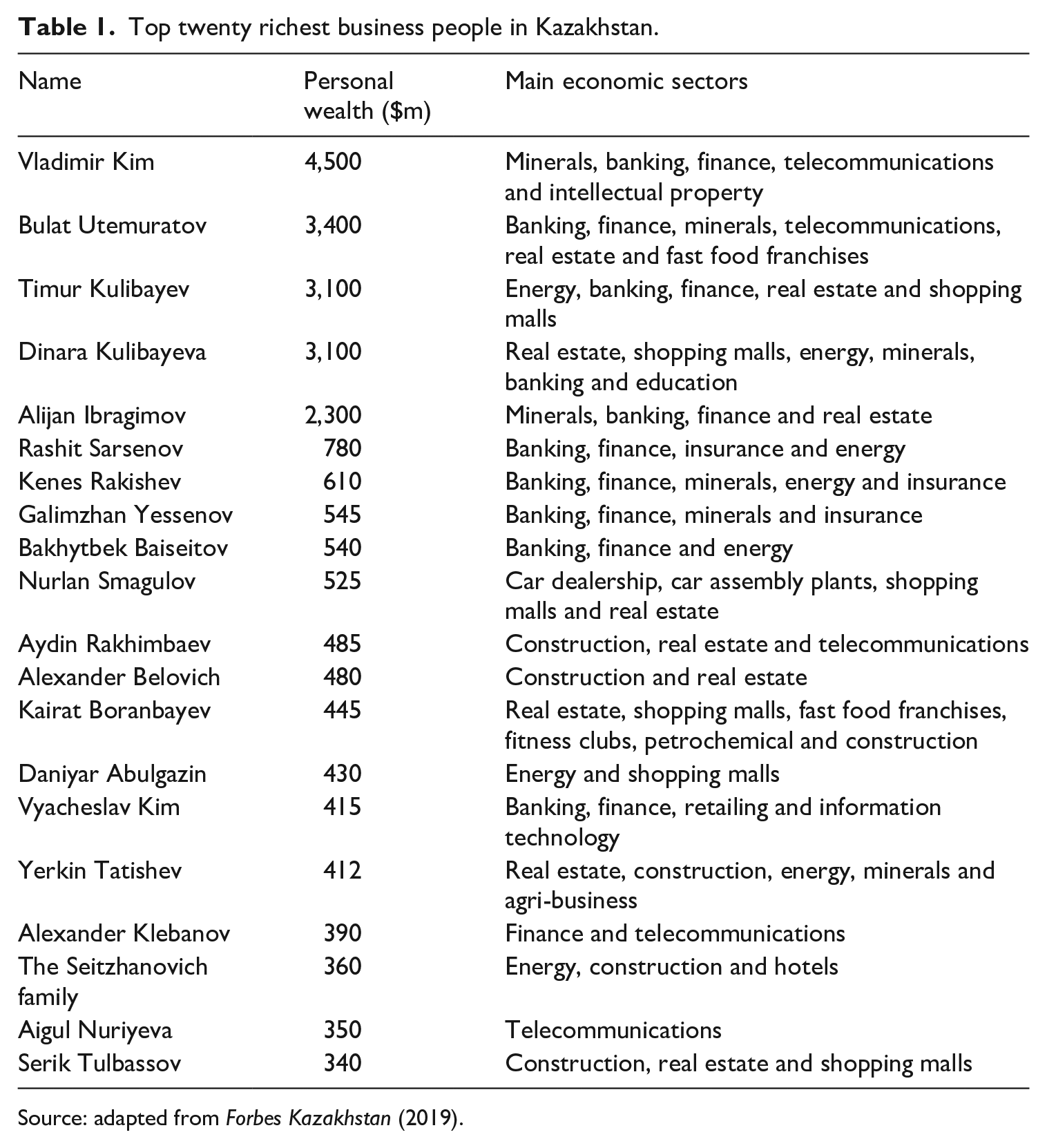
Table 1 shows the top twenty richest business people in 2018 in Kazakhstan according to Forbes’ ranking. It details their estimated wealth, and which sectors of the economy their companies operated in. Data was formed from public sources and financial information provided by each person. The evaluation of the total value of their assets was conservative; i.e. not less than the estimated figure. The list does not include citizens of other countries who have substantial wealth in Kazakhstan.
Top twenty richest business people in Kazakhstan.
Source: adapted from Forbes Kazakhstan (2019).
Unearned income occurred in two ways: shares in companies entitled owners to dividends, profit and capital gains; and companies extracted specific forms of rent depending on the economic sector. All but one on the rich list had two or more forms of rent. They owned multiple companies, and many participated in several sectors.
The financialization of the economy and the scarcity of land have been important for the rentier class (Hudson, 2014: 188; Sayer, 2015: 172). Of the twenty richest individuals, ten extracted income through banking activities, in particular creating and lending credit money, as will be discussed in the first case study below. The same number siphoned off income through managing a broad range of financial assets and services. Ten business people had property companies that extracted rent through the ownership and control of residential and commercial real estate. There were six property developers, who facilitated and participated in rentier activities.
Given the abundance of natural resources in Kazakhstan, energy and minerals have been significant sources of rent for wealthy individuals (Franke, Gawrich & Alakbarov, 2009). Eight business people wholly or partly owned companies that had leasing rights to extract and/or distribute oil and gas. Owning petrol stations allowed some individuals to have a degree of control of the local market, and make quasi-monopoly rent. Seven on the list were involved in the mining sector.
The shift to a market economy has seen retail trade and consumption boom in post-Soviet countries. Shopping malls, retail centers and marketplaces are a significant source of economic rent for owners. They are often located in prime sites, giving owners spatial monopoly power, and retail units are usually leased to companies and traders (Spector, 2017). Six individuals on the rich list owned several high-end shopping malls. Moreover three business people had a degree of local monopoly power in specific retail markets – cars and fast food.
Some forms of rent have become more important because of technological change and innovation (Christophers, 2019). Five wealthy individuals owned telecommunication companies, which had exclusive rights to provide broadband internet access services and mobile networks. Their commercial control of the radio spectrum enabled them to extract rent.
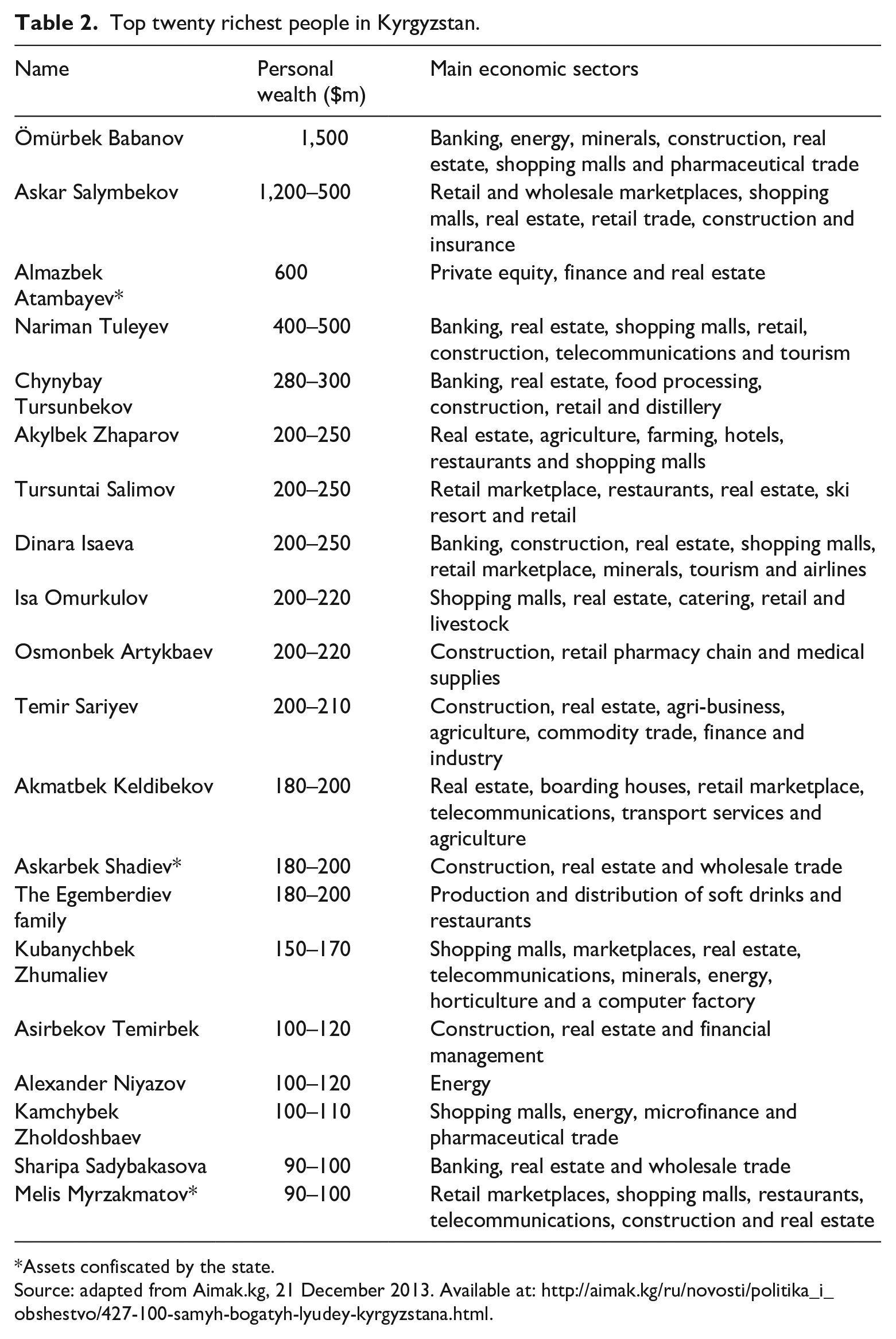
Table 2 shows the top twenty richest people in Kyrgyzstan. The list was adapted from a 2013 ranking of the top hundred richest people in the country. The table details their estimated wealth, and which sectors of the economy their companies operated in. Data was formed from a range of open sources, including newspapers and media platforms (e.g. Vecherniy Bishkek, Kloop.kg, Sputnik.kg, Gezitter.org, Stan Radar and Beli Parus). The list only includes Kyrgyzstani citizens.
Top twenty richest people in Kyrgyzstan.
Assets confiscated by the state.
Source: adapted from Aimak.kg, 21 December 2013. Available at: http://aimak.kg/ru/novosti/politika_i_obshestvo/427-100-samyh-bogatyh-lyudey-kyrgyzstana.html.
There are three caveats to the table. First, most people on the list have held public office, and they have tried to hide their true financial situation. It is widely believed that fraud, corruption, plunder and other illegal and illicit activities have helped them to acquire valuable assets and income (Engvall, 2014; McGlinchey, 2011; Cooley & Heathershaw, 2017). There have been many criminal investigations, and in some cases, the state has confiscated their assets.
Second, some names from the 2013 ranking have been omitted, because there was insufficient information on their wealth. Third, most individuals on the list have declared themselves to be honest, hard-working and not rich. Their assets are often held either by close family members, or holding companies, which are usually secretive about their true owners (Cooley & Sharman, 2015). Through careful investigation of open sources, it has been possible to identify what assets the rich and their close relatives have. The table offers some valuable insights into the broad range of rents in the country. All but two on the rich list had multiple forms of rent.
For the rentier class in Kyrgyzstan, as in Kazakhstan, land and money were two major instruments to acquire wealth without doing creative work, as Tawney (1921) noted of the British rentier class. Owning real estate was the most popular way to obtain unearned income. Sixteen wealthy individuals had a substantial number of residential apartments and other properties, which were either rented or re-sold. There were ten property developers, who engaged in extractive and speculative investment in the real estate sector, as will be discussed in the second case study below. Six individuals siphoned off interest and other charges based on the ownership and control of credit money. Four persons on the rich list extracted income through other financial services, including insurance.
Shopping malls and marketplaces were important rent-generating assets for eleven wealthy individuals. Askar Salymbekov owned Dordoi Bazaar, one of the largest retail and wholesale marketplaces in Central Asia (Spector, 2017). Of the eleven individuals, several either wholly or partly owned retail marketplaces, and some were large shareholders of prestigious shopping malls. Three persons on the list had a degree of monopoly power in the pharmaceutical market through their ownership of retail chains and exclusive licenses, enabling them to extract economic rent. The Egemberdiev Family extracted income through their famous brand of ‘Shoro’ (a Kyrgyz soft drink) and control of distribution channels in the soft drinks market.
The dominance of foreign capital in the natural resource and telecommunication sectors in Kazakhstan and Kyrgyzstan (Pomfret, 2019) means that the scale of natural resource and spectrum rents is greater than shown in Tables 1 and 2, which only detail the wealth of local elites. Energy and minerals were seemingly less significant for the rentier class in Kyrgyzstan than in Kazakhstan. Energy was a source of rent for four individuals on the rich list. Two of them owned a number of petrol stations, which gave them some spatial monopoly power, especially in Bishkek.
Three wealthy individuals used minerals to extract rent. One of them had leasing rights to a gold mine. Given that about a half of foreign direct investment in the country has been directed towards the mining sector, it was surprising that that it did not appear more prominently in the table. But gold mining companies have used complex financial schemes (such as shareholding companies) to hide final beneficiaries (Doolot & Heathershaw, 2015).
Four wealthy individuals owned companies with exclusive rights to broadcast radio and television, and to provide mobile broadband. One of the largest mobile operators, Megacom, was owned by former President Bakiyev’s son, Maxim. It was later confiscated and nationalized by the state after Bakiyev’s overthrow in the 2010 uprising.
Contract rents were significant for two wealthy individuals. Ömürbek Babanov had exclusive rights to supply jet fuel to Manas Airport and the US airbase (Toktomushev, 2015). Osmonbek Artykbaev had a contract to deliver medical drugs and equipment to state hospitals and clinics throughout the country. These contracts guaranteed income for a period of time, and protected Babanov and Artykbaev from competition, thereby allowing them to receive economic rent.
Plutocracy has come to dominate much of the post-Soviet political landscape. The rentier class has largely captured the state, and political elites have often been allied to rentier interests (Mihalyi & Szelenyi, 2017; Braguinsky, 2009). Tables 1 and 2 reveal how economic and political structures have become intertwined, partly as a result of nepotism, patronage, fraud and corruption (McGlinchey, 2011). In Kyrgyzstan, several rentiers occupied powerful political positions. Ömürbek Babanov and Almazbek Atambayev were former Prime Ministers. Atambayev was also an ex-President. Nariman Tuleyev, Isa Omkurkulov, Askar Salymbekov, Melis Myrzakmatov and Dinara Isaeva’s husband were former city mayors. Some rentiers were cabinet ministers, and several were speakers and members of the Parliament.
In Kazakhstan, some rentiers were related or close to ex-President Nursultan Nazarbayev. Dinara Kulibayeva was his second eldest daughter, and her husband was Timur Kulibayev. Vladimir Kim was part of Nazarbayev’s inner political circle, and Bulat Utemuratov was for a long time the head of the presidential administration, i.e. the ‘number two’ of the state apparatus (Peyrouse, 2012). Several rentiers have benefitted from Nazarbayev’s patronage: resources and assets were distributed to them on the basis of their loyalty to the president.
In promoting neoliberalism and rentierism, Western governments and international financial institutions have helped to create and sustain the post-Soviet political landscape (see Cooley & Heathershaw, 2017 on the illicit role of international financial networks in Central Asia). One of the unintended consequences of neoliberalism has been that plutocracy, and not democracy, has tended to prevail in this region, contrary to international expectations and hopes (Hudson, 2014: 440; Standing, 2016).
While there are broad similarities in rentiership and plutocracy between Kazakhstan and Kyrgyzstan, there are some differences. First, the significance of natural resource rents has varied over time, partly in response to exogenous factors, such as global recession and political instability. In Kazakhstan the total natural resource rents as a percentage of Gross Domestic Product (GDP) was 16% in 2017 (World Bank, 2020a). At the peak of oil and gas prices in 2008, it reached 33%. But since then, it has declined as world prices started to fall.
In Kyrgyzstan the total natural resource rents as a percentage of GDP was 8% in 2017 (World Bank, 2020a). Its highest value was 12% in 2011, partly reflecting rising gold prices at the start of the 2007–2008 crisis. Its value began to drop due to operational disruptions at major gold mines as a result of economic and political uncertainties following the 2010 political uprising in the country. Migrant remittances have been more important than natural resource rents for economic development. In 2018 Kyrgyzstan’s personal remittances as a percentage of GDP was 33%, whereas Kazakhstan’s figure was 0.35% (World Bank, 2020b).
Second, the development of household credit and debt has been different in the two countries. In resource-poor Kyrgyzstan international financial institutions and development agencies created and promoted micro-credit programs, aiming to alleviate poverty through women’s empowerment, microenterprises and rural development. But interests on micro-loans were much higher than on bank loans, and many borrowers experienced a high level of indebtedness and repossession. Protests against predatory lending and financial malpractices successfully led to the government capping interest rates. Major microfinance institutions later became commercial banks.
Resource-rich Kazakhstan attracted a large share of foreign direct investment. Cheap access to global credit expanded US dollar-denominated loans in the country. Easy credit fueled a housing bubble until the 2007–2008 financial crisis, which left many mortgage-holders struggling to make repayments (Yessenova, 2010). Several construction companies and banks collapsed, and mortgage-holders called on the government to safeguard their homes. The government injected funds to stabilize the national currency against the US dollar, nationalized troubled banks, and provided some assistance to the construction sector.
Third, Kyrgyzstan and Kazakhstan have had different post-1991 political developments. Kyrgyzstan experienced the 2005 Tulip Revolution and the 2010 political uprising that removed incumbent governments by force and violence. In both cases civil society played a critical role in ousting corrupt political regimes, which had accumulated personal wealth (Reeves, 2010; McGlinchey, 2011; Cooley & Heathershaw, 2017). In light of these events, Kyrgyzstan’s elites have tended to hide or understate their wealth and assets for fear that their holdings would be perceived as corrupt or undeserved. The tendency towards rentiership and plutocracy in the country has been countered by moral criticism and social activism (Satybaldieva, 2015; 2018b).
Kazakhstan has had a relatively stable political environment. But there were several violent riots and clashes, including the 2005 Shanyrak protest over informal settlements and housing rights; and the 2011 Zhanaozen protest over union representation and workers’ rights. In both cases the protests were suppressed by state violence, and activists were arrested and imprisoned. Junisbai (2010) argues that Kazakhstan’s relative economic prosperity has shaped attitudes about economic justice. In his study, many social groups believed that economic opportunities and outcomes were largely fair and just, thereby reducing support for egalitarianism and redistributive economic policies. In this context, Kazakhstan’s elites have been less discreet about accumulating wealth or power, having little fear of moral and social scrutiny.
Research design and methods
Whereas a Weberian analysis of rent-seeking activities usually focuses on clientelist relationships, social networks and market structures, and refrains from making criticisms of rentier practices (see Mihalyi & Szelenyi, 2019), this article offers a moral economy perspective. In interviewing powerful social actors who have shaped and promoted specific forms of rent and property relations, this article aims to understand how some egregious forms of rent extraction and unearned income have been morally justified and evaluated. It examines how moral discourses, norms, rules, sentiments and rights have constituted unequal social relationships, and what were the moral ambivalence, tensions and problems around them.
Three significant forms of rent and property relations were identified in Kazakhstan and Kyrgyzstan: relationships between lenders/mortgagees and borrowers/mortgagors, property owners/sellers and tenants/buyers, and landowners and squatters. They became the focus of three qualitative case studies. This article draws on these case studies to examine how banks, property developers, judges, international financial institutions and state officials morally construed and justified property relations and rentier activities (see Sanghera, 2020; Sanghera & Satybaldieva, forthcoming for further details).
Banking, property development and the judiciary were chosen as topics of investigation because of their significance in creating, expanding and legitimizing rentiership. Interest, rent and capital gains are key forms of unearned income based on the unequal ownership and control of financial and property assets. Banks and property developers have a significant degree of monopoly over access to credit money and residential real estate that others need or want but lack. The judiciary helps to sanction and normalize the right to exclude others, and authorize and de-politicize the unequal social relationship between the powerful propertied class and the propertyless.
The first case study on finance involved 28 semi-structured interviews conducted in Almaty, Astana and Bishkek. The sample consisted of twelve banks, one microcredit company, nine international financial institutions, four government ministries and agencies, and two trade associations. The authors and four research assistants used purposive sampling to recruit participants (Bryman, 2012). They sent emails and rang banks and microfinance companies requesting their participation in the study. Then requests were made to international financial institutions, state officials and trade associations. Most of the participants were recruited in this way. The study then used snowball sampling to recruit the remaining participants (Bryman, 2012).
Many of these interviews were conducted in Russian and several in English, and each interview lasted on average 45 minutes. The interview questions examined how the financial elites and state and non-state actors evaluated lending practices, what moral discourses and norms predominated their understandings, and what economic pressures shaped their judgments. The interviewees were encouraged to discuss what were the values, beliefs, norms and rights shaping the banking sector.
The second case study on real estate consisted of 18 semi-structured interviews undertaken in Bishkek and Osh. The sample comprised six directors and senior managers of property and construction companies, and twelve senior officials of government ministries, local councils and state agencies. The authors and two research assistants sent emails and rang property developers and state officials requesting their participation in the study. Purposive sampling was used to recruit all the participants.
Most of these interviews were conducted in Russian and some in English, and each interview lasted on average 45 minutes (ranging from 30 minutes to one and a half hour). The interview questions examined how property developers and state actors interpreted and shaped residential housing, and how the state developed property and rent relations. The interviewees were encouraged to discuss what norms and rights affected these relations.
The third case study on the judiciary had a sample of 29 participants, of which sixteen were Supreme Court, city and retired senior judges, twelve high-profile and local lawyers, and one ombudsman. Semi-structured interviews were conducted in Almaty, Astana, Bishkek and Osh. One of the authors and four research assistants used purposive sampling to recruit participants. They sent emails and rang Supreme Court judges requesting their participation in the study. Then requests were made to city judges, retired judges and prominent lawyers. Over half of the participants were recruited in this way. The study then used snowball sampling to recruit the remaining participants.
These interviews were conducted in Russian, and each interview lasted on average 45 minutes. The interview questions examined how judges and lawyers evaluated land, property rights and informal settlements, and what moral norms and concerns predominated their understandings. The interviewees were encouraged to discuss what were the rights and obligations of non-legal professionals, including the local authorities, property owners and illegal settlers, and what kind of justice underpinned their evaluations.
All the interviews in the three case studies were digitally recorded, and then were transcribed and translated into English. The interviewees were assured of confidentiality, and their names have been pseudonymized. The authors read the transcripts several times to understand what themes were emerging (Silverman, 2011). While some initial codes were derived from the authors’ research agenda for each study, others emerged from the interview data. In this way, the authors avoided their preconceptions distorting their interpretation of the data (Fletcher, 2017). The codes were changed, eliminated and supplemented as the data warranted until every piece of text was coded. Some codes were re-coded into theoretical-informed categories that allowed for greater conceptual clarity. NVivo 10 computer software was used to help with coding the data (Bazeley & Jackson, 2013).
The overall research questions across the three studies were: How did banks, property developers and judges construe, evaluate and shape rent and property relations and unearned income, and what role did the state play in shaping rent relations?
Moral construals of loans, apartments and land in Kazakhstan and Kyrgyzstan
First case study: Loans and moral values
The liberalization and de-regulation of the banking sector in post-Soviet countries in the 1990s aimed to increase competition and choice in the market (Ruziev & Dow, 2013; Lane, 2001). The number of retail banks, microfinance institutions and pawnshops increased in Russia and Central Asia. Kazakhstan’s banks actively borrowed from abroad through syndicated loans, securitization and issuance of bonded debt. In the 2000s, Kazakhstan’s banking sector was the second fastest-growing sector in the economy after the oil industry (Asian Development Bank Institute, 2014).
Kyrgyzstan saw the total banking assets increased from 7.9 billion soms in 2002 to 178 billion soms in 2015 (National Bank of the Kyrgyz Republic, 2016). Global and regional financiers benefitted from lax regulation on interest rates and debt collection, enabling them to achieve high returns on equity. The average interest rate on microfinance loans was about 34% in 2014, and the country had one of the highest real interest rates in the world (National Bank of the Kyrgyz Republic, 2014).
Booth (1994) explains that liberal markets can foster moral values, including formal equality, autonomy and freedom. Market actors are free from hierarchal and ascriptive relationships, and can formally access resources in pursuit of their projects. In the first case study, several banks favorably evaluated and compared the market mechanism of allocating credit to alternative arrangements, such as Islamic banking and rotating savings and credit associations. Islamic values and finance were characterized as opposing women’s economic participation, freedom and equality.
Our women don’t wear burkas. 55% of our employees are women, and 51% of our clients are women. They’re working or have a business . . . Women in Kyrgyzstan are very independent, and traditional Islam is not practiced here. Elnura, a bank director in Kyrgyzstan All banks operate on [market principles], and there’s only one bank that operates according to Islamic finance . . . Islamic principles aren’t suitable for us. We don’t have such fanatical beliefs. We’ve to defend the values of our country and the market. Gulmira, a bank director in Kyrgyzstan
For Elnura, the market system had expanded women’s freedoms and autonomy. Gulmira construed liberal markets as beneficial for society, and believed Islamic principles to be harmful. Most banks and international financial institutions evaluated market-based lending to be fair, in that a vast majority of the population could access credit (Pettifor, 2017). Islamic banking had limited presence in Central Asia, and was seen to diminish women’s economic autonomy (cf. Hoggarth, 2016; Botoeva, 2018). Rotating savings and credit associations in Central Asia were exclusive organizations, because members were selected on the basis of high income and social status (Kuehnast & Dudwick, 2002).
But markets can equally undermine moral values essential for their success (Hirschman, 1982). The pursuit of profit can foster a culture of dishonesty and corruption (Wiegratz, 2016). Bateman (2010: 55) observes that competitive commercial pressures can force moneylenders to ‘pressure and hoodwink their clients in order to obtain new business.’ Several banks and international financial institutions framed incidents of negligence, dishonesty or fraud as aberrations committed by a few poorly educated or greedy individuals, rather than as widespread and routine phenomena. It was an article of faith that markets had largely civilizing and beneficial effects on people and society.
The discourse of consumer choice and individual autonomy is central to liberal celebrations of ‘the market.’ Markets allow people to exercise judgment without being gullible or deferential to authority (O’Neill, 1998). Drawing on the discourse, several banks and international financial institutions argued that borrowers, who were struggling to pay off the debt, had to take responsibility for their choices.
It’s a choice. Nobody forces a person to take a loan. A borrower himself agrees to all the conditions. So it’s absolutely unfair to blame somebody else because he agreed to the conditions. Alima, a senior manager at a Kazakhstan’s bank
In emphasizing borrowers’ freedom and consent, Alima rejected accusations that loan contracts were unfair. The liberal discourse defends the market as a sphere of voluntary uncoerced contracts between free, equal and autonomous agents (O’Neill, 1998). Moreover, in the transition from the Soviet command economy to a market economy, liberals celebrated ‘the market’ for shifting decision-making powers from central planning authorities to individual market actors. Paternalism and elitism were rejected in favor of market choice and autonomy that allow individuals to shape their own lives (O’Neill, 1998).
In the abstract, markets can operate according to liberal principles of equality and freedom, but in concrete situations contracting parties are likely to be unequal in power, resulting in exploitation and injustice (O’Neill, 1998). Some banks and international financial institutions explained that high interest rates and strict enforcement reflected banks’ power over borrowers in Central Asia. Nurlan, a senior manager of a regional development bank, observed that Kyrgyzstan’s borrowers had no choice but to accept market rates:
It’s good for banks and bad for people. Banks earn the money people are losing. People don’t have a choice, and practically all the banks are charging the same high interest rate. People don’t have a choice, they go to microcredit and are charged 60% or maybe 90%. It’s terrible. It’s a robbery.
Nurlan maintained that banks had market power to control interest rates, and they received considerable income by siphoning interest from debt. The banks’ ownership and control of credit money allows them to take advantage of borrowers’ dependence, and to extract unearned income (Sayer, 2015: 73–74). Unable to be autonomous individuals or free choosers, borrowers are likely to act under duress within the unequal and dependent relationship with banks.
Graeber (2011) argues that the modern understanding on the morality of debt involves accepting one’s responsibilities, fulfilling one’s obligations to others, and paying one’s debt. Immorality consists of shirking one’s responsibilities, reneging on a promise, and refusing to pay a debt. Many banks and international financial institutions believed that borrowers had to honor their contractual promise, and approved of legal action against those who failed to do.
The government will never forgive loans. It’s people’s obligation [to pay back], it’s their responsibility. They can take the loan, but they’ve to be responsible. Jyldyz, a senior manager at the International Finance Corporation If [borrowers] delay re-payments or don’t make payments, we’ll take them to the court. We’ll make sure that they will pay their debts. Asel, a bank director in Kyrgyzstan
Jyldyz and Asel believed that borrowers had a personal ethic of responsibility. Paying one’s debt was construed as moral behavior (Graeber, 2011). When borrowers reneged on their promise, the courts adjudicated against them, forcing them to comply. In cases of contract violation, Central Asian judges tend to uphold powerful owners’ property rights against disadvantaged groups’ needs and well-being (Sanghera, 2020). The rule of law and the security of private property are used to promote the sanctity of contracts and debt claims (Hudson, 2017).
But the morality of paying debts is not necessarily justice, if powerful creditors become enriched at the expense of impoverishing debtors, who have to cut back on necessities, migrate or possibly revolt (Hudson, 2017). Rather than construing debt repayments as a moral imperative (i.e. the sanctity of debt claims and the obligation to repay), the overall consequences can be morally evaluated (Sayer, 2018). Several banks, state officials and trade associations recognized the negative effects of repayments on people’s well-being. For instance, Maxim, a director of an association of microfinance companies in Kyrgyzstan, observed:
The [borrowers] are very disciplined to pay back the loans because they’ve a particular mentality and tradition, but at the cost of sacrificing their food security, education and health . . . [P]eople are making their repayments on time but are cutting back on essential goods. This obviously causes them immense misery.
Maxim explained how borrowers felt obligated to honor their promises under a threat of legal action. As a consequence of reducing household expenditure to repay loans, people’s well-being was damaged. Graeber (2011) maintains that accepting one’s responsibilities and fulfilling one’s obligations can result in harm and suffering for much of the population. Moreover, as repayments come from those who have less money to those who have more money than they need, social inequalities can be exacerbated. Interest rate is a hidden redistribution mechanism (Kennedy, 1995).
Second case study: Apartments and property rights
The system of public housing in Kyrgyzstan collapsed after 1991. In 2005 5% of apartments were built using state funds, and in 2010 it was only 2.7% (Osenov, 2011). The post-Soviet state shifted the responsibility of housing to the private sector. In 2010 the average selling price was 800–1,000 USD per square meter in the capital Bishkek, about 6–8 times the average monthly salary (Osenov, 2011). Private apartments were unaffordable for many families, forcing some of them to rent apartments, or build adobe houses in informal settlements (Sanghera et al., 2012).
In capitalism, effective demand, not needs, typically shapes what commodities are produced. In the second case study, most property developers catered to the wants and desires of wealthy and high middle-class families, because the profit margins were greater than for low middle- and working-class families. Aibek, an executive director of a construction company, explained most of his apartment complexes were targeted at the top of the market:
The market is divided into four sections: the economy class, the comfort class, the business class, and the deluxe, or luxury, premium class. We construct comfort class and premium class complexes, we’re not building business class or economy class . . . What defines premium class is first and foremost the location, and second the materials used.
In satisfying the wants of the affluent and wealthy classes, Aibek was able to generate profits. These classes had the money to pay for exclusivity, elegance and extravagance that property developers provided. Apartment complexes were located on prime sites, such as near natural reserves or gentrified and leafy districts of the capital. Many middle- and working-class families were financially excluded from the primary housing market, and were forced to buy or rent in the secondary market. Some resorted to building their own houses on the outskirts of the city (Hatcher, 2015).
Hudson (2014: 215–216) observes that real estate is one of the key ways to extract income. Rentiers hold assets for acquisition, not for productive or personal use (Tawney, 1921). The property developers in the sample believed that buying and selling luxury apartments was an effective way to make capital gains.
Many perspective buyers are thinking to buy new apartments, and then will try to sell it in a short period of time. They sell it to get profits easier and faster. You buy a property and in two years you sell it and you get 30% profit. It’s about reselling it. . . It’s better to invest 2 million USD in two years and get 30% profit and then just leave. Emil, a marketing director of a construction company Investment is always evaluated on how long it takes to be converted into money, right? Our real estate is one of the best in the secondary market, that is our apartments can be re-sold. . . It’s not necessary that investors should live in them, they remain in the primary market. Tima, a senior manager of a construction company
Emil and Tima observed that re-selling new luxury apartments was a lucrative business. Some of them were also not occupied before they were re-sold. While the property developers in the sample created new commodities, they also expanded the sources of rentier income, in that these commodities were used for rent extraction. The property developers appeared to contribute to the production of use-value, but in fact they were dependent on and catered for the rentier class. In building new assets merely for exchange-value, the property developers were rentiers-at-one-removed (Sayer, 2015: 105).
Tawney (1921) observes that whereas property is used to aid useful work that produces earned income, improperty is an alternative to work that results in unearned income. In the study, some property developers characterized real estate investment as passive, in that affluent buyers were able to make money with little or no productive effort, as Aibek noted:
[Many of our buyers] have new apartments as second or third apartments, maybe used for rent like investment or maybe for their young children for the future. . . This is called lazy or sleep investment. It’s different from active investment, when you have a factory. . . all time it’s a working company. Here you just put the money into apartments, like putting money in the bank.
Aibek critically distinguished between two forms of investments. Affluent property owners were deemed to be ‘lazy’ or ‘sleepy’ investors (see above Adam Smith’s (1776) and John Stuart Mill’s (1848) critical comments on landowners). They did not work or invest in the provision of useful commodities, but bought an entitlement to a stream of unearned income in the form of rent. The property developers helped to produce a shift from Soviet-era housing as a form of property that owners used for personal use to a form of improperty in post-Soviet Kyrgyzstan (Sanghera, 2016). Many rural migrant families were forced to build adobe homes, because private apartment rents were too high.
As well as being functionless, improperty creates social inequalities and tensions (Tawney, 1921). Whereas personal use can limit individual ownership of apartments, rentiers’ ability to acquire and hold apartments is unrestrained. Some property developers in the research accepted and justified a high concentration of apartment ownership.
I know some people who have maybe thirty apartments, maybe fifty apartments. . . If they can, why not! If you didn’t steal the money, it’s your right. Aibek
As Aibek attested, improperty has no practical limits, so that the better-off can accumulate assets on the basis of power without regard to need or purpose. Aibek de-politicized improperty, explaining that buyers were acting according to the law. As Marcuse (1996) observed, property rights were re-bundled after the collapse of the Soviet Union to liberalize and de-regulate state controls on private property, and to legitimize speculation and unearned income.
Aibek and other property developers expressed satisfaction that there were money-making opportunities in the economy (Wiegratz, 2016). But such justifications and evaluations elided vital distinctions between earned and unearned income, and productive and unproductive investment (Sayer, 2015: 35). Rentiers are able to make money based on power derived from liberal property rights over scarce assets, unrelated to effort, desert or the production of use-values.
The modern state plays a significant role in creating rent relations (Andreucci et al., 2017; Marcuse, 1996). During the transition to a market economy, Kyrgyzstan changed its constitution and legislations to re-bundle property rights. The changes protected investors’ ownership of assets free of state control, and their rights to speculate and dispose at a profit. Azamat, a senior official at the City Department of Architecture in Bishkek, explained how the shift from Soviet urban planning to a free market benefitted investors rather than ordinary people:
Under the Soviet system the society was planned for people to live and work comfortably. Now cities are based on making money only. . . We’re a free market, capitalist country. What the money investors give must be paid back, they’re not doing it just for people. . . They pursue only money, they don’t think about the people.
In transition economies, property rights were liberalized and de-regulated to institute a ‘free market’ ideology. As Azamat noted, this meant investors were free to make income without regard to social needs. Hudson (2017) observes that whereas classical political economy understood ‘free market’ to mean an economy free of economic rent, neoliberal reforms have allowed investors to extract income free of state regulation.
Third case study: Land and judicial justice
After the collapse of the Soviet Union, major Western donors started to create a legal infrastructure for a market economy in Central Asia (Anderson et al., 2005; USAID, 2005). They supported the drafting and adoption of constitutions that enshrined an independent judiciary, the protection of property rights and economic freedoms. Acquiring property rights to scarce assets allowed owners to exclude others, have a degree of monopoly power, and extract economic rent (Tawney, 1921). In contrast, many rural migrants migrated to major cities, and did not have access to social housing. They sought practical solutions through the market or squatting (‘quiet encroachment’) on private and public land (Bayat, 2000).
In the third case study, most judges and lawyers discussed the internal normative dimension of the relationship between landowners and squatters in informal settlements. They viewed squatting as an example of unjust enrichment, where one party had gained at the expense of the other party, and the courts had to undo the wrong. Asyl, a senior judge in Bishkek, observed that in informal settlements the relationship between the parties was morally correlative, in which illegal settlers had harmed landowners:
We know that rights of one person end where another person’s rights begin. Therefore, the rights of those who have come and seize the land end there, where the rights of private property of another person begin. Therefore when the court decides fairly, it makes decision based on the law. Therefore, we believe that the legal decision is a fair decision. . . The right to private property has to be protected. . . If a person’s legal rights have been violated, why should not the perpetrator be liable?
Asyl explained that property rights had established responsibilities, and that a person who had violated another person’s property was liable. As illegal settlers were held responsible for causing loss and injustice through their violation of the other party’s rights, the courts were morally obligated to defend the latter’s rights and repair the wrong. Weinrib (1994: 277) explains that legal justice links ‘the parties in a bipolar relationship that mirrors the bipolarity of the wrong being corrected.’ In corrective justice, the sole function of a judge is to undo the injustice of the correlative gain and loss.
Weinrib (1994: 292) argues that in corrective justice the conception of individual equality abstracts from the particulars of the parties’ economic and social life to ‘the sheer relationship of wrongdoer and sufferer.’ People’s social and personal characteristics, such as wealth, status, power and needs, are considered to be irrelevant in assessing wrongdoing. In the study, all the judges and lawyers maintained that people were equal before the law, and had equal moral status. Bolot, a senior judge in Bishkek, was adamant that social or economic status had no bearing in disputes of corrective justice:
The question of whether the parties are poor, rich or middle class is illegitimate and improper. It’s not about that. All of us are equal before the law. It’s written in the Constitution and in any other laws. When the courts consider some specific cases, no one looks at the parties’ financial position. The question is about their rights and whether actions were lawful or not. The court protects legal rights. The fact is that when land plots were seized by squatters, they committed abuses.
Bolot believed that the courts determined what was right or wrong on the basis of the parties’ rights, duties and actions, rather than their social position, needs and virtues. Most of the judges in the sample justified their construal of illegal settlers as wrongdoers and landowners as victims, irrespective of their class, status and character.
The abstraction of individuals from their social positions enabled most judges in the study to ignore social and economic disparities between the parties, and to justify rectification of illegal settlers’ wrongdoing. In the interviews, many judges and lawyers were reluctant to engage in questions about the vast differences in power and resources between the parties. Instead they sought to neutralize and normalize inequalities and power in terms of individual rights and responsibilities. Bourdieu (1987) critically observes that the juridical construction of individuals misrecognizes and denies the economic and the political, and disguises interested judgments in favor of the status quo.
Bourdieu (1987) argues that the juridical language is committed to impartiality, rationality, objectivity and the generality of the rule of law. This allows judges to appear to be neutral and fair in court proceedings. All the judges in the study claimed that there was little room for personal values and convictions in adjudicating cases of property violations and illegal occupations. Aidan, a Supreme Court judge in Astana, insisted that judges were limited in their interpretation of the law and their concern for poor and vulnerable groups:
We don’t interpret the law as we want to. Our activity is limited by the law. . . Judges simply enact the law. If we’ve good and clear laws, judges don’t have room for manoeuvre. . . Although a judge is a civil servant and so is accountable to the people, he must be impartial. Opportunities for judges to help poor groups are very limited. . . The law can be unsympathetic or even severe to poor groups, but nevertheless the judges will apply the law.
Aidan explained that judges were duty-bound to apply the law in an impartial and fair manner. Although their judgments had severe consequences for marginalized groups, they had to execute the law. Several judges claimed to embody professionalism and justice, and they framed their judgments on informal settlements in terms of objectivity and neutrality. Aristotle (2009: book 5, chapter 4, section 1132a20–1132a25) notes that in disputes of corrective justice, ‘to go to the judge is to go to justice; for the nature of the judge is to be a sort of animate justice; and [. . .] the judge restores equality.’
But critically, the juridical rules and norms regularized unequal social relationships between the parties. Restoring ‘equality’ meant rectifying the correlative gain and loss arising from informal settlements, so as to re-establish the parties’ status, positions and power prior to squatting. In this way, the judges did not simply ratify and sanctify the doxic view of social divisions and classifications, they legitimized and normalized social suffering and violence against disadvantaged groups (Bourdieu, 1987). The juridical construal of justice and equality was an active discourse that misrecognized and de-politicized harm and power, by proclaiming what were historical, contingent and unequal patterns of resources as rational, just and equal.
Sayer (2018) observes that rules, norms and rights do not merely regularize economic relations, they justify and rationalize who should do, get or control what. In the study, the judges described how property relations were partly morally constituted by individual rights and responsibilities, by ideas of corrective justice and equality, and by a professional ethos of impartiality and fairness. In doing so, the judges provided moral justifications of the unequal social relationship between landowners and squatters. In legitimizing the unequal ownership and control of land, the judges rationalized and de-politicized the social suffering of poor and migrant groups. This form of judicial justice was also applied to other unequal social relationships, such as between lenders and borrowers and property owners and tenants, where the rights of the propertied class often trumped the needs and well-being of the propertyless (Sanghera, 2020; Sanghera & Satybaldieva, forthcoming).
Conclusion
This article examined how after the collapse of the Soviet Union the neoliberal transition to a market economy in Kazakhstan and Kyrgyzstan expanded the sources of rent and unearned income based on the ownership and control of scarce assets. The post-Soviet rentiers used property not as a means of production or creative work, but as an instrument to acquire wealth and power (Mihalyi & Szelenyi, 2017; Braguinsky, 2009). Neoliberalism created plutocracy that allied politics to rentier interests in the region (Standing, 2016). Moreover economic and political elites used nepotism, patronage, fraud and corruption to obtain rent-generated assets (Peyrouse, 2012; McGlinchey, 2011; Cooley & Heathershaw, 2017).
This article showed the diversity and significance of rents in Central Asia. Energy, minerals, banking, real estate, telecommunications, shopping malls, retail marketplaces, exclusive and local monopoly rights over retail trade and service contracts were important assets for extracting rent (Christophers, 2019). Rentierisation aptly describes the transformation from a command economy to a neoliberal ‘free market’ capitalism (Hudson, 2014: 467). Western governments and international financial institutions helped to liberalize, privatize and promote rent-generating sectors. Foreign capital was invested into rent-extractive industries, including natural resources, finance and telecommunications (Pomfret, 2019; Satybaldieva & Sanghera, forthcoming).
The first case study discussed how the banks and international financial institutions in Kazakhstan and Kyrgyzstan articulated moral discourses, norms and myths to legitimize and de-politicize the unequal relationship between lenders and borrowers. Using the neoliberal rhetoric of consumer choice and market freedom, the participants offered accounts of debt that disregarded power by abstracting borrowers from their social context. But borrowers were in an unequal and dependent relationship with lenders (Sayer, 2015: 62). The former had no choice but to accept exorbitant interest, and felt morally and legally obligated to pay their debt (Graeber, 2011). The rule of law and property rights over money was used to promote the sanctity of contracts, and protect lenders’ debt claims (Hudson, 2017).
The second case study explored how the property developers and state officials in Kyrgyzstan created and facilitated improperty and unearned income in the housing market. The interviewees explained that most new apartments catered to the desires of affluent customers, who acquired them for exchange-value, rather than for use-value. Wealthy buyers often re-sold apartments for capital gains, or rented them at a high price. Their activities were legitimized as conforming to the law. Property rights were liberalized and re-bundled to allow the property-owning class to speculate and receive unearned income (Marcuse, 1996). The post-Soviet states had normalized ‘value grabbing’ by the rich (Andreucci et al., 2017).
The third case study investigated how the judges in Kazakhstan and Kyrgyzstan viewed the relationship between landowners and illegal settlers in terms of unjust enrichment, in which the latter had wrongfully gained at the expense of the former (Weinrib, 1994). The judges maintained that it was their duty to defend the owners’ property rights, and to undo the injustice. In this way, they ratified and sanctified existing social inequalities and the power of the propertied class over the propertyless (Bourdieu, 1987). The latter were deprived of housing rights and legal protection, forcing many to live in exploitative, precarious and informal conditions (Sanghera et al., 2012).
This article has offered a critical analysis of the moral dimensions of rentiership. While rentiers have defended their activities on the basis of neoliberal market values, property rights and the rule of law, there are strong reasons to restrict their practices (cf. Mihalyi & Szelenyi, 2019). Rentiership involves unearned and undeserved income derived from improperty (Hobson, 1937; Tawney, 1921). Adam Smith, John Stuart Mill and John Maynard Keynes criticized rentiers for being unproductive, unjust and useless investors, who damaged the economy’s competitiveness. Moreover rentierism produces a high concentration of wealth and power, resulting in plutocracy and unsustainable development (Hudson, 2014: 437; Sayer, 2015: 347; Standing, 2016).
The literature on post-socialism usually argues that political elites are engaged in illegal or illicit rent-seeking, and that the state is embroiled in nepotism, patronage, corruption and fraud (e.g. Engvall, 2014; Mihalyi & Szelenyi, 2017; Peyrouse, 2012; McGlinchey, 2011; Cooley & Heathershaw, 2017). Rentiership is also often understood to refer to natural resources only (Pomfret, 2019).
But this does not adequately analyze how rent-seeking has become de-politicized and widespread. As this article demonstrated, the forms of rent and rentierism are diverse, and unearned income is widely viewed to be legitimate and acceptable (Christophers, 2019). Moreover Western governments and international financial institutions advanced neoliberal reforms that established and expanded the sources of rent in post-Soviet economies. Contrary to their hopes and intentions, they helped to create undemocratic societies (Pirani, 2010).
One implication arising from this article is to curtail rentiership. In the absence of strong moral economic principles against unearned income, various proposals can be implemented (see Sayer, 2015: 348–353). First, the state can regulate rentier activities by controlling prices of scarce assets (e.g. caps on interest rates, housing rent and utility tariffs), and significantly taxing unearned income (e.g. high tax on land value, dividends and capital gains). In order to reduce unearned income, the state can impose restrictions on the ownership of scarce assets (e.g. limits on financial, property and land holdings per family). This would minimize wealth concentration and improperty, and equalize the distribution of property.
Second, more desirable though less politically feasible, the state can nationalize entities, such as banks, housing and energy companies, so that scarce assets are under democratic control for the benefit of the whole economy, rather than the interests of private elites.
Measures to curtail rentiership should not merely aim to minimize social inequalities, but to save the planet. The rate of global production and consumption of resources is ecologically unsustainable. The extraction of fossil fuels must decrease, and rich countries must decrease their consumption. While returning to the principles of classical political economy of creating markets free of rent can address some of the worst aspects of global warming and resource depletion, anti-rentierism must also combine with anti-capitalism and green politics to ensure a sustainable and equitable development.
Footnotes
Acknowledgements
Our thanks to the journal editors, the referees and Larry Ray for their suggestions and advice on an earlier version of the manuscript. We are deeply grateful to the research assistants who helped us to conduct the interviews. We would like to express our gratitude to the interviewees for their time, guidance and patience. The usual disclaimers apply.
Funding
The author(s) disclosed receipt of the following financial support for the research, authorship, and/or publication of this article: This article draws on research projects funded by the University of Kent’s Social Sciences Faculty Research Fund, the British Academy and the Open Society Institute Central Eurasia Project.
