




Abstract
A large body of often rather complex findings on intergenerational social mobility has by now come into existence but theoretical development has not kept pace. In this paper, focusing specifically on class mobility in European nations and the US, we aim, first of all, to identify the main empirical regularities that have emerged from research, making the now standard distinction between absolute and relative mobility. Next, we review previous theories of mobility, leading up to what we label as the liberal theory, and we note the difficulties now evident with the latter, associated with its functionalist basis. We then set out our own theory of intergenerational class mobility, grounded in the subjectively rational courses of action followed by the various actors involved. We seek to show how the empirical regularities described can in this way be accounted for, while pointing to additional evidence that supports the theory but also to ways in which it is open to further empirical test. Finally, we consider some more general implications of the theory and, on this basis, venture a number of – conditional – predictions on the future of class mobility in more advanced societies.
Keywords
Introduction
From the mid-twentieth century, research into intergenerational social mobility has been an area of sustained activity within sociology. Significant progress has been made in relevant conceptualisation, data collection, and methods of data analysis (see e.g. Goldthorpe, 2005; Hout and DiPrete, 2006; Torche, 2015). Of late, such research has been given further impetus as a result of social mobility becoming an issue of rising political concern in many countries. However, although a body of empirical findings, impressive in its volume and range, has been created, theory development has not kept pace. That is to say, many of the often rather complex empirical regularities that have been established have not been provided with any very satisfactory explanation. Theories of mobility earlier advanced have become rather evidently inadequate but without being replaced by ones of greater explanatory power.
We seek here to do something to remedy this situation, although with two qualifications. First, we are concerned specifically with intergenerational social mobility treated in terms of class rather than, say, of socioeconomic status or income. Mobility research concerned with long-term trends and with comparisons across national societies has in fact been largely carried out within a class structural context, and largely on the basis of versions of the EGP class schema (Erikson et al., 1979; see also Goldthorpe, 2007, vol.2: ch. 5), or derivatives, in which class is conceptualised in terms of social relations within labour markets and workplaces or, in brief, of employment relations. Second, we focus on the findings of research on intergenerational class mobility from European nations and from the US, since it is in these cases that the highest standards of cross-national comparability have been achieved.
The structure of the paper is as follows. First, we set out what we take to be the major findings to date in the field of intergenerational class mobility research. It is important at the outset to identify those findings that present, in Merton’s words (1987: 2), ‘enough of a regularity to require and allow explanation’ – that is, explanation via sociological theory – as distinct from findings of place and time specificities that call for explanation of a different, historical kind (cf. Goldthorpe, 2016: ch. 4). Second, we review previous theories of social mobility, leading up to what we label as the liberal theory, and note the difficulties that this theory faces in the light of more recent research. Third, we set out our own theory of intergenerational class mobility, drawing in part on earlier work (Goldthorpe, 2007, vol. 2, ch. 7; Bukodi and Goldthorpe, 2020), and try to show how it can account in a fairly systematic way for the empirical regularities that we have noted. Fourth, and in conclusion, we consider some more general implications of the theory and venture some predictions following from it as regards the future of class mobility in more advanced societies.
We do not suppose that what we present is in any way a ‘final’ theory. Its ultimate fate, like that of all theories, is to be proved insufficient, if not simply wrong. But we believe that it can at all events serve to improve our understanding of research findings as they currently stand, and that future research guided by it – and involving tests of its validity – will represent a profitable way ahead.
Major research findings
In considering these findings, we treat absolute and relative class mobility separately, following the now standard distinction. We focus on those findings that are largely common across gender, and the theory we subsequently advance is intended to be gender neutral. 1
Absolute mobility
Absolute class mobility refers to the actually observed movement of individuals between different classes. In intergenerational perspective, attention centres on their movement between their family’s class, as usually fixed at some point in their adolescence – their class of origin – and their own class, as usually fixed at some point in mid-life – their class of destination. The basic measure of absolute mobility is the total mobility rate, as given by the percentage of individuals in a population whose class of destination is different from their class of origin.
A broad consensus would now appear to exist on the following points.
(1) Across industrial and post-industrial societies, total mobility rates are moving towards a similar and seemingly stable level. Early studies (Erikson and Goldthorpe, 1992: Table 6. 3; Breen and Luijkx, 2004a: Tables 3.6, 3.17)) found some significant degree of cross-national variation in such rates. But later work points to a marked convergence. Adopting the sevenfold European Socio-Economic Classification (Rose and Harrison, 2010), Bukodi et al. (2020: Figs. 1, 3) show, on the basis of European Social Survey data, that for men and women born between 1938 and 1985 in 30 European nations, the total mobility rate falls within the 70–80% range with the exception of only one national case for men and one for women. 2
(2) When the total mobility rate is decomposed into upward, downward and horizontal mobility (the latter referring to mobility between classes that, while clearly differentiated, cannot be readily placed in hierarchical order), some similarity in trend again shows up but also some variation. For cohorts born in more advanced societies during the first half of the 20th century, a steady rise in the upward component of total mobility went generally together with a corresponding fall in the downward component, with little change occurring in horizontal mobility (Erikson and Goldthorpe, 1992: Table 6.3; Breen and Luijkx, 2004a: Table 3.6). This period has then been aptly characterised as ‘the Golden Age’ of class mobility, when social ascent clearly predominated over social descent. However, for cohorts born in the second half of the century, these earlier trends have levelled out or in some cases actually reversed. In most West-Central and Southern European nations and also in the US, it is still the case that upward mobility is more commonly experienced than downward, though the difference is tending to narrow. But in most West-Nordic European nations the upward and downward components of the total rate are now close to similarity (Bukodi et al., 2020: Fig. 2; Breen and Müller, 2020b: Fig. 11.4) and in a number of post-Soviet and other post-socialist societies men, at least, have become more likely to be downwardly than upwardly mobile. 3
(3) The shifts in question predominantly derive from changes in national class structures. They have little to do with differences in mobility chances for individuals of differing class origins – or, that is, with differences in relative rates of class mobility, as discussed below. 4 The Golden Age of class mobility has to be seen as resulting in very large part from class structural changes that occurred as societies moved through industrialisation into post-industrialism. A steady expansion of the managerial and professional salariat went together with a decline of the agricultural classes of peasants, small farmers and farm workers and then of the general body of manual wage-workers (cf. Breen and Luijkx, 2004b: 383–5; Breen and Müller, 2020b: 251–5, 277–9). Class structures were, in other words, upgraded, with progressively ‘more room at the top’. Consequently, increased upward mobility into more advantaged classes could occur without any requirement for greater downward mobility on the part of individuals originating in these classes. Class mobility, considered in absolute terms, was a positive-sum game. The ending of the Golden Age then came about as in the late 20th century in most advanced societies the growth of the managerial and professional salariat tended to slacken off. As a consequence of its earlier growth, however, a higher proportion of children of salariat origins existed than previously who were exposed to the possibility of demotion, while at the same time the continuing decline of less advantaged classes meant that the pool of those in a position to move up was reduced. Thus, the larger numbers at risk of downward mobility and the smaller numbers potentially upwardly mobile made it possible for the downward component of the total mobility rate to increase and the upward component to decrease without any change being entailed in relative mobility chances (cf. the discussion in terms of class floor and ceiling effects in Breen and Müller, 2020b: 257–8).
Relative mobility
Relative class mobility refers to the chances of individuals of different class origins being found in different class destinations when considered net of class structural change; or, that is, to the strength of the inherent association existing between class origins and destinations. Relative mobility rates can be expressed in terms of odds ratios – a ‘margin-insensitive’ measure of association – and the degree of relative mobility, or social fluidity, within class structures is now usually assessed through the application of loglinear and logmultiplicative models based on odds ratios.
Results of research into relative rates of class mobility might appear to have been less consistent than those of research into absolute mobility. But a consensus can now be seen as emerging on the following lines.
(1) Patterns of relative rates, or what might be called endogenous mobility regimes, show a broad similarity across advanced societies. Erikson and Goldthorpe (1992) proposed a ‘core model’ of such regimes to which all such societies approximate, but on which nationally specific variation occurs. This core model was subsequently widely applied (e.g. Breen, 2004; Ishida, 2008) and has been further developed (Bukodi and Goldthorpe, 2021). National variations on the model associated with gender have in many cases been shown, but the most substantial variations have been found to be of political origin: that is, as deriving from the differing ways in which, and extent to which, state power has been used to modify opportunities for class mobility.
(2) As regards the level of relative rates and variation over time, Erikson and Goldthorpe (1992) found, on the basis of quasi-cohort analyses, that for men and women born in 15 advanced societies in the first half of the 20th century there was no general tendency for such rates to become more equal: constant social fluidity prevailed. However, similar studies of European societies reported in Breen (2004), but covering men and women born up to the 1960s, did in a number of cases, including socialist societies, reveal some equalisation in relative mobility rates. In what could be regarded as a follow-up project led by Breen and Müller (2020), and based on true birth cohorts extending up to those of the 1970s, these earlier findings of increasing social fluidity were largely confirmed for men and women born from the second decade of the 20th century up to around 1950. However, with later cohorts it was found that this increase did not continue. In line with this, in their 30 European nations study, Bukodi et al. (2020: 19–21 and Appendix A) find no evidence of increasing fluidity for men born between 1938 and 1978; and in many post-socialist societies fluidity was in fact falling (see also Jackson and Evans, 2017). In sum, relative rates did show some tendency, if not a universal one, to become more equal for individuals whose prime years in the labour market fell into the two or three decades immediately following World War II. But these changes might now be seen as more in the nature of historical episodes than the expression of a secular movement.
(3) As regards the level of relative rates and cross-national variation, Erikson and Goldthorpe (1992: Table 11.1) found that within Europe the most equal rates were in the three state socialist societies that they covered – Czechoslovakia, Hungary and Poland – and in social-democratic Sweden. Results reported in Breen (2004) were largely confirmatory (Breen and Luijkx, 2004a). However, the 30 European nations study (Bukodi et al., 2020) revealed that post-socialist societies, as a result of the decline in social fluidity that they were experiencing, were no longer as distinctive as apparent in earlier research and that in some cases – notably Hungary and Poland – had become among the European societies with the most unequal relative rates.
Previous theories of social mobility
Our main focus here is on what we will call the liberal theory of social mobility but it is relevant to see how this was developed in part in opposition to and in part in continuity with the earlier theories of Sorokin and of Lipset and Zetterberg.
Sorokin (1927/1959) was writing before any nationally based studies of social mobility had been undertaken and also before the distinction between absolute and relative rates of mobility was established. Although at various points he can be taken as implicitly making such a distinction, he is best understood as being concerned with total mobility, as resulting from both structural effects and the operation of endogenous mobility regimes.
Sorokin believed that western societies, from the 18th century onwards, had been characterised by relatively high rates of social mobility, in terms of class and otherwise. But he rejected the idea that a new form of society was currently emerging in which there would be a ‘perpetual increase of mobility’. In long-term historical perspective, periods of increasing mobility were regularly followed by ones in which mobility declined: there was no definite overall trend, merely ‘trendless fluctuation’. In the modern period, many former juridical and religious obstacles to mobility had been removed, but others were, potentially at least, being created (1927/1959: 153). Educational institutions were becoming major agencies of social selection, acting as ‘sieves’ that served to test, select and distribute individuals into different class positions; and mobility could in this way be restricted as much as promoted. This was so because ‘universal education and instruction leads not so much to an obliteration of mental and social differences as to their increase’. The school, if it performs its task properly, is a ‘machinery’ for the stratification of society, not for its levelling (1927/1959: 189–90). Also with regard to the expansion of higher education, Sorokin noted the possibility – already, he thought, being realised in the US – that mobility achievable through education could be limited by the supply of university graduates outstripping the growth of occupational opportunities ‘proper to the degree’ (1927/59: 201).
Consistently with his idea of ‘trendless fluctuation’, Sorokin advanced one further argument of interest. As regards the degree of either equality or inequality of mobility chances, he proposed that there are limits that cannot be exceeded (1927/1959: 57–60, 141–3). No society has come close to having a form of stratification in which mobility is effectively precluded; but neither has any society come close to a situation of perfect mobility, in which no association exists between the positions of parents and children. In societies at any level of development, various factors will always come into play to maintain these limits, and will operate with increasing force as in any particular case they are approximated.
By the time Lipset and Zetterberg (1956, 1959) were writing, the results of the first national surveys of social mobility, made after World War II, had become available, although the distinction between absolute and relative rates was still not explicitly recognised. They in fact followed Sorokin in focussing in effect on total mobility – but arrived at a quite different position.
For Lipset and Zetterberg (see esp. 1959: 37–8, 57–60) modern industrial societies were distinctive in their high rates of social mobility, and in particular of class mobility, and this was not simply a phase in a long-term historical process of trendless fluctuation in mobility levels. Rather, it marked a step change. In the course of industrialisation, the occupational and class structures of societies had been fundamentally transformed and, under industrialism, change in these structures had to be seen as built-in and continuous. Thus, the probability of children ending up in the same class positions as their parents would always be at a relatively low level, and with, it was implied, upward mobility being more likely than downward. All societies at a similar level of industrial development would have similar rates of class mobility (Lipset and Zetterberg, 1959: 13, 48–56); differences in national cultures and value systems were of little consequence.
Moreover, as well as claiming generally operative structural factors on levels of mobility, Lipset and Zetterberg also emphasised (1956: 163, 1959: 60–3) the importance of generally operative motivational factors – located ‘in the realm of more or less universal ego-needs’. Drawing heavily on Veblen (1899), they saw any social stratification order as being in itself a source of mobility motivations. Thus, while people sought to protect their class positions in order to protect their egos, they sought still more urgently to improve their class positions as a means of enhancing their egos. Even under the most rigid forms of stratification, such as the Indian caste system, there was ‘a constant striving for upward mobility’ and, under industrialism, structurally created opportunities heightened such striving through significantly raising the chances of its success.
The liberal theory of social mobility emerged in American sociology in the 1970s in the context of more general ‘modernisation’ theory. Its fullest and most coherent statements came in an influential essay by Treiman (1970) and, with a more specific reference to class mobility, in the work of Bell (1972, 1973).
Proponents of the liberal theory agreed with Lipset and Zetterberg that industrial – and likewise post-industrial – societies were characterised by high and rising rates of social mobility, and by a preponderance of upward over downward movement. But rather than considering simply structural effects, their concern was also with processes bearing on the equality of mobility chances – or, that is, with what was becoming understood as relative mobility. In this regard, they focussed on the role played by education, and advanced a far more positive interpretation of this role than had Sorokin.
The liberal theory can in fact be most clearly expressed in terms of changing associations between individuals’ class origins, their education, and their eventual class destinations – or of associations within what has become known as the ‘OED triangle’. And further, such change was provided with a functionalist grounding: it was to be explained as essentially the outcome of functional imperatives integral to modern societies. 5
In the case of the association between individuals’ class origins and their educational attainment – the OE association – the argument was that this progressively weakens or, in other words, equality of educational opportunity increases. This is necessitated by the rapid rate of technological and organisational change. A steadily growing demand exists for more highly qualified and trained personnel, who have ‘theoretical’ rather than simply ‘empirical’ knowledge (Bell, 1973: 14, 18–26 and ch. 3), and this demand has to be met through educational expansion and the ‘democratisation’ of educational institutions. Human resources cannot be wasted: talent has to be exploited wherever in society it is to be found. Correspondingly, as the OE association weakens, the association between individuals’ education and their class destinations – the ED association – will strengthen. Employing organisations, in order to maintain their own efficient functioning, have to recruit individuals to positions of differing level increasingly on the basis of their ‘educated talent’ (Bell, 1972: 30–1) and without reference to their social backgrounds. And, in turn, the association between individuals’ class origins and their class destinations that is not mediated via education – the ‘direct’ OD association – must then fade away. Insofar as individuals’ social origins are not expressed through their educational attainment, they are of declining importance for their experience of mobility or immobility (Bell, 1973: 410).
What was, in short, maintained was that the economic and societal changes set in train by industrialisation led, through functional imperatives, to an education-based meritocracy. Post-industrial society, Bell claimed (1972: 30) was ‘in its logic’ such a meritocracy. And, under this dispensation, a ‘worldwide secular trend’ would be initiated for the overall OD association to weaken – for social fluidity within class structures to increase as the mobility chances of individuals of different social origins were equalised, subject only to any limits that might be set by the social distribution of educational potential. 6
In what respects, then, does previous theory, and the liberal theory in particular, appear inadequate in the light of the current state of research on social mobility?
The most immediate difficulties that arise for the liberal theory, as also for that of Lipset and Zetterberg, is that class mobility rates are no longer moving on the lines expected. Total absolute rates would appear to have stabilised, while it is now downward rather than upward mobility that is more often on the increase. The effects of class structural change have, if anything, been reversed. And for the liberal theory still more serious are the findings concerning relative rates. The increasing equality in such rates that did show up in some number of nations for men and women born in the first half of the 20th century has not been maintained for those born later. The idea of an inherent trend towards greater social fluidity within modern societies is called into evident doubt. 7
Where, then, more specifically, did the liberal theory go wrong – that is, as regards the changes in associations within the OED triangle that were seen as generating a steady rise in social fluidity?
In the case of the OE association, the collection of papers edited by Shavit and Blossfeld (1993) indicated that this association had remained remarkably constant across most of the national cases studied. Against this, Breen et al. (2009, 2010), drawing on larger samples, were able to detect some cross-national tendency for the association to weaken. And in the later Breen and Müller collection (2020a) this tendency was confirmed for cohorts born up to the mid-twentieth century. However, for later cohorts what was found was that for women the OE association remained largely constant and for men remained constant or, in a majority of the nations studied, was actually strengthening (Breen and Müller, 2020b: 289, and see Figures 11.17 and 11.18). In this regard also it can then be questioned whether any secular trend is in operation (cf. also Barone and Ruggera, 2018).
With the ED association, relevant research is more restricted but such evidence as exists gives little support to the idea of this association generally strengthening over time. In the Breen collection (2004a; see further Breen and Luijkx, 2004b: 393) the most common finding was that in advanced societies during the later 20th century the ED association tended, if anything, to weaken, and no later contrary evidence has emerged (cf. Breen and Müller, 2020b: 286–7). An implication then is that, even where some reduction might to be achieved in class-linked inequalities in educational attainment, this would not necessarily translate into a corresponding reduction in inequalities in class mobility chances.
Finally, with the direct OD association the available evidence goes clearly against the idea that this is becoming of little consequence. In the major comparative project directed by Bernardi and Ballarino (2016), the OD association, net of education, was found to be weakening in only two of the 14 advanced societies covered, while being constant, or even strengthening over time, in the remainder (Ballarino and Bernardi, 2016: 259–61 and Table 16.1).
In sum, what is indicated is that the role of education in creating greater fluidity within the class structures of modern societies has proved far more problematic than liberal theorists envisaged. Under economic and social pressures, educational systems have indeed been expanded and attempts made at reforming educational institutions in the interests of a greater equality of opportunity – but without any general and sustained increase in social fluidity within class structures then following. Education, as Sorokin anticipated, has turned out not to be ‘the great equaliser’. For any new theory of social class mobility, one central task must be to provide an explanation of why this has been the case.
Elements of a general theory
As previously observed, attempts at developing sociological theory are appropriate only in relation to the explanation of well-established empirical regularities. In the case of intergenerational class mobility, the question then arises of where the focus of theoretical endeavour should lie. We believe that it is on relative rates that theoretical attention has to centre. As earlier observed, absolute mobility is predominantly determined by the course of class structural change. And since wide, and often historically contingent, variation in such change is evident in the transitions of different nations from agricultural to industrial, and then from industrial to post-industrial, society (Singelmann, 1978), variation of a similar kind shows up in their levels, trends and patterns of absolute mobility. 8
With relative rates, in contrast, levels, patterns and trends, do show a sufficient degree of cross-national commonality or of variation of a more systematic kind to warrant theoretical interest. This does not, however, mean that consideration of absolute rates is irrelevant to our theoretical concerns. Rather, absolute rates and the class structural changes underlying them provide important context for the social processes through which we would see relative rates as being generated and sustained.
As noted, the liberal theory was one of functionalist inspiration. But a problematic feature of functionalist theories is their weak micro-foundations. It is assumed that the functional exigencies that are postulated are in fact met, but no account is given of how this comes about at the level of individual action. We advance a theory of intergenerational class mobility that is grounded in such action – in what are taken to be central tendencies in the courses of action followed by the different categories of actor involved. And further we represent such action as being rational, given actors’ ends, in at least a subjective sense. In this way, the action is made intelligible, so that a hermeneutic as well as an explanatory purpose is served (Boudon, 2003; Goldthorpe, 2007, vol. 1, chs. 6–8).
We present the elements of our theory in relation to what we would see as three major explanatory issues arising from the empirical findings that we have reviewed, and especially as these run contrary to expectations under the liberal theory. We refer to further research findings of our own – chiefly relating to Britain and to Hungary – and likewise to those of others for primarily illustrative purposes, while recognising that theory does of course require far more extensive empirical test.
Why in industrial and post-industrial societies have relative rates of class mobility not shown the ‘worldwide secular trend’ in the direction of greater equality that would be expected under the liberal theory?
The accumulated empirical evidence indicates that the endogenous class mobility regimes of modern societies show a marked resistance to change in the direction of a greater equality of mobility chances. We would see this resistance to change as deriving primarily from the motivation and the capacity of families holding more advantaged class positions to protect their children from downward mobility. Any equalisation of relative rates of mobility – any weakening of the net association between class origins and destinations – must imply that the increasing upward mobility that ensues is directly matched by increasing downward mobility. But it is the latter that is, so to speak, the sticking point. Lipset and Zetterberg emphasised motivations to achieve upward mobility. In contrast, we would emphasise motivations to avoid downward mobility.
It would now seem clear that downward class mobility tends to have damaging consequences not only in economic terms but also as regards social participation (see e.g. Chan, 2018) and psychological and indeed physical well-being (see e.g. Präg and Richards, 2019; Präg and Gugushvili, 2020). Parents do therefore have good objective grounds for seeking to prevent the downward mobility of their children. But, in addition, we would argue, their motivation is intensified by a now well-documented subjective factor, that of ‘loss aversion’. What the theory of loss aversion claims (Kahneman and Tversky, 1979; Kahneman, 2011: chs. 26, 27) is that losses subjectively ‘loom larger’ than gains even if of the same objective value, and that the motivation to avoid losses is thus stronger than that to achieve gains. Given, then, that parents who hold more advantaged class positions – in, say, the managerial and professional salariat – do have such intensified motivation to ensure that their children are not less advantaged than themselves, they can be expected to attach high priority to pursuing this end in the deployment of their resources. These will include their superior economic resources – relatively high and secure incomes rising over the life-course – which derive directly from their class positions (Bukodi and Goldthorpe, 2019: ch. 1) and also, insofar as a correlation exists between class, social status and education, their superior sociocultural and specifically educational resources. 9 At the higher levels of the class structure the motivation to prevent the downward mobility of children and the capacity to do so can thus be seen as coming together in a powerful combination. We do not need or wish to imply a lack of motivation to achieve upward mobility on the part of families in less advantaged class positions – as might result, say, from a ‘poverty of aspirations’. Our claim is only that this motivation tends to be less strong than that to avoid downward mobility and, in the nature of the case, is not backed up by the same resources. The asymmetry that here arises is crucial. It is, we propose, the basic source of the resistance to change that endogenous class mobility regimes display. 10 On this, our central theoretical argument, it is then possible to elaborate in regard to the two further questions that arise.
Why has the resistance to change of endogenous mobility regimes not been progressively overcome through educational expansion and reform and the growing importance of educational qualifications in determining class positions – i.e. through the steady weakening of the OE association and strengthening of the ED association – as envisaged in the liberal theory?
Research into the OE and ED associations has thus far led to a situation that is not easily interpretable. As noted, while the OE association did in many societies weaken somewhat over the decades after World War II, as the liberal theory would predict, this weakening has not in general been sustained, and in some instances is now being reversed. And, further, contrary to the liberal theory, the ED association has not consistently strengthened but has, if anything, more often weakened.
In the research in question, educational attainment has been conceptualised and measured in absolute terms: that is, by number of years completed or level of qualifications gained. We would propose that a better understanding of change in the OE and ED associations can be obtained if educational attainment is conceptualised and measured in relative terms. If education is regarded simply as a consumption good, it can be treated as an absolute good in the sense that the value of its consumption to any one person is not affected by the extent of its consumption by others. However, if education is regarded as an investment good, as it evidently is when its association with individuals’ class destinations is at issue, it is more appropriately treated as a relative, or following Hirsch (1976), a ‘positional’ good. In this case, the value of an individual’s level of educational attainment will be dependent on the levels of attainment of others. What matters is not how much education individuals have in absolute terms but how much relative to others, and especially relative to those others with whom they will be in most direct labour market competition. Insofar, then, as educational attainment is being taken as a mediator of class mobility, and in particular in the context of the educational expansion that has characterised modern societies, the case for a relative measure – as, say, in terms of individuals’ quantile positions within the overall educational distribution for their birth cohort – would appear a powerful one.
With education being measured relatively, what we would then expect is that, at least in capitalist free-market economies, neither the OE nor the ED association will show any sustained tendency to weaken. Thus, in the British case, in research covering three birth cohorts spanning a quarter of a century, we have found (Bukodi and Goldthorpe, 2016) that while both associations do more or less continuously weaken when education is treated in absolute terms, when education is treated in relative terms, the weakening of the OE association becomes statistically insignificant and change in the strength of the ED association is directionless. And what we would further note is that there are grounds for supposing that a relative rather than an absolute view of education is that taken by employers in their recruitment procedures and also by parents and their children insofar as they consider education as an investment rather than a consumption good.
As regards employers, we would follow the lead of those economists who argue that the labour market is not simply one in which individuals with different levels of human capital compete with each other over wages but also one in which they compete over jobs, understood as training opportunities that offer differing lifetime earnings prospects. In the underlying model, employers rank potential employees on the basis of their qualifications – also seen as signals of their trainability and productivity if engaged – so as to form a ‘labour queue’, and this they seek to match up to the positions they have to fill, their ‘job queue’, working from the top downwards. In other words, it is the relative aspect of individuals’ qualifications that count. And the strength of the ED association will then vary with the degree of correspondence between the two queues as this is affected by fluctuations in supply and demand. 11
With the economic futures of their children in mind, parents, we would further suggest, are led to view qualifications in the same relative way as do employers. In particular, advantaged parents with the motivation to protect their children against the risks of downward mobility will respond to any threats posed by educational expansion and reform by taking appropriate ‘defensive measures’ (Thurow, 1976, 1983). In what becomes in effect an educational arms race, they will use their superior resources in order to ensure that their children retain their competitive edge so far as educational success and levels of qualification are concerned – i.e. retain their positions in the labour queue – and by seeking quality as well as simply quantity of education (Lucas, 2001). Strategies will vary with the features of different national educational systems. Resort to the private educational sector may be a favoured option or, within the state sector, residential shifts into the high-value catchment areas of high-performing schools, and the buying of additional support from private tutors. 12 Through such ‘commodification of opportunity’, made possible by emerging ‘opportunity markets’ (Grusky, 2016; Grusky et al., 2019) and intensified in many societies by rising inequalities in income and wealth, parents with greater economic resources can gain increasing educational advantage for their children that carry through to the tertiary level. And, in addition, there is evidence of the growing importance in creating such advantage of parents’ socio-cultural and specifically educational, as well as economic, resources – as, for example, in providing a favourable home-learning environment and informed guidance on progressing through the educational system. 13 In these ways, powerful countervailing tendencies are formed against any weakening of the OE association that may be sought through educational expansion and reform, and the strength of this association may even be increased.
Why in industrial and post-industrial societies has there been no consistent weakening in the direct OD association – that not mediated via education – as would be expected if the development of an education-based meritocracy were in train?
The direct effect of social origins on social destinations – now usually labelled as DESO – appears remarkably persistent. The operation of DESO is not necessarily less favourable to social fluidity than the mediation of the OD association via education. Empirically, though, DESO would appear to work against social fluidity in two ways: in serving to create ‘glass ceilings’ that limit individuals’ opportunities for upward mobility, and ‘glass floors’ that limit their risks of downward mobility, with the latter – and consistently with our main line of argument – being the more important. For example, in research based on a British birth cohort, it has been shown (Gugushvili et al., 2017: Fig. 8.1) that men with no, or only sub-secondary qualifications but from advantaged social origins are not only more likely than their counterparts from less advantaged origins to eventually access salaried employment, but also far less likely to end up in the wage-earning working class. Cross-national findings that likewise show DESO as being the more important, the lower individuals’ levels of education are reported by Ballarino and Bernardi (2016: Table 16.2).
Insofar as class origins do exert an effect on class destinations that is direct in the sense of not being mediated through education, the question obviously arises of what are the social processes through which this effect operates. Relevant research is not, unfortunately, extensive, and findings are somewhat inconsistent. While parental influence appears often to play a part in children securing their first jobs, and especially in the case of those not well-qualified (see e.g. Kramarz and Skans, 2014), how far more advantaged parents are able to further the subsequent careers of their children through social contacts and networks appears questionable (for a review of British research, see Bukodi and Goldthorpe, 2019: 163–5). A special case is, however, where children are taken into employment in family businesses, which are then likely at some stage to be passed over to them, and in such intergenerational succession education would appear to play rather little part (Ishida et al., 1995).
We would ourselves attach more general importance to the extent to which DESO is related to individuals’ concern to avoid social descent, and is then expressed through what Girod (1971) has labelled as ‘counter-mobility’. That is, upward mobility achieved by individuals in the course of their working lives that offsets initial downward mobility at labour market entry – as resulting, say, from educational failings – and that brings them back to the social level of their families of origin. In other words, even if the motivation to avoid downward mobility should prove in some way ineffective in the context of individuals’ education, it may still persist into their working lives. Counter-mobility remains a not uncommon ‘class trajectory’ in modern societies (for Britain, see Bukodi et al., 2016). And possibilities for such compensatory career advancement appear particularly favourable in the expanding services sectors of modern economies, where formal qualifications may matter less for career progression than personal and life-style attributes associated with more advantaged class origins (Jackson et al., 2005; Bernardi and Gil-Hernández, 2021).
However, what is perhaps of yet greater consequence is a process that, while often appearing as DESO, is in fact one where education again enters in. This is where counter-mobility is mediated via further education over the course of working life. Provision for such adult education has been typically seen as offering second chances to those who, because of their disadvantaged social origins, have been previously unable to realise their full academic potential. But, at least for Britain, a critical case in that adult education is extensive, it can be shown (Bukodi, 2017) that the educational second chances that are most strongly associated with subsequent upward mobility – that is, ones that lead to new academic rather than vocational qualifications – are taken up largely by men and women of relatively advantaged social origins. Ability to meet the opportunity and other costs involved would seem of obvious relevance here. But further, one of the best predictors of an individual obtaining an additional academic qualification in the course of working life is that at labour market entry they were in a less advantaged class position than that of their parents (Bukodi, 2017: Table 4). In this case, the persistence of the motivation to avoid downward mobility is very clearly indicated; and at the same time education still more strikingly appears not as ‘the great equaliser’ but rather as serving to maintain the stability of the endogenous mobility regime.
More general implications of the theory
We have maintained that what primarily prevents any sustained movement towards greater fluidity within class structures is the motivation and the capacity of families in more advantaged class positions to protect their children against the possibility of downward mobility. What would then follow is that where and when a greater equality in relative mobility chances has come about, some weakening has occurred in the expression of this motivation and/or capacity. There are grounds for believing that this is in fact the case.
As regards motivation, the context provided by absolute class mobility rates during the Golden Age is of main relevance. During this period, when structural change made mobility a positive-sum game, more advantaged parents still had, it may be supposed, the motivation to protect their children’s favoured positions in relation to educational attainment and labour market opportunities. But there was no great need for – and in fact little indication of – this motivation leading to any very specific reaction to changes that might favour the equalisation of relative rates. Widely introduced educational reforms, such as free secondary education for all, increases in the school leaving age, moves towards comprehensive rather than selective secondary schooling, and the expansion of tertiary education, do not appear to have provoked much in the way of ‘defensive measures’. Any threat of increasing downward mobility was offset by the favourable development of the objective opportunity structure.
However, the situation that has arisen from the later 20th century onwards is a very different one. With class structural change now leading to growing numbers of individuals experiencing downward mobility – creating in itself a potentially disturbing ‘demonstration effect’ – the motivation among families at the higher levels of the class structure to protect their children’s prospects has become increasingly evident. It is in this period that the parental strategies previously referred to, creating and exploiting ‘opportunity markets’, have become prevalent. And it is also notable that educational policy, especially in regard to tertiary education, has in most advanced societies become characterised by widening partisan divisions, turning on questions of equality of opportunity and the extent of public subsidisation of educational careers, in which divergent class interest are readily apparent (Ansell, 2010; Jungblut, 2016).
In short, from the position we adopt it is in no way accidental that any equalisation of relative class mobility chances that may been achieved should have come about under structural conditions favouring upward rather than downward mobility, nor that with the ending of these conditions, such equalising tendencies have for the most part been halted.
As regards parental capacity to protect children against downward mobility, it is the experience of socialist and post-socialist nations that is of chief relevance. Although some amount of cross-national variation has to be recognised, what can in general be said is that under state socialism not only were economic inequalities of condition greatly reduced, including through the abolition of most private property in production, but efforts were also directly made to reduce inequalities of opportunity. In the interests of ‘class justice’, educational systems were expanded and reformed in ways directly intended to be beneficial to the children of peasants and workers, while forms of ‘negative discrimination’ against the children of previously more advantaged classes were, at least for a time, set in place. Further, with a command economy, it was possible for close linkages to be established across all sectors between levels of educational qualification and levels of employment.
Where it was possible for comparisons to be made with the pre-socialist era, as, for example, for Hungary, it was found that over the early decades of socialist rule, the OE association weakened (Simkus, 1981; Simkus and Andorka, 1982) and the ED association strengthened, while both the direct and the overall OD associations also weakened (Andorka, 1990; Bukodi and Goldthorpe, 2010). 14 And, as earlier noted, cross-national comparisons then regularly revealed that state socialist societies had greater fluidity within their class structures than did most western liberal democracies.
What is thus indicated is that under state socialism the capacity of parents to use at least their economic resources to influence the educational and the labour market careers of their children became more limited, thus reducing the possibility of the intergenerational maintenance of more advantaged class positions. This is not to say that the OD association disappeared. Downward mobility was not of the extent that would have occurred had perfect mobility prevailed. Despite economic levelling, differences that remained in families’ sociocultural and educational resources were sufficient to prevent this. Nonetheless, some movement was brought about towards an education-based meritocracy, albeit of a different kind and in a different way, to that envisaged by liberal theorists. 15
This new social order did not, however, survive the break-up of the Soviet bloc and the transition of former state socialist societies to versions of capitalist democracy. Again as earlier noted, the subsequent tendency has been for relative rates of class mobility to become more unequal and in some cases, such as Hungary and Poland, to an extreme degree within the European range. The capacity of more advantaged parents to protect their children’s life-chances has been restored as a result, on the one hand, of rising income inequality and the dismantling of egalitarian social policies and, on the other, of the re-stratification of state educational systems and the growth of private education. And as employers have been able to introduce their own personnel policies, the importance in accessing higher-level class positions of factors other than education – such as social background and ‘connections’ – would appear to have grown (see for Hungary, Bukodi and Róbert, 2011, Keller and Róbert, 2016; for the Czech republic, Mateju et al., 2003; for Poland, Baranowska, 2008; for Russia, Gerber, 2018; and for the former East Germany after reunification, Betthäuser, 2019).
Given, then, the foregoing considerations, what follows from the theory we have outlined for the future of class mobility in advanced societies? Any predictions have to be conditional – in particular, conditional on the absence of major social upheavals such as might be envisaged in consequence of global economic collapses, geopolitical crises, and public health or environmental disasters. With this being recognised, we would start out – with a nod back to Sorokin – from the following proposition: that for all societies with a capitalist market economy, a liberal democratic polity and some version of a nuclear family system, a limit exists to the extent to which relative rates of class mobility can be brought towards equality, and one that will only be approximated with increasing sociopolitical difficulty.
We are not able to specify where the limit that we hypothesise actually lies. In the light of the experience of the state socialist societies of the post-war years, we can say that it would appear possible to go some way beyond this limit, given economic and educational systems largely under the control of an authoritarian political regime. But the important question that arises concerns the more advanced societies of the present day: how do they stand in relation to this limit? In the interests of further exposing our theoretical position to test, we venture a response on the following lines, with reference to the geopolitical groupings of European nations of Table 1, which in earlier research (Bukodi et al., 2020) we have shown can be divided into high and low fluidity sets. We also consider the position of the US. Figure 1 provides a graphical summary of our response.
Nations and national groups in high and low fluidity sets.
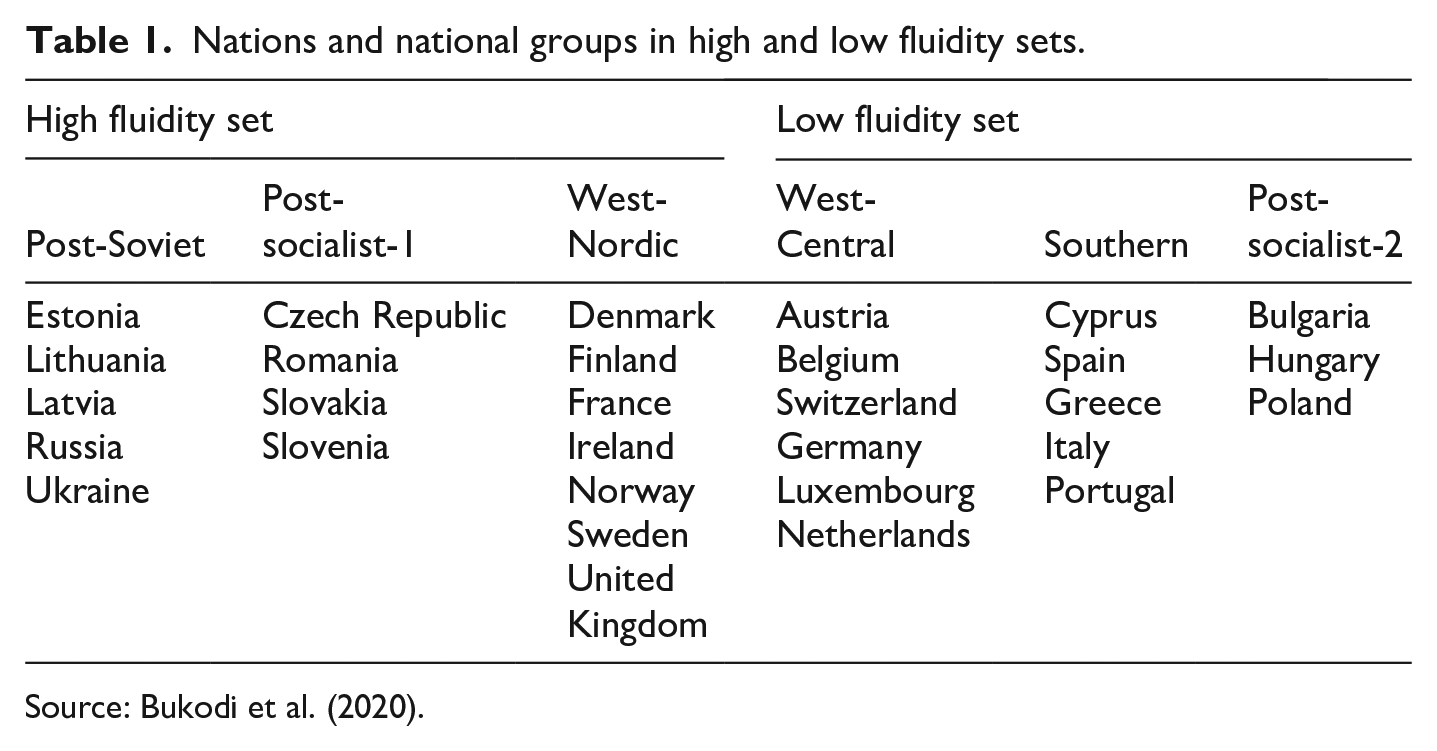
Source: Bukodi et al. (2020).
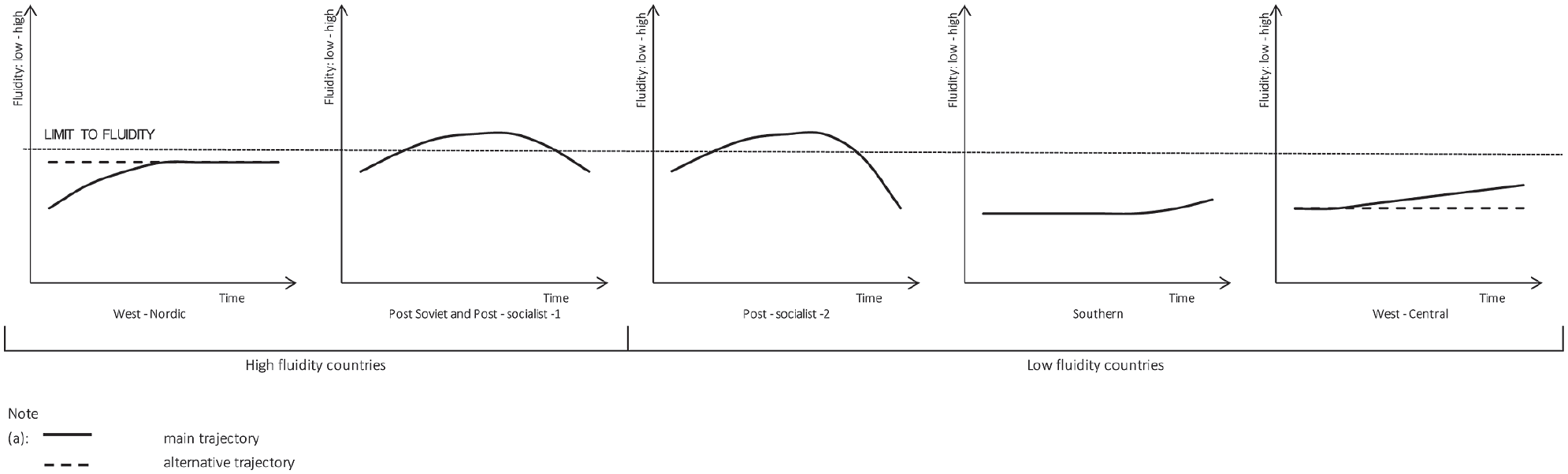
Fluidity trajectories in relation to proposed limit for countries with a capitalist market economy, a liberal democratic polity and a nuclear family system(a).
In the case of the Southern European nations that fall within the low fluidity set, we would believe that they are still some way from the limit we propose, and that the possibility of a further increase in fluidity is a realistic one. That is, if only through their continuing economic development, hastening the decline of agricultural classes and of small family concerns and thus reducing propensities for intergenerational immobility. In addition, though, given the marked degree of inequality in educational opportunity that still exists and the strong association between low educational attainment and disadvantaged class positions, continuing educational reforms of a relatively basic kind and the expansion of forms of post-secondary education would have the potential to raise fluidity. And such reforms would be unlikely to appear as a threat to, nor thus to lead to countervailing action from, more advantaged classes, especially since in these nations, as earlier noted, the pattern of class structural change means that upward mobility is still, for the time being, a more common experience than downward.
Also within the low fluidity set are the more economically advanced nations of the West Central group. In their case, too, we see some possibility for the achievement of greater fluidity, although with the reduction of educational inequalities here being the crucial requirement. If educational reforms can bring about such a reduction, then the importance of formal qualifications in the labour markets of these nations – the high degree of credentialism that prevails – makes it likely that a greater equality in mobility chances will in turn result. But, in contrast with the Southern nations, the reforms required would be of more than a basic kind. Further-reaching measures would be called for, in particular aimed at a significant reduction in the existing degree of stratification of secondary education. There are, however, indications of sociopolitical opposition to such measures from more advantaged classes, as in Germany with the successful Hamburg opposition – the ‘Gucci Aufstand’ – to the introduction of non-selective secondary schooling in (cf. Erikson, 2020). And Germany, along with the Netherlands and Switzerland, are among the nations in which Breen and Müller (2020b) found the OE association to be actually strengthening with more recent birth cohorts.
Turning next to the three groups of post-socialist societies that figure in Table 1, in the case of the group falling in the low fluidity set, comprising Hungary and Poland and also Bulgaria, we have no reason to envisage any change in this situation for the foreseeable future. But with the two groups in the high fluidity set, comprising those formerly in the USSR and the remaining post-socialist nations, we would expect this to be only a temporary allocation – one associated with relatively turbulent transition periods and/or less rapid institutional change and ‘marketisation’. In the light of the evidence previously referred to of decreasing fluidity in these nations, and of the factors driving this tendency, our prediction here would be that over the next decades they will fall back clearly below our notional limit and quite possibly follow Hungary, Poland and Bulgaria into the low fluidity set.
Finally, the remaining group in the high fluidity set, the West Nordic group, comprising the four Nordic nations plus France, Ireland and the UK, is that most critical for us. It is these European nations that we would regard as coming closest to the limit on increasing fluidity that we envisage. In Britain (Buscha and Sturgis, 2017; Bukodi and Goldthorpe, 2019: ch. 3) and Ireland (Layte and Whelan, 2004; Whelan and Layte, 2006) equalisation in mobility chances has been rather slight, if evident at all, over now many decades. In at least some of the Nordic nations previous equalisation has in more recent times evidently stalled (for Finland, see Erola, 2009; for Sweden, Breen and Jonsson, 2020). And in France, though equalisation appears to be continuing, this is at a decreasing rate (Vallet, 2014: 15; 2020: 109). We would further be inclined to place the US in the same situation as these European nations, despite some inconsistency in findings on trends in relative rates (compare Mitnik et al., 2016 and Hertl and Pfeffer, 2020) and the lack of recent US-European comparative studies. There would at all events appear to be agreement that any increase in fluidity within the American class structure that may have occurred up to the mid-twentieth century has over more recent decades tended to weaken (and cf. Hout, 2018 on essentially constant relative mobility over recent decades in terms of socioeconomic status).
As regards these nations that we see as approximating our hypothetical limit, it is not our claim that no further increase in fluidity is possible. It is, rather, that if such an increase is to be achieved, it will have to be through some relatively large-scale political mobilisation in favour of far more radical public policy interventions than have thus far been made. In the nations in question, not only have the gains in fluidity that follow from the decline of the agricultural and other more traditional economic sectors now been largely realised but also those deriving from the expansion and the at least formal de-stratification and democratisation of state educational systems. Further measures aimed at equalising relative mobility rates will then need to be ones that are primarily directed towards restricting the capacity of more advantaged families still to use their superior resources in order to enhance the educational and employment chances of their children, and thus ensure intergenerational class stability. Such measures may, however, be expected to meet with strong resistance, and especially so in a context in which, because of class structural effects, downward mobility is becoming more widely experienced.
To revert to our underlying argument, given a capitalist market economy, wide inequalities across classes in at least economic resources will always be present and are as likely to widen, as at the present time, as to contract. Further, given a liberal democratic polity, the extent to which it is possible to prevent parents from using the resources they possess, economic and other, in order to ‘do the best they can’ for their children is subject to evident contestation and, ultimately, constraint. Thus, as regards education, policies aimed at discouraging resort to the private sector by, say, increasing its cost through taxation, or at compelling schools and universities to have more socially balanced intakes, are open to powerful opposition on the grounds of involving improper state intervention and the curtailment of the rights of individuals or of independent institutions. And, finally, it has to be recognised that powerful forces in any event exist creating inequalities in educational attainment, and in turn in mobility chances, that lie largely beyond political reach. That is, in the capacity of socioculturally and educationally advantaged families to engage in what Lareau (2011) has aptly called the ‘concerted cultivation’ of children, aimed at the fullest possible expression of their academic and more general human potential – perhaps in some degree independently of, but still entirely consistent with, a concern to protect them against the risk of déclassement. The important point here is that the activities involved – from bedtime stories and supper table debates to the direct encouragement of, and help with, academic progress and personal development – have all to be regarded as being constituent of family life (Swift, 2004; Brighouse and Swift, 2014). And thus to seek in some way to restrict these activities, even if possible, cannot be presented as evidently desirable.
In sum, even if all measures were to be taken that could be thought politically feasible in a liberal democracy by way of increasing equality of opportunity, the family would remain as the ultimate source of the resistance to change that endogenous mobility regimes present, and of the limit on such change, in the direction of more equal class mobility chances, that we have proposed.
Footnotes
Acknowledgements
We are grateful to Fabrizio Bernardi, Bastian Betthäuser, Robert Erikson, Walter Müller, Brian Nolan, Adam Swift and Nhat An Trinh for their helpful comments on earlier versions of this paper.
Funding
The author(s) received no financial support for the research, authorship, and/or publication of this article.
