




Abstract
This study contrasts two theoretical perspectives on the relationship between intergenerational class mobility and child-rearing values. According to the dissociative thesis, which describes social mobility as a disruptive experience leading to insecurity, social isolation, stress and frustration, socially mobile individuals less often prefer community-oriented qualities such as tolerance and respect for other people, unselfishness, good manners and obedience. The beneficiary thesis, on the other hand, predicts that socially mobile individuals have a stronger preference for individual-based values such as hard work, determination, responsibility, independence and thrift. In both cases, these mobility effects are thought to be stronger for more extremely mobile individuals and for downwardly mobile compared with upwardly mobile individuals. However, using Dutch data from the European Values Study 2008, hardly any significant intergenerational mobility effects are found. Maybe intergenerational mobility is not such an extraordinary experience as mobility theory would lead us to believe, or mobile individuals adjust themselves very quickly to their new situation.
One of the most intriguing human values sociologists have been studying in the past decades lies in how individuals value the qualities that children should be taught at home. These so-called child-rearing values can be thought of as the criteria or standards used as a basis to determine which characteristics are most desirable for children to acquire (Kohn, 1969). In the literature, most attention has been paid to the contrast between ‘autonomy’ and ‘obedience’ (see Alwin, 2001). Since Kohn’s (1969) seminal work Class and Conformity, these values have been linked to social class and occupations: working class parents more highly value obedience, whereas middle or higher class parents stress independence (e.g. Fjellvang, 2011; Sherman and Harris, 2012).
In this study, I move beyond this classic line of research which studies the relationship between social class and the child-rearing values of autonomy versus obedience and progress in two ways. First, I look at the impact of intergenerational mobility, i.e. changes in social class positions between individuals and their parents. Alwin (2001) argues that child-rearing values are not only affected by current conditions in life, but also by past experiences, and one of these experiences could be social mobility in class position. No research to date has answered the question whether the upwardly (or downwardly) mobile value certain child qualities differently than those who do not change social positions intergenerationally. This study tries to overcome this gap by formulating and testing hypotheses for child-rearing values based on the literature on the impact of social mobility on values and behaviour in general.
The second contribution of this study lies in studying a broader range of child-rearing values than the above-mentioned contrast between autonomy and obedience. When asked for the most important qualities that children should be taught at home, Europeans more often mention characteristics such as good manners, responsibility, respect for other people and hard work than autonomy or obedience (Halman et al., 2011). As I argue below, mobility experiences are expected to shape these (and other) child-rearing values as they can be linked to either society or community-oriented values or individual-based values. The latter can be traced back to the Protestant work ethic first proposed by Max Weber and are seen as the foundations of an individualistic orientation: hard work, determination, responsibility, independence and thrift (Tamis-LeMonda et al., 2008). Society or community-oriented values on the other hand are linked to collectivism (Triandis, 1995): priority is given to the goals of the in-group over personal goals, and in order to behave in a communal way, qualities such as obedience, good manners, unselfishness and respect for others are promoted. By employing data from the 2008 European Values Study (EVS, 2011) collected for the Netherlands, I examine a wide range of these (and other) child-rearing values. As research shows that community-oriented and individual-based values are not mutually exclusive – individuals may very well stress aspects of both (e.g. Tamis-LeMonda et al., 2008), I assess the impact of social mobility on 11 child-rearing values separately (cf. Voicu, 2012).
It should be noted that the Netherlands is an especially useful case for exploring the impact of intergenerational class mobility on child-rearing values, as it stands out as one of most ‘open’ countries in the western world and – in contrast to other nations – has experienced a continuing growth in social mobility for both men and women (Breen and Luijkx, 2004). This trend towards more social mobility started in the second half of the 20th century and continues right into the 21st century (Ganzeboom and Luijkx, 2004). This means that large proportions of the Dutch population experienced social mobility, in different degrees, and either upwardly or downwardly. It is these mobility experiences, and their associations with child-rearing values, that this study focuses on.
Intergenerational mobility and child-rearing values
In his work on the relationship between social class and child-rearing values, Kohn (1959, 1963, 1969) suggests that individuals use their daily experiences at work to evaluate which qualities are most necessary and useful in occupational life. It is these qualities that they, through socialization and schooling, seek to instil in children to reach the ultimate goal that children have good lives, or even better lives, than they have (cf. Breen and Goldthorpe, 1997). I would like to argue that the same line of reasoning works for intergenerational class mobility. Individuals’ child-rearing values will be shaped by their experiences with social mobility as such. By this, I mean that social mobility has an additional effect on child-rearing values, next to the effects of current class position and class of origin.
Earlier studies on the relationship between intergenerational class mobility and values particularly mention the tensions that accompany both upward and downward mobility. In this so-called ‘dissociative thesis’ (Friedman, 2013), social mobility is seen as a disruptive experience: mobile individuals can no longer identify with the class of origin, but do not fit in their new social class either. As a result, they feel socially isolated, stressed out and frustrated (Bean and Swicegood, 1979; Jackman, 1972; Tumin, 1957). Because the socially mobile are poorly integrated in either class, they experience a ‘double isolation’ (Bourdieu, 1998: 107). They sense a lack of social support (Lee and Kramer, 2013) which might lead to feelings of insecurity (Blau, 1956; see also Friedman, 2012). In addition, mobile individuals could be stressed out because they on the one hand try to adopt to the culture valued in their new class, while on the other hand are not able to disconnect from the (different) culture in their class of origin. Managing these colliding cultures leads to a ‘split self’, full of internal conflict and psychological discomfort (Friedman, 2016; Lahire, 2011). Finally, both upwardly and downwardly mobile groups might feel frustrated because they are not fully accepted in their new class. In the case of the upwardly mobile, it is assumed that members of the high-status or elite groups in society do not see newcomers as full equals, while the downwardly mobile themselves do not feel permanent members of their new lower-status class as they want to recapture previous higher-status positions (Jackman, 1972). In all situations, lack of acceptance and recognition leads to feelings of deprivation and frustration, which might manifest in low levels of self-esteem (Friedman, 2016; Tumin, 1957) and dissatisfaction with life (Sorokin, 1959; but see Houle and Martin, 2011).
How can we relate this rather pessimistic view on social mobility to child-rearing values? In the Durkheimian tradition, many scholars hypothesized that the negative feelings of social isolation and frustration of both the upward and downward socially mobile are rooted in societal alienation and anomie caused by their mobility (Tolsma et al., 2009). This implies that the socially mobile are more prone to feel disconnected from society, and to turn their back on the civic culture that makes society work. This is demonstrated for example in the rather radical political ideas they display, such as anti-democratic attitudes, extreme right-wing or left-wing voting behaviour and antagonistic opinions towards minorities (Lipset and Bendix, 1959; Lopreato, 1967; Tolsma et al., 2009). Being socially isolated and frustrated individuals, the socially mobile feel no need to be ‘good citizens’, i.e. ‘being active in politics and public life, showing solidarity with other people, … and obeying laws and regulations.’ (Van Deth, 2007: 402). Because of their negative mobility experiences, they feel that civic virtues, such as tolerance, cooperation, solidarity and law abidance (Halman, 2010), are not very useful in life, and therefore are not considered as important qualities that children need to acquire. We thus expect that the socially mobile will attach lower importance to child-rearing values that are society or community-oriented, such as tolerance and respect for people, unselfishness, good manners and obedience, than individuals who are immobile. Although the now large body of literature (based on both quantitative and qualitative research designs; see above) on the negative consequences of social mobility stresses that these consequences are experienced by both upwardly and downwardly mobile individuals, it can be argued that these particularly affect the downwardly mobile in contemporary societies. After all, intergenerational progress is an important expectation in modern society, which implies that the downwardly mobile are ‘the losers of modernization’ and especially likely to develop feelings of isolation, stress and frustration (Tolsma et al., 2009). Thus, we predict that the impact of social mobility on community-oriented child-rearing values is stronger for downwardly mobile individuals compared with upwardly mobile individuals.
Other scholars doubt that social mobility is a stressful experience leading to dissatisfaction (Houle and Martin, 2011; Marshall and Firth, 1999). The most influential among these has been John Goldthorpe (1980), who collected self-completed life history notes from 246 men with varying mobility experiences. 1 From these notes, Goldthorpe concluded that the socially mobile, including the downwardly mobile, are overwhelmingly satisfied with the progress of their lives. This means that social mobility is not such a traumatic experience as the dissociative thesis mentioned above wants us to believe. Instead, mobility is seen as rather beneficiary to individuals, from both an economic and psychological perspective. Qualitative research examining the life courses of upwardly mobile individuals indicates that they develop characteristics which help them to become successful in life. Mallman (2015: 7), for example, mentions that the upwardly mobile transfer ‘classed-family challenges from early life into types of resources’, and refers to traits such as hard work, having an independent identity, viewing dominated circumstances as surmountable, being strongly motivated to escape towards a more secure life, and an internal pressure to realize inherited potential. Other scholars also point to hard work (Lehmann, 2009; Matthys and Thijssen, 2013), perseverance, discipline and effort (Lehmann, 2009; Thijssen et al., 2015) and maturity, responsibility and independence (Lehmann, 2009) as important characteristics of the upwardly mobile. This implies that the upwardly mobile value personal traits that they associate with getting ahead in life. They therefore prefer individual-based child-rearing values such as hard work, determination, responsibility, independence and thrift more than others. After all, these qualities may help children to do well in life. The same child-rearing values might be stressed by the downwardly mobile, possibly even to a higher degree. After all, the status enhancement thesis proposes that these individuals will do their best to return to their former higher-status positions, or in any event try to avoid further decline for themselves or their family (Bean and Swicegood, 1979). Please note that this line of reasoning can also be linked to an alternative reaction of the socially mobile to deal with their anomic feelings. Next to feeling socially isolated, stressed out and frustrated, leading them to opt out of society (dissociative thesis), anomic mobile individuals may actively try to restore a meaningful order (cf. Berger et al., 1973), for example by emphasizing individual-based values that are associated with getting ahead in life. In any case, according to the beneficiary thesis, the downwardly mobile will emphasize individual-based values such as hard work, determination, responsibility, independence and thrift, and even more so than the upwardly mobile, because more is at stake.
Hypotheses
To sum up, individuals’ ‘mobility experience’, either negative or positive, is thought to shape their ideas about which child qualities are important. If we take the position that social mobility is a negative experience (dissociative thesis), the first hypothesis is that the socially mobile will attach less importance to child-rearing values that are society or community-oriented, such as tolerance and respect for other people, unselfishness, good manners and obedience, than those individuals who do not change social positions intergenerationally. When we see social mobility as a positive experience in life (beneficiary thesis), the second hypothesis states that the socially mobile stress individual-based values such as hard work, determination, feeling of responsibility, independence and thrift more than the immobile. The third hypothesis suggests that mobility effects will be stronger for the downwardly mobile than for the upwardly mobile, since downward mobility is a more negative experience than upward mobility (dissociative thesis) and more is at stake in the case of downward mobility (beneficiary thesis). Finally, a fourth hypothesis can be added: differences in child-rearing values will be more pronounced in the group of more extreme mobility, as they will experience the consequences of social mobility more severely (Kessin, 1971).
Data and measurements
To test these hypotheses, I employ Dutch data from the fourth wave of the European Values Study (EVS, 2011). This dataset is based on a random, stratified sample of private households in the Netherlands. The data were collected from May till October 2008 by means of standardized, face-to-face interviews. In total, 1554 respondents answered questions about moral, religious, societal, political, work and family values, yielding a response rate of 50.4%. All documentation can be found at www.europeanvaluesstudy.eu.
I selected all respondents who are older than 25 years of age. At that age, most individuals in the Netherlands have finished their education and started their occupational careers. Of course, respondents are in different stages of their occupational careers at the time of interview, which might affect their social mobility (cf. Hillmert, 2011). In general, individuals often start their careers at a point which is lower than their father’s occupational status, but end up in occupational positions with an equal or higher-status level than their fathers (De Graaf and Luijkx, 1995). As younger respondents might not yet have reached their occupational peak, I performed additional analyses with respondents of 40 years and older only. The results of these analyses show about the same mobility effects for child-rearing values as for respondents of 25 years and older. 2
The analyses focus on those who have a job, or who once had a job but are retired, unemployed or disabled at the moment of interview. The social class position of these latter groups is based on information about their present or last occupation. I focus on occupation, as this dimension of social class has received most attention in the literature on child-rearing values (e.g. Kohn, 1969) as well as in social stratification research on social mobility (Tolsma and Wolbers, 2014; Treiman and Ganzeboom, 2000). Housewives (n = 165) and students (n = 2) are excluded from the analysis. These selections left me with 1306 respondents for the analysis. All information is weighted in order to adjust the sample to the distribution of gender and age in the Dutch population.
Social class and intergenerational class mobility
Respondents were asked to provide detailed information about their current or – in case of not being employed at the time of interview – last job title, self-employment and the number of employees they supervised. I include a dummy variable indicating whether a respondent is currently working or not to control for possible differences between respondents who provided information on present occupation and those who reported their last job. Based on this occupational information, respondents were assigned to one of the 11 original EGP classes (Erikson and Goldthorpe, 1992; Erikson et al., 1979), a widely used class scheme in research on social mobility (Treiman and Ganzeboom, 2000). Due to sample size considerations, these 11 categories were recoded into seven class positions, following Ganzeboom et al. (1989), with one exception: EGP classes I (large proprietors, higher professionals and managers) and II (lower professionals and managers) are not combined into one class position, since this would result in a very large social class containing 55% of all respondents. From the first column in Table 1, representing current class position, we see that the majority of people in the Netherlands work in non-manual jobs.
Class positions and social mobility.
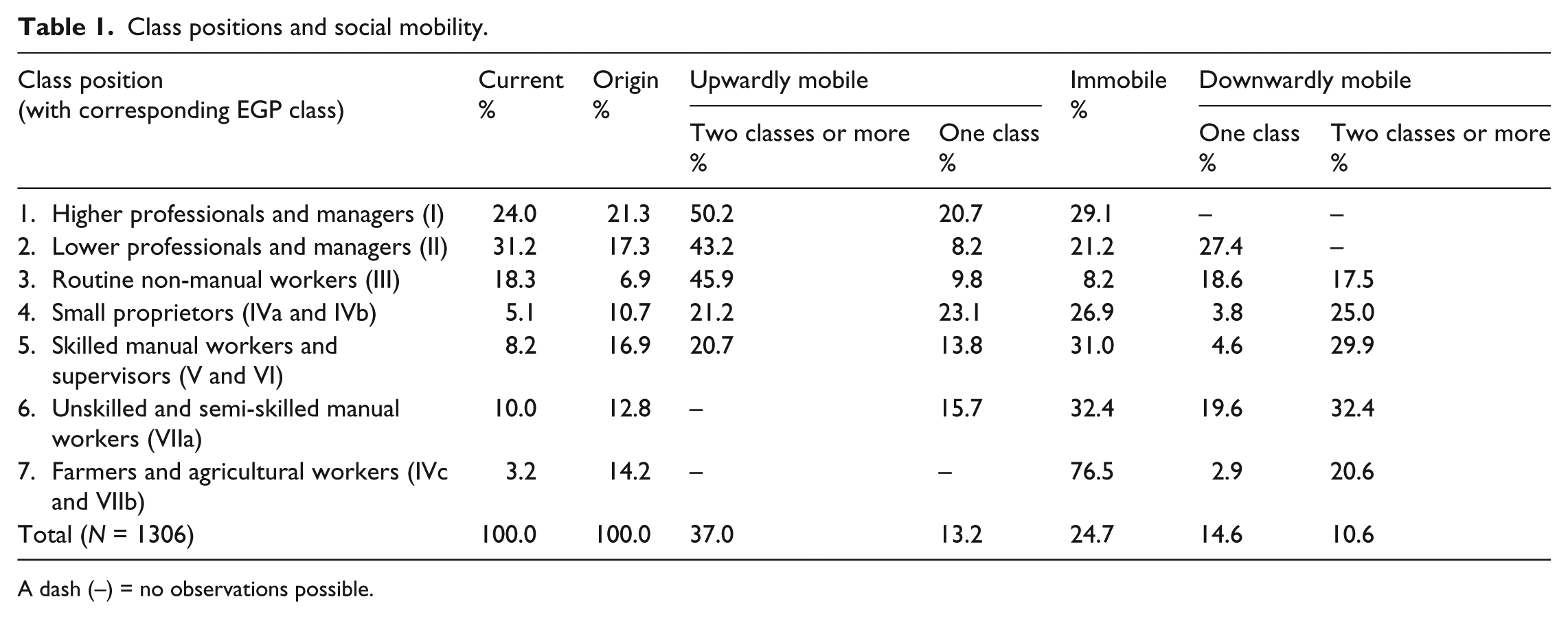
A dash (–) = no observations possible.
In a corresponding way, class of origin was constructed by using the occupational information that respondents were asked to provide about their fathers’ jobs when they were 14 years of age. If respondents at that time lived with their mother (and not their father), this information was asked about their mother’s job. Table 1 shows that the Netherlands has seen quite some intergenerational class mobility, mainly in an upward direction (cf. Breen and Luijkx, 2004). In total, about half of the sample can be classified as upwardly mobile, a quarter is immobile and another quarter is downwardly mobile. As much as a third of the respondents moved two classes or more upward compared to the class position of their parents.
Child-rearing values
Respondents were asked to choose up to five qualities they considered to be especially important from a list of 11 qualities which children can be encouraged to learn at home. This list consisted of good manners, independence, hard work, feeling of responsibility, imagination, tolerance and respect for other people, thrift, determination, perseverance, religious faith, unselfishness and obedience. Most respondents (86.2%) chose five qualities; 9.4% chose four qualities; 3.2% three; 0.3% two; 0.1% one; and 0.7% none. Please note that this question deviates from most other studies on child-rearing values, in which respondents were asked to rank a set of child qualities according to the level of importance attached to these qualities (Kohn, 1969; Lenski, 1961). The EVS question is not based on a full ranking and thus avoids extreme negative intercorrelations due to the linear dependency of ipsative measures (Alwin and Krosnick, 1985). In addition, the reader should be aware that this question assesses the qualities that respondents prefer in children in general, regardless of their parenting experiences. I included a control for parental status (having children or not) in the analyses, since parents may value different child qualities than non-parents (cf. Tudge et al., 2012). Following the advice of Voicu (2012), the 11 child qualities enter the analysis as separate dependent variables as internal consistency is low.
Table 2 shows the popularity of each of the 11 child-rearing values in the Netherlands. The Dutch particularly stress qualities such as feeling of responsibility, good manners and tolerance and respect for other people. These child-rearing values were chosen by more than 85% of the sample. About half of the respondents find independence important, and more than a third determination and perseverance. Least popular are child-rearing values relating to religious faith (11%). Given the fact that the Netherlands is a highly secularized society (Norris and Inglehart, 2005), this observation comes as no surprise.
Child-rearing values and social mobility.
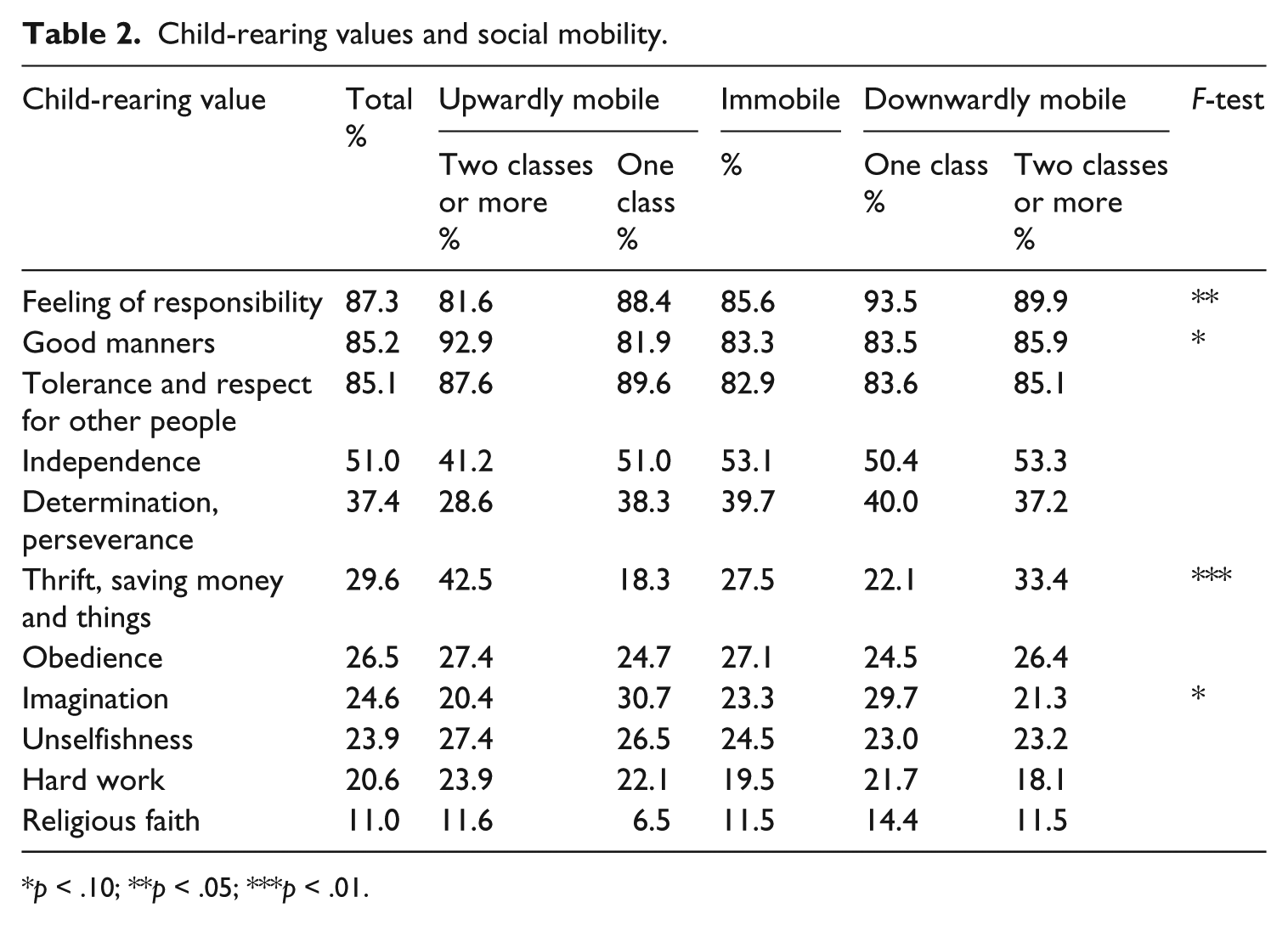
p < .10; **p < .05; ***p < .01.
The table also explores some preliminary (because bivariate) relations between intergenerational class mobility and child-rearing values. For four values, the differences between upwardly mobile, downwardly mobile and immobile individuals are statistically significant. Social mobility is associated with a stronger preference for feelings of responsibility, although this does not hold for those who are two classes or more upwardly mobile. In addition, both the more extreme upwardly mobile (two classes and more) and the more extreme downwardly mobile (two classes or more) value thrift more than the immobile, whereas individuals who move only one class up or down compared to their parent’s class attach less importance to thrift than those that have stable intergenerational class positions. The same observation can be made for good manners. Again, the two more extreme mobility positions deviate from the immobile and show a stronger preference for good manners. Finally, imagination is valued as more important by those who move either one class up or one class down. This pattern cannot be observed for the more extreme mobility positions, however.
Controls
The associations described above are all bivariate in nature. To fully test my hypotheses, I perform multivariate analyses in which several important characteristics that might affect the association between social mobility and child-rearing values are included. The first is educational attainment, which is closely linked to occupational class positions. Education can be an avenue to achieve social mobility (Blau and Duncan, 1967), but at the same time might also be a way of social reproduction and immobility, as it is associated to class of origin. I therefore present models without and with controls for education. Moreover, this is important because research shows that educational attainment influences the way people value child qualities (Van der Slik et al., 2002; Wright and Wright, 1976). In addition, in all models I control for other characteristics that are related to child-rearing values, namely gender (Alwin, 1989; Spade, 1991; Xiao, 2000), having a partner and/or children (Alwin, 1984; Xiao, 2000), birth cohort (Alwin, 1990; Scott, 2000), religious denomination (Alwin, 1984; Lenski, 1961) and church attendance (Alwin, 1986; Sieben and Halman, 2014). Of course, these characteristics might be related to social mobility as well (Lipset and Bendix, 1959), which means that it is important to include them in the analyses. Educational attainment is measured by asking respondents what the highest level of education is they completed. I recoded the answers into eight categories: (1) primary education, (2) lower vocational education, (3) lower general secondary education, (4) higher general secondary education, (5) middle vocational education, (6) pre-university education, (7) higher vocational education and (8) university. Gender, having a partner and having children are all dichotomous variables. Birth cohort 3 includes seven categories: born before 1925, born between 1925 and 1934, between 1935 and 1944, between 1945 and 1954, between 1955 and 1964, between 1965 and 1974 and born in 1975 or after. Religious denomination is assessed in five categories: Roman Catholic, Dutch Reformed (liberal Protestants), Rereformed (orthodox Protestants), other religion and no religion. Finally, church attendance refers to the frequency of attending religious services, apart from weddings, funerals and christenings: never, less than once a month, once a month, once a week or more often.
Analyses and results
When studying the effects of intergenerational class mobility, one has to take into account the complicated nature of the data. The most intuitive way to model social mobility is by the difference between current social class and class of origin. However, conventional techniques run into problems of identification when including class origins and destinations as well as the difference between the two, as the latter is a linear transformation of the former (see Hendrickx et al., 1993). Diagonal reference models (DRM) are thought to be the best solution to this problem: they offer a parsimonious way to estimate effects of current class position, class of origin, as well as social mobility simultaneously. DRM were introduced by Sobel (1981, 1985), and are based on the idea that non-mobile individuals (the diagonal cells in a table of current class by class of origin) represent the core of each social class position and thus define its norms and values. Those who are mobile, either upwardly or downwardly, will look at two references when it comes to their own values: current social class and class of origin. Thus, attitudes and values of mobile individuals can be modelled as the weighted sum of the values of the non-mobiles in the current classes and those in the classes of origin. Given the dichotomous nature of the dependent variables studied here (i.e. child-rearing values), I started my analyses with a logistic baseline version of DRM (Weakliem, 1992), which included main effects of current social class and class of origin only. This baseline logistic DRM is given by:

where p is the probability of choosing a particular child-rearing value, m are the population means in this child-rearing value for class of origin and current social class position respectively, and w is the relative weight of the class of origin. (1 – w) represents the relative weight of the current social class position. The parameter w is restricted to lie within the [0,1] interval. Finally, e is an error term with expectation 0.
However, the results revealed that class of origin does not have an impact on child-rearing values: parameter w is statistically not significantly different from zero (see online Appendix A). 4 This means first of all that the assumption that current class and class of origin both affect child-rearing values (i.e. the child-rearing values of the socially mobile are somewhere in between the values of the immobile in the current class and the immobile in the class of origin) that underlies these models does not hold. Moreover, it shows that DRM are not needed and conventional logistic regression analyses can be applied (Kulis, 1987), since one can leave out of the analyses class of origin, and focus on current social class position and the effects of social mobility only. The mobility coefficients will not capture any social origin effects (as they are zero), which means that the problem of identification mentioned above is ‘solved’. Table 3 gives the results of these conventional analyses, for each child-rearing value separately.
Logistic regression coefficients a for child-rearing values without (Model I) and with (Model II) controls for educational attainment.

p < .10; **p < .05; ***p < .01.
Coefficients are controlled for gender, cohort (7 categories), having a partner, having child(ren), religious denomination (5 categories) and church attendance (4 categories).
We first look at the coefficients for intergenerational class mobility in the models without educational attainment (Models I). There are hardly any significant mobility effects, although it should be noted that the regression coefficients of some categories in the models are based on a relatively small number of observations, which makes it harder to reach statistically significance. Exceptions are found for four child-rearing values. Individuals who moved two classes or more upward compared to their parents value determination and perseverance less than those who are not intergenerationally mobile (difference in odds equals e–.328 = .720), although this relationship is not found for individuals who have moved one class upward, or who are downwardly mobile. With respect to feeling of responsibility, individuals who moved one class upward value this child quality more than individuals who are not socially mobile (difference in odds equals e.904 = 2.469). In addition, the more extreme upwardly mobile (two classes or more) attach more importance to thrift, saving money and things (difference in odds equals e.527 = 1.694), whereas those who are downwardly mobile (one class) stress this child quality less (difference in odds equals e–.509 = .601). Finally, individuals who are extremely downwardly mobile (two classes or more) prefer independence less than those who are immobile (difference in odds equals e–.527 = .590). Although mobility effects thus are rare, the results suggest that upwardly mobile individuals have different mobility experiences than downwardly mobile individuals, which in turn lead to differences in valuing specific child qualities. After all, the coefficients do not display the same sign for upwardly and downwardly mobile individuals, with one exception: religious faith seems to be related to social mobility of whatever nature (upwardly or downwardly) in a negative way.
In order to find out whether the mobility experiences shaping child-rearing values are driven by occupational class mobility, and not by education associated with this mobility, Models II include educational attainment. Although the coefficients of Models I with Models II cannot be directly compared due to varying non-observed heterogeneity between the models (Mood, 2010), we see that the observed mobility effects on child-rearing values remain substantial, and for three of the four cases described above (i.e. responsibility, thrift and independence), significant. Furthermore, the analyses show that educational attainment is a much stronger predictor of child-rearing values than social class. Only in the case of the value of determination and perseverance, did I find substantial class effects once educational attainment is controlled for: small proprietors (class 4), manual workers (classes 5 and 6) and farmers (class 7) stress determination less than the higher professionals and managers (class 1). In addition, compared to the latter class, the skilled manual workers attach more importance to obedience, and the unskilled and semi-skilled manual workers more to thrift and less to imagination. Other studies confirm the observation that educational attainment is an important factor in shaping child-rearing values (Alwin, 1984; Wright and Wright, 1976). This warrants the idea of looking at educational mobility instead of class mobility as an indicator for intergenerational mobility (Daenekindt and Roose, 2013; Di Paolo et al., 2013). As respondents are asked to provide information about their own educational attainment, and that of their father (or, in the case of not living with their father, their mother), educational mobility can be constructed in a similar way as class mobility. Individuals are labelled upwardly (downwardly) mobile if they have a higher (lower) educational attainment than their parents, and they are seen as immobile if they have reached the same educational level as their parents. In addition, I differentiate between smaller and larger leaps of educational mobility, i.e. between one and two or more educational levels respectively. The results of these additional analyses (see online Appendix B), in which I include all control variables, but exclude current social class position and class mobility, very much resemble the outcomes of the class mobility analyses described above. Alternative specifications of educational mobility, such as defining the group of the immobile as individuals with a difference up to a maximum of one between their own and their parents’ education, or combining smaller and larger leaps of educational mobility, lead to the same conclusions. Parental educational attainment is not a substantial factor in shaping someone’s child-rearing values, and only a few significant effects of educational mobility are found. Individuals who reached higher educational levels than their parents, or who have educations one level lower, attach less importance to good manners. In addition, those who are downwardly mobile (two educational levels or more) stress determination, whereas those who are upwardly mobile (two educational levels or more) value thrift. However, no other significant relationships between educational mobility and child-rearing values can be observed.
Conclusion and discussion
This study explored the relationship between intergenerational class mobility and child-rearing values in the Netherlands and contrasted two opposing lines of research. On the one hand, the dissociative thesis, which sees social mobility as a disruptive experience that leads to insecurity, social isolation, stress and frustration, predicts that the socially mobile less value society or community-oriented qualities such as tolerance and respect for people, unselfishness, good manners and obedience than the immobile. The beneficiary thesis, on the other hand, displays a more positive way of thinking about social mobility and predicts that the socially mobile stress individual-based values such as hard work, determination, responsibility, independence and thrift more. In both cases, these mobility effects would be stronger for the more extremely mobile and for the downwardly mobile compared to the upwardly mobile. I tested these hypotheses using Dutch data from the European Values Study 2008, as the Netherlands stands out as being a highly ‘open’ society with continuing growth in social mobility. The analyses revealed five major conclusions.
First, the results of the baseline DRM – the state of the art technique to study effects of social mobility – showed that class of origin is not significantly related to child-rearing values.
Second, in the conventional logistic regression analyses which I subsequently performed and which included both current social class position and social mobility dummies (next to controls for educational attainment, gender, having a partner and/or children, birth cohort, religious denomination and participation in religious services), only a few significant effects of intergenerational class mobility were found. First, in line with the beneficiary thesis, the more extreme upwardly mobile (two classes or more) prefer thrift more than those who are not socially mobile. However, this association is not found for individuals who move one class up compared to their parents, or for the downwardly mobile. Second, those who move upward one class compared to their parents attach more importance to responsibility, which also corroborates the beneficiary thesis. Third, the downwardly mobile show lower (and not higher) preferences for the child-rearing value of independence than the immobile, which is in contrast with the expectations of the beneficiary thesis. The other two individual-based values (hard work and determination) are not significantly related with intergenerational class mobility. However, the sample the analyses are based on is rather small, which implies that we must be careful in reaching definite conclusions; these results thus give only limited support for the beneficiary thesis. In addition, with respect to the other child-rearing values, no statistically significant class mobility effects were found. This implies that the upwardly and downwardly mobile do not seem to stress community-oriented child-rearing values (i.e. tolerance and respect for other people, unselfishness, good manners and obedience) less than the immobile. The dissociative thesis therefore seems to be refuted.
Third, there is no evidence that the few intergenerational class mobility effects observed are stronger for the downwardly mobile compared to the upwardly mobile (third hypothesis) or for the more extremely mobile (fourth hypothesis). After all, downward mobility effects are only found for the child-rearing value of independence, and not for responsibility and thrift. In addition, those who shift social positions two classes or more compared to their parents have more pronounced views in the case of thrift and independence, but not with respect to responsibility. However, there is some evidence (although not statistically significant) that upward mobility leads to different experiences than downward mobility, as the signs of the mobility coefficients often are not in the same direction.
Fourth, the results show that educational attainment is a much more powerful determinant of child-rearing values than is social class. Once educational attainment is taken into account, there are hardly any statistically significant coefficients of current class position. Only for the child-rearing values of determination and perseverance, do I find substantial associations with social class: the higher professionals and managers stress this child quality more than all other class positions. In addition, the skilled manual workers seem to attach more importance to obedience, and the unskilled and semi-skilled manual workers more to thrift and less to imagination. The relationships between child-rearing values and educational attainment on the other hand are quite evident. The higher-educated prefer independence and determination (both individual-based child-rearing values), whereas the lower-educated stress obedience and good manners (both community-oriented values), as well as thrift (individual-based value). Other scholars confirmed the observation that educational attainment is the most important determinant when assessing the relative impact of socioeconomic factors for both child-rearing values (Alwin, 1984) and attitudes in general (Kalmijn and Kraaykamp, 2007). The latter study shows that this can be linked to (post)modernization, as the effect of education is strongest in the most highly modernized countries, such as the Netherlands.
Fifth, additional analyses however show that educational mobility – instead of occupational class mobility – hardly impacts child-rearing values either, with a few exceptions. Good manners are less valued by the upwardly mobile and downwardly mobile (although not by downwardly mobile who move two or more educational levels). This is in line with the dissociative thesis, which predicted that the socially mobile value community-oriented child-rearing qualities less. With respect to the beneficiary thesis, some evidence is found with respect to the individual-based child-rearing values of determination (more valued by those who are two educational levels or more downwardly mobile) and thrift (more valued by those who are two educational levels or more upwardly mobile).
The main conclusion therefore is that, although a few mobility effects are found, intergenerational mobility – either through channels of educational attainment or occupational class – is not the most important experience in life when it comes to shaping child-rearing values. Several reasons can be suggested to explain the lack of empirical evidence for the dissociative thesis and the beneficiary thesis. First, both theoretical perspectives see social mobility as a unique experience in society which causes mobile individuals to feel marginal (dissociative thesis) or special (beneficiary thesis). However, social mobility is not a deviant experience, but rather a modal one, given the high rates of intergenerational mobility in the Netherlands. Mobility effects might therefore only be detected in the case of extraordinary mobility (Jackson and Curtis, 1972). This notion is not confirmed in this study, as only half of the mobility effects observed here pertain to extreme mobility (two classes or levels of education and more). A counterargument for the ‘mobility is modal’ thesis is that the increase in upward mobility has slowed down over time, and is seen much more as the result of personal achievement than before (Kalmijn, 2006). This implies that social effects of mobility might vary over time. In this respect, it would be interesting to study how mobility experiences are influenced by the economic recession (which started after the collection of the data employed here) and globalization processes taking place in the Netherlands and other parts of the world.
Another alternative explanation for the lack of significant findings of social mobility on child-rearing values is that social mobility does affect individuals, but these individuals quickly learn to make resolutions to any conflict they might experience from mobility by adjusting to the status which is most salient to them (Treiman, 1966). This implies that only those who had recently become upwardly or downwardly mobile would be affected by these experiences (Jackson and Curtis, 1972). This calls for a longitudinal design of research, in which the effects of life-long mobility experiences of preferably different cohorts in time (given the structural influences mentioned above) can be modelled. In such a design, individuals’ intragenerational mobility should be taken into account as well, as people often start their occupational careers at a lower point than their father’s occupational class, but end up in equal or higher occupational positions due to upward career mobility (De Graaf and Luijkx, 1995). In the ideal case, such a quantitative study would be complemented with qualitative research investigating how individuals experience their intra- and intergenerational (im)mobility, and how this affects their meaning and interpretation of specific child-rearing values. In particular, the possible diverging experiences between the upwardly and downwardly mobile my observations hint at are worth exploring.
Footnotes
Acknowledgements

Funding
This research received no specific grant from any funding agency in the public, commercial, or not-for-profit sectors.
Notes
Author biography
References
Supplementary Material
Please find the following supplemental material available below.
For Open Access articles published under a Creative Commons License, all supplemental material carries the same license as the article it is associated with.
For non-Open Access articles published, all supplemental material carries a non-exclusive license, and permission requests for re-use of supplemental material or any part of supplemental material shall be sent directly to the copyright owner as specified in the copyright notice associated with the article.
