




Abstract
This paper reports results from a classroom dictator game comparing the effects of three different sets of standard instructions. The results show that seemingly small and typically unreported differences in standard instructions induce different perceptions regarding entitlement and ownership of the money to be distributed, and that these perceptions influence behaviour. Less is given when the task is described as a task of generosity and more when the task is a task of distribution (average 35% vs. 52%). The results can contribute to explaining the large variation in dictator game giving reported in the literature and show that even small and unreported differences in instructions change how the game is perceived.
JEL codes: C70; C91; D63
Introduction
The dictator game – a person distributing a fixed monetary amount between themselves and a receiver – was introduced in economics as a hypothetical choice experiment by Kahneman et al. (1986). The idea was to test whether people really take as much as they can for themselves if possible. 1 The common finding in standard dictator games is that most dictators give between nothing and half of their endowment with considerable variance in distributions between treatments (Camerer, 2003; Engel, 2011). A meta-study of 129 papers published between 1992 and 2009 reports that dictators on average give 28% of the endowment (Engel, 2011).
The behaviour in the dictator game is typically interpreted as evidence for substantial (unconditional) generosity, altruism or fairness preferences. Such interpretations are not uncontentious, and some evidence points in different directions. 2 For example, Oxoby and Spraggon (2008) show that the percentage of subjects who give nothing can be as low as 10% or as high as 100%, depending on how subjects perceive the property rights (dictators who first earn the money give nothing; if receivers first earn the endowment, they get a lot). 3 Moreover, Bardsley (2008) shows that giving is lower than usual if the action set also permits taking money from others, concluding that dictator game generosity is an artifact of the experimental design. In fact, Winking and Mizer (2013) find no altruistic giving in a natural field dictator game.
Taking up the above discussion, the present study focuses on the influence of the combination of the aforementioned framing effects (Bardsley, 2008) especially the perceived ownership effect demonstrated by Oxoby and Spraggon (2008). In particular, we report the results from a randomized experiment with three different sets of standard dictator game instructions. 4 While all instructions describe the same task to be performed (an endowment to be divided), they differ in terms of the implicit description of initial ownership: In treatment 1, the dictator gives a share of the money allocated to him/her; in treatment 2, the dictator distributes the money allocated to him/her; in treatment 3, the dictator distributes an amount of money.
As expected, different treatments induce a different perception of the task with treatment 1 resulting in the lowest fraction of subjects (48%) perceiving the task as distributive, compared to one of generosity/giving, and treatment 3 resulting in the highest (70%; 63% for treatment 2). Moreover, in line with the results by Oxoby and Spraggon, the more the task is perceived as one of generous giving (stronger entitlement for the dictator), the lower are average offers to receivers. Thus, our findings show that already small variations in standard dictator game instructions (with no intended framing) give rise to tangible framing effects which significantly impact on how the dictator task is perceived with respect to entitlements/property rights.
Such differences in perception are important to understand as they affect the subjects frame of mind when deciding how much to transfer, as demonstrated by the ownership effects found by Oxoby and Spraggon. In a similar vein, albeit focusing more on effects of emphasizing socially desired behaviour, Branas-Garza (2007) shows that adding the sentence ‘Note that your recipient relies on you.’ to the instructions induces a tangible increase in the average amount transferred; in this case by making the moral aspect of the task (the dependence of another person on the decision) more salient. Many other interesting framing effects have been studied in connection with the dictator game (e.g. Branas-Garza, 2006; Charness and Gneezy, 2008; Dreber et al., 2013).
Adding to this discussion, the present study shows that already small variations in the instructions give rise to (supposedly unintended 5 ) framing effects that significantly affect the subjects’ perception of the task and subsequent behaviour (a stronger perception of generous giving inducing lower transfers). As instructions for simple standard games are often no longer reported, we believe that our finding offers a possible explanation for at least some of the variance in distributions found for dictator games by Engel (2011). It also seems likely that other games with distributional aspects and unbalanced initial endowments such as the ultimatum game (Güth et al., 1982) or possibly even the trust game (Berg et al., 1995) may show similar framing effects. Yet, based on the present data, we can of course only speculate about the wider relevance of the argument.
Regarding the more specific discussion concerning the dictator game, we see our results as giving further support to the idea that giving in this game is not necessarily a sign of general generosity, fair-mindedness or altruism (cf. Camerer, 2003: 56). Instead, we believe that the different degrees of other-regarding behaviour in this game are rather an attempt to find an appropriate response to uncertainty about the demands of the situation, including vagueries regarding the ownership/entitlement of the initial endowment. Note that pure altruism should induce substantial giving especially if there was no doubt about the money belonging to the dictator. Yet, as already demonstrated by Oxoby and Spraggon (2008), if it is perfectly clear that the money was earned by the dictator, much less was given; if it is perfectly clear, that it was earned by the receiver, there is a strong tendency to give a lot (or even everything).
Adding to this discussion, the present findings indicate that the transition between the two extreme cases may indeed be ‘continuous’. A formal argument emphasizing effects of uncertainty about the social aspects of a situation is provided in the next section. The argument draws on the simple framework proposed by Bergh and Wichardt (2018) designed to account for both monetary and non-monetary, context-specific incentives. As we demonstrate below, it can be used to illustrate how changes in the subjects perception of the situation – induced through small changes in the instructions – may affect behaviour in the observed way if we explicitly consider the subjects’ beliefs about what is appropriate in the context.
Before we go on to illustrate how the occurrence of such effects can be accounted for using a very special (and admittedly stylized) framework, it is worth noting that there has recently been a more general discussion about framing and focusing effects in the literature (see in particular Köszegi and Rabin, 2008; or Loewenstein and O’Donoghue, 2007, for a more detailed account and further references). For example, Köszegi and Rabin (2008), discussing the benefits of broadening the conception of utility in the context of welfare, emphasize that framing effects may be either due to mistakes in the perception of the task or to context-specific changes in actual preferences. As the dictator game is comparably simple, we believe that mistakes are rather unlikely in our context. 6 The framework used therefore models (context-specific) changes in preferences and not mistakes. 7
Model and hypotheses
As indicated in the introduction, the main hypothesis motivating the present study was that already small and seemingly innocuous variations in the description of the dictator game may lead to significant differences in perceived entitlement/ownership, thereby having a tangible effect on subsequent behaviour. More specifically, we assume that the small variations in the instructions affect social/socio-psychological incentives.
In order to illustrate the supposed underlying mechanism more formally, we use the framework proposed by Bergh and Wichardt (2018) for cases where utility comprises monetary as well as social incentives (e.g. a desire to conform to some sharing norms). For such cases, Bergh and Wichardt suggest that utility can be thought of as distinctly covering two different incentive components, one monetary and one social, that is

For a standard normal form game, G, with set of players N, strategies S
i
and a (standard) utility function

For the dictator game studied in the sequel,
For the dictator game analyzed in the sequel, we therefore expect a stronger framing towards possession of initial endowments by the dictator to (1) increase the frequency with which subjects state that they see the task as one of giving rather than distributing and (2) to decrease the average share given to the receiver. Moreover, we expected (3) a positive correlation between the perception of the task as distributive and the amount allocated to the receiver.
For the three treatment frames – T1: allocation to A and giving to B, T2: allocation to A and distributing, T3: distributing – we expected the following orderings in the subjects responses:
1. Perception: A stronger framing in terms of entitlement of the dictator induces a stronger perception of the task as generous giving. Relative frequencies of subjects referring to the task as ‘giving’ are highest in T1, intermediate in T2 and lowest in T3. 2. Behaviour: A stronger framing in terms of entitlement of the dictator induces a smaller average allocations to the receiver. The average amount given should be highest in T3, intermediate in T2 and lowest in T1. 3. Behaviour conditional on perception: On average, subjects who perceive the task as giving should give less than subjects who perceive the task as distributive.
13
Experimental design and procedures
Design
Instructions for the three dictator game treatments.
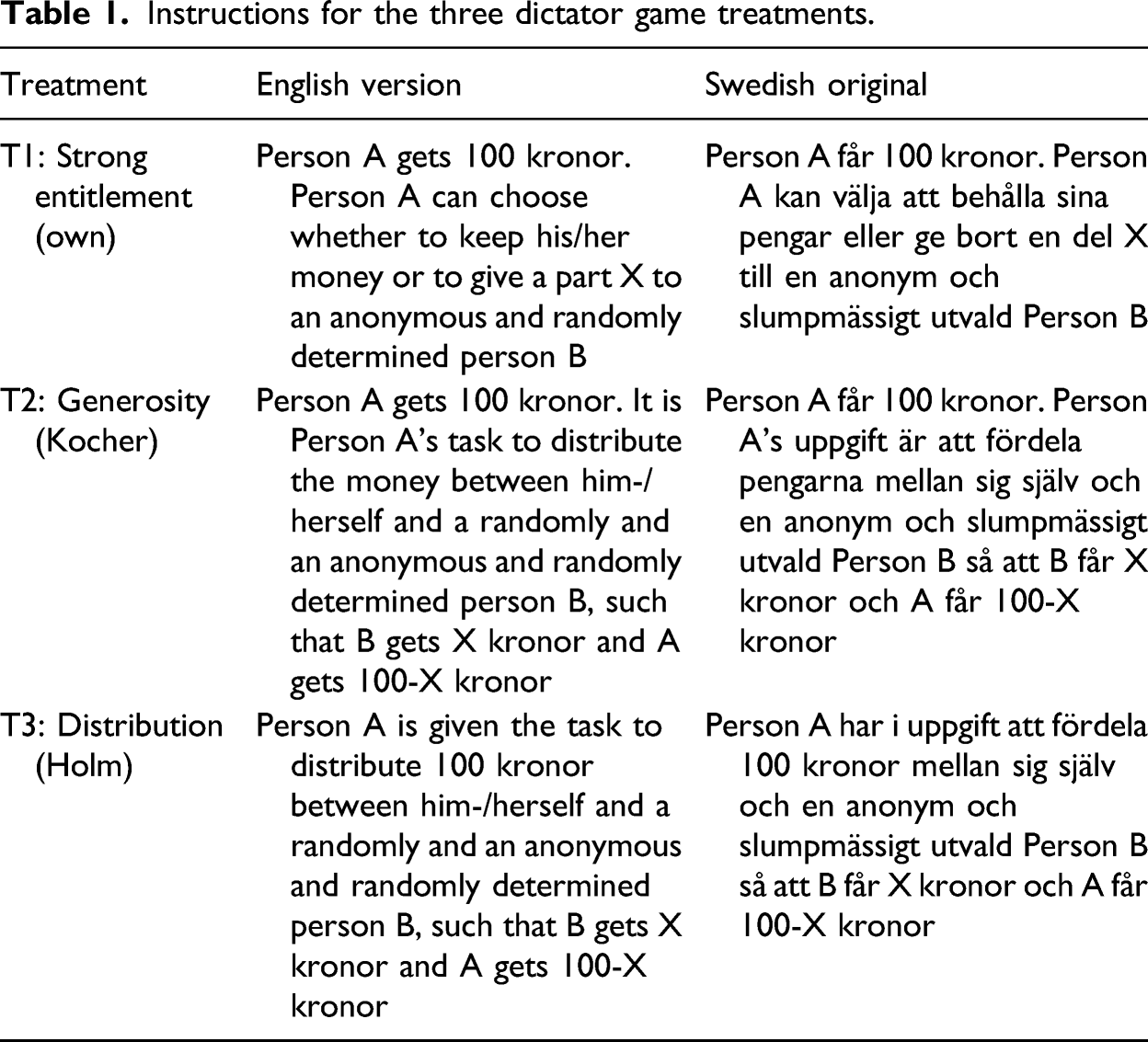
Note that among the three wordings, T1 most clearly describes the money as belonging to the dictator. T3 does the opposite by talking about a task of distribution, and T2 falls in between these two. We want to emphasize that the corresponding instructions were not framed on purpose. Instead, all three instructions surfaced when looking and asking around for instructions for the standard dictator game. Thus, while we were interested in differences in perceptions and assumed that there would be some kinds of (unintended) implicit framing in different standard instructions, only the choice between the different suggestions we encountered was intentional but not the wording itself.
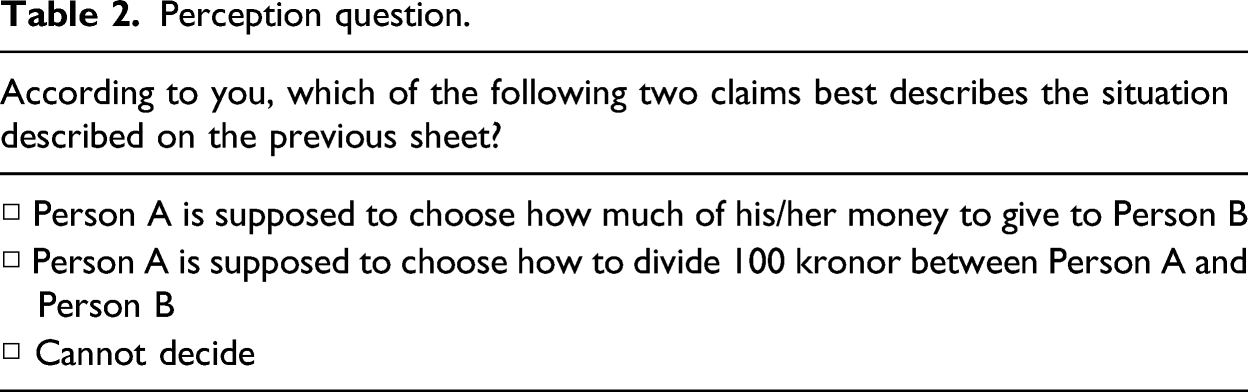
In order to find out how subjects perceive the task, we first asked them to state whether they see it mainly as ‘giving away mine’ or ‘distribute’, see Table 2. After that, subjects were asked to indicate the amount they thought appropriate to be transferred, their guess about other participants view on the appropriate amount and the actual average transfer of other participants. Each question was asked on a separate sheet. The order of questions (asking about perception before asking about amount transferred) was chosen to ensure that task perception -– our primary variable of interest – is based only on task instructions, ruling out potential ex-post justifications for behaviour where (part of) the stated perception of the task is used as a justification for earlier transfers (or lack of such).
15
Of course, a possible consequence of the chosen question order is that answers about task perception may influence the transfer decision, potentially strengthening the effect on transfers. However, we see no reason why this influence should be more than one of strength of effects.
16
In addition, at the beginning of the experiment, we gathered information about gender, age, number of siblings, parent’s education, previous participation in economic experiments (yes/no) and self-stated political view on a scale from 1 to 5, with 4 and 5 indicating ‘somewhat’ or ‘strongly’ to the right, with 3 labeled ‘center’. Finally, because Zizzo and Fleming (2011) find that dictator game behaviour is connected to sensitivity to social pressure, we ask subjects ‘How important is it for you to be liked by others’ ranging from 1 (completely unimportant) to 5 (very important).
Perception question.
Procedures
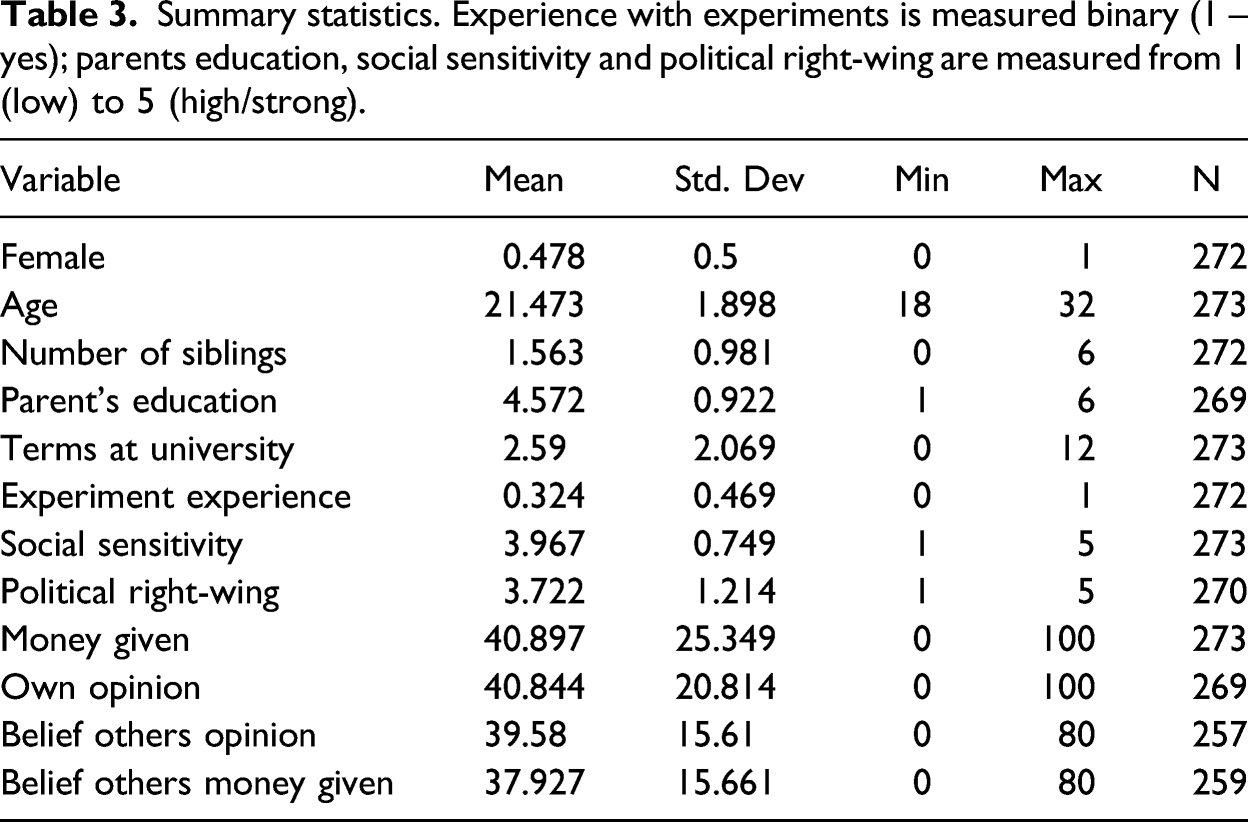
The experiment was conducted, using pen and paper, at the beginning of a first year economics course at Lund university in September 2014. In order to have time for the experiment, the lecture was ended a little earlier, and interested students were invited to take part in the experiment. 276 students (approximately 90 percent of all students present) decided to do so; 48% women, mean age 22 years.
Summary statistics. Experience with experiments is measured binary (1 – yes); parents education, social sensitivity and political right-wing are measured from 1 (low) to 5 (high/strong).
Results
The results of our study are presented below. As we will show, analysis of the data essentially confirms our hypotheses.
Perception
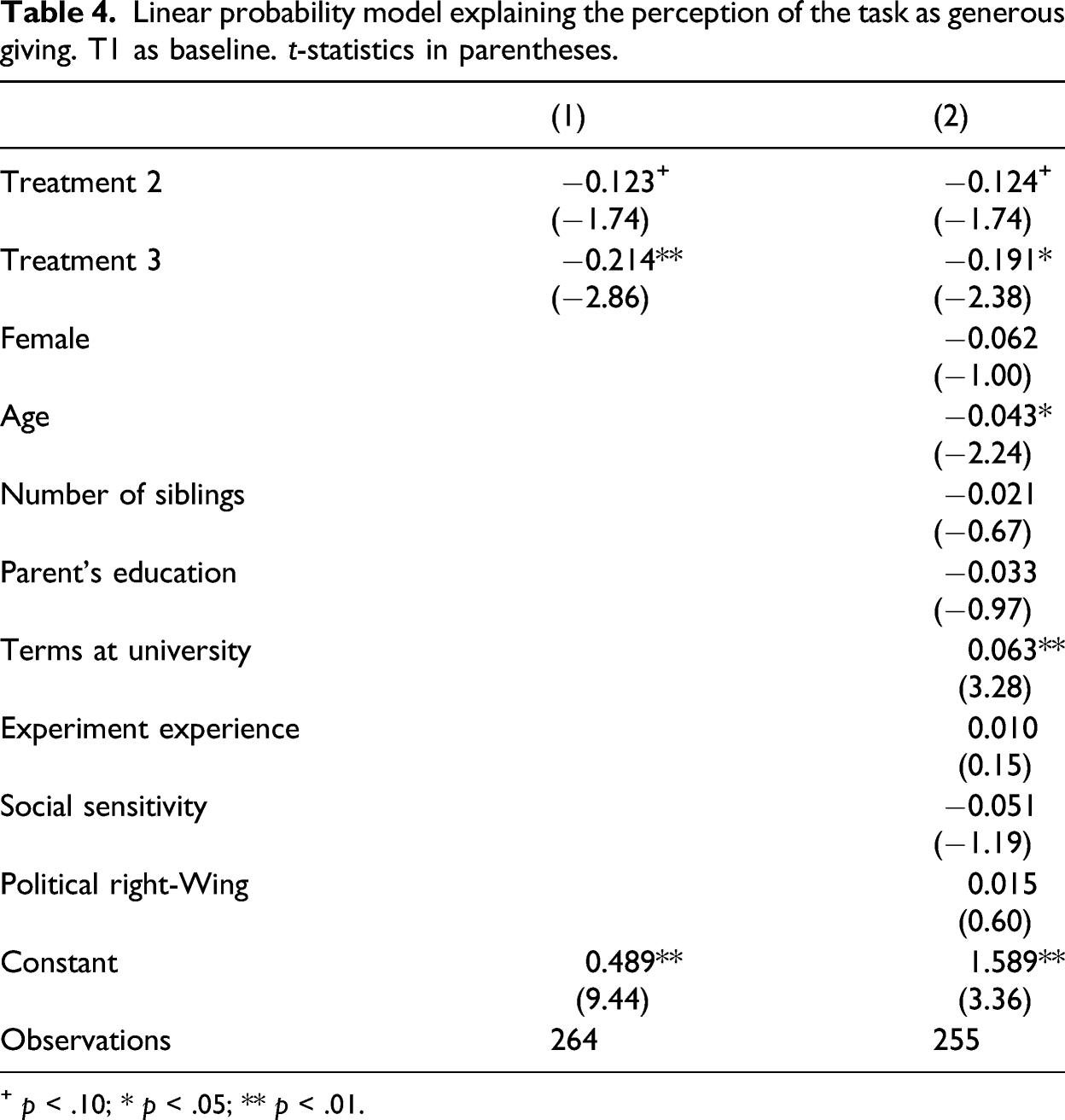
The share of participants who perceive the task as one of distribution varies as expected between the treatments. In T1, participants are completely divided: 48% perceive the task as distributive, and 5% cannot decide. In T2 and T3, 63% and 70% perceive the task as distributive (with 2% and 3% being undecided).
Linear probability model explaining the perception of the task as generous giving. T1 as baseline. t-statistics in parentheses.
+ p < .10; * p < .05; ** p < .01.
Behaviour
Subjects presented with the instructions which most clearly indicated dictator ownership, that is, T1, on average give 35% of their endowment. Instructions for the intermediate frame in T2 resulted in transfers of 39%. Finally, framing in T3, which described the task distributive, resulted in subjects transferring on average 52%. Thus, the ordering of shares allocated to the receiver is exactly in line with our hypotheses.
The difference between T1 and T2 is not significant at conventional levels (p = 0.21), but T3 is significantly different from both T2 (p = 0.0012) and T1 (p = 0.0000). This suggests that the part of the instructions saying ‘person A gets 100 kronor’ has a substantially stronger effect in terms of induced feelings of entitlement than describing the task as ‘giving’ instead of ‘distributing’.
Behaviour conditional on perception
OLS regression explaining the amount transferred; T1 as baseline. t statistics in parentheses.
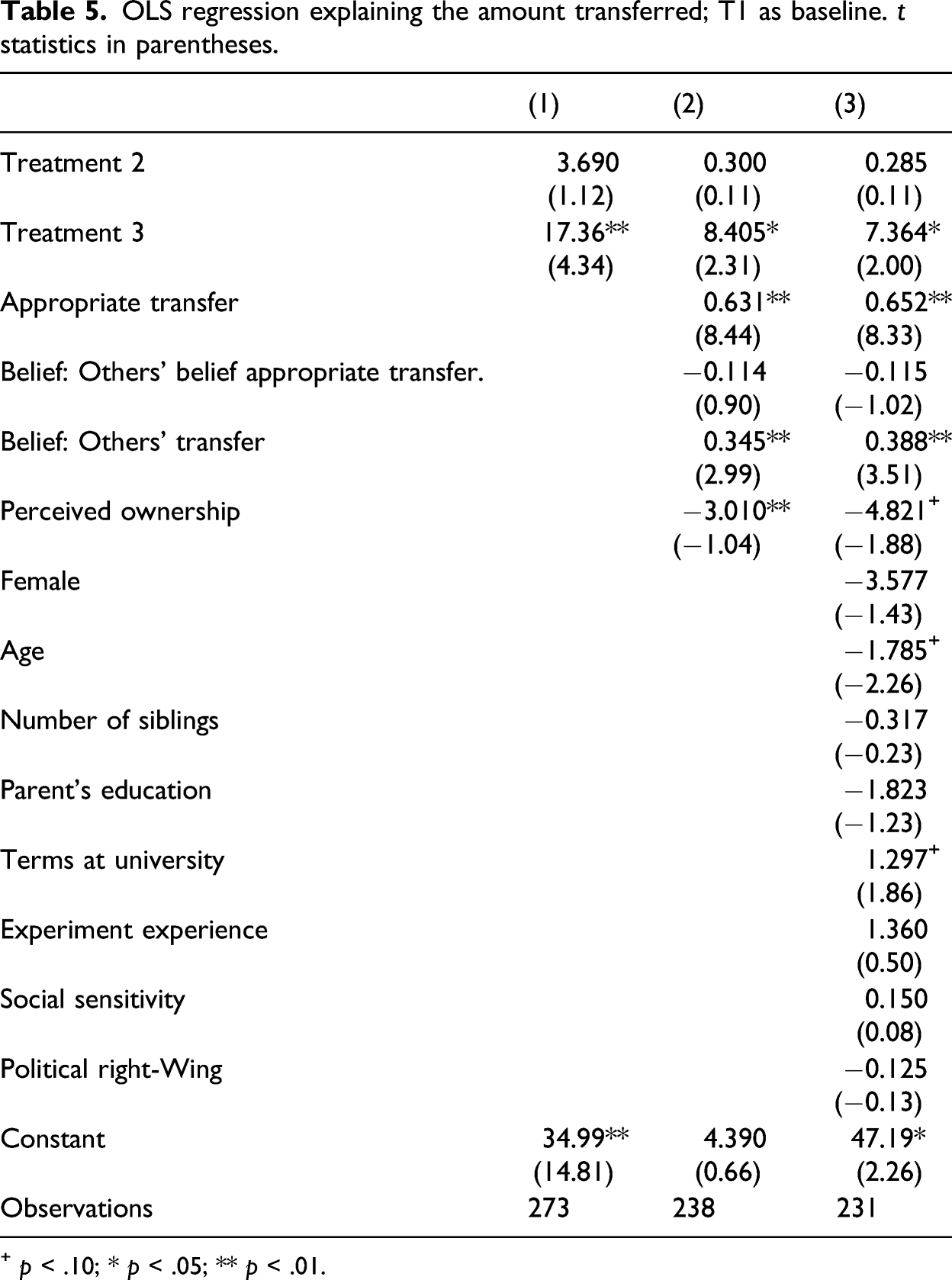
+ p < .10; * p < .05; ** p < .01.
Finally, it can be verified that, in line with Hypothesis 1.3, subjects perceiving the task as distributive – according to their own answers – transfer more than those who do not: 44 SEK vs 35 SEK (p = 0.005 6).
Summary
We summarize the main findings of our study below. Compared with our expectations, the results essentially confirm our hypotheses from Section 2.
For the three treatment frames – T1 allocation to A and giving to B, T2 allocation to A and distributing, T3 distributing – the data show the following patterns: 1. Perception: A stronger framing in terms of entitlement of the dictator induces a stronger perception of the task as generous giving. Relative frequencies of subjects referring to the task as ‘giving’ are highest in T1, 70%, intermediate in T2, 63%, and lowest in T3, 48%. 2. Behaviour: A stronger framing in terms of entitlement of the dictator induces a smaller average allocations to the receiver. The average amount given is highest in T3, 52%, intermediate in T2, 39% and lowest in T1, 35%. The difference between T1 and T2 is not statistically significant, though. 3. Behaviour conditional on perception: On average, subjects who perceive the task as giving indeed give less (35%) than subjects who perceive the task as distributive (44%).
Discussion
We conclude the results section with some additional comments regarding the theoretical framework presented in Section 2.
As we have seen, small changes in the instructions of the dictator game – which do not affect the structure of monetary incentives – have a considerable effect on both the subjects’ perception of the situation and, subsequently, the amount transferred to the receiver. As we have argued in Section 2, a likely reason for these changes is the subjects’ uncertainty regarding appropriate behaviour in the – typically rather uncommon – situation of the dictator game (cf. Zizzo, 2013). Subjects looking for clues as to how to behave, when monetary incentives certainly favour keeping the whole endowment, take the description of the situation, the instructions, as their best guidance. Thus, framing instructions slightly towards dictator ownership and generosity rather than distribution of joint resources induces a stronger perception of ‘money belonging to the dictator’ and more selfish behaviour. In terms of the framework presented in Section 2, the expected non-monetary utility from keeping more decreases once subjects are led to believe that the context is more likely to be one in which taking is appropriate.
Note that the argument remains agnostic about the exact sources of the non-monetary (dis-)utility from not sharing. We are convinced that the differences in motivations such as a warm glow of giving (Andreoni, 1990), identity (e.g. Ackerlof and Kranton, 2000), feelings of guilt (e.g. Charness and Dufwenberg, 2006) or general equality concerns (e.g. Fehr and Schmidt, 1999) are important and interesting to study. Yet, we also believe that for many economic questions, the exact details of what prevents people from solely following monetary incentives are less important. In the present setting, for example, uncertainty about the appropriate interpretation of the context (among probably many) and the possibility to affect the subjects’ judgement in this respect are likely to be decisive. The framework used allows us to account for this using simple comparative statics (a more ‘distributive’ context implies stronger ‘sharing incentives’). No details about the nature of the non-monetary incentives are needed. This may well be different if we are interested not only in motivating behaviour but also want to say more, for instance, about details of the motivation or welfare consequences (cf. Köszegi and Rabin, 2008). 21
Moreover, once we recognize the role of uncertainty regarding contextual effects, it becomes easier to justify more ‘continuous’ transitions of aggregate behaviours in experiments where social incentives (of whatever form) are likely to matter, too. The above discussion of the dictator game exemplifies this point.
Concluding remarks
The data presented in this paper show that different instructions in dictator games induce different perceptions of the task – giving away versus distributing money – and different levels of giving. Moreover, the statistical analysis relates this effect to particularities of the framing. The more explicitly the task is described in terms of dictator entitlement and generous giving (rather than distribution of joint resources), the more it is perceived accordingly and the less dictators give.
Our findings are in line with earlier studies showing that when the endowment to be allocated is provided by having one subject earning it, this induces higher allocations to the respective subject (cf. Hoffman et al., 1994; Oxoby and Spraggon, 2008). Adding to these findings, the present study demonstrates that ownership effects do not necessitate a behavioural act justifying them (e.g. filling in a test) to become effective. Instead, small and often unintended variations in the wording of the instructions are enough to trigger tangible changes in the subjects’ perception of the task.
A possible explanation for the effect of framing on perception is that subjects in artificial decision situations which they have no experience with are highly responsive to small clues about appropriate behaviour. As argued by Zizzo (2013: 3), a person coming to the lab ‘needs to make sense of the decision environment to identify what he or she is expected to do’. And instructions naturally provide important guidance in this exercise. Seen from that angle, giving in dictator games would be much less of a sign of intrinsic preferences for equality, though, rather than a response to allusions to sharing norms by contextual clues. 22 In that sense, we are inclined to agree with Bardsley (2008) that giving in dictator games to a large extent is an artifact of the framing, albeit focusing on a different aspect of the frame.
It is beyond the scope of this paper to adjudicate on the correct interpretation of giving in dictator games. Yet, we believe that the general thrust of the results presented here – as well as the earlier studies cited above – is interesting: The more selfish behaviour is permitted by (even small) contextual clues, the more it is exercised. And the more social norms about sharing are alluded to (e.g. talking about distribution), the more they are followed.
Following the present line of argument, some of the variation in aggregate behaviour can be ascribed to uncertainty about the appropriate interpretation of the context (cf. Bergh and Wichardt, 2018). Of course, individual differences in how this uncertainty is resolved or in the weighing of social versus selfish incentives are difficult to assess. Yet, the general message seems clear: once contextual clues emphasize social connotations, the relevance of socio-psychological aspects of utility (i.e. their probability weight) becomes more prominent and aggregate behaviour reacts accordingly.
To conclude, we believe that uncertainty about the non-monetary incentives in a certain context (i.e. their relative importance) is likely to be relevant also in other experimental settings. We can of course only speculate about how far it will affect the outcomes in settings with strong strategic aspects, which are absent in dictator games. Yet, in our view, the dictator game experiment presented in the present paper nicely illustrates the main aspects of the argument.
Footnotes
Acknowledgements
We thank Roberto Weber as well as two anonymous reviewers and the editor for helpful comments. Financial support from Jan Wallanders och Tom Hedelius stiftelse (grant P19-0180) and Torsten Söderberg’s Foundation (Bergh) and from the Arne Ryde Foundation (Wichardt) is gratefully acknowledged. The project once started as a joint work with Manuela Oberauer from the University of Innsbruck who later decided not to continue. We are grateful for her contribution in the early stages of the project.
Funding
The author(s) disclosed receipt of the following financial support for the research, authorship, and/or publication of this article: This work was supported by the Vetenskapsrådet; Jan Wallanders och Tom Hedelius Stiftelse samt Tore Browaldhs Stiftelse.
