




Abstract
Lindenberg et al. report experimental evidence for the effect of hedonic shifts on subjects’ propensity to engage in moral hypocrisy. Hedonic shifts are changes in individuals’ cognitive states that can be triggered by cues in these individuals’ environments such as ambient smells. Individuals in a hedonic cognitive state aim at doing what makes them feel good. Hence, the authors hypothesize that (1) individuals who are in a bad mood and are put in a hedonic cognitive state will more often take a moral stance and (2) when asked to act morally refuse to do so, (3) especially when the costs for acting morally are high, and (4) even if the moral issue upon which they are asked to act is unrelated to the issue pertaining to the moral stance they took. The authors test these four hypotheses in two laboratory experiments and conclude that their results support these hypotheses. In this comment, I highlight design, measurement, and data analysis issues arising with the two studies that challenge this conclusion. Throughout my comment, I give some indications as to how a laboratory experiment testing these four hypotheses could be designed and conducted.
The Forum
The Forum consists of comments on previously published papers and responses by the authors. It includes both solicited as well as unsolicited contributions. We encourage open and critical debate by actively seeking points of view contrary to those expressed in articles published in this journal. The Forum is intended to promote discussion that contributes to the intellectual vitality and further development of rational-choice-based theory and research.
Summary of Lindenberg et al. (2018)
Lindenberg et al. (2018) investigate the causes of an understudied type of hypocrisy, namely hedonic moral hypocrisy. Unlike in pragmatic hypocrisy, where people fake moral commitment for their own advantage (e.g. claiming to be cooperative only to benefit from the cooperation of others), hedonic moral hypocrisy is motivated by people’s urge to feel good. In other words, a hedonic moral hypocrite will take a moral stance and when prompted to act morally (even on an issue unrelated to the one pertaining to their moral stance) will refuse to do so if the required effort is too large. Most important, a hedonic moral hypocrite is not a rigid actor type; it can manifest itself in each one of us (temporarily) depending on our mood or, more precisely, our want to lift our mood. In this regard, hedonic moral hypocrisy offers an excellent testbed for goal-framing theory.
In a nutshell, goal-framing theory posits that actors are in three cognitive states (so-called overarching goal frames), one of which is at any one time more dominant than the other two and thus has the largest bearing on actors’ deliberation and decision making. The three overarching goal frames are as follows: (1) the normative goal frame, in which actors aim to do what is right and morally appropriate; (2) the gain goal frame, in which actors aim to do what increases their material gains and other resources; and (3) the hedonic goal frame, in which actors aim to do what makes them feel good. Importantly, which one of the three cognitive states is the dominant one in a given situation can be triggered by cues in an actor’s environment. For example, a trash littered parking lot can push the normative goal frame in the background and promote parking violations (i.e. behavior that is self-regarding or hedonic).
The authors thus conjecture that actions of actors for whom the hedonic goal frame is more dominant will more likely serve the purpose of making them feel good, especially when they are in a sad mood. For example, they will more likely take a moral stance that signals to themselves that they are good (hypothesis 1) and when prompted to act morally will more often refuse to do so (hypothesis 2), and even more the higher the effort necessary to perform the moral act (hypothesis 3), and even if the moral issue on which they are prompted to act is unrelated to the moral stance they took (hypothesis 4). Let me repeat these hypotheses for the sake of clarity:
H1: The stronger the hedonic shift, the more likely will actors who are in a sad mood take a moral stance.
H2: The stronger the hedonic shift, the more likely will actors who are in a sad mood take a moral stance and not act morally (i.e. be hedonically hypocritical).
H3: Given a hedonic shift, the larger the effort necessary to act morally, the more likely will actors who are in a sad mood be hedonically hypocritical (i.e. take a moral stance and not act morally).
H4: The occurrence of hedonic moral hypocrisy does not require the moral stance to be substantially related to the moral behavior (i.e. address the same moral question).
Lindenberg et al. (2018) conduct two laboratory experiments with student subjects to test these four hypotheses. The first experiment is designed to test H1. The second experiment is designed to test H2 through H4. Based on the results of these two experiments, the authors conclude that their hypotheses are supported.
In what follows, I will first summarize the design and procedure of experiment 1 and argue that the design of experiment 1 leaves open alternative explanations that are inconsistent with H1. Then, I will summarize the design and procedure of experiment 2 and argue that the design of experiment 2 limits the testability of H3. I will then briefly summarize the results of experiment 2 and show that experiment 2 did not produce evidence in support of H2 and H4.
Experiment 1
Experiment 1 had a 2 × 2 between-subject factorial design. A total of 80 student subjects were first assigned to a condition in which their overarching goals were shifted in either a hedonic or normative direction. Then, half the subjects in both conditions were induced to have a sad or a happy mood. The hedonic shift manipulation was accomplished with gender-specific cues: a picture of a sexy model or a yummy-looking chocolate cake for male and female participants, respectively. The normative shift manipulation was accomplished by letting participants (irrespective of gender) evaluate a picture of Lady Justice on three normative dimensions. The mood manipulation was accomplished by asking participants to briefly describe a personal memory in which they felt happy or sad to induce a happy or sad mood in them, respectively. Then, participants’ moral stance was measured as the average of these participants’ evaluations of four scenarios of environmentally harmful behavior. Finally, participants were asked how happy/sad they were on a 9-point scale. The main result (Figure 2 in Lindenberg et al. 2018: 403) shows that moral stance is lower only for participants in the hedonic goal frame happy mood condition; moral stance is about the same for participants in the other three conditions.
I argue that two design features of experiment 1 impede the conclusion that (only) participants in the hedonic sad condition took a moral stance (as high as participants in the normative conditions) because they wanted to lift their mood. There are plausible alternative explanations for this result.
First, the authors’ mood manipulation procedure leaves it to subjects to choose their stimulus (a personal memory). An unpleasant memory is likely to be about being harmed by others or treated unjustly. Such a reminiscence may push the normative goal frame into the foreground and thus undermine the initially induced hedonic shift. This would be in line with the results shown in Figure 2 in Lindenberg et al. (2018), which shows moral stance in the sad hedonic condition to be as high as in the normative conditions. Second, even if mood had been manipulated by the authors more uniformly, for example, by showing participants a short movie with a happy or a sad ending depending on condition, it remains unclear whether the expression of moral stance indeed makes participants feel better as the mood repair test is only administered thereafter. Experiment 1, thus, lacks two hedonic control conditions (one happy and one sad) in which participants do not have an opportunity to express their moral stance. Had there been such control conditions, the mood repair test should show (1) different scores across the happy and sad hedonic conditions and (2) a lower score in the sad hedonic condition without than with a possibility to express moral stance. Without these controls, one could claim, in line with Figure 2 in Lindenberg et al. (2018), that also the normative shift manipulation induces subjects to want to feel better, for example, because of how deficient they feel after having acknowledged the virtues of Lady Justice.
In sum, the results of experiment 1 are inconclusive with regard to H1 because they rely on a doubtful mood manipulation and are not being compared with results from two necessary but lacking control conditions.
Experiment 2
Experiment 2 had a 3 × 2 between-subject factorial design. A total of 135 student subjects were first assigned to a control, light hedonic shift, or strong hedonic shift condition. The hedonic shift manipulation was accomplished with ambient smells. The authors used an ambient pleasant cake smell to induce a weak hedonic shift and an ambient unpleasant fart smell to induce a stronger hedonic shift. No ambient smell was used in the control condition. Unlike in experiment 1, mood was not manipulated but only measured on a 9-point scale (see experiment 1). Next, participants’ moral stance was measured as the average of these participants’ responses to three 7-point items asked with regard to each of the seven established social norms (21 items in total).
Unlike in experiment 1, there is no difference in participants’ moral stance across hedonic shift conditions, even if participants’ mood is accounted for. Note that this is in fact evidence against H1. Surprisingly, in the Results section of experiment 2, the authors state that they “did not expect the severity of moral stance to differ between the goal conditions” (Lindenberg et al., 2018: 409). Their post hoc statement is surprising because it contradicts H1. Moreover, given that participants’ sad mood is a precondition for hypotheses H1 through H4 to be testable, this insight casts doubt on the adequacy of the design of experiment 2. Since the authors do not seem to see a problem with this, let me follow through with my argument.
Next, participants in experiment 2 were given the opportunity to act morally. After the moral stance elicitation, when the experiment had seemingly ended for them, participants were asked whether they would be willing to help a fellow student by filling in a questionnaire. At this stage of experiment 2, the second factor, the cost of the moral act, was varied in two conditions. In the low-cost condition, participants were told that filling in the questionnaire would last about 2 minutes; in the high-cost condition, this was 15 minutes. In line with their definition, the authors operationalized moral hypocrites as those participants with a median or higher moral stance who refused to help. The main result (Figure 4 in Lindenberg et al., 2018: 410) shows that the proportion of moral hypocrites increases significantly with the strength of the hedonic shift and tends to be higher in the high-cost conditions.
First note that because the effort level was revealed to participants only after the moral stance elicitation, the testability of H3 is limited. H3 predicts a positive effect of the effort level on moral hypocrisy, and moral hypocrites are defined as actors who take a moral stance and refuse to act morally when given the chance. The effort manipulation can thus affect participants’ willingness to help but not their moral stance. In defense of the authors’ approach, one could say that someone who takes a moral stance, only thereafter learns the effort level of a moral act, and refuses to act morally is still a moral hypocrite. However, this approach cannot disentangle the effect of the effort level on moral hypocrisy from its effect on participants’ actual time constraints. A task lasting 15 minutes is simply more likely to interfere with participants’ other plans than a task lasting only 2 minutes, irrespective of these participants’ moral stances.
Second, the authors test H2 by showing that the increase in the proportion of moral hypocrites conditional on the strength of the hedonic shift is statistically significant. However, for the result in Figure 4 to be in support of H2, the proportion of moral hypocrites must increase relative to the proportion of non-hypocrites who are unwilling to help (i.e. participants with a below median moral stance who are unwilling to help). If this was not the case, the hedonic shift conditions too would be affecting willingness to help, but not moral hypocrisy. To test H2, I created Table 1 based on the information available in Lindenberg et al. (2018). My calculations are based on the following assumption and results reported by the authors:
Number of subjects who were unwilling to help across hedonic shift conditions.
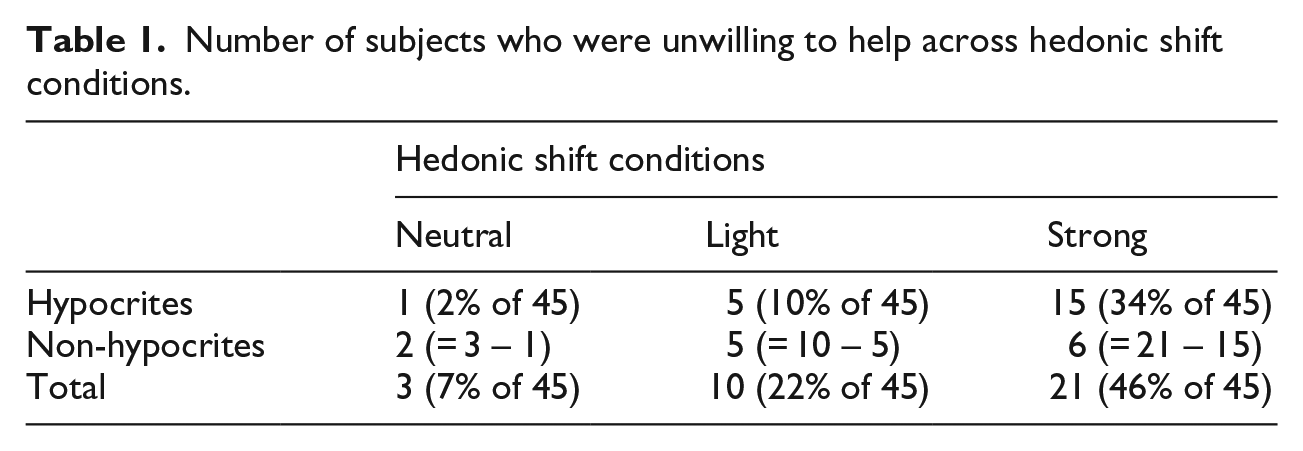
I assume that the 135 participants of study 2 were divided equally on the three hedonic shift conditions (i.e. 45 subjects per condition).
I use the helping rates reported by the authors in the second part of the paragraph labeled “Helping” in the Results section. The corresponding numbers are listed in Table 1 (row “Total”).
Based on the proportions of hypocrites reported by the authors in the first part of the paragraph “Hedonic hypocrisy” in the Results section, I calculate the number of hypocrites. The corresponding numbers are listed in Table 1 (row “Hypocrites”).
Based on the total number of subjects who did not help and the number of hypocrites, I calculate the number of non-hypocrites who did not help. The corresponding numbers are listed in Table 1 (row “Non-hypocrites”).
Based on the numbers in Table 1, Fisher’s exact test produces a value of p = 0.277, which suggests that H2 is not supported. I arrive at the same conclusion based on a logistic regression model estimated on data constructed from these numbers.
Finally, since there is no evidence in support of H2, H4 is not supported either. Moreover, experiment 2 lacks a control condition in which moral stance and behavior are prompted on the same issue rather than unrelated issues. It is not entirely clear what the predictions would be in this case. My conjecture is that participants would be more conscious about the connection between their moral stance and the request to act morally and strive for self-consistency. As a result, the proportion of moral hypocrisy would be lower than in a condition in which stance and behavior are elicited on different issues, irrespective of hedonic shift manipulations.
Concluding remarks
Based on the results reported in Lindenberg et al. (2018), there is not much we can say about whether and how hedonic shifts bring about more moral hypocrisy. Despite the design, measurement, and data analysis issues, I have highlighted above, it does not appear impossible to test the hypotheses put forward by the authors. My comments provide some indications as to how an experiment testing these hypotheses could be designed and conducted.
