




Abstract
A social norm clearly pre- or proscribes which kind of behavior is appropriate in a given situation. However, there are situations in which two competing norms apply, meaning that two opposing types of behavior are potentially legitimate. This study examines such a scenario among health care students during the initial COVID-19 lockdown in the Netherlands in 2020. The students faced two potentially competing norms, choosing between continuing to work in their internships, or to stay at home. Drawing on Goal-Framing Theory, we explore how the salience of norms may vary in four conditions of personal beliefs: sociality, normativity, conjointness, and interdependence. We argue perceived sociality and normativity serve as cues of the appropriate norm in a situation, which can be supported by beliefs about interdependence with others. The salience of disjoint norms, where the beneficiaries of normative behavior differ from those performing the behavior, is theorized to be more brittle than the salience of conjoint norms. Empirically, we surveyed 55 interns about their social norm perceptions, and employed Qualitative Comparative Analysis to uncover patterns in beliefs that lead to normative outcomes. The pathways to work continuation indicate the importance of normative beliefs in strengthening disjoint norms, combined with strong interdependence perceptions. The pathways to staying at home show how conjoint norms require less support, and that perceived normative ambivalence also favors the conjoint norm. Altogether, these results show the importance of assessing the varieties of beliefs underlying norms in situations of competing norms.
Keywords
Social norms are important to elicit and sustain individually costly contributions to collective goods, in particular when formal sanction opportunities are weak or absent (Burke and Young, 2011; Fehr and Schurtenberger, 2018). As “standards of behavior that are based on widely shared beliefs how individual group members ought to behave in a given situation” (Fehr and Fischbacher, 2004: 185), perceived norms often provide indications of the appropriateness of certain types of behavior. However, there are situations in which more than one norm may apply, such that it may be legitimate to follow either of them. The kind of behaviors pro- or prescribed by these different norms may even conflict; one norm may require people to “do X”, while another norm may require them to “don’t do X” (for qualitative work illustrating situations of competing norms, see Boivin et al., 2008; Holmelin, 2019; James-Hawkins et al., 2019).
Previous research on competing norms is still relatively limited. In an early study on the effect of competing norms on individual behavior, Stouffer (1949) found large variations in individual beliefs, expectations, and perceptions concerning the degree to which a specific behavior is approved by different reference groups. Subsequent studies problematized situations in which only one norm is present, showing that norm compliance depends strongly on the beliefs individuals have about the actual behavior of others (Bicchieri and Xiao, 2009; McDonald et al., 2014; Smith et al., 2012) and on perceived motivations for others’ behavior (Feltz, 2007; Robinson et al., 2015). Additionally, the structure of the normative dilemma may affect individuals’ behavioral choices, as individuals are more likely to contribute to common goods if they perceive their situations as interdependent (Balliet and Lindström, 2023; Wageman, 2001) and when the normative behavior benefits themselves (Coleman, 1994; Farkas, 2019).
This paper integrates, under the psychological micro-foundation of Goal-Framing Theory (GFT) (Lindenberg and Steg, 2013), four different conditions that shape the salience of a particular norm: sociality, normativity, interdependence, and conjointness. While each of these conditions has been shown to be an important predictor of norm compliance in previous research, they remain largely disconnected and only applied in situations with a single norm. GFT explicitly models the shifting salience of different goal-frames, emphasizing that two competing norms cannot simultaneously be equally salient, which makes GFT particularly useful to assess situations in which two norms compete. The core of our argument is that when individuals are confronted with two competing and legitimate norms and the related behavioral alternatives, they will follow the norm that is most salient to them. The salience of the norm is in turn shaped by the four conditions.
Our study investigates the decision Dutch health care students had to make during the Netherlands’ first COVID-19 lockdown in 2020. Their unique situation as interns in several health care facilities posed a dilemma between continuing to work on-site, or to stay at home. During the earliest days of the COVID-19 pandemic, when many countries were entering lockdown, most individuals were homebound to prevent the disease from spreading further. Perceptions about the legitimacy of norms and the perceived degree to which others would abide played a pivotal role in explaining individual norm compliance (Bicchieri et al., 2021; Kooistra and van Rooij, 2020). A more select group of individuals, such as health care professionals, were urged to continue working during the pandemic (Janietz, 2025). This decision too was normatively charged, with mediatized global applause recognizing their vital contributions (Eftekhar Ardebili et al., 2021). Despite debates about the legitimacy of lockdown restrictions, for most individuals it was relatively clear which norm applied to them. However, Dutch health care students in vocational education who were doing their internships in different health care facilities faced a difficult dilemma. On the one hand, they were explicitly offered the choice to continue working in their internship organization (thereby contributing to the common cause), but, on the other hand, they were free to choose to suspend their internship and stay home to help prevent the disease from spreading. Our study makes use of this unique naturalistic setting to explore how norm beliefs affected the choices of students in a situation of competing norms. We empirically investigate the decisions and beliefs of a group of first-year nursing interns (n = 55) in the north of the Netherlands, of whom 18 (33%) decided to continue their internship and be physically present at their internship workplace, while the others decided to stay at home.
This situation of competing norms can be placed within the broader literature on how environmental uncertainty and external shocks, like the COVID-19 pandemic, can lead to social norm changes (Hawkins et al., 2019; Neville et al., 2021; Young, 2015). Where norm changes are often gradual, external shocks may create such uncertainty in a situation to induce swift changes to a particular norm. Our study contributes to the understanding of norm changes by adding a theoretical framework and empirical results on how individuals may perceive competing norms amidst this uncertainty. In addition, by including the framework of competing norms in our analysis, we complement the burgeoning literature on norm-compliance during the COVID-19 pandemic (e.g., Bicchieri et al., 2021; Hensel et al., 2022; Mallinas et al., 2021; Martínez et al., 2021). In addition, this study differs from previous research on competing norms in three important ways. First, it is conducted within a real organizational setting, which introduces dilemmas related to interdependence and joint production, while at the same time increasing the external validity of the results. Second, competing norms in the study were induced by an external shock that had clear and widespread consequences for the general population and for our sample, and last, the behavioral outcomes of the shock and the related decisions were visible and unambiguous.
In the following, we first outline our theoretical argument. We then contextualize the empirical setting of this study, and describe the data collection and method of analysis. After the results section, we offer our conclusions and end with the discussion section.
Theory
Goal-framing theory
Goal-framing theory (GFT) is a cognitive theory that emphasizes how situational contexts frame the goals that individuals pursue (Lindenberg and Steg, 2007, 2013; Steg et al., 2016). By doing so, these contexts influence how individuals perceive, select, and act on information. The theory distinguishes three overarching goal-frames (Lindenberg and Steg, 2007). The hedonic goal-frame points individuals towards goals regarding the satisfaction of needs in the moment, in order to “feel better right now” (Steg et al., 2016: 181). For instance, a student hearing their alarm clock in the morning who has a strong hedonic goal-frame would be particularly aware of the coziness of their bed, thereby being more inclined to ignore the alarm. The gain goal-frame deals with resources and brings into focus the future states of individuals. These resources can be both material and social: behavior aimed at increasing one’s status also falls in this goal-frame (Liobikienė et al., 2020). If a gain goal-frame is salient for the student from the previous example, they might think of losing their internship position if coming too late. The normative goal-frame brings into focus the social collective of which the individual is a part, as well as behavior that is appropriate in that particular context. When the normative goal-frame is salient, a student can be acutely aware of how their timely appearance would benefit the patients they are tending to at their internship organization.
The three overarching goal-frames differ in their a-priori salience, with the hedonic goalframe being the strongest, and the normative goal-frame being the most brittle. Physiological stimuli such as comfort and adrenaline draw an individual’s attention towards the fulfillment of immediate needs, thereby increasing the salience of the hedonic goal-frame (Lindenberg, 2008b: 675). Ignoring the urge to give in to such needs requires cognitive effort. The normative goal-frame, on the other hand, is brittle by its very nature, and needs constant situational buttressing to remain salient. Social cues are essential to trigger normative behavior, as such cues provide support for the salience of the normative goal-frame (Keizer et al., 2008; Lindenberg et al., 2021).
One of the key insights of GFT is that goal-frames can be simultaneously salient to different degrees. While only one goal-frame can be in the foreground at one moment (the “focal” goal-frame), other “background goals” may be operating at the same time (Lindenberg and Steg, 2007). As motivations are seldom completely homogeneous, and contexts often provide conflicting signals potentially triggering multiple goal-frames (Dóci and Vasileiadou, 2015), there is an intricate interplay of the shifting saliences of goal-frames. For instance, Lam and Lambermont-Ford (2010) report how workers’ normative behavior—the sharing of knowledge across team boundaries—is increased when organizations manage to increase the enjoyment of such knowledge sharing, thereby strengthening the hedonic background goal. In other words, the background goals can provide support to the focal goal-frame, as long as they do not conflict with or become the focal goal-frame (Lindenberg, 2018; Lindenberg et al., 2021).
Shifting saliences in beliefs about norms
GFT has so far been successfully applied to explain individuals’ norm-following behavior in situations where one norm applies. Empirically, the best-documented normative behaviors using the shifting saliences of GFT explain environmentally-friendly behavior (Do Canto et al., 2023; Steg et al., 2016), public conformity to collective norms (Chaudhuri et al., 2016; Lindenberg et al., 2021), and organizational behavior (Mühlau and Lindenberg, 2003; Xia et al., 2024). These studies consistently point to the importance of contextual social cues and aligned background goals that provide support for the normative goal-frame. Our study extends the theoretical framework towards situations of competing norms, while applying the same core mechanisms of shifting saliences of goal-frames. We contend that when individuals are confronted with two competing and legitimate norms and the related behavioral alternatives, they will follow the norm that is most salient to them. We argue that there are four types of beliefs that act as antecedents of normative behaviors and, for those beliefs that are norms (Bicchieri, 2005, 2017), the context determines the saliency of the beliefs. The normative goal-frame is shaped by environmental cues and supportive background goals, which makes it crucial to understand how individuals perceive their social context. This includes identifying the cues they notice and their beliefs about their actions within that context. Since GFT explains that two competing norms cannot be equally salient, individuals will behave according to the norm that they perceive as more salient.
The question then becomes: which conditions influence the salience of a norm? Building on the work of Lindenberg (2008a), McDonald et al. (2014) and Smith et al. (2012), we argue that beliefs about the extent to which one’s social environment adheres to the norm are key factors influencing the salience of a norm. To differentiate individual beliefs regarding the norms in their situations, we draw from Bicchieri’s (2005, 2017) influential categorization of norm beliefs. This categorization delineates how individuals perceive the appropriateness of social behavior in their surroundings, offering a way to understand how social cues affect the normative goal-frame. We expand this categorization by introducing two additional conditions of norm beliefs: conjointness and interdependence. Taken together, we identify four conditions on which the social normative beliefs can vary in strength: sociality, normativity, conjointness, and interdependence. Figure 1 depicts the conceptual model, with the four conditions affecting the salience of either norm and the behavior accompanying it. Conceptual model of competing norms. Note: This conceptual model applies Goal-Framing Theory to explain the conditions underlying the salience of two competing norms. Solid lines indicate conditions strengthening the salience of norms, while the dashed lines indicate weakening influences between the salience of one norm and the alternative behavior.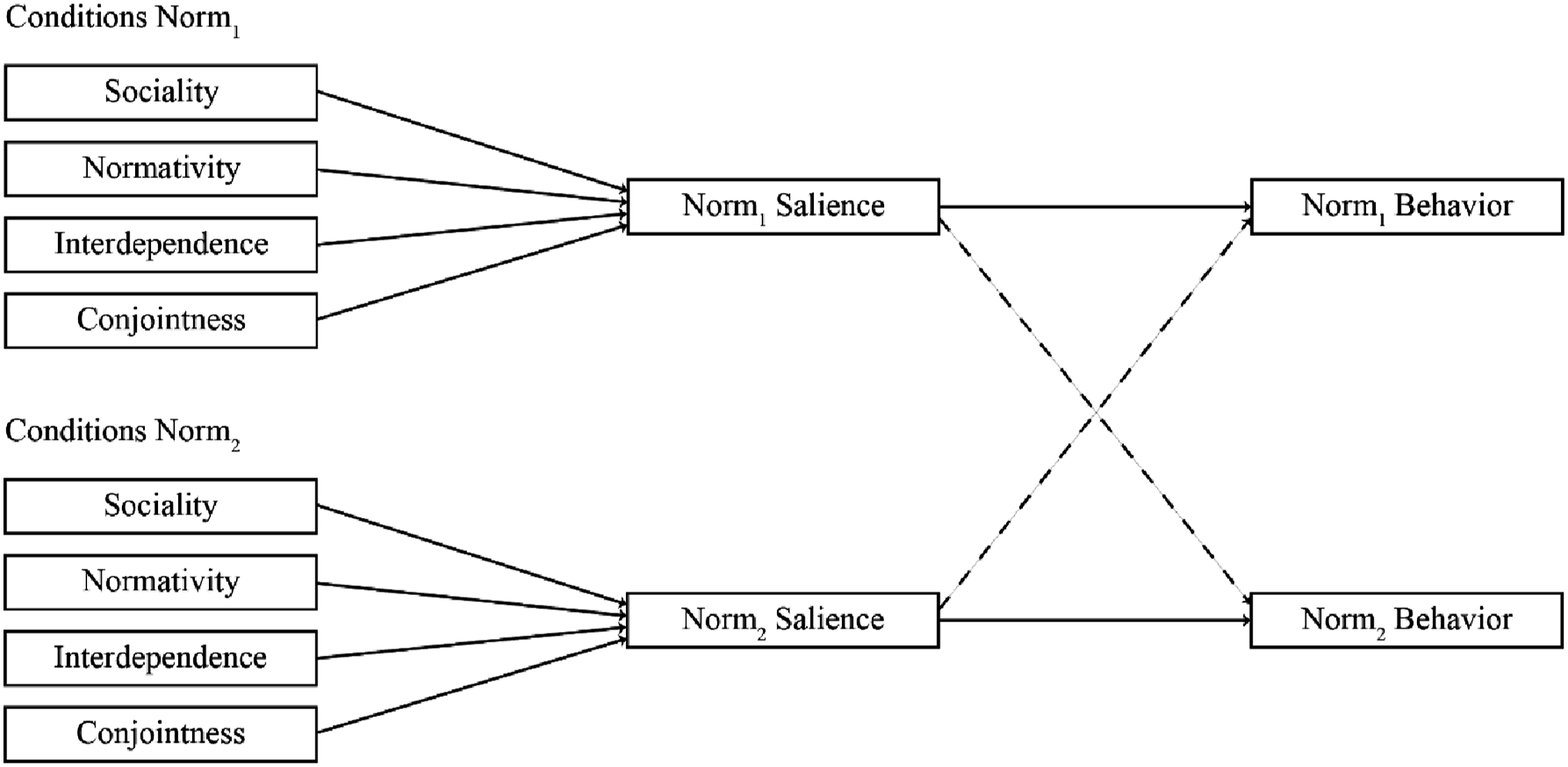
Social versus non-social beliefs
Bicchieri (2005, 2017; Bicchieri et al., 2021) categorized individual beliefs about norms in two dimensions: one regarding their (non-)social nature, and one regarding their (non-)normativity. The first dimension differentiates between non-social beliefs and social beliefs, and these beliefs differ in the degree to which they include expectations about the behavior of others. Social beliefs are beliefs about the social world around an individual, and therefore include expectations about the behavior of others. Non-social beliefs are beliefs that individuals have about reality outside of the behavior of others: these are beliefs that are perceived as factual realities, or beliefs that regard personal norms. The distinction makes clear that individuals may have a belief about what they themselves ought to do (in our study, we call these non-social personal beliefs), which can differ from the belief of what others ought to do (social normative beliefs).
GFT predicts that the more a belief about normative behavior is social, the more likely it is to make the normative goal-frame salient (Lindenberg and Steg, 2013). Non-social personal beliefs, such as personal moral beliefs, can support the salience of a normative goal-frame when they are aligned. However, when these personal beliefs are supported by social cues from the environment, their influence on the salience of the normative goal-frame becomes stronger (De Groot and Steg, 2009).
Normative versus non-normative beliefs
Beliefs can differ in the degree to which they are normative. Beliefs are non-normative when they evaluate behavior without adding a normative component, in a sense that they are either perceived as facts or empirical expectations about the behavior of others (in other terminology called descriptive norms). Normative beliefs are either personal normative beliefs on how a person themselves should act (in our study, we call these non-social personal beliefs), or a social normative belief that others also believe one ought to act in a particular way. Bicchieri (2005) argues that only in the case that a belief is both social and normative, we can truly speak of a social norm.
Regarding the influence of the perceived normative behavior of others, it is important to note that some individuals may have a stronger impact on an individual’s beliefs than others. Reference groups play a key role in shaping one’s norm beliefs, as individuals differentiate between social identities and functions when assessing what behavior is appropriate (Spears, 2021; Wuestenenk et al., 2023). In the empirical context of this study, the students who were doing their internship have two potential reference groups that may influence their norm beliefs. The first group contains professionals, for whom the appropriate normative behavior was clearer, as their behavior aligns with the organization strongly and not going to work was not an option (Janietz and van de Werfhorst, 2020). The second group contained the other students, for whom the appropriate normative behavior is more blurred as both behaviors were formally presented as a legitimate option. In addition, given previous evidence that both reference groups and hierarchically superordinate employees influence beliefs about the appropriate organizational behavior (Dannals and Miller, 2017; Takeuchi et al., 2009), our study therefore differentiates between students’ norm beliefs pertaining to other students and other professionals.
From a GFT perspective, the extent to which a particular type of behavior is perceived as normative will play a strong role in the salience of a particular norm. Empirical expectations have been repeatedly shown to have a strong pull towards the gain goal-frame when normative and empirical expectations do not align (Bicchieri and Xiao, 2009; Kölle and Quercia, 2021). When individuals perceive the behavior of others as “simply” an empirical expectation about social reality, this would not offer any cognitive cues towards the normative goal-frame (Andrighetto et al., 2015). Alternatively, seeing others persistently perform normative behavior would be a strong social cue that would increase the salience of the normative goal-frame (Lindenberg et al., 2021).
Conjoint versus disjoint beliefs
A third relevant condition of personal beliefs deals with the target groups and beneficiary of norms. Coleman (1994: 247–248) analytically divided social actors involved with norms in two classes, with the target group being those individuals whose actions are pro- or prescribed by a norm, and the beneficiaries are those actors who benefit from it. When the two groups overlap, and the individuals whose behavior is affected by the norm are also the individuals who benefit from their behavior, a norm is conjoint. When the actors who are affected by the norm are not those who benefit from their actions, the norm is disjoint. In the empirical context of this paper, the perceived norm to continue working is disjoint, as the behavior prescribed to health care interns does not benefit themselves directly, instead benefitting the health care organization and its patients. The norm to stay at home to stop the disease from spreading is conjoint, as the intern staying at home directly benefits from their own behavior by decreasing the risk of becoming infected with the virus.
A problem inherent to disjoint norms, where targets and beneficiaries differ, is the increased likelihood of free-riding, because the costs of norm conformity are incurred by another group (Rauhut and Winter, 2017). When targets and beneficiaries are part of the same social group (conjoint norms), chances for compliance are higher, as individuals following the norm derive some benefit from following the norm. In situations of conjoint norms, the normative goal-frame receives support from a gain goal-frame that may function in the background. In a situation of competing norms, our prediction would therefore be that conjoint norms are more likely to be salient, unless the disjoint norm receives extra support from beliefs about sociality, normativity and task interdependence.
Interdependent versus independent beliefs
The fourth condition of personal beliefs regarding norm-following behavior concerns the individual’s beliefs about interdependencies with others. Individual beliefs about how one’s behavior will impact a situation consistently affects their contribution to a common good (Balliet and Lindström, 2023). The salience of interdependencies is particularly important in situations of joint production, where individuals collaborate to create some kind of joint value, such as in workplace teams. Lindenberg and Foss (2011) argue for the importance of team and task design as important functional precursors to increase the salience of the normative goal-frame in organizations. In order to increase their joint production motivation, functional interdependence between organization members needs to be complemented by cognitive interdependence (Lindenberg, 2015), for example through shared group identities and collective understandings of a situation (Foss and Lindenberg, 2013).
Particularly in contexts of joint production, the salience of functional and cognitive interdependencies can be a strong antecedent of a normative goal-frame (Teekens et al., 2021). When individual beliefs regarding interdependencies are strong, they are more likely to perceive a situation through a normative goal-frame (Balliet and Lindström, 2023; Wageman, 2001). We therefore expect that beliefs about strong functional and cognitive interdependence are likely to increase conformity to norms regulating contributions to joint productions.
Conflicting norms: Empirical expectations
The four conditions of beliefs about norms do not exclude each other: individuals can hold different combinations of these beliefs. From a GFT perspective, the strongest support for a normative goal-frame is present when a norm is particularly salient to an individual. Following our categorization, we predict a normative goal-frame would be strongest when norm perceptions are rooted in high degrees of sociality and normativity, when a norm is conjoint, and when individuals perceive a situation as cognitively and functionally interdependent. In situations of competing norms, however, it is important to assess how competing perceptions may interact in supporting one particular norm over another. Our framework predicts that the more beliefs in these four conditions converge around one specific norm, the more likely an individual is to select that behavior. When individuals perceive competing beliefs about two norms, the conditions of conjointness and interdependence will function as decisive factors to support one normative goal-frame over the other. It is worth stressing that the empirical strategy of the paper allows for equifinality, i.e., the possibility for different combinations of conditions influencing the decision between two competing norms. This means that we do not claim that there are unique combinations of beliefs, valid across individuals, that explain their choices, but rather that the same behavior can be induced by different combinations of conditions.
Regarding this study’s empirical setting, we expect that particularly the disjoint norm to continue working during the pandemic may require more support from the environment and from interdependence beliefs than the conjoint norm to stay at home. When a norm is conjoint, the targets and beneficiaries of the normative behavior overlap, meaning that the normative goal-frame may be supported by a background gain goal. In situations of disjoint norms, such supporting background gain goals are missing, therefore necessitating the need for different types of support in the form of interdependence beliefs. Note that this analysis of underlying beliefs regarding two potentially competing norms also implies that, whereas at the surface level both norms can be legitimate and applicable (and hence represent a situation of competing norms), at the deeper level of individual beliefs the underlying competition of norms may be far less pronounced or even absent.
Field setting and research design
Our empirical analysis of competing norms, personal beliefs, and behavior in organizational settings focuses on Nursing students participating in an internship program in health care organizations in the Northern Netherlands. These students follow such internship programs as part of their vocational training education to become nurses. This particular sample comprises first-year Nursing students who were to participate in a 4-month program in which they worked in a health care organization for about two or 3 days per week. Originally, our research plans were to track the experiences of these interns during their internships, with three waves of surveys sent out to the students during the entire internship trajectory, from February 2020 to July 2020.
Then, in the beginning of March 2020, the COVID-19 pandemic hit the Netherlands. On March 12th, national safety measures were instated, and people were advised to work from home as much as possible. Although any help in the health care organizations was needed, amidst the uncertainty of the safety measures, the nursing students in our sample received a letter from their schools on March 13th. This letter informed the students that their internship programs were (potentially momentarily) halted. Five days later, the students received another letter, which offered the students an open choice: students could choose to continue their internship programs, but they were also allowed to stop their internship programs. In the latter case, the students would stay at home and homeschool with replacement assignments. The choice, the letter stressed, was personal, and continuing to work was completely optional: refraining from participation would not lead to any disadvantage with regards to the educational program. According to the organization monitoring the internships, 55 students (18.6%) of the 295 students decided to continue their internship program.
To assess the role personal beliefs and social norms played for the behavior of this sample of interns, we therefore distributed another survey among the initial sample. Both students who quit and those who continued their internship were surveyed in the final days of April 2020, when we asked students to describe the situations in the final days of their internship organizations. We received 55 complete surveys (response rate: 18.6%). From this sample, 18 continued their internship (32.7%), indicating the students who continued were more likely to complete their surveys. Our study offers the opportunity to assess perceptions and normative behavior in a unique naturalistic setting. However, it is important to acknowledge that the data on norm beliefs were collected around 6 weeks after the students decided to continue or quit their internship and might therefore be subject to recall and social-desirability bias as well as post-hoc rationalization. Given that a part of the questionnaire data collected during the second study captures retroactive normative perceptions and behavior, no causal claims can be made on the basis of this data. Rather, our study offers the opportunity to explore the multi-dimensionality of how students’ normative behavior and perceptions interact in this unique setting.
Methods of analysis
Our analytical strategy assesses the interplay of four different factors: the potential presence of two social norms (possibly differing across social groups), and the personal beliefs regarding the normativity, the conjoint or disjoint nature of those norms, and the functional and cognitive interdependencies that may be present in the context. Qualitative Comparative Analysis (Duşa, 2018; Rihoux and Ragin, 2008) is particularly well-suited for this purpose because it was developed for small sample sizes and allows for different combinations to explain the outcome (the so-called equifinality principle). QCA uses a combination of set logic and Boolean algebra to assess (a) how different factors are overlapping or unrelated (i.e., assessing how often combinations occur in empirical reality), (b) whether particular conditions are necessary or sufficient for particular outcomes (how strongly one factor determines the outcome variable), and (c) whether there are specific combinations of factors that go together with particular outcome variables. Combinations that co-occur with an outcome are referred to as recipes (e.g., Heyse et al., 2021; Raab et al., 2013). Given that personal beliefs, perceived social norms, and levels of organizational commitment were measured on an ordinal scale, we perform a fuzzy-set QCA, in which cases are rated on a scale from 0 to 1. In the following, we describe how we measured and calibrated our variables into these 0-1 fuzzy set scores.
Measures
Behavioral outcome: Internship continuation
The behavioral outcome we model is that of a student continuing or quitting their internship during the COVID-19 pandemic. The outcome is measured as a binary variable, with 0 indicating a student quit their internship program, while a 1 indicates the student continued. Transformation of these scores was not necessary, as they are already within the 0/1-spectrum.
Non-social beliefs
To measure the student’s non-social beliefs about the nature of particular behavior during the COVID-19 pandemic within their internship organizations, we asked students to rate their agreement with two statements, saying “I find it important to stay at home/continue working” respectively. The items were measured as 5-point Likert scale items, from 1 (very unimportant) to 5 (very important).
As fuzzy-set QCA (fsQCA) analysis does not allow for set memberships exactly on the junction of 0 and 1, scores of 0.5 are impossible to include in fsQCA models. This means we could not symmetrically transform the scores from 1 (a set score of 0) to 5 (a set score of 1), because option 3 would be exactly at the average. Given the unequal distribution of the lower regions, we decided to transform the scores as follows: students indicating they find continuing to work either “very unimportant” (1) or “unimportant” (2) score a set membership of personal belief of 0. The “neutral” (3) response category received a score of 0.33, whereas the “important” category received a score of 0.67. Interns indicating that work continuation was “very important” to them (5) score a perfect set membership of 1. The same method was applied to the personal belief about staying at home.
Social norms: Social and normative beliefs
To measure the several levels of beliefs about appropriate behavior in a situation, we followed Bicchieri’s (2017) step-by-step model to empirically measure the sociality and normativity of norm beliefs. We measured the beliefs and experienced behaviors regarding two types of behavior separately: that of continuing to work during a pandemic and that of staying at home to stop the spread of the pandemic.
As norms deal with both personal ideas of what is right, and with expectations about others’ behaviors and beliefs, our questionnaire explicitly differentiated between the two conditions. For each potential norm, respondents received one question measuring their normative expectation (“Other students in my internship organization find it important to continue working”) and one question about their empirical expectation (“Other students in my internship organization continued to work during the pandemic”). Both items were measured on a 5-point Likert-type scale, with 1 indicating “low” and 5 indicating a “high” score.
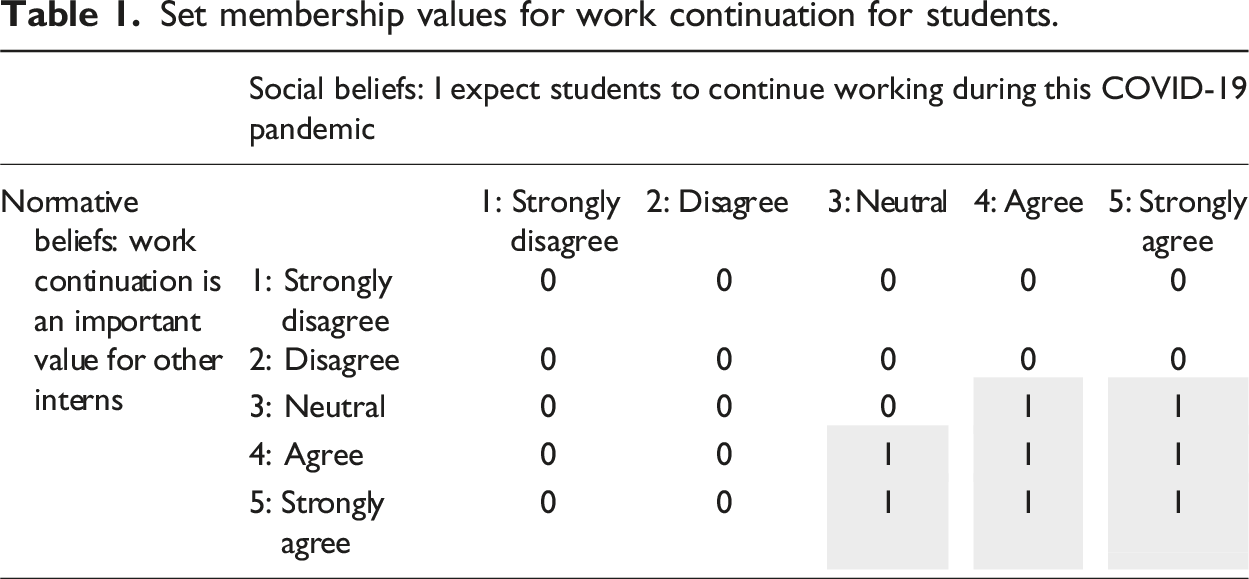
Set membership values for work continuation for students.
Conjoint and disjoint norms
The two norms we measure differ in the extent to which they are conjoint and disjoint. The norm to stay at home during the pandemic is a conjoint norm because the targets of the norm (students) are also those who benefit from the behavior it prescribes: staying at home reduces their individual risk of getting infected by the COVID-19 virus. The norm to continue working is a disjoint norm, because the targets (students) whose behavior it governs differ from the beneficiaries, i.e., the organization and the patients. For the student target group, we therefore have a clear differentiation between a disjoint and a conjoint norm.
Interdependence versus independence beliefs
Two variables measure the student’s interdependence beliefs regarding their work at the internship organization. As stated earlier, the students participated in a survey about their internship organizations a few weeks into their internship programs, just before the COVID-19 pandemic forced the students to reconsider their choices of doing their internships. In this first wave of data, we attempted to map the students’ collaborative network in their internship, to assess how collaborative relations change over time, and how they affect the student’s learning outcomes and workplace motivation. This data now allows us to assess how embedded the students felt within their organization’s collaborations, and how much they felt they contributed to the organization.
In the original survey, we asked students to name several of their collaborators in a name-generator question. We asked them to mention up to n = 5 students and n = 5 professionals with whom they collaborated. Later in the survey, we asked about the student’s perception of the nature of collaborative relations for every one of the names mentioned. To measure functional interdependence, which we operationalized as task interdependence, students indicated how important they felt they were for that specific person to be able to carry out their work (outgoing task-interdependence) on a scale of 1 (very unimportant) to 5 (very important). Using the same answer categories, incoming task-interdependence captures how important that person was for them to carry out their work. We coded a collaboration as strongly task interdependent if the scores for both incoming and outgoing task interdependence were higher than 3. Given the relatively low number of respondents reporting more than n = 5 highly task interdependent ties, we set n = 5 ties as the maximum set membership of 1. Tie frequency was recoded in 0.2 steps (i.e., students reporting no tie received a score of 0, students reporting n = 1 tie receiving a score of 0.2, students reporting n = 2 ties receiving a score of 0.4, etc.).
The same procedure was applied to measure cognitive interdependence, which we operationalized as shared understanding. On a 5-point scale (1 = strongly disagree, 5 = strongly agree) students indicated to what degree they (dis)agreed with the statements “When I talk to [this person], they understand what I mean” (outgoing understanding) and “When I talk to [this person], I understand what they mean” (incoming understanding). Again, ties that had both a reported incoming and outgoing understanding higher than 3 were coded as high shared understanding. The aggregation procedure was identical to the transformation of the task interdependence scores.
Results
Descriptive results
Descriptive results.
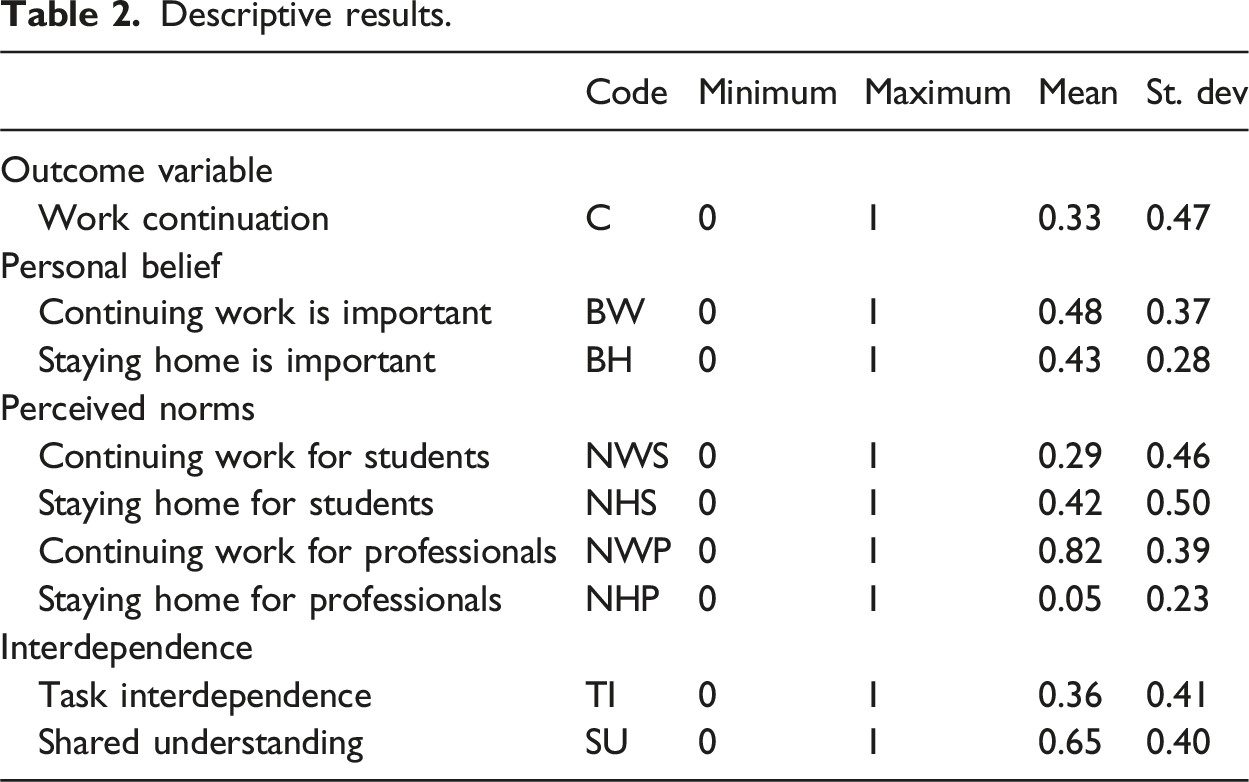
Whereas 82% of students perceive a social norm to be present for professionals to continue working, only 5% indicate that the norm of staying at home holds for professionals. That is, in the perception of almost all students, there are no competing norms for professionals in the health care sector: they should and do continue working during the crisis. This is different for students. 29% of students perceived the social norm for students to continue working, while 42% reported that a social norm to stay at home for students was present in their internship organizations.
QCA results
Fuzzy-set QCA analysis offers a method of analyzing the configurations of variables that associate with an outcome variable present in the data. It first creates an overview of all empirical data in the form of a Truth Table, determining how often each combination of factors appears in the data, and how often those combinations co-occur with an outcome variable. Here, an important decision is to assess how consistent the scores need to be within one cell to be considered a successful recipe for the outcome variable. While 0.75 is a reference point for this consistency score (Rihoux and Ragin, 2008), QCA analysts recommend a careful calibration of such scores, based on breaking points present in the distribution of consistency scores in the data. Given that our consistency scores have a gap between 0.67 and 0.84, we opt for the breaking point score of 0.75.
After the creation of the Truth Table, fsQCA follows a procedure called minimization, in which an algorithm searches for patterns in the data. In its most parsimonious edition, this Quine-McCluskey algorithm searches for combinations of data that coincide with the outcome variable, while including the empty spaces in the empirical data (Duşa, 2018). This means that our analysis does not a-priori assume that combinations of variables that are not present in the empirical data are a logical impossibility. More limiting algorithms exist, which restrict the analysis to only observed configurations, but as our sample of students did not contain the entire population, we prefer the more open Quine-McCluskey algorithm.
Continuing work
Our data show two recipes that are associated with the continuation of working at the internship organization during the COVID-19 pandemic:
Recipes towards work continuation during the COVID-19 pandemic.
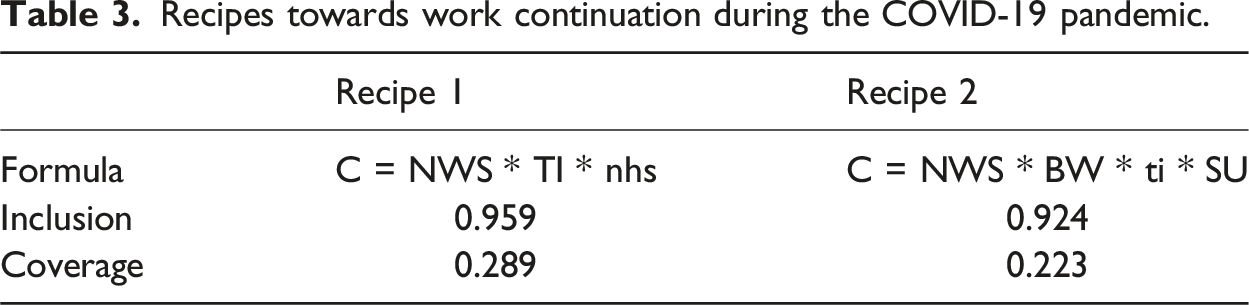
A key characteristic of QCA is that it allows for equifinality, meaning that the method has the capacity to find several pathways to one particular outcome. Regarding the choice to continue Working, our analysis indeed shows there are two different recipes related to the decision to continue working. Both recipes have in common the presence of the salient Norm to Work for Students (NWS), but differ in the beliefs that go together with the norm. Importantly, neither recipe contains perceptions of competing norms.
The first recipe for work Continuation (C) combines the presence of the perceived Norm to Work for Students (NWS), with the absence of the Norm to stay Home for Students (nhs), and adds Task Interdependence (TI), which together associate with a student continuing with their internship. The inclusion score, which ranges from 0 (indicating no consistency) to 1 (indicating perfect consistency) (Duşa, 2018) is high (0.959), which indicates a high consistency within the recipe leading to the outcome variable, and the coverage score of 0.289 indicates that 28.9% of the students who Continued followed this pathway. The second recipe combines the presence of the Norm to Work for Students (NWS) with the personal Belief that Work is important (BW) and the presence of Shared Understanding (SU) in situations when the task interdependence (ti) is absent. The inclusion once again is high (0.924), and the coverage indicates that 22.3% of students that Continued followed this pathway. Together, the coverage scores of the two recipes indicate that these combinations of conditions explain 51.2% of the students who Continued their internships. The remaining students did not fit any consistent recipe, suggesting that the two identified recipes reveal the most prevalent patterns in the data.
As a disjoint norm, GFT predicts that the normative goal-frame would require extra support from social cues and background goals in order to remain salient. The only commonality in both recipes is the presence of the perceived Norm to continue Working for Students (NWS), which can be seen as a necessary condition towards the continuation of working during a pandemic. This is in line with GFT, as the normative expectation students have is social and normative, the strongest form of belief. However, the norm to continue working is disjoint, so it requires extra support. In the first recipe, the perceived competition of norms is reduced by the fact that the norm to stay at home is in the cognitive background, and therefore not salient. The norm to work is strengthened further by Task Interdependence (TI) beliefs regarding the work the students performed at their internship organizations. The second recipe, on the other hand, shows what happens when task interdependence beliefs are absent. In this recipe, task interdependence (ti) is replaced by a strong Personal Belief that Work is important for the student (BW), and a strong cognitive interdependence in the form of Shared Understanding (SU). Importantly, these results together indicate that the decision to continue work requires both the absence of a competing norm perception, and the salience of interdependence beliefs.
Staying at home
Concurring with good practices in QCA, we also ran our analysis with the negation of work continuation as the outcome variable (now written with a lowercase “c”, as in: not Continued). Given the higher prevalence of “not continuing the internship” in our dataset, we increased the consistency score breaking point at 0.90. The formula we get from this analysis is: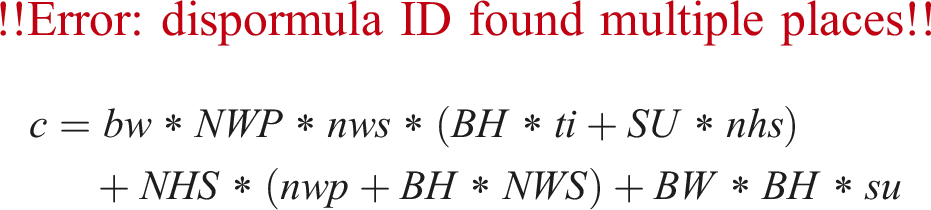
Recipes towards staying at home during the COVID-19 pandemic.
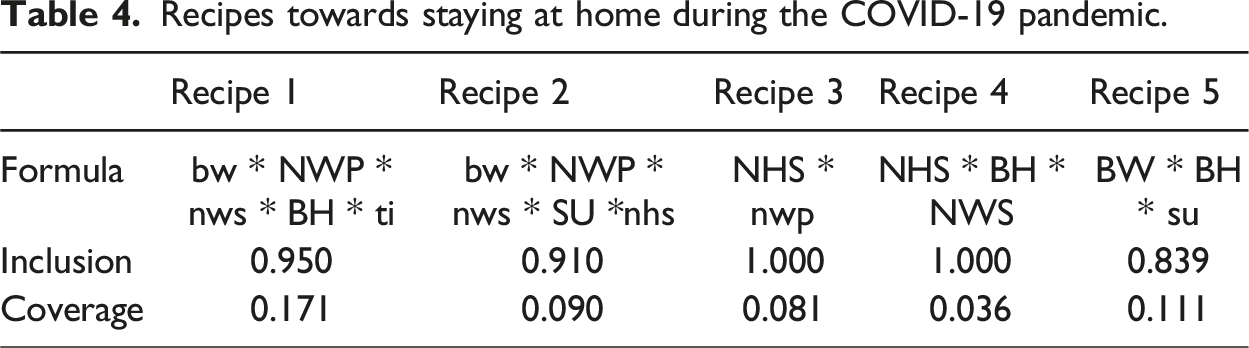
Recipe 3 finds that students who reported the presence of the Norm for Students to stay at Home (NHS) simultaneously with the absence of the norm to continue working for professionals (nwp) did not continue to work at their internship positions. Given the pervasiveness of the norm for working for professionals (80% of students perceived the presence of that norm), the absence of the norm for even professionals perhaps means that the students themselves did not have to continue working either.
Recipe 4 and 5 both contain situations of competing norms. Recipe 4 is the only pathway in our analysis that explicates competing social normative beliefs, as this recipe contains the students that perceive simultaneously the Norm to continue Working for Students (NWS) and the Norm to stay at Home for Students (NHS). The last ingredient of this recipe is the personal Belief that staying at Home is important (BH), which associates with students’ decisions to stay at home. This recipe therefore points to the importance of the distinction between disjoint and conjoint norms, as students who perceive the presence of both norms opt for the behavior that is less risky for them.
The fifth recipe contains students who reported competing personal beliefs, as they reported both the personal belief in the importance of continuing to work (BW) and the personal belief in the importance of staying at home (BH). When students reported these competing personal beliefs, the absence of shared understanding (su) in the organization may have triggered students to stay at home. This indicates that a number of students perceived competing non-social beliefs. The competing behaviors were perceived as a conflict between personal normative beliefs that did not regard the possible behavior of others. Interestingly, this recipe points to the absence of shared understanding, and therefore of cognitive interdependence in the organization, as the pathway to students’ decisions to stay at home in a situation of competing personal beliefs.
These configurations of beliefs that coincide with staying at home can be broadly categorized in two groups. The first group captures students who strongly perceived the norm to stay at home. Recipe 1, 2, and 3 favor the choice to stay at home, with recipes 1 and 2 both explicitly requiring the absence of a personal belief that working was important and an absence of the normative condition. Interestingly, these recipes do require the norm to continue working for professionals in the organization, shifting our attention towards the distinction between disjoint and conjoint norms. The students in this recipe explicitly differentiate themselves from the normative behavior of professionals. This finding may also explain Recipe number 3, which combines the presence of the perceived norm to stay at home for students with the absence of the norm to continue working for professionals. When members of the more conjoint group (professionals) then did not adhere to the norm, this may have signaled to the students that they also ought not comply with this norm.
The second group of recipes is striking as they contain competing beliefs. In Recipe 4, students actually perceive the importance of the norm to continue working and the norm to stay at home simultaneously. In that case, the personal belief seems to make a difference, as it coincides with students deciding to stay at home. This result indicates that, when the normative beliefs are competing, the disjoint norm is weaker than the conjoint norm. Recipe 5 includes students who report competing personal beliefs: they simultaneously believe it is important they continue working and stay at home. However, in conjunction with the absence of shared understanding with their collaborators in the organization, these students decided to stay at home.
Conclusion
This study set out to sketch an explanatory framework that explicates how personal beliefs function in situations of competing norms in a real-life scenario. We argued that norm following behavior depends on the salience of a norm, meaning that individuals perceive cues from their environment that will bring into focus a particular type of normative behavior. We then differentiate four conditions along which personal perceptions about norms may differ that play a role in supporting the salience of a norm.
Our study examined the normative ambiguity faced by health care students (n = 55) during the unprecedented COVID-19 pandemic. Presented with two normative options—staying home to prevent virus spread or continuing their work in healthcare settings—67% chose the former, while 33% persisted in their internships. Our first conclusion echoes the early findings of Stouffer (1949), namely that personal beliefs regarding norms in potentially competing normative situations show large variations and appear in several configurations. While some students clearly reported one of the behavioral outcomes as the clear norm, others recount the exact opposite. On the surface level, both norms therefore indeed seemed to be legitimate and applicable for these students, indicating that the situation contained conflicting norms. However, our results also show that at the individual level, the underlying competition between norms may be far less pronounced or even absent. For only 3 students, the two normative beliefs were simultaneously salient, but our results show that even for these students, personal beliefs guided students to favor the choice to stay at home. This descriptive finding points to the importance of distinguishing underlying personal beliefs and perceptions about norms in situations of competing norms.
Altogether, these results show the fruitfulness of using Goal-Framing Theory as a framework to analyze situations in which norms compete. We argued that the strongest support for a normative goal-frame is present when a norm is particularly salient to an individual, which means norm perceptions are rooted in high degrees of sociality and normativity, when a norm is conjoint, and when individuals perceive a situation as cognitively and functionally interdependent. However, in situations of two norms potentially competing, our framework predicts that the more beliefs in these four conditions converge around one specific norm, the more likely an individual is to select that behavior than the alternative competing norm. When individuals perceive competing beliefs about two norms, the conditions of conjointness and interdependence may function as decisive factors to support one normative goal-frame over the other.
A fuzzy-set QCA analysis allowed us to explore how patterns in the data aligned with the two normative behaviors. Our results align with the predictions regarding the shifting saliences of goal-frames and the support that a normative goal-frame requires to be salient. The most direct support for a normative goal-frame occurs in situations in which the norm beliefs of students converge around one specific norm. For instance, when students did perceive the sociality and normativity of other students staying at home, combined with absent interdependence beliefs about continuing work, the students’ beliefs converged around the conjoint norm of staying at home (see Recipes 1 and 2 for the Norm to Stay at Home). In such a situation, the normative goal-frame is supported by aligned cues from the students’ environment (in the form of the beliefs about other students’ behavior) and an aligned background gain goal (in the form of benefitting from the conjoint norm).
The students who Continued Working during the COVID-19 pandemic also reported convergent beliefs about the Norm to Continue Working, with norm beliefs directly supporting this particular normative goal. However, our results indicate that this particular norm required extra support, in the form of interdependence beliefs in the workplace: the two Recipes our analysis uncovered contain either a belief in functional interdependence (in the form of tasks) or cognitive interdependence (in the form of shared understanding). This indicates an asymmetry between the two normative behaviors: where the norm to stay at home is sufficiently supported by perceived norm behavior alone, the norm to continue working required extra support in the form of interdependence beliefs. We argue this asymmetry can be explained through the difference between the norms in the conjointness condition, with one norm being conjoint and the other being disjoint. For the disjoint norm to remain strong, interdependence considerations become particularly important in order to strengthen its salience (cf. Rauhut and Winter, 2017).
The significance of the condition of conjointness is reiterated in the few reports of students who refer to perceiving two competing norm beliefs simultaneously. This would, in principle, mean that individuals perceive competing cues about what type of behavior is appropriate in a given situation. Our results indicate that, among the competing cues for two normative goals, the conjoint norm is more likely to be salient than the disjoint norm. The brittleness of disjoint normative behavior is therefore twofold: not only does disjoint norm goals require extra interdependence beliefs as normative support, but also it requires the absence of a competing conjoint norm. Given that other academic accounts of competing norm behavior (Boivin et al., 2008; Holmelin, 2019; James-Hawkins et al., 2019) often involve the competition of a disjoint and conjoint norm, our study emphasizes the relevance of understanding how interdependence beliefs and conjointness may function in individual’s choices between one type of norm behavior over the other.
Our study examined a situation where two competing norms required individuals to explicitly choose between two types of normative behavior. However, in many cases individuals clearly understand which norm applies to whom. Our conceptual model explains this clarity as a process in which one norm becomes increasingly salient among various alternatives: after enough interactions, it is likely that one norm will become the salient rule of appropriate behavior (Sugden, 1998). The empirical situation of this study may have been unique, as the external shock of the COVID-19 lockdown could not have been foreseen, but future research should take a closer look at competing norms in more regular circumstances. An example of competing norms can be found in the contrast between the norm to help those in danger and the norm found in U.S. state legislations, which does not impose a legal obligation to help others, in some cases even prescribing severe penalties if a “Good Samaritan” unintentionally causes harm to a victim during their effort to help. Here, the altruistic norm of helping is in clear contrast with the legal norm to refrain from doing so. Peyer and Heywood (2019) suggest the salience of the legal norm of liability may significantly influence U.S. citizens’ decisions about whether to help others or not. Other potentially relevant empirical cases can be found in Holmelin’s (2019) account of changing gender norms in work division or James-Hawkins et al.’s (2019) description of changing gender norms in contraceptive use.
This study has two main limitations. First, the data about norm beliefs were collected several weeks after students had made their decision whether or not to stay at home. The post-hoc data collection was a necessary approach due to the unforeseen nature of the external shock, but might come with the risk that students’ answers, rather than capturing their actual beliefs at the time, may reflect their retrospective rationalization of their behavior. Out of four analyzed conditions, the conditions of sociality and normativity are therefore potentially biased. However, the wide variety of answers regarding the beliefs about norms suggests that such a bias, if present in our data, is weak. The condition of interdependence was measured during the students’ internships, before the COVID-19 lockdown was announced, and the condition of conjointness is structural (by the nature of the two normative behaviors), indicating these conditions are not subject to post-hoc rationalization bias. Future research may overcome this limitation by collecting longitudinal data on competing norms in more “regular” situations, such as those outlined above.
Secondly, two sampling issues may limit the generalizability of the found results. Our relatively limited sample size (n = 55) allowed us to execute a meaningful QCA-analysis, in which we could explore particular patterns in the data. A larger sample, however, would have allowed for hypotheses testing of the impact of the four delineated conditions. In addition, the sampling strategy that was used during data collection was not completely random. In the general population of health care interns, only 18% continued with their internships during the COVID-19 pandemic. However, this group is overrepresented in our sample, where it constitutes 33% of the students. This indicates that perhaps the students who continued their work were also more inclined to participate in our survey. Therefore, the recipes in our analysis offer results for the group of students who are more likely to participate research during the COVID-19 pandemic. A potential target group absent from our analysis includes interns who were impacted by the COVID-19 pandemic and related restrictions, leading to their inability or lack of motivation to participate in our survey.
In sum, our investigation unveils that which of two competing norms will be followed hinges on the interplay of four conditions regarding norms: their perceived sociality, normativity, conjointness, and interdependence. Although the separate effects of these conditions have been researched (Bicchieri, 2005, 2017; Bicchieri et al., 2020; Bicchieri and Xiao, 2009; Rauhut and Winter, 2017), goal framing theory allows us to synthesize them into a novel framework that provides an improved micro-foundation of norm-following behavior in situations of competing norms. Future work should extend the application of this novel framework to different settings in order to test its validity, but also to get a better grasp of human norm-following behavior.
Footnotes
Acknowledgements
The authors thank Jelly Zuidersma, the members of the SCIO Research Cluster at the University of Groningen and the anonymous reviewers for their indispensable comments and suggestions on earlier versions of this paper. We would also like to explicitly thank our respondents for participating in our research during the uncertain COVID-19 period.
Declaration of conflicting interests
The author(s) declared no potential conflicts of interest with respect to the research, authorship, and/or publication of this article.
Funding
The author(s) disclosed receipt of the following financial support for the research, authorship, and/or publication of this article: This work was supported by the Ministerie van Onderwijs, Cultuur en Wetenschap [grant number rif 16024]; Nederlandse Organisatie voor Wetenschappelijk Onderzoek [Gravitation Program 2017 [number 024.003.025]].
Ethical statement
Data availability statement
The datasets collected during and analyzed during the current study are not publicly available due to the anonymity clauses in the participant consent form, but are available from the corresponding author on reasonable request.
