




Abstract
The literature on nudging has rekindled normative and conceptual debates surrounding the extent to which and the direction in which people can legitimately influence each other’s actions. An oft-heard objection to nudging is that it exploits psychological mechanisms, manipulates people and thereby insufficiently respects their rational decision-making capacities. Bypassing and/or perverting people’s rational capacities, nudges are said to undermine agency. In this paper, I analyze and deflate these criticisms. After disentangling the different conceptions of rationality that pervade the arguments of both nudging enthusiasts and critics, I critically assess how and under which circumstances nudging can be said to undermine, pervert, bypass but also strengthen people’s rationality. Only in a limited set of cases, I argue, does it make sense to object to nudges for making people less rational than they are, can be or should be. Crucial in this respect will be the distinction between outcome-oriented and process-oriented conceptions of rationality.
Introduction
Nudging to ‘improve’ people’s decisions has been defended on the basis of the claim that people are predictably irrational (Thaler and Sunstein 2008). Behavioral economics, the argument goes, shows that people’s actions, beliefs and preferences are often inconsistent and influenced by cognitive heuristics and motivational mechanisms that should be irrelevant from a rational point of view. In such cases, nudges – deliberate changes in people’s choice architectures that have a predictable impact on their behavior without imposing material costs or coercing them – arguably help people act in ways that they really want and judge best. The alternative would be to leave people subject to psychological heuristics and biases, which in specific circumstances results in predictably erroneous behavior.
In this paper, I focus on the impact of government nudges on people’s rationality. Do nudges undermine and violate rationality and are they legitimate only despite of this? Or can they have a positive impact on rationality and are they legitimate precisely because of that? In other words, do nudges necessarily come at a cost in terms of rationality or are there gains conceivable as well?
Critics object to nudging for not respecting and even violating people’s rationality. Most nudging techniques, the objection goes, tap into cognitive heuristics and biases.
Indeed, I will understand nudges as intentional changes in the design of people’s choice architecture aimed at influencing their behavior. Nudges are based on empirical evidence about people’s psychological setup, which includes not only rational decision-making capacities but also arational heuristics and biases. Instead of coercing, incentivizing or merely informing or persuading people, nudges steer people’s behavior by tapping into arational psychological mechanisms such as salience, loss aversion, conformism, akrasia and status quo bias. 1 Some well-known examples of nudges are the use of defaults (e.g. installing an opt out system for organ donation registration), the design of physical architecture (e.g. rearranging shelves in supermarkets and designing door handles that predictably lead people to either push or pull) and the use of salient messages (e.g. using bold, large and colorful fonts or concrete examples of beneficiaries rather than statistical data in letters from charity organizations).
As soon as governments employ nudges such as the above, the objection goes, they manipulate their citizens and treat them as children or as puppets on strings (Wilkinson 2013). Most criticisms boil down to concerns about goals and means. First, nudges have been claimed to steer people in undesirable directions (goals). Second, the steering itself has been criticized for insufficiently respecting people’s rational decision-making capacities and thus undermining people’s agency and autonomy (means) (Hausman and Welch 2010). A nudgee is not really the author of his actions, which result not from his own deliberations or reasons but from arational factors he is not fully aware of. 2 Because these factors influence nudgees behind their backs, Jeremy Waldron (2014) calls nudging “an affront to human dignity (…) in the sense of self-respect, an individual’s awareness of her own worth as a chooser”.
Without aiming to settle all of these worries about goals and means, I analyze more narrowly what they imply for people’s rationality and deflate most of them. Let me briefly summarize three of my main arguments. First, with respect to the goals, I will argue that these can quite often be safely assumed, in which case nudging can be perfectly legitimate. Second, with respect to the means, I will argue that nudging always needs to be compared to available and viable alternatives. While most nudges do not play into people’s rational capacities, removing nudges or refusing to introduce them does not necessarily respect or increase people’s rationality either. As I will show, it all depends on whether rational capacities are (or can and should be) at play in the absence of nudges. Third, I will show how concerns about goals and means are related in that respecting people’s rational capacities (means) does not always generate the most desirable outcome (goals). Assessing the desirability of specific nudges often requires weighing off what matters most: generating desirable outcomes or respecting people’s decision-making processes.
In general then, I argue that nudging does not threaten rationality when evidence suggests that, even in its absence, the decisions of citizens are influenced by arational processes and where attempts to promote rationality – through informing and persuading citizens – are likely to fail. In such cases, nudges cannot be claimed to undermine, pervert or bypass rational capacities. Only if these rational capacities are effectively at play or can be restored to good effect, can nudges be said to make people less rational than they were or could be.
To make these arguments work, I need to analyze more closely the relation between nudging and rationality and clear up the conceptual confusion currently manifest in current debates. Both proponents and opponents of nudging have made claims along the following lines.
Nudging is possible because/whenever people are irrational (Bovens 2009: 209; Le Grand and New 2015, chapter 5).
Nudging is legitimate because/whenever people are irrational (Grill 2013: 38).
Nudging bypasses people’s rationality (Grüne-Yanoff 2012: 636; Waldron 2014).
Nudging perverts people’s rationality and thus makes them less rational, either in the short run (exploiting arational factors to influence choices) or in the long run (undermining capacities for rational decision-making) (Hausman and Welch 2010; Reiss 2013: 295).
Nudging strengthens or restores people’s rationality and thus makes them more rational (Barton and Grune-Yanoff 2015: 346).
This paper does not aim to provide an extensive analysis of all the positions that have been defended in this respect. Note, for example, that hardly any nudging proponent has claimed that people are ‘irrational’. The point of the paper is to clear up some of the confusion that underlies these wildly diverging claims. In my view, this confusion arises from the fact that different conceptions of rationality are at play and different nudging techniques are being scrutinized. In order to assess these claims, I aim to provide the first full-fledged account of the impact of nudging techniques on rationality.
In what follows, I first distinguish between different conceptions of rationality to disentangle the diverging meanings of the notion ‘rationality’. In the section “Outcome-rationality and process-rationality,” I go into the crucial distinction between outcome-rationality and process-rationality. In the section “Different conceptions of rationality,” I apply this distinction to different conceptions of rationality. Here, I will also address the often overlooked issue which conception of rationality captures something valuable that governments need to respect, protect or even promote. In the section “How nudges affect rationality,” I analyze the kinds of impact nudges can have on (relevant conceptions of) rationality and deflate most of the worries critics have. I go into different scenarios to discuss when exactly nudging threatens rationality and when it does not. In most scenarios, I argue, nudges should be welcomed instead of dismissed. In the section “Conclusion,” I sum things up.
Before starting out, let me stress that rationality is not the only relevant value when discussing the ethics of nudging. Autonomy, liberty and dignity matter as well and none of them can be reduced to rationality. In this paper, I will not assess the impact that different nudging techniques can have on people’s autonomy, liberty and dignity but instead will focus on their impact on rationality. 3 This means that my analysis here does not provide a complete ethical evaluation of nudge strategies. As I will explain later on, however, it is a vital part of that because rationality plays a key role in some of the most widespread and weightiest arguments against and in favor of nudging.
Outcome-rationality and process-rationality
Conceptions of rationality specify the criteria that actions, beliefs and preferences should fulfil if they are to be called ‘rational’. Before going into the many conceptions that permeate the literature (in the section “Different conceptions of rationality”), I will first focus on a crucial but often overlooked distinction, namely between outcome-oriented and process-oriented understandings of rationality.
The general idea is that outcome-rationality stipulates criteria that apply only to the outcomes (actions), not to the psychological processes that bring them about. Process-rationality stipulates criteria for those very processes, such as belief and preference formation and practical reasoning (Barton and Grüne-Yanoff 2015: 345). What counts in process-rationality is the “internal rationality” of the reasoning processes, not so much the content of the resulting decisions (Charland 2014). Process-rationality tends to be more demanding, since rationality criteria are specified for both actions and underlying processes (Hurley 2011). 4
Most nudges, I argue, aim to promote outcome-rationality. Playing into a rational processes that influence people’s decisions (Blumenthal-Barby 2012), they aim to make the resulting actions outwardly conform to whatever action would arise from rational processes. If I do not want to get killed in a car crash, the annoying sound reminding me to put my seatbelt on induces me to act in ways that I have reason to (even without reminding me of those reasons). The same holds for people whose decision to lead a healthier lifestyle is facilitated when shelves in supermarkets and cafeterias put healthy food items at eye level. Nudges like these aim to promote their outcome-rationality rather than their process-rationality (but note that they do not promote and can even decrease the outcome-rationality of people who really want to die in traffic or lead unhealthy lifestyles). In the section “How nudges affect rationality,” I will analyze whether, when, and how nudges succeed in promoting outcome-rationality; whether, when and how nudges undermine or decrease process-rationality; and how to weigh off both kinds of rationality against each other.
My analysis of the (positive, neutral or negative) impact of nudges on rationality is situated exclusively at the individual level. Of course, nudges can have different effects on different people. The same nudge (placing healthy food at eye level) can steer me (who wants to adopt a healthier lifestyle) in a direction I endorse (increasing my outcome-rationality), while steering you (who is happy with your unhealthy lifestyle) in a direction you do not endorse (decreasing your outcome-rationality). Also, the same nudge can decrease my process-rationality (since I am unaware of being influenced) but not yours (since you can see the nudge coming and circumvent it). I will describe these as rationality gains and losses at the individual level. Of course, when assessing the desirability of nudges in heterogeneous populations, more needs to be said on how to weigh these off.
Different conceptions of rationality
Next to the distinction between process-rationality and outcome-rationality, which is hardly ever made explicit, there is a wide variety of conceptions of rationality at work in economics, psychology, the social sciences and philosophy. I briefly and incompletely distinguish four such conceptions below. As readers of this journal will know, the literature on rationality in philosophy, economics, psychology, sociology and evolutionary theory is rife with different conceptions. 5 I limit myself to these four conceptions because they dominate at least the philosophical and economic literature and because each of them has process-oriented and outcome-oriented variants, which will be the key distinction in my analysis.
Economic rationality
The first, economic conception dominates the social sciences and understands rationality along the lines of expected utility theory and axiomatic decision theory.
Nudge proponents refer to economic rationality in two ways. First, they justify nudges on the basis of empirical evidence that “unlike Econs, Humans predictably err” (Thaler and Sunstein 2008: 7). Actual people have been shown to violate these rationality axioms and display all kinds of “anomalies and departures from (…) “classical” economic rationality” (Le Grand and New 2015: 80-83). Psychological mechanisms cause people to deviate from both economic process-rationality and outcome-rationality: they make logical mistakes, are influenced by irrelevant aspects of choice situations (framing effects), suffer from cognitive biases (hindsight bias, status quo bias, confirmatory bias et cetera) and from akrasia, laziness and conformism (Le Grand and New 2015, chapter 5). Humans are clearly not Econs and they often do not act as if they are.
Second, while criticizing the descriptive aspirations of economic rationality, nudge proponents often hold on to it as a normative ideal, stressing that nudges should be aimed at what people would prefer if they had “complete information, unlimited cognitive abilities, and no lack of self-control” (Sunstein and Thaler 2003: 1162). According to Gerd Gigerenzer (2015: 365), “libertarian paternalists do not try to overthrow Homo economicus. On the contrary, (…) they rather uncritically accept the rules of axiomatic decision theory as the norm for all rational behavior, and blame mortals for not living up to this ideal” (see also: Rebonato 2014: 362).
Rationality in terms of reasons
A second, more philosophical conception understands rationality in terms of ‘reasons’ (and there are huge philosophical debates about what exactly reasons are and how they motivate and justify action). The least demanding version of this requires an agent’s actions to be based on her reasons, i.e. her beliefs and preferences. The only criterion is that these are internally coherent or consistent (Kolodny 2005). 7 A more demanding version stresses that these reasons should also be ‘informed’. A consistent madman or someone with blatantly false or misinformed but consistent beliefs and preferences are, this version argues, obviously irrational. Rational beliefs are typically formed properly (e.g. by processes that reliably produce true beliefs; Nozick 1993: 64) and are based on available evidence and thus do not result from belief-irrelevant processes (such as wishful thinking, deception, manipulation; Tversky and Kahneman 1981; Elster 1979). Rational preferences are formed properly (Elster 1979) and/or identified with by the agent (Frankfurt 1988). The most demanding versions understand rationality in terms of ‘idealized’ reasons. 8
Rationality in terms of reflectiveness
A third conception understands rationality as reflectiveness. Kahneman (2012: 49) refers to the so-called ‘Reflective System’ or ‘System 2’ which actively, consciously and effortfully engages in thinking. In contrast, the ‘Automatic System’ or ‘System 1’ consists of heuristics and psychological mechanisms that influence behavior in more automatic, unconscious and effortless ways. Thaler and Sunstein (2008, 19) use this ‘dual process’ account of human psychology and call people’s Reflective Systems “reflective and rational”. In his ‘Rationality and the Reflective Mind’, Keith Stanovic (2010) distinguishes rationality from intelligence: even a smart person can be a lazy or superficial thinker and suffer from “a flaw in the reflective mind, a failure of rationality”.
Note that rationality as reflectiveness is not the same as the ‘Olympian’ rationality of Econs or otherwise idealized agents (Kahneman 2012: 415; Thaler and Sunstein 2008: 19-22). Even when our Reflective Systems are in control, we are hardly Econs and we do not have unlimited cognitive abilities. As such, the evidence about cognitive heuristics and other System 1 aspects, which informs the nudge literature, does not show that “human choices are irrational” but that “Humans are not well described by the rational-agent model” most economists work with (Kahneman (2012: 411). Rationality as reflectiveness is then more plausible than the outlandish economic conception that fails to do justice to human rationality.
Expressive rationality
A fourth and final conception understands rationality in expressive terms (Schuessler 2000). An agent’s actions are expressively rational if they express whatever she wholeheartedly identifies with. The rationality of people cheering for their favorite football team or voting in national elections is to be understood not in instrumental terms – they are not primarily trying to achieve some result – but in expressive terms. Their actions express who they are and what they care about (Frankfurt 1988).
Process and outcome variants of these conceptions of rationality
As with economic rationality, each of these conceptions has a process and an outcome variant.
People often violate these requirements and act irrationally or suffer from ‘reasoning failure’ (Le Grand and New 2015: 82) on most of the above accounts. They often act inconsistently or do something out of forgetfulness, procrastination or akrasia. Think of someone who wants to go jogging but fails to get out of the couch. Or think of quasi-automatic behavior caused by something other than and decoupled from one’s reasons, such as pulling a door handle when it needs to be pushed. All kinds of irrelevant factors can cause people to act in ways that go against their beliefs and preferences and that thus violate both process-rationality and outcome-rationality (Le Grand and New 2015: 82-101).
Instead of settling the debate which conception and variant best captures what rationality is about, I focus here on their overlap. When people reflect, they tend to make judgements based on their reasons and what they care about. A somewhat looser and broader conception usefully includes multiple rational capacities “that enable agents to assess and revise their beliefs in accordance with the basic canons of logic; to evaluate their epistemic and practical options against criteria generated by their beliefs, values, and preference sets; to make adjustments to these beliefs, values, and preference sets in light of new information; and to act in accordance with their judgments about what they have most reason to do” (Gorin 2014: 52).
Normative force of these conceptions of rationality
Without committing myself to a single conception of rationality, I do want to ask which of these has normative force and is relevant when thinking how governments should treat their citizens. Despite its dominance in the literature, and this is seldom fully appreciated, most people do not see value in economic rationality. Since most of us do not care about having complete and transitive preference functions, the economic conception of rationality lacks the normative appeal needed to do justice to arguments that criticize (or defend) nudges on the basis of their impact on people’s rationality.
The other conceptions of rationality have more normative appeal. Most of us want to have good reasons for our actions, beliefs and preferences and believe something is off when these lack coherence or justification. What matters to people is that they deliberate, weigh off alternatives, make judgements and form plans. Most of us want to be rational in the sense of having consistent, informed reasons that align with the things we care about or with the reasons we would have if we were thinking straight. Precisely because we want to be reasonable and reflective, do we find the evidence about the causal force of irrelevant aspects – in our psychological make-up and in choice architectures – not only surprising but also unsettling.
All this is not to say that we always care about being rational. I sure like my occasional lazy decision not to go out running now and then. Rationality then is not the only thing that is valuable. Competing values like well-being, autonomy and liberty might outweigh concerns for (ir)rationality. This is also why legitimate worries about the impact of nudges on rationality, which I analyze in the next section, are not knock-down arguments. Even nudges that decrease rationality can be justified by more weighty considerations. Lines on the road that slow down a psychopath speed enthusiast reduce both her process-rationality and her outcome-rationality but for extremely good reasons that outweigh both of these concerns. Nevertheless, because rationality matters, one needs to investigate thoroughly claims about nudges having detrimental effects on rationality. If they turn out to be justified, we will have to take such losses in rationality into account when providing more complete ethical evaluations of nudges, which can and should be based on a thorough assessment of the impact of nudges on all relevant moral values, such as autonomy, liberty, dignity, and so on.
How nudges affect rationality
So how do nudges affect people’s rationality? Does the fact that they tap into cognitive heuristics and biases undermine rationality? Or can nudges promote rationality and, if so, in which sense? In this section, the abovementioned distinctions will be used to assess the claims in the introduction and deflate most of the objections from nudge critics. I will assess the impact of nudges on both outcome-rationality (in the section “How nudges affect outcome-rationality”) and process-rationality (in the section “How nudges affect process-rationality”) and indicate how to weigh those off (in the section “Weighing off outcome-rationality and process-rationality”). In theory, nudges can increase (plus, +), have no net effect on (zero, 0) or decrease (minus, -) people’s process-rationality and outcome-rationality. This gives rise to nine possible scenarios, visualized in the matrix below. In what follows, I fill in the different boxes, give examples of nudges that fit each scenario and assess their relative importance.
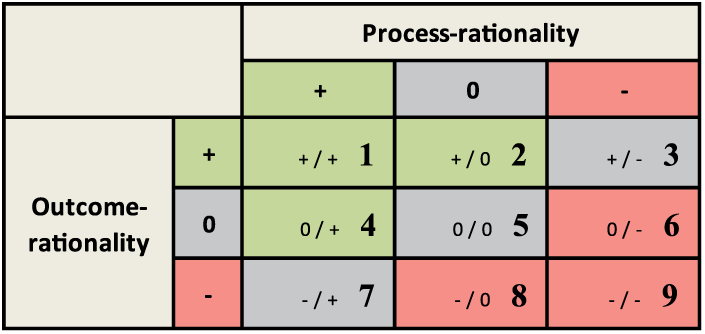
For those who value outcome-rationality, the first row contains the most promising scenarios and the third row contains the most objectionable scenarios. Those who value process-rationality focus on the columns. If you value both, box 1 will be unequivocally good and box 9 unequivocally bad. Boxes 2 and 4 contain gains and no losses (hence the green color) and boxes 6 and 8 contain losses and no gains (hence the red color). Box 5 has no real impact on either kind of rationality. Boxes 3 and 7 contain both gains and losses (hence the grey color), in which case one needs to weigh off the value of process-rationality and outcome-rationality.
How nudges affect outcome-rationality
Let us start with outcome-rationality and focus on the rows in the matrix. The main worry is that nudges steer people in directions that they do not endorse and for which they have no reasons and thus decrease their outcome-rationality (bottom row: boxes 7, 8 and 9). Critics like Mark White (2013) argue that nudges almost always imply a form of value-substitution: the values – or goals or reasons – of the nudgee are replaced by those of the nudger. The problems here are ethical (perfectionism violates liberal principles of respect for citizens) and epistemic (nudgers cannot know what people’s consistent, informed, ideal, reflective beliefs and preferences are). The epistemic challenges are huge (Rizzo and Whitman 2009). How can nudgers ever come to know where nudgees (really) want to end up? And will nudges targeted at heterogenous populations not inevitably go against the goals, preferences and beliefs of at least some nudgees?
This “predicament” (Rebonato 2014: 379) arguably amounts to a ‘rationality paradox’: the limits to rationality that justify the use of nudges are not taken to hold for the nudgers themselves, who are assumed to be “equipped with perfect rationality, or, at least, superior rationality” (Lodge and Wegrich 2016: 252). Nudgers are assumed to be able to figure out what nudgees would want if they could overcome their rationality deficits (Grüne-Yanoff and Hertwig 2016: 170-173; Rebonato 2014: 390). According to Robert Sugden (2015: 579), the underlying idea is that there is some “inner rational agent”, which he criticizes as “psychologically ungrounded”. If there is no rational homunculus with informed, idealized or reflective reasons, then how can nudges ever hope to promote outcome-rationality?
I agree with critics that nudgers should generally avoid imposing their own goals on nudgees and should thus respect people’s outcome-rationality. In short, they should try and stay clear from the bottom row. As Thaler and Sunstein (2008: 5) argue, nudges should mainly aim “to influence choices in a way that will make choosers better off, as judged by themselves”. Nudges should be ‘means paternalist’, helping people correct their errors with respect to the means they choose in order to achieve their own ends (Le Grand and New 2015: 27-30; Sunstein 2014: 50). When heuristics and biases lead people astray from what they reflectively judge best, people themselves do not – pace John Stuart Mill – know best what is good for them.
During such “occasions for paternalism” (Sunstein 2014: 25), nudges can actually promote outcome-rationality (boxes 1, 2 and 3). Nudges then aim to restore the breakdown between people’s reasons and their actions, so that their actions better express what they judge best. They realign people’s actions with their reflective judgements, reasons or things they care about. The idea is to have people doing what they reflectively judge best and thus ending up where they would want to end up if they would be reflective (Bovens 2009; Heilmann 2014). Means paternalist nudges aim to steer “in the directions that they would go if they were fully rational. Paternalism (…) creates “as if” rationality. Indeed, that is a central point of good choice architecture” (Sunstein 2014: 154). As Sunstein (2015b: 426) stresses, most nudges aim to make it “easier for people to get to their preferred destination”. Whenever you have reason to go in some direction but you fail because of some irrelevant aspect of your psyche or your choice environment, a successful nudge facilitates you ending up there.
This is not to deny the epistemic challenge. Quite often, people’s reasons and goals are hard to establish and may vary greatly. I do not claim that nudgers can always find out what people want or that people always share the same goals. It is, for example, notoriously hard to determine whether and to what exact extent people with unhealthy lifestyles prefer (or do not prefer) leading healthier lives. My analysis here distinguishes between multiple scenarios, some of which are more controversial (since people’s goals are hard to determine or vary greatly) and others less so.
In what follows, I provide six reasons why the epistemic challenge can often be met and thus why quite a lot of nudges are situated not in the controversial bottom row (which go against people’s goals and decrease their outcome-rationality) but in the top row (which promote people’s goals and increase their outcome-rationality).
First, people’s goals can be safely assumed in quite a few circumstances. Many nudges are quite innocuous in this respect. Think of well-designed stoves, flies in urinals, handles on doors (round plates for pushing, handles for pulling) and lines on roads. 9 In such cases, there are no heated debates or worrying doubts about what people want. Such nudges are not imposing another’s will on nudgees or substituting their values. They can be safely assumed to help people do whatever they have reason to and what they themselves judge best: start cooking, avoid urine spillage, get in or out of rooms and avoid traffic accidents. Note that my claim is that people’s goals and preferences can often be safely assumed, not always. My aim is to shift attention from more controversial cases, which have rightly concerned nudge critics, to the mostly ignored cases in which these epistemic concerns are quite easily met.
Second, nudges should be easily resistible, which means that nudgees can effortlessly become aware of them and inhibit whatever psychological propensity they trigger (Saghai 2013). If an intervention is not easily resistible, for example because it coerces or taps into arational forces that people cannot circumvent, it is not a nudge proper but a shove. Interventions that are hard to resist, like switching from an opt-in to an opt-out system for health insurance or for organ donation without informing people or making the opt-out as easy as possible, do raise substantial worries with respect to outcome-rationality. In such cases, a lot of people will actually end up in places where they do not have reason to end up.
That said, the focus here lies not on shoves but on nudges, which by definition are “easy and cheap” to resist (Thaler and Sunstein 2008: 6). While there is a grey area here and while some shoves and even taxes and mandates have been misrepresented and sold as ‘nudges’, the easily resistible nature of nudges proper addresses a lot of worries about outcome-rationality. Crucially, the more an intervention goes against your reasons, the more likely you will notice and resist it (Saghai 2013: 489). This is another reason why boxes 7, 8 and 9, at least when it comes to easily resistible nudges, do not contain a lot of scenarios. When did you last find yourself in a cafeteria paying for something you completely did not want (as judged by yourself)? Nudges can be understood as ‘asymmetrically paternalist’: they help people who are prone to irrational decision-making without harming others who are (capable of) making rational, informed, deliberate decisions (Le Grand and New 2015: 138-139).
This brings us to a third point. When nudges are effective in steering people’s behavior, they mostly do so by forming people’s beliefs and preferences rather than going against them. Often, people entering cafeterias have only general or global beliefs and preferences, such as the desire to eat vegetarian. More specific or local beliefs and preferences (concerning a specific meal) are typically formed on the fly. When I find myself buying a goat cheese salad, my ex post local preference remains within the constraints set by my ex ante global preferences (which in turn are informed by my reflective judgements and the things I care about). Critics object that exploiting the malleability of local preferences is manipulative, because it changes people’s minds and shapes their wants and desires behind their backs. While I go into this concern when discussing process-rationality (in the section “How nudges affect process-rationality”), let me say this for now. If you have clear and/or weighty ex ante reasons, you can probably circumvent or resist nudges that go against them. Clever choice architecture will never nudge principled vegetarians into picking a pastrami sandwich. However, if you have no clear or weighty ex ante reasons, your local preferences will be quite malleable and you will typically be fine with whatever option you end up with. In both cases, your outcome-rationality is not violated (and you will not end up in the bottom row).
Fourth, quite a few nudges can be understood as instruments for self-control, enabling the reasonable or reflective part of the mind to keep instincts, passions and biases in check. People can self-impose nudges when in a non-aroused and unbiased state to steer their behavior when in an aroused or biased state. Think of ClockyTM: a clock with wheels that starts driving around your room when it goes off. Instead of reminding me of my reasons, and thus promoting my process-rationality, such a self-nudge simply aligns my actions to my reasons, thus promoting my outcome-rationality and achieving the best outcome, as judged by myself.
Fifth, people can acknowledge that they have reasons for being nudged. They can go to a specific cafeteria because of the way its shelves are arranged. Some preliminary evidence (Schmidt 2017: 408-409) suggests that nudges are often welcomed by nudgees. When the nudgee trusts the nudger and/or sees the nudge as supportive of her own goals, she will welcome the nudge (Reisch and Sunstein 2016). When she perceives the nudge as an illegitimate attempt to manipulate her in a direction she does not endorse, ‘reactance’ can arise and the nudgee may deliberately go against the nudge. In both cases, outcome-rationality is not violated.
On a sixth, related and final point, nudges can also be justified democratically with people debating whether, how and why nudges are needed and endorsing (the reasons behind) them. Democratically informed and justified nudges function as collective precommitment strategies that in themselves do not constitute reasons for people to act but induce compliance with what their reasons demand. Of course, if people have diverse goals, it is impossible to promote everyone’s outcome-rationality. These resulting gains and losses in outcome-rationality should be weighed off. When democratically informed, nudges are at least likely to promote the outcome-rationality of a majority of nudgees (while their easy resistibility leaves intact the outcome-rationality of the minority). In addition, the fact that a one-size-fits all nudge steers some people into a direction they do not endorse does not make it illegitimate. Obviously, unanimous consent is too strict a requirement for democratic legitimacy.
In addition to these six reasons, it is important to always compare nudging to alternatives such as 1) informing, 2) having random or ill-intentioned choice architecture and 3) coercing. First, informing and convincing people will fail to promote outcome-rationality when the problem lies not so much with people’s reasons but with the extent to which these translate into actions. When there is a gap between knowing (the reasons people reflectively have) and doing (how people actually behave), addressing their rational capacities is basically beside the point. Second, it seems highly unlikely that random or ill-intentioned choice architecture performs any better in promoting outcome-rationality than nudges that at least aim to be means paternalist. Third, the same holds for more coercive measures, which are not easily resistible and thus shove people in a specific direction, whether they like it or not. In sum, compared to its alternatives, nudging tends to perform well when it comes to outcome-rationality.
How nudges affect process-rationality
Let us move then from concerns about goals to concerns about means. How do the behavioral techniques used in nudging affect process-rationality? Here, we focus on the matrix’ columns. The worry is that nudges that exploit arational or nonrational heuristics and psychological mechanisms “threaten the individual’s control over her own choosing” (Hausman and Welch 2010: 130). In short, nudges are criticized because they are manipulative and influence people ‘behind their backs’ (Waldron 2014). While this criticism is often expressed in terms of people’s autonomy or self-control – which nudges arguably violate, undermine or decrease – I reformulate it here in terms of rationality. The worry here is that nudges violate people’s process-rationality (right hand column; boxes 3, 6 and 9).
Blumenthal-Barby (2012: 349-350) distinguishes between “reason-bypassing nonargumentative influences” such as framing or setting defaults, and “reason-countering nonargumentative influences” such as triggering social norms or inducing affective states. Such nudges either bypass people’s rational capacities or actively go against them. 10 Think of defaults that tap into people’s laziness or akrasia. Whether there is an opt-in or opt-out for organ donation registration or enrollment in some insurance or savings policy has nothing to do whatsoever with and thus bypasses people’s reasons completely. Or think of an extremely salient and fear-inducing message that can lead people to vote for a political party, regardless what a more rational assessment of the situation and that party’s policies would justify. Now, even if such nudges succeed in aligning people’s behavior to their reasons, and thus promote outcome-rationality, something is wrong, because they are violating process-rationality.
Nudging doesn’t teach me not to use inappropriate heuristics or to abandon irrational intuitions or outdated rules of thumb. It does not try to educate my choosing, for maybe I am unteachable. Instead it builds on my foibles. It manipulates my sense of the situation so that some heuristic (…) which is in principle inappropriate for the choice that I face, will still, thanks to a nudge, yield the answer that rational reflection would yield. (Waldron 2014)
Such nudges are said to display a lack of respect and violate people’s dignity: “my choosing is being made a means to my ends by somebody else – and I think this is what the concern about dignity is all about” (Waldron 2014). Relatedly, nudges are criticized for being manipulative (Wilkinson 2013), because they “deliberately circumvent people’s rational reasoning and deliberating faculties, and instead seek to influence their choices through knowledge of the biases to which they are susceptible” (Grüne-Yanoff 2012: 636). 11
In response, nudge enthusiasts like Sunstein (2015b: 208) typically argue that “a behavioral bias is not a necessary condition for a nudge” (Sunstein 2015a: 512). If nudges are broadly defined as changes in choice architecture that have a predictable impact on behavior without imposing material costs or coercing, even the mere provision of information qualifies as a nudge. While critics focus on “heuristics-triggering” nudges, proponents thus point at “heuristics-blocking” nudges (Barton and Grüne-Yanoff 2015: 343-344). Typical examples are reminders, prompts and cool-down periods. These nudges restore the causal efficacy of reasons whenever these risk being overrun by arational influences. In doing so, they promote both process-rationality and outcome-rationality: reminding the agent of her reasons is meant to help her align her actions with those reasons (box 1). This is exactly what a GPS or a reminder for your yearly dentist appointment does: it promotes rather than undermines agency (Sunstein 2015a).
However, this response does not address the critics’ genuine worries, which relate to nudges that do exploit behavioral biases. The fact that some nudges promote process-rationality (and are in the left-hand column) does not imply that all nudges do (or that the right-hand column is empty). A lot of authors argue that nudges by definition tap into arational heuristics and biases. To assess the force of the legitimate worry that nudges decrease people’s process-rationality, consider the following four points.
First, nobody defends nudging as a panacea, which should completely replace other strategies such as informing or rationally persuading people. When it comes to process-rationality, nudging generally is more favorable, the harder heuristics are to avoid. If we can change people’s behavior by appealing to or improving their rational capacities, this is generally preferable to nudging. As Sunstein (2015a: 207) argues, “there is no opposition between education on the one hand and nudges on the other. Many nudges are educative. Even when they are not, they can complement, and not displace, consumer education”. Nudges are often second-best solutions in those situations where other interventions, which respect process-rationality, predictably fail. 12
Second, there is the crucial and related issue what the alternatives are. Often nudge critics argue that that governments should opt for “think” strategies (John et al 2011) or try to ‘boost’ rather than ‘nudge’ people (Grüne-Yanoff and Hertwig 2016). Nudgers who take heuristics as given assume people to be “somewhat mindless, passive decision makers” (Thaler and Sunstein 2008: 37) and thus basically settle for outcome-rationality. Instead, ‘think’ and ‘boost’ policies aim to enhance people’s decision-making capacities and thus promote their process-rationality. The idea here is that heuristics and biases should not so much be exploited but overcome through “training, information, education” (Grüne-Yanoff and Hertwig 2016: 163). One can, for example, teach people basic financial rules and statistics to increase their financial literacy and risk competence.
In defense of nudge proponents, one should recognize the limits of attempts to promote process-rationality. Given our cognitive and motivational setup, boost and think strategies may not always succeed and have the desired outcome. I may wholeheartedly desire to lead a healthier life and know full well how to do that, but still fail to act accordingly. Nudge proponents take such flaws seriously, identify the source (which lies not in my rational capacities that need to be boosted but in my failure to act on these) and offer ways out (redesigning choice architectures that realign my actions and reasons).
The main disagreement here concerns the extent to which people are ‘educable’ (Gigerenzer 2015). In contrast to nudge proponents, boost proponents understand heuristics not as flawed biases but as useful tools that produce good results when applied in appropriate contexts. While I cannot go into Gigerenzer’s views on ‘simple heuristics’ and ‘ecological rationality’ for reasons of space, the main idea is that heuristics and choice settings should be attuned to each other. If they are not attuned, one can either enrich the agent’s decision-making tools and capacities (boost) or restructure the choice environment so that existing tools and capacities are more effectively applied (nudge) (Grüne-Yanoff and Hertwig 2016: 152). In my view, this dichotomy is slightly misleading, as both nudge and boost proponents argue that heuristics generally produce good decisions but lead to bad choices when they are maladapted to choice environments.
Also, a lot of examples seem to have both ‘nudge’ and ‘boost’ aspects, invoking arational processes in order to improve people’s uptake of information. Take prompts and reminders, or the salient visualization of information provided by a GPS or by traffic light labeling of food items. All these interventions work via both rational processes (updating people’s beliefs and preferences and in a sense improving their process-rationality) and arational processes (making use of the ‘salience’ heuristic or other insights from the “psychology of choice”; Tversky and Kahneman 1981). Instead of debating whether such interventions are best labelled ‘nudges’ and/or ‘boosts’, the main points here are that no one objects to them and that the less and more rational processes and capacities often work together.
Third and this is a crucial addition to this last point, nudge proponents rightly stress that the arational processes that influence behavior – both internal (heuristics) and external (choice architecture) – are often inevitable (Sunstein 2015b: 419-420). Whenever this is the case, critics wrongly assume that people’s process-rationality can be promoted. Doing away with intentional nudges can leave people subject to these irrelevant influences and thus do nothing to promote process-rationality. The underlying idea that process-rationality is in place before nudges are implemented and can be restored by removing them, is often unrealistic. Introducing nudges in such circumstances leaves process-rationality unaffected (middle column: boxes 2, 5 and 8).
To substantiate the objection that nudges decrease process-rationality, critics thus need to identify situations where 1) people’s rational capacities do initially or can plausibly motivate their decisions but 2) are bypassed, perverted or thwarted by (the heuristics triggered by) nudges. Imagine someone reflecting about lunch who is steered by the cafeteria’s choice architect. This nudge influences her behavior without appealing to her reasons, which are no longer motivating her actions. This decrease in her process-rationality is problematic regardless whether she ends up buying something she has reasons for (no change in outcome-rationality; box 6) or something she lacks reasons for (decreasing outcome-rationality; box 9).
In my view, however, nudges that bypass people’s reasons work best for people who have no strong reflective and well-reasoned judgements but are fine with whatever is on offer and willing to ‘go with the flow’. Here, there is no real process-rationality to respect or undermine. Whatever reason-bypassing nudge is implemented, it will not (positively or negatively) affect process-rationality (middle column). The minority of customers that are typically influenced by cafeteria shelves design are likely not those customers who are carefully weighing off their reasons and whose process-rationality can arguably be undermined. Such nudges work precisely when people are acting in relatively ‘mindless’ ways. 13
Reason-bypassing nudges are, in other words, typically introduced whenever (there is good evidence that) arational processes are already influencing people’s decisions (no process-rationality) in ways that go against their own reasons (no outcome-rationality). Whether or not choice architects, such as cafeteria designers, succeed in promoting people’s outcome-rationality (box 2) or not (boxes 5 or 8), they cannot be claimed to decrease process-rationality (boxes 3, 6 and 9).
When there is no process-rationality to respect or undermine, the only impact reason-bypassing nudges can have on rationality relates to outcome-rationality. This can remain unaffected, for example because it is unclear what goal the agent is pursuing (whether or not people want to eat healthy and less; box 5) or promote her outcome-rationality (decreasing plate size for people who want to eat less; box 2) or decrease it (increasing plate size for people who want to eat less; box 8).
In my view, critics generally fail to appreciate that the bulk of nudges are actually situated in box 2, promoting (most people’s) outcome-rationality without decreasing process-rationality. Often, nudges invoke one arational process to counteract another. Think of defaults in retirement savings schemes or health insurance. Tapping into arational factors such as inertia, laziness and status quo bias, these nudges counter the force of other arational factors such as myopia or optimism bias. Or remember the innocuous nudges such as stove buttons, urinal flies and door handles. While we clearly have reasons to use these artefacts in specific ways, these reasons generally do not enter our reflective deliberations when using them. The whole idea behind clever choice architecture is to make choices easier and to create environments that tailor to what we want without continuously appealing to our Reflective Systems or our reasons.
A fourth and last point. Increasing process-rationality is not always desirable. There are three reasons for this. First, reflection can be counterproductive: reminding yourself of your reasons for doing something can distract you from whatever you have reason for. Think of sleep, which is one essentially a by-product that cannot be deliberately achieved (Elster 2016: 43). Here, an increase in process-rationality can decrease outcome-rationality (box 7). In such cases, the trick is to nudge yourself into doing what you have reason to and to set up a facilitating environment that takes your reflective mind off your goal and indirectly helps you achieve it. Decreasing process-rationality is needed to increase outcome-rationality (box 3).
Second, being reminded of your reasons (increasing process-rationality) may not suffice to motivate you to do whatever is needed to achieve your goals (failing to increase outcome-rationality). Again, a well-designed nudge is needed. Think of precommitment strategies to overcome laziness, akrasia or procrastination such as alarm clocks. The reasons I have for waking up early (getting to a job interview in time) motivate me to set up the alarm clock but do not motivate me in the morning. Alarm clocks promote outcome-rationality, spurring me into doing what I have most reason to, but do not appeal to my rational capacities. On drowsy mornings in bed, relying on process-rationality – for example, by having someone remind me of my reasons – is not going to do the trick. 14
A third reason not to increase process-rationality is that reflection comes with extra cognitive effort. This can be a real cost to the agent, not because such effort is painstaking but because her ‘mental bandwidth’ is limited (Mullainathan and Shafir 2014). Having to focus reflectively on some choices is likely to lead to worse choices elsewhere. This is why nudges that decrease process-rationality without affecting their outcome-rationality (box 6) may actually be desirable: they free up cognitive space for more important decisions. In perhaps most situations, we should not be actively figuring out what to do. If I need to start gathering and interpreting all kinds of information when trying to engage with poorly designed stoves, doors, smartphones or websites, this will take up mental bandwidth that I could and should have been using for more important things in life.
Weighing off outcome-rationality and process-rationality
The nine scenarios in the matrix show how nudges can increase and decrease both outcome-rationality and process-rationality. In the scenarios where there is a trade-off between both, which of these matters most (see also: Barton and Grüne-Yanoff 2015: 345)? In my view, outcome-rationality is often more valuable than process-rationality. For a lot of day-to-day decisions, the underlying causal story simply does not matter that much. Whether or not people do things for the right reasons or in a reflective state of mind, what matters most (to them) is whether they get things right and achieve their goals (falling asleep, putting on stoves, opening doors, driving cars, shopping and having lunch).
Of course, like Waldron (2014), most of us dread living in a “nudge-world”, where “almost every decision is manipulated” and we are continuously ‘managed’ by others and have our responsibility as decision-makers eroded. However, taking seriously the inevitability of choice architecture and the power of heuristics, it is important to realize that influences are often inevitable. We are arguably already living in such a world, be it one that is often not conducive to the things we care about, because the choice architecture is either not consciously designed or designed by people who couldn’t care less about our reasons and goals. Also, would you want to live in ‘think-world’ where you are continuously enticed to use your rational capacities for each and every decision you face? Given our limited mental bandwidth, we probably need to sacrifice some process-rationality to increase our outcome-rationality.
Whether or not promoting process-rationality is a better idea than relying on heuristics-triggering nudges not only depends on people’s mental bandwidth but also on the decision at hand. People may, for example, not mind being nudged in kitchens and toilets but object to being nudged into organ donation (Oliver 2015: 704). This does not necessarily imply, however, that important decisions with high stakes should always be properly motivated by the agent’s reasons. Think of traffic: the value of saving lives typically outweighs that of respecting people’s process-rationality. That is why well-designed road markings are perfectly fine, even if they decrease process-rationality. Again, the point here is that, while respect for process-rationality and outcome-rationality is important, there are many other values – such as liberty, autonomy, dignity, health and well-being – at stake here. A complete ethical evaluation of nudges should take all those values into account.
Finally, the effectiveness and feasibility of different strategies matter. When appealing to reason is known to be largely ineffective or when arational influences are inevitable, promoting process-rationality is not an option. Again, when rational capacities do not play a causal role anyway, it does not make sense to argue that nudges undermine, violate or bypass them or that these need to be restored or respected. If there is no negative impact on process-rationality, there is no tradeoff with outcome-rationality. In terms of rationality, the only issue here is whether or not nudges succeed in promoting outcome-rationality.
Take defaults. When only a minority chooses to diverge from a default, the majority is revealed to be lazy, suffer from the status quo bias or have reason to devolve responsibility. While there is a genuine concern about outcome-rationality in such cases (which can be addressed by informing people about the default and making opting out as easy as possible), the impact on process-rationality is typically neutral (boxes 2, 5 and 8). The nudge is not violating the agent’s process-rationality but merely exploiting her lack of process-rationality.
Conclusion
Let us take a final look at the somewhat revised matrix below. Note that ‘good’ here is ‘whatever promotes behavior in line with the agent’s reasons, reflective judgements or things she cares about’. Similarly, ‘bad’ is whatever goes against these and ‘neutral’ means there is neither a positive nor negative impact in this respect.
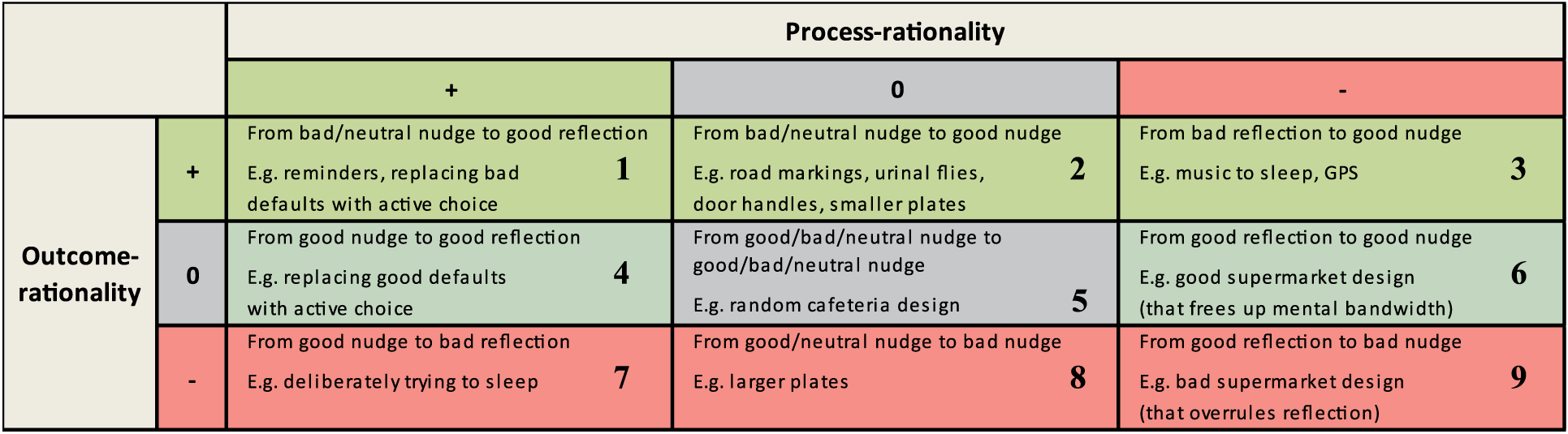
Critics rightly voice concerns that nudges can be manipulative and decrease outcome-rationality, triggering arational heuristics, bypassing or perverting rational capacities and thus decreasing process-rationality (box 9). While Sunstein rightly points to uncontroversial nudges that promote both outcome-rationality and process-rationality (box 1), his response does not address critics’ concerns. I believe my more fine-grained analysis does.
More specifically, I have made several arguments to mitigate these worries. First, I acknowledge that badly designed nudges can indeed steer people in directions they do not endorse, incurring a loss in outcome-rationality (red-colored boxes 7, 8 and 9). Second, the easy resistibility of nudges ensures that most nudgees will be able to stay on track. Third, even if they do not promote process-rationality, a lot of nudges are innocuous (grey-colored box 5) or even desirable because they are more conducive to people’s goals than alternatives (green-colored box 2). Fourth, process-rationality is often overrated: nudges that decrease it can still be desirable because they are conducive to people’s goals (green-colored box 3) and free up mental bandwidth (green-colored box 6). Fifth, outcome-rationality often matters more than process-rationality (green-colored top row and middle row).
Some issues remain, such as the appropriate point of comparison when evaluating nudges. Should the reference point be how rational people ideally are or can in principle be? Or how rational they were before being nudged? Or how rational people can realistically be expected to be? Without settling this debate here, I believe nudge critics often mistakenly refer to all too unrealistic and overly demanding conceptions of rationality. More psychologically realistic conceptions allow for a more generous assessment of the impact of nudges on rationality.
If we take the evidence surrounding the limits of rationality seriously, choice architects – family, friends, companies and governments – should carefully consider how to design the choice environments in which people act. In doing so, they have every right, reason and even duty to treat us as we are, not as we think we are or as we ideally are. If one cares about respecting and promoting people’s rationality in a relevant sense – which I certainly do – I have argued here why one should welcome most of the above nudges instead of dismissing them. Quite a few nudges can be said to promote the kind of rationality that we care about most (spurring us into doing whatever we have reasons for; outcome-rationality), even if they do not treat us as fully rational creatures (appealing to those very reasons and influencing behavior only via those reasons; process-rationality).
Footnotes
Acknowledgements
I presented earlier versions of this paper at the Choice Seminar of the Centre for Philosophy of Natural and Social Sciences (CPNSS) of the London School of Economics and Political Science (LSE) (March 2017) and at the ethics seminar of TiLPS (Tilburg Centre for Ethics, Logic, and Philosophy of Science). I want to thank participants of these events for their valuable questions and comments. I am particularly grateful to Alan Thomas, Alfred Archer, Andreas Schmidt, Viktor Ivanković and my colleagues at TiLPS for all of their useful feedback on earlier drafts. The bulk of this work was done during my research visit at LSE during February and March 2017. Finally, I want to thank Luc Bovens, for having me over at LSE and providing detailed comments on my paper, and to TiLPS, for funding this research visit.
Funding
The author(s) received no financial support for the research, authorship, and/or publication of this article.