




Abstract
Hybrid entrepreneurship as a side hustle is a widespread yet understudied coping strategy among low-income wage workers. This study examines how loss aversion is associated with such side-hustle activities and their links to well-being. We conducted a mixed-method study in Bangladesh. Quantitative analysis, based on surveys and lab experiments, indicates that loss aversion is associated with a higher likelihood of engaging in hybrid entrepreneurship, which is in turn linked to higher well-being. Qualitative analysis, based on in-depth interviews, illustrates mechanisms that may underlie these associations. Together, these findings provide insights into the protective role of hybrid entrepreneurship in poverty contexts.
Introduction
Hybrid entrepreneurship—engaging in both wage employment and self-employment simultaneously—has attracted considerable scholarly attention (Folta et al., 2010; Gänser-Stickler et al., 2022; Raffiee & Feng, 2014). Much of this literature, grounded in high-income contexts, conceptualizes hybrid entrepreneurship as a strategic stepping stone to full-time self-employment. Individuals retain wage employment while testing entrepreneurial opportunities, thereby mitigating the risks associated with venturing (Gänser-Stickler et al., 2022; Raffiee & Feng, 2014). In these settings, hybrid entrepreneurship is largely opportunity-driven, shaped by market signals, personal risk tolerance, and expected returns, with risk-averse individuals more likely to pursue hybrid entry as a gradual pathway to self-employment (Folta et al., 2010; Raffiee & Feng, 2014). Its effects on well-being are mixed: while hybrid entrepreneurship can enhance earnings and foster skill development, the dual demands of wage and self-employment can reduce procedural utility and lower job and life satisfaction (Ardianti et al., 2022; Stephan et al., 2023).
However, among low-income populations in developing countries, combining wage labor and self-employment often arises from necessity rather than opportunity (Banerjee & Duflo, 2007, 2011; Fields, 2019). Low-income individuals often engage in informal income-generating activities, such as selling goods, running food stalls, or offering basic services, not to explore entrepreneurial ambitions, but to survive amid poverty (Marti & Mair, 2009), food insecurity (Cheng et al., 2021), income instability (Shahriar & Shepherd, 2025), and weak social protection systems (Shepherd et al., 2021). Unlike in high-income settings, where hybrid entrepreneurship typically serves as a transitional phase toward full-time self-employment, in low-income contexts it often constitutes a persistent livelihood strategy. Many individuals remain engaged in both wage work and self-employment indefinitely, constrained by structural barriers, limited upward mobility, and unstable earnings (Banerjee & Duflo, 2007; Falco & Haywood, 2016; Kilic et al., 2009). To better capture this distinction, we propose an alternative understanding of hybrid entrepreneurship—one that aligns with the concept of a side hustle: self-employment, pursued alongside wage work, for the purpose of generating supplementary income (Liu et al., 2025; Sessions et al., 2021).
The enduring nature of hybrid entrepreneurship as a side hustle raises important theoretical issues. If running a business alongside wage employment is not transitional but structural, then (a) the motivations driving such engagement may differ fundamentally from those identified in existing theories, and (b) its consequences for individuals’ livelihoods may also follow a different logic. Yet we know remarkably little about the mechanisms and implications of hybrid entrepreneurship among low-income populations (Demir et al., 2020).
Addressing this gap is critical for two interrelated reasons. First, existing research emphasizes risk aversion as a key driver of hybrid entrepreneurship in affluent settings, where individuals strategically test opportunities while maintaining the security of wage employment (Gänser-Stickler et al., 2022; Raffiee & Feng, 2014). In resource-constrained environments, however, individuals often focus less on capturing uncertain gains and more on avoiding further hardship (Dalton et al., 2020; de Bruijn & Antonides, 2022). Long-term engagement in self-employment alongside wage work may therefore be driven by loss aversion—a cognitive process in which the psychological pain of losses looms larger than the pleasure of equivalent gains (Kahneman & Tversky, 1979; Tversky & Kahneman, 1992). This theoretical shift from risk aversion to loss aversion points to a distinct behavioral mechanism underlying entrepreneurial decisions in poverty contexts (George et al., 2016; Shahriar & Shepherd, 2025).
Second, this necessity-driven and enduring form of hybrid entrepreneurship as a side hustle may also shape individuals’ economic trajectories and livelihood stability in ways that differ from high-income contexts. Whereas in affluent settings, hybrid entrepreneurship can enhance earnings and skill development but entails certain costs (Ardianti et al., 2022; Stephan et al., 2023), in low-income contexts, it may influence fundamental dimensions of economic security, household strategies, and resilience over time. Taken together, these distinctions suggest that hybrid entrepreneurship in low-income contexts is likely driven by different motivational drivers and produces different livelihood outcomes than in other contexts. These theoretical differences motivate our research question: How does low-income wage workers’ loss aversion influence their engagement in hybrid entrepreneurship as side hustles, and to what effect?
To answer these questions, we build on the literatures on prospect theory (Barberis, 2013; Devers et al., 2007; Kahneman & Tversky, 1979) and entrepreneurship in poverty contexts (Banerjee & Duflo, 2007; George et al., 2016; Shepherd et al., 2021) to propose a side-hustle model of hybrid entrepreneurship. 1 The model suggests that loss aversion is associated with both the decision to engage in hybrid entrepreneurship and the resulting impact on well-being. In contexts of income insecurity and limited safety nets, individuals are motivated to pursue side hustles primarily to avoid losses relative to a subsistence reference point, rather than to seek entrepreneurial gains. Engaging in side hustles thus acts as a protective mechanism, buffering financial instability and reducing the stress associated with economic vulnerability. In doing so, the model predicts that individuals who are more loss averse are more likely to undertake side hustles, and that this engagement is associated with improved well-being in low-income settings.
To empirically test this model, we conducted a mixed-methods study in the Haragach region of northern Bangladesh—an area known for its cottage industry, particularly bidi (hand-rolled cigarette) production. Workers in this industry are typically underpaid and face hazardous working conditions, prompting many to engage in side hustles, such as poultry farming, operating tea stalls, and running makeshift eateries. Our data collection comprised three components: (a) a survey of 318 bidi workers; (b) in-depth interviews with 33 hybrid entrepreneurs with side hustles, drawn from the survey sample; and (c) a lab experiment conducted with the full survey group. The findings largely support our proposed model.
This study contributes to the literature on hybrid entrepreneurship in several ways. First, it broadens the prevailing opportunity-driven view (Gänser-Stickler et al., 2022; Raffiee & Feng, 2014) by integrating a loss aversion perspective. It shows how hybrid entrepreneurship—as a side hustle—can function not only as a transitional step but also as a sustained livelihood strategy, serving as an adaptive response to economic insecurity in low-income settings. Second, it complements existing occupational choice models (Brockhaus, 1980; Douglas & Shepherd, 2002; McMullen & Shepherd, 2006; Vereshchagina & Hopenhayn, 2009) by incorporating insights from prospect theory, highlighting loss aversion as a key psychological mechanism that shapes entrepreneurial behavior under conditions of poverty. Finally, it links entrepreneurs’ well-being (Ardianti et al., 2022; Ryff, 2019; Saridakis et al., 2021; Wiklund et al., 2019) to hybrid entrepreneurship, demonstrating how loss-averse individuals can enhance both financial and psychological well-being through engagement in side hustles.
A Side-Hustle Model of Hybrid Entrepreneurship
Our side-hustle model of hybrid entrepreneurship theorizes that loss aversion motivates low-income wage workers to initiate small ventures alongside their regular jobs. In poverty contexts, where income shocks are frequent and safety nets are limited, the fear of loss outweighs the attraction of potential gains. Loss aversion thus shapes how individuals perceive risk: the uncertainty of running a small side venture feels less threatening than the predictable hardship of relying solely on wages. This form of hybrid entrepreneurship strengthens both economic security and psychological well-being. Accordingly, the side-hustle model links loss aversion, hybrid entrepreneurial engagement, and well-being in low-income settings.
Hybrid Entrepreneurship as a Side Hustle
Most existing research on hybrid entrepreneurship has been conducted in developed economies, where the decision to combine self-employment with wage work is largely explained by aspiration and opportunity recognition (Folta et al., 2010; Klyver et al., 2020; Raffiee & Feng, 2014). Individuals in these settings often enter hybrid status to explore promising ideas while maintaining income security—using the period to test market potential, develop skills, and assess entrepreneurial fit. Such dual engagement is portrayed as a strategic, opportunity-driven process that enables individuals to learn, reduce uncertainty, and ultimately decide whether to transition to full-time entrepreneurship, remain hybrid, or exit the entrepreneurial path.
In contrast, hybrid entrepreneurship in low-income contexts frequently arises from necessity rather than ambition or strategic experimentation (Banerjee & Duflo, 2007). Structural constraints, such as job insecurity, wage stagnation, and recurrent income shocks, push individuals to combine wage employment with small-scale self-employment as a side hustle (Falco & Haywood, 2016; Gindling & Newhouse, 2014). When formal employment alone cannot meet basic needs, low-income workers engage in supplemental activities, such as selling food, repairing goods, or providing household services to stabilize their livelihoods (Kilic et al., 2009; Shepherd et al., 2021). Banerjee and Duflo (2007, p. 151) illustrated this pattern among low-income women in India who juggle multiple income sources. In the slums of Guntur, women set up roadside stalls each morning, selling dosas—rice and lentil pancakes—before heading to their primary jobs in factories or households. These transient stalls provide a crucial supplement to meagre wages. Indeed, many people living in poverty start businesses not from a desire for growth but from desperation (George et al., 2016); they are too poor to remain underemployed in subsistence agriculture or precarious wage work (Fields, 2019).
Our field interviews reflect this logic.
2
Monirul (pseudonym), a 34-year-old hybrid entrepreneur in Haragach, Bangladesh, explained:
They pay us by the bundle of bidis [cigarettes] produced. Even if I roll 5,000 bidis in a day, it’s barely enough to buy food and medicine. So, I run a grocery store by the roadside in the evenings [as a side hustle]. If I don’t, my children go hungry and untreated.
This account underscores how hybrid entrepreneurship in poverty contexts is motivated by a desire to avoid deeper financial hardship and the emotional pain of failing to provide for one’s family. Confronted with chronic income instability, individuals view the potential losses from not pursuing a side hustle as more consequential than the uncertain gains from starting one. By retaining wage employment while running a small side business, they create a modest safety net to buffer against prolonged income shortages. Hybrid entrepreneurship thus emerges as a defensive strategy aimed at minimizing the risk of falling below subsistence, calling for a re-examination of the role of entrepreneurial risk-taking.
Entrepreneurial Risk-Taking in Poverty Contexts
Entrepreneurship research has long characterized risk-taking (or less risk aversion) as a defining characteristic of entrepreneurs (Brockhaus, 1980; Douglas & Shepherd, 2002; Vereshchagina & Hopenhayn, 2009). Opportunity-based entrepreneurs are typically more willing to tolerate uncertainty because they frame it as a path to potential gain (McMullen & Shepherd, 2006; Stewart & Roth, 2001). Rooted in expected utility theory, this view treats risk tolerance as a stable individual attribute that can explain entrepreneurial entry and success (Kihlstrom & Laffont, 1979; Nieß & Biemann, 2014).
However, this logic does not hold uniformly across socioeconomic contexts. In poverty settings, chronic scarcity fundamentally reshapes the meaning of risk. Low-income individuals manage their daily needs, challenges, and urgencies with limited resources (Ravallion, 2016)—a task often described using the metaphor of a “tightrope balancing act” (Mani et al., 2020). They face persistent income shocks, limited access to credit, and minimal social protection—conditions under which even small losses can be devastating (Haushofer & Fehr, 2014; Mani et al., 2013; Molotsky & Handa, 2021). Decision-making under such constraints is driven less by the pursuit of gains than by the avoidance of losses, and as such, “risk-taking” often reflects a defensive strategy to prevent further deterioration of livelihood rather than a genuine appetite for risk (Dalton et al., 2020; de Bruijn & Antonides, 2022; Vieider et al., 2019). Thus, for low-income wage workers in developing economies, the greatest danger lies not in the uncertain outcomes of a side venture but in the predictable insufficiency of wage income. In this setting, starting a small business alongside wage employment becomes a form of loss avoidance—a strategy to preserve a minimal standard of living rather than to seek advancement (George et al., 2016; Shepherd et al., 2021). Such behavior, which is inconsistent with the predictions of classical decision theory, calls for an alternative psychological explanation rooted in prospect theory (Kahneman & Tversky, 1979).
Loss Aversion and Hybrid Entrepreneurship
Prospect theory suggests that individuals evaluate outcomes relative to a reference point—often their current situation—rather than in terms of absolute wealth or utility (Barberis, 2013). Outcomes below this reference point are perceived as losses, while those above are seen as gains. Crucially, the pain of losing something typically outweighs the pleasure of gaining something of equal value. This cognitive process, known as loss aversion, helps explain why individuals are often more strongly motivated to avoid losses than to pursue equivalent gains.
Loss aversion has wide-ranging implications for decision-making under economic scarcity. For instance, highly loss-averse individuals underinvest in profitable agricultural inputs (Yesuf & Bluffstone, 2009), avoid insurance because of upfront costs (Alderman & Paxson, 1994), or make overly conservative financial choices that reinforce poverty traps (Vieider et al., 2019). Prior research on the psychology of poverty shows that when scarcity “captures the mind,” it sharpens cognitive focus on avoiding immediate shortfalls (Mani et al., 2013). Economic insecurity heightens the salience of loss prevention, often prompting defensive strategies even when these entail risk (de Bruijn & Antonides, 2022).
Within this framing, hybrid entrepreneurship emerges as a behavioral adaptation consistent with loss aversion. For low-income wage workers, relying solely on wages can lead to gradual financial decline. In such circumstances, not pursuing additional income-generating activities, such as starting a side hustle, can feel like accepting a certain loss. A highly loss-averse individual, particularly sensitive to this perception, may choose to face the uncertainty of self-employment rather than endure the inevitability of worsening hardship. The following quotes of our study participants illustrate this logic:
I know selling second-hand shoes in the market is risky. Some days I sell nothing. But if I just rely on the bidi wages, I’ll fall into debt. I’d rather try and fail than just wait for things to get worse. (Rafiq—28-year-old male hybrid entrepreneur). When my husband lost his job, I started stitching blouses for the neighbors at night. I couldn’t just sit and hope the factory work would be enough. That would have been like choosing to fall behind. (Nasima—32-year-old female hybrid entrepreneur).
These accounts reveal how the psychological weight of potential losses—falling into debt, failing to feed one’s family, or “falling behind”—translates into entrepreneurial action. From a prospect theory perspective, the uncertain returns of side hustling are perceived as less threatening than the certain losses of wage dependency. Thus, in poverty contexts, greater loss aversion—rather than risk tolerance, as commonly emphasized in affluent settings (Raffiee & Feng, 2014)—is the primary psychological driver of hybrid entrepreneurship. Starting a small business alongside wage employment offers a chance to “hold the line” and avoid further financial decline. For loss-averse individuals, the potential benefits of such ventures outweigh the uncertainties, making entrepreneurship a preferable alternative to the predictable downside of inaction. By contrast, those who are less loss averse may not view wage dependence as especially threatening and thus feel less urgency to pursue a side hustle. Based on the above reasoning that emphasizes sensitivity to loss among low-income individuals and the protective role of side hustles, we offer the following:
Hybrid Entrepreneurship as a Side Hustle and Well-Being
Entrepreneurial well-being has increasingly been recognized as a multidimensional construct encompassing both economic and psychological dimensions. Wiklund et al. (2019, p. 579) defined it as “the experience of satisfaction, positive affect, infrequent negative affect, and psychological functioning in relation to developing, starting, growing, and running an entrepreneurial venture.” Prior studies have shown that entrepreneurship can enhance well-being by improving financial autonomy, reducing stress linked to economic insecurity, and fostering a sense of purpose and control (Ardianti et al., 2022; Saridakis et al., 2021). However, existing research on entrepreneurial well-being has largely focused on opportunity-driven entrepreneurship in more affluent contexts, where well-being gains are often tied to growth aspirations and personal fulfillment (Kimmitt et al., 2020).
In poverty contexts, the relationship between entrepreneurship and well-being is shaped by different psychological dynamics. Grounded in prospect theory, well-being can be understood not solely as a function of absolute income but as a reflection of how individuals perceive changes relative to a reference point—particularly their ability to avoid losses. For low-income individuals, falling below subsistence levels triggers disproportionate distress, making loss avoidance a central concern (Dalton et al., 2020; Vieider et al., 2019). Loss aversion, therefore, not only motivates entrepreneurial entry but also influences how individuals experience the outcomes of their ventures.
Engaging in small-scale self-employment alongside wage work is likely a buffering mechanism that helps individuals maintain their reference point and avoid deeper hardship. For example, when wage income is volatile or insufficient, side hustles such as tailoring, street vending, or food preparation provide supplemental earnings that stabilize consumption and access to essential services (de Mel et al., 2008; Gindling & Newhouse, 2014). This economic buffer reduces the frequency and intensity of stressors, thereby enhancing psychological well-being through reduced anxiety, increased perceived control, and emotional relief (Haushofer & Fehr, 2014; Molotsky & Handa, 2021). The psychological relief comes not from entrepreneurial success in an aspirational sense (Kimmitt et al., 2020), but from the assurance of avoiding acute hardship (George et al., 2016). We propose that such protection translates into reduced anxiety, lighter cognitive load, and greater perceived control over daily life.
Our field interviews reinforce this proposition. One hybrid entrepreneur shared, “The [bidi] factory pays me enough when there’s work, but when it’s off-season, I also sell snacks from a cart. That’s how I buy medicine for my mother.” Another explained, “Sewing blouses at night helps me send my daughter to school. I can’t rely only on factory wages.” These accounts illustrate how side hustles are not pursued for growth or aspiration, but to protect against loss and preserve a basic standard of living.
Moreover, hybrid entrepreneurship as side hustles may generate positive affect through meaning, recognition, and personal growth. A woman selling pickles alongside her factory job explained, “People appreciate my pickles—now I feel like I can do something on my own.” A carpenter shared, “It [the carpentry] keeps me busy and learning—better than tedious and hazardous bidi making.” A grocery shop owner explained, “Now the bidi work feels like backup—my shop comes first.” These narratives show how side hustles stabilize income and reshape individuals’ self-perception—transforming their wage job from a trap into a safety net, and their entrepreneurial activity into a source of agency and pride.
Taken together, this suggests that loss aversion drives individuals toward hybrid entrepreneurship and amplifies the well-being benefits of engaging in it. Hybrid entrepreneurship operates as a mechanism through which loss-averse individuals both protect their economic baseline and safeguard their psychological security. The same sensitivity to potential losses that drives individuals to initiate side hustles also amplifies the benefits of engaging in them. By buffering against economic shocks, these ventures reduce the material and emotional consequences of falling below one’s reference point. These potential benefits create a coherent pathway linking loss aversion, hybrid entrepreneurship, and well-being: those who are more loss averse are more likely to pursue side hustles, and in doing so, they are better positioned to stabilize their lives and enhance their sense of well-being. Based on this reasoning, we propose the following:
Data and Empirical Methods
Context
We conducted this study in the Haragach region of Rangpur district in Bangladesh. The local economy is primarily agrarian: 51.08% of residents depend on agriculture, followed by non-agricultural daily labor (12.52%), commerce (13.18%), services (5.30%), and industry (2.86%) (Asiatic Society of Bangladesh, 2023). Within the industrial sector, bidi (hand-rolled, inexpensive cigarette) production dominates and serves as a key source of income for many low-income households. Approximately 35 bidi factories operate in this region, employing an estimated 40,000 workers (Mallick, 2017; Ullah, 2017).
Most bidi workers are poor, illiterate, and have limited access to alternative livelihoods. They typically work in dark, poorly ventilated spaces without protective gear, exposing themselves to tobacco dust and other harmful substances that pose significant health risks (Kim et al., 2020; Tyagi et al., 2023). Wages are also extremely low. Workers get paid based on the number of bidis rolled and packed. Specifically, they earn 50 Taka (less than 50 cents) for rolling 1,000 bidis. While many attempts to supplement their earnings through informal means such as poultry farming, day labor, or petty trade, bidi production remains their primary occupation. These overlapping challenges—economic marginalization, occupational hazards, and constrained livelihood options—make Haragach an exemplary setting for exploring how low-income workers respond to financial precarity through hybrid entrepreneurship as side hustles.
Research Design
To investigate the relationship between loss aversion, side hustles, and the well-being of low-income individuals, we conducted a structured survey of 318 bidi workers, in-depth interviews with 33 hybrid entrepreneurs with side hustles drawn from the survey sample, and a lab-in-the-field experiment involving all survey participants. The survey and experiment enabled a quantitative assessment of the relationship between loss aversion, side-hustle participation, and individual well-being. Complementing this, the qualitative interviews offered critical contextual depth and richer insights into the mechanisms linking loss aversion to side hustling, and side hustling to well-being.
Participants and Data Collection
One of the authors, a native Bangladeshi, spent over a month in the field collecting these data. To facilitate the process, this author worked closely with local surveyors and local research assistants drawn from the community. The involvement of locals in data collection was instrumental in overcoming cultural and linguistic barriers and building trust with participants. In collaboration with members of the local Union Council—the lowest administrative unit in rural Bangladesh—we compiled a list of 350 adult bidi workers. Eligibility criteria limited participation to individuals whose households owned less than 0.5 acres of cultivable land, a widely used threshold for identifying extreme poverty in rural Bangladesh (Food and Agriculture Organization, 2011). To minimize potential intrahousehold bias and ensure independent responses, we invited only one individual per household to participate in the study. Of the 350 individuals invited, 318 completed the survey and the lab experiment, forming the final sample.
We collected data in three stages. First, participants completed a lab-in-the-field experiment designed to elicit individual-level loss aversion (described below). Next, trained local surveyors verbally administered a structured survey in the local language to accommodate participants’ low literacy levels. These surveyors used a questionnaire booklet to guide the survey and recorded participants’ responses in the same booklet. The survey captured information on demographics, income sources, well-being indicators, and side-hustle participation.
Finally, we conducted semi-structured in-depth interviews with the hybrid entrepreneurs with side hustles. Of the 318 wage workers who participated in the survey, 33 were engaged in side hustling; we interviewed all of them. On average, the interviews took 45 min. We audio-recorded, transcribed, and translated the interviews into English. The questions explored personal and structural factors shaping participants’ engagement in side hustles, the challenges of balancing multiple income-generating activities, perceptions of well-being, and the influence of financial pressures. We conducted a thematic analysis of the transcripts, following the approach outlined by Braun and Clarke (2006). We coded for themes related to our research questions, focusing on participants’ experiences and interpretations of loss aversion, side-hustle engagement, and well-being. We draw on this qualitative evidence to interpret the quantitative results and to deepen understanding of the mechanisms underlying the relationships observed in our empirical analysis. We provide a detailed discussion of the qualitative research methods in Appendix A. Notably, we also interviewed 12 randomly selected wage workers who were not engaged in side hustling. We used a similar thematic analysis to understand better what prevented them from starting a small business along with their wage work. 3
Measuring Loss Aversion in Lab-in-the-Field Experiments
Loss aversion describes individuals’ tendency to perceive losses as more psychologically impactful than equivalent gains. To capture this behavioral characteristic, we conducted a series of incentivized decision-making tasks in lab-in-the-field settings—temporary experimental spaces in local school buildings. Drawing on established protocols for field-based behavioral research (Chakravarty & Shahriar, 2015; Gneezy et al., 2009), the experiments offered real monetary rewards to ensure participant engagement and authenticity in responses. Each participant received a fixed participation fee and had the chance to earn additional income based on their choices. Full details of the experimental setup appear in Appendix B.
We adapted a risk-elicitation protocol from Harbaugh et al. (2002) and Voors et al. (2012), which measures risk preferences in both gain and loss domains. In the gain condition, participants chose between a risky lottery (50% chance of winning 100 Taka 4 ) and a certain payout (40, 50, or 60 Taka). In the loss condition, we endowed participants with 100 Taka, and presented them with a choice between a risky lottery (50% chance of losing 100 Taka) and a certain loss (40, 50, or 60 Taka). Table 1 outlines the task structure.
Experimental Tasks.
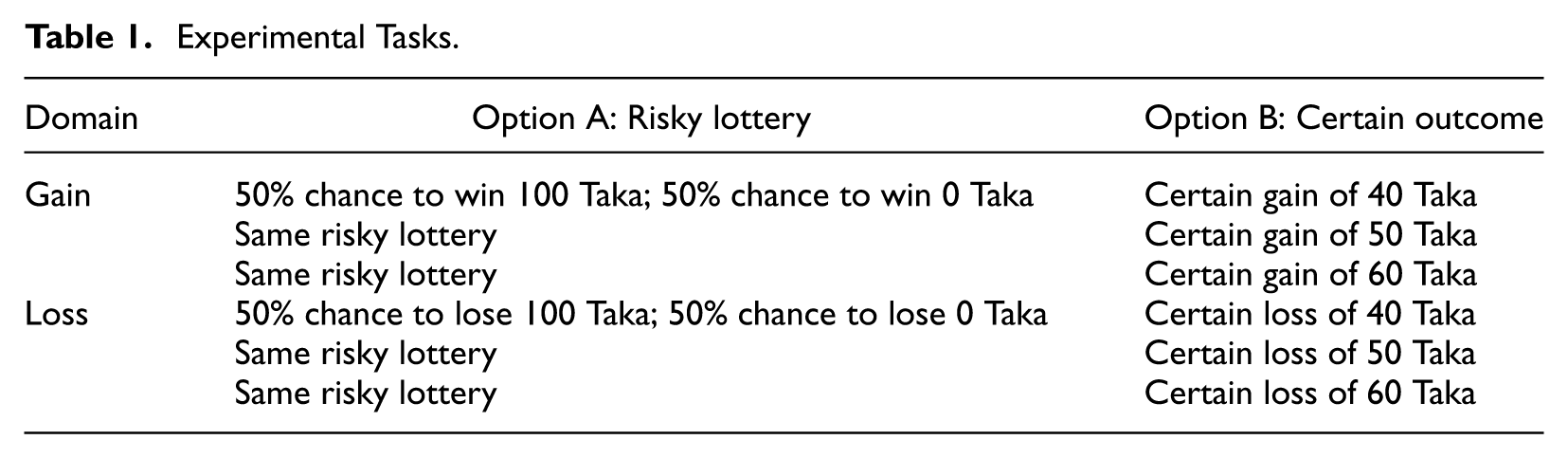
Based on these selections, we estimated the certainty equivalent (CE) within each domain, defined as the minimum certain gain or maximum certain loss that a participant is willing to accept instead of opting for the risky alternative. The ratio of the loss-domain CE to the gain-domain CE serves as a behavioral indicator of loss aversion. This ratio reflects the degree to which an individual demonstrates heightened sensitivity to prospective losses compared to equivalent gains. For instance, let us consider a participant who switches to the sure option in the gain domain at 50 Taka, suggesting a CE of 50 Taka—that is, they are indifferent between a 50% chance of gaining 100 Taka and a guaranteed gain of 50 Taka. In the loss domain, the same participant opts for the sure loss only at 60 Taka, indicating a CE of 60 Taka, that is, they are indifferent between a 50% chance of losing 100 Taka and a guaranteed loss of 60 Taka. Consequently, the loss aversion coefficient is 1.2.
Variables
We measured the following variables using data collected through the survey and the lab-in-the-field experiment:
Loss Aversion
We introduce two variables to capture individual-level loss aversion using data from our lab-in-the-field experiment. First, we construct a continuous measure of loss aversion, defined as the ratio of the CE in the loss domain to that in the gain domain. A higher ratio reflects a stronger tendency to avoid losses relative to equivalent gains, indicating greater loss aversion. Additionally, we constructed a binary variable, loss-averse individual, to classify participants based on their loss aversion ratio. This variable equals 1 if the ratio exceeds 1, thereby identifying the individual as loss averse. Conversely, it equals 0 if the ratio is equal to or less than 1, thereby capturing individuals who are either loss-neutral (ratio = 1) or loss-tolerant (ratio < 1).
Side Hustle
Side hustle refers to the decision to engage in side hustling. It is measured as a binary variable that equals 1 for wage workers who run a side business. Otherwise, it equals 0 if they are solely employees.
Well-Being
We define well-being as a multidimensional construct encompassing both economic and psychological domains. The economic component captures material living conditions through a four-point self-assessed financial status scale. The psychological component includes job satisfaction, mental strain (reverse-coded), and overall life satisfaction, each measured with validated survey items. All four components are normalized to a 0–1 scale and equally weighted to create a composite well-being index that reflects both financial security and subjective quality of life. We discussed the construction of the well-being index in Appendix C.
Control Variables
We include a range of control variables capturing individuals’ entrepreneurial cognition, key antecedents of entrepreneurial intention, demographic characteristics, and financial vulnerability.
Entrepreneurial cognition reflects individuals’ attitudes toward entrepreneurship. It includes three binary variables: opportunity perception (equals 1 if the respondent expects good business opportunities in their village within the next 6 months), entrepreneurial self-efficacy (equals 1 if the respondent believes they have the necessary skills and knowledge to start a business), and fear of business failure (equals 1 if the respondent reports that fear of failure would prevent them from starting a business). These questions have been adopted from the Adult Population Survey of the Global Entrepreneurship Monitor.
Antecedents of entrepreneurial intention capture motivational factors (Ajzen, 1991). Perceived attractiveness of doing business is measured through a hypothetical investment scenario assessing willingness to invest in a new business. 5 Perceived social norms is a binary variable equal to 1 if the respondent believes their family would support their entrepreneurial decision.
Demographic characteristics include age (measured in years), education (number of years of formal schooling), household size (total number of household members), and gender (binary variable; 1 = female, 0 = male). Primary income refers to the respondent’s monthly earnings from their main employment, specifically bidi-making.
Financial Vulnerability
We gathered information on the financial vulnerability experienced by the respondents. Income shock is a binary variable equal to 1 if the respondent experienced a significant income disruption in the past 12 months due to natural disasters (flood, river erosion, or cyclone) or the death of a family breadwinner; otherwise, it equals 0. Seasonal hardship is a binary variable equal to 1 if the respondent reported a seasonal decline in income and consumption during the agricultural lean season; otherwise, it equals 0.
Summary Statistics
Table 2 reports the summary statistics of the variables and their pairwise correlations. On average, 16% of respondents are loss averse, and about 10% engage in side hustling. The mean well-being index score is 0.32, indicating relatively low overall well-being. Regarding entrepreneurial cognition, 68% perceive good business opportunities in their village, 49% believe they have the skills to start a business, and 55% report fear of failure as a barrier. The perceived attractiveness of doing business has a mean score of 72.6 (on a 0–100 scale), while perceived social norms around entrepreneurship average 2.62 (on a 1–3 scale). The average age of respondents is 37.5 years, with 5 years of formal education. The typical household comprises about 4.5 members, and 58% of the sample are women. Respondents report an average monthly primary income of 2,081 Taka (∼USD 20). Most respondents experienced financial shocks, with 66% reporting an income shock in the past year and 57% facing seasonal hardship. Appendix D reports a detailed comparison of the study population with national and regional indicators, drawing on data from the Bangladesh Bureau of Statistics (2022, 2024) and the Global Entrepreneurship Monitor (2011), highlighting the context of low-income wage workers in Haragach, Rangpur.
Summary Statistics and Correlation Coefficients.
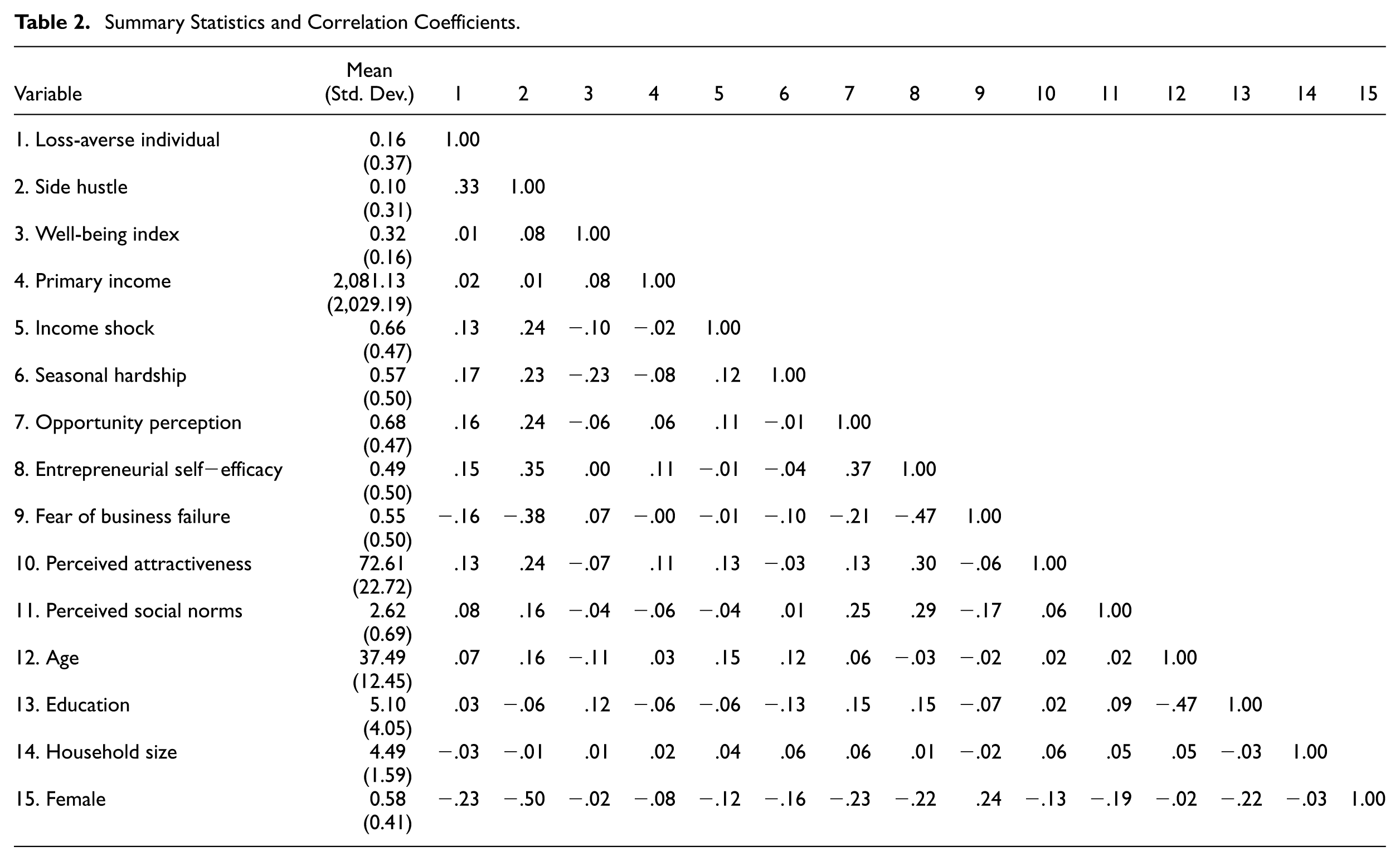
The largest pairwise correlation coefficient between any two independent variables was .25, between opportunity perception and perceived social norms. A correlation coefficient of .7 or higher between two variables indicates that multicollinearity could be a serious problem, reducing the precision of regression coefficients (Tabachnick et al., 2013); however, this is not the case in our sample.
Characteristics and Features of Hybrid Entrepreneurs With Side Hustles
Table 3 presents the descriptive statistics of the 33 hybrid entrepreneurs with side hustles surveyed, offering insight into their demographic profiles and business operations. Educational attainment of those engaged in side hustling is low, with just over 4 years of schooling on average. Only 18% of those engaged in side hustling were women, even though 58% of the respondents in our sample were women, indicating lower entrepreneurial participation among women. On average, they have been involved in bidi-making for 17 years, suggesting that many began working as children.
Business Characteristics of Hybrid Entrepreneurs: Descriptive Statistics.
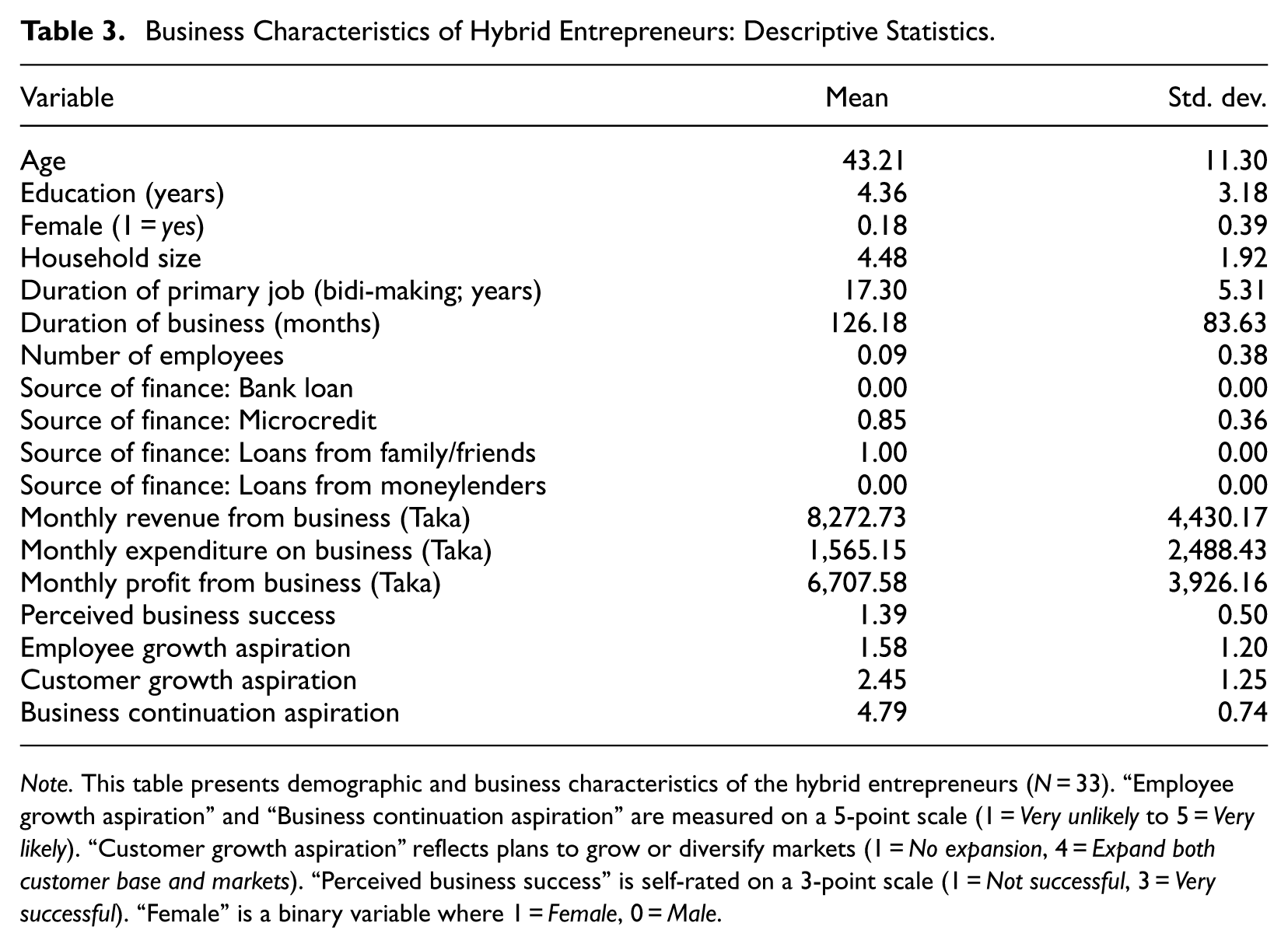
Note. This table presents demographic and business characteristics of the hybrid entrepreneurs (N = 33). “Employee growth aspiration” and “Business continuation aspiration” are measured on a 5-point scale (1 = Very unlikely to 5 = Very likely). “Customer growth aspiration” reflects plans to grow or diversify markets (1 = No expansion, 4 = Expand both customer base and markets). “Perceived business success” is self-rated on a 3-point scale (1 = Not successful, 3 = Very successful). “Female” is a binary variable where 1 = Female, 0 = Male.
Those engaged in side hustling reported that their businesses are primarily rooted in local demand and low start-up costs. Typical activities include poultry farming, food vending, tailoring, home-based cooking, and selling handmade crafts or herbal medicines. Most businesses are operated from the home or local community, reflecting spatial limitations. On average, the side ventures of the bidi workers have been running for 10 years, typically operated without hired employees. All participants rely on loans from family or friends to finance their businesses, with 85% also using microcredit. None reported receiving financing from banks or informal moneylenders.
Businesses earn an average monthly revenue of 8,273 Taka, yielding a profit of approximately 6,708 Taka (∼USD 64). Thus, the average monthly profit from side hustles is much higher than the monthly wage income from bidi-making (∼USD 20). Notably, the median monthly business profit is 7,000 Taka, close to the mean of 6,708 Taka (SD = 3,866 Taka), indicating that a few high earners do not inflate the average. Moreover, the variation in wage income is also high (mean = 2,100 Taka; SD = 2,029 Taka), suggesting that dispersion exists in both sources. Indeed, this difference is better explained by a reporting distinction. Bidi-making is reported as each respondent’s occupation; thus, wage income reflects individual earnings. In contrast, income from side hustles often involves contributions from multiple family members. This family contribution aligns with the common pattern in small business operations in Bangladesh, where small businesses are typically family-run and income is shared among family members (International Labour Organization, 2018). As a result, even when household businesses generate higher total income, respondents continue to identify bidi-making as their primary occupation and the business as a side hustle.
Despite limited perceived business success, hybrid entrepreneurs with side hustles express strong intentions to continue and show modest aspirations for growth in employees and customers or markets, suggesting that while these ventures remain small in scale, they are viewed as valuable and enduring sources of livelihood. However, in direct interviews, many hybrid entrepreneurs with side hustles mentioned that their aspiration to grow is tempered by fear of failure and the reality of limited resources, lack of market access, and inadequate institutional support. As a result, they continue to balance side businesses with bidi-making rather than leaving wage work to become full-time entrepreneurs.
Quantitative Analysis: Main Results
Hypothesis 1 posits that low-income wage workers who are more loss averse are more likely to engage in hybrid entrepreneurship as a side hustle than those who are less loss averse. To test this hypothesis, we regressed side hustle involvement on loss aversion using a linear probability model (LPM). The coefficients are reported in Table 4. First, we ran the regression without any control variables (Column 1 of Table 4). Next, we added the control variables (Column 2). The loss aversion coefficient is positive and significant (p < .01) in both specifications. Next, we regressed side hustle involvement on the dummy variable, loss-averse individual, using an LPM without control variables (Column 3) and then with control variables (Column 4). The results suggest that loss-averse individuals are 12 to 27 percentage points more likely to engage in a side hustle than those who are not loss averse (p < .01). These findings support Hypothesis 1: low-income wage workers who are more loss averse are more likely to engage in hybrid entrepreneurship as a side hustle than those who are less loss averse.
Loss Aversion Drives Hybrid Entrepreneurship as a Side Hustle.
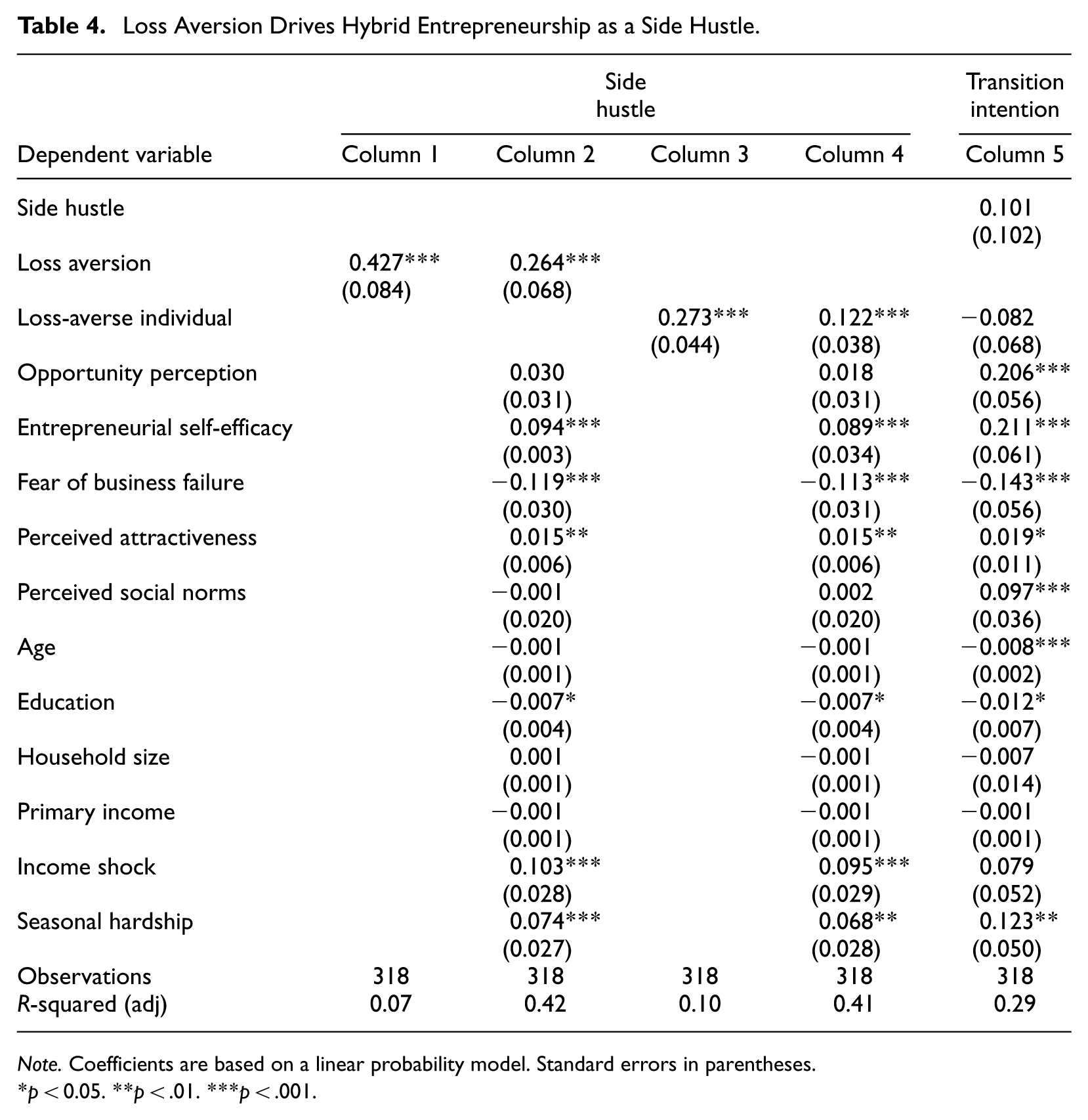
Note. Coefficients are based on a linear probability model. Standard errors in parentheses.
p < 0.05. **p < .01. ***p < .001.
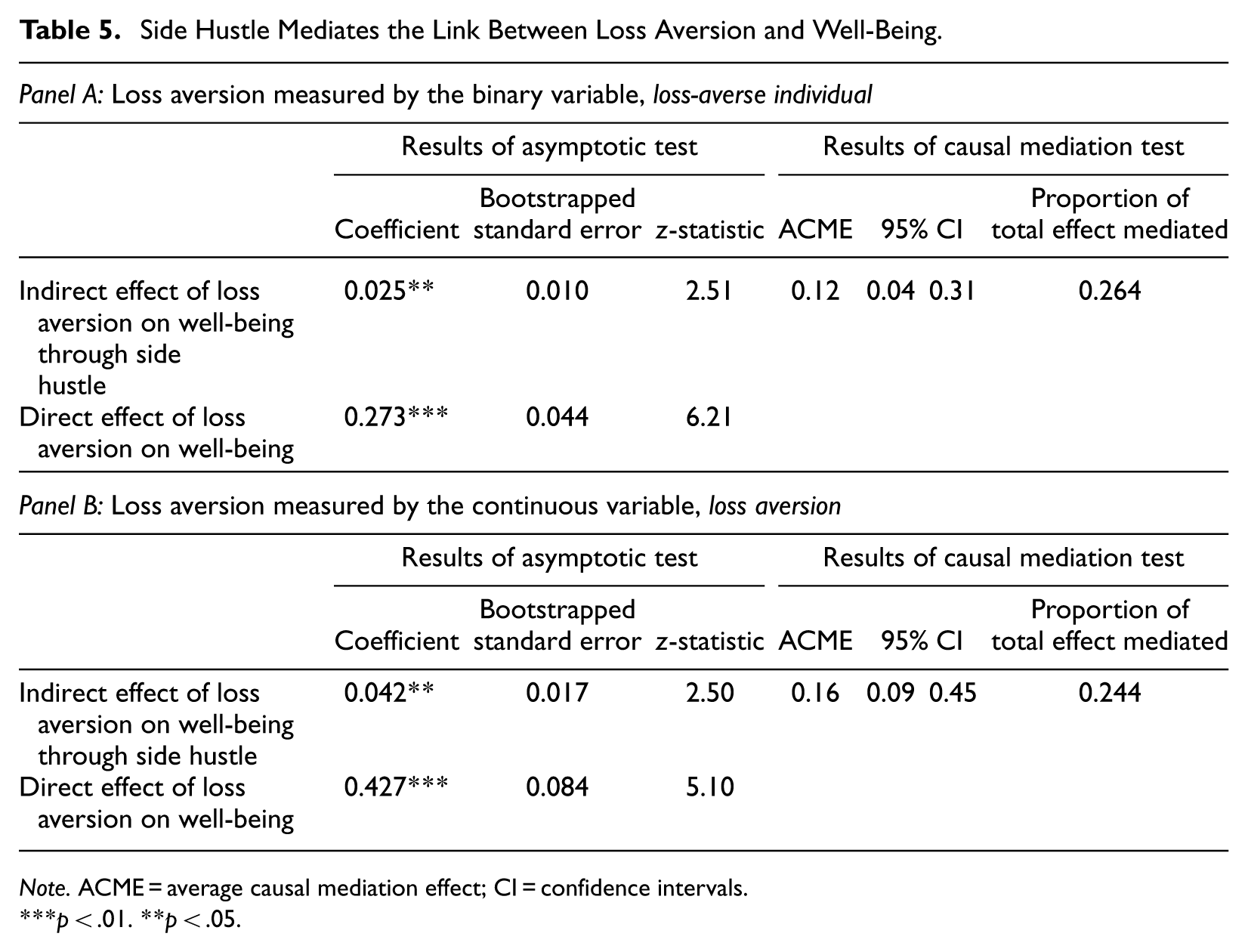
Hypothesis 2 proposes that hybrid entrepreneurship as a side hustle mediates the relationship between impoverished individuals’ loss aversion and well-being. Specifically, impoverished individuals with greater loss aversion are more likely to engage in hybrid entrepreneurship as a side hustle than those with less loss aversion, and those who engage in hybrid entrepreneurship as a side hustle likely experience greater well-being than those who do not engage in hybrid entrepreneurship as a side hustle. We used mediation analysis with Preacher and Hayes’ (2008) asymptotic product-based method to test this hypothesis. This approach estimates the indirect effect of loss aversion (X) on well-being (Y) through side hustling (M) by multiplying the effect of X on M with the effect of M on Y. Table 5 presents the results.
Side Hustle Mediates the Link Between Loss Aversion and Well-Being.
Note. ACME = average causal mediation effect; CI = confidence intervals.
p < .01. **p < .05.
We first measured loss aversion as a binary variable (Panel A), then as a continuous variable (Panel B). In both cases, the indirect effect of loss aversion on overall well-being through side hustling was positive and statistically significant (Panel A: β = .025, p < .05; Panel B: β = .042, p < .05). The direct effect of loss aversion on well-being was also positive and significant (Panel A: β = .273, p < .01; Panel B: β = .427, p < .01). These findings support Hypothesis 2.
As a robustness check, we applied Imai et al.’s (2010) causal mediation test, which uses a counterfactual framework to estimate the indirect effect of a treatment through a mediator. We calculated the average causal mediation effect (ACME) of side hustling and bootstrapped the sample (5,000 replications) to estimate 95% confidence intervals (CIs), reported in Table 5. Results in Panel A indicate that a one-standard deviation increase in the likelihood of being loss-averse is associated with an increased probability of engaging in hybrid entrepreneurship as a side hustle, which is associated with a 12% increase in the well-being index. Results in Panel B show that a one-standard deviation increase in the continuous loss aversion measure is associated with an increased probability of side hustling, which is associated with 16% increase in well-being. The ACME is statistically significant (p < .05) in both cases, supporting Hypothesis 2. Side hustling mediated 24% to 26% of the total effect of loss aversion on individuals’ well-being.
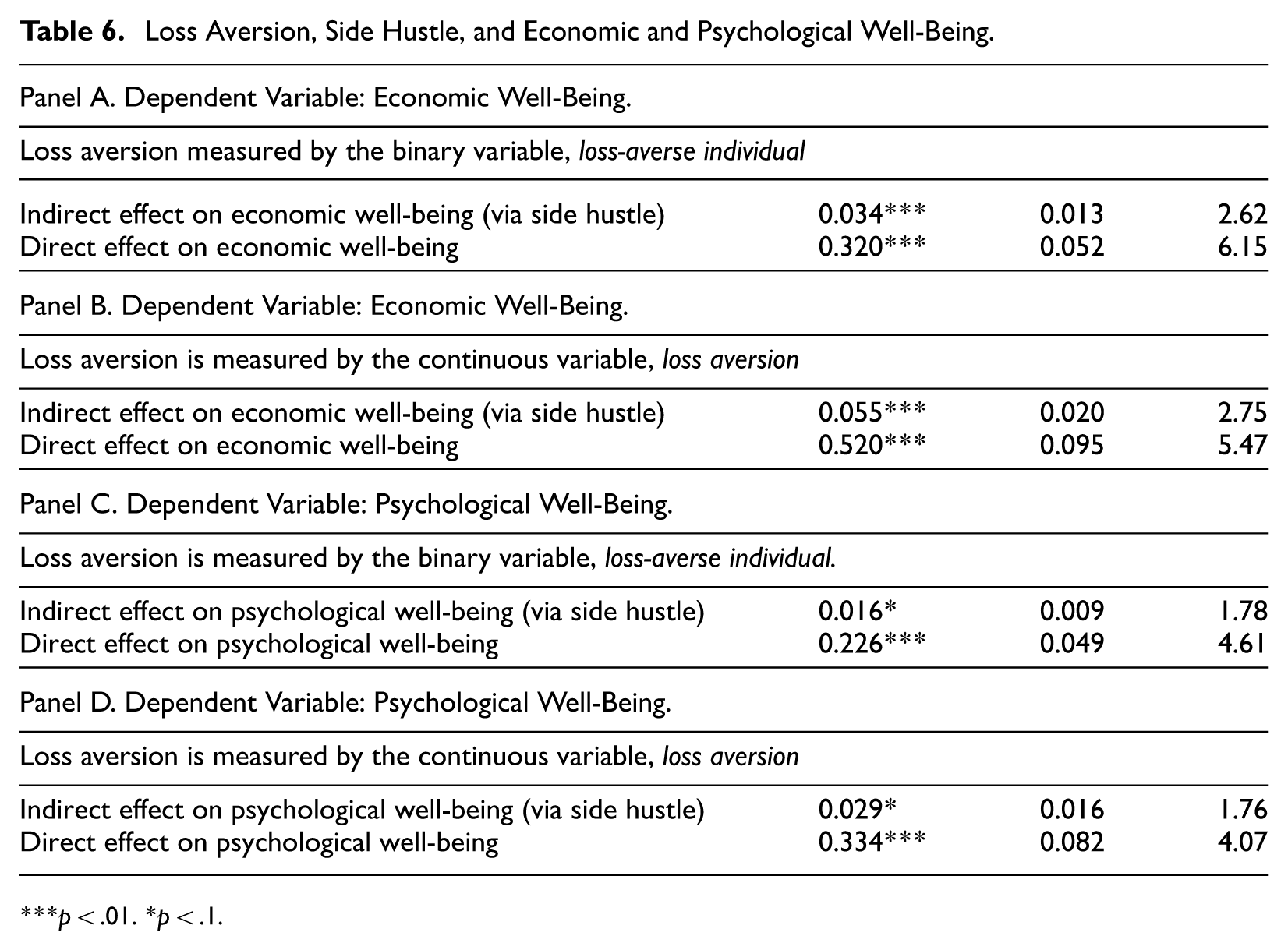
To better understand which aspects of well-being were most affected, we decomposed the overall well-being index into its two components: economic and psychological well-being, and conducted the asymptotic test. The results are reported in Table 6. The indirect effect of loss aversion on economic well-being through side hustling was significantly stronger (Panel A: β = .034, p < .01; Panel B: β = .055, p < .01) than psychological well-being (Panel C: β = .016, p < .10; Panel D: β = .029, p < .10). The direct effects were also positive and statistically significant for both dimensions of well-being (economic: Panel A: β = .320, Panel B: β = .520; psychological: Panel C: β = .226, Panel D: β = .334; all p < .01). These results suggest that while hybrid entrepreneurship contributes to both economic and psychological well-being, its impact is more pronounced on the economic dimension.
Loss Aversion, Side Hustle, and Economic and Psychological Well-Being.
p < .01. *p < .1.
Robustness Checks
In this section, we conducted a series of robustness checks of our main findings. A limitation of our study is that we cannot establish causal relationships. Alternative explanations are possible. For example, higher well-being may lead individuals to become more loss averse or enable them to invest in side hustles, rather than loss aversion driving side-hustle engagement and well-being. These considerations and the relatively small sample size necessitate caution in interpreting our results causally.
To assess our findings’ robustness, we conducted a propensity score matching (PSM) analysis following Heckman et al. (1998). PSM uses a binary choice (e.g., probit model) to estimate the predicted probability of receiving a treatment based on observed characteristics. Individuals with similar propensity scores—one from the treatment group and one from the control group—are matched. The mean difference in outcomes between matched pairs can then be attributed to the treatment, since they are comparable on observed characteristics. In the present context, we used the observable characteristics listed in Table 2 to generate the probability of an individual being loss averse. We matched each loss-averse individual to one or more non-loss-averse individuals using nearest neighbor and radius matching algorithms.
The PSM analysis, with bootstrapped standard errors, shows that the average treatment effect on the treated of loss aversion is positive and statistically significant (p < .05) for both (1) engagement in side hustles and (2) well-being. While these results should not be interpreted as causal, they support our main findings, indicating that the associations between loss aversion, side-hustle participation, and well-being remain robust in the matched sample. Results are not reported here but are available from the first author.
Another potential concern is that fear of failure might be conceptually related to components of the loss aversion measure, particularly the perception of potential losses. Although the correlation between these variables is negative and statistically insignificant (p > .05), we conducted a robustness check excluding the fear of failure variable from the model to ensure that this overlap does not drive our results. The results, not reported here but available from the first author, remain consistent with our main findings: loss aversion continues to significantly predict engagement in hybrid entrepreneurship, and both the direction and magnitude of the effects are stable. This finding suggests that the loss aversion measure captures a distinct psychological mechanism beyond fear of failure.
Quantitative Analysis: An Additional Test
Unlike in high-income contexts, where hybrid entrepreneurship often serves as a pathway to full-time self-employment, we assumed that low-wage workers do not typically view hybrid entrepreneurship as a transition strategy but an ongoing source of supplemental income. In this section, we test whether hybrid entrepreneurs show a higher intention than others to quit wage work to become full-time entrepreneurs—a concept we refer to as transition intention (consistent with Thorgren et al., 2016). Specifically, in our survey, we asked respondents whether they intended to leave their current paid employment (bidi-making) and become a full-time entrepreneur within the next 12 months. Based on their responses, we created a binary variable, transition intention, coded as 1 for those who expressed this intent and 0 otherwise. We regressed transition intention on side hustle, controlling for entrepreneurial cognition and demographic characteristics. The results, presented in Column 5 of Table 4, show that the coefficient for side hustle is statistically insignificant (p > .05). Therefore, we did not find evidence that hybrid entrepreneurs in low-income settings view their entrepreneurial ventures as stepping stones toward full-time self-employment.
Qualitative Evidence: Adding Richness
Loss Aversion Driving Side Hustles
Our qualitative interviews provide some richness to our findings for why low-income wage workers turn to hybrid entrepreneurship. While the quantitative results showed that loss aversion is significantly associated with hybrid entrepreneurship as a side hustle, the interview data help illustrate three possible mechanisms underlying this relationship.
First, our interviews indicated that impoverished individuals’fear of not meeting basic survival needs may undergird the link between loss aversion and hybrid entrepreneurship as a side hustle. For many participants, side hustling was not driven by ambition but by the need to survive. Inadequate and irregular income from primary wage work left families unable to meet basic needs like food. The fear of going hungry—not just themselves but their dependents—frequently triggered entrepreneurial action. Ariful, a 50-year-old bidi worker who repairs cycles and vans on the side, explained, “Just doing bidi work is not enough to feed us … I do servicing of cycles, vans, and motorcycles. Otherwise, we cannot eat properly.” For others, household shocks such as illness or losing a male breadwinner forced them into side hustles. Rashida, a 48-year-old woman who runs a small shop and rolls bidis, shared, “My husband became unable to work after surgeries. His autorickshaw was sold to pay for his treatment. We had no money, no other income. So, I started the shop—and I also make bidi.” These accounts reflect a clear risk logic: the cost of not acting was too great. For low-income wage workers, side hustling became necessary to avoid deeper poverty and protect their dignity and security.
Second, our interviews indicated that the’ volatility of wage income among impoverished individuals may undergird the link between loss aversion and hybrid entrepreneurship as a side hustle. Most respondents described their side hustles as a protective measure against the unreliability and insufficiency of their primary wage work. With limited or no savings and persistent income shortfalls, side hustling emerged as a necessary response to the perceived risk of falling deeper into poverty. Shahabuddin, a 30-year-old bidi worker who sells vegetables in the evenings, explained that relying solely on bidi work caused anxiety about the future. This uncertainty pushed him to a side hustle:
I started making bidis in childhood, and now my children have begun working in bidi rolling. I go to the bidi factory in the morning and return around 5 PM. After that, I start my cart business. Before starting this business, I solely relied on bidi work, but dwindling opportunities and declining wages pushed me toward vending. I began that vegetable-selling business without much knowledge. Earnings are better now.
Other participants similarly highlighted how side hustling offered a buffer against unpredictable income. Helena, a 65-year-old woman who runs a small grocery shop alongside her wage work, said, “While bidi work offers some relief, it falls short of meeting my daily needs. My sons do offer support, but it’s not enough … (with the earnings from the shop), I can now eat every day.” Halima, a 34-year-old bidi worker, turned to entrepreneurship when her husband’s earnings became increasingly unreliable:
I have been working with bidi factories since childhood. In addition, I now use a sewing machine. I also do cane work because I need a significant amount of money to educate my three children. My husband also works, but he is currently unable to earn much, so I manage everything by juggling these various tasks.
These accounts reveal how loss aversion—especially the fear of sudden income loss—prompted participants to diversify their income sources. Even modest or irregular earnings from side hustles were seen as essential to avoid the more painful loss of failing to meet basic needs.
Finally, our interviews indicated that impoverished individuals’stress from the physical requirement of wage work may undergird the link between loss aversion and hybrid entrepreneurship as a side hustle. For several participants, the decision to take on side hustles was motivated by financial necessity and the physical toll of their primary wage work. They reported that the demanding manual labor, especially bidi rolling, led to health deterioration, prompting them to seek less physically taxing activities that could sustain their income over time. Side hustling thus emerged as a strategy to preserve their earning capacity by adapting to declining physical resilience. Aziz, a 36-year-old bidi worker who also runs a small shop in the evenings, reflected on this challenge:
I begin my day early, working in a bidi factory in the morning and managing a shop in the evening. The demanding bidi work, along with deteriorating health and insufficient income, led me to find a way to earn a living while sitting down. Thus, running the shop solved my decreasing physical capability and financial challenges.
Similarly, Jamal described how his body no longer tolerated the long hours in the bidi factory:
I’m 63 now and can’t manage a full day in the factory—my body just can’t handle it. Bidi work alone doesn’t bring in enough, and whenever I try to work full-time, I start coughing from the tobacco dust.
For these workers, loss aversion is experienced somatically: the fear of worsening health, loss of physical capacity, and consequent job loss motivates a proactive shift to side hustles that are less physically demanding. The perceived cost of continuing with strenuous labor without income diversification was too high, leading them to seek sustainable alternatives before health issues forced a complete withdrawal from work.
Taken together, these mechanisms illustrate loss aversion as a pressing and deeply rooted concern in the everyday lives of low-income individuals. Hybrid entrepreneurship as side hustles emerges as a decision to avert anticipated losses—whether related to basic necessities, financial stability, or physical well-being. The interviews illustrate how even modest opportunities for additional income are pursued despite long hours and limited resources: the pain of bearing the risk of inaction (i.e., relying solely on current employment work) is too great; they side hustle to reduce the implications of income loss.
Qualitative Evidence on Side Hustles and Well-Being
We draw on qualitative data from participant interviews to enrich our understanding of the material and psychological mechanisms through which hybrid entrepreneurship mediates the relationship between loss aversion and well-being. While the statistical results suggest that loss-averse individuals enhance their well-being by engaging in side hustles—the interviews provide a richer indication of how this may occur.
First, hybrid entrepreneurship as a side hustle gave these impoverished individuals financial security. For many low-income individuals, hybrid entrepreneurship helped them manage daily expenses, regain a degree of control over their finances, and reduce dependence on others. Even when income gains were modest, side hustles provided a stabilizing function amid volatility. Amirul, a 55-year-old who began selling vegetables after his primary income from bidi work declined, emphasized this role:
I started selling vegetables around two years ago when bidi work became unsustainable—the income was simply insufficient to support my family. Although I face both financial and physical exhaustion, and every paisa I earn gets spent with nothing left over, I still feel happy.
Despite persistent hardship, this sense of relief and happiness underscores how hybrid entrepreneurship offered a buffer against income shocks, helping individuals maintain a sense of financial control.
Participants also described the psychological benefits of side hustling. Loss aversion often took the form of a fear of slipping further into poverty or being unable to support one’s family. In response, many initiated side ventures to avoid these feared outcomes. For Shefali, a 65-year-old widow, opening a small shop after her husband’s death restored a sense of independence: “I opened this shop after my husband passed away. My sons help me, but their support isn’t enough. I often worry—if they stop helping, how will I manage? The shop doesn’t fully cover my daily expenses but offers some relief.” That “some relief,” while financially limited, was psychologically powerful. Similarly, Jahirul, a 65-year-old grocer, spoke of continuing to work through his side hustle to preserve peace of mind: “I can’t spend much time with my family, but I’m doing my best to earn whatever little money I can, so that I can spend my final days in peace.” These accounts show how even modest side incomes can be an important emotional safety net. For the loss-averse poor, hybrid entrepreneurship helped transform anxiety into purposeful action, enhancing their sense of well-being.
Second, hybrid entrepreneurship as a side hustle appeared to provide these impoverished individuals a sense of empowerment. Participants often described how earning small supplemental income helped them navigate uncertainty more confidently and regain control over their lives. For individuals constantly fearing losing financial stability, social standing, or a sense of purpose, side hustling became a proactive strategy to protect what mattered most. Anowarul, a 63-year-old bidi packer who co-manages a home-based grocery shop with his wife, exemplifies this experience. Although he continues bidi work, the shop helps cover daily expenses and allows the couple to host their grandchildren. For Anowarul, the side hustle reduced his mental burden, helped him cope with the pressure of supporting extended family, and preserved his sense of usefulness. He took pride in the life he and his wife sustained, finding practical relief and emotional comfort in their shared effort.
Others echoed this sense of regained purpose through side hustles. When their primary work—such as bidi making—no longer offered the respect, satisfaction, or meaning they desired, hybrid entrepreneurship became a way to avoid marginalization and maintain dignity. Abul Kabiraj, for instance, turned to traditional healing (Kabiraji) after sensing that bidi work left him emotionally unfulfilled. His decision was driven less by financial goals and more by a desire for recognition, mastery, and social worth. As he reflected:
Faced with hardship, I began thinking about changing professions and became interested in traditional healing. … by the grace of Allah, I am now able to practise Kabiraji. I have earned a name and reputation in Haragach and find genuine satisfaction in healing others.
These accounts suggest that side hustling served as an economic strategy and a means of preserving self-worth, cultivating pride, and affirming social value—critical forms of well-being in contexts where people face persistent precarity.
Finally, hybrid entrepreneurship as a side hustle appeared to provide these impoverished individuals a sense of meaning in their lives. In contexts where economic participation shapes one’s role within the household and community, side hustling offered a powerful way to maintain self-respect and emotional stability. Salma, for example, transitioned from bidi making to tailoring when her household needs outpaced what bidi work could provide. “I really appreciate being self-sufficient,” she said. “My husband is happy that I can spend my own money. Alhamdulillah, I’m doing very well.” For her, side hustling was not about maximizing income but about finding balance—earning modestly while avoiding overwork—while gaining pride, control, and mutual respect at home. These narratives underscore how hybrid entrepreneurship protected against not only material loss but also more profound threats to identity and perceived social worth. Halima, who raised goats in addition to bidi making, described how this additional income, though modest, allowed her to afford small but meaningful household items—oil, soap, clothes, sandals, powder, betel leaves, and gifts for Eid. “My husband cannot work, so we struggle to make ends meet. I do this work … it makes me feel good,” she explained. For individuals who feared losing their role as contributors, side hustling offered a means of reclaiming purpose, agency, and pride. Even in the face of economic and emotional vulnerability, these efforts allowed participants to see themselves as capable and valuable, reinforcing a resilient identity rooted in contribution and dignity.
Comparative Insights: Wage Workers Without Side Hustles
To better understand why some low-income wage workers do not engage in side hustles, we conducted qualitative interviews with 12 bidi workers who rely solely on their primary wage employment. These interviews provide insight into the constraints and decision-making processes that differentiate them from side-hustlers. Several themes emerged. First, low loss aversion appeared as a deterrent. Many participants described their wage earnings as modest but predictable, allowing them to manage daily expenses through careful budgeting. This relative sense of stability reduced the urgency to take on additional economic activities. As one 42-year-old male bidi worker explained: “I roll about the same number of bidis every day, so I know how much I’ll earn. It’s not a lot, but with careful budgeting I can get by. I don’t feel the need to start something else—I’d rather rest after work.” Another male worker, aged 29, said: “I’m used to managing with what little I have. I know I could try running a small business in the evenings, but I don’t feel any urgent need as long as I can support my family.” These statements suggest that when sensitivity to potential losses is lower, individuals may simply lack the push to diversify, aligning with our quantitative finding that high, rather than low, loss aversion drives side-hustling behavior.
Second, structural and resource constraints were frequently cited as barriers. Lack of start-up capital, limited access to credit, and family responsibilities prevented some participants from pursuing additional income-generating activities. A 29-year-old bidi worker explained, “I’d like to try something small [i.e., a side business] but have no money to buy ingredients for a snack stall. Even if I borrow, I worry about paying it back.” Another participant, a 47-year-old woman, emphasized caregiving responsibilities: “I can’t work evenings selling anything; I need to look after my children and sick parents. Even if I wanted to, finding the time is impossible.” These constraints reveal that economic, social, and temporal factors can inhibit entry into hybrid entrepreneurship even among those who might otherwise be motivated by loss aversion.
Third, personal circumstances shaped these decisions, particularly physical condition and fatigue. Participants often described the exhausting nature of bidi work, leaving little energy to pursue additional activities. A 38-year-old worker said, “I finish a full day at the factory and my body is too tired. I’d rather rest than start something that could fail.” The interviews highlight that not engaging in side hustles often reflects a combination of lower loss sensitivity, structural constraints, and personal preferences. While loss aversion remains a key explanatory factor for why some workers diversify their income, other contextual and individual differences also play a critical role.
Discussion
Many low-income wage workers run small businesses alongside their paid employment, blending wage labor with entrepreneurial activity as a common livelihood strategy (Banerjee & Duflo, 2007, 2011). We find that individuals who are more loss averse are more likely to pursue hybrid entrepreneurship as a side hustle than those who are less loss averse. Moreover, we find that loss aversion is positively associated with well-being, and this relationship is mediated by engagement in hybrid entrepreneurship. Those who respond to their loss aversion by starting small businesses experience better financial and psychological outcomes. These findings extend the theoretical understanding of hybrid entrepreneurship by shifting the analytical lens from opportunity seeking in affluent contexts to loss avoidance under conditions of poverty.
This study makes important contributions to theory. First, prior research predominantly conceptualizes hybrid entrepreneurship as an opportunity-driven stepping stone to full-time self-employment (Folta et al., 2010; Gänser-Stickler et al., 2022; Raffiee & Feng, 2014). Individuals are viewed as pursuing side ventures strategically to explore opportunities while retaining wage security. In contrast, our study highlights hybrid entrepreneurship as a necessity-driven response to persistent income instability in low-income settings. This reframing shifts the motivational basis of hybrid entrepreneurship from proactive opportunity exploration to defensive loss avoidance. Theoretically, this broadens the understanding of entrepreneurial entry mechanisms, including psychological responses to anticipated loss, not just the pursuit of expected gains.
Second, existing literature often treats hybrid entrepreneurship as a transitional phase toward full-time self-employment, where individuals experiment, learn, and eventually decide whether to commit or exit (see, for a review, Demir et al., 2020). Our study departs from this view by showing that in poverty contexts, side hustles frequently function as a steady-state livelihood strategy, not a temporary stage. This perspective emphasizes hybrid entrepreneurship as an enduring and adaptive practice rather than a linear transition, expanding the conceptual boundaries of the phenomenon.
Third, entrepreneurship research has historically emphasized risk-taking as a relatively stable characteristic that explains entrepreneurial entry (Brockhaus, 1980; Douglas & Shepherd, 2002; McMullen & Shepherd, 2006; Vereshchagina & Hopenhayn, 2009). The dominant logic suggests that risk-tolerant individuals are more likely to engage in entrepreneurial activities (Nieß & Biemann, 2014; Stewart & Roth, 2001). In contrast, risk-averse individuals are more likely to pursue hybrid entrepreneurship as a risk-mitigating strategy (Raffiee & Feng, 2014). Our study departs from this dominant logic by demonstrating that, in low-income contexts, hybrid entrepreneurship is shaped by loss aversion. This psychological mechanism prompts risk-taking in the loss domain (Dalton et al., 2020; Kahneman & Tversky, 1979; Vieider et al., 2019), introducing a new theoretical pathway linking prospect theory to hybrid entrepreneurship research and explains why those who are more loss averse are more likely to initiate side hustles despite uncertainty.
Fourth, the relationship between hybrid entrepreneurship and well-being has been debated primarily in high-income contexts, with findings pointing to flexibility benefits and strain from dual roles (Ardianti et al., 2022; Stephan et al., 2023). Our study departs from this debate by showing that side hustles can enhance well-being in low-income settings by buffering against financial shocks and stabilizing livelihoods. These findings support a protective framing of hybrid entrepreneurship, highlighting how entrepreneurial activity can preserve material and psychological security under economic precarity.
Together, these contributions reposition hybrid entrepreneurship from an opportunity-driven transition mechanism to a loss-avoidance strategy associated with improved well-being in poverty contexts. This reposition expands the theoretical terrain of hybrid entrepreneurship, integrates psychological mechanisms from prospect theory, and deepens our understanding of how entrepreneurship functions under conditions of structural constraint.
From a practical standpoint, our findings suggest that policies and programs to support low-income entrepreneurs should account for psychological drivers, such as loss aversion, and the structural constraints these individuals navigate. Interventions will be more effective if they promote flexible, low-risk forms of entrepreneurship that reflect the survival-oriented motivations of the working poor. For individuals in hazardous, low-paying jobs or facing chronic financial instability, enabling hybrid entrepreneurship can offer a meaningful pathway toward greater security, empowerment, and mobility.
Limitations and Future Research Directions
While this study offers important insights into hybrid entrepreneurship in low-income contexts, several limitations warrant consideration. First, the cross-sectional design limits our ability to draw causal conclusions over time. Longitudinal research could explore how loss aversion and side-hustle engagement interact dynamically as individuals’ economic situations evolve. Hybrid entrepreneurship is an evolving phenomenon, and short-term surveys and field experiments may not fully capture its temporal dynamics. Future studies could employ long-term tracking to understand better the relationships between loss aversion, entrepreneurial activity, and well-being.
Second, the relatively small sample size and reliance on data from a single developing economy limit the generalizability of our findings. Future research could address this by using larger, more diverse samples and expanding data collection across multiple countries to enhance robustness and external validity. Third, while grounded in established protocols (Voors et al., 2012), our loss aversion experiment has inherent limitations. Participants’ reference points may not always align perfectly with the intended design; for instance, although the task framed 100 Taka as a gain and 100 Taka as a loss, some participants may perceive the full 200 Taka as a gain. Additionally, the experimental protocol and analysis plan were not pre-registered. Future studies could strengthen transparency and credibility by incorporating pre-registration and alternative experimental designs.
Finally, while our study emphasizes psychological traits like loss aversion, structural factors—such as labor market flexibility, access to microfinance, gender norms, and social safety nets—also shape entrepreneurial behavior. Interventions promoting entrepreneurship among low-income individuals should go beyond skill-building to address poverty’s cognitive and emotional dimensions, particularly how individuals perceive loss, risk, and control in economic decision-making.
Conclusion
Hybrid entrepreneurship in low-income settings is not simply an economic pursuit, but a behavioral adaptation to persistent uncertainty and deprivation. By foregrounding the role of loss aversion, this study reframes hybrid entrepreneurship as a necessary response to the threat of deeper poverty, rather than a deliberate step toward full-time self-employment. These side hustles, often undertaken out of necessity, are vital in enhancing financial stability and psychological well-being. Recognizing hybrid entrepreneurship as both a coping mechanism and a form of resilience expands our understanding of entrepreneurial behavior in impoverished contexts and carries important implications for future research, policy design, and program implementation.
Footnotes
Appendix A
Appendix B
Appendix C
Appendix D
Declaration of Conflicting Interests
The authors declared no potential conflicts of interest with respect to the research, authorship, and/or publication of this article.
Funding
The authors disclosed receipt of the following financial support for the research, authorship, and/or publication of this article: This research was financially supported by Monash Business School (B23001-1805187).
