



Abstract
Hybrid entrepreneurship—pursuing a venture while maintaining paid employment—can enhance or undermine well-being. Based on a longitudinal, qualitative study, we identify two distinct trajectories shaped by envisioned future selves: delayed entrepreneurial gratification with cumulative strains on well-being, and present gratification with supportive effects on well-being. Drawing on role identity theory, we theorize how role internalization and identity centrality relate to the well-being experiences of hybrid entrepreneurs and introduce gratification and rationalization as ways to handle strains on well-being. Our findings offer a deeper understanding of the divergent well-being experiences in hybrid entrepreneurship.
Introduction
Hybrid entrepreneurship—“the process of initiating a business while simultaneously remaining employed for wages” (Raffiee & Feng, 2014, p. 936, emphasis added)—can enhance or undermine well-being (Carr et al., 2023; Kappe et al., 2025). While it can offer security and learning opportunities as individuals test a venture alongside paid work (Folta et al., 2010), it can also generate strain and conflict as hybrid entrepreneurs juggle competing roles (Kuske et al., 2025). But why does hybrid entrepreneurship have different effects on well-being?
Although scholars have begun to explore this question (e.g., Ardianti et al., 2022), the process of hybrid entrepreneurship is still understood too narrowly. Most studies assume a single, linear trajectory in which individuals maintain their paid jobs while starting ventures and then quit once their ventures are established (Folta et al., 2010). This perspective overlooks the processual and often recursive nature of hybrid entrepreneurship, which can involve combining part-time or flexible paid employment with self-employment, holding multiple jobs or businesses, or alternating between employment and entrepreneurship by returning to paid work after a setback and resuming entrepreneurial activities when conditions change (Block & Landgraf, 2016; Brändle & Kuckertz, 2022; Burke et al., 2008; Kuske et al., 2025; Shevchuk et al., 2024). In addition, private life is integral to how individuals organize and adapt their hybrid work over time. Recognizing this embeddedness underscores that hybrid entrepreneurship is not a temporary stage, but an evolving process that must be examined to understand its implications for well-being.
Well-being follows a similarly processual pattern across psychological and physical dimensions (Bhullar et al., 2013), with mental health ranging from stress and burnout to satisfaction, thriving, and flourishing (Pollack et al., 2019; Stephan, 2018), and physical health ranging from poor sleep, headaches, or stomach pain to vitality and optimal functioning (Bhullar et al., 2013). Hybrid entrepreneurship creates distinct health-related stresses compared with holding two wage jobs (Ardianti et al., 2022), as the entrepreneurial component introduces additional uncertainty regarding income stability, business survival, and future prospects, thereby amplifying strains on well-being. Like hybrid entrepreneurship, well-being evolves through experiences and role transitions. Roles can be internalized or rejected, and internalized roles become part of an individual’s identity (Ashforth, 2000; Barley, 1989; Wittman, 2019). In hybrid entrepreneurship, these processes are particularly complex, as some individuals prioritize entrepreneurship, while others emphasize paid employment (Viljamaa et al., 2017). This requires ongoing separation or integration of identities to sustain coherence (Bousfiha & Berglund, 2025; Fenters et al., 2025). Although scholars have begun to examine these role configurations (Bousfiha & Berglund, 2025; Fenters et al., 2025), they have not yet explored how the complex blending and adaptation of roles and identities shape well-being (Anglin et al., 2022; Strauss et al., 2025). We therefore ask: How do hybrid entrepreneurs experience hybrid entrepreneurship and dynamically handle its effects on their well-being?
To explore this question, we conducted a qualitative, abductive study that combines structured coding (Gioia et al., 2013) with iterative engagement with theory (Kreiner, 2016). This design enabled us to integrate role identity theory early in the coding process, allowing us to compare emerging findings with existing theory to develop new explanations (Kreiner, 2016; Van Burg et al., 2020). We built our sample iteratively by selecting similar cases and leveraging contrasting cases to refine our emerging insights (Flick, 2008), ensuring variation in employment constellations, venture stages, and personal circumstances among hybrid entrepreneurs (Patton, 2002). We conducted 49 longitudinal interviews (>39 hr) with 11 hybrid entrepreneurs in Germany, capturing changes in role identities and well-being over time. To triangulate our findings, we conducted 19 additional interviews with 14 informants (>15 hr) and compiled >31.5 hr of digital and observational material, including informal conversations, podcasts, and social media content, totaling 500 pages.
We identify two role identity configurations that shape how individuals experience hybrid entrepreneurship and subsequent effects on their well-being. Those who envision becoming full-time entrepreneurs often experience paid employment as a threat to their identity, leading to strained well-being that frequently spills over into their private lives. In contrast, those who internalize multiple roles and view paid employment, entrepreneurship, and private life as interconnected experience hybrid entrepreneurship as a source of enrichment. How hybrid entrepreneurs handle these experiences further differentiates their well-being. Those oriented toward a future entrepreneurial self tend to delay gratification and rationalize paid employment, enduring present-day strains in anticipation of future rewards. Those who embrace hybrid entrepreneurship as a lasting arrangement seek present gratification and rationalize entrepreneurship by adjusting their expectations to maintain well-being. These patterns produce cyclical dynamics of well-being as hybrid entrepreneurs continually recalibrate roles and priorities.
Our findings contribute to research on hybrid entrepreneurship and well-being in three ways. First, we demonstrate how identity centrality (Stryker & Serpe, 1994) and envisioned future selves (Ibarra, 1999; Markus & Nurius, 1986; Strauss et al., 2025) shape the well-being of hybrid entrepreneurs. Extending prior work on role transitions and identity configurations (Bousfiha & Berglund, 2025; Fenters et al., 2025), we show how different envisioned future selves explain divergent effects on well-being in structurally similar hybrid settings (Anglin et al., 2022; Strauss et al., 2025), integrating externally imposed role demands (Kuske et al., 2025) with evolving internal role identity dynamics (Ramarajan, 2014).
Second, we identify gratification and rationalization as ways through which hybrid entrepreneurs handle effects on their well-being, shaped by identity dynamics (Markus & Nurius, 1986; Stryker & Serpe, 1994) and time orientations (Lévesque & Stephan, 2020; Siegrist, 1996, 2013). Contrary to work portraying delayed gratification as beneficial (Ballard & Knutson, 2009; Peters & Büchel, 2011), we show that seeking present gratification can sustain well-being for those envisioning a future self as a hybrid entrepreneur, whereas delaying gratification may intensify strains and produce a paradoxical cycle for those envisioning a future self as a full-time entrepreneur. This extends beyond linear conflict resolution models (Bataille & Vough, 2022).
Third, we advance a process view of hybrid entrepreneurs’ well-being, conceptualizing it as an ongoing alignment among internalized, centralized, and rejected roles. This shifts the focus beyond static assessments of whether hybrid entrepreneurship enhances or undermines well-being (Asante et al., 2022; Kuske et al., 2025) to explaining how well-being emerges and evolves through recursive role identity dynamics and gratification and rationalization as ways of handling strained well-being. In doing so, we extend Raffiee and Feng’s (2014) conceptualization of hybrid entrepreneurship as an evolving process, with well-being and role identities dynamically unfolding as part of the diverse trajectories of hybrid entrepreneurship.
Conceptual Background
Toward a More Dynamic Understanding of Hybrid Entrepreneurial Trajectories
Hybrid entrepreneurship has been described as offering the “best of both worlds” (Viljamaa et al., 2017, p. 339), combining the stability of paid employment with the autonomy of self-employment (Bhayana et al., 2024; Schulz et al., 2017). Yet, this bi-directional engagement can strain well-being when individuals struggle to meet a triad of demands between paid employment, entrepreneurship, and private life (Ardianti et al., 2022; Kappe et al., 2025; Stephan et al., 2023). While paid employment provides financial security and professional skills that support venture development, entrepreneurship may offer meaning and autonomy, which can be lacking in paid employment. However, the friction of satisfying employers’ expectations and entrepreneurial demands can result in role conflict (Kappe et al., 2025). These tensions show that hybrid entrepreneurship is a dynamic, evolving role configuration, rather than a stable job category.
Early research portrayed hybrid entrepreneurship as a transitional stage to “test the entrepreneurial waters” before moving to full-time self-employment (Folta et al., 2010, p. 253). Subsequent studies have recognized considerable heterogeneity among hybrid entrepreneurs, employing quantitative typologies that distinguish between intentions and motivational profiles (e.g., Viljamaa et al., 2017). However, these studies do not explain how such differences, particularly in role identity and well-being, evolve over time. Some entrepreneurs gradually reduce paid employment hours as their ventures grow, or begin with side projects that eventually develop into scalable businesses (Block & Landgraf, 2016; Kuske et al., 2025; Shevchuk et al., 2024). Others pursue entrepreneurship full-time and return to paid employment after failure or life changes (Brändle & Kuckertz, 2022; Burke et al., 2008). Thus, hybrid entrepreneurship is a process (Raffiee & Feng, 2014) that must be theorized as an evolving constellation of role identities.
Hybrid Entrepreneurship through a Role Identity Lens
Role identity theory explains the multiple roles of hybrid entrepreneurs, with recent work emphasizing role identity configurations (Bousfiha & Berglund, 2025; Fenters et al., 2025). Roles reflect externally defined expectations, whereas identities capture the meanings individuals attach to them (Barley, 1989; McClean et al., 2025; Wittman, 2019). Internalized roles become role identities that guide goals, values, and norms (Barley, 1989; Fenters et al., 2025; Wittman, 2019). Entrepreneurs’ self-understandings influence how roles are accepted, integrated, prioritized, or rejected, and whether a role becomes central to the self (Caza et al., 2018; Settles, 2004).
In hybrid entrepreneurship, a new venture and paid employment alternately take precedence, with the other serving as a pragmatic anchor or side pursuit (Viljamaa et al., 2017). Research shows that hybrid entrepreneurs negotiate these tensions through identity work and identity play by compartmentalizing or blending roles in ways that feel authentic and manageable (Bousfiha & Berglund, 2025; Fenters et al., 2025). These processes shape career management, time and energy allocation, perceived coherence or conflict, and well-being (Kuske et al., 2025).
Entrepreneurship research increasingly links role conflict and personal values to well-being (Hanard et al., 2026; Kuske et al., 2025), yet tends to examine role identity configurations (Fenters et al., 2025) or well-being (Kuske et al., 2025) in isolation, leaving their connection underexplored (Anglin et al., 2022; Strauss et al., 2025). Given the inherent role multiplicity in hybrid entrepreneurship, examining role identities alongside well-being helps explain why some hybrid entrepreneurs thrive while others experience depletion. Research shows that individuals frequently imagine possible future selves (Ibarra, 1999; Markus & Nurius, 1986), and this multiplicity can be energizing when envisioned selves are complementary (Strauss et al., 2025). However, scholars have not fully examined the potential negative repercussions of pursuing possible future selves over extended periods of time, as is often the case in hybrid entrepreneurship.
Conceptualizing Well-Being in Hybrid Entrepreneurship
Examining the role identities and well-being of hybrid entrepreneurs requires a multidimensional, dynamic conception of well-being, that is, interacting psychological (Pollack et al., 2019; Stephan, 2018) and physiological (Bhullar et al., 2013) dimensions that fluctuate over time in response to changing work demands, personal circumstances, and identity configurations. Hybrid entrepreneurship can have enriching and straining effects: while it offers autonomy, purpose, and opportunities for cross-role enrichment (Asante et al., 2022), it also exacerbates stressors, such as role conflict, that have straining effects on well-being (Carr et al., 2023; Kappe et al., 2025; Kuske et al., 2025). However, scholars rarely integrate these dynamics to explain how the well-being of hybrid entrepreneurs evolves over time, instead examining positive (e.g., Asante et al., 2022) or negative outcomes (e.g., Kappe et al., 2025) in isolation.
Taken together, the literature offers three key insights. First, hybrid entrepreneurship is not merely transitional, but a dynamic constellation of role identities that evolves over time. Second, identity work and identity play are crucial in navigating the competing demands of paid employment, entrepreneurship, and private lives. Third, the well-being of hybrid entrepreneurs is multifaceted and fluctuating, necessitating a process framework that integrates psychological and physiological dimensions. These insights underscore the need for an integrated framework that connects role dynamics, identity processes, and well-being trajectories to explain why some hybrid entrepreneurs thrive while others experience strain.
Method
To examine how individuals experience hybrid entrepreneurship and how they handle its effects on their well-being, we conducted an abductive qualitative study (Kreiner, 2016; Sætre & Van de Ven, 2021). We combined formal-analytical coding and data structuring (Gioia et al., 2013) with early theoretical engagement (Kreiner, 2016), iteratively moving between data and theory. We adopted a constructivist stance, viewing reality as socially constructed and accessible through hybrid entrepreneurs’ lived experiences of self and becoming (Berger & Luckman, 1966; Schuetz, 1945). Embracing a process perspective, we treated hybrid entrepreneurship and well-being as shaped through practices, interactions, and interpretations (Langley & Tsoukas, 2017). This enabled us to capture the subjective meanings and the evolving nature of hybrid entrepreneurs’ well-being.
Sampling Strategy
To guide our sampling strategy, and consistent with our definition of hybrid entrepreneurs as individuals concurrently engaged in paid employment and self-employment, we included all forms of self-employment (e.g., freelancing) to capture a broad range of hybrid trajectories (Kuske et al., 2025; Viljamaa et al., 2017). We focused on hybrid entrepreneurs based in Germany to capture variation in trajectories within a shared institutional context, and combined theoretical and purposive sampling following a minimal-maximal contrast logic (Flick, 2008; Patton, 2002).
We identified and recruited informants through LinkedIn and personal networks, and our sampling evolved iteratively with analysis. First, we selected similar cases to identify patterns in how individuals experienced hybrid entrepreneurship and how they handled its effects on their well-being. These individuals envisioned themselves as full-time entrepreneurs in the future and experienced identity threats associated with paid employment, which strained their well-being. We then added contrasting cases of hybrid entrepreneurs who envisioned enduring hybrid work arrangements and experienced strains on well-being rooted in role conflict. Leveraging the distinction between identity threat and role conflict (Carr et al., 2023; George et al., 2023), we subsequently employed purposive sampling to capture variation in sample characteristics (e.g., gender, age, entrepreneurial experience) while limiting alternative explanations. The gender distribution of our sample (males: 73%) roughly reflects the German entrepreneurship landscape (GEM, 2023). Despite variation in sample characteristics, strains on well-being aligned with our emerging explanation, centered on envisioned future selves, role conflict, and identity threat. Sampling concluded when additional interviews no longer yielded meaningful variation, and the distinction between envisioned future selves as full-time versus hybrid entrepreneurs consistently accounted for observed differences. We also collected supplementary materials to triangulate the data.
Data Collection
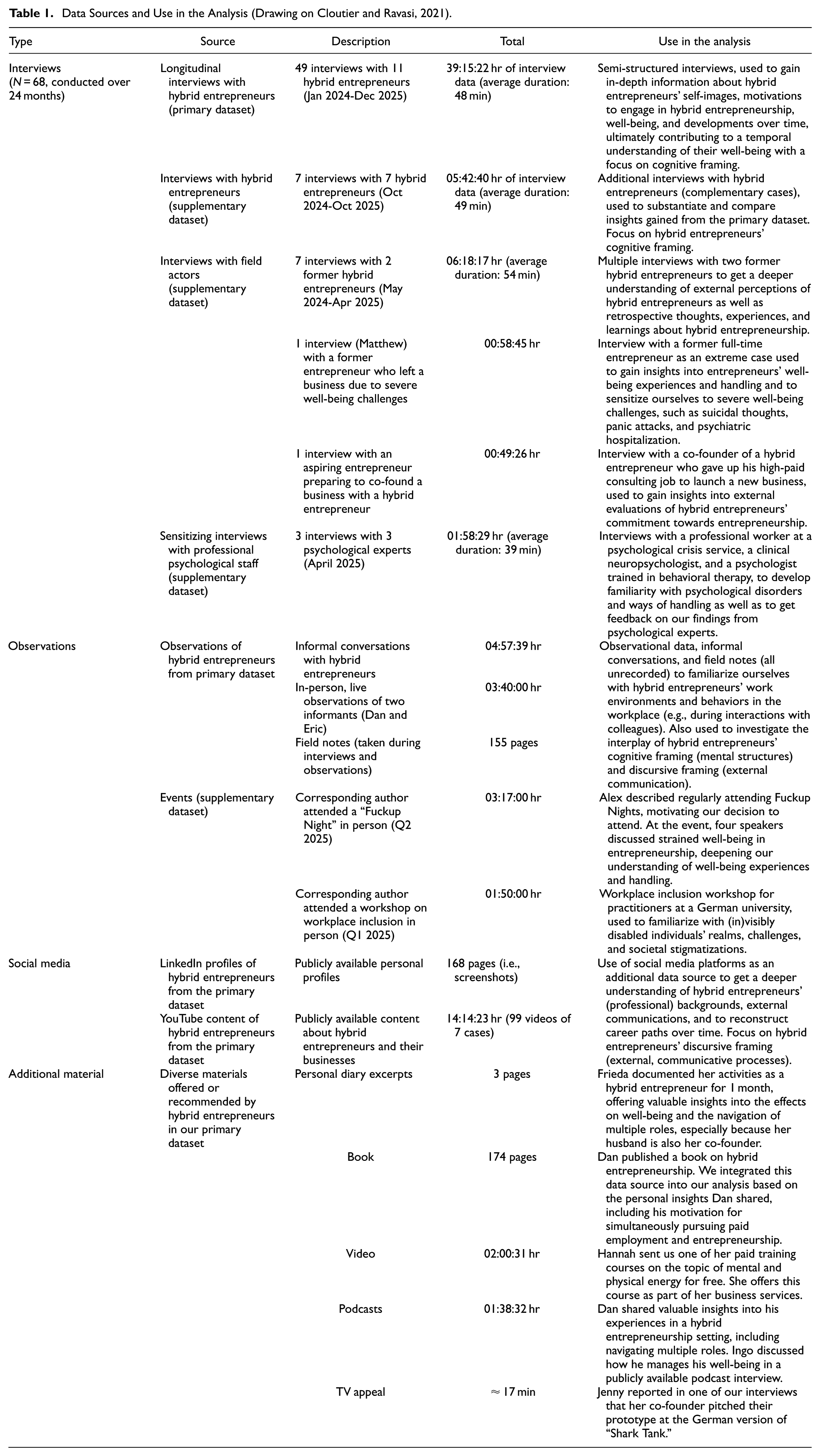
To develop a comprehensive understanding of hybrid entrepreneurs’ lived experiences, we combined and triangulated multiple data sources (Van Burg et al., 2020). Table 1 summarizes all data sources and their use in the analysis (Cloutier & Ravasi, 2021).
Data Sources and Use in the Analysis (Drawing on Cloutier and Ravasi, 2021).
Primary Dataset
Our primary dataset comprises 49 longitudinal interviews with 11 hybrid entrepreneurs (>39 hr), collected between January 2024 and December 2025. All 11 informants completed at least 3 interviews, with 7 completing four, 5 completing five, 3 completing six, and 1 completing 7 interviews. Because our study addresses highly personal and sensitive topics (e.g., burnout, depression, and even suicidal ideation), data collection required deep trust, confidentiality, and flexibility. Thus, we developed close, long-term relationships with our informants, scheduling interviews based on their availability and emotional readiness rather than adhering to fixed intervals. This flexible approach did not compromise comparability, as our analysis prioritized within-case trajectories and cross-case comparisons, focusing on the sequence of events rather than their precise timing. The corresponding author’s university ethics committee approved the project, and we assigned pseudonyms to ensure anonymity.
Taking an empathetic and flexible approach, we encouraged informants to speak openly about how they handled multiple roles, identity configurations, and well-being. Conversations lasted between 15 and 112 min (with an average duration of 48 min) and were transcribed in full. To ensure rigor and consistency, the first and second authors jointly collected 16% of interviews with hybrid entrepreneurs from our primary dataset. Interviews followed a semi-structured guide that struck a balance between openness to surface emergent insights and sufficient structure to facilitate reflective dialogue. See Table 2 for sample characteristics.
Sample Characteristics.
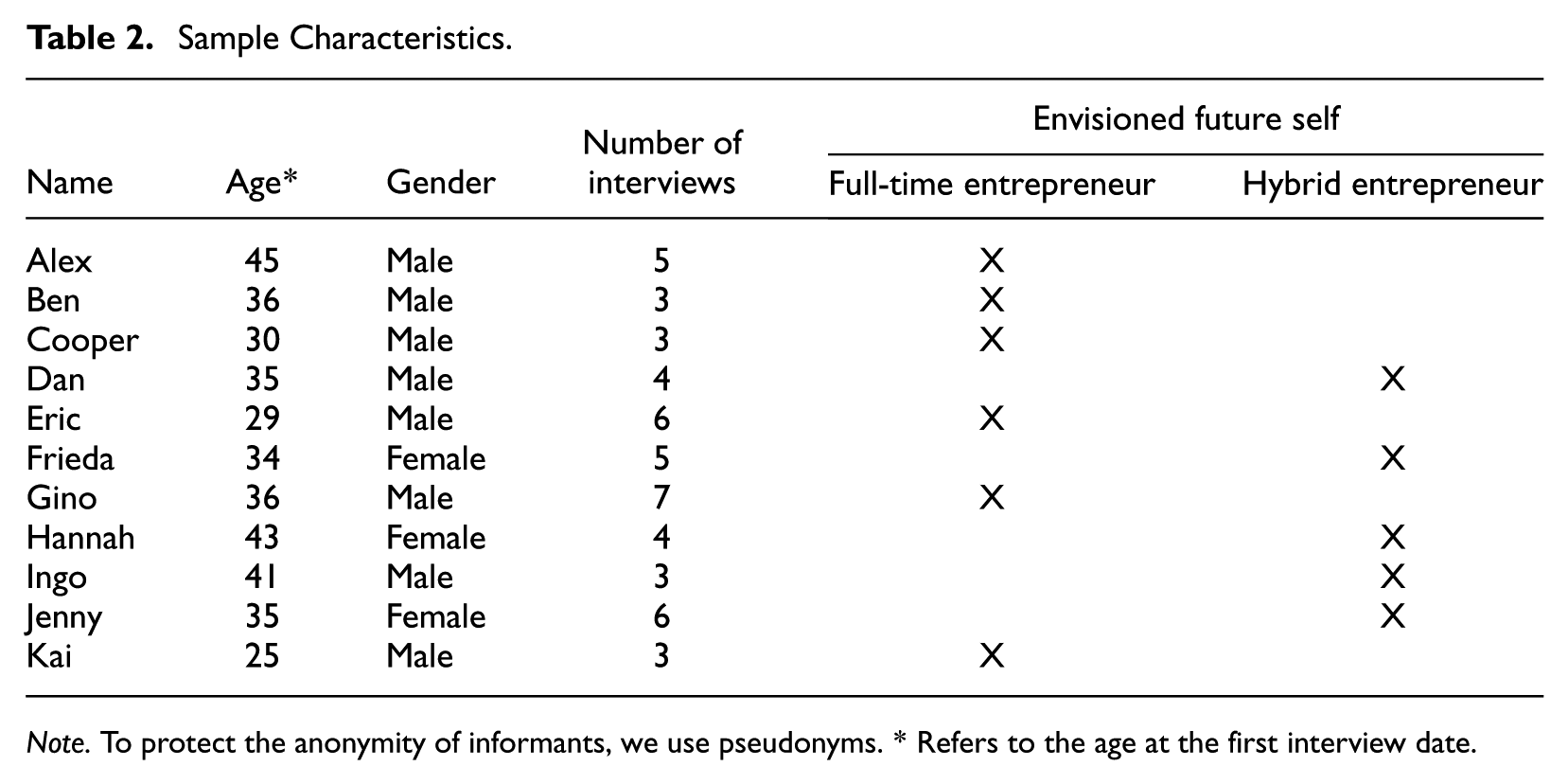
Note. To protect the anonymity of informants, we use pseudonyms. * Refers to the age at the first interview date.
To complement and deepen the insights generated through interviews, we collected multimodal data related to our 11 cases, aiming not only to mitigate retrospective distortion and social desirability bias but also to enhance the temporal granularity and contextual richness of our analysis. These materials—99 YouTube videos (>14 hr), 168 pages of LinkedIn screenshots, a Shark-Tank–style TV pitch (17 min), a training video (2 hr), two podcast episodes (>1.5 hr), a published book on hybrid entrepreneurship (174 pages), diary excerpts (3 pages), and 155 pages of field notes—allowed us to trace individuals’ experiences of hybrid entrepreneurship and well-being across multiple time points and settings. Triangulation with our interview data allowed for a more nuanced reconstruction of role identities and fluctuations in well-being over time. For example, Ingo’s podcast reflections on energy management added temporal depth and emotional nuance to his interview narrative. Frieda’s diary excerpts allowed access to daily fluctuations in well-being, underscoring the non-linearity of her well-being experiences in hybrid entrepreneurship. Hannah’s training video revealed how she presented herself as an entrepreneur and top manager at an IT company to external audiences, while a television pitch by Jenny’s co-founder reinforced that their business had been a high-growth endeavor. We also gathered observational data through >3.5 hr of workplace shadowing and ≈5 hr of informal conversations. Observations of two hybrid entrepreneurs in their paid employment settings revealed effects of overlapping roles in their daily lives (e.g., sleep deprivation).
Supplementary Dataset
We collected supplementary data to enhance our understanding of the strains on hybrid entrepreneurs’ well-being, validate and refine emerging insights from our primary dataset, and deepen our understanding of extreme cases. Seven one-time interviews with practicing hybrid entrepreneurs (>5.5 hr) served as replication checks, confirming that emerging themes extended beyond our primary dataset. We also conducted seven interviews with two former hybrid entrepreneurs and one interview with an aspiring entrepreneur who had worked with a hybrid co-founder (>7 hr). These retrospective accounts provided valuable insights into how the well-being of hybrid entrepreneurs persists or changes when transitioning into new career paths, offering contextual understanding of how hybrid entrepreneurship is perceived by outsiders, such as investors or co-founders, particularly regarding their perceived commitment to the business.
As an extreme case, we interviewed Matthew, a former full-time entrepreneur who was not part of our primary dataset but had experienced a severe mental health crisis, including burnout, psychiatric hospitalization, panic attacks, and suicidal ideation (≈1 hr). His narrative of a forced business exit sensitized our analysis to subtle early indicators of strained well-being. We also observed Mathew at a public event where he reflected on his experiences, recovery, and renewed entrepreneurial aspirations (>3 hr, Observation Q2 2025). This sensitizing perspective informed our interpretation of similar dynamics within our sample. For instance, Alex, a hybrid entrepreneur from our primary dataset, described regularly attending such events, which helped him process his past business failure (“this [event] is very therapeutic,” Alex).
To further deepen our engagement with the broader themes of well-being, inclusion, and disability, we attended an additional event for organizational practitioners that enriched our understanding of the experiences and challenges faced by individuals affected by mental or physical illnesses, including stigmatization and marginalization (≈2 hr, Observation Q1 2025). We also conducted three in-depth interviews with psychologists specializing in behavioral therapy, crisis intervention, and neurological rehabilitation (≈2 hr), who helped us interpret recurring patterns of burnout and depression and offered clinical perspectives.
Data Analysis
We analyzed our dataset following an abductive approach (Kreiner, 2016; Sætre & Van de Ven, 2021) and structured coding procedures (Gioia et al., 2013). From the outset, we moved iteratively between data and theory, using both data-driven and theory-informed codes (Kreiner, 2016). The resulting (four-step) process allowed us to interpret emerging patterns while remaining open to theoretical refinement.
Step 1: Within-Case Groundwork
We began by developing short, descriptive case summaries and timelines for all 11 hybrid entrepreneurs to gain an initial overview of their trajectories (Langley, 1999). Professional trajectories were reconstructed using interview transcripts, LinkedIn profiles, YouTube videos, and complementary observational and secondary materials, mapping entrepreneurial, employment, and private roles with particular attention to episodes of strain. As analysis and coding progressed, these materials were progressively enriched into interpretive case descriptions and timelines, producing thick accounts of within-case behavioral indicators (Geertz, 1973). The resulting case timelines and write-ups (Online Appendix III) also served as the basis for cross-case comparisons and conceptual model development (Step 4; Figure 1), thereby supporting alignment between theoretical claims and detailed empirical evidence.
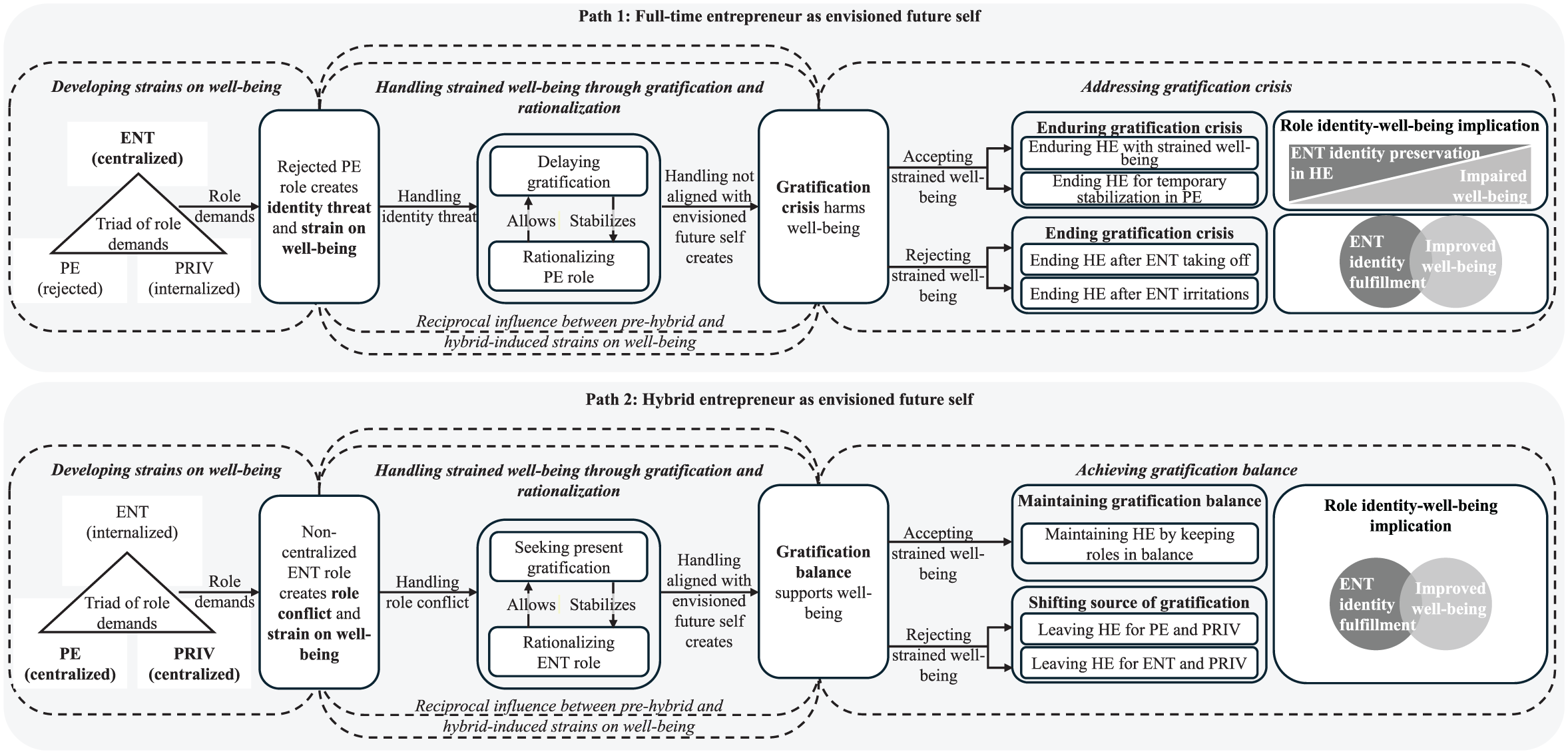
A model of hybrid entrepreneurs’ well-being.
Step 2: Coding Data on Experiences of Hybrid Entrepreneurship and Well-Being
To understand experiences of hybrid entrepreneurship and well-being, we conducted four iterative coding rounds, distinguishing first-order codes, second-order themes, and aggregate dimensions (Gioia et al., 2013; Kreiner, 2016). Coding schemes are provided in Online Appendix V.
In the first round, we focused on identifying strained well-being through interviews and complementary materials, including data from podcasts, diary excerpts, YouTube videos, and an observation (Observation Q2 2025). We captured subjective descriptions and behavioral cues of exhaustion and loss of control (e.g., quotes: “completely at the end of my rope,”“everything breaks away”), as well as role prioritization dynamics, reflected in first-order codes such as “prioritizing entrepreneurship” versus “deprioritizing entrepreneurship when role conflicts arise.” Integrating these codes with concepts from role identity theory (e.g., Bataille & Vough, 2022; George et al., 2023), we identified that strains on well-being were often related to whether informants centralized the entrepreneurship role or the roles of private and paid employment. We aggregated these insights into two second-order themes—“rejected paid employment role creates identity threat and strains on well-being” and “non-centralized entrepreneurship role creates role conflict and strains on well-being”—forming the aggregate dimension “developing strains on well-being.” We further distinguished subjective strain from clinical distress using the WHO’s ICD-11 (2024), validated through consultation with two medical professionals.
Building on the insight that role identity mattered, we coded how hybrid entrepreneurs described themselves. Some framed hybrid entrepreneurship as a temporary phase toward full-time entrepreneurship (e.g., “entrepreneurship is my main focus, it’s where I see myself in the future”), captured in the second-order theme “full-time entrepreneur as envisioned future self,” while others described it as a durable arrangement (e.g., “the hybrid setting is simply a very desirable model”), captured in the second-order theme “hybrid entrepreneur as envisioned future self.” This distinction led us to differentiate two paths of hybrid entrepreneurship (Path 1 and Path 2), refining the aggregate dimension “developing strains on well-being.”
Step 3: Coding Data on How Hybrid Entrepreneurs Handle Strained Well-Being
In a third round of coding, we analyzed how hybrid entrepreneurs in each path handled strained well-being, drawing on insights from interviews, podcasts, YouTube videos, and event observations (Observation Q2 2025, Q1 2025). We initially focused on concrete practices, often marked by temporal orientations, contrasting future-oriented statements (e.g., “postponing things into the future”) with present-focused ones (e.g., “just doing it right now”). This comparison revealed systematic differences across paths. Entrepreneurs envisioning full-time entrepreneurship (Path 1) repeatedly emphasized postponement, whereas those envisioning hybrid entrepreneurship as a long-term arrangement (Path 2) emphasized a present orientation. These patterns foregrounded gratification as a relevant concept in hybrid entrepreneurship. Drawing on Siegrist (1996, 2013), and noting that delayed gratification has only been tangentially addressed in entrepreneurship research (Lévesque & Stephan, 2020), we treated gratification (delayed vs. present) as an abductive finding and clustered codes into two second-order themes: “delaying gratification” (Path 1) and “seeking present gratification” (Path 2).
Beyond temporal orientation, this coding round also revealed how entrepreneurs’ rationalized their role configurations. In Path 1, statements such as “a great job,” articulated despite experienced identity threats, informed the second-order theme “rationalizing paid employment role.” In Path 2, statements such as “everything just fits right now,” articulated despite role conflict, informed the second-order theme “rationalizing entrepreneurship role.”
Importantly, through ongoing comparisons of codes on strains and their handling, we identified accounts in which strained well-being predated hybrid entrepreneurship and resurfaced during the hybrid phase, across paths. These patterns were captured in the second-order theme “reciprocal influence between pre-hybrid and hybrid-induced strains on well-being,” highlighting how earlier experiences of strain shaped informants’ interpretations and management of later challenges across both paths. Together, these three second-order themes per path—centered on gratification, rationalization, and the role of pre-hybrid strains—formed the aggregate dimension “handling strained well-being through gratification and rationalization.”
Further analysis showed that the consequences of these patterns diverged over time. In Path 1, additional quotes such as “paid employment pains me a lot” and “this moment of gratification never really came” indicated that repeated postponement accumulated into a crisis. By comparing emerging codes with case timelines and write-ups, we identified behavioral indicators of cumulative strain across cases. These interpretations were corroborated through interviews with three professional psychological staff members, two of whom independently emphasized the dynamics of a gratification crisis (Siegrist, 1996, 2013). This led to the second-order theme “gratification crisis harms well-being.” In contrast, Path 2 was characterized by statements such as “I only see a win-win,” which informed the second-order theme of “gratification balance supports well-being.” For both paths, these second-order themes further refined the aggregate dimension “handling strained well-being through gratification and rationalization.”
In a fourth round of coding, we examined how hybrid entrepreneurs addressed a gratification crisis (Path 1) or achieved a gratification balance (Path 2) by triangulating interview data with LinkedIn and YouTube content to reconstruct career trajectories and link envisioned future selves to behavioral indicators. For Path 1, two second-order themes captured responses to a gratification crisis. Some informants fulfilled their envisioned future self by transitioning to full-time entrepreneurship and reported improved well-being (e.g., “I now realize … what freedom really means”), which informed the second-order theme of “ending gratification crisis.” Others remained in hybrid entrepreneurship despite identity-threatening paid employment, captured in the second-order theme “enduring gratification crisis.” Together, these themes formed the aggregate dimension “addressing gratification crisis.” For Path 2, two second-order themes captured how informants sustained well-being. Continued satisfaction with the hybrid entrepreneurship setting (e.g., “I tend to live in the present”) informed the second-order theme of “maintaining gratification balance,” while shifting focus toward paid employment or private life (e.g., “[I] want to focus on other things again”) informed the second-order theme of “shifting source of gratification.” These themes formed the aggregate dimension, “achieving gratification balance.”
Step 4: Model Consolidation, Debrief Rounds, and Quality Measures
In a final, integrative interpretive step that draws together the coding from Steps 2 and 3, we developed a model that links role identities, gratification, and rationalization dynamics to well-being via two pathways—a gratification crisis and a gratification balance—shaped by envisioned future selves. Revisiting data from seven one-time interviews revealed no disconfirming evidence, and saturation was reached when no new codes or insights emerged during final interviews, recoding, or debriefs with hybrid entrepreneurs and psychologists (Saunders et al., 2018). Analytical rigor was ensured through independent coding by the first two authors, critical review by the remaining authors, and triangulation across interviews, supplementary data, and input from medical and psychological professionals (Flick, 2008).
Findings: A Model of Hybrid Entrepreneurs’ Well-Being
Our analysis reveals two distinct pathways shaped by the envisioned future selves of hybrid entrepreneurs. Those aiming for full-time entrepreneurship tend to experience hybrid entrepreneurship as temporary and constraining, often undermining their well-being, whereas those envisioning long-term hybrid arrangements view it as a way to achieve balance, yielding support for their well-being. Depending on these different experiences, they handle the effects on their well-being through distinct forms of gratification and rationalization.
Path 1: Full-time Entrepreneur as Envisioned Future Self
Path 1 comprises Alex, Ben, Cooper, Gino, Eric, and Kai, all of whom envisioned themselves as full-time entrepreneurs. Alex, Ben, Cooper, and Eric had already founded and exited businesses, whereas Gino, and Kai were still working on their first business. Despite these different trajectories, all primarily self-identified as entrepreneurs, motivated by the goal of transitioning to full-time entrepreneurship. As Eric put it: “I eventually see entrepreneurship as the main focus, where I see myself in the future. Now that I have the comparison between being a paid employee and being self-employed … I would definitely prefer being self-employed.”
They described hybrid entrepreneurship as temporary, a bridge toward their envisioned futures. It enabled them to sustain their self-images as entrepreneurs while remaining employed in paid positions. Cooper leveraged paid employment to develop his next business idea: “It took almost half a year to find this [business idea] … This is what my heart beats for … Then, it was clear to me that this [business idea] is it.” Ben similarly described paid employment as instrumental: “I almost treated it like a tool … like, okay, I need this to build the next step [full-time entrepreneurship].” These individuals reinforced their envisioned future selves by protecting time for their businesses. Yet, hybrid entrepreneurship also gave rise to role- and identity-related tensions that strained their well-being.
Developing Strains on Well-Being
Across cases, hybrid entrepreneurs described a triad of role demands—entrepreneurship, paid employment, and private life—that frequently clashed. The entrepreneurial role was consistently assigned the greatest importance, reflecting their aspirations to become full-time entrepreneurs. Alex explained, “I never gave up my self-image as an entrepreneur,” prioritizing it even when the business failed, “and then I also lost my family.” Gino similarly noted that his entrepreneurial success outweighed a relationship “that didn’t work out … things are going well for me professionally, and I think that’s a good pillar at the moment, also for being happy.” By contrast, paid employment was repeatedly rejected as part of their self-concept, creating an identity threat. As Alex put it: “My self-concept was that of a self-employed individual.” Cooper likened himself to an intrapreneur, acting “very autonomously” in his paid employment job. Individuals on Path 1 did not internalize their roles as paid employees.
These individuals also experienced persistent strains on their well-being as they subordinated their private lives and health to the demands of entrepreneurship. Eric provided an example: “On vacation … I did a night shift to deliver some input on the project.” Gino described feeling “completely at the end of my rope” and “even breaking out in tears at an event.” Kai described how opportunities displaced other roles: “I have little time for other things … when I see [entrepreneurial] opportunities, I ask how I can free up time for that.” Alex reflected on the broader costs: “When you subordinate everything to entrepreneurship, everything breaks away.” Cooper summarized the effects on well-being succinctly: “When work comes first and then health second, it is clear what happens.”
The implications could be severe. Alex admitted, “I prioritized my business above everything else. And when things do not go well, you have nothing left.” Cooper likened entrepreneurship to an addictive high: “Like extreme sports …, stress and adrenaline make you feel numb.” Daily sacrifices at the cost of their own well-being were commonly reported. Eric explained, “If I make cuts, then I make them at myself … with sports or sleep deprivation.” Across cases, prioritizing the entrepreneurial role while rejecting paid employment and deprioritizing private life generated tensions that strained their well-being, highlighting the costs of hybrid entrepreneurship under competing role and identity demands. When informants experienced such strains, they sought ways to handle them.
Handling Strained Well-Being Through Gratification and Rationalization
Despite ongoing strains, informants did not abandon their ambitions to become entrepreneurs. Instead, they delayed gratification tied to their envisioned future selves and rationalized the necessity of paid employment, thereby maintaining a central entrepreneurial identity under hybrid conditions.
Delaying gratification meant accepting sacrifices in the present in anticipation of future rewards. Kai described it as focusing on “the picture you are painting of the future, to reach your goals.” Alex described how he constantly deferred fulfillment to the next milestone: “I always thought I just had to go there and there … but this moment of gratification never really came.” Even after failing, he delayed gratification by focusing on “repay[ing] my debts … [to] achieve a financially secure future. But I know that my chosen path does not guarantee such gratification.” Ben likewise stressed clarity of direction: “I know what I want [entrepreneurship], or I know what I do not want [paid employment]”; yet he still postponed his ambitions: “my goal is to become an entrepreneur … but that will come later.” Temporal anchoring thus preserved their entrepreneurial self-image despite their strained well-being.
Informants also rationalized paid employment as purposeful rather than constraining. Ben reframed depression as resilience: “What doesn’t kill you makes you stronger.” Alex deliberately worked in a field unrelated to his business (“At the moment, I am a bicycle courier … my head is completely free, a great job”), described himself as a “former entrepreneur on sabbatical,” and reframed paid employment as a “health and well-being career break” (LinkedIn). Others sought closer alignment between roles. Cooper explained, “Generally, my tasks [in paid employment] are similar to those [as an entrepreneur].” Eric framed his doctorate as both a means of employment and an investment in his future, calling hybrid entrepreneurship “a means to an end,” sustained by “a deeper belief … that things can be changed for the better” (private message, WhatsApp). While such rationalizations temporarily stabilized their situations by casting paid employment as instrumental to entrepreneurship, delaying gratification ultimately intensified strains on their well-being.
Paid employment repeatedly blocked progress toward full-time entrepreneurship, widening the gap between their envisioned future selves and present realities. Constantly delaying gratification produced what Siegrist (1996, 2013) termed gratification crises, as future selves remained uncertain and out of reach. Kai captured this loss of optimism amid repeated setbacks: “when you keep getting bad news … you start to lose sight of that light at the end of the tunnel … you start asking yourself … does this still make sense?”
Ben represented an extreme case. After returning to a high-paying job, he experienced paid employment as a “golden cage … like a prison.” Continued postponement of his entrepreneurial identity coincided with depression and suicidal ideation: “It took a relatively long time to get out of this depression, until I realized what the problem was [i.e., paid employment].” During his commute, he pulled off the highway because “being there [at his employer] … made no sense … I knew what was coming afterward [full-time entrepreneurship].”
Notably, not all strains of hybrid entrepreneurship originated in this context. For some, earlier mental health challenges resurfaced for hybrid entrepreneurs. Alex explained, “Five years ago, I had a burnout … I still carry emotional ballast,” noting that shifting toward self-employment reactivated “anxieties,” creating a need to “dismantle my emotional legacy.” Similarly, Cooper described how earlier struggles with stress and self-worth intensified, whereas Ben’s distress emerged when returning to full-time employment: “I couldn’t find my place anymore.” Hybrid entrepreneurship can thus generate and reactivate strains on well-being when delayed gratification no longer sustains the envisioned future self.
Addressing Gratification Crisis
These entrepreneurs addressed gratification crises in hybrid entrepreneurship either by enduring ongoing strains on well-being or by rejecting further strains and ending the crises. Alex remained caught in a cycle, accepting strained well-being as an inherent aspect of hybrid entrepreneurship. Although he rationalized paid employment, he was determined to leave his position: “I know the pain of paid employment very well.” For him, strain was a regular feature of hybrid entrepreneurship, reinforced by attending Fuckup Nights where failure is normalized (Observation Q2 2025). Cooper sought temporary relief by changing his job status. After preparing for full-time entrepreneurship and experiencing business failure and burnout, he returned to paid employment, framing it as restorative and a way to endure ongoing strains on his well-being: “Entrepreneurship is pure chaos and stress … I must calm my nervous system … this is exactly what I need.” Ben, Gino, and Kai exited hybrid entrepreneurship by realizing their envisioned future selves. Ben quit paid employment and launched his business: “The business plan for my new business is ready now … this was always the plan.” He contrasted prior exhaustion (“I was really at the end of my rope … I can’t keep this up much longer;”) with relief: “Really, the time I’m experiencing now is truly a great time.” Leaving paid employment ended their gratification crises. Finally, some hybrid entrepreneurs reconsidered their envisioned future selves. Eric, who had long been committed to entrepreneurship, reconsidered his pursuits after getting married, starting a family, and enduring a cofounder dispute: “For me, it’s more like a chapter … coming to an end.” By attempting to redirect gratification toward his private life, he rejected further strains on his well-being, thereby ending the gratification crisis.
Path 2: Hybrid Entrepreneur as Envisioned Future Self
Path 2 reflects the experiences of Dan, Frieda, Hannah, Ingo, and Jenny, who envisioned hybrid entrepreneurship as a long-term future. Except for Frieda, all of them founded multiple businesses. For them, hybrid entrepreneurship was not a temporary compromise, but an envisioned future self, one that combined security with opportunities for growth and expression. Hannah explained: “I started with the ulterior motive of doing something on the side … and ever since, I run this business in parallel.” A shared theme was feeling underutilized as paid employees, which they counterbalanced through entrepreneurial activities. Dan emphasized, “I think I get much self-efficacy from my venture.”
Security remained paramount. Frieda noted, “When you’re self-employed, you’re always on. In our current life situation, a permanent position [paid employment] just has advantages.” She even described her business as “more of a hobby”. Others accepted slower growth, focusing on freelance work or lifestyle businesses that felt sustainable. As Dan put it: “For me, entrepreneurship is like a PlayStation game. I can turn it on whenever I want … I don’t know if I’d like to make it for a living because then it gets stressful.” Frieda added, “Becoming a full-time entrepreneur is a clear no for me … we can live a good life [from paid employment], so I don’t see why I should spend twice the time to earn the money on my own.”
Developing Strains on Well-Being
These entrepreneurs internalized multiple roles, with entrepreneurship remaining secondary to self-definition. Dan explained, “I do not define myself through this [entrepreneurship].” Ingo emphasized that although he saw himself as “an entrepreneur in thinking and doing, … my identity is not failed because of [a failed business].” By contrast, paid employment and their private lives (including care for their own well-being) were central. Frieda explained, “As long as there’s energy, I do something, and when the energy is gone, it’s gone… I just need my breaks.” Dan stressed the importance of recuperation: “You have to take and find your breaks every now and then.” For others, family anchored identity. For example, Dan frequently mentioned his daughters during interviews and observations.
Hybrid entrepreneurship created conflicting role demands across domains, with the non-centralized entrepreneurial role often clashing with central, paid employment, and private roles. Frieda described how administrative obligations in her business had created lingering anxiety: “I woke up in the middle of the night, thinking, ‘Oh god, I must do something’… even after everything was resolved.” She contrasted how setbacks in entrepreneurship weighed more heavily than routine problems at work: “Things that go wrong in my self-employment influence me a lot more.” Jenny also highlighted tensions, pointing to constant investor inquiries, tax obligations, and the weight of her regular job duties as sources of strain. Paid employment often left her too exhausted to tackle entrepreneurial tasks, which she repeatedly postponed: “Knowing full well I won’t be able to finish it that evening … that often leads to things getting postponed … that’s kind of annoying and stressful.”
These cases show that strains on well-being stemmed from conflicts between a non-central entrepreneurial role and central paid employment and private roles, manifesting in psychological (e.g., stress, sleeplessness) and physiological symptoms (e.g., digestive issues). Although entrepreneurship provided a meaningful outlet, its lower priority generated ongoing friction that eroded well-being. Informants handled these strains in distinct ways.
Handling Strained Well-Being Through Gratification and Rationalization
Informants responded to strained well-being by: (a) seeking present gratification from paid employment and from their private lives, and (b) rationalizing the entrepreneurial role as secondary. Shifting their attention away from long-term entrepreneurial ambitions, they found fulfillment in everyday routines, family, and secure paid employment. Frieda, a mother of two young kids, emphasized the grounding effect of family life: “It’s really beautiful to see how my kids grow up … I’m happy in my marriage, with my kids, my family, my friends. I really have nothing to complain about … everything just fits right now.” Dan described paid employment as a safety net that ensured financial security while allowing him to pursue entrepreneurship part-time. In this way, gratification from private life and paid employment buffered entrepreneurial stress, reinforcing the prioritization of stability.
To sustain hybridity, informants rationalized entrepreneurship as a complementary, non-identity-threatening role. Frieda explained, “Self-employment is less important for me … [than] paid employment and my private [life].” Ingo similarly cast paid employment as the basis for stability while entrepreneurship provided self-fulfillment: “Employment is what you do for your basic income … but in my self-employment, I find happiness beyond the family.” They also described distancing themselves from the self-worth associated with entrepreneurship. Ingo noted, “If you detach the concept of identity from roles, it simply creates more freedom and flexibility.” Frieda echoed this holistic stance: “I don’t define myself through any one role … it all belongs together, and all of it matters.”
Taken together, these accounts show that when informants experienced strained well-being, they deprioritized their commitments to entrepreneurship. By seeking present gratification in paid employment and private roles, and by reframing entrepreneurship as a secondary pursuit, they perceived hybrid entrepreneurship as supporting their well-being. For these hybrid entrepreneurs, paid employment functioned as a stabilizing anchor rather than a barrier, with most strains on well-being stemming from entrepreneurial demands. Hybrid entrepreneurship was experienced as energizing rather than paralyzing. As Dan explained, it offered both independence and security: “I have this self-built backbone … and that is what is extremely awesome in this hybrid mode. I only see a win-win.” While time and resource pressures occasionally caused insomnia or stomachaches, such strains were mitigated by the present gratification derived from paid employment and private life. Frieda emphasized this stability: “Financially, we are in a good situation. Somehow, everything is great at the moment.” These sources of meaning helped sustain the hybrid entrepreneurship setting.
Entrepreneurship and paid employment were often framed as complementary. Dan noted, “The more successful I became with my side ventures, the freer I became [in paid employment].” He also recognized the path dependency of stable income, as leaving employment would require doubling entrepreneurial earnings and accepting greater risk: “For me, this was never an option.” Ingo similarly emphasized, “I do not perceive a huge identity conflict.” Although entrepreneurial demands produced strains, they were counterbalanced by the present gratification derived from employment stability and private life.
Some strains on these entrepreneurs’ well-being predated hybrid entrepreneurship but resurfaced within it, indicating reciprocal effects. Dan linked panic attacks in corporate life to earlier trauma: “Everything you go through in life becomes a package, just like a sober alcoholic.” Earlier disruptions, such as Dan’s father’s suicide attempt or Ingo’s failed business, shaped their desire to combine entrepreneurship with employment-based security.
Overall, these hybrid entrepreneurs achieved gratification balance by deriving present gratification from both paid employment and their personal lives and treating entrepreneurship as a valued supplement. Unlike Path 1, where entrepreneurship intensified identity conflict and gratification crises, they managed competing demands in ways that preserved well-being and reinforced hybrid entrepreneurship as a desirable arrangement.
Achieving Gratification Balance
Hybrid entrepreneurs achieved gratification balance in three distinct ways, depending on how they interpreted the strains on their well-being and satisfaction across roles and life domains. Dan, Frieda, and Ingo derived present gratification from paid employment and from their private lives. These central roles provided stability and buffered strains on well-being, allowing entrepreneurship to remain a contained, secondary outlet that did not interfere with work or family commitments. Jenny closed her business because entrepreneurship had become a source of stress due to investor pressure, administrative demands, and tax obligations that conflicted with her personal priorities, including paid employment and family responsibilities. She viewed ending the business as a means of restoring balance, rather than as a failure of identity. Hannah redefined her envisioned self and shifted her source of gratification. After a demanding corporate career, she found full-time entrepreneurship more autonomous and satisfying than either paid employment or a hybrid arrangement. Having accumulated sufficient financial security, Hannah transitioned fully to entrepreneurship: “Being a hybrid entrepreneur is a part of my life, but it’s now in the past.” Taken together, these cases demonstrate that enduring, exiting, or redefining hybrid entrepreneurship were deliberate ways for achieving a gratification balance, shaped by how they interpreted strains on their well-being.
General Discussion
Our qualitative, longitudinal study reveals how individuals experience hybrid entrepreneurship and handle strains on their well-being. We have demonstrated that envisioned future selves (full-time entrepreneurs versus hybrid entrepreneurs) shape whether and how entrepreneurs experience identity threats or role conflicts, and how they handle strained well-being through delayed versus present gratification, as well as by rationalizing non-central roles.
Theoretical Contributions
Role Identity and Well-Being in Hybrid Entrepreneurship
Recent research suggests that identity structures and role transitions impact hybrid entrepreneurs’ experiences (Bousfiha & Berglund, 2025; Fenters et al., 2025). Other studies have focused on well-being in hybrid entrepreneurship settings (Ardianti et al., 2022; Kuske et al., 2025). Yet these streams remain largely separate (Anglin et al., 2022; Strauss et al., 2025). Bringing these concepts together, we have theorized how role internalization, identity centrality (Stryker & Serpe, 1994), and envisioned future selves (Ibarra, 1999; Markus & Nurius, 1986; Strauss et al., 2025) influence how individuals experience hybrid entrepreneurship and handle strained well-being. Across our 11 cases, hybrid entrepreneurs who centralized the entrepreneurial role and envisioned themselves as full-time entrepreneurs often experienced paid employment as a threat to their identity. Over time, the misalignment between the present and envisioned selves accumulated into a gratification crisis, marked by sustained effort and insufficient rewards (Siegrist, 1996, 2013). In contrast, those who internalized multiple roles primarily experienced strains on well-being rooted in role conflict (e.g., time pressure) rather than identity misalignment. Furthermore, identity-related misalignments were predominantly associated with more enduring, psychological strains (e.g., depressive symptoms, panic attacks), whereas role-related conflicts were more often linked to episodic physical strains (e.g., stomachaches, sleep problems). This distinction clarifies how the well-being of hybrid entrepreneurs differs from job-lock strain (Fisher et al., 2016): rather than an external constraint, strained well-being emerges from internally negotiated tensions among central, peripheral, and rejected role identities.
Our findings explain why structurally similar hybrid arrangements yield divergent effects on well-being. We integrate external role demands (Kappe et al., 2025; Kuske et al., 2025) with internal identity dynamics (Bataille & Vough, 2022; Ramarajan, 2014), showing how envisioned future selves function as long-term identity anchors. Our model’s first path corresponds with Fenters et al.’s (2025) hierarchical identity structure, in which a centralized entrepreneurial identity dominates the intrapersonal network, generating identity threats and strains resulting from role rejection. Our model’s second path corresponds with an integrative structure, characterized by overlapping, non-hierarchical identities to maintain coherence across roles. Extending Fenters et al.’s (2025) account of identity threat resolution, we highlight the paradox of sustaining a rejected role, as entrepreneurs aspiring to full-time entrepreneurship (Path 1) simultaneously maintain and seek to disentangle themselves from the paid employment role, thereby intensifying strains on their well-being over time.
Gratification and Rationalization as Ways to Handle Strains on Well-Being
Our second contribution introduces the concepts of gratification (delayed vs. present) and rationalization of non-central roles as ways in which hybrid entrepreneurs dynamically handle strains on their well-being, shaped by their envisioned future selves. Our findings suggest well-being cannot be understood by identity centrality alone but depends on how individuals navigate the tensions between present and delayed gratification. Gratification has received limited attention in entrepreneurship research, with Lévesque and Stephan (2020) being a rare exception. Building on and extending this work, we integrate Siegrist’s (1996, 2013) theory of effort-reward imbalance into the study of hybrid entrepreneurship and its relationship with well-being.
In hybrid entrepreneurship, delayed gratification involves maintaining paid employment and accepting strains in other roles to sustain a commitment to an entrepreneurial future self, which can become draining when the hybrid entrepreneurship setting prolongs effort without enabling a transition. Present gratification involves rebalancing paid employment, entrepreneurship, and private life to stabilize well-being, often by limiting entrepreneurial effort or prioritizing paid employment or family demands. Present gratification thus supports well-being when hybrid entrepreneurship is envisioned as a lasting arrangement. Conversely, delayed gratification becomes straining when sustained effort fails to yield entrepreneurial progress. These dynamics produce cyclical recalibrations of role internalization, identity centrality, and well-being over time.
Our findings on gratification and rationalization extend prior work on how hybrid entrepreneurs navigate multiple roles. Focusing on micro-role transitions and professional identity construction, Bousfiha and Berglund (2025) documented how academic hybrid entrepreneurs perceived paid employment as beneficial for their start-ups and vice versa. We observed similar rationalizing practices among hybrid entrepreneurs in our study. For example, Dan and Ingo (non-academic hybrid entrepreneurs) perceived intrapreneurial tasks they performed as paid employees to be beneficial for their start-ups. In contrast, Eric and Gino (academic hybrid entrepreneurs) experienced identity threats because they rejected the paid employment role. We have demonstrated how the alignment (or lack thereof) between short-term practices for handling strained well-being and hybrid entrepreneurs’ long-term identity orientations helps them achieve balance (or creates additional strains). Whereas Strauss et al. (2025) showed that complementarity among multiple future selves can be energizing, they did not address potentially straining effects. Our findings suggest that complementarity depends on gratification orientation: present gratification stabilizes well-being, whereas delayed gratification becomes draining when anticipated futures fail to materialize. This is a salient dynamic in hybrid entrepreneurship, where multiple future selves can be temporarily complementary yet increasingly conflicting over time.
Hybrid Entrepreneurs’ Well-Being is a Dynamic Process
Our third contribution reframes hybrid entrepreneurs’ well-being as a dynamic process of becoming rather than a static outcome. Previous research on hybrid entrepreneurs’ well-being has often relied on quantitative, static research designs, using either comparative sub-sample approaches (e.g., Asante et al., 2022) or survey models that link role dynamics to well-being outcomes (e.g., Kappe et al., 2025).
Our findings indicate that well-being in hybrid entrepreneurship is continually in flux, shaped by ongoing negotiations of role identity, gratification, and rationalization, depending on hybrid entrepreneurs’ envisioned future selves. This perspective foregrounds temporality and contingency, suggesting that well-being cannot be reduced to an outcome variable but unfolds through recursive processes of role navigation and identity configuration, in line with calls for more dynamic perspectives on role transitions (McClean et al., 2025). Our findings suggest that well-being is not downstream from role decisions, but constitutes the terrain on which hybrid entrepreneurship unfolds, as individuals oscillate between stabilization and strain. This view aligns with a strong process ontology that rejects linear input–output models and treats outcomes as provisional stabilizations within ongoing flows of becoming (Hernes, 2014; Tsoukas & Chia, 2002). From this perspective, gratification crises and balances are not static outcomes but temporary phases in a recursive process in which well-being fluctuates as role configurations and aspirations shift.
Recent scholarship in career and human resource management reinforces this view. Ibarra et al. (2025, p. 18.21) showed that transitions involve the interplay of “multiple identities—professional, nonwork, lingering, and future possible selves,” rather than discrete identity switches. Complementing this perspective, Matej and Amadeja (2025) theorized employment multiplicity as a defining feature of contemporary work, in which individuals increasingly operate across multiple roles, contracts, and organizational contexts. Such multiplicity weakens traditional organizational identity anchors and gives rise to identity fragmentation, as coherence is no longer institutionally provided, but must be actively assembled across shifting arrangements. These dynamics are particularly salient for hybrid entrepreneurs, whose well-being depends on navigating overlapping employment logics and fragmented identity cues, requiring ongoing adjustment rather than stable identity resolution.
Practical Implications, Limitations, and Future Research Opportunities
Our findings provide practical guidance for hybrid entrepreneurs and those who support them. Hybrid entrepreneurs can benefit from reflecting on their envisioned future selves: Do they aspire to full-time entrepreneurship or long-term hybrid arrangements? This distinction helps anticipate typical challenges, such as identity threats from rejecting paid employment or role conflicts from balancing multiple roles. Such awareness supports early recognition of strained well-being (e.g., persistent exhaustion, sleep disruption, feeling trapped) and informed decisions about continuing to delay gratification, adjusting workloads, renegotiating employment arrangements, or redefining identity priorities. For mentors, incubators, and accelerators, our findings provide a diagnostic lens for understanding the well-being dynamics underlying hybrid arrangements. Rather than viewing hybrid entrepreneurship as a weak commitment, support actors can help hybrid entrepreneurs on Path 1 reassess time horizons or exit strategies, and reinforce realistic growth expectations and protected recovery time for hybrid entrepreneurs on Path 2.
This study also has limitations that provide opportunities for future research. Interview timing varied due to availability and periods of acute strain, resulting in differences in the empirical depth across cases. In addition, our findings are situated within the German institutional context, where hybrid entrepreneurship is facilitated by employer flexibility (e.g., part-time work arrangements, sabbaticals, and frequent job transitions) and access to financial buffers. These factors, along with other cultural or institutional characteristics, restrict cross-context generalizability. We also recognize that retrospective sensemaking introduces potential recall bias and limits causal inference, particularly when strains on well-being predate hybrid entrepreneurship or reflect broader personal or medical factors.
Individual-level differences may also affect our findings and limit their generalizability. Differences in entrepreneurial experience (e.g., first-time versus serial founders; transitions between full-time and hybrid entrepreneurship) may shape effects on well-being. We focused on hybrid entrepreneurs aged 25 to 45 who operated businesses with moderate scaling or funding ambitions during our data collection period. Age, parenthood status, prior founding experience, and past business failure did not appear to be associated with systematic patterns. However, given our qualitative approach, we cannot rule out that such factors serve as boundary conditions. Importantly, gender may moderate the identified processes, as female entrepreneurs were exclusively represented in our model’s second path. To address these limitations, we encourage future research to investigate the interplay between psychological and physiological well-being (Bhullar et al., 2013) and to explore potential gender differences. Venture type and funding ambitions may be additional boundary conditions to explore in future research. Finally, we call for additional research employing longitudinal or experience-sampling designs to test and extend our process model across career and role identity transitions.
Supplemental Material
sj-pdf-1-etp-10.1177_10422587261419463 – Supplemental material for Perceived Pain or Gain: Role Identity, Gratification, and the Well-Being of Hybrid Entrepreneurs
Supplemental material, sj-pdf-1-etp-10.1177_10422587261419463 for Perceived Pain or Gain: Role Identity, Gratification, and the Well-Being of Hybrid Entrepreneurs by Nadine Albrecht, Pauline Charlotte Reinecke, Matthias Baum, Rodrigo Isidor and Monique Ingrid Boddington in Entrepreneurship Theory and Practice
Footnotes
Acknowledgements
We thank our journal editor, Moren Lévesque, and three anonymous reviewers for their constructive and developmental feedback. We appreciate the insightful comments received from participants at the 2025 Babson College Entrepreneurship Research Conference and the 2025 Academy of Management Annual Meeting.
Declaration of Conflicting Interests
The authors declared no potential conflicts of interest with respect to the research, authorship, and/or publication of this article.
Funding
The authors received no financial support for the research, authorship, and/or publication of this article.
Ethical Approval
Given the sensitive nature of our study (interviews included sensitive topics such as depression, suicidal ideation, panic attacks, and burnout), we sought and received approval from the University of Bayreuth’s ethics committee after a thorough review. Ethical recommendations are implemented.
ORCID iDs

Data Availability Statement
The study is based on confidential qualitative interviews conducted under strict privacy agreements. In line with ethical guidelines, interview data is not available to be shared publicly.
Supplemental Material
Supplemental material for this article is available online.