



Abstract
Current theorizing on learning during hybrid entrepreneurship is limited in explaining the circumstances under which entrepreneurs’ well-being benefits from a preceding phase in hybrid entrepreneurship. Using existing theory on entrepreneurial learning and role conflict, we argue that interfering demands from roles outside entrepreneurship constrain hybrid entrepreneurs’ ability to transform experiences into skills that protect their well-being when they enter full entrepreneurship. Moreover, we argue that interfering role demands affect female and male hybrid entrepreneurs differently. We test the hypotheses using panel data. Our study contributes to entrepreneurship research on hybrid entrepreneurship, well-being, role conflict, and gender differences.
Introduction
As entrepreneurship has the potential to benefit individuals, the economy, and wider society, explaining its outcomes, such as performance, innovation, or job creation, is at the core of entrepreneurship research (Shepherd et al., 2019). Recently, entrepreneurs’ well-being, defined as their mental state of feeling well and functioning effectively (Ryan & Deci, 2001), has emerged as an increasingly relevant outcome of entrepreneurship (U. Stephan et al., 2023; Wiklund et al., 2019). Reaching high levels of well-being through entrepreneurial work is not only a desirable outcome of the work itself but also benefits entrepreneurs’ health and their individual and business performance (e.g., U. Stephan, 2018; U. Stephan et al., 2023). Given these far-reaching consequences, entrepreneurship research needs to consider environments that allow entrepreneurs to learn skills that protect their well-being.
Hybrid entrepreneurship is a unique environment for individuals to learn before committing to entrepreneurship fully (Folta et al., 2010). That is, by starting a new business while keeping their wage-job, hybrid entrepreneurs can learn from experiencing entrepreneurial work and reduce entrepreneurship-related uncertainty before switching to full entrepreneurship (Benitez et al., 2023; Ferreira, 2020; Folta et al., 2010). Raffiee and Feng (2014) draw on this theorizing to suggest that businesses that were initially founded by hybrid entrepreneurs survive longer than businesses founded by individuals who directly gave up their wage-job to enter full entrepreneurship (i.e., direct entrants). Thus, following prior theorizing that hybrid entrepreneurship provides an environment to learn, one could argue that hybrid entrepreneurs can also learn skills during hybrid entrepreneurship that protect their well-being in subsequent full entrepreneurship.
However, insights from two relevant literature streams suggest that learning during hybrid entrepreneurship may be more complex than previously acknowledged. We know from entrepreneurial learning theory that learning from experiences does not happen automatically but requires entrepreneurs’ ability to transform experiences into skills (Funken et al., 2020; Politis, 2005; Winkler et al., 2021). Moreover, we know from the role conflict literature that interfering role demands can constrain individuals’ ability to fulfill their role as entrepreneurs (Anglin et al., 2022; Hsu et al., 2016; Nambisan & Baron, 2021), which is particularly relevant to hybrid entrepreneurs who fulfill multiple roles (Carr et al., 2023). However, current theorizing on learning during hybrid entrepreneurship rarely takes these complexities into account and therefore explains only partially the circumstances under which entrepreneurs’ well-being in full entrepreneurship benefits from a preceding phase in hybrid entrepreneurship.
To fill this gap in the literature, we engage in theory elaboration (Fisher & Aguinis, 2017). That is, we use existing knowledge from entrepreneurial learning theory and role conflict theory to refine current theorizing on learning during hybrid entrepreneurship (Folta et al., 2010; Raffiee & Feng, 2014). In doing so, we examine whether demands from roles outside entrepreneurship moderate the relationship between a preceding phase in hybrid entrepreneurship (t − 1) and entrepreneurs’ well-being in subsequent full entrepreneurship (t). We argue that interfering role demands from hybrid entrepreneurs’ wage-jobs and private lives constrain their ability to transform their experiences of running their own business and coping with feeling stressed into skills that protect their well-being in full entrepreneurship. Regarding their wage-jobs, we focus on rigid hours in the wage-job as demands that constrain hybrid entrepreneurs’ ability to transform experiences into skills by creating tension and limiting control over how many hours they work in their wage-jobs. Regarding the demands from hybrid entrepreneurs’ private lives, we focus on the unpredictability and burden of caring responsibilities that constrain their ability to transform experiences into skills. Finally, research on work–family conflict in entrepreneurship suggests that the interference of role demands depends on individuals’ role salience, which is often related to traditional gender norms (Ahl, 2006; Bem, 1981; Hsu et al., 2016). Consistent with this literature, we argue that the moderating effect of rigid hours in the wage-job particularly applies to male hybrid entrepreneurs, while the moderating effect of caring responsibilities particularly applies to female hybrid entrepreneurs.
To assess our hypotheses empirically, we draw on data from the United Kingdom Household Longitudinal Survey Understanding Society, which provides information on households annually from 1991 until 2019. This panel dataset contains data on individuals’ well-being and employment spells, including individuals’ employment in their main job and any second jobs. In addition to applying weights generated by Coarsened Exact Matching (CEM) in our linear regression analyses, we apply a Heckman Selection Model in a robustness check to address potential selection effects. Moreover, we test the robustness of our results when using entrepreneurs’ strain and life satisfaction as alternative measures of well-being. We also assess the wider implications of our argumentation by employing an individual fixed-effects panel estimator in a post hoc test.
By elaborating on current theorizing on learning during hybrid entrepreneurship, our study contributes to entrepreneurship research in three ways. First, we contribute to the conversation on outcomes of hybrid entrepreneurship (Folta et al., 2010; Raffiee & Feng, 2014). We refine the perspective of hybrid entrepreneurship as a mainly beneficial learning environment (Folta et al., 2010; Raffiee & Feng, 2014) by untangling the underlying learning mechanism and by accounting for the interference of role demands from hybrid entrepreneurs’ wage-jobs and private lives (Campion et al., 2020; Greenhaus & Beutell, 1985; Hsu et al., 2016). In doing so, we highlight the need for hybrid entrepreneurship research to take into account the heterogeneity of hybrid entrepreneurs’ role demands when examining the impact of a preceding phase in hybrid entrepreneurship on entrepreneurial outcomes. Moreover, by introducing circumstances outside entrepreneurship as learning constraints, our study may help to explain why prior research does not find that individuals’ cognitive ability strengthens the relationship between hybrid entrepreneurship and subsequent business survival (Raffiee & Feng, 2014).
Second, we contribute to the growing literature on entrepreneurs’ well-being (U. Stephan, 2018; U. Stephan et al., 2023) by considering the relationship between a preceding phase in hybrid entrepreneurship and entrepreneurs’ well-being in subsequent full entrepreneurship. Thus, we expand Shir and Ryff’s (2021) dynamic perspective on the interdependencies between entrepreneurs’ actions and their well-being across time. While Shir and Ryff (2021) argue in their conceptual study that entrepreneurs’ well-being affects their current and subsequent actions, our study shows that the opposite is also true, as under certain circumstances entrepreneurs’ actions and experiences before entering full entrepreneurship can affect their subsequent well-being. Therefore, to account for entrepreneurs’ well-being more fully, studies should consider whether individuals entered full entrepreneurship via hybrid entrepreneurship or directly, along with their role demands outside entrepreneurship.
Third, we contribute to entrepreneurship research on gender differences and role conflict (Hsu et al., 2016; Jennings & McDougald, 2007; Powell & Eddleston, 2013). Prior studies suggest that demands from the private life interfere more strongly with female entrepreneurs’ work than with male entrepreneurs’ work (Hsu et al., 2016; Jennings & McDougald, 2007). In addition to using these insights to refine current theorizing on learning during hybrid entrepreneurship, we introduce the role conflict between entrepreneurial work and the wage-job as interfering for male hybrid entrepreneurs. Based on our insights, we echo Folta et al. (2010) in calling for more research on gender differences in hybrid entrepreneurship.
Theory and Hypotheses
Entrepreneurship and Well-Being
Well-being is an important outcome variable in entrepreneurship research (U. Stephan et al., 2023; Wiklund et al., 2019). Entrepreneurs with high levels of well-being tend to be happy, satisfied, and well-functioning, which increases their performance and persistence (Patel & Wolfe, 2019; U. Stephan, 2018). In contrast, low levels of well-being often impair entrepreneurs’ mental and physical health and increase absenteeism and presentism (Cardon & Patel, 2015; Cocker et al., 2013; Lerman et al., 2020), all of which negatively affect business performance (U. Stephan, 2018). Central threats to entrepreneurs’ well-being are challenges that are associated with running a business, including working in an uncertain and ambiguous environment, working alone or for long hours, and financial insecurity (Fernet et al., 2016; Lerman et al., 2020; Schonfeld & Mazzola, 2015). Entrepreneurs are likely to feel stressed in response to these challenges, which can manifest in a variety of physical and emotional reactions, such as feeling worthless, worrying, or having difficulty sleeping (Lerman et al., 2020; U. Stephan, 2018). Thus, being able to run their own business and to cope with feeling stressed are essential skills that entrepreneurs need to learn to protect their well-being in full entrepreneurship (Ahmed et al., 2022; U. Stephan et al., 2022; Williamson et al., 2021).
Current Theorizing on Learning During Hybrid Entrepreneurship
Hybrid entrepreneurship attracts increasing attention in entrepreneurship research (e.g., Benitez et al., 2023; Carr et al., 2023; Schulz et al., 2021). Next to examining the drivers and characteristics of hybrid entrepreneurs (e.g., Folta et al., 2010; Pollack et al., 2019), studies suggest that individuals choose hybrid entrepreneurship as a learning environment to test entrepreneurial work before committing to it fully (Ferreira, 2020; Gänser-Stickler et al., 2022; Raffiee & Feng, 2014). Prior research argues that keeping their wage-jobs provides hybrid entrepreneurs with the security of a back-up income and a lower downside potential if their businesses fail (Gänser-Stickler et al., 2022). As such, individuals can use their phase in hybrid entrepreneurship to experience entrepreneurial work and learn relevant information about the value of their business idea, the necessary skills to work as an entrepreneur, and about their personal fit (Folta et al., 2010; Raffiee & Feng, 2014). In line with this theorizing on learning during hybrid entrepreneurship, Raffiee and Feng (2014) find that entering full entrepreneurship via hybrid entrepreneurship (compared to direct entry) decreases the risk of business failure. They also suggest that hybrid entrepreneurs’ individual characteristics, such as cognitive ability and prior entrepreneurial experience, can strengthen the beneficial learning effect of hybrid entrepreneurship.
Thus, current theorizing on learning during hybrid entrepreneurship would suggest that hybrid entrepreneurs can also learn skills that will help them to protect their well-being in full entrepreneurship. Consistently, one could argue that a preceding phase in hybrid entrepreneurship has a positive effect on entrepreneurs’ subsequent well-being. However, first empirical evidence indicates that the relationship between hybrid entrepreneurship and entrepreneurs’ well-being in full entrepreneurship is not as straightforward as current theorizing on learning during hybrid entrepreneurship would suggest. That is, Ardianti et al. (2022) find that switching from hybrid entrepreneurship to full entrepreneurship increases individuals’ well-being, but they do not observe a change in well-being among direct entrants. In contrast, M. Stephan et al. (2023) find no significant changes in either hybrid entrants’ or direct entrants’ well-being when they switch to full entrepreneurship. Moreover, as both studies are mainly empirically driven, their focus is not on developing detailed theory. 1
Based on the above discussion, we conclude that current theorizing on learning during hybrid entrepreneurship explains only partially hybrid entrepreneurship’s impact on entrepreneurs’ well-being in full entrepreneurship. To address this shortcoming, we engage in theory elaboration. That is, we “use existing theory [on learning during hybrid entrepreneurship] as a basis for moving from a direct and linear relationship to moderation […] and unpack the mechanisms driving known relations” (Fisher & Aguinis, 2017, p. 448). Theory elaboration differs from theory generation (i.e., inductively exploring new theory) and theory testing (i.e., testing hypotheses derived from extant theory) in that theory elaboration structures specific relations to refine existing theory so that it “more accurately accounts for contextual factors, constructs, and/or relationships” (Fisher & Aguinis, 2017, p. 442). Referring to the present study, this means that we structure the specific relationship between a preceding phase in hybrid entrepreneurship and well-being in subsequent full entrepreneurship in three ways. First, we use insights from entrepreneurial learning theory (Kolb, 1984; Politis, 2005) to explain more accurately that learning skills (during hybrid entrepreneurship) that protect individuals’ well-being in full entrepreneurship requires hybrid entrepreneurs to be able to transform their experiences of running their own business and coping with feeling stressed into such skills. Second, we use insights from role conflict research to argue that demands from roles outside entrepreneurship can interfere with hybrid entrepreneurs’ ability to transform experiences into skills (Anglin et al., 2022; Carr et al., 2023; Hsu et al., 2016). Third, we follow prior research on role salience to elaborate on how the interference of role demands differs for male and female hybrid entrepreneurs (Ahl, 2006; Anglin et al., 2022; Hsu et al., 2016).
Learning Skills During Hybrid Entrepreneurship That Protect Well-Being in Full Entrepreneurship
Entrepreneurial learning theory highlights that the sole experience of entrepreneurship is not enough for entrepreneurs to learn new skills (Kolb, 1984; Politis, 2005). Instead, learning from experiences requires the ability to transform experiences into skills, that is, the ability to engage in the process of observing and reflecting on one’s behavior to assess whether one has achieved a desired outcome and potential alternative actions (Funken et al., 2020; Winkler et al., 2021). Following these insights, hybrid entrepreneurs can learn skills that protect their well-being in full entrepreneurship as long as they are able to transform their experiences of running their own business and coping with feeling stressed into such skills during hybrid entrepreneurship. That is, by engaging in entrepreneurial work, hybrid entrepreneurs experience what does and does not work well in running their business to improve daily business operations and reduce potential sources of stress (Schonfeld & Mazzola, 2015). Similarly, they can experience feeling stressed and how detaching and recovering from a stressful situation prevents performance- and health-related consequences of entrepreneurial stress (Ahmed et al., 2022; Eager et al., 2019; Wach et al., 2020). However, only if hybrid entrepreneurs are able to observe and reflect on their behavior and its outcomes, they are able to transform these experiences into skills (i.e., how to run their own business and cope with feeling stressed), which they can rely on to protect their well-being when they enter full entrepreneurship.
The following example illustrates how hybrid entrepreneurs can transform their experiences of running their own business and coping with feeling stressed into skills during hybrid entrepreneurship and how these skills benefit their well-being in full entrepreneurship. When starting a business in hybrid entrepreneurship, hybrid entrepreneurs may receive negative client feedback. As an initial response, they may engage with the client to understand their feedback better. When reflecting on this behavior, they may acknowledge that their exchange with the client generated valuable ideas for improving their product. Thus, hybrid entrepreneurs transform their experience of running their own business into skills that help them to reduce critical sources of stress (e.g., malfunctioning products or unhappy clients). Similarly, hybrid entrepreneurs may feel stressed because of the client’s complaint. When considering taking a day off to unwind, they may realize that doing so would take too much time away from the business. Alternatively, they may engage in a meditation exercise or go for a run to cope with feeling stressed. When reflecting on the outcomes of their behavior, they may acknowledge that these alternative strategies helped them to refocus and ensured that the negative feedback did not overshadow their following workdays. Thus, they transform their experience of coping with feeling stressed into skills that help them to reduce the negative consequences of stress. If they eventually switch to full entrepreneurship and encounter similar situations, they can rely on these skills to protect their well-being.
In sum, insights from entrepreneurial learning theory help to refine prior theorizing on learning during hybrid entrepreneurship (Folta et al., 2010; Raffiee & Feng, 2014) by highlighting that a preceding phase in hybrid entrepreneurship does not automatically benefit well-being in subsequent full entrepreneurship. Instead, a positive relationship between hybrid entrepreneurship and subsequent well-being in full entrepreneurship requires hybrid entrepreneurs’ ability to transform their experiences of running their own business and coping with feeling stressed into skills that protect their well-being in full entrepreneurship. Given that such a transformation is demanding and likely to be context-dependent, it is important to consider boundary conditions that may constrain hybrid entrepreneurs’ ability to transform experiences into skills to examine the relationship between hybrid entrepreneurship and subsequent well-being in more depth. Thus, we refrain from hypothesizing a direct effect and focus on examining the circumstances under which entrepreneurs’ well-being benefits from a preceding phase in hybrid entrepreneurship.
Interfering Role Demands Outside Entrepreneurship
Extant theory on role conflict highlights that demands from other roles can interfere with entrepreneurs’ ability to execute their role as entrepreneurs (Carr et al., 2023; Jennings & McDougald, 2007; Nambisan & Baron, 2021), particularly when the role demands constrain the resources required to fulfill the entrepreneurial role, such as cognitive resources, energy, or time (Greenhaus & Beutell, 1985; Hetrick et al., 2023). Similarly, the emotions and strain that individuals feel in one role can spill over to other roles (Greenhaus & Beutell, 1985). In turn, increased strain due to interfering demands from one role can make it difficult for entrepreneurs to engage in activities in their entrepreneurial role, which, ultimately, impairs their role performance and engagement (Hsu et al., 2016; Jennings & McDougald, 2007; Shelton, 2006).
Given these insights into the consequences of interference from other roles, demands from hybrid entrepreneurs’ roles outside entrepreneurship are likely to interfere with them learning the skills that will help them to protect their well-being in full entrepreneurship. That is, interfering role demands may constrain the resources and energy hybrid entrepreneurs need to observe and reflect on how they run their own business and cope with feeling stressed, thus, interfering with their transformation of experiences into skills. Therefore, it is important to take into account the role demands hybrid entrepreneurs face outside entrepreneurship and their potential to interfere with learning during hybrid entrepreneurship. To this end, we consider demands from two central roles of a hybrid entrepreneur outside entrepreneurship: the role as a wage-employee and the role as a private person (Campion et al., 2020; Carr et al., 2023; Powell & Greenhaus, 2010).
Recently, Carr et al. (2023) introduced the notion of role conflict to the literature on hybrid entrepreneurship. By highlighting that the interference of wage-job demands with the role as entrepreneurs is unique to hybrid entrepreneurs, the authors advance research that predominantly views hybrid entrepreneurs’ wage-job as a source of security and income (Folta et al., 2010; Gänser-Stickler et al., 2022). In this regard, studies suggest that demands from hybrid entrepreneurs’ wage-jobs and entrepreneurial work can also conflict with each other (Carr et al., 2023; Mmbaga et al., 2023). The present study focuses on the interfering demands due to rigid hours in the wage-job, that is, the degree to which individuals are limited in determining how many hours they work in their wage-job.
We argue that higher degrees of rigid hours in the wage-job constrain hybrid entrepreneurs’ ability to transform experiences into skills that protect their well-being in full entrepreneurship for two reasons. First, we argue that greater degrees of rigid hours in the wage-job create tension among hybrid entrepreneurs, as prior research shows that more intense wage-job demands increase tension between their entrepreneurial work and wage-job (Mmbaga et al., 2023). Similarly, research suggests that hybrid entrepreneurs report more strain compared to individuals who engage in either full entrepreneurship or hold only one wage-job (Ardianti et al., 2022). In support of this argument, studies show that increased strain can be detrimental to learning (Kubicek et al., 2023; LePine et al., 2004). Second, we argue that greater degrees of rigid hours in the wage-job limit hybrid entrepreneurs’ control over how they schedule their work and work hours, which are important resources to reduce role conflict (Allen et al., 2013; Jennings & McDougald, 2007; Noe et al., 2014). Thus, by increasing tension and limiting control, greater degrees of rigid hours in the wage-job constrain hybrid entrepreneurs’ ability to transform their experiences of running their own business and coping with feeling stressed into skills. As a result, hybrid entrepreneurs are less able to learn skills that protect their well-being in full entrepreneurship despite their experiences during hybrid entrepreneurship. In comparison, hybrid entrepreneurs who have more freedom to determine their working hours in their wage-jobs face less interference from their role as wage-employees and are more able to transform their experiences of running their own business and coping with feeling stressed into skills that protect their well-being in full entrepreneurship. Therefore, we hypothesize:
Hypothesis 1: Greater degrees of rigid hours in hybrid entrepreneurs’ wage-job negatively moderate the relationship between a preceding phase in hybrid entrepreneurship and entrepreneurs’ well-being.
Regarding interfering role demands from hybrid entrepreneurs’ private lives, we use extant research on the conflict between work and family demands (Anglin et al., 2022; Casper et al., 2018). While research that focuses on entrepreneurs’ interference from family-related demands is limited (Kelliher et al., 2019), some studies suggest that such interference can, for example, limit business growth or increase entrepreneurs’ intention to quit (Hsu et al., 2016; Jennings & McDougald, 2007; Shelton, 2006). The present study focuses on caring responsibilities as an interfering role demand from hybrid entrepreneurs’ private lives, referring to the responsibility to provide informal, unpaid care for children, elderly individuals, or individuals with chronic illnesses or disabilities (Kelliher et al., 2019).
We argue that caring responsibilities constrain hybrid entrepreneurs’ ability to transform their experiences into skills for two reasons. First, we argue that caring responsibilities require caregivers to react flexibly to dependents’ needs. That is, caring responsibilities involve unexpected and short-term demands, such as picking up a sick child from school or accompanying an elderly parent to medical appointments (Clancy et al., 2020; Lam et al., 2022; Schneider et al., 2013). Second, while caring for children and others can be fulfilling (Gatrell et al., 2013), it can also be emotionally overwhelming (Spann et al., 2020). Worrying and feeling responsible for others’ welfare is likely to be stressful itself, leading to feeling overburdened and exhausted (Gérain & Zech, 2021; Lam et al., 2022; Zacher & Winter, 2011). Therefore, both the unpredictability and burden of caring responsibilities are likely to constrain hybrid entrepreneurs’ ability to transform their experiences of running their own business and coping with feeling stressed into skills that protect their well-being in full entrepreneurship. As a result, hybrid entrepreneurs with caring responsibilities are less likely to learn such skills compared to hybrid entrepreneurs without caring responsibilities. Therefore, we hypothesize:
Hypothesis 2: Hybrid entrepreneurs’ caring responsibilities negatively moderate the relationship between a preceding phase in hybrid entrepreneurship and entrepreneurs’ well-being.
Gender Differences
Finally, we use existing research that suggests that the interference of role demands outside entrepreneurship differs for male and female entrepreneurs (Hsu et al., 2016; Jennings & McDougald, 2007; Shelton, 2006) to argue that interfering demands from the wage-job or private life constrain male and female hybrid entrepreneurs’ ability to transform experiences into skills differently. We base our argumentation on research that shows that traditional gender norms—that is, shared beliefs about what behavior is appropriate for a man or a woman (Eagly & Wood, 2016)—determine the roles that men and women find to be particularly salient to themselves (Anglin et al., 2022).
Given that traditional gender roles portray women as loyal, sensitive caregivers (Ahl, 2006; Eddleston & Powell, 2012), we argue that female hybrid entrepreneurs are likely to see their family-related roles as particularly salient. Such family-related role salience, in turn, determines the extent to which family demands from the private life affect female hybrid entrepreneurs (Anglin et al., 2022; Jennings & McDougald, 2007). Supporting this argumentation, research finds that female entrepreneurs are more likely to exit entrepreneurship due to interfering demands from their family-related roles than male entrepreneurs (Hsu et al., 2016). In addition, Jennings and McDougald (2007) argue that female entrepreneurs are more likely than male entrepreneurs to manage role conflict with strategies that prioritize their family demands at the cost of their entrepreneurial work. Consistent with this literature, we argue that caring responsibilities particularly constrain female hybrid entrepreneurs’ ability to transform their experiences of running their own business and coping with feeling stressed into skills that protect their well-being in full entrepreneurship.
Due to the unique role conflict between the two work-related roles as entrepreneur and wage-employee for hybrid entrepreneurs (Carr et al., 2023), the wider entrepreneurship literature, to date, hardly provides any insights into gender differences regarding the interference of wage-job demands with entrepreneurial work. Moreover, research outside entrepreneurship also rarely considers gender differences in role conflicts beyond the traditional work–family conflict (Campion et al., 2020; Kelliher et al., 2019). Yet, the traditional portrayal of men as independent, ambitious providers (Ahl, 2006; Hsu et al., 2016), as well as studies showing that men tend to place more value on their work-related role than women (Anglin et al., 2022; Reichl et al., 2014; Shockley et al., 2017), suggest that male hybrid entrepreneurs have a particularly high wage-job-related role salience. In turn, interfering role demands from their wage-job are likely to particularly constrain male hybrid entrepreneurs’ ability to fulfill their role as entrepreneurs. The argument that work-related role salience shapes men’s behavior at work is supported by prior evidence showing that men with high work-related role salience put in longer working hours when they face a high workload (Greenhaus et al., 2012). Following these insights, we argue that rigid hours in the wage-job particularly constrain male hybrid entrepreneurs’ ability to transform their experiences of running their own business and coping with feeling stressed into skills that protect their well-being in full entrepreneurship. Therefore, we hypothesize:
Hypothesis 3a: The negative moderating effect of caring responsibilities on the relationship between a preceding phase in hybrid entrepreneurship and entrepreneurs’ well-being particularly affects female hybrid entrepreneurs.
Hypothesis 3b: The negative moderating effect of greater degrees of rigid hours in the wage-job on the relationship between a preceding phase in hybrid entrepreneurship and entrepreneurs’ well-being particularly affects male hybrid entrepreneurs.
Methodology
Data
To test our hypotheses empirically, we drew on data from the individual-level panel dataset Understanding Society, which provides longitudinal data on households from the United Kingdom from 1991 until 2019 (through harmonization with data from the British Household Panel Survey [University of Essex, Institute for Social and Economic Research, 2021]). The data are based on annual interviews with approximately 40,000 households covering a variety of topics, including individuals’ employment status, family situation, education, well-being, and living situation. As study participants provide information regarding their employment in a second job, the dataset is particularly well-suited to identify hybrid entrepreneurs (Ardianti et al., 2022; Schulz et al., 2017). The data have also been used previously to investigate entrepreneurs’ well-being (e.g., Abreu et al., 2019; Ardianti et al., 2022; Patel et al., 2019).
To test our hypotheses, we drew a sample of entrepreneurs who were in full entrepreneurship in a given year t, that is, they were self-employed in their main job and did not have a second job (n = 7,322). 2 We further restricted this sample to individuals who have either engaged in a phase in hybrid entrepreneurship in the previous year t − 1 (i.e., wage-employed in their main job and self-employed in their second job) or were only wage-employed in t − 1. This restriction reduced our sample to 2,638 observations. Among those who went through a phase in hybrid entrepreneurship in t − 1, we took advantage of the longitudinal design of our dataset to ensure that we considered only those individuals who had entered hybrid entrepreneurship out of a wage-job. Thus, we dropped entrepreneurs who were self-employed before entering hybrid entrepreneurship, as these may have entered hybrid entrepreneurship for entirely different reasons (Schulz et al., 2018). This restriction reduced our sample to 2,457 observations. As it is an important assumption in our study that individuals entered full entrepreneurship deliberately, we also dropped entrepreneurs who indicated having been laid off as the reason for their job change or who changed their job status more than once between t − 1 and t. This step reduced our sample to 2,091 observations. Finally, we dropped 302 observations because of missing data and 52 additional observations when applying CEM, as described in more detail below. This process yielded a final sample of 1,737 observations of entrepreneurs in t, of which 101 had gone through a phase in hybrid entrepreneurship in t − 1.
Measures
Dependent Variable: Well-Being
We used the 12-item version of the general health questionnaire (GHQ) to measure entrepreneurs’well-being (Goldberg, 1972). The GHQ is a well-established measurement for assessing individuals’ well-being (Gnambs & Staufenbiel, 2018), both generally in the workplace (Sonnentag et al., 2023) as well as specifically in the field of entrepreneurship (e.g., Abreu et al., 2019; Uy et al., 2013). The GHQ includes six positively phrased items (e.g., “Have you recently felt capable of making decisions about things?”) with the response categories “more so than usual” (value of 0 in scoring), “same as usual” (1), “less so than usual” (2), and “much less than usual” (3). The GHQ also contains six negatively phrased items (e.g., “Have you recently been feeling unhappy or depressed?”) with the response categories “not at all” (0), “no more than usual” (1), “rather more than usual” (2), and “much more than usual” (3). Table OA1 in the Supplemental Appendix gives a full overview of the measurement. We summed the responses to create a total well-being score ranging from 0 to 36 and recoded all items so that low scores indicate low levels of well-being and high scores indicate high levels of well-being (Rey et al., 2014).
Independent Variable: Hybrid Entrepreneurship
The dummy variable hybrid entrepreneurship equals 1 if entrepreneurs engaged in hybrid entrepreneurship in t − 1 and 0 if individuals held a wage-job in t − 1 without simultaneously engaging in self-employment (Folta et al., 2010; Gänser-Stickler et al., 2022).
Moderator Variable: Rigid Hours in the Wage-Job
We measured the degree to which individuals are limited in determining how many hours they work by the extent to which the number of working hours in their wage-job is contractually set rather than adjustable. We base the construction of the variable on the assumption that individuals can adjust their number of overtime hours according to their needs, which would mean that individuals with higher proportions of overtime have more discretion over their overall number of working hours. To this end, we assessed individuals’ share of contractually set hours from their overall number of working hours in their wage-job (i.e., contractually fixed hours + overtime hours). The variable ranges from 0 to 1, with higher values indicating greater degrees of rigid hours in the wage-job. We tested the validity of this approach by assessing the correlation between this measure and individuals’ perceived autonomy over their work hours in the wage-job, which was assessed on a 4-point Likert scale and is only available for a subsample of our data (n = 449). Finding a statistically significant negative correlation (r = −.16, p = .001) confirms the validity of applying our measure of rigid hours in the wage-job, which is available for the entire dataset.
Moderator Variable: Caring Responsibilities
Our dataset provides detailed information on individuals’caring responsibilities in terms of minors living in the household and the number of hours individuals care for a dependent, that is, someone sick, disabled, or elderly inside or outside the household. Based on this information, we constructed the variable caring responsibilities, which equals 1 if an individual affirmed either having at least one child under the age of 16 living in the household or having spent at least 5 hr each week looking after or helping a dependent in t − 1. We applied the threshold of 5 hr because the panel data considers weekly caring responsibilities in categories. As the lowest category “0–4 hr” entails cases of 0 hr where the caring responsibilities are not meaningful, we applied our threshold at the next higher category (“5–10 hr”).
Control Variables
When prior research provides a clear rationale for additional influences on entrepreneurs’ well-being in full entrepreneurship, we controlled for these variables (Bernerth & Aguinis, 2016). We controlled for age, as prior research highlights that age influences entrepreneurs’ well-being (Amorós et al., 2021; Bluedorn & Martin, 2008). Moreover, female entrepreneurs report, on average, lower well-being than male entrepreneurs (Love et al., 2024), which is why we controlled for being female. As studies show that married individuals’ well-being differs from non-married individuals (Shapiro & Keyes, 2008), we controlled for being married. We measured age in years and gender and marital status as dummy variables, which equal 1 if entrepreneurs were female or married, respectively. We also controlled for education as higher levels of education are related to higher levels of well-being among entrepreneurs (U. Stephan, 2018) by differentiating five categories: secondary education (i.e., general certificate of secondary education) or lower, qualification for university entrance (i.e., advanced-level degree or similar), university degree, vocational training (or other higher qualification), and other qualification.
In addition, we controlled for the effect of entrepreneurs’ economic situation as financial resources positively affect entrepreneurs’ well-being, while financial problems impair well-being (U. Stephan, 2018). That is, we assessed entrepreneurs’living situation with a categorical variable indicating if entrepreneurs rented their home, owned their home (including those in the process of buying their home on a mortgage), or had other living situations. To control for financial resources in the household provided by others, we included the monthly household income in Pound Sterling minus the income of the entrepreneur. We also controlled for entrepreneurs’well-being in t − 1 (Wach et al., 2020) to account for the fact that some individuals may generally assess their well-being as higher than others. As prior research shows that having employees affects entrepreneurs’ well-being (Nikolova et al., 2023), we included a dummy variable that equals 1 if entrepreneurs had employees in t. Furthermore, as prior entrepreneurial experience can affect entrepreneurs’ well-being (U. Stephan, 2018), we leveraged the panel nature of our data and included a dummy variable that equals 1 if entrepreneurs had been previously engaged in self-employment.
Finally, we controlled for occupation types and year by means of fixed-effects. First, we included occupation type fixed-effects to account for occupation-specific effects on well-being, such as differences in work resources, skill utilization, or task variety (U. Stephan, 2018). As such, we differentiated entrepreneurs’ occupations in self-employment according to the nine major groups of the UK Standard Classification of Occupations (Office for National Statistics, 2020), including, for example, professional occupations, skilled trades occupations, or elementary occupations. By controlling for year fixed-effects, we accounted for macroeconomic events that may have affected entrepreneurs’ well-being in a given year, such as the Brexit referendum and its consequences in 2016.
Analysis
We apply linear regression models to test the hypotheses. To account for the possibility that entrepreneurs who have gone through a preceding phase in hybrid entrepreneurship differ systematically from entrepreneurs who have not, we apply weights generated by CEM. The key objective of CEM is to establish a balance between groups by matching observations (Blackwell et al., 2009). The method is computationally efficient and reduces sample dependence and estimation error (Aggarwal & Hsu, 2014; Awate & Makhija, 2021), which makes it superior to other matching estimators, such as propensity score matching (King & Nielsen, 2019). Moreover, CEM is widely applied in entrepreneurship and management research on, for example, entrepreneurs’ well-being (Abreu et al., 2019), entrepreneurial exit (Aggarwal & Hsu, 2014), and knowledge spillover (Awate & Makhija, 2021). The method applies three steps. First, CEM coarsens each observation into bins according to pre-defined observable characteristics. Then, the method identifies observations in the control group that exactly match the treatment group and excludes observations in the control group without exact matches. Finally, CEM calculates weights to normalize the observations across the treatment and control groups.
In our context, applying CEM is useful to mitigate concerns that other factors may influence individuals to choose hybrid entrepreneurship in t − 1 while also affecting their well-being in full entrepreneurship in t, thus driving our results beyond our learning rationale. These alternative explanations may relate to, for example, unobserved events in t − 1, as prior research suggests that events can influence the decision to enter hybrid entrepreneurship over full entrepreneurship (Schulz et al., 2016) and also have long-term effects on well-being (Luhmann et al., 2012). That is, a personal crisis due to a blow of fate in individuals’ families may make individuals more prone to choose the safer option of hybrid entrepreneurship when starting a new business and still impair their well-being in subsequent full entrepreneurship.
Given the variety of such alternative explanations, it is difficult to account for each directly with archival datasets, such as the one we used in this study. Therefore, we accounted for this issue indirectly through matching individuals on their well-being in t − 1. The intuition is that events that make individuals both engage in hybrid entrepreneurship in t − 1 and shape their well-being in subsequent full entrepreneurship will also already shape their well-being in t − 1. Hence, matching entrepreneurs who went through a preceding phase in hybrid entrepreneurship with direct entrants based on their well-being in t − 1 partials out the confounding impact of such unobserved variables in our empirical analyses. We coarsened well-being in t − 1 into 37 bins, which reflects the most differentiated matching possible as well-being is measured on a scale from 0 to 36. This matching reduced our sample by 52 observations that had no matches. We applied the resulting weights in a linear regression with robust standard errors and used standardized values for all independent variables.
Results
Descriptive Statistics and Main Results
Table 1 shows the descriptive statistics and pairwise correlations of the variables. The average well-being of entrepreneurs was 26. In t − 1, 6% went through a phase of hybrid entrepreneurship. Their average degree of rigid hours in the wage-job in t − 1 was 0.93 and 50% faced caring responsibilities in t − 1. The entrepreneurs in our sample were, on average, 41 years old, 37% were women, and 59% were married. Regarding entrepreneurs’ highest level of education, 30% had finished secondary education or lower, 23% had qualified to enter university, 29% had a university degree, 11% had finished vocational training or other higher qualification, and 7% had other qualifications. Regarding their living situation, 13% were renting, 77% owned a house or were paying off a mortgage, and 10% had another living situation. The average financial resources beyond the entrepreneur’s income were 1,968 Pound Sterling per month. Overall, 19% had employees in their own business and 31% had prior entrepreneurial experience. The pairwise correlations in Table 1 indicate no serious risk for multicollinearity, as none of the correlations exceeds p = .38 and none of the variance inflation factors exceeds 5.26 (mean = 2.14).
Descriptive Statistics and Correlations.
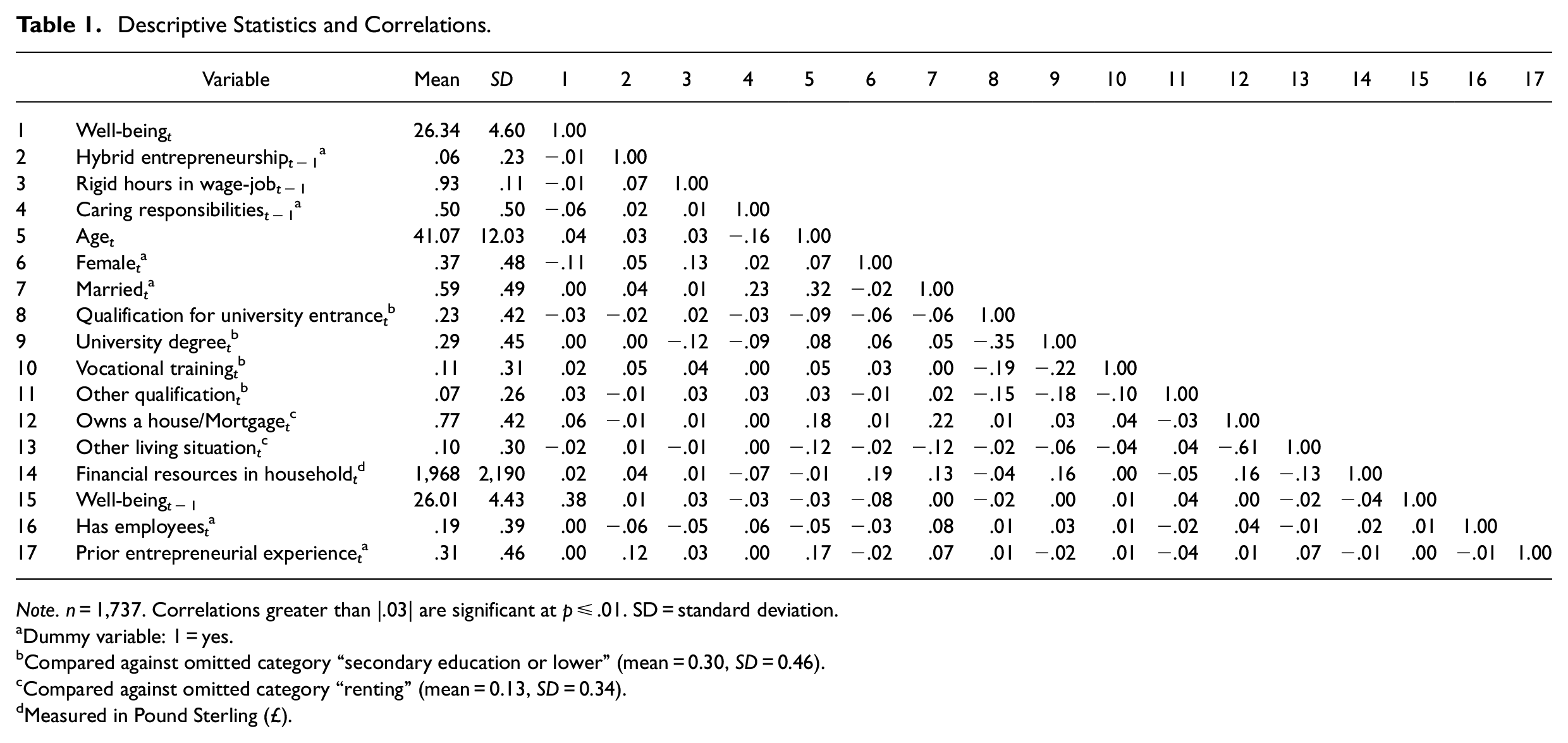
Note. n = 1,737. Correlations greater than |.03| are significant at p ≤ .01. SD = standard deviation.
Dummy variable: 1 = yes.
Compared against omitted category “secondary education or lower” (mean = 0.30, SD = 0.46).
Compared against omitted category “renting” (mean = 0.13, SD = 0.34).
Measured in Pound Sterling (£).
Table 2 presents the results to test Hypotheses 1 and 2. Model 1 includes only the control variables. Model 2 adds the direct effect of a phase in hybrid entrepreneurship in t − 1 on entrepreneurs’ well-being in t. Model 3 includes the direct effects of the moderators and the interaction terms between rigid hours in the wage-job and a phase in hybrid entrepreneurship as well as caring responsibilities and a phase in hybrid entrepreneurship. As expected, the results in Model 1 indicate that age affects well-being positively (β = .30, p = .013) and that being female (as opposed to being male) affects well-being negatively (β = −.32, p = .019). Moreover, we find that owning or buying a home (as opposed to renting it) affects entrepreneurs’ well-being positively (β = .37, p = .027) as do additional financial resources in the household (β = .31, p = .005). Individuals’ well-being in t − 1 also has a positive effect on their well-being in t (β = 1.72, p < .001). In line with previous studies (e.g., Kibler et al., 2019; Uy et al., 2013), we find no significant direct effect of prior entrepreneurial experience on entrepreneurs’ well-being (β = .00, p = .975). Furthermore, the results in Model 2 indicate no significant direct effect of a preceding phase in hybrid entrepreneurship on entrepreneurs’ well-being (β = −.05, p = .673), which is consistent with the notion that learning during hybrid entrepreneurship may be more complex than previously acknowledged.
Regression Results (Full Sample).
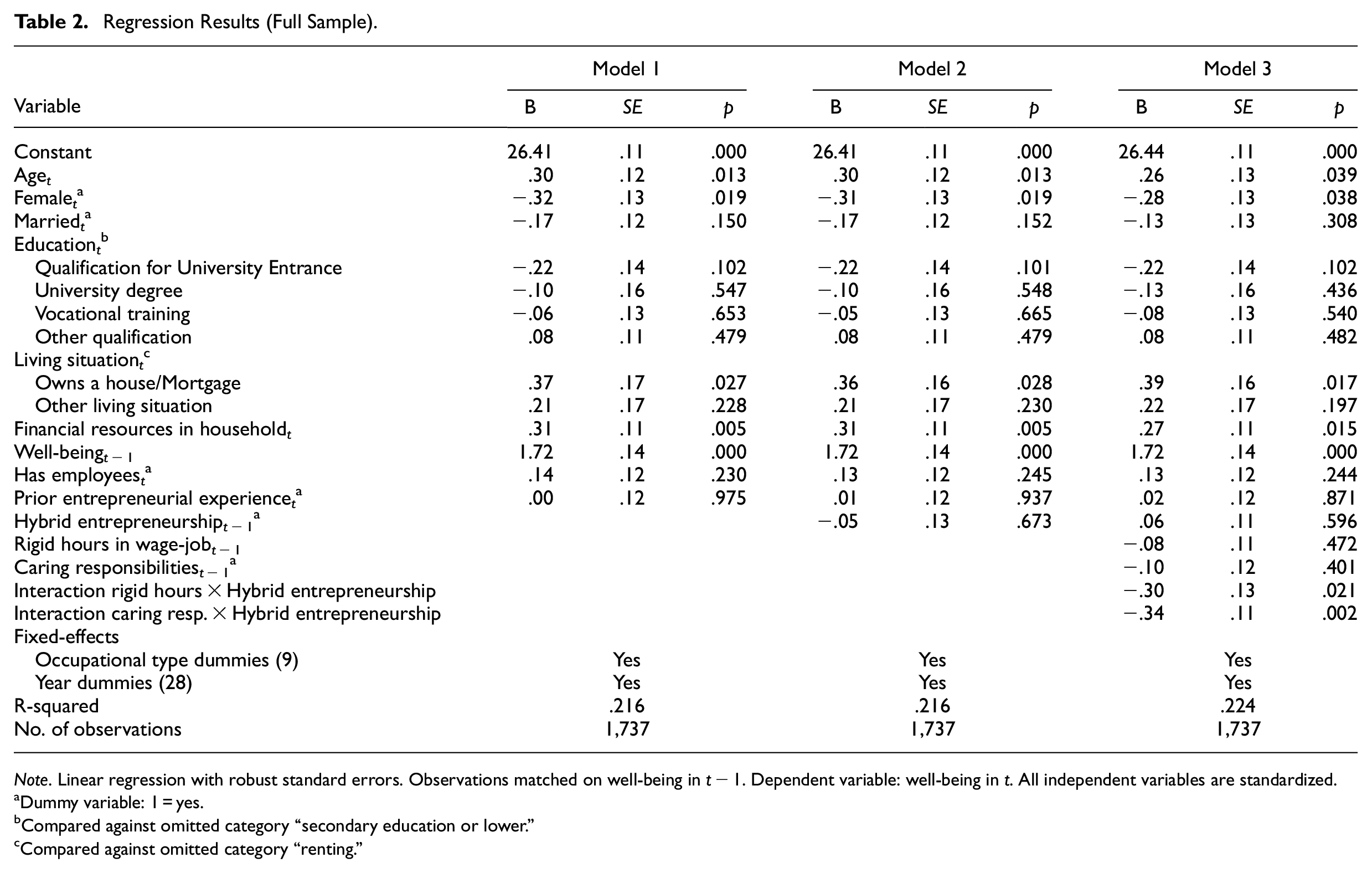
Note. Linear regression with robust standard errors. Observations matched on well-being in t − 1. Dependent variable: well-being in t. All independent variables are standardized.
Dummy variable: 1 = yes.
Compared against omitted category “secondary education or lower.”
Compared against omitted category “renting.”
The results displayed in Model 3 show a negative significant effect of the interaction between a preceding phase in hybrid entrepreneurship and rigid hours in the wage-job on entrepreneurs’ well-being (β = −.30, p = .021), lending support to Hypothesis 1. We also find a negative significant interaction effect between a preceding phase in hybrid entrepreneurship and individuals’ caring responsibilities on entrepreneurs’ well-being (β = −.34, p = .002), lending support to Hypothesis 2.
To inspect these results further, we plotted the interaction effects. Figure 1 indicates the marginal effect of a preceding phase in hybrid entrepreneurship on entrepreneurs’ well-being at different degrees of rigid hours in the wage-job. In support of Hypothesis 1, we observe that the positive effect of a phase in hybrid entrepreneurship decreases with increasing degrees of rigid hours in individuals’ wage-job in t − 1. Figure 2 shows the marginal effect of a preceding phase in hybrid entrepreneurship on entrepreneurs’ well-being for individuals with and without caring responsibilities in t − 1. The graph indicates that the positive effect of a phase in hybrid entrepreneurship on entrepreneurs’ well-being in t decreases for entrepreneurs with caring responsibilities in t − 1, which supports Hypothesis 2 further.
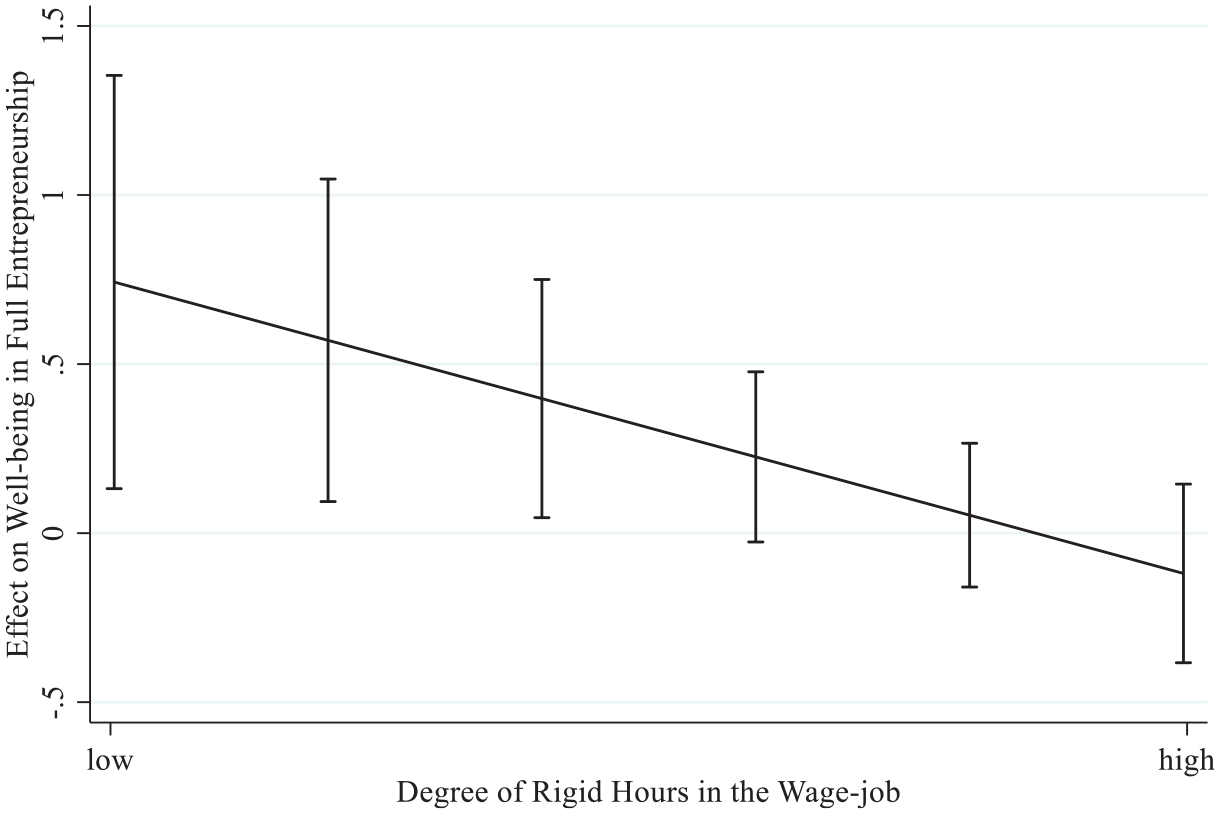
Average marginal effect of a preceding phase in hybrid entrepreneurship on entrepreneurs’ well-being in subsequent full entrepreneurship with 95% CIs at different degrees of rigid hours in the wage-job.
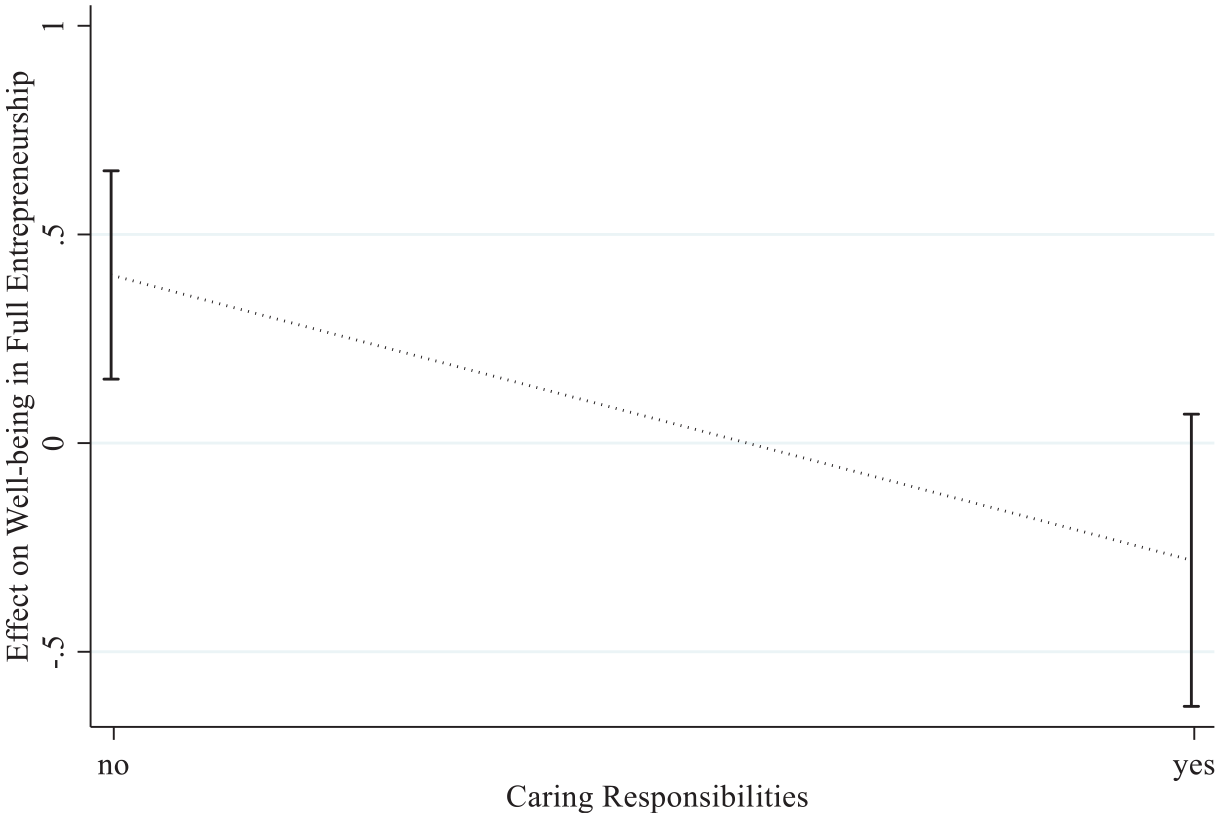
Average marginal effect of a preceding phase in hybrid entrepreneurship on entrepreneurs’ well-being in subsequent full entrepreneurship with 95% CIs for individuals with and without caring responsibilities.
We took additional steps to assess the meaningfulness of these results. To this end, we calculated the average change in entrepreneurs’ well-being from t − 1 to t in our sample (marginal effect = 3.51 units) and the marginal effect of a preceding phase in hybrid entrepreneurship on entrepreneurs’ well-being for individuals with the least degrees of rigid hours in their wage-job (marginal effect = 0.74 units). Comparing these numbers suggests that a preceding phase in hybrid entrepreneurship explains 21% of the change in entrepreneurs’ well-being for individuals with low degrees of rigid hours in wage-job. Similarly, the marginal effect of a preceding phase in hybrid entrepreneurship on entrepreneurs’ well-being corresponds to 0.40 units if individuals did not face caring responsibilities in t − 1. Thus, a preceding phase in hybrid entrepreneurship explains 11% of the change in entrepreneurs’ well-being among individuals without caring responsibilities. Considering both effects simultaneously suggests that a phase in hybrid entrepreneurship of individuals with low degrees of rigid hours in their wage-job and no caring responsibilities (marginal effect = 1.08) explains 31% of the absolute change in entrepreneurs’ well-being from t − 1 to t.
To test Hypotheses 3a and 3b, we performed separate gender subsample analyses 3 (Table 3). In support of Hypothesis 3a, we find that the interaction effect of caring responsibilities on entrepreneurs’ well-being in t is statistically significant for the female subsample (Model 3a: β = −.68, p = .006), but insignificant for the male subsample (Model 3b: β = −.16, p = .172). Visual inspection of the interaction supports Hypothesis 3a further, indicating that the effect of a preceding phase in hybrid entrepreneurship on entrepreneurs’ well-being decreases for women with caring responsibilities at t − 1 (Figure 3). In line with Hypothesis 3b, we find that the interaction effect of rigid hours in the wage-job is statistically significant for the male subsample (Model 3b: β = −.25, p = .040) and insignificant for the female subsample (Model 3a: β = −.36, p = .189). Plotting the interaction effect suggests that the effect of a preceding phase in hybrid entrepreneurship on entrepreneurs’ well-being decreases with increasing degrees of rigid hours in the wage-job in the male subsample (Figure 4), which also supports Hypothesis 3b.
Regression Results (Gender Subsamples).
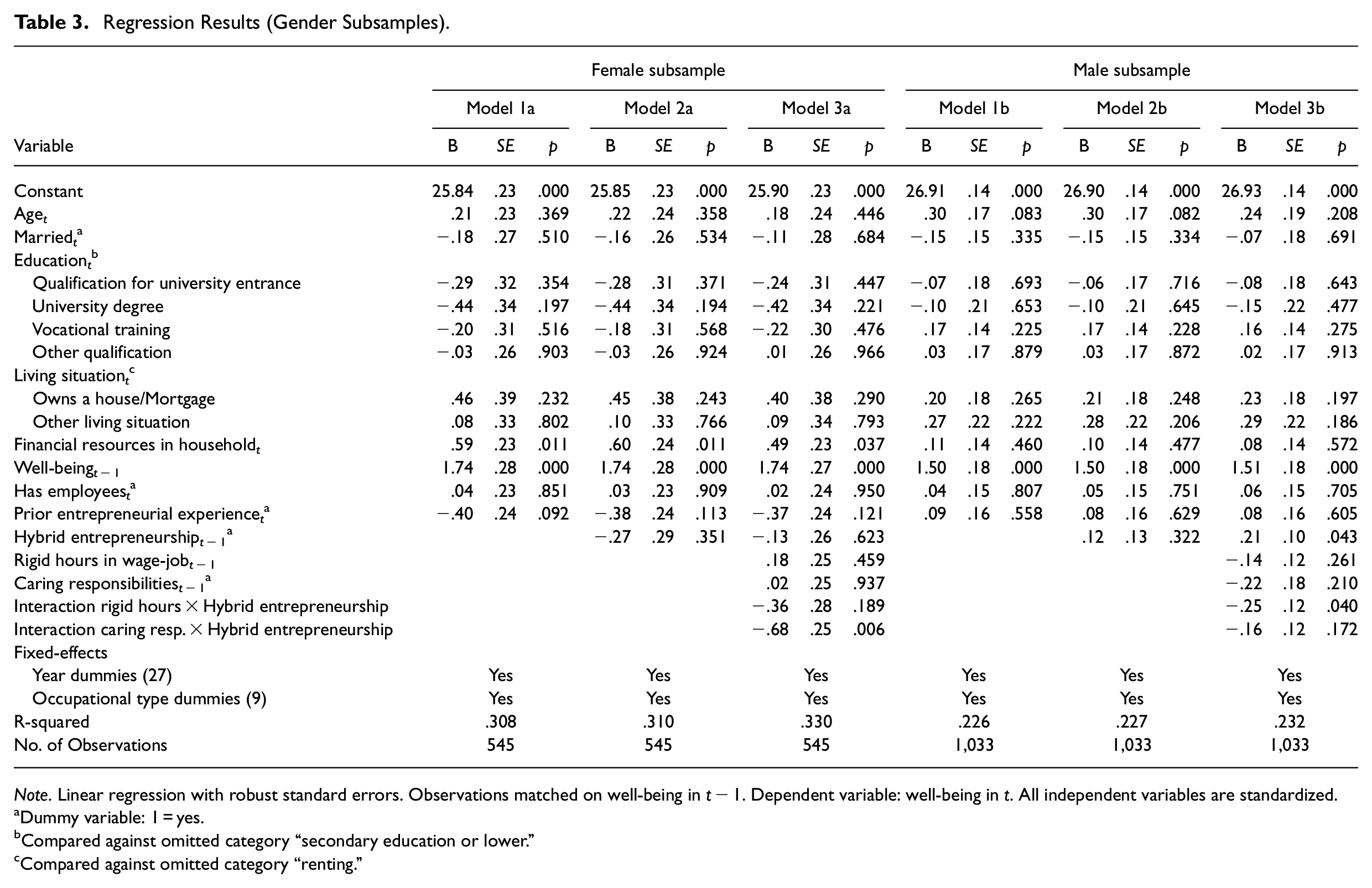
Note. Linear regression with robust standard errors. Observations matched on well-being in t − 1. Dependent variable: well-being in t. All independent variables are standardized.
Dummy variable: 1 = yes.
Compared against omitted category “secondary education or lower.”
Compared against omitted category “renting.”
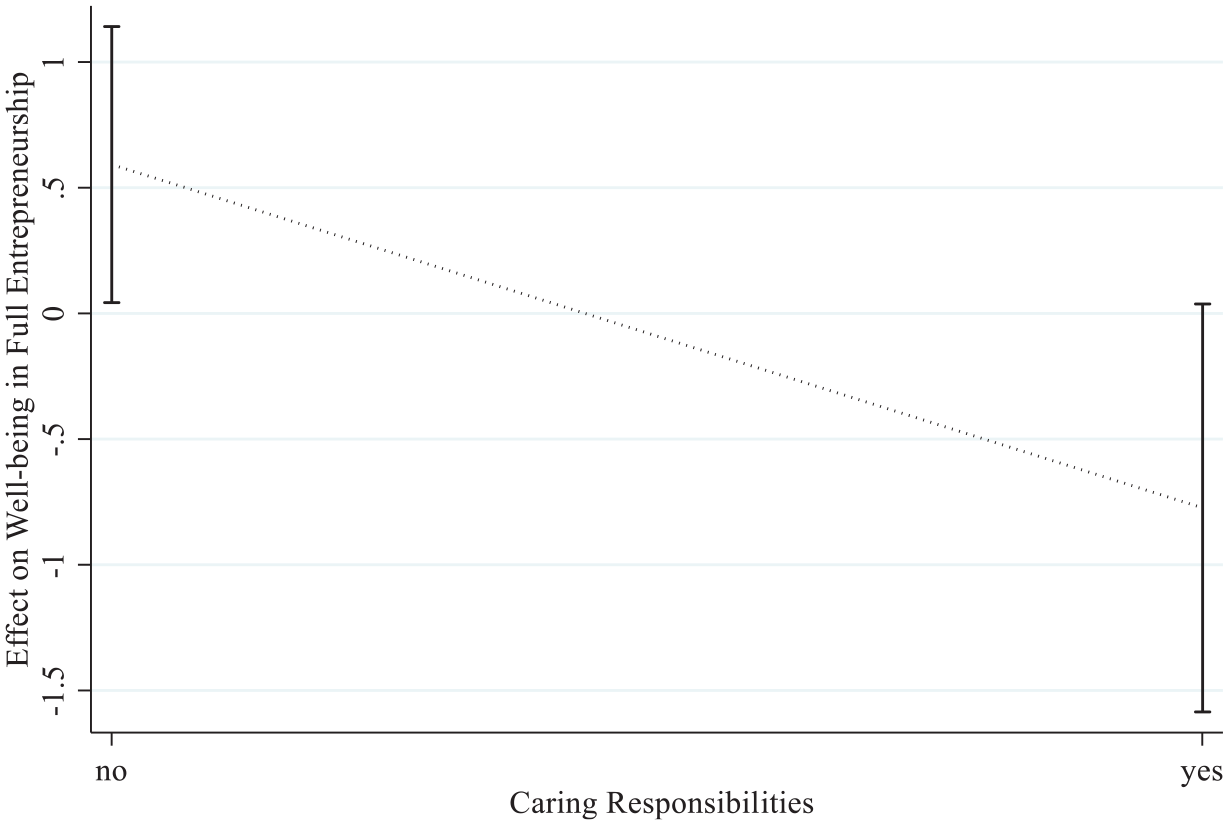
Average marginal effect of a preceding phase in hybrid entrepreneurship on entrepreneurs’ well-being in subsequent full entrepreneurship with 95% CIs for individuals with and without caring responsibilities (female subsample).
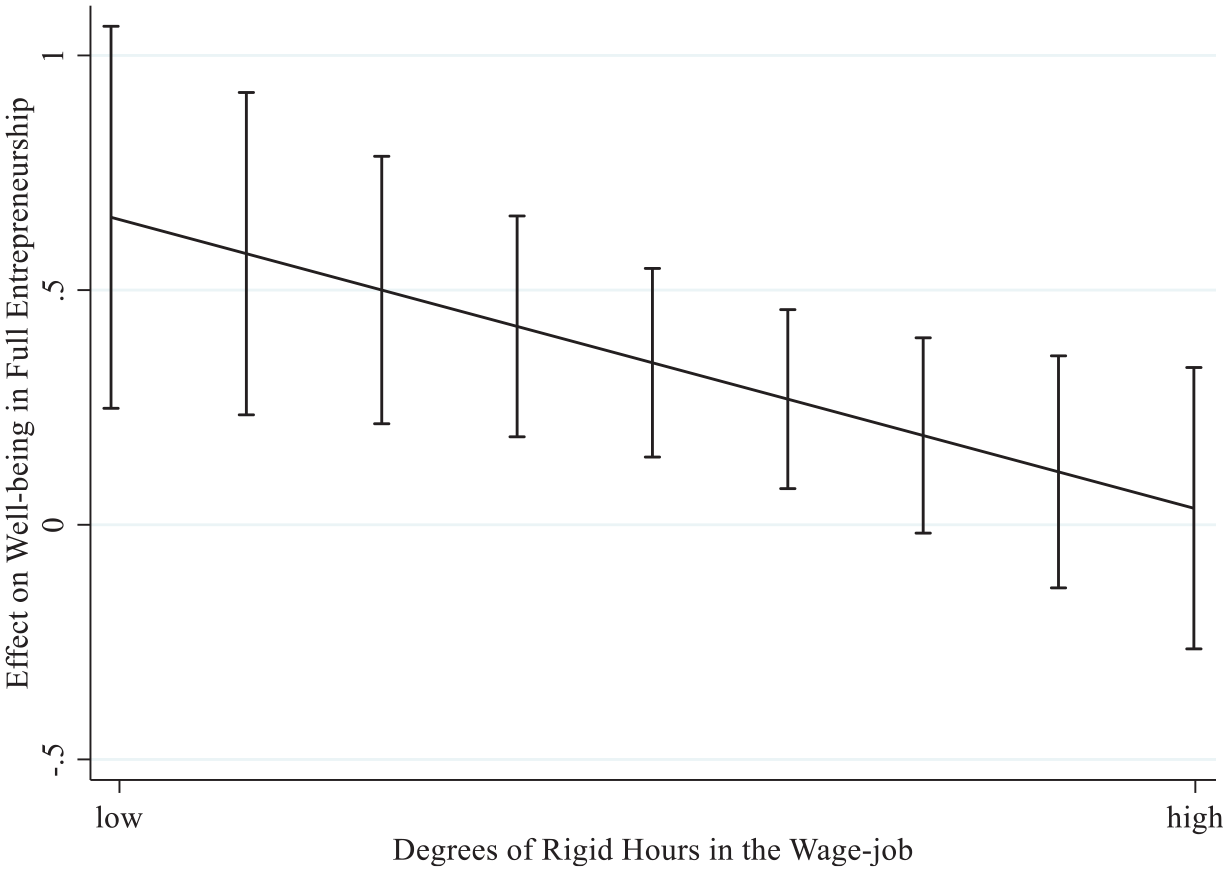
Average marginal effect of a preceding phase in hybrid entrepreneurship on entrepreneurs’ well-being in subsequent full entrepreneurship with 95% CIs at different degrees of rigid hours in the wage-job (male subsample).
Robustness Checks
We conducted three robustness checks to validate our findings further. First, we included only individuals aged between 18 and 65 years to restrict our sample to the typical working population in the United Kingdom, who are of full age and below the common UK pension age (Hobson, 2023). The results of this robustness check confirmed our main findings. Table OA2 in the Supplemental Appendix depicts significant moderation effects of rigid hours in the wage-job (Model 3: β = −.30, p = .021) as well as caring responsibilities (Model 3: β = −.34, p = .002). Further, the subsample analyses (Table OA3 in the Supplemental Appendix) show that the interaction effect of caring responsibilities is only significant in the female subsample (Model 3a: β = −.70, p = .006), while the interaction effect of rigid hours in the wage-job is only significant in the male subsample (Model 3b: β = −.25, p = .039).
In a second robustness check, we applied a Heckman Selection Model to address that our data may be subject to selection bias (Certo et al., 2016; Heckman, 1976), as we only observe the well-being of individuals who transitioned into full entrepreneurship. That is, we cannot rule out that unobserved differences between individuals who do and those who do not enter full entrepreneurship drive our obtained estimates. Heckman Selection Models “help address sample selection effects” (Anderson et al., 2019, p. 7) and are commonly used in entrepreneurship research (e.g., Chan et al., 2020; Gänser-Stickler et al., 2022). The approach follows two stages. In the first stage, it estimates the selection probability term, that is, the probability that an individual enters the final sample based on an exclusion criterion. In our case, we use workplace size in the wage-job in t − 1 as an exclusion criterion, as it predicts entry into full entrepreneurship (Kacperczyk, 2012; Sørensen, 2007), yet, it is unlikely to affect entrepreneurs’ well-being in full entrepreneurship. The panel data provide information on workplace size according to the number of employees and differentiates between five categories: 1 to 24 employees, 25 to 49 employees, 50 to 199 employees, 200 to 499 employees, and 500 and more employees. We conducted the first-stage regression with a sample including all individuals who held a wage-job in t − 1 (n = 18,299). In the second stage, we included the selection probability term in the final regression to control for selection bias.
Table OA4 in the Supplemental Appendix shows the results of the Heckman Selection Model testing Hypotheses 1 and 2. The results of the first stage confirm the negative effect of workplace size on entry into full entrepreneurship. Furthermore, lambda indicates the selection probability term (λ = −.53, p = .631). While previous research has interpreted a non-significant lambda as an indication of no selection bias (which would confirm the empirical approach of our main analyses), recent research flags this conclusion as too arbitrary (Certo et al., 2016). Thus, we still interpret the results of the second stage, which show the results of our regression while controlling for potential selection bias. In line with the results of our main analysis, the results support Hypothesis 1, as we find a negative interaction effect of a phase in hybrid entrepreneurship and rigid hours in the wage-job on entrepreneurs’ well-being in t (β = −.33, p = .013). Our results also lend support to Hypothesis 2, as we find a negative interaction effect of a phase in hybrid entrepreneurship and caring responsibilities on entrepreneurs’ well-being in t (β = −.28, p = .001). Furthermore, applying the Heckman Selection Model to the gender subsample analyses (Supplemental Table OA5) yields support for Hypothesis 3a. In the second stage, the interaction effect of caring responsibilities is significant in the female subsample (β = −.50, p = .001) and not significant in the male subsample (β = −.14, p = .176). The results provide partial support for Hypothesis 3b (Supplemental Table OA5), as the interaction effects of rigid hours in the wage-job are marginally significant at a 10%-level in both the male subsample (Model 3b: β = −.28, p = .084) as well as the female subsample (Model 3a: β = −.40, p = .081).
In a third robustness check, we re-analyzed our data with alternative measures of well-being. In our main analysis, we assessed entrepreneurs’ well-being comparably broadly by measuring the absence of individuals’ psychological distress and ill-functioning with the GHQ (Gnambs & Staufenbiel, 2018; Goldberg, 1972). To test the argument that hybrid entrepreneurs learn to protect their well-being by learning skills that help them to prevent entrepreneurial stress in full entrepreneurship more explicitly (i.e., learning how to run their own business helps to reduce sources of stress and learning how to cope with feeling stressed helps to prevent consequences of stress), we re-analyzed our data by considering entrepreneurs’strain as an alternative dependent variable. We measure strain with the question “Have you recently felt constantly under strain?” on a 4-point Likert scale, ranging from 0 = “not at all” to 3 = “much more than usual” (Ardianti et al., 2022).
The results in Table OA6 in the Supplemental Appendix indicate that the relationship between a preceding phase in hybrid entrepreneurship and entrepreneurs’ strain becomes stronger for individuals with greater degrees of rigid hours in their wage-job (Model 3: β = .04, p = .029) or caring responsibilities in t − 1 (Model 3: β = .05, p = .001), supporting Hypotheses 1 and 2. In addition, the results of the subsample analyses (Table OA7 in the Supplemental Appendix) show that the moderating effect of caring responsibilities is significant in the female subsample (Model 3a: β = .09, p = .003) and only marginally significant in the male subsample (Model 3b: β = .03, p = .066), which is consistent with Hypothesis 3a. Moreover, the moderating effect of rigid hours in the wage-job is significant in the male subsample (Model 3b: β = .06, p = .006) and insignificant in the female subsample (Model 3a: β = .01, p = .817), lending support for Hypothesis 3b.
Moreover, we follow recent research that emphasizes the importance of considering both negative and positive components when researching entrepreneurs’ well-being (U. Stephan et al., 2023). By measuring the absence of ill-being as an indicator of well-being, the GHQ measures a negative component of well-being (Gnambs & Staufenbiel, 2018; Goldberg, 1972), which is consistent with our argumentation. To examine whether our theory elaboration also applies when considering a positive component of well-being, we re-analyzed our data with life satisfaction as an alternative dependent variable (Ardianti et al., 2022; M. Stephan et al., 2023). In line with prior entrepreneurship research (Fritsch et al., 2019; U. Stephan et al., 2022), we measure entrepreneurs’ overall life satisfaction with a single item on a 7-point Likert scale ranging from 1 = “not satisfied at all” to 7 = “completely satisfied.”
The results in Table OA8 in the Supplemental Appendix provide partial support for Hypotheses 1 and 2, as we find marginally significant interaction effects of rigid hours in the wage-job (Model 3: β = −.12, p = .052) and caring responsibilities (Model 3: β = −.07, p = .052), which may be due to the reduced sample size (n = 1,495), as life satisfaction is not measured in all waves of the panel. The subsample analyses support Hypothesis 3a (Table OA9 in the Supplemental Appendix), as we find that the interaction effect of caring responsibilities is significant in the female subsample (Model 3a: β = −.16, p = .019), but not in the male subsample (Model 3b: β = −.01, p = .856). However, we find that the interaction effect of rigid hours is not significant in the male subsample (Model 3b: β = −.02, p = .834), but significant in the female subsample (Model 3a: β = −.19, p = .046), which is opposite to Hypothesis 3b. One possible explanation for these findings could be that male entrepreneurs’ responses to the GHQ deviate from their assessment of life satisfaction to a greater extent than female entrepreneurs’ responses. Supporting this notion, our data suggest that the correlation between the GHQ and life satisfaction is r = .44 for men and r = .54 for women. Overall, the results of this robustness check suggest that our refined theory with regards to gender differences holds only partially for positive measures of well-being and therefore echo U. Stephan et al. (2023) to choose the measurement of well-being carefully and in line with theory.
Post Hoc Tests
We also considered in how far our argumentation can explain the development of hybrid entrepreneurs’ well-being over time. We argue that rigid hours in the wage-job and caring responsibilities in t − 1 constrain hybrid entrepreneurs’ learning of skills that protect well-being and therefore shape their well-being in subsequent full entrepreneurship. Thus, we would also expect that rigid hours in the wage-job and caring responsibilities in t − 1 moderate the relationship between entry into full entrepreneurship in t and hybrid entrepreneurs’change in well-being. To test this possibility, we took advantage of the panel nature of our dataset and generated a longitudinal panel of all observations of hybrid entrepreneurs in the sample of our main regression analyses. The resulting panel sample contained 694 observations of all 101 hybrid entrepreneurs. Then, we applied an individual fixed-effects estimator, which accounts for every individual-specific heterogeneity that is constant over time (Bettis et al., 2014) to investigate hybrid entrepreneurs’ development of well-being when transitioning to the full-time stage. Hence, this approach also controls for the impact of unobserved characteristics at the individual level that are constant in the period of observation and relevant for hybrid entrepreneurship and well-being, such as individuals’ ability and personality (Folta et al., 2010; U. Stephan, 2018). In line with our argumentation, the empirical results depicted in Table OA10 (in the Supplemental Appendix) show statistically significant interaction effects for both rigid hours in the wage-job (β = −.36, p = .011) and caring responsibilities (β = −.39, p = .006) on the relationship between entry into full entrepreneurship and hybrid entrepreneurs’ change in well-being. These results further corroborate that demands from hybrid entrepreneurs’ wage-jobs and private lives shape the relationship between hybrid entrepreneurship and well-being.
Overall, our empirical results lend full support for Hypotheses 1, 2, and 3a. With regard to Hypothesis 3b, the results of the Heckman Selection Model and when using life satisfaction as an alternative dependent variable lead us to conclude that we receive only partial support for Hypothesis 3b.
Discussion
Using insights from entrepreneurial learning theory and role conflict theory, we elaborated on current theorizing on learning during hybrid entrepreneurship and its influence on entrepreneurs’ well-being in full entrepreneurship. We argued that demands from hybrid entrepreneurs’ wage-jobs and private lives constrain their ability to transform experiences into skills that protect well-being in full entrepreneurship. Moreover, we argued that role demands from hybrid entrepreneurs’ wage-jobs particularly affect male hybrid entrepreneurs, while demands from their private lives particularly affect female hybrid entrepreneurs. Our analyses, including various robustness checks and a post hoc test, widely support our refined theory (with a few notable exceptions). In the following, we discuss the findings and their implications for research on hybrid entrepreneurship, entrepreneurs’ well-being, and role conflict and gender differences in entrepreneurship.
Contributions to Theory
Our study advances prior research on hybrid entrepreneurship and well-being by refining current theorizing on learning during hybrid entrepreneurship, which tends to assume that learning simply “happens” when hybrid entrepreneurs experience entrepreneurial work (Folta et al., 2010; Gänser-Stickler et al., 2022; Raffiee & Feng, 2014). We refine this theorizing by, first, explaining more accurately that learning requires hybrid entrepreneurs to be able to transform their experiences into skills that allow them to protect their well-being in full entrepreneurship. Second, we structure this relationship by considering the circumstances under which learning during hybrid entrepreneurship may or may not take place. In this regard, our refined theory suggests that role demands from outside entrepreneurship constrain hybrid entrepreneurs’ ability to transform their experiences into skills that can benefit them in full entrepreneurship. Finally, our refined theory explains how the interference of role demands differs for male and female hybrid entrepreneurs.
Our study contributes to research on outcomes of hybrid entrepreneurship (Folta et al., 2010; Raffiee & Feng, 2014) by elaborating on learning during hybrid entrepreneurship. For example, our refined theory may explain why Raffiee and Feng (2014) do not find support for a moderating effect of cognitive ability on the relationship between a preceding phase in hybrid entrepreneurship and business survival, as they do not account for possible constraining effects of role demands outside entrepreneurship. We caution future studies on outcomes of hybrid entrepreneurship to take the heterogeneity of hybrid entrepreneurs and their role demands into account, as this heterogeneity can determine whether a preceding phase in hybrid entrepreneurship feeds into full entrepreneurship and benefits entrepreneurial outcomes. In this regard, and despite the timeliness of studying well-being as an outcome variable (U. Stephan et al., 2023; Wiklund et al., 2019), we encourage future studies to validate our refined theory with regard to other entrepreneurial outcomes (Shepherd et al., 2019). For example, the transformation of hybrid entrepreneurs’ experiences of running their own business into skills may also benefit their performance when they enter full entrepreneurship. Similarly, the transformation of their experiences of coping with feeling stressed into skills during hybrid entrepreneurship may positively affect their resilience in full entrepreneurship.
We also contribute to research on hybrid entrepreneurship and role conflict (Carr et al., 2023; Mmbaga et al., 2023). The study by Carr et al. (2023) is an important foundation for our study as it introduces the notion of role conflict between hybrid entrepreneurs’ entrepreneurial work and their wage-jobs. We advance their study in two ways. First, we add hybrid entrepreneurs’ role as private persons, which can be an additional source of constrain that affects entrepreneurial work. Second, by studying the effect of role demands outside entrepreneurship on hybrid entrepreneurs’ learning and subsequent well-being (rather than the effect of entrepreneurial work on hybrid entrepreneurs’ attitudes and behavior in their wage-jobs), we consider role conflict with regard to outcomes in full entrepreneurship. We encourage future research to untangle the complexities that underlie role conflict in hybrid entrepreneurship further.
Our study also contributes to research on entrepreneurs’ well-being (Lerman et al., 2020; U. Stephan et al., 2023; Wach et al., 2020) by introducing hybrid entrepreneurship into the debate on entrepreneurs’ well-being across time. Specifically, our refined theory and findings expand Shir and Ryff’s (2021) dynamic perspective on interdependencies between entrepreneurs’ actions and their well-being, which suggests that entrepreneurs’ well-being affects their actions in subsequent phases of entrepreneurship. Our study indicates that the reverse is possible as well: If role demands outside entrepreneurship are not constraining, individuals’ experiences and actions during hybrid entrepreneurship benefit their well-being in subsequent full entrepreneurship. As such, our study takes a step toward a longitudinal perspective on entrepreneurs’ well-being, which prior research calls for (U. Stephan, 2018; U. Stephan et al., 2023; Wiklund et al., 2019). Moreover, we add to the emerging debate on hybrid entrepreneurs’ well-being (Ardianti et al., 2022; Mmbaga et al., 2023; M. Stephan et al., 2023) by showing that the impact of hybrid entrepreneurship on well-being extends into full entrepreneurship and by differentiating direct entrants from entrepreneurs who transition from hybrid entrepreneurship. As such, we also advance research on the drivers of entrepreneurs’ well-being in full entrepreneurship, which rarely considers the circumstances under which individuals engaged in a preceding phase in hybrid entrepreneurship (e.g., Nikolova, 2019; U. Stephan et al., 2022).
In addition, our study forges a link between research on entrepreneurs’ role conflict and research on entrepreneurs’ well-being (Jennings & McDougald, 2007; U. Stephan et al., 2020). We extend prior studies that show that the interference of demands from private lives is stronger for female entrepreneurs (Hsu et al., 2016; Jennings & McDougald, 2007) by explaining that these gender differences transfer to hybrid entrepreneurs’ learning of skills that protect their well-being in full entrepreneurship. These findings are particularly informative for prior research on gender differences in entrepreneurs’ well-being (Caliendo et al., 2023; U. Stephan et al., 2020). So far, research explains lower levels of well-being and profit among female entrepreneurs by pointing out that caring responsibilities may limit women’s ability to focus on their own business during full entrepreneurship (Arráiz, 2018; U. Stephan et al., 2020). By considering their role demands during hybrid entrepreneurship, our study shows that caring responsibilities may affect female entrepreneurs even before they enter full entrepreneurship.
Finally, the argumentation that greater degrees of rigid hours in the wage-job particularly interfere with male hybrid entrepreneurs’ learning offers a novel perspective on gender differences in entrepreneurs’ role conflict (Hsu et al., 2016; Jennings & McDougald, 2007), as the literature has focused primarily on role conflict’s disadvantages for female entrepreneurs so far. Yet, the unique context of hybrid entrepreneurship, where demands from entrepreneurial work conflict with wage-job demands, appears to be a challenge for male entrepreneurs as well. Moreover, by suggesting that the traditionally more pronounced work-related role salience among men may influence how wage-job-related demands interfere with their entrepreneurial work, we contribute to the wider role conflict literature. As such, our study is an initial response to prior research calling to consider role conflicts beyond the traditional focus on the interference between work- and family-related roles (Kelliher et al., 2019). Nevertheless, we emphasize to interpret these insights with caution, as our findings regarding the moderating role of rigid hours in the wage-job in the male subsample are the least robust results in our study. Therefore, we extend the call by Folta et al. (2010) and encourage future research to delve more deeply into gender differences during hybrid entrepreneurship by focusing on hybrid entrepreneurs’ role conflict (especially the conflict between the wage-job and entrepreneurial work) and its impact on learning.
Limitations and Implications
Our study has several limitations. First, the correlational nature of our empirical analyses does not allow us to infer causality from our findings. While a randomized controlled experiment would allow causal claims, such an approach would require us to allocate individuals randomly into hybrid entrepreneurship or impose caring responsibilities on them, which we deem to be “neither feasible, nor ethical” (Anderson et al., 2019, p. 3). We undertook various efforts to ensure methodological rigor and to show the robustness of our results, such as using CEM, a Heckman Selection Model to address selection effects (as Anderson et al. [2019] suggest), and an individual fixed-effects estimator to control for the impact of unobserved stable characteristics at the individual-level. Still, we see a need for future research to explore alternative methodological approaches that allow for causal interpretations regarding the outcomes of hybrid entrepreneurship, such as by identifying opportunities for natural experiments. Overcoming these methodological shortcomings is particularly important as they also apply to the majority of research on hybrid entrepreneurship.
Second, since the panel dataset we use in this study does not include data on the skills individuals learn with regard to running their own business and coping with feeling stressed, we cannot measure directly whether hybrid entrepreneurs learn skills that protect their well-being in full entrepreneurship. While our approach is consistent with prior research on learning during hybrid entrepreneurship (e.g., Folta et al., 2010; Gänser-Stickler et al., 2022; Raffiee & Feng, 2014), we call for future research to capture the skills individuals learn during hybrid entrepreneurship more directly and how role demands constrain such learning.
Third, even though the Understanding Society dataset provides us with a large amount of information on entrepreneurs during and before full entrepreneurship, the information on employment status allows us only to measure entrepreneurship as self-employment. Differentiating between entrepreneurship (i.e., creating growth-driven ventures) and self-employment is particularly important when theorizing about entrepreneurship at an institutional level, such as when assessing innovation in a country (Henrekson & Sanandaji, 2014, 2020). However, as our study focuses on explaining the well-being of individuals who run their own business, which applies to all types of self-employment, we consider our measurement appropriate. In addition, our procedure is common in research in entrepreneurship (Folta et al., 2010; U. Stephan, 2018). Nevertheless, we encourage future research to validate our refined theory in a more nuanced sample of entrepreneurs, such as founders of start-ups.
Finally, we acknowledge that our refined theory is based on a binary and heteronormative perspective on gender and gender roles (Hyde et al., 2019; Joel et al., 2014), which does not necessarily reflect reality. While we envisage our research as providing first empirical evidence in this regard, we see the potential for future research to consider the diversity of gender and sexuality when examining gender differences in entrepreneurship.
Conclusion
This study elaborated on current theorizing on learning during hybrid entrepreneurship and examined the moderating effect of role demands outside entrepreneurship on the relationship between a preceding phase in hybrid entrepreneurship and entrepreneurs’ well-being in subsequent full entrepreneurship. We assessed how interfering role demands from hybrid entrepreneurs’ wage-jobs and private lives constrain their ability to transform the experiences of running their own business and coping with feeling stressed into skills that protect their well-being in full entrepreneurship. Moreover, we argued that these role demands affect female and male hybrid entrepreneurs differently. Testing the hypotheses on a large panel dataset, we obtained wide support for our refined theory. We discussed how our research contributes to the literature on hybrid entrepreneurship, entrepreneurs’ well-being, and role conflict and gender differences in entrepreneurship. The limitations of our research revealed opportunities for future scholarly inquiry.
Supplemental Material
sj-docx-2-etp-10.1177_10422587241288108 – Supplemental material for Hybrid Entrepreneurship and Entrepreneurs’ Well-Being: The Moderating Effect of Role Demands Outside Entrepreneurship
Supplemental material, sj-docx-2-etp-10.1177_10422587241288108 for Hybrid Entrepreneurship and Entrepreneurs’ Well-Being: The Moderating Effect of Role Demands Outside Entrepreneurship by Johanna Kuske, Matthias Schulz and Christian Schwens in Entrepreneurship Theory and Practice
Supplemental Material
sj-pdf-1-etp-10.1177_10422587241288108 – Supplemental material for Hybrid Entrepreneurship and Entrepreneurs’ Well-Being: The Moderating Effect of Role Demands Outside Entrepreneurship
Supplemental material, sj-pdf-1-etp-10.1177_10422587241288108 for Hybrid Entrepreneurship and Entrepreneurs’ Well-Being: The Moderating Effect of Role Demands Outside Entrepreneurship by Johanna Kuske, Matthias Schulz and Christian Schwens in Entrepreneurship Theory and Practice
Footnotes
Acknowledgements
We thank the editor, Jeff Pollack, and two anonymous reviewers for their excellent and constructive guidance throughout the review process. We also thank Ute Stephan, Marilyn Uy, and the attendants of research seminars at King’s College London and the University of Groningen for their valuable comments and suggestions.
Declaration of Conflicting Interests
The authors declared no potential conflicts of interest with respect to the research, authorship, and/or publication of this article.
Funding
The authors received no financial support for the research, authorship, and/or publication of this article.

Supplemental Material
Supplemental material for this article is available online.
Notes
Author Biographies
References
Supplementary Material
Please find the following supplemental material available below.
For Open Access articles published under a Creative Commons License, all supplemental material carries the same license as the article it is associated with.
For non-Open Access articles published, all supplemental material carries a non-exclusive license, and permission requests for re-use of supplemental material or any part of supplemental material shall be sent directly to the copyright owner as specified in the copyright notice associated with the article.
