



Abstract
Startup founders often encounter paradoxical tensions. Yet, whether and how startup accelerators can equip founders to embrace such contradictions remains underexplored. Our study of Y Combinator reveals that accelerators can play a pivotal role in cultivating an entrepreneurial paradox mindset by exposing founders to teachings about paradoxical tensions, imparting heuristics to navigate them, and implementing thoughtful design choices to foster learning—particularly through vicarious and experiential learning opportunities. This study integrates paradox theory into entrepreneurship research, contributes to understanding the interplay between accelerator design choices and entrepreneurial learning, extends knowledge of entrepreneurial mindsets, and provides several practical insights.
Introduction
[…] Founders run into: should I be doing the work? Or should I be recruiting people and delegating the work? […] You need to do both! […] You need to sometimes do one at 100%, sometimes the other at 100%, and sometimes—even though this is not so good at math—both at 100%! This is classic when you begin thinking about what is a great founder—is you navigating what are apparent paradoxes. (Reid Hoffman)
Founders often encounter numerous paradoxical tensions throughout a startup’s lifecycle (DeSantola and Gulati, 2017; Sullivan, 2016). Examples include the need for startups to simultaneously execute tasks while delegating, integrate data-driven decision-making with a vision-oriented approach, and maintain both flexibility and persistence (Y Combinator, 2014). Entrepreneurship theory has traditionally explored the tension between opportunity discovery and opportunity creation (Bingham, Eisenhardt, & Furr, 2007; Kirzner, 1997) and has more recently examined additional tensions in the life of startups. For instance, scholars have shown that founders’ breadth and diversity of experiences foster innovation but undermine legitimacy among investors (Kacperczyk & Younkin, 2017; Pinelli et al., 2020), that future-oriented narratives can secure stakeholder support but question their legitimacy (Cappa et al., 2021; Garud et al., 2014), and that startups must scale rapidly while using limited resources (DiVito & Bohnsack, 2017).
However, the entrepreneurship literature has neither systematically engaged with the concept of paradoxical tensions (Lewis, 2000) nor leveraged paradox theory (Lewis & Smith, 2014; Miron-Spektor, Gino, & Argote, 2011; Schad et al., 2016; Smith & Lewis, 2011). This is surprising because the entrepreneurship studies above show that startups are characterized by tensions stemming from opposing yet interrelated elements, which ultimately lead to paradoxes. To advance theoretical insights in the field of entrepreneurship, we build on paradox theory that posits that paradoxes involve “contradictory yet interrelated elements that exist simultaneously and persist over time” (Smith & Lewis, 2011, p. 382).
Paradox theory advocates embracing conflicting demands rather than attempting to disentangle them. Similarly in entrepreneurship, founders of startups must balance and accept contradictory forces while finding innovative solutions (Cozzolino & Geiger, 2024). Paradox theory indicates that experiencing and embracing paradoxes foster creativity and improve innovation outcomes (Miron-Spektor, Gino, & Argote, 2011). Likewise, experience, acceptance of challenges, and innovation outcomes are crucial for entrepreneurial startups (Bingham & Eisenhardt, 2011; Chandler, 1996). According to paradox theory, tensions become salient under conditions of resource scarcity, change, and plurality (Smith & Lewis, 2011), requiring a both/end thinking to embrace them. Similarly, entrepreneurship operates within these exact conditions, and entrepreneurs could greatly benefit from a similar mindset.
Despite this clear alignment, paradox theory has not been explicitly examined in the entrepreneurial contexts of early-stage startups. Instead, it has primarily been applied to large or established organizations to examine tensions such as exploration and exploitation (e.g., Andriopoulos & Lewis, 2009) and cooperation and competition (e.g., Cozzolino & Rothaermel, 2018; Gnyawali et al., 2016). Moreover, it remains yet to be examined whether and how startup founders can be taught to embrace paradoxes—and, if so, which paradoxes are most crucial for them to learn.
To address this relevant knowledge gap, we focus on entrepreneurial education and learning within the context of startup accelerator programs. Accelerators are organizations that offer “fixed-term, cohort-based programs for startups, including mentorship and/or educational components” (Cohen, Fehder, Hochberg, et al., 2019, p. 1782). They provide startups with essential resources for their ventures’ development, such as financial support, legitimacy, and a range of services, while also offering valuable entrepreneurial education (Cohen, Bingham, & Hallen, 2019). Extant research has shown that the effectiveness of these educational programs is significantly influenced by the design choices made by accelerators (Assenova & Amit, 2024; Cohen, Bingham, & Hallen, 2019; Hallen, Cohen, Bingham, 2020). These choices include, among others, decisions about the content and direction of the programs, the breadth and depth of the accelerator’s knowledge base, the frequency of interactions among founders, and between founders and mentors, as well as the availability of office space. While previous studies have shown that such design choices impact startups’ performance (Assenova & Amit, 2024; Cohen, Fehder, Hochberg, et al., 2019), it remains unclear whether and how their contribution stems from fostering founders’ ability and mindset to manage conflicting priorities. Specifically, we do not yet know whether founders can develop or strengthen a paradox mindset within the supportive environment of accelerators. All in all, we ask: Do startup accelerators, through their educational programs and related design choices, equip founders to navigate the paradoxical tensions inherent in entrepreneurship?
To answer this question, we conducted an inductive single case study of Y Combinator (YC), one of the world’s leading and pioneering accelerators, founded in 2005 in Silicon Valley. 1 Successful companies that were initially accelerated by YC include Airbnb, Coinbase, DoorDash, Dropbox, Stripe, and Twitch. YC is an ideal empirical context to explore our research question because its program puts a strong emphasis on relentless growth, which amplifies founders’ exposure to the intense tensions and paradoxes of the startup stage (Cohen, Bingham, & Hallen, 2019; Cohen, Fehder, Hochberg, et al., 2019; Chan et al 2020). Our analysis draws on a combination of 64 archival interviews and 6 direct interviews, talks, and lectures held by 46 YC partners, YC alumni, and other members of the YC entrepreneurial network. In addition, we gathered 3,467 unique contributions of archival material (7,283 pages).
Our novel finding is that startup accelerators contribute to developing a paradox mindset in founders, achieving this through a combination of approaches. In particular, accelerators can expose founders to apparently contradictory prescriptions or teachings, as reflected in our findings of four key paradoxes: “Indeterminate Experimentation,” “Fragmented Persistence,” “Run while Waiting,” and “Grow while remaining Small.” Each of these teachings about paradoxes can be accompanied by heuristics—cognitive shortcuts to simplify decision-making (Tversky & Kahneman, 1974). Paradox theory suggests that mere exposure to paradoxical statements or goals can foster creativity and innovation (Miron-Spektor, Erez, & Naveh, 2011). Therefore, the teachings and heuristics on embracing paradoxes encourage founders to innovate creatively by accepting contradictory elements, ultimately developing their paradox mindset. We also found that this mindset is further cultivated through the accelerator’s creation of learning opportunities (both vicarious and experiential learning) and its design choices (including the selection of speakers, mentors, admitted founders, market testing, and the centralization of daily activities). Overall, the combination of these factors fosters the development of an entrepreneurial paradox mindset—which we define as a cognitive attitude that enables entrepreneurs to not only accept and feel at ease with paradoxical tensions but also to actively embrace and leverage them as opportunities for growth and innovation.
Our study makes important contributions. First, we introduce paradox theory (Smith & Lewis, 2011) into entrepreneurship research, thus extending the application of paradox theory from large, established organizations (Schad et al., 2016) to early-stage and small ventures. In doing so, we advance entrepreneurship scholarship by integrating principles from paradox theory such as the necessity of experiencing and accepting tensions to drive innovation (Miron-Spektor, Ingram, Keller, et al., 2018) and the concept of both/end thinking to embrace contradictions (Smith & Lewis, 2022). Second, we show that, and how, startup accelerators can foster an entrepreneurial paradox mindset (see our framework in Figure 3). Specifically, we illustrate how the interplay of accelerators’ design choices (Cohen, Fehder, Hochberg, et al., 2019), heuristics (Bingham, Eisenhardt, and Furr, 2007), and both vicarious and experiential learning (Holcomb et al., 2009) helps to foster a paradox mindset. This advances research on accelerators and entrepreneurial education and learning (e.g., Assenova & Amit, 2024; Cohen, Fehder, Hochberg, et al., 2019), shedding new light on their functioning, processes, and outcomes. Third, we introduce the concept of “entrepreneurial paradox mindset,” thus bridging recent research on paradox mindset (Miron-Spektor et al., 2018) with entrepreneurial cognition studies on entrepreneurial mindset (McGrath & MacMillan, 2000; Mitchell et al., 2002) and bounded rationality (Cohen, Bingham, & Hallen, 2019).
This study also makes valuable contributions to the practice of entrepreneurship because we provide the first comprehensive framework to help accelerators and entrepreneurial educators effectively integrate paradoxical thinking into entrepreneurial training programs and accelerators’ design choices, thereby positively influencing new ventures’ innovativeness and development.
Theory Background
Accelerators’ Choices, Entrepreneurial Education, and Learning
Accelerators are organizations that invest in new ventures and offer fixed-term cohort-based mentoring and educational programs (Cohen, Bingham, & Hallen, 2019; Hallen et al., 2020). Their design choices—such as resource endowments, admission criteria, support intensity, program location, co-working spaces, and educational content—can significantly influence startups’ development and performance (Chan et al., 2020; Cohen, Bingham, & Hallen, 2019; Drori & Wright, 2018). Educational programs, in particular, play a critical role in shaping post-acceleration performance, interacting with factors like venture stage, industry, and founder expertise (Assenova & Amit, 2024).
Beyond formal teaching and mentoring, accelerators enable valuable learning experiences that complement traditional entrepreneurial education. In the following, we present some of these learning opportunities and illustrate how they can be closely intertwined with an accelerator’s design choices. While business schools often emphasize scientific management, accelerators address learning needs unique to entrepreneurship, such as navigating uncertainty and complexity (Bhatia & Levina, 2020; Mustar, 2009; see also Garbuio et al., 2018). Research on entrepreneurial learning highlights three key learning mechanisms central to entrepreneurial education: heuristics, vicarious learning, and experiential learning (Holcomb et al., 2009). 2 Heuristics are rules of thumb that simplify decision-making under uncertainty (Bingham & Eisenhardt, 2011; Tversky & Kahneman, 1974). Because accelerators—by design—often choose to expose startups to experienced serial entrepreneurs who have learned successful heuristics in their careers and are aware of their importance, they can teach valuable heuristics such as “fail fast” or “focus on customer feedback.”
Vicarious learning occurs when people learn by observing the behavior and actions of others (Bandura, 1977). In the context of entrepreneurship, vicarious learning may reduce the need to learn from direct trial-and-error or complement its learning outcomes (Park & Puranam, 2024). An accelerator’s design choices play an important role in fostering vicarious learning. The cohort-based structure of accelerators fosters collective learning, encouraging founders to share knowledge and insights with peers, mentors, and alumni (Krishnan et al., 2021). Design choices also shape the extent of interactions within and across cohorts, enhancing vicarious learning opportunities (Hallen et al., 2020). Accelerators choose the extent and forms of interactions between startup founders and their mentors, and the interactions among founders within and across cohorts (Hallen et al., 2020; Krishnan et al., 2021). By enabling founders to engage with experienced mentors, speakers from successful startups, and other founders, accelerators not only transfer entrepreneurial knowledge but also enable vicarious learning.
Experiential learning refers to the assimilation of “new knowledge through the transformation of experience” (Kolb, 2014, p. 34). By design, accelerators favor experiential learning by encouraging founders to undertake and manage actual startup activities that require them to actively engage with their business ideas and the market. Through hands-on activities and iterative experimentation, entrepreneurs construct and refine their mental models (Pinelli et al., 2020), thereby enhancing their ability to recognize opportunities and make strategic decisions (Corbett, 2005; Sansone et al, 2020). Hence, accelerators bridge the gap between knowledge acquisition and practical application (Cohen, Fehder, Hochberg, et al., 2019).
In sum, accelerators’ design choices and educational programs foster environments conducive to entrepreneurial learning and to the development of an entrepreneurial mindset (McGrath & MacMillan, 2000). They do so by enabling startup founders to acquire knowledge and refine their thinking and modes of action, through various learning mechanisms, including heuristics, vicarious learning, and direct experiences. However, it remains unexplored whether and how accelerators can also teach startups the necessary mindset to embrace paradoxes. This is important as the entrepreneurial life of new ventures is inherently fraught with paradoxes.
Tensions in the Life of Startups and the Integration of Paradox Theory
The entrepreneurship literature highlights that startup entrepreneurs frequently face paradoxical tensions. For instance, they must balance rapid growth with limited resources (DiVito & Bohnsack, 2017), leverage diverse experiences while maintaining focused expertise (Kacperczyk & Younkin, 2017), and establish legitimacy without a proven track record (Garud et al., 2014). Founders also encounter the paradox of knowledge as both an enabler and constraint to entrepreneurial ideas (Ward, 2004), as well as contradictions such as empowerment and control, vulnerability and invulnerability, social and profit goals, and family versus business-centered priorities (Waldman & Bowen, 2016; Pinelli et al., 2023; Pradies et al., 2021; Sharma & Bansal, 2017). Managing these contradictory demands effectively is crucial for facilitating rapid scaling and success (Sullivan, 2016).
Given the abundance and significance of tensions in the life of startups, paradox theory can provide a valuable lens to advance entrepreneurship research. Paradox theory posits that organizations and individuals must embrace contradictions rather than resolve them (Smith & Lewis, 2011). A paradox is defined as a “[set of] contradictory yet interrelated elements that exist simultaneously and persist over time” (Smith & Lewis, 2011, p. 382). Examples of paradoxes are abundant in management research both at the macro and micro levels (Schad et al., 2016), and they can be relevant for entrepreneurship. At the macro level, they include the paradox of cooperation and competition, whose simultaneous pursuit leads to the dynamics of “coopetition” (Brandenburger & Nalebuff, 1995; Cozzolino & Verona, 2022; Gnyawali et al., 2016), and the paradox of exploration and exploitation, whose reconciliation requires organizational ambidexterity (O’Reilly and Tushman, 2011; Raisch & Birkinshaw, 2008). These paradoxes are relevant for startups which often collaborate with competitors while striving for differentiation and often balance disruptive innovation with operational efficiency. At the micro-level, examples include the paradox of novelty and usefulness (Miron-Spektor, Erez, & Naveh, 2011) and the learning-performance paradox (Aoki, 2020; Lewis & Smith, 2014). These paradoxes highlight tensions that startup founders experience daily, such as ensuring that a product is innovative yet intuitive for users, and the need to experiment with new approaches while maintaining productivity.
Paradox theory shares significant commonalities with entrepreneurship literature. Despite their independent development, both fields identify similar environmental factors as central to their studies. Smith & Lewis (2011) identified scarcity of resources, change, and plurality of views as factors that make tensions become more salient, a pre-condition for the tensions to be embraced. Similarly, entrepreneurship literature underscores that startups operate within an environment characterized by limited resources, uncertainty driven by change and innovation, and conflicting stakeholder expectations. Paradox theory also emphasizes the role of experience in recognizing and managing tensions (Miron-Spektor, Ingram, Keller, et al., 2018). Without direct exposure, paradoxes remain latent and unnoticed (Knight & Paurotis, 2017). Similarly, entrepreneurship research stresses the importance of founders’ experience and education to successfully innovate and grow. This shared focus on the value of experience further reinforces the relevance of linking paradox theory with entrepreneurship research. Moreover, paradox theory shows that one of the positive outcomes of embracing tensions is an increase in creativity and innovation. In four laboratory studies, Miron-Spektor, Gino, and Argote (2011) found that participants exposed to paradoxical statements or goals outperformed control groups in generating creative solutions, suggesting that even a simple prompt—such as exposure to a paradox statement—can enhance free thinking and problem-solving. Similarly, entrepreneurship is deeply rooted in innovation and creativity. Furthermore, building on the findings of Miron-Spektor et al., (2011), we propose that exposure to paradoxes—such as those encountered during participation in an acceleration program, as observed in our study—can foster creativity and innovation in startups.
An interesting insight from paradox theory is that paradoxes necessitate a shift from either/or decision-making to a both/and mindset, unlike dilemmas or dualities (Smith & Lewis, 2022). Rather than viewing paradoxical tensions as obstacles, this approach encourages individuals to integrate opposing forces and explore alternative solutions. Ingram et al. (2016) argue that paradoxical thinking, a more fluid and holistic approach that leverages the distinctions and synergies between contrasting elements—as opposed to trying to eliminate or choose between them—can facilitate breakthrough innovation. A mindset can be defined as a mental framework or lens through which individuals interpret reality (Gupta & Gavindarajan, 2002). A paradox mindset, as introduced by Miron-Spektor, Ingram, Keller, et al. (2018), reflects “the extent to which one is accepting and is energized by tensions” (p. 26) and “value, accept, and feel comfortable with tensions” (p. 27). In a study of a large consumer-products manufacturer, employees with a stronger paradox mindset—measured through a questionnaire to rate their willingness to embrace contradictions—responded to contradictions with positive emotions and by identifying superior solutions despite resource constraints (Miron-Spektor, Ingram, Keller, et al., 2018). This mindset fosters adaptability and success by embracing synergistic solutions over binary thinking (Smith & Lewis, 2011; Smith et al., 2014). Foundational evidence of the benefit of a paradox mindset can be found in psychological studies. Rothenberg (1996) found that Nobel laureates and world-changing scientists including Einstein 3 , conceived revolutionary ideas by holding opposing concepts simultaneously—a process he termed the Janusian process (Heracleous & Robson, 2020). In organizations, cultivating a paradox mindset requires a culture that encourages experimentation, risk-taking, and reflection on contradictions (Besharov & Smith, 2014). Leaders play a crucial role by employing cognitive and behavioral mechanisms that encourage paradoxical thinking, which has been shown to enhance innovation at both individual and team levels (Boemelburg et al., 2023; Zhang et al., 2022). Leaders who embrace paradoxical tensions are more likely to achieve organizational ambidexterity, adapt to changing environments, and achieve innovation and growth (Balogun & Johnson, 2004), compared to those who do not (Smith et al., 2016). These findings, with their cognitive focus, hold particularly relevant to startups whose founders must cultivate a specific entrepreneurial mindset—often characterized by adaptability, resilience, and integrative thinking (McGrath & MacMillan, 2000)—to effectively balance competing demands. Indeed, successful entrepreneurs frequently exhibit an ability to reframe problems, challenge conventional wisdom, and find creative ways to overcome resource constraints.
Finally, there can be also benefits from incorporating insights from entrepreneurship into paradox theory. Specifically, paradox theory has traditionally not focused on heuristics—widely studied in entrepreneurship—and we argue that heuristics can enhance paradox management. Paradox theory identifies common cognitive traps, such as rigid either/or thinking (Sundaramurthy & Lewis, 2003), and proposes solutions like reframing tensions, separating while connecting, and iterating choices (Andriopoulos & Lewis, 2009; Smith & Lewis, 2022). We suggest that heuristics can help entrepreneurs adopt these paradox-solving strategies more effectively. By providing structured yet flexible mental shortcuts, heuristics help entrepreneurs embrace tensions rather than avoid them. Heuristics can offer three key benefits for paradox management. First, they help focus attention and save time, allowing founders to make quick yet informed decisions. Second, heuristics enable improvisation by being semi-structured, providing guidance without rigid rules (Brown & Eisenhardt, 1997). Third, they limit errors by offering tested decision-making patterns (Bingham et al., 2007). These benefits align well with paradox theory, as they facilitate the recognition and integration of tensions rather than their elimination. Moreover, heuristics may help surface latent paradoxes. As Knight and Paurotis (2017) noted, the existence of a paradox is not enough to trigger action—tensions often remain unnoticed unless actively surfaced. We propose that heuristics specifically related to paradoxes can prepare entrepreneurs to recognize and accept these tensions earlier. They can complement other mechanisms identified in the literature, such as the role of top management teams in making tensions salient (Knight and Paurotis, 2017) and the use of humor as a paradox-communication tool (Jarzabkowski & Lê, 2017).
Methods
We conducted an inductive study as this approach is appropriate to generate or elaborate theory when a phenomenon is not well understood (Strauss & Corbin, 1997). The next paragraphs briefly show our setting, present our data, and finally unveil our methodological choices, which mostly rely on the first-order/second-order approach proposed by Gioia and Chittipeddi (1991).
Setting: Y Combinator Accelerator and Startup Development
Founded in 2005, YC is widely recognized as the pioneer of the modern accelerator model and has significantly influenced the design and operation of subsequent accelerators worldwide (Cohen, Bingham, & Hallen, 2019; Hallen et al., 2020). While accelerators differ in resource endowments, program designs, and outcomes (Assenova & Amit, 2024; Cohen, Bingham, & Hallen, 2019), many share foundational elements introduced by YC, such as emphasizing learning, iteration and the goal of accelerating startups’ growth trajectories. YC’s unique characteristics—including its emphasis on relentless growth and entrepreneurial training—make it an exceptional context for studying how accelerators equip entrepreneurs to navigate the paradoxical challenges of the startup stage. Specifically, YC not only provides seed funding and access to a vast network of investors but also prioritizes entrepreneurial education not only through its acceleration program but also through initiatives like the Startup School, which is an open program that complements its mission of fostering widespread innovation. This focus on education positions YC as a pioneer in promoting learning and skill development among startup founders (Hallen et al., 2023).
While most accelerators cannot be compared to YC in terms of different specificities, for example, its position in the Silicon Valley ecosystem, its accumulated resource endowments or its track-record of success, many have adopted its core principles and emulated its practices (such as Techstars—see Cohen, Fehder, Hochberg, et al., 2019). As such, most accelerators resemble in some aspect to the YC’s archetype, but they also depart from it due to adaptive design choices that reflect each accelerator’s distinctive traits. For instance, many accelerators incorporate mentorship, educational workshops, and networking events. Yet, YC schedules meetings with the program directors once a week and—to limit co-dependency—does not offer startups any working space. Conversely, interactions among founders, directors, and mentors are more frequent at Techstars (Cohen, Fehder, Hochberg, et al., 2019). Despite such differences, acceleration programs’ focus on entrepreneurial education and learning is ubiquitous (Assenova & Amit, 2024; Hallen et al., 2023). Thus, regardless of the variance in some specific design choices, we expect the concept of fostering a mindset to manage conflicting priorities is common across accelerators and startups. It is useful to recall that startup development in an accelerator, and at YC, unfolds through three pivotal stages, marked by two key events: the launch of the minimum viable product (MVP) and the attainment of product-market fit (PMF). The initial stage involves activities undertaken by the founding team before launching an MVP, which encompasses the selection of the problem to be addressed and the construction of a first MVP version. In a subsequent stage, founders continuously improve and refine the MVP to reach PMF—a state achieved when demand grows organically and at low cost through customer retention and viral word of mouth. This search for PMF entails an iterative cycle of high-priority, often conflicting tasks, such as understanding customer pain points (Customer Development) and refining the product (MVP Refinement). In a third stage, once PMF is established, other growth-supporting activities, including hiring, process refinement, and fundraising, typically occur.
Data Collection
We focused our data collection on YC’s practices, insights, and advice. Table 1 presents descriptive statistics of the collected data and how we used them in the study. Our dataset creation followed three steps. First, to develop a deep understanding of the context, we retrieved articles from online newspapers and business magazines, as the use of newspaper articles in conjunction with other sources is considered a meaningful way to add robustness to findings and it is a widely used procedure in qualitative studies published in top-tier academic journals (e.g., Berends et al., 2011). We collected 1,226 newspaper articles (from e.g., The Financial Times, The Wall Street Journal, WSJ Pro Venture Capital, The Economic Times), and 1,989 articles published in specialized magazines (e.g., TechCrunch and Business Insider). These 3,215 articles provided insights about our focal actors and helped us mitigate biases related to single sources and overly enthusiastic informants. Second, we retrieved and transcribed 64 among pre-recorded video interviews (10) and lectures (54) given by YC’s executives and alumni as well as by investors, managers and entrepreneurs connected to the YC’s community between 2014 and 2022 (see Table A1 in the Appendix). As summarized in Table 1, the talks and interviews were given as part of various collections of YC’s educational material, such as Startup School (26), video podcasts (5), the Scaleup Offsite (4), university courses (26), or practitioner-oriented events (3). Such audio-visual material represented the core data for this study, allowing us to capture tones, inflections and emotions that could not have been captured otherwise (Elsbach & Kramer, 2003; Irvine et al., 2013). Due to these benefits, the use of video-based data has gained traction in top-tier management journals (Cunliffe, 2001; Gylfe et al., 2016; Sloan & Oliver, 2013). As we detail in Table 2, 44 of such videos cover one or more specific topics (e.g., customer development, fundraising, product development) whereas the remaining 20 encompass a variety of topics. We categorized our video material by analyzing the related full transcripts and identifying the most recurrent words. Then, we clustered those terms into core representative themes, following the principles of qualitative content analysis (Banks et al., 2016; Hsieh & Shannon, 2005). Third, we collected publicly available material on YC, which led us to acquire a set of 352 blog articles (retrieved from YC’s and YC founders’ websites); this material allowed us to further increase the richness, robustness, and validity of our findings. We terminated the data collection activity when new data were adding only very little new information to our analysis. After thorough examination, we observed that additional data no longer provided significant new insights or themes to our emerging categories and concepts. This situation, known as theoretical saturation (Glaser & Strauss, 1967), occurs when continued data collection fails to yield new properties or dimensions relevant to the developing theory. By reaching theoretical saturation, we ensured that our categories were well-developed and that our theoretical framework was robust and grounded in the data. Therefore, we made an informed decision to conclude data collection at this juncture.
Overview of Data.
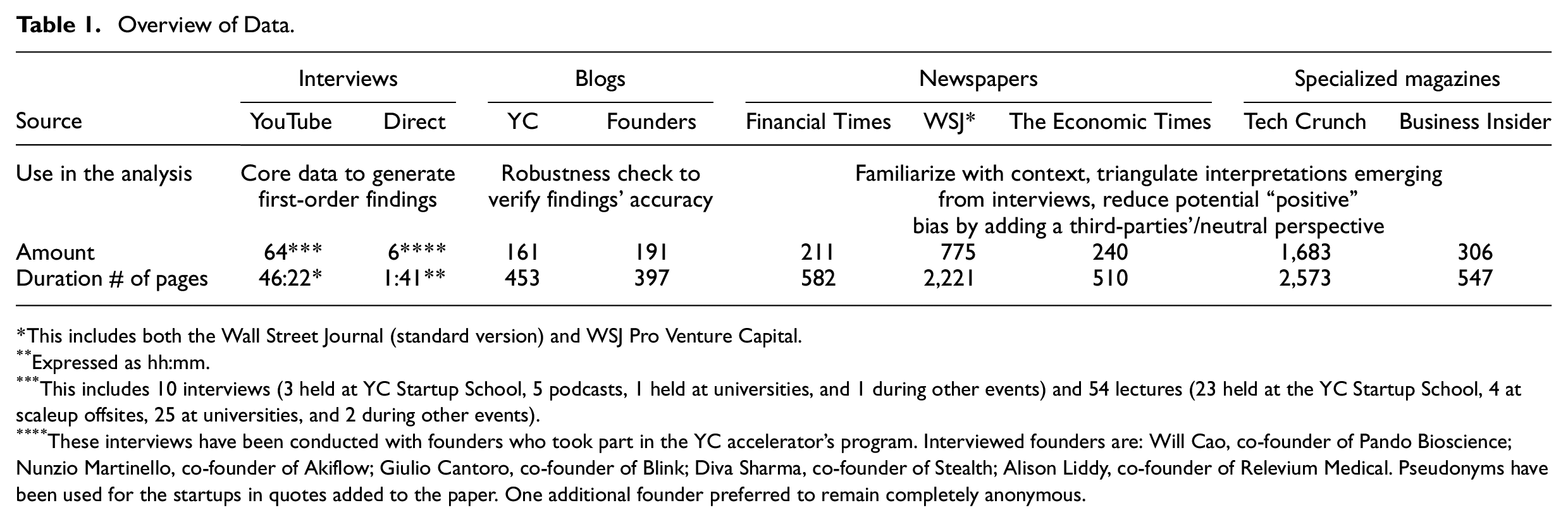
This includes both the Wall Street Journal (standard version) and WSJ Pro Venture Capital.
Expressed as hh:mm.
This includes 10 interviews (3 held at YC Startup School, 5 podcasts, 1 held at universities, and 1 during other events) and 54 lectures (23 held at the YC Startup School, 4 at scaleup offsites, 25 at universities, and 2 during other events).
These interviews have been conducted with founders who took part in the YC accelerator’s program. Interviewed founders are: Will Cao, co-founder of Pando Bioscience; Nunzio Martinello, co-founder of Akiflow; Giulio Cantoro, co-founder of Blink; Diva Sharma, co-founder of Stealth; Alison Liddy, co-founder of Relevium Medical. Pseudonyms have been used for the startups in quotes added to the paper. One additional founder preferred to remain completely anonymous.
Content Topics of the Secondary Audio-Visual Material.

Data Analysis
Our empirical investigation encompasses four interconnected stages, during which our gathered data serve various objectives.
Phase 1. Familiarizing With the Context of YC
While we were familiar with accelerators’ modus operandi in general and with that of YC in particular, we decided to perform an extensive and preliminary immersion in the phenomenon of interest before engaging in any formal finding-building activity. We decided to rely on different newspaper and specialized magazine articles to get a more objective and neutral perspective on YC and to eliminate (or, at least, mitigate) any preconception or prejudice we may have had. We independently read all the 3,215 articles that we had collected. This phase lasted approximately 6 months and allowed us to gain a fine-grained view of YC (e.g., its core activities, programs and services, its core values, its organizational structure and its leaders, the characteristics of its community and alumni-base, and its most successful alumni companies) through the opinions of actors both internal and external to YC (e.g., industry experts, journalists, entrepreneurs, and investors). We did not follow any formalized process during this phase because our goal was to familiarize with the object of our investigation in preparation for the following phases (Stigliani & Ravasi, 2012). However, we did methodically analyze this archival material in phase 4.
Phase 2. First-Order Findings: The Operative Actions
We then started an in-depth analysis of our audio-visual data to answer our theoretical question. Our goal was to identify patterns within the evolution of such questions, following the key procedural conventions for developing grounded theory (Strauss & Corbin, 1997). We generally followed the method described by Gioia et al. (2013), thus collecting and analyzing data, both independently and jointly, to discuss our respective interpretations. To start making sense of the raw material, we relied on common procedures for grounded-theory building (Locke, 2001). Specifically, we separately performed an open coding of the full transcripts of the audio-visual material and blog articles, trying to find pieces of informative text that described the key prescriptions of YC’s entrepreneurial training. After multiple reading iterations, we compared and reciprocally challenged the multiple codes that we had developed individually to validate our preliminary coding structure. Codes that resulted similar in essence were synthetized in first-order findings. We resolved a few discordances (less than 10% of our codes) through a joint re-reading of the transcripts, collegial discussions, and eventual re-coding, also through the support of the informative power of blog articles. For this specific phase, which lasted approximately 8 months, we relied on the transcripts of the audio-visual material as core data for the analysis, and we used blog articles to enrich and refine the interpretation of emerging categories.
Phase 3. Second-Order Findings: Key Paradoxes
The third phase began after the final refinement of our first-order codes. We aimed to aggregate the first-order findings into more theoretical and generalizable second-order themes. We observed that a pattern of contrasts was emerging and was linking our theoretical constructs, which we thus grouped into four core aggregate dimensions. A constant triangulation with existing theory (e.g., Schad et al., 2016; Smith & Lewis, 2011) played a crucial role: in fact, our goal was to gradually move from purely empirical first-order concepts to more theoretical dimensions (Gioia et al., 2013). We approximately needed 4 months to clear this phase. In addition, it is worth mentioning that during the aggregation of first-order codes into second-order themes, we noticed that some of the first-order codes were falling somewhat in-between two different second-order themes. We interpreted these instances as links that were bridging across different themes and used that as an additional criterion to aggregate the latter into consistent higher-order dimensions. This step represents an incremental innovation of the standard Gioia methodology and goes in the direction encouraged by the same authors: “we envision the approach as a ‘methodology’, rather than a ‘method’—that is, we see it as a flexible orientation toward qualitative, inductive research that is open to innovation, rather than a ‘cookbook’” (Gioia et al., 2013, p. 26).
Phase 4. Data Sources Triangulation and the Process Model
To ensure robustness, we triangulated our emerging codes and relationships also through an analysis of the archival material (i.e., newspaper and specialized magazine articles). We looked for concepts and narratives within the articles that resonated with our codes and themes. When relevant topics were identified, we wrote memos, that is, analytical notes aimed at reporting the most relevant insights acquired from data analysis (Strauss, 1987). We compared these memos with theory and previous findings to check the robustness and unbiasedness of our research. In a few cases, this led to a minor revisioning of previously conceived first-order findings and second-order themes. Then, building on the second-order themes and aggregate dimensions, we developed a process model to generate theoretical knowledge (Corley & Gioia, 2011; Mantere & Ketokivi, 2013) about the contribution of accelerators’ entrepreneurial training to ventures’ success. To unveil the relationships among our second-order themes, we moved to axial coding (Strauss & Corbin, 1990, p. 123). Overall, this last phase required about 4 months. Finally, to maximize the usefulness and clarity of our emerged model, we represented it on top of a simplified model of startup development. In fact, the manifestation of paradoxes within entrepreneurial ventures becomes more apparent when we analyze the dimensions that define the venture development process. Figure 1 displays our data structure, showing how first-order findings, second-order themes, and aggregate dimensions reflect paradoxical tensions, while Figure 2 visually shows the identified paradoxes in a simplified startup development model.
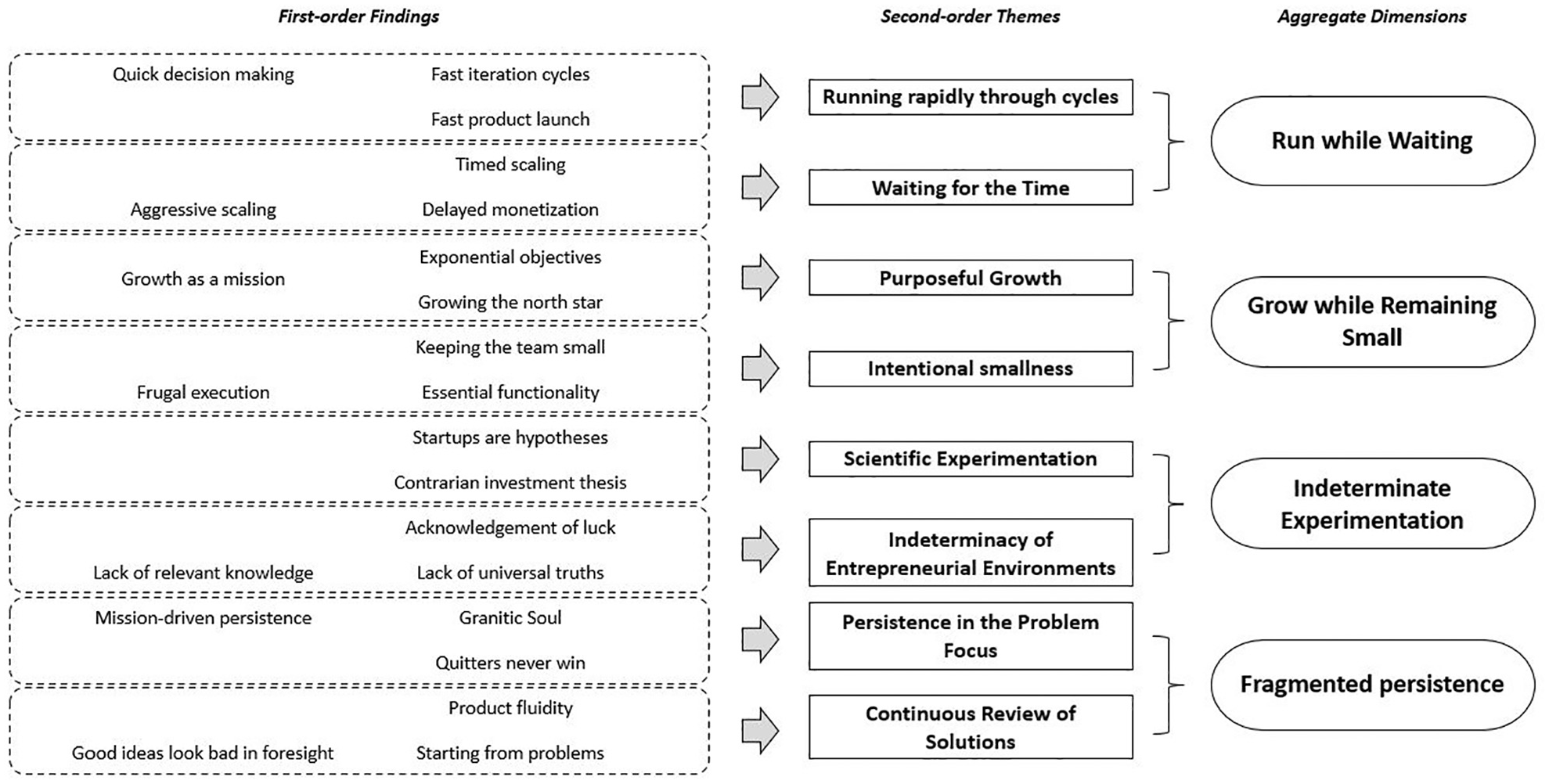
Data structure.
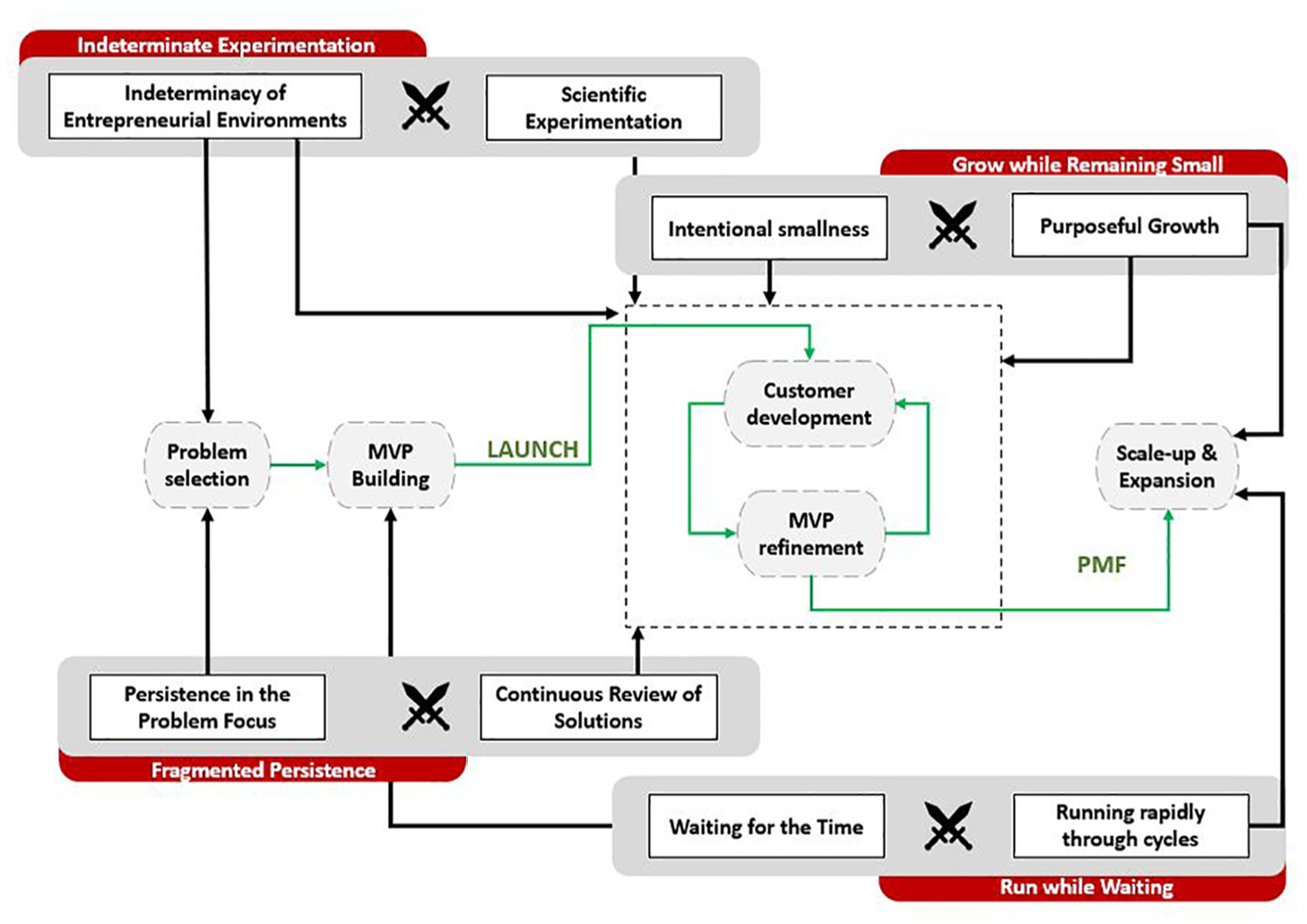
The four paradoxes on a simplified model of startup development.
Findings
Our findings show that an accelerator can contribute to the development of an entrepreneurial paradox mindset through multiple elements. The first part of the findings section focuses on the role played by the accelerator’s educational program, which reveals that founders are exposed to—and encouraged to embrace—four different types of paradoxes and related heuristics. The second part presents interrelated factors that contribute to the development of an entrepreneurial paradox mindset: the accelerator’s design choices and specific learning mechanisms (i.e., vicarious and experiential learning). Although our framework of entrepreneurial paradox mindset emerged after analyzing our findings, we introduce its graphical representation here, in Figure 3, to help readers follow our empirical evidence, which is organized around our rich framework.
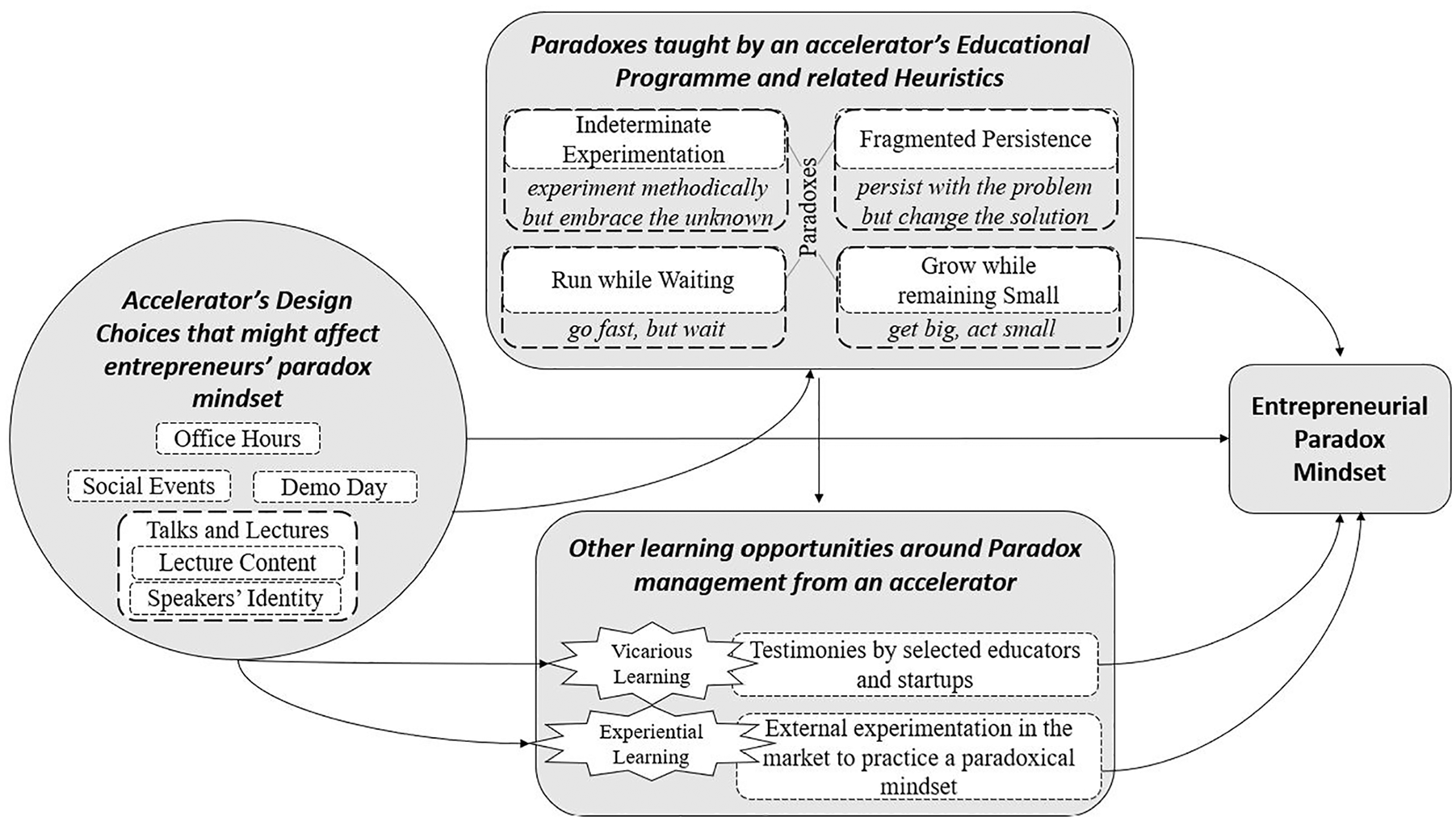
A framework of how accelerators can foster an entrepreneurial paradox mindset.
Four Paradoxes that an Accelerator Educational Program Can Teach
This first section of the findings is divided into four parts, each describing one of the four paradoxes and related heuristics that emerged from our study of YC’s educational program (see the upper portion of Figure 3). In each of these four parts, we outline the interdependent and contradictory components of the identified paradoxes that YC founders are exposed to, thereby fostering their ability to embrace paradoxes and develop a paradox mindset.
The Paradox of Indeterminate Experimentation
Our data show that YC’s entrepreneurial training teaches founders to develop their ventures scientifically by theorizing about markets, experimenting with product features, and making assessments based on empirical data. At the same time, however, the accelerator teaches also that entrepreneurship is an indeterminate context characterized by several unknowns, which makes methodological experimentation necessary but not sufficient to succeed.
Scientific Experimentation
At YC, founders are warned against the limits of business planning because it is not possible to figure out in advance all the unknowns, and because of that they are encouraged to verify empirically their business assumptions and to frame their ventures as hypotheses that need testing: A startup idea is basically an hypothesis. […] it is an hypothesis about why a company could grow quickly (Kevin Hale)
Founders are also pushed to develop their venture hypothesis based on a theory: some original insight they have about the market that explains why solving a particular customer problem would allow to build a profitable business. In our data, such theory is referred to in various ways (e.g., the secret, the contrarian truth, the contrarian investment thesis, and the insight), but the common element is that this theory should question and challenge some established belief at the core of a market. As such, this investment thesis should be non-obvious and unpopular: It is totally easy to have an insight when everyone else has the same insight. Have you ever tried to have an insight when it is not popular? Have you ever had an insight when people said that it is a bad idea? Most of the successful YC companies their ideas looked stupid when they started and if they were the types of people who were polling their friends in order to pick an idea, their companies would have never existed. (Michael Seibel)
At the same time, however, founders are also warned that their unpopular investment thesis could build on false premises and assumptions, and therefore, they need to empirically test hypotheses to confirm or reject their investment thesis.
Indeterminacy of Entrepreneurial Environments
Although YC’s educational program teaches scientific approaches to develop startups (e.g., hypothesis, assumptions, thesis, and experiments), it also emphasizes the truth about the indeterminacy of the entrepreneurial environment: It is not just that the outcomes of startups are hard to predict. I think to some degree they are actually indeterminate. (Paul Graham)
As observed in our data, in an indeterminate environment, the potential to experiment away the falsity of pre-existing premises and assumptions has serious limitations. First, it is not possible to truly ascertain the reliability of empirical results because it is not possible to control for all influencing variables, so that the experiments’ results may be false negatives or false positives.
Every billion-dollar company is like a unique product in a unique moment in time and if you were to do the exact something in a different moment in time there would be a different result. That is the opposite of science! […] We can’t experiment, it’s not repeatable, we can’t run true experiments. (Michael Seibel)
Second, and relatedly, the pre-existing knowledge on which founders build their investment thesis is, by definition, scarce. Founders are told that the only chance that resource-constrained small ventures have to become large and profitable companies is to avoid competition, which requires creating a product so innovative that it can become the first of a new category. In other words, founders need to create a new market where they have monopolistic power. This high degree of innovativeness that poses additional limits to the usefulness of pre-existing knowledge: If you are trying to do a startup, you are signing up for just like death. It’s like basically sure death. […] So, know that you are signing up for something ridiculously hard and just be cool with it. (Michael Seibel)
As a result, founders are explained that embarking on the project of building a venture that aims to grow quickly and profitably implies operating in a context that lacks universal rules and where even the same methodologies that they are encouraged to adopt have serious limitations and cannot guarantee that the venture will succeed: It is not a simple recipe. It is not “insert a capital, insert a little technology, stir, it happens.” So, there is heuristics not rules, there is ways to think about this, and so that is the kind of thing we’re doing and is more or less big concepts. (Reid Hoffman)
Finally, due to the unreliability of empirical results, pre-existing knowledge and universal guidelines, founders are taught that the role played by luck is ultimately prominent: The outcome is something like: idea times product, times execution, times team, times luck, where luck is a random number between 0 and 10,000. Literally that much. (Sam Altman)
Summary of the First Paradox and Related Heuristic
As shown, YC’s simultaneous teaching about “scientific experimentation” and the “indeterminacy of the entrepreneurial environment” contains inherently contradictory yet interdependent aspects, which is what constitutes a paradox according to management theory (Smith & Lewis, 2011). We labeled this first paradox as “indeterminate experimentation.” The paradox consists of teaching founders to adopt a scientific experimental approach by relying on empirical data for hypothesis confirmation while educating founders about the unsuitability of new venture development for real hypothesis testing due to entrepreneurial indeterminacy. Acknowledging both aspects is important to teach the benefits of the empirical experimentation method while recognizing that it will only be tentative in the startup context. Therefore, we found that YC exposes founders to a tension where contradictory aspects need to be embraced rather than reconciled. As noted by Reid Hoffman quoted above, heuristics (see Holcomb et al., 2009) are to be used to embrace similar challenges. We found that YC instills in founders the heuristic of “experiment methodically but embrace the unknown” which recognizes the value of empirical validation in reducing uncertainty while acknowledging that entrepreneurial success remains inherently high-risk and reliant on serendipity.
The Paradox of Fragmented Persistence
In the first two stages of the venture development process, founders need to develop an investment thesis that challenges established business assumptions and test it through empirical evidence. These tasks require a certain degree of trust in the business hypothesis but also openness to reject them based on unsupportive market data. Founders are thus simultaneously exposed to a tension between the necessity of persistence in the long-term vision of the problem and the required flexibility for continuous reviewing of their proposed solutions. Such a tension represents a paradox because these aspects are difficult to reconcile simultaneously in that “persistence in the problem focus” requires emotional attachment while the “continuous reviewing of solutions” requires emotional detachment.
Persistence in the Problem Focus
Founders are explained that the market potential of a new venture is determined by the characteristics of the particular problem (e.g., diffusion, frequency, urgency, and expensiveness) that they decide to solve, rather than by how promising a certain product idea may seem ex-ante: They [entrepreneurs] think their solution is the genius part. I think the problem is the genius part. I think that figuring out a problem that other people have not figured out is worth working on is the genius part (Michael Seibel)
Founders are urged to anchor themselves to the identified problem despite inevitable hardships. Iteration cycles accumulate knowledge about the problem and customer experiences, emphasizing a relentless focus on problem-solving. Our dataset highlights that persisting with the initial problem is crucial for transforming an extravagant MVP into a widely adopted success. Conversely, pivoting—shifting the product to solve a different problem—is deemed counterproductive, as the accumulated problem-related knowledge loses substantial value, hindering venture development: If you pivot over and over again it causes whiplash. Whiplash is very bad because it causes founders to give up and not wanna work on this anymore and that actually kills the company […]. If you get sad and hate your life while you are working on your startup you will definitely not succeed and it’s because you will give up. (Dalton Caldwell)
As founders are supposed to stay committed to the problem for a long time, they are advised to select it carefully, based on the sense of purpose, pride, and motivation that they anticipate they would obtain from solving it: Building a company is hard. It’s a long process and there will be some really difficult times and if you are not proud of what you are doing you will not maintain the level of energy and enthusiasm you need to sustain the company. (Tim Brady)
In turn, the sense of purpose that derives from the mission to solve a specific customer problem is deemed to be the pillar on which the founders can develop an enduring vision, which becomes the element of continuity that keeps together the venture and its people throughout numerous changes and hardships: Airbnb, you know, a lot of people describe it as a way to book a room or house and you travel around the world. And that is what we do. But that is not at all why we do it […]. We want to help bring the world together and we want to do that by giving a sense of belonging anywhere you go. So, our mission is to belong anywhere. So, 5 years from now, 20 years from now, maybe we are still selling rooms and houses but maybe we are not. But I can guarantee you that we are always going to be about this sense of belonging and bringing people together. And that is the more enduring idea. (Brian Chesky)
Continuous Reviewing of Solutions
Since the inception of the venture, founders are encouraged to see products as experiments aimed at testing their hypotheses that a certain set of features solves a particular problem of the targeted customer. As the ex-ante understanding of the customer and of its problem is likely to be underdeveloped, YC warns founders that the first versions of the product that they will launch are likely to be not successful.
The product you launch with and the feature set you launch with is almost certainly not going to be the feature set you scale with. (Walker Williams).
Contrary to traditional businesses, the product, the business model, and/or the market strategy are considered unknown and something that can be revealed only through experimentation with different product features and learning about customers. Founders are encouraged to review their solutions through experiential learning by iteratively undergoing through phases of product building and interaction with the customers. Founders are requested to continuously improve their knowledge of the customers, figure out what new value-adding features can be incorporated in the next product versions, and then test whether they are effective. Since the initial stages, founders are dissuaded from forming a fixed vision or emotional attachment to their product. The rationale is that constant reviewing, prompted by unexpected directions, becomes challenging with ingrained initial assumptions. Finally, founders are also warned against product ideas or concepts that sound promising early on and are encouraged to build on unconventional assumptions and to operate in market spaces that ex-ante look extravagant and unlikely but via experimentation and refinement can give the startup a huge leadership position: I love it when ideas seem implausible in the right way! (Paul Graham)
Summary of the Second Paradox and Related Heuristic
As shown, YC teaches founders to embrace a paradox that we have labeled as “fragmented persistence” consisting of a simultaneous persistent focus on the problem and continued flexibility to change solutions. Persistence in the problem focus requires emotional attachment for enduring vision, while a continuous reviewing of the solutions demands emotional detachment for adaptability, and that creates an inherent tension. The pressure for persistence requires founders to remain resolute in realizing their long-term vision, instilling a sense of purpose, but this anchoring makes it challenging to accept negative feedback and to question their solutions or product versions. To embrace this paradox, YC essentially instills in founders the heuristic “persist with the problem but change the solution.” Such a heuristic can be utilized as a guiding principle to navigate the paradox: by assigning different scopes to persistence and flexibility, YC partially relieves founders from the anxiety and frustration that emerge when negative market feedback challenges their pre-existing beliefs, assumptions, and hypotheses. Interestingly, YC’s emphasis on remaining committed to the problem contradicts the conventional wisdom of prioritizing solutions. However, we found this approach to be highly effective in entrepreneurial decision-making: Be radically critical of whether the solution is actually solving the problem and be willing to change it, modify it or throw it away because it is not solving the problem. That doesn’t mean changing the problem you are solving. (Michael Seibel)
The Paradox of Run While Waiting
Our data reveal that two antithetical time-related pressures are simultaneously exerted on the founders: the pressure to progress quickly through iteration cycles and the admonishment that the scaling process is not supposed to begin prematurely. Hence, the founders’ ability to manage time correctly plays a crucial role in a venture’s development.
Running Rapidly Through Cycles
An abundance of references in our dataset evokes a pervasive sense of urgency. In general, founders are pushed to make decisions rapidly and to act fast. Conversely, procrastination, delay, and inactivity are seen as the greatest threats to new ventures’ development: The only way to make progress is making decisions. Procrastination is the devil in startups. So, no matter what you do, you gotta keep that ship moving. (Ron Conway)
Such a sense of urgency is especially intense for the activities that relate to launching and refining the MVP: The quote […] that I will never leave down is that “if you are not embarrassed by your product release, you released too late.” The whole point of that quote is to say the importance of speed and the importance of time (Reid Hoffman)
Launching a first version of the product as quickly as possible allows founders to start accumulating knowledge early. To reduce uncertainty about unanticipated variables and to test the validity of pre-existing business assumptions, in fact, founders are strongly encouraged to and continuously reminded of interacting with their customers and observing their consumption behavior. Such activities are deemed conducive to developing a better understanding of the customers’ problem and the product’s performance. As previously mentioned, for highly innovative products, the first versions are expected to perform poorly and the initial assumptions to be incorrect. The founders’ priority is thus to improve the product’s performance by developing first-hand knowledge of the market space, that is by progressing rapidly through iteration cycles: The trick is not in being a genius and getting a 100% at choosing the right solution for the problem. The trick is how quickly you can cycle through solutions. (Michael Seibel)
Waiting for the Time
While our data contain abundant evidence of the importance of executing quickly, they also contain as many references as possible about the importance of waiting for the right time to act. In general, while founders are encouraged to make decisions and solve problems fast, they are also warned not to jump the gun and address problems ahead of time: One of the key things in both startups and scaleups is to solve problems at the right time, do not pre-solve them. (Reid Hoffman)
Interestingly, our data reveal that speed does not apply to all dimensions of progress. While the importance of speed is emphasized for technical activities such as building products, getting customer feedback, and growing the customer base, founders are explained that it is risky to scale the venture too early: We have a say at YC: “don’t peak in high school.” If demo day is the best day in your startups, that is not a good sign. If you are peaking in the first year of your startup, not a good sign. (Michael Seibel)
In fact, our data suggest that all the activities that relate to growing the organization (hiring, adding functions, building capacity, optimizing for profitability, etc.) are not supposed to take place before the product hits market-fit. As per YC’s motto “build something people want,” the fundamental belief is that there is no point in building structure on a product that does not have enough traction yet: don’t go and do growth tactics, go and do virality, don’t hire a growth hacker. Focus on getting product market/fit because, in the end […], if you don’t have a great product there’s no point executing well on growing it because it won’t grow” (Alex Schultz)
Scaling the venture appears to make sense only at the right time, that is, when the customer base is growing organically due to repeated usage, customer retention, and positive word of mouth. Before this happens, founders are warned that scaling the organization not only is unlikely to trigger an expansion of the customer base, but it is actually likely to be counterproductive because the management of a larger organization would distract the founders from the primary operating activities: Above six to eight people you move slower as you hire more people because you have to introduce management. So now the founders, who are typically the most talented people in the team, are spending time managing and they are not spending their time talking to customers and building. (Michael Seibel)
Interestingly, the emphasis on speed comes back after the founders find PMF because the venture should scale as quickly as possible at that point. Our data suggest that scaling aggressively allows funders to defend their first mover advantage in a market that will soon attract the interest of the competition. In addition, scaling also implies further expanding the customer base, which is necessary to start optimizing for profitability.
Scale aggressively once you achieve PMF. So, at this point presumably you have either found or created a new market but it is likely you are not the only one. You may have not heard of your competitors yet but there are probably other people out there doing the same thing. You are in a race to capture this new market and advantages accrue to the number one player, they always do. (David Rusenko)
Summary of the Third Paradox and Related Heuristic
As shown, the emerged themes of “running rapidly through cycles” and “waiting for the time” characterize the third paradox of run while waiting. Founders at YC are urged to make swift decisions, launch MVPs rapidly, and achieve PMF through fast iteration cycles. However, YC also teaches that the emphasis on speed must not lead to premature problem-solving or scaling before PMF, in order not to invest resources when market uncertainty remains high. At the right moment, the scaling stage will demand quick engagement in company-building activities to capture market share. Therefore, founders are advised to embrace both rapidity of action and patience for the right time. Such a paradox encapsulates the need for founders to discern what to grow rapidly and what to avoid scaling prematurely. The heuristic “go fast, but wait” guides founders to expedite product performance, customer base expansion, and market knowledge while avoiding premature scaling and optimization until conditions are favorable.
We know we need to be operationally efficient. We know we need to be focused on operating margins and how costs work and how scale works and everything else in a capital efficient model… but not yet! (Reid Hoffman)
The Paradox of Grow While Remaining Small
Finally, our data highlight that founders are pushed to pursue ambitious growth objectives while staying modest, maintaining a small and lean organization that burns as few resources as possible.
Purposeful Growth
In line with YC’s founder’s belief that “Startup = Growth” (Graham, 2012), YC’s entrepreneurial education gives founders the objective of making continuous and exponential progress. As such, growth is seen as the fundamental mission that should characterize the very character and essence of the venture: My contrarian viewpoint, or whatever, is: if you are a startup, you shouldn’t have a … growth team […]. Startups should not have growth teams. The whole company should be the growth team. (Alex Schultz)
Founders are invited to carefully select a single metric that can accurately capture the utility that customers get from using the product. Founders are also explained that such metric, referred to as the North Star, is usually a measure of repeated purchase (e.g., recurring revenues) or repeated usage (e.g., active users) because repeated consumption highly correlates with both customer retention and virality, which are the elements that ultimately drive the expansion of the customer base. Founders are then encouraged to grow the North Star through small and frequent (i.e., weekly or bi-weekly) improvements because constant improvements instill a sense of progress and enhance motivation.
The goal of your startup is to grow your primary metric. […] Each week your goal should be to set a weekly growth rate. (Adora Cheung)
Most importantly, however, the explicit objective of increasing the North Star of even a small percentage every week is necessary to achieve exponential growth, as small and frequent improvements compound over time.
A company has to get better at something 10% each week in the early days. And if you compound, if you can have this product cycle, or whatever you are building, that is 10% better every week and you project that out, you do that for 3 or 4 years, then you are like, you know, a really big company. (Sam Altman)
Intentional Smallness
While the growth objectives that founders are given are ambitious, their means are supposed to stay modest and parsimony should characterize both the structure of the venture and the way founders operate. First, founders are instructed to keep costs at a minimum because monetization is often delayed. A particular emphasis is put on keeping the team size small, as employees’ salaries absorb a significant amount of cash and the number of founders that exceeds three tends to correlate with conflicts.
No more than 6 people, no more than 8 people. Like that range is kind of the optimal range. […] The sad part of this is that I often have to talk to these companies and I have to tell them that they have to lay off all these people they hired… (Michael Seibel)
Second, modesty should also characterize the products that founders build. They are discouraged from realizing complex solutions rich of features and pushed to focus on a single dimension of the product’s performance while maintaining limited functionality in all other aspects of the product: You want to start intentionally small. […] you create a product that will slip in between the gaps of other existing products […]. Maybe you are just starting a sliver of the use case and then you are going to expand out, but you intentionally start small (Aaron Levie)
Third, founders are asked to be parsimonious and modest in how they operate. On the one hand, they are discouraged from raising money early and encouraged to use their limited resources in the most efficient way possible because frugality is considered a driver of creativity, novelty, and innovation.
We believe constraints bring out creativity and when you raise 100 million dollars suddenly all that scrappiness is easy to lose […], and whenever someone is not being just like frugal and not being creative, or they tell me they can’t do something, I’ll just take a box of cereal to suggest that they need to be scrappy and frugal. (Brian Chesky)
On the other hand, founders are also warned that they cannot expect to be able to solve all the problems that continuously emerge in a new venture and that solutions to these problems do not need to be elegant and robust, but rather “quick and dirty.” As such, founders should address only the few key problems that threaten the venture’s survival in the shortest amount of time possible through manual solutions and simple processes that are not required to stay in place for the whole life of the venture.
Part of the entrepreneurial journey—and that happens even when you are at a scale of thousands—is: there are fires burning when you are going home. That’s fine. You have to know with which fires it is ok to go home […] and which one you can’t. (Reid Hoffman)
Summary of the Fourth Paradox and Related Heuristic
The themes “Purposeful Growth” and “Intentional Smallness” encapsulated within the paradox “Grow while remaining Small” signify contradictory elements of ambitious growth intentions and modest execution. Founders are advised to pursue challenging growth objectives in product and venture metrics while building products with limited functionality, keeping the venture small and cost-effective. The paradoxical tension arises from the asymmetry between ambitious goals and constrained means. The heuristic “get big, act small” advises founders to have as the ultimate goal to build a rapidly growing and large company but to use small resources, teams, and features: Figuring out how to win is often described as just figuring out how not to die long enough (Michael Seibel)
Accelerators’ Design Choices and Learning Mechanisms Fostering a Paradox Mindset
This second part of the findings details the contribution of an accelerator’s design choices and enabling learning mechanisms to the development of a paradox mindset (see the left and bottom portions of Figure 3). As a starting point, our data suggest that entrepreneurs became well aware of the presence of multiple paradoxes in entrepreneurship after taking part into the YC program: In general, we learnt there are many tensions at play. As I mentioned earlier, some of these arise from human factors—entrepreneurs often have bigger egos than others, so they can become overly attached to their ideas, which is good, but in doing so they may not be used to receiving feedback. I also think there’s sometimes a missing mindset: the drive for high performance. And by that, I do not mean working excessively or being a workaholic. I mean working with intense focus toward a clearly defined goal—being able to set that goal and channelling all your energy in that direction, but also be prepared to change something when necessary. (Co-founder at Alpha).
Like other accelerators, YC makes design choices regarding cohort admission, the profile and background of advisors and managing directors, the educational program, batch retreats, and graduation events, among other elements (see Cohen, Bingham, & Hallen, 2019). We found that these choices, in turn, are conducive and reinforce vicarious and experiential learning for founders. For instance, the speakers and mentors who take part to the YC’s acceleration program show attitudes that are consistent with an emphasis on paradox embracement, as shown in our quotes above. In so doing, they convey paradox-related teachings via vicarious learning or observation (Bandura, 1977). An evidence of founders’ vicarious learning from mentors, also related to the paradox “fragmented persistence,” was: The YC partner team helped us process strategic and tactical challenges, which are tied directly to the partners’ experience as successful founders themselves. They have an incredible mentorship program, and they can help you stay on track to meet the goals you set. […] (Frank Licea, co-founder of Howdy.com)
Similarly, a founder also highlights how mentors frequently made reference to the paradoxes that can emerge during the entrepreneurial journey: [The mentor] explained how things work in practice, highlighting another common paradox in entrepreneurship: should you market your product before building it? Traditionally, the sequence is to build first and then market, but this can lead to discovering—too late—that there is no demand. In contrast, by engaging with potential customers early and gauging interest, you can identify your audience before investing in development. (Co-founder at Beta)
The frequent interactions with other startups, which begin with YC’s 3-day batch retreat and continue during the program and even after Demo day through YC’s alumni network, allow founders to socialize and develop personal relationships with both YC’s mentors and other funders. These interactions enable vicarious learning via exposure to and observation of people that share the same core approach to startup development and management. YC’s highly exclusive acceleration program, with an acceptance rate of only 1%–3%, increases the likelihood that selected founders are quite homogeneous in terms of capabilities and aspirations, which ensures a certain degree of compatibility and fosters mutual learning and collaboration among participants. Evidence of vicarious learning among founders includes: It’s so important that multiple people have described a startup as existing in only two regimes, before PMF and after PMF. I have seen it myself in talking to founders on both sides of it. […] Before PMF it is in the depressive stage, filled with existential angst over its place in the world, not sure if it should keep going on or not. After, it is manic, trying to productively focus its flailing energy and not harm itself in the process. Your first goal as a startup is to go from being depressive to being manic. (Eric Landau, co-founder of Encord). The second important aspect is being part of a cohort—other founders who are all building things alongside you. That shared experience is incredibly valuable, especially when you hear their stories and engage in discussions around the topics you’re all exploring. The sense of community is, without a doubt, a crucial part of the experience and I learnt a lot from them. (Co-founder at Gamma).
Experiential learning is highly encouraged at YC through a strong emphasis on engaging directly in interactions with customers and activities related to product development. In fact, the pursuit of PMF via relentless product experimentation and validation based on market data, which resonates with the identified paradoxes: Another thing about “doing things that don’t scale” is that it allows you to become an expert in your business. You know, like driving helped us understand how the whole delivery process worked. We used that as an opportunity to talk to our customers to talk to our restaurants. We did dispatching that helped us figure out, you know, we manually dispatched every driver and that helped us figure out, you know, what our driver assignment algorithm should look like. We did customer support ourselves, you know, getting real time feedback from our customers. (Stanley Tang, co-founder of DoorDash).
In sum, an accelerator’s design choices, the opportunities for vicarious and experiential learning, and the direction of the accelerator’s educational program all contribute to the development of an entrepreneurial paradox mindset, which is a fundamental learning outcome that emerges from our analysis. Two pieces of evidence of how YC shape the mindset of its startup funders, often instilling a paradox mindset, are: I think the best piece of advice I can give, from my experience, is to build your business in such a way that it has a high likelihood of failure. But, if it succeeds, it will go stratospheric and take over the entire market. (Gary Lin, co-founder of Airwork) A startup should only ever get faster—adding more employees should add output/velocity, adding another feature should unlock more customers, more time means better processes. YC gives founders a reason to create this DNA inside their company, and then after the batch it’s up to the founder to continue the mindset. (Paul Copplestone, co-founder of Supabase)
Figure 4 provides additional evidence of the development of an entrepreneurial paradox mindset from the perspective of founders, by taking into account the main elements of our framework illustrated in Figure 3.
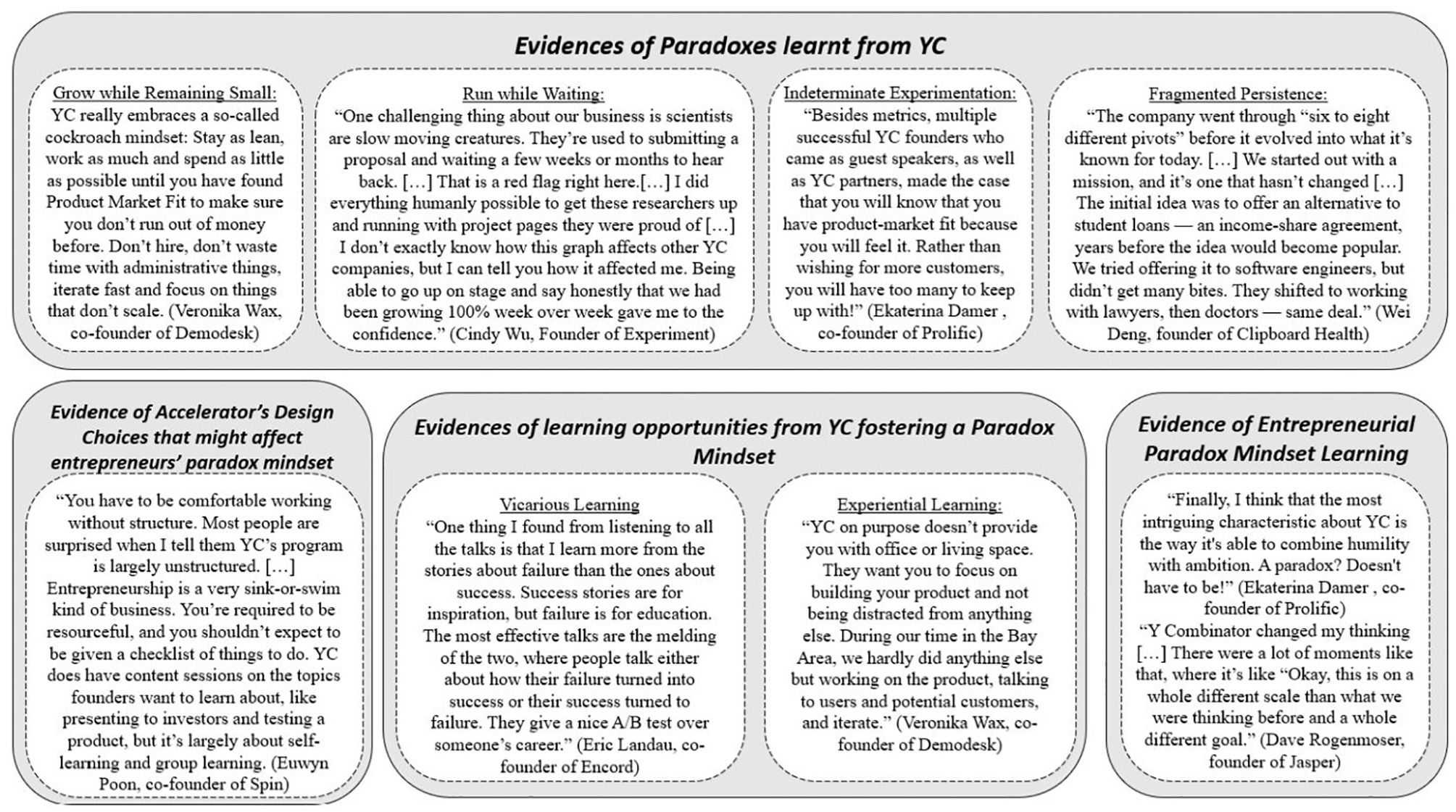
Evidence of paradoxes learnt from YC.
Discussion
Our analysis of the data led us to develop a conceptual framework of how accelerators can foster the development of an entrepreneurial paradox mindset. The framework highlights how an accelerator’s educational program can teach four paradoxes to startup founders: Indeterminate Experimentation, Fragmented Persistence, Run while Waiting, and Grow while Remaining Small. Our evidence also shows that heuristics can simplify decision-making about these paradoxes. Importantly, the framework also links the accelerator’s design choices—including the selection of speakers, mentors, and market-testing activities—with the opportunity for a founder to generate vicarious and experiential learning. Together, these elements work in concert to foster and refine an entrepreneurial paradox mindset among startup founders. Taken together, these findings underscore that accelerators are not merely conduits for knowledge and resources but strategic educational environments that actively shape founders’ entrepreneurial mindset even to the point of enabling paradoxical thinking.
Theoretical Contributions
Integrating Paradox Theory Into Entrepreneurship
This study introduces paradox theory (Lewis & Smith, 2014; Smith & Lewis, 2011) into entrepreneurship research. While past entrepreneurship studies have examined contradictory demands in startup development (DiVito & Bohnsack, 2017; Garud et al., 2014; Kacperczyk & Younkin, 2017; Pinelli et al., 2020), they have not explicitly built on paradox theory. Conversely, paradox theory has mostly focused on traditional and medium-large enterprises (Schad et al., 2016; Smith & Lewis, 2011). By bridging these perspectives, we not only advance entrepreneurship research but also extend paradox theory to the context of nascent, resource-constrained ventures. Our specific contributions lie in uncovering the implicit commonalities between the two research streams and in showing how insights from paradox theory can be applied to entrepreneurship research. Regarding the identified commonalities, both perspectives recognize the value of similar factor conditions: resource scarcity, change, and plurality of stakeholders are not only critical to the emergence of paradoxical tensions (Smith & Lewis, 2011) but also represent fundamental environmental conditions in which startups operate. Moreover, both perspectives emphasize the role of experience: paradox theory identifies experience as crucial for recognizing, accepting, and ultimately embracing tensions (Miron-Spektor, Ingram, Keller, et al., 2018), and experience is equally crucial in entrepreneurship. These shared foundations suggest that insights from paradox theory can be applicable and relevant for entrepreneurship research. Our findings show that important insights from paradox theory apply to entrepreneurship. In particular, the recommendation from this theory to embrace the positive aspects of opposing elements rather than choosing between them (Smith & Lewis, 2022) is consistent with what we observe in our study of a startup accelerator. Moreover, the key insight from paradox theory that a both/and mindset enhances performance, creativity, and satisfaction, compared to either/or thinking (Miron-Spektor, Ingram, Keller, et al., 2018; Smith & Lewis, 2022), aligns with our findings that accelerators can play a critical role in fostering a paradox mindset to drive innovation and scalability. Finally, the notion of “paradox mindset” (Miron-Spektor, Ingram, Keller, et al., 2018) aligns with our evidence that startup founders must cultivate an “entrepreneurial paradox mindset” to balance conflicting demands, reframing challenges, and devising creative solutions. By integrating the notions of paradox mindset (Miron-Spektor, Ingram, Keller, et al., 2018) and entrepreneurial mindset (McGrath & MacMillan, 2000), our newly introduced concept of entrepreneurial paradox mindset also extends paradox theory and contributes to the field of entrepreneurial cognition (e.g., Mitchell et al., 2002).
Deepening the Understanding of Accelerators and Educational Programs
Previous studies on accelerators have examined their role in providing resources, networks, education, and strategic guidance, and their performance impact (Bergman & McMullen, 2020; Cohen, Fehder, Hochberg, et al., 2019; Hallen et al., 2020; Ratinho et al., 2020). However, they have not investigated whether and how accelerators can enhance founders’ ability to navigate inherent contradictions. This knowledge gap is significant as accelerators are extensively used by startups (e.g., Assenova & Amit, 2024; Hallen et al., 2020) and understanding whether and how they can help managing paradoxes is crucial as startups face numerous paradoxical tensions (e.g., DeSantola and Gulati, 2017; Kacperczyk & Younkin. 2017; Sullivan, 2016). Our contribution derives from showing that accelerators’ educational programs can expose founders to paradoxes, equip them with heuristics for effective management, and create enabling conditions via thoughtful design choices and learning opportunities—thus collectively fostering the development of a mindset that predisposes founders to embrace paradoxes.
Our study offers new insights into the impact, functioning, and internal processes of accelerators. Indeed, our primary finding is a framework (Figure 3) illustrating how accelerators can help founders in developing an entrepreneurial paradox mindset. Our data suggest that accelerators achieve this by teaching the importance of embracing paradoxical tensions, demonstrating key paradoxes faced by ventures, and providing practical heuristics to help founders make decisions amidst conflicts. At the same time, our findings reveal that accelerators stimulate learning about paradoxes by creating opportunities for both experiential and vicarious learning, while tailoring the teaching and learning processes through deliberate design choices, such as the selection of classrooms, speakers, schedules, and more.
As a result, we contribute to the literature on entrepreneurial education and design choices (Assenova & Amit, 2024; Cohen, Fehder, Hochberg, et al., 2019) by showcasing the interplay between entrepreneurial education, design choices, and learning modes in achieving new cognitive outcomes. Our study uniquely integrates insights on accelerators’ design choices (Cohen, Fehder, Hochberg, et al., 2019), paradoxical teachings (Smith & Lewis, 2011) for new ventures, decision-making tools such as heuristics (Bingham & Eisenhardt, 2011), vicarious learning (Bandura, 1977; Park & Puranam, 2024), and experiential learning (Corbett, 2005; Kolb, 2014). This offers significant advancements to studies on entrepreneurial education, particularly those comparing accelerators and business schools (Bhatia & Levina, 2020; Garbuio et al., 2018; Mustar, 2009), as well as to research on the impact of accelerators’ design choices.
Moreover, we extend prior work on the architecture of entrepreneurial learning (Holcomb et al., 2009) by identifying learning about embracing paradoxes as a crucial new building block. While prior research has shown that entrepreneurs benefit from heuristics and social learning within accelerators (Assenova & Amit, 2024; Cohen, Bingham, & Hallen, 2019; Cohen, Fehder, Hochberg, et al., 2019; Hallen et al., 2020), our study reveals that a combination of teaching and diverse learning mechanisms—specifically vicarious and experiential learning—can foster the development of an entrepreneurial paradox mindset. By teaching founders about paradoxes and exposing them to paradoxical decisions, accelerators enable founders to directly recognize and embrace conflicting priorities.
Finally, the finding that accelerators can cultivate a paradox mindset contributes to entrepreneurial cognition (e.g., Mitchell et al., 2002) and paradox theory and provides broader implications for research on creativity and innovation. Embracing paradoxes has been shown to enhance creativity, strategic agility, and resilience (Boemelburg et al., 2023; Ingram et al., 2016; Smith & Lewis, 2011, 2022; Zhang et al., 2022). Importantly, we argue that an entrepreneurial paradox mindset can be stimulated or further developed through formal education, experiential learning, and vicarious learning within accelerator programs, consistent with findings from paradox theory in other empirical settings. Paradox theory demonstrates that exposure to paradoxical sentences, goals, and situations enhances individuals’ ability to resolve conflicting tensions with creative, non-obvious solutions (Miron-Spektor et al., 2011; Rothenberg, 1996). Thus, paradox theory supports our claim that a paradox mindset can be cultivated in founders during and as a result of participating in an accelerator program. In addition, the finding that accelerators can help develop an entrepreneurial paradox mindset also extends research showing how accelerators mitigate entrepreneurs’ bounded rationality (Cohen, Bingham, & Hallen, 2019).
Implications for Practice
From a practitioners’ standpoint, our findings offer actionable insights for entrepreneurs, accelerator managers, and startup mentors by emphasizing how embracing paradoxical tensions can improve strategic decision-making and foster innovation throughout the entrepreneurial journey.
First, our study highlights (a) that startup founders are likely to face challenges from paradoxical tensions throughout a venture’s life cycle; (b) that these challenges can be either paralyzing or a source of inspiration and creativity; and (c) that developing familiarity with paradoxes can help develop a psychological disposition to thrive under the pressure of conflicting demands and priorities. Building on these insights, we invite entrepreneurs to consider that, when confronted with paradoxes, making “tough choices” (e.g., prioritizing or “choosing the lesser evil”) is not their only option. Instead, embracing these tensions (e.g., growth vs. frugality, speed vs. thoroughness) can unlock unique opportunities for creativity and strategic agility. We also caution entrepreneurs that, to ensure that paradoxes act as enablers of—rather than obstacles to—innovation and creativity, they need to proactively accumulate experience with scenarios and dilemmas that involve reconciling conflicting elements. This applies both at the knowledge level and in practical terms. As such, entrepreneurs may want to seek experiences that expose them to contradictions (e.g., undergoing an acceleration program, engaging directly with activities related to product and customer development) and to interact socially with peers and more experienced entrepreneurs and mentors. These interactions help them leverage experiential and vicarious learning opportunities and acquire heuristics that clarify how paradoxes can best be approached and resolved.
For accelerator managers, our findings highlight the pivotal role that deliberately designed acceleration programs can play in developing founders’ entrepreneurial paradox mindset. Managers are, therefore, advised to make design choices about their programs that actively foster the growth of such a mindset. This can be achieved, for instance, by exposing founders to paradoxical scenarios (e.g., trade-offs between bold risk-taking and prudent caution), assigning tasks that directly involve paradoxical tensions, and requiring founders to make decisions about conflicting demands. Furthermore, accelerator managers should consider organizing structured reflection sessions to help founders internalize their lessons from paradoxical challenges, while promoting environments that encourage social interaction, enabling founders to learn from the behavior and experiences of their peers. Importantly, managers should be aware that formal teaching, experiential learning (hands-on problem-solving), and vicarious learning (observing others) collectively contribute to fostering an entrepreneurial paradox mindset. As such, program design should integrate all these elements cohesively to maximize learning impact. Finally, startup mentors and advisors should guide founders through the complexities of strategic decision-making related to paradoxes. They can achieve this by teaching actionable tools and frameworks that simplify the process of addressing conflicting priorities, organizing practice sessions to reframe conflicting demands (e.g., innovation vs. resource constraints), and sharing personal experiences; mentors can foster experiential and vicarious learning. These efforts build founders’ confidence and competence in addressing paradoxes strategically and creatively.
Limitations, Generalizability, and Future Research
The study presents some limitations which represent opportunities for future research. First, we acknowledge that our empirical analysis relies primarily on abundant secondary data and uses only six personal interviews. While this might be a limitation, it also offers notable advantages. In particular, since our raw data are publicly available, our claims and quotes are easily verifiable and demonstrably free of misrepresentation. Moreover, to increase the robustness and validity of our findings, we supplemented the archival audio-visual material (interviews, lectures, talks, etc.) with a multitude of additional data sources, including newspaper articles, consulting reports, specialized business magazines, and blog posts. The heterogeneity of these sources in terms of origin, publication date, and purpose mitigates this limitation.
Another limitation is our focus on a single case study. Although YC has funded over 4,000 startups across diverse market spaces and verticals, this may constrain the external validity of our findings. However, concerns about external validity may be mitigated for two reasons. First, YC’s pioneering role and consistent success have established it as an influential model that has shaped many accelerators globally. Second, the paradoxical tensions examined in this study are challenges that most startup founders are likely to encounter. Thus, it is unlikely that our findings are unique to YC. For instance, accelerators like Techstars, which foster more frequent peer interactions (Cohen, Fehder, Hochberg, et al., 2019), may amplify mechanisms of vicarious and experiential learning. Conversely, YC’s approach, which limits peer interactions, may enable stronger control over the mindset instilled in founders. Future research could address the generalizability problem by exploring, for instance, accelerator-level, industry-level, or geographic-level boundary conditions.
Additionally, we cannot exclude the possibility that confounding factors may have influenced some of our findings. However, we consider this risk tolerable given the global adoption of accelerators and their diffusion of best practices, which lend a degree of homogeneity to entrepreneurial training. Future research could explore other entrepreneurial education sources, such as alternative accelerators or executive programs offered by business school.
Future research can also investigate whether the development of a paradox mindset influences startups’ ability to attract high-status investors, an aspect we did not consider in our study. Recent studies indicate that accelerators may serve as status springboards, enabling ventures to signal legitimacy and access elite investors, or as sand traps that restrict startups to lower-status investor networks (Hallen et al., 2023). It is plausible that founders demonstrating a strong paradox mindset might impress investors valuing flexibility, strategic agility, and an ability to navigate complex trade-offs. Conversely, other high-status investors might find these signals ambiguous or might prefer more traditional, singularly focused approaches to strategy and growth. Future research could explore whether the cultivation of a paradox mindset within accelerators shapes the types and tiers of investors startups attract, potentially shaping their long-term resource acquisition paths and strategic opportunities.
Finally, entrepreneurs may possess a greater-than-average propensity to manage paradoxes through individual problem-solving and intuition. However, we cannot determine the extent to which founders were predisposed to handle paradoxical tensions before entering the acceleration program. That said, our thorough examination of YC’s admission criteria revealed no evidence that founders’ selection may be based on their ability to navigate paradoxes. Combined with accelerators’ relatively low admission-stage scrutiny (Cohen, Bingham, & Hallen, 2019), this alleviates concerns about sample selection bias. Moreover, paradox theory supports our conclusion as it demonstrates that exposure to paradoxes inherently enhances individuals’ ability to manage them effectively (Miron-Spektor et al., 2011). Nonetheless, to explore the possibility that the effect of acceleration programs on the development of entrepreneurial paradox mindsets may be contingent on the ex-ante predisposition of a founder to tackle paradoxical tensions, future empirical research may employ longitudinal designs or pre- and post-acceleration measures to evaluate changes in entrepreneurs’ paradox mindsets.
Supplemental Material
sj-docx-1-etp-10.1177_10422587251347056 – Supplemental material for Developing the Entrepreneurial Paradox Mindset: The Role of Startup Accelerators and Educational Programs
Supplemental material, sj-docx-1-etp-10.1177_10422587251347056 for Developing the Entrepreneurial Paradox Mindset: The Role of Startup Accelerators and Educational Programs by Michele Pinelli, Luca Pistilli and Alessio Cozzolino in Entrepreneurship Theory and Practice
Footnotes
Acknowledgements
The authors are grateful to the six entrepreneurs who kindly agreed to be interviewed (listed in alphabetical order: Will Cao, Giulio Cantoro, Alison Liddy, Nunzio Martinello, Diva Sharma, and one anonymous founder). The authors commend and thank YC for making publicly available the invaluable material and resources that were used for conducting this research. The authors are also deeply thankful to Prof. Gaylen Chandler and the two anonymous reviewers for their invaluable guidance and support throughout the review process. Michele Pinelli thanks Prof. Christian Lechner for driving him to pursue this line of research. Alessio Cozzolino acknowledges the pivotal inspiration and support of B. Mary of Guadalupe and Archangel St. Michael in the development and completion of this project. Michele Pinelli thinks that mentioning supernatural beings in the acknowledgement section of a scientific publication is grotesque.
Declaration of Conflicting Interests
The author(s) declared no potential conflicts of interest with respect to the research, authorship, and/or publication of this article.
Funding
The author(s) received no financial support for the research, authorship, and/or publication of this article.

Supplemental Material
Supplemental material for this article is available online.
Notes
Author Biographies
References
Supplementary Material
Please find the following supplemental material available below.
For Open Access articles published under a Creative Commons License, all supplemental material carries the same license as the article it is associated with.
For non-Open Access articles published, all supplemental material carries a non-exclusive license, and permission requests for re-use of supplemental material or any part of supplemental material shall be sent directly to the copyright owner as specified in the copyright notice associated with the article.
