



Abstract
Drawing upon the paradox theory, this study examines how an individual’s paradox mindset drives their entrepreneurial intentions via entrepreneurial self-efficacy under the moderation of past, current, and future focus. Findings from Study 1, a one-factor, two-level within-subjects design, supported the relationship between paradox mindset and entrepreneurial intentions and the mediating role of entrepreneurial self-efficacy. Study 2, a two-wave survey, confirmed the findings in Study 1. Results also reveal that past focus strengthens the link between paradox mindset and entrepreneurial intentions via entrepreneurial self-efficacy. Meanwhile, this link is attenuated when individuals strongly focus on the present and is not significantly influenced when they strongly focus on the future. We discuss theoretical contributions and managerial implications and suggest areas for future research.
1. Introduction
The social and economic benefits of starting new business ventures have stimulated increasing interest in an entrepreneurial career, as the 2021 Global Entrepreneurship Monitor reported that on average, 68.7% of the 18–94 world population agree that starting a new venture is a desirable career choice in their country (Global Entrepreneurship Monitor, 2021). However, the same report also found that only 23.4% of this population intends to start a new business within 3 years. Such a difference between a favorable view of entrepreneurship and entrepreneurial intentions highlights the importance of research to identify the factors that account for differences in the likelihood of individuals pursuing a career in entrepreneurship.
Drawing upon social cognitive theory (Bandura, 1997), previous research has emphasized the role of cognitive factors in shaping entrepreneurial intentions (Shepherd and Krueger, 2002). This theory posits that an individual’s behavior, such as the decision to engage in entrepreneurial activities, is influenced by their self-efficacy beliefs and outcome expectations. Entrepreneurial self-efficacy, defined as an individual’s belief in their ability to successfully perform entrepreneurial tasks, has been identified as a key predictor of entrepreneurial intentions (Boyd and Vozikis, 1994; Kickul et al., 2009; Newman et al., 2019; Zhao et al., 2005). However, the cognitive factors that shape entrepreneurial self-efficacy and subsequently influence entrepreneurial intentions remain underexplored, particularly under the conditions of tension, ambiguity, and complexity, which are characteristic of the entrepreneurial environment.
To address this gap, paradox theory (Smith and Lewis, 2011) offers a novel and compelling lens through which to examine the cognitive antecedents of entrepreneurial intentions. Entrepreneurs constantly face paradoxes, such as being both optimistic and realistic, or both persistent and adaptive (Miller and Sardais, 2015; Zhu et al., 2023). Paradoxes are defined as “contradictory yet interrelated elements that exist simultaneously and persist over time” (Smith and Lewis, 2011: 382). To manage such paradoxes, instead of attempting to eliminate them, paradox theory emphasizes the importance of accepting and being excited by tensions (Smith and Lewis, 2011) and highly values such a mindset in entrepreneurship. Such appreciation raises the question about whether individuals possessing the paradox mindset or “the extent to which one is accepting of and energized by tensions” (Miron-Spektor et al., 2018: 26) have the tendency to start an entrepreneurial career; however, this remains unexplored. Furthermore, while paradoxes are considered to persist and develop over time (Smith and Lewis, 2011), extant research has treated the paradox mindset as a static and time-invariant construct (Miron-Spektor et al., 2018; Schad et al., 2016). This intensifies the need for research into how individuals perceive and respond to paradoxes under the boundary conditions of their temporal focus or “the attention individuals devote to thinking about the past, present, and future” (Shipp et al., 2009: 1). The relationship between paradox mindset and entrepreneurial intentions, as well as the potential moderating role of temporal focus, has not been empirically examined.
In addressing the aforementioned limitations, this study is built upon the paradox theory (Smith and Lewis, 2011) to achieve three research purposes. First, this research investigates the main effect of an individual’s paradox mindset on their entrepreneurial intentions. Second, this study further examines how entrepreneurial self-efficacy acts as the mediating mechanism for this mindset-intention linkage. To achieve these two purposes, Study 1 was conducted using a one-factor, two-level within-subjects experiment with 137 university alumni, whereas Study 2 used a two-wave survey with 168 alumni from a business school in Vietnam. Most respondents in both studies were young adults with less than 3 years of work experience, and a small percentage had prior entrepreneurial experience (3.65% in Study 1% and 27.98% in Study 2).
The first contribution of this study is to advance entrepreneurial motivation theories through the paradox lens. By examining the effect of paradox mindset on entrepreneurial intentions, we shed light on how entrepreneurs’ ability to embrace and navigate tensions can shape their motivations to pursue entrepreneurial endeavors (Erdogan et al., 2020; Ingram et al., 2016; Miller and Sardais, 2015) by providing evidence for the effect of paradox mindset on entrepreneurial intentions. Second, we offer new insights into paradox theory (Smith and Lewis, 2011) by demonstrating how a paradox mindset influences entrepreneurial intentions via the mediating role of self-efficacy. This finding responds to calls for further research on exploring the effects of mindsets in coping with paradoxical tensions (Zheng et al., 2018). Third, this study advances the knowledge about the role of three types of temporal focus (past, current, and future) in the context of entrepreneurship. While previous studies have discussed the impact of temporal focus on leadership (Back et al., 2020; Nadkarni and Chen, 2014), we complement the extant literature by examining how an individual’s temporal focus moderates the relationship between paradox mindset and entrepreneurial intentions via self-efficacy. This contribution highlights the importance of considering temporal perspectives when studying entrepreneurial cognition and motivation. Last, this study overcomes the limitation in previous studies on single-sourced cross-sectional surveys, which is prevalent in many entrepreneurial intention studies (Obschonka et al., 2010; Zhao et al., 2005). By employing a multimethod approach (experiment and two-wave survey) and collecting data at different time points, we address the common method bias and enhance the generalizability of findings.
2. Theoretical background
2.1. Paradox theory and paradox mindset
As our world becomes more global, fast-paced, and complex, limited financial, human, and temporal resources are intensified and paradoxical tensions continually surface for individuals in the context of organizational life (Miron-Spektor et al., 2018). Some people see tensions as dilemmas and focus on solving tensions by either-or responses in which they make the selection, refuse to acknowledge the presence of tensions or defensively withdraw from the situation (Vince and Broussine, 1996; Waldman et al., 2019). However, the approach that competing demands require immediate solutions and choices to respond to tensions might only aid short-term performance. Instead, other people adopt the paradox theory, which argues that tensions in the organizational setting are embedded and persistent over time, and can experience more sustainable performance (Smith and Lewis, 2011). Such individuals are considered to have the paradox mindset (Miron-Spektor et al., 2018). For the last decade, accumulated research adopting the paradox theory lens has proved its value and more opportunities have been sought to expand this value beyond organization-level approaches.
The definition of paradox mindset highlights two outstanding approaches to tensions (Miron-Spektor et al., 2018). First, instead of resisting and avoiding tensions, people with paradox mindset consider paradoxes persistent, unsolvable, and interdependent (Smith and Lewis, 2011: 385). Second, from accepting tensions, individuals with paradox mindset become excited by tensions. Instead of being emotionally depleted from attempting to eliminate tensions, they can immerse themselves in tensions, gain energy from them, proactively explore more effective responses to paradoxes, and inspire others to engage in constructive controversy (Kanfer and Ackerman, 1989; Lüscher and Lewis, 2008; Miron-Spektor et al., 2018; Wei et al., 2023).
The entrepreneurship literature has highlighted the importance of paradoxical approach to paradoxes as entrepreneurial ventures, like other organizations, are described to have to face different types of paradoxes at different stages of entrepreneurial process (Ingram et al., 2016; Miller and Sardais, 2015). To tackle such paradoxes during the entrepreneurial process, entrepreneurs become increasingly aware that choosing among competing tensions is not a sustainable solution, and the paradox theory lens has had its value increasingly proven in multiple studies in entrepreneurship. In order to overcome the paradoxical tension, Ingram et al. (2016) emphasized the role of paradoxical thinking in which leaders of family businesses are encouraged to confront tensions and embrace contradictions to enable innovative behaviors. It is also important for family businesses to concurrently sustain tradition and achieve innovation by adopting retrospective and prospective strategies to utilize their resources (Erdogan et al., 2020). Paradoxical thinking also enables entrepreneurs to embrace the interdependence of conflicting tensions and devise innovative resolutions to controversies between global matters and local interests in the context of globalization (Prashantham et al., 2018) between the positive and negative sides of receiving support from their families in the context of the family business to maximize stability and sustainability (Zhang and Reay, 2018).
While paradox mindset denotes the cognitive capability to handle paradoxes (Smith and Tushman, 2005), and recent research has emphasized the importance of cognition in explaining entrepreneurial intentions (Dheer and Lenartowicz, 2019; Obschonka et al., 2018), little is known about how individuals’ paradox mindset influences their choice of entrepreneurial career. We thus examine here the influence of paradox mindset on entrepreneurial intentions and its mediating mechanism and boundary conditions.
2.2. Paradox mindset and entrepreneurial intentions
Defined as “the state of mind that directs and guides the actions of the entrepreneur toward the development and implementation of the business concept” (Boyd and Vozikis, 1994: 64), entrepreneurial intentions have been confirmed to be the key driver in predicting actual behaviors of creating new ventures (Kautonen et al., 2015; Liñán and Chen, 2009). According to the theory of planned behavior, three motivational factors: attitude toward entrepreneurship, subjective norms and perceived behavioral control to become entrepreneurs or self-efficacy, mediate the links between antecedents and entrepreneurial intentions (Feola et al., 2019; Kolvereid, 1996; Liñán and Chen, 2009).
While paradox mindset denotes the cognitive ability to handle paradoxes (Smith and Tushman, 2005), previous research argued that entrepreneurial intentions can be influenced by entrepreneurs’ personal abilities (Fini et al., 2012; Wiklund and Shepherd, 2003). Paradox theory suggests that tensions, such as the competing demands entrepreneurs face, are inherent and persistent within complex systems (Smith and Lewis, 2011). These tensions become salient in the entrepreneurial context due to environmental conditions of plurality, change, and scarcity (Smith and Lewis, 2011). Effectively managing these salient tensions depends on a paradox mindset, a cognitive frame that accepts and embraces contradictions. Individuals with a paradox mindset remain acutely aware of tensions yet view them as opportunities to be leveraged rather than obstacles to overcome (Miron-Spektor et al., 2018). In the entrepreneurial context, a paradox mindset enables individuals to accept the inherent tensions between exploring new opportunities and exploiting existing competencies, crafting a unique identity and gaining legitimacy (Navis and Glynn, 2011; Smith and Lewis, 2011). Accepting rather than avoiding such tensions allows entrepreneurs to confront challenges, seek creative solutions, and persevere in their entrepreneurial pursuits. Furthermore, people with paradox mindset are less risk-averse as they are confident in their ability to deal with uncertainties (Sleesman, 2019). Meanwhile, the more tolerance a person has toward risk, the greater incentive that person has to become an entrepreneur (Douglas and Shepherd, 2002). Finally, individuals with higher paradox mindset tend to have more creativity (Miron-Spektor et al., 2018), which is considered to be a part of the entrepreneurial stereotype (Gupta et al., 2014). They will be more likely to see themselves as matching the personality of businesspeople (Al Halbusi et al., 2022), which boosts their interest in starting a business. As shown in Figure 1, we hypothesize the following:
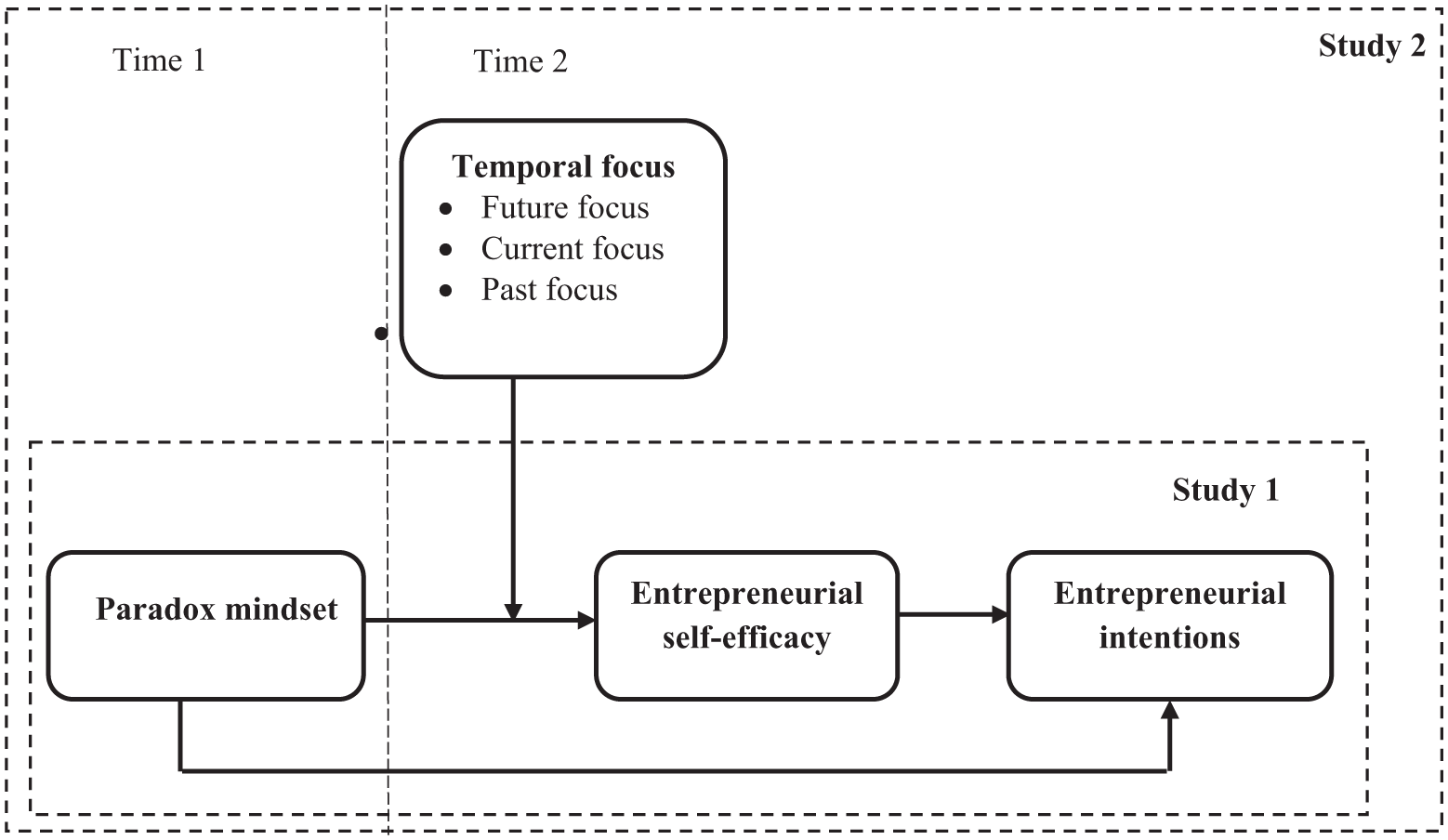
Conceptual model.
2.3. The mediating role of self-efficacy
Defined as one’s belief in their ability to successfully conduct various tasks and roles of entrepreneurship (Bae et al., 2014; Zhao et al., 2005), entrepreneurial self-efficacy emerges from the concept of self-efficacy, which develops from social observation, context, and behavior replication in social learning (Newman et al., 2019). Drawing upon social cognitive theory, most of the extant research into antecedents of entrepreneurial self-efficacy examines how social persuasion, physiological states, vicarious learning and mastery experiences serve as pathways to develop entrepreneurial self-efficacy (Arora et al., 2013; Locke, 1997). The review by Newman et al. (2019) summarizes that entrepreneurial self-efficacy comes from factors of firm characteristics, work experience, education and training, cultural and institutional environment, and role models. In line with social cognitive theory, individual differences, such as differences in personality characteristics, cognitive styles, risk-taking preferences (Zhao et al., 2005), and entrepreneurial passion (Murnieks et al., 2014) are also found to influence individuals’ evaluation of their physiological states, affecting their level of confidence to conduct entrepreneurial activity (Newman et al., 2019). Based on this grounding, differences in individuals’ paradox mindsets reflect differences in their cognitive styles (Heslin et al., 2019), which will then lead to differences in their entrepreneurial self-efficacy. Furthermore, paradox mindset motivates individuals to proactively confront tensions, question long-held assumptions and scan for solutions (Miron-Spektor et al., 2018), and such proactiveness is the catalyst promoting confidence in their ability to take on an entrepreneur’s role. Last, paradox mindset motivates individuals to think flexibly (Miron-Spektor and Beenen, 2015), which develops the ability to find innovative solutions and the efficacy beliefs toward creating new ventures (Dheer and Lenartowicz, 2019). Building upon such arguments, and as depicted in Figure 1, we argue that paradox mindset increases entrepreneurial self-efficacy.
Multiple previous studies have validated the positive effect of entrepreneurial self-efficacy on entrepreneurial intentions (Bandura, 1997; Liñán and Chen, 2009). They have also highlighted the role of self-efficacy as the mediating factor linking antecedents to entrepreneurial intentions (Boyd and Vozikis, 1994; Chang et al., 2023; Kickul et al., 2009; Newman et al., 2019; Zhao et al., 2005). For example, Zhao et al. (2005) suggests that the impacts of entrepreneurial experience, willingness to take risks, gender, and beliefs about formal education on entrepreneurial intentions are mediated by entrepreneurial self-efficacy. Meanwhile, the effect of a growth mindset intervention on interest in entrepreneurship was also found to be mediated by entrepreneurial self-efficacy (Burnette et al., 2020). Building upon such findings, we can expect entrepreneurial self-efficacy to perform as the theoretical linkage between paradox mindset and entrepreneurial intentions. Individuals with paradox mindset are more confident in their ability to cope with tensions which are common in entrepreneurship, and this promotes their intentions to form new ventures. Furthermore, paradox mindset with high flexibility and proactivity attenuates individuals’ perception of the difficulty of becoming an entrepreneur, which makes their entrepreneurial intentions stronger. As presented in Figure 1, we posit the following hypothesis:
2.4. Moderating roles of three types of temporal focus
We argue, however, that it is not likely that all individuals are equally attracted to entrepreneurial direction by their paradox mindset. Previous research argued that time perspectives may shape how individuals perceive and respond to paradoxes (Ingram et al., 2016; Waldman et al., 2019). Building upon the premise that people have different perspectives of the past, present, and future, the construct, temporal focus, is developed and found to be a stable cognitive characteristic (DesJardine and Shi, 2021). Temporal focus is categorized into three dimensions: past, current and future (Shipp et al., 2009). Importantly, a weak focus on one dimension does not necessarily mean a strong focus on another dimension, as past, current and future foci are little correlated (DesJardine and Shi, 2021). For example, when individuals pay less attention to the past, it does not necessarily mean that they focus more on the current or future (Gamache and McNamara, 2019). Temporal focus is important because how individuals think differently about the past, current and future affects different attitudes, decisions and behaviors they have (Shipp et al., 2009; Makri and Schlegelmilch, 2017). For example, individuals who focus more on the present, compared to those who focus more on the past or future, have more tendency to be impulsive, ignorant of future outcomes of current actions, and have no future plan (Zimbardo and Boyd, 1999).
Previous research has provided the evidence for the significant impact of country-level temporal orientation on country innovation (Barreto et al., 2022) or leader-level temporal focus on their firm’s strategies and performance (Back et al., 2020; Gamache and McNamara, 2019; Nadkarni and Chen, 2014; Nadkarni and Herrmann, 2010). Besides the direct effect of temporal focus, its moderating effect has also been found in multiple studies. Gamache and McNamara (2019) found that the connection between negative media responses to a firm’s acquisition announcements and the resulting acquisition activity can be influenced by the CEO’s temporal focus. Specifically, this relationship is stronger when the CEO focuses more on the past but is weaker when they focus more on the future. Furthermore, DesJardine and Shi (2021) demonstrated that when a CEO focuses differently on the current and the future, how they endow current or prospective wealth will differently influence their investment in mergers and acquisitions. Temporal focus has also been found to play a significant role in determining individuals’ career decisions when moderating the turnover intention- behavior link (Peltokorpi et al., 2023). People focusing strongly on the past will be more likely to translate their turnover intention into behavior while people focusing strongly on the future will be less likely to do so.
This research will extend the previous examination of the role of temporal focus on individuals’ career decisions as temporal focus may offer the opportunity to explore why individuals are differently attracted to an entrepreneurial career by their paradox mindset. Their temporal focus is likely to influence their perspective, the information they choose to focus on, and how they interpret it (Gamache and McNamara, 2019: 924). Because the three types of temporal focus are independent (Shipp et al., 2009), we propose that they will have independent moderating effects on the association between paradox mindset and entrepreneurial intentions.
2.4.1 Past focus
Past focus refers to the extent to which individuals devote their attention to thinking about past experiences (Shipp et al., 2009). The more individuals focus on the past, the more likely their paradox mindset will be to enhance their entrepreneurial intentions through self-efficacy for several reasons.
First, research has revealed that when individuals look back at the success or failure of past experiences, such enactive mastery experiences are a means of improving their self-efficacy (Bandura, 1997). The cognitive mode of strong devotion to past events helps individuals learn from previous important situations to have better future results (Back et al., 2020; Shipp et al., 2009). According to paradox theory, past experiences with contradictions serve as a source of meaning and enlightenment, rather than a source of anxiety and defensiveness (Smith and Lewis, 2011). When individuals with a paradox mindset also have a strong past focus, they are more likely to reflect on and leverage these past experiences to build up their entrepreneurial self-efficacy and intentions to join entrepreneurship. Second, thinking about positive experiences in the past contributes to an individual’s dissatisfaction with the present (Shipp et al., 2009). When individuals with paradox mindset are energized by tensions and the journey to manage such tensions, their strong past focus will further intensify their dissatisfaction with the current long-held assumptions and reinforce their beliefs in an entrepreneurial career and their interests in seeking new opportunities in entrepreneurship. Finally, individuals who are more past-focused pay more attention to feedback (Shipp et al., 2009). Meanwhile, to effectively cope with tensions, individuals with paradox mindset need continuous double-loop learning (Miron-Spektor et al., 2018) which requires their attention to feedback from the environment (Argyris, 1976). Therefore, past focus will promote the learning process of individuals with paradox mindset to better manage tensions so that they will be more confident in their entrepreneurial capabilities and strengthen their interests in entrepreneurship. As shown in Figure 1, we propose the following hypothesis:
2.4.2 Current focus
Current focus denotes the extent of an individual’s attention devoted to thinking about the present (Shipp et al., 2009). When individuals focus on the present, their paradox mindset will be less likely to improve their entrepreneurial intentions through self-efficacy for several reasons.
First, paradox theory emphasizes the importance of embracing a long-term, dynamic approach to managing tensions, iterating between splitting and integrating contradictory elements over time (Smith and Lewis, 2011). Individuals with a strong current focus, however, are oriented toward “here-and-now,” do not have much consideration about the future (Shipp and Aeon, 2019; Zimbardo and Boyd, 1999), so they will be less likely to make plans or act proactively to solve conflicts. They focus most of their attention on current information they have while ignoring past information or predicting future events (Gamache and McNamara, 2019). Therefore, such a current focus will impede individuals with paradox mindset to search for solutions, which results in a weaker improvement in their confidence in entrepreneurial capabilities and less interest in starting a new business. Second, paradox theory highlights the value of a holistic perspective, simultaneously attending to contradictory demands (Smith and Lewis, 2011). Individuals with a strong current focus, however, may become “trapped” in the present moment and neglect broader considerations (DesJardine and Shi, 2021). This narrow, present-oriented focus may limit individuals’ ability to think flexibly and develop entrepreneurial solutions. Therefore, the positive effect of paradox mindset on entrepreneurial intentions through self-efficacy will be dampened. Third, paradox theory suggests that effectively managing tensions requires a degree of dissatisfaction with the status quo and a willingness to embrace change (Smith and Lewis, 2011). When individuals have a strong “present” orientation, they will be more likely to be satisfied and committed to their current jobs and will report more positive interpretations of their current experiences (Rush and Grouzet, 2012; Shipp et al., 2009). This will then limit their perceived ability to perform entrepreneurial tasks and become self-employed, as individuals may feel less motivated to pursue entrepreneurial change. Finally, although people who possess a paradox mindset are inclined to exhibit higher levels of creativity (Miron-Spektor et al., 2018), their focus on the present prevents them from making use of such creativity or recognizing business opportunities that have potential in the future (Shipp et al., 2009; Smallwood et al., 2013). Therefore, the current focus attenuates the positive impact of a paradox mindset on entrepreneurial intentions through self-efficacy. As illustrated in Figure 1, we hypothesize that:
2.4.3 Future focus
Future focus describes the extent to which an individual concentrates on thinking about experiences to come (Shipp et al., 2009). Previous research has shown that individuals with future focus tend to engage in planning for future possibilities (Cerdin et al., 2020), getting motivated, and striving for achievements (Zimbardo and Boyd, 1999). Future-oriented individuals pay more attention to their careers, have more positive attitudes toward their careers and are more proactive in coping and adapting to career changes (Cerdin et al., 2020). Future focus will motivate people with paradox mindset to pay more attention to an entrepreneurial career by increasing their entrepreneurial self-efficacy for three reasons.
First, paradox theory emphasizes the importance of accepting and embracing contradictions, rather than attempting to eliminate them (Smith and Lewis, 2011). Individuals with a paradox mindset tend to view the uncertainties and challenges of entrepreneurship as opportunities for learning and growth rather than as threats to be avoided (Miron-Spektor et al., 2018). When these individuals have a strong future focus, they are more likely to anticipate and proactively explore potential tensions and opportunities in the entrepreneurial journey. This future-oriented opportunity-seeking mindset can boost entrepreneurial self-efficacy and intentions. Second, future-oriented individuals more proactively explore opportunities and prepare for career changes (Cerdin et al., 2020). Therefore, they will be more likely to find business opportunities in the paradoxes they are facing, confident in their abilities to grasp these opportunities, and willing to embrace entrepreneurship as a career change. Finally, paradox theory highlights the importance of dynamic, flexible, and adaptive approaches to managing tensions (Smith and Lewis, 2011). By focusing on the future, individuals with a paradox mindset can anticipate potential tensions, and find creative ways to overcome them (Nadkarni and Chen, 2014) in order to stay focused and motivated, even in the uncertainties. Such abilities will promote their self-confidence in entrepreneurship and strengthen their entrepreneurial intentions. Therefore, as outlined in Figure 1, we hypothesize that:
Figure 1 summarizes our hypotheses. In two following studies, Study 1 tests Hypothesis 1 and 2 by using an experiment, while Study 2 tests Hypothesis 1, Hypothesis 2, Hypothesis 3a-c by using two-wave survey data.
3. Study 1
3.1. Participants and procedure
We designed a one-factor, two-level (paradox mindset, control) within-subject experiment in 2021. Then, we sampled and emailed alumni from a large metropolitan university in Vietnam, asking for their participation. Our sampling frame is the email list of 1,569 graduates who have completed bachelor’s degree in the field of entrepreneurship management. The approach has been suggested and widely employed in management research (Bernerth et al., 2012; Ju et al., 2019). To facilitate their motivation, we promised to gift them a 3-month membership subscription for some entrepreneurial e-books worth USD 3.69 in total. Initially, 150 respondents accepted the invitation and accessed the survey link. After screening and excluding non-response data, 137 participants (81.75% female) were qualified. The final sample size satisfied the minimum ratio of 5:1 between the number of respondents and the number of parameters (i.e. 22) in Study 1 (Kline, 1998). In terms of working experience, 94.16% had equal to or less than 3 years at work, and 5.84% had from 4 to 14 years at work. In terms of founding experience, 96.35% said “no,” and 3.65% said “yes.” In terms of family background, 64.23% said “no,” and 35.77% said “yes.” In terms of planning to start-up, 24.82% intended to start their business after “5 years,” 13.87% in “3 to 5 years,” 8.76% “within 3 years,” and 52.55% chose “not available.” Of the final sample of participants, 50.36% responded for the control condition and 49.64% for the paradox mindset condition.
Two different conditions (i.e. paradox mindset vs control) were designed and randomly distributed to the potential respondents (adapted from Miron-Spektor et al., 2018). In each condition, we asked the respondents to engage in a Recall Skills writing task for a few minutes after reading the task instructions. As we were interested in how the respondents recall their past experiences in condition A (i.e. paradox mindset condition), their task was to think of paradoxical statements they encountered in the past or paradoxical statements that they thought were interesting. We also gave them a brief explanation of “paradoxical,” which means seemingly contradictory but nonetheless possibly true. We then provided them with a sample paradoxical statement such as ‘‘It is paradoxical that standing is more tiring than walking.’’ They were then asked to write down three paradoxical statements. In condition B (i.e. control condition), their task was to think of statements they encountered in the past or statements that they thought were interesting. A sample was provided as “People often believe that standing is more tiring than walking.” Then, they were asked to write down three statements.
After finishing the writing task, respondents were invited to evaluate their entrepreneurial intentions and entrepreneurial self-efficacy. We then asked them to think back to the initial Recall Skills task and indicate the extent to which they agreed with their own three written statements. A sample was “In the statements, there are conflicts about ideas or factors.” After that, they continued to evaluate the remaining statements to rate their paradox mindset, perceived relational support, and perceived educational support. Finally, they were asked to provide their gender, age, backgrounds, working experiences, among other demographics.
3.2. Measures
The three main investigated constructs were paradox mindset, entrepreneurial self-efficacy, and entrepreneurial intentions. All items were evaluated using a 7-point agreement Likert-type scale.
3.2.1 Paradox mindset
Paradox mindset (Cronbach’s alpha (α) = 0.76) was measured using a 5-item scale adapted from Miron-Spektor et al. (2018). A sample item is “Tension between ideas energizes me.”
3.2.2 Entrepreneurial self-efficacy
Entrepreneurial self-efficacy (α = 0.86) was measured by four items borrowed from Zhao et al. (2005). A sample item is “How confident are you in your ability to identify new business opportunities as entrepreneurs?.”
3.2.3 Entrepreneurial intentions
Entrepreneurial intentions (α = 0.84) was measured using a six-item scale borrowed from Liñán and Chen (2009). A sample item is “I am ready to do anything to be an entrepreneur.”
3.2.4 Control variables
We also included control variables such as respondents’ gender, working experience, founding experience, family experience, perceived educational support, and perceived relational support as control variables. This is in line with prior research that has demonstrated that these individual characteristics (i.e. gender, working experience, founding experience, and family background) had effects on entrepreneurial intentions (Turker and Selcuk, 2009). Besides, education plays a key role in the development of entrepreneurs (Bui et al., 2025; Soomro and Shah, 2022; Turker and Selcuk, 2009). Furthermore, in collectivist cultures, social connections such as family and friends may significantly influence students’ career selection decisions (Turker and Selcuk, 2009). Dummy coding (1: male; 0: female) was used for respondents’ gender. Dummy coding (1: yes; 0: no) was used for founding experience and family background. Specifically, respondents answered whether they have start-up experience (i.e. founding experience) and whether their families have a business tradition (i.e. family background). Working experience was measured by the actual number of years of respondents at work. Perceived educational support (α = 0.81) and perceived relational support (α = 0.68) were measured by three items each, borrowed from Turker and Selcuk (2009).
3.3. Data analysis and results
3.3.1 Manipulation check
A t-test was conducted on the level of paradox mindset function. As expected, significant differences were observed on the level of paradox mindset function (p < 0.01), such that participants who evaluated paradox mindset statements in condition A reported higher levels of paradox mindset functions (MA = 4.70) than those who evaluated statements in condition B (MB = 4.23), indicating that the manipulation was successful in the expected direction.
3.3.2 Results
All Cronbach’s alphas and composite reliabilities of our constructs were >0.68 (Table 1). A saturated CFA model was formed from five focal constructs: paradox mindset, entrepreneurial self-efficacy, entrepreneurial intentions, perceived educational support, and perceived relational support. All indices demonstrated a satisfactory fit to the data: χ2(167) = 229.28 (χ2/df = 1.37), IFI = 0.95, CFI = 0.95, and RMSEA = 0.05. Tables 1 and 2 documented that all items of the corresponding focal constructs exhibit acceptable and significant factor loadings, except one item of entrepreneurial intentions with a loading of 0.45. The composite reliability (CR) scores and average variance extracted (AVE) demonstrated acceptable discriminant validity and convergent validity (Table 1). Prior to testing H1 and H2, a Levene’s test was conducted to identify any issues with variance. The results (2.26; p > 0.10) confirmed the homogeneity of variance. Results from the t-test (p = 0.001) showed that respondents in the condition A (MA = 4.78) reported higher entrepreneurial intentions as compared to those in the condition B (MB = 4.22). We found that paradox mindset has a significant direct effect on entrepreneurial intentions (B = 0.26, SE = 0.09, p < 0.01), supporting H1. Then, we used PROCESS (Hayes et al., 2017) and employed the bias-corrected bootstrap method with 1000 bootstrap samples to examine the mediating effect of entrepreneurial self-efficacy in the mindset-intentions linkage. The results demonstrated that the above indirect effect was positive and significant (B = 0.09, 95% CI [0.02, 0.18]), supporting H2.
Correlations between constructs.
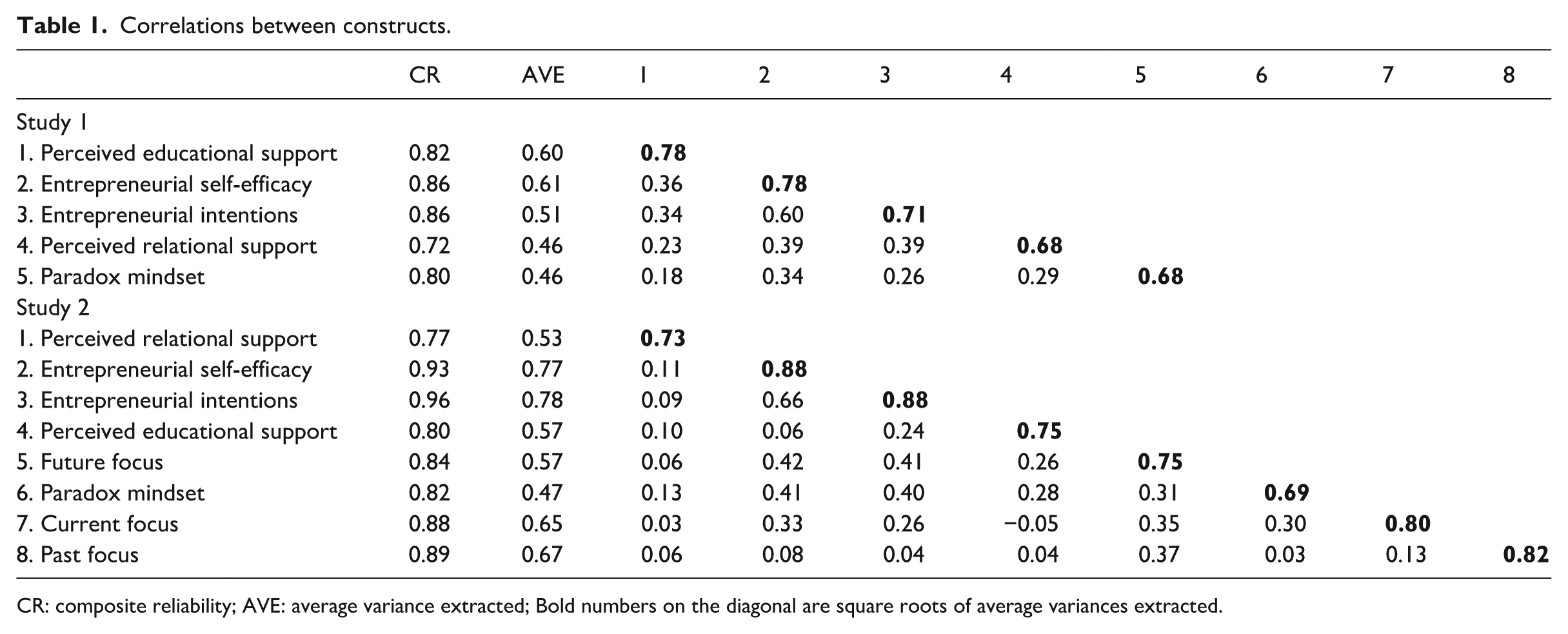
CR: composite reliability; AVE: average variance extracted; Bold numbers on the diagonal are square roots of average variances extracted.
Means (M), standard deviations (SD), and standardized CFA loadings (λ) of items.
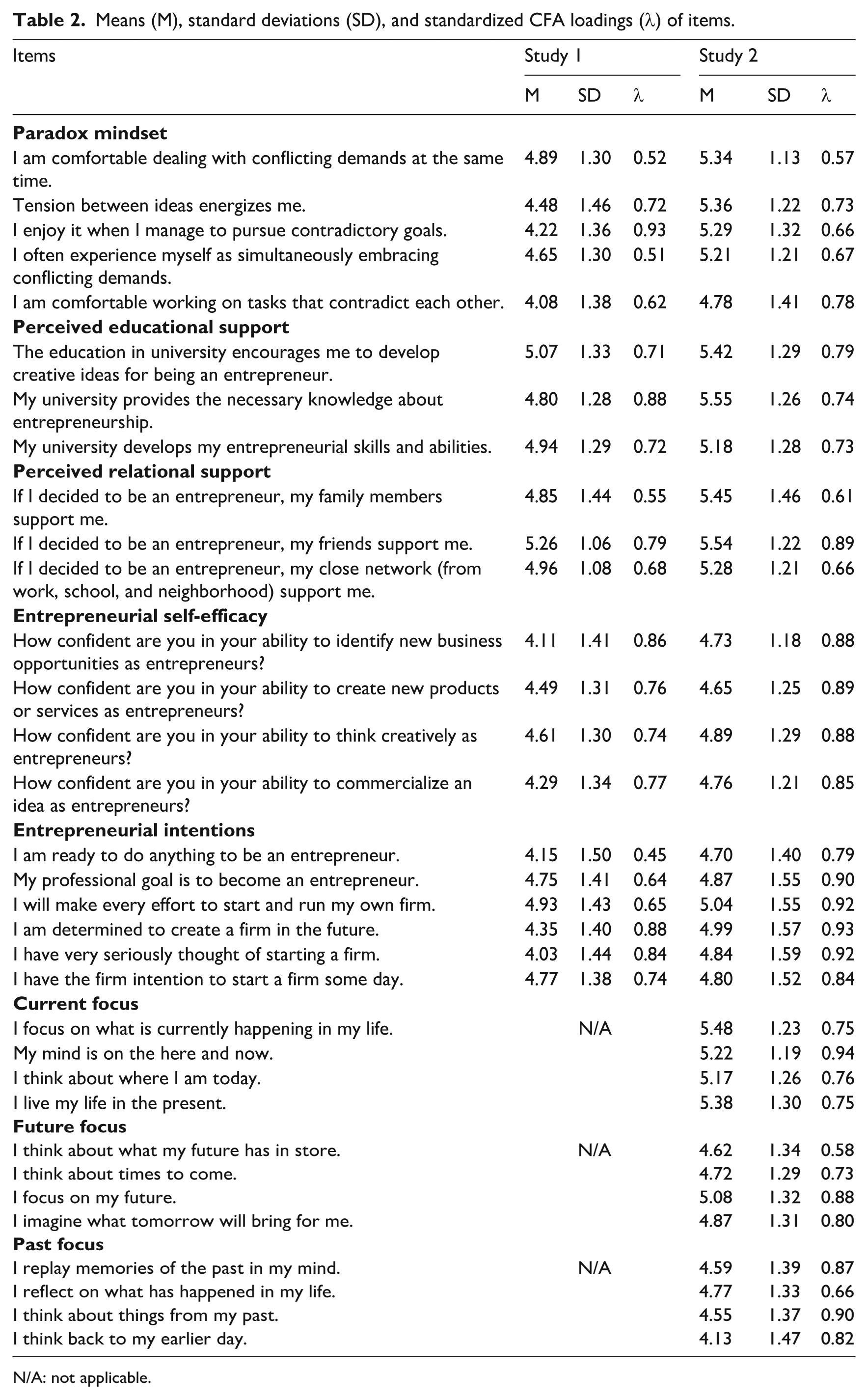
N/A: not applicable.
3.4. Discussion of study 1
Using a sample of 137 respondents in an experiment, we show that the impact of paradox mindset on entrepreneurial intentions is mediated by entrepreneurial self-efficacy. By adopting the paradox mindset, individuals have a greater propensity to be more confident in their entrepreneurial abilities, which strengthens their intentions to choose entrepreneurship for their future careers. Noted that one of the major limitations of Study 1 was that only 3.65% of 137 participants had founding experience. To further address the issue of generalizability and limitations in the Study 1 design and to extend the investigation of the model to the moderating effects of future, current, and past focus, we conducted the second study with two waves of surveys. Specifically, the number of respondents with founding experience increased to 27.98% of 168 respondents. In Study 1 and Study 2, the percentage of respondents with a family background of the total was 35.77% and 35.12%, respectively.
4. Study 2
4.1. Participants and procedure
We collected data from alumni of a business school in Ho Chi Minh City in 2021. The sampling frame consisted of 3,203 registered emails. The potential respondents on the list have completed at least one entrepreneurship course during their university studies. We prepared two questionnaires and used the email address as a unique code to match the data collected from a respondent at two different times. The matching process was kept confidential under the control of a researcher. At the beginning of the email, we informed the participants that they were invited to share their opinions, that there was no right or wrong answer, and that all information related to them was kept anonymous.
At Time 1, we asked the participants to evaluate the statements related to their paradox mindset, as well as the perceived support from the university and relatives. A total of 448 responses contributed to the response rate of Time 1 at 13.99%. One month later, in Time 2, the respondents of Time 1 were continually invited to evaluate their perceptions of entrepreneurial self-efficacy, entrepreneurial intention, and past, current, and future focus. Only 46.21% of the respondents of Time 1 completed the questionnaires after several reminders. We ended with 207 responses at Time 2. After matching and screening data, 39 paired responses were removed due to problems related to attention and comprehension checks. Ultimately, our final sample is 168 pairs, so the overall response rate of our survey is 5.25%. Despite the low response rate, in the higher education context, Fosnacht et al. (2017) documented that data remained reliable even with a 5% to 10% response rate with a sample size of at least 500. The response rate of Time 1 (13.99%) exceeds the accepted threshold; however, the overall response rate declined due to the time-lagged study. Besides, the final sample size met the minimum ratio of 5:1 between the number of respondents and the number of parameters (i.e. 33) in Study 2 (Kline, 1998).
The final sample size was 168 respondents, including 55.36% females and 44.64% males. In terms of working experience, 55.36% had equal to or less than 3 years at work, and 44.64% had from 4 to 33 years at work. In terms of founding experience, 72.02% say “no,” and 27.98% say “yes.” With respect to family background, 64.88% say “no,” and 35.12% say “yes.” In terms of planning to start-up, 22.02% intended to start their business “within 3 years,” 19.05% from “3 to 5 years,” 18.45% after “5 years,” and 40.48% did not intend to do so.
4.2. Measures
The six main constructs were paradox mindset, entrepreneurial self-efficacy, current focus, future focus, past focus, and entrepreneurial intentions, which were all first-order constructs. Study 2 also employed the same control variables as Study 1.
4.2.1 Paradox mindset
Paradox mindset (α = 0.79) was measured by five items developed by Miron-Spektor et al. (2018). A sample item is “I enjoy it when I manage to pursue contradictory goals.”
4.2.2 Entrepreneurial self-efficacy
Entrepreneurial self-efficacy (α = 0.93) was measured by four items developed by Zhao et al. (2005). A sample item is “How confident are you in your ability to create new products or services as entrepreneurs?.”
4.2.3 Past focus
Past focus (α = 0.89) was measured by four items borrowed from Shipp et al. (2009). A sample item is “I replay memories of the past in my mind” (1 = never to 7 = constantly).
4.2.4 Current focus
Current focus (α = 0.87) was measured by four items adapted from Shipp et al. (2009). A sample item is “I focus on what is currently happening in my life” (1 = never to 7 = constantly).
4.2.5 Future focus
Future focus (α = 0.85) was measured by four items developed by Shipp et al. (2009). A sample item is “I focus on what is currently happening in my life” (1 = never to 7 = constantly).
4.2.6 Entrepreneurial intentions
Entrepreneurial intentions (α = 0.96) was measured by six items borrowed from Liñán and Chen (2009). A sample item is “I have very seriously thought of starting a firm.”
4.3. Data analysis and results
4.3.1 Measurement validation
We incorporated and formed a saturated CFA model of the eight focal constructs in the conceptual model: paradox mindset, entrepreneurial self-efficacy, current focus, future focus, past focus, entrepreneurial intentions, perceived educational support, and perceived relational support. All indices demonstrated a satisfactory fit to the data: χ2(463) = 698.70 (χ2/df = 1.51), IFI = 0.94, CFI = 0.94, and RMSEA = 0.06. As shown in Tables 1 and 2, all items and the corresponding focal constructs exhibit acceptable and significant factor loadings, CR scores, and AVE, demonstrating acceptable discriminant validity and convergent validity.
4.3.2 Common method bias
We addressed potential threats of common method bias in Study 2 in several ways. First, we designed the questionnaire with different scaling methods, attention checks, and randomly assigned the items into the questionnaire. Second, we employed a survey using two measurement waves. Third, we examined and compared a CFA Harman’s single-factor model test with the trait model test. We found that in comparison to the trait model, the CFA Harman’s single-factor model showed an unsatisfactory fit to the data (χ2491) = 2411.66, IFI = 0.48, CFI = 0.47, and RMSEA = 0.15, compared to the trait model. We conclude that common method bias is not an issue in Study 2.
4.3.3 Hypothesis testing
Structural equation modeling (SEM) was employed via SPSS AMOS software version 23 to test the theoretical model and hypotheses. Model 1 was used to test H1 which proposed that paradox mindset has a direct relationship on entrepreneurial intentions. Model 2 and Model 3 were used to test H2, which proposed that paradox mindset has an indirect effect on entrepreneurial intentions via entrepreneurial self-efficacy. As shown in Table 3, paradox mindset positively influences entrepreneurial intentions (Model 1, B = 0.73, p < 0.001), supporting H1. In Model 2, paradox mindset influences entrepreneurial self-efficacy (B = 0.60, p < 0.001). In Model 3, when including entrepreneurial self-efficacy, paradox mindset still strongly influences self-efficacy (B = 0.66, p < 0.001) while the positive effect of paradox mindset on entrepreneurial intentions becomes less significant (B = 0.28, p < 0.05). Furthermore, the results produced by the bias-corrected bootstrap method with 1000 bootstrap samples demonstrated that the indirect effect of paradox mindset on entrepreneurial intentions via entrepreneurial self-efficacy was positive and significant (Model 3, B = 0.49, p < 0.01, 95% CI [0.28, 0.83]), supporting H2. Therefore, entrepreneurial self-efficacy partially mediates the link between paradox mindset and entrepreneurial intentions. Finally, Model 4 was developed to test whether the interaction between three types of temporal focus and paradox mindset influences entrepreneurial self-efficacy (H3a-c). To calculate these interactions, we employed a single-indicator approach suggested by Ping (1995). We also calculated mean-centered variables to avoid multicollinearity when creating the interaction (Iacobucci et al., 2016). Also, we note that Heywood case was not found in any model.
Path analysis results of study 2 (N = 168).
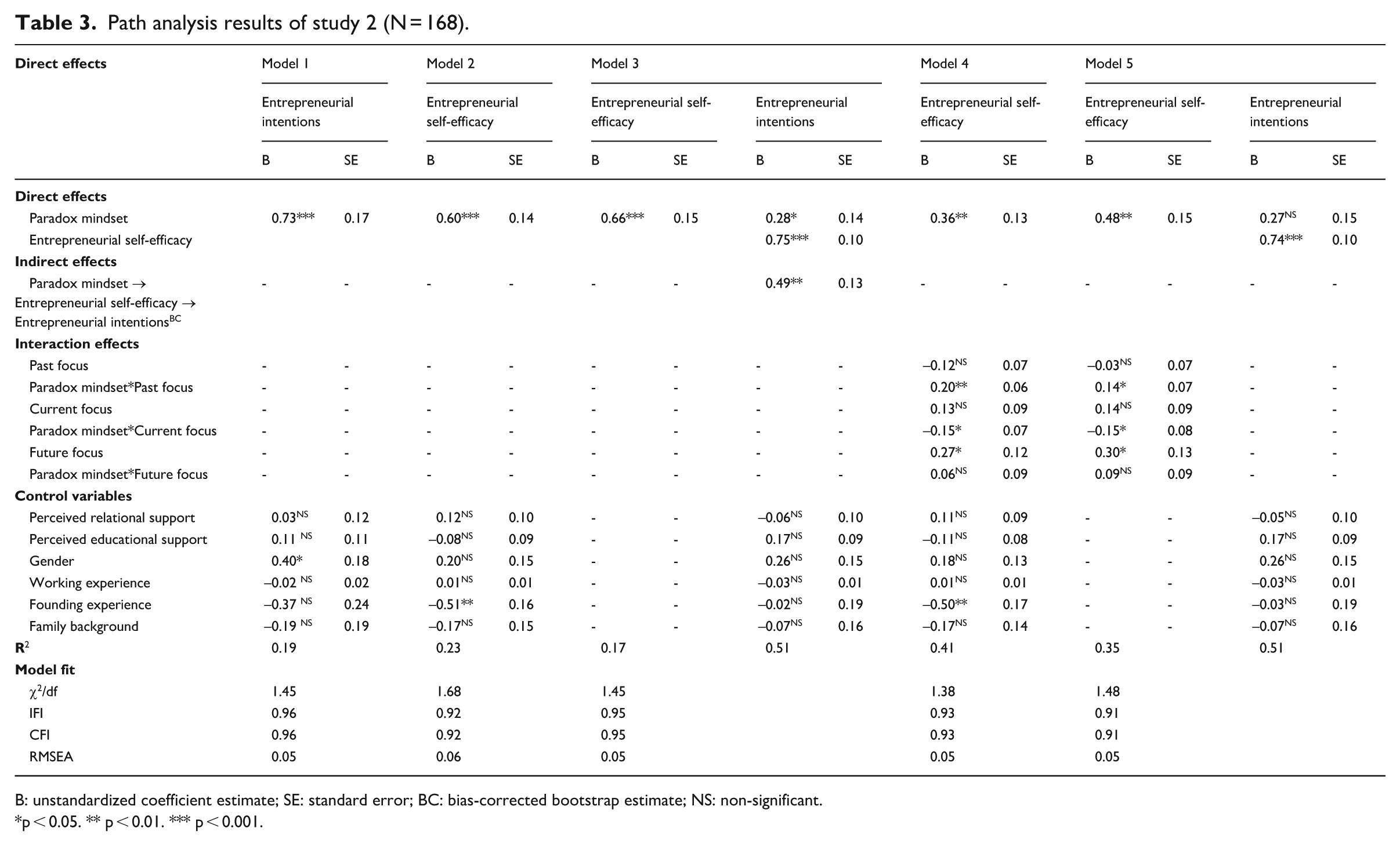
B: unstandardized coefficient estimate; SE: standard error; BC: bias-corrected bootstrap estimate; NS: non-significant.
p < 0.05. ** p < 0.01. *** p < 0.001.
Furthermore, the interaction between past focus and paradox mindset has a significant positive effect on entrepreneurial self-efficacy (Model 4, B = 0.20, p < 0.01), supporting H3a. In other words, past focus strengthens the positive relationship between paradox mindset and entrepreneurial self-efficacy. In addition, the interaction between current focus and paradox mindset has a significant effect on entrepreneurial self-efficacy (Model 4, B = −0.15, p < 0.05), supporting H3b. In other words, the current focus dampens the positive relationship between paradox mindset and entrepreneurial self-efficacy. Finally, the interaction between future focus and paradox mindset has a non-significant effect on entrepreneurial self-efficacy (Model 4, B = 0.06, p > 0.10), not supporting H3c. Neither perceived relational nor educational support has any significant effect on entrepreneurial intentions in any model. In addition, respondents’ gender, founding experience, and family experience do not have any significant effect on entrepreneurial intentions in any model. Table 3 shows our hypothesis testing results.
We probed the interaction effect using the Johnson-Neyman technique (Carden et al., 2017; Hayes, 2018). Specifically, we determined where in the distribution of current and past focus and the conditional effect of paradox mindset and entrepreneurial self-efficacy transition between statistically significant and not significant (Hayes, 2018). Figure 2 and Figure 3 show that the effect of paradox mindset on entrepreneurial self-efficacy was significant for the values of past focus and current focus larger than 3.75 and 6.11, respectively.
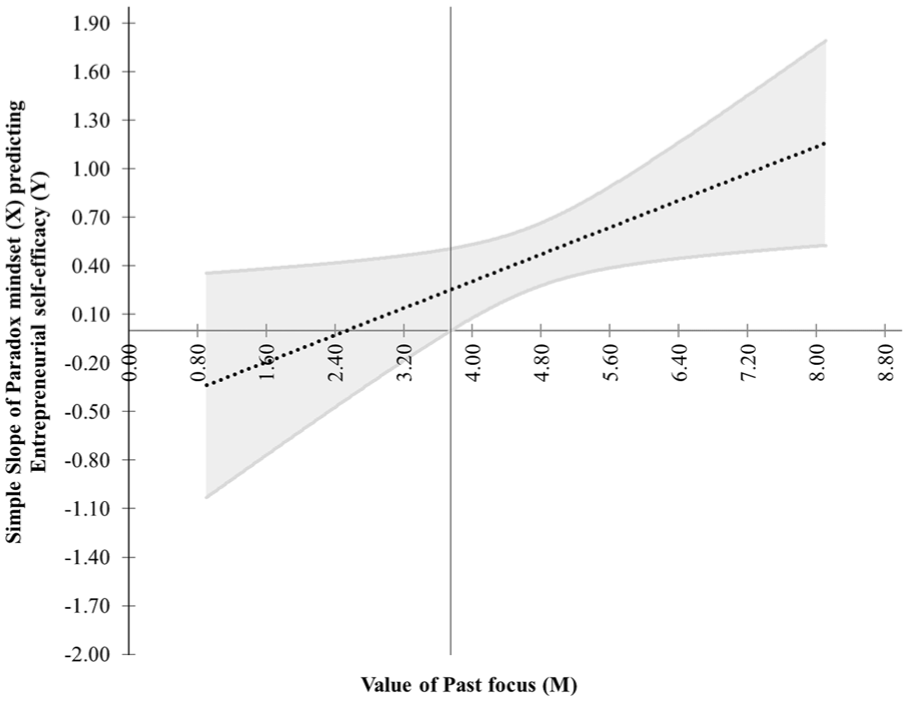
Johnson-Neyman graph produced by CAHOST_v1.01 (past focus as a moderator).
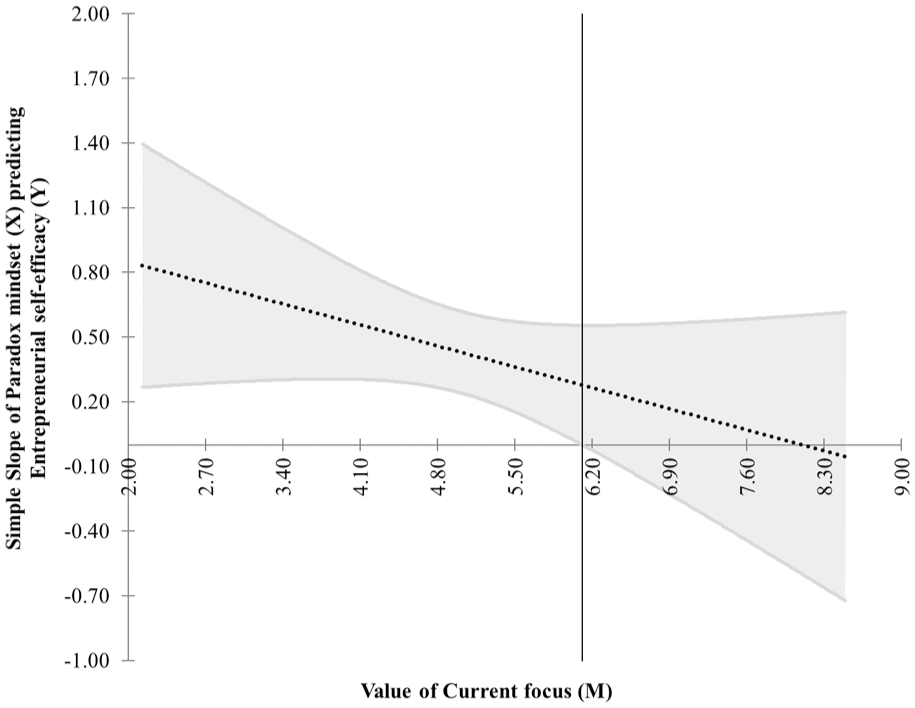
Johnson-Neyman graph produced by CAHOST_v1.01 (current focus as a moderator).
4.4. Discussion of Study 2
Study 2 is a two-wave survey conducted for two purposes. First, we addressed the issue of generalizability of the findings in Study 1. Second, through multiple waves of surveys, we replicated and confirmed the effect of paradox mindset on entrepreneurial intentions via entrepreneurial self-efficacy. We also showed that to individuals with lower current focus or higher past focus, the more paradox mindset they adopt, the more confident they will be in conducting their future entrepreneurial activities and will be more likely to start new ventures. Moreover, the insignificant moderating role of future focus, in particular, aligns with recent studies that have found mixed results when examining the interaction between future focus and other cognitive factors in shaping work outcomes (Rudolph et al., 2018).
Regarding the relationship between current focus and the ability to leverage paradoxical thinking for entrepreneurial purposes, our findings suggest that individuals with a strong present orientation may struggle to fully capitalize on their paradoxical thinking capabilities. This could be due to their tendency to become overly absorbed in the immediate demands and challenges of the present moment, which may hinder their ability to recognize and pursue entrepreneurial opportunities arising from paradoxical tensions (Shipp et al., 2009). For example, an entrepreneur with a strong current focus might become preoccupied by resolving a pressing financial issue, in which they fail to identify potential opportunities for innovation emerging from the tension between short-term survival and long-term sustainability. In other words, a strong present focus may lead individuals to become excessively fixated on the current moment, unable to see beyond the immediate challenges and tensions they face (Shipp et al., 2009). This narrow temporal perspective may limit their ability to fully leverage paradoxical thinking capabilities, as they may struggle to recognize the potential opportunities and benefits that can arise from embracing and navigating paradoxical demands (Miron-Spektor et al., 2018).
Consequently, even if these individuals possess a high level of paradox mindset, their strong current focus may hinder their ability to translate this cognitive capability into enhanced entrepreneurial self-efficacy and intentions. Supporting this interpretation, previous research highlights the importance of temporal flexibility and the ability to switch between different temporal foci in an entrepreneurial context. For instance, Nadkarni and Chen (2014) found that entrepreneurs who were able to balance their attention among the past, present, and future were more adept at recognizing and seizing opportunities in dynamic environments. Similarly, Shipp et al. (2009) argued that a balanced temporal perspective, rather than an overemphasis on any one temporal focus, is essential for effective decision-making and problem-solving in complex and uncertain situations. By extending these insights to the context of paradoxical thinking, we posit that a strong current focus may limit individuals’ ability to fully harness the benefits of paradox mindset for entrepreneurial purposes, as it may constrain their capacity to recognize and pursue the opportunities that can emerge from paradoxical tensions.
5. Discussion
Drawing insights from the paradox theory (Miron-Spektor et al., 2018) and temporal focus literature (Shipp et al., 2009), we develop a model in which paradox mindset influences entrepreneurial self-efficacy and then influences entrepreneurial intentions under the moderating impacts of past, current and future focus. The findings demonstrate that (a) paradox mindset is an important catalyst to increase self-efficacy in entrepreneurship, (b) individuals with paradox mindset will have more intention to start up their own businesses when they are more confident in their entrepreneurial ability, (c) focusing more on the past will help individuals with paradox mindset to build up their entrepreneurial self-efficacy, (d) focusing less on the present positively influences how individuals with paradox mindset develop confidence in their entrepreneurial abilities.
5.1. Theoretical contributions
This study makes several important contributions to the literature on entrepreneurship and paradox theory. Moving beyond prior work that describes entrepreneurs as having paradoxical traits (Miller and Sardais, 2015), we reveal how paradox mindset cognitively empowers entrepreneurs to harness these contradictions. Moreover, while cognition has been widely recognized as a driver of entrepreneurial intentions (Dheer and Lenartowicz, 2019; Obschonka et al., 2018), the role of paradoxical cognition has been largely overlooked. Our findings empirically validate the positive influence of paradoxical thinking on entrepreneurship (Ingram et al., 2016; Klonek et al., 2021), highlighting paradox mindset as a critical cognitive driver that empowers individuals to confront tensions, identify opportunities, and cultivate the confidence to pursue ventures. This reframing offers new insights into the psychological underpinnings of entrepreneurial motivation under uncertainty.
Second, this study extends paradox theory by applying it to the entrepreneurial context beyond its traditional focus on managerial settings in established organizations (Miller and Sardais, 2015). Responding to recent calls for research on paradox management in entrepreneurship (Erdogan et al., 2020; Ferreras-Méndez et al., 2022; Ingram et al., 2016), we reconceptualize paradox mindset as a cognitive mechanism that influences entrepreneurial intentions through the mediating role of self-efficacy during venture initiation. This novel application of paradox theory to entrepreneurship enriches our understanding of how entrepreneurs cognitively mobilize contradictory demands to fuel their motivation for action. By demonstrating the explanatory power of the paradox mindset in the entrepreneurial context, this study expands the boundaries of paradox theory and opens new avenues for research at the intersection of cognition, motivation, and entrepreneurship.
Third, although paradoxes are considered to persist and develop over time (Smith and Lewis, 2011), the extant research has treated paradox mindset as a static and time-invariant construct (Miron-Spektor et al., 2018; Schad et al., 2016). Responding to the call for research into how various individuals perceive and respond to paradoxes over time (Ingram et al., 2016; Waldman et al., 2019), this study has unpacked how the outcomes of paradoxical mindsets differ among people with different perspectives of the past, present, and future. It confirms previous findings that three types of temporal focus are independent constructs (Shipp et al., 2009) when they have different effects on the outcomes of paradox mindset.
Fourth, this study responds to the call to take time more seriously in entrepreneurship research (Lévesque and Stephan, 2020) by examining how entrepreneurs’ temporal focus moderates the links between paradox mindset and entrepreneurial self-efficacy and intention. The findings revealed that the positive impact of paradox mindset on an individual’s entrepreneurial self-efficacy is attenuated by their focus on the present while promoted by their focus on the past. It extends previous research on paradox mindset (Liu et al., 2020; Snehvrat et al., 2022) when confirming its positive outcomes are contingent on individuals’ time perspectives. When individuals focus on the present while ignoring past experiences or potential future events, their search for solutions to paradoxes will be impeded, resulting in less enhancement in their entrepreneurial self-efficacy, which in turn decreases entrepreneurial intentions. Meanwhile, their attention to past experiences is very useful for their learning to leverage experienced paradoxes and achieve beneficial outcomes (Back et al., 2020; Shipp et al., 2009).
Interestingly, future focus does not significantly moderate the relationship between paradox mindset and entrepreneurial intentions via self-efficacy. Such a finding can stem from its dual nature. Although future focus can motivate people with paradox mindset to embrace risks for future gains, it can also motivate individuals to view any current difficulties with their job as temporary setbacks and to remain in their current position (Peltokorpi et al., 2023). In addition, the cognitive tension between optimism and realism (Hmieleski and Baron, 2009), often present in future-focused thinking, may dilute its enhancing effects. Cultural and contextual variables (e.g. long-term orientation, risk tolerance) could also shape how future focus interacts with paradox mindset (Hofstede, 2001; Kreiser et al., 2010). In supportive environments, future-focused individuals may better leverage their paradox mindset; in short-term or risk-averse cultures, this potential may be constrained.
5.2. Practical implications
This study also provides some practical implications for educators, policymakers, and organizations to foster successful entrepreneurship. First, we would like to bring to the attention of educators and policymakers who would like to identify potential future entrepreneurs the implication that paradox mindset might perform as a valuable screening tool for identifying young individuals (Lechner et al., 2018). Such information is useful to offer encouragement and support to individuals with the capability to embrace and tackle tensions, helping them put entrepreneurial aspirations into practice. Paradox mindset can also become a possible target in training and interventions to encourage people to aspire to entrepreneurial roles. Individuals should be trained to have a “healthy” attitude toward tensions early in life in which they should accept paradoxes to be persistent and interdependent. Instead of attempting to eliminate tensions, they can gain excitement from them, proactively explore opportunities from them, and develop their confidence in entrepreneurial capabilities, which drives them toward entrepreneurial careers. For instance, educators could incorporate case studies and simulations that present students with paradoxical situations in entrepreneurial contexts, such as balancing the need for short-term financial viability with long-term strategic growth or managing the tensions between exploration and exploitation in a resource-constrained environment (Miron-Spektor and Beenen, 2015; Smith and Lewis, 2011). By exposing students to these challenges and providing them with tools to navigate these tensions, educators can foster the development of a paradox mindset for aspiring entrepreneurs. In addition, policymakers could develop mentorship programs that pair young individuals with experienced entrepreneurs, who have successfully navigated the paradoxes of entrepreneurship. These mentors could share their strategies for embracing and leveraging tensions, providing valuable insights and encouragement for aspiring entrepreneurs.
Furthermore, to enhance individuals’ self-confidence in entrepreneurship, temporal focus is also a factor that requires intervention. For individuals with paradox mindset, their strong focus on the present will impede their capabilities to search for solutions and realize entrepreneurial opportunities from job tensions. Instead, to fully promote the benefits of the paradoxical thinking capabilities, potential future entrepreneurs should take into consideration past experiences, learn from feedback on their previous performance to proactively solve conflicts, recognize promising business ideas, and develop their self-confidence to pursue these opportunities.
To address this, organizations could implement a two-pronged approach targeting both past and future temporal focuses. On the one hand, training programs could encourage a balanced temporal focus, emphasizing the importance of learning from past experiences while maintaining a future-oriented perspective (Nadkarni and Chen, 2014). For example, these programs could include exercises that prompt participants to reflect on their past successes and failures, and identify key lessons that inform their future entrepreneurial pursuits. Moreover, case studies and testimonies featuring successful entrepreneurs who have leveraged their past experiences to overcome obstacles and achieve their goals can be incorporated into training programs (Fayolle and Gailly, 2008). In addition, organizations could provide aspiring entrepreneurs with tools and techniques for scenario planning, helping them to prepare for future threats and opportunities (Schoemaker, 1995). On the other hand, to address the limiting effects of the current focus, we propose that entrepreneurial training programs could integrate mindfulness practices to maintain a long-term perspective in the face of present challenges. Mindfulness, defined as focusing one’s attention on the present moment without judgment, has been shown to foster decision-making, creativity, and resilience in entrepreneurship (Kabat-Zinn, 2003; Ming et al., 2025; Ngo et al., 2020). By cultivating mindfulness in daily practice, training programs can help entrepreneurs manage stress, adapt to changing circumstances, and avoid becoming overly preoccupied with current obstacles. Specifically, these programs should incorporate goal-setting exercises, visualization techniques, and strategic planning tools to envision desired future outcomes and develop actionable steps to achieve them.
5.3. Limitations and implications for future research
The study is subject to certain limitations, which provide opportunities for further investigation in the future. First, due to our interest in temporal focus, we attend to only its moderating influence on the link between paradox mindset and entrepreneurial intentions via self-efficacy. However, there may exist other interesting conditions due to the interactive effects between the mindset, resources and context (Daspit et al., 2021). For example, an individual’s regulatory focus, promotion focus, or prevention focus can influence how they search for solutions to paradoxes and how they decide to pursue change goals or not (Taylor-Bianco and Schermerhorn, 2006; Hirst et al., 2020). In addition, an individual’s resilience or passion can influence how they mobilize their self-regulatory process to embrace and pursue business ideas (Minh et al., 2025). Therefore, future research can examine whether other boundary conditions for the impact of paradox mindset on entrepreneurial intentions via self-efficacy. In addition, future research can investigate how these interactions evolve over different stages of entrepreneurial ventures (e.g. ideation, scaling, exit), which could yield meaningful longitudinal findings.
Second, as there exists a discrepancy between what one intends to do and their actual behavior (Ajzen, 2002), it would be an interesting future research direction to examine how paradox mindset leads to actual entrepreneurial entry behavior. Also, although this study revealed that individuals with higher paradox mindset will be more confident in starting new ventures, we do not know whether they will be more successful or proficient in their entrepreneurship roles. Therefore, future research can examine whether entrepreneurs with a paradox mindset will successfully tackle paradoxes in different stages of the entrepreneurial process (e.g. long-term sustainability and performance of ventures).
Third, while our study highlights the importance of past focus as a key factor in the relationship between paradox mindset and entrepreneurial self-efficacy, it does not delve into the specific elements of past experiences that may be the most impactful in enhancing this relationship. Future research could explore the role of learning from failure and reflecting on prior successes in shaping the interaction between paradox mindset and entrepreneurial self-efficacy.
Fourth, we measured paradox mindset using a self-report scale, although it has reliability and validity established in previous studies (Miron-Spektor et al., 2018; Snehvrat et al., 2022), which tested its effects on psychological and behavioral factors. Self-report scales are commonly used to measure cognitive capabilities in previous entrepreneurship studies (Arora et al., 2013; Dheer and Lenartowicz, 2019). However, due to the disadvantages of self-report scales (Chan, 2010), we suggest future research to use multi-source data or adopt advancements in neuroentrepreneurship (Sharma et al., 2021) to evaluate the effect of cognitive capabilities, such as paradox mindset, on individuals’ entrepreneurial attitudes, beliefs, and intentions.
Finally, the one-month interval between the two survey waves may have limited the ability to capture shifts in entrepreneurial intention adequately. Future research could consider employing longer time intervals to better observe the longitudinal development of entrepreneurial cognition and intentions.
6. Conclusion
This study offers insights, from the perspective of paradox theory, into how paradox mindset is a significant catalyst for entrepreneurial intentions. While paradox mindset can directly motivate individuals to pursue entrepreneurial careers, our findings highlight the mediating role of entrepreneurial self-efficacy. Finally, our results emphasize the important roles of past and current focus in the relationship between paradox mindset and entrepreneurial intentions through self-efficacy.
What This Paper Adds
IPP literature is under theorized with less than a quarter of studies (4 of 18) using explicit theoretical frameworks.
The geographic spread of the literature is uneven with case studies of Australia dominating the literature.
We find a weak collaboration density amongst the IPP scholars, which reflects the geographic clustering among scholars investigating their local contexts.
Scholarly interest in IPP is diverse, with publications spanning seven disciplines: engineering and construction management, law, economic development, public administration, public procurement, social work, and diversity and inclusion.
The main themes were the legality of these policies, issues arising from their implementation and governance, policy evaluation and approaches to conceptualizing social value in IPP.
Contributions to Research
Provides a systematic overview of the contemporary scholarship on IPP.
Contributes to a systematic understanding and analysis of Australia’s IPP evolution.
Demonstrates the usefulness of the Five-Stage Policy Life Cycle Model as a framework for analysis of the development and outcomes of IPPs in Indigenous communities across various post-colonial settler societies.
Identifies theoretical and empirical gaps in research to inform a comprehensive IPP research agenda across settler societies.
Makes a case for the use of middle-range theories to enrich future IPP research
Contributions to Practice
Provides an assessment tool for policymakers and practitioners to appraise the current stage of their IPP and how they can advance the IPP along its life cycle.
Highlights and offers useful recommendations, including improving legal defensibility and embedding cultural legitimacy through Indigenous-led evaluation frameworks.
Informs the roadmap of future IPP work by identifying emerging risks and trends.
Footnotes
Acknowledgements
N/A.
Final transcript accepted on 6 June 2025 by Ali Muhammad (Deputy Editr).
Funding
The author(s) disclosed receipt of the following financial support for the research, authorship, and/or publication of this article: This work was supported by a grant from the University of Economics HCM City (UEH University) and Western Sydney University Joint Research Program.
