



Abstract
By following 17 entrepreneurial ventures throughout the COVID-19 pandemic, we show how entrepreneurial ventures can resourcefully mobilize resources throughout crisis—when resource constraints and opportunities for resource mobilization shift erratically. In a period marked by significant resource constraints, a temporary field emerged, centered around societal consequences of the crisis and temporarily offered opportunities for resource mobilization. We identified two types of resourcefulness, both of which were successful immediately after the crisis struck. Surprisingly, only leveraging the temporary field enabled resource mobilization throughout the crisis and fostered venture survival, while, despite initial successes, absorbing the temporary field did not.
Keywords
Introduction
Crises such as natural disasters, wars, or pandemics can disrupt economic activities for an unforeseeable period of time and threaten the viability of entrepreneurial ventures (Batjargal et al., 2023; Doern et al., 2019; Kuckertz & Brändle, 2022). To survive these sudden yet prolonged disruptions, ventures need to mobilize resources such as revenue or investment throughout the crisis to maintain stability and position the venture for growth beyond the crisis.
Yet, they must do so under particularly challenging conditions, as resource constraints and opportunities for resource mobilization occur abruptly and subsequently shift erratically. When a crisis hits, immediate constraints disrupt conventional ways of resource mobilization (Kuckertz et al., 2020; Shepherd & Williams, 2020), as, for example, revenue streams may suddenly fall away (Björklund et al., 2020), or the availability of investment capital might pause abruptly (Brown et al., 2020). These constraints may ease eventually, but due to the crisis’“ambiguity of cause, effects and means of resolution” (Pearson & Clair, 1998, p. 60), recovery might proceed intermittently and take an unknown amount of time. Hence, for entrepreneurial ventures, it is hard to anticipate when such constraints may ease—and whether the venture can survive until then. At the same time, opportunities for resource mobilization may surface, for instance, crowdfunding to tackle the societal consequences of the crisis (Farhoud et al., 2020), and these may proffer a way out from the ventures’ precarious position (Dushnitsky et al., 2020; Guckenbiehl & Corral de Zubielqui, 2022). However, as these opportunities are frequently linked to the crisis itself (Browder et al., 2023; Williams & Shepherd, 2016), they tend to be temporary and may cease at an unforeseeable point in time (Mittermaier et al., 2022).
Resourcefulness, that is, the ability to mobilize and deploy resources in boundary-breaking and creative ways to generate or capture new or unexpected sources of value (Williams et al., 2021), is likely to be important in navigating these erratic shifts throughout a crisis, as its boundary-breaking and creative nature allows ventures to adjust their resource mobilization continuously. Yet although resourcefulness is arguably important throughout crisis, prior research has primarily examined how it helps entrepreneurial ventures to cope with resource constraints at the onset of a crisis (Björklund et al., 2020; Kuckertz et al., 2020; Sonenshein & Nault, 2024). This prevailing focus on the initial period of a crisis currently limits our understanding of whether, and how, ventures can resourcefully mobilize resources throughout the crisis so as to survive beyond it. Hence, we set out to explore: How can entrepreneurial ventures resourcefully mobilize resources throughout crisis—when resource constraints and opportunities for resource mobilization shift erratically?
Based on a two-year qualitative study on 17 entrepreneurial ventures conducted during the COVID-19 pandemic in Germany (Gioia et al., 2013; Strauss & Corbin, 1990), we developed a two-field model of resourcefulness throughout crisis, thereby illuminating two new types of resourcefulness and explaining their differing outcomes.
To theorize the erratic shifts in entrepreneurial ventures’ resource environment, this model builds on the concept of fields from institutional theory (DiMaggio & Powell, 1983; Scott, 1995), which enables us to divide an entrepreneurial ventures’ resource environment into coexisting fields (Furnari, 2014). Crucially here, resource constraints may occur in one field, while opportunities for resource mobilization might occur in another, either of which might change idiosyncratically (Bohn & Gümüsay, 2023; Buchanan et al., 2023; Furnari, 2018).
When COVID-19 struck, numerous enduring fields, that is, established fields such as the education sector or event industry, experienced sudden resource constraints. In this setting, we observed that a new field emerged around the societal consequences of the crisis and offered opportunities for resource mobilization for a limited period of time. We conceptualize this type of field as a temporary field, that is, an emerging field that begins to institutionalize yet ceases to do so before it has attained full institutionalization. In our case, the temporary field ceased although the crisis prevailed, and resource constraints in the enduring fields recovered over time.
Amid these erratic shifts in temporary and enduring fields, we identified two types of resourcefulness among our 17 entrepreneurial ventures: leveraging the temporary field, observed among nine ventures, and absorbing the temporary field, observed among the remaining eight. Ventures who leveraged the temporary field mobilized resources therefrom to aid further resource mobilization concurrently within their constrained enduring fields—thereby bypassing their constraint. In contrast, ventures who absorbed the temporary field mobilized resources only from the temporary field and avoided engagement with their constrained enduring fields. Both types of resourcefulness successfully mobilized resources at the onset of the crisis. However, ventures who leveraged the temporary field continued to mobilize resources throughout the crisis and went on to survive beyond it, whereas ventures who absorbed the temporary field did not. Hence, only proactive engagement with the constrained enduring fields from the onset of the crisis prepared ventures to adjust their resourcefulness to these erratic shifts in a timely manner.
We offer three contributions. First, with our two-field model of resourcefulness throughout crisis, we contribute two new types of resourcefulness to research on entrepreneurial resourcefulness amid crisis, and we explain why only one of these is beneficial for ventures’ survival beyond the crisis, although both types successfully mobilize resources at the onset of the crisis. While earlier studies suggest that successful resource mobilization at the onset of the crisis fosters survival beyond the crisis itself (Klyver & Nielsen, 2021; Kuckertz et al., 2020), our findings show that this is not necessarily the case. What is successful initially might not be successful in the long run. This alerts us to the possibility that some resourceful crisis-responses identified in prior research might threaten venture survival beyond the crisis.
Second, by distinguishing between temporary and enduring fields, we provide a conceptualization for the erratic shifts between resource constraints and opportunities for resource mobilization to research on entrepreneurship amid crisis (Batjargal et al., 2023; Doern et al., 2019; Kuckertz & Brändle, 2022; Salvato et al., 2020). Such theorizing illuminates that crisis-related opportunities for resource mobilization may cease while the crisis prevails, thus showing that such crisis-related opportunities are distinct from the crisis itself. This allows for a clearer understanding of their temporal nature and enables more accurate theory development and apposite practical recommendations.
Third, we contribute the concept of temporary fields to institutional theory (Bohn & Gümüsay, 2023; Buchanan et al., 2023; Furnari, 2018). This concept allows for a deeper theoretical understanding of specific fields that may emerge during crises, which are more ephemeral and unstable than is accounted for in current theorizing (Buchanan et al., 2023; Greenwood & Suddaby, 2006; Zietsma & Lawrence, 2010), and which might shape processes such as resource exchange within and across fields in specific ways.
Theoretical Grounding
During crises, resource constraints and opportunities for resource mobilization may shift erratically, thereby making resource mobilization throughout a crisis particularly challenging even while being critically important for entrepreneurial ventures’ survival beyond the crisis. Resourcefulness might help entrepreneurial ventures to mobilize resources throughout these erratic shifts.
Resourceful Resource Mobilization Amid Crises
Through resourcefulness, entrepreneurial ventures can mobilize resources despite constraints (Baker & Nelson, 2005; Michaelis et al., 2020; Sonenshein, 2014; Welter et al., 2018; Williams et al., 2021; Zahra, 2021). For example, they can convince desirable partners of the venture’s potential in original ways (Di Domenico et al., 2010; Fisher et al., 2021; Reypens et al., 2021), use symbolic actions to convey an entrepreneur’s personal credibility (Zott & Huy, 2007), or creatively form partnerships for joint resource deployment (Hertel et al., 2021; Michaelis et al., 2022; Moss et al., 2022; Reypens et al., 2021).
Due to its potential to mobilize resources despite constraints, such resourcefulness is vital for entrepreneurial ventures’ resource mobilization at the onset of a crisis (Giones et al., 2020; Muñoz et al., 2019; Sonenshein & Nault, 2024), as sudden constraints within their resource environment can disrupt their conventional ways of resource mobilization. For example, to cope with substantial decrease in available financial capital (Brown & Rocha, 2020), entrepreneurial ventures might creatively find and deploy alternative financial resources such as crowdfunding (Farhoud et al., 2020). Equally, when markets suddenly become adverse or hostile (Batjargal et al., 2023; Kuckertz et al., 2020), entrepreneurial ventures can break boundaries through rapid pivoting (Björklund et al., 2020; Scheidgen et al., 2021; Wenzel et al., 2021) and mobilize resources through new, crisis-related revenue streams (Klyver & Nielsen, 2021; Kuckertz et al., 2020; Manolova et al., 2020).
While these studies indicate that opportunities for resource mobilization may emerge within the setting of overall resource constraints (Dushnitsky et al., 2020; Guckenbiehl & Corral de Zubielqui, 2022), for example, when alternative financial resources or new revenue streams become available (Farhoud et al., 2020; Kuckertz et al., 2020; Manolova et al., 2020), they fall short in terms of capturing the nature of these opportunities. This is problematic, because studies that focus on such opportunities show that these might be closely linked to the consequences of the crisis and, hence, only last temporarily (Browder et al., 2023; Kornberger et al., 2018; Williams & Shepherd, 2016). For example, in the aftermath of natural disasters diverse actors may offer resources to help devastated regions, and entrepreneurial ventures can tap into these by calling on the resource provider’s urge to help (Williams & Shepherd, 2016, 2018, 2021)—but only for an indeterminate amount of time (Mittermaier et al., 2022).
It stands to reason that the unforeseeable duration of such opportunities imposes decisive boundaries on how entrepreneurial ventures can resourcefully mobilize resources throughout the crisis to survive beyond it. Here, current theory remains insufficient: due to a focus on the onset of the crisis, we do not know whether, and how, ventures can and need to adjust to the cessation of such opportunities, as well as to the potential easing of constraints. This raises a simple yet astonishingly neglected question: How can entrepreneurial ventures resourcefully mobilize resources throughout crisis—when resource constraints and opportunities for resource mobilization shift erratically?
Theorizing the Erratic Shifts Between Resource Constraints and Opportunities for Resource Mobilization
To develop a profound understanding of resourceful resource mobilization throughout crisis, we need to conceptualize the erratic shifts between resource constraints and opportunities for resource mobilization. For that, we use the concept of fields from institutional theory (DiMaggio & Powell, 1983), defined as social orders that comprise diverse, interdependent actors who participate in a common meaning system (Fligstein & McAdam, 2012; Scott, 1995) and coordinate resource exchange by referring to the institutional setting within the field (DiMaggio & Powell, 1983; Scott, 1995). The field concept allows us to theorize how entrepreneurial ventures’ resource environment spans several coexisting fields (Furnari, 2014). This illuminates that resource constraints may occur in one field while opportunities for resource mobilization emerge in another—and this is crucial for capturing the erratic nature of these shifts.
Fields change constantly (Buchanan et al., 2023; Corbo et al., 2016; Smets et al., 2012) because normative settings change (Bohn & Gümüsay, 2023; Greenwood & Suddaby, 2006; Staggs et al., 2022), field boundaries shift (Zietsma & Lawrence, 2010), and fields fracture into subfields (Faulconbridge & Muzio, 2021). Such field changes can be propelled by actors from within the field (Greenwood & Suddaby, 2006) or triggered by issues that move to the center of societal attention (Furnari, 2018), as can be the case during crisis.
Crises, defined as “low-probability, high-impact events” that are characterized by an “ambiguity of cause, effects and means of resolution” (Pearson & Clair, 1998, p. 60), may suddenly induce, facilitate, or accelerate specific field changes (Rauch & Hulsink, 2023). For example, many fields might experience substantial resource constraints (Anwar et al., 2023; Brown et al., 2020; Doern, 2021; Kuckertz et al., 2020) as demand drops or supply chains become disrupted. Importantly, such crisis-driven constraint is specific and different than, for example, competition-driven constraint (Browder et al., 2024), as crisis-driven constraint occurs suddenly (Shepherd & Williams, 2020; Sonenshein & Nault, 2024) and, hence, is “highly salient, unexpected, and potentially disruptive” (Bundy et al., 2017, p. 1662).
At the same time, other fields might experience crisis-driven opportunities, for example, through a sudden increase in demand (Davidsson et al., 2021; T. Morgan et al., 2020), and, in some cases, new fields may even emerge due to the crisis at hand, as indicated by the aforementioned research on opportunities for resource mobilization amid crisis (Browder et al., 2023; Mittermaier et al., 2022; Williams & Shepherd, 2016). Yet, although the field concept provides a solid theoretical backbone to capture field emergence 1 (DiMaggio & Powell, 1983; Hoffman, 1999), to date, we lack a profound understanding of how fields that emerge due to crisis might be different than fields that emerge outside of crises. Such specificities are important to grasp, as ventures might (need to) respond differently to crisis-driven shifts as opposed to competition-driven shifts (Browder et al., 2024).
Methods
To understand how entrepreneurial ventures resourcefully mobilize resources throughout crisis, we adopted a qualitative research design with multiple cases and employed grounded theory techniques (Strauss & Corbin, 1990) ideal for capturing and comparing complex processes that are deeply intertwined with social contexts.
Research Setting
Empirically, we focused on the COVID-19 pandemic, a truly global and dynamic crisis with an unforeseeable duration and course. The pandemic triggered numerous subsequent events, including contact restrictions with far-reaching economic and societal consequences, thereby creating a unique setting to observe the erratic shifts between resource constraints and opportunities for resource mobilization (Kuckertz & Brändle, 2022). We focus on the implementations of contact restrictions in Germany as relevant subsequent events that unfolded locally within the global pandemic (Rauch & Hulsink, 2023).
In March 2020, Germany implemented comprehensive contact restrictions, including closing national borders, schools, and nonessential businesses, as well as promoting work from home. These measures were relaxed after 9 weeks, but reinstated and intensified in late 2020 and, again, in 2021. The German economy suffered a 5% GDP decline, and restrictions also exacerbated preexisting societal issues such as educational inequalities and widespread mental health problems, amplifying these and rendering them more visible.
Sampling and Data Collection
Our study applied grounded theory techniques (Strauss & Corbin, 1990), emphasizing the iterative nature of data collection, analysis, and theory development, which we visualize in Figure 1. We gathered data across four distinct waves, with further details provided in Table 1.
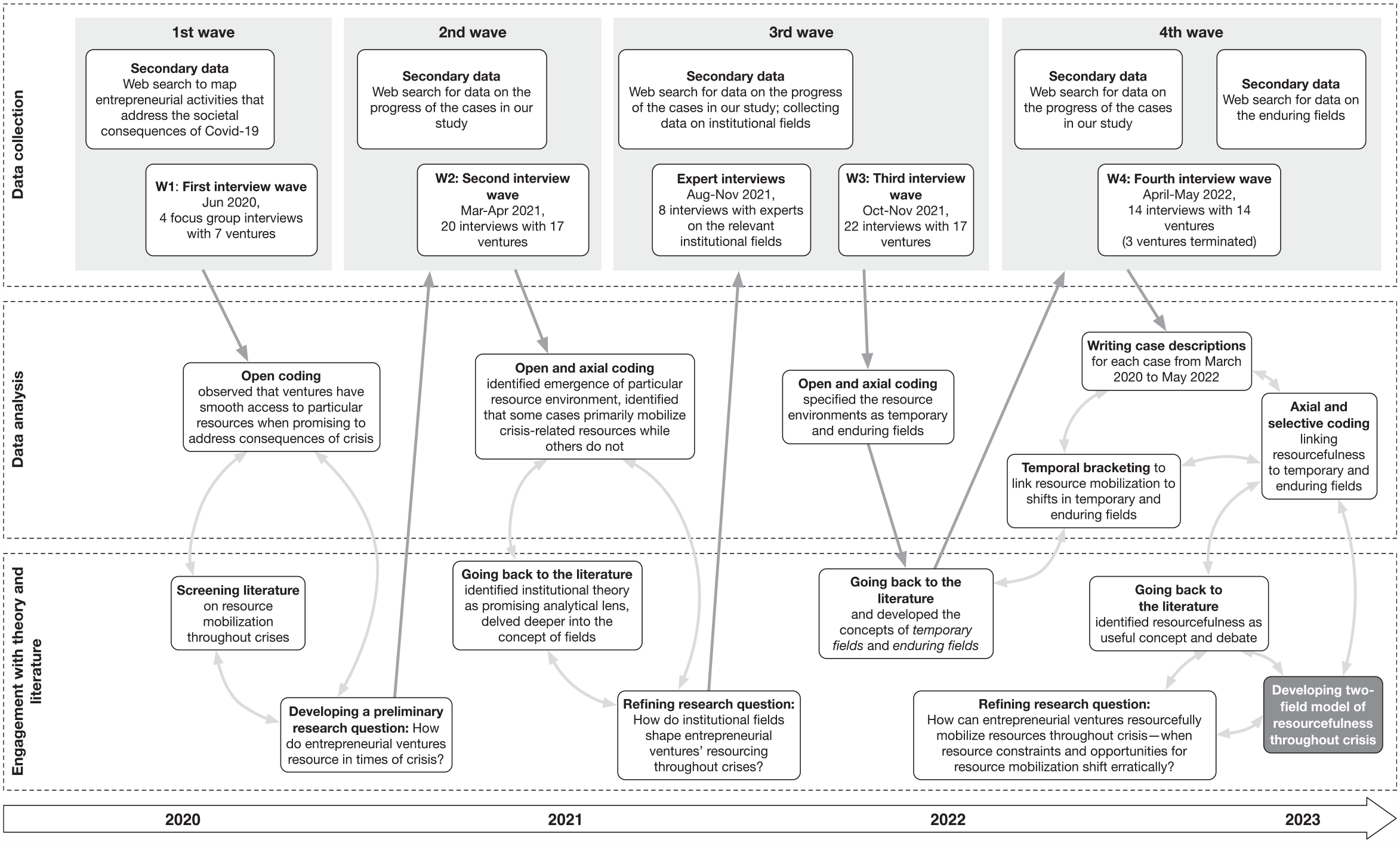
Research Process.
Overview of Case Data.
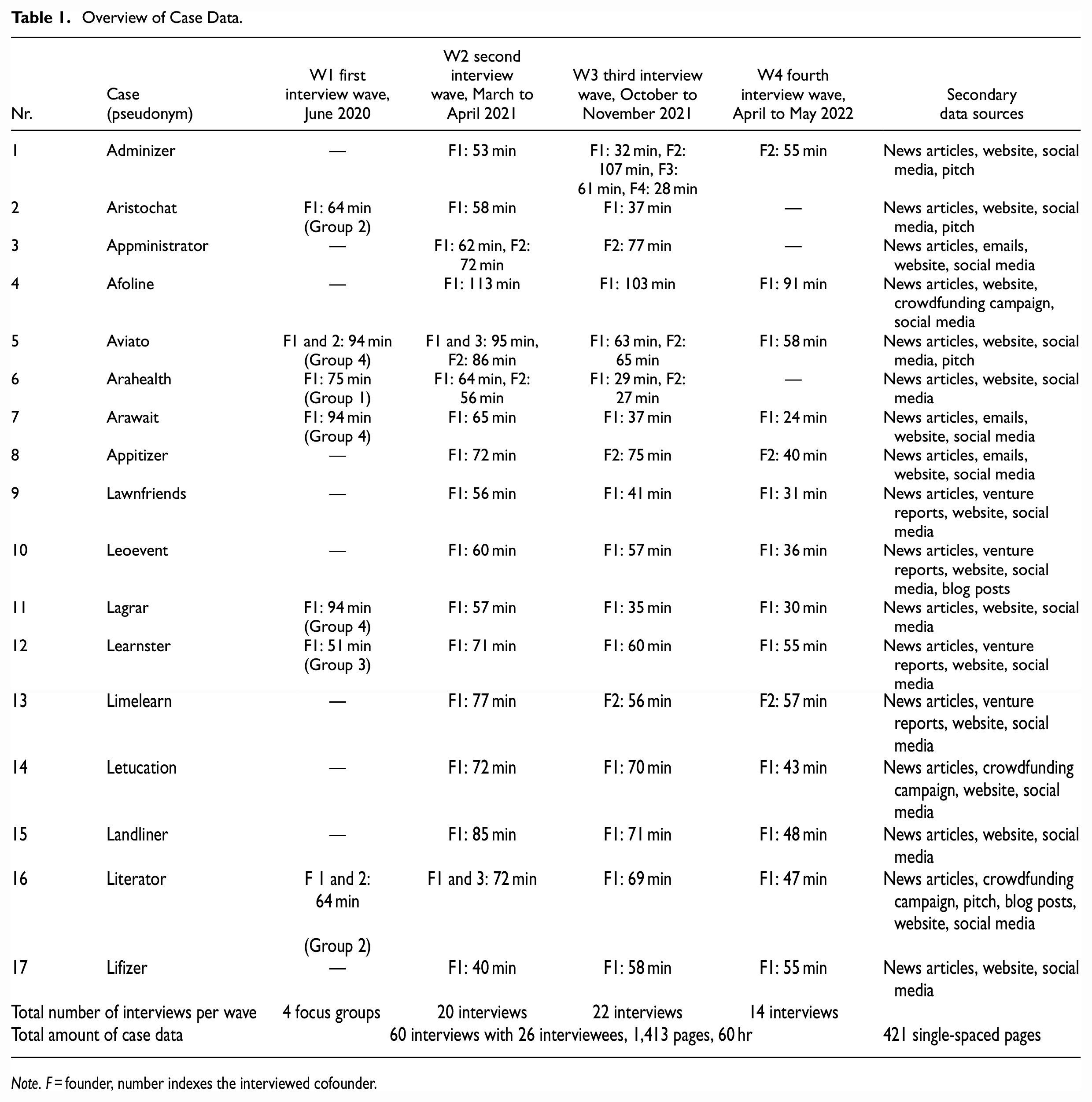
Note. F = founder, number indexes the interviewed cofounder.
First Wave
Initially, we conducted a comprehensive web search to identify entrepreneurial ventures that developed digital solutions addressing the societal consequences of COVID-19-related contact restrictions, selecting 10 of these for 4 focus-group interviews. 2 At this explorative stage, we sampled entrepreneurial ventures addressing diverse issues, thereby revealing creative resource mobilization, which prompted further exploration.
Second Wave
Following initial insights gleaned from these focus groups, we conducted a second wave of data collection relying on semi-structured interviews (see Figure 1). Seven of the 10 entrepreneurial ventures that participated in the focus-group interviews elected to continue in our study. Interviews with these seven ventures revealed similarities in resource mobilization, yet divergences emerged once contact restrictions eased. To comprehend these patterns, we expanded our sample (Strauss & Corbin, 1990).
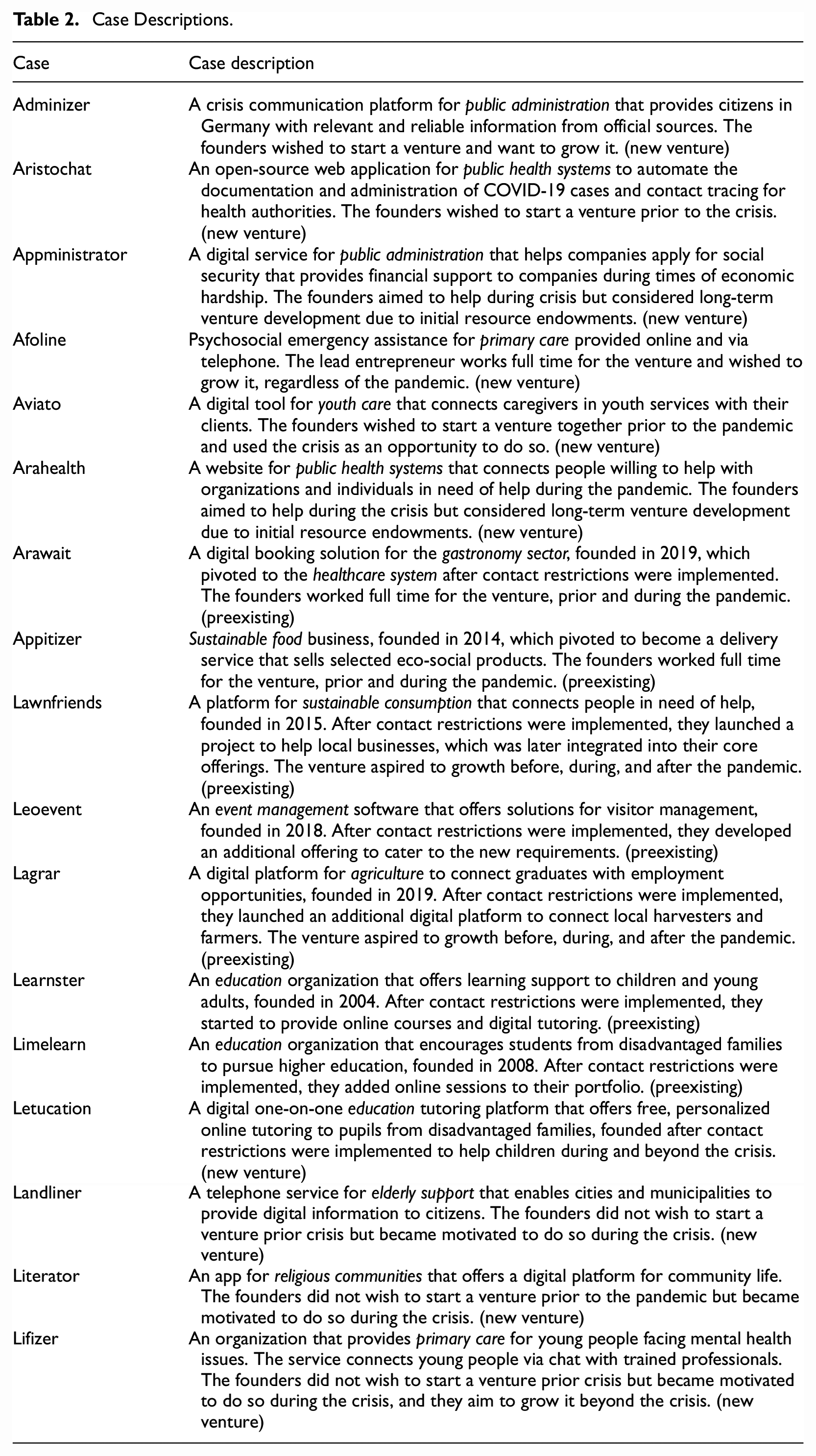
Guided by these insights and the extant literature, we set three sampling criteria (Lincoln & Guba, 1985). First, to avoid results being contingent on a single industry or domain, we included ventures across various industries and domains. Second, for comparability we sampled ventures tackling long-term issues that predated the crisis. Third, based on previous research we expected preexisting and new ventures to mobilize resources in different ways, yet we were unable to observe such differences in our initial data. To gain deeper insights into this observation, we continued to sample both types. Through an online search we identified 21 potential cases, ceasing to include more once phenomena mirrored earlier observations (Glaser & Strauss, 1967; Lund, 2014). This led to the addition of 10 cases to our initial sample, resulting in a total of 17 cases (see Table 2).
Case Descriptions.
During this wave we conducted 20 individual interviews with all 17 ventures (see Table 1). These, and all subsequent interviews, followed a narrative approach (Weiss, 1995) and were conducted online. The interviews covered, among others, ventures’ products/services, the crisis-consequence they addressed, and how they mobilized resources. We expressly ensured all interviewees’ anonymity to increase candor. As in most qualitative research, these interviews became our primary data source. To prepare the interviews, and to mitigate retrospective and social desirability bias, we collected comprehensive secondary data comprising organizational documents and materials prepared externally.
Third Wave
To capture resource mobilization throughout crisis, we interviewed these 17 cases again after roughly 6 months. We continued to gather secondary data on all cases to track their progress and prepare for the third interview wave, which comprised 22 interviews. By this point, three ventures had ceased operations; their activities were recorded until termination.
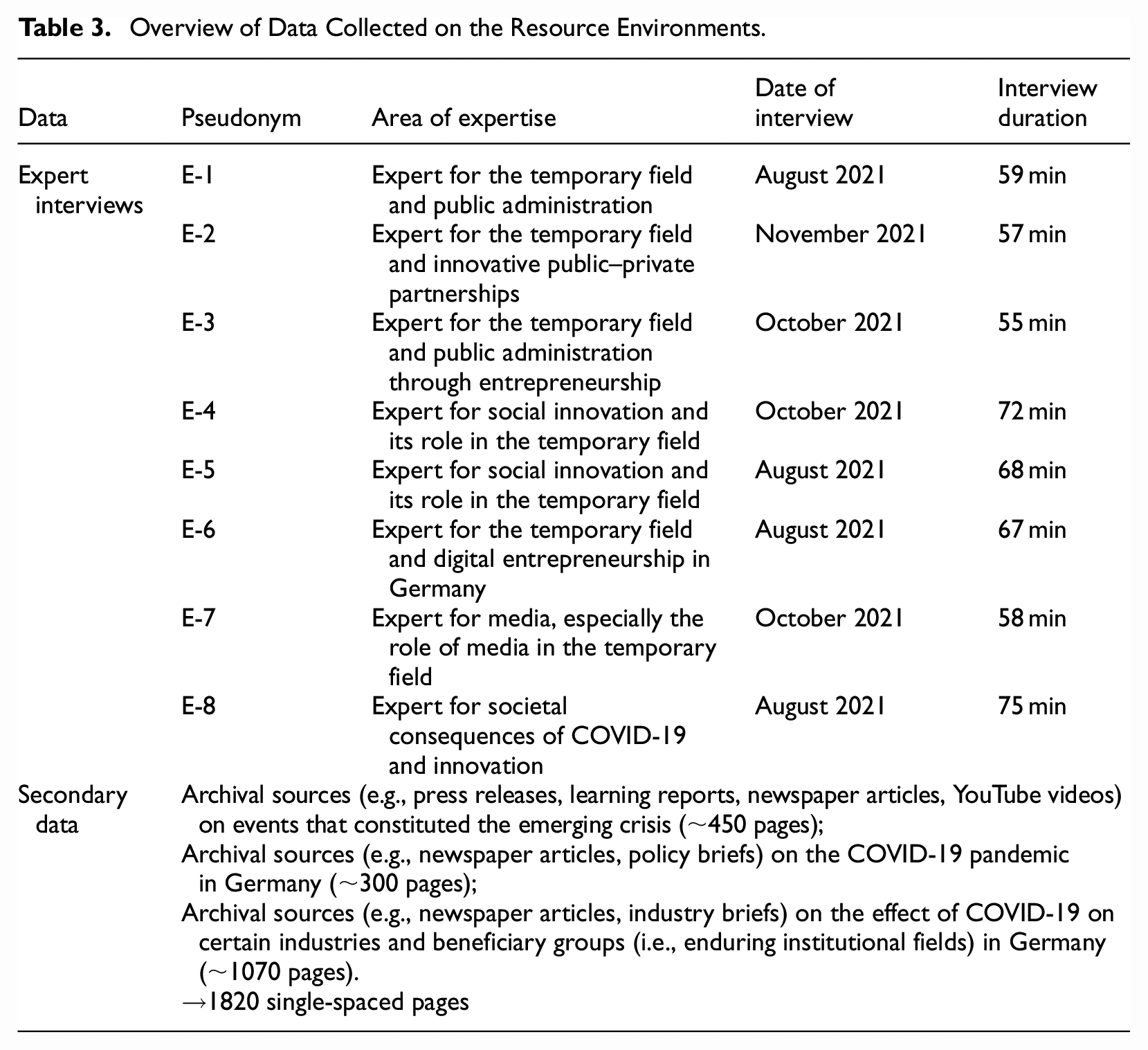
To enrich our understanding of the resource environment, we supplemented the case data with data specifically collected on their resource environment. These included German and international newspaper articles or reports on the COVID-19 crisis and entrepreneurship. When existing data were insufficient, we conducted interviews with eight experts who promised to provide relevant insights on the particularities of the observed resource environment, for example, experts on crisis-related resources or public administration during the pandemic (see Table 3).
Overview of Data Collected on the Resource Environments.
Fourth Wave
Six months later, we conducted 14 interviews with the remaining 14 cases to track their resource mobilization over time, once again gathering secondary data on our cases’ ongoing progress and their resource environments. Two additional ventures ceased operations between the third and fourth wave.
Final Data Set
Our final data set comprised 60 interviews with 17 ventures and 421 single-spaced pages of secondary data on these ventures, plus eight expert interviews and 1820 single-spaced pages of secondary data on the relevant resource environment. All interviews were recorded and transcribed verbatim.
Data Analysis
Our data analysis proceeded iteratively (Gioia et al., 2013; Magnani & Gioia, 2023; Miles et al., 2014), using coding techniques consistent with grounded theory (Strauss & Corbin, 1990). We coded our data in NVivo, a software that supports qualitative data analysis. One author conducted open coding, continuously discussing procedures with the other two authors, who were well versed with the data. All authors contributed to axial and selective coding. Weekly data sessions throughout the data analysis process facilitated reflection on emerging codes. We wrote case descriptions for each venture to timeline resource mobilization.
Open Coding
Guided by our broad interest in resource mobilization throughout crisis, we initially coded all discrete instances of ventures aiming to mobilize specific resources that were observable in our data, subsequently clustering according to their similarity. For example, we clustered all instances where ventures appealed to the crisis-motivation of volunteers, labelling this as “utilizing crisis motivation to mobilize volunteers”; similarly, we clustered all instances where ventures described their collaboration with universities in developing an incentive system for student volunteers as “offering university credits to mobilize human resources.” We then used the case descriptions to timeline these codes: while most instances of “utilizing crisis motivation to mobilize volunteers” occurred at the onset of the crisis, the identified incidents of “offering university credits to mobilize human resources” mostly occurred later. We observed such shifts in other codes of resource mobilization, as well as observing that some ventures engaged in similar patterns even as differences appeared between groups of ventures.
To enhance our understanding, we broadened our coding to encompass the ventures’ resource environment in our case interviews, expert interviews, and secondary data. We coded all text passages that contained information on resource availability, the actors that provided resources (or not), and why they provided them (or not). We observed constraint, for example, the initial hesitancy of venture capitalists to invest during the early days of the crisis, coding this as “venture capitalists” withdrawal of investments’. We also observed opportunities for resource mobilization, for example, when governmental grants were made available for ventures that aimed to help during crisis, coding this as “financial resources for crisis-help.” Mapping our codes onto the progression of the crisis revealed shifts in the availability of certain resources. Furthermore, we coded text passages that explicitly outlined changes in resource environments.
Axial Coding
To understand the similarities and differences in ventures’ resource mobilization throughout the crisis, we grouped first-order codes into higher-order themes, thereby capturing (1) changes in resource environment throughout the crisis and (2) differences between ventures’ adjustments.
First, we identified the concept of fields from institutional theory as beneficial for conceptualizing ventures’ resource environment (DiMaggio & Powell, 1983; Hoffman, 1999). We grouped together first-order codes related to actors, resources, and the respective normative setting that guided their activities in order to delimit relevant institutional fields (see Table 4 for exemplary codes and text segments). Our analysis showed that a crisis-related field emerged around the societal consequences of contact restrictions, coexisting with other fields linked to the diverse industries and domains where these issues arose.
Coding Scheme to Identify Fields.
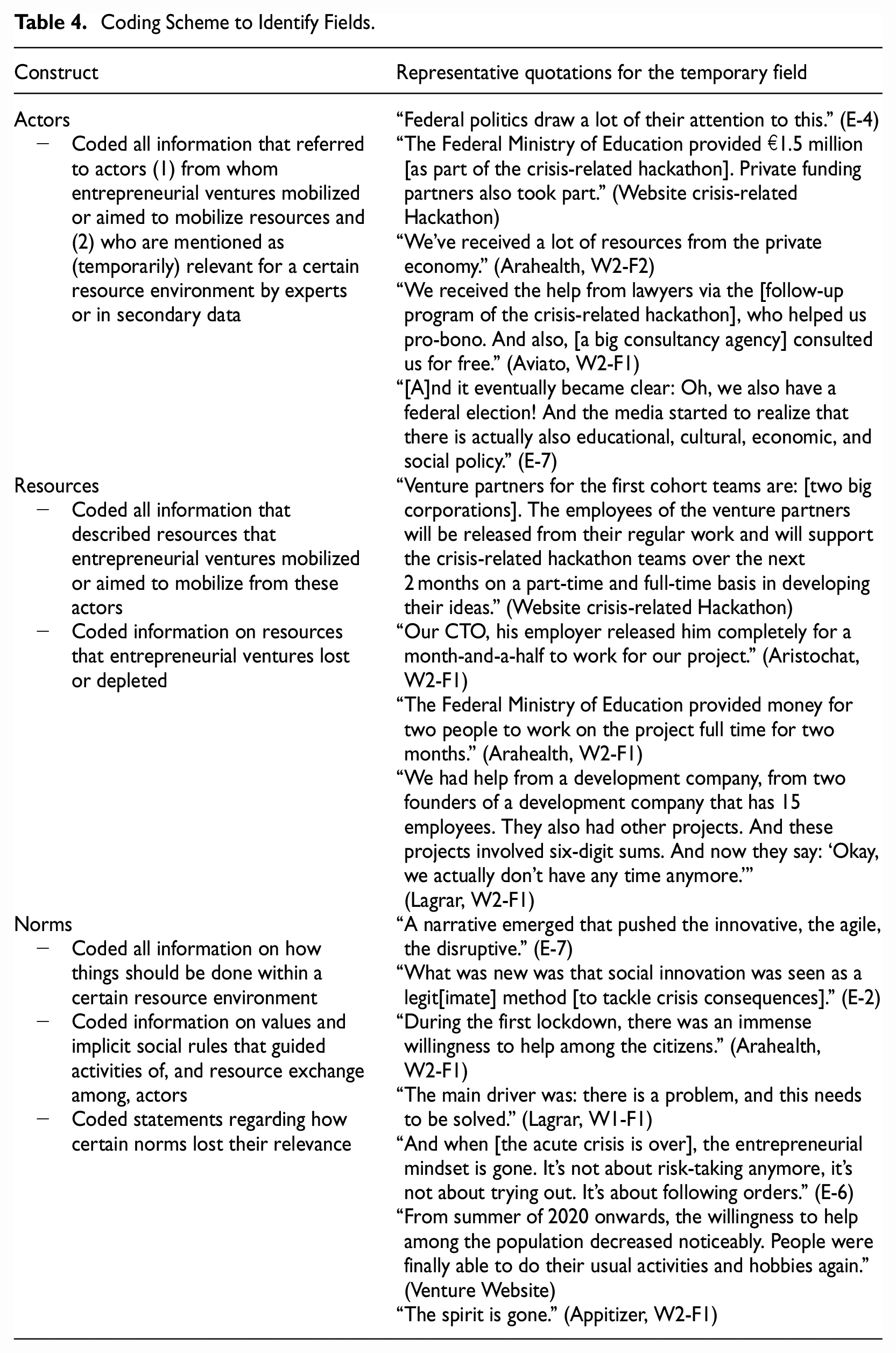
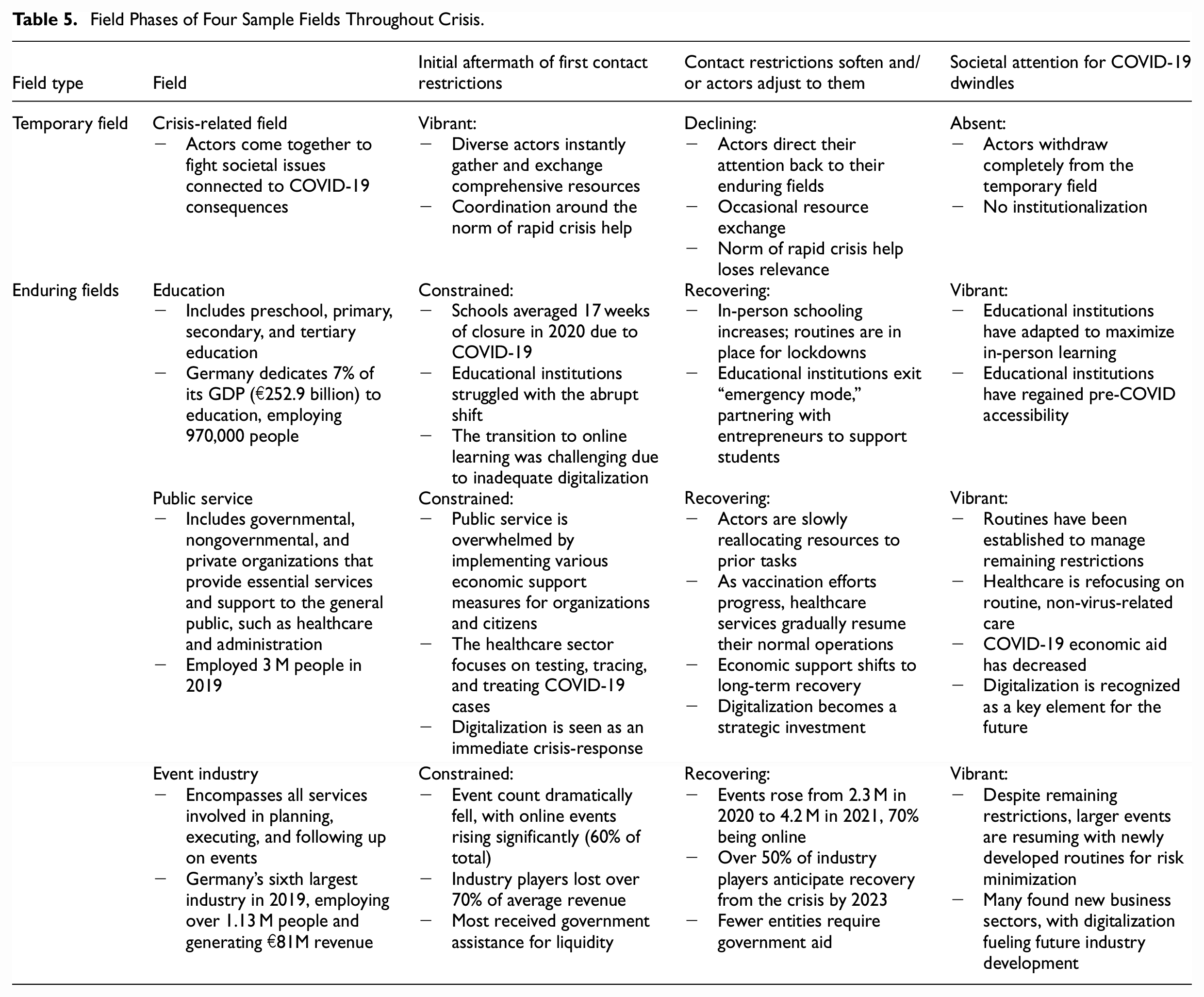
Moving back and forth between data and theoretical insights on institutional fields, we realized that the temporary nature of this crisis-related field was the most relevant characteristic. As we did not find an appropriate conceptualization for this phenomenon, we developed the concept of temporary fields in distinction to enduring fields. Next, we delved into each identified field and aimed to identify the most relevant shifts by means of temporal bracketing (Langley, 1999). Table 5 provides an overview of field phases of four sample fields.
Field Phases of Four Sample Fields Throughout Crisis.
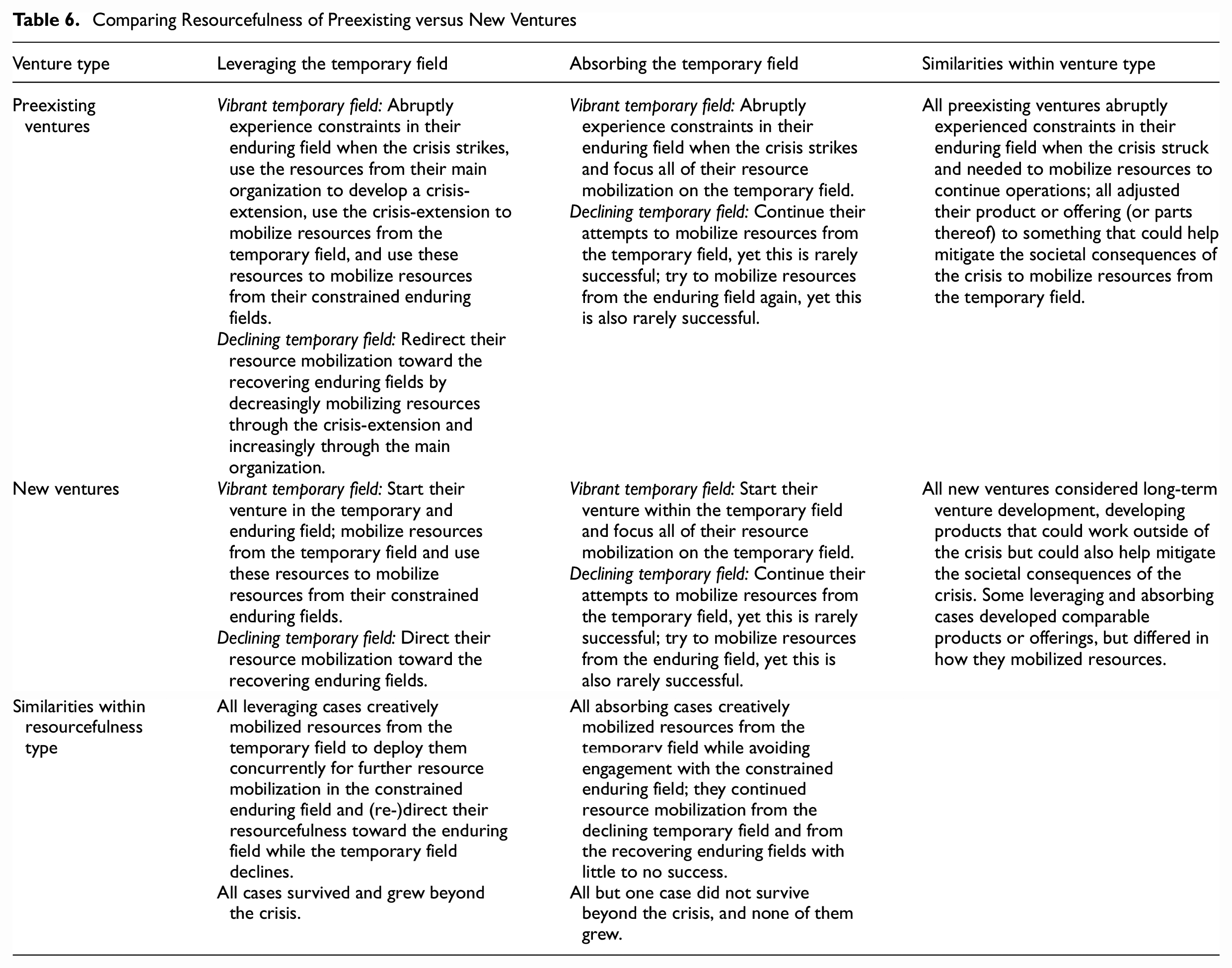
Second, we delved deeper into the differences observed across groups of cases by comparing cases with common themes and variations (Klag & Langley, 2013). We developed several tables and matrices to relate venture characteristics to our open codes on resource mobilization, as well as to relate resource mobilization to the temporary and enduring fields. For example, we compared cases from similar enduring fields that showed differences in resource mobilization and cases from different enduring fields that showed similarities in resource mobilization. Furthermore, we compared preexisting vs. new ventures, within vs. across the two groups of cases, as illustrated in Table 6, realizing that the prevailing difference occurs in how they mobilized resources from the temporary field, specifically in relation to if and how they mobilized resources from their enduring fields. This led us to categorize cases into two groups: those mobilizing resources from the temporary and their enduring field versus those primarily mobilizing resources from the temporary field. To theorize this observation, we identified entrepreneurial resourcefulness as a promising lens.
Comparing Resourcefulness of Preexisting versus New Ventures
Selective Coding
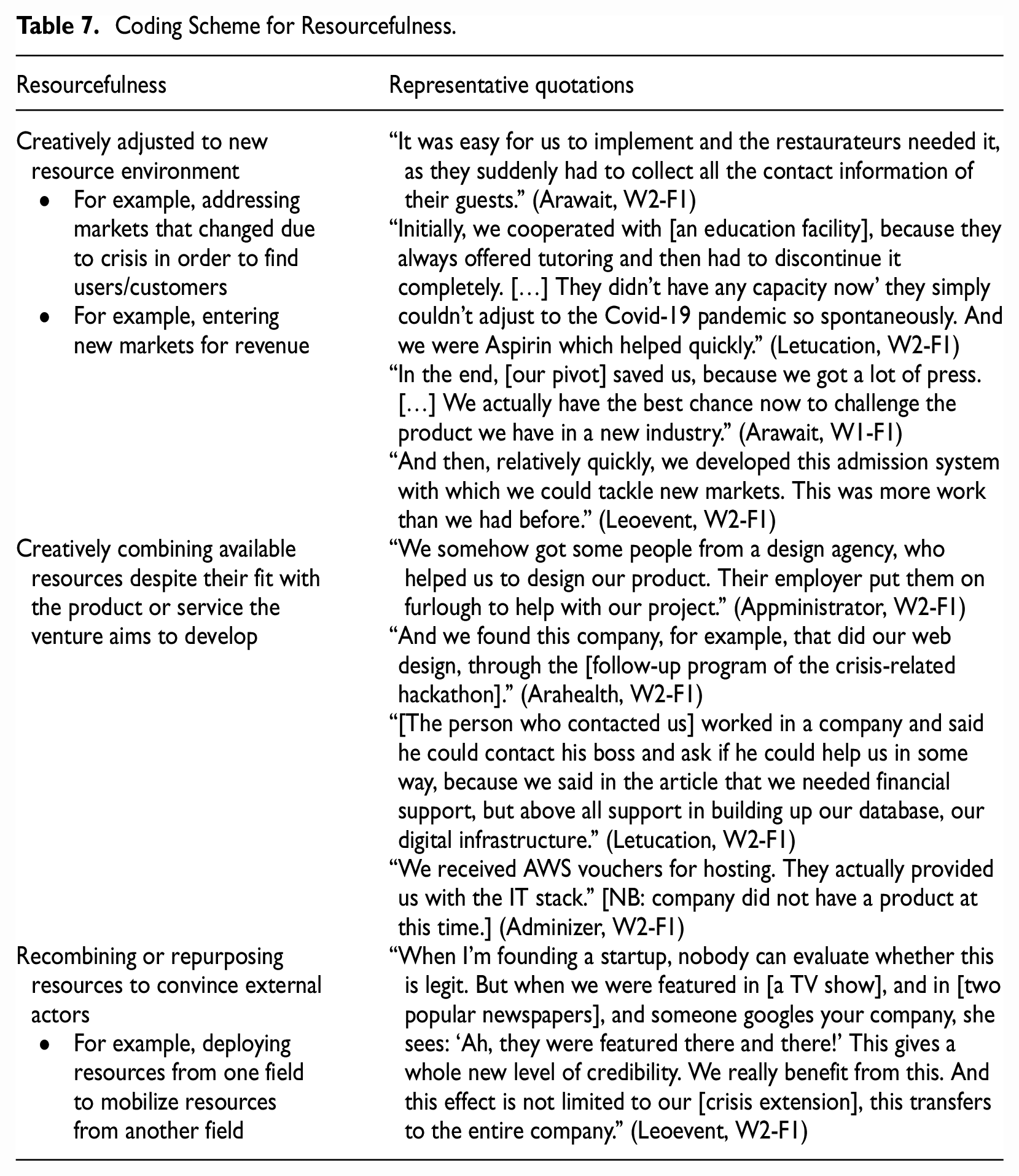
After specifying the relevant fields, their different phases, and the two groups of ventures and their respective resource mobilization, we re-coded text segments and coded parts of our raw data again. To code resourcefulness, we built on Reypens et al.’s (2021, p. 9) coding scheme. 3 Table 7 depicts our coding criteria and illustrative text segments.
Coding Scheme for Resourcefulness.
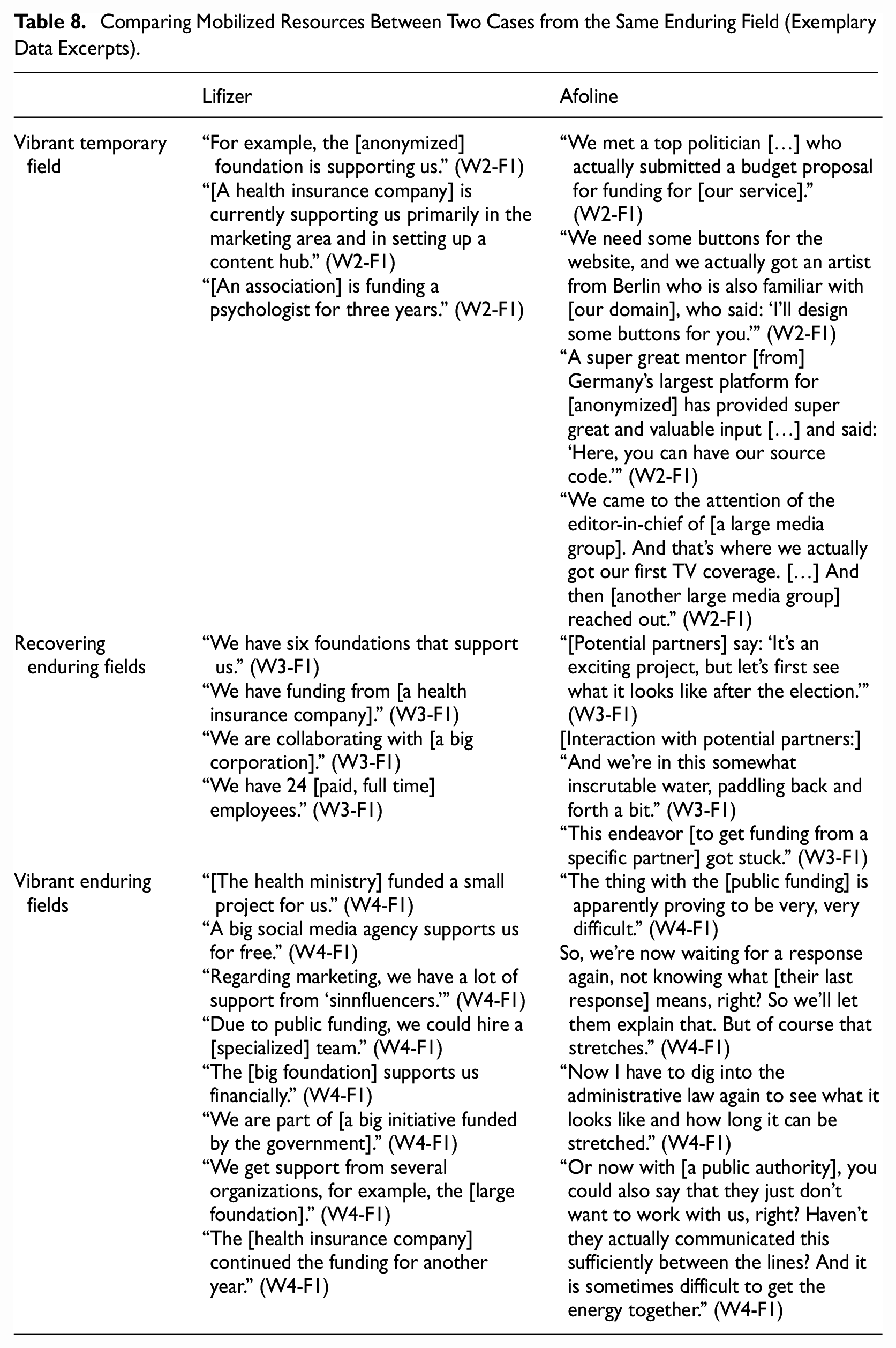
Through continuous rearrangement and integration of codes, and in repeated theoretical reflection, leveraging the temporary field and absorbing the temporary field emerged as two types of resourcefulness. To specify their distinct outcomes, we coded ventures’ mobilized resources throughout the crisis. While we did code a plethora of mobilized resources for leveraging ventures, we rarely identified them for absorbing ventures beyond the temporary field’s decline (see Table 8). Furthermore, we linked venture termination to the two types of resourcefulness and mobilized resources, indicating that absorbing the temporary field threatened venture survival beyond the crisis.
Comparing Mobilized Resources Between Two Cases from the Same Enduring Field (Exemplary Data Excerpts).
This highly iterative process evolved over numerous cycles, resulting in our data structure, depicted in Figure 2, and our two-field model of resourcefulness throughout crisis, depicted in Figure 3.
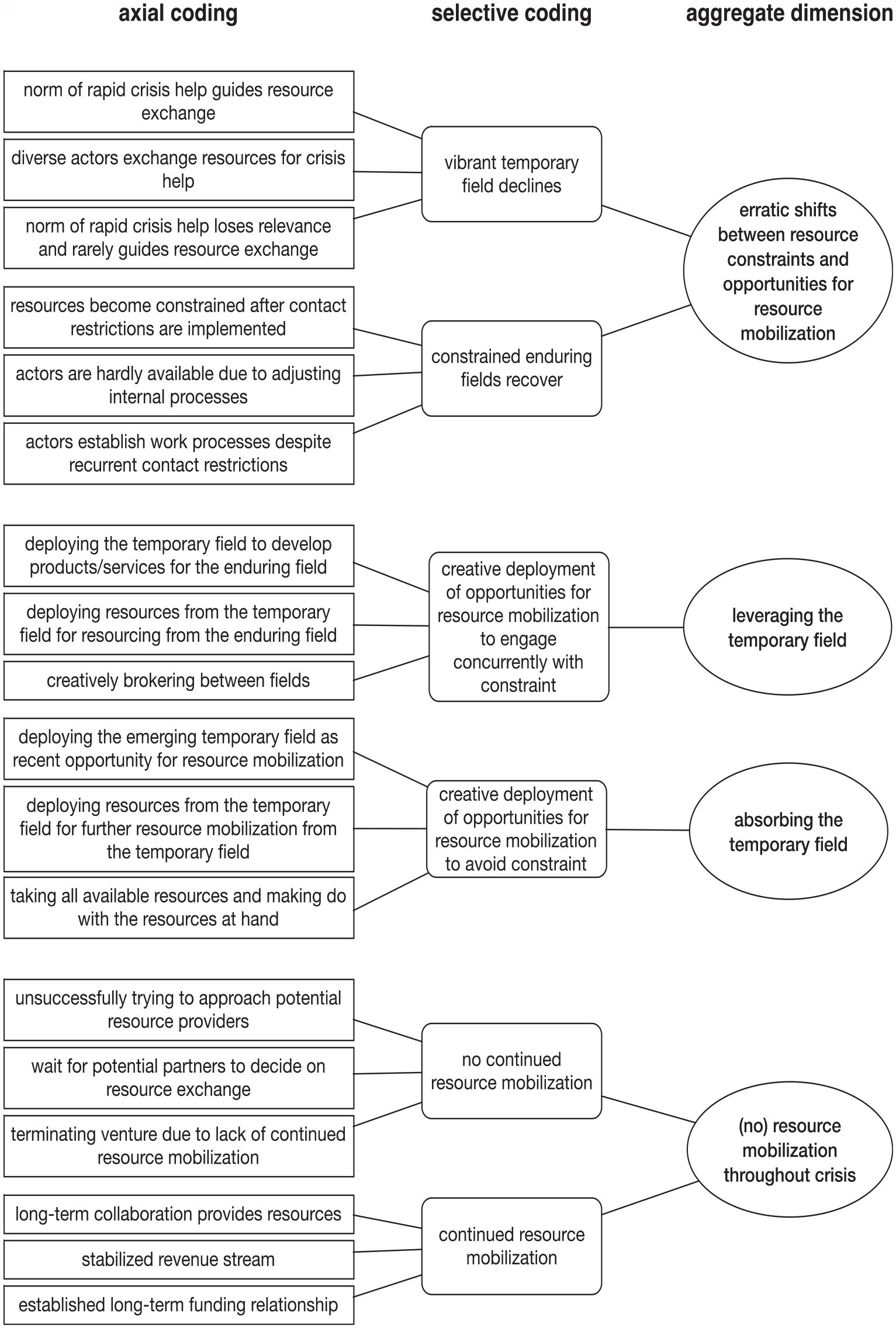
Coding Structure.
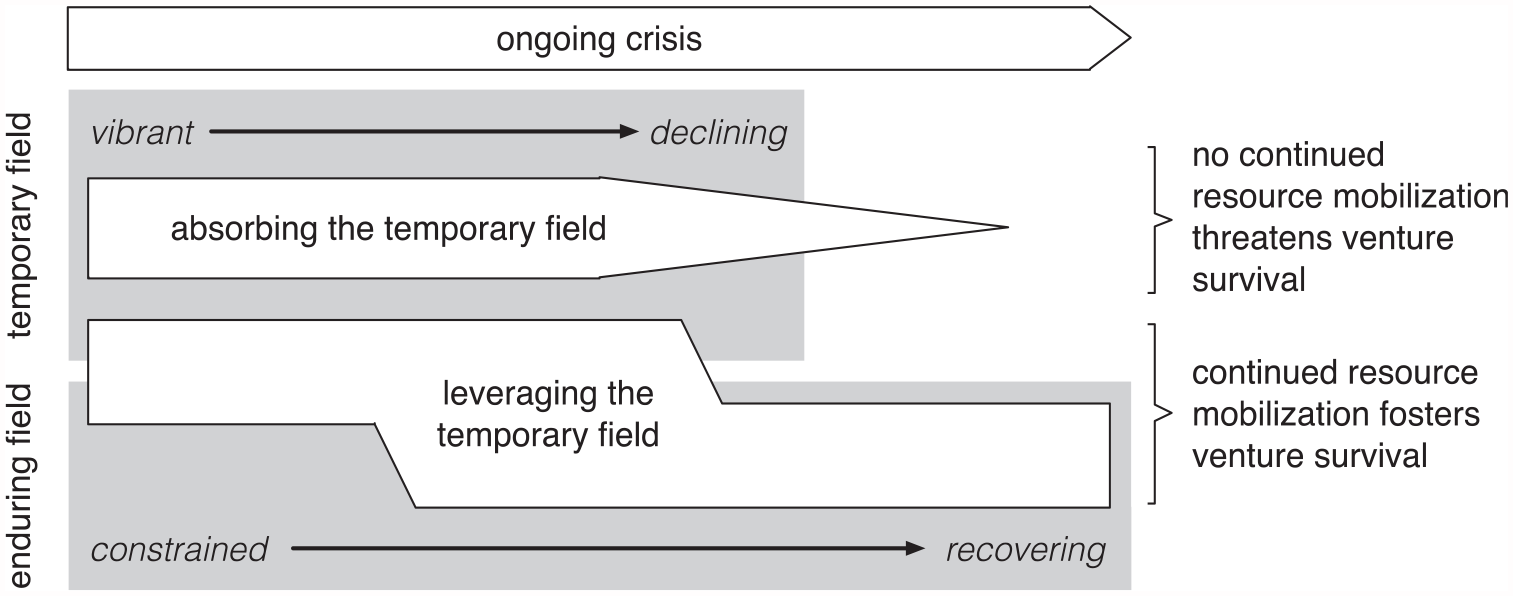
Two-field Model of Resourcefulness throughout Crisis.
Findings
By differentiating between resource constraints and opportunities for resource mobilization, our two-field model of resourcefulness throughout crisis (Figure 3) illuminates two new types of resourcefulness and explains their differing outcomes.
We identified a temporary field, that is, an emerging field that began to institutionalize yet ceased to do so before it had attained full institutionalization, and enduring fields, that is, fully institutionalized fields (DiMaggio & Powell, 1983), as relevant fields that coexisted at the onset of the crisis and shifted erratically throughout the crisis. In our case, the analyzed enduring fields existed prior to the crisis and experienced abrupt constraints. At the same time, a vibrant temporary field emerged and offered opportunities to mobilize resources. Although the crisis prevailed, the enduring fields recovered and the temporary field declined.
Within these erratic shifts we identified two types of resourcefulness: leveraging the temporary field, that is, creatively mobilizing resources from the temporary field to deploy them for concurrent resource mobilization in the constrained enduring field; and absorbing the temporary field, that is, creatively mobilizing resources from the temporary field while avoiding engagement with the constrained enduring field.
Resourcefulness in a Vibrant Temporary Field and in Constrained Enduring Fields
Enduring Fields
As a consequence of the initial implementation of contact restrictions, our cases’enduring fields abruptly experienced substantial constraints (see Table 5). Contact restrictions necessitated the closure of educational and administrative facilities, offices, and places for leisure activities, thereby impeding societal and economic life in general. For example, event organizers witnessed a drastic decrease in revenue, surpassing 70% in 2020 (IGVW, 2021). This financial strain jeopardized the survival of many industry actors and led to extensive layoffs and short-term work arrangements. Schools shifted to home-schooling, and ventures working with schools noted that they “were not approachable at all, teachers were not reachable” (Limelearn, W2-F1). Public-sector organizations struggled to uphold social welfare despite closed offices and remote work, and work processes decelerated.
Temporary Field
Simultaneously, a temporary field suddenly emerged around the norm of rapid crisis help and presented new opportunities for resource mobilization. Guided by an immense willingness to help, diverse actors came “together with their different perspectives” (E-5), because everyone wanted “to somehow contribute […] to fight this pandemic” (Lawnfriends, W2-F1). Around this norm, “a wide variety of actors could get involved” (E-8), including the government, corporates, SMEs, foundations, individuals, universities, or the media. Within this community, “different people came together and had a collective motivation” (Appministrator, W2-F2), and this motivation was “to get solutions on the road as quickly as possible” (E-5).
This norm of rapid crisis help provided a common meaning system for these actors to coordinate their activities. They shared the idea that they “can all do something” (E-4) and realized “which power actually lies [in them together]” (E-4), underscoring the solidifying awareness of actors that they were involved in a common undertaking: “We had a joint problem. And as a result, people cooperated and did things they would have never done before” (Limelearn, W3-F1), which led to a “welding together” (Lawnfriends, W2-F1) within this field.
Around this norm numerous actors provided resources for rapid crisis help, and others—such as the entrepreneurial ventures analyzed here—could tap into these by promising to help. For example, individuals who experienced time surplus lent their skills. Corporations experienced a withdrawal of contracts and, therefore, could “provide a certain amount of [their] employees for societal purposes” (Arahealth, W2-F2). SMEs offered financial and technological resources, and the “government provided a lot of money” (E-8). Media outlets focused single-mindedly on COVID-19: “You had the impression that there was nothing else except Covid” (E-7).
Leveraging the Vibrant Temporary Field
Nine of our cases leveraged the temporary field: five preexisting ventures (Lawnfriends, Leoevent, Lagrar, Learnster, and Limelearn) and four new ventures (Letucation, Landliner, Literator, and Lifizer).
When the crisis struck, the five preexisting ventures experienced resource constraints within their enduring fields; simultaneously, they recognized the opportunities for resource mobilization that emerged with the temporary field. To break boundaries and deploy this opportunity, they developed a crisis-extension, that is, a detached product or service that coexisted with the main organization and aimed to address crisis-related markets: “We called it a satellite, which floated around our space station” (Lawnfriends, W3-F1). To develop this crisis-extension these five preexisting ventures creatively mobilized their internal human resources by calling on the norm of rapid crisis help: “During the first lockdown, the team gave everything to contribute something to fight the pandemic” (Lawnfriends, W3-F1). They subsequently deployed this crisis-extension to generate crisis-related revenue that could be used to sustain the main organization: “Relatively quickly, we developed [a solution based on our original product that could help with contact restrictions], and there were many new markets that we could enter with that” (Leoevent, W2-F1).
This crisis-extension not only generated crisis-related revenue, but also crisis-related media attention, which ventures then deployed to mobilize resources from their constrained enduring fields. For example, Lawnfriends leveraged the media’s attention (and concomitant new users) from their crisis-extension to acquire funding for their main organization: “Due to that, our investors put in another round. This was during a time where it was very hard for startups to raise capital, but we managed to acquire another round” (Lawnfriends, W2-F1). Moreover, Leoevent increased the credibility of their main organization via its crisis-extension, as their media appearance generated “a whole new level of credibility,” and “this effect is not limited to our [crisis-extension], this transfers to the entire company” (Leoevent, W2-F1). Hence, they deployed crisis-related media attention—derived from the temporary field—as a lever for resource mobilization from their constrained enduring fields.
Importantly, preexisting ventures who leveraged the temporary field only mobilized resources from the temporary field through parts of their organization, namely their crisis-extension. This enabled them to leverage the resources mobilized through the crisis-extension to benefit the main organization, which remained in the enduring field, thus paving the way for continued resource mobilization beyond the temporary field’s decline.
The four new ventures identified the temporary field as a ready opportunity to mobilize resources for a problem they regarded as relevant independently of the crisis, yet which had gained in relevance or visibility due to the crisis. To kick-start their entrepreneurial undertaking, ventures deployed team members’ time surplus by referring to the norm of rapid crisis help: “Now, during the lockdown, several people said: ‘At the moment, I have time. I can now invest this time’” (Literator, W2-F1). They then leveraged the human resources mobilized via the norm of rapid crisis help to mobilize further resources from their constrained enduring field—by calling on norms linked to long-term societal problems. Here, resources were mobilized in different ways from the temporary and enduring field, as the actors, resources, and norms differed between these fields. Ventures were thus able to mobilize volunteers and team members in their enduring field—human resources that could subsequently be made permanent. Lifizer explained that many volunteers joining them during the early days of COVID-19 had “waited for a chance to volunteer in this area and in this form” (Lifizer, W2-F1).
In sum, preexisting and new ventures who leveraged the temporary field mobilized resources therefrom to aid further resource mobilization concurrently within their constrained enduring fields—thereby bypassing their constraint.
Absorbing the Vibrant Temporary Field
Eight of our cases absorbed the temporary field: two preexisting ventures (Appitizer and Arawait) and six new ventures (Adminizer, Aristochat, Appministrator, Afoline, Aviato, and Arahealth).
As their enduring field abruptly became constrained, the two preexisting ventures eluded this constraint by immediately focusing their entire resource mobilization on the opportunities provided by the emerging temporary field: “Thanks to Covid-19, we lost all our customers [from our enduring field] relatively quickly and spontaneously decided to adapt the product to [the temporary field]” (Arawait, W1-F1). They approached new customers who needed their offering due to contact restrictions, thereby generating revenue streams from the temporary field. To adapt their product, they mobilized resources from the temporary field; for example, acknowledging the need for a distribution partner, Appitizer (W1-F1) realized: “We missed the trucks on the road and knew that they were standing somewhere. […] And they’re actually just waiting to move.” Here, the venture was able to mobilize such free capacities by appealing to the norm of rapid crisis help. In contrast to the leveraging ventures who utilized a crisis-extension to mobilize resources from the temporary field (and remained connected to the enduring field through their main organization), these ventures redirected their entire organizations’ resource mobilization to the temporary field.
The six new ventures identified the temporary field as a ready opportunity to mobilize resources for an undertaking that either resulted from the urge to do “something—anything” (Appministrator, W2-F1) at the onset of the crisis, or from the intent to start a venture for some time, evaluating this opportunity for resource mobilization as a good setting for doing so: “we took it as a chance to finally work together” (Aviato, W1-F1). Although team-internal and team-external human resources were initially motivated by the norm of rapid crisis help, and primarily available due to time surplus produced by the crisis, they all tackled issues that had relevance independently from the crisis.
Preexisting and new ventures alike absorbed a plethora of other resources from the temporary field—yet, importantly, only from the temporary field. These resources comprised financial and legal aid, design services, time from volunteers, IT services, in-kind donations, and media attention: “It was crazy. Many, many media outlets approached us. Even the really really good outlets, like prominent TV programs that aired at prime-time” (Appitizer, W2-F2). Ventures then creatively deployed this media attention to mobilize further resources from the temporary field, again by calling on the norm of rapid crisis help. For example, based on their TV appearance, Aristochat acquired a customer in need of their product due to the crisis. In contrast, the leveraging ventures used such media attention to mobilize funding from their constrained enduring field.
In sum, preexisting and new ventures who absorbed the temporary field mobilized resources only from the temporary field and avoided constraint; and the temporary field enabled comprehensive resource mobilization while it was vibrant.
Resourcefulness in a Declining Temporary Field and Recovering Enduring Fields
Enduring Fields
Following the initial relaxation of contact restrictions and adaptation of work practices, enduring fields gradually began to recover. Some particularities notwithstanding, we observed common trends across enduring fields (see Table 5). Actors in the enduring fields adjusted to the overall crisis situation by incorporating online or hybrid models into their work processes, products, and services, thereby allowing them to serve their original organizational goals, offerings, and markets once again. When educational facilities reopened, interaction and resource exchange was reinitiated: “We received many, many inquiries from schools who wanted us to host in-person events for them” (Limelearn, W3-F2). Moreover, public services established a selection of online offerings, such as “solutions to schedule appointments online” (E-1). Eventually, the enduring fields recovered—not because the COVID-19 crisis ended, but because those fields had adjusted to it (see Table 5).
Temporary Field
Although the pandemic was not over—infection numbers rose and contact restrictions increased over the following two winters—numerous relevant actors no longer regarded COVID-19’s societal consequences as detrimental. Attention toward COVID-19’s societal consequences diminished, and the temporary field began to decline. The norm of rapid crisis help lost relevance and actors pulled back from the temporary field. The media “started to realize that there is actually also educational, cultural, economic, and social policy” (E-7) upon which to report. Numerous actors tired of the pandemic, and other issues (e.g., the German national election in late 2021) and crises (e.g., the war in Ukraine) moved to the center of societal attention. Some actors allocated their resources to the latest crises, others reallocated them to their enduring fields. In consequence, the opportunities to mobilize resources from the temporary field were not synchronous with the crisis itself.
Leveraging the Declining Temporary Field
Although the temporary field declined, leveraging the temporary field continued to mobilize resources—both for preexisting and new ventures. As the enduring fields began to recover, ventures shifted their focus to their enduring fields while gradually detaching their resourcefulness from the declining temporary field.
Despite the crisis continuing to hold sway, preexisting and new ventures alike mobilized only selected resources from the declining temporary field. For example, Landliner selectively accepted invitations to events hosted by the temporary field’s actors, hence only maintaining relationships that could be deployed within their enduring field (W3-F1): “I’m looking at [invitations] very specifically and ask myself: ‘What’s the outcome? […] Is there a possibility of [long-term] financing?’ I look at it more critically than I did a year ago.” They focused their attention on events where relationships could be formed that later served to elevate their topic onto political agendas. Similarly, they leveraged media attention generated occasionally in the declining temporary field so as “to approach people that are relevant for our societal issue” (Landliner, W2-F1), that is, those who were part of their recovering enduring field.
All nine of our cases who leveraged the temporary field focused their resourcefulness on the enduring field for continued resource mobilization, specifically by deploying relationships that they had formed within the enduring field while it was constrained. For example, Lifizer and Letucation used increased awareness for their societal problem generated at the onset of the crisis to initiate collaboration with universities. They subsequently solidified these partnerships by integrating venture-specific tasks into the curriculum, that is, by calling on the institutional setting of their enduring field (W4-F1): “We get our [volunteers] via our university cooperation. They really like to join our project for one semester because they receive credits for it.” Similarly, Lawnfriends cooperated with a payment provider while the temporary field remained vibrant. As that company was also part of Lawnfriends’ enduring field, they moved to deepen this relationship, which subsequently “evolved into a real collaboration” (W3-F1); Throughout the enduring field’s recovery, they integrated this partnership into their long-term offering.
Overall similarities notwithstanding, preexisting ventures evinced few specific nuances in how they redirected their resourcefulness to their enduring fields, chiefly due to the coexistence of their crisis-extension and main organization. Concretely, these ventures decreasingly mobilized resources through the crisis-extension (temporary field), and increasingly through the main organization (enduring field). Two of our cases dropped relationships formed via the crisis-extension (Leoevent and Lagrar), as they “shifted our focus back to our original business model” (Lagrar, W2-F1). Three of our cases (Lawnfriends, Learnster, and Limelearn) integrated the crisis-extension into the main organization’s business processes: “We focus on solidifying our [crisis project]. It should become something that not just helps someone once or twice a year, but all year long” (Lawnfriends, W2-F1). This permitted long-term market expansion: “We definitely expanded our activity sphere and customer base” (Limelearn, W3-F2).
In sum, proactively engaging with the enduring field while it was constrained paved the way for resource mobilization throughout the crisis; and this proactive engagement was facilitated by resourcefully deploying resources mobilized from the temporary field within the constrained enduring fields.
Absorbing the Declining Temporary Field
Ventures who absorbed the temporary field continued to (try to) mobilize resources from the declining temporary field, as its decline was masked by the crisis’ prevalence. Yet, although absorbing the temporary field mobilized comprehensive resources while the temporary field was vibrant, it ceased to do so as the crisis prevailed but the temporary field declined.
Preexisting and new ventures alike continued to address actors who had been, or sometimes still were, part of the temporary field. Yet, these actors were often unable or unwilling to provide resources as the norm of rapid crisis help lost relevance and their focus was redirected to their recovering enduring fields. For example, Appministrator approached a government agency while the temporary field was vibrant and, “one week later, our website had a prominent link on their website” (Appministrator, W3-F2). Then, to expand their cooperation they “tried to contact a colleague with a good network in [this government agency] again, but we did not really get any resonance” (Appministrator, W3-F2).
Beyond delivering minimal resource endowments infrequently (e.g., programmers who would infrequently work for a few hours on Appministrator’s app), no significant resources were mobilized from the declining temporary field. Hence, ventures increasingly sought to mobilize resources from their recovering enduring fields, yet experienced difficulties in doing so. They approached potential partners but were often forced into “a standby position” (Aviato, W3-F2), where “the biggest challenge are the waiting times with our partners” (Aviato, W2-F3). Adminizer repeatedly had to remind potential partners to respond (W3-F2): “We have to ask them again and again, have to remind them, this is very tedious.” These struggles in redirecting their resource mobilization to the recovering enduring fields indicates that ventures can only mobilize resources throughout crisis by simultaneously engaging with the temporary and enduring field from the onset of the crisis, that is, through leveraging the temporary field.
In sum, focusing entirely on the suddenly emerging opportunities for resource mobilization at the onset of the crisis—the temporary field—inhibited resource mobilization throughout the crisis, and the cessation of this opportunity was masked by the crisis’ ongoing prevalence.
Outcomes Beyond Crisis
By leveraging the temporary field, preexisting and new ventures alike were able to mobilize resources throughout the crisis—beyond the temporary field’s decline. For example, Literator created a professionalized pricing model for its software and approached customers via solidified relationships with multipliers (W3-F1): “We really have intensified our relationship to [a key actor].” Securing revenue and long-term funding enabled ventures to perpetuate human resources; for instance, Lifizer was launched by four team members during their spare time as the crisis struck, and, by the time of our fourth interview wave, had “24, 25 employees, but we are urgently looking for more” (Lifizer, W4-F1) due to funding secured from several health-care insurance companies, a number of foundations, and the German federal government. Partnerships initiated at the onset of the crisis were “really stabilized and even further perpetuated” (Lawnfriends, W4-F1).
All nine cases survived beyond the crisis and, at the time of our final wave of interviews, showed continuous growth, indicating that continued resource mobilization through leveraging the temporary field fostered venture survival beyond the crisis.
In contrast, by absorbing the temporary field, preexisting and new ventures alike were able to mobilize resources only at the onset of the crisis—but not throughout the crisis. Due to a lack in resource inflow, the two preexisting ventures (Arawait and Appitizer) and three of the six new ventures (Arahealth, Aristochat, and Appministrator) terminated their activities during our data collection period, and two further cases (Aviato and Adminizer) terminated them in the following year. 4
Summary of Our Findings
In sum, we found that when the crisis struck, a temporary field suddenly emerged and offered opportunities for resource mobilization. Yet, this field declined although the crisis prevailed. Enduring fields abruptly experienced resource constraints and eventually recovered. We identified two types of resourcefulness through which ventures mobilized resources throughout these erratic shifts between resource constraints and opportunities for resource mobilization. While both enabled ventures to mobilize comprehensive resources at the onset of the crisis, only leveraging the temporary field mobilized resources throughout the crisis and fostered venture survival beyond the crisis; absorbing the temporary field did not.
Contributions
We set out to explore how entrepreneurial ventures can resourcefully mobilize resources throughout crisis—when resource constraints and opportunities for resource mobilization shift erratically. We found that entrepreneurial ventures can only do so by leveraging the temporary field, not by absorbing the temporary field, although both types of resourcefulness are successful at the onset of the crisis. Our theoretical model explains why: only proactive engagement with the constrained enduring fields from the onset of the crisis prepares ventures to adjust their resourcefulness to erratic shifts in a timely manner. With this, our study offers three contributions.
Contribution to Research on Entrepreneurial Resourcefulness Amid Crisis
First, we contribute a clearer understanding of entrepreneurial resourcefulness throughout crisis and its consequences for venture survival beyond crisis. Our two-field model of resourcefulness throughout crisis explains how and why only one type of resourcefulness enables resource mobilization throughout the crisis and fosters venture survival beyond crisis, although both types successfully mobilized resources at the onset of the crisis. This underscores the need to evaluate initial crisis responses in relation to longer-term outcomes.
Although it might not be very surprising that one approach is more successful than the other, it is surprising here, because at the onset of the crisis, both seemed equally successful. Based on prior research, we would assume that successful resourceful resource mobilization at the onset of a crisis helps ventures to survive the crisis (Klyver & Nielsen, 2021; Kuckertz et al., 2020; Wenzel et al., 2021). However, our findings suggest that this is not necessarily the case. The fact that certain approaches ensure resource mobilization at the onset of the crisis (Doern, 2021; Farhoud et al., 2020; Manolova et al., 2020) does not necessarily mean that they will help the venture to survive beyond the crisis.
Specifically, our findings show that too great a focus on opportunities for resource mobilization (i.e., absorbing the temporary field) might threaten venture survival beyond the crisis. While it might appear tempting to focus solely on opportunities for resource mobilization during such turbulent times (Scheve et al., 2024), our findings provide a cautionary note. For example, prior research proposes the importance of generating new, crisis-related revenue streams to cope with constraints after a crisis strikes (Björklund et al., 2020; Guckenbiehl & Corral de Zubielqui, 2022), yet our findings reveal that focusing entirely on such new, crisis-related revenue streams might threaten venture survival beyond crisis, as they might cease at an unforeseeable point in time—possibly even as the crisis continues to rage. Due to the unforeseeable duration of such opportunities, (re-)instating revenue streams within enduring fields is difficult to time. Furthermore, while ventures focus on crisis-related opportunities, competing ventures might seize their market position in the enduring field. To prevent this, ventures need to proactively engage with their constrained enduring fields from the onset of the crisis, and deploying crisis-related opportunities (i.e., leveraging the temporary field) can help them do so.
However, for certain types of ventures, absorbing the temporary field may suffice: research shows that temporary ventures might be founded with the short-term goal of tackling the societal consequences of crises (Mittermaier et al., 2023; Williams & Shepherd, 2018, 2021). Although beyond the scope of our study, our findings do suggest that absorbing the temporary field might enable sufficient resource mobilization for these ventures. Yet, while absorbing a temporary field could arguably be more fruitful for ventures that aim only to address the immediate consequences of crisis (Browder et al., 2023; Williams & Shepherd, 2018, 2021), even here the leveraging of a temporary field might be necessary for temporary ventures that aim to provide support for as long as the crisis and its consequences persist (Farhoud et al., 2024; Mittermaier et al., 2022; Williams & Shepherd, 2016).
Overall, our findings challenge the extant literature’s focus on ventures’ resourcefulness immediately following a crisis’ irruption (Batjargal et al., 2023; Doern et al., 2019). While we have a solid understanding about ventures’ actions once a crisis hits (Björklund et al., 2020; Doern, 2021; Kuckertz & Brändle, 2022; Scheidgen et al., 2021), our study demonstrates the need to extend theorizing in order to capture how resourcefulness unfolds throughout crisis as well as the outcomes thereof beyond crisis. This is highly relevant because the effects of certain types of resourcefulness beyond the crisis’ duration may differ even though they appear equally promising at the onset of the crisis. This implies that some resourceful crisis-responses identified in extant research might potentially threaten venture survival beyond the crisis, thus calling for a critical reexamination of these approaches prior to transferring these into practical recommendations.
Contribution to Research on Crises in Entrepreneurship
Second, by distinguishing between temporary and enduring fields, we contribute a conceptualization for the erratic shifts between resource constraints and opportunities for resource mobilization. This injects clarity into the ambiguous dynamics identified in prior research (Batjargal et al., 2023; Doern et al., 2019; Guckenbiehl & Corral de Zubielqui, 2022; Kuckertz & Brändle, 2022; Salvato et al., 2020). Resource constraints can occur in some fields (Anwar et al., 2023; Brown et al., 2020) even while opportunities to mobilize resources surface in others (Browder et al., 2023; Mittermaier et al., 2022), and changes within either type of field culminate in erratic shifts throughout the crisis.
Our findings demonstrate the theoretical leverage that arises here: It is only through such theorizing that the key mechanisms enabling or inhibiting resource mobilization throughout a crisis become visible—namely, leveraging the temporary field into enduring fields vs. absorbing only the temporary field. Thus, jointly theorizing fields that impose resource constraints and fields that offer (crisis-related) opportunities for resource mobilization promises greater explanatory power than merely describing the particularities of either crisis-related constraints (Browder et al., 2024; Shepherd & Williams, 2020) or opportunities for resource mobilization (Mittermaier et al., 2022; Williams & Shepherd, 2016), concretely because this allows us to capture both—and their concomitant dynamics—in their interplay.
Such theorizing not only increases analytical depth, but is also crucial for the comparability and transferability of research results by specifying the conditions under which certain crisis responses result in distinct outcomes. Each crisis appears unique, yet their effects on selected temporary and enduring fields may well bear similarities (Batjargal et al., 2023; Rauch & Hulsink, 2023). For example, both Mittermaier et al. (2022) and Kornberger et al. (2018) empirically indicate that temporary fields may also have emerged in Germany and Austria in the context of the refugee crisis of 2015. Findings generated within those settings could be abstracted and applied to crises that spawn comparable temporary fields.
Importantly, the concept of temporary fields draws attention to the temporary nature of opportunities for resource mobilization amid a crisis. While the majority of studies either do not address the cessation of opportunities (Guckenbiehl & Corral de Zubielqui, 2022; Kuckertz et al., 2020; Manolova et al., 2020) or, more or less implicitly, assume their synchronicity with the crisis (Dushnitsky et al., 2020; Kornberger et al., 2018), we show that such opportunities are not necessarily synchronous with the crisis itself. In our specific case, the COVID-19 crisis and related contact restrictions far outlasted the temporary field, and the crisis’ continued hold masked the temporary field’s decline and concomitant resource cessation. Recognizing that such crisis-related opportunities are distinct from the crisis itself allows for a clearer understanding of their temporal nature, thus enabling more nuanced theory development and apposite practical recommendations.
Contribution to Institutional Theory
Third, we contribute the concept of temporary fields to institutional theory, defined as emerging fields that begin to institutionalize yet cease to do so before they have attained full institutionalization. Research on field dynamics is thriving (Bohn & Gümüsay, 2023; Buchanan et al., 2023; Furnari, 2018), and our concept of temporary fields adds a deeper theoretical understanding on fields that may emerge during crises, arguing that these fields might be more ephemeral and unstable than accounted for in current theory (Buchanan et al., 2023; Greenwood & Suddaby, 2006; Zietsma & Lawrence, 2010).
To date, the literature often implies a fully institutionalized field as either the starting point for field dynamics (Bohn & Gümüsay, 2023; Faulconbridge & Muzio, 2021; Zietsma & Lawrence, 2010) or their result (Hoffman, 1999; Lawrence & Phillips, 2004). Our study indicates that not all institutionalization processes may result in fully institutionalized fields, or that field dynamics do not necessarily depart from fully institutionalized fields. Rather, while some fields might institutionalize, others might not—and the limbo that spreads between emerging and ceasing could severely affect ventures’ scope of action within these fields.
The theoretical leverage of temporary fields arises from linking their temporal dimension (Boutinot & Mangematin, 2013; Furnari, 2018) to their degree of institutionalization 5 (DiMaggio & Powell, 1983; Zietsma et al., 2017). Due to their existence in the state between emerging and ceasing, they differ structurally from both emerging fields and fully institutionalized fields. In temporary fields, (1) ongoing interactions hover between stabilizing and evaporating; (2) structures of domination and patterns of coalition drift from emerging to dwindling; (3) information load fluctuates; and (4) the mutual awareness that actors are involved in a common undertaking swings between solidifying and fading.
These structural specificities have four implications for ventures’ activities within these fields: (1) they open up space for unconventional interactions, yet also provide less guidance, especially throughout field decline; (2) they provide an open arena for negotiating power relations, forming new coalitions, and potentially establishing oneself as a key player, yet their cessation questions the potential gains made from such efforts; (3) they provide possibilities to influence that information is considered relevant within the field, yet they also complicate the processing of such heterogeneous information loads; and (4) they provide a space within which to negotiate the goal of a common undertaking, yet also aggravate collective action as this emerging understanding might fade before solidifying.
This conceptualization provides a stepping stone for future research to analyze how fields that emerge during crisis shape processes such as resource exchange within and across fields.
Implications for Policy and Practice
For entrepreneurs we stress that temporary fields can decline independent of a crisis’ prevalence. In our specific case, the COVID-19 crisis outlasted the temporary field’s decline by years, underscoring the need to engage early on with resource providers from enduring fields.
For policymakers our findings suggest a stronger role for policy in promoting the emergence of temporary fields, for example, by relaxing certain regulations or granting short-term benefits, as temporary fields might not only provide support to entrepreneurial ventures experiencing hardship due to the crisis, but also for ventures that identify the crisis as an opportunity for addressing persistent societal needs. At the same time, policymakers should support entrepreneurial ventures’ transition from temporary fields toward enduring fields, for example, by providing better access to sustained financing, introducing training for enduring business strategies, and facilitating networking between temporary and enduring fields.
Limitations and Avenues for Future Research
While our qualitative study provides profound insights into one particular setting, this comes with limitations. First, we focus on ventures aiming to address societal consequences exacerbated by the crisis. Although this might be a relevant condition for mobilizing resources from a temporary field, some ventures may find this easier to accomplish than others. Second, Germany ranks among the strongest economies, and this might shape the structure and resource endowment of the temporary field; hence, leveraging vs. absorbing a temporary field may play out differently in other national settings. Third, the specificities of the COVID-19 crisis, with its unknown duration and both global and local impact, may affect our findings.
This notwithstanding, our study unveils several avenues for future research. For instance, despite nuances, we found overarching similarities across preexisting vs. new ventures, concluding that both types of resourcefulness appear available to both types of ventures and inviting future research to further explore under which conditions and to which extent certain strategies identified for one type might also be applicable to the other.
Furthermore, future research could explore if, and how, temporary fields might emerge outside of crises, or whether crisis-driven constraint in enduring fields (Browder et al., 2024; Shepherd & Williams, 2020) presents a boundary condition for their emergence. In addition, future research might explore whether and how certain actors can promote the emergence—and possibly even decline—of temporary fields, and, here, research on windows of opportunities may prove to be highly inspirational (Granqvist & Gustafsson, 2016; Suarez et al., 2015; Tyre & Orlikowski, 1994).
Footnotes
Acknowledgements
We are grateful to Steffen Korsgaard, Michaela Hruskova, Ali Aslan Gümüsay, Matthias Wenzel, Claus Thrane, Nicole Siebold, Jochen Gläser, Grit Laudel, Helle Neergard, Jörg Sydow, Arnold Windeler, Matthias Schulz and Ninna Meier for their insightful comments on earlier versions of this manuscript. We thank our editor, Sarah Jack, and the reviewers for their constructive and developmental feedback during the review process. Special thanks go to all the entrepreneurs and experts who participated in our study; without their involvement, this research could not have been realized.
Declaration of Conflicting Interests
The author(s) declared no potential conflicts of interest with respect to the research, authorship, and/or publication of this article.
Funding
The author(s) received no financial support for the research, authorship, and/or publication of this article.
