



Abstract
Entrepreneurs increasingly tap into both spatial and digital resource environments to mobilize critical resources in support of new ventures. Yet, we know surprisingly little about how entrepreneurs make joint use of these environments. Linking the recent debate on spatial and digital affordances to the resource mobilization literature, this study examines how entrepreneurs mobilize critical resources from local ecosystems and the crowdfunding platform Kickstarter in complementary ways. We discuss two strategies of resource mobilization. (1) The circular strategy, which is mainly applied by social ventures, leverages community narratives and support for crowdfunding campaigns to strengthen and expand the very community support the campaigns are based on. (2) The cumulative strategy, which is mainly applied by commercial high-tech ventures, mobilizes the symbolic value of local institutional ties to attract crowdfunding backers and uses crowdfunding success to attract new resource-holders in local ecosystems. Our findings contribute to research on entrepreneurial resource mobilization and our understanding of the interplay of spatial and digital affordances.
Introduction
For new venture creation, entrepreneurs need to mobilize a range of external resources—from financial and human capital to market access and new technology (Clough et al., 2019; Fisher et al., 2020). To do so, entrepreneurs often tap into local entrepreneurial ecosystems (LEEs) which are typically constituted by co-located services (e.g. incubators, universities, venture capitalists) and communities of firms and professionals that jointly provide critical resources and facilitate market access for entrepreneurial ventures (Audretsch et al., 2012; Autio et al., 2014; Spigel, 2017). In addition, entrepreneurs make increasing use of digital platforms, such as crowdfunding, to facilitate the financing and marketing of new ventures (Belleflamme et al., 2013; Short et al., 2017; Wald et al., 2019). As a result, local ecosystems and digital platforms, such as crowdfunding, have become increasingly interconnected (Autio et al., 2018).
While entrepreneurship research has recognized the importance of both spatial and digital resource environments (see e.g. Clough et al., 2019; Korsgaard et al., 2021; Nambisan, 2017), our understanding of how entrepreneurs mobilize resources across these environments is still limited. On the one hand, prior studies suggest that LEEs allow embedded entrepreneurs to access co-located resource providers (Autio et al., 2018; Spigel, 2017), whereas crowdfunding platforms (CPs) give access to diverse supporters beyond local contexts (Nambisan, 2017), thus substituting for resource constraints in LEEs (Botsman, 2014; Younkin and Kashkooli, 2016). From this viewpoint, digital and spatial affordances, that is, possibilities for entrepreneurial action and resource mobilization in digital and spatial contexts (Autio et al., 2018), are largely separate. On the other hand, studies show that local entrepreneurial contexts may affect crowdfunding strategies and success (Breznitz and Noonan, 2020; Dejean, 2019; Gallemore et al., 2019), and that entrepreneurs can mobilize resources from both environments in complementary ways (Colombo and Shafi, 2021; Murray et al., 2020). This suggests that LEEs and CPs may provide joint affordances to entrepreneurs. Yet, we need to better understand how these resource environments may be interlinked and how entrepreneurs make joint use of them. We ask: What resource mobilization strategies do entrepreneurs apply to make joint use of local entrepreneurial ecosystems and crowdfunding platforms?
To examine this question, we build on prior studies on the complementary use of CPs and LEEs (Colombo and Shafi, 2021; Murray et al., 2020) and on research on the importance of narratives in entrepreneurial resource mobilization (Lounsbury and Glynn, 2001; Taeuscher et al., 2021; Zott and Huy, 2007). Based on rich interview, video, and archival data of 44 new ventures and their successful campaigns on Kickstarter, we identified two main resource mobilization strategies entrepreneurs apply to combine spatial and digital affordances in complementary ways—“circular” and “cumulative” strategies. Circular strategies enable entrepreneurs to leverage and build on as well as strengthen and expand communities of interconnected resource-holders by engaging in crowdfunding and LEEs. This strategy focuses on building personal, embedded relationships with resource-holders. It draws on community-focused narratives to craft crowdfunding campaigns, which, in turn, help strengthen and extend community support. Circular strategies generate “mutual complementarities” (Teece, 1986) and coincide with a thick overlap in resource-holders between LEEs and CPs while also mobilizing resource-holders from outside the LEE. They are applied mainly by social ventures with a typically strong local community orientation. By contrast, cumulative strategies enable entrepreneurs to accumulate resources from unconnected populations of individual and organizational resource-holders in LEEs and CPs. This strategy focuses on building transactional and professional relationships across resource environments. To do so, the symbolic and brand value of local institutional ties is leveraged to promote crowdfunding success, which, in turn, is leveraged to attract new resource-holders, including those in the LEE. Cumulative strategies generate “one-sided complementarities” (Teece, 1986) and are associated with a thin overlap in resource-holders between LEEs and CPs. They are mainly applied by high-tech and commercial ventures with a global customer orientation.
Our findings contribute to scholarship in the following ways. First, we expand narrative perspectives on resource mobilization (Lounsbury and Glynn, 2001; Taeuscher et al., 2021; Zott and Huy, 2007) by showing how narratives can help connect resource mobilization across different resource environments. Second, we address the need for more theory-oriented research on crowdfunding (McKenny et al., 2017), by enriching our understanding of how crowdfunding campaigns are interrelated with local entrepreneurial contexts (Dejean, 2019; Gallemore et al., 2019; Murray et al., 2020). Third, we contribute to the recent literature on affordances in entrepreneurship (Nambisan, 2017; Nambisan et al., 2019), by specifying the interplay between digital and spatial affordances (Autio et al., 2018) in the context of resource mobilization.
Local ecosystems and crowdfunding platforms: affordances, linkages, and complementarity
Resource mobilization strategies, that is, ways in which entrepreneurs acquire external resources to exploit an opportunity (Murray et al., 2020), are critical to the entrepreneurial process (Hertel et al., 2021). Resources refer to all the tangible and intangible assets that are potentially controlled or accessed by an entrepreneur (Lounsbury and Glynn, 2001). To mobilize resources—human capital, knowledge, technologies, financial capital, etc.—entrepreneurs need to navigate often resource-constrained environments (Clough et al., 2019). For example, they engage in bricolage (Baker and Nelson, 2005; Korsgaard et al., 2021; Reypens et al., 2021), bootstrapping (Winborg and Landström, 2001), and alliance strategies (Moss et al., 2018). Prior studies have emphasized the importance of narratives, storytelling, and impression management in helping entrepreneurs mobilize initially limited resource endowments to acquire more resources (Lounsbury and Glynn, 2001; Martens, 2007; Zott and Huy, 2007). In this process, entrepreneurs are concerned with gaining legitimacy from critical resource-holders, which allows them to get easier access to various other resources (e.g. Soublière and Gehman, 2020; Taeuscher et al., 2021; Zimmerman and Zeitz, 2002).
Thanks to advanced technology, entrepreneurs increasingly tap into both spatial and digital environments to mobilize resources (Autio et al., 2018). Yet, despite the increasing importance of both spatial and digital contexts, the ways in which entrepreneurs make use of them simultaneously are surprisingly understudied. Most studies treat resource environments as one generic context (Clough et al., 2019) or they focus on specific environments, for example, the local context (Korsgaard et al., 2021) or crowdfunding platforms (e.g. Soublière and Gehman, 2020; Taeuscher et al., 2021). Each environment has specific contextual properties (Fisher et al., 2020; Welter, 2011), which are reflected in specific affordances (Autio et al., 2018; Nambisan, 2017). However, different resource environments may also be interrelated, which affects how entrepreneurs make use of them. Next, we look in more detail at the affordances of local ecosystems and crowdfunding platforms in particular, before discussing potential overlaps and strategies of joint exploitation.
Spatial resource environments have always been critically important to early-stage entrepreneurs (Audretsch et al., 2012; Autio et al., 2014; Welter, 2011). One specific manifestation of spatial environments are LEEs. They are composed of localized support networks of incubators, universities, venture capitalists, policies, and communities of firms and professionals (Motoyama and Watkins, 2014; Spigel, 2017; Spigel and Harrison, 2018). As such, LEEs afford convenient, efficient, and transparent resource mobilization as they ease access to a range of proximate resources, including human capital (Feld, 2012), financial capital (Saxenian, 1996), social capital (Lafuente et al., 2007), business expertise and access to potential clients and suppliers (Spigel, 2017), and political and legal support (Feldman and Francis, 2004). In other words, operating within a well-developed LEE offers entrepreneurs the potential to efficiently engage in resource mobilization as LEEs combine geographical, social, and institutional properties (Spigel, 2017; Welter, 2011). Specifically, they are characterized by (1) the co-location of different resource-holders and potential markets, (2) the embeddedness of resource-holders and markets in local communities with often specific histories, values, and identities, and (3) a certain degree of institutional specialization between different resource-holders. These properties both enable and constrain resource access for different types of entrepreneurs (Korsgaard et al., 2021).
While most entrepreneurs mobilize resources from the LEEs they are embedded in, they increasingly make use of digital resource environments (Autio et al., 2018). Under the label of “digital entrepreneurship” (Nambisan, 2017), there has been increasing interest in the different ways in which digital technologies influence the entrepreneurship process. Research on digital affordances (Nambisan, 2017) and external enablers (von Briel et al., 2018) distinguishes multiple technologies that shape entrepreneurial pursuits, including the Internet, data analytics platforms, social media, and three-dimensional (3D) printing. These technologies offer entrepreneurs significant potential to catalyze innovation processes (e.g. prototyping through 3D printing), gain access to early adopters (e.g. through feedback from digital communities), and facilitate internationalization (e.g. through digital banks). In the following, we focus in particular on crowdfunding platforms (CPs) as digital infrastructures.
CPs are designed to support the marketing and financing of new ventures by connecting entrepreneurs to a potentially large group of individual supporters (the “crowd”) via the Internet (Felin et al., 2015; Mollick, 2014). As such, CPs increase the capacity of developers and entrepreneurs to create, market, and distribute their products and services (Calic and Mosakowski, 2016; Wald et al., 2019). However, CPs are quite different from LEEs in the way they support resource mobilization (Murray et al., 2020). First, unlike LEE actors, resource-holders on CPs are geographically dispersed. Second, entrepreneurs often do not immediately share any community ties or histories with CP resource-holders. Their primary initial connection on CPs are video and text narratives. Third, resource-holders on CPs are a very diverse group of professional and non-professional supporters with various interests ranging from general support to buying specific products.
However, more and more scholars view LEEs and CPs as interlinked resource environments. Initially, crowdfunding was mainly seen as a means to mobilize funding independent of geographic location (Agrawal et al., 2011). Today, studies recognize that LEEs and CPs may geographically overlap quite significantly in terms of resource-holders since some supporters on CPs may be members of the local communities entrepreneurs reside in or target (Josefy et al., 2017; Murray et al., 2020). Also, some CP resource-holders may have ties to the location or be located in the greater region (Dejean, 2019). Local customers, suppliers, or friends of entrepreneurs may thus turn into resource-holders in both resource environments (Murray et al., 2020). However, who will become a resource-holder in both environments is not pre-determined. For example, while co-location of resource-holders on CPs may present an opportunity to entrepreneurs to utilize them both on CPs and in the LEE, it is ultimately their ability to attract these resource-holders that determines how much these overlaps can benefit the entrepreneur. Also, both LEEs and CPs typically have resource-holders with no direct connection to the other resource environment, for example, VC firms and universities in the case of LEEs and globally dispersed supporters in the case of CPs (see Figure 1).
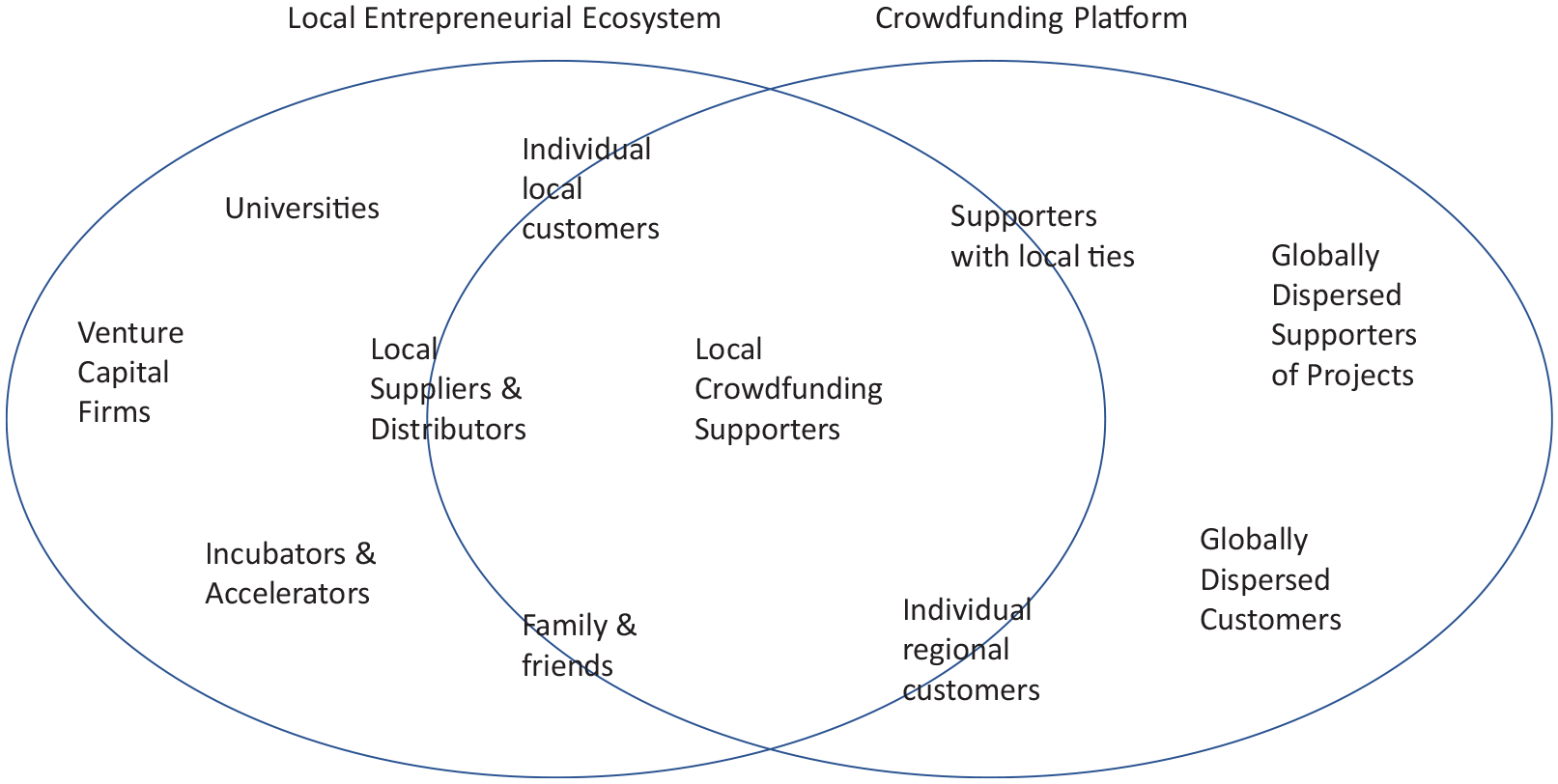
Potential overlaps in resource-holders between LEEs and CPs.
Related to this, recent studies indicate that LEEs and CPs may be interlinked through their affordances (Autio et al., 2018). In general, affordances are viewed as an action potential offered by technology or infrastructure (Nambisan, 2017). Affordances are not determined by features of a particular technology or infrastructure, but they differ depending on the intent, purpose, and capabilities of actors using it (Nambisan et al., 2019). Thus, affordances of a technology denote “what an individual or organization with a particular purpose can do with a technology” (Majchrzak and Markus, 2013: 832). Based on this understanding, spatial and digital resource environments do not only offer affordances that are specific to these environments (see above), but, depending on the entrepreneurial process, spatial affordances can magnify, catalyze, and shape digital affordances and vice versa (Autio et al., 2018). Accordingly, prior studies suggest that crowdfunding campaigns and their success are geographically embedded and linked to the location of project creators (Mollick, 2014). For example, projects originating from metropolitan areas are more likely to attract crowdfunding (Breznitz and Noonan, 2020; Gallemore et al., 2019; Yu and Fleming, 2020). Prior studies also find that it can be difficult to attract funders from outside the home region of entrepreneurs (Dejean, 2019; Guenther et al., 2018; Lehner and Harrer, 2019; Lin and Viswanathan, 2015). In other words, these studies indirectly point to potential “joint affordances” of crowdfunding and local ecosystems that enable entrepreneurs to mobilize resources across these environments and create new ventures in effective ways.
Interestingly, while previous studies have been pointing to geographical overlaps and potential joint affordances of CP and LEEs, their implications for resource mobilization processes and strategies have not been examined much. One recent exception is the article by Murray et al. (2020) in which the authors conceptualize crowdfunding as a “community-engaging” process that is successful only when it follows up on “community-building” activities before the launch of campaigns, and when it is followed by “community-spanning” work afterward, in which crowdfunding successes are leveraged through intermediaries in the broader ecosystem. Similarly, Colombo and Shafi (2021) propose that crowdfunding and resource acquisition in the LEE—specifically: venture capital (VC) funding—may in fact be complementary elements in the entrepreneurial process, since successful crowdfunding makes subsequent VC funding more likely (see also Roma et al., 2017). Yet, we lack a deeper understanding of how such synergies are purposefully generated by entrepreneurs and what strategies they utilize when mobilizing resources across multiple environments.
To address this question, we employ insights from prior studies on complementarities and entrepreneurial narratives. The concept of complementarity encompasses the idea of synergy and interdependencies between two or more elements (Parmigiani and Mitchell, 2009). Formally speaking, A and B are complementary when either A does not function without B or when the value of A increases with the acquisition or use of B (Hart and Moore, 1990; Milgrom and Roberts, 1995; Schmidt and Keil, 2013). Complementarities can be one-sided (A increases the value of B) or mutual (A and B increase each other’s value) (Jacobides et al., 2018; Teece, 1986). Applying this concept to resource mobilization strategies, resource acquisition on CPs can be seen as complementary to resource acquisition in LEEs when the accumulation of resources on CPs eases or amplifies the acquisition of resources in LEEs (or vice versa). Such complementarities, however, do not exist per se but they are likely to be mobilized through entrepreneurial action.
To better understand how such complementarities are potentially generated, it is critical to examine how entrepreneurs refer to resource environments in their narratives. For example, Welter and Baker (2020) argue that the way we talk about a place produces particular meanings to audiences, thus rendering their willingness to support new ventures (see also Josefy et al., 2017). The general importance of narratives and storytelling in resource acquisition is not new (Garud and Giuliani, 2013; Lounsbury and Glynn, 2001; Martens, 2007; Zott and Huy, 2007). For example, studies find evidence for the importance of narratives in the context of crowdfunding (Allison et al., 2015; Anglin et al., 2020; Luo and Luo, 2017; Xiang et al., 2019). In general, studies suggest that narratives, storytelling, and impression management can be key in helping entrepreneurs leverage their often limited resource endowments to acquire more resources ((Fisher et al., 2020; Lounsbury and Glynn, 2001; Zott and Huy, 2007). Narratives can help craft coherent entrepreneurial identities that help generate commitment among potential resource-holders (Martens, 2007), not least by “pulling in” supporters who are initially unrelated to the venture (Fletcher, 2007). Yet prior studies have primarily focused on narratives in resource accumulation within the same resource environment (e.g. Hertel et al., 2021). In contrast, this study seeks to examine ways in which narratives can also help bridge and elevate resource acquisition across resource environments in potentially complementary ways. Thus, for the context of this study, we understand narratives as a potentially important device utilized by entrepreneurs to create resource mobilization linkages between LEEs and CPs, to attract new resource-holders but also to mobilize the same resource-holders in multiple ways (see also Hertel et al., 2021).
Next, we examine in greater detail resource mobilization strategies of entrepreneurs that link LEEs and CPs as resource environments and that potentially generate complementarities across these environments. Following the affordances debate, we thereby pay special attention to how entrepreneurs may differ in terms of how they make joint use of LEEs and CPs as resource environments and what role narratives play in this. Next, we introduce the empirical context and data of our study.
Data and methodology
We draw on an inductive theory-building approach based on multiple cases to study resource mobilization strategies of entrepreneurs as they make joint use of local entrepreneurial ecosystems and crowdfunding platforms. Specifically, we study campaigns on the CP Kickstarter. Our primary data sources range from interviews with focal actors to videos and transcripts of crowdfunding campaigns, as well as web pages of project creators.
Empirical context
Kickstarter was established in 2006 to provide new ventures with funding opportunities beyond the established banking system (see also Botsman, 2014). To launch Kickstarter campaigns, initiators set a funding target and deadline until which the target has to be met. According to Statista (2021), around 40% of campaigns meet their funding target. However, even after a funding target is met, projects can continue raising money until the funding deadline is reached, which is why those projects that meet the target typically exceed it. Funding can come from any user, whereby individual contributions may vary from US$1 to US$10,000, depending on the pledges and rewards decided upon by the campaign initiators. On average, Kickstarter campaigns are backed by >100 people, which is significantly more than other CPs (Clifford, 2016); this makes Kickstarter a suitable case for studying the mobilization of “crowds.” Kickstarter is not equity-based, but limited to one-off exchanges of pledges and rewards (Lehner and Harrer, 2019). The initiators receive the rewards only if the funding target is met. Rewards can range from symbolic rewards (t-shirts and posters) to actual products, invitations, meetings, and events. Kickstarter campaigns combine multiple goals—from raising funds, to marketing products and mobilizing community support. Campaigns tend to have a creative edge, and they can range from high-tech, software, fashion, and food to social and artistic ventures.
Findings from this inductive study of new ventures and their Kickstarter campaigns can be used to assist theory-building, as these findings can help derive and interrelate theoretical constructs and categories for future research (Eisenhardt, 1989; Siggelkow, 2007; Yin, 2003). The main objective is not to “generalize” the findings in the statistical sense but to promote “analytical generalization” (Yin, 2013), that is, to construct theoretical relationships and categories from case findings to inform future research (see also Tsang, 2014). Compared to single-case studies, a multi-case design adds robustness and helps differentiate findings along important dimensions (Yin, 2013), thus assisting in a “generalization in small steps” (Diesing, 1971; Weick, 1995; Yin, 2003).
Data collection
The selection of new ventures and their Kickstarter campaigns was guided by our theoretical interest in identifying major strategic approaches utilized by new ventures that run campaigns on CPs while also tapping into LEEs. As is typical for inductive multi-case designs (see, for example, Tsang, 2014), case selection was further motivated by our interest in the effect of certain factors—particularly, market orientation, product characteristics, and related resource needs—while controlling for other potential sources of variation (Eisenhardt, 1989). Concretely, we compare and interrelate findings across 44 crowdfunding campaigns launched on Kickstarter between 2012 and 2014. We focused on projects with significant investments and a long-term interest in marketability. For this reason, we focused on ventures pursued by entrepreneurial teams (rather than individuals) and campaigns with a minimum target of US$5000 (Huang, 2018). Although we did not set an upper funding target limit, our sample largely reflects the size distribution of projects on Kickstarter, with most projects below and only very few above US$100,000 (Kickstarter, 2018).
Data were collected in multiple rounds, combining the logics of “literal” and “theoretical” replication, that is, adding robustness by examining similar ventures (literal replication) and adding differentiation by increasing case variety along theoretically important dimensions (theoretical replication) (Yin, 2003). The first round was explorative and conducted in 2012, including 14 cases. We focused on campaigns by new ventures in the Greater Boston area, which is known as an important LEE, particularly for tech and science ventures (Friar and Meyer, 2003). Focusing on Boston also facilitated case access, particularly for interviews, since two out of the three authors were located in that city at that time. The greater Boston area, according to the Kauffman Index of Growth Entrepreneurship 2016, has one of the highest startup growth rates in the United States, supported by numerous colleges, professional communities, and incubators, such as MassChallenge and TechStar, and hence seemed like a suitable point of departure. This first round mainly served to provide a sense of major resource mobilization strategies. We discovered how strategies differed in relation to resource-holder overlaps between the LEE and the CP.
In the next round in 2013/2014, 30 cases were added both to add robustness and to further differentiate findings. In particular, accounting for potential effects of product variety, we increased case diversity along all major categories offered by Kickstarter, including fashion, food, games, technology, design, and music. We also included campaigns that were launched outside of Greater Boston to check for any potential Boston-specific effects to allow for comparisons that are not Boston-specific. We thereby took a three step-approach in collecting the data in the respective phases to allow for a “thick description” for each individual case.
First, we gathered the professionally transcribed videos of all selected campaigns (72 pages, single-spaced). Videos are the primary means of communicating projects to audiences through Kickstarter and are, thus, regarded as a key vehicle for generating funding (Mollick, 2014). They tell entrepreneurial stories of projects in a rather condensed manner, ranging from 1 to 5 minutes in length. The content indicates a critical choice by entrepreneurs regarding how diverse audiences are addressed to mobilize support.
Second, we interviewed the initiators of all campaigns selected in the two rounds of data collection (54 interviews in total; one or two interviews per venture). These interviews helped us better understand how new ventures tap into LEEs—for idea and technology development, recruitment, and reaching out to lead users and test clients—as well as what role crowdfunding campaigns played in their overall strategy.
Third, we used archival data on Kickstarter and other websites to collect additional data on product features as well as on performance statistics of all the campaigns we studied. For example, we collected information on the locations of campaign initiators, the number of backers, percentage of new backers, geographical distribution of backers, and main types of rewards. These data enabled us to identify differences in the effects of different crowdfunding strategies along with critical contingencies. To protect the anonymity of the ventures, we used synonyms throughout the article.
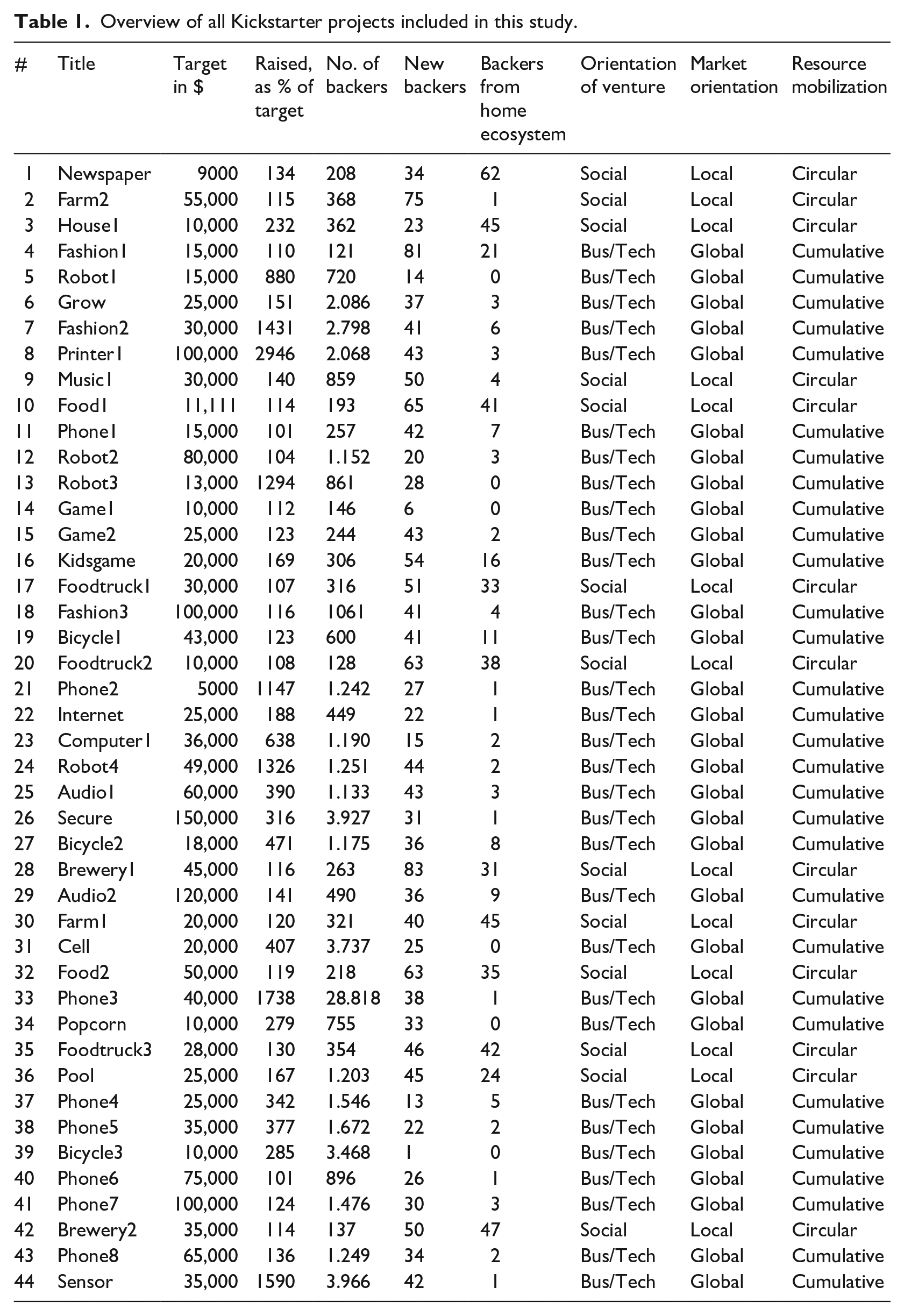
Table 1 provides an overview of all new ventures included in this study. In terms of their target funding, campaigns ranged from US$5000 to US$710,000. Actual funding ranged from US$10,789 to US$2,945,885. Entrepreneurial teams were typically small and did not exceed 10 people when campaigns were launched. All of the 44 ventures reached or exceeded their funding target and were, thus, able to utilize the funding.
Overview of all Kickstarter projects included in this study.
Data analysis
For each case and across all cases, three major data sources were mobilized to generate findings of high validity (Yin, 2013): videos, interviews, and archival data. All data were imported into a qualitative data analysis software (NVivo) for further analysis. We followed a theoretically sensitized inductive approach (Glaser and Strauss, 1967; Strauss and Corbin, 1998). We iterated between data, emerging themes, and theories throughout our analysis (Locke, 2001). We were intrigued by how entrepreneurs “juggle” different resource environments. Our hunch pointed to differences in resource mobilization strategies that are employed by these new ventures across these environments. We followed a four-step process to analyze them.
First, we examined the ways in which entrepreneurs engaged with different resource environments. We created tables and timelines, with background information, key events, and major milestones in their venture history (Van de Ven and Poole, 1990) for each venture. The development of these case-specific chronologies revealed that ventures engaged with Kickstarter and the local environment in different ways. One important initial finding was that the campaigns differed quite substantially in the percentage of Kickstarter funders coming from the location entrepreneurs were from. We also identified key differences in project characteristics (see Table 1 and Figure 2). Specifically, we categorized projects in terms of their market orientation, as well as their technological sophistication, and social versus commercial orientation (see Table 1 and Figure 2).
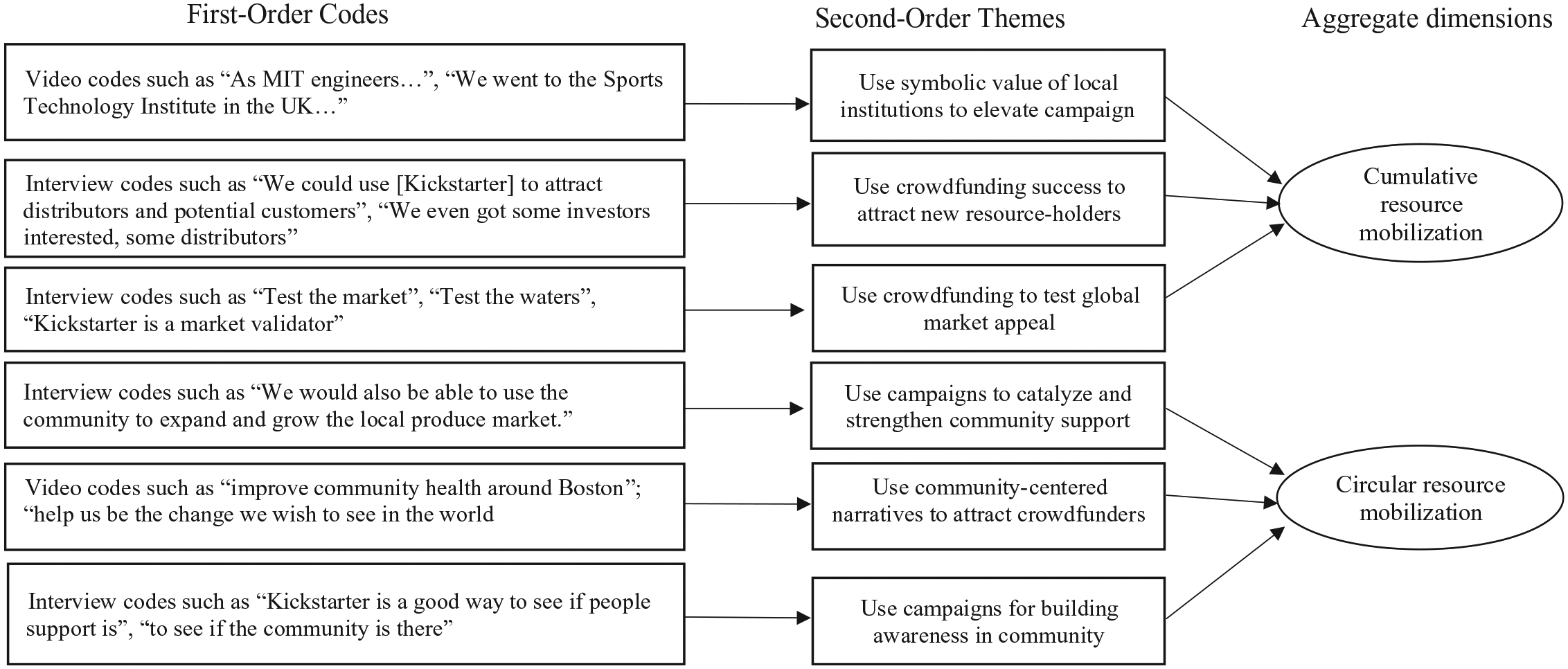
Simplified coding tree.
Second, following an interpretive approach, we conducted open coding of the database and engaged in a first round of in vivo coding by staying true to the terms and phrases of our respondents. For example, whereas some entrepreneurs would refer to their local context in the interviews and their crowdfunding campaign mainly in terms of “communities,” other ventures would focus more on universities and other institutions (see Figure 2). These terminological differences would inform our later categorization of resource mobilization strategies. In capturing the latter, we also paid special attention to complementarities as defined in prior literatures (e.g. Jacobides et al., 2018), specifically the distinction between one-sided and mutual complementarities (Jacobides et al., 2018; Teece, 1986). However, as “sensitizing devices,” these established categories did not “provide prescriptions of what to see” but only suggested “directions along which to look” (Blumer, 1954: 7). More specifically, we ended up defining our own categories—circular versus cumulative resource mobilization strategy—since they captured empirical dynamics better than any established distinction.
Third, we collapsed similar codes and created first-order categories, which enabled us to move from provisional to advanced categories (Locke, 2001). As mentioned above, we noticed that the new ventures in our sample mainly use two distinct types of resource mobilization strategies across LEE and Kickstarter. We arrived at those by identifying and grouping together different ventures and the ways they mobilized resources. Some ventures would draw mainly upon the principle of leveraging local community ties and community narratives to not only promote crowdfunding campaigns but also further strengthen and expand the community they build on (circular strategy), whereas other ventures would mobilize mainly the symbolic value of local institutional ties to promote crowdfunding success, and then use the latter to attract new resource-holders in the LEE, for example, venture capital firms (cumulative strategy). To further support our main categories, we chose to interpret quantitative indicators as qualitative markers in support of findings across cases.
Fourth, we engaged in axial coding to identify relationships between different categories (Strauss and Corbin, 1998). Iterating between data and theory (Corbin and Strauss, 1990), we compared our respondents’ reports, discerning differences across time and groups and generating theory-driven second-order categories. For example, we explored the drivers behind different resource mobilization strategies. More specifically, we engaged in elucidating the underlying properties of the ventures in favoring a cumulative or circular strategy. In doing so, we could see differences across the two groups in the product offering and the geographical scope. When comparing different ventures, we could see how a circular resource mobilization strategy is typically applied in projects that are social mission-driven and that target local markets, whereas a cumulative strategy often applies to commercial high-tech ventures with a global orientation. As such, we could see how (1) technological sophistication and (2) social orientation and geographical scope interrelate with resource mobilization strategies. We also conducted member checks (Lincoln and Guba, 1985) for our findings, which we discussed with various entrepreneurs at different times of the data processing.
Strategies of combining crowdfunding and LEE resource mobilization
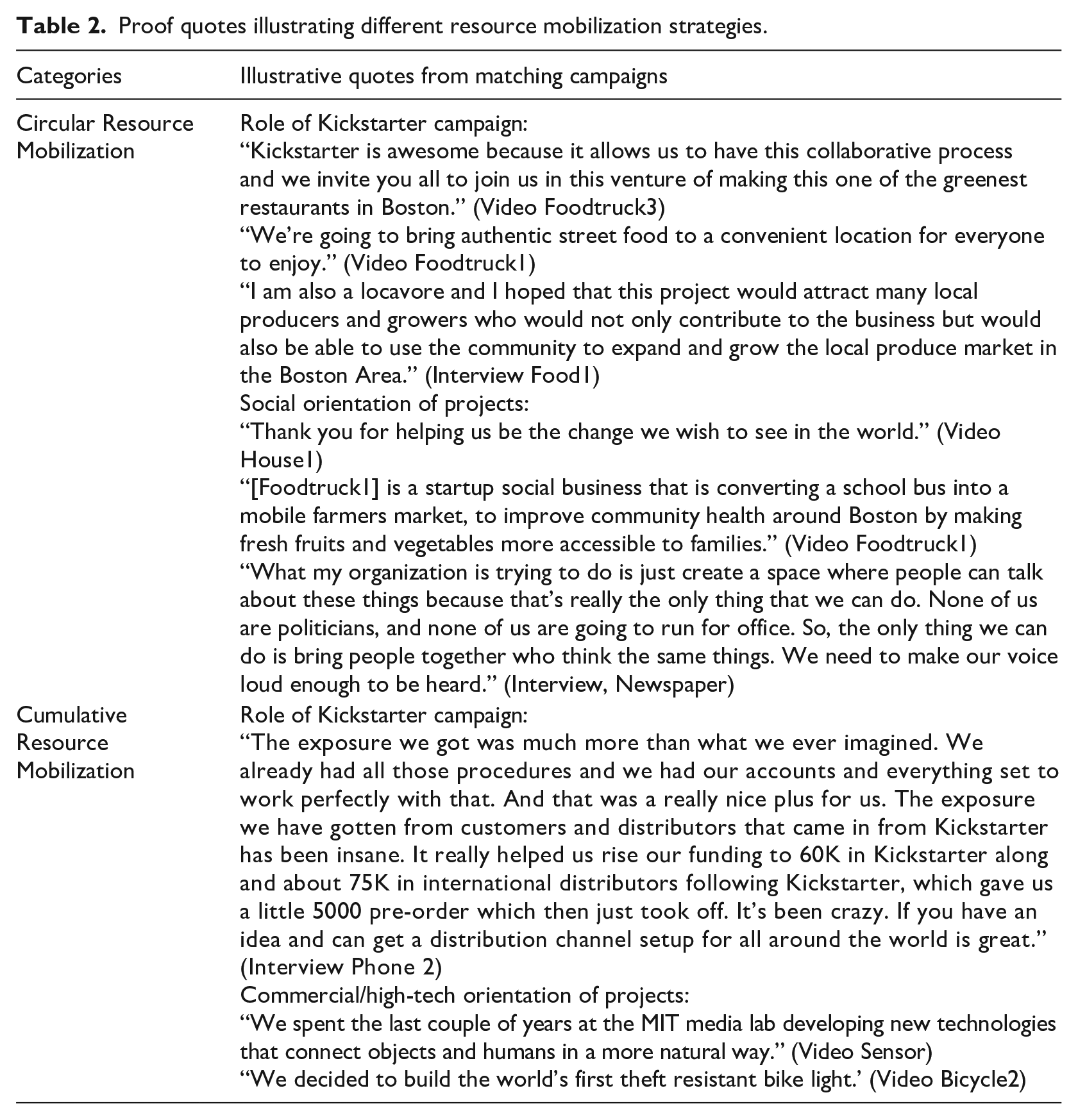
In this section, we examine how entrepreneurs mobilize resources across LEEs and CPs. Next, we discuss two main strategies: the cumulative and circular strategy of resource mobilization. Following Pratt (2009), we use “power quotes” as evidence from videos and interviews in this article while providing “proof quotes” as additional evidence in table format (Table 2). Furthermore, we use a few guiding cases in the text to better illustrate the various dimensions of each strategy.
Proof quotes illustrating different resource mobilization strategies.
Cumulative resource mobilization strategy
In our sample, 31 ventures primarily applied a cumulative strategy of resource mobilization across LEE and Kickstarter. Cumulative means that entrepreneurs use their access to LEEs and CPs to accumulate additional resources from new resource-holders both when entering the CP and when re-entering the LEE. As a first step, they mobilize local resource endowments, especially the symbolic value of institutional ties, to elevate crowdfunding campaigns. In a potential second step, they use their crowdfunding success to ease access to other localized resources, for example, seed funding, angel funding, or venture capital. In doing so, entrepreneurs can generate complementarities in the sense that their LEE embeddedness and affiliation add value to their crowdfunding campaign, and their crowdfunding success adds value to subsequent pitches to local resource-holders. However, the complementarities they generate in Step I are largely separate from the complementarities they generate in Step II, because Step I and Step II involve very different resource-holders.
We find that the cumulative resource mobilization strategy more likely applies when projects are tangible, commercial, and technologically sophisticated, such as robots, games, 3D printers, and other devices. Examples of campaigns following a cumulative resource mobilization strategy include PRINTER1, a high-resolution 3D printer for professional creators; FASHION2, a high-tech business apparel fashion design; SECURE, a voice-activated USB device for passwords; and GROW, a producer of pencils with seeds inside. The interview with the founders of GROW illustrates how crowdfunding is embedded in the entrepreneurial process:
I just finished my Master’s degree in Mechanical Engineering from MIT. As part of our senior capstone, I worked with a team of students, a team of graduate students to design an eco-friendly office product and came up with the idea of [Grow]. All through this graduate product design course, and then, after I graduated, I decided to put together a Kickstarter campaign and see if we could crowd fund [Grow] and get it out there. Once that went well, I founded a company to kind of act as an umbrella for us to do [Grow] and start to get it on sale, after Kickstarter. (Interview GROW)
Importantly, the cumulative approach is associated with particular affordances of crowdfunding, which go way beyond the accumulation of funding. Affordances include early access to global markets, feedback from early adopters that was used to refine and change the design of technology, and funding to organize the supply chain. As a key outcome, successful campaigns facilitate the transition from an idea or a prototype to mass production (see Table 3). At the same time, ventures are able to build branding power by referencing their local affiliations to global audiences (see also below). These outcomes become instrumental in subsequent LEE resource acquisition (see below).
Crowdfunding platform affordances in line with cumulative approach.
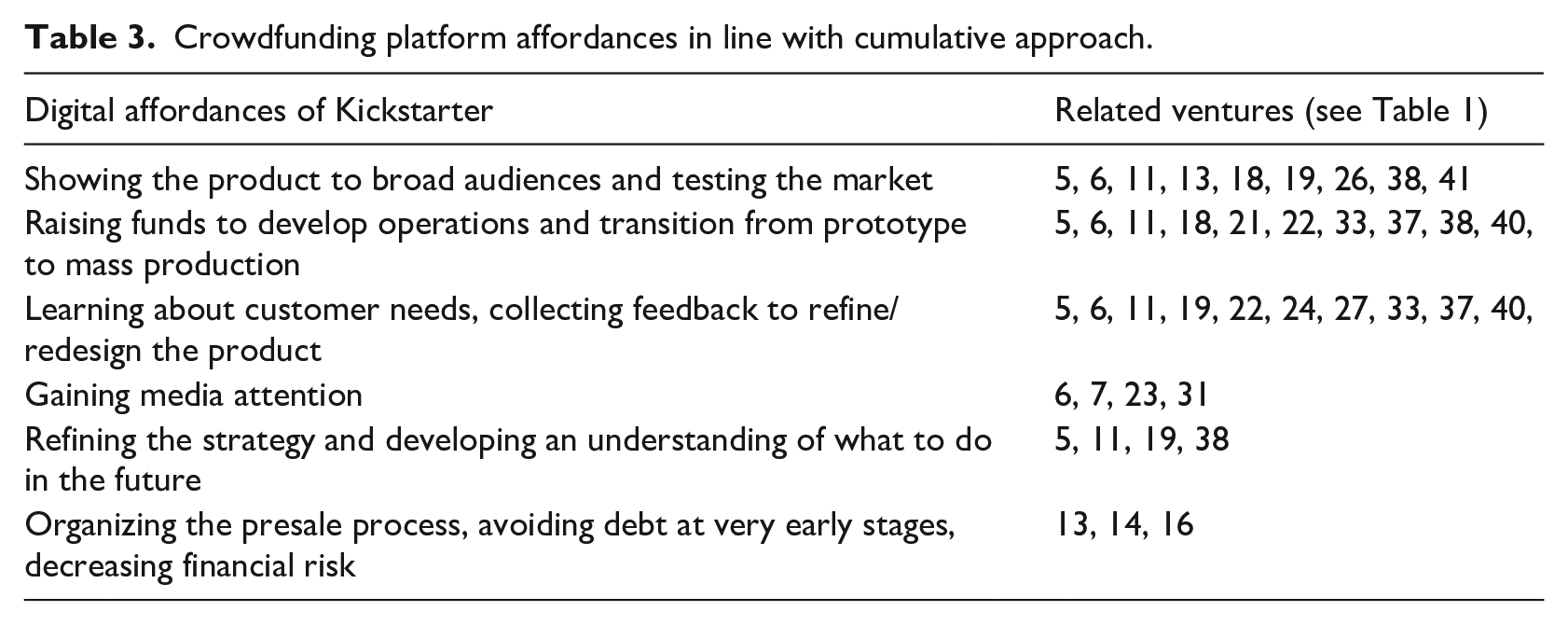
Typically, ventures following this approach use their products as rewards in crowdfunding campaigns. The main type of rewards to backers who provide pledges to a campaign, in this case, are preorders to a technological product, such as a printer or a game. Thus, the success of crowdfunding campaigns provided entrepreneurs with the understanding that their prototype or an idea appeals to broader audiences. The project GROW is a good example. This rather unusual and innovative product—pencils with seeds inside—was aimed at writers, artists, and lovers of plants who share the idea of having pencils that cannot only be used for writing but also for gardening. Testing markets was an important motivator for launching the crowdfunding campaign. In addition, however, the success and media coverage of crowdfunding campaigns were used to attract distributors and customers:
We just had a bunch of prototypes. We didn’t really have a market or any way to get it out there. Or enough orders to make a production run possible. Kickstarter gave us access to a really broad market and it was a really good market validator and got us a lot of media attention that we could use to attract distributors and potential customers. [In sum,] we used Kickstarter to kind of test the waters. It’s a really low risk way to get market validation. We invested zero dollars before the Kickstarter campaign. (Interview GROW)
We observed similar tendencies in other campaigns that used this strategy of resource mobilization. Some entrepreneurs viewed Kickstarter as “a market to test waters” (PHONE1), some explained that Kickstarted added value to their venture as “a brokerage firm” (ROBOT3), and some as a “pre-order market” that lowers financial risk (GAME1). For example, as a founder of BICYCLE1 explained,
Making a prototype is easy but then you can test it on the market before you spend the whatever $20 -$30 thousand that it takes to bring it from an idea to reality. That’s why I think Kickstarter is great. (Interview BICYCLE1)
In addition to market knowledge, Kickstarter served as a knowledge intermediation tool that helped entrepreneurs to refine the technology and to change the design of their innovation. As the products that were distributed after successful campaigns were still beta-versions, Kickstarter campaigns allowed to significantly increase the number of testers, collect extensive feedback post-sale, and implement changes according to feedback:
We did do beta testing with a small focus group of 25 unique users prior to going out on Kickstarter. Our test group of individuals liked the concept. . . We also collected information from this group about pricing and how likely they would be to purchase and use the product. . . Although our test data sample was very small, we felt we had enough positive feedback overall to go ahead with our idea on Kickstarter. Because we were successfully funded on Kickstarter, our backers represent a new and very significant group (500+ users) for commercially testing the product. (Interview PHONE1)
Another important role that successful campaigns play in the new venture entrepreneurship process is providing resources to establish operations, often at the global scale, to satisfy the requirements of their campaign, to produce and distribute their product (in form of rewards) to backers. For the GROW project, the Kickstarter campaign helped to establish global supply chain operations:
So we did all the manufacturing supply chain analysis, found our manufacturing partner—ho we can hire as a contract manufacturer. . . Kind of in parallel with this we pursued intellectual property protection we filed a provisional US patent application—reserved our right to file internationally. . . (Interview GROW)
Our descriptive analysis suggests that backers of these projects are typically distributed across many different locations and countries. The geographic overlap of resource-holders between the LEE and project funders on the CP is very small. For example, from among the 2068 backers that supported PRINTER1, only 3% are from the home LEE, Greater Boston. On average, across all campaigns in this category, only 4% of backers come from the venture’s home location. However, in terms of crowdfunding success, these campaigns typically gained high traction, with an average overshoot (funding raised minus initial target) of 470% (min 1% and max 2846%). Next, we describe the main building blocks of a cumulative resource mobilization strategy.
Step 1: mobilizing the symbolic value of local institutions to elevate crowdfunding campaigns
Campaigns in this category make use of the local context they are embedded in primarily by mobilizing the symbolic value of institutional affiliations in campaign narratives. High-tech projects have in common their strong reliance on advanced skills and technology development, and their need for often significant upfront investments. One central source for skills and technology development are local institutions, such as universities, which in part explains their importance in campaign narratives in support of the cumulative resource mobilization strategy. For example, the developers of PRINTER1 have close connections with the university system in Boston, specifically to MIT. Not only did all the core team members meet at and graduate from MIT, but MIT also provided a laboratory and an important test user base for the product itself. Within the MIT system, the MIT Media Lab is particularly critical, as it concentrates resources and support around cutting-edge high-tech projects. These institutions are often linked to investors who help with upfront financing and speeding up commercialization. The interview with the PRINTER1 developers illustrates,
The large bulk of team is engineers; mechanical and software. [. . .]. The team is very technology focused . . . We have good investors. Joi Ito, director of the Media Lab at MIT, Mitch Kapor, as well as a couple small angel funds like Eric Schmidt’s Innovation Endeavors. (Interview PRINTER1)
In general, we find that technology-focused Boston-based entrepreneurs would often reference the MIT affiliations of their teams. This pattern can also be observed in the narrative displayed in the recorded videos on Kickstarter: For example, the following examples are typical:
As MIT engineers, we design space suits that regulate astronauts’ body temperature using phase change material. We use that same technology in [our new shirt]. (Video FASHION2) When we were at the Media Lab at MIT, we had access to an amazing set of tools, 3D printing being one of the most important. (Video PRINTER1) We designed [product name] in a product design course at MIT and we’re excited to see the product bear fruit. (Video GROW)
Other locations are referenced in similar ways, emphasizing the brand value of locations or institutions within those locations. Each location or institution is typically associated with a particular capability that is referenced as a building block in the overall skill set of the campaign initiators. One example is FASHION2, a new take on business apparel combining new materials with a professional look to appeal to young urban professionals. This campaign emphasized the importance of ties to different locations in the world by pointing out how each location made a specific contribution to their project, reflecting location-specific capabilities with a certain global brand value. For example, the project video would reference the “Sports Technology Institute in the UK” and “New York’s garment district” to add symbolic value to their product:
Staying active in our shirts is important. We went to the Sports Technology Institute in the UK to map how the skin to the body stretches. (Video FASHION2) Our manufacturer in the New York’s garment district works with Ralph Lauren and Express. Amazing craftsmanship. (Video FASHION2)
In leveraging primarily the symbolic value of local institutions and other location properties, these campaigns address the fact that most individual funders on the CP have no direct connection with the local environment the entrepreneurs operate from. As outside audiences, however, they get attracted to the global brand value of location properties. This is in stark contrast to the circular resource mobilization strategy we detail below.
Step 2: using crowdfunding success to acquire resources from new local resource-holders
One important feature of the cumulative strategy is that entrepreneurs treat resource mobilization as a continuous effort of gaining legitimacy and of reaching out to different types of resource-holders across resource environments over time. In particular, crowdfunding campaigns help reach out to global markets benefiting from the legitimacy gained through local institutional ties (see above). After that, entrepreneurs use the success of crowdfunding campaigns to promote legitimacy, for example, through media coverage. For example, after a successful crowdfunding campaign, entrepreneurs can show potential resource-holders that there is a global market for their product:
The success from Kickstarter was a huge asset for that, too, because we could show, like, look, people actually want these, it’s not just us with an idea. Like, a thousand people bought them without ever even touching them or trying them on. That is a pretty good testament to the shoe. That’s what every retailer or person you’re trying to sell to will say, well, where is your traction, how am I going to know that people actually want this? So, Kickstarter is a great way to get that tangible proof of concept. (Interview FASHION3)
As the rewards in the campaigns within this strategy are mostly pre-orders of a technological or tangible product that has to be delivered to customers, entrepreneurs can also show that they were able to organize an operating venture to serve global markets, that they can increase the production and manage growth. Showing that there is a demand for their product and that there is an organization in place to satisfy this demand can then help in attracting other types of resource-holders, including banks, seed funding, other types of early-stage investors, and even venture capital firms:
Another reason why you do a Kickstarter campaign is the venture capitalists see it as market validation, you’re out there and you’re successful that validates you, you can say there is a market there, which is a little risky, we all knew that if this business didn’t go anywhere, then the VCs would say there’s no market there. (Interview SECURE) We would try to loan some more amount from bank showing the success of kickstarter. We are optimistic of the loan getting approved. (Interview KIDSGAME)
Another example is the campaign of ROBOT1—a toy robot for education purposes. In this case, the crowdfunding campaign was leveraged to attract new investors to take an interest in the project, and to reach new distributors as well:
We found in Kickstarter an excellent way of showing the product and getting people interested in doing business. We even got some investors interested. . . (Interview ROBOT1)
To summarize, in the cumulative strategy, the resource-holders that are approached in LEEs after the crowdfunding campaign are typically different from the ones entrepreneurs had reached out to and benefited from before the campaign. Before the campaign, these local institutions are resource-holders that are not directly connected with CPs like Kickstarter. The main purpose of crowdfunding in those cases is to attract new (non-institutional) resource-holders. Yet, to attract them, communicating the symbolic value of local institutional affiliations, specifically universities, becomes critical. In turn, after running crowdfunding campaigns successfully, project creators may reach out to new institutional resource-holders in the ecosystem who may regard crowdfunding success as an additional signal of project legitimacy. Thus, the success of crowdfunding campaigns provides access to LEE resources that were previously unavailable to an entrepreneur, mostly because access to them was constrained. In other words, while complementarities are generated in mobilizing resources from LEEs and CPs both “going into” the campaign and “going out” of the campaign, these complementarities are created largely independent of each other, in a sequential fashion. As we detail next, the circular strategy of resource mobilization differs substantially in this respect.
Circular resource mobilization strategy
Thirteen new ventures in our sample primarily applied what we call a circular strategy of resource mobilization across LEEs and CP. Circular means that crowdfunding campaigns leverage and build on, and thereby strengthen and expand communities of interconnected resource-holders. Rather than merely expanding the resource base through crowdfunding, as is the case with the cumulative strategy, crowdfunding campaigns as part of a circular approach are designed, first of all, to catalyze support from previously mobilized resource-holders in the LEE, and strengthen ties to existing communities of resource-holders, while also connecting new external supporters to these communities. In this strategy, ventures predominantly used Kickstarter as a fundraising and an awareness -creating platform. In these efforts, community-centered narratives play an important role. They help expand community support both directly and indirectly: directly by appealing to members of the local community, indirectly by mobilizing resources from resource-holders who are sympathetic with the community approach and willing to “join” the extended community supporting the project.
The circular resource mobilization strategy is typically applied in projects that are social mission-driven and that target local markets. Examples of such campaigns include FOODTRUCK1, a venture focused on providing high-quality Asian food on a food truck in urban food deserts; FARM1, a rooftop gardening project that provides food for the local neighborhood, while also utilizing unused roof space; NEWSPAPER, a venture focused on revitalizing a local newspaper; and BREWERY1, an initiative to set up a pub with integrated brewery and brewing courses. One major reason why campaigns of social mission-driven and locally embedded projects often make use of community narratives is their strong dependence on community support for their projects. For example, BREWERY1, an initiative to launch an educational brewery in North Carolina, had a strong community focus from the start. One key to early idea development was a sense of a “local demand” for such a venture and the availability of partners:
We wanted to open a tasting room for beer lovers. [. . .] a destination place for visitors, drive buyers and locals. [. . .] We know that locals would want such a place. [. . .] We have also launched partnerships with restaurants in the area, for example to sell sandwiches in the tasting room.” (Interview BREWERY1)
Another example is FARM1, the rooftop gardening project in Boston. As the founders explain in the interview, having local community support was key for it to take off. This included volunteer helpers from the community, government ties, and connections to restaurants and distributors:
There is the restaurant network which is everybody that [we] have become friends with or colleagues with that have supported them and said yes, this is a good idea. [. . .] And then we probably had 50 maybe 60 direct volunteers that have helped us in some way so far. We’ve had offers from a couple of hundred people who want to help once the farm is ready. Then there are also people involved in the institutional government side. People in various offices that [we] will need to interact with in order to install and operate. (Interview FARM1)
From the affordances perspective, successful Kickstarter campaigns following a circular strategy afforded entrepreneurs a variety of actions. Most basically, ventures taking this strategy used Kickstarter to fundraise and cover the capital or infrastructure cost of project development. However, beyond being funded, Kickstarter, in combination with LEE access, afforded these ventures more robust access to local resource-holders and the ability to integrate local and external supporters into one community. Table 4 provides a summary of the affordances of these campaigns.
Crowdfunding platform affordances in line with circular approach.
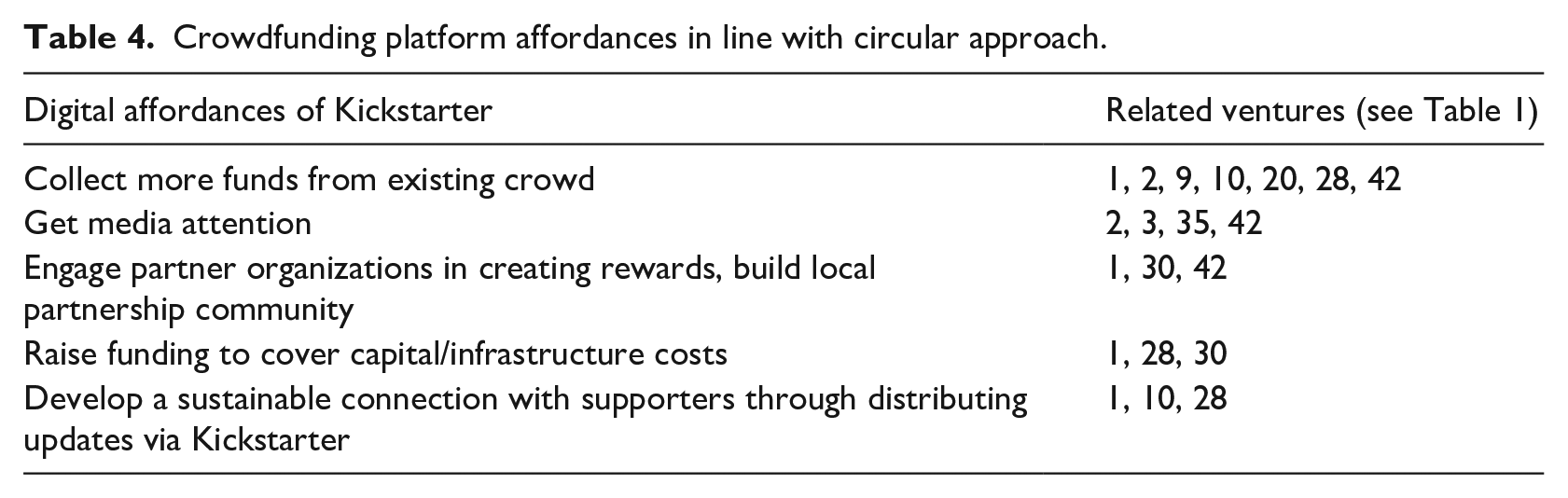
Backers of campaigns that used the circular resource mobilization approach are typically highly concentrated in particular locations, including the location where the project creators operate from. On average, 35% of backers are from the home location of a venture. This implies that crowdfunding campaigns help entrepreneurs mobilize local communities to support a venture they might already know through friends and local ties. Thus, an important property of Kickstarter that entrepreneurs utilized beyond fundraising was its marketing component. Since an increasing amount of marketing and communication happens through social media, particularly in urban settings, using online platforms has become an essential element of local marketing. This becomes clear in the case of the project NEWSPAPER, which used social media and Kickstarter deliberately to inform their existing community about the undertaking. The founder recalls:
Naturally, the idea of Kickstarter came up because it is so linked to crowdsource funding, and that’s something we thought would be a big strength because we were working from a pool of 60 years of people reading the website. We figured that would be a good way to have people support us and become informed that we were coming back and get involved in their own way. (Interview NEWSPAPER)
Other campaigns followed the same approach, utilizing Kickstarter as a marketing platform:
We launched our kickstarter campaign to spread the news and educate people about a unique opportunity that we were working on. We hoped that interest would be drawn and it would become a spiraling effect. Prior to kickstarter we have raised almost $5,000 in donations from 86 personal donors, but we wanted to raise more money. However, we also wanted to set a goal that was realistic and that we could achieve. We thought that $10-12K would be reasonable. That money would really help us to get off the ground including hiring a lawyer to negotiate a deal, and putting together some promotional materials, web hosting so we can connect to donors, funders, and founding contract members. (Interview FOOD1) Kickstarter is a nationally recognized fundraising platform. We were pretty sure we could drum up media attention to our fundraising efforts as many media outlets have been covering Kickstarter campaigns. (Interview HOUSE1) I don’t want to blow your bubble about Kickstarter but we are in a $850,000 business to get going. But, intentionally, I raised only $35,000 on Kickstarter. Kickstarter for me was all about awareness and marketing. It was a marketing platform. I was able to go out there and do a cool video and basically tell the community that I want you to be involved in this. (Interview BREWERY2)
Success in crowdfunding helped entrepreneurs expand their support community or even develop it from scratch as, through Kickstarter, entrepreneurs were able to reach out to new locals who did not know about the project but learned about it “online.” While ventures following a cumulative approach used Kickstarter primarily to test the market, entrepreneurs taking a circular approach used Kickstarter campaigns to “test” the vibrance of their support community:
We choose to use Kickstarter more as a way to see if the support in the community was there. Numbers don’t lie—if people were investing then the support was there. It was a good measure of seeing if the area was ready for this type of business. Money was secondary objective—we had invested much of their own money in as well and needed to continue growing. (Interview BREWERY2)
However, a large percentage of backers also come from outside the local community, often from similar regions. Backers from outside the local community become important, especially for ventures originated in resource-constraint locations, such as developing economies. One example of this type of ventures is FARM2, an education-focused dairy farming in a Caribbean country, for which 99% of the crowdfunding backers came from outside the local context. Similar to FARM1, this project is strongly social mission-driven and also builds on a community narrative in its crowdfunding campaign. However, due to the small size and poor economic condition of the island, mobilizing the local community to become crowdfunders was not a feasible option. Instead, a community narrative was evoked to (1) attract members of immigrant communities from around the world to support the project in the location that these individuals have ties to, and (2) send a strong signal to institutional supporters to buy into the development mission of the project.
Finally, the campaigns following a circular resource mobilization approach, on average, reached a 32% overshoot from the initial target, which is lower than the other group. According to an entrepreneur, they often set lower fundraising targets, pursuing rather marketing and awareness building goals. In other words, funding success here means hitting the target rather than overshooting it. Next, we describe the main building blocks of a circular resource mobilization strategy.
Step 1: using community-centered narratives to elevate crowdfunding campaigns
One central feature of campaigns applying a circular strategy are community-centered narratives. These narratives not only refer and appeal to members of local communities which projects are embedded in but they also invite supporters to “join” the larger vision. Often, the notion of community is used as a device through which the project connects a locally embedded idea with a globally appealing mission, attracting both members of the local community and outside supporters who buy into the larger mission. The video narrative of BREWERY1 is a good example:
We are committed to making our community and the world a better place. By supporting local organizations and charities through fundraising and partnerships there are many opportunities for [us] to give back. (Interview BREWERY1)
The FARM1 campaign is another good example. The campaign video begins with the two main founders standing on the Boston design center and describing how they can see the Boston skyline. This image connects mostly with Boston audiences or individuals who are familiar with the city. However, the founders go on to identify themselves as “being farmers in a city,” providing substantial information on the context and purpose of the project, and mentioning various connections to local farmers’ markets and restaurants. These stories resonate not only with people in Boston but with individuals in other urban contexts who may have experiences with rooftop farming.
This narrative strategy allowed both projects to attract a significant number of supporters outside of the local environment. In the case of BREWERY1, 68% of funders came from outside the home location of the venture; in the case of FARM1, it was 55%. Thus, the community frame both links campaigns to local communities and assists outreach across geographic boundaries. Even if supporters outside the local community may not directly benefit from the project, they are invited to join the larger mission that is associated with it. This mission, in turn, is connected back to the very community it serves. The campaign by BREWERY1 is a good example. Similar examples are FOOD2, a community kitchen, and HOUSE1, an art studio project in an old firehouse:
Join us on this quest. Walk alongside [our Brewing Company]. Seize this opportunity to help us fund [our] Brewing Company. (Video BREWERY1) What makes Kickstarter great is that your donation really, really helps build something tangible. You can come in for lunch and you are like, I probably bought that oven or my sandwich was cooked off of that [oven], and every little bit really does make a difference. (Video FOOD2) Check out our amazing international and local rewards, and thank you for helping us be the change we wish to see in the world. (Video HOUSE1)
Venture located in resource-constrained LEEs may create a community-based narrative to attract supporters that are linked to the location, for example, through immigrant ties. One very interesting example is FARM2, a project dedicated to educating kids about dairy farming in a Caribbean country (name concealed). While the project is deeply embedded in the local community—with connections to local government, schools, and other farms—the ability to raise money through community members has been rather limited. Thus, crowdfunding became a complementary means to attract funding from outside the region who sympathize with the project, even if they do not directly benefit from it:
There is an olympic champion in swimming in our country, that was fantastic for the country, and we’ve been kind of using that as a pitch too. We want to be an international winner for [our country]. The immigrant community is really spread out. About 400,000 people have left the island, they call it “brain drain” . a lot of people head to the States or Canada or Europe and a lot of them end up in London. And they still have their heart and their families here, a lot of them still have relatives in [our country], so that’s why this international component was really nice because we were able to reach out to other groups in other countries. I think that’s what really helped us with the Kickstarter. (Interview FARM2)
In addition, in the FARM2 project, a community narrative was combined with a location branding strategy that capitalized on the image of the island as poor and underdeveloped. This may explain why in the case of FARM2 many backers came from Geneva, including some large-scale donors. Geneva is a hub of multilateral development agencies, global nongovernmental organizations (NGOs), and also a center for financial institutions. Crowdfunding provided FARM2 the means to establish a funding channel to backers and organizations in such places. In the end, 99% of the crowdfunding backers came from outside the local context. In addition to targeting immigrant communities all over the world, founders of FARM2 ensured that their campaign comes across as a legitimate development project that values impact, transparency, and professionalism. One founder explains,
We’ve been taking a grassroots approach to this by using Kickstarter as a fundraiser, and we are very transparent. There’s a lot of scams out there, especially in the non-profit world, where you don’t know where your money goes to but we’re making ours very transparent. We’re going to be posting our accounting records, we’re going to be posting videos, so people can really see that their money is going to something legitimate. (Interview FARM2)
Step 2: using crowdfunding campaigns to strengthen and extend local support communities
Ventures taking a circular resource mobilization approach use crowdfunding campaigns to strengthen and extend local support communities. By analyzing the rewards, we can develop an understanding of how entrepreneurs interact with resource-holders after successful crowdfunding campaigns. As for rewards, entrepreneurs taking this approach, typically, used branded merchandise products as rewards (postcards, t-shirts, and bags), various forms of recognition (named plates, lists of donors on websites, and Facebook groups), products of their local partners (art, posters, and food), and tickets to events, galas, and opening parties. One main purpose of these rewards was to connect supporters to the project mission and the community surrounding the project. The founder of a brewery explains,
People who were supporting the project were supporting it because they wanted the end goal, not they weren’t just about the “free stuff.” (Interview BREWERY2)
More specifically, rewards management helped to strengthen ties with local resource-holders in three major ways. First, via rewards, entrepreneurs were strengthening the ties with the community by creating a sense of collective “ownership.” For example, most of social ventures mentioned on their websites the names of backers that provided US$5 pledges. These ventures include HOUSE1, FOOD1, FOODTRUCK1, FOODTRUCK2, and FARM1. For larger pledges, the names of backers were mentioned in the facility. For example, the US$500 plus reward of FOODTRUCK1 was “Your organization or family’s name will be forever on display on the interior of the bus. We are working with a great local artist to build a THANK YOU mural inside the Truck.” Similarly, FARM1, an urban arm, created a reward “A garden bed named after you or in someone’s honor” for backers who pledged more than US$400 (total, six backers provided this type of pledge). Another example is POOL, which added the names of backers who provided pledges that exceed U$100 into their donor list and mentioned these backers as “owners” in the interviews:
With the Kickstarter campaign and the idea of everyone being able to own a piece of the pool and funding the pool tile by tile has become a whole other thing in itself. (Interview POOL)
Second, several ventures used tickets to events, galas, or launch parties as rewards. This includes such ventures as NEWSPAPER, HOUSE1, FOOD1, FOODTRUCK1, FOODTRUCK2, BREWERY1, FARM1, FOOD2, and FOODTRUCK3. The tickets to an event were usually distributed to backers who provided substantial rewards. For example, HOUSE1 organized a gala party and used tickets as rewards for backers who pledged US$125 and more (25% of backers used this type of pledge). For those who were not able to attend the party but still wanted to visit the facility, HOUSE1 created a special pledge that allowed to have a personalized tour in the facility. Launching events as rewards has a potential to build a long-standing connection between a venture and its key resource-holders and can also result in donations, partnerships, and collaborations.
Third, the success of crowdfunding campaigns was also used to strengthen existing partnerships in the community. Many ventures used partners’ products as rewards. For example, FARM2 sent backers who pledged US$75 or more a poster specially designed by a local artist and for those who pledged more than US$150 they provided free yoga classes in a partner studio. In other words, successful campaigns were embedded in the larger community of partners and pledges of successful campaigns not only supported the entrepreneurs who initiated crowdfunding campaigns but also indirectly provided revenues to local artists, musicians, and entertainers, thus strengthening the community of organizations working in a particular location and catalyzing local collaboration.
Discussion: the interplay of crowdfunding and local ecosystem resource mobilization
This study has examined what resource mobilization strategies entrepreneurs apply to make joint use of LEEs and CPs. Based on our multi-case study of 44 crowdfunding campaigns, we identified two major resource mobilization strategies we call circular and cumulative, which enable entrepreneurs to make joint use of LEEs and CPs in specific ways. Table 5 provides a comparative summary of the characteristics of each resource mobilization strategy, which we detail next.
Comparing key features of circular and cumulative resource mobilization strategies.
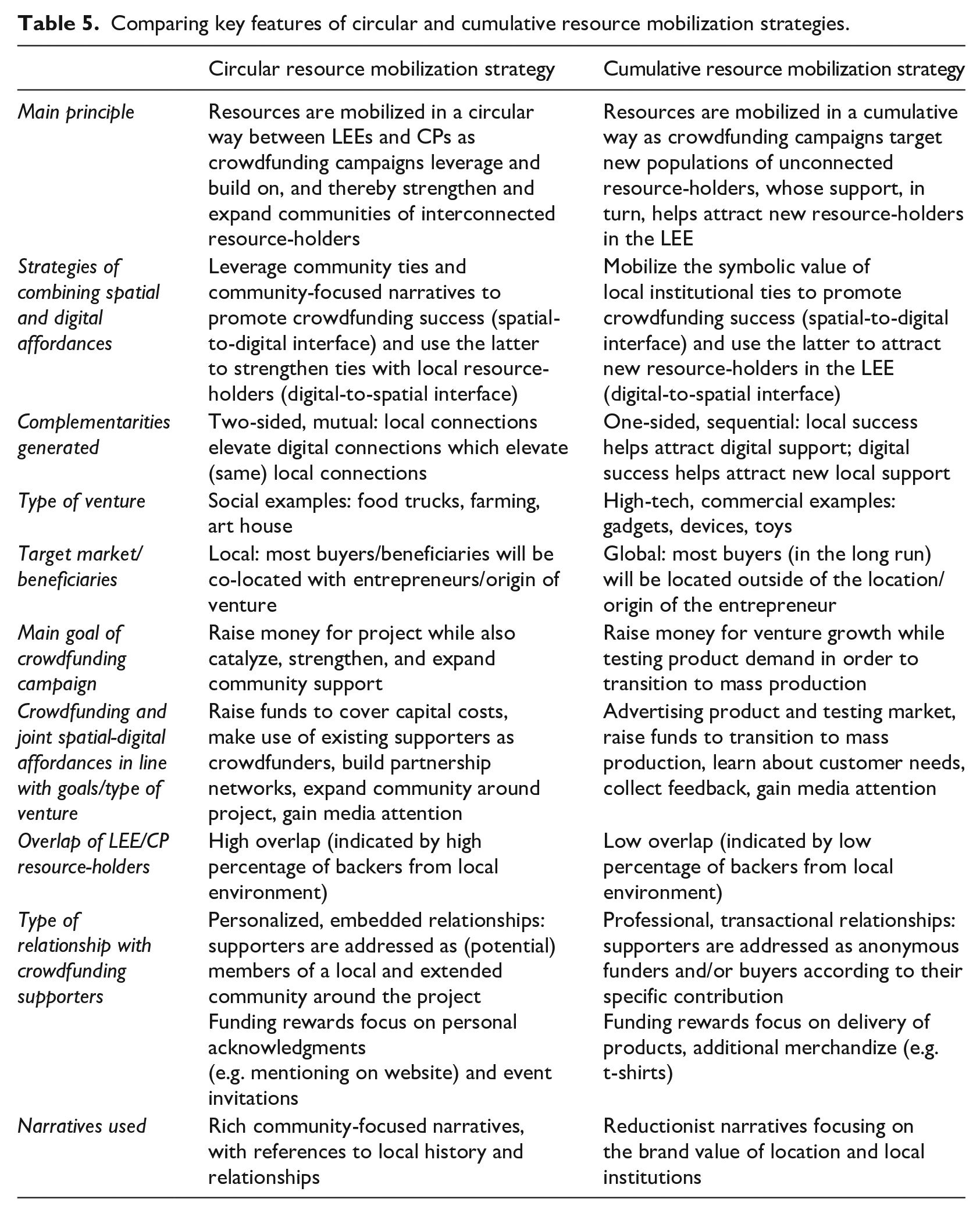
Circular resource mobilization denotes a strategy of mobilizing resources in a “circular way” between LEEs and CPs by running crowdfunding campaigns that leverage and build on, and thereby strengthen and expand communities of interconnected supporters. Community ties and community-focused narratives are leveraged to promote crowdfunding success, which can help strengthen ties with local resource-holders. We call this strategy “circular” because crowdfunding campaigns feed back into the communities that help launch the campaigns in the first place. In our dataset, projects taking this approach include, for example, restaurants, rooftop gardens, and food trucks. Through the circular approach to resource mobilization, crowdfunding becomes part of a community-building and community-engaging entrepreneurial process (Calic and Mosakowski, 2016; Josefy et al., 2017; Murray et al., 2020). It is based on the idea of “getting more from many” partly by re-engaging the same resource-holders in different ways (Hertel et al., 2021). More specifically, the circular strategy allows entrepreneurs to expand the utility of resource-holders beyond their role in any one resource environment. For example, the creators of project FARM1 use their crowdfunding campaign in part to turn potential local business partners they had established contact with into crowdfunders, which further strengthens their business connection going forward.
The circular strategy can thus be seen as a way for entrepreneurs to generate two-sided or mutual complementarities (Jacobides et al., 2018; Teece, 1986) between crowdfunding campaigns and LEE resource mobilization. This is because crowdfunding elevates the value of local resource-holders, whose support, in turn, increases the likelihood of crowdfunding campaigns to succeed. As a result, circular strategies utilize the affordances of crowdfunding and LEEs in a joint way. Rather than merely combining individual affordances of LEEs, such as getting access to markets and business support, and individual affordances of crowdfunding, such as accessing a large population of diverse funders, circular strategies allow entrepreneurs to exploit joint affordances that are neither just spatial or digital (see also Autio et al., 2018). Specifically, findings suggest that circular strategies unlock certain affordances of digital-spatial resource mobilization interfaces—for example, the ability to turn local supporters into crowdfunding supporters (and vice versa) and the related ability to develop multiplex support relationships with individuals across these two environments.
The joint digital-spatial affordances that are mobilized through circular strategies are linked to the purpose of crowdfunding campaigns and the type of venture (Majchrzak and Markus, 2013; Nambisan, 2017). Campaigns applying a circular strategy are related to projects that are social mission-driven, such as food trucks and community gardens. These projects tend to target locally embedded buyers and beneficiaries. In fact, social mission-driven projects, such as community gardens, often derive part of their legitimacy from the needs and support from local communities (Haugh, 2007). In addition, lacking any high-tech features, these projects share properties of “experience goods” (Hirsch, 1972; Lampel et al., 2000) whose value is highly subjective and connected to local contexts. Our findings thus suggest that crowdfunding campaigns employing circular strategies typically aim to build partnership networks and expand communities around projects while also attracting media attention and raising funds to cover capital costs. Supporters are addressed in a personalized fashion and as potential members of a support community.
The purpose and orientation of these campaigns also explain why they heavily rely on community-centered narratives—not only to attract funding but also to strengthen overall project support across resource environments (see also Figure 3). The notion of “community” is to some extent linked to the local context within which projects are embedded and to some extent transcends it. Whereas prior studies have emphasized how crowdfunding campaigns often build on and exploit local community-building efforts (Murray et al., 2020), other studies have illustrated how crowdfunding campaigns contribute to the construction of communities around projects beyond the local context (Josefy et al., 2017). Our findings suggest that to exploit affordances of spatial-digital interfaces, both dimensions of “community” are equally important. This is because circular strategies use community narratives to target crowdfunding supporters from both inside and outside the local context. In one extreme example, FARM2, 99% of the crowdfunding backers came from outside the local context, yet community narratives were used to convey the local value of the project and to attract funders who sympathize with the local mission—education-focused dairy farming in a Caribbean country—even if they are not part of the local environment. Prior studies have similarly shown the power of narratives in getting “buy-in” from previously unrelated supporters (Fletcher, 2007).
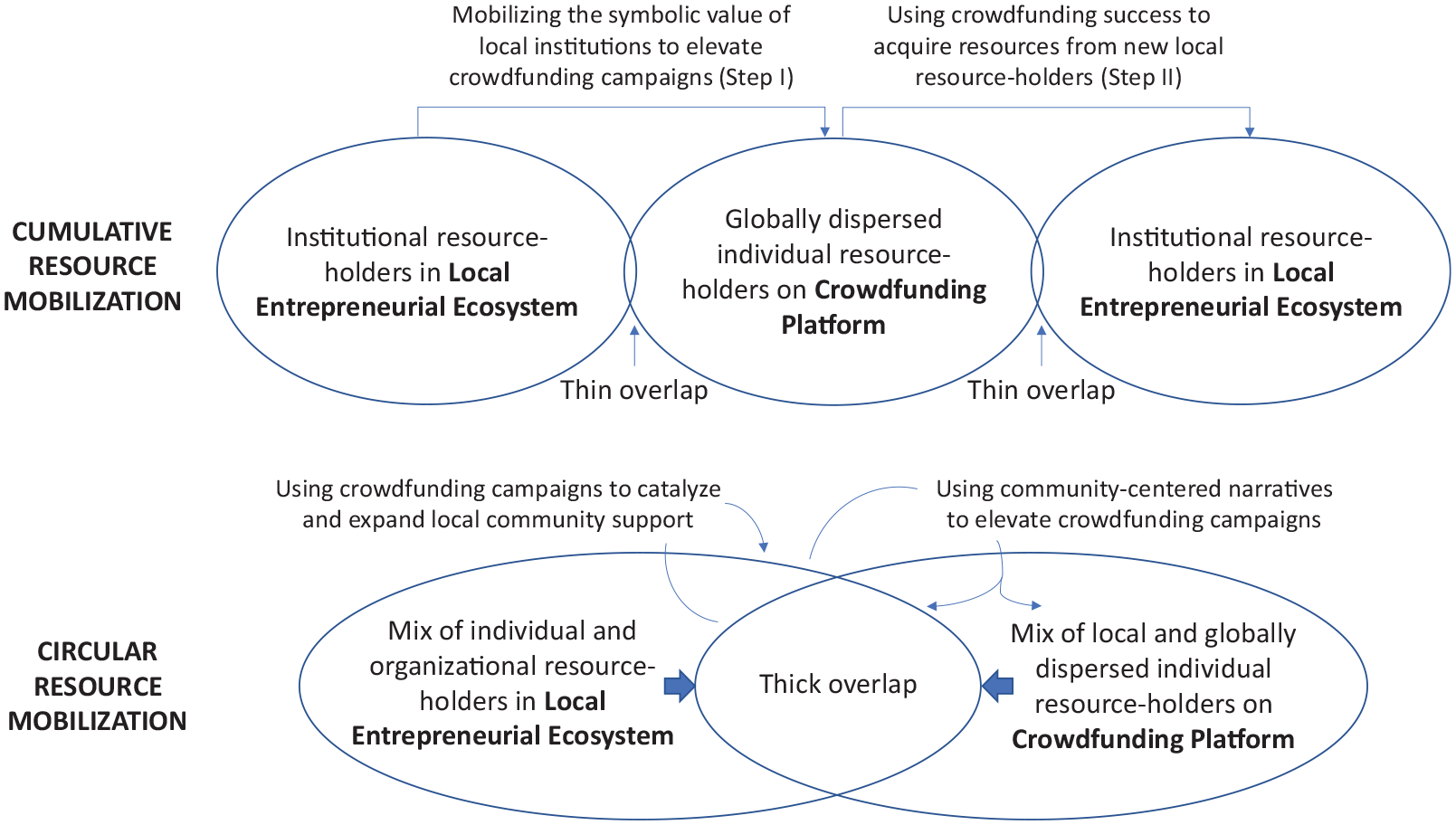
Cumulative and circular strategies of resource mobilization across LEEs and CPs.
Typically, however, circular strategies apply to situations where the geographical overlap between LEE and CP resource-holders is significant. In fact, we find that on average 35% of supporters of campaigns that follow a circular resource mobilization strategy are located in the very LEE the project creators are embedded in. However, this also suggests that on average, 65% of supporters do not come from these locations. Yet, they are addressed as members of an extended support community that is a joint result of spatial and digital resource mobilization. One important characteristic of the circular approach is that campaigns aim at making supporters feel connected to the same community, for example by inviting them to events and by adding their names to websites. Creating such extended communities can be seen as another joint affordance of LEEs and CPs, which entrepreneurs tap into by employing circular resource mobilization strategies.
By contrast, cumulative resource mobilization denotes a strategy of mobilizing resources in a cumulative way as crowdfunding campaigns target new populations of unconnected resource-holders, whose support, in turn, helps attract new resource-holders in the LEE. Whereas supporters in the circular approach are addressed in personal ways, in the cumulative approach support relationships are mostly transactional and professional. In this effort, the symbolic value of local institutional ties is leveraged to promote crowdfunding success. We call this strategy “cumulative” because entrepreneurs that use this strategy mainly try to accumulate new, additional resources and resource-holders when entering a new resource environment. Examples of projects that utilize this approach include games, 3D printers, robots, and other gadgets. Many of these projects first accumulate support from various local institutions, including universities and funding institutions, prior to crowdfunding, then they mobilize a new population of individual supporters through the campaign, and eventually, they communicate the campaign success to new local resource-holders, such as angel investors, VC firms, and business partners. This form of accumulating resources by combining access to spatial and digital resource environments in complementary, yet sequential ways, has been noted in previous studies (Colombo and Shafi, 2021; Roma et al., 2017). Our findings further specify this approach, in particular by contrasting it with circular resource mobilization.
Whereas circular resource mobilization allows entrepreneurs to accomplish what has been called “mutual complementarities,” in the case of cumulative resource mobilization, we are dealing instead with “one-sided complementarities” (Jacobides et al., 2018; Teece, 1986) that add up in sequential ways. First, the value is added to crowdfunding campaigns by referencing local institutional ties in these campaigns (Step 1), and then crowdfunding success is used to elevate pitches to new local resource-holders (Step 2). This implies that cumulative strategies unlock very different affordances of spatial-digital interfaces compared to circular strategies. Specifically, cumulative strategies enable entrepreneurs to build legitimacy by exploiting the brand value of locations and local institutions when attracting digital supporters (Step 1) and by exploiting the symbolic value of crowdfunding success when attracting new local resource-holders (Step 2). Like in the case of circular strategies, however, these affordances result from the joint use of LEEs and CPs as resource environments, thus adding to individual affordances of each environment.
These joint affordances are again linked to the purpose of crowdfunding campaigns and the type of venture. Campaigns as part of a cumulative resource mobilization approach are related to projects that are typically high-tech and commercially oriented. High-tech projects, such as 3D printers, depend a lot on institutional support because of high upfront investments. Appealing to institutional funders in LEEs is therefore key. At the same time, being able to test the appeal of products before rolling out mass production is an important motivation to reach out to large crowds for feedback. The commercial nature of these projects is aligned with transactional ways of addressing supporters. For example, most campaigns in this category directly address supporters as early buyers of their products. Furthermore, commercial orientations are aligned with focusing on the brand value of locations and local institutions, rather than the embeddedness in communities. Both high-tech features and commercial orientations further imply that most of these projects have a global orientation in terms of future target markets. Crowdfunding campaigns are thus aimed to advertise products to diverse audiences from around the world, test their market appeal, and collect feedback, aside from raising funds for mass production and attracting media attention.
In line with a more transactional approach of addressing supporters, the cumulative strategy primarily focuses on the symbolic value of LEE resource endowments in crowdfunding narratives. For example, we showed how campaigns in this category make reference to the brand value of local universities and research institutes, as well as the brand value of entire cities, to elevate their campaigns. The importance of communicating symbolic values as part of resource mobilization is not new (see e.g. Zott and Huy, 2007). However, we find that focusing on symbolic value—rather than community narratives—is a strategic choice of managing the spatial-digital interface and of elevating the brand value of products through this interface. This choice applies to a situation where the potential geographical overlap in resource-holders between LEEs and the CP is relatively low. We find that on average 4% of supporters of campaigns that follow a cumulative resource mobilization strategy are located in the LEE project creators are embedded in. This, however, does not mean that the local context is not important in attracting funding. On the contrary, referencing the symbolic value of local institutions induces trust in the product, especially among supporters outside of the local context.
Further implications for future research
Our findings have major implications for future research. In particular, we inform research on entrepreneurial resource mobilization (Clough et al., 2019), research on the intersection between crowdfunding and local contexts (Breznitz and Noonan, 2020; Gallemore et al., 2019), and research on digital affordances (Autio et al., 2018; Nambisan, 2017; Nambisan et al., 2019).
Our study has important implications for research on entrepreneurial resource mobilization. While prior research in this field has focused on single resource environments (Clough et al., 2019), for example, local entrepreneurial ecosystems (Spigel, 2017) or crowdfunding platforms (Soublière and Gehman, 2020), our study has shifted attention to resource mobilization across resource environments and different ways in which entrepreneurs can generate complementarities. We argued that LEEs and CPs operate based on different principles of resource mobilization, yet they potentially overlap in terms of individual resource-holders while also giving access to resource-holders who do not participate in other resource environments.
We show that narratives play an important role in navigating between different resource environments. Whereas prior research has shown primarily how narratives and storytelling can help accumulate resources in the same resource environment (Fisher et al., 2020; Lounsbury and Glynn, 2001; Zott and Huy, 2007), our study shows how narratives can be equally important in establishing and exploiting interfaces between different resource environments. We highlight that entrepreneurs employ community narratives when the interface between resource environments is potentially “thick” in terms of the geographical overlap in the presence of resource-holders, whereas entrepreneurs primarily evoke the symbolic value of resources when the interface is “thin.” We further showed that these different narratives are supportive of different kinds of complementarities entrepreneurs generate when tapping into multiple resource environments. Whereas community narratives help generate mutual or two-sided complementarities, symbolic value-focused narratives help generate one-sided complementarities. We thus encourage future research to further examine how the use of different narratives aligns with different forms of resource mobilization across resource environments.
Our findings also have potentially interesting implications for resource mobilization in international entrepreneurship. For example, entrepreneurs in developing countries often reach out to international funders in light of local resource constraints (Desa and Basu, 2013). Since the overlap in resource-holders between such LEEs and international resource environments is often thin, our findings suggest that entrepreneurs in such cases are likely to refer to the symbolic value of resources to generate primarily cumulative complementarities. For example, they may reference unique local resource access in their narratives toward international funders while referencing access to and success in mobilizing international funding for local resource acquisition. Similarly, findings are relevant for international entrepreneurs who operate between home and host countries. For example, prior studies suggest that certain resource-holders, for example, venture capital firms, set up operations in Silicon Valley and Bangalore, India, to support new ventures targeting US clients with operations in India (Bresnahan et al., 2001; Saxenian, 2005). Studies also suggest that transnational professional communities have formed connecting the Silicon Valley and Bangalore ecosystem (Kenney et al., 2013). Our findings suggest that in the case of such a thick overlap in resource-holders, circular resource mobilization strategies are likely to be employed that generate mutual complementarities in tapping into interconnected resource environments.
More broadly, our findings add nuance to two important recent movements in entrepreneurship research—community-centered understandings of the entrepreneurial process (Haugh, 2007; Jennings et al., 2013; Josefy et al., 2017; Murray et al., 2020) and the role of contextuality in entrepreneurship (Welter, 2011; Welter and Baker, 2020). On the one hand, our findings confirm the importance of using and referencing community ties to mobilize crowdfunding (Josefy et al., 2017; Murray et al., 2020) and LEE resources. Yet we also showed that the importance of community-building and community-engaging activities (see e.g. Murray et al., 2020) differs for different ventures. While indeed community-building and community narratives are important for projects that are social mission-driven and locally embedded (see also Haugh, 2007), they seem less critical for projects that are commercial, globally oriented, and technologically sophisticated. In such cases, entrepreneurs employ narrative strategies that focus on the symbolic value of institutional ties. Thus, we need a better understanding of how and when community-focused narratives are applied.
On the other hand, our study is a good example of how contexts are “talked into being” (Welter and Baker, 2020) to assist resource mobilization across resource environments. Advancing this line of research, our study shows that depending on project properties and target audiences, location contexts are “talking into being” quite differently. Whereas entrepreneurs link locations to community narratives to target audiences with local affiliations, locations are associated with global brand values when audiences are more geographically dispersed. However, the diversity of resource-holders on CPs raises some important questions about the effectiveness of certain location narratives. To attract both local community members to become funders and appeal to outside audiences, entrepreneurs face the challenge of communicating local contexts in a way that is sufficiently “embedded” and linked to local values and discourse to appeal to locals, while also being “disembedded” in using terminology that makes project benefits understandable to outsiders. The project FARM2—education-focused dairy farming in a Caribbean country—is an extreme example where community narratives were evoked primarily to attract outside audiences with loose connection to the location. Here, the “community” frame almost becomes a narrative commodity in signaling the “localized value” of projects to global funders. More research is needed to better understand such contextualization strategies in increasingly fragmented and geographically dispersed resource environments.
Our study also informs crowdfunding research, specifically the increasing interest in the role of location in crowdfunding campaigns (Breznitz and Noonan, 2020; Colombo and Shafi, 2021; Dejean, 2019; Gallemore et al., 2019; Murray et al., 2020). Several prior studies have suggested that projects tend to be more successful on CPs when they originate in metropolitan areas (Breznitz and Noonan, 2020; Gallemore et al., 2019; Yu and Fleming, 2020), and that, in turn, it can be very difficult to attract funders who are very distant from the home region of entrepreneurs (Dejean, 2019; Guenther et al., 2018; Lehner and Harrer, 2019; Lin and Viswanathan, 2015). At the same time, recent studies show that crowdfunding success can increase the effectiveness of resourcing strategies in LEEs (Colombo and Shafi, 2021; Gegenhuber and Naderer, 2019; Murray et al., 2020). Our findings make three very important contributions that urge us to add sophistication to this line of research.
First, while our study confirms the importance of location in informing crowdfunding campaigns and in affecting crowdfunding success, our findings also suggest that narratives play an important role in connecting crowdfunding campaigns to local resource environments. Notably, prior studies have emphasized the importance of narratives in crowdfunding success (Anglin et al., 2020; Allison et al., 2015; Luo and Luo, 2017; Manning and Bejarano, 2017; Xiang et al., 2019). However, our understanding of how crowdfunding narratives evoke location contexts is still rather limited. Our findings indicate that the choice of narratives may have an effect on the extent to which project creators can generate and exploit overlaps in resource-holders between LEEs and CPs. We thus encourage future research to take location narratives more seriously in crowdfunding studies rather than assuming that location automatically affects crowdfunding success.
Second, and relatedly, we show that quite surprisingly many campaigns that manage to attract large amounts of crowdfunding do not mobilize funders from their local environment but from globally dispersed locations. This is true, for example, for high-tech projects. However, this does not mean that location does not matter in such campaigns. Rather, we find that such campaigns succeeded in attracting funding partly because of how they evoke the global brand value of local institutional ties. By comparison, campaigns that effectively turn members of the LEE into crowdfunders, facilitated by community-centered narratives, often mobilize much smaller amounts, even if their projects are located in metropolitan areas such as Boston. These findings urge us to develop a much more nuanced understanding of how location matters in crowdfunding campaigns.
Third, our study continues the recent stream of research on crowdfunding as an embedded entrepreneurial effort (Gafni et al., 2018; Pollack et al., 2021), connecting to resourcing strategies in LEEs before and after campaigns (Colombo and Shafi, 2021; Murray et al., 2020). We add to this research by demarcating two distinct ways of accomplishing complementarities between LEE and crowdfunding strategies. We show that crowdfunding campaigns differ quite substantially between new ventures aiming for community-building and community support before and after campaigns (see, for example, Murray et al., 2020), and new ventures aiming primarily for institutional support (e.g. venture capital) before and after campaigns (see e.g. Colombo and Shafi, 2021). While both are examples of how complementarities can be generated across LEE and CP resourcing strategies, the mechanisms by which such complementarities are achieved are very different. We thus encourage future studies to better examine how different crowdfunding campaigns are embedded in the larger entrepreneurial process, and how this affects the interplay of CP and LEE resource acquisition.
Our study also has important implications for the growing research on affordances (Autio et al., 2018; Nambisan, 2017; Nambisan et al., 2019). In particular, our study responds to the call for more research on the interplay of spatial and digital affordances (Autio et al., 2018). Previous research mostly suggests that digital infrastructures, such as crowdfunding, reduce “the dependency of new ventures on cluster-specific spatial affordances for entrepreneurial opportunities” (Autio et al., 2018: 20). In other words, digital and spatial affordances are seen as partially substituting and partially complementing each other. By comparison, our study suggests that spatial and digital resource environments may offer joint affordances, depending on the properties of the entrepreneurial endeavor, which cannot be reduced to affordances of any one resource environment alone. For example, we showed how the joint use of LEEs and CPs affords entrepreneurs to use the same resource-holders in multiple ways, to connect otherwise unconnected resource-holders into communities supporting entrepreneurial projects, and to build the brand value of entrepreneurial projects in ways neither the LEE nor the CP by itself could afford entrepreneurs to do. This strongly suggests that the affordances debate needs to move beyond system or technology-specific affordances and instead examine how affordances emerge from the interconnected use of different environments. This also helps further advance the notion of “entrepreneurial ecosystems” as interconnected spatial and digital systems (Autio et al., 2018). At the same time, affordances need to be examined not only in relation to properties of entrepreneurial efforts within particular environments (Nambisan, 2017), but across interconnected resource environments (see also Nambisan et al., 2019).
In conclusion, our study adds to our understanding of entrepreneurial resource mobilization across resource environments, which is of relevance not just to crowdfunding research but also to the larger debate on entrepreneurial processes. Findings are important not just for academic research but could be useful for entrepreneurs, entrepreneurship support organizations, and policy-makers who are concerned with building and connecting entrepreneurial ecosystems.
Footnotes
Acknowledgements
We would like to thank the handling editor Professor Ann Langley for her very constructive and thorough reviews and suggestions, as well as three excellent anonymous reviewers for their helpful feedback. We are also grateful for the valuable feedback we received on earlier versions of the manuscript at multiple conferences, including Druid and the Academy of Management, as well as for the Best Conference Paper Award we received at the Strategic Management Society Special Conference in Oslo. We also received very useful comments at a workshop at Copenhagen Business School.
Funding
The author(s) received no financial support for the research, authorship, and/or publication of this article.
Author biographies
 .
.