



Abstract
We adopt a dyadic, multi-referent trust perspective to assess the effects of franchisee–franchisor trust (in)congruence and franchisee trust in peers on franchisee network exit intentions, under varying levels of franchisee perceived network control. We observe a nuanced relationship between trust (in)congruence and exit intentions, revealing a negative and nonlinear effect for trust congruence, and, surprisingly, a negative effect for incongruence. The effects of trust congruence and trust in peers are distinctively moderated by perceived control; when franchisees perceive stronger control, the negative effect of trust congruence on exit intentions becomes stronger, whereas the insignificant effect of peer trust becomes positive.
Keywords
Introduction
Franchising is a complex form of inter-firm cooperation between franchisors and franchisees (Gillis et al., 2014, 2020), where the franchisor leads franchisees in collectively seizing a business opportunity by growing a network of dispersed units with a shared business format (Combs & Ketchen, 2003), and franchisees are semi-autonomous entrepreneurs who take risks by adopting the franchisor’s business format to run their businesses (Combs, Ketchen, & Short, 2011; Kidwell et al., 2007). Effective franchise cooperation requires the coordination of resources and actions of franchise partners with mixed motives (Kidwell & Nygaard, 2011).
Franchisee turnover is a key measure of network performance (Kim & Min, 2023). Franchisee exits can impact a network’s viability and profitability by reducing economies of scale and royalties, creating reputational damage, and increasing costs for the selection and training of new franchisees (Dada, 2023). Moreover, depending on legal restrictions, exiting franchisees may spawn into new ventures or join rival networks. Given these consequences, research has aimed to explain why franchisees intend to leave their franchise networks. Our study makes three contributions to this research stream.
First, rather than taking a unilateral trust perspective in which researchers link franchisee trust in their franchisor to franchisee network exit intentions (Croonen & Brand, 2015; Wu, 2015), we adopt a dyadic trust perspective to fully understand relationship outcomes (as suggested by Combs, Ketchen, Shook, & Short, 2011; Nijmeijer et al., 2014). Franchising is inherently relational, with success depending on the (trust) interplay between franchisor and franchisee. A unilateral trust perspective may create an erroneous understanding of relationships, as it solely displays the perspective and expectations of one party, and thus fails to capture the effects of trust (a)symmetry (Graebner et al., 2020; Korsgaard et al., 2015). A few studies in other organizational settings measure dyadic trust but limit themselves to calculating “difference scores” to proxy trust (a)symmetry (De Jong & Dirks, 2012; M. Wang et al., 2020). Employing difference scores as a measure of trust (a)symmetry inherently results in a substantial loss of valuable information because it collapses two distinct trust variables into a single score, operates on the assumption of a linear relationship that may overlook the complexities and possible nonlinearity of trust (a)symmetry’s impact on outcomes, and generates ambiguity in its interpretation due to its nondirectional nature. To address this limitation, we adopt polynomial regression (PR) and response surface analysis (RSA) to better understand the intricate dynamics of franchisee–franchisor trust relationships and their influence on exit intentions. Our approach offers a nuanced examination of how franchisee–franchisor trust (in)congruence (i.e., partners experiencing a (dis)similar level of trust in each other) affects exit intentions, addressing the shortcomings of previous research that has overlooked the dyadic nature of trust and its nonlinear effects on franchising outcomes. By focusing on the congruence—or lack thereof—of trust between partners, our approach enables a three-dimensional examination of how trust (in)congruence impacts outcomes (Edwards, 2002; Edwards & Parry, 1993), thereby providing a more nuanced understanding of how (a)symmetric trust levels affect relationship outcomes. This innovative perspective not only fills a gap in franchising studies, which have traditionally neglected the dyadic perspective of trust, but also uncovers nonlinear and unexpected effects that challenge conventional assumptions on the role of trust congruence, and paves the way for novel avenues of inquiry in other organizational research.
Our second contribution is the adoption of a multi-referent trust approach (cf. Fulmer & Gelfand, 2012), which assesses not only the trust franchisees have in their franchisor but also in their peers, that is: other franchisees within the same franchise network. Existing research on exit intentions typically focuses on franchisee perceived outcomes from direct exchanges with the franchisor (e.g., Meek et al., 2011; Mignonac et al., 2015; Wu, 2015) but ignores generalized exchanges with franchisee peers. Drawing from studies on generalized exchanges (Das & Teng, 2002; Li et al., 2012), we posit that franchise networks uniquely combine direct exchanges (between each individual franchisee and the franchisor) and generalized exchanges (among franchisee peers in the network) that result in different exchange risks and different trust referents for franchisees. Trust in peers is important as peer opportunistic behaviors, such as free-riding and non-compliance, can harm the franchise network’s brand reputation (Kidwell et al., 2007). Even though franchisors perform an important network control function, such control is imperfect and residual risks remain (Kashyap et al., 2012). Our results show that franchisee trust in different referents differentially impacts exit intentions—especially under different franchisee perceived control conditions. Our study hints at the existence of network phenomena resulting from peer trust, such as joint “balancing operations” and “network spawning” that can polarize the franchisor–franchisee relationship and harm the stability of franchise networks. This underscores the need to extend research to include peer trust, exploring its impact on relational outcomes in franchise networks under specific conditions.
We finally contribute to franchising research by exploring trust and control in tandem. Specifically, we investigate how franchisee perceived network control, as a boundary condition, moderates the influence of franchisee–franchisor trust congruence and of trust in peers on exit intentions. Existing franchising studies have separately focused on trust (Altinay et al., 2014; Davies et al., 2011) or on control (Dada, 2018), neglecting the interplay between trust and control. Despite the importance of trust and control in reducing perceived exchange risks and improving cooperative outcomes (Das & Teng, 1998, 2001; Long & Sitkin, 2018), it is surprising that no research has applied them together to explain franchisee behavioral intentions. We fill this gap by simultaneously incorporating trust and control to explain exit intentions. Our findings reveal that franchisee perceived network control acts a boundary condition that moderates the effects of the two trust types differently. A high level of perceived control strengthens the exit-reducing effect of franchisee–franchisor trust congruence (synergistic effect) but promotes exit intentions by transforming a previously insignificant relationship between peer trust and exit intentions into a positive one (antagonistic effect).
In sum, we explain franchisee network exit intentions by adopting a dyadic, multi-referent perspective on trust, while accounting for the interplay of trust and control. We employ multi-source and time-lagged data including 120 franchisee–franchisor dyads to analyze the effects of franchisee–franchisor trust congruence and franchisee trust in peers on exit intentions, under varying levels of franchisee perceived network control. From a managerial perspective, we point to trust and control as important mechanisms that steer exit intentions. Recognizing the pivotal roles of trust and control, we discuss the effectiveness of franchisor strategies like “forging bonds” and “divide and conquer” in preventing exit intentions and enhancing overall network governance.
Theoretical Backgrounds and Hypotheses Development
Theoretical Backgrounds
Research on franchisee exit intentions has typically focused on either a relational/social exchange perspective, revealing trust as an important predictor (Chiou et al., 2004; Wu, 2015), or an agency perspective, demonstrating that franchisees may leave when the franchisor’s rules or controls restrict them to reach their own goals (Croonen & Brand, 2015; López-Fernández & López-Bayon, 2018). However, this research falls short by (a) adopting a unilateral trust perspective, (b) considering only the franchisor as trust referent, and (c) ignoring the simultaneous inclusion of trust and control (see Supplemental Material #1 for an overview; all our Supplemental Materials can be found online under the Contents tab on the article page).
In dealing with these limitations, our theoretical framework integrates social exchange theory (SET), trust (in)congruence literature, and trust–control literature. SET helps in building our dyadic and multi-referent trust perspective. It suggests that business partners like franchisees and franchisors evaluate their relationships based on both economic and social outcomes, with a significant emphasis on trust as a social outcome (Blau, 1964; Cropanzano & Mitchell, 2005; Lioukas & Reuer, 2015). Trust reflects a partner’s positive expectations that the other partner will reciprocate by being willing and able to fulfill its obligations in the exchange relationship (Connelly et al., 2018). It reduces partners’ perceived exchange risks (Das & Teng, 2001, 2002), and helps partners to bond emotionally (Rowley et al., 2005). In our analysis, we consider franchisee–franchisor trust (in)congruence (representing direct exchange) and franchisee trust in peers (representing generalized exchange). Finally, we build upon the trust–control literature (Das & Teng, 1998, 2001; Long & Sitkin, 2018) and introduce franchisee perceived network control as a contextual factor influencing how franchisees interpret and are affected by both types of trust (Figure 1).
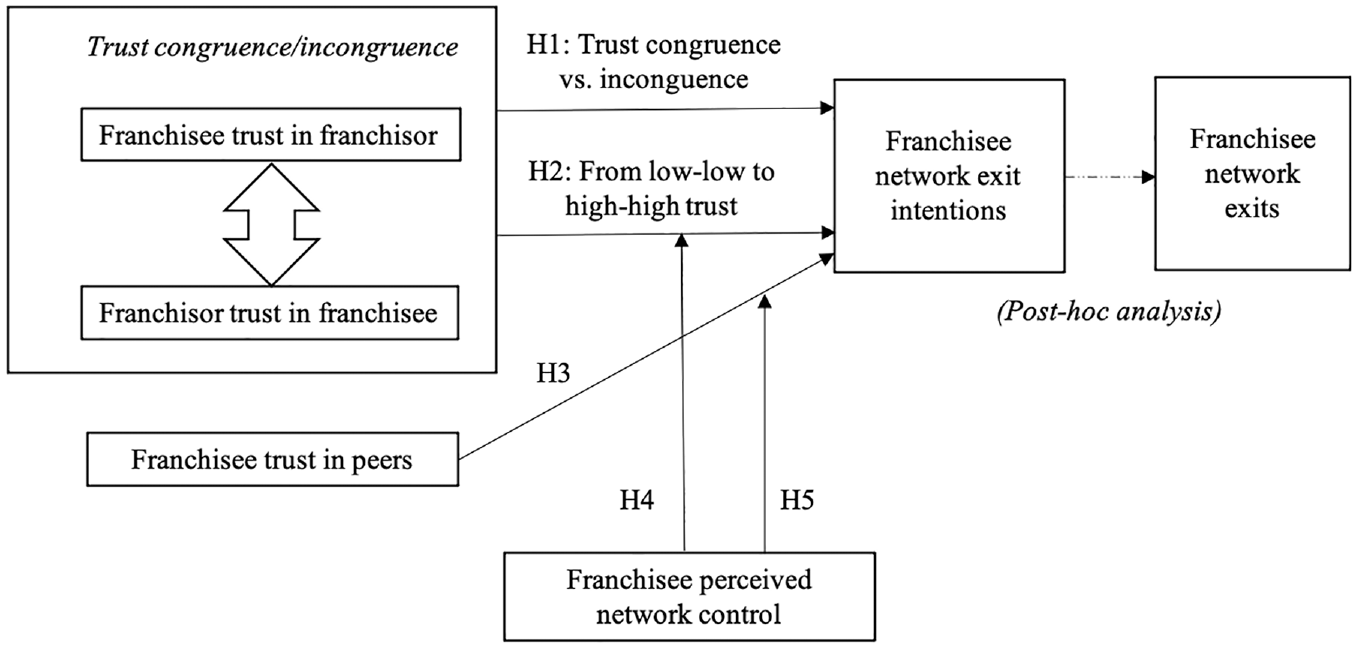
Conceptual model.
The “Trust Congruence Effect”: Trust Congruence Versus Incongruence
Franchisees face risks in the direct exchange with the franchisor as a result of the mixed and potentially conflicting motives between them and the impossibility to fully eliminate such risks via formal contracts (Combs et al., 2004; López-Fernández & López-Bayon, 2018). This risk is exacerbated by the franchisor’s asymmetrical control, placing franchisees in a vulnerable position and increasing their dependency on the franchisor’s actions (Altinay et al., 2014; Davies et al., 2011). Franchisee trust in the franchisor is crucial to maintain the relationship by reducing franchisee perceived direct exchange risks via stronger goal alignment and a greater likelihood of goal attainment (Das & Teng, 2001; Davies et al., 2011). Prior franchising studies have already shown that if franchisees trust their franchisor to be willing and able to fulfill its exchange obligations, they are more likely to anticipate positive future exchange outcomes and are more likely to stay in the franchise network (Chiou et al., 2004; Croonen & Brand, 2015; Wu, 2015). However, as argued, these studies have adopted a unilateral rather than a dyadic trust perspective and cannot account for the possible effects of trust (in)congruence.
Studies in other organizational fields have argued or found that trust congruence between partners—where trust levels are aligned—strongly influences relational behaviors and/or outcomes (Korsgaard et al., 2015; Tomlinson et al., 2009; L. Wang et al., 2023). Trust congruence enhances compatible views among partners on the nature of their exchange and how to behave in the relationship, regarding resource investments, risk taking, knowledge sharing, or communication routines (Korsgaard et al., 2015; L. Wang et al., 2023). This compatibility results in higher predictability and lower perceived exchange risks, even when the congruence results from partners both having low trust levels. In such a low trust environment, the exchange of resources becomes strictly transactional, focusing on the immediate utility and compensation rather than long-term relational synergy (L. Wang et al., 2023). Using a transaction-oriented approach, the franchisor and franchisee can then still sustain the relationship by ensuring that both of them adhere to agreed-upon standards and deliverables (Bradach & Eccles, 1989). Due to their low trust levels, partners are mutually cautious, but they understand where each of them is coming from (Tomlinson et al., 2009), enabling them to work better together than in case of trust incongruence; that is, when there is a difference in trust levels among the partners.
Trust incongruence leads to incompatible views among partners on the nature of their exchange. The unaligned expectations regarding desirable relationship behaviors (L. Wang et al., 2023) can lead to miscommunications, misconceptions, and conflicts (Korsgaard et al., 2015; Tomlinson et al., 2009) that destabilize the relationship. Trust incongruence can cause confusion and may lead to one party perceiving the other’s actions as too forward, invasive, or not committed enough, depending on the direction of the incongruence (L. Wang et al., 2023). For example, excessive trust from the franchisor might lead a franchisee to feel overwhelmed by unrealistic expectations, leading to a phenomenon known as “role overload” where the franchisee fears the potential consequences of failing to meet these expectations (cf. Tang & Vandenberghe, 2021). Conversely, when the franchisee bestows more trust in the franchisor than vice versa, this may also lead to unaligned expectations that destabilize the franchise relationship. A high-trusting franchisee may be more willing to take risks, such as engaging in innovation (Hadjielias et al., 2021) or opening additional units (Mignonac et al., 2015), based on the expectation of ongoing support and collaboration from the franchisor. However, if the franchisor lacks trust in the franchisee, it may be hesitant to take these risks and/or refrain from the necessary support. Again, this incongruence may lead to feelings of discomfort as the franchisee may feel unsupported or misled, whereas the franchisor may feel pressured and uneasy about the franchisee’s ambitious expectations, which may lead to a strained franchise relationship. Ultimately, when there is a mismatch in trust levels, misconceptions happen because parties infer a narrative based on how strongly they trust the other party, which may not align with the reality of the other party’s commitment, reliability, or openness (Tomlinson et al., 2009; Korsgaard et al., 2015). Each party may feel misunderstood or undervalued, and these feelings can escalate into conflicts, which might not only damage the relationship but also impede productive collaboration and the pursuit of mutual goals.
In sum, we propose that trust congruence promotes compatible views on risk taking, knowledge sharing, and communication in the relationship. Conversely, trust incongruence complicates relationships by making it difficult for both parties to develop a shared understanding and agree on common goals, leading to a less effective and more arduous relationship. This principle, where relational outcomes are more positive when trust is congruent than when it is incongruent, is referred to as the “congruence effect” (Humberg et al. 2019; L. Wang et al., 2023). Hence:
Moving on the Line of Congruence: From Low-Low to High-High Trust
In Hypothesis 1, we propose that trust congruence leads to lower exit intentions. However, we also posit that the effect of trust congruence on exit intentions varies according to the level of trust: it makes a difference whether partners are congruent because they both have low, medium, or high levels of trust on the line of congruence (LOC; for a discussion, see Tomlinson et al., 2009; L. Wang et al., 2023). In other words, the outcome (i.e., exit intention) depends on the level of the two examined variables (Edwards, 2007). As explained above, congruence at low trust levels (i.e., low-low trust) leads to very transactional interactions where partners are mutually cautious, resulting in low levels of resource investments, risk taking, knowledge sharing, and communication. Conversely, congruence at high trust levels (i.e., high-high trust) creates a fertile ground for positive interactions through shared norms, reciprocity, streamlined communication routines, and deeper comprehension of each other’s needs (Korsgaard et al., 2015). Hence, congruence at high trust levels encourages partners to take more risks, exchange vital instead of basic knowledge, and to work collaboratively toward achieving joint objectives when compared with congruence at lower trust levels (Tomlinson et al., 2009; L. Wang et al., 2023). Congruence at higher trust levels fosters a more committed investment in one another, setting the stage for more durable relationships that offer long-term benefits to both sides (Ferrin et al., 2008). While the congruence mechanisms still allow both parties to reach agreement regarding resource commitments, risk taking, knowledge exchange, and communication at low trust levels, we expect that trust congruence at higher levels of trust will enhance the franchisee’s expectation of positive outcomes from its network membership, increase commitment to strive for mutual benefits, and thereby reduce network exit intentions.
We also posit that the relationship between trust congruence and exit intentions is not linear, implying that the impact of trust increments on the LOC (i.e., the simultaneous and equal strengthening of trust among the franchisor and franchisee) on relationship outcomes may increase or decrease at different rates. Several trust studies suggest that positive relationship outcomes may be amplified, when two parties, who equally trust each other, also do so at higher levels of trust (Korsgaard et al., 2015), as trust congruence increments not only reduce risks (via greater predictability) but also foster the strengthening the positive side of relationships (via goodwill) (Hardy et al., 1998). The high trust setting allows for high mutual investments and an in-depth understanding of what the other party needs, providing a greater potential to reap relational rewards and enduring relationships. Applied to a franchise context, these findings suggest a nonlinear relationship in which exit intentions decrease more sharply for trust congruence increments at high trust levels. Hence:
Effect of Franchisee Trust in Peers
When entering a franchise network, franchisees inevitably become subject to a generalized exchange with their network peers. This means they engage in an interconnected network of indirect, multiparty relationships that benefit each franchisee not necessarily through direct quid-pro-quo transactions but through a web of mutual dependencies and collective value creation (cf. Das & Teng, 2002; Heidl et al., 2014; Li et al., 2012). Perceived generalized exchange risks arise in this setting because franchisees’ constructive or destructive behaviors impact the network (Combs et al., 2004; Kidwell & Nygaard, 2011). Since franchisor network control is inherently imperfect (Kashyap et al., 2012), franchisees must trust their peers to meet exchange obligations and adhere to franchisor guidelines and norms.
Despite previous studies on outcomes of franchisee peer cohesion or peer interactions (Brand et al., 2018; El Akremi et al., 2011; Hadjielias et al., 2021), the specific effects of franchisee peer trust on exit intentions have not been investigated. We hypothesize that peer trust reduces exit intentions because of a reduction of perceived risks of peer opportunistic behaviors, increased peer helping and knowledge sharing, and a cultivation of shared values and sense of community. We explain the three underlying arguments for our hypothesis below.
First, an increase in peer trust results in lower perceived risks of peer opportunistic behaviors, such as non-compliance or free-riding. Peer trust promotes compliance with the group’s behavioral norms through affective bonds (Cochet et al., 2008; Kidwell et al., 2007). When franchisees trust their peers, they expect them to comply with the franchisor’s guidelines, thereby reducing the expectancy that peers damage the network’s brand reputation (El Akremi et al., 2011; Kidwell et al., 2007).
Second, peer trust facilitates helping behaviors and knowledge sharing in franchise networks (El Akremi et al., 2011; Hadjielias et al., 2021). With greater peer trust, franchisees are more likely to provide and receive emotional support, share honest feedback, flag potential issues, and collaboratively tackle problems, thereby reducing the likelihood of problems and inefficiencies. High peer trust also facilitates open communication channels in which franchisees share knowledge that increase franchisees’ learning and expectations regarding the achievement of positive outcomes for their units from their network membership (Brand et al., 2018), which reduces their exit intentions.
Third, peer trust creates robust relationships based on shared values and interests, a psychologically safe environment, and engagement with the franchise network. Enhanced peer trust serves as a catalyst for an effective generalized exchange system by developing a collective sense of cohesion and brand community (El Akremi et al., 2011) in which franchisees do not expect to directly benefit from aiding another franchisee, but do so because they want to contribute to the network’s strength and operational efficiency. Franchisees might benefit from these positive peer behaviors via the generated positive word-of-mouth of their peers’ satisfied clients, or the increased brand reputation fueled by local advertising efforts from their peers. Hence:
Moderating Effects of Perceived Network Control
Building on trust–control literature, we hypothesize that franchisee perceived network control is a critical contextual factor that moderates the effects of trust congruence (H2) and peer trust (H3) on exit intentions. Existing studies highlight the significance of control in mitigating generalized exchange risks (Das & Teng, 2002; Heidl et al., 2014; Li et al., 2012) that manifest in forms like franchisee free-riding or non-compliance (Kashyap et al., 2012; Kidwell & Nygaard, 2011). These risks compel franchisors to implement control mechanisms to ensure consistent quality and uphold the network’s brand reputation (Kidwell et al., 2007). Franchisors typically carry out such control through establishing a formal contract and through the monitoring of franchisee behaviors, for example through regular field visits and audits (Antia & Frazier, 2001; Dada, 2018; Kashyap et al., 2012). In our focal franchise network, where formal contracts show minimal variation, we investigate franchisee perceived network control through franchisee perceived monitoring by the franchisor. Franchisees—even within the same network—may differ in terms of how they interpret franchisor network control depending on their own traits, experiences, and market circumstances (Cochet et al., 2008; Dada, 2018). Hence, we hypothesize that franchisee control interpretations vary across direct and generalized exchanges, that is, franchisee perceived control moderates the effects of franchisee–franchisor trust congruence and franchisee peer trust on exit intentions in distinct ways.
We hypothesize that franchisee perceived network control intensifies the negative relationship between trust congruence and exit intentions. In situations of high perceived control, franchisees can strongly benefit from the mutual understanding and alignment of objectives provided by trust congruence; trust congruence increments strongly reduce their exit intentions because control helps to more effectively reduce generalized exchange risks and deepen the franchisee–franchisor relationship. This amplified effect is rooted in the franchisee’s interpretation of control as a means to effectively reduce generalized exchange risks. A high perceived level of network control tends to be associated with lower performance network variability (cf. Das & Teng, 1998, 2001) via enabling quick identification of deviations and anomalies, and allowing timely corrections to prevent small problems from becoming major setbacks. The perception of frequent monitoring not only creates a secure and predictable operating environment but also acts as a safeguard for maintaining quality standards, serves as an early warning system, and ensures efficient utilization of resources shared with the franchisor (cf. Kidwell & Nygaard, 2011).
Additionally, in a high control setting, franchisees may perceive frequent franchisor interactions through field visits and audits as a form of deepening their relationship with the franchisor, rather than as mere compliance checks. This elevated level of control creates enhanced opportunities for mutual benefit and goal alignment (Bradach, 1997). Frequent interactions allow the franchisor to identify, communicate, and address the timely needs of individual franchisees in terms of financing, operational assistance, and growth opportunities. These interactions contribute to mutual understanding and a synergistic relationship where both parties can work toward shared objectives (Dada, 2018; Davies et al., 2011) and steers future value co-creation initiatives, in which both the franchisor and franchisee seek to share their valuable resources to improve the functioning of the franchise network. When high perceived network control is coupled with congruence at high trust levels, it creates a collaborative atmosphere that nurtures value creation and aligns objectives, making trust congruence particularly effective in reducing exit intentions due to enhanced relationship depth facilitated by franchisor monitoring. Hence:
Franchisee peer trust and perceived network control both serve to mitigate perceived generalized exchange risks within the network by discouraging opportunistic behavior, enhancing peer cooperation, and promoting peer knowledge sharing (El Akremi et al., 2011; Hadjielias et al., 2021). Yet, we posit that franchisee (horizontal) peer trust and the franchisor’s (vertical) network control are to a certain extent incompatible, such that their simultaneous presence creates antagonistic effects. Although peer trust leads to lower perceived risks of peer opportunistic behaviors, increased peer cooperation, and a cultivation of shared values and sense of community, strong franchisor network control—aimed hierarchically, unilaterally, and formally at reducing perceived generalized exchange risks—may diminish the positive impacts of peer trust, as it may create a wedge between the franchisor and franchisees. Franchisees, as independent entrepreneurs, are typically critical toward the control imposed on them (Dada, 2018; Heide et al., 2007). Enhanced peer trust is particularly effective in reducing perceived exchange risks in low control contexts, as it promotes strong bonds, shared values, and effective social control among franchisees (El Akremi et al., 2011). Conversely, in high-control situations, increased peer trust would make franchisees interpret the franchisor’s control activities as redundant, inappropriate, costly, and even excessive (Heidl et al., 2014), which may lead to their psychological reactance and noncooperative reactions (Heide et al., 2007). In such a scenario, franchisees may communicate their grievances about the franchisor’s strong but ineffective network control with other trusted peers creating an “us-vs-them” culture in the network that may ultimately lead to coalition formation and, in extreme cases, even lead to collective network exits (cf. Emerson, 1962). Hence:
Research Method
Research Context, Sample, and Data Collection
To enhance internal validity (Davies et al., 2011), we collected data within a single franchise network (pseudonym: @Home), which provides home services to Dutch customers. The lion’s share of @Home franchisees worked alone or with very few employees. At the time of data collection (late 2011/early 2012), the @Home network had 209 franchisees—only male franchisees operating single units—who often knew each other personally through joint meetings and/or projects. The franchisor’s office included a management team of 5, led by a single owner-manager. The @Home network equipped its franchisees with a recognized brand, consolidated marketing, training, mentorship, and additional services like insurance and guarantee schemes. The franchisees also adhered to a uniform presentation style, including professional uniforms and company-branded vans. Back-office operations were less regulated, with no centralized procurement or logistics department, although @Home recommended specific suppliers that offered franchisees a standard discount.
The management team maintained regular contact with each individual franchisee through field visits to discuss performance, compliance, and challenges. Furthermore, the franchisor held annual network events and regional meetings to discuss updates and gather franchisee feedback.
To ensure honest and representative responses we: (a) cooperated with the network’s Franchise Advisory Council; (b) guaranteed confidentiality; (c) visited eight regional member meetings to establish respondents’ trust; (d) provided a small incentive to respondents; and (e) sent a paper-and-pencil survey to the personal addresses of the franchisees with a prepaid reply envelope administrated by our university. We sent reminders via email and phone calls.
We invited all franchisees to participate in the survey, receiving 135 responses, with 120 complete surveys. The net response rate (57%) is high, and helped to ensure the representativeness of our sample compared to the network’s franchisee population. In the same time period, during a meeting at the headquarters, the six members of @HOME’s management team jointly determined their trust in each franchisee, resulting in data on 120 franchisee–franchisor dyads. For a post hoc analysis, we also collected archival data from 2015 to analyze actual franchisee exits, and we conducted an interview with the network’s owner-manager to understand the reasons behind these actual exits (i.e., whether they were voluntary or involuntary).
Measures and Measurement Properties
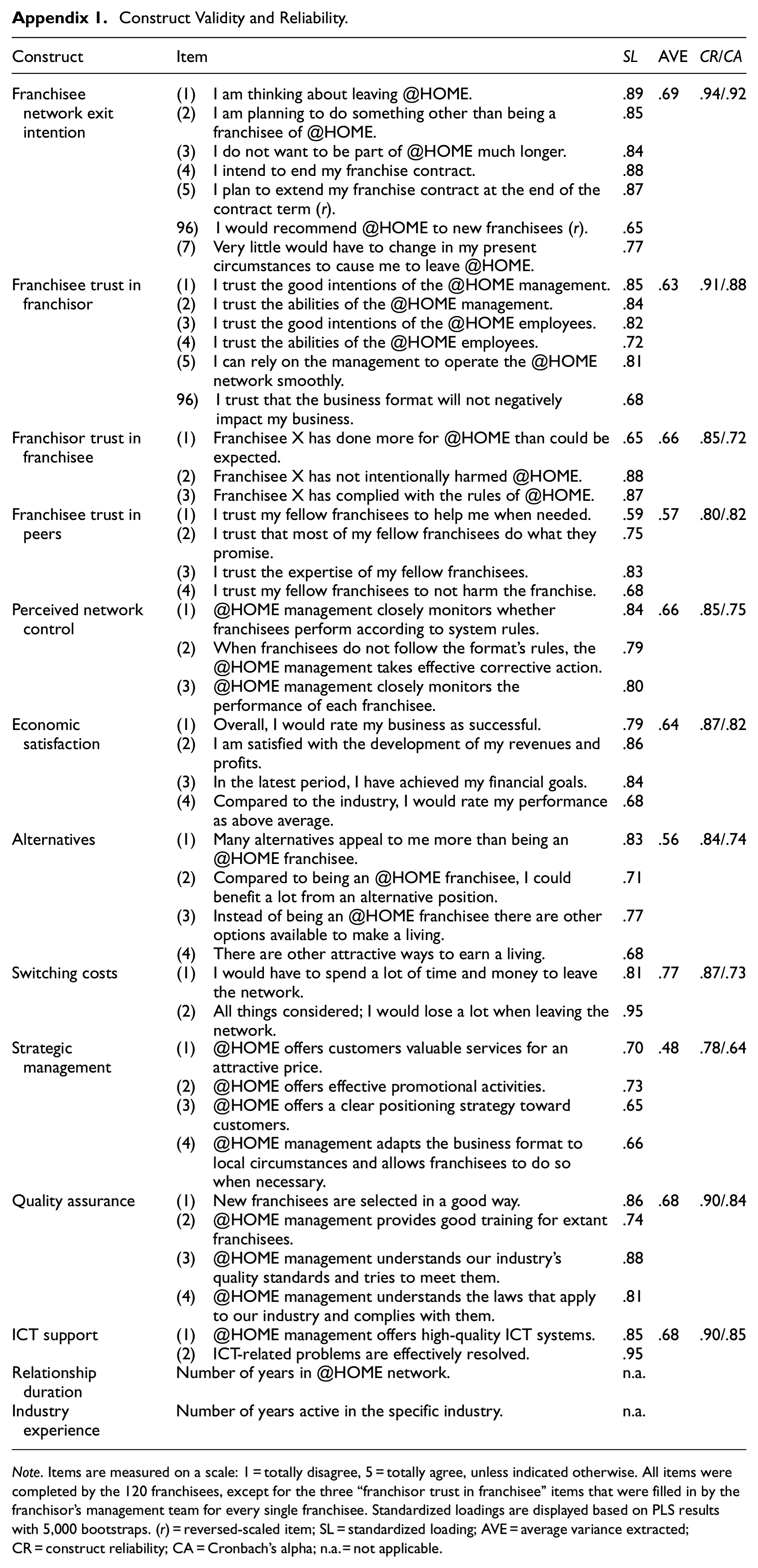
We employed validated scales from earlier studies for all the constructs, adapting the items to fit our research context (see Appendix 1 for the full list of items). Unless specified otherwise, all items were measured on 5-point Likert scales.
Dependent Variable
Franchisee network exit intention was measured using seven items derived from the behavioral loyalty intentions scale developed by Kelloway et al. (1999).
Independent Variables
Our trust (in)congruence measure is based on measures for the franchisee’s trust in the franchisor, and vice versa. For both trust measures, we use scales that reflect two well-known key dimensions of (inter-)organizational trust: goodwill and ability (Connelly et al., 2018; Das & Teng, 2001; Davies et al., 2011). Goodwill focuses on the moral aspects, such as the trusted party’s intentions, care for the other party, and adherence to ethical standards, while ability centers on the instrumental aspects, emphasizing the trusted party’s competence in fulfilling its functional role and ability to deliver on its promises. Each party’s trust was assessed with role-specific items to ensure theoretical alignment and meaningful comparisons.
Franchisee Trust in Franchisor
We adapted Searle et al.’s (2011) scale to reflect on the franchisee’s perception of the franchisor’s goodwill and ability of the franchisor via six items. We adjusted the scale to measure “goodwill” via the franchisee’s trust in the good intentions of @HOME’s management and its employees, and “ability” via the franchisee’s trust in the ability of @HOME’s management and its employees, and proficient and effective management of the business format.
Franchisor Trust in Franchisee
The @HOME management team assessed each franchisee’s goodwill and ability, using three criteria: going above expectations, not harming the network, and effectively complying with the business format rules.
In measuring trust congruence, Korsgaard et al. (2015) recommend scholars to consider the unique roles occupied by each party in relationships marked by unequal power distribution as these roles are crucial for the effective functioning of the relationship. For this reason, we adjusted the trust items to capture the distinct roles and duties of franchisees and the franchisor (role-specific trust items). While ensuring the consistent use of 5-point Likert scales and same underlying trust dimensions, this approach may introduce nuances in interpretations; for instance, questions arise regarding whether comparable averages signify overlap, and if increments in trust means hold equivalent implications for both parties. We investigate the (effects of) trust congruence, operating under the assumption that higher scores for both parties correspond to similar trust improvements. We used an alternative congruence measure for cross-validation in our robustness checks, and discuss potential measurement issues in the limitations section.
Franchisee trust in peers was measured using four items based on J. Cook and Wall (1980) and Kiffin-Petersen and Cordery (2003). These studies have used these items to measure organizational members’ trust in their peers. These items do not reflect trust in specific peers, but—in line with generalized exchange—refer to the trust in the population of peers belonging to the @Home franchise network.
Moderating Variable
Franchisee perceived network control was measured using a three-item scale based on studies on monitoring and enforcement in (franchise) channel relationships (Antia & Frazier, 2001; Kashyap et al., 2012).
Control Variables
We incorporated different types of control variables. First, relationship characteristics included economic satisfaction, relationship duration, alternatives, and switching costs. Economic satisfaction consisted of four items reflecting the franchisee’s satisfaction with unit performance (Cochet et al., 2008). Relationship duration was recorded in years. Alternatives and switching costs were measured with multiple items (Ping, 1993). Second, we control for franchisor characteristics by including franchisees’ assessments of the franchisor’s performance regarding strategic management, quality assurance, and information- and communication technology (ICT) support (Croonen & Broekhuizen, 2019; Wu, 2015). Finally, we control for franchisee characteristics by considering industry experience, measured in years, as it influences a franchisee’s knowledge and ability (López-Fernández & López-Bayon, 2018).
Pre-Analysis Checks
We assessed the validity and reliability of our constructs using variance-based Structural Equation Modeling (SEM) utilizing SmartPLS 4 (Ringle et al., 2020) (see Appendix 1). All scales demonstrate convergent validity, as they have high standardized loadings. Furthermore, —with one exception of 0.48 for one of our control variables—the average variance extracted (AVE) of each construct is above the recommended threshold of 0.5 (Fornell & Larcker, 1981). There is evidence of discriminant validity in that the square root of the AVE is higher than each of the underlying correlations with the other constructs. Finally, based on the Cronbach’s alphas and composite reliabilities, the scales were deemed reliable. Table 1 outlines the descriptives and the correlation matrix.
Correlation Matrix and Discriminant Test.
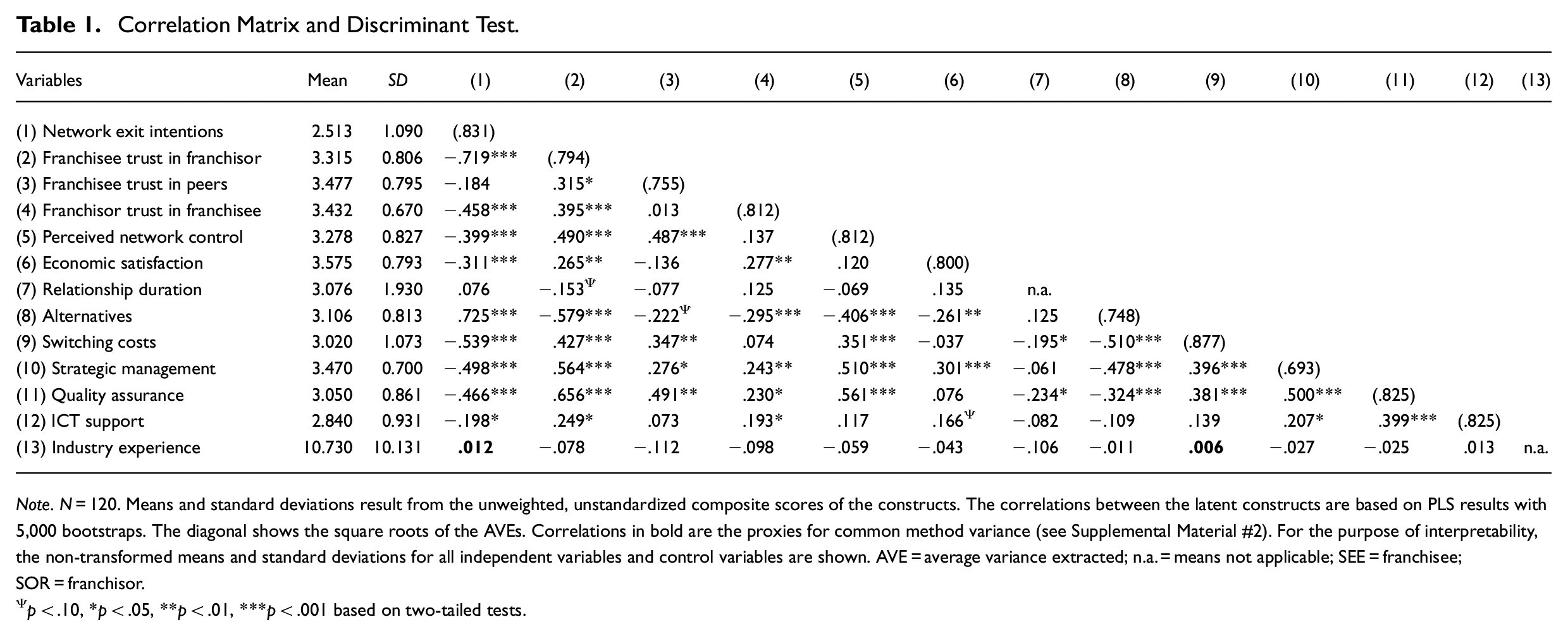
Note. N = 120. Means and standard deviations result from the unweighted, unstandardized composite scores of the constructs. The correlations between the latent constructs are based on PLS results with 5,000 bootstraps. The diagonal shows the square roots of the AVEs. Correlations in bold are the proxies for common method variance (see Supplemental Material #2). For the purpose of interpretability, the non-transformed means and standard deviations for all independent variables and control variables are shown. AVE = average variance extracted; n.a. = means not applicable; SEE = franchisee; SOR = franchisor.
Ψp < .10, *p < .05, **p < .01, ***p < .001 based on two-tailed tests.
To assess possible non-response bias, we compare early and late respondents and find no significant differences regarding distance to the franchisor headquarters in both kilometers (Mearly = 91.6; Mlate = 90.7, t = 0.119, p = .475) and travel time in minutes (Mearly = 66.4; Mlate = 66.4, t = 0.005, p = .694), or in network exit intentions (Mearly = 2.5; Mlate = 2.6, t = −0.506, p = .971), which indicates that non-response bias is unlikely to be a problem. The late respondents tend to be slightly younger (Mearly = 46.6; Mlate = 43.8, t = 1.853, p = .026). Comparing the non-response with the response sample, we find no differences in terms of distance in kilometers (Mresp = 91.2; Mnonresp = 89.8, t = 0.227, p = .463), travel time (Mresp = 66.4; Mnonresp = 64.3, t = 0.555, p = .496), and age (Mresp = 45.2; Mnonresp = 43.8, t = 1.205, p = .535).
To reduce the danger of common method bias in the survey data among bivariate relationships, we followed Podsakoff et al.’s (2003) recommendations regarding survey design; we used reversed-coded items and prevented funneling in the survey. We also used multiple informants (franchisor and franchisees) to mitigate single-informant bias (Podsakoff & Organ, 1986). To assess the extent of common method variance (CMV), we used three tests. First, we assessed CMV using a full collinearity test (Kock, 2015). The full collinearity inflation factors, calculated using SmartPLS, were all below the 3.3 threshold. Second, we conducted a marker-variable test (Lindell & Withney, 2001), using the smallest (r = .006) and second smallest (r = .012) positive correlations as proxies for CMV. Results (see Supplemental Material #2) show that all partial correlations remained statistically significant, suggesting that CMV does not drive our results. Third, we assessed how much variance in the items was accounted for by a single latent CMV factor versus the respective constructs (Liang et al., 2007). The common factor accounted for less than 2% of the variance on average, whereas the constructs explained about 65%. Only 5 of the 43 paths from the CMV factor were significant. These tests collectively indicate that CMV is not a major concern.
Analysis Method
We test our hypotheses using PR and RSA, which models the effects of trust (in)congruence on relational outcomes (Edwards, 2002). Our goal was to assess if exit intentions are lower when franchisee and franchisor trust levels are congruent, as opposed to when they are incongruent (H1), following the criteria set by Humberg et al. (2019) for testing the acceptance (or rejection) of “the congruence effect.” To ascertain the effect of franchisee–franchisor trust congruence on exit intentions (H2), we rely on the coefficients of Model 2 in Table 2. Using the PR equations, we graphically plot these relationships and employ the RSA to test various features of the effect of trust congruence on franchisee exit intentions (Edwards, 2002; Edwards & Parry, 1993). To explore how trust congruence affects exit intentions under varying levels of perceived network control (H4), we categorized our data into low and high control groups using a median split (N = 51 and N = 48, respectively). 1 Following prior research (L. Wang et al., 2023), we then ran Model 2 for both groups. Additionally, we examined the relationship between franchisee peer trust and exit intentions (H3) (Model 3, Table 2), and included an interaction term to assess the moderation effect of perceived network control (H5) (Model 3, Table 2).
Polynomial Regression Results.
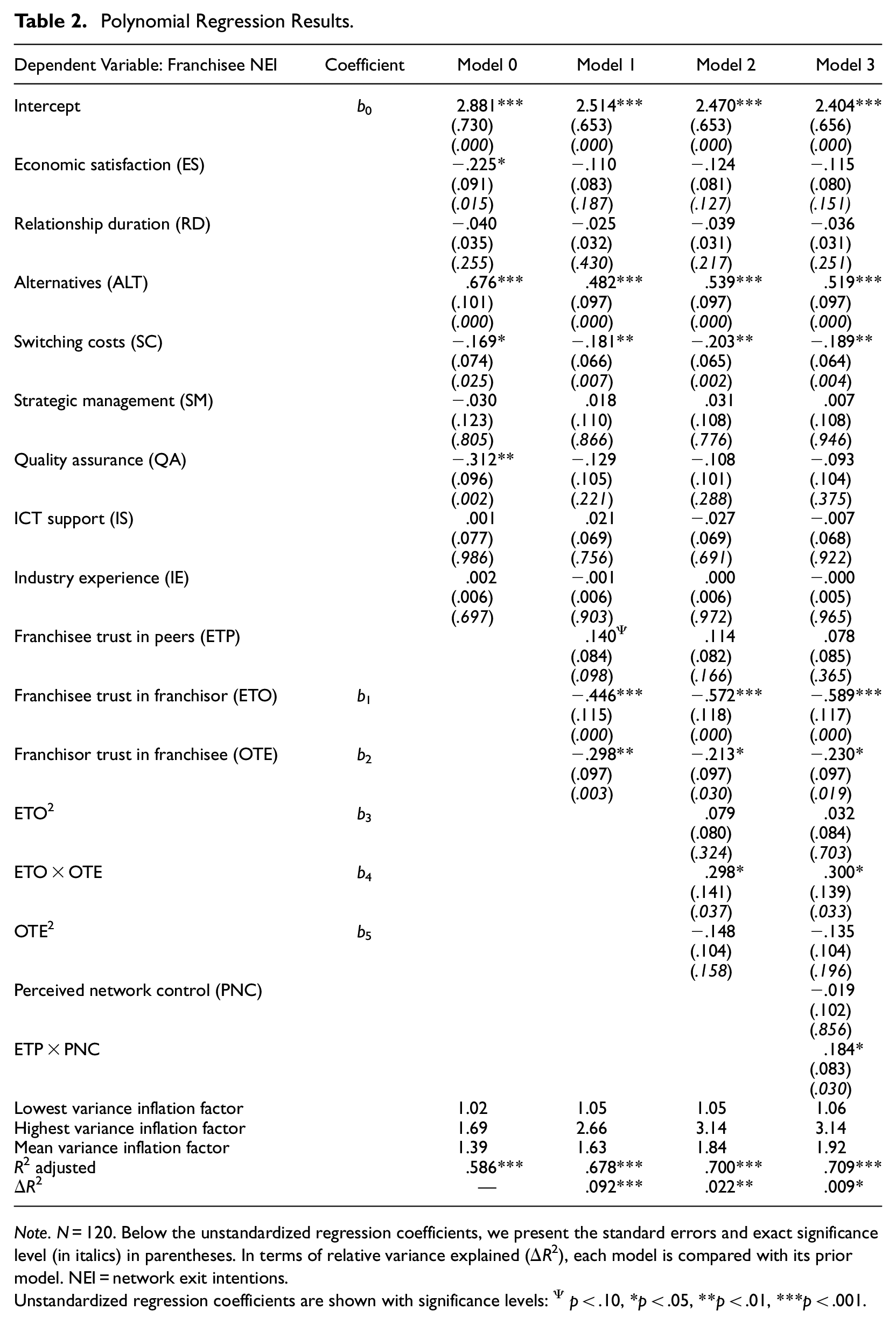
Note. N = 120. Below the unstandardized regression coefficients, we present the standard errors and exact significance level (in italics) in parentheses. In terms of relative variance explained (ΔR2), each model is compared with its prior model. NEI = network exit intentions.
Unstandardized regression coefficients are shown with significance levels: Ψp < .10, *p < .05, **p < .01, ***p < .001.
Given the sensitivity of PR to multicollinearity and outliers, particularly with the inclusion of interaction and quadratic terms (Edwards, 2002), we scale-centered the variables before computing these terms. This step reduces the potential for multicollinearity and aids in interpreting response surface plots (Aiken et al., 1991). We also checked for influential outliers using Cook’s D and standardized residuals generated by the PR formulas (Bollen & Jackman, 1990). Although five potential outliers were identified, their exclusion did not significantly influence the results, leading us to include the complete dataset in our reported analysis.
Following Edwards and Parry (1993), we advanced from simple to complex regression models, favoring those that explained more variance significantly. We employed conventional PR equations (while including control variables) to represent our theoretical model (Edwards & Parry, 1993):


where Z = network exit intentions, X = franchisee trust in franchisor, and Y = franchisor trust in franchisee, and e = error.
The polynomial terms in equation (2) help calculate all elements of the response surface plot (slopes and curvatures of the lines of congruence and incongruence, as well as principal axes), which are needed to test the hypothesized congruence effect. Humberg et al. (2019) noted that these elements should not be interpreted separately, but alongside other elements of the RSA.
The beta coefficients resulting from equation (2) form the basis for the response surface plot, from which several key parameters can be derived. To identify the effect of franchisee–franchisee trust congruence, we are interested in parameters related to the LOC, along which the values of X and Y are equal (X = Y). To investigate the effect of trust incongruence, we look at increments on the line of incongruence (LOIC), where the values for X and Y differ (X = −Y). The key parameters regarding these lines are: the slope of the surface along the LOC (a1, resulting from b1 + b2); the curvature of the surface along the LOC (a2, resulting from b3 + b4 + b5); the slope of the surface along the LOIC (a3, resulting from b1 − b2), and the curvature of the surface along the LOIC (a4, resulting from b3 − b4 + b5).
Table 2 shows the results of the regression analyses predicting exit intentions. In Model 0, we insert our control variables. In Model 1, we test equation (1). As the results for Model 1 show, the linear terms for the three trust variables and the control variables explain 67.8% of the variance in exit intentions. Model 2 introduces the interaction and quadratic terms, as shown in equation (2), and explains statistically greater variance in exit intentions than Model 1 (Adj. R2 = .700, ΔR2 = .022, p = .009). Following Edwards (2002), we discard the linear model in favor of the quadratic model. Model 2 forms the basis of our analyses of Hypotheses 1, 2, and 4. Table 3 presents the coefficients for the response surface features for this model. Figure 2a shows the accompanying response surface plot for the entire sample. Figure 2b and 2c depict the cross-sections of Figure 2a, highlighting the LOIC and the LOC. Table 3 also presents the coefficients for the response surface features of Model 2 under low and high franchisee perceived network control, forming the basis for the response surface plots in Figure 3a and 3b. For Hypotheses 3 and 5, Model 3 in Table 2 incorporates the perceived network control variable and its interaction with peer trust. This model explains more variance in exit intentions (Adj. R2 = .709, ΔR2 = .009, p = .046), underscoring the importance of this interaction term.
Response Surface Features.
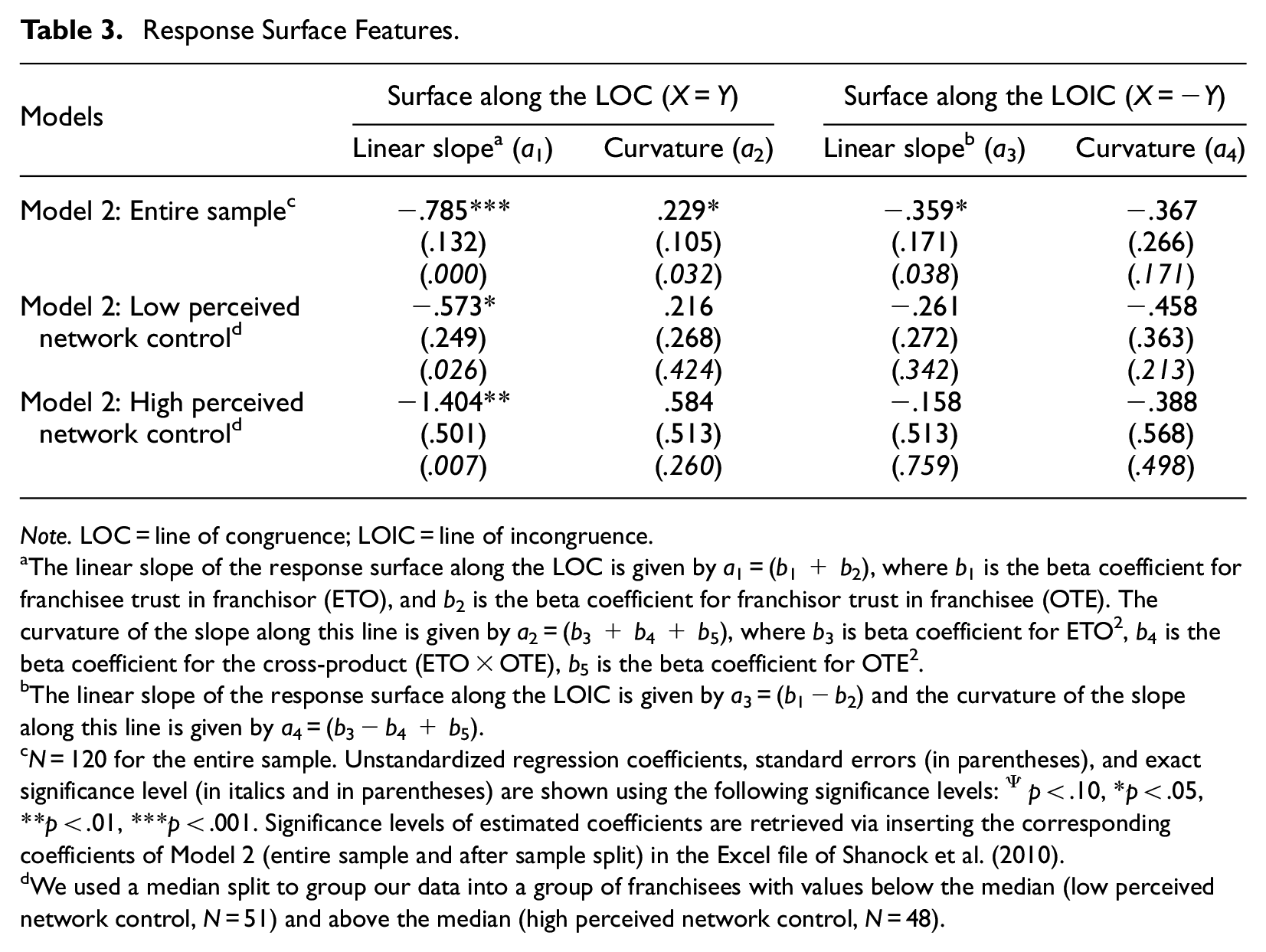
Note. LOC = line of congruence; LOIC = line of incongruence.
The linear slope of the response surface along the LOC is given by a1 = (b1 + b2), where b1 is the beta coefficient for franchisee trust in franchisor (ETO), and b2 is the beta coefficient for franchisor trust in franchisee (OTE). The curvature of the slope along this line is given by a2 = (b3 + b4 + b5), where b3 is beta coefficient for ETO2, b4 is the beta coefficient for the cross-product (ETO × OTE), b5 is the beta coefficient for OTE2.
The linear slope of the response surface along the LOIC is given by a3 = (b1 − b2) and the curvature of the slope along this line is given by a4 = (b3 − b4 + b5).
N = 120 for the entire sample. Unstandardized regression coefficients, standard errors (in parentheses), and exact significance level (in italics and in parentheses) are shown using the following significance levels: Ψp < .10, *p < .05, **p < .01, ***p < .001. Significance levels of estimated coefficients are retrieved via inserting the corresponding coefficients of Model 2 (entire sample and after sample split) in the Excel file of Shanock et al. (2010).
We used a median split to group our data into a group of franchisees with values below the median (low perceived network control, N = 51) and above the median (high perceived network control, N = 48).
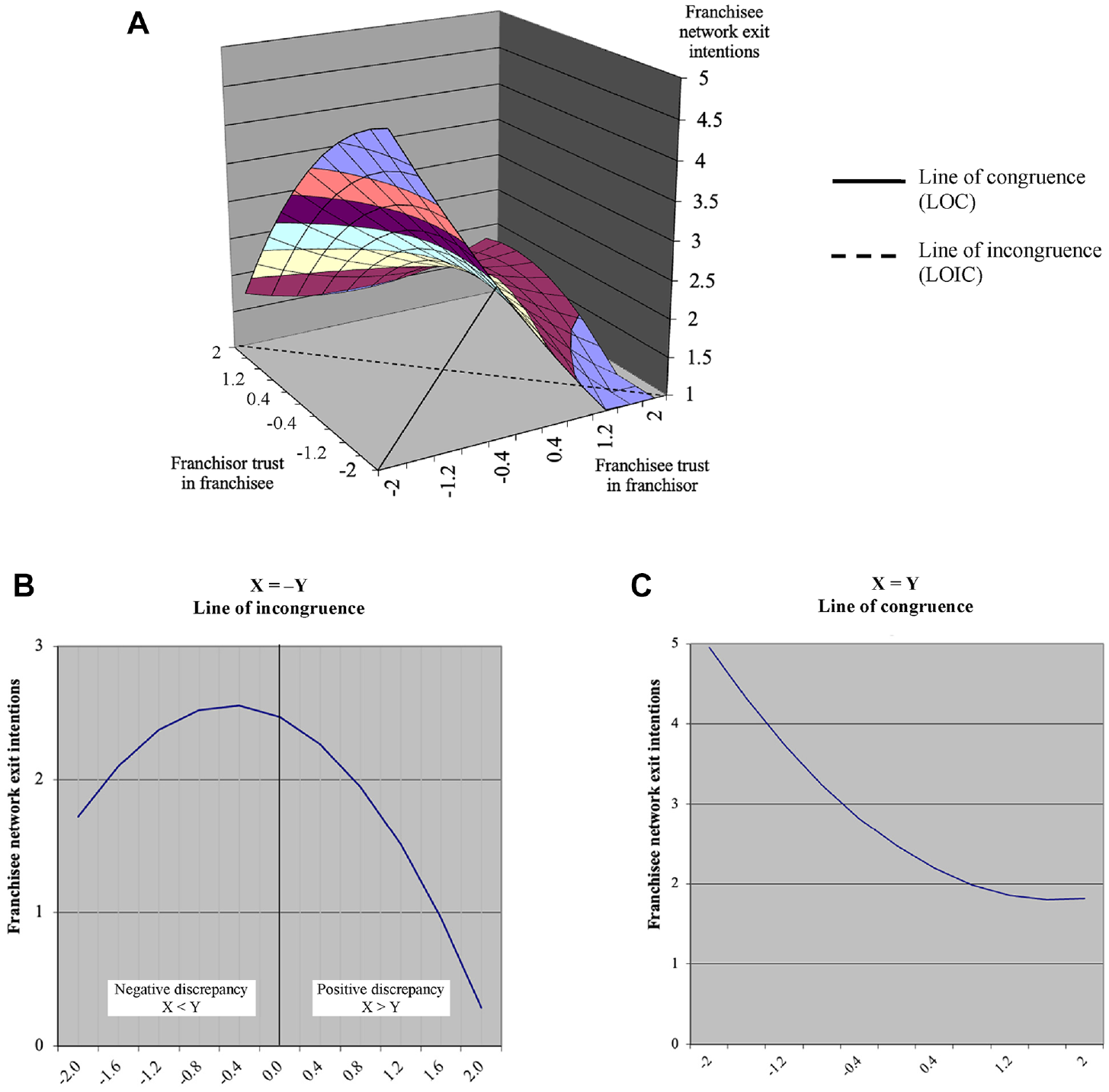
(a) Response surface plot (entire sample); (b) Curvature for the LOIC; (c) Curvature for the LOC.
Results
The “Trust Congruence Effect”
Regarding the “trust congruence effect” (H1), we follow the steps of Humberg et al. (2019) who delineate the conditions for testing the congruence effect. The first condition generally requires that the LOIC follows an inverted U, but because our DV represents a negative outcome, we should refer to the inverse: a U-curvature (Edwards & Parry, 1993). Our results should therefore demonstrate a positive and significant curvature on the LOIC, such that exit intentions increase when values for franchisor trust in the franchisee and franchisee trust in the franchisor deviate from each other in either direction (Baer et al., 2021; Humberg et al., 2019). In contrast with this condition, the curvature along the LOIC (X = −Y) was insignificant (a4 [b3 − b4 + b5] = −.367, p = .171, Table 3), suggesting that there is no U-shaped relationship wherein the values of exit intentions are higher when values deviate from congruence levels of trust.
In testing for the congruence effect, we consider the second principal axis instead of the first principal axis, because we test for the “reverse” congruence hypothesis that hypothesizes that network exit intentions are lower in the case of trust congruence compared to trust incongruence (Humberg et al., 2019). Upon further inspection of this second principal axis, we generated 10,000 bootstrapped samples to estimate 95% confidence intervals (CIs) for the intercept (p20) and slope (p21), following the methods of Edwards (2002) and Edwards & Parry (1993). For the congruence effect to exist, the CI for the intercept of the second principal axis should include zero, and the CI for the slope should include one. Our findings, however, reveal that the 95% CI for the intercept (p20) excludes zero (2.118, 12.616) and that the slope (p21) excludes one (−5.014, −1.011), disproving the congruence effect (Humberg et al., 2019). Hence, we reject Hypothesis 1 and conclude that there is no evidence for the “trust congruence effect.”
The absence of the “trust congruence effect” indicates that trust incongruence may not necessarily produce higher exit intentions. Surprisingly, we observed that the slope of the LOIC displays a significant negative linear association with exit intentions (a3 = −.359, p = .038, Table 3), suggesting that, on average, higher levels of trust incongruence between the franchisor and the franchisee are associated with lower exit intentions. This somewhat counterintuitive result can be explained by the shape of the surface plot. Incongruence can refer to either negative or positive discrepancy (Edwards, 2008). In our findings, negative discrepancy means that franchisee trust in franchisor (X) falls short of franchisor trust in franchisee (Y), such that X < Y, whereas positive discrepancy means that X exceeds Y. An investigation of the LOIC (Figure 2b) reveals that incongruence does not enhance but reduces exit intentions—especially in case of positive discrepancy. Hence, when franchisee trust in the franchisor significantly exceeds the franchisor’s trust in franchisee, exit intentions tend to diminish. This finding challenges the traditional view of trust incongruence, and highlights the need to consider the direction of incongruence in future studies.
Effects of Trust Congruence for Low and High Franchisee Perceived Network Control
Next, we test Hypotheses 2 and 4, which investigate the effects of trust congruence on exit intentions (H2) and the moderating effect of perceived control on this relationship (H4). In line with Hypothesis 2, we find that trust congruence increments strongly reduce exit intentions (a1 = −.785, p = .000, Table 3), such that exit intentions decrease when franchisor and franchisee trust are congruent at higher trust levels than at lower trust levels. While the significance of a2 in Table 3 indicates that this negative association on the LOC is indeed nonlinear, the positive and significant curvature of (a2 = .229, p = .032) and Figure 2c suggest that the reduction of exit intentions plateaus for higher values of trust on the LOC. Thus, Hypothesis 2 is only partially supported.
Hypothesis 4 predicts that perceived network control strengthens the relationship between trust congruence and exit intentions. Analyzing split samples, we find a more pronounced negative linear slope on the LOC for the high control (a1high = −1.404, p = .007, Table 3) than for the low control sample (a1low = −.573, p = .026). Furthermore, the response surface plots for low (Figure 3a) and high (Figure 3b) values of perceived control show that the slope is steeper, and more negative, along the LOC, supporting Hypothesis 4. Additionally, the insignificance of the curvature values for both groups (a2low = .216, p = .424; a2high = .584, p = .260) in Table 3 suggests that these effects are linear.
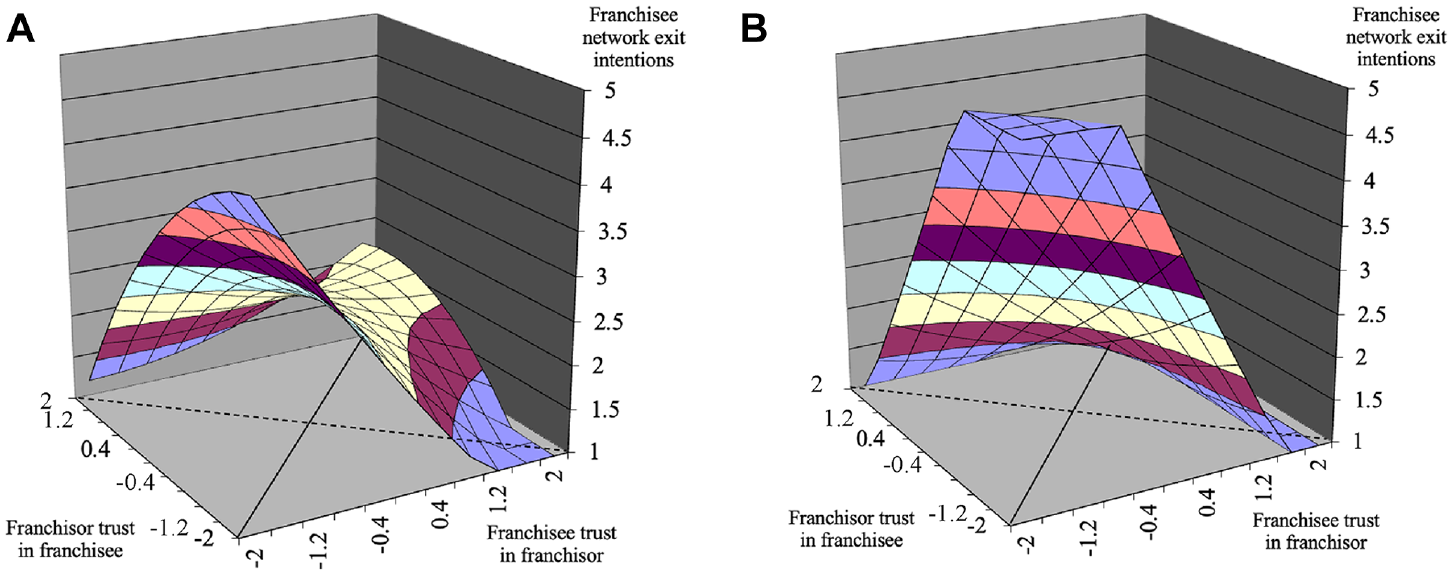
(a) Low perceived network control; (b) High perceived network control.
Effects of Trust in Peers for Low and High Franchisee Perceived Network Control
Hypotheses 3 and 5 examine the effect of franchisee peer trust (H3) and its interaction with perceived network control (H5). Model 3 in Table 2 reveals no support for Hypothesis 3, which anticipated a simple linear negative effect of peer trust on exit intentions (B = .078, p = .365). However, for Hypothesis 5, the results confirm for the predicted interaction effect between peer trust and perceived control (B = .184, p = .030). Simple slope analyses demonstrate that peer trust positively affects under high control (B = .262 p = .018), but this effect is not significant under low control (B = −.106, p = .404), as depicted in Figure 4. Hence, peer trust only significantly influences exit intentions when perceived control is high.
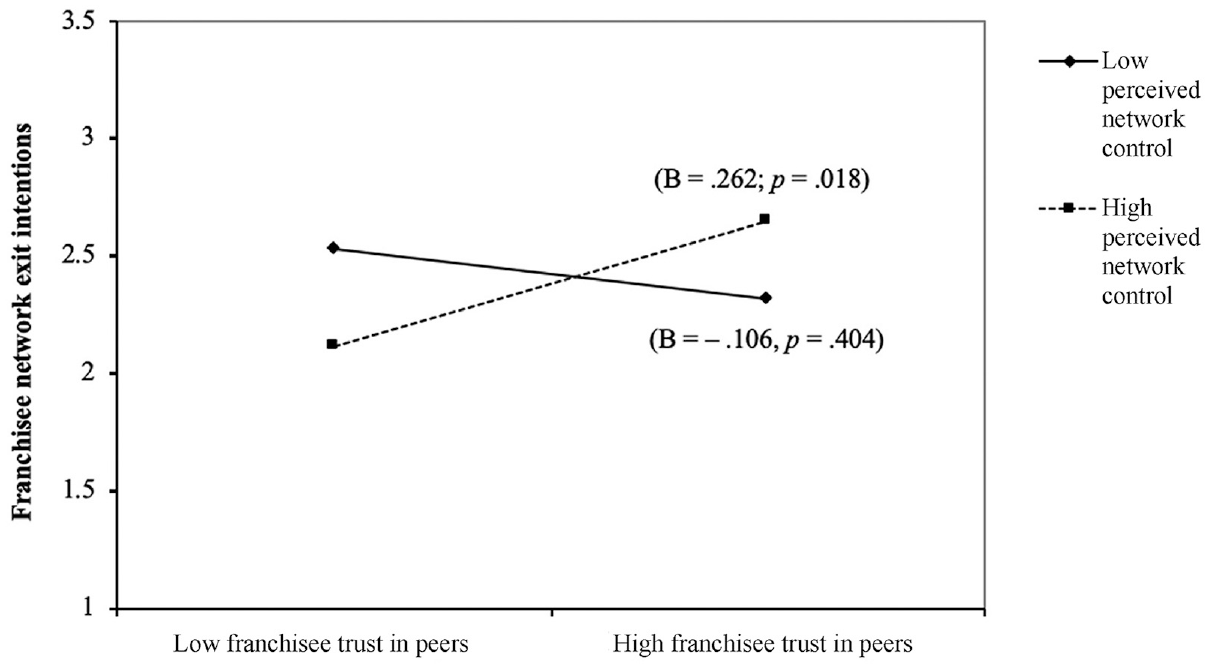
Interaction plot for franchisee trust in peers with perceived network control.
Robustness Checks and Post hoc Analyses
Independence of Observations
Despite assumptions of independence in our regression analyses, franchisees may interact and personally influence each other in their assigned geographical regions, which could potentially violate this assumption (W. L. Cook, 2012). We used multilevel regression analysis with Dutch provinces as groups (12 in total), finding an intra-class correlation (ICC) of .051, barely meeting the threshold of .05, suggesting minimal homogeneity within provinces. The low ICC supports the adequacy of our data’s independence, such that the grouping by provinces may not highly influence the pattern of responses in our sample. As an additional check, we inserted the provinces as dummy variables into our PR results. The results remain the same.
Alternative Measure for Trust Congruence
Our selection of distinct trust items to measure franchisee–franchisor trust congruence may hinder the interpretability of our results. To address this limitation, we composed an alternative measure for trust congruence based on underlying trust scales that display greater wording similarity (without specifying roles or duties). Our survey contained three unused 5-point Likert scale items that reflect franchisee trust in the franchisor and that mirror the three items of franchisor trust in franchisee (see Supplemental Material #3). Comparisons across models using this alternative measure yielded results consistent with our primary analysis, particularly under conditions of high perceived control, indicating robustness in our findings.
Alternative Analytical Approach
As an alternative approach, we tested the moderation effect in H4 using a moderated PR model. A moderated PR examines how the relationship between X and Y influences Z, using the full value range of the moderator W (cf. Maruping et al., 2019). Although this analytical approach is generally more informative (Edwards, 2002), the introduction of these terms (see Supplemental Material #4) also often leads to multicollinearity concerns that may complicate interpretation. Despite concerns about multicollinearity (VIF values among interaction terms close to 10, see Table A in Supplemental Material #4), the results of 10,000 bootstraps and analysis of the bias-adjusted CIs for low and high values of perceived network control (Table B, Supplemental Material #4) confirm that the effect of a1 is more negative in a high control setting (B = −3.262, p < .05) compared to a low control setting (B = −2.517, p < .05), corroborating H4.
Endogeneity
To address potential endogeneity from our cross-sectional data, we follow Bharadwaj et al. (2007) and employed a two-stage Heckman model (see Supplemental Material #5). First, we summed up the three independent variables and dichotomized the sum to create a new dummy variable, indicating whether trust is high (higher than mean, value = 1) or low (lower than mean, value = 0) based on franchisee trust in the franchisor, franchisee trust in peers, and franchisor trust in franchisee. We selected propensity to trust, an eight-item construct, as an individual-level trait, to serve as a filter that influences one’s trust in another party (Colquitt et al., 2007). The first stage involved a probit model regressing the new dummy variable based on trust propensity as the exclusive condition. The probit model demonstrates a good fit. We then calculated the Inverse Mills Ratio (IMR), which represents the propensity of our independent variables being endogenously determined (the residuals of the selection equation). In the second stage, we re-estimated our model with IMR as an additional control. The IMR’s insignificance and consistency with our main findings suggest minimal endogeneity concerns.
Post hoc Analysis
To check the relevance of network exit intentions, we verify the strength of the intention-behavior link (Lee et al., 2017), whether exit intentions (partially or fully) mediate the effects of the predictors, and the significance of the indirect effects (see Supplemental Material #6). We complemented our data with actual franchisee network exit data from 2015—3 years after the initial data collection. This timeframe ensured that each franchisee could leave the network voluntarily without being restricted by any contractual regulations. Out of 120 respondents, 45 (37.5%) had left the @Home network of which 12 involuntarily (i.e., bankruptcy, illness, retirement, or franchisor’s decision). After excluding these involuntarily exits, we analyzed the remaining 108 respondents using logistic regression to assess the impact of control variables, independent variables, and exit intention on exit as the binary dependent variable. Exit intention was found to be a significant mediator and the strongest predictor of network exit behavior (B = 13.664, p = .000), fully mediating the effects of relationship duration, alternatives, and franchisee trust in franchisor on network exits (see Table A in Supplemental Material #6). Additionally, variance-based SEM with 5,000 bootstraps, confirmed significant indirect effects of switching costs, alternatives and franchisee trust in franchisor on network exit (all p’s < .01) (see Table B in Supplemental Material #6).
Discussion
We address three shortcomings in franchising research by adopting a dyadic, multi-referent trust perspective to explain franchisee network exit intentions under varying levels of perceived network control. Our perspective offers a more nuanced view of the complex interplay between trust and perceived control in franchise networks.
Theoretical Contributions and Implications
Trust (In)congruence in Franchisee–Franchisor Dyads
First, we challenge the conventional wisdom that “congruence is good” and “incongruence is bad,” offering a nuanced view of the effects of trust congruence and incongruence. Unlike previous studies that find a “trust congruence effect” (L. Wang et al., 2023; Yang et al., 2021), our results reveal that exit intentions are not necessarily lower when trust is congruent than when trust is incongruent. Our data show that trust incongruence, rather than being detrimental, can sometimes lower exit intentions. Yet, its effect strongly depends on the direction of the discrepancy. Exit intentions are particularly low in the case of strong positive discrepancy; that is, when the franchisee’s trust in franchisor strongly exceeds that of the franchisor. The novelty of this finding provides an interesting avenue for research into the reasons, mechanisms, and conditions under which trust incongruence could positively affect relational outcomes in franchise and other exchange relationships.
Second, our analysis indicates that trust increments on the LOC, where values vary from low-low to high–high trust, correspond to lower exit intentions but with diminishing returns. Rather than deepening a mutually beneficial relationship at higher trust levels (Hardy et al., 1998; Korsgaard et al., 2015), we find that such high-trusting relationships may suffer from the phenomenon of “marginal value of trust” (Anand et al., 2010; Villena et al., 2019). Drawing parallels with Anand et al. (2010), we infer that additional increases in trust are perceived as redundant in an already valued relationship. A franchisee may similarly interpret further increases of franchisor trust as yet another positive signal: once a foundational level of trust is established, additional trust congruence increments yield smaller gains in terms of operational efficiency, cooperation, and conflict resolution. We thus find that the marginal value of trust also occurs when studying trust congruence as a theoretical concept.
Trust–Control Interplay: Synergistic and Antagonistic Trust Effects Across Referents
Our study advances existing research by demonstrating that a franchisee’s perception of franchisor control, which can be either synergistic or antagonistic, depends on whether their trust is placed in the franchisor or in peers. This interplay between trust and franchisee perceived control refines our understanding of how trust referents shape control interpretations, and extends current research that merely acknowledges the positive and negative interpretations of franchisee control (Cochet et al., 2008; Dada, 2018).
Trust congruence increments on the LOC reduce exit intentions in situations of high franchisee perceived control, indicating a synergistic effect. In such settings, strong monitoring increases predictability and franchisees’ confidence in the franchisor’s ability to manage generalized exchange risks, enabling them to more fully benefit from the shared understanding, problem solving, and goal alignment that trust congruence provides. Franchisees interpret the frequent visits and audits not merely as compliance checks, but as opportunities for engagement and collaboration which strengthens the franchise relationship. Conversely, higher peer trust promotes exit intentions in settings of high perceived network control, showing an antagonistic effect. Franchisees with higher peer trust view the franchisor’s control measures as redundant, inappropriate, costly, and even excessive (Heide et al., 2007, 2014), potentially seeing these as an overreach of power. Moreover, peer trust facilitates knowledge sharing, peer cooperation, and learning among franchisees (El Akremi et al., 2011; Hadjielias et al., 2021), boosting their confidence to replicate franchisor’s resources and pursue outside options. Increased peer trust nurtures closer, horizontal relationships among franchisees, providing a collective force against the powerful franchisor. The forging of horizontal relationships and resultant coalition formation may create a wedge between the vertical relationships of the franchisor with its franchisees. This may incentivize franchisees to withdraw and seek business outside the network, either individually or with the help of trusted peers.
This dynamic leads to what we could call “network spawning” (see Campbell et al., 2012 on “entrepreneurial spawning”), a process where franchisees (jointly) leave their networks after sharing and accumulating enough knowledge and resources to operate independently, thus retaining more value for themselves. We found clear evidence of this phenomenon: out of 33 @Home franchisees who left voluntarily, 30 (91%) remained in the same industry or cooperated on new initiatives with former peers. Network spawning, where ex-franchisees form competing franchise networks as seen in Runnersworld and DA drugstores in The Netherlands, likely occurs in other entrepreneurial networks (Neergaard & Ulhøi, 2006) and merits further scholarly investigation. The antagonistic effects can be further studied by power-dependence theory, which suggests that actors who face a very powerful exchange partner may engage in “balancing operations,” such as withdrawal or coalition formation, to restore the power balance in their favor (Emerson, 1962).
Beyond Trust in the Franchisor: The Role of Peer Trust in Exit Intentions
Our multi-referent trust perspective demonstrates the importance of including franchisee trust in peers. Even though prior franchising research has highlighted effects of peer interactions in franchising (El Akremi et al., 2011; Hadjielias et al., 2021), our study extends the discourse by demonstrating how and when peer trust impacts exit intentions, extending beyond the effect of trust in the franchisor. Our study may explain the limited attention in previous franchising research, as we find that peer trust’s impact on relational outcomes only becomes visible under conditions of high perceived network control. To better understand network phenomena such as balancing operations and network spawning, future franchising research should try to open the “black box” of franchisee peer trust. By integrating insights from networking behavior literature, research can elucidate the trust and social interactions among franchisees, exploring their collaborative tendencies, underlying motives, and relational outcomes (Darr & Kurtzberg, 2000). This research may require theoretical lenses relatively new to franchising research, such as horizontal agency, social networking, resource dependence, and coalition formation.
Practical Implications: Forging Bonds and Divide and Conquer
Our findings lead to two key practical implications at the dyadic and the network level. First, for the franchisee–franchisor dyad, our study highlights that franchisors can strongly reduce franchisees’ exit intentions by “forging bonds.” It is particularly effective for a franchisor to prioritize increasing franchisees’ trust by demonstrating both ability—by fulfilment of its strategic and operational duties to develop a robust business format—and goodwill—for example through openness in communication (Altinay et al., 2014; Croonen & Broekhuizen, 2019). Yet, since we found that trust-congruence increments display marginal returns, franchisees should be wary to not overinvest in improving franchisees’ trust for franchisees who already strongly trust them.
Second, from a network perspective, given the antagonistic effects we found between franchisee peer trust and perceived network control, franchisors should adjust their network control (i.e., monitoring) behaviors according to the level of franchisee peer trust. One simple way to reduce exit intentions is to adjust the level of monitoring; increases (decreases) in peer trust should be matched with lower (higher) monitoring activity to limit exit intentions, as long as the reduced monitoring does not lead to adverse effects regarding the network’s output quality and brand reputation. Another way to reduce exit intentions is to lower peer trust levels within the network. To counter the potential adverse effects of high levels of peer trust, franchisors may consider adopting a “divide and conquer” strategy to limit peer trust among their franchisees. However, the pursuit of divide and conquer can be questioned from an ethical point of view, as it refers to leaders deliberately generating or exploiting social divisions among members (Case & Maner, 2014). Such a strategy should therefore be carefully deployed and balanced against other franchise network benefits, since its pursuit may lower franchisee trust in the franchisor and reduce the positive effects of peer trust, such as peer learning and peer cooperation. Franchisors should thus carefully balance peer trust and network control by, for example, deploying “tournament strategies” (Gillis et al., 2011), which can boost franchisees’ innovativeness and output quality, while increasing peer competition.
Building on these dyadic and network perspectives, we argue that franchisors should engage in both strategies to prevent franchisee network exits, that is: “forging bonds” with individual franchisees in the direct exchange and“divide and conquer” to manage the generalized exchanges among peers.
Limitations and Further Research
Several limitations and future research directions are noteworthy. First, focusing on a single franchise network enhances internal validity by controlling for industry and network differences (Davies et al., 2011). However, it limits generalizability to other networks with varying network characteristics, such as centralization levels (Mumdžiev & Windsperger, 2011), or types of unit ownership (Bradach, 1997). Further research should examine the degree to which our findings apply across various franchise networks. Second, our data from 2011/2012, may not account for the impact of recent AI advancements and increased market data availability, altering how franchisors control and assess trust for individual franchisees. Future research could explore how this more customizable, technology- and data-driven franchisor control may affect exit intentions. Third, although our study considers time in linking intentions to exit behavior, our cross-sectional survey data did not allow to track trust dynamics in real time. More detailed longitudinal data would enhance our understanding of how franchisee trust and control ultimately influence exit intentions, behaviors, and network instability. Fourth, in measuring trust congruence, we favored the inclusion of role- and duty-specific trust items to capture the crucial aspects of the distinct roles and duties of the franchisees and the franchisor. Future research should further assess the use of more generic scales that display greater item similarity. Finally, our congruence approach helps to assess the effects of (in)congruence, but does not verify partners’ awareness of each other’s trust. Our approach reduces social desirability bias but overlooks the dynamics and relational depth of other types of trust, such as mutual and reciprocal trust (Korsgaard et al., 2015). Future research could investigate how mutual trust, in which the franchisor and franchisee at least trust each other, influences exit intentions and exits, and explore the role of reciprocal trust via analyzing specific franchisor interventions and franchisee responses.
In conclusion, we shed light on the complex trust–control interplay that determines why and under what control conditions franchisees intend to leave their networks. We encourage researchers to explore entrepreneurs’ exit intentions (and exits) in various strategic network organizations like cooperatives or R&D consortia (e.g., Neergaard & Ulhøi, 2006). Understanding how different network configurations and control conditions shape entrepreneurs’ exits could enhance our knowledge of effective network leadership strategies.
Supplemental Material
sj-pdf-1-etp-10.1177_10422587241254724 – Supplemental material for Trust and Control in Franchise Networks: A Dyadic, Multi-Referent Analysis on Franchisee Network Exit Intentions
Supplemental material, sj-pdf-1-etp-10.1177_10422587241254724 for Trust and Control in Franchise Networks: A Dyadic, Multi-Referent Analysis on Franchisee Network Exit Intentions by Evelien P. M. Croonen, Thijs L. J. Broekhuizen and Maryse J. Brand in Entrepreneurship Theory and Practice
Footnotes
Appendix
Construct Validity and Reliability.
| Construct | Item | SL | AVE | CR/CA |
|---|---|---|---|---|
| Franchisee network exit intention | (1) I am thinking about leaving @HOME. | .89 | .69 | .94/.92 |
| (2) I am planning to do something other than being a franchisee of @HOME. | .85 | |||
| (3) I do not want to be part of @HOME much longer. | .84 | |||
| (4) I intend to end my franchise contract. | .88 | |||
| (5) I plan to extend my franchise contract at the end of the contract term (r). | .87 | |||
| 96) I would recommend @HOME to new franchisees (r). | .65 | |||
| (7) Very little would have to change in my present circumstances to cause me to leave @HOME. | .77 | |||
| Franchisee trust in franchisor | (1) I trust the good intentions of the @HOME management. | .85 | .63 | .91/.88 |
| (2) I trust the abilities of the @HOME management. | .84 | |||
| (3) I trust the good intentions of the @HOME employees. | .82 | |||
| (4) I trust the abilities of the @HOME employees. | .72 | |||
| (5) I can rely on the management to operate the @HOME network smoothly. | .81 | |||
| 96) I trust that the business format will not negatively impact my business. | .68 | |||
| Franchisor trust in franchisee | (1) Franchisee X has done more for @HOME than could be expected. | .65 | .66 | .85/.72 |
| (2) Franchisee X has not intentionally harmed @HOME. | .88 | |||
| (3) Franchisee X has complied with the rules of @HOME. | .87 | |||
| Franchisee trust in peers | (1) I trust my fellow franchisees to help me when needed. | .59 | .57 | .80/.82 |
| (2) I trust that most of my fellow franchisees do what they promise. | .75 | |||
| (3) I trust the expertise of my fellow franchisees. | .83 | |||
| (4) I trust my fellow franchisees to not harm the franchise. | .68 | |||
| Perceived network control | (1) @HOME management closely monitors whether franchisees perform according to system rules. | .84 | .66 | .85/.75 |
| (2) When franchisees do not follow the format’s rules, the @HOME management takes effective corrective action. | .79 | |||
| (3) @HOME management closely monitors the performance of each franchisee. | .80 | |||
| Economic satisfaction | (1) Overall, I would rate my business as successful. | .79 | .64 | .87/.82 |
| (2) I am satisfied with the development of my revenues and profits. | .86 | |||
| (3) In the latest period, I have achieved my financial goals. | .84 | |||
| (4) Compared to the industry, I would rate my performance as above average. | .68 | |||
| Alternatives | (1) Many alternatives appeal to me more than being an @HOME franchisee. | .83 | .56 | .84/.74 |
| (2) Compared to being an @HOME franchisee, I could benefit a lot from an alternative position. | .71 | |||
| (3) Instead of being an @HOME franchisee there are other options available to make a living. | .77 | |||
| (4) There are other attractive ways to earn a living. | .68 | |||
| Switching costs | (1) I would have to spend a lot of time and money to leave the network. | .81 | .77 | .87/.73 |
| (2) All things considered; I would lose a lot when leaving the network. | .95 | |||
| Strategic management | (1) @HOME offers customers valuable services for an attractive price. | .70 | .48 | .78/.64 |
| (2) @HOME offers effective promotional activities. | .73 | |||
| (3) @HOME offers a clear positioning strategy toward customers. | .65 | |||
| (4) @HOME management adapts the business format to local circumstances and allows franchisees to do so when necessary. | .66 | |||
| Quality assurance | (1) New franchisees are selected in a good way. | .86 | .68 | .90/.84 |
| (2) @HOME management provides good training for extant franchisees. | .74 | |||
| (3) @HOME management understands our industry’s quality standards and tries to meet them. | .88 | |||
| (4) @HOME management understands the laws that apply to our industry and complies with them. | .81 | |||
| ICT support | (1) @HOME management offers high-quality ICT systems. | .85 | .68 | .90/.85 |
| (2) ICT-related problems are effectively resolved. | .95 | |||
| Relationship duration | Number of years in @HOME network. | n.a. | ||
| Industry experience | Number of years active in the specific industry. | n.a. |
Note. Items are measured on a scale: 1 = totally disagree, 5 = totally agree, unless indicated otherwise. All items were completed by the 120 franchisees, except for the three “franchisor trust in franchisee” items that were filled in by the franchisor’s management team for every single franchisee. Standardized loadings are displayed based on PLS results with 5,000 bootstraps. (r) = reversed-scaled item; SL = standardized loading; AVE = average variance extracted; CR = construct reliability; CA = Cronbach’s alpha; n.a. = not applicable.
Acknowledgements
We would like to thank Khoi Nguyen for the valuable discussions on the application of the congruence approach.
Declaration of Conflicting Interests
The authors declared no potential conflicts of interest with respect to the research, authorship, and/or publication of this article.
Funding
The authors received no financial support for the research, authorship, and/or publication of this article.

Supplemental Material
Supplemental material for this article is available online.
Notes
Author Biographies
References
Supplementary Material
Please find the following supplemental material available below.
For Open Access articles published under a Creative Commons License, all supplemental material carries the same license as the article it is associated with.
For non-Open Access articles published, all supplemental material carries a non-exclusive license, and permission requests for re-use of supplemental material or any part of supplemental material shall be sent directly to the copyright owner as specified in the copyright notice associated with the article.
