




Abstract
Supervisors may experience time differently from their subordinates, and little is known about the interplay between the time pressures experienced by supervisors and their teams. Focusing on team creativity as the outcome of interest, we explore how teams with varying time pressures function alongside the distinct time pressures experienced by their supervisors. In a polynomial regression and response surface analytical framework, team creativity was enhanced when there was a greater divergence between the time pressures of supervisors and team members. Conversely, creativity suffered when the time pressures of both parties were more aligned, whether at low or high levels.
Keywords
Time is of essential importance, a commodity that we often feel is inadequate in contemporary work environments (L. Pearce, 2011). Yet, objective time is filtered through individuals’ subjective experiences of time (Shipp & Jansen, 2021; Tang et al., 2020). Not only do individuals vary significantly in their subjective perceptions of time at work (Briker et al., 2020; Mohammed & Harrison, 2013), but their subjective time experience plays a central role in explaining key work-related outcomes (Ganushchak & Schiller, 2009; Roskes et al., 2013). This is partly because it stems from their understanding and tracking of progress toward their goals (Kronenwett & Rigotti, 2019; Teuchmann et al., 1999). Time pressure, in particular, is a unique aspect of temporal experience that highlights how the finite nature of time influences task management at work (Kühnel et al., 2012; Prem et al., 2017; Stiglbauer, 2017).
The construct of time pressure raises an important puzzle in teams seeking creativity, a work context that most organizations today utilize as their dominant way of harvesting innovation (Bell et al., 2018; Edmondson & Harvey, 2018). From a broader, subjective time perspective, research has shown that the manifestation of team effectiveness is contingent on the extent to which a leader synchronizes different time-related experiences of all team members so that the team operates on the same temporal interpretations (e.g., Z. Liu et al., 2021; Maruping et al., 2015; Mohammed & Nadkarni, 2011). The misalignment of time-related experiences among team members, the logic goes, functions as a process loss that distracts from successfully integrating actions (Kelly & McGrath, 1988; McGrath, 1991) and potentially hampering the team’s creativity. Such a perspective is in line with various conceptual work of teams, in which it was suggested that team emergent states may offer positive outcomes when in equilibrium (Cronin et al., 2011; Harvey, Leblanc, & Cronin, 2019).
However, we posit that team leaders (hereinafter referred to as supervisors) are not mere team members. Supervisors, whose total amount of time, like that of team members, is fixed and limited. Due to the realities of the organizational context in which they are enmeshed, supervisors may naturally operate on and experience different agendas and constraints than their subordinates (Dierdorff et al., 2009; Sherf, Venkataramani, & Gajendran, 2019). Therefore, one party’s experience of time (e.g., time pressure) may not always align with that of the other party. Against this backdrop, how teams with different degrees of time pressure operate in conjunction with distinct time pressure perceived by supervisors remains an open question.
We thus explore a research question related to an (in)congruence between supervisors’ and members’ time pressures, thereby expanding the understanding of how the interplay between the supervisors’ and their teams’ time pressures impact creativity. Our analysis is based on a multi-source, time-lagged sample of 377 salespeople in 51 teams. By conceptualizing supervisors’ time pressure as a distinct construct from the time pressure experienced by their subordinates, we advance the literature on time pressure by identifying different configurations of supervisor and team time pressure affecting team creativity. We discuss the theoretical and applied implications of our findings for improving the functioning of teams and leadership and suggest avenues for future research.
Time Pressure in Teams
In contrast to objective time, which references its measurable quantity (such as hours, minutes, and seconds) or a specific chronological point or period, a growing body of organizational literature has begun to focus on subjective time (Shipp & Cole, 2015; Shipp & Jansen, 2021). Subjective time is defined as “the experience of the past, present, and future, which occurs as individuals (intrasubjectively) and collectives (intersubjectively) mentally travel through, perceive, and interpret time” (Shipp & Jansen, 2021, p. 301). We narrow our focus to a specific component of subjective time along two dimensions. First, given our focus on teams, we specifically examine individuals’ shared collective experience (Waller et al., 2016). Second, we address the subjective interpretations of time, as these interpretations are more closely related to individuals’ time judgments vis-à-vis their task-related processes (Shipp & Jansen, 2021; Tang et al., 2020). They contrast with the other two more neutral, theorized components of subjective time, which are time travel—such as mental travel to the past or future—and time perception—one’s construal or orientation of time structure (Shipp & Jansen, 2021).
In particular, we focus on a time interpretation that is one of the most common features of organizational work and consequential to task processing—the experience of time pressure (Briker et al., 2020; Gevers et al., 2006; Kinicki & Vecchio, 1994). Although time pressure may stem from objective time insufficiency, it is ultimately subjective, originating from the perception—objectively true or not—that one lacks sufficient time to fulfill their responsibilities (DeVoe & Pfeffer, 2011; Restegary & Landy, 1993). Thus, time pressure is an evaluation of the task environment; it is different from an individual trait, such as urgency (i.e., a trait that involves the feeling of being chronically hurried; Mohammed & Nadkarni, 2011). Also, while time pressure is related to how one understands a scarcity of time available to complete a task, the construct is distinct from performance pressure, which highlights the individual’s accountability for, and possible implications of, outcomes (H. K. Gardner, 2012).
Time pressure influences how individuals prioritize tasks, manage resources, and collaborate with colleagues, resulting in varied workplace outcomes, albeit with mixed directionality. On the one hand, a heightened sense of time pressure facilitates a sense of urgency, thereby increasing the motivation to exert additional efforts for accomplishments (D. G. Gardner & Cummings, 1988; LePine et al., 2005). In other words, time pressure increases stimulation (D. G. Gardner & Cummings, 1988). Studies showed higher time pressure elicits higher levels of problem-solving, coordination, and performance (Chong et al., 2011; Pearsall et al., 2009). On the other hand, time pressure may also constrain cognitive capacity with intensified heuristic processing strategies over more deliberative cognitive processing (Byron et al., 2010; Moray et al., 1991; Waller et al., 1999). Also, operating under greater time pressures may reduce the perception of control and, in turn, individuals’ intrinsic motivation toward their tasks (Driskell et al., 1999; Karau & Kelly, 1992; McGrath, 1991).
Amidst the presence of conflicting findings on the various work ramifications of time pressure, the literature has addressed the construct largely with an individual focus (e.g., Baer & Oldham, 2006; Briker et al., 2021; Cromwell et al., 2018; Y. Zhang et al., 2023; Z. Zhang & Jia, 2023). Against this backdrop, we contribute to the limited body of studies that extend the conceptualization of time pressure to the team level (Chong et al., 2011; Maruping et al., 2015), reflecting the increasing prevalence of teams as the dominant form of organizing work (Harvey et al., 2022). Aggregated to the team level, team time pressure is a shared property that originates from the common experiences of team members as they experience the same task environment and frequently interact with each other (Klein & Kozlowski, 2000; Marks et al., 2001). In other words, given the task and outcome interdependence of teams, individual team members’ perceptions of time pressure tend to converge (Maruping et al., 2015; Mathieu et al., 2017). In this sense, team time pressure is defined as the extent to which team members, as a whole, feel they lack time to do all their tasks and meet their goals (Teuchmann et al., 1999; Zuzanek, 2004).
Team Creativity: The Interplay Between Supervisor and Team Time Pressure
Our focus on creativity as a final outcome underscores its importance for creating or updating organizational capabilities, a process often carried out in teams (Harvey et al., 2022). Team creativity is defined as “the production of novel and useful ideas concerning products, services, processes, and procedures by a team of employees working together” (Shin & Zhou, 2007, p. 1715). According to this definition, creativity involves viewing things from different perspectives, discovering fresh solutions to old problems, and combining previously unrelated processes, products, or materials into something new and useful (Mumford & Gustafson, 1988).
When it comes to team time pressure and creativity, as with any other work outcomes in a team context, supervisors play a crucial and integral role (Hughes et al., 2018). Supervisors and team members engage in mutual influence, shaping each other’s actions and effectiveness through continuous interaction (DeRue & Ashford, 2010; Gruda et al., 2017). Being visible figures within the team, supervisors are closely observed by team members, thus playing a crucial role in guiding and influencing how the team processes tasks (Lin et al., 2021). For instance, in the context of creativity, supervisors may either explicitly guide the realization of their creative vision or adopt a more implicit role by fostering a creativity-inducing climate and providing supportive contributions (Edmondson & Harvey, 2017; Mainemelis et al., 2015; Reiter-Palmon & Illies, 2004). Team members may also shape supervisors’ behaviors toward creativity not only through their reactions to the supervisor’s display of behaviors but also by proactively offering their inputs and perspectives (Kim et al., 2023; Morrison, 2011). Furthermore, of particular importance is that, like team members, supervisors’ total amount of time is also fixed and limited (Sherf, Venkataramani, & Gajendran, 2019; Vancouver et al., 2010). Supervisors also experience strain that results from insufficient time to complete their tasks, and time pressure affects how they prioritize tasks, allocate resources, and collaborate with subordinates (Z. Zhang & Jia, 2023). In this sense, considering the interaction between supervisor and team time pressure may reveal a more holistic picture of team creativity.
There have been previous attempts to highlight the role of leaders in shaping their team members’ subjective experience of time. Research relevant to our inquiry on team time pressure highlights that leaders generally intervene directly to improve the alignment, or entrainment, of subjective time experiences among team members (Mohammed & Nadkarni, 2014; Mohammed et al., 2017). The literature has assumed that different time experiences among team members may engender greater ambiguity and coordination problems, and lower task commitment, each of which can reduce team processes crucial for creativity (Gersick, 1989; Mohammed & Nadkarni, 2014). Here, studies have shed light on leaders’ top-down managerial style on team task pacing, sequencing, and scheduling (e.g., Z. Liu et al., 2021; Maruping et al., 2015; Mohammed & Nadkarni, 2011), through which team members’ interpretations of time can be effectively synchronized (Gevers et al., 2006; Schriber & Gutek, 1987). As leaders set a uniform temporal interpretation within the team, the logic goes, it enables the entrainment of team member inputs to one another, thereby engendering greater work effectiveness (Harrison et al., 2003; McGrath, 1991). In short, these studies share the premise that the alignment of team members’ time interpretations—and the active role of leaders in attaining such a state (e.g., temporal leadership)—is critical for the collective’s effectiveness outcome.
Yet, this stream of literature has not considered the fact that supervisors’ experience of time itself may not always be aligned with that of their teams. Supervisors may operate on agendas and objectives different from those of their subordinates, facing different situational constraints that may hinder their task processes. Beyond structuring, planning, and leading the teams’ tasks and workflow, supervisors occupy a central position in organizational hierarchies (Beck & Plowman, 2009; Dierdorff et al., 2009; Morgeson et al., 2010; Sherf, Venkataramani, & Gajendran, 2019). Supervisors function not only as managers of their teams but also as subordinates to higher-level executives (Lüscher & Lewis, 2008; Mintzberg, 1973). For example, they not only manage their subordinates to ensure effective task execution, but they are also responsible for implementing decisions made by top management (Harvey & Kudesia, 2023; Schubert & Tavassoli, 2020; Talke et al., 2011; Wooldridge et al., 2008). Additionally, they may participate in operational committees and conduct technical workflow reviews (Mortensen & Gardner, 2017; Yukl, 2010). As such, supervisors’ time pressures may not necessarily be aligned with their subordinates’ feeling that they lack time to do all their tasks and meet their goals.
Given the closely connected nature of supervisors and team members, who influence each other as they work on their tasks (Hackman & Wageman, 2005; Morgeson et al., 2010), we posit that temporal disparities can significantly shape team outcomes. While existing literature acknowledges the varying temporal demands placed on supervisors and their teams (e.g., Dierdorff et al., 2009; Sherf, Venkataramani, & Gajendran, 2019), it has not fully explored how these differences influence outcomes such as team creativity. Due to limited theoretical rationale or empirical evidence to inform the exact directionality or magnitude of the relationship between supervisor and team time pressure in predicting team creativity, we propose to explore the following research question:
Research Question: How does the degree of (mis)alignment between supervisor and team time pressure affect team creativity?
In our research, we focus on teams that work together for a reasonable length of time to achieve interdependent goals and have supervisors with formally assigned external leadership roles (Morgeson et al., 2010; Salas et al., 1992). This indicates that the leaders of our interest (i.e., supervisors) are positioned mostly above and outside the team’s day-to-day activities, thus taking on the responsibility of allocating work to assigning work roles and specifying procedures while also monitoring the environment outside the team’s boundary (Gibson & Vermeulen, 2003; Morgeson et al., 2010). This type of team is conceptually distinct from creative or design teams, wherein leaders are also a member and an integral part of the team’s task cycle (Kane et al., 2002), or self-managing workgroups lacking officially designated leaders, in which team members collectively determine their task processes and goals (Hollenbeck et al., 2012; Lee et al., 2015). Also, in contrast to production teams or other action teams that can utilize existing process prescriptions and focus on the efficiency of execution, teams of our interest have no apparent fit-for-all solutions. Due to these attributes, our type of team often faces the challenge of performing in-role responsibilities and coming up with new, creative approaches to tackle team task problems (Anderson et al., 2014; Mainemelis, 2010), while their supervisors often operate on different agendas and objectives. This feature sets it apart from teams specializing in innovation, whose work is predominantly comprised of creativity-related tasks (Gray et al., 2020; Harvey et al., 2023).
Methods
Data and Research Sample
To explore our research question, we conducted a time-lagged study in which we collected data from teams and their direct-level supervisors in a large financial service firm in Canada. The organization was going through major changes, which could open opportunities to bid in new markets and impact its teams’ creativity. On top of their regular workload, the organization chose to put their teams through a 30-minute work-integrated training program conducted every week for 12 consecutive weeks. An external consulting firm created the program to support changes in sales methods, scripts, and tools while launching new services. Both team members and supervisors were invited to participate. The organization permitted us to collect data and asked us to provide an impartial analysis. Again, participation in the training program was separate from the teams’ regular workload and task processes. Also, the amount of additional tasks stemming from the training program was negligible, and the program did not burden the participating teams’ regular routines. For these reasons, we are confident that participating in the program did not artificially deflate the variance of our focal variables among the teams (and their supervisors). Rather, given that the training program centered on facilitating team-based innovations, our field site was an appropriate setting for investigating our research question on team creativity.
To justify data aggregation for our study, we determined whether sales teams in this organization corresponded to the conceptualization of “real teams” (Harvey, Johnson, et al., 2019). To do so, we compiled evidence through discussion with management to identify three key components: task, goal, and reward interdependence. Although team members completed customer service calls alone, other core tasks seemed to be done in collaboration. Team members worked together towards their goals by assuring workflow through a common platform and contributing to group sales knowledge. Moreover, human resource practices confirmed that teams were also remunerated when they achieved team goals. Considering the above information, we concluded that the teams in our sample are “real teams.” Furthermore, the leadership structure of the sales teams was in line with our conceptual focus on formal, external leaders (Morgeson et al., 2010). Specifically, the supervisors were not responsible for performing the same day-to-day tasks of the salespeople (e.g., selling products and services) they managed. Instead, the supervisors were charged with planning, developing, and monitoring the activities of their subordinates while interacting with the upper management.
Participation in completing the survey was strictly voluntary and kept confidential as we used non-identifying codes to aggregate data across the surveys to conduct our analysis. As we initiated data collection, 749 salespeople working on 81 teams participated in the training program. We collected data by administering surveys at two-time points (T1 and T2). At T1, the independent variable (team time pressure) was measured using a survey completed by team members, and the moderator (supervisor time pressure) was measured using a survey of supervisors at the beginning of the program. At T2, approximately 8 weeks later, the dependent variable (team creativity) was measured using a survey completed by supervisors. We collected data from 64 (T1) and 62 (T2) supervisors and 583 (T1) team members. Based on Timmerman (2005), we used a cut-off participation rate for each team based on its size (e.g., three out of seven). Accordingly, 51 teams and their supervisors were retained for our analysis, representing 63% of the initial sample. Regarding supervisors, 76% were female, and the average team size was 9.92 team members (minimum = 4, maximum = 18, SD = 3.52). Regarding supervisor age, 39.22% and 19.61% of the supervisors in our data were between the ages of 35 and 44 and 45 and 54, respectively. Those aged 55 or over accounted for 25.49% of the data, whereas only 15.69% of the supervisors were between the ages of 25 and 34.
Measures
Team and Supervisor Time Pressure
At T1, team time pressure and supervisor time pressure were measured using the same four items derived from Roxburgh (2004). Samples of the items were as follows: “At work, you feel pressed for time” and “At work, you are often in a hurry.” Answers were ranked on a Likert scale ranging from “strongly disagree” (1) to “strongly agree” (5). Cronbach’s alpha for the four-item supervisor and team time pressure scales were .97 and .93, respectively. Both supervisors and team members completed the survey individually. However, we asked the team members to rank their answers while picturing their overall experience, including their fellow team members, to compensate for the difference between individual and team variance. To facilitate this task, we modified the vocabulary from “You” to “Your team” for the team time pressure items in the questionnaire.
Team Creativity
At T2, only supervisors were invited to rate their respective team’s creativity using three items derived from those developed by Zhou and George (2001). Items included in the survey are the following: “comes up with new and practical ideas to improve performance” and “suggests new ways of performing work tasks.” Answers were ranked on a 7-point Likert scale ranging from “strongly disagree” (1) to “strongly agree” (7). Items formed a single scale (α = .76).
Control Variables
To rule out the possibility that the results were due to a spurious association, we included the following control variables in our analysis: team size, supervisor age, and supervisor gender. We also followed recent guidance on limiting the number of controls by confining the variables to those theoretically relevant to the model (Becker, 2005; Carlson & Wu, 2012; Spector & Brannick, 2011). We controlled for team size because past research has revealed that it can impact team processes and outcomes (Hackman, 2002). This variable was based on the total number of members of a team (ranging from 3 to 18). We also controlled for the supervisor’s age (“1” = 25–34; “2” = 35–44; “3” = 45–54; “4” = 55 and over), as age has been associated not only with the capacities of creative processes but also with differences in cognitive patterns regarding time perspective and the formation of common cognition with team members (Gielnik et al., 2018; Martins & Sohn, 2022). Additionally, supervisor gender may differentially impact team processes leading to creativity (Lanaj & Hollenbeck, 2015; Lord et al., 1984), as gender is one of the most salient demographic bases for team member categorization (Eagly & Karau, 2002), thereby affecting follower receptivity to leader influence. Thus, we also controlled for supervisor gender (0 = male; 1 = female).
Validity and Data Aggregation
Confirming Validity of Measures
We investigated the factorial structure of our three latent constructs: team time pressure, supervisor time pressure, and team creativity. A confirmatory factor analysis (CFA) was conducted to verify the construct validity of these measures. First, a 3-factor model was used to verify the presence of three latent constructs as theoretically hypothesized, confirming goodness-of-fit indices. A first model was tested and yielded satisfactory goodness-of-fit indices for a three-factor model of the data: χ²(41) = 47.122 (p = .236), comparative fit index (CFI) = 0.988, Tucker–Lewis index (TLI) = 0.984, root mean square error of approximation (RMSEA) = 0.054, and standardized root mean square residual (SRMR) = 0.068. We tested an alternative model where both types of team time pressure and supervisor time pressure were constrained to load onto the same latent variable. The chi-square difference test shows a significant result, proving that the first three-factor solution best fits the data (Δχ² = 173.85, Δdf = 2, p < .001).
Reliability and convergent and discriminant validity were examined using each latent construct average variance extracted (AVE) and composite reliability (CR). The convergent and discriminant validity were found and demonstrated that all AVE values were acceptable as they exceeded 0.5 (Hair et al., 2010; Fornell & Larcker, 1981): AVE at 0.899 (team time pressure), 0.778 (supervisor time pressure), 0.524 (team creativity). Most CR values were in the acceptable range of 0.8 and above (Hair et al., 2014), with CR ranging from 0.764 (team creativity) to 0.973 (team time pressure). Furthermore, additional indices confirmed convergent and discriminant validity as AVE values were higher than their maximum-shared variance (MSV). Also, the square root value of each AVE was greater than the correlation value with any of the other latent variables. Thus, the psychometrics tests confirmed the factorial structure, reliability, and convergent and discriminant validity of our measures.
Data Aggregation
Since data for team time pressure was collected through surveys that were individually completed and subsequently compiled, we tested to determine if it was appropriate to aggregate the data. This was done using interrater agreement scores (rwg(j)) to test whether the variance of response intra-groups was lower than the variance of inter-groups (James et al., 1993; LeBreton et al., 2003). ANOVA yielded an acceptable rwg(j) score (.81), way above the recommended threshold of .70 (George & James, 1993). We assessed the variance explained by team members, and the reliability of team means by calculating intraclass correlation coefficients ICC(1) and ICC(2) and found the following: ICC(1) = 0.16, ICC(2) = 0.58 (F = 2.40, p < .001). Considering the results obtained from the tests, their satisfactory values, and the small team sizes within our sample (LeBreton & Senter, 2008; Shieh, 2016), we aggregated our data from individuals to teams.
Results
Analytical Strategy
To explore the (in)congruence effects of team- and supervisor time pressure, we used Mplus (Muthén & Muthén, 2019) to perform polynomial regression with response surface analysis, visualizing the regression results in a three-dimensional space (Edwards & Cable, 2009; Shanock et al., 2010). This approach uses parameter estimates from polynomial regression to construct combinations that summarize the association between two predictor variables and the outcome of interest, which allows an effective examination of the discrepancy effect between the predictors (Humberg et al., 2019; Ilmarinen et al., 2016). Our model consists of the linear effects of each predictor (i.e., supervisor time pressure and team time pressure) and the control variables, as well as the interaction effect and two quadratic effects. Our model is as follows (control variables are not shown to simplify the equation):

where C represents the outcome variable (i.e., team creativity), whereas T and S are team time pressure and supervisor time pressure, respectively.
To facilitate the interpretation of our results, we used grand-mean-centered team time pressure and supervisor time pressure scores before calculating the second-order terms (Carter & Mossholder, 2015; Cole et al., 2013). We then applied the regression coefficients from the polynomial regression (i.e., b1 T, b2 S, b3 T2, b4 T × S, b5 S2) to generate a three-dimensional response surface. In this surface, T and S values (ranging from ±2 SD from the mean) were plotted along the perpendicular horizontal axes, while team creativity was represented on the vertical axis. The horizontal plane of the plot features a solid congruence line, representing the points where team time pressure and supervisor time pressure scores are equal (i.e., T = S). Additionally, there is a dashed incongruence line, indicating points where team time pressure and supervisor time pressure have the same absolute values but opposite signs (i.e., T = −S).
Then, we examined how team creativity changes as the team’s team time pressure and supervisor time pressure scores become more misaligned (more aligned) as opposed to becoming more aligned (more misaligned). This corresponds to points on the surface along the incongruence line. A non-significant slope of the incongruence line (calculated as b1 − b2) combined with a significant negative curvature along the incongruence line (calculated as b3 − b4 + b5; an inverted U-shaped curve) would indicate that team creativity increases as the supervisor’s and the team’s time pressure converge to each other. On the contrary, a non-significant slope of the incongruence line combined with a significant positive curvature along the incongruence line would indicate results consistent with the incongruence effect (Dahm et al., 2015; Edwards & Cable, 2009). In other words, if the surface curves upward along the incongruence line, it suggests that team creativity rises as the two predictor scores move away from the congruence point (i.e., T = S) in either direction, whether team time pressure is greater than supervisor time pressure or team time pressure is less than supervisor time pressure.
Furthermore, in the case of a significant congruence effect (i.e., a negative curvature along the incongruence line), the ridge representing the peak of the response surface may be examined, which should run along the congruence line such that the dependent variable (i.e., team creativity) is maximized at the point of congruence at each and every level of supervisor and team time pressure (Edwards & Cable, 2009; Matta et al., 2015). In the case of a “reverse” congruence effect, such that the outcome variable is lower for more congruent predictor combinations, the analysis of the response surface ridge is irrelevant (Humberg et al., 2019). Finally, to confirm a congruence (or incongruence) effect, the slope of the congruence line should not be significant (calculated as b1 + b2). However, this is not a strict requirement; if this condition is rejected, which indicates the height of the surface varies along the congruence line, but the other prerequisites are met, then support can be inferred for a value (in)congruence effect with the caveat that the maximum value of the outcome variable depends on whether values are low or high (Cole et al., 2013; Edwards & Cable, 2009).
Exploring the Research Question
Descriptive statistics and correlations are shown in Table 1. Although our study does not primarily focus on the main effects of our predictor variables on team creativity, we observed some notable correlations. The bivariate correlation between team time pressure and creativity was statistically non-significant (r = .06, p = .722). In contrast, the relationship between supervisor time pressure and team creativity was positive and statistically significant (r = .30, p = .031). While stress stimuli, including time pressure, are often found to have an inverted U-shaped curvilinear effect on creativity (Byron et al., 2010), our data did not show a significant non-linear effect between team time pressure and team creativity (r = .07, p = .628). Moreover, a positive curvilinear relationship between supervisor time pressure and team creativity was detected (r = .30, p = .034), suggesting that at low levels of supervisor time pressure, increasing time pressure may initially decrease team creativity, and after reaching a certain threshold, further increases in supervisor time pressure start to enhance team creativity.
Descriptive Statistics and Correlations.
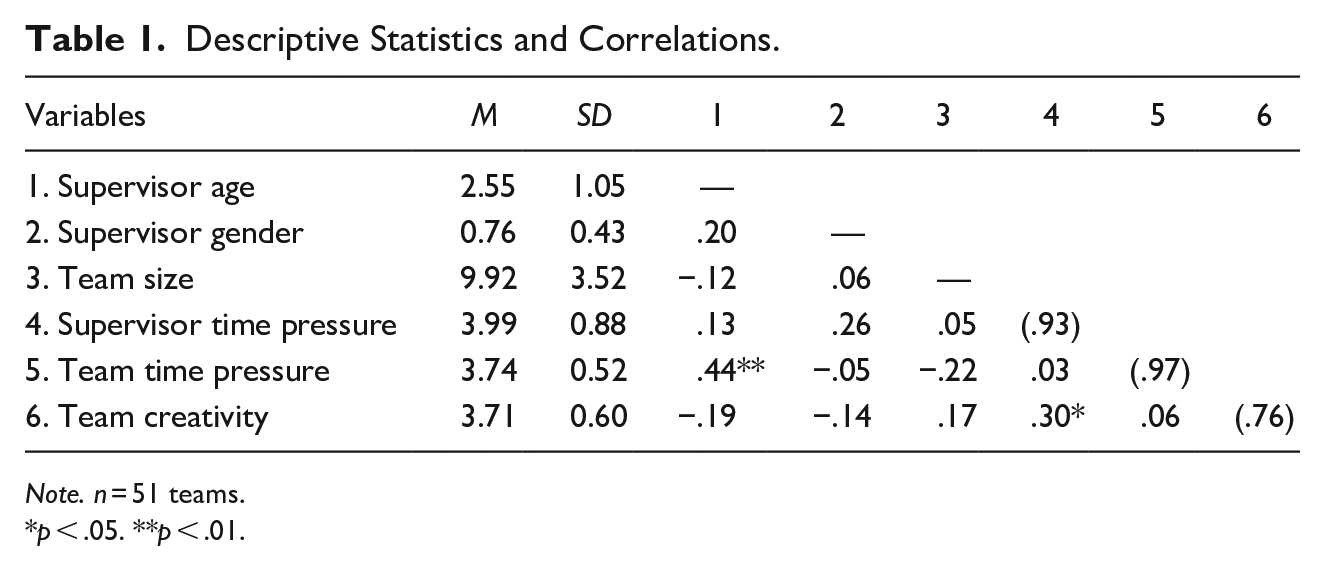
Note. n = 51 teams.
p < .05. **p < .01.
Before performing the polynomial regression analyses, we examined how many teams showed discrepancies between the two predictors. Following Shanock et al. (2010), we first standardized the scores for each predictor variable (i.e., team time pressure and supervisor time pressure). A team was considered to have discrepant values if its standardized score for team time pressure was half a standard deviation higher or lower than the standardized score for supervisor time pressure (Fleenor et al., 1996; Lankton et al., 2016; Nielsen et al., 2022). The majority of teams (74.4%) had differing values of team time pressure and supervisor time pressure, either in one direction (i.e., team time pressure higher than supervisor time pressure; 33.3%, N = 17) or the other (i.e., supervisor time pressure higher than team time pressure; 41.1%, N = 21), supporting the relevance of examining the incongruence effect of our predictors. Furthermore, we also checked for multicollinearity by conducting a post hoc analysis to calculate the variance inflation factor (VIF) in the polynomial regression equation, both with and without control variables. None of the variables in either model had VIF values exceeding 5, indicating that multicollinearity was not a concern (Fox, 2016).
As shown in Table 2, the overall inclusion of the five focal polynomial variables to the baseline model (∆R2 = .28, p < .001), as well as the addition of the three non-linear terms (i.e., T2, T × S, S2) to the model with only first-order variables (∆R2 = .12, p = .035), explain significant incremental variance in team creativity. This substantial increase in R2 demonstrates that a significant, nonlinear relationship exists between team time pressure values and team creativity (Edwards, 2002; Edwards & Parry, 1993). Also shown in Table 2 is that the surface along the incongruence line is curved upward (curvature [b3 − b4 + b5] = 0.68, p = .010), whereas the slope of the incongruence line is non-significant (slope [b1 − b2] = −0.02, p = .925).
Polynomial Regression of Team Creativity on the (In)congruence of Supervisor and Team Time Pressure.
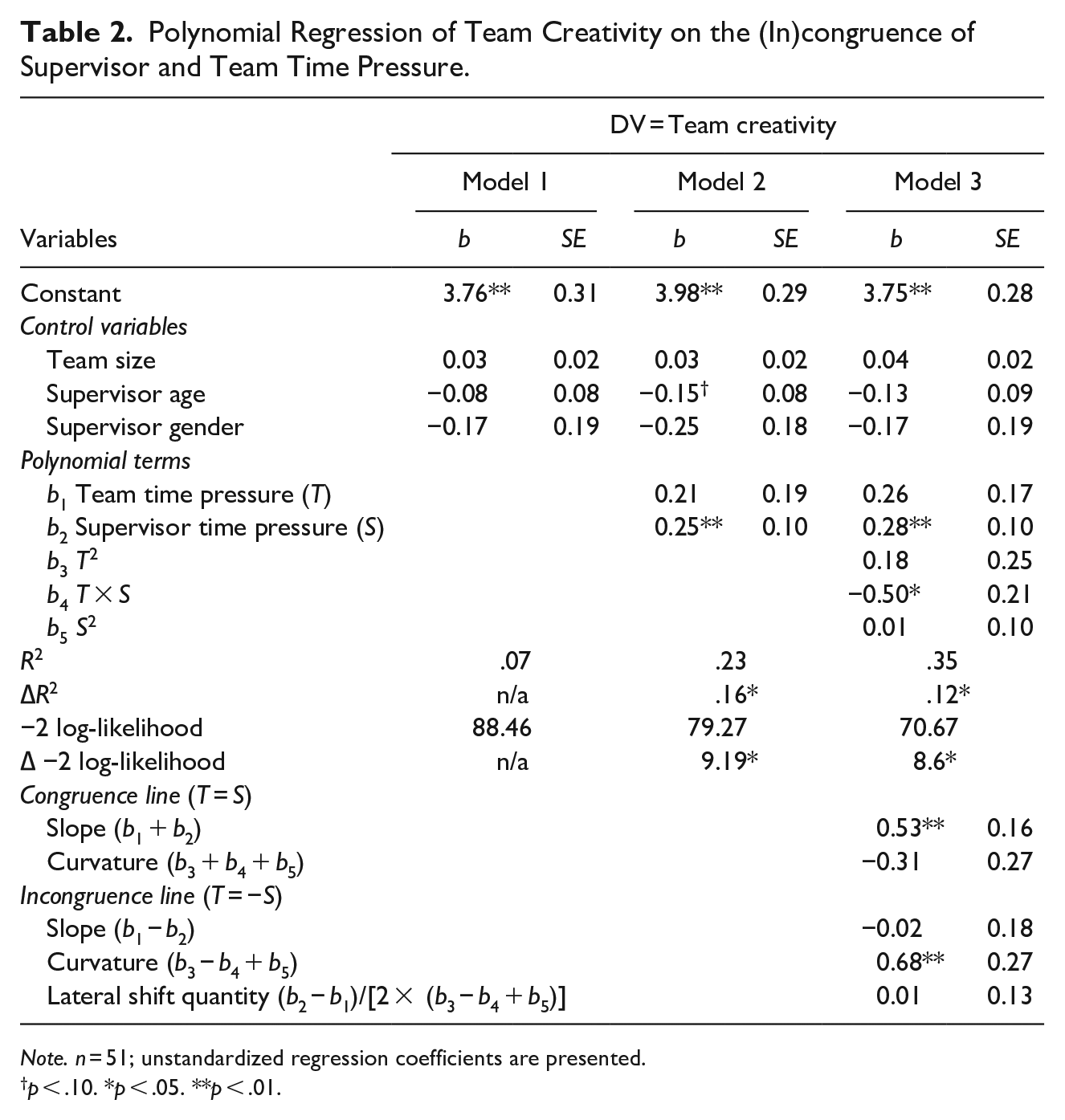
Note. n = 51; unstandardized regression coefficients are presented.
p < .10. *p < .05. **p < .01.
Figure 1 depicts the response surface plot for this polynomial regression where the congruence line (T = S) corresponds to the line on the floor of the graph that begins at the near left corner and proceeds to the far-right corner, whereas the incongruence line (T = −S) corresponds to the line on the floor of the graph that begins at the far-left corner and proceeds to the near-right corner. Again, the convex surface in Figure 1 illustrates a U-shaped curve along the incongruence line (T = −S), demonstrating that team creativity is higher when team time pressure scores diverge from supervisor time pressure scores and vice versa. Thus, the results indicate a significant (in)congruence effect: levels of team creativity will increase as team time pressure and supervisor time pressure values diverge more, and levels of team creativity will decrease as the time pressure values become more aligned. 1
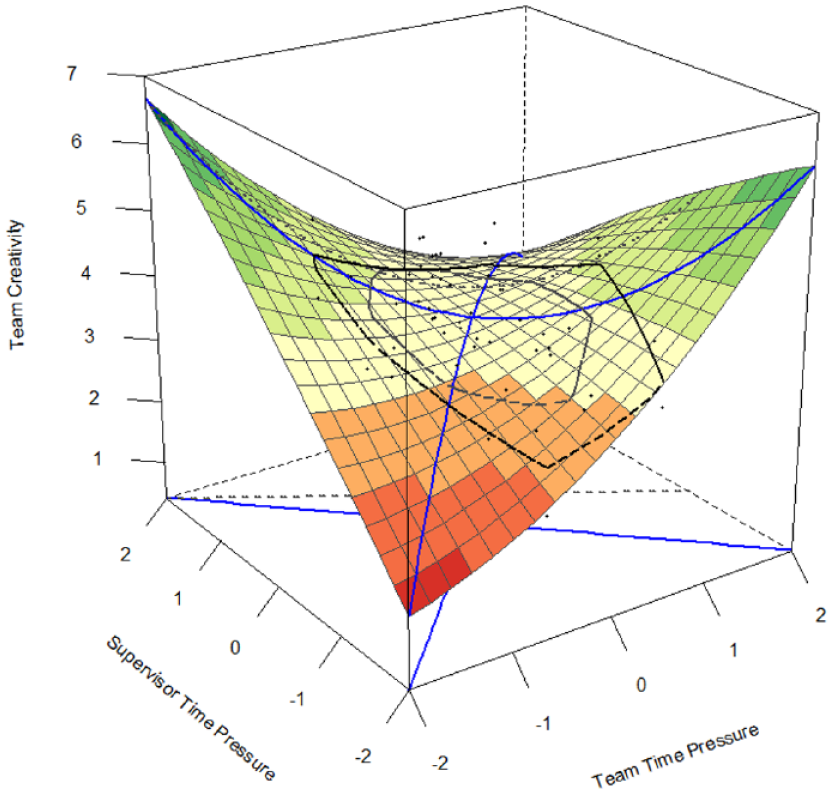
Incongruence effects of supervisor-team time pressure on team creativity.
In addition to our primary discovery that the more misaligned the values of our two predictor variables, supervisor time pressure and team time pressure, to one another, the higher the value of team creativity, we investigated whether team creativity is higher when supervisor time pressure exceeds team time pressure than when team time pressure exceeds supervisor time pressure. Such specifications require the calculation of the lateral shift quantity (i.e., (b2 − b1)/[2 × (b3 − b4 + b5)], following the approaches used by Cole et al. (2013) and Z. Zhang et al. (2012). The lateral shift quantity demonstrates the magnitude and direction of a lateral shift of the response surface along the incongruence line. However, the lateral shift quantity was not statistically significant (lateral shift quantity = 0.01, p = .925), preventing us from proceeding to inspect whether an “asymmetry incongruence” effect is in place. As a result, our data does not support the possibility that supervisor-team time pressure incongruence in any specific direction is associated with variations in team creativity.
Discussion
Theoretical Implications
In this exploratory study, we set out to investigate the potential impact of misalignment between supervisor and team time pressure on team creativity in the workplace. Through a time-lagged, multisource field study of sales teams, we uncovered intriguing patterns that offer new perspectives and raise important questions for future research. One of the most interesting patterns we observed is that team creativity appeared to be enhanced when there was a greater divergence between the time pressures experienced by supervisors and team members. Conversely, creativity seemed to diminish when the time pressures of both parties were more aligned. This finding challenges traditional views and suggests that the relationship between time pressure and creativity within teams might be more complex than previously thought. Additionally, we found that the direction of misalignment—whether the supervisor’s time pressure exceeds that of the team members or vice versa—did not significantly influence variations in team creativity. This suggests that the mere presence of a misalignment, rather than its specific direction, may play a crucial role in fostering creativity. Taken together, our results provide further insight into the anomalies in the literature concerning whether and when team time pressure (or supervisor pressure) is beneficial, detrimental, or unimportant for team creativity.
More specifically, the findings provide evidence of the need for a possible consensus shift in the teams literature regarding team members’—and supervisors’— subjective time experiences. This literature suggests that team effectiveness hinges on a leader’s ability to synchronize the varied time-related experiences of all team members, ensuring the team operates with a unified temporal understanding (e.g., Z. Liu et al., 2021; Maruping et al., 2015; Mohammed & Nadkarni, 2011). In a broader context, this perspective aligns with various conceptual frameworks on team dynamics, which suggest that team emergent states can lead to positive outcomes when they are in equilibrium (Cronin et al., 2011; Harvey, Leblanc, & Cronin, 2019). However, based on a conceptualization of supervisors’ time pressure as a distinct construct from the time pressure experienced by their subordinates, we show that a differentiated, rather than an integrated, perception of time pressure between team members and supervisors is more beneficial for engendering creativity as a team. Instead of attempting to synchronize the operational tempo of team members with their supervisors or vice versa, our study recommends recognizing the distinct roles of supervisors and team members; embracing the differences in how each party perceives time can be beneficial for fostering creativity within teams.
When considering these results, the following theoretical explanations seem plausible. To begin with, time pressure is a stressor that consumes individuals’ limited cognitive resources; thus, higher time pressure leaves fewer resources available for creative tasks (Byron et al., 2010; Prem et al., 2017). However, when supervisors and team members experience different time pressures, it may encourage cognitive flexibility, which is closely linked to creativity (Braem & Egner, 2018; George, 2007). Specifically, team members and supervisors are more likely to explore unconventional ideas and solutions when not confined to a single, uniform timeline. For instance, when supervisors experience low time pressure while team members face high time pressure, the urgency felt by team members can drive them to think creatively to meet deadlines. Crucially, this dynamic is made possible only when combined with supervisors’ low time pressure, which allows them to provide support and resources without imposing their own urgent deadlines. In this context, supervisors can adopt a supportive and mentoring role focused on fostering creativity rather than enforcing strict technical deliverables. This balance enables team members to feel both challenged and supported, enhancing their creativity.
Next, explicating the situation in which supervisors experience high time pressure while team members face low time pressure is the role of autonomy and empowerment in fostering team creativity. Interpreting this result, of particular importance is that subordinates are keen to “read the wind” from their supervisor’s behavior at work (Morrison & Milliken, 2000; Sy et al., 2005). Thus, seeing their supervisors feeling hurried, team members may be stimulated to exert more effort on their tasks. At the same time, high time pressure may limit supervisors’ ability to get directly involved with the team task, forcing them to trust their team members to handle tasks independently. This trust can empower team members to take initiative and approach problems creatively. Hence, high time pressure on supervisors may lead them to delegate tasks more effectively and empower team members to take ownership of their work. This delegation can foster a sense of responsibility and autonomy among team members, which is conducive to creative thinking (Anderson et al., 2014; D. Liu et al., 2011). With low time pressure, team members have the cognitive bandwidth to explore and experiment with new ideas without the stress of imminent deadlines, leading to more innovative solutions (Driskell et al., 1999; Harvey et al., 2023; Harvey & Kudesia, 2023; Karau & Kelly, 1992; McGrath, 1991).
Aligned time pressures between supervisors and team members at higher levels, which are associated with lower team creativity, indicate a homogeneous environment where there is a stronger push for uniformity and compliance. Supervisors experiencing greater time pressure, burdened with their own tasks as middle managers (Schmidt & DeShon, 2007; Vancouver et al., 2010), are less equipped to make meaningful and supportive creative contributions. In such cases, highly time-pressured supervisors are likely to be passive and reluctant to lead and encourage their subordinates’ creative thinking. This alignment of time pressures can lead to groupthink, as hurried supervisors may push for quick solutions to the team’s tasks, intensifying the pressure for consensus. Consequently, team members may also default to their usual ways of processing tasks, which, combined with their supervisors’ hurried status, stifles creativity.
Finally, when supervisors’ and team members’ time pressures are aligned at lower levels, a situation that is also associated with low team creativity in our research, this indicates that both supervisors and team members are not feeling rushed or pressed for time in their tasks and responsibilities. Although time pressure is a stressor that limits individuals’ cognitive capacity, it also functions as a motivational stimulus that leads individuals to exert additional efforts for accomplishments (D. G. Gardner & Cummings, 1988; LePine et al., 2005), another key aspect of the construct that is essential for interpreting our exploratory findings. In line with this, our results suggest that when both supervisors and team members become complacent due to low time pressures, they adhere to routine methods and do not seek new or creative solutions. Furthermore, as both parties experience low levels of urgency at work, neither can provide the necessary stimulus or feedback to the other.
However, it is important to note that the findings presented here are exploratory. More empirical work is needed to substantiate these findings in larger samples, while future research may also apply more direct hypotheses testing based on the present findings. In particular, future research may incorporate subsequent team processes or emergent states that stem from the interplay between team members and supervisors’ time pressure. For instance, future researchers may expand the current investigation toward testing teams’ affective states and processes surrounding supervisors’ and team members’ time pressures. By doing so, researchers may further delineate proximal outcomes of our focal interaction effect, which would address concerns of potential alternative mechanisms, hence increasing the theoretical fidelity of the overall model. Furthermore, utilizing an experimental design can effectively triangulate the results obtained from our field data (N. Li et al., 2016). These recommendations, combined with the limitations of the study detailed in the next section, provide a fruitful avenue for future research.
Directions for Further Exploration
The current investigation included a field study with two sources of multi-level data collected over two separate time points. Yet, our research involves several limitations, which spurs fruitful future research opportunities. First, future research may extend our exploratory findings by addressing the potential boundary conditions of our analysis. One example would be investigating our exploration in a setting where teams are led by different types of leaders other than external, formal leaders (Morgeson et al., 2010). Exploring this possibility is important, as teams may have leaders whose responsibilities are shared among team members (Day et al., 2004; C. L. Pearce & Conger, 2003) or experience certain team members emerging informally as a leader (Couture & Harvey, 2021; McClean et al., 2018). In such teams, leaders are often internal to their teams, playing a stronger role in processing the collective’s task, a setting that may yield different results on creativity. Similarly, we also wonder whether the time pressure incongruence effect might be particularly amplified or dampened to achieve great creativity in teams operating in more dynamic environments than those we investigated. Such contexts may include virtual teams, multiteam systems, or teams that experience frequent membership changes, which are increasingly prevalent in contemporary organizations (De Vries et al., 2016; Lanaj et al., 2013).
Another idea for further exploration would be incorporating team members’ collective sense of their status. Research indicates that perceptions of high status provide individuals with more “freedom of maneuver” in processing work (Briker et al., 2020; W. Zhang et al., 2014). The interplay between team members’ and supervisors’ time pressure may operate differently based on the team’s self-perceived status. For instance, a team with low collective self-perceived status may be more willing to accept and follow the supervisor’s state of time pressure. In a related manner, future researchers may incorporate potential dispositional or motivational factors that can further explain supervisors’ time pressure (and the potential behavioral ramifications it may entail). For example, future research might consider additional leader-related factors, such as supervisors’ time management skills at work (Claessens et al., 2007), multitasking preferences or capabilities (Poposki & Oswald, 2010), construal levels (Harvey, 2022) or mindfulness (Harvey & Kudesia, 2023), or supervisors’ tendencies to process possible long-term effects of creativity amidst high time pressure and competing demands (Sherf, Tangirala, & Venkataramani, 2019).
Moreover, to increase the applicability of our theorizing, future research should investigate the incongruence effects between team members’ and supervisors’ time pressure with additional outcome variables. For example, our exploration may be applied and extended to explicate the extent to which individuals or teams engage in prosocial, organizational citizenship behaviors (e.g., helping, voice, etc.) as opposed to their prescribed in-role behaviors (Bergeron, 2007; Bergeron et al., 2013). Given that the topic of team prosocial behavior is of increasing importance (Hu & Liden, 2015; A. N. Li et al., 2017), it would be worthwhile to examine whether the ramifications of supervisors’ time pressure combined with team members’ time pressure, as uncovered in this investigation, may generalize toward such alternative outcomes.
Future research could build on current theoretical and empirical work in the team domain (e.g., Harvey et al., 2023) by examining how different “time pressure trajectories” experienced by both supervisors and teams influence creative outcomes. A longitudinal field study could track time pressure at these two levels over time, revealing how their interactions impact performance. By analyzing the timing and intensity of time pressure within the workflows of supervisors and teams, researchers could determine if these pathways are path-dependent, where their effects shift depending on when and how pressure is experienced. This dynamic approach could lead to more effective time management interventions, boosting team adaptability and reducing the adverse effects of time pressure in complex, high-stakes environments.
Practical Implications
Organizations can leverage our findings by implementing flexible time management policies that accommodate varying time pressures between supervisors and team members. Again, different roles within a team often entail distinct temporal demands; for example, supervisors might face more strategic, long-term deadlines, while team members might deal with immediate, task-oriented pressures (Dierdorff et al., 2009; Sherf, Venkataramani, & Gajendran, 2019). In this sense, tailoring time management policies to the specific needs of different roles thus ensures that all team members can perform at their best, leading to improved innovation for the organization. This can be achieved by setting different deadlines for strategic tasks versus operational tasks, giving team members the flexibility to manage their immediate workload independently of their supervisors’ longer-term schedules.
Second, organizations may design and implement training programs for both supervisors and team members that emphasize the importance of understanding and respecting the different temporal demands of each role. Supervisors should be trained to avoid imposing their own time pressures on their team members, while team members should be encouraged to communicate their time constraints openly. Team members should refrain from overly synchronizing their subjective understanding of time at work with that of their supervisors. By recognizing and addressing these differences, organizations can foster a work environment that supports diverse working paces and schedules, thereby enhancing overall team creativity, as our findings have shown.
Relatedly, encouraging open communication about time pressures can help supervisors and team members better understand each other’s constraints and work more effectively together, acknowledging the divergence of their time-related needs and constraints. Open dialogue allows team members to express their concerns about deadlines and workload, providing supervisors with valuable insights into the challenges faced by their team. In this sense, through organization-wide training, creating an environment of psychological safety, where team members feel comfortable voicing their time-related concerns without fear of negative repercussions, is essential (Edmondson & Lei, 2014). This sense of safety fosters trust and openness, enabling more honest discussions regarding each party’s time pressure (Edmondson & Bransby, 2023; Frazier et al., 2017).
Conclusion
With its finite nature, time, and the way it is perceived and experienced, profoundly shapes team outcomes in the work context. Our study highlights the significant role of divergent time pressures between supervisors and team members in enhancing team creativity. The exploratory findings suggest that organizations should embrace and manage temporal diversity within teams, specifically between supervisors and subordinates, to foster more creative work outcomes. Future research should continue to explore the complex dynamics of time perception in organizational settings to further understand its impact on team performance and creativity. We hope this study will encourage further development of theory and research in the domain of subjective time interpretation in the context of teams, creativity, and leadership.
Footnotes
Acknowledgements
We thank Associate Editor Bret Bradley and anonymous reviewers, for valuable feedback on earlier versions of this paper.
Declaration of Conflicting Interests
The author(s) declared no potential conflicts of interest with respect to the research, authorship, and/or publication of this article.
Funding
The author(s) disclosed receipt of the following financial support for the research, authorship, and/or publication of this article: Funding for this research was provided by the Social Sciences and Humanities Research Council (SSHRC) of Canada [#435-2022-0642].
