




Abstract
Enacting a corporate entrepreneurial role requires cognitive, behavioral, and emotional qualities. While scholarly work has focused on the cognitive and behavioral aspects of this role, its emotional aspect—how corporate entrepreneurs feel when enacting their role—remains relatively unexplored. Our qualitative study reveals the corporate entrepreneurial role as a source of liabilities and assets for the role incumbents’ work-related identity, which are brought to light as these employees emotionally experience their role. In addition, we elucidate how contextual elements shape this experience, and how corporate entrepreneurs use emotions to work around the detrimental and beneficial effects of their role enactment.
Introduction
Corporate entrepreneurship involves a social exchange process (Dess et al., 2003) whereby individual employees engage in endeavors to create new businesses, instigate renewal, or innovate within (and in association with) an existing organization (Sharma & Chrisman, 1999). Scholars have labeled employees who assume and enact a corporate entrepreneurial (CE) role as “corporate entrepreneurs” (CEs; Greene et al., 1999) or “intrapreneurs” (Pinchot, 1985). Such a role is enacted within an organizational context where relational and socio-cultural elements affect exchanges of resources (e.g., information and knowledge), coordination, collaboration, and the decisions concerning the exploitation of value-creating opportunities (De Clercq, Dimov, & Thongpapanl, 2010; Simsek & Heavey, 2011). In such an interactional setting, the CE role becomes an intermediary device (i.e., a “vehicle” or “boundary object”) between the “different worlds” or “knowledge domains” (Simpson & Carroll, 2008, p. 45) represented by entrepreneurship and bureaucracy. By mediating and negotiating meanings between these different worlds, the CE role takes shape as its occupants enact and experience it in relation to its surrounding context (Morris et al., 2012; Welter, 2011).
Scholars have acknowledged the influence of the organizational context on the exchange process that underpins corporate entrepreneurship (Ireland et al., 2003; Mustafa et al., 2018; Turró et al., 2014), advancing its role in shaping (Fini et al., 2012; Sørensen, 2007) and supporting (Brundin et al., 2008; Marvel et al., 2007) employees’ desire and willingness to behave entrepreneurially, while also recognizing it as a source of opportunities in itself (Sørensen & Fassiotto, 2011). In this regard, prior research has argued for appreciating the cognitive and motivational micro-foundations of entrepreneurial behavior (Elfenbein et al., 2010; Urbano et al., 2022), thus emphasizing the cognitive and behavioral skills deployed by CEs when pursuing opportunities (Corbett & Hmieleski, 2007; Kuratko et al., 2015; Nambisan & Baron, 2013). However, when enacting their role in social interactions (Dess et al., 1999), CEs also interpret and subjectively experience the organizational context (Courpasson et al., 2016; Morris et al., 2012) while abiding by the socio-cultural norms contained therein (Ireland et al., 2003). Here, such employees’ distinctive entrepreneurial mindset (Kuratko et al., 2023) or “thought world” (Fiol, 1995, p. 71) clashes with the bureaucratic mindset of their employing organization (Sørensen & Fassiotto, 2011), engendering tensions that add an emotional component to their interactions and entrepreneurial processes (Cardon et al., 2009; Doern & Goss, 2014). Consequently, embracing the distinctiveness (Shepherd & Haynie, 2009) and emotionality (Cardon et al., 2012; Kuratko et al., 2023) inherent in their entrepreneurial behavior—also described as “a feeling of permanent struggle against the world” (Goss, 2005, p. 209)—may place CEs at odds with who they are at work or clash with their “work-related identity” (WRI; i.e., self-definitions based on work-related attributes, experiences, role engagements, and group memberships; Ibarra, 2005).
Despite considerable insight generated within the literature regarding how organizations can support and encourage the emergence of CEs, its predominantly top-down perspective trivializes the interplay between the organizational context and an employee who assumes and enacts a CE role (Garud et al., 2014; Urbano et al., 2022). In turn, this perspective regards context as an objective reality where an organizational code dictates how things are (Cirillo et al., 2014), thereby dismissing its subjective or “invisible” side (i.e., how individuals experience or perceive their organization’s reality; Welter & Gartner, 2016). For their part, studies exploring CEs’ emotionality have typically adopted an intra-personal approach to emotions and their associated coping mechanisms (Patzelt et al., 2021; Shepherd et al., 2009), which, despite enabling valuable scholarly contributions, still falls short in acknowledging emotions as a core element of social life and human action (Weenink & Spaargaren, 2016). Emotions, therefore, are not simply a “feeling within us” but rather a social construction resulting from the interaction between individuals and their immediate context (Lawler & Thye, 1999). As such, the notion that emotions are given meaning in, but also give meaning to, interactions and the contexts within which they occur (Goss, 2005) can prove helpful to understanding how CEs are able to enact their role, as well as elucidate how CEs’ emotions relate to their cognitions and behavior (Mitchell et al., 2007). Against this backdrop, we set out to explore: “How does it feel like to act as a corporate entrepreneur within the context of an established organization?” and “What (if any) is the role of corporate entrepreneurs’ emotions in their contextually imbued role engagement and enactment?”.
To address our research questions, we conducted a qualitative, inductive study of 54 employees engaged in a CE role within large and established Finnish organizations. Our analysis revealed that these employees perceived their role as a source of liabilities but also assets to their WRI, which were brought to light as they emotionally experienced their role as their entrepreneurial journey unfolded. A range of contextual elements influenced the interpretation of their CE role and its associated emotions. Furthermore, employees deployed different forms of emotion work as strategies to manage the emotions experienced during their CE role enactment.
By illuminating the emotionality of the CE role, we advance the corporate entrepreneurship literature in the following ways. First, we expand the perspective on corporate entrepreneurship as a system of roles and social exchanges (Dess et al., 2003) by elucidating how CEs’ subjective experience of contextual elements that frame or inhere in such exchanges determine what their role enactment feels like. Second, by regarding roles as boundary objects (Simpson & Carroll, 2008) in corporate entrepreneurship, we propose the paradoxical nature of the CE role by postulating it as a “double-edged sword” for the role incumbents’ WRI. In doing so, we reveal the informational function played by emotions—in light of the lack of relevant role schemas (Corbett & Hmieleski, 2007)—as a form of guidance, or “probing cane” for the enactment of the CE role. Third, we advance knowledge on the emotional aspect of the corporate entrepreneurial mindset (Kuratko et al., 2023) by bringing forward CEs’ strategic management and usage of emotions as a core skill for their role enactment.
Theoretical Background
To identify, evaluate, and exploit value-creating opportunities, established organizations rely on the behaviors and practices of employees who assume and enact a role as CEs (Kuratko et al., 2023). The pursuit and exploitation of such opportunities, as well as the concomitant process of articulating, developing, and implementing entrepreneurial ideas requires and promotes interaction, or “exchanges” (Simsek & Heavey, 2011), between individuals belonging to different stakeholder groups. These include organizational members—that is, employees in managerial as well as non-managerial positions, and employees who are occupants of a CE role as well as those who are not—who constitute the internal stakeholder group; and customers and suppliers as external stakeholders (Haefner et al., 2023). Interactions between these actors define corporate entrepreneurship as an ongoing and dynamic process entailing a system of roles and social exchanges (Dess et al., 2003) where, as the entrepreneurial journey unfolds, individuals experience numerous events that are often uncontrollable and unpredictable (Morris et al., 2012). In such a system, the performance of a CE role involves undertaking entrepreneurial action while acquiring, processing, and exchanging information in pursuit of innovation and organizational change. This implies that individual actions and decisions are situated in a relational context where, as organization members and other stakeholders interact and exchange information, roles and role expectations necessary for CE activities develop (Greene et al., 1999).
Scholars have acknowledged that all organizational members have “some degree of penetration of the social forms” they inhabit (McMullen et al., 2021, p. 1199), regardless of their position. However, only a few are willing and able to engage in CE activities and bear the concomitant extreme levels of uncertainty (Covin et al., 2020) and personal risk (Shane, 1994). Such members—or CEs—differentiate themselves from other employees by exercising “the power of transformative capacity” (McMullen et al., 2021, p. 1200) within organizations; that is, CEs possess the capability to intervene in events and produce outcomes by shaping the circumstances according to their wants. Arguably, most employees would act entrepreneurially if they could, yet only CEs are sufficiently motivated and equipped to challenge organizational norms (Globocnik & Salomo, 2015) and overcome the rigidities that hinder transformative action in bureaucratic environments (Sørensen, 2007). In such settings, entrepreneurial behavior refers to employees’ endeavors in creating new value for their organization, be it a new business, innovation, artifact, or process that is novel, useful, and appropriate therein (Sharma & Chrisman, 1999). This behavior, in turn, is an expression of the distinctive “entrepreneurial mindset” that CEs are argued to hold (Kuratko et al., 2023). This mindset revolves around three mutually reinforcing dimensions, the lack of any of which will render an entrepreneur unable to operate optimally (Kuratko et al., 2023): cognitive (how entrepreneurs think), behavioral (how entrepreneurs engage or act for opportunities), and emotional (what entrepreneurs feel). Here, cognitive aspects involve motivations (Fini et al., 2012), human capital (Urbano et al., 2022), distinctiveness (Shepherd & Haynie, 2009), and ill-defined schemas (Corbett & Hmieleski, 2007); behavioral aspects include a tendency toward innovation, proactivity, and risk-taking (Covin et al., 2020; De Jong et al., 2015); and, in the emotional domain, scholars have accounted for the negative emotions (e.g., fear, grief, sadness, anger) experienced by entrepreneurial employees upon exiting or failing to succeed in their endeavors (Behrens & Patzelt, 2016; Cacciotti & Hayton, 2015; Wolfe & Shepherd, 2015), further noting the internal self-regulatory mechanisms they deploy so as to cope with these emotions (De Cock et al., 2020; Shepherd et al., 2013). On the flip side, studies have also documented the positive emotions experienced by these employees upon succeeding in their projects (Gawke et al., 2017), as well as the strong emotional bonds they develop toward the initiatives in which they engage (Patzelt et al., 2020; Shepherd et al., 2009). In turn, such initiatives may elicit envy in other organizational members, thus triggering complementary emotions in CEs, for example, feeling envied (Biniari, 2012).
Prior research on the emotional dimension of the entrepreneurial mindset advances views of entrepreneurs as purely cognitive or rational individuals (Morris et al., 2012) by further suggesting them as emoting subjects, owners of an “entrepreneurial heart” (Cardon et al., 2012). However, holding such a heart can be more painful for CEs compared to their independent counterparts, as the former’s embeddedness within (Baker & Welter, 2020) and interactions with different elements of the organizational setting (Pirhadi & Feyzbakhsh, 2021) exposes them to experiencing substantial negative emotions (De Clercq, Dimov, & Belausteguigoitia, 2016; Shepherd et al., 2013). As their entrepreneurial journey unfolds, CEs must wrestle with organizational rigidities, such as bureaucracy, corporate politics, and inertia (McMullen et al., 2021); tensions between events and role schemas necessary for entrepreneurial action (Corbett & Hmieleski, 2007); and cultural aspects that dictate what is considered to be legitimate within that context (Garud et al., 2014) and, therefore, influence CEs’ status and social recognition (Turró et al., 2014). Moreover, organizational culture plays an influential role in organizational members’ cognitions, affecting how they perceive different situations (Foo, 2011; Turró et al., 2014) and framing what is desirable or appropriate as behavior (Mustafa et al., 2018). In this vein, organizations—as social and cultural contexts of exchange (Welter, 2011)—can also provide their members with rules, scripts, and vocabularies of emotional display (Cardon et al., 2009), thereby making their emotional experiences crucial for the social construction of meanings (Goss, 2008; Morris et al., 2012) and conceptions of “what is important” (Ireland et al., 2009, p. 970).
These elements intensify the emotionally charged nature of the entrepreneurial process (Cardon et al., 2012) and demand unique emotional skills from CEs (Kuratko et al., 2023), hence making the entrepreneurial experience in established organizations fundamentally different from that of independent entrepreneurs (Corbett et al., 2013). Subsequently, employees who enact such a role must be able to accommodate between their organization’s codes and the meanings emanating from their entrepreneurial mindset. However, as the former may not always be in harmony with the latter (Shepherd et al., 2010), CEs must also work to prevent or “fix” any potential breakdowns that such dissonance might cause to their mindset’s optimal functioning—that is, the underpinning force of their role enactment (Kuratko et al., 2023). Strikingly, while previous research has stressed the interrelation between entrepreneurs’ emotions, cognitions, and behaviors (Byrne & Shepherd, 2015; Mitchell et al., 2007), as well as pointing out that “all decisions by individuals-as-entrepreneurs entail emotional and social influences” (Arend, 2013, p. 314), the emotionality of the CE role remains undertheorized.
Theories of emotions in social exchange (Lawler & Thye, 1999) emphasize the different functions that emotions play in social interactions. Such theories consider emotions as part of the exchange context (i.e., norms and structures dictate how people should feel; Hochschild, 1979; Kemper, 1978), the exchange process (i.e., emotions shape perceptions and signal information; Isen, 1987; Turner, 2006), and the exchange outcomes (i.e., emotions as a result of interactions; Collins, 2004). By acknowledging the role of emotions in informing individuals’ identities in social interactions (Lawler & Thye, 1999), sociological perspectives help in comprehending the nature and experience of enacting a distinctive and ill-defined CE role. Surprisingly, these approaches have been largely absent in the literature on corporate entrepreneurship, despite its uniqueness as a setting where the peculiarities of the CE role enactment (e.g., its organizational conditioning and intertwinement with other work-related identities and their associated emotions; Cardon et al., 2009) imbue emotions with a crucial function in terms of CEs’ cognitions and behavioral engagements. Knowledge on CEs’ emotionality could help understand why and how such agents are able to persevere in their role and exert transformative action within established organizations.
Beyond this, while entrepreneurship research has explored the interplay between independent entrepreneurs and their context(s) (e.g., Doern & Goss, 2014; Farny et al., 2019), context in corporate entrepreneurship studies has remained underappreciated and regarded as an external force independent of the individual (Garud et al., 2014). Studies have acknowledged that the organizational context may provide a set of resources, including knowledge and skills (Elfenbein et al., 2010), beliefs and values (Ireland et al., 2009; Urbano et al., 2022), financial (Fini et al., 2012; Turró et al., 2014) and social-emotional support (Andersén, 2017; Brundin et al., 2008; Glinyanova et al., 2021), and conditions that influence the “making” of entrepreneurs (Sørensen, 2007, p. 409) like a psychologically safe climate (Danneels & Vestal, 2020; Yuan & Woodman, 2010). However, such context is typically assumed as unidimensional, objective, and taken for granted (Welter & Gartner, 2016), thus largely neglecting the subjectivity of context as lived and interpreted by individual actors (Morris et al., 2012; Welter, 2011) and the fact that such individuals’ interactions with it, and their experiences thereof, produce context-specific outcomes (Sørensen, 2007) while also shaping the ways they behave (Brännback & Carsrud, 2016). For instance, employees’ appraisals of a given situation within the organization may differ, so that what appears as “supportive” or “legitimate” for some may not necessarily be so for others (Courpasson et al., 2016; Marvel et al., 2007)—and this conditions their role engagement. Since subjective perceptions of context influence entrepreneurial action (Foo, 2011; Welter & Gartner, 2016), understanding what acting as a corporate entrepreneur feels like requires us to consider the interplay between employees and the organizational context in which they enact their role. Such interplay is relevant once this role is understood as a “vehicle” that mediates and negotiates meanings between different “thought worlds” (Fiol, 1995, p. 71) that co-exist within organizations. Against this background, we draw on sociological theories of emotions (Lawler & Thye, 1999) to unravel the experience of the CE role enactment, thus exploring: How does it feel like to act as a corporate entrepreneur within the context of an established organization? What (if any) is the role of corporate entrepreneurs’ emotions in their contextually imbued role engagement and enactment?
Methodology
Research Setting
Large and established organizations are considered the engines of innovation (Schumpeter, 1934), thus constituting an attractive setting for corporate entrepreneurship (Kacperczyk, 2012). Organizations that regularly and systematically recognize and exploit entrepreneurial opportunities typically embrace an “entrepreneurial strategy” (Ireland et al., 2009, p. 19), that is, a vision-directed, organization-wide reliance on entrepreneurial behavior. In such entrepreneurial organizations, employees are allowed to be innovative, creative, and responsible for their decisions (Ireland et al., 2009), hence encouraged to engage in and enact a CE role. With this in mind, our sample draws from 16 large and established Finnish organizations (i.e., with over 250 employees; OECD, 2022), all of which portray themselves as espousing an entrepreneurial strategy.
Research Design and Sampling
As the study of the emotional side of corporate entrepreneurship is still in its infancy, we chose an inductive grounded-theory design to permit the data to guide us toward the most salient themes and generate a deeper understanding of the phenomenon at hand (Corbin & Strauss, 2008; Gioia et al., 2013; Glaser & Strauss, 1967). Specifically, we identified employees (i.e., CEs) from different firms to investigate how acting entrepreneurially within the context of an established organization feels like for them, and which role (if any) their emotions play in their role engagement and enactment.
Discovering suitable CEs for our study proceeded in two stages. First, we identified and subsequently selected potential entrepreneurial organizations (Ireland et al., 2009); and, second, we identified entrepreneurial employees within those focal organizations before engaging them as informants for this study. Accordingly, we theoretically sampled large, established organizations whose visions and/or values statements suggested an “entrepreneurial” or “innovative” orientation (Ireland et al., 2003), and whose actual doings indicated current engagement in any form of CE activity, for example, internal venturing, product/service innovations development, or strategic renewal processes (Dess et al., 2003; Turró et al., 2014). By focusing on large firms, we increased our chances of finding sufficient study participants while also adding variety and comparability in terms of the organizational contexts within which these employees operated. We provide an overview of the (anonymized) organizations and this study’s participants in Table 1.
Overview of Firms and Informants in Our Sample.
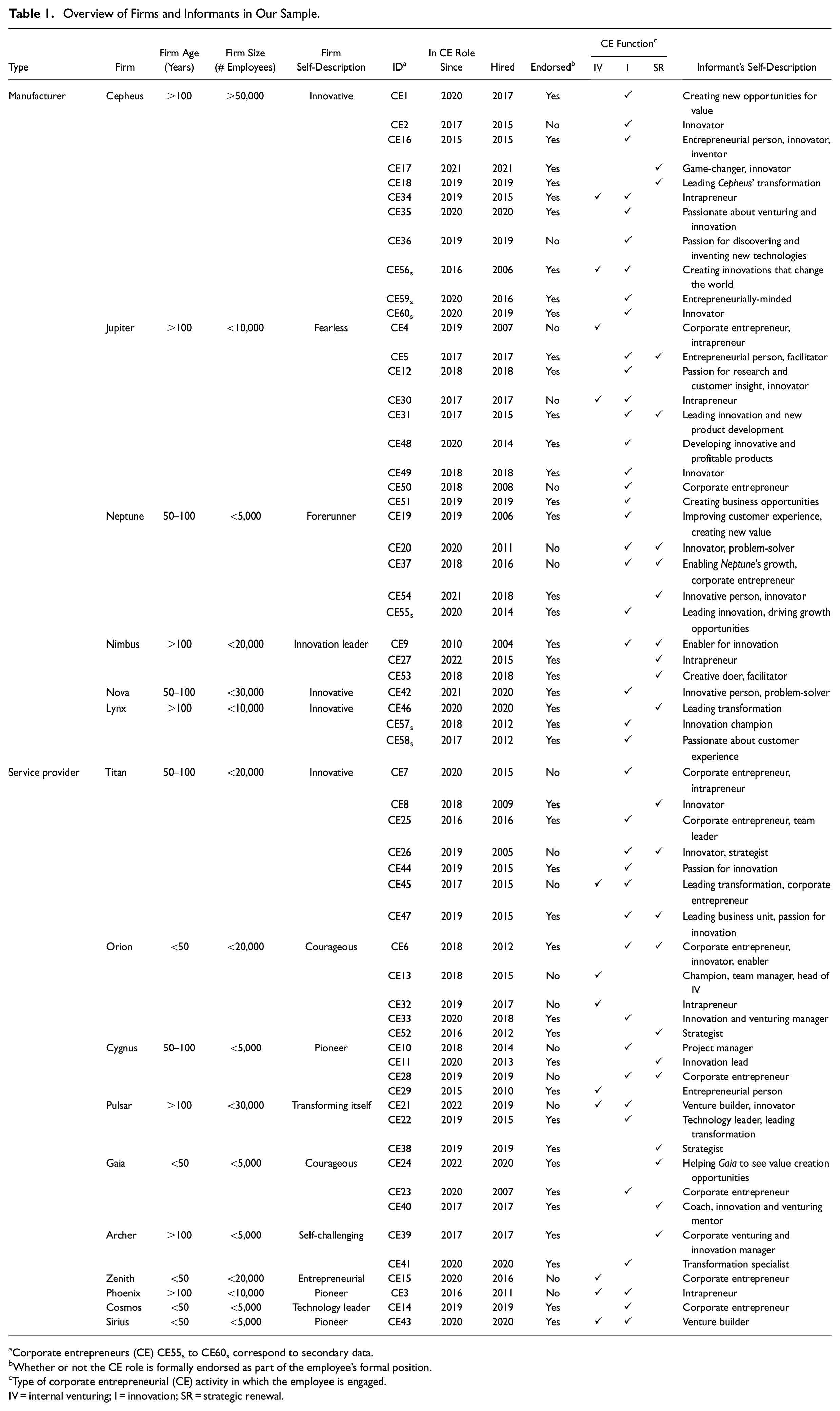
aCorporate entrepreneurs (CE) CE55s to CE60s correspond to secondary data.
Whether or not the CE role is formally endorsed as part of the employee’s formal position.
Type of corporate entrepreneurial (CE) activity in which the employee is engaged.
IV = internal venturing; I = innovation; SR = strategic renewal.
To identify potential informants for our study, we drew on existing literature and defined CEs as full-time employees who, at the time of the interview, were engaged in entrepreneurial endeavors, that is, the identification and exploitation of value-creating opportunities (Patzelt et al., 2020) within their employing organization. Such employees could be occupied with (i) creating and championing new ventures within their employing organization; (ii) inventing and commercializing new products, services, or technologies that represent innovation breakthroughs; or (iii) leading or instigating internal renewal processes (Sharma & Chrisman, 1999). Importantly, identifying and accessing CEs was challenging in a number of ways. First, CEs are a hard-to-reach population in that they are both hidden and vulnerable (Ellard-Gray et al., 2015). This group represents a hidden population because “corporate entrepreneur” or “intrapreneur” is a scholarly label rather than a formal label or job title used by organizations. As such, employees who assume and enact a CE role typically do so in form of extra-role behavior (Covin et al., 2020), and they do not always identify themselves as “corporate entrepreneurs” given the liability (Radu-Lefebvre et al., 2021) that such a label might incur for them, for example, their association with (negative) stereotypes that threaten their belonging in the organization (Shepherd & Haynie, 2009). Alternatively, CEs might be motivated to hide, or to convey their identity ambiguously as a way to manage expectations about themselves, their performance, and outcomes (Kannan-Narasimhan, 2014). Furthermore, CEs are a vulnerable population exposed to the stigma of failure arising from the uncertainty of their entrepreneurial endeavors (Byrne & Shepherd, 2015). As such, even if they can be identified, individuals involved in risky (or even failed) initiatives are often reluctant to provide information about their experiences to protect their image as competent employees (Patzelt et al., 2021). Additionally, their experiences may involve sensitive matters and make them likely to wish avoiding the psychological distress of recalling and retelling painful or humiliating stories (Ellard-Gray et al., 2015), let alone share these with individuals they do not know (Patzelt et al., 2021).
Consequently, to maximize our participant recruitment efforts, we combined rigor with flexibility and creativity (Ellard-Gray et al., 2015) and used a mix of sampling strategies. Following previous researchers’ recommendations to deal with hard-to-reach populations, we iterated between sampling methods (e.g., snowball and purposeful sampling) and gradually discovered the most appropriate sampling strategy for this specific population (Thornberg & Charmaz, 2014). Initially, we resorted to our professional contacts (i.e., senior or middle managers in a number of target organizations), who helped us identify employees who met our defining criteria within their teams or employing organizations. We also contacted innovation and HR managers within the focal organizations and asked them for referrals regarding our target population. Whenever possible, we collected additional information on these referrals (e.g., LinkedIn profiles, when available) and invited them to participate in this study. However, while this sampling strategy (i.e., snowball sampling or chain referral sampling method; Parker et al., 2019) was initially helpful in accessing some organizations, thereby familiarizing ourselves with the environment in which corporate entrepreneurship occurs and establishing some degree of rapport (Ellard-Gray et al., 2015), this only enabled us to identify and access a small number of informants.
In parallel, we reviewed publicly available materials on the focal organizations, including media interviews, newspapers, firms’ websites, and blogs, and searched for information about recent entrepreneurial undertakings. We focused on identifying employees involved in such initiatives, such as team leaders and project managers. We purposefully searched for potential entrepreneurial employees within the focal organizations by looking at individual profiles available on LinkedIn. With the difficulties associated with labeling in terms of entrepreneurial descriptors in mind, we remained flexible regarding the possible descriptors individuals could use and which were likely to suggest a corporate entrepreneur. As such, we did not rule out the possibility that some individuals would describe themselves as “corporate entrepreneur” or “intrapreneur,” yet we also expanded our eligibility criteria to include labels such as “change agent,”“champion,”“innovator,”“entrepreneurial minded,” and similar terminology. We also checked for these individuals’ (LinkedIn) “about” information, education, experience, patenting activity (when available), received recommendations, and skills endorsements—that is, a double-checking process aimed at identifying additional evidence on activities that proved or supported individuals’ self-descriptions—subsequently contacting and inviting suitable candidates to participate in our study. 1 As a final check of the information provided by individuals about themselves on social media, we contrasted such information with the individual narratives and details they shared with us during the interviews. As a result, we engaged 54 participants in our study.
Data Collection
Our data collection took place between March 2021 and August 2022. We conducted semi-structured interviews with the sampled participants, which lasted between 50 minutes and 2 hours. We used videoconferencing tools (e.g., Zoom and Microsoft Teams) and recorded and transcribed the interviews verbatim. After obtaining informed consent from all interviewees, we followed a standard set of questions 2 to facilitate comparative analysis across informants. Broadly, we inquired about (a) their role as CEs (e.g., what it meant to them and what they did); (b) their motivations for engaging in their role; (c) how they felt about their role, their activities, and actions; (d) the challenges that they faced as CEs; and (e) their perceptions of their employing organization as a setting for corporate entrepreneurship, for example, how supportive of entrepreneurial behavior the organization was, and how organization members reacted to what they did. Given that the retrospective nature of the narrative interviews is susceptible to hindsight bias or recall bias (Van Burg et al., 2022), we combined the reflective, retrospective data from the interviews with real-time, secondary data about the informants’ activities in public records. Furthermore, our interview protocol allowed informants to reflect on both their successes and failures as CEs (Terjesen & Elam, 2009), focusing on their current experiences and/or the recent past (i.e., no more than 5 years). We also drew upon secondary data sources, such as interviewees’ social networks profiles (e.g., Twitter) and firms’ annual reports, websites, podcasts, and social media (data from these sources are earmarked in the text with an “s” subscript, for example, narrative by “CE60s” in the Findings section below). Such data allowed us to identify and select the organizations in our sample, and it also complemented the interviews by allowing further contextualization and triangulation of the information gathered from informants (Gibbert et al., 2008).
Data Analysis
Our coding process started as soon as we gathered initial data for our study; and we engaged in an interplay between data collection and coding throughout the research process (Glaser & Strauss, 1967). All authors read and went through all of the interview transcripts, independently coding the information contained therein. Three analytical questions guided our coding process: (i) What (and how) matters for how CEs experience their role? (ii) What emotions are connected to the enactment of the CE role, and how are they connected? (iii) Which forms of behaviors, if any, are connected to the emotions arising from the CE role enactment? We compared our codes and iteratively revised, adjusted, and discussed our independent interpretations of the data (Thornberg & Charmaz, 2014) to achieve agreement on what our codes aimed to capture and represent. When applicable, we deployed the same procedure to code and analyze available secondary data.
Step 1
In this step, we aimed at identifying what mattered for employees’ intrapreneurial experience. To achieve this, we identified via open coding (Corbin & Strauss, 2008) every possible kind of contextual influence (events, elements, or circumstances) that informants perceived as affecting their role enactment, either positively or negatively. Our early codes cleaved to informants’ language (Locke, 2001), accounting for circumstances such as “collaboration spirit,”“culture of openness,”“freedom,” and “power to make decisions.” Over the course of analysis, these early codes transitioned to more refined first-order codes obtained via comparisons among our coded fragments of data, and in tandem with concepts drawn from the corporate entrepreneurship and management literature. We noted that the influences mentioned by informants represented characteristics of different organizational elements (such as climate, norms, authority, and relationships), which provided a basis for clustering our early codes into first-order codes. To illustrate this, frequent statements about decision-making, freedom, and power (i.e., who decides and controls what) were coded as representing either “autonomy” or “hierarchy” as dimensions of “authority.” We subsequently drew on axial coding (Locke, 2001) to aggregate the first-order codes into four broader second-order themes—proposed in the literature as “dimensions of context” (Welter, 2011)—namely human relations, organizational structures, organizational culture, and temporality. We further collapsed these themes into the theoretical category of Contextual Influences on CE Role Enactment.
Step 2
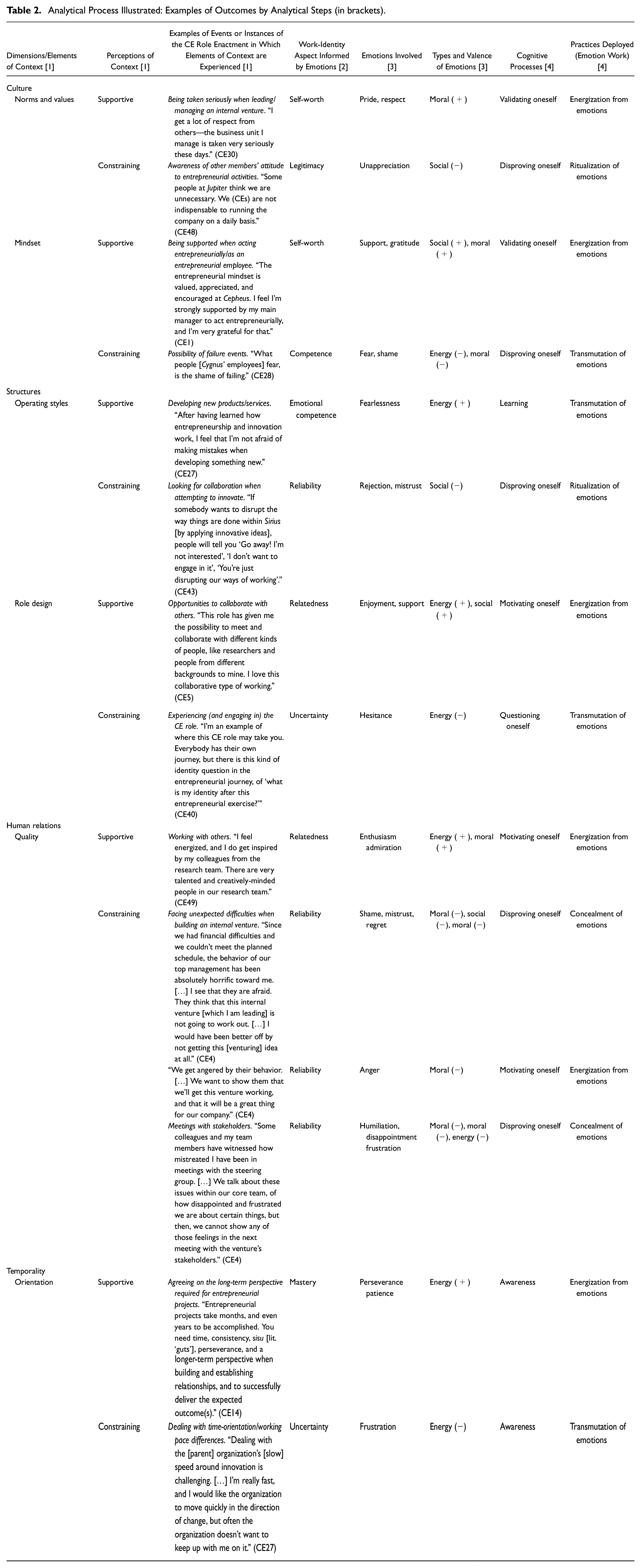
Next, we examined how the contextual influences identified related to employees’ CE role enactment. We observed that informants’ narratives accounted for two different ways in which their contextually imbued role enactment affected their perceptions of who they were at work, either by harming (e.g., threatening) or by benefitting (e.g., enhancing) their sense of self. In turn, informants’ accounts indicated that these effects were connected to different emotions that they experienced in relation to contextual influences on their role enactment. Table 2 illustrates the outcomes of this analytical step, that is, the influences we identified, their associated effects, and the emotions connected to such effects. There, for example, corporate entrepreneur #4 [CE4] describes self-threatening events in which she felt mistrusted and humiliated by other organizational members upon facing unexpected difficulties while building an internal venture and interacting with its stakeholders.
Analytical Process Illustrated: Examples of Outcomes by Analytical Steps (in brackets).
We openly coded (Locke, 2001) all fragments of data where informants expressed (actual or potential) harms or benefits to their WRI that emerged from their CE role enactment (e.g., “lacking competencies,”“being unprofessional,”“feeling respected/appreciated”). Sensitized by the identity and entrepreneurship literature (e.g., Radu-Lefebvre et al., 2021), we further sorted these codes out into second-order themes denoting different types of liabilities (i.e., self-threatening aspects) and assets (i.e., self-enhancing aspects) to one’s WRI emerging from the CE role enactment. Themes denoting liabilities involved (a lack of) competence, reliability, legitimacy, and uncertainty. For instance, CE6 described her need “to constantly justify” what she does in the face of organizational actors holding decision-making power, suggesting a threat to her confidence in the intrinsic legitimacy of her CE actions. Themes representing assets included emotional competence, self-worth, relatedness, and mastery. For example, CE36 described how achievements resulting from his CE role engagement allowed him to advance himself, thereby increasing his sense of self-worth as an employee.
Step 3
The analysis of informants’ accounts of themselves as either harmed or benefitted by their role enactment revealed a latent emotional tone in their narratives, prompting us to examine the emotions experienced by CEs when enacting their role and the reasons why such emotions were aroused. Here, we drew on the idea of emotions as narratives (Boudens, 2005; Doern & Goss, 2014), where emotional experience is constituted by situational circumstances, events, and conditions due to their importance for the emoting subject (Lawler & Thye, 1999). Following this approach, we focused on identifying whether, and how, diverse emotions experienced by CEs were related to contextual influences on their role enactment. Hence, our interpretive process examined evaluative statements about particular facts or events described by informants, that is, expressions of the narrator’s attitude toward or feelings about the content of the narrative (Boudens, 2005). We accessed informants’ emotional experiences by looking at (i) verbal descriptions of emotions they experienced in relation to a given event, specifically their direct usage of emotion words (Stets & Turner, 2006) such as feeling “frustrated” or “mistreated,” or open expressions of “admiration” or “respect” for colleagues, team members, or managers; (ii) usage of figurative and/or colored language, for instance to “make a clown of oneself” or “being in a roller coaster”; (iii) how overtly emotional displays or non-verbal expressions were used, for instance, nervous laughter or chuckles when describing uncomfortable situations; and (iv) usage of other linguistic markers (Scheff, 1988), including turns in the narratives where something was left unsaid, or the use of generic or impersonal forms for self-reference when depicting personal experiences, for example, “you” or third-person forms. We also paid attention to the use of optative sentences, understatements, the intensification of ideas (e.g., repeating or emphasizing something that had already been said), and hypothetical constructions (e.g., “Had I not been involved in this role, things would have been better [for me];” CE4). To illustrate our analytical process in this stage, we provide the following narrative by CE8, within which we identified an overall underlying feeling of shame: I’ve seen that a lot of being a corporate entrepreneur is about raising your personal visibility, and I’m not interested in self-promotion at all. By the way, [addressing the interviewer], I just want to say this: There’s a lot of that [self-promotion] going on in the start-up world, or at least, there used to be—and I always hated it. Maybe I’m too modest—being a Finnish guy—but I don’t like it. I’m only interested in results and not in that sort of personal branding.
Here, the informant describes a particular situation (CEs’ role engagement as a means to promote themselves) and subsequently expresses the distress that this generates in him (the evaluative statement on how he “always hated” such self-promoting behavior). He also reiterates this idea by emphasizing his dislike of what he considers wrong (or foolish) behavior, simultaneously using this narrative to detach himself, as a “modest Finnish guy,” from such reprehensible behavior. Although the informant does not explicitly refer to this experience as provoking “shame” or “embarrassment” in him, we interpreted this narrative as reflecting the speaker’s awareness of a situation (or behavior) that would make others regard him negatively, or as the anticipation thereof (Scheff, 1988). We openly coded (Locke, 2001) the emotions identified in informants’ narratives by initially using either their terminology or our own words. Then, we ratified our coding with the assistance of the Oxford English Dictionary (2022) and existing literature on emotions to ensure that our codes reflected as accurately as possible the precise (i.e., intended) meanings of emotions. Informed by the sociology of emotions literature, we kept track of the valence of the emotions identified (i.e., positive, neutral, or negative; Turner, 2006) and further sorted these into the second-order themes of moral emotions (Stets & Turner, 2006), social emotions (Shott, 1979), and energizing emotions (Collins, 2004).
Step 4
Lastly, we identified in the data whether and how the emotions that CEs experienced from their role enactment related to any subsequent behaviors or actions in which they might have engaged. For instance, the narrative by CE4 (see Step 1 above) continues with a description of how, upon being aggravated (“We get angered by their [the top management’s] behavior”), this employee became energized to move the internal venture forward: “This is [the reason] why we—the [internal venture] team and myself—get the motivation to push this venture forward: we want to show them [the top management] that we’ll get this venture working and that, eventually, it will be a great thing for our company.” Accordingly, we openly coded (Locke, 2001) fragments of data indicating informants’ behaviors in response to the emotions that had been aroused, such as “suppressing,”“off-loading,”“sucking up,” and “not sharing/showing” emotions. The sociology of emotions informed our sorting of these codes into four second-order themes denoting CEs’ emotion-oriented actions: concealing, ritualizing, transmuting, and energizing from emotions (Stets & Turner, 2006). Following Hochschild (1979), we further collapsed such themes into the theoretical category of CEs’ Emotion Work since they represented individuals’ actions or efforts intended to shape, change (in terms of intensity or quality), or evoke their own or others’ emotions. The following account by CE35 illustrates ‘transmutation’ as a form of emotion work (specifically here around frustration) that we identified in our data: [Interviewer: How do you deal with frustration?] I suck it up. I just suck it up. I use the experience that I have gained as a corporate entrepreneur in a way such that when those [unpleasant] things happen, they are not a surprise anymore.
Our analytical process resulted in the data structure provided in Figure 1 (for additional illustrative evidence, see Table 3), upon which we developed a conceptual model of how CEs’ emotions emerge and operate in the corporate setting faced by such individuals (Figure 2). Here, we identified the sequential order of events that appeared to be causally related (i.e., determinants of emotions, their effects, and related actions) and moved back and forth between our data and existing theory to elucidate potential mechanisms that helped to explain the connections among our model’s constituents (Gioia et al., 2013). The following section on our findings describes what acting entrepreneurially within the context of an established organization feels like for CEs, and we explain the role played by corporate entrepreneurs’ emotions as they engage in and enact their role.
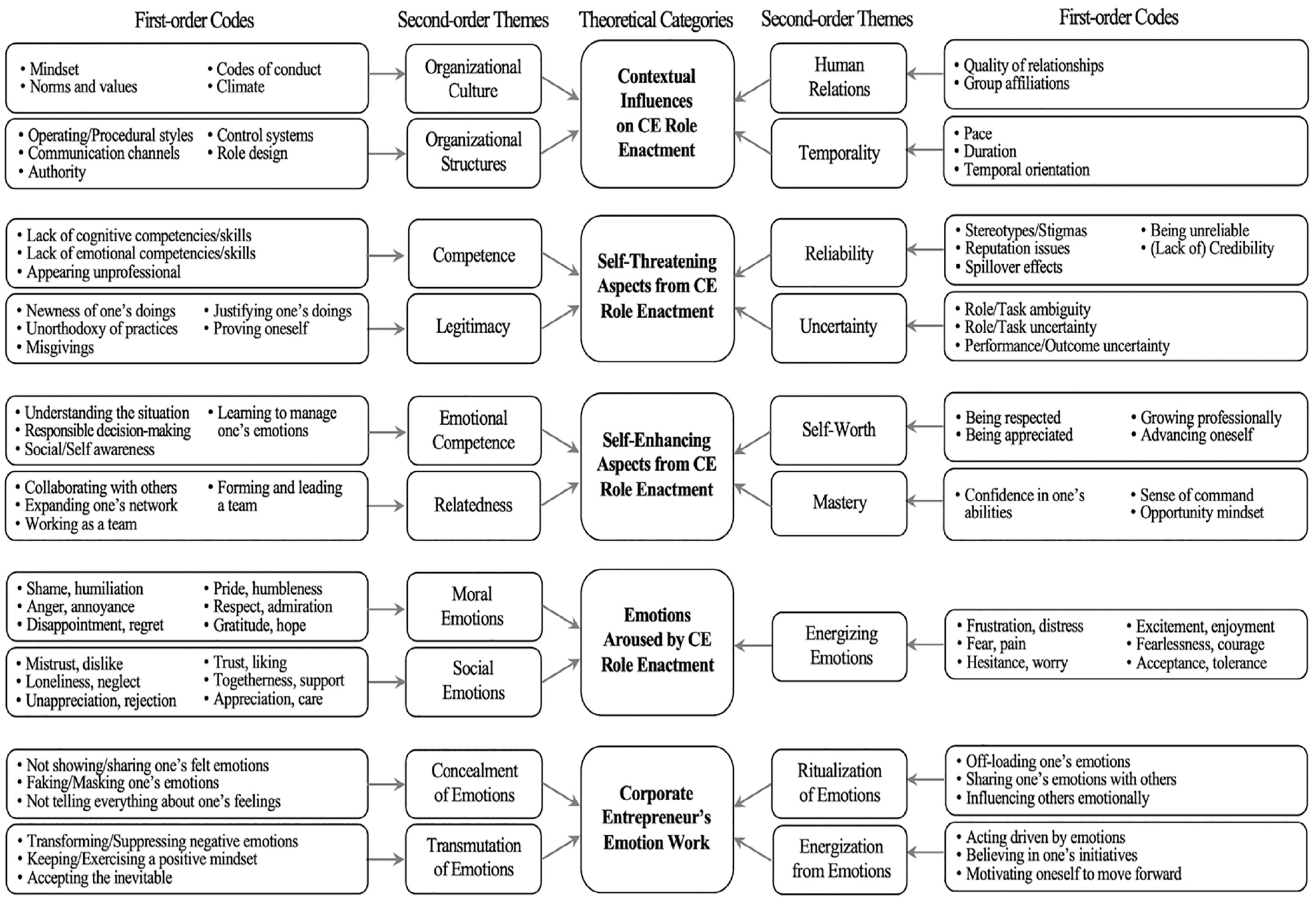
Data structure.
Additional Evidence for Data Structure.

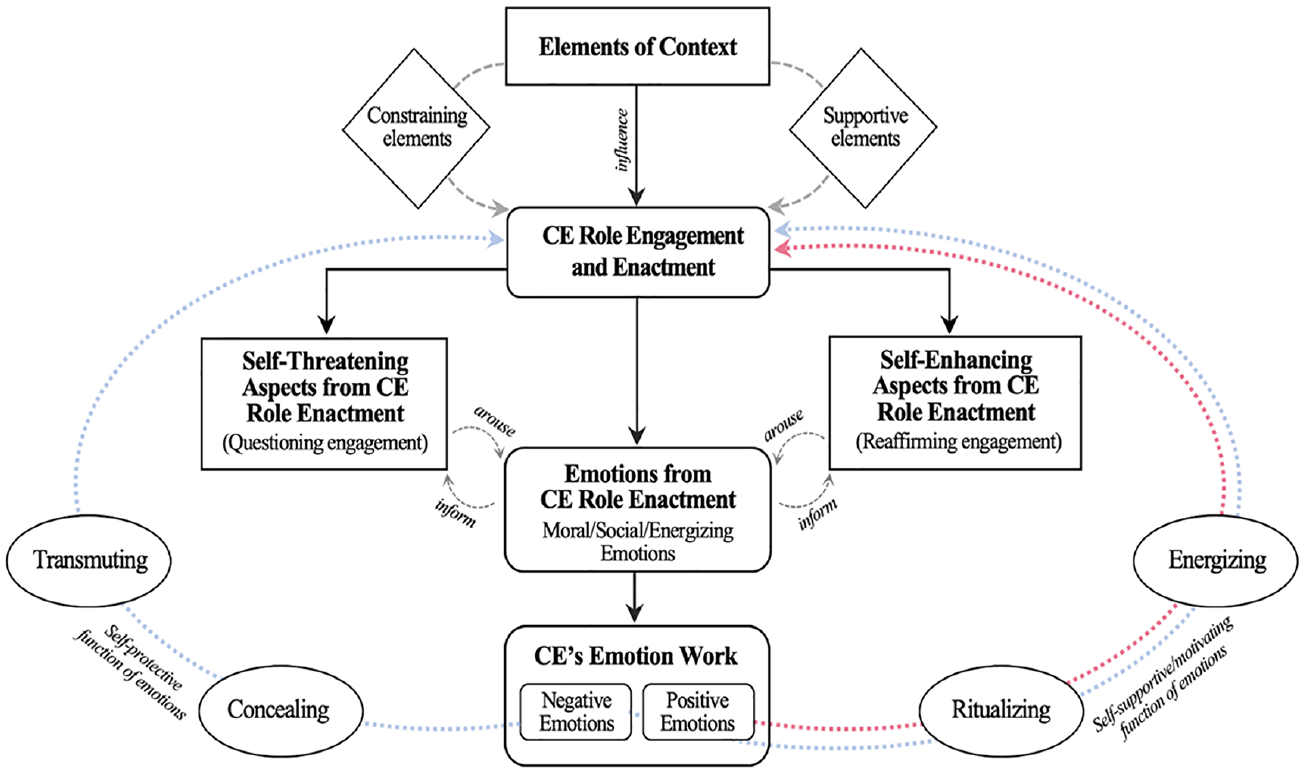
Conceptualization of the informational role of emotions in the CE role enactment.
Findings
Our analysis revealed a variety of contextual elements influencing employees’ experiences as CEs, which brought about diverse liabilities and assets to their WRI. CEs discovered these facets as their entrepreneurial journey unfolded, thus allowing them to subjectively experience the contextual circumstances underlying their role enactment. In turn, emotions provoked by their contextually imbued role enactment activated various forms of emotion work in CEs, thereby helping them to “handle” or navigate through their role. We outline our findings in Figure 3, exploring them in further detail in the following sub-sections.
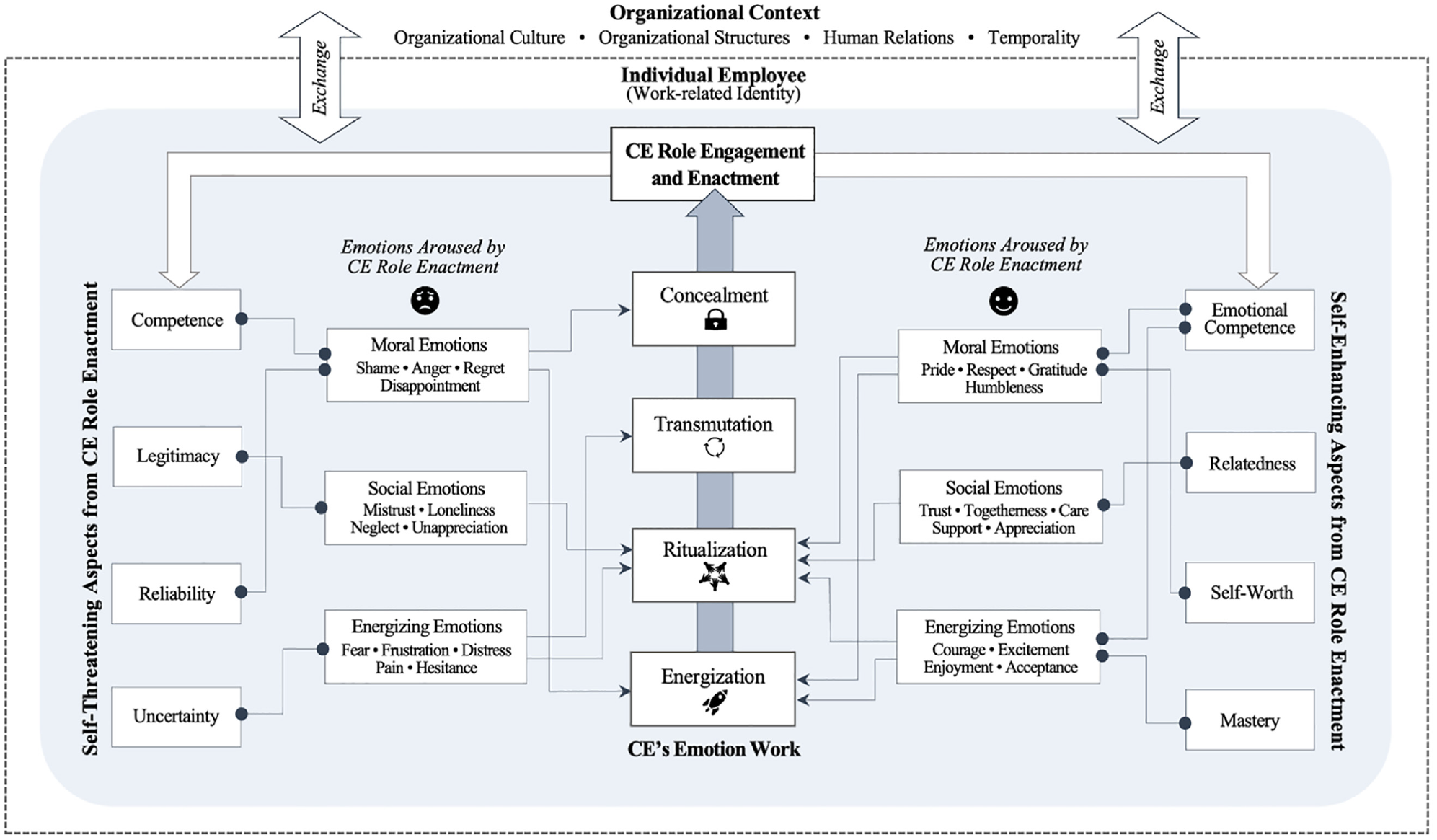
The corporate entrepreneur’s heart in context: An overview of findings.
Contextual Elements that Determine the Emotionality of the CE Role
CEs’ accounts revealed four broad categories of contextual elements that influenced their role enactment either by constraining or facilitating it. These involved (i) human relations, (ii) organizational structures, (iii) organizational culture, and (iv) temporality. First, with regard to human relations, CEs identified attributes (e.g., quality and affiliations) of relationships with others who were relevant for enacting their role: internal stakeholders, such as managers, team members, and colleagues, and external stakeholders such as customers and suppliers. Second, in structures (i.e., the systems by which “decisions are made, activities coordinated, and resources allocated within organizations”; Amis et al., 2020, p. 207), CEs identified issues of authority and control (e.g., hierarchy vs. autonomy), operating styles (e.g., formality vs. flexibility), communication channels (e.g., structured vs. open), and role design (e.g., specified vs. ill-defined). Third, in the cultural domain (i.e., shared norms, values, and beliefs that shape the way organizational members think and act; Dess et al., 1999), CEs referred to the mindsets that exist within the organization (e.g., entrepreneurial vs. pro status quo), its climate (e.g., safe, open), norms, values, and codes (e.g., professionalism). Fourth, in terms of temporality (i.e., time-related events or elements internal to social processes that contribute to their making and meaning; Reinecke & Lawrence, 2023), CEs mentioned issues concerning the pace of work (e.g., slowness vs. agility), temporal orientation (e.g., the future), and duration of events (e.g., tenure, role engagement span). We now proceed to describe how these contextual elements—summarized by one informant in the quotation below—could influence CEs’ role enactment and WRI. Despite its positive aspects, the negative side of working as a corporate entrepreneur is that you’re still in a corporate environment with many different stakeholders and decision-makers. You have hierarchies, many silos, different units and ways of working—and you also have the burden of reporting, which I wouldn’t have if I were acting on my own. (CE32)
Emotionally Experiencing the CE Role as a Liability to Oneself
Our analysis indicated that enacting a CE role created a sense of vulnerability in CEs, who perceived that acting entrepreneurially within an organizational context affected or held potential to affect negatively who they were at work. In this regard, four different types of liabilities to CEs’ WRI emerged from their role enactment: (i) competence, (ii) legitimacy, (iii) reliability, and (iv) uncertainty.
Competence
Informants acknowledged that enacting a CE role required specific competencies or individual characteristics in the form of knowledge, skills, and personality traits that allowed them to perform a job or handle a situation successfully (Hayton & Kelley, 2006). It follows that a lack of such competencies—or not possessing these in sufficient amounts—hindered the role’s effective enactment. Importantly, cultural and temporal contextual elements contributed to this liability. On the one hand, informants felt vulnerable when cultural factors, such as norms and codes of conduct, did not tolerate failure or technical incompetence. This situation emerged because CEs were not knowledgeable about everything related to their entrepreneurial initiatives, particularly when these involved multidisciplinary types of knowledge or technical skills they did not possess. On the other hand, an unsupportive culture together with the future-oriented nature of corporate entrepreneurship required psychological or emotional strengths, described by CEs as being “resilient,”“patient,” and not easily “defeated” by the (unexpected) difficulties they encountered. They also had to be willing to assume responsibilities and able to bear ambiguity. The lack of such strengths meant that CEs were unable to perform well and endure the long-term commitment required by their entrepreneurial endeavors, thus making them more likely to give up. In this respect, one of the informants explained: In a CE role, you need emotional, in addition to cognitive competencies to perform well. Yeah, that’s absolutely important in this role. Lacking emotional competence is something that I, personally, have been struggling with. In my previous CE role, I was really broken [emotionally] by failure because of not having such competence well developed in myself. (CE13)
Informants also pointed to the potentially devastating consequences of a lack of emotional strength on their mental health. For instance, one employee leading an internal venture declared, “Had I been [emotionally] weak, I would have been on burnout leave a long time ago,” further affirming, in reference to herself, that “occupants of a CE role should necessarily be emotionally strong individuals” (CE4). Overall, CEs perceived that a lack of cognitive and emotional competencies could endanger their leadership and affect their image as individuals capable of managing the challenges of an entrepreneurial process. This situation made them feel “ashamed” and emotionally “exposed” or “vulnerable”—an experience that they figuratively assimilated to the Finnish habit of “getting naked together with [unfamiliar] others [e.g., customers] in a sauna” (CE60s).
Legitimacy
Enacting a CE role posed a challenge to CEs’ acceptance, validation, and appreciation within their employing organization, thus generating a legitimacy struggle for them. They attributed these difficulties to structural (e.g., the unorthodoxy and lack of institutionalization of their role) and cultural (e.g., a pro-status quo mindset) circumstances, in addition to the temporality inherent in the entrepreneurial process (i.e., a future orientation). These elements elevated this liability for employees who perceived their employing organization’s culture as unsupportive of entrepreneurial initiatives. Informants accounted for this aspect by recalling that, in view of their entrepreneurial initiatives, other members typically asked: “Why they [people working at the venturing and innovation unit] have to be different to the rest of us [the organization’s members]?” (CE13). Such concerns induced CEs to feel that their role and actions were misunderstood or even questioned within the organization, treated for example as unnecessary or not contributing to the organization, as one informant illustrated: When you’re inside a corporation trying to implement this internal startup system, it always raises suspicion in others, and it starts to affect the company’s culture. Titan is a big company, of about 15,000 people. So, maybe 75% of them did not even know that our internal startup existed, but 25% of them were thinking, “Hey, those guys are now somehow special. They’re given freedom to do things, and we don’t have such amount of freedom.” So, it was creating a divide among Titan’s employees. There was a feeling like, “We need to do tough business and they are wasting our money.” (CE45)
Although this liability was present even if a corporate entrepreneur was a tenured employee or current or former occupant of a leadership position (e.g., a top management member), our data also suggested that it was somewhat alleviated when entrepreneurial activities were formally endorsed or included as part of an employee’s formal role description: My team is quite different from the rest of the organization [laughs]—very much different. And it’s really about showing this entrepreneurial spirit—we’re people who want to change how things are done. And luckily, we have a mandate for that—none of us is even supposed to work on the same things that we’ve been doing for the last twenty years. (CE34)
However, such a “mandate” was not typically the case in our sample. Instead, for employees who invested exceptional energy in serving the organization’s best interests, the absence of their organization’s validation and support affected their motivation at work, disheartened them in their entrepreneurial endeavors, and made them feel unappreciated, distrusted, ignored, and abandoned. Overall, the lack of legitimacy made their intrapreneurial experience a “lonely journey” (e.g., CE4, CE50) and caused demotivation and regret about their role engagement.
Reliability
Hindrances to employees’ reliability in terms of their image as individuals worthy of respect and trust also emerged from their engagement in a CE role. Informants perceived that several contextual elements influenced this liability. The organization’s culture (e.g., norms, mindsets) caused setbacks in the entrepreneurial process and endangered CEs’ reliability. Furthermore, organization members’ beliefs around entrepreneurs and entrepreneurship in general, that is, their image of CEs as self-interested, self-sufficient individuals seeking to stand out within the organization generated a negative stereotype around CEs. Here, employees described how images such as the “hero” stereotype posed a liability in terms of their trustworthiness, recalling, for instance: Back in the day, it was said that we—innovators—regarded ourselves as better than the rest of Titan’s employees. This saying originated in a shared perception of intrapreneurs portraying themselves as “heroes,” but not actually caring about the organization. They were just interested in personal merit and whatever their CE role could bring to themselves. (CE8)
Relationships with others, such as external stakeholders including collaborators, suppliers, or customers, could also have a similar effect on CEs’ reliability, as these third parties’ failures (e.g., lack of commitment, bad reputation) likely spilled over to affect CEs. Moreover, organizational structures such as operating styles or control systems thwarted the progress of CEs’ initiatives; while temporal elements (an organization’s pacing) clashed with CEs’“hustle” (Fisher et al., 2020) or created pressures that challenged their ability to deliver on time or perform according to the organization’s expectations.
Overall, these circumstances undermined CEs’ ability to perform consistently well, concomitantly raising suspicions among other members over the virtuousness of CEs’ intentions. Such attitudes toward their reliability caused CEs to feel frustrated, mistrusted, and angry about others’ misconceptions of their role. For instance, one of them expressed: “We have ‘ex-heroes’ at Titan, and I always hated it [the ‘hero’ idea], because what ends up happening is that these ‘heroes’ publicize stunts and don’t deliver anything. That’s why you lose [others’] trust as a corporate entrepreneur” (CE8). Likewise, failure to perform well or live up to the expectations and trust placed in them by others aroused shame and guilt in CEs, who perceived that these downsides could extend to and damage their image and self-conception as employees. In this regard, one informant referred to the negative effects that her entrepreneurial behavior had on her reputation, portraying herself as “an example of how deep sh*t you can get by doing something like this” (CE4), in reference to her internal venturing experience and the unexpected difficulties she faced throughout the entrepreneurial process. Furthermore, emotions caused by this liability could also induce these employees to withdraw from their role or even the organization, as one informant engaged in innovation activities revealed to us: I really felt that I had personally failed, because innovation takes time, and I couldn’t see any results in the short term. I was so frustrated about this situation, that I decided to resign from the company. I was blaming myself for not having any results, and for whatever I hadn’t done right. (CE26)
Uncertainty
A final liability inherent in the CE role enactment was that of ambiguity (i.e., lack of clarity; Monsen & Boss, 2009) and uncertainty. This hindrance emerged from structural elements, or deficient formal institutions around corporate entrepreneurship, that created ambiguity in terms of CEs’ role expectations, task/decision domains, and career paths. For instance, informants asked: “Who [unit] in Nimbus is responsible for start-ups, venturing, or innovation-related collaboration? Nobody!” (CE53); or, “What’s next for me in this organization after this entrepreneurial role? I don’t know” (CE29). Beyond this, temporality, that is, entrepreneurship and innovation as innate “long-term bets,” contributed to the uncertainty of the role and its outcomes, thereby hampering CEs’ ability to anticipate stakeholders’ (customers, top management, other organizational members) requirements and to perform optimally in their role.
The ambiguity and uncertainty faced by CEs rendered them confused, for instance, over who they were and about what they and others could expect from their role (CE7), as well as hesitant, for example, about who they would become after the “entrepreneurial exercise” or where the “entrepreneurial journey” could lead them (CE40). Since this liability hindered the successful enactment of their role, which, in turn affected their overall performance as employees, CEs were concerned about the future of their role and by extension, their continued status as employees and members of the organization. In this vein, one informant reflected: “After all the challenges I have gone through as a corporate entrepreneur, whether there will be a position for me at Jupiter in the future is a total question mark” (CE4). Moreover, CEs’ narratives suggested a fear of failing and/or underperforming because of their inability to “control everything out there,” expressing, for instance: “When you’re scared about something, the way you behave is just human—like coming from the back of your head. We just freeze when facing a possibility of failure, and we simply don’t move forward” (CE1).
Emotionally Experiencing the CE Role as an Asset to Oneself
Our analysis also revealed a flip side to the liabilities of enacting a CE role, namely assets or self-enhancing aspects (i.e., advantages and opportunities for personal growth) to CEs’ WRI that emerged from their role enactment. These self-enhancing outcomes could take the form of (i) emotional competence, (ii) relatedness, (iii) self-worth, and (iv) mastery.
Emotional Competence
Informants perceived that enacting a CE role helped them to develop intra- and inter-personal emotional competencies (Domitrovich et al., 2017; Osher et al., 2016) essential to success in such a role, which they also regarded as further strengthening their self-conception at work. The emergence of this asset, however, was typically triggered by experiences of the distress that CEs encountered when engaging in and enacting their role. For instance, one of them told us: Assuming a CE role took me out of my comfort zone. It’s like dropping you into the ocean and learning to swim—this is why the moment when I engaged in this role was a really defining moment for me. I learned a lot. I really had to push my own limits. (CE15)
Specifically, the development of emotional competencies from their role enactment involved a learning process (Osher et al., 2016) over the course of which informants cultivated abilities that enabled them to understand and deal with the negative aspects of their role, thus perceiving themselves as better equipped to deal with emotionally taxing situations and organizational demands. One informant explained, “As you get more experience [in a CE role], you understand the urgency of things and you learn how to react [emotion-wise], how to manage your emotions” (CE30). Informants acknowledged how they had learned to deal with failure and stressful or disheartening situations, for instance, by staying calm and developing patience and resilience; to recognize and admit their own limitations; and to identify and detach themselves emotionally from situations they remained unable to influence. One informant described this learning process as follows: I could realize that taking failure and the setbacks of my CE role personally was not healthy. So, this was a self-learning process, together with trying to detach myself emotionally from these [negative] things that could emerge from my [entrepreneurial] actions. So, if something doesn’t work, then it doesn’t work—and that’s totally fine! (CE13)
Our data suggested that organizational structures and temporality facilitated the emergence of such competence. For instance, conditions supportive of experimentation allowed employees to overcome their fears or concerns about “doing things differently” by making it psychologically safe for them to try out new ways, whereas role design (e.g., time availability) and time-related aspects (e.g., duration of role engagement) facilitated employees’ exposure to, acquaintance with, and appropriation of the CE role by allowing them to learn, understand, and exercise what their role was about even as they navigated through the emotions that the role generated in them.
Relatedness
Informants further identified relational advantages that emerged from their CE role enactment. Employees explicitly indicated that their “corporate entrepreneurial journey” permitted them to meet new people and expand their networks both within and beyond their organization’s boundaries, thus generating possibilities for forging alliances, collaborating, and learning (e.g., CE5). They also stated that their role provided them with the opportunity to build and lead a team, and to spread their “entrepreneurial spirit” and “vision” amongst members (e.g., CE58s). In addition, convincing internal stakeholders about the relevance of their entrepreneurial initiatives and forming a team was crucial for their projects’ success, and formed an essential source of emotional support for these employees: In this CE role, I also enjoy meeting new people outside Jupiter. But, if we talk about feelings and support, it comes mainly from internal colleagues. But in general, I love meeting new people, new companies, and start-ups, as well as working with universities and research centers. There’s a lot to learn for me from them. (CE5)
The relational asset that emerged from enacting a CE role enhanced employees’ work identity by nurturing their sense of belonging within the organization, making them feel that it was “their place” (CE29). At the same time, establishing good relationships at work made them feel “supported,”“appreciated,” and “rewarded,” which encouraged them to move their initiatives forward and persist in their role. In this context, CE34 expressed being part of “a nice team” which “worked very well together” and where members “cherished the same values.” Such characteristics, in turn, helped group members “share their experiences at work and support each other emotionally.” Similarly, CE1 described her “gratitude” for “being supported” by her main manager (referring to CE56s), remarking that “feeling emotionally supported” motivated her to do her job.
Self-Worth
Informants also indicated that the challenging nature of their CE role increased their self-appreciation. Their success in enacting this role led these employees to regard themselves as capable of doing things that others would not dare to do. Achieving good results was emotionally rewarding for them, typically stating: “Seeing that we are doing something different makes it worth the struggle and worth the change management. That’s really great.” (CE34). Similarly, the ability to assume risks that others would not undertake, and the courage to engage in entrepreneurial initiatives imbued CEs with a sense of pride in themselves (CE5): “I am proud of the work I have been doing [as a CE]. This new area has not been the easiest one to work in, and that makes a lot of things different.”
Our analysis indicated that contextual cultural and structural elements perceived by CEs as facilitating their role enactment contributed to their self-worth. However, even in cases when such elements were perceived as “not optimal” for entrepreneurial activities, they also contributed to CEs’ growth and sense of meaningfulness. In this regard, informants acknowledged the “legacy” (e.g., a strengthened entrepreneurial culture; CE38) or “trail” (e.g., proven ways of doing things; CE36) they had created for “doing” and “encouraging” corporate entrepreneurship within their organization. What is more, they perceived that their actions improved how things were done in the organization in general: What I have done as a corporate entrepreneur at Phoenix has been worthwhile. We have impacted significantly how things are done in the company. We took the necessary first steps to implement this transformation [from manual, to tool-driven, to automated processes] and now I want to encourage other employees to engage in these kinds of experiments. (CE3)
Being able to generate an impact enhanced CEs’ self-worth and helped them realize the relevance of their role, while their achievements also elicited appreciation and respect from colleagues and peers. For instance, CE31 referred to a colleague engaged in a CE role as follows: She [CE50] had a very good idea, and it’s been mainly her who has been pushing this new concept [description of the innovation developed]. It’s been quite a nice project, and she has been very persistent. I would say that she is the best entrepreneur in our whole organization—she has really been doing almost everything by herself. (CE31)
Mastery
Lastly, employees perceived that enacting a CE role allowed them to gain self-confidence and strengthened their ability to manage themselves and their circumstances, that is, uncertainty and ambiguity. Organizational structures (role design) and temporality (future orientation) appeared to influence this asset and its associated emotions. Informants noted the ability they had acquired over time to suggest what should be done in a given situation with confidence (e.g., CE32), to identify possible courses of action and new opportunities that leveraged their competencies (e.g., CE43), and to control and take ownership of their role-related tasks (e.g., CE7, CE30). At the same time, they did not regard working in ambiguous or turbulent scenarios as a necessarily negative aspect. In effect, some informants acknowledged the attraction inherent in the ambiguity and speed of their entrepreneurial activities, and others expressed their predilection for uncertainty (e.g., CE1, CE40): After being engaged in this CE role for a while, I’m now able to see uncertainties as opportunities, so I’m usually thinking in terms of, “Ok, we don’t know about ‘xyz’, but how can we get rid of the uncertainty?” (CE40)
Overall, employees acknowledged that by engaging in a CE role, they developed a higher sense of control over dynamic environments and the outcomes of their entrepreneurial actions, which induced feelings of empowered and courage. For instance, CE14 explained that “having [collected a number of] success stories” over time as a corporate entrepreneur “increased his self-confidence” and made him “braver and bolder.” These outcomes, in turn, strengthened CEs’ sense of mastery (Ryff, 2019), which energized them to move their initiatives forward, generated a sense of hope for the future, and nurtured their projective agency (Reinecke & Lawrence, 2023): I get a lot of enthusiasm from what I do [as a corporate entrepreneur]. I’m hopeful about the future, hopeful about creating something better through what we are doing. I’m happy about being in this role because it has such a good purpose: it feels like we’re actually doing something good for our planet. (CE53)
In numerous instances CEs noted the twofold or “paradoxical” effects of their role enactment, pointing out its challenges while also acknowledging its rewarding side. For these employees, their role was like a “double-edged sword” (CE20) whose challenges would not easily defeat them: If I cannot find a solution to a problem in this CE role, I don’t give up very easily. Overall, I would say that my role is kind of a “double-edged sword.” (CE20) Being a corporate entrepreneur is, definitely, not easy. But I think that because the role itself is challenging, it is also rewarding—It feels extremely rewarding when you achieve results or deliver projects successfully. (CE14)
Managing Emotions Strategically to Sail Through a CE Role
Faced with the emotions aroused by their role enactment, CEs resorted to diverse emotion-based practices or emotion work (Hochschild, 1979), which enabled them to overcome the challenges they encountered along the entrepreneurial journey and alleviate their role-related emotional load. These practices involved (i) concealing, (ii) transmuting, (iii) energizing from, and (iv) ritualizing emotions.
Concealing Emotions
One common practice deployed by CEs was the concealment of negative emotions provoked by role-related liabilities due to a perception that displaying such emotions could affect their image or how others within the organization regarded their ability to endure and deal with the challenges of a CE role. For instance, CE4 manifested her comfort with her team in being able to “talk about the [emotional] difficulties” (i.e., disappointment and frustration) associated with their internal venture’s activities, while being constrained to “show those feelings” when meeting the [venture’s] stakeholders. CEs needed to be able to manage their emotions in a way considered “appropriate” to their organizational context, which, in turn, enabled them to live up to the fuzzy expectations of their role and the apparent status it created. Informants explained this situation by stating that, “if you are an entrepreneur within an organizational context, showing [emotional] weakness or stress will negatively affect your image as an employee” (CE34), subsequently explaining that they had to conceal emotions that would endanger their image and perceived competence: The official statement from the company is that everyone is allowed to show weaknesses and emotions. That’s what people are saying—but that is not true. You always have to show up smiling and be full of energy and in a positive mood. (CE34)
Transmuting Emotions
CEs also worked internally to neutralize, suppress, or transform potentially detrimental or negative emotions that they experienced in the wake of the undesirable consequences of their actions. In this way, they cognitively reappraised (Stets & Turner, 2006) negative experiences and worked on shaping their meaning so as to transform these into representing or evoking something good, subsequently arousing positive emotions in themselves. For instance, CEs reappraised failure as “a learning experience” (e.g., CE1, CE32), or as an inevitable aspect of acting entrepreneurially. Such reappraisal, however, required “exercise” and regularly embracing a pro-failure mindset: If you’re in this risk-averse world and mindset, failure is typically considered as not good. But for us—entrepreneurial employees—failing is fine and failing is learning. And that’s also very much a mindset issue; you just have to bring this pro-failure mindset up on a regular basis. (CE25)
By reappraising the negative consequences of their entrepreneurial activities, CEs resigned themselves to accepting these challenges as unavoidable aspects of their role. As such, they believed that “experiencing emotional difficulties” was “part of being in a CE role,” as they were “always faced with challenges and problems” (CE43). This voluntary and conscious effort to transmute (Turner, 2006) their emotions typically helped CEs to deal with the frustration elicited by, for example, failure, adversity, or other undesired events, transforming it into neutral or slightly positive emotions such as serenity or acceptance, thus enabling them to move forward in their role. In one informant’s words: When you face these “windmills” [negative situations] which you cannot fight against, either you get frustrated and bang your head on it, or you just accept that you cannot affect everything out there. (CE36)
Energizing from Emotions
Entrepreneurial employees also described a form of emotion work that consisted in resorting to their own emotions so as to energize themselves. This self-directed emotion work helped them to endure their role and promote their initiatives. In that sense, informants experienced excitement and enjoyment about their entrepreneurial initiatives, passion for what they did, and the courage to take risks and face uncertainty. Such emotions denoted CEs’emotional energy, that is, feelings of enthusiasm and strength, as well as the desire for action (Collins, 2004, p. 42). Here, CE1 explained that “staying curious, being courageous, and having fun at work” were “critical to endure and perform” a CE role. Similarly, another informant acknowledged that her CE role was “not easy” and that she “faced emotional challenges” when enacting it; but her “passion for innovating” kept her “energized to move her initiatives forward” (CE27). Informants’ accounts also suggested that their motivations to persist in their role were grounded in moral emotions, that is, feelings of approval or disapproval based on their values and moral intuitions (Stets & Turner, 2006). Gratitude (e.g., about the support received and trust conferred upon them), as well as shame and anger (e.g., upon perceiving that their reliability was at stake, or that they were being mistreated) also emerged as sources of emotional energy for CEs, thus motivating them to endure challenges or assume responsibilities from which other employees just withdrew. For instance, CE4 explained: The company trusted me to lead this project. I was chosen to be the one who would build this idea [internal venture] from scratch, all the way through to the factory and business. It would have been easier to do the same that my colleague did a year and a half ago and just leave the company in view of the internal venture’s difficulties. I could have done that too, but I didn’t; and I don’t want to do it because that would be a totally wrong message to the top management and my team. We want to take this internal venture all the way through together.
Ritualizing Emotions
Lastly, our data suggested that CEs drew on emotions to gain support and credibility from other organizational members. By verbalizing how they felt in their role, these employees sought to create empathy and understanding about their disruptive function, as well as generate a sense of togetherness within their team. In parallel, this practice constituted a way to “vent” and “offload” negative emotions (CE36). However, CEs emphasized that this required trust as a precondition so that individuals could talk about their emotions, and, therefore tended to occur within the boundaries of the corporate entrepreneur’s team or with people who were close to them, for instance supervisors and colleagues. We further observed that CEs drew on this form of emotion work to energize others, keep them engaged, and bring their initiatives forward, thereby inducing them to recognize themselves as being “capable of inspiring others to deal with their fears and not be so afraid of trying out new things and failing” (CE43). In doing so, they resorted to social emotions (Shott, 1979) such as care and support, and to energizing emotions (Collins, 2004) such as courage: In a CE role, you need to take care of your teammates, build team spirit, and encourage them to move forward. (CE1) I’m involved in several projects, so there’s quite a few people whom I am purposefully trying to motivate. To successfully run innovation projects and to keep these people engaged in other projects in the future, it is crucial that you empower them and make them feel that they are important, that they are listened to, and that their work is recognized. (CE42)
Discussion
Little is known about the emotionality of acting entrepreneurially within established organizations, and how this relates to CEs’ cognitions and behaviors. Our study reduces this gap by revealing (i) how the organizational context contributes to shaping the emotional experience that underlies the enactment of a CE role; and (ii) the role played by emotions in supporting such role enactment. Based on our findings, we propose an understanding of the CE role as a double-edged sword forged by heart and context—a metaphor through which we portray its paradoxical nature as a source of contextually engendered assets and liabilities for the role incumbent’s WRI. Furthermore, we suggest that to wield such a sword, CEs must be skilled in strategically using their emotions in relation to their context. By uncovering these aspects, we advance the literature on corporate entrepreneurship as a social exchange, illuminating the social (human relations) and symbolic (culture, structure, and temporality) elements that influence CE role enactment and determine its emotionality.
Although prior research has acknowledged that the organizational context may support the emergence and actions of CEs (Ireland et al., 2003; Sørensen & Fassiotto, 2011), a perspective on context that is primarily objective and unidimensional, as well as predominantly top-down and focused at the organization-level (Garud et al., 2014; Welter & Gartner, 2016) disregards its subjective side—that is, employees’ experiences of, and interactions with such a context (Morris et al., 2012). By drawing on CEs’ accounts, our study elucidates those contextual elements employees perceive as influencing their role enactment and bearing significant emotional implications for themselves. Concretely, social, cultural, structural, and temporal dimensions of context (i.e., circumstances depicting the “where” and “when” of role enactment; Welter, 2011) emerged as elements that could enable or hinder the CE role. When CEs perceived that contextual dimensions’ characteristics supported their role enactment, they experienced positive emotions—while negative emotions emerged when the opposite held true. This interplay accounts for how, beyond the boundaries of the venture itself (Cardon et al., 2009), the social and symbolic contextual elements in which CEs are socialized (Cirillo et al., 2014) can also constitute objects of emotional attributions (Lawler & Thye, 1999) for these actors. In this respect, although previous research suggests that organizational norms neutralize CEs’ emotions (De Cock et al., 2020), our study reveals such norms (as well as other elements of the organizational context at hand) as an active force in triggering and even exacerbating them. Relatedly, our study suggests that contextual elements may matter differently depending on the type of CE activity at hand, with some contextual influences becoming more salient (i.e., perceived as exerting a stronger constraining or supportive effect on CE role enactment) the more that entrepreneurial action deviates from, or challenges, the status quo.
Overall, the dimensions of context we identified—both individually and collectively—extend our understanding of corporate entrepreneurship by adding nuance to what scholars typically regard as the “context” or “container” of entrepreneurial action within organizations (Welter, 2011). Importantly, however, context is neither static nor simply “out there”; instead, contexts are “inside” and “outside” of us (Welter & Gartner, 2016, p. 157) and hence, both subjective and objective realities, the discrepancies between which likely exacerbate the ambiguity of entrepreneurial processes (McMullen et al., 2021). As organizational members, CEs interact with different elements of their context, and their subjective experiences of each of these matter for how they decide to behave and the kinds of roles they are willing to assume and enact. Although entrepreneurial culture has been suggested as the context within which CEs emerge and thrive (Ireland et al., 2009), our study indicates that further contextual dimensions, beyond culture or “institutions” (Welter, 2011), also matter in making bureaucracies more entrepreneur-friendly places. Thus, by illuminating the multidimensionality and subjectivity of context, our study advances knowledge on what drives emotion in entrepreneurship, further elucidating the role of emotions in the “big picture” (Arend, 2013, p. 314) of corporate entrepreneurship as a form of social exchange.
Building on this initial finding, our study also sheds light on how enacting a CE role feels to employees who engage in such an intermediary function (Simpson & Carroll, 2008). Our research reveals not only the CE role as paradoxical, that is, a role that can harm but also benefit the role incumbent’s WRI. These paradoxical aspects are experienced emotionally (i.e., decoded through associated emotions), which suggests the informational, or “guiding” function (Lawler & Thye, 1999) that emotions may play concerning the enactment of roles in the absence of role schemas (Corbett & Hmieleski, 2007). In light of this insight, the exchange underpinning corporate entrepreneurship is also an emotional exchange, where emotions signal information to CEs and their counterparts (i.e., stakeholders). Specifically, because the emotions aroused in exchange are contingent upon actors’ identities (Lawler & Thye, 1999), they become a means of experiencing the “personal significance” of a situation (Stets & Turner, 2006, p. 56). Thus, CEs sense their own and others’ emotional reactions to their role enactment, leveraging this information to generate inferences about themselves and their surrounding environment. When emotions (information) about “who they are” or “what they do” at work are positive (favorable), CEs feel enhanced and, thus, verify or validate their self-views (e.g., what they do is good for the organization), thereby nurturing a positive WRI (Shepherd & Williams, 2018). This experience supports CEs’ role enactment, motivating them to reaffirm their engagement and even encourage others to do the same. In contrast, when such emotions are negative, they indicate a threatened or disproved self and, thus, prompt questions regarding their role engagement. Faced with this situation, CEs resort to self-protective or corrective behaviors (Stets & Turner, 2006) to ameliorate any potential or actual damage to their WRI (Figure 2).
Following from this, our findings suggest that while CEs experienced certain positive and negative emotions concurrently (e.g., excitement and frustration) throughout their journey, other positive emotions (e.g., pride, trust, and courage) took longer to emerge. In effect, such emotions required, or emerged from the cognitive processing of negative emotions by means of, for example, neutralization or “transmutation.” This suggests that the forging of a CE’s sword occurs over time, with a negative side being more evident during early stages of the journey before a positive side gradually emerges as a CE gains experience in their role. We therefore hypothesize that since some of the emotions at stake in each case of liabilities and assets represent complementary opposites (e.g., shame and pride; loneliness and togetherness; fear and courage), this indicates that each liability has a potential asset counterpart, and the underlying emotions signal possible gateways to their achievement—for instance, CEs could alleviate a legitimacy liability by working emotionally on social relationships; overcome a competence liability by developing the necessary emotional competencies; and master or make uncertainty enjoyable by exercising courage. Overall, these findings resonate with previous research that suggests the mixed and ambivalent nature of emotions in entrepreneurship (Farny et al., 2019; Ginting-Szczesny, 2022; Podoynitsyna et al., 2012), as well as adding nuance to the ongoing process (Garud et al., 2014; Morris et al., 2012) through which entrepreneurs are “made” (Sørensen, 2007). Although extant entrepreneurship research has focused on specific emotional processes during early stages of business venturing (Hayton & Cholakova, 2012) or following success or failure episodes (Byrne & Shepherd, 2015), our study considers the emotional experience during the precise period in which the CE role is enacted. By revealing the informational function played by emotions in this journey, we add to the other functions that emotions have been found to have in entrepreneurship, such as influencing decision-making (Podoynitsyna et al., 2012), shaping opportunity evaluations (Foo, 2011), supporting relationships and creativity (Baron, 2008), and facilitating sense-making (Wolfe & Shepherd, 2015).
Finally, our study proposes that CEs’ strategic usage or management of emotions (i.e., emotion work and its associated agency; Hochschild, 1979; Weenink & Spaargaren, 2016) is a crucial skill for CEs’ role enactment. Accordingly, in full awareness of their contextual circumstances, CEs deliberately choose when and which emotions they should conceal, share, transmute, or leverage as a source of energy. In general, we discovered that CEs resorted to all four of these strategies to work around their negative emotions. Such work was necessary, given the harmful consequences that such emotions may have on individuals, their relationships, and their organizational settings (Behrens & Patzelt, 2016; De Clercq, Dimov, & Belausteguigoitia, 2016). For instance, being “trapped” in a negative emotional loop could bias CEs toward identifying only the constraining side of a particular context for their role enactment, which might dissuade them from engaging in any sort of entrepreneurial action, imbue them with pessimism regarding the future; or even render them unable to deal with uncertainty or stigmatizing issues such as failure. From the perspective of relations, negative emotions could feed animosity between CEs and internal stakeholders, thus damaging the former’s sense of belonging in the organization (Shepherd & Haynie, 2009) and obstructing mutual support (De Clercq, Dimov, & Belausteguigoitia, 2016)—and this presents the need to neutralize such emotions or transform them into a more positive form. This flip side, that is, positive emotions aroused by role enactment, emerged in our study as forming the object of fewer types of emotion work, used instead as “fuel” to sustain CEs’ role enactment (Cardon et al., 2009) and motivate them in achieving their goals by energizing CEs and their teams. Overall, based on emotions’ potential to modify or adjust cognitions crucial to the exchange process (Lawler & Thye, 1999), these emotion-based strategies helped CEs to forestall the experience of self-devaluing judgments (Stets & Turner, 2006) and the consequent distressful emotions provoked by their role enactment.
Implications for Policy and Practice
We remain hopeful that our study’s insights will generate awareness in managers and aspiring CEs of the individual challenges and opportunities inherent in enacting a CE role, and the emotional competencies required by such a role. Managers in charge of implementing corporate entrepreneurship strategies within established organizations should consider the emotionality of the CE role and how different dimensions of the organizational context are likely to affect it. Consequently, managerial efforts should focus on nurturing a culture where members understand the nature and contents of entrepreneurial behavior, with an eye to developing the structures (institutions) necessary to facilitate and encourage the enactment of CE roles. For instance, the development of career paths for CEs could help to “institutionalize” this role and reduce employees’ uncertainty about “where the role might lead them” or “who they will become” by engaging in it. Although managers lead the top-down side of these processes, CEs’ bottom-up work could also support these efforts by creating paths for entrepreneurial action and mentoring or inspiring co-workers. Moreover, since our study accounts for the non-monetary benefits or “assets” (Urbano et al., 2022) generated by the CE role for employees who engage in it—that is, the source of eudaimonic well-being (Ryff, 2019)—managers could reconsider the design of incentives relevant for encouraging employees’ engagement in this role. For their part, entrepreneurship education programs may wish to consider the “emotional training” of entrepreneurs, for instance, social-emotional learning programs (Osher et al., 2016) as part of their formative process so as to better equip individuals opting for entrepreneurial careers for the challenges of their working life.
Limitations and Directions for Future Research
Our study is but a first step toward exploring the emotionality inherent in the CE role. One way to expand our insight into the harmful and beneficial aspects of such role enactment would be to undertake a longitudinal analysis of how these perceptions of liabilities and assets emerge over time, and whether they ever attenuate or even vanish. Similarly, researchers could explore the bottom-up influences that CEs can have on their environment, for instance whether, and how, they are able to influence contextual elements that affect their role enactment as they move forward in their entrepreneurial endeavors. A further, intriguing line of inquiry lies in exploring the emotional dynamics that pertain within CE teams or even larger organizational units. Importantly, one limitation of our research arises from our focus on individual experiences. Future research here could adopt an ethnographic approach in order to examine CEs’, and their teams’ or counterparts’, real-time emotion work, as well as the circumstances that determine the effectiveness of such emotion work.
Concluding Remarks
Enacting a CE role can be detrimental, yet also beneficial for those who undertake it. Our study has elucidated how such paradoxical facets of the CE role are experienced emotionally, and how they are shaped by the interplay between CEs and the organizational context in which the role is enacted. In this way, we advance understanding of emotions’ informational function in the enactment of the CE role, introducing CEs’ strategic management of emotions as a necessary skill that allows them to accommodate (embrace and harmonize) the paradoxical facets that their role entails.
Footnotes
Acknowledgements
This paper is dedicated to the first author’s father, an educator and public servant who embraced an entrepreneurial mindset in benefit of his community. Mr. Jaime Soto Bradasic sadly passed away before this manuscript was accepted for publication. Beyond his encouragement, guidance, and example, we are thankful to our editor, Dr. Gaylen Chandler, and the two anonymous reviewers for the immensely valuable comments offered during the review process. We also thank Steven Parham for his helpful editing suggestions.
Declaration of Conflicting Interests
The authors declared no potential conflicts of interest with respect to the research, authorship, and/or publication of this article.
Funding
We gratefully acknowledge the financial support received from the Foundation for Economic Education (Liikesivistysrahasto), Finland.
