




Abstract
Applying an inductive case study approach, we analyze four Pakistani family business portfolios and reveal that rural-based family business portfolios tend to grow internally (organically) and through related diversification. In contrast, urban-based portfolios rather grow externally through acquisitions and partnerships and pursue unrelated diversification. The family’s entrepreneurial legacy and how it is transferred to members of the next generation through grooming and imprinting in rural versus urban contexts emerge as a key underlying mechanism.
Keywords
Introduction
In recent years, the research on portfolio entrepreneurship—“the simultaneous ownership of several businesses” (Carter & Ram, 2003, p. 371)—and a contextualized view of entrepreneurship (De Massis et al., 2018; Welter, 2011) has increased substantially, both in general (e.g., Baert et al., 2016; Dencker et al., 2021; Santamaria, 2021) and in the field of family firms (e.g., Akhter et al., 2016; Stough et al., 2015). The increase in the latter is largely because most family firms—commonly depicted as an organization owned and managed by a family (see Chirico et al., 2020; Daspit et al., 2021; Miller et al., 2007)—often engage simultaneously in more than one business (Zellweger et al., 2012) to achieve long-term growth and entrepreneurial success (Akhter et al., 2016). In addition, by providing “opportunities and set boundaries for [. . .] actions” (Welter, 2011, p. 165), the context in which portfolio entrepreneurship takes place impacts family firms’ entrepreneurial behavior and outcomes (e.g., Fitz-Koch et al., 2019). Specifically, research suggests that distinguishing between family business portfolios in rural versus urban contexts—which denote the often polarized spatial disparity related to location, population, and access to resources (Audretsch & Dohse, 2007; Liu et al., 2013)—is important for explaining their growth, a central outcome of interest in portfolio entrepreneurship research (see Alsos et al., 2014; Fitz-Koch et al., 2019; Iacobucci & Rosa, 2010).
However, although family business portfolio growth (Iacobucci & Rosa, 2010) and the rural–urban context in which a family business portfolio operates (Hansson et al., 2013) are key factors in transgenerational entrepreneurship and value creation (Cirillo et al., 2020; Davidsson & Wiklund, 2006), the literature has remained silent regarding how rural and urban family business portfolios grow. Specifically, whether such growth occurs through an internal (organic) or external (acquisitions and partnerships) growth mode (Achtenhagen et al., 2017; McKelvie & Wiklund, 2010; Michael-Tsabari, 2023; Wiklund & Shepherd, 2008) or through related or unrelated diversification (Carter, 1998; Chatterjee & Wernerfelt, 1988; Hansson et al., 2013; Plate et al., 2010), and particularly whether and why these growth paths may differ between rural and urban contexts, remain unknown. Furthermore, the literature on business restructuring, which primarily focuses on firm growth and expansion (King et al., 2021), recognizes acquisitions, partnerships, and diversification as growth strategies that are decisive for family firm prosperity across generations (Miller et al., 2008). Nevertheless, “there is a need for [family business] research that explores the conditions that influence the selection of different business restructuring options,” with one of the key conditions being environmental factors (King et al., 2021, p. 30). In sum, there is a pressing need to explore how family business portfolios grow and why different growth paths might occur in rural and urban contexts; the main research question we seek to answer is, therefore, “How do rural and urban family business portfolios grow, and why do their growth paths differ?”
Given the limited amount of extant theory and because we seek to reveal the underlying mechanisms of rural and urban family business portfolio growth, we adopt an inductive, qualitative, multiple-case study approach to offer novel theoretical insights into this phenomenon (De Massis & Kotlar, 2014; Edmondson & McManus, 2007; Eisenhardt, 1989). Specifically, we investigate four Pakistani family business portfolios; two cases represent rural family business portfolios and two cases represent urban family business portfolios, allowing us to contrast these cases across the rural and urban contexts (Yin, 2009). In total, we base our study on 43 in-depth interviews conducted with family owners, which are supplemented with on-site observations, archival data, and contextual data.
Our study advances the portfolio entrepreneurship literature in two crucial ways. First, we address a blind spot by shedding light on how family business portfolios grow and what the corresponding role of the rural versus urban context is. We find that rural-based family business portfolios tend to develop internally by pursuing organic growth (i.e., growth through satellite firm creation) and often add satellite businesses that are related to their core business (related diversification). 1 Urban-based family business portfolios, in contrast, more commonly grow through external growth involving acquisitions and partnerships and rather diversify by adding unrelated satellite businesses (unrelated diversification). Second, we illuminate the theoretical mechanisms underlying these identified growth paths and why they differ between the rural and urban contexts. That is, a family’s entrepreneurial legacy, meaning the “rhetorical reconstruction of past entrepreneurial achievements or resilience” (see Jaskiewicz et al., 2015, p. 29) and how it is transferred to the next generation through grooming and imprinting emerge as a key underlying mechanism. In the rural context, family owners employ traditional grooming practices and imprint low risk-taking on next-generation members; in the urban context, family owners rely more on contemporary grooming practices and imprint high risk-taking. Hence, as our study provides “a further step in integrating theory and context by adding complexity to their links” (De Massis et al., 2018, p. 7), it also extends the literature concerning contextual influences on entrepreneurship (Welter, 2011). Interestingly, some studies argue that most family firms prefer to develop new businesses internally rather than through acquisitions (e.g., Boellis et al., 2016) and that they avoid unrelated diversification (i.e., into unrelated business areas) to protect their nonfinancial endowment (see Gomez-Mejia et al., 2010). However, our study points to the key role of the rural–urban context in driving internal versus external growth and related versus unrelated diversification decisions. Finally, we contribute to the growing literature on entrepreneurial legacy, for instance, by linking entrepreneurial legacy and how it is passed on to the next generation to family business portfolio growth.
Theoretical Background
Portfolio Entrepreneurship
The unique characteristic of portfolio entrepreneurship—the simultaneous ownership of multiple businesses (Carter & Ram, 2003)—is repeated engagement in the entrepreneurial process via business creation or acquisition (Alsos & Kolvereid, 1998). Thus, portfolio entrepreneurship constitutes a type of firm-level corporate entrepreneurship; specifically, it represents “external corporate venturing,” as it implies the creation of semiautonomous or autonomous organizational entities outside the existing organizational domain (Carter & Ram, 2003; Sharma & Chrisman, 1999). Some possible reasons for engaging in portfolio entrepreneurship include value maximization, risk diversification, or overall growth aspirations (see Carter & Ram, 2003). Given their members’ long-term orientation and transgenerational entrepreneurship, family firms constitute fertile grounds for studying portfolio entrepreneurship (Zellweger et al., 2012). In fact, an expanding stream of research on portfolio entrepreneurship in family firms has investigated a considerable range of related topics. Some examples include the individual- and family-related drivers of portfolio entrepreneurship, such as the provision of job opportunities for family members (see Carter & Ram, 2003), socioemotional wealth (SEW) tradeoffs (Cruz & Justo, 2017), household influence (Alsos et al., 2014), and the role of different types of resources in establishing a family business portfolio (Sieger et al., 2011). Furthermore, Michael-Tsabari et al. (2014) have found that business families may build a cluster of businesses (which can consist of core and peripheral businesses) in response to family and/or business needs. Similarly, Riar et al. (2022) have investigated how the venturing motives of family members may affect internal versus external venturing. In addition, Michael-Tsabari (2023) proposes that SEW considerations affect whether a new firm is added (by acquisition or founding) or an existing firm is deleted. Moreover, in recent years, research interest in family business portfolio growth in different contexts to explain, for instance, transgenerational entrepreneurship and value creation, has been strong (see Fitz-Koch et al., 2019; Hansson et al., 2013; Radicic et al., 2017). However, despite these considerable explorations of the antecedents and outcomes of family business portfolio growth, how family business portfolios grow, that is, which specific growth paths they follow and how and why these differ across contexts, remains unclear (see Cirillo et al., 2020; McKelvie & Wiklund, 2010; Miroshnychenko et al., 2021).
The Role of Context in Portfolio Entrepreneurship
A context comprises the “circumstances, conditions, situations, or environments that are external to the respective phenomenon and enable or constrain it” (Welter, 2011, p. 167). As such, contexts account for places, time frames, persons, organizations, and the ways in which the specific combinations of these “contexts” create various meanings and interpretations that influence the focal phenomenon (Welter, 2011; Zahra, 2007). In fact, spatial and temporal dynamics are crucial for a better understanding of entrepreneurial phenomena, including portfolio entrepreneurship (e.g., Jennings et al., 2013; Welter, 2011). Although there are many different types of contexts that can explain multiple firm-level outcomes (Patterson & Anderson, 2003), the distinction between rural and urban contexts has been used very frequently in both general entrepreneurship research (e.g., Baù et al., 2019; Bird & Wennberg, 2014) and portfolio entrepreneurship studies (e.g., Westhead & Wright, 1998, 1999).
The rural versus urban distinction is often depicted as a polarized spatial disparity related to location, population, and access to opportunities and resources (Audretsch & Dohse, 2007; Liu et al., 2013). This is because economic activities and resources are unevenly distributed across space, which implies that some locations are characterized by an abundance, and others by a scarcity, of opportunities and resources. Specifically, the distinction between rural and urban regions is drawn because urban regions have a larger and denser population than rural regions, which presents advantages, particularly the following: (a) a diversified supply of various producer services; (b) a regional network for information flows regarding new production techniques, products, customers, and suppliers; and (c) a large and differentiated labor supply (Baù et al., 2019; Norton, 1992). Moreover, compared with urban regions, rural regions are characterized by fewer labor market interactions, linkages between intermediate- and final-goods suppliers, and knowledge spillovers. Rural-based firms also face less demand for their products in both their immediate environment and adjacent nonmetropolitan regions than their urban-based counterparts (Duranton & Puga, 2004). Furthermore, rural regions often experience a lack of key growth resources, such as skilled labor or financial capital (Backman & Karlsson, 2013). These characteristics, in turn, may affect the growth rates of firms in rural versus urban contexts (Baù et al., 2019; Tunberg, 2014).
Most studies in the aforementioned widening stream of research on family business portfolio growth in different contexts have adopted the rural versus urban distinction, with several works explicitly positioned in the rural context. For instance, Alsos et al. (2014) have revealed how the entrepreneurial household and its related strategies affect the formation of business clusters in the rural context. Fitz-Koch et al. (2019) show that such portfolio development is driven by family members’ identities, which are related to the rural context. Moreover, Radicic et al. (2017) investigate the drivers of portfolio activities in the rural farming sector. Hansson et al. (2013) have found that their pursuit of reduced risk, use of idle resources, and social and lifestyle drivers may induce farmers to engage in portfolio entrepreneurship through unrelated diversification outside the agricultural sector. Taken together, these studies therefore reveal that while the location of a family business portfolio (i.e., rural or urban) can generally explain different aspects of family portfolio entrepreneurship, it is particularly central in understanding its growth. However, the understanding of which growth paths are followed in rural versus urban contexts and how and why potential differences occur is lacking. That is, despite the extant works, our knowledge of how family business portfolios grow and particularly why different growth paths may be followed in rural and urban contexts remains rather limited (see also Alsos et al., 2014; Fitz-Koch et al., 2019). Thus, to address this gap, we deeply explore the growth process of family business portfolios to better understand the causal mechanisms thereof (McKelvie & Wiklund, 2010).
Research Method
Research Design
A case study approach is appropriate when the research question is process-oriented or related to how and why something occurs, when longitudinal tracking is needed, and when theory needs to be developed or elaborated (Edmondson & McManus, 2007; Van Burg et al., 2020). Because our study fulfills these criteria, we apply an inductive multiple-case study approach (Eisenhardt, 1989; Eisenhardt & Graebner, 2007). Drawing on multiple cases permits systematic cross-case comparisons that enable the recognition of patterns in the relationships among the constructs, facilitating the emergence of theoretical insights from the data (Eisenhardt, 1989; Yin, 2009). In addition, as case studies are context-sensitive, they are highly suitable for exploring contextual questions (Yin, 2009; Zahra, 2007).
Because the aim of this study is not to test but to develop theory (Eisenhardt & Graebner, 2007), we adopted an inductive approach with “theoretical sampling” (see also Eisenhardt, 1989; Yin, 2009). This is a “purposefully nonrandom procedure that selects cases for theory-building reasons: to illuminate the focal phenomenon and to present theoretically important contrasts” (Li & Piezunka, 2020, p. 319; Nelson, 2017; Yin, 2009). Its main objective is to identify cases that are likely to replicate emergent insights. Given the limited number of cases that scholars usually study, it is beneficial to select extreme or polar types to transparently observe the focal process (Eisenhardt & Graebner, 2007; Pettigrew, 1990). In addition, theoretical sampling implies selecting information-rich cases with respondents who are knowledgeable of the focal phenomenon and available and willing to participate in data collection (Cresswell & Plano Clark, 2011; Patton, 2014). We, therefore, selected information-rich cases of family business portfolios in “polar”—rural versus urban—contexts. Importantly, we define a family business portfolio as a group of firms that includes the core legacy business and satellite firms that are owned by the business family (fully or in partnership).
Specifically, we started by interviewing representatives of family business portfolios. The initial sampling frame was a group of 12 such portfolios, whose selection was for both conceptual and pragmatic reasons (Nelson, 2017). For instance, we selected them from both rural and urban areas, contingent on our access to their data and the personal relationships of one of the authors. To contrast cases across rural and urban contexts, we then selected a final sample of four “polar” and particularly rich cases of private, fully family-owned business portfolios, two from the rural context and two from the urban context. 2 These comprised a total of 23 satellite businesses and allowed us to comprehensively understand the emerging insights. This final selection of four cases was made in accordance with Eisenhardt’s (1989) observation that incremental learning ceases at a certain point when further cases or interviews do not yield new information. Concerning both theoretical and practical factors, between four and ten cases are recommended in qualitative research due to the intricacies involved (Eisenhardt, 1989). 3 All our cases are located in the province of Punjab in Pakistan, where family business portfolios are widespread and key for economic growth in both rural and urban areas (Zaidi & Aslam, 2006). The rural cases are located in nearby villages in the northeast district of Punjab, where the population is predominantly engaged in agriculture- and farming-related business activities. This district has two tehsils (administrative divisions); each comprises two small towns with no higher education institute, forcing young graduates to move to other cities to obtain a university education, significantly limiting their access to a qualified labor supply (Backman & Karlsson, 2013; Norton, 1992). The two urban cases (Safeer and Cherry) are located in the twin cities of Pakistan’s federal capital, Islamabad, and the city of Rawalpindi, surrounded by the Punjab province boundary. There, due to the nearby industrial clusters of the adjacent provinces, population and business density are high, facilitating the exchange of information and enhancing product demand (Duranton & Puga, 2004).
Data Sources and Collection
We primarily relied on semistructured interviews, supplemented with on-site observations, and comprehensive additional data from different sources. In total, we conducted 43 in-depth face-to-face interviews with founders and family owners (see Table 1 for details). The first round of 25 interviews with 15 different interview partners was completed in January 2014. In the second round, 8 follow-up interviews (with 7 different interview partners) were performed across subsequent years until December 2019. Finally, in the third round, we conducted 10 follow-up interviews with 7 different interview partners in September and October 2021. Our interviews produced more than 950 pages of interview transcripts, and our informants provided complete access to information regarding their business portfolios as well as more detailed accounts (e.g., stories and narratives) of their business growth processes (Salvato & Corbetta, 2013).
Overview of the Cases.
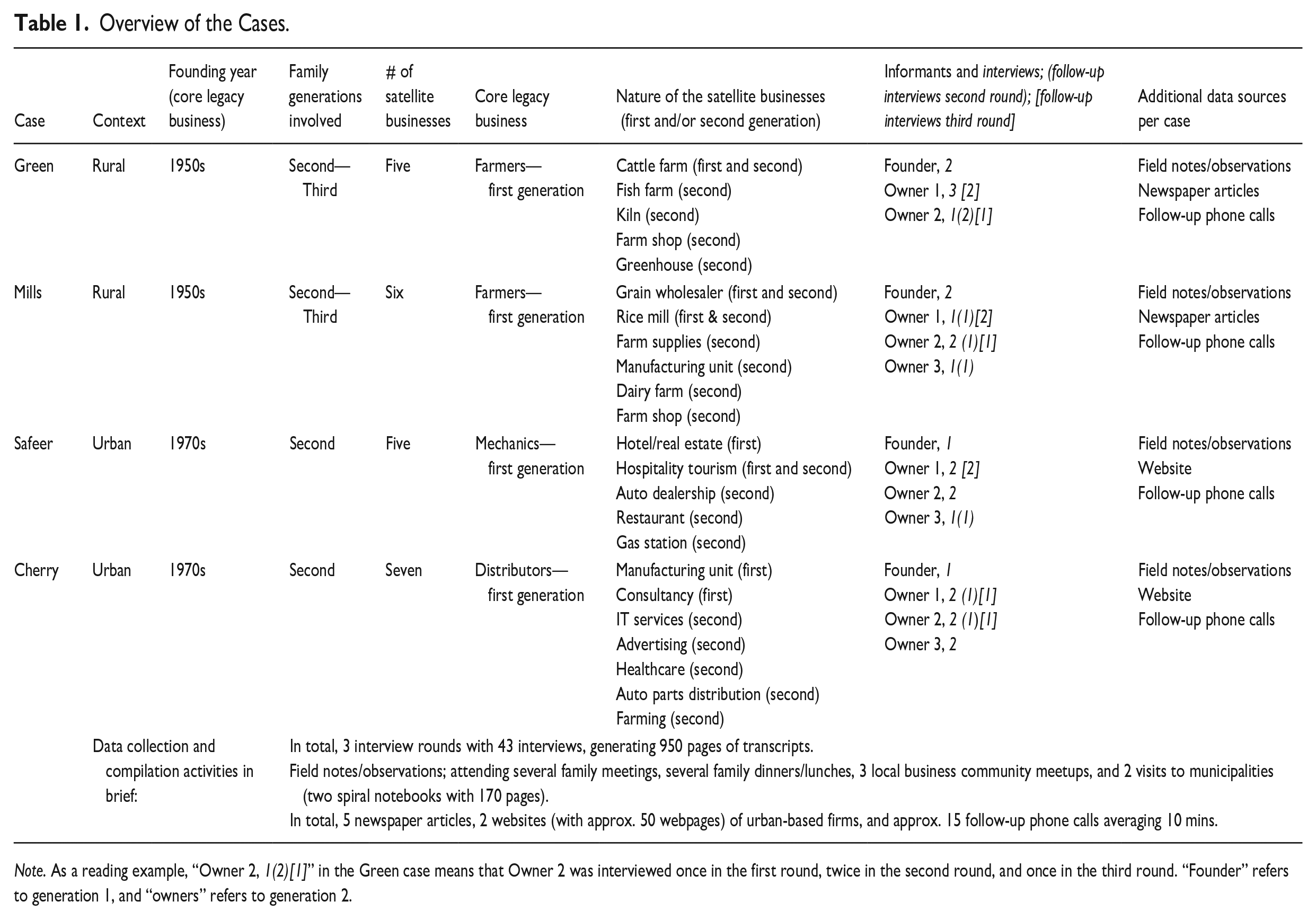
Note. As a reading example, “Owner 2, 1(2)[1]” in the Green case means that Owner 2 was interviewed once in the first round, twice in the second round, and once in the third round. “Founder” refers to generation 1, and “owners” refers to generation 2.
In the first round of interviews, the interviewees were asked to describe the background of their core family business and its satellites. We asked questions about the chronological development of the family businesses, the family members involved, and their places of establishment. For instance, following a narrative style (Floris et al., 2020), the interviewees were asked to describe their firm from its inception (e.g., how the firm was founded and how its historical development unfolded; Appendix B provides an overview of selected interview questions). After reviewing the stated events and business development, we asked the respondents whether we had covered all the key information. Then, the respondents were asked to describe each event associated with a new, subsequent satellite business. Because multiple satellites existed, we highlighted and emphasized the period when each addition occurred; for instance, we asked when, how, and why their family included a new satellite business? What were their reasons for choosing specific businesses and/or industries? We also asked the respondents about each satellite business and other related contextual events (e.g., who was involved, who managed the business, and why were particular family members involved?). Afterward, we began building case histories (i.e., comprehensive case narratives of each case that include, for instance, its corresponding history, major events, and milestones) and engaged in the preliminary data analysis process.
Next, we planned a second round of data collection (i.e., interviews) to gain further insights. Mainly applying a close-ended inquiry approach, we asked the respondents additional questions. Specifically, in light of the emerging themes, these follow-up interviews were performed in a courtroom style (Langley & Abdallah, 2011); we also included closed-ended questions to extract information regarding business development decisions, family involvement, and choices made across space and time. These types of questions are important for clarifying specific issues and triangulation; in addition, they are appropriate for extracting factual information and specific insights. 4 This is because the courtroom style emphasizes facts rather than interpretations, whereby it is widely used in inductive studies (Langley & Meziani, 2020). We also asked questions related to internal versus external growth and related versus unrelated diversification to explore the corresponding mechanisms. Then, a third round of interviews was designed with “why” questions to support, deepen, and validate the initial insights concerning the role of context. Again, these follow-up interviews were performed in a courtroom style by emphasizing facts in an investigative manner (Ozcan & Eisenhardt, 2009). To further validate our insights in our follow-up interviews (in person or through Skype or phone calls), we asked our respondents to clarify matters to incorporate these aspects into our case histories when necessary (Graebner, 2009). Through this “member check” process, we ensured that our interpretation of the data was highly accurate (Nag et al., 2007). These interviews lasted between 30 and 120 min (average length: 57 min) and were tape-recorded and transcribed. 5 We stopped conducting more interviews for each case once we reached its respective saturation point, not obtaining any new information (Francis et al., 2010). In addition, we consulted additional data and materials for triangulation (Miles & Huberman, 1994), such as observations and information from company websites, to further validate our findings. 6
Data Analysis
Consistent with the multiple-case study approach (Eisenhardt, 1989) and inductive theory building (Miles & Huberman, 1994), we completed a three-step process to proceed from raw data to interpretation. This process was iterative rather than linear; we constantly shifted back and forth among the raw data, the relevant literature, and the insights and patterns emerging from the data (Miles & Huberman, 1994; Van Maanen et al., 2007). Nevertheless, for clarity, below, we present the different steps of our analysis sequentially (see also Li & Piezunka, 2020; Smith, 2014).
Step 1
First, we transcribed the interviews, synthesized these transcriptions, and then employed a typical procedure in theory-building, namely, developing individual case reports (i.e., so-called case histories) before moving to analysis (see Van Maanen, 1979). In these documents, the history, major events, and milestones of each case were described. Each case history also included selected interview quotations and supplementary data, such as field notes, observational data, and a timeline summarizing the crucial facts (Bingham & Eisenhardt, 2011). One of the authors transcribed and translated the interview transcripts. Subsequently, all of the authors read these transcripts and then developed their independent views of the cases before agreeing on the emerging findings. These case histories helped us outline the historical issues and events that we subsequently focused on by backtracking their events (e.g., the different growth paths) (Langley, 1999). We continued adding and updating these case histories until we completed the interviews and reached data saturation with regard to extracting new information for each case. This step of developing historical case “narratives” aligns with the approaches in the literature and has allowed us to track and follow each case chronologically (e.g., Smith, 2014).
Step 2
We began coding via the following coding process/scheme, whereby our analytical strategy followed the established procedure in inductive theory building (Denzin & Lincoln, 2011; Miles & Huberman, 1994). On a general level, we started with open coding and used respondents’ terminologies and words to label the text. During this procedure, it became clear that, for instance, statements concerning the “family’s role in the next generations’ future plans” or how “the family is trying or not trying new things” sometimes overlapped with similar statements about “family traditions in business” or the “family’s close control of decisions.” We then reduced the number of codes by eliminating or merging any overlapping codes. We constantly compared our primary codes across the cases, which helped us initially understand these families’ role in growth and diversification. We further discussed the primary codes while moving back and forth between the data and the literature, using existing theories and concepts to interpret our data (Maitlis, 2005). Our iteration drove us to delineate between “grooming” and “imprinting” to explain our codes linked to “exposure,” “education,” and “control,” as well as to “low risk-taking” or “high risk-taking,” respectively.
On a more specific level and to further elaborate the details of our coding process and scheme, we provide the following example of how we moved from one step to the next in the coding process. We coded each case using the text of the interviews as coding units. We continued by labeling the sentences and paragraphs with specific descriptive phrases or simply with words that were striking, as these words were deemed important for capturing the informants’ typical emerging insights. For instance, the informants repeatedly mentioned topics related to their business and family startups and the past, current, and next generations’ entrepreneurial behaviors (Chirico et al., 2011). Importantly, during this phase of the analysis, when reviewing the case histories and transcripts, we identified the emergent themes, which were deemed important and recurrent as they appeared, namely, grooming and imprinting. For instance, the coded units led to the categories of exposure to business, education of next-generation family members, and family owners’ degree of control, which were then aggregated into a higher-order construct, namely, “grooming the next generation,” and then linked to either internal or external growth. Similarly, the previous family generation imprinted an entrepreneurial legacy of either taking low risks or high risks on next-generation members; this, in turn, was then linked to growth through related or unrelated diversification. As such, we coded numerous statements related to how next-generation members were raised by their parents and the influence of this upbringing on their entrepreneurial actions. Thus, the recorded responses allowed us to identify each family’s entrepreneurial legacy and its transfer to next-generation members through grooming and imprinting—as central family-related mechanisms—to explain family business portfolio growth in rural versus urban contexts. We performed manual coding and conducted a cross-check by randomly selecting interview transcripts where we compared our paper-based manual coding with a recoding procedure performed in NViVO. 7
Step 3
We started the within-case analysis process and analyzed each case independently. During this phase, to track each firm’s growth, we focused on emerging constructs and relationships. After this within-case analysis, we conducted a cross-case analysis and outlined the cases’ similarities and differences, leading to a higher level of external validity (Laffranchini & Hoy, 2020). When performing the cross-case analysis, we checked the results against the emerging theory by following the iterative process of alternating between data and theory until a framework emerged (Miles & Huberman, 1994). Specifically, we highlighted the main events in business development, which were subsequently categorized as “internal” or “external” growth and “related” or “unrelated” diversification and were explained by grooming and imprinting and the related impact of the rural versus urban context. Then, we developed propositions by grouping the portfolios (rural versus urban) according to these emerging patterns (internal versus external, related versus unrelated).
In addition, we adopted best practices in case study research to ensure that the findings were obtained through rigorous procedures (Maitlis & Lawrence, 2007). Specifically, we generated a processual understanding of the focal phenomenon by tracking the cases longitudinally, while both present and retrospective data were collected (Van de Ven & Huber, 1990). In addition, our coding process was performed independently but was agreed upon by all the researchers and checked for consistency by an external party (Miles & Huberman, 1994). Specifically, the authors discussed the coding scheme to reach a consensus regarding whether the coding revealed any overlaps. Regarding any disagreements, the coders discussed them until an agreement was reached. Moreover, we involved an external scholar from Pakistan who was familiar with the relevant rural versus urban dynamics; she provided her objective views regarding the interpretation of the data and the contrasting theoretical explanations linked to the rural versus urban context (Graebner, 2009), and she assessed the abovementioned resolved disagreements among the authors. All the authors’ involvement, supported by that of the external independent scholar, thereby “aided in the reliability of the coding” (Diaz-Moriana et al., 2020, p. 264). As mentioned earlier, additional information for triangulation was collected (Eisenhardt, 1989), and the existing information was double-checked using secondary sources, such as local newspapers, magazines, and knowledgeable individuals, including the members of local business communities (i.e., local entrepreneurs) in the different localities; this allowed us to confirm the observations we derived when collecting the data (Van Maanen, 1979). Below, Table 2 provides an overview of the key aspects of our cross-case comparison.
Cross-Case Comparison.
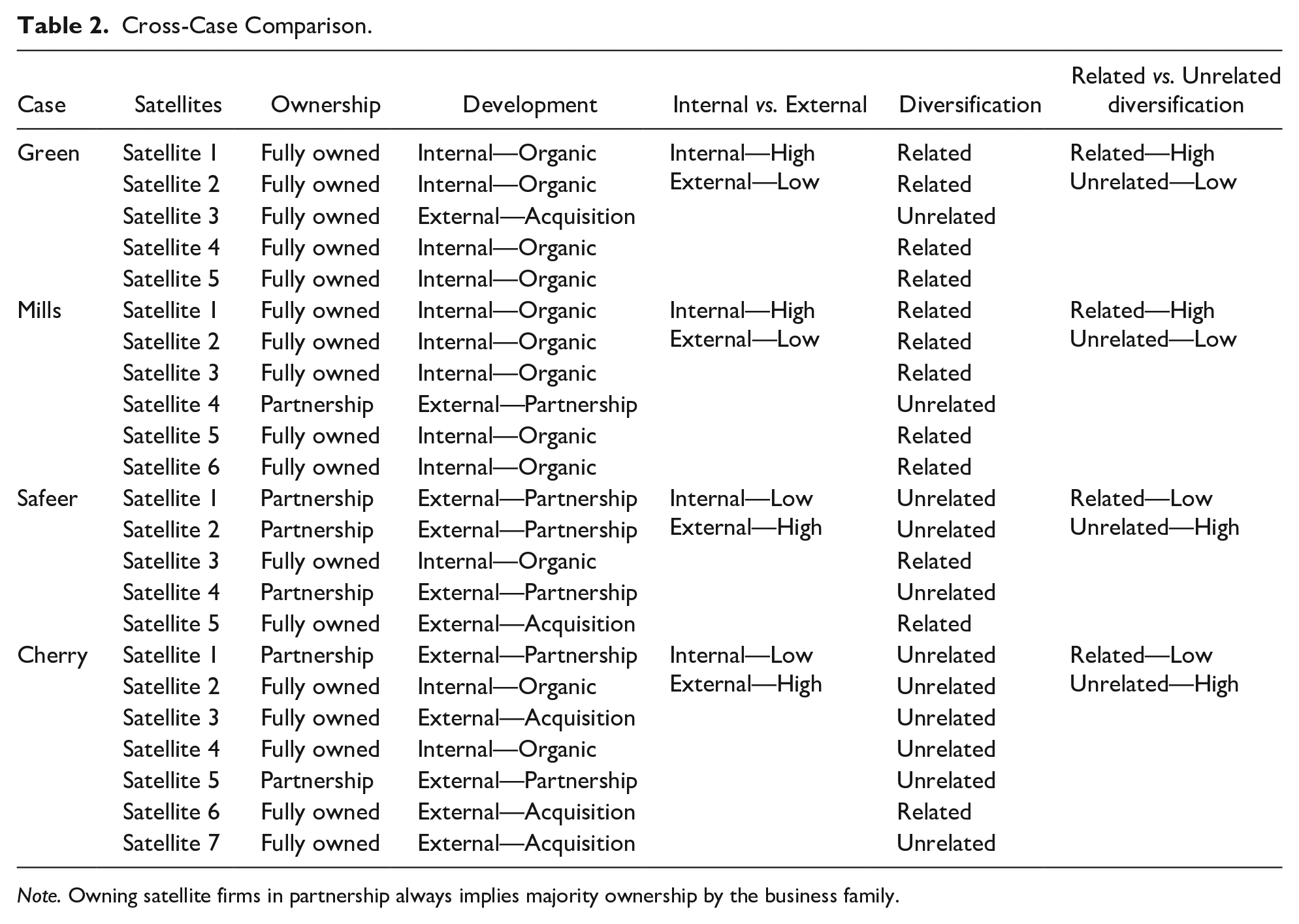
Note. Owning satellite firms in partnership always implies majority ownership by the business family.
Findings and Propositions
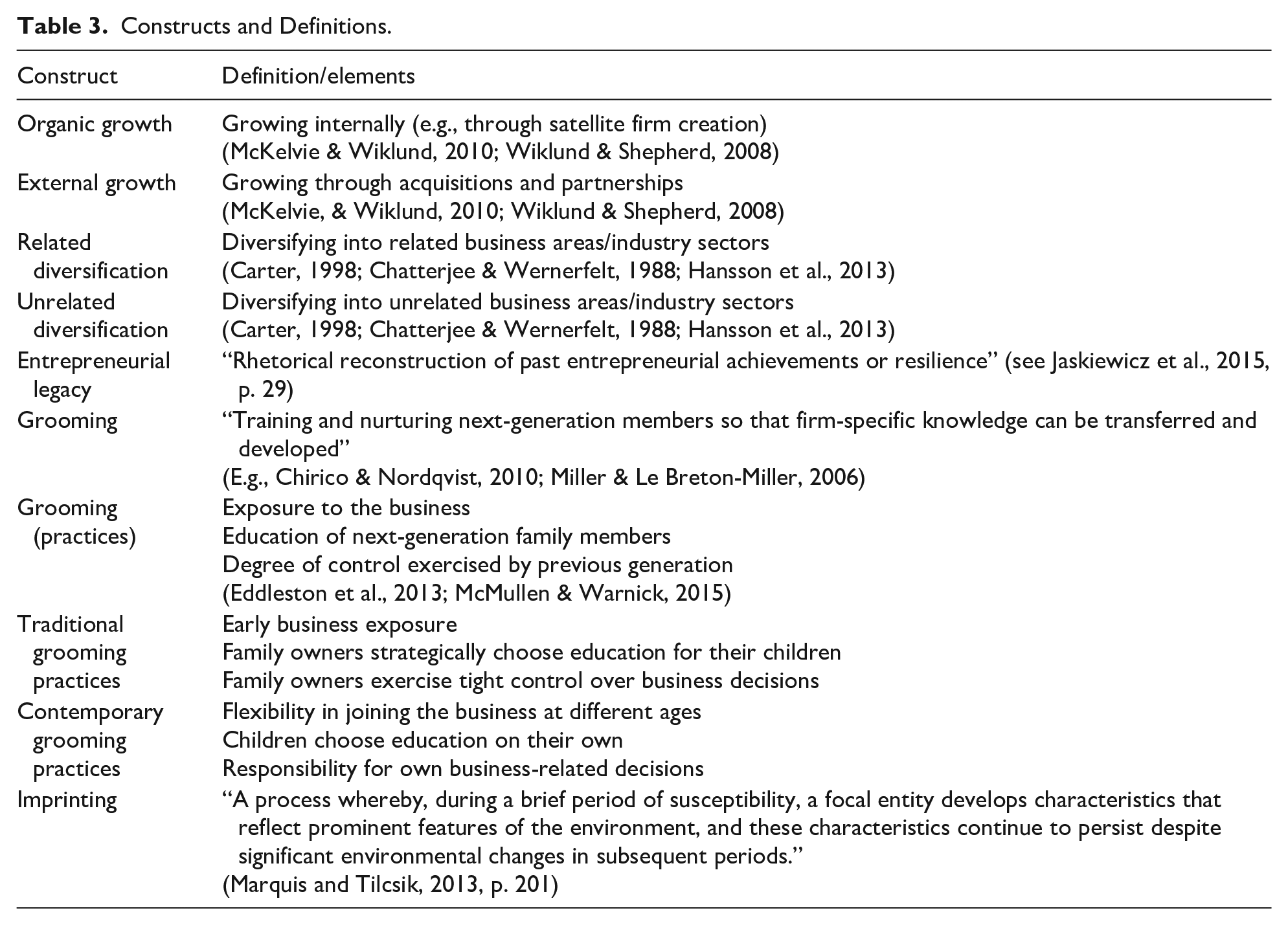
Our findings offer a fine-grained depiction of how family business portfolios grow and why different growth paths occur in rural and urban contexts. Importantly, our case studies show that the rural versus urban context affects the transfer of the entrepreneurial legacy of the family to the next generation through grooming and imprinting. 8 This, in turn, impacts family business portfolio growth. Specifically, our core findings are as follows: (a) the rural context induces traditional grooming practices to transfer the family’s entrepreneurial legacy, which leads family business portfolios to mainly exhibit internal growth (i.e., organic growth). In contrast, the urban context prompts contemporary grooming practices, which mainly imply external growth through acquisitions and partnerships. In addition, (b) the rural context leads to the imprinting of low risk-taking on the next generation, which largely results in related diversification, whereas the urban context implies the imprinting of high risk-taking, manifesting mainly in unrelated diversification. Furthermore, our findings reveal why the rural versus urban context leads to different types of grooming and imprinting. Key factors include the importance of family traditions and values and the availability of entrepreneurial opportunities and resources. An overview of all the focal constructs and their respective definitions is provided below in Table 3.
Constructs and Definitions.
Internal Versus External Growth
How family owners confer their entrepreneurial legacy to the next generation impacts whether an internal or external growth path is chosen. Specifically, how they groom next-generation family members is both decisive and influenced by the rural versus urban context. As we observed in our cases, grooming practices comprise exposure to the business, the education of next-generation members, and the degree of control exercised by the previous generation. In the rural context, family owners follow “traditional grooming practices,” which lead to the following: (a) next-generation members are exposed to the family business very early; (b) family owners strategically choose the education of their children; and (c) family owners exercise tight control over any business decisions. Collectively, this mostly results in internal family business portfolio growth. In contrast, in the urban context, we observed more “contemporary grooming practices”: next-generation members (a) are more flexible in terms of joining the family business at different ages, (b) choose their education on their own, and (c) can make and be responsible for their business-related choices and decisions. This, in turn, results mainly in external family business portfolio growth.
Traditional Grooming Practices and Internal Growth in the Rural Context
The Green case involves a rural-based family business operating primarily in the agriculture sector that has developed five businesses in addition to its core business. It is owned and managed by the founder’s three sons, and the third generation has recently joined the business. The portfolio has mostly developed internally, that is, through organic growth, except for one case in which a business unit was acquired (see Table 2). The Mills case involves a rural-based family business portfolio that has developed six businesses in addition to its agriculture-related core business. Mills’ founding owner manages the business together with his sons and grandchildren. Third-generation family members have also joined the business after completing their studies. Importantly, Mills internally developed five of the six satellite businesses in its portfolio. In the following paragraphs, we present and discuss relevant quotes from these cases; a comprehensive set of additional and representative quotes is provided in Appendix A.
The founder of Green stated the following concerning the early exposure of next-generation family members to the business, the selection of their education, and the underlying reasons: I started to involve both of my sons in the business when they were in their final year of high school and about to start college [common practice in rural areas]. I asked them to apply to the agriculture university for their undergraduate education, as this has been a family tradition [grooming the next generation in a similar business domain] [. . .]. Similarly, as the founder of Mills stated,[. . .] It is a tradition of the families in our [rural] area to involve their children in the business early [grooming], . . .as we believe in the joint family system.
In addition, in the Mills case, the family owners of the previous generation strategically chose to educate the next-generation members in a similar field, which allowed them to keep the latter actively engaged in the business. As Owner 2 stated, When growing up, it is normally difficult to decide on your future career path, but at least the family traditions have made it easy for some of us to choose a path that has already been taken by others in the family [referring to the family’s tradition and values of going to agriculture university in the rural area] [education of next generation].
Traditional grooming practices, in terms of the next generation’s early business exposure and the forced, yet willingly accepted choice regarding their education, are thus driven by the importance of the family tradition, also in terms of study field, and by the value of being embedded in the rural area, which includes the accepted authority of their father. As Owner 1 (Green) noted, The next generation is committed to following family traditions because the family has given our elders the power to decide for us. We enjoy their authority with love and respect, which is the cornerstone of a joint family system [where multiple family generations live under the same roof—a distinctive characteristic of Pakistani rural neighborhoods].
As such, in the rural context, practicing a “joint family system” implies strong values and traditions, which are manifested in traditional grooming practices. Another driver of this early exposure and forced educational choice is the rather limited availability of alternative entrepreneurial opportunities in the rural context. As Owner 1 (Green) commented,Due to the lack of other available opportunities, most of us stay in our family business.This, in turn, is likely to result in internal growth: A lot is happening in the agrifarming sector around us, and what we are doing now is bringing new and innovative ways of farming, keeping ourselves up to date and skilled in this area as well. . .we try to find passion in what we do and we try our best to create businesses out of what is available.
Supporting this view, Owner 3 (Mills) stated, We have been living in this area for several generations, and until the boundaries of the nearby town and our village blurred in recent years, there was some activity of farming practices. . .but, then again, mostly in the areas related to farming. . .as we did by starting the rice mill and our father introduced my brother to the business [the family follows the tradition of involving the next generation in the business at a young age] [grooming the next generation].
Furthermore, the availability of specific resources seems to play an important role; the family owners (Green) had already owned and worked their land and maintained a small farm in their household for several years, and the father had raised some funds to expand into cattle farming. This, in turn, induced the next-generation members’ early exposure to the business and the choice of their “appropriate” education. The family owners thus started and developed the cattle farm [satellite 1] internally, in part because it barely required any extra resources.
The Green case also reveals that the rural context implies tight family control as part of traditional grooming practices, which is used to transfer the family’s entrepreneurial legacy and can ultimately foster internal growth. Specifically, exercising tight control by staying close to the business to informally supervise business partners is a method that is imparted to next-generation members from the very early days of their lives. For instance, as stated by the founder, I receive phone calls and I am approached time to time by external parties interested in thaika [renting the agri-land]. . .and we did that a few times as per our requirement and financial status. . .even when the land was on thaika, our family kept close contact with the thaikaidar [renter], visiting the land everyday. . .practicing my father’s way of dealing with things, ‘keeping your land always close to you . . .’, something that he taught us.
In addition, in the Mills case, the family owners maintained control over the business by developing it internally. In fact, the next generation’s involvement was initially undertaken on a small scale, and subsequently increased through expanding operations. Specifically, as Owner 1 stated, I believe this has been our family’s approach [knowledge transfer through grooming]. . .typical of a rural context. . .to keep us in the business. . .they wanted to provide us with a platform to start the business and to also have control over the business through the involvement of my brother and myself [the next generation].
As such, in the Green case, adhering to the father’s way of addressing issues—exercising strong control and monitoring, which means unconditionally accepting him as a role model and implementing what he has taught—is linked with traditional grooming practices. Similarly, the Mills case illustrates the accepted authority and decision-making power of the family and, in particular, previous-generation members; the next-generation members strongly rely on the family’s agreement and adhere to what the more senior generations have taught them.
Taken together, following family role models, obeying authority, adhering to the established way of doing things, and “doing what has been taught” have thus emerged as the key characteristics of rural business families that, in turn, induce traditional grooming practices to transfer the entrepreneurial legacy. Furthermore, the availability of entrepreneurial opportunities and resources, such as human capital in terms of skilled labor, is limited and induces traditional grooming. Ultimately, rural family business portfolios therefore tend to grow internally. Thus, we formally propose the following:
Contemporary Grooming Practices and External Growth in the Urban Context
Cherry is a second-generation family business located in an urban area, currently and mainly managed by the founder’s sons (the younger of whom is mostly passive in the day-to-day operations and engaged in only smaller scale activities) and daughter (who is responsible for strategic decision-making). Having started in distribution as a core business activity, five satellites were later developed externally, and two internally (see Table 2). Safeer, a second-generation family business portfolio, has followed a pattern very similar to Cherry’s (see also Table 1). Safeer was founded by a motorcar enthusiast who started a repair service for luxury cars—a novel and unique workshop in its city. Through the involvement of the founder and later generation members, two sons and two daughters, the business developed into a portfolio with multiple companies. Specifically, today, the elder son and daughter manage the business, leading it by extending the family’s core business. In total, five satellites have been established, four of them externally.
Regarding the salient contemporary grooming practices, in terms of providing next-generation members flexibility in their timing when joining the family business and allowing them to make their own educational choices, Owner 1 (Cherry) stated the following: Our father gave us a free hand to make our own decisions with regard to our education and career . . . [. . .] There was never any pressure from our parents. . . later on, my sister decided not to join the business, but after my graduation, I decided to start as the executive director. . . our younger brother is finishing up his business studies in the UK; it was his decision, and he is going to start as a civil servant but perhaps plans to leave it at some point and will be involved in the business full-time [grooming the next generation].
Regarding the choice of education and the role of the urban context therein, the founder of Safeer reflected on his daughters as follows: It is not common in rural areas to send girls to study abroad, but it is certainly possible in cities. . . one reason is better education, exposure, and no pressure from being bound to customs that are not easy to break in traditional settings.
This, in turn, facilitated external portfolio growth; as Owner 2 (Safeer) explained, this type of grooming, Gave me substantial opportunities to test myself—the amount of freedom we had gave us the boost to start the business of our choice [through acquisitions] and fondness.
Owner 1 (Cherry) further elaborated on the limited amount of parental control (i.e., the high degree of freedom) and the resulting growth paths: [. . .] the businesses that we later entered into were mostly purchased externally or developed through partnerships. . .my father is basically less involved in the business, but he has had an encouraging attitude that has allowed me to pursue what I thought was best. . .
Similarly, referring to exercising control over business-related choices, Owner 1 (Safeer) noted, I have heard stories about my grandfather and have seen our father taking it easy and playing golf at the club and leaving the garage at the disposal of employees. He would just visit the garage in the evening and had this carefree attitude. For my sisters and me, this carefree mood unfolded in the form of being open to trying new things. We took pride in our parents’ approach and the way they allowed us to be free [degree of control].
These quotes indicate that more “contemporary” grooming practices are common in urban areas, whereby previous generation members serve as important role models and encourage subsequent generations to adopt more flexible behaviors while maintaining control over their own, autonomous choices, such as deciding when to join the family business, selecting their area of education, or choosing the type of businesses to create. This is nurtured by the urban context, in which more “modern” values, such as being independent and making one’s own decisions while being responsible for them, have overtaken the traditional values still found in rural settings.
The subsequent link to external portfolio growth is further facilitated by the urban context as such because it provides unique opportunities and resources to next-generation members, which allow them to follow their desires and engage in entrepreneurial endeavors that, in turn, are fully accepted by the senior generation. As the founder of Cherry explained, [Name of his son] loves to play cricket and now manages one of the cricket clubs in the city and is planning to turn this into a business; this is his way and not what I thought for him but rather what he chose for himself.
As evident in the Safeer case, the urban context provides opportunities and resources, e.g., in terms of networks, which facilitate external growth, as evident in the founder’s following statement:I arrived here in this city young and enthusiastic, got started playing golf, talking to business people with interesting ideas. . . if I had stayed in the village, that might not have given me as much I have achieved here.
In sum, we have found that family owners in the urban context adopt contemporary grooming practices to transfer their entrepreneurial legacy by allowing their children to flexibly choose whether and when to join the family business and complete their education, exercising limited control over businesses, and enabling next-generation members to embrace radical change. This is spurred by the unique characteristics of the urban context such as family traditions and values focused on, for example, granting freedom and independence. The availability of diverse entrepreneurial opportunities and resources in the urban context is also an important contributing factor. This, in turn, has helped next-generation members explore external growth paths, such as acquisitions and partnerships. We thus state:
Related Versus Unrelated Diversification
Our study also indicates that growth in family business portfolios is achieved through either related or unrelated diversification. Specifically, depending on the context (rural versus urban) in which the family business portfolio is embedded, the previous generation either imprints a family entrepreneurial legacy of low risk-taking (mainly leading to related diversification) or high risk-taking (mainly leading to unrelated diversification) on the next generation.
Imprinting Low Risk-Taking and Related Diversification in the Rural Context
In the rural Green case, most satellite businesses are related to the core business (see Table 2). Specifically, four of the five businesses were founded via related diversification. Similarly, in the rural Mills portfolio, five of its six satellite businesses were developed via related diversification.
Regarding the reasons for this, Owner 2 (Green) stated the following: We founded our subsequent businesses with the close guidance of our father, who was under the impression/influence of our business activity [core business] and was not open to entering into new areas of business outside what we were already involved in.
This illustrates how in the rural context, the previous generation’s entrepreneurial legacy of low risk-taking has been imprinted on the next generation, ultimately leading to related diversification. In Mills, next-generation members also found it difficult to overcome their imprinted family entrepreneurial legacy of low risk-taking, implying that they were following the general path blazed by previous generations through related diversification. For instance, as the founder stated, I was so determined to stay in the agricultural sector. . . it was the family inheritance, and I was not taking any chances. . . I probably raised my family like this as well—to not take any risks. . . I thought we were fine, as we were progressing in more traditional ways. . . I realized that others in the family were not going outside the agribusiness either. . . my sons were also using this approach in almost all of the businesses that they had founded.
As such, imprinting low risk-taking, as part of their family tradition and values, on the next generation seems to have been facilitated by the authority, oversight, and role-model function of the father, all of which have been accepted by the younger generation. Moreover, the family’s established way of doing things and a certain path dependency are both relevant in the rural context. These aspects, in turn, have led the family business portfolio to remain within its core business area, that is, related diversification has become an accepted growth path across generations.
Moreover, the limited availability of resources and opportunities in the rural context seems to play a key role. As the founder of Green stated, When I inherited the land from my father, it was a small activity [producing few products for the family], which I later expanded with additional investments [as a professional business activity]. However, I have always been skeptical. . . in regard to introducing new products or entering into new markets. . . after my sons entered the business, I allowed them to stay within the agricultural and farming sector. . . and the buying [acquisition] of Kiln [satellite 3] is not something out of context as this is the land adjoining our land. . . when we bought the land for agricultural purposes, there was this old kiln that my sons made operational. . . to run as an additional business.
Thus, the decision not to take risks and to diversify relatedly is also strongly driven by the availability of inherited farmland and the purchase of adjoining land. The following statement of Owner 2 (Mills) further demonstrates how the rural context limits risk-taking due to resource constraints, such as human capital: With the growth of our area, we recently discussed entering into a take-away pizza business, which we could perhaps easily manage when it comes to finances. But, of course, we would need a team with some sort of experience in the pizza take-away restaurant business. Believe me, we are struggling to find a chef, and no chef is willing to move to the rural setting, as they get a higher salary in towns. Thus, we plan to bring someone with limited experience and send him to training; then, maybe, we can start something like that.
In sum, we have found that family owners in the rural context imprint their entrepreneurial legacy of low risk-taking on the next generation, which results in the family business portfolio mostly growing through related diversification. This is due to the relevance of specific family traditions and values, such as the father’s authority and role-model function, as well as the next generation’s willingness to accept and follow these aspects. In addition, the limited availability of resources and opportunities in the rural context plays a key role, as it limits the possibility of being truly risk-taking and exploring alternative business areas. As such, on a more general level, we find that imprinting the entrepreneurial legacy of previous generations on next-generation members shapes the latter’s entrepreneurial behavior. These considerations therefore lead us to formally state the following:
Imprinting High Risk-Taking and Unrelated Diversification in the Urban Context
In the urban cases, family owners tended to exhibit high risk-taking and primarily develop businesses unrelated to their core business activity. In the Safeer case, the first satellite business was a hotel founded by the first generation and unrelated to the core business. As stated by Owner 2, The hotel business [satellite 1] was started in partnership with our uncle, and later, a few years down the line, my younger sister founded the restaurant business [satellite 4] with the help of some friends [partners in the business]. We had no prior experience in these businesses, but, with the help of my brother, who was studying in the US at that time, and my father’s will, we entered the business. . . and a few years later, when my sister wanted to get into another completely new business, this was supported by the family, although we had no direct experience in that business. . . she had my father’s ability to take risk.
Similarly, the founding generation of Cherry diversified its portfolio by venturing into the paper plant business, which was unrelated to its core business of motor oil distribution. In both cases, the driving force was the risk-taking behavior of the first generation; these behaviors were imprinted on the next-generation members and shaped their entrepreneurial behavior. As Owner 1 pointed out, Our father is an amazing person; he left his job when he was at the peak of growth in his career and opted for entrepreneurship as a career instead, as he was not happy working for someone else. . . his first business was in one of the most competitive industries [in the city], a very bold step.
This openness to risk was imprinted on the next generation, even developing into a “family characteristic” driving unrelated diversification. As Owner 1 illustrated, Three of us [siblings] inherited similar behavior. . . our mom is in favor of our adventurous endeavors; I never heard anything negative about our decision.These statements indicate that the previous generation’s risk-taking behavior allowed the next generation to be open to attempting new things in their businesses as well; this was further enabled by the family’s explicit support of such behavior. As such, the next-generation members have adopted the family tradition of high risk-taking, thereby exploring unrelated diverse business opportunities. That is, the entrepreneurial legacy of high risk-taking has been imprinted on the next generation, mostly resulting in its ongoing unrelated diversification.
Importantly, this pattern has been facilitated by the urban context, which provides novel entrepreneurial opportunities unrelated to the core family business as well as salient resources, for instance, the family-internal and family-external networks of like-minded entrepreneurs. This allows high risk-taking and the pursuit of unrelated diversification in the first place. As the founder of Safeer noted, The environment around us gave us many opportunities that were not possible [in the area] where I moved to the city from. I arrived here with my brother, and we only knew each other and no one else; however, we quickly started to build our network, which in turn opened many doors for us, building connections with the class driving the luxury cars we wanted to fix for them. In addition, we were able to join the ‘city club,’ where we could meet businesspeople and hear new ideas and where we received offers for partnerships. We were ready to take this risk, and we entered in our first business merely with my [theoretical] knowledge, which was my degree, and practically nothing in hand.
As such, the availability of a diverse range of opportunities and resources seems to induce and enable family members to take risks and to “try their luck” in the first place. Referring to the role of the urban context, Owner 1 (Cherry) added, Our parents showed us how to be competitive and motivated us to try our luck in the competitive business environment in our city. The surroundings offer this competitive environment with fast-growing business areas; opportunities are available in many different areas and in nearby industrial clusters. There is a lot to do in this city, you name it.
Taken together, our case studies therefore signal that family owners in the urban context apparently imprint an entrepreneurial legacy of risk-taking on the next generation, often impelling family business portfolios to grow through unrelated diversification. The urban context drives this pattern by providing the opportunities and resources that lay the foundation for taking high risks and pursuing entrepreneurial endeavors outside the core business. Importantly, our cases notably demonstrate that internal growth is not always associated with related diversification and that external growth does not always occur through unrelated diversification. For instance, in the Cherry case, Satellites 2 and 4 were developed internally but in unrelated business fields. Similarly, in the Safeer case, external growth occurred by entering a related business (Satellite 5, gas station business). As Owner 2 noted, We bought the gas station [satellite 5] close to our auto dealership [core legacy business]. . . it was an additional facility for our auto dealership and auto garage, [providing us with] our own gas station, which included additional services and extra space to park the cars as an additional service for our customers because it was [open] 24/7.
Nevertheless, collectively, our case study findings lead to the following proposition:
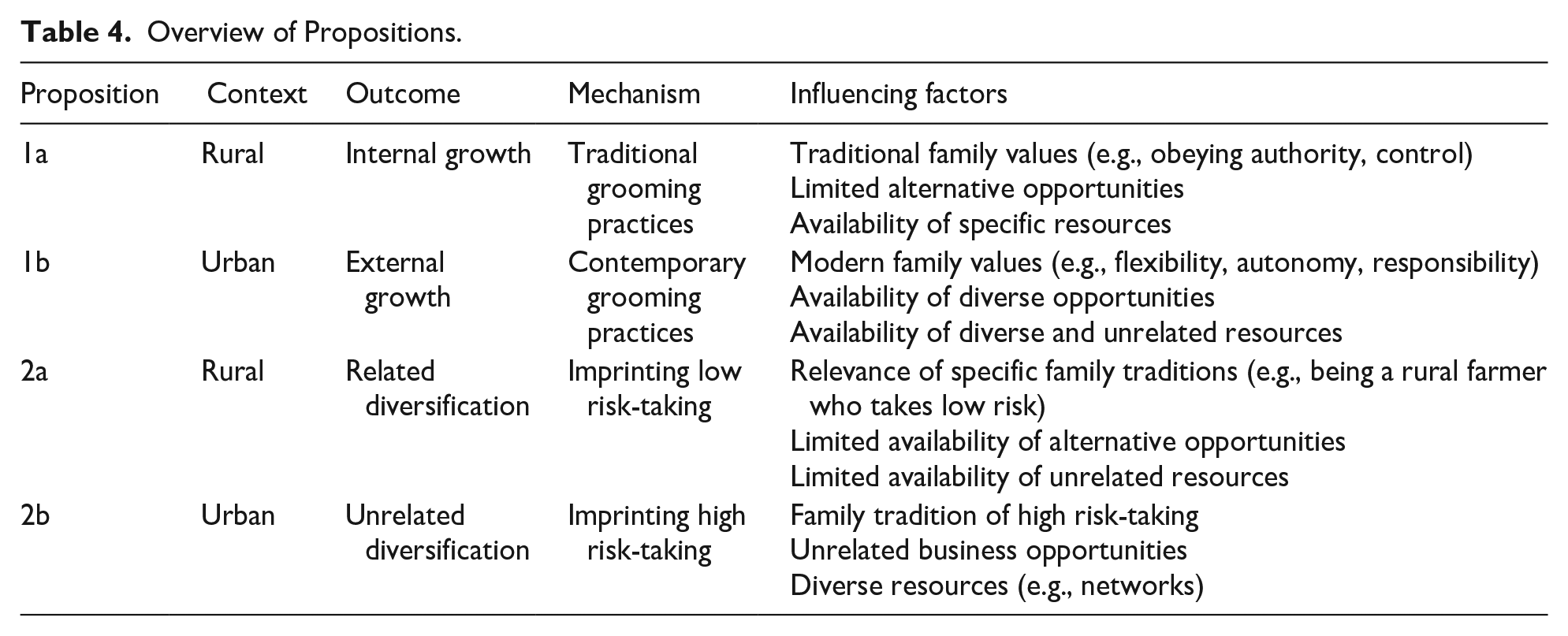
Below, Table 4 provides an overview of our propositions and their respective mechanisms and influencing factors.
Overview of Propositions.
Discussion
How do rural and urban family business portfolios grow, and why do their growth paths differ? Addressing this essential question, our study provides several novel key findings that offer valuable contributions to different streams in the literature.
Contributions and Implications: The Portfolio Entrepreneurship Literature
Our first core contribution to the portfolio entrepreneurship literature is that we show how rural and urban family business portfolios grow, which addresses a critical blind spot in the existing knowledge. In fact, while a comprehensive body of research has investigated the antecedents of engaging in portfolio entrepreneurship (e.g., Alsos et al., 2014; Carter & Ram, 2003; Cruz et al., 2008; Michael-Tsabari, 2023; Michael-Tsabari et al., 2014), it remained still unclear which growth mode and type of diversification family business portfolios adopt to grow (see Achtenhagen et al., 2017; Carter, 1998; McKelvie & Wiklund, 2010) and what the role of the rural versus urban context is therein (Alsos et al., 2014; Fitz-Koch et al., 2019; Hansson et al., 2013). Our case studies indicate that family business portfolios in rural contexts tend to be developed internally (through organic growth) and related diversification and that urban-based family business portfolios tend to grow externally (through partnerships and acquisitions) while mostly pursuing unrelated diversification. As such, we contribute relevant knowledge concerning growth in family business portfolios (Iacobucci & Rosa, 2010; Sieger et al., 2011) and the influence of context on portfolio entrepreneurship (e.g., Alsos et al., 2014; Fitz-Koch et al., 2019). Here, our finding that there may also be deviations from the growth paths that we otherwise have solid empirical evidence for aligns with earlier studies (e.g., Salvato et al. (2010) about Falck, an urban business family that initially followed a rather organic growth path; or Barredy and Caspersz (2022) about Taittinger, a rural-based family business that later followed unrelated diversification). Furthermore, and on a more general level, our study extends the literature on how transgenerational entrepreneurship (Zellweger et al., 2012) and value creation (Cirillo et al., 2020) can ultimately be achieved. Given that portfolio entrepreneurship is a form of external corporate venturing (Sharma & Chrisman, 1999), we also respond to the call to further investigate corporate entrepreneurship strategies in family businesses (McKelvie et al., 2014), drawing a nuanced and novel picture of family firms’ transgenerational entrepreneurship dynamics.
The second core contribution to the literature on portfolio entrepreneurship is that we delve deep into the mechanisms that drive these growth paths and reveal why these mechanisms differ between the rural and urban contexts. That is, we not only illuminate the relevant growth paths as such but also reveal why they occur depending on the context. Hence, we contribute to the vivid debate concerning how the rural versus urban distinction in particular affects the growth of family business portfolios (e.g., Fitz-Koch et al., 2019; Rosa, 2019). Our central and emergent finding from our case studies is that a family’s entrepreneurial legacy and the way it is transferred to next-generation members through grooming practices and imprinting is the underlying mechanism that affects family business portfolio growth. These elements, in turn, are crucially affected by the rural versus urban context (see also Table 4). Specifically, in the rural context, we have found “conservative” family traditions and values, such as continuing specific professional traditions, obeying authority, and accepting the decisions of others for oneself. This corresponds to the typical characteristics of rural-based families (see, for instance, Muhammad et al., 2017). It also resembles close-knit, cohesive “family clans” (Ouchi, 1980) and “joint family systems” (Akhter & Ning, 2019; Baig et al., 2014) that are still common in rural contexts in Pakistan and whose characteristics are strong sense of community, a system of legitimate authority and control, and a strong focus on traditions and related values and beliefs, leading to a unified view of how a business should be managed (see also Moores & Mula, 2000). In addition, in line with the literature, we observe that the availability and diversity of opportunities and resources are much more limited in the rural than in the urban context (e.g., Audretsch & Dohse, 2007; Backman & Karlsson, 2013; Baù et al., 2019; Norton, 1992), which limits the possibility of being truly risk-taking and exploring alternative business areas in the former. These characteristics, in turn, seem to induce traditional grooming practices and the imprinting of low risk-taking in the rural context. Notably, the literature suggests that being path-dependent and exercising greater control, which resembles the conditions under traditional grooming, may negatively affect family business growth (e.g., Kotlar et al., 2014; Pittino et al., 2020). Our case studies, however, indicate that traditional grooming can still lead to considerable portfolio growth over generations—albeit in the form of internal growth. Interestingly, taking low risks and following a path blazed by previous generations does not necessarily entail that next-generation members become less growth focused; instead, our case studies indicate that they seek growth, but through related diversification. This finding challenges Westhead and Wright (1999), who argue that risk aversion leads to a less growth-focused mind-set in habitual entrepreneurs. In the urban context, we find more “modern” traditions and values focused on independence, freedom, and openness to new ways of doing business, supporting the notion that a lower level of “clan control” is associated with urbanization, geographical mobility, and growth (see Moores & Mula, 2000). In addition, the availability of entrepreneurial opportunities and resources is greater in the urban context. Ultimately, these conditions favor contemporary grooming practices and the imprinting of high risk-taking. More generally, these findings also allow us to indicate important connections among the literature on portfolio entrepreneurship, the rural–urban distinction in entrepreneurship, and entrepreneurial legacy, thereby advancing the understanding of portfolio entrepreneurship growth (McKelvie & Wiklund, 2010).
This study has important implications for future research concerning portfolio entrepreneurship, both within and beyond the family business domain. We strongly encourage future studies to utilize further information-rich cases that explicitly account for the context in which a portfolio is situated, such as a rural versus an urban one, as this affects the emergence of important portfolio entrepreneurship outcomes, including growth (see Patterson & Anderson, 2003; Radicic et al., 2017). That is, studies that neglect to explicitly account for the context risk omit relevant driving forces and insights. Specifically, future research could further explore the role of the rural versus urban context in the portfolio entrepreneurship arena by investigating potential corresponding differences in terms of, for instance, the relevance of family-influenced resources when building a portfolio (such as reputation or social capital, see Sieger et al., 2011), SEW considerations (Michael-Tsabari, 2023), or family reaction to declining performance (Akhter et al., 2016). Relatedly, we believe that considering external enablers of entrepreneurship in general and of portfolio entrepreneurship in particular (see Kimjeon & Davidsson, 2021) is a promising approach. Our study should also inspire family business portfolio research that investigates, for instance, whether there are additional growth paths, contingency factors, environmental changes, or family-related drivers beyond our scope. In particular, the role of the family’s entrepreneurial legacy deserves explicit and further research attention; more in-depth and nuanced insights could be gained, for instance, concerning the specific nature of a family’s entrepreneurial legacy and the peculiarities of its links with different growth paths. Finally, our study also provides the groundwork for future quantitative research. Such scholars could seek to operationalize our propositions and to test them with appropriate quantitative data. For instance, they could identify family business portfolios in rural and urban contexts, use available or newly developed measures for the different types of grooming and imprinting, and then track different growth paths over time (i.e., by capturing internal versus external growth and related versus unrelated diversification, respectively).
Contributions and Implications: Research on Context and Entrepreneurship
As a central contribution to the literature on context and entrepreneurship, we address the general need to explore portfolio entrepreneurship along not only processual but also contextual lines (Carter & Ram, 2003). Here, the rural versus urban distinction has proven to be very useful, further supporting its explanatory power (see also Audretsch & Dohse, 2007). As such, we advance the literature by better-integrating theory and context while “adding complexity to their links” (De Massis et al., 2018, p. 7). As a key finding, our study suggests that the rural versus urban context enables either internal or external growth and either related or unrelated diversification. That is, our case studies indicate that family business portfolios can follow either approach, depending on their context. This challenges research that assumes family firms generally prefer internal to external growth (Boellis et al., 2016) and are hesitant to pursue unrelated diversification to protect their nonfinancial wealth (Gomez-Mejia et al., 2010).
Another important contribution is the new light that we have shed on how the rural versus urban context affects the mechanisms that drive our proposed relationships. That is, we provide helpful indications of why the rural versus urban context leads to differences in terms of how a family’s entrepreneurial legacy is transferred through grooming and imprinting, which ultimately affects family business portfolio growth paths. Our finding that this is likely due to the relevance of specific family traditions and values, in addition to the availability of opportunities and resources in the respective contexts, extends previous works on the prevalence and implications of close-knit “family clans” (Ouchi, 1980) and “joint family systems” in rural regions, where several generations live close together under one roof and where family traditions and values are particularly strong (Baig et al., 2014). Interestingly, in their review of the family firm restructuring literature, King et al. (2021) conclude that the mixed results on family firms’ restructuring and entrepreneurial activities indicate that their propensity to engage in restructuring likely depends on underinvestigated contextual variables (see also Pinelli et al., 2023). Our study addresses this notion and introduces the rural versus urban context as a corresponding driver or enabling mechanism (see Kimjeon & Davidsson, 2021) given that family firm restructuring may include acquisition, partnership, and diversification (King et al., 2021). Hence, we also respond to recent calls for research on the effect of context on strategic entrepreneurship decisions (e.g., Agarwal et al., 2017).
Future research concerning the influence of context on entrepreneurship in general and portfolio entrepreneurship in particular could extend our findings further. For instance, more deeply exploring whether not only the growth but also the long-term financial performance of family business portfolios differ between rural and urban contexts could be valuable. Regarding financial performance, scholars could also explore the conditions and circumstances (and time points) under which a rural or an urban context might lead to negative outcomes. Importantly, our case studies have also provided preliminary and initial evidence indicating that the rural versus urban context may “lock” family business portfolios into their respective growth paths. For instance, as Owner 1 (Green) stated,The major obstacle of not entering other industries is the [rural] environment; as you know, it is kind of a corner of Punjab squeezed between two borders, a place that has never attracted industrial investments.In contrast, as Owner 3 (Cherry) added,When you are in an environment that is flourishing and full of ideas, I think it is natural to prosper. . . trying to exploit the environment for growth; who does not love growth? As such, particularly the opportunities and resources provided by these respective contexts seem to make it very difficult to change growth paths, even in the long run. Clearly, systematic and in-depth research in this direction could be very promising. For instance, studies could explore the conditions under which family business portfolios may shift from a rural to an urban type of growth (or vice versa) or change their context altogether, and, if this occurs, how and why (see also Barredy & Caspersz, 2022; Salvato et al., 2010). Here, additional factors such as local embeddedness might play a role (Baù et al., 2019). In addition, on the individual level, the rural versus urban context seems to be relevant; as illustrated earlier, the founder of Safeer mentioned how moving from a village to a city enabled him to meet businesspeople with “interesting ideas.” Here, more research concerning the individual-level determinants of such a shift and the related implications could be valuable.
Contributions and Implications: The Entrepreneurial Legacy Literature
Our study also extends the still relatively small but dynamically growing literature on (family) entrepreneurial legacy (e.g., Barbera et al., 2018; Hammond et al., 2016; Jaskiewicz et al., 2015) in different ways. One key contribution is our novel finding indicating that a family’s entrepreneurial legacy and the manner in which it is transferred to the next generation affect how family business portfolios grow. This supports the notion that entrepreneurial legacy is fundamental for understanding how individuals constantly draw on and make sense of their past and act entrepreneurially across generations (Suddaby et al., 2010), that is, it helps explain transgenerational entrepreneurship (Zellweger et al., 2012). Specifically, we extend the literature by revealing that grooming and imprinting are central mechanisms in transferring a family’s entrepreneurial legacy, which, in turn, manifests in different types of family business portfolio growth. By offering in-depth and nuanced insights into the nature of family entrepreneurial legacy and the specific grooming- and imprinting-related mechanisms used to transfer it, we support the notion that grooming the next generation is key for a family’s future entrepreneurial activity (e.g., Foster, 1995). In addition, we complement earlier claims suggesting that an entrepreneurial legacy is passed on to next-generation members through their active involvement in the business (Barbera et al., 2018; Jaskiewicz et al., 2015), that the founding generation’s imprinting of organizational paths on the next generation is particularly important (e.g., Kammerlander et al., 2015), and that imprinting the entrepreneurial legacy shapes next-generation members’ entrepreneurial behavior (Erdogan et al., 2020). In fact, business families often depict and narrate how their family histories shape their entrepreneurial behavior and growth (e.g., Jaskiewicz et al., 2015; Kammerlander et al., 2015). Importantly, by revealing how entrepreneurial legacy and its transfer differ between the rural and urban contexts, we introduce these contexts as corresponding determinants. Finally, we note that whether family firms are either low or high risk-taking is a subject of continuous interest (see Hoskisson et al., 2017). Some studies have advanced the notion that family firms’ attitudes toward risk depend on the context in which they operate (Hiebl, 2012). For instance, some families opt for high risk-taking in one situation to maintain control but for the opposite in another situation (Hiebl, 2012). However, the literature has not elucidated the underlying mechanisms for why such behavior occurs and what its outcome is (see Hoskisson et al., 2017; Naldi et al., 2007). Our findings suggest that the rural versus urban context plays an essential role in this.
Regarding its implications for future research on entrepreneurial legacy, our study indicates that a family’s entrepreneurial legacy and grooming- and imprinting-related mechanisms clearly merit further attention. For instance, one could explore how these mechanisms can transfer different types and aspects of family entrepreneurial legacies. Moreover, it would be worth examining how a family’s entrepreneurial legacy and its transfer through grooming and imprinting affect other next-generation members’ attitudes and behaviors, such as their reactions to declining portfolio performance in terms of adopted exit strategies (Akhter et al., 2016).
Implications for Practice
Our insights into how the rural versus urban context affects the growth paths of family business portfolios, particularly through grooming practices and the imprinting effects related to next-generation members, have crucial value for family business owners and other members of business families. Members of the senior generation should reflect on how different aspects of their children’s upbringing can affect the future development of their business portfolio. As a result, they might adapt their grooming practices and/or be more aware of imprinting effects. For example, members of rural business families could consider whether they might want to follow less traditional and more contemporary grooming practices if they desire their portfolios to grow more externally and unrelatedly. In addition, members of the junior generation could rely on our findings to reflect on whether and how the way they were raised by their parents might have rendered them “path-dependent” to a certain degree and on how they may “break free” from this pattern. This, in turn, may also induce them to reflect on how they intend to raise their own children.
Limitations and Additional Future Research Opportunities
Our work is not free of limitations. First, although we offer detailed evidence on how and why the rural versus urban context drives growth patterns and grooming- and imprinting-related mechanisms, both our rural cases are active in the agricultural sector. As such, the agricultural sector might constitute an additional explanation of our findings; however, given our extensive and in-depth evidence for the role of context, we believe that context rather than industry is the main underlying driver. That is, we have good reasons to believe that the growth paths and underlying mechanisms we have identified are driven by the rural versus urban context, not by the characteristics of a specific industry or sector. Nevertheless, studies accounting for both the rural versus urban context, as a spatial, geographical distinction (Audretsch & Dohse, 2007), and/or different industrial sectors (De Massis et al., 2018) could be insightful. Second, the generalizability of our findings to, for instance, Western European or Northern American rural regions may have certain limitations given that the context where our rural cases are located is deemed “extremely rural.” While sampling such polar cases is not unusual in case study research because it allows unique knowledge to emerge (see Pettigrew, 1990), future studies that replicate our results in “less rural” regions would be valuable. Nevertheless, our findings could be analytically generalized to other rural settings with similar contextual features (e.g., India, Africa, South America, and Europe). Third, while building up a family business portfolio seems to be a prevalent phenomenon in both rural and urban contexts, doing so is not necessarily occurring under all circumstances. Clearly, more research is needed concerning how and why the rural versus urban context induces business families to develop a family business portfolio in the first place. Finally, when investigating our family business portfolios, we could not consider any satellite businesses that have been abandoned or that failed due to a lack of corresponding information. Therefore, a certain survivor bias cannot be excluded. Future research could address this issue by, for instance, explicitly comparing the growth patterns of failed versus successful satellite firms in the rural versus urban context.
In sum, studying portfolio entrepreneurship in family firms while considering the rural versus urban context has been very fruitful. We hope that our findings stimulate further research efforts that enhance the understanding of family business portfolio growth in rural and urban contexts and the role of a family’s entrepreneurial legacy therein.
Supplemental Material
sj-docx-1-fbr-10.1177_08944865231199791 – Supplemental material for Rural and Urban Family Business Portfolio Growth: The Role of Entrepreneurial Legacy
Supplemental material, sj-docx-1-fbr-10.1177_08944865231199791 for Rural and Urban Family Business Portfolio Growth: The Role of Entrepreneurial Legacy by Philipp Sieger, Naveed Akhter and Francesco Chirico in Family Business Review
Footnotes
Appendix A
Appendix B
Declaration of Conflicting Interests
The author(s) declared no potential conflicts of interest with respect to the research, authorship, and/or publication of this article.
Funding
The author(s) received no financial support for the research, authorship, and/or publication of this article.

Supplemental Material
Supplemental material for this article is available online.
Notes
Author Biographies
References
Supplementary Material
Please find the following supplemental material available below.
For Open Access articles published under a Creative Commons License, all supplemental material carries the same license as the article it is associated with.
For non-Open Access articles published, all supplemental material carries a non-exclusive license, and permission requests for re-use of supplemental material or any part of supplemental material shall be sent directly to the copyright owner as specified in the copyright notice associated with the article.
