



Abstract
Although prior research emphasizes the essential role of anchor organizations’ leadership in entrepreneurial ecosystem development in the early stages, their strategic functions are undertheorized. This study conducted a single case study with the entrepreneurial ecosystem of Santiago de Chile as a revelatory case by examining how anchor organizations catalyze the early evolution of the entrepreneurial ecosystem from the perspective of the orchestration theory. We developed a framework of ecosystem orchestration to demonstrate how anchor organizations adapt their strategic functions in managing and building various networks and resources to dynamic environments in entrepreneurial ecosystems.
Introduction
Since the mid-2010s, research on entrepreneurial ecosystems has drawn rapidly growing attention from scholars seeking to understand why certain regions are more productive than others in generating startups (Spigel & Harrison, 2018; Stam & van de Ven, 2021; Theodoraki et al., 2022; Wurth, Stam, & Spiegel, 2022). Many scholars have attempted to theorize about the development of entrepreneurial ecosystems from evolutionary perspectives (Brown et al., 2023; Cho et al., 2022). Paying attention to ecosystem governance is indispensable when examining ecosystem development processes, as it significantly changes according to the ecosystem’s evolutionary stages.
Recent studies have revealed that nascent entrepreneurial ecosystems are often delineated by a hierarchical governance structure dominated by a few influential actors (Brown & Mason, 2017; Colombelli et al., 2019; Colombo et al., 2019). Such actors may include policymakers, established firms, universities, startup support organizations like accelerators, and entrepreneurs who wish to foster entrepreneurial activities in the region (Goswami et al., 2018; Miles & Morrison, 2020; Ryan et al., 2021). Dominant actors in the early evolutionary stages of ecosystems are given different labels in the literature, such as “anchor firms” (Spigel & Vinodrai, 2021), “anchor tenants” (Rodríguez & Gómez, 2012), or “ecosystem leadership” (Roundy, 2021). Scholars commonly agree that such actors catalyze early ecosystem evolution (Bhawe & Zahra, 2019; Bichler et al., 2022; Goswami et al., 2018). This study uses the term “anchor organizations” to refer to dominant actors or organizations in nascent entrepreneurial ecosystems that take purposeful actions to develop a thriving entrepreneurial ecosystem in their regions.
Several studies have examined anchor organizations’ strategic functions in facilitating collaborative dynamics among stakeholders in entrepreneurial ecosystems, primarily from network or resource perspectives. On the one hand, scholars have identified anchor organizations’ roles in managing networks, such as creating common grounds facilitating collaboration in the ecosystem (Goswami et al., 2018; Hernández-Chea et al., 2021; Tabas et al., 2023) and shaping the collective orientation of stakeholders (Porras-Paez & Schmutzler, 2019). On the other hand, recent studies also show how anchor organizations contribute to mobilizing resources in entrepreneurial ecosystems, for instance, by developing resources in resource-scarce contexts (Porras-Paez & Schmutzler, 2019; Roundy, 2021).
However, recent scholars have criticized the insufficient exploration and theorization of the strategic functions of anchor organizations (Roundy & Lyons, 2023; Roundy, 2020). Specifically, the scholarly discourse on anchor organizations has overlooked two key aspects. First, entrepreneurial ecosystem studies have predominantly focused on identifying categorical functions, neglecting the processual dimension in theorization. Given the evolutionary nature of entrepreneurial ecosystems, understanding how anchor organizations adapt their functions to respond to dynamic environments is critical (Roundy, 2021). Second, despite existing studies highlighting anchor organizations’ essential roles in managing networks and resources, discussions on the interplay between these dimensions are absent. Considering that resources are embedded in the network of entrepreneurial ecosystems and the institutional environments of the region, networks and resources must be examined as mutually constitutive entities rather than dichotomous (Brown et al., 2023; Jack & Anderson, 2002).
Anchor organizations’ strategic functions in managing networks and resources can be understood as orchestration. Orchestration offers two complementary perspectives—the network perspective, which examines the roles of hub firms in building and managing interorganizational innovation networks (Dhanaraj & Parkhe, 2006; Reypens et al., 2021), and the resource perspective, which originated from the discussion of resource management (Sirmon et al., 2007; Sirmon & Hitt, 2003) and asset orchestration (Helfat et al., 2007), primarily explaining how firms manage resources to create competitive advantages. Coordinating communities and interorganizational networks within the ecosystem and developing resources available in networks are both essential for catalyzing ecosystem evolution. Therefore, orchestration offers a meaningful theoretical construct for this study to examine both the resource and network dimensions of anchor organizations’ strategic functions. Furthermore, orchestration captures the evolutionary nature of anchor organizations’ ecosystem engagement, involving evolving actions that leverage orchestrator capabilities to facilitate the coevolution of assets (Helfat et al., 2007; Paquin & Howard-Grenville, 2013). As such, orchestration is critical in realizing a dynamic fit by creating, extending, and modifying its resource base. In this study, we define “orchestration” as a set of deliberate, purposeful actions undertaken by anchor organizations to coordinate networks and resources to create value from the ecosystem (Dhanaraj & Parkhe, 2006; Sirmon et al., 2011).
Against this background, this study seeks to answer the following research questions: What orchestration practices do anchor organizations perform to catalyze the early evolutionary dynamics of the regional entrepreneurial ecosystem? How do different orchestration practices interplay? To answer these questions, we refined the orchestration theory (Dhanaraj & Parkhe, 2006; Nambisan & Sawhney, 2011; Sirmon et al., 2011) and conducted an exploratory qualitative single case study of the Santiago entrepreneurial ecosystem in Chile, where a public accelerator, Start-Up Chile, played a significant role in building a nascent regional entrepreneurial ecosystem as an anchor organization. The Santiago ecosystem demonstrated momentum with 500 to 700 active tech startups, accounting for approximately 90% of Chile’s startup activities (Genome, 2017). In its first 12 years, Start-Up Chile accommodated 2,200 startups in its program and occupied a dominant position in the ecosystem. Our analysis revealed four orchestration processes that operate behind the evolutionary trajectories of the entrepreneurial ecosystem. We developed a framework for ecosystem orchestration to demonstrate how anchor organizations adapt their strategic functions to manage and build various networks and resources to dynamic environments in ecosystems.
This study contributes to the literature on entrepreneurial ecosystems and orchestration in several ways. First, we advance the scholarly discussions on anchor organizations’ strategic functions by theorizing their capabilities to respond to the dynamically changing needs of the entrepreneurial ecosystem. Second, our study theorizes ecosystem orchestration as the interplay between resource and network dimensions in anchor organizations’ orchestration practices in entrepreneurial ecosystems. Third, this study advances recent critical discussions on the life-cycle approach to ecosystem evolution by providing a more nuanced approach by focusing on the early evolutionary stage of entrepreneurial ecosystems.
Theoretical Grounding
The Evolution of Entrepreneurial Ecosystems
Recently, scholars have made increasing efforts to examine the evolutionary aspects of entrepreneurial ecosystems (Audretsch et al., 2021). A major approach to theorizing ecosystem evolution is to view it from a life-cycle perspective (Cantner et al., 2020; Colombelli et al., 2019; Mack & Mayer, 2015; Thompson et al., 2018). Scholars consider resilience the most advanced stage of ecosystem evolution, as it facilitates sustainable ecosystem growth (Cho et al., 2022; Ryan et al., 2021). The resilience of entrepreneurial ecosystems is defined as “the degree to which an entrepreneurial ecosystem can continuously recover from and adapt to exogenous shocks and endogenous pressures” (Roundy et al., 2017, p. 99).
While the life-cycle-based approach has gained popularity in research on ecosystem evolution, several scholars have recently criticized it as an inappropriate lens since it tends to view ecosystem evolution as a relatively linear process, oversimplifying complex spatial phenomena (Brown et al., 2023; Cho et al., 2022; Roundy et al., 2018). Given these critiques, we consider two aspects in investigating ecosystem evolution. First, we argue that focusing on particular evolutionary phases of entrepreneurial ecosystems is more meaningful as a microfoundation for complex evolutionary mechanisms than attempting to theorize an entire evolution as a life cycle. Understanding ecosystem evolution as a life cycle and identifying different evolutionary stages may help conceptualize possible paths of ecosystem development and highlight characteristics of entrepreneurial ecosystems with different maturity levels. However, as Brown et al. (2023) pointed out, “life-cycle-based models […] convey the temporal evolution of entrepreneurial ecosystems as a simplistic, linear, deterministic, and path-dependent process” (p. 384). Therefore, focusing on a particular evolutionary stage, such as the emergence and early evolution of entrepreneurial ecosystems, effectively unpacks complex temporal evolution mechanisms (Roundy & Bayer, 2019).
Second, we argue for the necessity of viewing entrepreneurial ecosystems as a multilevel construct when examining ecosystem evolution. We agree with Cho et al. (2022), who argued that “from an evolutionary perspective, the essence of a place can change over time as boundaries may shift and scale expands” (p. 1876). Regional entrepreneurial ecosystems are embedded in national and global contexts, and the flow of resources and knowledge into and out of the ecosystem in these surrounding contexts catalyzes ecosystem evolution (Harima et al., 2021; Schäfer & Henn, 2018; Spigel & Harrison, 2018). Thus, examining subset ecosystems in the region while considering their embeddedness in regional, national, and global contexts enhances the theoretical development of ecosystem evolution from a spatial perspective (Brown et al., 2023).
This study focuses on the early evolution of entrepreneurial ecosystems. Nascent entrepreneurial ecosystems are characterized by low firm births; fragile, tentative, and unstable entrepreneurial arrangements and activities (Thompson et al., 2018); and a limited number of active stakeholders, such as entrepreneurs, investors, and local corporations. This results in human and social capital underdevelopment at the ecosystem level (Mack & Mayer, 2015). Given these attributes, entrepreneurial ecosystems need to acquire, develop, and diversify entrepreneurial resources and enhance the interconnectedness between ecosystem stakeholders to transform an ecosystem from a nascent to a more advanced stage (Roundy & Bayer, 2019). In nascent entrepreneurial ecosystems, anchor organizations play an essential role in developing connections between stakeholders and regional resources (Colombelli et al., 2019; Spigel & Harrison, 2018).
Recently, several studies have illuminated the essential roles of anchor organizations in facilitating ecosystem dynamics in early evolution (Goswami et al., 2018; Porras-Paez & Schmutzler, 2019; Ryan et al., 2021). The term “anchor organizations” stems from the concept of “anchor tenants” in retail, particularly in large department stores, which creates demand externalities for other shops. This concept has permeated the literature on regional systems and clusters (Karlsen, 2013; Korhonen, 2001; Korhonen & Snäkin, 2001; Niosi & Zhegu, 2010; Rodríguez & Gómez, 2012). Agrawal and Cockburn (2003) defined an anchor tenant in regional innovation systems as a large, locally presented firm with significant engagement in R&D in a particular technological area. Similarly, Feldman (2003) demonstrated that anchor organizations attract resources like skilled talent and provide knowledge spillovers that benefit new technology-driven startups.
Anchor organizations perform place leadership (Beer et al., 2019) as a mode of reflexive agency in developing regional entrepreneurial ecosystems. Previous studies on entrepreneurial ecosystems have illuminated anchor organizations’ functions in creating collaborative dynamics among stakeholders from several theoretical perspectives. For instance, Tabas et al. (2023) examined the roles of local small medium enterprises in orchestrating networks of the regional health technology ecosystem and identified their functions and related capabilities. Similarly, Porras-Paez and Schmutzler (2019) analyzed how specific actors performed a leadership role in shaping ecosystem-level collective directions in the Colombian entrepreneurial ecosystem from the social capital perspective. While these studies focused on anchor organizations’ functions in facilitating stakeholder networks, other studies illuminated the resource dimension of collaborative dynamics. For example, Hernández-Chea et al. (2021) theorized anchor organizations’ functions in creating different collaboration patterns in which unique resource mobilization scenarios occur. Meanwhile, Roundy (2021) suggested that anchor organizations’ leadership is particularly effective in resource-constrained entrepreneurial ecosystems, indicating ecosystem resource development as their essential strategic function.
Despite such studies, a recent comprehensive systematic literature review revealed a lack of empirical studies on leadership in entrepreneurial ecosystems (Wurth et al., 2023). In particular, anchor organizations’ strategic functions have not been fully explored (Roundy & Lyons, 2023; Roundy, 2020). Previous studies have predominantly focused on categorically identifying anchor organizations’ strategic functions but have not integrated the processual dimension into theorization. However, their leadership roles dynamically evolve to respond to the needs of the entrepreneurial ecosystem according to its developmental stage (Roundy, 2021). As such, anchor organizations’ adaptive capabilities in responding to dynamically developing regional environments must be understood. Furthermore, although scholars commonly acknowledge the indispensable role of anchor organizations in developing networks and resources in nascent entrepreneurial ecosystems, little is known about the interplay between these two dimensions’ strategic functions. However, resource and network orchestrations cannot be separately considered, as resources are embedded in networks in the regional entrepreneurial ecosystem (Jack & Anderson, 2002). Therefore, examining resources and networks as mutually constitutive would advance the current understanding of anchor organizations’ strategic functions.
The Theory of Orchestration
This study applies orchestration as a sensitizing theoretical construct to examine the function of anchor organizations in ecosystem development. Orchestration originates in asset orchestration, which illuminates the process of assembling and orchestrating particular asset constellations for economic gain (Helfat et al., 2007). The orchestration literature is characterized by two different streams with similar roots and main ideas that have rarely been intersected: network and resource perspectives on orchestration.
Network Perspective on Orchestration
Scholars started applying the term “orchestration” in the early 2000s, primarily in the context of innovation networks (Batterink et al., 2010; Dyer & Nobeoka, 2000; Hurmelinna-Laukkanen et al., 2022). For instance, Möller and Svahn (2003) metaphorically applied “a symphony orchestration” to refer to the capability of hub firms (“conductors”) who mobilize the specialized knowledge of net members (“players”) to create a value system (“composition”). Network orchestration is defined as the deliberate actions the hub firm undertakes to build and manage multistakeholder innovation networks (Dhanaraj & Parkhe, 2006; Reypens et al., 2021). Hub firms’ orchestration activities aim to create and extract value from the network without formal hierarchical authority (Dhanaraj & Parkhe, 2006).
Orchestrators tend to encounter dilemmas that require specific capabilities from hub firms to overcome. For instance, the value of ties in emerging interorganizational networks is often unclear and uncertain for potential participants, which necessitates the orchestrator establishing the legitimacy of the network’s activities with a broad audience and attracting new members who will contribute to creating ties within the network (Paquin & Howard-Grenville, 2013). Network orchestrators also need to mobilize different orchestration modes to manage a plurality of actors in networks according to the structural characteristics of the network (Reypens et al., 2021).
Interorganizational networks commonly consist of two or more legally independent organizations but have sustained relationships to achieve common goals and projects (Busch & Barkema, 2022; Cook, 1977; Thorelli, 1986). Several scholars have applied the central idea of orchestration to innovation and business ecosystems as particular forms of interorganizational networks (Helfat & Raubitschek, 2018; Parida et al., 2019; Still et al., 2014). Orchestration is considered a leadership form in interorganizational networks, as it designs networks to enhance the value created through interactions among network members (Müller-Seitz, 2012; Stephan et al., 2016).
While entrepreneurial ecosystems can also be viewed as interorganizational networks (Cavallo et al., 2021), orchestrators’ leadership in entrepreneurial ecosystems differs from that in innovation and business ecosystems. Business ecosystems are defined by “the alignment structure of the multilateral set of partners that need to interact in order for a focal value proposition to materialize” (Adner, 2017, p. 47). As such, orchestrating firms aim to maximize the creation and capture of value generated in the interorganizational network. Thus, orchestration in the context of innovation and business ecosystems can be understood as a strategic action to enhance firms’ competitiveness. In contrast, orchestration for entrepreneurial ecosystems can be understood as leadership coordinating collective action for the system-level goal of the ecosystem, such as catalyzing the ecosystem evolution to enhance aggregate well-being outcomes (Wurth et al., 2022).
Resource Perspective on Orchestration
The discussions on resource orchestration originated from resource management as an extension of the resource-based view (Barney, 1991; Helfat & Peteraf, 2003), building upon the critical arguments that firms need to manage resources to create competitive advantages (Priem & Butler, 2001; Sirmon & Hitt, 2003). Resource orchestration has been applied to diverse domains of management, including entrepreneurship (Baert et al., 2016; Frankenberger & Stam, 2019), operations management (Hughes et al., 2018; Liu et al., 2016), and business informatics (Cui, 2019; Zeng & Khan, 2019; Zhang et al., 2021). Resource orchestration provides a conceptual bridge between uncertain environments and firms’ capabilities (Cui & Pan, 2015). The resource management research stream concurrently emerged with discussions on asset orchestrations (Helfat et al., 2007). By combining the resource management framework and two primary processes of asset orchestration—search/selection and configuration/deployment—Sirmon et al. (2011) theorized about resource orchestration by managers within firms.
The typical unit of analysis for resource orchestration is firm, as it focuses on how firms convert resources into their organizational capabilities to develop competitive advantages, and resource orchestration is seen as a response to dynamic environments (Cui & Pan, 2015). However, several studies have applied resource orchestration and its subprocesses to interorganizational settings. For instance, Baert et al. (2016) applied resource orchestration to portfolio entrepreneurship. In operations management, Wowak et al. (2016) emphasized the importance of transcending firm boundaries to obtain and manage resources possessed by suppliers in new product development.
Network and resource orchestration differ in several ways. For instance, resource orchestration’s analytical focus is on the firm’s internal dynamics of acquiring external resources to transform them into competitive advantages. In contrast, network orchestration examines the entire network as a primary unit of analysis, investigating how the network absorbs knowledge and resources and increases knowledge mobility within the network (Hurmelinna-Laukkanen & Nätti, 2012; Paquin & Howard-Grenville, 2013; Sirmon et al., 2011). While network and resource perspectives have different analytical focuses, their views are complementary and essential to understanding the orchestration capability of anchor organizations.
In summary, this study seeks to reveal anchor organizations’ underexamined strategic leadership functions in nascent entrepreneurial ecosystems by focusing on how they orchestrate networks and resources.
Methods
Research Strategy
To address our research questions, we base our work on a qualitative inductive methodology while using the theory of orchestration (Dhanaraj & Parkhe, 2006; Sirmon et al., 2011) as a theoretical construct sensitizing our data analysis in examining the role of anchor organizations in nascent entrepreneurial ecosystems. We conducted a single case study with the Santiago entrepreneurial ecosystem in Chile, using Start-Up Chile, a prominent public accelerator, as an anchor organization in the regional entrepreneurial ecosystem. Start-Up Chile is a public accelerator program initiated and managed by Corporación de Fomento de la Producción (CORFO), a Chilean state economic agency (Mamalakis, 1969). We selected the Santiago entrepreneurial ecosystem because it was an unusually revelatory case (Eisenhardt & Graebner, 2007) for three reasons. First, Start-Up Chile contributed to creating the early evolutionary dynamics of the regional entrepreneurial ecosystem in Santiago. Second, Santiago’s ecosystem has rapidly grown and become one of the leading entrepreneurial ecosystems in Latin America. This allowed us to examine the interplay between the functions of the anchor organization and the evolution of the ecosystem in a comparatively short time. Third, while CORFO has launched and implemented diverse programs to support innovation and entrepreneurial activities at the national level, Start-Up Chile has focused on building a regional entrepreneurial ecosystem in Santiago (Gonzalez-Uribe & Leatherbee, 2018). Our focus on Start-Up Chile allows us to investigate the regional-level ecosystem dynamics by illuminating a comprehensive orchestration process in which the anchor organization senses, seizes, and reconfigures resources (cf. Helfat et al., 2007; Teece et al., 1997). The primary context of the anchor organization is the Santiago regional entrepreneurial ecosystem.
Research Context
Santiago is the capital of Chile, a country with a stable institutional environment but significant economic dependency on the primary sector. Chile is well known for its strong political support for innovation and entrepreneurship. A key actor in promoting innovation and entrepreneurship is CORFO. Especially in the last two decades, CORFO has initiated and implemented numerous programs to promote innovation and develop a knowledge-based economy (Bustamante et al., 2019; Celis & Hilliger, 2016; Navarro, 2018; Romaní et al., 2013). CORFO’s substantial efforts enabled the development of Santiago’s vibrant regional entrepreneurial ecosystem by encouraging the engagement of existing stakeholders to support innovative startups and institutionalizing entrepreneurial finance (Cancino et al., 2019; Fuentes & Dresdner, 2013). However, these early efforts of CORFO did not create a dynamically interconnected, coherent regional entrepreneurial ecosystem in Santiago. CORFO’s approach until 2010 was characterized by the allocation of public resources to different stakeholders in a decentralized manner and focus on reinforcing the institutional environment of the national innovation ecosystem rather than building a regional entrepreneurial ecosystem.
In 2010, CORFO shifted its approach to focus on internationalizing the national ecosystem and reinforcing regional entrepreneurial ecosystems, which resulted in several new programs (Espinoza et al., 2019), including an acceleration program called Start-Up Chile. Start-Up Chile has acted as an ecosystem builder by focusing on creating communities, facilitating interaction among stakeholders, and channeling resources within the ecosystem (Harima et al., 2021).
The program invited foreign startup entrepreneurs to Chile and engaged with the ecosystem. In exchange for equity-free grants, entrepreneurs were obliged to engage in activities such as working with university students in entrepreneurship classes, organizing entrepreneurship events, and mentoring local startups. Thus, program members spread out, connected with other ecosystem stakeholders, and functioned as role models for others in the nascent entrepreneurial ecosystem. The first evidence that Start-Up Chile “was able to improve the entrepreneurial behaviors of its target group of domestic entrepreneurs by leveraging social interaction with foreign entrepreneurs who had more effective entrepreneurial behaviors to start with” was presented by Leatherbee and Eesley (2014, p. 25).
Data Sampling and Collection
Data Collection
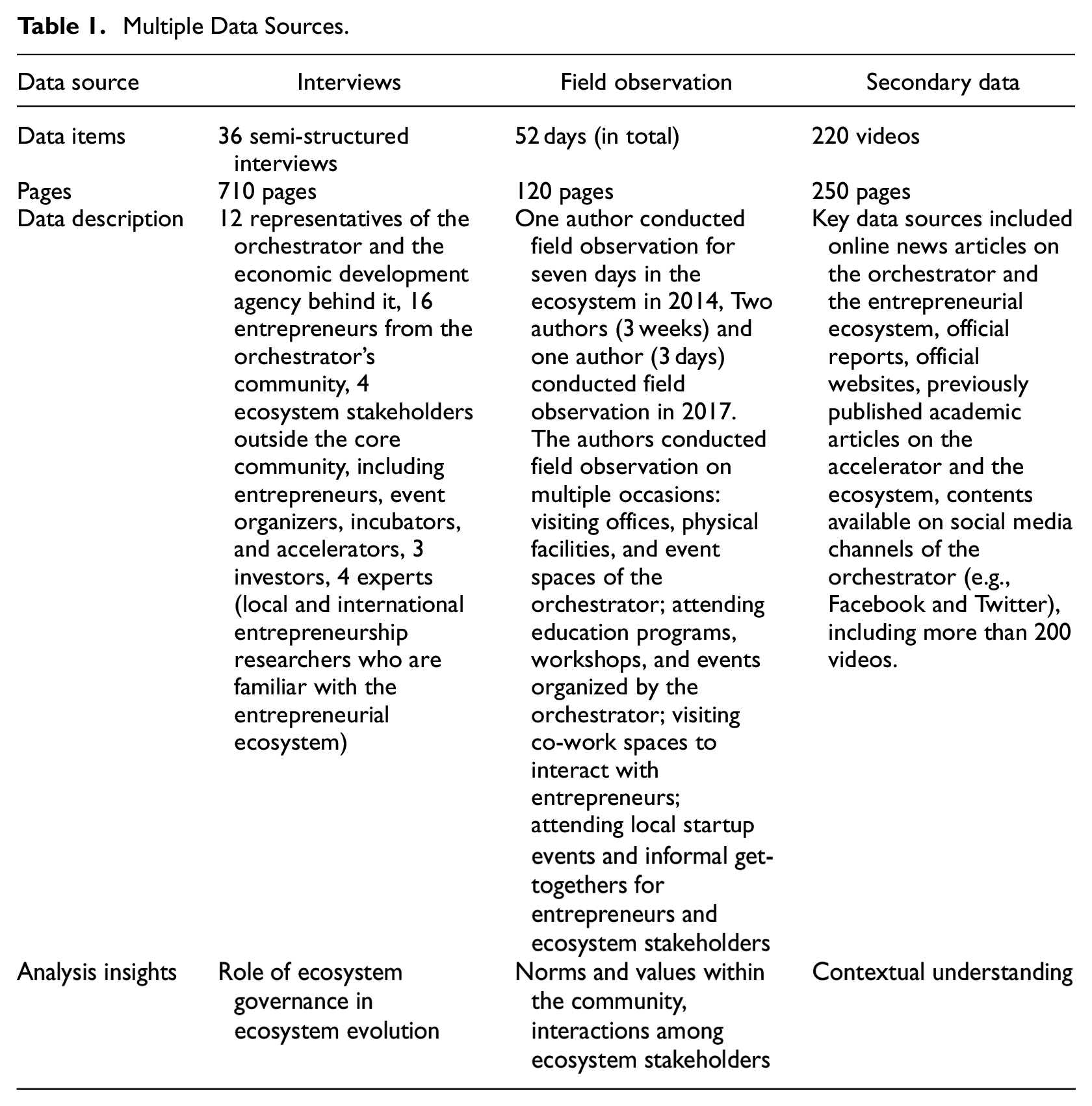
Our data-gathering method was flexible and emergent, as we collected information from multiple sources (Gioia et al., 2013). The primary data-collection period spanned 7 years and consisted of three steps. First, we conducted the initial field trip to Santiago in 2014 to gain insights into the context of the ecosystem and anchor organization. During this field trip, we conducted initial interviews with decision-makers at CORFO and managers at Start-Up Chile, who provided us with an understanding of the anchor organization’s general background and the Santiago ecosystem’s historical development. We then developed working research questions, remaining flexible about the key attributes of the phenomenon to help guide theoretical sampling. The next step for gathering data involved the second trip to Chile in 2017. We stayed in Santiago for three weeks to conduct field observations and interviews with initial contacts and additional important ecosystem stakeholders. Third, we conducted follow-up interviews with experts and ecosystem stakeholders via online video communication tools and analyzed secondary data to complete data essential to theorization (Denzin & Lincoln, 2000). Figure 1 presents the research timeline of this study, and Table 1 shows multiple data sources collected for this study.
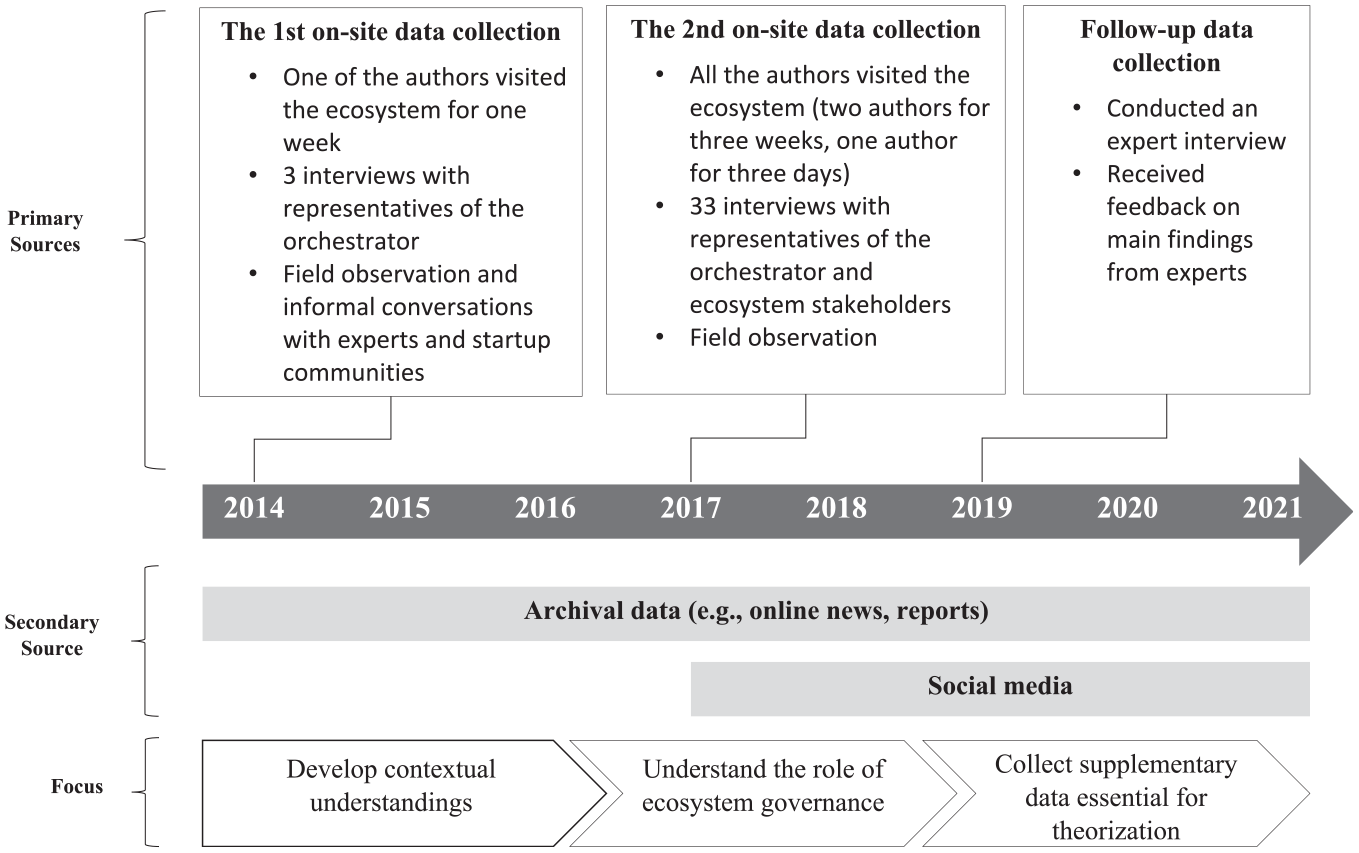
Timeline of research.
Multiple Data Sources.
Interviews
Our primary data source was in-depth interviews. We selected multiple stakeholders from the anchor organization and the Santiago entrepreneurial ecosystem as interviewees to gain different perspectives on the functions of Start-Up Chile. The sample included decision-makers and key actors of the anchor organization, foreign and Chilean entrepreneurs, representatives of service providers like incubators and accelerators, as well as event organizers, investors, and experts. We primarily asked stakeholders about their roles within the anchor organization; the background, organizational structure, and strategic focuses of their organizations; their (other ecosystem stakeholders’) perceptions of and critical reflections on their roles in ecosystem development.
The interviews lasted from 32 to 131 minutes, averaging 65. We conducted interviews in English, as most of the respondents were either native English speakers or spoke English fluently. We arranged on-site interviews in various locations mainly selected as convenient places by interviewees, including facilities at CORFO and Start-Up Chile, coworking spaces, and cafés in the city. The interviews were audio-recorded and transcribed in English. Table 2 shows an overview of the respondents.
List of Respondents.
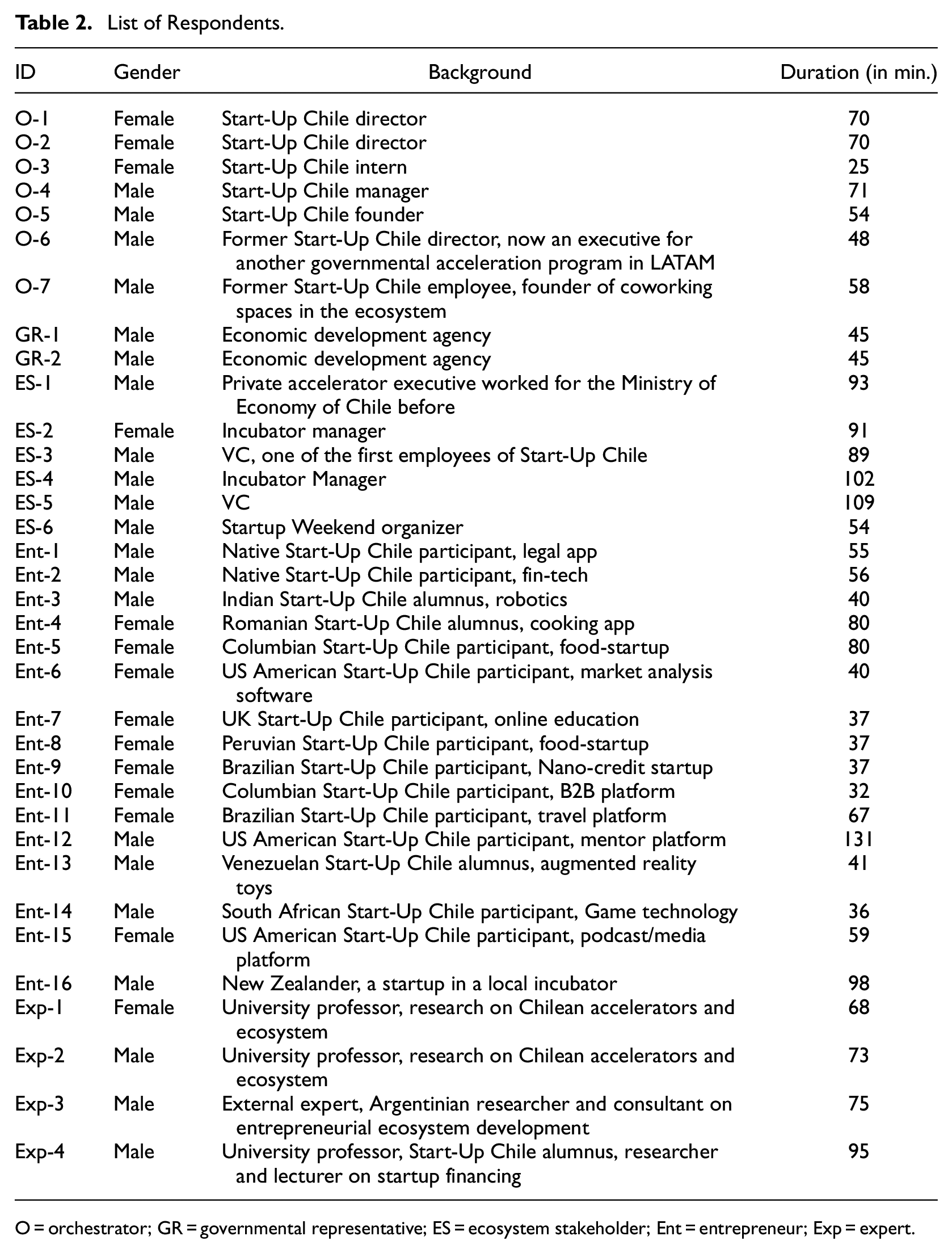
O = orchestrator; GR = governmental representative; ES = ecosystem stakeholder; Ent = entrepreneur; Exp = expert.
Field Observation
On the first two trips to Santiago, the authors conducted field observations on the physical facilities of CORFO and Start-Up Chile. This allowed observations of organizational culture and inter-relational dynamics between employees. The authors also visited several education programs, workshops, and events organized by the anchor organization, which took place at the coworking spaces. Before and after these events, the authors interacted with participants who shared their experiences with and opinions about the acceleration programs and the Santiago ecosystem. The authors spent considerable time observing daily interactions among entrepreneurs and other users at the coworking spaces. We visited numerous places, including universities, incubators, accelerators, coworking spaces, and meetups. Furthermore, we had regular informal chats with interviewees at cafés before and after the interviews. The authors took extensive field notes to summarize their observations and impressions. These field notes allowed us to triangulate the interview data and gain additional information that would have otherwise been unobtainable (e.g., taken-for-granted rules in interactions between stakeholders).
Secondary Data
Since the ecosystem-building approach of CORFO and Start-Up Chile has received significant attention from the domestic and international startup communities, numerous archival data sources, such as online news and reports, are available. The authors constantly collected publicly available secondary data about the anchor organization and the Santiago entrepreneurial ecosystem. These documents provided us with general knowledge concerning the organizational background and strategies of the anchor organization, as well as the evolutionary paths of the ecosystem. Furthermore, Start-Up Chile performs extensive social media activities, which offered additional opportunities for us to gather secondary data. For instance, more than 220 videos were publicly available on Start-Up Chile’s Facebook page. These videos offer additional visual impressions, information about their education programs and startups, and the interactions between the anchor organization and regional stakeholders at various events.
Data Analysis
After transcribing the collected data, we analyzed them in five subsequent iterative stages, consistent with the systematic inductive method (Gioia et al., 2013). These five stages are summarized in Table 3.
Data Analysis Stages.
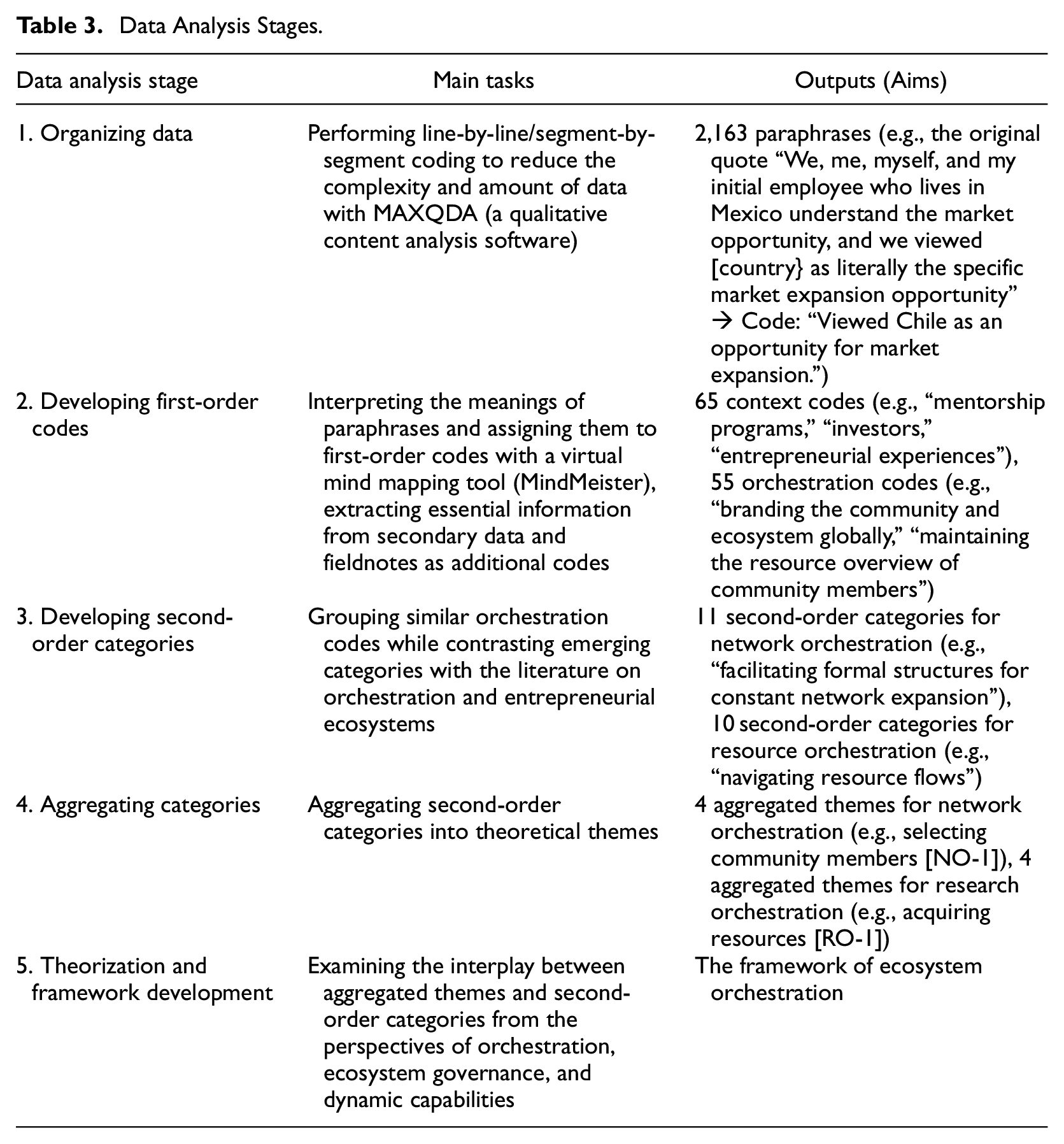
The primary aim of the first stage is to organize the collected data by reducing the complexity and amount of information to enable systematic analysis. After structuring interview transcripts, fieldnotes, and secondary data in qualitative data analysis software, we open-coded the interview with line-by-line and segment-by-segment coding methods (Charmaz, 2014). Two authors paraphrased sentences spoken by our respondents. At this stage, we considered the original terms used by our informants, avoiding using theoretical or analytical terms. We generated 2,163 paraphrases.
In the second stage, we analyzed the paraphrases by interpreting their meanings and assigning them to first-order codes. While interpreting the paraphrases, we developed codes to describe each paraphrase’s key information or attribution. We generated 55 first-order codes, primarily describing practices the anchor organization performed to manage networks and resources in the ecosystem (e.g., “branding the community and ecosystem globally” and “maintaining the resource overview of community members”).
In the third stage, we further analyzed first-order codes by grouping them into second-order categories based on similarities. The emerging second-order categories were constantly contrasted with the literature on orchestration and entrepreneurial ecosystems. For instance, the first-order codes “coworking space where community members see each other every day,”“formal programs and events where community members see each other weekly,” and “informal get-together of foreign entrepreneurs who seek to have a social life in a new environment” were grouped into a second-order category “facilitating regular intensive interactions among community members.” This stage evidenced that the anchor organization orchestrated both networks and resources and that network and resource orchestration practices are mutually constitutive. We developed 11 second-order categories for networks and 10 for resource orchestration.
The fourth data analysis stage aimed to aggregate second-order categories into overarching theoretical dimensions (Gioia et al., 2013). This step allowed us to understand the network and resource orchestration practices the anchor organization engaged in at different stages of ecosystem evolution. In doing so, we triangulated interview data with field notes and secondary data and compared the emerging dimensions with prior research in orchestration. We then developed eight aggregated themes. Finally, we developed a grounded framework by abductively analyzing the aggregated themes based on the literature on orchestration and entrepreneurial ecosystems.
Findings
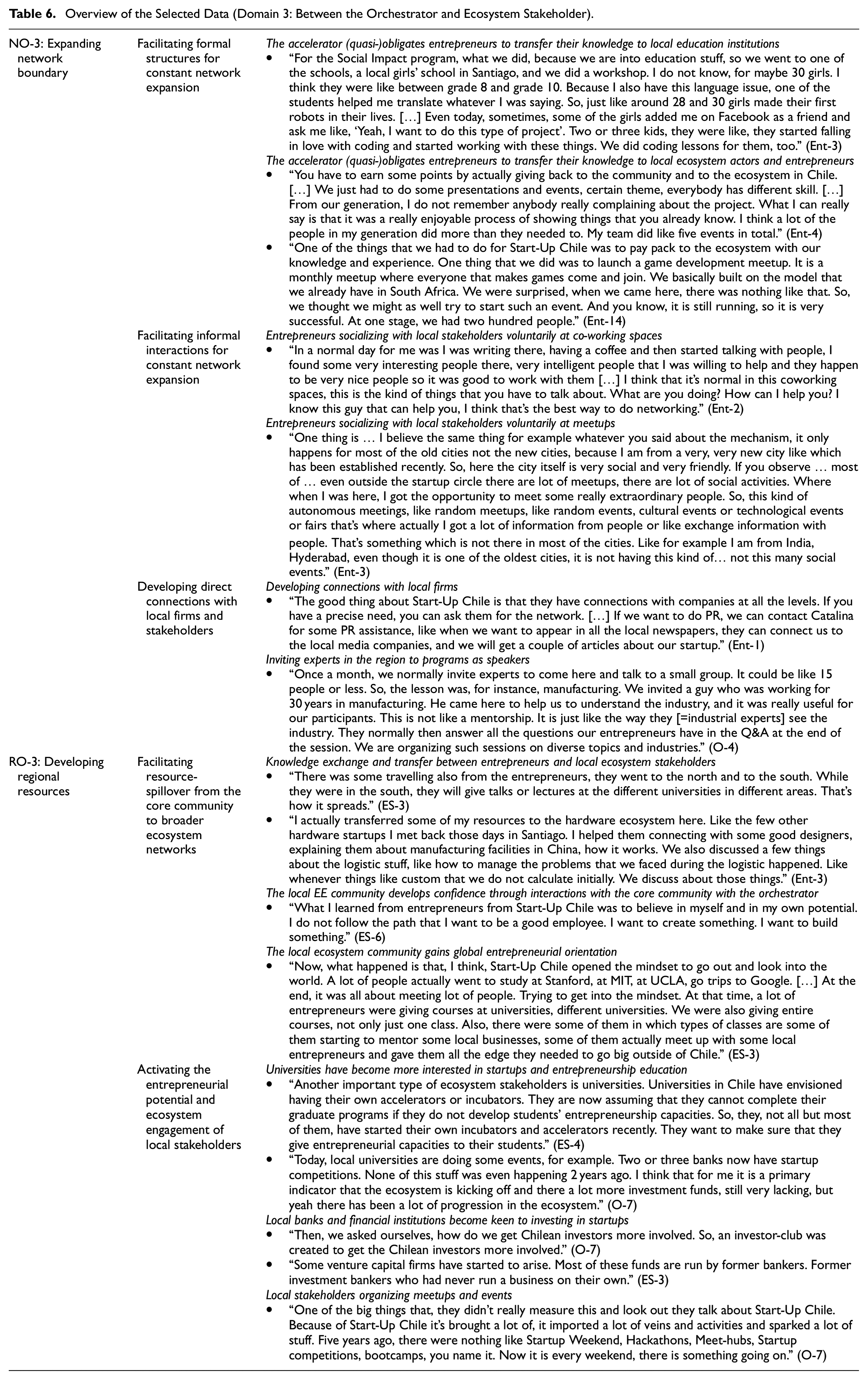
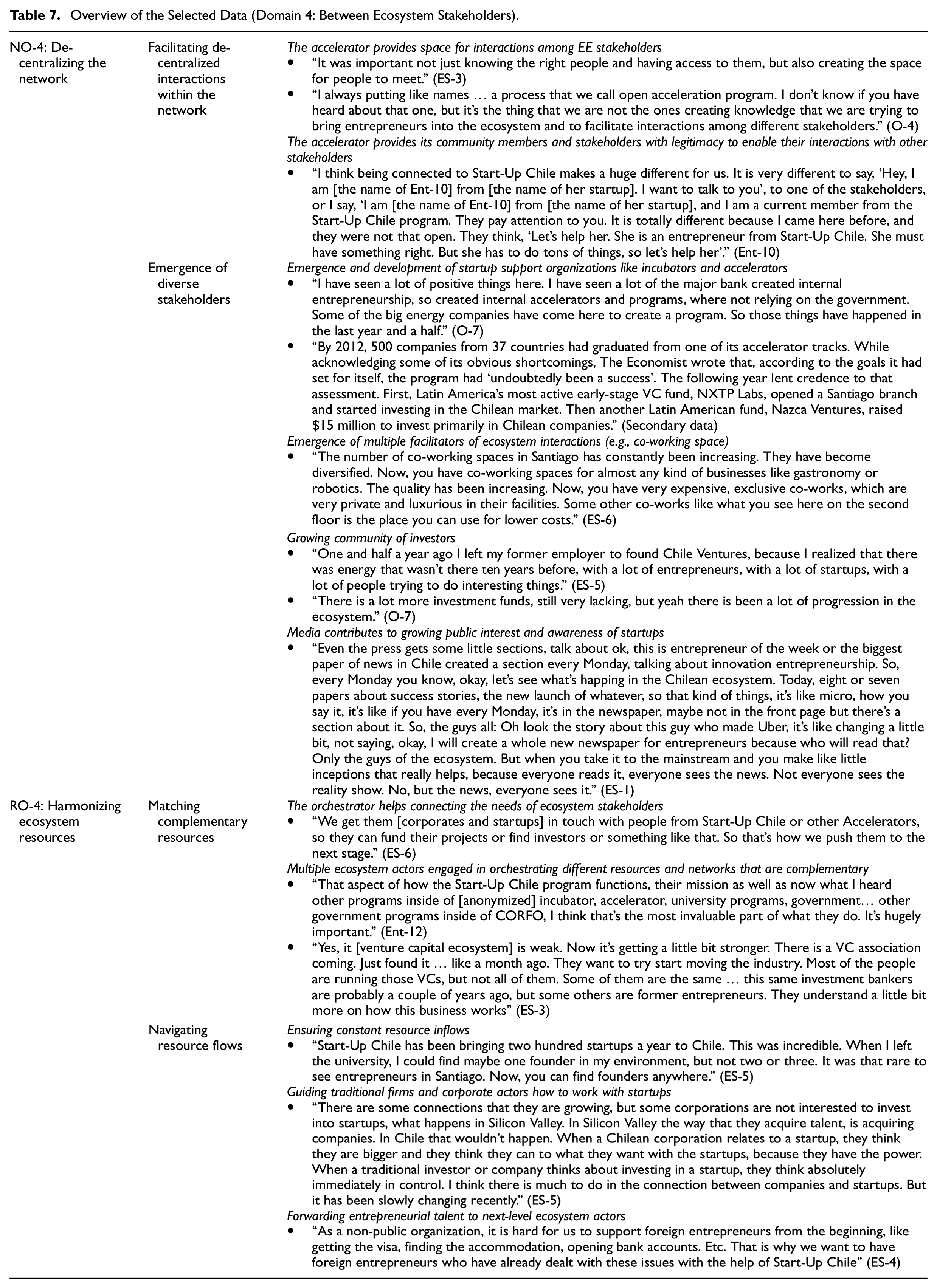
In this section, we present the four domains of orchestration practices that the anchor organization performed: (1) in the environment, (2) within the anchor organization, (3) between the anchor organization and ecosystem stakeholders, and (4) between ecosystem stakeholders. Each domain comprises network orchestration [NO] and resource orchestration [RO]. Figures 2 and 3 show the data structure of the findings. Tables 4 to 7 summarize the selected empirical data supporting each domain.
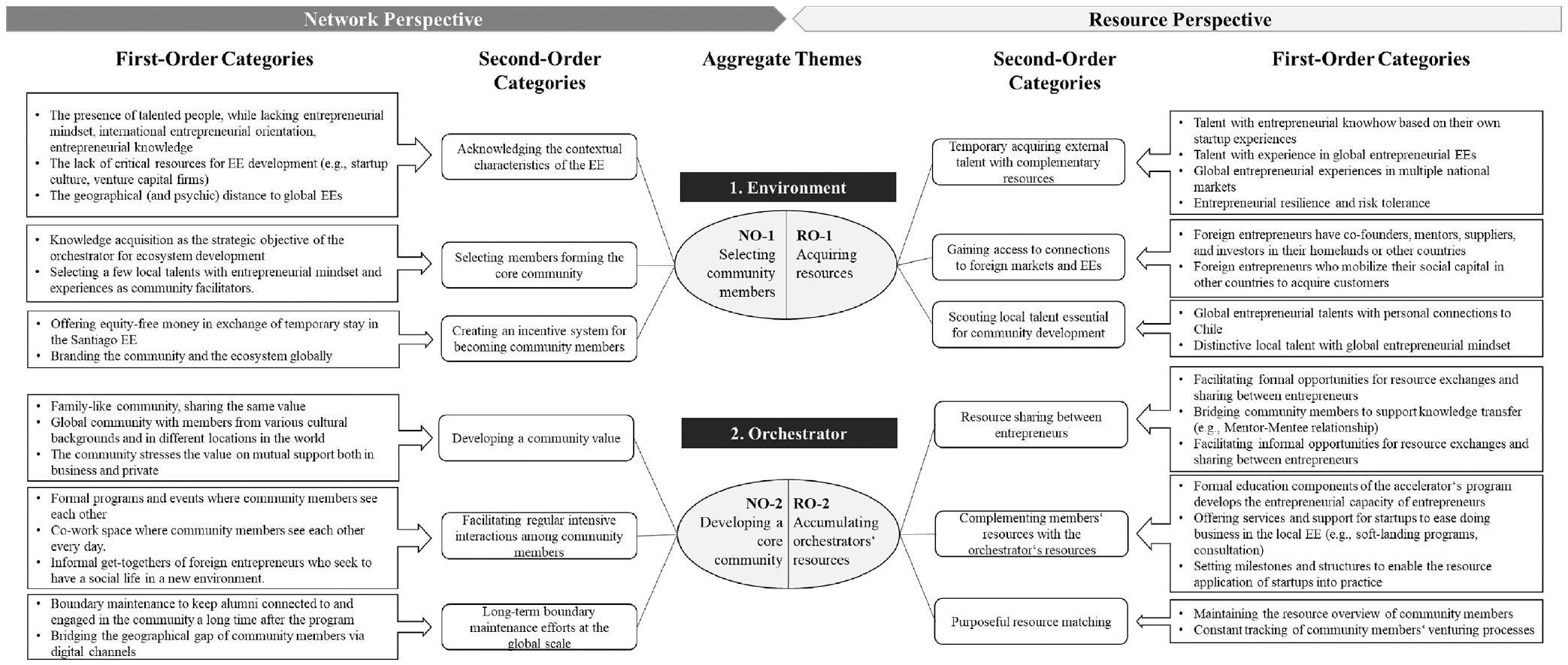
Data structure (part 1).
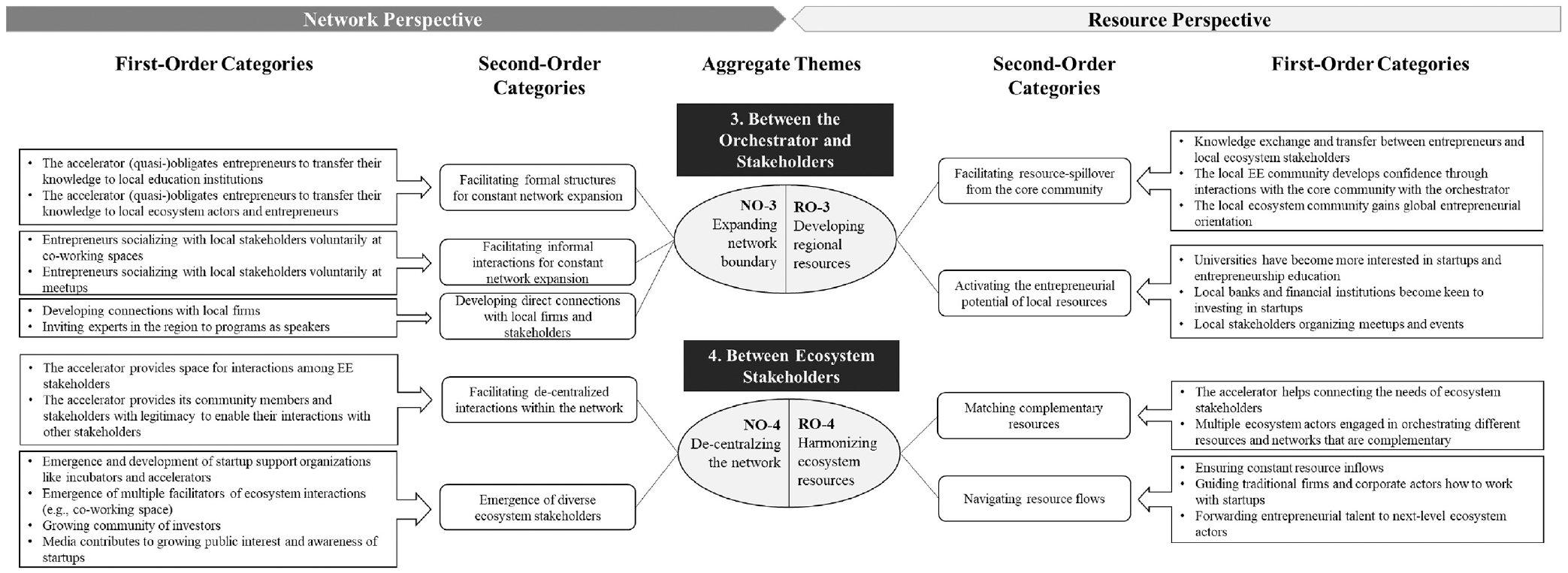
Data structure (part 2).
Overview of the Selected Data (Domain 1: The Environment).
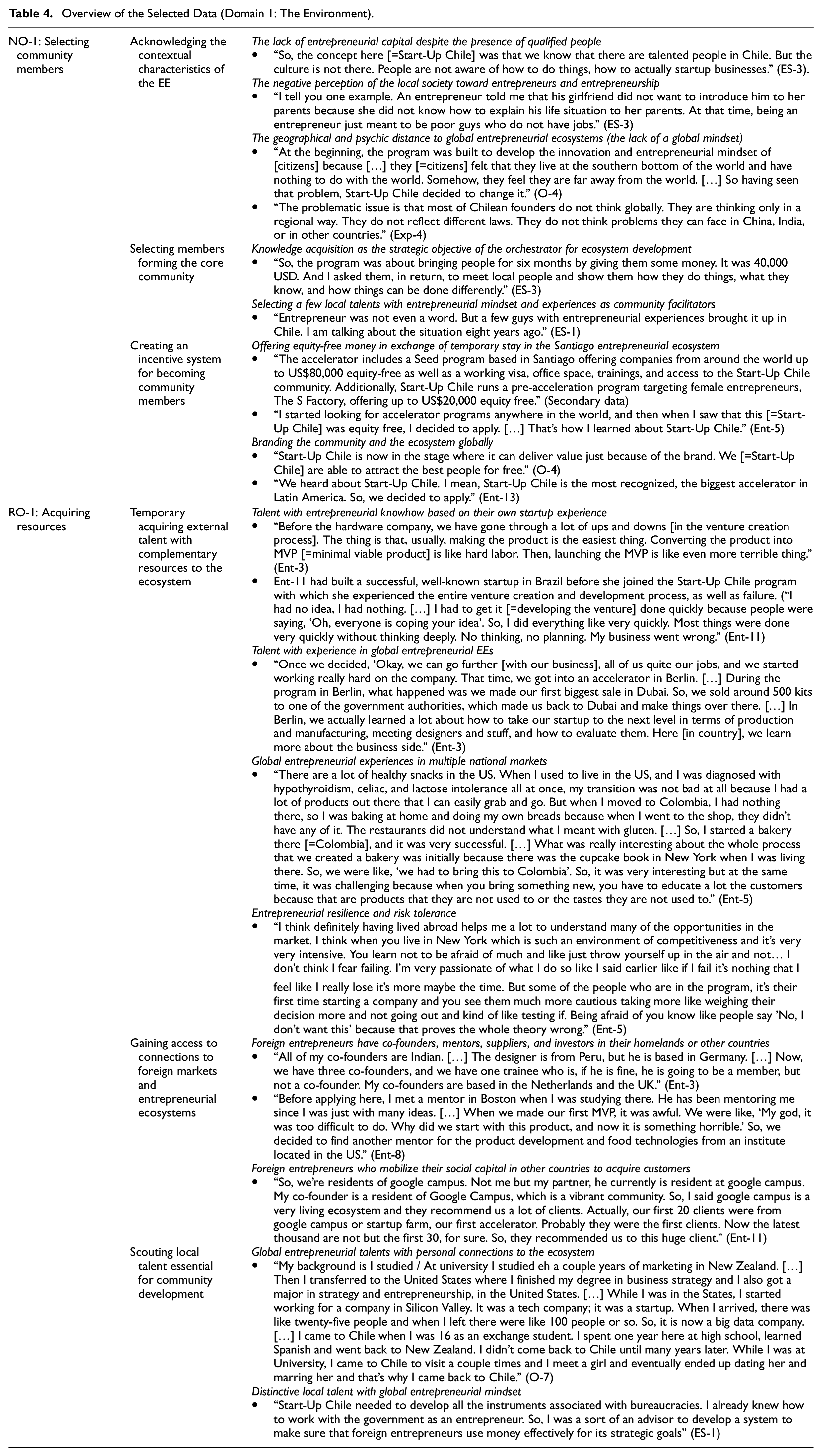
Overview of the Selected Data (Domain 2: Within the Orchestrator).
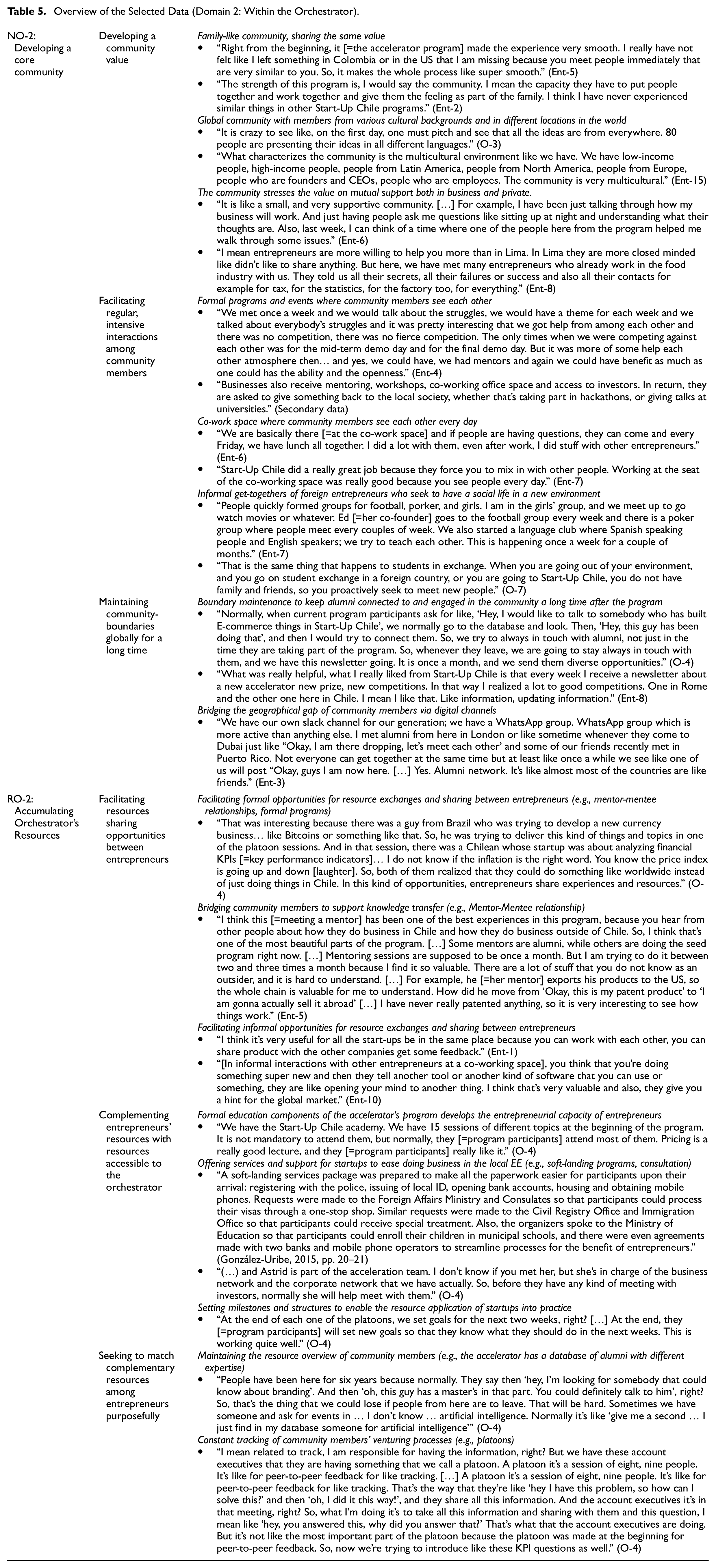
Overview of the Selected Data (Domain 3: Between the Orchestrator and Ecosystem Stakeholder).
Overview of the Selected Data (Domain 4: Between Ecosystem Stakeholders).
Domain 1: In the Environment
NO-1: Selecting Community Members
When CORFO initiated Start-Up Chile in 2010, there was little formal and informal governance within the regional entrepreneurial ecosystem, and stakeholders worked disconnected from each other. To begin, Start-Up Chile selected potential community members who could form a core network. First, the anchor organization acknowledged the contextual characteristics of the Santiago entrepreneurial ecosystem. It was essential for the anchor organization to evaluate the contextual strengths and weaknesses of the ecosystem before selecting community members. In this analytical step, on the one hand, the accelerator became aware that the ecosystem could benefit from well-educated, highly skilled local talent, comparably stable institutional environments, and an entrepreneurship-supportive policy. On the other hand, the ecosystem lacked innovation and seed investors. The ecosystem would need an entrepreneurial culture, successful entrepreneurs to serve as role models, and entrepreneurial know-how to establish a favorable environment for startups in the seed phase. Furthermore, the geographically isolated location of the country makes Chileans feel “somehow far away from the world” (O-4), hindering local entrepreneurs from developing a global orientation, which is essential for business scalability given the limited size of the domestic market.
Second, based on the contextual characteristics of the ecosystem, the anchor organization selected members who could form the core part of the community as participants in its acceleration programs. The primary strategic objective of acquiring foreign entrepreneurs was to gain access to knowledge and resources that were missing in the region but essential for the development of the ecosystem. “Chile took the right time with the right people and right mindset […]. Importing foreign entrepreneurs could not have worked without these things fitting together” (ES-3). It was essential to acquire enough of these entrepreneurs at once to reach the critical mass of core members, setting the new dominant logic within the community.
Third, the anchor organization facilitated incentive systems for entrepreneurs worldwide to become members of the emerging community. Having acknowledged financial support as a critical condition for foreign entrepreneurs for temporary relocations to Chile, the anchor organization offered generous equity-free funding to attract foreign entrepreneurs. This incentive system attracted considerable attention from global startup communities, which started to make the Santiago ecosystem internationally renowned.
RO-1: Acquiring Resources
Selecting foreign entrepreneurs as potential community members was essential to acquiring the external resources lacking in the entrepreneurial ecosystem. Here, Start-Up Chile demonstrated its ability to acquire resources by scouting foreign and local talent. First, the ecosystem focused on temporarily acquiring external talent with complementary resources to the ecosystem, such as entrepreneurial know-how, experience with global startup scenes and foreign markets, and knowledge about scaling up ventures. Furthermore, foreign entrepreneurs brought an entrepreneurial mindset, resilience, and risk tolerance to the region, which was characterized by conservative values and norms (Wadhwa, 2014). Start-Up Chile artificially created international environments in the local ecosystem: “The logic was, why do not we bring international competitions to Chile, so Chileans wake up somehow?” (ES-3).
Second, by accommodating foreign entrepreneurs temporarily in the ecosystem, Start-Up Chile gained access to connections to foreign markets and entrepreneurial ecosystems, which was essential to overcoming issues with isolation causing the paucity of international entrepreneurial orientations. For instance, respondents tested their products in their home markets and acquired mentors and investors from foreign entrepreneurial ecosystems. “My co-founder is a resident of Google Campus, which is a vibrant community. Other residents recommend us many clients. Actually, our first 30 clients were from Google Campus.” (Ent-11). Through entrepreneurs and their cofounders, the anchor organization acquired access to foreign markets and resources embedded in entrepreneurial ecosystems worldwide.
Third, scouting local talent was essential for creating a unique international community in Santiago. Start-Up Chile hired foreign entrepreneurs in Chile as early employees. An example is O-7: He is from New Zealand and has many years of entrepreneurial experience in Silicon Valley. He migrated to Chile to marry his Chilean wife: “My first role [at Start-Up Chile] was building up the acceleration program. I was in charge of different things from managing investor relations to mentoring programs and acceleration programs” (O-7). Start-Up Chile also hired local talents with global entrepreneurial mindsets and experience to build acceleration programs. Both migrant and local entrepreneurial talents played essential roles since they were familiar with global startup scenes and could critically observe the potential and problems of the ecosystem: “Start-Up Chile needed to develop all the instruments associated with bureaucracies. I already knew how to work with the government as an entrepreneur. So, I was a sort of an advisor to develop a system to make sure that foreign entrepreneurs use money effectively for its strategic goals” (ES-1).
Domain 2: Within the Anchor Organization
NO-2: Developing a Core Community
Start-Up Chile facilitated several mechanisms to develop a small and tightly connected community with selected members who brought complementary resources to the ecosystem. Selected members had diverse backgrounds, and many stayed in Santiago for only half a year. Therefore, the rapid creation of a community enabled external resources brought by network members to be converted into internal resources accumulated within the anchor organization. First, Start-Up Chile developed community values shared by members. Our respondents commonly described the nature of the community as “family” (Ent-2) or “one big, massive family” (Ent-12). The community is also characterized by significant international backgrounds among its members and is described by respondents as “multicultural” (Ent-15).
Second, Start-Up Chile facilitated regular, intensive interactions to quickly develop significant connections between community members. These interactions among community members often started with formal program components, such as welcoming events, pitch training, weekly peer feedback sessions, and demo days. Furthermore, Start-Up Chile had several structural components, such as coworking spaces, where program participants spent considerable time together, and social events fostering informal interactions among community members. A Colombian female entrepreneur shared an illustrative example of the willingness of community members to provide mutual support: We had a workshop 2 weeks ago. One of them suggested, “Hey, we can help each other a lot more. You are good in video production, and you are in programming.” Others said, “That is a good idea. Let’s have weekly wine Wednesday to discuss how we could help each other.” (Ent-10)
Third, since many entrepreneurs left the Santiago ecosystem after attending the six-month acceleration program, Start-Up Chile engaged in maintaining community boundaries globally for a long time. Both accelerator directors and entrepreneurs agreed that Start-Up Chile and its community members benefit from alumni networks: “Alumni are emotionally connected to the Santiago ecosystem because they spent intensive time here together. […] We call them ‘Start-Up Chile Diaspora.’” (O-1); “Whenever we face challenges, like for example if you need help in entering the Chinese market, you can just ask alumni network and will find someone that can help you” (Ent-3). The accelerator proactively made boundary maintenance efforts (i.e., by connecting community members with complementary interests), encouraging alumni’s engagements as mentors, sending newsletters about the Santiago entrepreneurial ecosystem, and developing global networks with accelerators and incubators worldwide to support alumni’s soft landing in foreign markets.
RO-2: Accumulating Anchor Organization’s Resources
In the emerging community, members’ resources became internalized and accumulated. We observed three mechanisms demonstrating the anchor organization’s ability to accumulate resources. First, Start-Up Chile facilitated numerous resource-sharing opportunities between entrepreneurs. For instance, in weekly workshops and seminars, entrepreneurs came together to learn about particular topics like online marketing and business idea validation. Discussions on such occasions created possibilities in which entrepreneurs exchanged their experiences. Another occasion involved weekly peer-to-peer group sessions during which entrepreneurs shared their progress and set the next milestones for venture creation processes: “Because [the participants of these sessions] have different profiles, you can receive diverse feedback. For instance, I got much feedback about regulations on my laboratory work” (Ent-8). These sessions also allowed Start-Up Chile to regularly evaluate venture progress and build its competencies to support entrepreneurs. Furthermore, the accelerator organized the mentor-mentee relationships within the community by connecting entrepreneurs in similar industries, encouraging community members to share sector-specific knowledge and experiences, thus strengthening ties among entrepreneurs with similar backgrounds.
Second, Start-Up Chile complemented entrepreneurs’ resources with resources accessible to the anchor organization. While entrepreneurs brought various invaluable resources to Start-Up Chile, the accelerator received complimentary resources from entrepreneurs to further develop their resources. Formal education components of the accelerator’s program helped build the entrepreneurial capacity of community members, such as “how to pitch” (Ent-10) and “how to make a proper business model” (Ent-3). Furthermore, Start-Up Chile offered services and support, such as soft-landing program packages, for foreign startups to help them conduct business in the local entrepreneurial ecosystem. Another complementary resource to entrepreneurs’ resources was the structure that Start-Up Chile developed, which allowed entrepreneurs to systematically apply their resources, such as their market knowledge and industry-specific experience. In the aforementioned weekly peer-to-peer feedback sessions, entrepreneurs were obliged to set goals they sought to fulfill by the next session. By collaboratively specifying weekly objectives, entrepreneurs could reflect on their previous achievements, current challenges, and perspectives.
Third, the accelerator sought to match complementary resources among entrepreneurs purposefully by developing a database of alumni and current participants to maintain the overview of expertise and networks community members possessed. This database was regularly used to arrange contacts when community members looked for specific profiles (e.g., fintech startups with experience with market entry in China). The management team constantly tracked venturing processes with evaluation tools and key performance indicators to overview available resources within the community.
Domain 3: Between the Anchor Organization and Stakeholders
NO-3: Expanding Network Boundary
While Start-Up Chile developed and managed the community core, it constantly expanded the boundaries of the emerging network. First, Start-Up Chile facilitated formal structures for constant network expansions. As one of the compulsory activities in acceleration programs, participants engaged in activities to develop the local entrepreneurial ecosystem by organizing workshops, seminars, courses, and events related to entrepreneurial activities. Since participants could freely choose the topic and how they transferred their knowledge, they tailored their activities to the needs of various ecosystem stakeholders, including local universities, established corporations, schools, and local entrepreneurial and technological talent (e.g., Hackathon, a regular get-together for engineers). Through these activities, foreign entrepreneurs interacted with not only close community members but also broader ecosystem stakeholders.
Second, Start-Up Chile facilitated informal interactions where community members’ network-spanning activities naturally occur. For instance, entrepreneurs in programs had free access to selected local coworking spaces and regularly interacted with other local stakeholders. Furthermore, the accelerator encouraged participants to attend local meetups and events to prevent foreign entrepreneurs from staying in the small core community.
Third, the accelerator engaged in developing direct connections with local firms and stakeholders to establish its central position in the local ecosystem networks. One of the founding members of the accelerator reflected on his role: “My main role was networking—connecting startups to whomever in Chile might be interested in understanding startups, CEOs of big companies or anyone else, the people with money who were interested in that kind of new things” (ES-3). Start-Up Chile actively invited new people in the region without prior engagement in the ecosystem to events and workshops, facilitating interactions with potential ecosystem actors and the emerging community. Such interactions enabled regional corporate actors to share their industrial expertise while learning about the potential of an emerging, vibrant startup community.
RO-3: Developing Regional Resources
Start-Up Chile strategically expanded its network boundary to avoid monopolizing resources within the core community. Boundary-spanning activities were essential to facilitate regular interactions between community members and ecosystem stakeholders in various forms, which built the anchor organization’s capabilities in developing entrepreneurial resources at the regional level.
First, entrepreneurs of the accelerator’s core community demonstrated a distinctive entrepreneurial mindset and attitude toward facilitating resource spillover from the core community to broader ecosystem networks. ES-6 initially attended events organized by entrepreneurs from the Start-Up Chile community and became an essential stakeholder in the ecosystem as an organizer of well-known startup events. This respondent emphasized the value he received from the core community: “Chilean people do not trust other people in general. At the beginning of our events, participants were always concerned about someone stealing their business ideas. Our events try to eliminate their concerns” (ES-6). Furthermore, the global reputation of the Chilean entrepreneurial ecosystem gave local stakeholders confidence in their potential. Another spillover effect was the growing global orientation of local entrepreneurs. Exposure to multinational entrepreneurs lowered local entrepreneurs’ barriers to internationalizing their ventures.
Second, Start-Up Chile’s efforts in developing its networks activated local stakeholders’ entrepreneurial potential and ecosystem engagement. The anchor organization demonstrated the benefits and methods of engaging in entrepreneurial ecosystems through interactions between the anchor organization and (potential) ecosystem stakeholders. “My role was mostly networking, creating meetups, inviting new people that were around but had not engaged with the ecosystem.” (ES-3). Ent-2 benefited from the knowledge, experience, and networks of a mentor from the innovation department of a local bank: “Our mentor is well connected. He knows much about how [the name of the local bank] is doing in the entrepreneurial ecosystem. This bank is investing in several startups.” However, not all the stakeholders were interested in supporting startups in the seed phase. In particular, conservative firms resisted becoming active in the ecosystem and hindered entrepreneurs: “[The name of a local bank] does not care about startups and uses ridiculously old technologies. The problem is that this bank is still playing a dominant role in the country, which is killing our business slowly” (Ent-16).
Domain 4: Between Ecosystem Stakeholders
NO-4: Decentralizing the Network
After building an extensive network within the entrepreneurial ecosystem, Start-Up Chile took on supportive functions to help decentralize the network of existing stakeholders and newly emerging actors. One of its critical actions as an anchor organization was to step back from the front line by embracing the emergence and diversification of ecosystem stakeholders. Here, we observed two network orchestration practices essential for ecosystem building.
First, Start-Up Chile facilitated decentralized interactions within the network. Ecosystem stakeholders, such as event organizers, investors, and startup support organizations, developed their own networks while leveraging the accelerator’s network platform. Start-Up Chile defined itself as an “open accelerator,” emphasizing its strategic orientation to share its resources and connections with other ecosystem stakeholders: “It was important not just knowing the right people and having access to them, but also creating the space for people to meet” (ES-3). Such resources and networks were shared with ecosystem actors so that they could connect with other stakeholders and develop their competencies as ecosystem service providers.
Second, the accelerator’s network extension and regional resource development activities aided the emergence of diverse ecosystem stakeholders. Notably, multiple orchestrators developed among these newly emerging ecosystem stakeholders by managing their own networks and resources. Other ecosystem-building initiatives like startup meetups and coworking spaces facilitating stakeholder interactions have grown: “5 years ago, there was nothing like Startup Weekends, Hackathons, meetups, startup competitions, boot camps, you name it. These things happen every week, and something is always going on.” (O-7).
Notably, newly emerging anchor organizations performed orchestration practices differently from Start-Up Chile. Their orchestration practices were complementary, as they managed different resources and networks. As such, Start-Up Chile contributed to developing the shared community value of horizontal collaborations among stakeholders, which enabled functional network complementarities: “Interactions with a lot of people from this ecosystem are possible. It is not a closed ecosystem. It is a very open one, making collaboration with others quite easy” (ES-5); “The ecosystem here has been caring to have good friends. Then you want to have friends of the friends joining. Eventually, we have the current community of investors, mentors, entrepreneurs, and other support organizations” (O-4).
RO-4: Harmonizing Ecosystem Resources
During network decentralization, the anchor organization’s capability to harmonize resources possessed by other ecosystem actors enhances the dynamic resource fit of the ecosystem. Our analysis revealed two sub-mechanisms of ecosystem resource harmonization. First, Start-Up Chile helped match complementary resource needs among ecosystem stakeholders. Emerging startup support organizations, for instance, addressed different needs within the entrepreneurial ecosystem. Meanwhile, University incubators emphasize the commercialization of technologies, and accelerators focus on particular industries or venture development stages (e.g., ideation stages). Furthermore, network facilitators provided opportunities for ecosystem stakeholders to connect with people in particular sectors. These activities complemented the anchor organization’s functions by addressing startups and stakeholders’ more detailed and broader demands.
Second, the accelerator’s activities navigated resource flows within the entrepreneurial ecosystem. On the one hand, the anchor organization ensured constant resource inflows into the Santiago ecosystem by bringing many entrepreneurs from other countries with diverse backgrounds. On the other hand, the anchor organization lubricated resource flows in the region that existed but were not mobilized for entrepreneurial activities. For example, Start-Up Chile helped corporate actors engage in the ecosystem by guiding them in working with startups. Furthermore, the accelerator developed entrepreneurial talent and forwarded it to other stakeholders. For instance, another well-known accelerator specializing in supporting startups in advanced stages funded foreign entrepreneurs who were alumni of the acceleration programs: “As a nonpublic organization, it is hard for us to support foreign entrepreneurs from the beginning, like getting the visa, finding the accommodation, opening bank accounts, etc. That is why we want foreign entrepreneurs who have already dealt with these issues with the help of Start-Up Chile” (ES-4). In addition, several key ecosystem stakeholders were founded by ex-employees of the anchor organization.
Discussion
We conducted a case study in the Santiago entrepreneurial ecosystem to reveal the strategic functions of anchor organizations in catalyzing the early evolutionary dynamics of entrepreneurial ecosystems. We developed a process model of ecosystem orchestration based on identified network and resource orchestration practices (Figure 4).
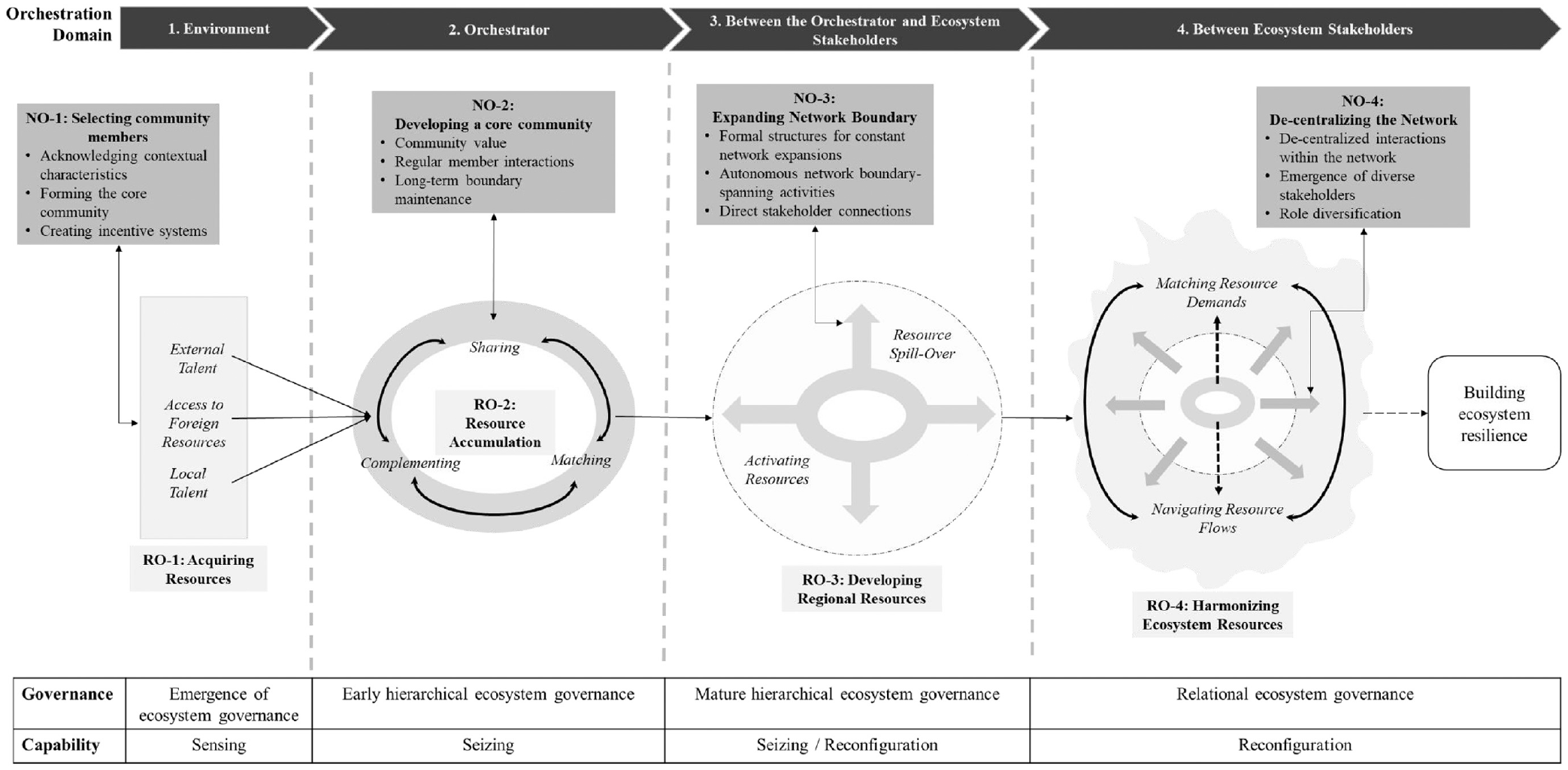
Framework for ecosystem orchestration.
The Interplay Between Network and Resource Orchestration
The framework demonstrates that the anchor organization manages both networks and resources and that there is a close interplay between network and resource orchestration. The findings of this study reveal four orchestration domains: (1) environment, (2) within the anchor organization, (3) between the anchor organization and stakeholders, and (4) between stakeholders. Each orchestration stage consists of network and resource orchestration practices that are mutually constitutive for generating ecosystem dynamics, as presented in the grounded framework (Figure 4). More specifically, our study reveals that network orchestration practices create the necessary structural conditions for the anchor organization to engage in resource orchestration practices. For instance, selecting community members [NO-1] enables the anchor organization to acquire resources that complement the available resources in the ecosystem [RO-1]. The literature also acknowledges that network orchestration develops common norms among members, enabling the hub firm to organize value-cocreation processes (Dessaigne & Pardo, 2020). While network and resource orchestration are interrelated, network theory draws a line between them. Following Powell et al. (1996), resources can be considered nodes in a network, and relationships can be considered edges. The topology of a network made of these nodes and edges is essential in shaping how resources flow and how relationships influence resource accessibility (Powell et al., 1996). Therefore, governing the structure of nodes (resources) and edges (relationships) is essential for enabling anchor organizations to orchestrate resources and networks.
Our observation of the interplay between network and resource orchestration practices aligns with processes involved in network orchestration to manage knowledge mobility (innovation leverage) and innovation appropriability (Dhanaraj & Parkhe, 2006; Nambisan & Sawhney, 2011). Therefore, the fact that network orchestration ensures and improves stakeholder resource benefits may not be surprising. However, our findings demonstrate that resource orchestration practices also enable next-level network orchestration practices.
Evolutionary Adaptation of Ecosystem Orchestration
Scholars have addressed the anchor organization’s capacity to assemble networks and resources by dealing with the plurality of orchestration modes. Building on the work of Collinson and Collinson (2009), which revealed the coexistence of multiple leadership forms in networks, Reypens et al. (2021) promoted the notion of hybrid orchestration by identifying that hub-firms interchangeably performed dominating orchestration and consensus-based orchestration in response to emergent network challenges. Similarly, Paquin and Howard-Grenville (2013) demonstrated how orchestrators shifted their orchestration practices from encouraging serendipitous encounters between network members to coordinating stakeholder interactions by selecting members more intentionally. In this study, we observed sequential and partly simultaneous engagement in different modes of orchestration to catalyze ecosystem evolution. More specifically, the anchor organization initially focused on building the small community core before expanding its orchestration activities by gradually reaching more stakeholders at the periphery of the ecosystem boundary. The findings thus underline the necessity for the anchor organization to possess the capability to adapt its orchestration practices according to ecosystem evolution. This study demonstrates that the anchor organization started with dominant orchestration to create an entrepreneurial community (Stam, 2023) that embodied norms and values, determining relational mechanisms attracting further members, and enforcing member engagement [NO-2]. Once the community is established and constantly growing, the anchor organization simultaneously engages in more relational orchestration by expanding the network boundary and decentralizing the alignment of ecosystem engagement among stakeholders [NO-3] [NO-4]. Relational governance is heterarchical, and the influence of leadership-exerting organizations is limited (Müller-Seitz, 2012).
In the best-case scenario, the evolutionary adaptation of orchestration practices leads to the resilience of the regional entrepreneurial ecosystem. Roundy et al. (2017) theorized that the resilience of an entrepreneurial ecosystem depends on “balancing the seemingly paradoxical tension between the diversity and coherence of its components” (p. 99). To become more resilient, a regional entrepreneurial ecosystem needs to reduce its dependency on a single, powerful anchor organization and embrace multiple anchor organizations, as they can orchestrate different resources and networks, which diversifies ecosystem components (Colombelli et al., 2019). It is equally essential that anchor organizations maintain their resilience for a long time to catalyze the early ecosystem evolutionary dynamics. In the observed case, Start-Up Chile experienced three significant transitions in the governing coalitions due to presidential elections in the country (Verde, 2016). Despite such endogenous political changes, which led to marginal program modifications, Start-Up Chile endured and maintained its legitimacy, power, and impact on the development of the regional entrepreneurial ecosystem. Without its persistent engagement in ecosystem building through resource and network orchestration practices, the early ecosystem dynamics would not have emerged in Santiago. This situation demonstrates that anchor organizations’ resilience against endogenous political changes is necessary for developing the ecosystem’s resilience against exogenous shocks.
According to the network governance perspective, ensuring the openness and decentralization of networks is critical for developing ecosystem resilience. Giudici et al. (2018) theorized open-system network orchestration, as opposed to the prevailing “closed-system” network orchestration performed by hub firms, by arguing that open-system orchestration positively influences the sensing capabilities of network members. Furthermore, the literature on network orchestration suggests that dominant governance effectively creates networks, but decentralizing power is essential for the sustainable growth of networks (Nambisan & Sawhney, 2011; Reypens et al., 2021). The anchor organization’s efforts to constantly expand network boundaries [NO-3] and decentralize networks [NO-4] contribute to ensuring ecosystem networks’ open, fluid, dynamic governance structure. In particular, the anchor organization attempts to expand the boundary of the core community to local ecosystem stakeholders and entrepreneurial ecosystems worldwide by establishing its global reputation, which enables it to facilitate the constant inflow of resources. In parallel to constant boundary-spanning activities, the anchor organization decentralizes networks by supporting growing autonomous interactions between local ecosystem stakeholders.
From a resource orchestration perspective, the literature argues that resource multiplication, diversification, and coherence within entrepreneurial ecosystems are essential to developing ecosystem resilience. Similarly, ecosystem scholars generally agree that the amount and heterogeneity of resources available in the region determine the degree of ecosystem resilience (Brown & Mason, 2017; Spigel & Harrison, 2018). Furthermore, Roundy et al. (2017) argued that the diversity of ecosystem stakeholders, including the types and sectors of ventures and support organizations, as well as the coherence of shared intentions, culture, and goals among ecosystem stakeholders, codevelop the resilience of entrepreneurial ecosystems.
The framework demonstrates three main types of orchestration practices that develop resilience from resource perspectives. First, due to harmonizing resources among ecosystem stakeholders [RO-4], autonomous resource multiplication mechanisms occur independently from the anchor organization. Second, the anchor organization develops regional resources [RO-3], which leads to entrepreneurial role models that can inspire next-generation entrepreneurs and develop the entrepreneurial mindset of potential ecosystem stakeholders. Third, entrepreneurial recycling is an essential step toward the ecosystem’s sustainability. Experienced entrepreneurs reuse and reinvest entrepreneurial resources from former startups to further develop the ecosystem through involvement in new projects (Spigel & Vinodrai, 2021; Walsh & Nelles, 2023)
The table at the bottom of Figure 4 summarizes the evolutionary adaptation of the orchestration practices from the dynamic capabilities perspective, which refers to “the capacity […] to purposefully create, extend, or modify its resource base” (Helfat et al., 2007, p. 4). In the orchestration practices of Domain 1, the anchor organization starts engaging in strategically forming a network, which promotes ecosystem governance. This stage primarily requires sensing capability from the anchor organization to identify essential resources in the environment by employing explicitly or implicitly specific analytical frameworks (Helfat et al., 2007; Teece, 2009). In Domain 2, the anchor organization engages in early hierarchical ecosystem governance by forming a core community. The community serves as a foundation for expanding its network boundary and developing stakeholders’ resources in the ecosystem in Domain 3. At this stage, the anchor organization shifts to an indirect hierarchical orchestration style by developing connections between the community and ecosystem stakeholders to extend its governance model. The anchor organization needs to constantly redefine and extend its boundaries according to ecosystem evolution, since correctly setting the boundaries of orchestration is particularly essential for defining and constantly developing ecosystem architecture (Teece, 2009). In Domain 4, the anchor organization steps back from its position as the central player to accept the peripheral function by decentralizing the network. Decentralization is crucial, as it allows the emergence and development of further anchor organizations that can autonomously catalyze ecosystem dynamics by creating and recycling entrepreneurial resources.
Theoretical Implications
This study advances the overall entrepreneurial ecosystem research program in several ways (Wurth et al., 2022). First, this study responds to the recent call for empirical studies on spillover effects between regional entrepreneurial ecosystems (Wurth et al., 2022). Previous studies have predominantly focused on the endogenous dynamics within specific ecosystems (Alvedalen & Boschma, 2017). By examining how the anchor organization seeks to facilitate resource inflows to the ecosystem through the attraction of foreign entrepreneurs, our study reveals a specific mechanism of inter-ecosystem resource spillover. Second, by exploring anchor organizations’ strategic function in ecosystem building, this study advances the microfoundations about interdependencies between ecosystem components. As such, our study provides partial answers to the critical research questions proposed by Wurth et al. (2022, p. 50), such as “How and why do organizations and individuals go beyond their regular scope to support the entrepreneurial ecosystem?” and “What are the processes behind resource allocation and orchestration within entrepreneurial ecosystems?” Third, this study responds to the call to conceptualize leadership in ecosystems (Wurth et al., 2023). Recently, Foss et al. (2023) revealed how ecosystem leadership impacts the coordination and cooperation problems that need to be overcome for ecosystem emergence from a dynamic capabilities perspective. Our findings corroborate their arguments that “ecosystem emergence […] can be seen as a process of guided evolution where the coevolutionary process between leader and the other ecosystem participants affect the shape the ecosystem will take” (p. 102270). Our study provides a novel perspective on ecosystem leadership by exploring how the interplay between the anchor organizations’ network and resource orchestration leads to the dynamic capabilities of the regional entrepreneurial ecosystems.
The findings extend scholarly conversations on the strategic functions of anchor organizations in the literature on entrepreneurial ecosystems in three ways. First, previous studies have primarily focused on identifying the types of strategic functions performed by anchor organizations. For instance, Tabas et al. (2023) classified these organizations’ roles into three orchestration categories: facilitating orchestration, creating prerequisites for collaboration, and helping to create an offering. In this study, we identified eight novel types of resource and network orchestration practices performed by anchor organizations to catalyze ecosystem evolution in four domains: environment, orchestrator, between the orchestrator and stakeholders, and between ecosystem stakeholders. Furthermore, our findings identify network and resource orchestration practices and demonstrate anchor organizations’ capabilities to respond to the dynamically changing needs of the entrepreneurial ecosystem.
Second, extant studies have illuminated anchor organizations’ functions in developing and managing networks (Porras-Paez & Schmutzler, 2019; Tabas et al., 2023) and resources (Hernández-Chea et al., 2021; Roundy, 2021). Our findings support existing knowledge, as they show that anchor organizations play a significant role in orchestrating networks and resources. However, to the best of our knowledge, our study made the first attempt to examine the interplay between resource and network dimensions in anchor organizations’ orchestration practices in entrepreneurial ecosystems. This study suggests that network orchestration represents a necessary condition for resource orchestration and that resource orchestration creates an essential ground for performing network orchestration in the following evolution stage of the ecosystem. Furthermore, our findings extend the orchestration theory by bridging network and resource perspectives (Dhanaraj & Parkhe, 2006; Sirmon et al., 2011). Entrepreneurial ecosystems are characterized by interdependent networks between various stakeholders, which requires investigations into the governance of interorganizational networks (Lô & Theodoraki, 2021). Simultaneously, entrepreneurial ecosystem evolution is exemplified by the processes of resource development, accumulation, and recycling within the local context (Spigel & Harrison, 2018). The current findings revealed four domains of ecosystem orchestration, each of which contains both network and resource orchestration as subprocesses that mutually influence one another. By doing so, we theorized ecosystem orchestration, which opened a new horizon for orchestration theory. Notably, ecosystem orchestration is not a mere network-and-resource orchestration combination. It captures how orchestration practices correspond to the needs of entrepreneurial ecosystems in different evolutionary stages to build resilience (Roundy et al., 2017). The theory of ecosystem orchestration demonstrates that the combination of network and resource perspectives allows the regional embeddedness of networks and entrepreneurial firms to be examined and entrepreneurial dynamics bounded to particular (geographic) contexts to evolve, which goes beyond conventional orchestration theories.
Third, our study advances recent critical discussions on the life-cycle approach to the evolution of entrepreneurial ecosystems. While conceptualizing ecosystem evolution as a life cycle has been a dominant approach in the literature on entrepreneurial ecosystems, several scholars have recently raised concerns that this approach oversimplifies the dynamic processes and complex mechanisms of the place-based phenomenon (Brown et al., 2023; Cho et al., 2022; Roundy et al., 2018). We propose that focusing on a particular evolutionary phase is meaningful as a means of microfoundation to reveal the complex dynamics of ecosystem evolution while inquiring about possible long-term evolutionary paths from the life-cycle-based theory of ecosystem evolution. This study, therefore, focused on unpacking the evolutionary dynamics of nascent entrepreneurial ecosystems. We also contrasted our findings with the life-cycle ecosystem evolution literature to theorize possible relationships between early evolutionary dynamics and ecosystem resilience. We hope that this study demonstrates a more nuanced approach to the evolution of entrepreneurial ecosystems.
Limitations and Outlook
It is essential to discuss this study’s limitations to delineate the boundaries of our theorization. First, we selected Start-Up Chile as an anchor organization due to its strategic focus on ecosystem building and its essential role in catalyzing the early evolutionary dynamics of the regional entrepreneurial ecosystem in Santiago. However, as described in the research context, Start-Up Chile is one of many support programs initiated by CORFO. CORFO’s numerous efforts over decades to support different stakeholders in developing Chile’s knowledge-based economy were essential to broadening the institutional environment of the national innovation ecosystem. The regional entrepreneurial ecosystem is embedded in a broader institutional context and the national ecosystem (Acs et al., 2014). Therefore, this study provides a limited picture owing to its focus on Start-Up Chile as an anchor organization building the regional entrepreneurial ecosystem. Although this focus was necessary to elaborate on the ecosystem’s early evolutionary dynamics, we recommend that future studies examine anchor organizations’ strategic functions in broader institutional contexts. In particular, the literature would significantly benefit from studies revealing the coevolution between regional entrepreneurial ecosystems and national institutional contexts and how it influences anchor organizations’ roles.
Second, the selected case is characterized by a powerful anchor organization with rich resources and legitimacy in the local community. However, other entrepreneurial ecosystems may experience the simultaneous emergence of less influential anchor organizations. Furthermore, multiple anchor organizations play critical roles in catalyzing ecosystem evolution as the ecosystem matures (Colombelli et al., 2019). However, the framework of ecosystem orchestration does not consider the interplay between multiple anchor organizations, which can reinforce or weaken their strategic functions. Therefore, we recommend that future researchers examine entrepreneurial ecosystems characterized by the coexistence of multiple anchor organizations. Furthermore, Start-Up Chile has continuously demonstrated resilience as an anchor organization, which enabled it to engage in ecosystem orchestration. However, little remains known about the potential impact of the anchor organization’s continuity on resilience at the ecosystem level. A thorough examination of the relationship between the anchor organization’s sustained presence and the resilience of the entrepreneurial ecosystem would help explain the evolutionary mechanisms of the entrepreneurial ecosystem.
Third, our study paid little attention to the interorganizational dynamics within Start-Up Chile. Our empirical data imply that a few key individuals, such as the founder of Start-Up Chile or program directors, may have played significant roles in building and maintaining its strategic objective of developing the regional entrepreneurial ecosystem and performing innovative orchestration practices. The leadership of specific individuals within anchor organizations remains underexamined, and more knowledge about this factor would enrich the understanding of their strategic functions.
Finally, applying this study’s findings to other contexts merits scholars’ close attention to the unique contextual characteristics of the Santiago entrepreneurial ecosystem. As discussed above, our case is characterized by a single, dominant anchor organization with high legitimacy and resilience in an emerging country. The national history has demonstrated relatively stable political and institutional environments compared to other Latin American countries. Chile is also exemplified by its geographical isolation from other countries, which has hindered the development of an international mindset among local entrepreneurs. Contextual factors, such as the number and power of anchor organizations, endogenous political conditions, and geographical proximity to other ecosystems, naturally influence the strategies anchor organizations use when orchestrating resources and networks. However, given the nature of the single case study, the impact of contextual variations on the anchor organization’s ecosystem orchestration in catalyzing the early evolutionary dynamics was not part of our investigation. Therefore, we recommend that future studies examine contextual variations between entrepreneurial ecosystems to further theorize the anchor organizations’ strategic functions, which would respond to the question, “What is generalizable about entrepreneurial ecosystems as opposed to what is inherently bounded up in local social, economic, and political contexts?” (Wurth et al., 2022, p. 751).
Conclusion
We conducted a single case study with the regional entrepreneurial ecosystem in Santiago to analyze how the anchor organization (Start-Up Chile) orchestrated resources and networks to catalyze early ecosystem evolutionary dynamics. We theorized the strategic functions of anchor organizations by illuminating their adaptive capabilities in the dynamic environments of the regional entrepreneurial ecosystem and examining the interplay between network and resource orchestration practices. We hope our study advances the scholarly conversation on anchor organizations, ecosystem governance, and the evolution of nascent entrepreneurial ecosystems.
Footnotes
Acknowledgements
We also would like to appreciate for Start-Up Chile, which shared data and contact for our interviews.
Declaration of Conflicting Interests
The author(s) declared no potential conflicts of interest with respect to the research, authorship, and/or publication of this article.
Funding
The author(s) disclosed receipt of the following financial support for the research, authorship, and/or publication of this article: This research was supported by the Central Research Development Fund of the University of Bremen.
