



Abstract
This article investigates how fatherhood (or the prospect thereof) shapes entrepreneurial masculinities. Drawing on constructivist grounded theory, we analyze 22 life story interviews with Finnish men technology founders and identify three entrepreneurial masculinities enacted by men to accommodate concurrent normative ideals at the intersection of work and family life. These entrepreneurial masculinities alternatively maintain, restructure, and resist entrepreneurial and parental hegemonic masculinities and are subject to generational and situational scripts. We contribute to the gender and entrepreneurship literature by revealing that the neoliberal new father discourse blurs hegemonic masculinities leading entrepreneurial masculinities to emerge as hybrid hegemonic masculinities.
Introduction
The gender literature has long investigated the relationship between fatherhood and work for men employees and managers (see Gatrell et al., 2022 for a review). However, although men entrepreneurs may also be husbands and (prospective) fathers, research on gender and entrepreneurship (Ahl & Nelson, 2010; Smith, 2022) has not elaborated extensively on how fatherhood affects men’s lives as entrepreneurs. In comparison, we find a plethora of studies investigating motherhood and entrepreneurship (Greene et al., 2013; Hughes & Jennings, 2020), showing how being a “good” mother and an entrepreneur needs to be accommodated into women’s lives in non-intrusive ways (Brush et al., 2009; Duberley & Carrigan, 2013). Entrepreneurship research has positioned women as generic proxies for the gendered subject (Marlow & Martinez Dy, 2018) while rendering men and masculinities invisible (Marlow, 2014) or simply equating entrepreneurial masculinity to hegemonic masculinity (Berglund & Tillmar, 2015; Connell, 2000). As a result, despite emerging literature on the gender identities (Hamilton, 2014), narratives (Smith, 2010), and performances (Giazitzoglu & Down, 2017) of men entrepreneurs, we know little about how men entrepreneurs enact entrepreneurial masculinities (Marlow & Martinez Dy, 2018).
The interplay of fatherhood and entrepreneurial masculinities has rarely been addressed in gender research on masculinities either, although it is argued that fatherhood is a turning point in men’s lives (Eerola & Huttunen, 2011), opening an avenue for them to assume alternative, non-hegemonic masculinities (Banchefsky & Park, 2016). It has been suggested that several contemporary fatherhoods are open to men offering varied discursive resources with respect to actual practices of parental care (Cannito, 2020). This includes notions such as the new father, the involved father, and the caring father, all of which emphasize what it means to be a good father in contemporary Western societies (Johansson & Klinth, 2008; Lund et al., 2019; Whitman, 2018). These notions echo the concept of postfeminist men put forward by the dominant family politics in Western societies (Sutherland et al., 2017). Postfeminism calls upon the reconstruction of traditional gender relations combined with the pressure to challenge them, asking men to “co-embody contradictory positions” (Gruson-Wood et al., 2022, p. 258). Specifically, men are expected to enact masculinity while responding to the demands of feminism (e.g., respecting gender equality, engaging with care and share parental responsibilities) (cf. Rumens, 2017). This uncomfortable position is ideologically framed within the realm of neoliberalism—a set of capitalist economic ideas and social practices (Hayek, 1989) constructing the individual as a “self-governing neoliberal subject who takes responsibility to use her agency by developing an entrepreneurial self” (Ahl & Marlow, 2021, p. 44). Yet, we wonder to what extent different masculinities and fatherhoods are available for, and performed by, men entrepreneurs confronted with the dominant, hegemonic normative ideal of the neoliberal, heroic entrepreneurial masculinity (Jernberg et al., 2020). Furthermore, as being both a father and an entrepreneur imposes important normative expectations on men entrepreneurs, we still lack an understanding of how they engage with gender to manage and negotiate concurrent expectations in the postfeminist era (Gatrell et al., 2022; Gruson-Wood et al., 2022).
To address these omissions in understanding, we pose the following research question: How does fatherhood (or the prospect thereof) shape entrepreneurial masculinities? Drawing on the postfeminist tradition of doing gender studies (Gill, 2007; West & Zimmerman, 1987) and on extant theorizing on men and masculinities (Connell, 2005; Hearn, 2014; Messerschmidt, 2018; Rumens, 2013, 2017), we engage with constructivist grounded theory to analyze 22 life story interviews with Finnish men technology founders. Given the divergent normative demands regarding work and family life at the country level (Finland being a Nordic country with strong gender equality norms), and at the industry level (the technology field being a highly masculine domain), this research setting represents an excellent opportunity to understand how (prospective) father entrepreneurs enact entrepreneurial masculinities at the intersection of work and family life.
This article makes three important contributions to the literature on gender and entrepreneurship by advancing a doing gender perspective of entrepreneurial masculinities enacted by (prospective) father entrepreneurs (Giazitzoglu & Down, 2017; Smith, 2010, 2022). First, we make men entrepreneurs visible as gendered subjects by empirically documenting three enacted entrepreneurial masculinities that accommodate concurrent entrepreneurship and fatherhood normative ideals. Second, we challenge the neoliberal discourse of the new father figure praised as bringing gendered egalitarianism by showing that when entrepreneurial masculinities intersect with (prospective) fatherhood, unequal gender relations are maintained within the household and at work. Even when subordinate feminine caring qualities are exhibited by men entrepreneurs, they are incorporated into reconfigured hybrid hegemonic masculinities. Third, by engaging with men entrepreneurs at various career and life stages, we reveal entrepreneurial masculinities as generational and situational. The display of hegemonic entrepreneurial masculinity is secured or obscured in various ways by men from different generations and with different family configurations.
We begin by outlining our theoretical framing of entrepreneurial masculinities and fatherhood followed by our methodological approach that draws upon constructivist grounded theory. Findings are then presented describing three ways of doing gender as a (prospective) father entrepreneur at the intersection of work and family life. We conclude by discussing the theoretical contributions and implications to the gender and entrepreneurship literature.
Entrepreneurial Masculinity as Hegemonic Masculinity
Since its reemergence as an issue of interest in the 1980s, entrepreneurship has been widely constructed as a masculine domain (Marlow & Martinez Dy, 2018). Academic research (Ahl & Marlow, 2012) and the media discourse (Byrne et al., 2019; Swail et al., 2014) have significantly shaped, conveyed, and legitimated a portrayal of entrepreneurs and entrepreneurship as “resolutely male” (Nicholson & Anderson 2005, p. 163). The social construction of entrepreneurs and entrepreneurship as masculine normatively dictates and constrains the identities and practices of entrepreneurs. The function of the male norm is not only prescriptive but also ideological (Anderson & Warren, 2011), with the dominant discourse on entrepreneurs and entrepreneurship promoting a neoliberal understanding of economic rationality and agency defended as universal regardless of individual and cultural differences (Ahl & Marlow, 2021). The image of the entrepreneur embodies the meritocratic, autonomous self of the neoliberal discourse within a rhetoric “fueled by agentic effort” and yet, fundamentally gender biased (Treanor & Marlow, 2021, p. 111).
Among the potential representations of masculinity available in our cultural repertoires (Connell, 1995), the neoliberal subtext ideologically positions our representation of entrepreneurs and entrepreneurship around the idealized and narrow figure of the heroic man (Berglund & Tillmar, 2015; Connell, 2000). He is constructed as a risk taker and “player” characterized as dominant (Smith, 2010), rational, powerful, and controlling (Giazitzoglu & Down, 2017). This heroic masculine portrayal is not only dominant—the most widespread and celebrated form of masculinity in startup settings worldwide—but also hegemonic, legitimating “an unequal relationship between men and women, masculinity and constructs women entrepreneurs as illegitimate entrepreneurial actors and marginalizes men entrepreneurs who are less than heroic” (Jones & Spicer, 2005). Constructed locally, regionally, or globally, hegemonic masculinities (Connell & Messerschmidt, 2005) are materially and discursively enacted to set up unequal gender relations and position superior masculine gender qualities in relation to inferior feminine ones (Messerschmidt, 2018). Broadly accepted as embodying specific masculine qualities perfectly aligned with the neoliberal ideal of freedom and success (Garlick, 2020), entrepreneurial masculinity acts as hegemonic. It enables the emergence and maintenance of a gendered social order in contemporary societies characterized by vulnerability and precarity (Butler, 2009). In a global context haunted by economic and political crises, entrepreneurial masculinity provides a feeling of security through the very denial of “its constitutive vulnerability” (Butler, 2015, p. 145). However, this hegemonic masculinity is not monolithic. Several hegemonic masculinities might coexist, and they should be approached as subject to hybridization and contestation (Messerschmidt, 2018).
Numerous studies have documented the struggles and suffering of women entrepreneurs confronted with the normative ideal of entrepreneurial masculinity in their search for legitimacy, resources, emancipation, and well-being (Jennings et al., 2016; Marlow & McAdam, 2015; Stephan, 2018). The literature on gender and entrepreneurship has focused largely on women’s experiences (Marlow & Martinez Dy, 2018). It is only in recent years that men entrepreneurs have been accredited as subject to gender bias in relation to the dominant, hegemonic masculine representation of the heroic man (Giazitzoglu & Down, 2017). Although entrepreneurial masculinities are cultural products that vary across cultural settings (Smith, 2010), this ideal type of masculinity informs the identities and practices of men entrepreneurs across countries. Men are expected to embody ascribed representations regarding entrepreneurial manhood, with alternative masculinities being evaluated against the normative ideal embraced within a particular culture. In one of the few empirical studies dedicated to men entrepreneurs, Giazitzoglu and Down (2017) showed how they negotiate, perform, and evaluate entrepreneurial masculinities during informal meetings at a rural pub in the UK. Those judged as not fitting the entrepreneurial masculine ideal are subject to social sanctions typical in the gender system such as critique, irony, or marginalization.
Moving beyond the “axiomatic association between gender and women” (Marlow, 2014, p. 104) and its corollary belief—the conceptualization of men as genderless (Ahl & Marlow, 2012; Marlow, 2014)—this study re-directs scholarly attention to how men entrepreneurs enact entrepreneurial masculinities (Giazitzoglu & Down, 2017; Smith, 2010, 2022). Critical developments on men and masculinity emphasize masculinities as diverse and multiple, acknowledging that different forms of hegemonic, hybrid masculinities coexist and are enacted by men (Collinson & Hearn, 1996; Messerschmidt, 2018). Men entrepreneurs might, for example, include the “family provider type of masculinity onto their entrepreneurial motivations and ambitions” (Marlow & Martinez Dy, 2018, p. 10). Focus on this uncovered topic could highlight how everyday masculinities are enacted and thus, offer a more critical and contextualized outlook of how hegemonic entrepreneurial masculinity is maintained, restructured, and resisted.
Investigating (prospective) father entrepreneurs represents an excellent opportunity to understand how men entrepreneurs do gender at the intersection of work and family life (Hamilton, 2013; Jernberg et al., 2020; Marlow & Martinez Dy, 2018). This investigation may enable us to explore and theorize the enactment and reconfiguration of hegemonic entrepreneurial masculinity in a period characterized by the postfeminist discourse of changing expectations regarding a father’s roles within the family as a site of equalitarian gender relations. The inherent tension between entrepreneurial masculinity and paternal masculinity might be quite tangible in the case of father entrepreneurs with hegemonic masculinities not always translating “into a satisfying experience of life” (Connell & Messerschmidt, 2005, p. 852). Indeed, the intense commitment with entrepreneurial activities might involve associated costs and difficulties in articulating egalitarian gender relations within the household. If male privilege is also a trap, men entrepreneurs may find it difficult to balance earning and caring (McDonald & Jeanes, 2012) while navigating entrepreneurial masculinities at the intersection of work and family life.
Fatherhood: A Challenge for Hegemonic Entrepreneurial Masculinity?
Over the last two decades, gender research has integrated the idea of the social construction of masculinity into the study of fatherhood, characterized as “both the status of being a father and the activities associated with fathering (i.e., how fathers ‘do fatherhood’)” (Gatrell et al., 2022, p. 1199). Studies focusing on employed workers, with a notable omission of self-employed entrepreneurs, demonstrate that fatherhood is gendered and culturally shaped during the process of socialization. It prepares men to protect and provide for others, exert control and solve problems, and to avoid femininity and emotional intimacy (Eerola & Mykkänen, 2015). Interestingly, the type of work environment has been found to influence the construction of masculinities (Lund et al., 2019); this potentially leads men entrepreneurs to construct different masculinities compared with those in employment.
As a social construction, fatherhood is conjointly shaped by the interplay of relationships within the family and the social expectations surrounding parenthood (Plantin et al., 2003). Cultural conceptions of paternal masculinity are seen to be changing with fathers progressively moving away from an exclusive breadwinner position—the dominant male parenting role—to a more care giving role in certain contexts. Specifically, Nordic countries have been noted as examples of gender-equal parenting informing models for the new father figure, although evidence indicates that unequal parental responsibilities still endure in these societies (Lundqvist, 2012). In Nordic countries, gender equality is instrumentalized as “a discursive resource for family policies” (Annfelt, 2008, p. 119). This involves fathers being publicly depicted as embodying a reconfigured or hybrid masculinity (Buschmeyer & Lengersdorf, 2016). This does not suggest an abandonment of the breadwinner masculinity and its replacement with an alternative, nonhegemonic masculinity. Instead, the decent father figure endowed with a family and child orientation (Eerola & Mykkänen, 2015) has become a new cultural norm. It leverages breadwinner masculinity and integrates feminine caring components indicative of an ongoing reconfiguration of hegemonic masculinity.
Evidence shows that shifts in public policies and discourse regarding fatherhood reflect the ideal of the involved father. It remains difficult, however, to assert how effective these shifts are at the individual level and the extent to which they challenge traditional breadwinner masculinity. The breadwinner masculinity legitimizes men as income earners and spouses as domestic workers supporting a husband’s career and undertaking childcare (Gatrell et al., 2022). Despite women’s increased participation in employment, breadwinner masculinity is still the primary parental masculinity celebrated at work (Eräranta & Moisander, 2011). Claiming a more caring masculinity as a father in the workplace can be a source of flexibility stigma (Coltrane et al., 2013). Therefore, when men do engage with effective caring practices, they might not challenge or revise breadwinner hegemonic masculinity but instead “recalibrate” it as “an important activity” (Gatrell et al., 2022, p. 1209). The persistence of varying forms of hegemonic masculinities has been confirmed in studies (Hunter et al., 2017; Whitman, 2018) documenting men’s ambivalence (Tienari & Taylor, 2019). This is visible in men’s attempts to both maintain and challenge—either openly or in hidden ways—unequal gender relations with women, children, and other men, which is an issue that should be addressed more directly by research on men and masculinities (Hearn, 2014).
Within the family sphere, gender relations are co-constructed through discursive and nondiscursive practices, such as childcare and domestic work (Messerschmidt, 2018), with differences existing between how fathers self-position at the discursive level and how they actually engage with fathering. Talking about fatherhood and doing fatherhood are recognized as two different accomplishments through which men do gender in their role as fathers. Intra-individual differences also exist. Wetherell and Edley (1999) show how the same man can both conform to hegemonic masculinity and distance himself from it strategically, depending on his objectives in a local context. Cannito (2020) suggests two areas in which the diversity of fatherhoods is apparent: the management of time and the enactment of care. Basing on analyses of men’s engagement with these two areas, Cannito (2020) distinguishes between neoliberal fathers (career oriented, emotionally detached, and absent), care-oriented fathers (intimate, hands-on, and interchangeable with mothers), and hybrid fathers (mainly breadwinners). Moreover, Cannito demonstrates that fathers still spend less time with their children, and that they spend this time differently than mothers. Similarly, Cooper (2000) shows that fathers balance work and family obligations and tensions by acting either as superdads (self-sacrificing for their family), traditionals (preserving traditional gender roles and prioritizing work over family life), or transitionals (defending gender equality while still leaving most of the family duties to their wives). The most conflicted fathers are the superdads, as they enact self-sacrifice and silence work–family conflict more than the other two groups of men.
Debates arise about whether becoming a father enriches men’s identities or fundamentally challenges or even threatens masculinity. Some speak about a crisis of masculinity (Marx Ferree, 2020), others about its deconstruction or reconstruction (Buschmeyer & Lengersdorf, 2016), illustrating the tensions and difficulties of postfeminist fathers juggling between “cash and/or care” (Henwood & Procter, 2003, p. 345). These tensions accumulate around the practice of care (Johansson & Klinth, 2008). Traditionally, care has been associated with femininity yet, the new man discourse calls for caring fathers (Jordan, 2020). However, caring for and caring about are not the same as taking care of, as clearly emphasized by Tronto (1998), with fathers being called upon to participate more thoughtfully in effective caring practices (Banchefsky & Park, 2016; Farstad & Stefansen, 2015). This idea is accepted as a principle, especially by fathers in their early adulthood, but is rarely implemented in practice. This applies even to the Finnish context, which has been presented as particularly sensitive to the familistic turn since the beginning of the 2000s (Eerola & Huttunen, 2011). Today, many fathers acknowledge fatherhood as a turning point in their lives as men (Eerola & Huttunen, 2011), with prospective fathers projecting themselves in this potential or future role with anxiety and prudence (Skjøthaug, 2020).
Therefore, investigating how fatherhood (or the prospect thereof) shapes entrepreneurial masculinities is both timely and theoretically relevant for understanding entrepreneurial masculinities enacted by men and the extent to which these enactments maintain, restructure, and resist hegemonic masculinities at the intersection of work and family life.
Methodology
Research Design and Context
In this study, we make masculinities visible in entrepreneurship research by exposing how fatherhood (or the prospect thereof) shapes entrepreneurial masculinities in the Finnish context. As Finland is a Nordic country with strong gender equality norms, it enables researching how (prospective) father entrepreneurs enact entrepreneurial masculinities at the intersection of work and family life. To do so, we leverage the postfeminist tradition of doing gender studies (Gill, 2007; West & Zimmerman, 1987) and extant theorizing on men and masculinities (Connell, 2005; Hearn, 2014; Rumens, 2013, 2017). Doing gender scholars investigate gender as a “routine accomplishment […] constituted through everyday interactions” (West & Zimmerman, 1987, p. 129), uncovering how men entrepreneurs perform multiple masculinities at work and in private settings (Giazitzoglu & Down, 2017; Smith, 2010, 2022). Among other qualitative approaches used to uncover doing gender mechanisms, constructivist grounded theory (Charmaz, 2006) is acknowledged as a method particularly relevant for “taking conceptual analyses into theory development” (Charmaz, 1996, p. 48).
Reflecting prior studies applying a constructivist grounded theory approach to gender (Pyke & Johnson, 2003), we use this methodology to analyze 22 life story interviews with Finnish men technology founders. Anchored in pragmatist philosophy, constructivist grounded theory helps reveal the intricacies of “events and situations, meanings and actions […] that otherwise may remain invisible” (Charmaz, 2020, p. 167) by bringing participants and their perspectives into the spotlight. To understand how participants define their situations and motivate their actions, we pay special attention to meaning and language by focusing on how the participants made sense of their experiences and by taking into account our own positionality as knowledge co-producers (Clarke et al., 2017). We are cognizant that the analyses highlighted in this study are social constructions theoretically and contextually situated and emerge from our interpretations and interactions with the participants and within the research team.
Data Collection
Following constructivist grounded theory, we relied on theoretical sampling as a strategy for collecting rich material, accounting for varied experiences across the participants (Charmaz & Belgrave, 2012). We aimed to build a sample that was both homogeneous on certain dimensions and heterogeneous on other dimensions. To ensure homogeneity, we selected founders of technology ventures located in the largest cities in Finland (Helsinki, Espoo, and Tampere). We define a technology venture as an innovation-based enterprise operating in high-technology industries (such as nanotechnologies, optoelectronics, and environmental technologies). In the preparation of our study, we identified 47 technology ventures and 61 individuals who served as (co-)founders of these ventures. We sent e-mail invitations and described the aim of our research as an inquiry into entrepreneurial life. We received 25 positive acceptance responses including additional participants who were suggested by the entrepreneurs we contacted. All participants were granted anonymity and confidentiality and the interview transcripts were sent for their approval prior to using them. One informant did not give his approval to use his interview, so the respective material was deleted from our database. Two interviews were not considered sufficiently informative in view of our analytical purposes and were therefore, excluded.
In parallel, to ensure heterogeneity, we purposefully selected founders with different profiles, using criteria such as age, employment status, marital status, and family situation regarding childcare responsibilities (see Table 1). We hoped that this variation in participant profiles would flesh out masculinities, as the type of work environment (academia vs. business) has been found to influence the construction of masculinities (Lund et al., 2019). By including participants with different marital and family situations, we were curious to uncover how different life experiences might prompt distinct discursive articulations of (prospective) fatherhood and entrepreneurship. Moreover, as gendered practices and relations within family have been depicted as having changed over the past decades, particularly in Nordic countries (Eerola & Mykkänen, 2015), we searched for participants representing different age groups and generations. Taken together, this sample helps us generate new understandings of entrepreneurial masculinities and the ways in which they are enacted (Messerschmidt, 2018).
Research Participants.
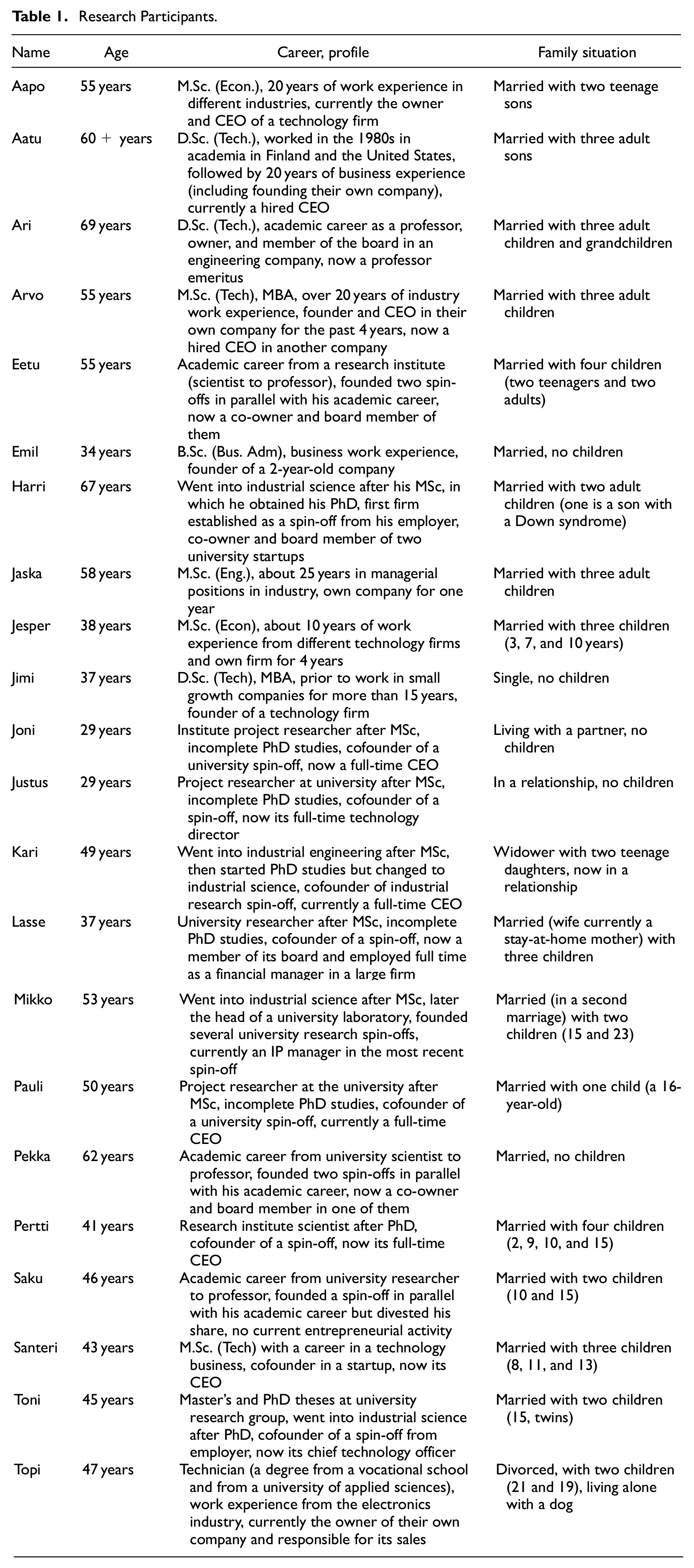
As recommended by constructivist grounded theory scholars (Haraldsson & McLean, 2022), we drew upon life story interviews (Atkinson, 2002). Grounded theory interviews have been depicted as “an unfolding story” (Charmaz & Belgrave, 2012, p. 361). The participants were first asked to talk about their firms. This was assumed to be an easy and meaningful topic and one which would establish trust and lay the foundation for more personal questions. We then invited them to tell the story of how they became entrepreneurs beginning with questions regarding where and when they were born. This was done to signal that the interviewer was interested in the whole life stories of the participants. The interviews were conducted in Finnish by native Finnish speakers and lasted from 1 to 3 hours. Each transcribed interview consisted of 10–24 single-spaced pages of text, resulting in a total of 353 pages.
Life story interviews were conducted to allow the participants to tell their own stories as opposed to accommodating fixed, preconceived categories set by the researcher (Marlow & McAdam, 2012). However, it would be naïve to assume that the participants were completely free to tell their stories and share true and authentic experiences. Interview settings inherently involve cues from the interviewer about the topics of interest. Thus, narrators construct their stories against a particular demand (Silverman, 2017) even if no questions are asked. Prior research has also demonstrated that when interviews are kept fully open ended, women entrepreneurs often spontaneously include family and children in their entrepreneurial life stories (Mallon & Cohen, 2001), whereas men limit their narrations to the professional and business arenas and assign family to a minor position (Drakopoulou Dodd, 2002). For these reasons, we asked the participants questions about family, free time, and hobbies to prompt more encompassing life narratives. We acknowledge that life story narratives are co-constructed between the participants and the interviewer (Charmaz & Belgrave, 2012) and thus, reflect power and gender dynamics. In our case, while all participants were men, all the interviewers were women.
Data Analysis
We approached the 22 collected life stories as gender arenas in which the participants were given opportunities to discursively reproduce, challenge, or disrupt gender relations and masculinities (Whitman, 2018). Following the recommendations of Charmaz and Belgrave (2012), we inductively analyzed the collected data using a constructivist grounded theory approach (see Figure 1 for our data structure). After reading the interview transcripts multiple times, we engaged in three rounds of coding and analysis. Working iteratively, we began with open coding, which aimed at identifying initial categories coded according to gendered practices and relations with which men engaged in different life spheres (family, venture/work) as (prospective) fathers and entrepreneurs. Specifically, we coded for doings—what men entrepreneurs said they do in relation to others, for example, family members, employees, and friends, why they do it, and how they feel about doing it, for example, exerting control over others and taking care of children.
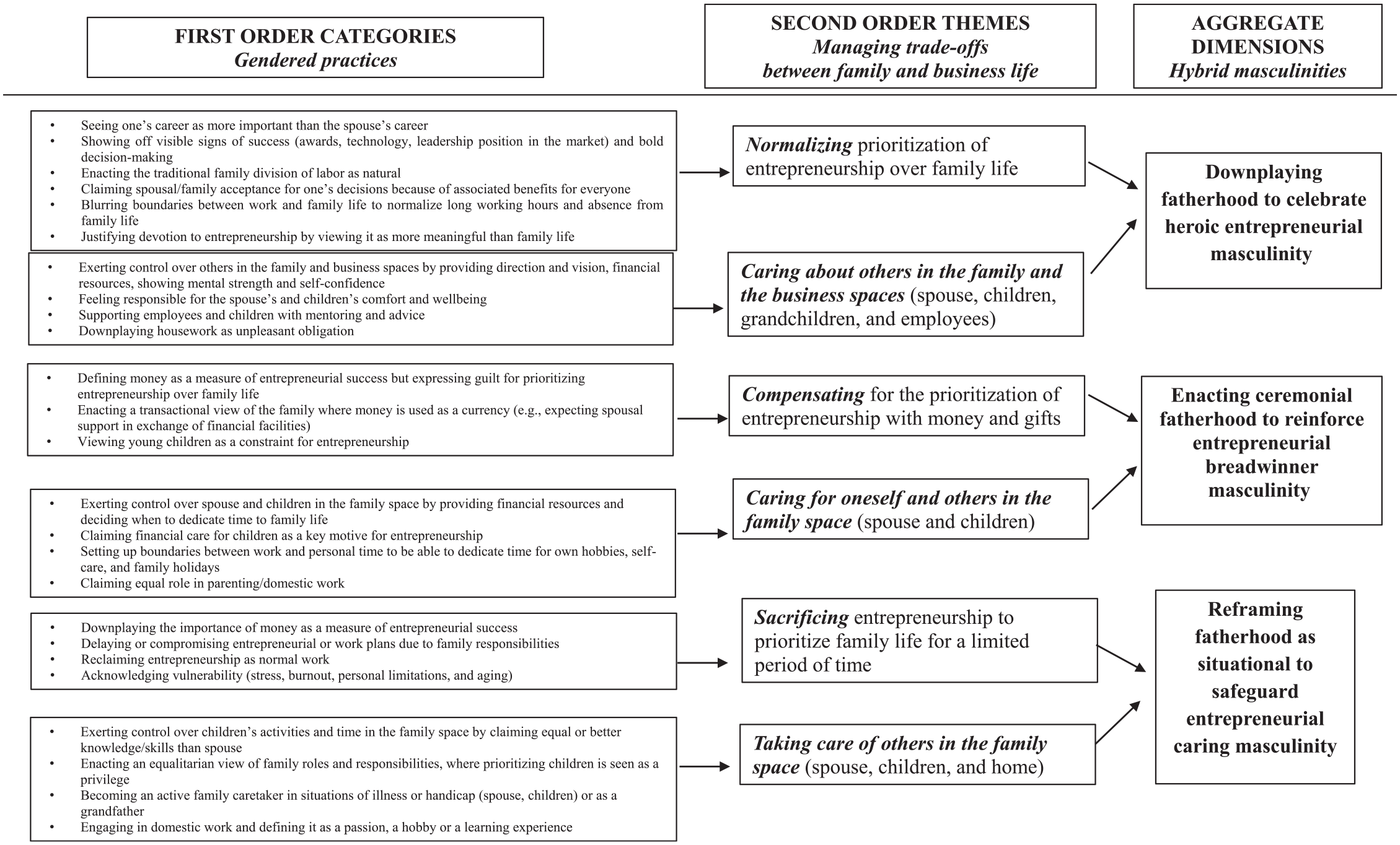
Data Structure.
After iteratively coding our material based on first-order codes and moving back and forth between data and codes, we focused our attention on how the participants discursively engaged with establishing hierarchies and priorities as (prospective) father entrepreneurs by managing trade-offs between their work and family lives. We paid attention to how these trade-offs were discursively constructed by the participants, regrouping our first-order categories into two sets of higher-order codes that depicted the relative importance given to entrepreneurship and fatherhood, respectively, on a continuum line. The first set of second-order codes distinguished between the priority given to entrepreneurship, the compensation for this prioritization with money or gifts, and, at the opposite, the prioritization of family life for a limited period. The second set of second-order codes emerged from the regrouping of the first-order codes relative to family relations within three distinct forms of engagement with parental caring practices: caring about, caring for, and taking care of the self and/or others (cf. Cannito, 2020).
Third, as we aimed at theory development, we reflected on inferring what these second-order categories were expressing at a higher theoretical level in terms of how (prospective) fatherhood shapes the enactment of entrepreneurial masculinities. This related to a set of aggregated dimensions enabling us to address our research question. To do so, we regrouped the six second-order codes to highlight three main discursive strategies used by men entrepreneurs to construct entrepreneurial masculinities, each distinctly leveraging fatherhood as a discursive resource of entrepreneurial masculinities.
Findings
In this section, we show how our participants construct meaningful entrepreneurial masculinities at the intersection of work and family lives. We reveal that these masculinities are rooted in hegemonic masculinity, either very openly or in more subtle, hidden, or ephemeral ways. The mechanism of establishing unequal gender relations in relation to spouse and/or other men was present in all our participant accounts, albeit in different ways, suggesting the enduring persistence and influence of hegemonic masculinity in the lives of contemporary Finnish men entrepreneurs.
Downplaying Fatherhood to Justify Heroic Entrepreneurial Masculinity
Heroic entrepreneurial masculinity is openly and directly performed as hegemonic masculinity legitimizing unequal gender relations between men and women, between masculinity and femininity (Messerschmidt, 2018). This involves normalizing the male privilege of prioritizing work over family life, in which men’s careers are seen as more important than the careers of their spouses. The female spouse is naturally placed in the feminine role of taking care of domestic labor and endorsing the primary caregiver role in relation to children:
It led to my wife needing to leave her work here [in Finland]. She was at home for 14 years, so she managed our home because I was away so much. If you live in [a capital city], your commute to work may take up to 1.5 hours or at least an hour. So, the days got to be very long. (Jaska)
The family, particularly the female spouse, is expected to support the father’s immersion in entrepreneurship. Failure to do so can justify a divorce and the selection of a new, more understanding spouse:
My ex-wife was a really good person, but she was a nine-to-five person. This means you work from nine to five, followed by leisure time when you do not think about work. […] So, we never reached an agreement about my entrepreneurship. […] My current wife has a different attitude; of course, she has seen it from the very beginning, and it has been natural for her, so she has a very positive attitude toward it. (Mikko)
The spouse is also expected to accept the risks associated with entrepreneurship, although these risks may “make her feel scared” (Harri). The spousal acceptance of the long hours at work and immersion in the business is claimed on the basis of mutual benefits. For example, high work motivation ensures that the entrepreneur is rewarded with “being more relaxed during the leisure time” (Santeri). The availability of a wife who assumes the role of a primary caretaker is key, although prioritizing work over family activities is sometimes acknowledged to have “caused some minor disputes” with the spouse (Ari). The children are also expected to support their father’s entrepreneurship, as they “see that their father enjoys life [as an entrepreneur]” (Kari). The freedom to engage in work that is fun contributes to entrepreneurs’ happiness, which is seen as automatically triggering spousal and family satisfaction:
My wife claims that I work longer hours than ever, and I do not know if she is right. […] Honestly, I do not think there is a great difference. Maybe a marginal one. If you were a CEO or a director at a large company, the days would be equally long. Maybe you would then work more seriously than now because now, it is fun. [Interviewer: So, the wife is happy when you are happy?] Yes. (Jaska)
Blurring the boundaries between work and family life also serves to normalize long working hours and absence from the family. Continuing to work at home after office hours is justified by “not spending long days in the office” (Santeri), or by framing work as leisure time—“work is a kind of hobby as well” (Ari) or even as a way of relaxing when working from a summer cottage—“It felt like being on a holiday” (Jaska). Prioritizing work and working long hours, thanks to the silent support of the spouse and children, are not seen as privileges. They do not trigger any reaction of empathy with potential spousal fatigue or frustration, and no guilt is expressed about the risk of not responding to family expectations during leisure time. Support and understanding from the family are taken for granted:
Being an entrepreneur requires that the home base needs to be in order so that you do not need to integrate the domestic affairs to the daily routine, not to think about them. You can fully concentrate on work. (Pauli)
Men’s parenting also serves as a role model for their children, transmitting values to guide children’s choices and behavior. Participants repeatedly refer to hardworking and honesty as traditional Finnish/Lutheran values, which they think will help their children to achieve well-being and prosperity later in life. The responsibility of not spending more time with children or family is assigned to others, even if this works against the father’s wishes. Absent parenting is not perceived as a problem as the participants claim a strong rapport with their children; they are confident that their children will be in touch with them when needed:
With the kids, I would like to spend more time with them. But then again, I remember that as an 18-year-old, when I was living alone, I had so many activities at the time, so my parents were not my first [priority]. But of course, it is nice to know that the support is there, the network, that if there are problems, I have good contact with the kids, that I know they are not in trouble, that they call me often, and that if I do not call them for a while, they will call me and ask how I am doing and where I am. (Topi)
We interpret these accounts as signaling the enactment of heroic entrepreneurial masculinity, with the participants identifying as “a typical entrepreneur, married to his work” (Jimi). This identity is proudly depicted as more meaningful than the ordinary lives of other men, such as managers or employees “with a nine-to-five job, a house, a car, two kids, and a dog” (Jimi). An implicit hierarchy is introduced between entrepreneurs and other men who are not endowed with the same masculine stamina for work and prefer a more feminine, stable and somehow narrow life that lacks the excessive dedication and passion of an entrepreneur. By normalizing work as a fundamental priority, men entrepreneurs avoid the responsibility for domestic tasks which are downplayed as an unpleasant duty, particularly by the older generation of men: “I have been spared from housework as compared to my son, who is a young dad; he is forced to do a lot more” (Jaska).
Entrepreneurship is an arena for pursuing one’s personal ambitions and achieving a recognized social position. Heroic entrepreneurial masculinity is enacted by showing visible signs of success and the masculine ability to make bold decisions. An example is taking risks to achieve fast growth, which also positions entrepreneurs as superior to other men, such as managers, who cannot or do not dare to act boldly and who simultaneously fail to reach success and fortune: “If one would have been cautious, we would still have less than 10 employees” (Topi). The participants depict heroic entrepreneurial masculinity by emphasizing how they exert control over others, that is, by featuring their key positions in their companies in terms of providing direction and showing masculine mental strength in difficult situations:
One of our employees […] said that the strength and the weakness of the firm are that, even if 27 employees think of the same thing [the firm had 28 employees at the time], if Lasse thinks otherwise, then we will proceed as Lasse thinks. This does not mean that I would have an absolute veto in the decisions, but I was pretty persistent in things I knew I was right about. (Lasse)
The emphasis here is on having a competitive, goal-oriented, or even addict personality considered acceptable, and even desirable for the entrepreneurial context:
I remember by heart the firm’s business ID but not my godson’s birthday. I guess this says something. […] When somebody asks me if I am a work addict, I reply, “No, I am just an addict.” No matter what it is, I will do it at full speed. (Jimi)
From this position of perceived superiority in relation to others, such as the female spouse or other men, the heroic entrepreneur expresses his magnanimity by acknowledging his feeling of being responsible for the comfort and well-being of others in the family and the business spheres: “when I see that everyone is happy with their lives, that is enough for me” (Ari). This heroic masculinity places an onus on them by showing paternalism as a form of caring (through guiding and mentoring employees as pseudo-children):
We now have this startup. There is one guy from India; I selected him because over the years, you see a lot; he has done his PhD for me, and he has also been on one project. You see who has got energy. I thought he would be a good leader for the startup. […] I am mentoring him, what things to present and how to present them to financiers, and so on … but he is good. (Pekka)
Enacting Ceremonial Fatherhood to Celebrate Entrepreneurial Breadwinner Masculinity
There is tension between care and hegemonic masculinity when enacting entrepreneurial breadwinner masculinity (Gruson-Wood et al., 2022). This conflict is resolved by relying on a transactional view of family relations, in which money and time are exchangeable currencies: “You must show that you can at least compensate the time [spent at work] with money. With money you can do nice things” (Pauli).
Money and wealth are not depicted as personally important or meaningful; their value is instrumental and directed toward providing for families and children: “It [money] has its own meaning. When you have a family, you will need to support them” (Aapo). Claiming financial responsibility and care for children is framed as the key motive for entre-preneurship:
As to money, the most important motive for me is to reach such a level of income and such a standard of living that my only daughter can have the hobbies she wants and do what she likes (Mikko).
While entrepreneurship and the freedom of “doing what I like” (Mikko) are perceived as important for one’s life, the participants confess feeling guilty for prioritizing work over family life, which requires careful organization and family support:
My working days really depend on the day. I was in Japan for a week, and I felt guilty [for being away]. But my girlfriend was there a couple of times to see how things were going. And then I have other relatives here. This was my reason for moving from Northern Finland—to be able to organize my everyday life a bit better. (Kari)
The participants relieve this tension in different ways. For some, particularly older men, the feeling of guilt stemming from prioritizing entrepreneurship over family life—“I can imagine that I have neglected the family” (Aatu)—is resolved by placing it in the past and emphasizing that the children “have grown up to become alright, so I don’t have [regrets] anymore” (Arvo).
Overall, claiming a commitment to equal parenting and caring for children and family is crucial for enacting an entrepreneurial breadwinner masculinity. Equal participation in the household is not described in detail but rather proudly claimed as a routine-like statement: “My wife does the cooking, and I do everything else” (Pertti). Even if the spouse is currently a stay-at-home mother, asserting fully equal parental participation in the interview is important and any suggestion to the contrary is taken offensively:
Interviewer: “OK, so it is your wife who takes more responsibility for raising the children, and then you, of course, participate as much as you can.” Lasse: “Well, I do not talk about this area of my life, but I would say that we participate equally in raising the children.” Interviewer: “Yes, but is she at home?” Lasse: “Yes.”
The participants discursively construct fatherhood and entrepreneurship as two sides of the same coin, arguing how important it is for them to achieve an acceptable balance between work and family life, with family depicted as their most important achievement: “Getting married. This is, of course, something that comes to mind first. It is such a big thing” (Emil). However, ambivalence is evident, with small children being framed as constraints to the practice of entrepreneurship: “It narrowed my [career] opportunities quite a bit for 10 years, when I was primarily responsible for my son’s care. I was not interested, and I had no time to think about my career” (Harri).
The tension between entrepreneurship and fatherhood is visible even in the case of prospective fathers. Being an entrepreneur means that life is not sufficiently stable to make plans for a family, compared with the alternative career possibility in academia. Therefore, family plans are delayed, at least partially, by entrepreneurship:
I have been thinking that had I stayed at the university, I would have graduated and would be doing my PhD now. So, of course, it could be [that I would have had a family], but it is dependent on other things; you cannot build a family on your own. But it could be that the [family] situation would be different. (Justus)
Enacting entrepreneurial breadwinner masculinity is performed by setting boundaries between work and family time. This enables dedicating time for parenting and spending time with the family, for example, by not working on weekends, as this time is specifically reserved to family members:
At the moment, I do not have any hobbies other than attending to my children. When I was launching the business, it, as well as the research that accompanied it, was my only hobby […] Well, weekends are mainly for spending time with the family […] And then there are the children’s hobbies; they take up a lot of time during the week and on the weekends, driving the kids around to different places. (Saku)
The boundaries between work and family life are repeatedly acknowledged as fragile during the interviews:
I work more or less normal hours. Of course, sometimes you have to travel or there are some urgencies that you just need to finish; then I work in the evening at home as well. But I do not want to give the impression that I would work around the clock. (Jesper)
Yet, the participants also proudly recognize that, as entrepreneurs, they have the privilege of managing these boundaries as they wish, compared to other men. They have flexible hours and can take their children to movies in the middle of the day (albeit compensating for these family hours the following night):
The work never gets done, so you have to set the limit somewhere. I am perhaps a bit atypical in the sense that I can go and watch a children’s movie in the middle of the day with the kids, start working at 10 pm, and finish at 4 am. I have tried to schedule my work time so that it interferes as little as possible with the time I spend at home with the kids (Lasse).
Taking holidays with the family is constructed as an important norm. However, it is equally acceptable to exert control over how time is spent during holidays, including being available for business calls and e-mails—“of course there can be some meetings during the holidays” (Eetu)—during this theoretically preserved family time:
When I was single, I did not want to take any vacations. But for the last few years, I have kept a very full vacation schedule, something like five weeks a year. I do not feel guilty of joining a teleconference, sending some e-mails, or making some calls while on vacation. (Lasse)
Setting up boundaries between work and personal time is also important for hobbies, self-care, and exercise. Taking time off serves as preparation for future work demands: “I can pretty well devote the weekends for charging the batteries” (Toni). Self-care serves the purpose of “staying healthy and fit to be able to work hard” (Emil) or being a “well-earned reward” for having worked hard (Jimi). This suggests that entrepreneurship is a central life pillar, for which the family receives certain compensation, and requires men entrepreneurs to invest in their health in order to continue working hard and providing for their families. While men entrepreneurs frame themselves outside gender hegemony, for example, by emphasizing equal parenting or by expressing guilt for their long hours at work, the entrepreneurial breadwinner masculinity is enacted as a hybrid hegemonic masculinity. As such, it draws on hegemonic masculinity by reproducing unequal gender relations with women and other men, as illustrated in our findings.
Claiming Fatherhood as Pivotal to Rationalizing Entrepreneurial Caring Masculinity
Entrepreneurial caring masculinity reflects the new father masculinity characterized by the increased involvement of men in caring practices (Banchefsky & Park, 2016; Cannito, 2020). The participants depict fatherhood as pivotal to their lives, organized around the fatherhood role, at least for a certain period. Prioritizing family is not always a voluntary choice but is pushed by an extreme situation. For example, the need to take care of the spouse with an aggressive cancer involves a swift change of plans from full-time work into becoming a primary caretaker:
I resigned immediately from [a large chemical firm] and decided that I would take care of her so that she did not have to be in a hospital. I was her caretaker at home for two years, lived off my savings, and did some consulting. (Kari)
A scientist career when one has a disabled child is preferred to entrepreneurship as the latter is deemed to be too demanding and time consuming:
My career as an industrial scientist worked very well for me for personal reasons. I had so many problems that impeded me from going anywhere. Having children is a barrier in itself, but then my son has Down syndrome, so it was a pretty tough 10 years after 1976. (Harri)
Children are depicted as a barrier because they impede the enactment of entrepreneurial masculinity. However, taking the primary caretaker role does not mean completely sacrificing one’s professional career but rather making concessions. The participants also reveal the adverse effects of the family on changing work plans, which are sometimes compromised because of family responsibilities:
After my PhD in 2001, I needed to go abroad as a postdoc or go to real work, but then I had kids and mortgage, so I decided that it was not worth it to go abroad and be burned out; I went to a research institute to work from nine to five. (Pertti)
Active care commitment delays entrepreneurial entry decisions but does not put them at risk. Once family barriers are removed, entrepreneurship might happen: “Then the children were a bit older, and I had my most active period as an entrepreneur” (Harri). Time spent in active care is framed as a needed interim phase enabling business ideas to develop smoothly: “During this time [of care], I was considering my options, and I contacted some people and started building this [business]” (Kari). Caring is not experienced as a threat to masculinity, as the time spent in care activities or in a family friendly research job is not misspent but rather helps prepare future entrepreneurial plans. Furthermore, masculinity is protected by claiming superior skills in exerting care over those of the female spouse:
The wife would have liked to intervene in the daughter’s school affairs, but the daughter was like me in the sense that she did not like it. So, I knew how to help her, being there for her if needed. I made a deal with my wife that she would not say a word about the daughter’s school affairs in the last year. And that worked well. (Harri)
Entrepreneurship is depicted as normal work, not as something requiring extraordinary or heroic performance: “We have built this systematically so that we [founders] are here just to work (all founders). And we have managed this as a firm” (Lasse). The female spouse’s career is viewed as equally important, which—paradoxically—is emphasized as an argument for explaining spousal support: “My wife has been working all the time as well so there is a mutual understanding that this is the way it goes” (Santeri). Female spouses are depicted not only as tolerating or supporting their husband’s entrepreneurial venturing but also as wanting them to succeed. They are described as partly responsible for pushing the business forward, which might be a post hoc rationalization of long working hours and commitment: “As a career person, she, of course, wants that things move forward. In general, she has a positive attitude toward entrepreneurship” (Emil).
The typical heroic image of the entrepreneur is denied and the participants problematize the motivation for limitless growth to legitimize an alternative entrepreneurial practice:
There is no upper limit for growth. Why not grow to become insanely big? But I do not think I will succeed in it. But one can always try. [..] I am an example of this kind of a not-so-successful technology entrepreneur. (Pertti)
Renouncing the heroic image and embracing an entrepreneurial caring masculinity involves accepting one’s vulnerability, including acknowledging stress and aging. For some participants, health problems were necessary wake-up calls to make changes to self-care:
During the first two years, we had only like a week off in total—I nearly had a burnout last autumn. I had to admit to myself that I could not think about work all the time; now, I no longer open my laptop at home as much. (Joni)
For others, vulnerability is related to aging and the loss of masculine energy: “When I was younger, I worked around the clock. Nowadays, I do not have energy for that anymore” (Pekka). Stress, mental burden, and related health problems are recognized as parts of the early entrepreneurial journey with the acknowledged need to change and take better care of oneself. The heroic, all-consuming entrepreneurial masculinity of their younger selves is situated in the early startup phase and needs to be replaced:
I was pretty tired then, totally worn out. In the early days, there were a lot of issues. We went through financing rounds and were rejected from everywhere, so it was pretty rough. We did not have orders, and, of course, money was quite a problem then, even personally. I think I got an ulcer then” (Emil).
Entrepreneurs are clearly aware that active fatherhood is a new norm and that being able to engage with it puts them in a superior position compared with other men, such as managers or employees, who are largely excluded from this social progress because of their fixed working hours:
The nature of my work makes it possible that I do not need to spend overlong days in the office. Often my working day starts at home, then I take care of the kids until I go to the office. Then there are kids’ hobbies, after which the working day continues. It is kind of a puzzle. (Santeri)
Similarly, men entrepreneurs wish to embody the new norm of equal domestic labor division, thus depicting domestic work as desirable and excessively framing it as a passion or a hobby; being at home is depicted as relaxing compared with the hectic days in the office. However, to safeguard entrepreneurial masculinity, the participants explain how they adopt masculine standards for active care:
And even cleaning is actually quite OK. I really like it. I remember the first time—because previously I did not need to—well, my wife did it, then I would do just the bare minimum. But then when you have to fill the washing machine and so […] you do not need to be so stressed about it; if you wash a shirt incorrectly, and it gets colored, then you learn and do not mess up the next time. (Kari)
For older entrepreneurs, engaging in active care does not jeopardize their entrepreneurial masculinity since their masculinity is protected by their past business achievements and their newly acquired position as super granddads: “I guess this is a classic situation; only when you become a granddad do you know how to be a dad” (Arvo).
Entrepreneurial caring masculinity seems to suggest critiquing, challenging and attempting to dismantle hegemonic masculinities and transitioning toward positive masculinities that legitimate an egalitarian relationship between men and women (Messerschmidt, 2018). Yet, even here, we note that hybrid hegemonic masculinity prevails, with its emphasis on men’s superiority as caretakers. Engagement in caring activities is framed as a passion or a hobby, possible to be accomplished with male standards.
Discussion
This article offers a nuanced understanding of how fatherhood (or the prospect thereof) shapes entrepreneurial masculinities by illustrating how men entrepreneurs do gender at the intersection of work and family life, thus addressing calls from Marlow and Martinez Dy (2018) and Cannito (2020). In so doing, we provide three main contributions to gender and entrepreneurship research. First, we make men entrepreneurs visible as gendered subjects by documenting three entrepreneurial masculinities enacted by (prospective) father entrepreneurs to accommodate concurrent normative ideals of entrepreneurship and fatherhood. Second, we challenge the neoliberal discourse of the new father figure, which is praised as bringing gendered egalitarianism, by showing that when entrepreneurial masculinities intersect with (prospective) fatherhood, unequal gender relations are maintained within the household and at work. Even when subordinate feminine caring qualities are assumed by men entrepreneurs, they are incorporated into reconfigured hybrid hegemonic masculinities. Third, by engaging with men entrepreneurs at various career and life stages, we also reveal entrepreneurial masculinities as generational and situational. The display of hegemonic entrepreneurial masculinity is secured or obscured in various ways by men from different generations and with different family configurations.
Entrepreneurial Masculinities of (Prospective) Father Entrepreneurs
Our research setting, technology entrepreneurship, is a masculinized domain in which hegemonic entrepreneurial masculinity is the norm (Marlow & McAdam, 2012). Within this setting, we identify three different entrepreneurial masculinities enacted to accommodate concurrent entrepreneurship and fatherhood normative ideals. These entrepreneurial masculinities emerge as a fluid contextual assemblage of different versions of masculinity subject to change and negotiation (Buschmeyer & Lengersdorf, 2016). 1 Men enacting heroic entrepreneurial masculinity conform to the normative ideal of hegemonic entrepreneurial masculinity by claiming superior masculine qualities, such as competitiveness (Lund et al., 2019), certainty and control (Garlick, 2020). This is done both in relation to their spouse and children and when interacting with men employees. Their discourse on entrepreneurship denies personal vulnerabilities and emphasizes physical and mental strength envisioned as sources of security and comfort for employees and family members. This entrepreneurial masculinity seems close to the “sovereign masculinity” conceptualized by Mann (2014, p. 44) as a solution to perceived insecurity and risks. Being tough and unemotional is discursively framed as an effective solution to a neoliberal world filled with uncertainties and challenges. Being a true man is presented as a necessity that provides mutual benefits to everyone, including those—subordinated others—who accept being overviewed and protected from the real or imaginary violence of the environment.
While heroic entrepreneurial masculinity clearly downplays fatherhood to align with the normative ideal of hegemonic entrepreneurial masculinity, men enacting entrepreneurial breadwinner masculinity conform to the dominant paternal masculinity in Nordic countries (Tienari & Taylor, 2019). They display an egalitarian discourse regarding family relations despite engaging with limited domestic work and children’s activities. Being able to provide for one’s family is claimed as a source of pride and identity for men entrepreneurs, which inherently positions them at a superior place in the gender hierarchy, compared with men employees who might lack opportunities to be breadwinners (Garlick, 2021). Masculine qualities, such as personal responsibility and self-determination (Whitman, 2018), are used by men entrepreneurs to justify their engagement in earning money for the family. However, they fail to realize that the constant prioritization of entrepreneurial work makes the traditional gender structure of family relations intact (see Gatrell et al., 2022). Spouses devote themselves to raising children while also following their own careers and fathers are positioned as providers and protectors. Enacting breadwinner masculinity involves reciprocal instrumentalization within the household—men entrepreneurs not only exchange work time with money and gifts but also self-instrumentalize themselves. They deny fatigue and stress to maintain their role as economic providers, which is perceived as a source of self-esteem. Moreover, signs of ambivalence manifest in the enactment of breadwinner masculinity, with men entrepreneurs engaging in ceremonial, public parenting to show others that they are progressive fathers, in line with the gender equality discourse.
Some men entrepreneurs also enact a caring entrepreneurial masculinity, claiming the prioritization of family life over entrepreneurship, although for a limited time and only because of spousal or child illness or death. Enacting this masculinity is constructed as a source of emotional closeness with children, bringing joy and satisfaction to fathers and their families. Such a caring masculinity is framed through a masculine lens, that of a choice, a decision that the participants have the privilege to take, whereas other men employees might have difficulties in implementing it. This indirectly positions men entrepreneurs at a superior place in the gender system (cf. Lund et al., 2019). Moreover, although men entrepreneurs do engage in caring practices at home, they also acknowledge leaving less attractive responsibilities to their spouses or engaging in doing them with male standards that insidiously maintain unequal gender relations within the family.
We see these entrepreneurial masculinities as revolving in varying ways around hegemonic masculinities, which are entrepreneurial as well as parental. Next, we discuss how these entrepreneurial masculinities maintain, restructure, and resist hegemonic masculinities.
Entrepreneurial Masculinities as Hybrid Hegemonic Masculinitie
We interpret the three entrepreneurial masculinities highlighted in our study as hybrid hegemonic masculinities (Messerschmidt, 2018), appropriating and incorporating certain feminine caring qualities and behaviors, albeit without altering gendered power. What we observe in our material is that hegemonic entrepreneurial masculinity is alternatively maintained, restructured, and resisted to enable men entrepreneurs to adapt to their historical context characterized by the new normative ideal of the new, involved father. While heroic entrepreneurial masculinity openly maintains and secures hegemonic entrepreneurial masculinity, denying any form of internal or interpersonal tensions, entrepreneurial breadwinner masculinity incorporates the discourse on gender equality. This discourse blurs hegemonic masculinity and leads to its reconfiguration around a monetarization of gender relations, compensating for unequal domestic and paternal engagement with money and gifts. As for entrepreneurial caring masculinity, although it seems to resist hegemonic entrepreneurial masculinity by constructing an alternative gender relation within the couple and incorporating feminine caring displays, this masculinity seemingly only obscures hegemonic entrepreneurial masculinity without rejecting it. The emphasis is shifted to the superiority of men as caretakers. Indeed, the hegemonic entrepreneurial and caring masculinities “sit alongside one another” (Hunter et al., 2017, p. 4), which leads—here again—to a reconfiguration of hegemonic entrepreneurial masculinity.
This suggests that the entrepreneurial masculinities of (prospective) father entrepreneurs are simultaneously constructed in reference to hegemonic entrepreneurial masculinity and parental masculinity, each imposing different, concurrent normative ideals upon men entrepreneurs. Entrepreneurial caring masculinity has been depicted as hegemonic because it still maintains patriarchal legacies (Miller, 2011) despite claiming equal domestic partnership. Navigating these hegemonic masculinities leads to the restructuring and broadening of hegemonic masculinity and not to its deconstruction. As a result, entrepreneurial masculinities emerge as hybrid hegemonic masculinities that are typical of the postfeminist culture of Western societies (Gill, 2007). Postfeminist masculinities are enacted as “a melting pot of masculinities” (Genz & Brabon, 2009, p. 143)—alternatively reworked, recycled, or strategically used not without ambiguities and tensions. Critical voices observe that the result of these enactments is not always the emergence of a new man or a new father, but also the reinforcement of patriarchal forms of masculinity, men’s power being simultaneously reconfigured and sometimes reinforced (Holmquist & Lindgren, 2002), as illustrated by our findings. The (prospective) father entrepreneurs in our study do not make a notable departure from hegemonic masculinity. Instead, thanks to their privileged social position, they continue to normalize or compensate for unhealthy work arrangements without fundamentally challenging the division of domestic labor and certainly without losing status or threatening their masculinity because of engaging with care.
Our accounts of fatherhood and entrepreneurship practices also reveal how the privilege of entrepreneurs, above other men, or those in different work environments, is constructed. Two main sources of this privilege are discursively leveraged by men entrepreneurs: entrepreneurial freedom and entrepreneurial passion. For instance, heroic entrepreneurial masculinity enacts workaholism, as other men in organizations might do it (see careerism, a masculinity conceptualized by Hearn & Collinson, 1998), with these masculinities establishing traditional family roles and justifying absent fathering. Nevertheless, an entrepreneur’s immersion in work is framed differently from that of waged employees, our participants insisting on describing it as a voluntary choice, not dictated by the organization. For entrepreneurs, work is fun or a hobby, which is seen as more meaningful than the ordinary nine-to-five jobs of male employees. Therefore, the excessive dedication and passion of entrepreneurs implicitly position them at the top of the masculine hierarchy, as entrepreneurs have the freedom to pursue personal ambitions and take risks, eventually leading to financial success and social recognition.
Similarly, the construction of breadwinner entrepreneurial masculinity in our data makes visible the implicit comparison that entrepreneurs engage in when speaking about men with other career choices. Breadwinner entrepreneurs frame entrepreneurial freedom as providing the privilege of being atypical fathers, who have flexible working hours and can dedicate time to fathering in the middle of the day. The participants construct entrepreneurship as filled with uncertainty and requiring full devotion, particularly in the startup phase, which might postpone family plans. This makes entrepreneurship more masculine because it requires courage and is potentially more successful compared with more predictable career paths. As for men enacting caring entrepreneurial masculinity, they recognize the incompatibility of heroic entrepreneurship with family obligations by contrasting it with the less demanding work of industrial scientists. However, entrepreneurs prioritizing family obligations when their children are young do not jeopardize their career progression, unlike men employees, because entrepreneurial entry and success can be achieved at any stage of one’s professional life.
In the next section, we highlight entrepreneurial masculinities as differently enacted by men entrepreneurs from different generations and with different family configurations.
The Generational and Situational Dimension of Hegemonic Entrepreneurial Masculinity
Engaging with men entrepreneurs at various career and life stages enabled us to observe how entrepreneurial masculinities are enacted differently at different stages of the entrepreneurial and family life cycles. Our findings confirm that narratives of entrepreneurial masculinities have generational scripts (Eerola & Huttunen, 2011). For instance, young single men entrepreneurs—as prospective fathers—may engage with gender differently than fathers with young children. Young prospective father entrepreneurs may fully embrace the heroic entrepreneurial masculinity normative ideal. However, they might confess some anxiety regarding their future role as fathers, perceived as a potential masculinity threat because of the need to engage with active caring. Similarly, entrepreneurs in the early phase of their startup enact heroic entrepreneurial masculinity, making this phase a restrictive period in terms of available alternative masculinities. Men entrepreneurs with young or teenage children mostly embrace entrepreneurial breadwinner masculinity, whereas older men either conform to heroic entrepreneurial masculinity or adopt entrepreneurial caring masculinity in relation to their grandchildren. Entrepreneurial caring masculinity is mainly situationally enacted by divorced or widowed men with ill or young children or by men with ill spouses.
This suggests that the caring and heroic/breadwinner masculinities are enacted at two distinctive and consecutive life phases. Taking temporary responsibility for the children or spouse is not at the cost of one’s entrepreneurial career, although some compromises must be made. Eventually, this does not prevent immersion in entrepreneurship once the situation triggering a need for active caring has been solved. Indeed, entrepreneurial caring masculinity, which seems to resist hegemonic masculinity at first glance, does not replace heroic entrepreneurial masculinity but just postpones its enactment. The decision to take responsibility for the family domain is associated with taking control—the caring father knows what is best for his children and rejects the female standards of household work according to the men’s way (Farstad & Stefansen, 2015). Alternatively, caring masculinity is available for older-generation grandfathers who can show past performance and for whom such an enactment does not represent a gender threat (Johansson, 2011).
While young single men or older entrepreneurs with adult children rather effortlessly embrace heroic entrepreneurial masculinity, the participants identifying with breadwinner masculinity paternalistically defend feeling responsible and taking responsibility not only for family financial security, but also for partner and employee well-being. Men enacting entrepreneurial breadwinner masculinity express their pride for being able to be good fathers. They cherry-pick parenting duties that can be fitted to available slots during working days or weekends, such as going to see children’s movies (Johansson, 2011), instead of making concessions, such as shortening working hours to take care of their children’s daily needs (see also Cannito 2020). They justify their absolute dedication to entrepreneurship by explaining that the venture places demands upon them that they depict as absolutely compulsory. For example, they need to be on call all the time to check their e-mails first thing in the morning or during holidays. This is willingly accepted as it confirms and enhances their entrepreneurial masculinity and compensates for the caring position they eventually adopt in the household. As they cultivate their entrepreneurial masculinity at work, these breadwinner entrepreneurs can publicly claim that their families are their most important priorities, although they dedicate most of their time to their work. Meanwhile, their spouses are praised for accepting unhealthy working hours in exchange for mutual benefits or wanting to see their husbands happy.
Limitations and Suggestions for Future Research
Our research is not without limitations. First, our results represent a specific group of men entrepreneurs. They share a relatively homogenous educational background, having at least a master’s degree in engineering or physics, and domain of entrepreneurship (high technologies). They are embedded in the national context of Finland as a Nordic welfare society and a forerunner in gender equality although the older informant accounts in our data illustrate the different gender norms of their generations in Finland. Second, our research has relied on heterosexual couples in the context of nuclear families and on a heteronormative understanding of what fatherhood is (i.e., a status of having a biological relationship to a child). Future studies could benefit from a more diverse set of men (and non-binary) entrepreneurs and their families, including those in other cultural contexts, to explore how different normative expectations of fatherhood shape entrepreneurial masculinities. Third, the fact that we do not solely focus on fathers who are actively engaged in caring for their young children living at home can be seen as a limitation that future research could address by focusing exclusively on men entrepreneurs in this life stage. A purposeful sampling of “superdad” entrepreneurs might be one interesting avenue for future research. However, our approach enabled us to analyze how fatherhood (or the prospect thereof) intersects with entrepreneurial masculinities to uncover generational scripts. Future research would benefit from longitudinal investigations of men entrepreneurs across different life stages to better uncover the role of family and venture dynamics in the enactment of entrepreneurial masculinities. Fourth, our study has exclusively focused on technology founders. Future studies may investigate men entrepreneurs in more feminine industries, such as health care or education. Fifth, in our research, men entrepreneurs were the sole informants of their parental roles and contributions to family care. Further research might investigate spousal relationships and family dynamics by including spouses and other family members as informants. Ethnographic approaches might help understanding how different practices of care intertwine with the entrepreneurial practice, and what are the implications for men, their families, and their ventures.
Conclusion
This article makes men entrepreneurs visible as gendered subjects by empirically identifying three entrepreneurial masculinities that men enact in order to accommodate the normative ideals of entrepreneurship and fatherhood and to resolve the potential tensions between them. We show that the enactment of hegemonic masculinity takes different forms for men of different generations and in different family situations. These different generational scripts indicate that entrepreneurial masculinities might change over time. There are some intentional, active attempts to modernize gender relations, shaping masculinities toward positive masculinities (Messerschmidt, 2018). However, our article suggests that the discourse of the new father figure has not contributed to greater gender equality and to the extinction of hegemonic entrepreneurial masculinity. Instead, it has led to the reconfiguration of hybrid hegemonic masculinities that simultaneously secure and obscure their hegemonic power, increasing their elasticity (Messerschmidt, 2018). The heroic and hegemonic entrepreneurial masculinity is persistent even in the Nordic context, despite the high expectations for gender equality and the growing emphasis on male parenting as important for families (Eerola & Mykkänen, 2015).
As we did not identify any superdads who would fully commit to their roles as fathers (Cooper, 2000), this may indicate that the male privilege can be a trap for men entrepreneurs because they are deprived of the opportunity of intensive fathering (McDonald & Jeanes, 2012). We hope that our research will help raise awareness among men entrepreneurs and entrepreneurship educators, affording the former more agency in how they want to be known and how they want to act as fathers and entrepreneurs for instance, by engaging actively in taking care of their children and families. Furthermore, we hope that our study encourages future investigations into doing gender, men entrepreneurs, fatherhood, and masculinities.
Footnotes
Declaration of Conflicting Interests
The author(s) declared no potential conflicts of interest with respect to the research, authorship, and/or publication of this article.
Funding
The author(s) received no financial support for the research, authorship, and/or publication of this article.
