



Abstract
This article examines how the war-torn context in Iraq has affected men’s entrepreneurship and entrepreneurial masculinities. Drawing on the entrepreneurship masculinities literature, Connell’s notion of hegemonic masculinity and in-depth interviews with 21 Iraqi men entrepreneurs, this article demonstrates the complex interplay between entrepreneurship, masculinity and patriarchal dynamics in the context of wars and economic instability in Iraq. Study findings show how Iraqi men often turn to entrepreneurship out of necessity to meet patriarchal expectations of them as primary providers for their families. We contribute to the literature on entrepreneurship, men and masculinities by demonstrating how entrepreneurship not only serves as an imperfect economic solution to familial poverty but also enables some men to conform to patriarchal norms of hegemonic masculinity that continue to disadvantage women. Theoretically, the article shows how men’s entrepreneurial hegemonic masculinities in contexts of war can be conceptualised as generational, situated and implicated in corruption and the reproduction of patriarchal relations between men and women.
Introduction
Entrepreneurship is often constructed as a masculine domain, associated with men and their practices (Barragan et al., 2018; Marlow and Swail, 2014; Swail and Marlow, 2018). Despite this, there remains an ‘almost complete absence of any explicit discussion of men and masculinities within entrepreneurship’ (Marlow and Swail, 2014: 91). An important body of scholarship has started to address this knowledge gap (Giazitzoglu and Korede, 2023; Hamilton, 2014; Hytti et al., 2024; Rumens and Ozturk, 2019; Smith, 2022). These studies have sought to deconstruct entrepreneurial masculinities, with scholars converging on the view that ‘entrepreneurial masculinities’ are not monolithic, but rather ‘performed in different contexts by different sorts of enterprising males’ (Giazitzoglu and Down, 2017: 53). Indeed, as this article demonstrates, the critical examination of entrepreneurial men and masculinities in specific cultural, economic, social and political contexts can provide insights into how gendered hierarchies among men and patriarchal relations between men and women are reproduced and contested through entrepreneurship.
Research on the connections between entrepreneurship, men and masculinities within patriarchal cultures is especially limited (Tlaiss and Kauser, 2019). Yet, entrepreneurship occurs within patriarchal societies such as those within settings like Iraq that are marked by unequal and rigid gender relations between men and women. As Connell (1995) argues, patriarchy is a system of gender practices and power relations that serves to reinforce men’s interests and authority while disadvantaging those of women. Entrepreneurial masculinities can play a part in legitimating patriarchal relations between men and women (Hytti et al., 2024; Tlaiss and Kauser, 2019), but patriarchy is neither monolithic nor uniform. Prior research on men, entrepreneurship and masculinities tended to be conducted in Western societies (Giazitzoglu and Down, 2017; Hytti et al., 2024), which reflect culturally specific patriarchal relationships compared to those found in the Arab world. We know remarkably little about men’s entrepreneurship and masculinities in such patriarchal societies, which we argue represents an important and timely research focus (Althalathini and Tlaiss, 2023; Farquhar et al., 2024). Indeed, in patriarchal societies such as those within Iraq, rigid patriarchal gender relations between men and women can be placed under pressure and reshaped by conflict such as that experienced within war-torn contexts. While conflict is a capacious term, in this article, our understanding of conflict relates to that generated by war. As such, we use ‘war-torn’ in this article to refer to settings where international administration, oversight or interventions have occurred due to the societal instability precipitated by active conflict or historical war (Barakat and Chard, 2002; Jackson, 2004).
Critical analyses of research on entrepreneurship in contexts affected by conflict is uncommon. Previous studies have shown how people often turn to entrepreneurship from necessity to provide economic security for their families (Dencker et al., 2021; Khoury and Prasad, 2016; Naudé et al., 2023). While both men and women may pursue entrepreneurship in war-torn contexts to that end, existing entrepreneurship research has predominantly focused on women, leaving men entrepreneurs largely under examined (Althalathini et al., 2020, 2022; Farquhar et al., 2024; Tlaiss, 2019; Welsh et al., 2021). For men, however, such environments – characterised by institutional challenges, corruption and resource scarcity – may hinder entrepreneurship (Webb et al., 2020). In turn, this may restrict their ability to engage in entrepreneurial activities and enact entrepreneurial masculinities that reproduce patriarchal relations with other men and women (Naudé et al., 2023). As such, this article addresses the question: How do war-torn contexts affect men’s entrepreneurship and entrepreneurial masculinities, and what are the consequences for reproducing patriarchal relations between men and women?
Analytically, we draw on Connell’s (1987, 1995) early seminal writing on hegemonic masculinity and subsequent scholarship that has reformulated the concept (Connell and Messerschmidt, 2005; Messerschmidt, 2012, 2019). Following other entrepreneurship scholars writing on men and masculinities (Giazitzoglu and Down, 2017; Giazitzoglu and Korede, 2023; Hytti et al., 2024), we do not treat entrepreneurial masculinities as hegemonic masculinity but understand how specific entrepreneurial masculinities can be enacted in a hegemonic form. Conceptualising hegemonic masculinity as a set of gender practices that are relational and reproduce patriarchal relations between men and women (Connell, 1987, 1995), we contribute to extant research on entrepreneurship in war-torn contexts (Althalathini et al., 2022; Farquhar et al., 2024; Tlaiss, 2023). Study data shows how a depressed labour market structured by patriarchal gender relations has placed men entrepreneurs under severe pressure to meet socio-cultural expectations of them as breadwinners who must provide the family wage. Insights are provided into which entrepreneurial men can succeed in that regard, but also those men who fail and struggle, including some younger men who are deterred from entrepreneurship by older male patriarchs, and those who are excluded from access to entrepreneurial resources. Theoretically, this study contributes to research on men and masculinities (Giazitzoglu and Korede, 2023; Hamilton, 2013; Hytti et al., 2024; Rumens and Ozturk, 2019; Smith, 2022) by conceptualising men’s entrepreneurial hegemonic masculinities as generational, situated and implicated in pervasive corruption and the reproduction of patriarchal relations between men and women.
This article is structured as follows. First, we outline the article’s theoretical underpinning before reviewing the relevant streams of literature on entrepreneurship, wars and gender. Next, the study’s methodology is presented, followed by the findings. The discussion section outlines the article’s principal contributions to knowledge and theory. Finally, the conclusion highlights study limitations and signpost avenues for future research.
Theorising entrepreneurial hegemonic masculinities and patriarchy
In our analysis, we mobilise Connell’s (1987, 1995) concept of hegemonic masculinity, including subsequent revisions that address its criticisms (Connell and Messerschmidt, 2005; Messerschmidt, 2012). As mentioned above, hegemonic masculinity is defined by Connell (1995: 77) as a set of ‘gender practices’ that are linked to patriarchy, an important feminist concept that Connell (1995: 74) draws upon to describe a gender order that sustains the overall ‘subordination of women and dominance of men’. Hegemonic masculinity is understood by Connell (1995) to reproduce the legitimacy of patriarchy, which gives rise to questions about how hegemonic masculinities can be identified. For Connell (1995: 77), hegemonic masculinity attains cultural ascendancy, whereby the hegemony of specific masculinity is established through ‘correspondence between cultural ideal and institutional power’. As such, hegemonic masculinity becomes the idealised version of how masculinity should be accomplished to consolidate men’s authority and gender privilege over women. In this frame, hegemonic masculinities are constructed in relation to non-hegemonic masculinities. One example of the latter is complicit masculinities enacted by men who ‘do not embody hegemonic masculinity’ (Connell, 1995: 77), but still realise a ‘patriarchal dividend’, understood as the ‘advantage men in general gain from the overall subordination of women’ (p. 79). Thus, hegemonic masculinity can represent the most socially appropriate and ‘natural’ version of masculinity for men to accomplish, although in some contexts it may not be the most common masculinity (Messerschmidt, 2012).
While Connell’s (1987, 1995, 2003) writing on hegemonic masculinity has profoundly shaped critical men’s studies, Messerschmidt (2019) argues that numerous scholars of masculinity have misunderstood and misapplied hegemonic masculinity, apparent in studies and debates about which ‘types’ of men are the archetypes of hegemonic masculinity. This angle of analysis has overlooked hegemonic masculinity as a relationship of gender inequality and has tended to study and/or fix the nature of hegemonic masculinity in terms of domination, control, rationality and competitiveness. Correcting this, Connell and Messerschmidt (2005) revised hegemonic masculinity to emphasise the agency of subordinated groups (e.g. women, gay men and people of colour), the mutually constitutive relationship gender has with other differences (e.g. class, sexuality, age and race), and the study of hegemonic masculinities at societal, regional, local and global levels. Crucially, Messerschmidt (2019) stresses that research on hegemonic masculinities must elaborate on how hegemonic masculinity is a set of gender relations that reproduces unequal gender relations between men and women, and among men, analysing how ‘patriarchal relations are legitimated and stabilised’. We acknowledge the importance of examining the link between hegemonic masculinities and patriarchy, to avoid reducing and bonding hegemonic masculinity to a set of fixed traits or types of men (Connell and Messerschmidt, 2005).
Related to this assumption, patriarchy is not monolithic in how it manifests in the types of unequal gender relations it reproduces between men and women, and among men. Indeed, the effects of conflict on the economy, family and social institutions can be such that men may have to accept compromises with women (e.g. when women are forced to seek employment), meaning that an uncontested exhibition of men’s authority over women is not always possible. Different types of masculinities may emerge, some of which may not be directly implicated in legitimating patriarchal relations. As mentioned above, complicit masculinities may represent ‘softer’, but no less carefully constructed, versions of hegemonic masculinities; yet, they still enable men to realise a benefit through the norms of established patriarchy. Or, as Connell (1995: 79) puts it, complicit masculinities may be constructed in ways that ‘realise the patriarchal dividend, without the tensions or risks of being the frontline troops of patriarchy’.
Men’s entrepreneurship and hegemonic masculinity
Entrepreneurship research on men and hegemonic masculinity is very limited (Giazitzoglu and Down, 2017; Giazitzoglu and Korede, 2023; Hytti et al., 2024). One aspect of this important body of literature has cautioned against simply reading entrepreneurial masculinities as hegemonic masculinity. Rather, this corpus of research has demonstrated how specific entrepreneurial masculinities can be enacted as hegemonic, characterised by risk-taking, competitiveness, control and aggression (Ahl and Marlow, 2012; Hytti et al., 2024). More precisely, Hytti et al. (2024: 248) assert that when normatively masculine characteristics are brought into line with neoliberal notions of freedom and success, ‘entrepreneurial masculinity acts as hegemonic’. Crucially, hegemonic entrepreneurial masculinities are implicated in reproducing and sustaining patriarchal relations between men and women that advantage men and disadvantage women. While hegemonic entrepreneurial masculinities are neither uniform nor universal, prior research has indicated that White, heterosexual, able-bodied, middle-class masculinities appear to be hegemonic in Western entrepreneurship contexts (Hamilton, 2013; Hytti et al., 2024; Jammaers and Zanoni, 2020; Rumens and Ozturk, 2019).
There is variation among entrepreneurship studies scholars in how they have appropriated Connell’s (1995) notion of hegemonic masculinity. Giazitzoglu and Down (2017: 43, 53) have shown how men entrepreneurs in the United Kingdom construct a ‘hegemonic, entrepreneurial masculine identity’ as a ‘heuristic device’ they then rely on to ‘appear credible and legitimate’. They reveal how men entrepreneurs do not fully conform to the stereotype of entrepreneurial men as necessarily ‘ruthless’, ‘bullish’ and aggressive, but perform entrepreneurial masculinities characterised also by ‘altruism’. While this study ruptures a prevailing stereotype about the nature of men’s entrepreneurial masculinities, it does not fully interrogate how locally agreed hegemonic entrepreneurial masculinities are implicated in the reproduction of patriarchal relations. In contrast, Hytti et al. (2024) examine how fatherhood and entrepreneurship intersect, producing hybrid paternal/entrepreneurial hegemonic masculinities that display more feminine components. While the ‘caring’ and ‘paternal’ aspects of these entrepreneurial masculinities demonstrate differences in how men enact entrepreneurial masculinities, Hytti et al. (2024: 266) argue that they ‘do not make a notable departure from hegemonic masculinity’. Furthermore, they are shown to reproduce patriarchal relations between men and women. Similarly, but in relation to gay men entrepreneurs in the United Kingdom, Rumens and Ozturk (2019) show how some gay men have tried to approximate the pattern of entrepreneurial hegemonic masculinity by repudiating the display of femininity in other gay men entrepreneurs. In so doing, they engage in entrepreneurship in a relation of complicity with its hegemonic masculine form that reproduces misogyny and enables them to benefit from a patriarchal dividend.
Crucially, while the research cited above is located within specific Western social contexts that can be understood as patriarchal, these will be very different from the patriarchal relations in non-Western societies where gender relations between men and women are more rigid and strictly regulated. Furthermore, the entrepreneurial and patriarchal contexts of the above studies are not marked by conflict produced by war. As such, one of the principal merits of this study is that it examines men’s entrepreneurship and masculinities in a more traditionally patriarchal society that has been affected by ongoing conflict due to war, demonstrating how men’s entrepreneurial masculinities and patriarchal gender relations can be reinforced and altered under these circumstances.
Entrepreneurial men, masculinities, patriarchy and war
Research on entrepreneurship in contexts affected by military conflict born from war and ongoing occupation is scarce (Alvi et al., 2019; Brück et al., 2013; Churchill et al., 2021; Joseph and Van Buren, 2022; Khoury and Prasad, 2016). Scarce still is the scholarship that examines entrepreneurial men and masculinities in patriarchal entrepreneurship contexts that have been reshaped by war. Prior studies have shown that entrepreneurship in war-torn settings can be understood as an act of resilience (Alvi et al., 2019; Renko et al., 2021), where entrepreneurial intention and subsequent engagements with entrepreneurship are triggered by the negative impact of war on available employment opportunities (Althalathini et al., 2020). Under such circumstances, entrepreneurship may represent a viable form of work that can alleviate economic hardship (Shantz et al., 2018) and even emancipate individuals from societal constraints (Shymko and Khoury, 2023). Indeed, Churchill et al. (2021) found that the likelihood of engaging in entrepreneurial activities increases in contexts beset by wars. Thus, interest in how the effects of military conflict can have a shaping effect on men’s entrepreneurship is an important research site, not least because it forces attention on how entrepreneurial masculinities, both in hegemonic and non-hegemonic forms, are contextually contingent and embedded within gendered relations of power that may be subject to alteration under the severe pressure of war.
In war-torn contexts, men’s capacity to engage in entrepreneurship may be severely curtailed. In these types of settings, such as the case of Israel’s implementation of an apartheid system in occupied Palestine, men are often targeted, and their practices are subject to surveillance and control by occupying forces, compromising their ability to contribute economically (Khoury and Prasad, 2016; Roy, 2004). In addition, research has indicated that living under war conditions results in poverty, further hampering basic living conditions and obstructing access to economic initiatives (Webb et al., 2020). Consequently, men can experience social isolation, mental health issues, absenteeism from work or school, interpersonal violence and group conflict (Maguen et al., 2008). In patriarchal societies destabilised by war, men’s capacity to maintain their authority and relations with other men and women in ways that reproduce their gender privilege can be constrained (Naudé et al., 2013). Since work and employment are the primary means by which men provide economic security for their families, it is important to ascertain the disruptive effects that emanate from the conflict and their effects on economic conditions by which patriarchal relations are sustained and legitimated. Although men’s practices can vary in how they contribute to the ongoing reproduction of patriarchal relations, such as through the maintenance of power differentials against women, the hegemony of men in contexts of work can be unsettled by war. Said differently in Connell’s (1995) words, the ‘bases for dominance of a particular masculinity’ may be ‘eroded’. Hegemony is a ‘mobile relation’ (p. 77), which has implications for how some entrepreneurial masculinities in patriarchal contexts of war may be (re)configured as hegemonic and non-hegemonic.
In summary, while the field of entrepreneurial masculinities remains understudied, it is emerging as an important area of inquiry. 1 Drawing on data generated from a context where men feel more pressured to provide economic security for their families, we explore how a war-torn context impacts men’s entrepreneurship and entrepreneurial masculinities, and the consequences for reproducing patriarchal relations between men and women.
Research context
In selecting Iraq as a research context, it is important to outline the country’s political, social and economic context. Iraq has endured decades of geopolitical wars, leading to unresolved waves of refugees and internally displaced people (Malik et al., 2021; UNHCR, 2021). Governed historically by an autocratic regime, it has also faced prolonged U.S. military occupation across its territories. By 1980, at the onset of its 8-year war with Iran, Iraq was the Arab world’s second-largest economy, reliant heavily on oil exports (Foote et al., 2004). Today, the public sector remains a key employer, providing nearly half of all jobs (Idris, 2018). Following the 1990 UN embargo after Iraq’s invasion of Kuwait, the U.S. led a bombing campaign in 1991 and invaded again in 2003. From 2013 to 2017, and intermittently since, military operations, often justified as countering Islamic State of Iraq and Syria, further destabilised the nation. Decades of wars have fostered systemic corruption, ranking Iraq 160th out of 180 countries in the 2018 Corruption Perception Index (Transparency International, 2020). Socioeconomic conditions have deteriorated sharply. Unemployment stood at 15.5% in 2023, with female unemployment nearly three times higher than male – 29.8% compared to 13.2% (World Bank, 2024). Between 2007 and 2020, the middle-class shrank from 61% to 30%, while poverty levels surged from 23% to 60% (Dagher, 2020).
Iraq has a highly conservative and patriarchal culture (Alexander and Welzel, 2011), where men are traditionally regarded as the main breadwinners and leaders of the household, while women fulfil their designated gendered roles within the home (Shamieh and Althalathini, 2022; Vilardo and Bittar, 2018). Family and social values also ‘tend to control the behaviour of all family members who experience strong pressures to comply and maintain the honour and image of the whole family’ (Hrar and Farhan, 2019: 122). Hegemonic masculinities in Iraq can be seen to cluster around a cultural ideal of men as economic providers, patriarchal heads of their families, authoritarian and powerful (Ali, 2018). For men, a relevant fixture of social protocol and economic transacting in the Middle East is wasta (Baranik et al., 2023) – ‘a right and expectation’, and a mutual societal obligation to rely on interpersonal connections to access resources and foster success (Barnett et al., 2013: 46). In the Middle East and North Africa, wasta exacerbates economic uncertainty with 54% of the working-age population unemployed or inactive, and over 60% of youth believing that personal connections, rather than qualifications, are crucial for securing a job (Transparency International, 2019). Wasta is especially relevant in shaping the challenges in social contexts where entrepreneurs must learn to ‘cope with rupture in everyday life’ (Johannisson and Olaison, 2007: 55). In Iraq, those granted preferential treatment have been able to access business ownership, while others encounter substantial obstacles, including being excluded from power and resources (Desai, 2011).
In terms of business opportunities, the World Bank Doing Business 2020 Report ranks Iraq 172 out of 190 economies (World Bank, 2020). With such extreme levels of uncertainty in the economy and government, the country has suffered from high levels of foreign debt, chronic hyperinflation, currency depreciation, high rates of unemployment and severely deteriorated infrastructure (Bandiera et al., 2018). Iraq has one of the lowest employment-to-total population ratios in the Middle East and worldwide, with an estimated labour force participation rate of 41% (International Labour Organisation, 2021), and especially low female labour force participation, estimated at 12%. These conditions have prompted a greater shift towards necessity-induced entrepreneurship to secure economic livelihoods (Althalathini et al., 2022). Iraqis grapple with harsh restrictions imposed on their mobility, punitive regulations, a lack of access to basic resources (e.g. financing), shortages of skilled labour, inadequate infrastructure and the unavailability of stable public (e.g. government) jobs (Katsos and AlKafaji, 2019). 2 Capturing this whole picture, it is accurate to understand Iraq as a war-torn, patriarchal context.
Methodology
We employed an interpretive qualitative approach to explore the narratives of men entrepreneurs, highlighting their voices and personal experiences (Schoonmaker et al., 2024). This approach facilitated the integration of more theoretically nuanced perspectives on gender within the context of men’s entrepreneurship (Hamilton, 2013). It enabled us to explore the intricate interplay between masculinity and entrepreneurship, recognising how cultural and societal expectations of masculinity shape entrepreneurial practices. By contextualising their lived experiences using this approach, we uncovered the nuances and complexities of their journeys (Giazitzoglu and Korede, 2023), addressing gaps in the literature where masculinity in entrepreneurship has often been overlooked (Marlow and Swail, 2014).
Data collection
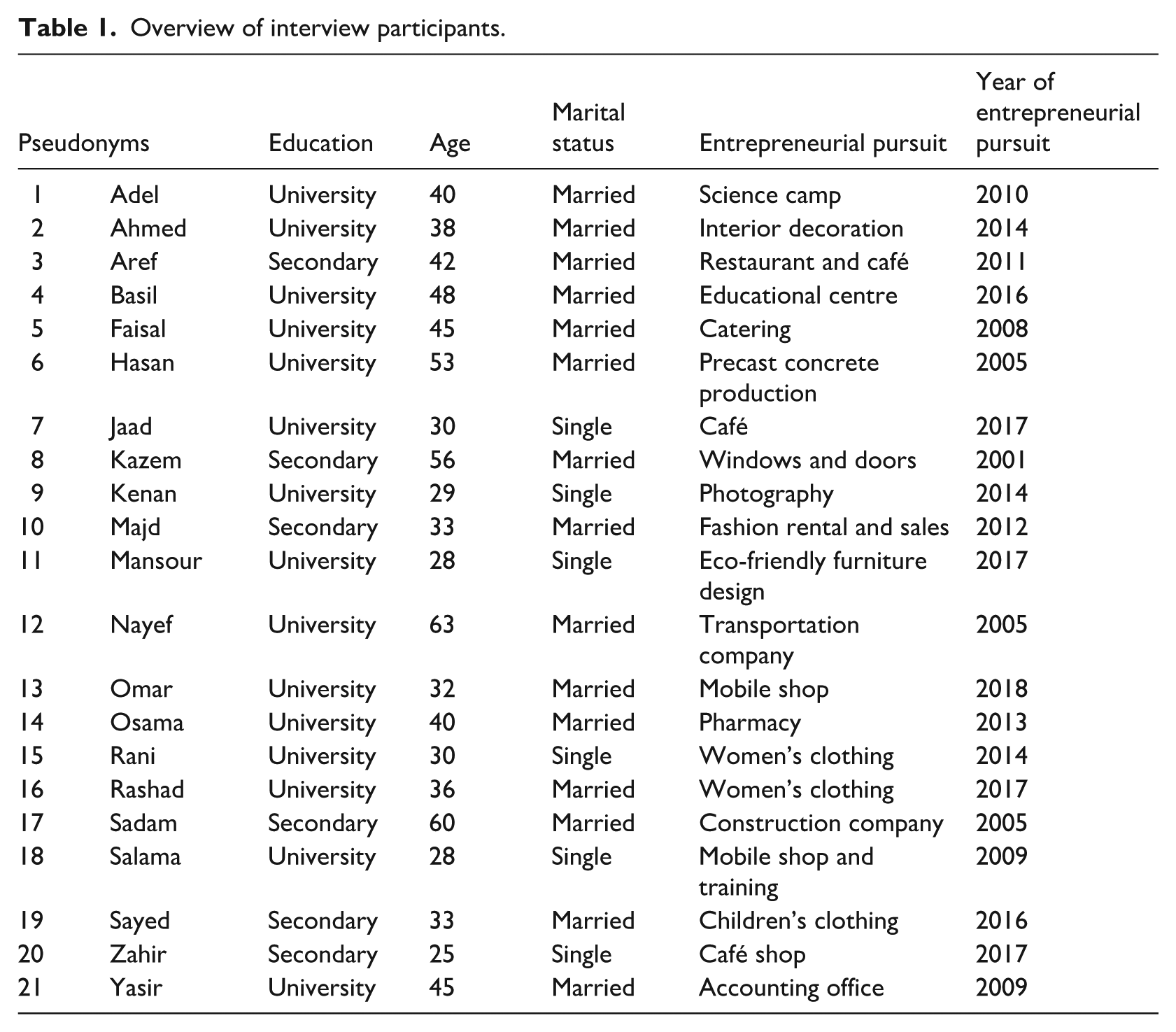
We conducted in-depth, semi-structured interviews between July and December 2022 with 21 men who had established small enterprises in Baghdad and Basra, the two largest cities in Iraq. Table 1 presents brief demographic information of the study participants, who ranged in age from 25 to 60 years. Almost half of the participants had a university degree, and 14 were married with children. Navigating the challenges of generating qualitative data in war-torn research sites, we initially recruited interview participants within our personal networks, followed by a snowball sampling technique to minimise bias in the recruitment process (Cohen and Arieli, 2011). Due to security challenges in accessing Iraq, interviews were conducted online, with each interview lasting 60–90 minutes. Following Lo Iacono et al. (2016), we used telephone and social media platforms such as WhatsApp to communicate with the participants. Interviews were digitally recorded following consent by the participant.
Overview of interview participants.
The participants were given an information sheet that clearly outlined the research objectives and topics to cover, focusing on gender and masculinities within patriarchal contexts. The sheet also detailed the ethical considerations of the study, emphasising the confidentiality and anonymity of the participants, ensuring that their identities and responses would be protected throughout the research process. The participants were first questioned about their backgrounds up to the time they started their businesses. Applying an exploratory approach, we asked open-ended questions about Iraq’s political, economic and social context and how it affects their entrepreneurial aspirations and activities, entrepreneurship opportunities and obstacles, familial relations and societal expectations and their relations with other men entrepreneurs. The first author allowed participants to guide the discussion towards what they found most relevant and meaningful. The in-depth qualitative data generated through the interviews contained rich insights into the gendered construction of men’s entrepreneurship activities in a patriarchal context that has been disrupted by ongoing wars.
Since the first author, a woman and native speaker of the Levantine dialect of Arabic was fluent in Modern Standard Arabic, all interviews were conducted in the participant’s native language. The interviews were conducted until data saturation was reached. Although identifying data saturation can be challenging (Bowen, 2008), iterative data analysis and discussion among the research team helped determine the point at which no further new insights were revealed (Fusch and Ness, 2015). We revisited some of our participants for a second round to follow up on specific responses and delve deeper into emerging themes. This iterative approach allowed us to obtain more detailed data (Srivastava and Hopwood, 2009). With a woman (first author) having conducted the interviews, the issue of interviewing male study participants about entrepreneurship in the context of a highly patriarchal society could have posed gendered challenges or bias in the subject responses, such as strained introspection about revealing their failures as entrepreneurs to a female researcher. Contrary to these expectations, the men interviewees were surprisingly open in their answers. Explaining this, Lefkowich (2019) argues that male study participants, when interviewed by a male researcher, may prioritise protecting their masculinity and upholding traditional masculine ideals, which include avoiding personal reflections about themselves as men. We acknowledge that our study participants may not have fully disclosed their experiences and views to the first author, and if the interviewer had been a man, a different set of responses may have been generated. What appeared to be more salient for cultivating rapport was that the first author had first-hand experience of living within a similar war-torn context. This seemed to provide a distinct advantage in building rapport, as the participants demonstrated a willingness to share their stories as an expression of felt empathy. They often made references to this familiarity by relating their experience about war with comments such as ‘I’m sure you experienced that’ or drawing analogies by saying ‘like the wars in [mentioning her own city]’. To protect the anonymity of the study participants, we used pseudonyms to refer to them in the empirical sections presented below.
Data analysis
Interviews were transcribed using MAXQDA software, which supports the Arabic language. Transcription and thematic analysis were undertaken in the Arabic language to avoid meaning loss, and translation was carried out during the analysis process. An academic fluent in the two languages also back-translated the content to ensure accuracy (Chen and Boore, 2010). To analyse the data, we employed Gioia et al. (2013) by considering the theoretical relationships between the codes, then categorising the first-order codes into second-order themes, and finally aggregating these to theoretical dimensions. We first familiarised ourselves with the data through iterative reading of each transcript. From this process, we developed a list of open codes based on participants’ texts and transcripts, for example, the quote, ‘Securing a government job in Iraq has always been a considerable challenge. . .I needed to do something [starting the business]’, was coded as pressures towards entrepreneurship due to lack of employment opportunities. Similarly, the quote, ‘Corruption plays a significant role in the limited government support available to entrepreneurs’, was coded as corruption as a barrier to entrepreneurship. Following this initial coding, we systematically organised the open codes to uncover relationships and patterns among them, enabling the formation of first-order codes. For example, codes like, ‘This connection [wasta], such as knowing a bank manager, can lead to expedited and simplified processes’, and ‘The government support depends on relations and party affiliations’, were grouped under the first-order code, Entrepreneurship options dependent on wasta.
Then, we grouped these first-order codes into axial codes, representing second-order themes by looking for similarities and differences among the myriad categories (Corbin and Strauss, 1990). For example, the first-order codes of ‘Pressure towards entrepreneurship based on rigid patriarchal beliefs of gender obligations to family’, ‘Pressure towards entrepreneurship in response to a tension between lack of employment opportunities and family role expectations’ and ‘Pressure towards entrepreneurship with increasing support for women competing for jobs’ were grouped to form the second-order theme of Entrepreneurial push according to gender-bound tensions. Accounting for the existing literature on entrepreneurial masculinities (Giazitzoglu and Down, 2017; Hytti et al., 2024; Smith, 2022) and research on entrepreneurship and gender in war-torn contexts (Althalathini et al., 2020; Tlaiss, 2023), these codes were developed into themes. We analysed the emergent themes and the relationships between them by re-reading the coded data extracts under each theme (Braun and Clarke, 2006). We moved back and forth between the emergent themes and coded data extracts with the help of MAXQDA, ensuring that the themes and sub-themes ‘made sense’ in relation to each other and to the research question (Vaismoradi et al., 2016).
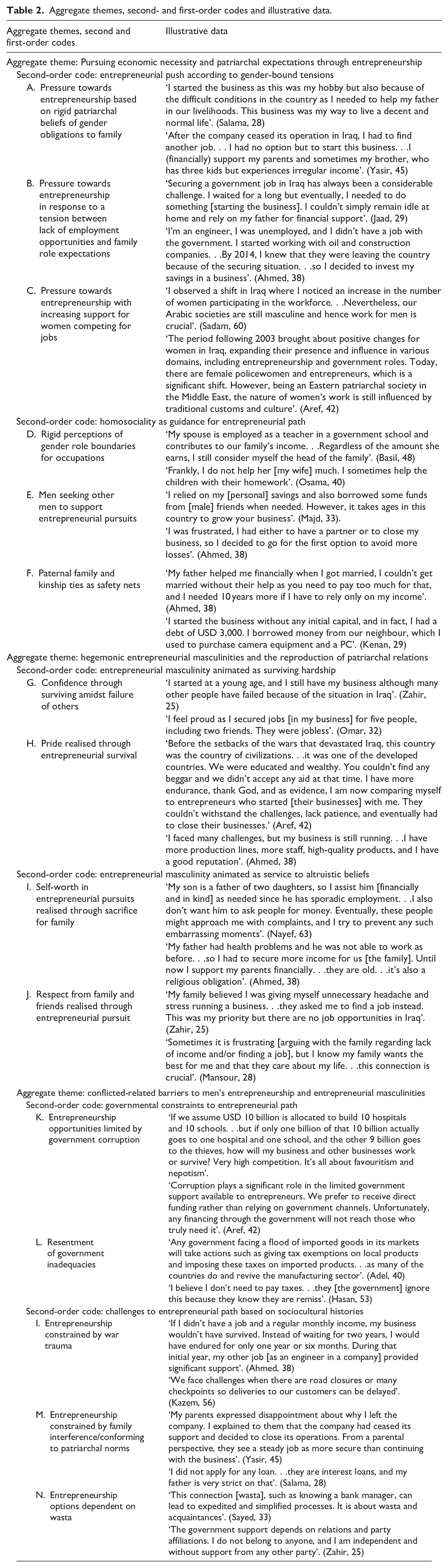
Finally, we moved the axial codes into more theoretically abstract categories to develop the aggregate dimensions (Magnani and Gioia, 2023). While, traditionally, the Gioia approach follows an inductive, data-driven method using informant-centric labels before conceptual abstraction, we adopted an abductive approach, incorporating theoretical perspectives early in the analysis (Van Burg et al., 2022). The research team, who are experienced qualitative researchers, engaged in a rigorous process of refining the themes and aggregate dimensions. Figure 1 presents our first-order codes, second-order themes and aggregate theoretical dimensions. We created Table 2 to assist with prewriting and composing for effectively presenting qualitative data as evidence (Rockmann and Vough, 2024).
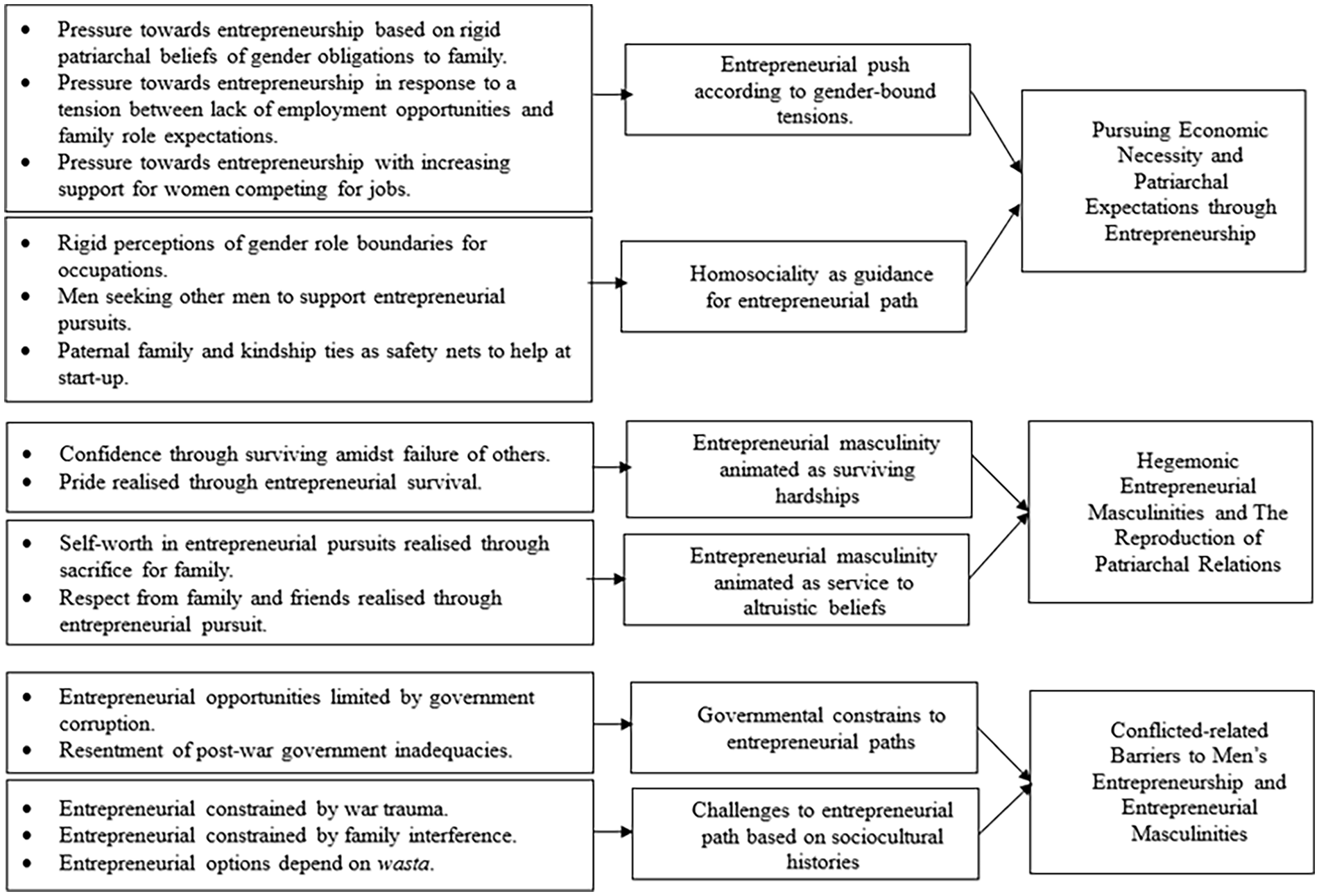
Data structure.
Aggregate themes, second- and first-order codes and illustrative data.
Findings
The findings are organised around three principal themes. In our empirical setting, we found that war as well as society’s patriarchal beliefs have pressured men into entrepreneurship for familial economic security. With this impetus to engage in entrepreneurship, we also found that men’s entrepreneurship and entrepreneurial masculinities were persistently constrained by their contexts, which originate from the experience of contending with government shortcomings and the experience of war and its fallout. Nevertheless, men’s entrepreneurship and entrepreneurial masculinities can reproduce patriarchal gender relations in contexts of war.
Pursuing economic necessity and patriarchal expectations through entrepreneurship
This section examines how the wars in Iraq have driven participants toward entrepreneurship as a means of fulfilling their familial responsibilities as the primary economic providers within a traditional Iraqi patriarchal society. Interview data reveals how participants have grappled with this in various ways. The pressure to engage in entrepreneurship in a labour context marked by the paucity of traditional job opportunities was particularly apparent among the younger participants, many of whom regarded it as a more viable alternative to secure an income. For example, Mansour (30) explained: Finding a job was my priority, but the situation in Iraq made it challenging, as there were limited job opportunities available. . .I started this business because I did not have other options. I had to work and support myself and my family.
Other participants framed their decision to pursue entrepreneurship based on prior poor access to work opportunities and confronting a potentially stark reality of experiencing their ‘prime’ working years without access to paid work. Majd (33) stated: ‘When I was not working, I felt hopeless and frustrated. If I can’t generate and provide income when I am a young man, then when will I do that?’.
Participants appeared anxious to conform to a patriarchal pattern of work and family life, which positioned them as the principal providers for their families. In this context, entrepreneurship was seen to resolve the tension between limited work opportunities and societal pressure to ensure economic stability for their family. For some, entrepreneurship was viewed as a way of avoiding the undesirable situation of relying on older men within their families for financial support. As Jaad (29) put it: ‘I couldn’t simply remain idle at home and rely on my father for financial support’. Some participants were explicit about the gendered aspect of this pressure to perform as economic providers: This is the societal stereotype around being a man. . .they [the family] were saying, ‘You are a man, go and work, save some money and establish a life to prepare for marriage’. . . Because of this, I worked hard and overcame many challenges to avoid being unemployed again, and mainly, I am now getting engaged. (Kenan, 29)
In some cases, fathers berated their sons for not fulfilling their paternal obligations. For example, Sayed (33) provides financial support to his unemployed brother, with assistance from their father: My brother is somewhat reliant on others despite having a family of his own. My father consistently urges him to find any kind of work and often uses harsh language in his conversations with him. I offer occasional support, but my income is not substantial, especially given that I have four children to provide for. My father also provides me with money to indirectly pass on to my brother since they have a strained relationship.
The interview extracts above illustrate how entrepreneurship is not merely a means of providing economic support for their families, but also a manifestation of gendered practices that enable men to follow a patriarchal pattern of hegemonic masculinity. Indeed, the data indicate how younger participants have inherited such gendered patterns and practices from their fathers, who repeatedly reinforce them.
The destabilising effects of wars on patriarchal gender relations between men and women were also apparent in other ways. The historical wars in Iraq and their depressive impact on local labour markets have created some opportunities for women to access entrepreneurship, potentially reconfiguring gender relations within the workforce. This was striking because women in the family were traditionally expected to support the entrepreneurial activities of men family members. As a result, participants struggled to accept the economic policies that prioritised resources for aspiring women entrepreneurs. Ahmed (38) expressed his frustration: ‘I disagree with supporting only women or one group. This is unfair; the whole society needs to work, particularly graduates’. Omar (32) further added: ‘I do not understand why programmes should focus mainly on women entrepreneurs. We [Iraqi men] also struggle and need support. I do not have wasta and I still face many challenges’. In these comments, participants constructed women as a potential threat to their status as breadwinners, deploring the lack of resources and support for their entrepreneurial aspirations and activities. While one economic response to a depressed labour market is to widen participation among women entrepreneurs, this does not necessarily mean a non-patriarchal world of gender relations is forthcoming. All participants re-asserted their role as head of the family and household. Basil (48) was typical of other participants in his response: ‘Regardless of the amount she [his wife] earns, I still consider myself the head of the family’. Likewise, Rashad (36) stated: Men and women are different. Men have more responsibilities than women, they need to secure a house and get married. Even if the woman does not work, she will receive care from her father, husband, or brother. Conversely, a man bears the responsibility of his wife, daughter, or sister.
In this extract, Rashad extols the virtues of patriarchal gender relations and practices that separate men and women, justifying this by reinforcing hegemonic masculinity that positions men as the head of the household, responsible for providing for and supporting all the women in their family. Only a few participants admitted to sometimes helping with childcare, but this did not constitute a fundamental change in patriarchal gender relations. As Yasir stated: childcare is ‘a woman’s job’ (Yasir, 45), and legitimated this by saying, ‘I work hard all day to bring money for them [the family]’.
Hegemonic entrepreneurial masculinities and the reproduction of patriarchal relations
The study uncovers how men’s entrepreneurship and entrepreneurial masculinities can reproduce patriarchal gender relations in contexts of war. The study data showed that patriarchal relations are perpetuated through entrepreneurial masculinities precisely because men entrepreneurs were seen to have overcome the obstacles to entrepreneurship in a context of ongoing wars and corruption. One key aspect of this was how participants discussed their entrepreneurial achievements in terms of dedication, diligence and commitment to hard work to maintain their respective businesses. These ways of constructing entrepreneurial success were particularly prominent among younger participants. They often contrasted their success with the entrepreneurial failures of other men, speaking with pride about how they had ‘survived’ and overcome economic hardship where other men had failed. For instance, Salama (28) said: ‘I consider myself successful as I grow my business, although many others have failed. . .I offer new and more developed services from time to time, which is a success’. These statements construct a gendered hierarchy of ‘failed’ versus ‘successful’ men entrepreneurs, allowing those who succeed to continue running businesses that provide a family wage and to command respect from both their families and other men within their personal networks.
Notably, study participants who succeeded in entrepreneurship often invoked national ideals of enduring strength and resilience displayed by the Iraqi people throughout successive periods of war that have persisted for many years. This form of hegemonic masculinity, which appeared more culturally exalted than others in the data, was used by some participants as a pattern for their own entrepreneurial masculinities, based on their ability to overcome adverse circumstances and obstacles within a war-torn context. For example, Nayef (63), speaking about his entrepreneurial success, stated: We Iraqis are accustomed to challenging circumstances. From the 1980s to the 2000s, every single year witnessed conflicts, wars, and difficulties. We endured these challenging conditions, and this resilience has made us more adaptable and resilient.
Compounding this sense of adaptability and resilience, some participants emphasised their entrepreneurial success in terms of self-sacrifice in an altruistic sense. This sentiment emerged in the interview data regarding entrepreneurial masculinities, reflecting how they sacrificed their personal well-being by immersing themselves in entrepreneurship, working long hours, eliminating obstacles to entrepreneurship and remaining committed to providing for their families. In addition, the notion of self-sacrifice was used in conjunction with the concept of legacy, specifically being able to provide an inheritance in the form of a business to their sons. In so doing, these hegemonic entrepreneurial masculinities contribute to the reproduction of patriarchal familial relations, both between men and women and among younger and older men. Yasir (45), for example, viewed his business as a form of inheritance for his sons: ‘I wanted to secure a decent life for my children and for them not to live the life I lived. . .My two sons work with me sometimes so they can learn the profession’.
Similarly, younger participants who entered entrepreneurship against the wishes and views of family members, particularly older patriarchs, also framed their entrepreneurial success in terms of overcoming barriers. However, these barriers were not external but rooted within gendered patriarchal familial arrangements and traditions. This could entail defying their fathers and other elder men, perceived by these participants as a risk in terms of alienating themselves from their families and being seen as ‘failed men’ if their entrepreneurial ventures collapsed. Yet, several participants who defied their family expectations and succeeded in their entrepreneurial endeavours reported gaining respect from their families as they had taken significant risks to provide economic security under war-torn circumstances. As Rani (30) explained: My family played a frustrating role in all my decisions at first, arguing that I was giving myself a headache with the business and wasting my money. This is the nature of the family. . .They thought no business could succeed in Iraq, [but] I insisted on continuing [and] now they feel proud after I opened another branch.
In Rani’s example, contravening his family’s wishes to engage in entrepreneurship demonstrated an entrepreneurial masculinity that reproduces a patriarchal dividend. Unlike other participants who spoke of making compromises with family members to earn a family wage, participants such as Rani enact hegemonic entrepreneurial masculinity, which draws him closer to an uncontested display of authority. As a result, he gains a patriarchal dividend in the form of respect, honour and pride.
Conflicted-related barriers to men’s entrepreneurship and entrepreneurial masculinities
This section examines how patriarchal gender relations between men within conflict-riven contexts can both enable and restrict men’s engagement with entrepreneurship and interrogates the gendered consequences for men in terms of their opportunities to enact entrepreneurial masculinities. While hegemonic masculinities can work in ways that shore up men’s interests and authority (Connell, 1987, 1995), this is not always the case. The types of gender relations that form between men in war-torn contexts can shape the grim realities experienced by men who may look to other men for entrepreneurial support. Some participants encountered widespread corruption within and across different levels of the Iraqi government, which was deemed a significant barrier to entrepreneurship. According to Hasan (53), ‘I refused to do any direct work with the government. They often asked me for money to win the bidding. . .so much corruption across various levels’. Some participants had to pay bribes to government officials to navigate a smooth passage through corrupt channels of administration, as Faisal (45) illustrates: ‘I had to pay money [to the officers]; otherwise, they will humiliate you and delay your paperwork’. These interview extracts indicate how gendered relations between men in different positions of authority and power can produce gendered hierarchies between different groups of men. The data showed that men’s interactions with governmental structures organised around corruption can determine which groups of men gain or lose in different ways. In contexts affected by wars, when government structures become fragile and are susceptible to abuse, these differentials between men can be exacerbated. The gendered consequences for participants centred on the restrictions that corruption placed on the men’s ability to engage in entrepreneurial activity, which in turn threatened their credibility as heads of their households. The realities of grappling with corrupt men in authority appeared to leave some participants resigned to paying bribes. As Omar (32) comments: ‘In Iraq, it’s typical to pay bribes. I would rather not do so, but I must keep my business running because my family depends on me’.
Similarly, gendered relations with other men in positions of influence within personal networks who could support entrepreneurial activity also acted as a barrier to entrepreneurship. Participants expressed frustrations with the cultural practice of wasta, which constrained their access to capital and influenced decision-making. The enactment of wasta was frequently cited as an obstacle to finding necessary entrepreneurial support, as in the case of Sayed (33): ‘Financing tends to be more accessible for people who have connections with institutional workers, whether they are employed in government or non-governmental organisations’. Often framed within a reference to government corruption, wasta could have a detrimental impact on entrepreneurial survival, as Ahmed (38) explained: If we assume USD 10 billion is allocated to build 10 hospitals and 10 schools. . .but if only one billion of that 10 billion actually goes to one hospital and one school, and the other 9 billion goes to the thieves, how will my business and other businesses work or survive? Very high competition. It’s all about favouritism and nepotism.
Ahmed’s stark outline of corruption within the Iraqi government and its implications for men’s entrepreneurship vividly illustrates how wars can generate tensions between men in different positions of authority and influence. As evidenced in the data above, gendered relations among corrupt and non-corrupt men can construct gender inequalities that determine which men benefit from or miss out on entrepreneurial opportunities that are consequent upon them.
Other barriers to men’s entrepreneurship and entrepreneurial masculinities were rooted in the gendered relations between men in familial contexts. In patriarchal family structures, where the man is the head of the family, some younger participants found themselves unable to seek support from older patriarchs within their families. These participants discussed how older family members, particularly the eldest man, were often revered and held considerable influence in family matters. Several participants who were not heads of their families experienced unsupportive attitudes from elder men, who viewed entrepreneurship as too risky in a context marked by war. Typically, this older generation of men emphasised that younger men should find any form of employment to generate income for the family. This is evident in Kenan’s remarks (29): ‘I had many problems with my father because I wanted to start my business. He thought I was joking. He asked me to go and do any job because mainly I wouldn’t have any income in the beginning’.
Younger participants often found themselves making compromises not only regarding the types of employment they sought but also in how they secured financial resources for entrepreneurial activities. Salama (28) stated, ‘I did not apply for any loan. . .they are interest loans, and my father is very strict on that’. Jad (30), dissatisfied with his job due to the high workload and low pay, explained, ‘I had to retain my job while starting the business to prevent any problems with my family, who would not be happy with solely pursuing the business’. Similarly, Jaad (30) remarked: My family generally wish the best for me. Sometimes, I share some of the challenges I face with the business with them, but they often suggest closing the café and opting for stable employment, believing it would be a more stable option for me, even though they know that I can’t secure a government job and a fixed salary.
His quote highlights how younger men can be subordinated by dominant older men, which has implications for both their personal and work lives. For younger participants like Jaad, the barriers to entrepreneurship were not only related to government corruption and scarce material resources but also to the gendered patriarchal politics within their families.
Discussion
In this article, we have sought to examine how war-torn contexts in Iraq influence men’s entrepreneurship and entrepreneurial masculinities, and the consequences of reproducing patriarchal relations between men and women. Building on the assumption that opportunities for entrepreneurship are shaped by a context that is precipitated by war, this Iraq-based study highlights the complex interplay between entrepreneurship, masculinity and patriarchal dynamics amidst institutional instability. Here, men often face pressure to turn towards entrepreneurship out of necessity to support their families, but also to meet social, patriarchal expectations of men as economic providers. Under these circumstances, entrepreneurship can be constructed and mobilised as a viable economic alternative to familial poverty and financial insecurity, but also as a gendered practice that enables men to conform to patriarchal norms of hegemonic masculinity. Based on such findings, we open new and promising avenues for exploring gender-based work in entrepreneurship, such as how the conditions of war shape hegemonic masculinities through entrepreneurship. Building on current conceptualisations of entrepreneurial hegemonic masculinity as contextually contingent (Giazitzoglu and Down, 2015; Giazitzoglu and Korede, 2023; Hamilton, 2014; Hytti et al., 2024), we can understand how, within intensely patriarchal societies, entrepreneurial pursuits can provide a work career that is heavily implicated in reproducing a patriarchal division of labour between men and women. We organise our contributions according to theory, context and empirical areas of our research design.
Theoretical contributions
This article contributes to the conceptualisation of entrepreneurial hegemonic masculinities. Prior research on entrepreneurship, men and masculinities has problematised the assumption that entrepreneurial masculinities are enacted by men through universal and uniform behaviours (Giazitzoglu and Down, 2015; Giazitzoglu and Korede, 2023; Hamilton, 2014; Hytti et al., 2024; Rumens and Ozturk, 2019). Our study advances this literature by demonstrating how the attachments some men form with entrepreneurial hegemonic masculinities take on greater importance for providing them with a ‘patriarchal dividend’. This outcome occurs in the absence of other ‘traditional’ forms of employment that can be relied upon to that end (Connell, 1995). Based on a war-torn context, entrepreneurial hegemonic masculinities can be conceptualised as providing a patriarchal dividend that is material and ideological. Outcomes of this realised dividend are that successful entrepreneurial men can economically support their families, and women are not relied upon as wage earners, thus, reinforcing their positions as caregivers for children and wives.
As a theoretical contribution, we demonstrate how hierarchical gendered relations of power within families can influence the entrepreneurial behaviour of men. Our findings contribute to Smith’s (2022) call for further research to challenge the overarching myth of male power, as we demonstrate that not all entrepreneurial men experience gender privilege in the same way. While many of our participants are typically regarded as key decision-makers within their families, their masculine privilege is vulnerable to familial paternal dynamics as well as the institutional constraints arising from war. In the Iraqi context, the patriarchal and collective family culture provided a support system for men entrepreneurs (Welsh et al., 2021). However, this same cultural framework also generated significant tensions between familial expectations and men’s entrepreneurial intentions. Thus, gendered hierarchies that exist among men within a family unit or social network can (dis)advantage some men but not others. For those men who were able to overcome the institutional challenges associated with war, whereby they could sustain entrepreneurial activity, entrepreneurship can help them maintain a sense of self as successful men who are able to provide for their families. Building on entrepreneurship and gender scholarship in patriarchal contexts of war (Althalathini et al., 2022; Farquhar et al., 2024), this contribution shows that entrepreneurial hegemonic masculinity can help to address men’s anxieties about not meeting cultural expectations of them as breadwinners.
Contextual contributions
Given the rarity of investigation within a war-torn setting (Althalathini et al., 2022), this study yields valuable contributions from this context. In the case of Iraq, entrepreneurship structured by patriarchy can reproduce the gender practices that constitute patriarchal relations between men and women and organise the roles and responsibilities defined along patriarchal lines. As such, the study builds on extant research on entrepreneurship in contexts of war and conflict (Alvi et al., 2019; Joseph and Van Buren, 2022) by demonstrating how such contexts can push more men towards entrepreneurial activities that reproduce hegemonic forms of masculinity (Churchill et al., 2021). Yet, as mentioned above, the findings also highlight how men must confront significant challenges in a war-torn context, including a diminished economy, the prevalence of wasta in contracting and pervasive corruption. These barriers, such as inequalities in men’s access to resources and social relations necessary to serve the entrepreneurial process, can significantly impair their ability to pursue entrepreneurial activities and enact entrepreneurial masculinities (Naudé et al., 2023). While the study data demonstrate how war can disrupt traditional patriarchal gender relations, potentially offering women greater opportunities to participate in the labour market, entrepreneurship may simultaneously serve as a means for men to retain a sense of masculinity. In so doing, it can uphold gendered privilege in ways that continue to disadvantage women. Given the context, moreover, it is apparent how entrepreneurial hegemonic masculinities can be understood to be vulnerable to the effects of government corruption, as illustrated in those instances when study participants had to pay bribes to officials to pursue entrepreneurship. Hegemonic entrepreneurial masculinities can thus, be conceptualised as complicit with the corrupt structures of governance that reproduce gendered hierarchies that determine what men will gain and lose differently in accessing entrepreneurial support. Ideologically, some participants received a patriarchal dividend in terms of honour, respect and a right to familial authority as head of the household. In these scenarios, entrepreneurial men are seen to enact entrepreneurial hegemonic masculinity associated with the family as a configuration of patriarchal relations and practices.
The defining feature of recent and active conflict in our context shows how entrepreneurial hegemonic masculinities in such settings can be highly contingent and sometimes unachievable. While prior research has linked men to hyper-masculine traits (Laguía et al., 2019; Marlow, 2014), our findings highlight the dimension of marginalisation that left some study participants with a sense of powerlessness. For these men, experiences with government corruption or the complications posed by wasta heightened the risks associated with entrepreneurship, which underscored their vulnerability as emerging entrepreneurial men. In this sense, our study resonates with research by Ahl and Marlow (2012) and Hytti et al. (2024), suggesting that men’s initial forays into entrepreneurship do not always reproduce entrepreneurial masculinities that are hegemonic. In contexts of war, entrepreneurship can function as an imperfect means for men to meet patriarchal expectations as breadwinners, challenging perspectives that view entrepreneurship as a liberating act. What is distinct about our research context in that respect is its contribution to understanding how men can use entrepreneurship to recoup a sense of self as masculine within their social networks and, at least temporarily, fulfil familial expectations of their ability to act as breadwinners. This context challenges the conventional portrayal of entrepreneurial men and masculinity as inherently risk-taking, individualistic and aggressive (Hamilton, 2014; Smith, 2022), indicating a shift away from the dominant assumptions in the literature regarding risk-taking men entrepreneurs and the notion of ‘genderless’ male entrepreneurship (Marlow and Martinez Dy, 2018).
Building on Moghadam (2004), we open new dialogues on the vulnerability of younger men in contexts like Iraq, where respect for elders and parents is highly valued and influences their entrepreneurial agency. As the data sections show, some younger men may be deterred from entrepreneurship by older patriarchs because, within a war-torn setting that is marred by corruption, it is deemed too risky and uncertain in terms of its potential outcomes. This finding questions the argument that men’s entrepreneurship is characterised by risk-taking and assertiveness, as some study participants carefully weighed up the risks associated with entrepreneurship and pursued alternative work-related options. In that respect, younger men’s entrepreneurial intentions are provisional, shaped by both patriarchal and family norms and these pressures are further exacerbated by the conditions imposed by war and conflict.
Empirical contributions
We uncover the gendered consequences associated with men’s entrepreneurship in war-torn settings. While entrepreneurship can potentially offer some men a means to perform hegemonic masculinity, its pursuit does not guarantee gendered ontological security. As observed in our study, men, like women, are also subject to gender stereotypes (Gupta et al., 2009), and normative constructs of men entrepreneurs depicted in much of the literature do not fully capture the complexities of men’s experiences across different cultural and economic contexts (Hamilton, 2014). In contrast to the challenges women face in overcoming the underperformance hypothesis (Marlow and McAdam, 2013), younger men, particularly those with less lived experience of working in unstable contexts, must negotiate competing demands placed on them by family members and patriarchal expectations of them as men who are family providers. This negotiation can involve taking on additional jobs alongside entrepreneurial ventures, defying the wishes of family members and defending their entrepreneurial pursuits, characterised as an ongoing process of compliance, confrontation and justification (Althalathini et al., 2020).
Like women entrepreneurs in such contexts (Althalathini et al., 2020; Tlaiss, 2019), success in entrepreneurship is measured by the ability to generate income, which serves as a key indicator of entrepreneurial legitimacy and prestige. For men, this legitimacy is also bound up with enacting entrepreneurial hegemonic masculinities that serve to legitimate patriarchal relations that sustain men’s dominance over women. However, specific men may experience vulnerability to the harmful effects of other men’s practices (e.g. corruption and bribery) and, thus, the outcomes of entrepreneurial pursuits are not easily controlled. Indeed, the gendered masculine ideal of the entrepreneurial man who can exert control within entrepreneurial domains is undermined by our study data, because it clearly shows how such control depends heavily on having access to financial resources (e.g. to pay government bribes) and complying with older patriarchs and family members. Based on our context, younger Iraqi men appear to be especially vulnerable in those regards.
The context-specific qualities of Iraqi patriarchy have considerable bearing on how hegemonic entrepreneurship masculinities can be conceptualised. In settings where patriarchal relations are less rigid, such as the Finnish context of Hytti et al.’s (2024) study, hegemonic entrepreneurial masculinities have been understood in terms of hybridity because they include elements of both hegemonic masculinities and paternalistic caregiving roles. For example, some men in Hytti et al. (2024) expressed guilt over prioritising entrepreneurship over family life. Our study findings offer a contrasting perspective on the relations between men, fatherhood and entrepreneurial hegemonic masculinities. While entrepreneurial hegemonic masculinity in our study may also display paternalistic components, the men who enact them frame them significantly less in terms of care and guilt about being immersed in entrepreneurship, and more in terms of maintaining their position as primary wage earners and consolidating their authority as heads of the household. This difference may be explained by the specific patriarchal forces that play out in Iraqi society, which may also be exacerbated by war (Ali, 2018). The limited options for employment and achieving economic security within the family can heighten men’s patriarchal expectations of themselves as breadwinners, creating a sharp gender hierarchy between and among entrepreneurial men who are successful and those who are not. Indeed, the potential for failure may be felt very keenly and personally, especially for those men who cannot or who are perceived to struggle to meet patriarchal demands placed on them to provide for their families and, in so doing, maintain their authority as heads of the family and household.
Practical implications
Our study has practical implications for developing inclusive strategies to support entrepreneurship-based interventions. While current research in war-torn contexts aims to change the stereotypical image of women entrepreneurs (Laguía et al., 2022), we argue that similar efforts should be made for men in these contexts who lack an understanding of entrepreneurship and its potential contribution to peacebuilding (Katsos and AlKafaji, 2019). For example, institutional reforms that can promote equality, inclusion, and peace through destigmatising entrepreneurial pursuits - relative to existing career conventions - can help build an ecosystem that supports men both economically and socially. This, in turn, could reduce the tensions that amass in households for men due to the shame and embarrassment of not providing for their families. Simultaneously, promoting entrepreneurial opportunities for women and across all gender lines can help facilitate the acquiescence to new norms and belief systems. However, we caution that any effort to promote entrepreneurship in war-torn contexts would be ineffective without a localised understanding of how entrepreneurship can actually be enacted. This approach averts the dilemma of imposing Western entrepreneurship models on communities that may struggle to localise such models into their terms (Shymko and Khoury, 2023).
Future research and limitations
Highlighting similarities faced by many women entrepreneurs (Welsh et al., 2021; Tlaiss, 2019), we extend our analysis to show how men entrepreneurs in war-torn contexts confront and navigate sociocultural challenges related to their entrepreneurial intention and success. Given that research on entrepreneurial masculinities is still in its nascent stages, we encourage further research exploration to deepen our understanding of how masculinities are constructed, negotiated, and expressed within entrepreneurial contexts. Future research could examine diverse socio-cultural settings, particularly in conflict-affected contexts beyond war, such as political upheaval, economic crises, natural disasters, and forced displacement, to uncover how these conditions shape entrepreneurial masculinities and gender dynamics. While our study focused on a single country-specific context and one gender group of entrepreneurs, future research can benefit from cross-country studies in other war-torn countries, such as the unique circumstances found in Palestine in undergoing an unprecedented genocide, ecocide, and scholacticide. Situations as serious as the annihilation of Gaza, alongside Israel’s prohibition of humanitarian aid for 2.4 million people may prompt the urgent need for such severely damaged societies to rewire various gender-based boundaries and institutional norms in order to realise basic survival.
Furthermore, exploring intergenerational tensions between older and younger men within patriarchal family structures may offer valuable insights into how such dynamics influence the construction of entrepreneurial masculinities and success in such contexts. Future research could also investigate how factors such as religious affiliations, varying levels of religiosity, and educational backgrounds shape the construction and performance of entrepreneurial masculinities. Moreover, as many participants highlighted their roles as financial supporters of extended families, further studies could adopt a more holistic approach by interviewing other family members, such as spouses, fathers, and siblings to uncover intra-family dynamics that were beyond the scope of our study. This would provide deeper insights into family dynamics, intergenerational relationships, and how various family members perceive and contribute to the understanding of entrepreneurial masculinities and success within patriarchal structures. Finally, while not considered a limitation in our study, it would be intriguing to explore different men’s experiences of entrepreneurial masculinity marked by race, ethnicity, sexuality and disability to problematise ideas of men’s hegemonic entrepreneurship and entrepreneurial masculinities as universal and uniform.
Conclusion
In this article, we do not aim to generalise our findings or claim that they represent all men in war-torn and/or patriarchal contexts. Instead, we seek to generate new theoretical insights into the entrepreneurial journeys of men within a specific war-torn context and leverage this towards interrogating the conventional understandings of masculinity in entrepreneurship. In this entrepreneurial context, the experiences of these men have often been rendered invisible in entrepreneurship research in general (Marlow and Swail, 2014) and within war-torn contexts in particular (Tlaiss, 2023). As Marlow (2014: 107) has argued, we need to critically question to which men entrepreneurs identify with masculinised stereotypical entrepreneurial characteristics that are seamlessly attached to them by virtue of their gender. As we have demonstrated, the relationship between entrepreneurship, men and masculinities requires careful deconstruction to illuminate the sharper details of how it is (re)shaped within war-torn, patriarchal contexts.
Footnotes
Acknowledgements
We would like to thank Dr. Murat Erogul for his comments and valuable insights on an earlier version of this manuscript.
Funding
The author(s) received no financial support for the research, authorship and/or publication of this article.
Ethical approval
This study received ethical approval from the University Research Ethics Committee (UREC) – Oxford Brookes University (Registration No: 211533) on 24 November 2021. All participants were provided written informed consent prior to participating and they gave signatures before starting interviews.
