




Abstract
This article focuses on a rugby organisation, in which a distinct configuration of hyper-masculinity exists as the hegemonic one. Using three storified accounts that emerged during ethnographic research, empirics show that when a player’s body fails to align him with hegemonic masculine ideals, he encounters an identity-threat and a separation from the organisational collective. In turn, a player participates in embodied remedial identity-work processes, to (re)accomplish hegemonic masculinity and (re)integrate with the organisational collective, using his body as an identity-resource to counter the identity-threat. Empirics reveals the extent to which the body underpins expressions of hegemonic masculinity, and how important the body is as a site that is used to symbolically maintain a viable organisational identity. Ontologically, it is emphasised that men whose bodies appear to fit normative organisational ideals do not necessarily encounter the embodied aspects of their organisational experiences unproblematically; rather, their bodies – like those of less normative actors – are vulnerable to identity threats and a source of exclusion. This encourages scholars to think about the relationship between embodiment, gender, hegemony and integration in organisational settings in more nuanced ways.
Introduction
Organisational members reflexively consider – through sense-making processes (Ashforth and Schinoff, 2016) – what constitutes a preferred identity in their organisational context; that is, an identity that ‘captures aspects of who one would like to be, and how one desires to be regarded by others’ (Brown et al., 2021: 16). In turn, members participate in corresponding identity-work, being ‘the actions that people enact to build, revise, and maintain . . . identities’ (Caza et al., 2018: 893). Identity-work, if successful, will see the organisational member align their (micro-level) personal identity with organisational-level definitions of what a preferred identity constitutes. Upon accomplishing a preferred identity, a sense of legitimacy and belonging within the organisational collective arises (Knights and Clarke, 2014).
Forming a preferred identity is an ongoing process (Symon and Pritchard, 2015: 244). A preferred identity, once accomplished, is susceptible to an identity-threat (Petriglieri, 2011: 644; see also Brown and Coupland, 2015). A preferred identity is therefore a fragile construction – never permanently secured – but always prone to challenges, in need of continual reflexive identity-work, repair and maintenance (Ybema et al., 2009).
How preferred identities are qualitatively formed by organisational members – via identity-work and in response to identity-threats – has become an important topic within organisation studies (Alvesson et al., 2008; Caza et al., 2018). Extant analysis has generally considered how preferred identities are constructed through spoken identity-work processes, rather than non-verbal identity-work practices (as argued by Brown and Coupland, 2015: 1317; Courpasson and Monties, 2017: 35; Meriläinen et al., 2015: 4; though see Haynes, 2012; Johansson et al., 2017; Riach and Cutcher, 2014 for exceptions). At a time when calls exist for the relationship between embodiment, identity-work and organisations to be explored more thoroughly (e.g. Brown, 2017: 301; Kuhn, 2009: 684) the purpose of this article is to further empirically investigate how and why organisational members participate in embodied identity-work.
More specifically, embodied identity-work is considered in the context of an amateur rugby organisation based in the north of England (UK) in which a distinct configuration of hyper-masculinity exists as the hegemonic (Connell and Messerschmidt, 2005), preferred identity. This configuration of hegemonic masculinity necessitates embodied expressions to be displayed by players, who use their bodies as a site for identity-maintenance. The research question: how do organisational members use their bodies as resources to (re)accomplish hegemonic masculinity? is addressed. To answer, qualitative, storified data captured from three rugby-playing men is presented; showing how the men utilised their bodies within remedial identity-work processes, to (re)accomplish hegemonic masculinity after encountering embodied identity-threats, as the men are faced with the ongoing challenge of constructing and maintaining hegemonic masculine identities, if they are to retain legitimacy within their rugby organisation.
Structurally, this article unfolds as follows. Next, relevant literature on hegemonic masculinity, embodiment and identity is reviewed, drawing on a cross-disciplinary perspective rooted in the sociology of sport and organisational studies. Then, the fieldwork and data-analysis that informs this article is outlined. Three empirical examples that demonstrate the body being used as a resource in the (re)accomplishment of hegemonic masculinity are presented. Finally, how the empirics presented in this paper contribute to extant theory is discussed, inviting scholars to challenge assumptions about the extent to which ‘normative’ bodies necessarily command integration and hegemonic status in organisations.
Literature review
Hegemonic masculinity
Hegemonic masculinity refers to the ‘most honoured way of being a man’ (Connell and Messerschmidt, 2005: 832), the ‘culturally exalted form of masculinity’ (Carrigan et al., 1985: 592). What constitutes hegemonic masculinity is subjective, with definitions fluctuating in relation to organisational settings and the cultural codes operating within them. This is shown by comparing the erudite masculinity that is hegemonic – that is, exalted and honoured – in middleclass universities with the ‘laddish’ masculinity that is hegemonic in the working class gym studied by Giazitzoglu (2018): the configuration of masculinity honoured in one context may be ridiculed and vilified in the other. Indeed, definitions of hegemonic masculinity fluctuate within the same man’s life, as he moves between spaces and roles, navigating cultural rules. For example, men who are ‘laddish’ in working class gyms go on to accomplish nurturing, caring masculinities when acting in their role as father or grandfathers in private spaces (e.g. Tarrant, 2013), where notions of hegemonic masculinity become rooted in family values. In this sense, one can speak of hegemonic masculinities pluralistically. Hegemonic masculinity is ‘not a certain type of man but, rather, a way that men position themselves through . . . practices’ (Connell and Messerschmidt, 2005: 841).
While recognising the subjective, fleeting nature of hegemonic masculinity conceptually, there are circumstances when a cohort of men agree what constitutes hegemonic masculinity as an empirical accomplishment here and now. This is illustrated in the unambiguous agreement that ‘corporate masculinity’ is hegemonic in the offices of the elite IT firm studied by Giazitzoglu and Muzio (2021). To accomplish a static configuration of hegemonic masculinity in a space and time, men utilise various symbolic (including embodied) resources and practices. As put: ‘men are not intrinsically hegemonic; rather, they must accomplish hegemonic masculinity in and through their enactments, by referring to the particular codes of the (hegemonic) masculinity sought’ (Giazitzoglu, 2020: 69).
For example, in the semi-rural pub that hosts a local entrepreneurial fraternity discussed by Giazitzoglu and Down (2017), men participate in symbolic acts like expressing Conservative political opinions, driving sports cars, displaying wads of cash and wearing tweed jackets and golfing attire. By so doing, the men qualitatively accomplish identities aligned with localised notions of hegemonic, respectable male entrepreneurs. Similarly, the IT professionals discussed by Giazitzoglu and Muzio (2021) reproduce a corporate masculinity seen as hegemonic in their firm through acts like wearing cufflinks. Men who are able to accomplish hegemonic masculinity in a context enjoy a heightened sense of power and integration, while men (and, more commonly studied, women) who are less or unable to accomplish hegemonic masculinity symbolically are subordinated and marginalised.
In the amateur rugby club studied, a particular configuration of hegemonic masculinity – which is more hyper and exaggerated than the formal, work-related masculinities discussed above – is seen as the preferred identity for local ‘rugby lads’ to accomplish, when in the spaces rugby is played and where ‘rugby lads’ interact socially. The body is the primary site where this configuration of hegemonic masculinity is negotiated and symbolised. This work contributes by exploring how rugby playing men’s attempts to accomplish hegemonic masculine identity are both impaired by their bodies and enabled because of their bodies, through complex embodied identity-threats and remedial embodied identity-work processes.
Hegemonic masculinity, embodiment and sporting institutions
By doing so, this study builds on work produced by scholarship in the sociology of sport, which demonstrates how embodiment and expressions of hegemonic masculinity intersect in sporting cultures and organisations. Ethnography has proved especially useful in revealing the nuances and complexity of this relationship. Klein (1993) looked at elite bodybuilders in Southern California. Klein’s ethnography shows men defining themselves and their worth through the size and strength of their bodies. Male bodybuilders lift weights, use anabolic steroids and diet to build large, highly muscular physiques, though these physiques may externally mask internal psychological insecurities (hence Klein’s title Little Big Men). The bigger a man’s muscles, the more successful he is in bodybuilding contests, and the more status he obtains among other bodybuilders. When failure is encountered – for example, not placing in bodybuilding shows and losing sponsors – the bodybuilder may behave in more extreme ways; dieting and training with even more intensity and using higher amounts of anabolic steroids to bolster his physique. Total commitment to bodybuilding was a pre-requisite in belonging within Southern California’s subcultural elite bodybuilding community.
Like bodybuilding, contact sports provide settings where the relationship between embodiment and hegemonic masculinity is expressed; for in contact sports, the body is the site where competition, aggression, risk-taking, pain tolerance and other aspects of hyper-masculine gendered norms and identity is evidenced and negotiated. Wacquant’s (1995) 4 year ethnographic study of boxers in South Side, Chicago, shows male boxers perceiving their bodies as physical capital, with physiological force, speed and skill being key embodied ways through which men negotiate their worth, hegemony and relations with each other. For boxers, success is determined by how well one’s body performs ‘in the ring’. With reference to a semi-professional British soccer organisation, Adams et al. (2010) consider how masculinity is constructed through gendered discourses among mainly white, working class males. The body is the primary site where soccer players focus their gendered discourses, and evidence their ability to participate in ‘a man’s game’. Players are expected to show willingness to ‘be warriors’ on the field, by ‘spilling blood’ through their bodies in the pursuit of winning, ‘getting on with it’ when their bodies are fouled and hurt, and ‘sticking the boot’ on the bodies of other men, if the chance arises (pp. 286–287) in a context where ‘aggression and violence is esteemed’ (p. 290) and intrinsically linked to a form of embodied masculinity. Soccer players who fail to use their bodies in such ways are vocally ridiculed, often through homophobic language. Players who use their bodies in these ways are celebrated, as brave, committed and manly organisational members.
These studies are two of many which show that ‘confrontational sports celebrate the force and power that is at the heart of the association of sport and masculinity’ (Theberge, 2003: 499); and the body is the primary site where force, power and other aspects of hyper masculinity are negotiated. In this regard, rugby has constructed a long-standing, distinctive setting.
Rugby, masculinity and embodiment
In the UK, rugby fields were where males – especially upper-class boys in elite schools – expressed and reproduced a masculinity rooted in physical courage, power and virility in the 19th century (Dunning and Sheard, 1979). Rugby fields evolved from these roots to become quintessential sites for expressions of exaggerated masculinity to be displayed by men from various socio-economic backgrounds. Violence, pain tolerance, competition and physical skill all became and remain embodied aspects of the masculinity rugby encourages, celebrates and defines as hegemonic (Light and Kirk, 2000; Muir and Seitz, 2004; Pringle and Markula, 2005: 474–475).
A player’s body must evidence that it can reproduce these aspects of masculinity, by tackling other men, and participating in other physical acts on the field (e.g. rucking), with physical competence and bravery being rewarded and seen as a badge of honour. Hence, players desire muscular bodies with low body-fat levels to symbolise and validate their legitimate participation in rugby (Mills and Giles, 2017) and ability to physically perform on the field. This relationship between masculinity, embodiment and rugby exists in other national contexts outside of the UK’s, for example, in Australia where – as shown by Hutchins and Mikosza (1998) – men playing rugby league do so in a framework where physical violence and domination over other men’s bodies is not just sanctioned but positively encouraged, rewarded and taken for granted.
Given the importance of the body within rugby, it is not surprising that male rugby players have utilised their bodies in innovative ways, to align their bodies with gendered expectations. Giazitzoglu’s (2020: 74 – 78) ethnography shows male rugby players trying to hide fear and nerves – manifest in their shaking bodies – before games in the locker room, so as to suppress suggestions they lack courage in front of other players. Ethnographic data also shows players physically striking each other, to prepare for physicality on the field and weed out players who lack aggression. Further, ethnographic data shows players using their bodies to participate in overly aggressive physical violence against opposing players and even opposing fans, to demonstrate and embody a ‘hard masculinity’. Indeed, even when a player’s body has undergone extreme circumstances, such as in case of player who had to be airlifted to hospital following a career ending injury (p. 78), rugby playing men underemphasise the extent of their physical ailments, to maintain a hegemonic masculine identity rooted in physical toughness in front of others, and avoid any accusations of emasculation on the basis of his body.
Darko (2009) further illustrates the intrinsic link between embodiment, masculinity and rugby. Darko studied British men, aged 18–30, playing for a university first 15, revealing the anxiety all studied men felt because of their belief that other men’s bodies are ‘better bodies’, that is, bodies more suited to rugby as they are more adapt at performing physical aggression, toughness and avoiding injuries. Because players believed their bodies lacked these qualities, they equated themselves as lesser than other men; seeing their bodies as a source of emasculation. To compensate, players may over-exercise, take anabolic steroids and make physically risky decisions on the field. The body therefore takes on special symbolic as well as physical importance to players, who experience psychological anguish when they believe their bodies are lacking and unable to reproduce physical expressions of hegemonic masculinity on the field.
Harris and Clayton (2007) analyse media representations of the Welsh international rugby player Gavin Henson, the first high-profile British ‘metro sexual’ player. Gavin Henson’s appearance was more stylised than normally associated with rugby players of his generation: his hair was gelled, he used sunbeds, his teeth were whitened and so he personified a ‘pretty boy’ masculinity, more commonly associated with British soccer players than rugby players. This meant Henson’s embodied masculinity, to an extent, contradicted and challenged traditional rugby masculinity. Yet, at the same time, Henson was a violent and physically strong player on the field and embroiled in violence off it. Off the field, he was often associated with alcohol-fuelled hedonistic ‘nights out with the lads’. Henson’s masculinity therefore simultaneously conformed to traditional notions of rugby masculinity. Henson’s metrosexual image did not replace or re-invent existing notions of hegemonic rugby masculinity. Rather, Henson’s metrosexual masculine identity was fused alongside other, more traditional expressions of masculinity. So central are these expressions of masculinity to rugby culture that – even in the case of Henson – they can’t be alleviated by alternative configurations of masculine identity.
While the field is the fundamental place where an embodied masculinity linked to physical toughness, violence and strength is displayed by rugby-players, embodied expressions of hyper masculinity occur in other spaces rugby-playing men interact in, away from the rugby field, for example, in rugby club houses. These expressions of masculinity are intrinsically related to heavy alcohol consumption. Indeed, alcohol-fuelled ‘laddish’ expressions of hyper masculinity are so ingrained in rugby contexts that failure to reproduce them creates rejection from other rugby-playing men (see Dunning and Sheard, 1973; Muir and Seitz, 2004; Pringle and Markula, 2005: 492). For example, Giazitzoglu (2020) ethnography shows a player being asked to leave a rugby club on account of his reluctance to participate in heavy drinking after games.
Boys who play rugby learn to embody and mimic the hyper-masculine hegemonic norms that older players perform, both on the field and in leisure spaces. This is shown in Light and Kirk’s (2000) analysis of the training sessions attended by young men who play for an elite independent school in Australia. The young men all aspire to embody a ‘traditional’ rugby masculinity, by being physically dominant, aggressive and ruthless when training against each other, and mimicking the physical aggression they see older elite international rugby playing men reproduce. In turn, the association between hyper-masculinity, embodiment and rugby is reproduced and relearned inter-generationally, as a normalised rite of passage.
This is not to essentialise rugby culture, and present rugby organisations as homogenous and monolithic. There are female, gay and trans rugby clubs, and what constitutes preferred, hegemonic identities in them may differ. Muir et al. (2021), on the basis of research into five gay rugby clubs in England, shows gay rugby clubs protecting their players from potential injuries; meaning the motivation for playing for a gay rugby club is about enjoying playing and being part of a collective, in a climate where there is not pressure to take risks and incur injuries to symbolise an embodied masculinity linked to aggression, confrontation and violence. Anderson and McGuire (2010) show how generational differences mean some younger players reject the risk taking, physicality, violence, misogynism and homophobia their older coaches see as constituting hegemonic masculinity and normative. Pringle and Markula (2005) emphasise that not all rugby playing men celebrate the embodied pain and risk which rugby positions as hegemonic. Hence the historic association between hyper-masculinity, embodiment and rugby may be dissipating at some clubs, where different gender norms mean expressions of hegemonic identity take different forms, in a sport that is seeing more heterogeneity and diversity in terms of who participates in it, and which behaviours are expected.
While acknowledging this heterogeneity, one must recognise that many (though not all) rugby-playing men – especially in settings like the amateur, working class, white, highly localised, semi-rural club studied here – have been conditioned to aspire to reproduce a distinct, traditional configuration of embodied hegemonic masculinity, expressed through physical fitness and aggression on the field and the consumption of alcohol off the field. In this sense, the body is a resource that rugby-playing men use to reproduce hegemonic masculinity and command belonging in their organisational collective.
It is important to recognise that while the men studied participate in embodied identity-work processes in order to underpin their accomplishment of hegemonic masculinity in a particular context, their male bodies command a level of normativity in sporting interactions – especially contact sporting interactions – that women’s bodies do not. Contact sports have historically been seen as unhealthy for women to participate in (Burroughs and Nauright, 2000), and not contexts conducive to cultural constructions of ‘soft’, ‘healthy’ female identity being affirmed (Coakley and White, 1992). Contemporary studies suggest this is still the case. For example, Alsarve and Tjønndal (2020) look at contact sports in Nordic counties, in which expressions of masculinity linked to embodied strength, endurance, risk taking and muscularity are hegemonic. They point out that people outside contact sports see women who fight as somewhat transgressive. (See, also, Migliaccio and Berg’s, 2007 study into women who play contact football in Northern California, who also experience stigma on the basis of their bodies not fitting gendered assumptions about which bodies can and should participate in violence). In turn, females must participate in particular embodied acts to legitimise their participation in sport, as shown through Theberge’s (2003) insight into adolescent female ice hockey players using their bodies to show their willingness to be physically aggressive and powerful. Hence, when this work goes on to look at embodied identity-work, it does so in relation to a cohort of men whose bodies appear to fit normative ideals and expectations about who can and should participate in contact sport. As discussed in more detail later, the fact that the men studied have to participate in identity-work despite their normative bodies challenges us to think more critically about the nature of gendered embodiment in organisations.
The body as an identity resource in organisational contexts
By analysing how rugby-playing men use their bodies as non-verbal resources in order to accomplish hegemonic masculinity in a particular organisational context, this study adds to existing literature produced by work and organisational scholars looking at the relationship between embodiment, identity and organisations. (See Meriläinen et al., 2015, for a more extensive review of this literature). Courpasson and Monties (2017) ethnography, titled I am my body, shows male members of the French police’s carjacking unit using their bodies to project identities associated with fitness, intimidation, cleanliness and toughness. By doing so, the men strengthen their occupational identities and deflect pressure off themselves, in a context of the police force being ‘feminised’. By using their bodies to demonstrate a masculine ‘corporeal efficiency’, the policemen affirm they are ‘real cops’; for it is only men with fit, clean, intimidating and tough bodies like theirs who can claim to be so.
On the basis of research into Swedish corporate executives, and building on Butler’s premise that the body is the fundamental site through which identity is evidenced, Johansson et al. (2017) propose the notion of managerial athleticism; which is an embodied identity defined by low body fat levels and lean muscularity, which corporate executives see as preferential. Health, fitness and sport are a key part of the lives that executives live, so they can embody this physiological ideal. To inhabit an athletic body is to denote that one is ‘in control’ and able to manage stress and pressure at work. Colleagues whose bodies deviate from this ideal are ‘corrected’ (p. 1155) and encouraged to adopt new lifestyles in the pursuit of more athletic bodies, in a culture where overweight bodies are condemned, and controlling the aesthetics of one’s body is seen as a personal responsibility. Managerial athleticism is, therefore, valorised as an embodied ideal, that both female and male executives aspire to reproduce; but which males are especially keen to display and gain admiration from others through (p. 1156).
Meriläinen et al. (2015), on the basis of data captured in Finland, point out that when searching for executives, head-hunters have in mind what an ‘ideal’ executive body looks like. Recruits whose bodies reproduce this ideal are more likely to be employed, while men and women who do not embody this ideal are less likely to be employed. The ideal executive body is one that has a particular physical appearance, linked to being ‘active’, a ‘doer’ and having ‘high energy’ and ‘intensity’ (p. 12); it is not a flabby body. Above all, it is a body associated with ‘fitness’ and ‘sportiness’ (p. 13). Such a body suggests embodied capability, in the form of being able to work harder and for longer hours.
Haynes (2012), focussing on women in accounting and law firms in the UK and USA, shows how a preferred body image exists in professional organisations. Notions of what constitutes a preferred body are defined by clients, who believe the external presentation of a professional says much about that professional’s competency and worth. Thus, bodies which are overweight are lamented; with overweight bodies positioning organisational members who inhabit them as lacking seriousness (p. 500). In contrast, bodies that ‘look right’ function as commodities and ‘embodied capital’, and suggest professionals who inhabit them have a symbolic legitimacy, that clients and co-workers admire.
Riach and Cutcher (2014) consider male hedge fund managers based in London, who are part of the highly competitive and masculine world of finance, which is defined by high stress, heavy workloads and therefore short careers. Riach and Cutcher point out that traders desire muscular, lean, fit looking bodies, and participate in dieting, sport and exercise to inhabit such bodies. By so doing, the traders counter the ageing process, ensuring they remain employable in the future, by inhabiting bodies which are ‘built to last’. The men also draw parallels between and celebrate the ‘stress’, ‘sweat’ and ‘challenges’ exercise and trading create. At the same time, the men see their aged bodies as symbolising their past experiences and longevity in an industry known for its attrition. Hence, the men’s bodies have issues of identity, ageing and values ‘mapped onto’ them. Because of their behaviours, age is not itself a reason for the men to ‘step back’ from the competitive context they inhabit, so long as they continue to inhabit bodies that function appropriately.
Riach and Wilson (2014) study a large pub chain based in the UK, frequented mainly by the 18–30 year old demographic. Their study shows that bodies are expected to move in certain ways, to obtain different results in service interactions between employees and consumers. Bodies may be used to overtly flirt with customers and secure more sales (p. 336), or bodies may be used in distinct ways – for example, arms folded, eye contact avoided and bodies turned away – to show an employee is not interested in sexual relations with a customer (p. 337).
Turning to how embodiment causes alienation for organisational members, Jack et al. (2019), with reference to menopausal women employed at two Australian Universities, show how, over time, women’s bodies become less likely to ‘fit’ in organisations and their gendered ideals. This creates a sense of marginalisation for women on the basis of their changing bodies. van Amsterdam (2015) provides an autoethnographic account of her experiences of expressing breastmilk while employed in a university. The body that breastfeeds – indeed the body involved in Motherhood more generally – is not congruent with embodied professional ideals. The ‘leaking’ female body therefore creates a sense of gendered alienation and ‘otherness’ in organisational cultures. Likewise, Gatrell (2013), on the basis of research into 27 professional women employed in the UK, demonstrates the disgust that leaking bodies create for pregnant women and recent Mothers in organisations. Because of the contradictions between the private context of reproduction (where leaking bodies are expected) and the public context of embodiment in organisations (where leaking bodies are stigmatised), pregnant women and new mothers must participate in ‘maternal body work’ to manage the disdain their bodies create.
The studies discussed above show that the body is not an unproblematic part of organisational life. Rather, the body can be a source of stigma and alienation, when it is deemed to deviate from normative ideals and expectations, in the case of leaking and menopausal bodies. Simultaneously, the studies show that far from being a passive or irrelevant aspect of organisational life, the body is the primary site or resource through which organisational members show their legitimacy to clients, co-workers and even themselves; especially by displaying and inhabiting the sort of lean, athletic, fit and muscular body that is typically seen as preferred and ideal in work organisational structures. This is true for ageing bodies, like those of ageing males in finance, and younger bodies, like those involved in pub service exchanges.
However, as others have pointed out, more work that explores the body’s role in the identity-formation and experiences of organisational members is needed (see Brown and Coupland, 2015: 1317; Courpasson and Monties, 2017: 35; Kuhn, 2009; Meriläinen et al., 2015: 4). This study contributes by considering the body’s role in identity-formation, and how embodiment is experienced. It does so in relation to the accomplishment of hegemonic masculinity, and with a particular focus on men restoring hegemonic masculine identity through embodied identity-work after encountering identity-threats.
Identity threats
Accomplishing hegemonic masculinity – like the formation of any preferred identity – is an ongoing, fluid challenge and process open to identity-threats (Petriglieri, 2011: 644), which are ‘any discursively constituted thought or feeling that challenges . . . an individual or group’s preferred identity’ (Brown and Coupland, 2015: 1318; see also Knights and Clarke, 2014: 336). Identity-threats prevent an organisational actor performing a preferred identity with coherence (Ashforth and Schinoff, 2016), making the accomplishment of a preferred identity a ‘kaleidoscopic process of becoming’ (Brown, 2015: 27) in need of ‘constant reconstruction’ (Fachin and Davel, 2015: 371).
Once an identity-threat is encountered, it typically acts as a trigger for remedial identity-work to occur, that is, identity work that (re)aligns an actor’s identity with a preferred identity, otherwise lost or threatened. As put: ‘to eliminate threat, a response must alter either the threatened identity or the views of the people who are the source of the threatening experience’ (Petriglieri, 2011: 652).
Extant literature details organisational actors participating in an array of remedial identity-work processes, to manage the identity-threats they encounter. Studied actors include business school academics (Learmonth and Humphreys, 2012), and elite rugby league players (Brown and Coupland, 2015). Or, to use the terms formulated by Brown and Coupland (2015), organisational actors have been shown to commonly encounter ‘threat construal’, and attempt to counter construal via ‘threat responses’, thereby (re)constructing a preferred identity and alleviating the sense of marginalisation from the organisational collective which accompanies an identity-threat.
How embodiment relates to the threat construal and threat responses of organisational actors is less studied. Extant work generally focuses on verbal rather than embodied remedial identity-work processes. In expansion, this article presents empirical data to show that in the studied rugby organisation, there are certain, standardised norms about what embodied hegemonic masculinity constitutes. It is highlighted that deviation from these embodied norms create identity threats for men, who face a lack of hegemony founded on doubt about their ability to contribute to their organisation’s goals (winning games). Simultaneously, empirical data shows that embodied identity threats are not necessarily permanent parts of organisational life, but temporal phenomena that can be countered through embodied remedial identity work processes, that realigns a player’s identity with organisational, gendered norms, and restates a man’s ability to contribute to the organisational collective. Through presented empirics, this work provides a valuable, qualitatively rich insight into the body’s role as an identity-resource in in the accomplishment of hegemonic masculine identity in a particular organisational context, where threat construal and threat responses occur.
Methodology
Case context
How do organisational members use their bodies as identity resources to (re)accomplish hegemonic masculinity? This question is answer in relation to ‘the case’ (Eisenhardt, 1989) of Wanstyne; a pseudonym used to refer to an amatory rugby club, based in the north of England, UK. Analysis occurs at a time when an ‘emerging tradition of scholarship which has explored organizations through the lens of sport’ (Brown and Coupland, 2015: 1316) exists; and in a period when studying a single organisational case has proved advantageous in understanding identity-formation (Karreman and Alvesson, 2001).
The researcher lives near Wanstyne and, prior to researching Wanstyne Rugby Club, was known to several first team players, owing to his local reputation as a strength and conditioning coach and former sportsman. Upon the request of several players who had paid the researcher to design training programmes for them, Wanstyne asked the researcher to work as a voluntary strength and conditioning coach, thereby helping players gain physiological power through anaerobic training techniques and dieting and lifestyle advice. This meant the researcher would prepare and supervise strength and conditioning sessions with first team players, and make suggestions on various components of their fitness lives, ranging from what mattresses to sleep on (and for how long), what temperature showers to take, how to stretch and even how to breathe. In the same way that ‘issues of access have traditionally made it difficult to penetrate the closed community of associated football’ (Adams et al., 2010: 282) for researchers trying to research soccer organisations in the UK, access to rugby organisations is difficult to ascertain. Via this invite, the researcher was able to access a type of hyper-masculine organisational context and culture that is often closed to scholars, and – upon securing sustained access to the case – research it with social scientific purpose.
Data: Collection and analysis
Data Source 1
Through his role as a coach, the researcher was able to conduct an extensive period of ethnographic research, which saw over 100 hours of overt participant-observations of Wanstyne players happen, between August 2016 and March 2017. These observations occurred in the club’s gym, on training fields during training sessions, on playing fields during games, on buses to and from away games, and in the leisure spaces where players interact (rugby club houses, pubs and bars). Hence, observations occurred in key spaces where rugby-playing men interact. Observations aimed to capture various insights into the way masculinity is, as a social-construct, engaged with and accomplished by men who play for Wanstyne. Observations produced a detailed, 300-page research diary, in which insights were recorded and described.
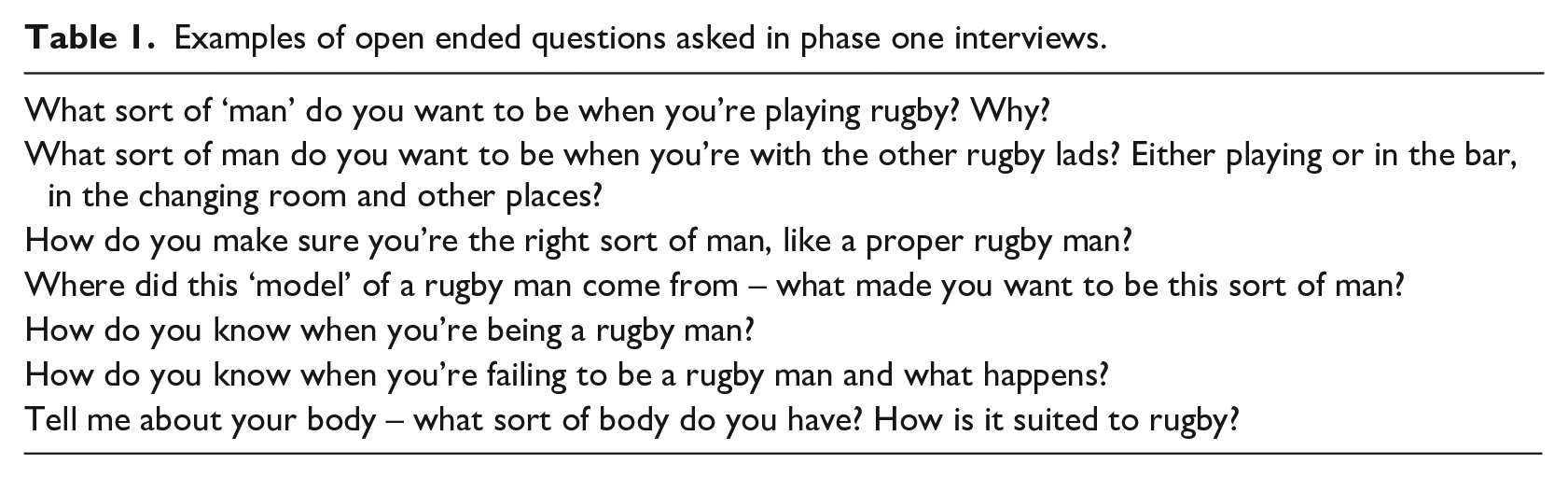
In addition to observations, nine individual qualitative interviews were undertaken with four former/retired Wanstyne players and five current Wanstyne players. Each interview lasted around 90 minutes and – through open-ended questions – captured further data on the way rugby playing men live, experience and articulate masculinity within the organisational structural context of Wanstyne. This interview data complimented observational data, allowing observations to be reflected on and articulated by players, in their own words. Examples of questions asked in interviews are reproduced in Table 1:
Examples of open ended questions asked in phase one interviews.
The nine interviews and observations discussed above constitute one data-source (data source 1). All interviews and observations complied with ethical guidelines: players consented to be researched (as well as trained) at the start of the project, and signed a consent form that clearly outlined the nature of the research project. Any quotes or anecdotes emerging from fieldwork were ‘checked’ with individual players, to ensure they were happy for their accounts and voices to reproduced in academic journal articles. Wanstyne coaching staff and management team (e.g. club secretaries, the bursar and committee members) gave permission for the research to occur.
Data source 1 revealed several, specific insights into masculinity in Wanstyne. In other words, masculinity is – as a social construct – experienced, negotiated and constructed in Wanstyne in complex, multiple, nuanced ways. One insight data revealed relates to the intersection of masculinity, space and emotions. This insight is discussed elsewhere (Giazitzoglu, 2020). A further insight relates to how masculinity, embodiment and identity intersect. It is this particular feature of data which this paper is concerned with. More specifically, data source 1 revealed two central findings on the relationship between masculinity, embodiment and identity.
First, that while players aim to accomplish a configuration of masculinity they see as hegemonic, their bodies create identity-threats, meaning their attempts to accomplish a sustained configuration of hegemonic masculinity are not linear or guaranteed, but in a constant process of becoming. A player’s body will look or function in a way that challenges his status as a legitimate, hegemonic member of the Wanstyne collective. These embodied identity-threats constitute what Petriglieri (2011 649) defined as ‘strong threats’, because they called a player’s future integration with the organisational collective into question. Second, that players use their bodies as symbolic identity-resources in remedial identity-work processes, to respond to the embodied identity-threats they encounter. Thus players use their bodies – in relative and complex ways – to (re)align their status as hegemonic men in Wanstyne, allowing their bodies to symbolically counter the identity-threat and associated loss of hegemonic masculinity they encountered.
In total, 12 examples of the body being a source of identity-threat, then beings used to counter identity-threats as part of embodied, remedial identity-work processes, were identified in data source 1. These 12 examples are clarified in Table 2.
Examples of embodied identity-threatsand embodied identity-work processes.
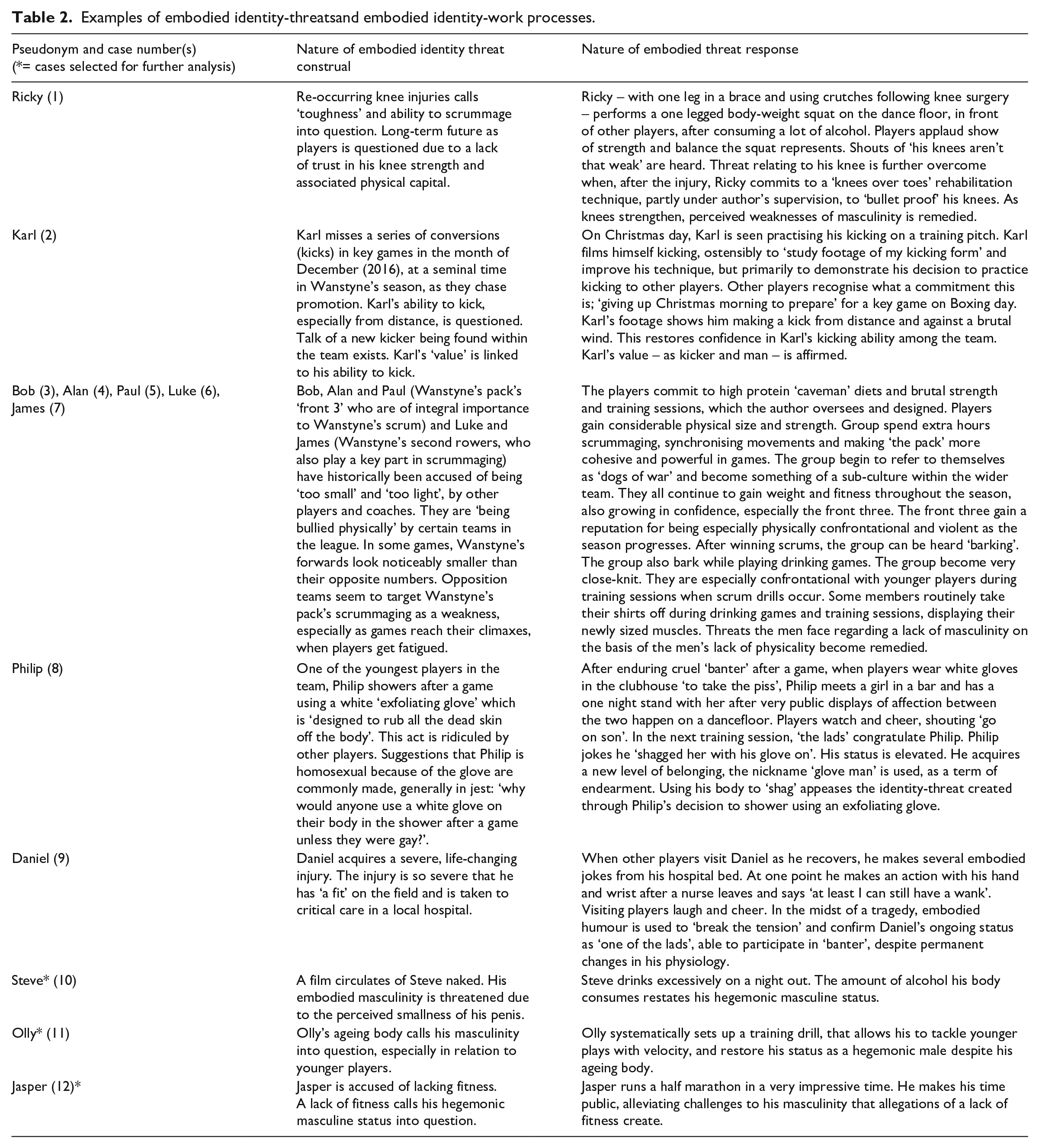
Cases 10, 11 and 12 are especially qualitatively pertinent and dramatic in demonstrating the role of the body in threat construal and threat response, and are therefore focussed on. Discussing three cases means each case can be explored in sufficient analytical depth. Simultaneously, these three cases are focussed on in the knowledge that several other, relevant cases were identified in fieldwork. Hence the relationship between embodiment, identity-work and masculinity articulated is not ‘cherry picked’ or limited to these three events and vignettes; but, rather, is a common, robust and consistent theme in captured data.
Data Source 2
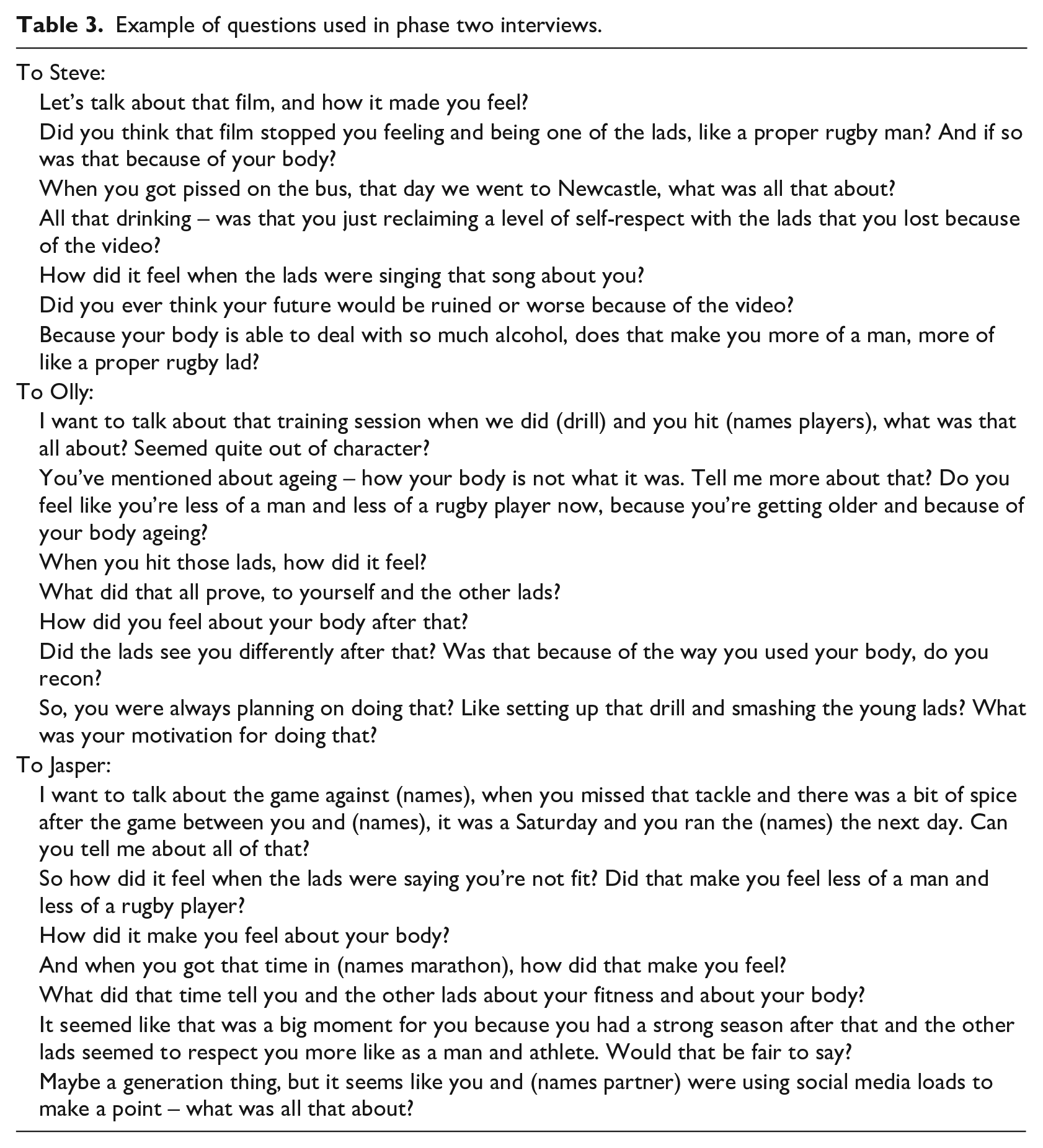
A second period of data generation occurred in late March and early April 2020, through individual qualitative interviews with Steve, Olly and Jasper: the three men cases 10, 11 and 12 involve. Interviewees gave consent for the research to occur and for quotes they gave to be reproduced. Interview questions were designed to understand the specific embodied identity threat experienced by each player, and how and why players participated in distinctive embodied remedial identity-work processes to counter their identity threats. Because of the ‘lockdown’ ensued by Covid-19, these interviews took place via Skype. While expecting interviews to last for 1 hour, interviews lasted considerably longer, with interviews all lasting at least 2 hours and one lasting 6 hours! Data captured in these interviews constitute a second data source (data source 2) which complimented and expanded data source 1, and allowed the relationship explored in this paper to be addressed more robustly and systematically. It is said that identity interactions, especially embodied ones, are made meaningful and ‘attributed retrospectively as we look back and try to make sense of events’ (Cunliffe and Coupland, 2012: 68). The timing of interviews – occurring after the studied events – allowed players to ‘look back’ and discuss their experiences with a level of hindsight and sense-making, that may have added to the quality of empirics captured. Examples of questions asked in phase two interviews are reproduced in Table 3:
Example of questions used in phase two interviews.
Interviews were recorded and transcribed fully. Transcriptions were read several times so familiarity with data was established. Data was then used to produce iterative, storified findings, rooted in the men’s experiences, to answer the research question how do organisational members use their bodies as identity resources to (re)accomplish hegemonic masculinity?
Positioning: researching embodied hyper-masculinity
Researching men and masculinities ethnographically requires that those being researched do not object to the researcher’s presence, and ideally have a level of rapport with the researcher. In the same way that Collinson (1988) had to engineer a configuration of masculinity that was seen as appropriate by the working class men he researched in the components division of a lorry producing factory, to generate ‘natural’ data and ensure sustained access in Wanstyne, it was important that those being researched accepted the researcher as a competent trainer and ‘good lad’. As one player put it: ‘if you came across like a stuck up snob like most university teachers I’d not let you train me’. While Collinson used humour to cement his status with other men when researching masculinities, the researcher also used humour and – more fundamentally – his own embodiment.
The researcher participated in physical acts during training sessions, like press-up and tyre flipping competitions. So doing allowed the researcher to prove his embodied masculinity symbolically, through physiological strength and associated embodied capital. Further, the researcher socialised with players in bars after games, occasionally drinking alcohol with them and joining in with rituals of theirs, like drinking games and singing songs. Wanstyne players wear jackets after games depicting the club’s crest. They also wear ties, with the pattern on their ties symbolising how many games they have played for the club (the 100 + game tie is especially revered). After games, the researcher wore sporting jackets and ties he owns, which were awarded to him during his sporting career. Through such symbolic acts, the researcher further reproduced and embodied a configuration of masculinity players recognise as hegemonic. Such acts were conducive to purposeful, sustained access to the case being secured, and rich, honest data emerging.
While some academics may have found the context studied intimidating, the researcher had little difficulty coping in the machismo world studied; he had participated in other ethnographies looking at excessive masculinity before this project, including the steroid-enhanced world of working class bodybuilders and bouncers (Giazitzoglu, 2018); meaning he has some knowledge of how to act in a hyper-masculine world while ensuring sustained access and data capture. The researcher’s localism also aided in rapport existing in the research process.
Having outlined the case of Wanstye, the data sources collected and analysed, and issues of positionality in the field, three storified accounts are now presented. In each account a players’ body constructs an identity-threat, and was then used in remedial identity-work processes to counter the threat, thereby allowing the player to (re)accomplish hegemonic masculinity and (re)secure belonging among the Wanstyne collective.
Steve’s naked balls: Rescued by drinking on the bus
During a party organised by Wanstyne, hosted in Wanstyne’s club house, several players took part in a ‘human bowling ball’ contest. This involves chairs being lined up at the end of the clubhouse, the (wooden) floor being drenched with beer, and players sliding on their fronts into the chairs, which they treat as skittles, while seeing themselves as bowling balls. The ‘winner’ is the player who has knocked down the most skittles in the form of chairs. Human bowling ball contests are popular among amateur rugby clubs in the north of England, especially during Christmas parties. It is usual for players to be naked while participating in human bowling ball contests. By participating in such events, players use their bodies to show their symbolic willingness to participate in a form of excessive hyper masculinity seen as ideal in Wanstyne: to be a human bowling ball, one must be brave, ‘up for a laugh’ (i.e. not overly self-serious), willing to take a risk and willing to endure pain.
Two things happened to Steve when he acted as a human bowling ball. First, he hit the chairs with too much velocity, cutting his head open. Second, a film was made of Steve. This film was passed around local social networks and was seen by other Wanstyne players.
The embodied threat construal experienced by Steve was linked to the size of his penis. Other players pointed out how small Steve’s penis looked on the film. During interviews, Steve commented how ‘embarrassing’ he found the footage, noting: ‘I’m not exactly hung like a horse but my cock doesn’t usually look that small . . . it was cold in there and I was pissed (drunk) so it was like shrivelled more’. Steve endured relentless and cruel though apparently well-meaning references to the size of his penis after the event from other Wanstyne players; especially during training sessions. This represented a major threat construal for Steve: a feature of his body meant his identity as a hegemonic man was lacking: ‘it was bad enough that the rugby lads saw it but it was at work, too. I mean this film got around, like I remember knowing people at work were saying things . . . made me feel like I’m not good enough like not a real man’ (Steve).
While ‘being hung like a horse’ is not a prerequisite for underpinning hegemonic masculinity in Wanstyne, a small penis does little to symbolise hegemonic masculinity, in sporting contexts or any other.
Shortly after the incident, several Wanstyne players hired a bus to take a large group of them to a nearby city, where they would watch a high-profile rugby match on a TV in a bar. I was invited to travel on the bus and watch the game. The bus was loaded with alcohol. Even before the bus arrived, players were drinking cans of beer early in the morning on the street, boasting about how drunk they were planning on getting throughout the day. The bus was christened ‘the drinking bus’ by players. Players were true to their words, with all of them consuming excessive amounts of alcohol. Several vomited and passed-out on the way home.
When players are not playing as a collective on the field, they socialise as a collective in leisure spaces, such as rugby club houses, bars and pubs. In these spaces, expressions of hegemonic masculinity are centred on the consumption of alcohol and associated hedonistic acts like singing and dancing. There is a high level of immaturity and ‘lad banter’ demonstrated in these spaces. Ensuring one’s masculinity is hegemonic in leisure spaces is just as important as ensuring one’s masculinity is hegemonic on the field; as phase one data showed, to be ‘one of the lads’ one must know to ‘to play rugby on the field and be a good bloke around the lads after a game’, by ‘knowing how to make the lads laugh’, ‘like having good banter and telling good jokes and taking the piss’ and ‘showing the boys you’re up for it on the drink (alcohol)’, ‘sometimes just drinking so much you pass out’. Several rituals exist for Wanstyne men to demonstrate their masculinity in this regard, including the annual ‘10 before 10 morning’ when players are required to drink 10 pints of beer before 10 am (without visiting a bathroom) then drink a bottle of port. Further, key acts like making one’s debut for Wanstyne and receiving 100 caps are marked by alcohol fuelled rituals. As soon as games are finished, players start drinking in the changing room (with cans of beer being opened to the mantra ‘win or lose on the booze’).
The actions of players on the drinking bus – and throughout the day – should be seen as extension of how significant alcohol is to expressions of hegemonic masculinity in Wanstyne. Significantly, no player consumed as much alcohol as Steve. With his ability to accomplish hegemonic masculinity in question as a result of the film and associated well-meaning but relentless and rather humiliating ‘banter’ from ‘the lads’, Steve drank a huge amount of alcohol, yet appeared to remain sober (at least in the view of other Wanstyne players). Further, Steve was keen to emphasise how much he drank. At one point, he was downing cans in front of other plays and shouting ‘who is keeping count, nobody can drink like me’. Throughout the day, other players emphasised the amount Steve drank, showing how impressed they were through statements like: ‘what an animal Steve is’ and ‘Steve is one of the best drinkers in England, he doesn’t even look like he’s had a can’. As my research diary noted, as the day progressed, Steve would shout ‘I might have a small cock but I can drink like a bastard’, to the delight and cheers of other players. On the bus home, other plays sang, to the tune of Lily the pink: ‘let’s have a drink a drink a drink to Steve the king the king the king, cause he’s the leader of our rugby team, and he’s the greatest human bowling ball that the world has ever seen’.
Steve stood up and conducted other men while they sang.
As the day progressed, Steve’s identity as hegemonic ‘rugby lad’ – based on the sheer amount of alcohol he drank – rapidly increased, with taunts about his ‘small cock’ being replaced by a celebration of his ability to drink alcohol. Through his actions, Steve repositioned the role of the body in relation to accomplishing hegemonic masculinity. Rather than being a vessel which places a premium on the size of a sexual organ, it was revised to an entity that places a premium on how much alcohol it can consume ‘in front of the lads’. In this way, Steve’s body was involved in an embodied identity-work process, to respond to and alleviate a threat it created; thus ‘repairing and revising’ (Brown and Coupland, 2015: 1317) Steve’s achievement of hegemonic masculinity within his organisational collective.
In phase two interviews, Steve reflected on his actions. He denied that his drinking was an attempt by him to divert the identity threat he incurred. For example, in response to the notion that his drinking was linked to him ‘reclaiming a level of self-respect with the lads that he lost because of the video’, Steve insisted: ‘mate I’m no way smart enough to do that, like go away and devise some sort of master plan to take the heat off’
Though, Steve admitted that his actions around drinking realigned his status ‘with the lads’: ‘I guess that for the first time since all that happened I felt like one of the lads again, like on the way home when they were singing my name and after that it all went back to normal’.
Steve’s storified account shows how vulnerable the male body is to identity-threats: a small penis emasculates one’s status and calls their hegemonic identity into question. Steve’s account also shows the compensatory potential of the body: by participating in an act that underpins embodied hegemonic masculinity (excessive alcohol consumption through and in the body), the body counters an identity-threat and restores hegemonic masculinity, reintegrating the player back into the organisational collective.
Olly’s old body gives out three massive hits in a row
Olly is one of the oldest players in Wanstyne’s squad. He incurred a debilitating knee injury in 2018, which resulted in a decrease in running speed. While Olly remains one of Wanstyne’s most respected players, it is accepted that Olly’s age and injuries means he is ‘past his best’ and could soon lose his starting place, which he has enjoyed for years, to several younger, emerging players.
During fieldwork, after a particular game in which Olly performed to a very high standard, Olly reluctantly admitted his ‘glory days are over’ and, therefore, his ability to accomplish hegemonic masculinity are coming to an end: ‘that (game) might have been my last ever big performance’. As time passes, Olly’s body will no longer allow him to plausibly enact with the physicality and speed required of a preferred identity; unlike younger players, whose bodies are approaching their prime. Olly’s body is nearing the point when it is unable to help Wanstyne win games. Therefore, Olly will become obsolete because his body won’t underpin hegemonic masculinity.
During the training session that immediately followed Olly’s comments, he did five things of note. First, Olly asked if the strength session scheduled could be replaced with a tackling session, claiming ‘some of the lads need to learn to dodge tackles better when they’re playing better teams in cup competitions’. A drill was set up, that would see attacking players receive a ball and try and run at and ‘beat’ defensive players. Second, Olly asked for ‘some of the younger lads’ – that is, players on the fringes of the first team – to join in the drill, so as to ‘boost numbers’ and ‘help the younger lads get used to the intensity’. Third, Olly – normally an attacking player – asked if he could tackle, thus becoming a defensive player. Forth, Olly spent time moving cones that were used to show players the spatial boundaries that the drill took place within, thus making the space that the drill would occur in tighter, heightening the chances of contact between ‘attackers’ and ‘defenders’ occurring. Generally, in training sessions, first-teamers are not encouraged to tackle each other, due to the potential of injuries being incurred. Fifth, once the drill commenced, Olly delivered ‘three massive hits in a row’. Specifically, Olly tackled three ‘younger lads’, hitting each one in three separate phases of the drill.
The tackles were fair (i.e. not too high to be illegal) but certainly overly-aggressive. Several older players observing applauded the hits. Olly seemed to talk quietly to the younger players after he hit them and they were on the floor, though in interviews he claimed he can’t remember doing this. Other players observing the hits shouted things like ‘yeah learn your place boys’ and ‘don’t be fooled by the grey hair and wrinkles’. The three hits represent remedial, embodied identity-work, in which Olly used his body to (re)confirm his hegemonic status: he symbolically proved his body’s worth to others (and maybe himself) as a man who can tackle younger ‘upstarts’ with velocity, and ‘put them in their place’, despite his age and injuries. Because his body is still stronger than younger players’, as evidenced in the drill he set up and the way his body behaved in the drill, Olly’s embodied acts stated that he is not just still able to physiologically contribute to the collective, but contribute in a better – i.e. more physical powerful and aggressive way – than younger men. Hence, the embodied acts (re)affirmed his hegemonic masculine status, clarifying any doubt about his hegemonic status on the basis of his ageing body, at least in the short-term.
In the spaces where rugby is played – that is, on the field during competitive games and on training pitches – the embodied masculinity seen as hegemonic and preferred is one linked to physical strength, fitness, competition and aggression: a man’s body must symbolise that he is a competent rugby playing athlete, and physiologically able to contribute on the field to the organisation’s primary aim (namely winning games). This masculinity is described in phase one data via players’ narratives including ‘winning at all costs’, ‘being fast as fuck on the field’, ‘never missing a tackle’, ‘always having the other lads’ backs’, ‘being hard as nails’, ‘taking no shit’, ‘not looking like a prick . . . by making stupid mistakes with the ball in hand and looking soft’, ‘being the topman, being a murder’, ‘eating so much food and lifting so many weights that when I go on the field I look like I should be in a cage and I am the biggest hardest bastard’. Olly’s embodied actions in a training session should be read in mind of this context.
When discussing these tackles with Olly during phase two interviews, Olly suggested his threat-response was pre-meditated. Olly acknowledged that he ‘planned all along’ to ‘hit’ younger players as he did, though ‘had no idea it would all work out so well and I’d hit them all so sweetly’. Further, Olly admitted he ‘shortened the pitch’ to prepare the stage for his performance, conceding that ‘he would never have catched the little bastards on an open field’. Olly suggested that he learned the drill when he was a younger player, when an older player did a similar thing to him. Olly defines his actions as having altruistic qualities, that were ‘for the good’ of younger players: ‘they’ll look back and thank me one day . . . respect is a hard lesson to learn and they learned it that day’.
Hence, it was on and through the body that Olly learned a hard lesson when he was a younger, less physically strong man; and it was on and through the body that the next cohort of Wanstyne men received their incarnation of this embodied ‘lesson’.
Jasper’s lack of fitness addressed by fast half-marathon
At the age of 16, Jasper was considered one of the best young players of his generation. At 19, Jasper left Wanstyne to play at a higher level. Yet he failed to take his rugby career seriously, missing his chance to turn professional as he and others expected. In his late twenties, having given up rugby for a number of years, Jasper returned to the Wanstyne area and started playing rugby again, while working full-time on building sites. Jasper shows flashes of brilliance, with other coaches often making remarks like ‘you can’t teach that’ and ‘that’s why he should have been the next (names famous rugby icon)’. However, Jasper still fails to train to the extent he should. He refuses to diet and is known to consume too much alcohol on nights before Wanstyne play. If Jasper’s body is not ‘fit’ to play rugby because of his lifestyle choices, he is unable to contribute to Wanstyne’s aim of winning rugby games. His hegemonic masculine status is thus questioned. The fact that such a talented athlete chooses to not prepare and condition his body properly calls his commitment to Wanstyne into question. This further jeopardises his hegemonic masculine status, suggesting selfishness on his part and disrespect for other players who, while less naturally talented, are fully committed to their teammates.
Jasper experienced an identity-threat on the basis of events surrounding a significant game for Wanstyne against their bitter local rivals. It was known that Jasper had ‘been out the night before’ the game. Jasper turned up late, missing the warm-up and was clearly hung-over. Jasper started the game, but the choice was unpopular with some players, who felt Jasper should be ‘dropped’ and replaced with a lesser but more reliable player. ‘It gives out the wrong impression when a lad like (names) comes to every training session and turns up on time in a nice blazer . . . then doesn’t get a game because big-time Charlie (Jasper) rocks up and just gets put in the team because of past glories’.
While Jasper finished the game without being subbed, his performance deteriorated as the game progressed. He missed a key tackle late in the game, with his body fatigued. This resulted in accusations being made in the changing room after the game, when things got heated. At one point a player threw a boot at the wall and accused Jasper of ‘having a bad attitude’ and ‘not being fit’. Other players nodded in agreement. Research notes indicate that Jasper never challenged accusations of him having a bad attitude (and even seemed to smirk at one point when this was brought up) but reacted very emotionally to accusations of being unfit. He stood up and shouted: ‘there is one thing I’ll not take from you lot and that is bollocks about my fitness, I’m the fittest here, I lift bricks all week and I played for (names club), who the fuck are you lot?’ At this point, Jasper left the dressing room and drove home; his separation from the organisational collective obvious and re-enforced by him leaving in what other players defined as a ‘huff’.
The next day – a Sunday – Jasper ran in a famous half-marathon hosted annually in the region. In the words of other players, the time that Jasper ran the half-marathon in was ‘ridiculous’, and almost as fast as some national-level club runners. Jasper proudly posted his time on several of his (and his partners’) social media accounts accompanied by pictures of himself with statements like ‘hashtagfittestonearth’ and ‘they said I’m not fit but look at my time!’. The fact that Jasper ran this time, having played a game the day before, added to the sense of ‘what a good and natural athlete’ Jasper must be among other players: ‘who else can play against (names club) one day then run that time the next? Super human’.
At the training session on the Tuesday evening that followed, no accusations about Jasper’s ‘lack of fitness’ were made. Several players made comments like ‘cracking time’ and ‘here comes Mo Farah (famous long-distance runner)’. When asked why he posted his time in phase two interviews, Jasper commented: ‘I did that (posting his time) on purpose cause I knew it would get around like wild fire, even the (names local paper) knew about it . . . in fact I remember driving away after that (names game) and thinking right, I’m unfit am I? Let’s see how fit I am tomorrow when I run the (names half-marathon), I hadn’t even trained for it, I’m a rugby player not a runner, but it doesn’t matter for me’.
Jasper was conscious of the opportunity to counter his identity-threat: ‘. . . at the end (of the half-marathon) there’s this road which is pretty much all straight, you come down a hill then hit this straight and I was literally like this (pumps arms in the air) the whole way even shouting at people ‘get out my fucking way’ (laughs) just thinking, this is going to be an awesome time, this is my chance, this is my opportunity . . . I’m going to get this (time) up on (names social media accounts) and I know all the lads will see it . . . they need to know I’m not just a normal player’.
In this example, Jasper used his body as a resource to directly counter an identity threat linked to allegations of him lacking fitness. One can’t be a hegemonic rugby man and unfit. With his fitness in question, Jasper’s legitimacy and hegemony was contestable. But by using his body to run, and by very publicly display his time, Jasper regained hegemonic masculinity, realigning himself with the form of ‘super fit’, ‘super competitive’ configuration of masculinity seen as preferred in Wanstyne.
Discussions and Conclusions
Wanstyne provides a context where a distinct configuration of hegemonic masculinity exists. When a player’s body fails to accomplish hegemonic masculinity as an embodied cultural construct, an identity-threat is created. The derivations of (rather than merely responses to) identity-threats among organisational members are under-studied empirically (Brown and Coupland, 2015: 1318). The storified accounts presented have detailed how the body functions as a site where ‘strong’ identity-threats (Petriglieri, 2011: 649) arise. This highlights that the body is not an unproblematic, inactive or docile entity in organisations (Elidrissi and Courpasson, 2021; Michel, 2011). Rather, the body is vulnerable to identity-threats and regulates organisational belonging, by symbolising an actor’s ability to conform to gendered organisational norms and ideals. The findings on embodiment and masculinity presented are congruent with other work looking at the more studied interplay of female embodiment and organisational belonging, which shows, further, that when bodies deviate from ideals and norms, organisational integration is impacted (e.g. Gatrell, 2013; van Amsterdam, 2015 on female ‘leaking’ bodies).
In addition, empirics reveal players participating in embodied, remedial identity-work processes, which counter identity-threats, by (re)accomplishing hegemonic masculinity. While the body is a source of identity-threat, embodied threats – once derived – don’t have to be a permanent, ongoing part of organisational life for the male actor. Instead, threats can be dissipated through appropriate embodied practices. At a time when others have called for explorations to emerge into how preferred identities in organisational contexts are formed through embodiment specifically (e.g. Courpasson and Monties, 2017; Cunliffe and Coupland, 2012) – and materialist, non-verbal resources more broadly (Symon and Pritchard, 2015: 245; Cooren et al., 20111152; De Vaujany et al., 2019) – this study has positioned the body as a significant member of the ‘cacophony of . . . sources’ (Ybema et al., 2009: 299) that organisational members can use, in innovative ways, as part of their ongoing identity-construction in organisational contexts, especially in the face of identity-threats. Empirics have thereby positioned the body as a site of identity maintenance, used as a resource by men seeking integration in a hyper-masculine organisational structure. While the three cases focussed on in this article saw identity-threats successfully countered, future work may consider cases of embodied identity-work that failed to counter identity-threats, paying attention to why embodied identity-work can fail.
Two wider epistemological contributions arise from analysis, which provide germane areas for future research. First, in relation to the theory of hegemonic masculinity. Embodiment was a key part of the theory of hegemonic masculinity during the theory’s inception. However, embodiment became neglected as a feature of hegemonic masculinity, analytically. As pointed out by Connell and Messerschmidt (2005: 851): ‘That hegemonic masculinity is related to particular ways of representing and using men’s bodies has been recognized from the earliest formulations of the concept. Yet the pattern of embodiment involved in hegemony has not been convincingly theorized . . . Bodies are involved more actively, more intimately, and more intricately in social processes than theory has usually allowed. Bodies participate in social action by delineating courses of social conduct—the body is a participant in generating social practice’.
Through empirics, the extent to which the body is actively, intimately and intricately involved in the qualitative accomplishment and (re)formation of hegemonic masculinity in a particular organisation has been highlighted, in rich empirical detail. Bringing the body back into discussions about hegemonic masculinity and how it is expression is valuable, ontologically. Thus, I encourage others to expand on this contribution; first, by examining what constitutes hegemonic masculinity as a subjective construct in other organisational spatial contexts, and second, by studying how specific configurations of hegemonic masculinity are realised and accomplished through the relative, embodied behaviours and embodied identity-work processes of organisational members interacting in these contexts. Such analysis will further reveal the ‘patterns of embodiment’ linked to expressions of hegemonic masculinities; enriching our understanding of how hegemonic masculinity, as a cultural construct, is underpinned and symbolised through embodied expressions, thus allowing the body’s role as a resource in the accomplishment of hegemonic masculinity to be appropriately acknowledged.
Second, scholars are encouraged to think more deeply and critically about the relationship between embodiment and the acquisition of hegemonic status in organisations. Organisation and management scholars have recognised that the male, white, healthy, younger body is seen as the most normative, ideal and thus hegemonic body in work organisations; and that employees who do not embody this ideal typically have to compensate through specific embodied behaviours (Meriläinen et al., 2015; Riach and Cutcher, 2014). Similarly, sociologists of sport have pointed out that the healthy, younger male body is seen as hegemonic and normative in sporting contexts, especially contact sport settings. In turn, females must participate in compensatory embodied behaviours that symbolise their ability to legitimately participate in sporting norms, such as via aggressive physical acts (Theberge, 2003). While not denying the privileged status and sense of legitimacy that fit, younger male bodies receive in work and sporting organisations – and the disadvantages this creates for ‘others’ – it is the case that scholars ought to reflect more closely on the extent to which actors who embody apparently normative embodied identities can take their hegemonic status for granted, and maintain their hegemony without compensatory embodied identity-work.
Empirics show that even for men like Olly, Jasper and Steve – that is, men who inhabit fit, strong, younger, battle-hardened bodies – normative, hegemonic masculine status in an organisation is not ensured because of their embodiment. Rather, their bodies are vulnerable to identity-threats and an associated loss of hegemony. The men have to rely on identity-work processes to symbolically affirm their worth to their organisational collective in response to identity-threats. It is not only women or men with obviously non-normative bodies (e.g. the disabled men looked at by Gerschick and Miller, 1995 and the men who are unwell, discussed by Sabo and Gordon, 1995) who have to participate in embodied processes as part of their ongoing quest to maintain a preferred identity in an organisational setting. In this sense, scholars can be more nuanced in who they see as naturally ‘fitting’ and commanding hegemony in organisations; with embodied hegemony being something that exists in degrees and with temporality; without permanence and inevitability, and which is contingent on ongoing identity-work. Bodies do not unequivocally commanded hegemony in organisations. Rather, bodies are resources that are used in corporeal identity-work processes, within distinct organisational structures and in relation to temporal gendered ideals and norms.
Footnotes
Funding
The author received no financial support for the research, authorship, and/or publication of this article.
