



Abstract
This study contributes a novel perspective on how new venture teams navigate task re-allocation during the new venture development phase. It highlights the relevance of task re-allocation conflict, shows how “negative affect expectations” shape the unfolding of such conflicts, and demonstrates why acting out conflict and its associated negative affect can enable team members to make substantial task re-allocations instead of symbolic ones. The analysis has implications for two bodies of research, which have previously not been considered in tandem: (1) research on task (re-)allocation, professionalization, and structural imprinting in new ventures, and (2) research on team conflict.
Introduction
As a new venture develops and grows, members of the new venture team need to elaborate on the initial allocation of task responsibilities and make adjustments where required (DeSantola & Gulati, 2017; DeSantola et al., 2022; Phelps et al., 2007). Through task re-allocations—for example, changing from overlapping to specialized task responsibilities, from an egalitarian form of decision-making to a more formalized one, or taking away task responsibilities from team members who have proven unfit for the tasks they are assigned—the new venture gains in both efficiency and legitimacy (Fisher et al., 2016; Sine et al., 2006).
Despite the crucial role that task re-allocations play in a new venture’s development phase, we know surprisingly little about how new venture teams actually navigate this process. Instead, research provides rich insights into how new venture teams initially allocate tasks during the venture inception phase (Jung et al., 2017). A specific line of research has also emerged on how task re-allocation occurs through founder replacements (e.g., Boeker & Wiltbank, 2005; Hendricks et al., 2019). Many founders, however, stay with their venture over time (Baker & Gompers 2003; Jain & Tabak 2008) and need to re-allocate tasks among themselves—instead of relying on external support to manage this process for them. This makes task re-allocation an important but undertheorized process in transforming a new venture team into a professional venture (Patzelt et al., 2021; Shepherd et al., 2021).
This study addresses this need for theory development, asking: how do new venture teams navigate the task re-allocation process without making membership changes? The analysis is based on a 6-month qualitative study of three new venture teams during a phase of intensive new venture development. To allow comparison, the teams were similar in how task allocation had initially been set up, they exhibited comparable situational conditions, and they faced comparable developmental milestones during the observation period. Despite these similarities, however, the three teams navigated their task re-allocation processes differently, leading to different outcomes. Only one team implemented substantial task re-allocations, meaning that they altered the allocation of task responsibilities in a way that substantially influenced the operations of the new venture. In the other two teams, task re-allocations were symbolic, meaning that even though they said they made changes in task responsibilities, these changes had little practical influence on operations.
The inductive analysis presented in this paper offers a reframing of task re-allocation processes in new ventures. From a modal process of professionalization, initiated by investors as the venture grows (Fisher et al., 2016; Phelps et al., 2007; Sine et al., 2006) or attains developmental milestones (DeSantola & Gulati, 2017; Hellmann & Puri, 2002; Wasserman, 2003), to a conflict-laden process, inherently intertwined with social interactions at the level of the new venture team. To better understand task re-allocation, I introduce a model of task re-allocation conflict, a specific form of process conflict that occurs during the new venture’s development phase and which concerns opposition about how task accomplishment should proceed in the new venture team, who is responsible for what, and how things should be delegated.
My analysis comes with important implications for two bodies of research, which have previously not been considered in tandem: (1) research on task (re-)allocation, professionalization, and structural imprinting in new ventures, and (2) research on team conflict. For the former, the analysis of task re-allocation conflict provides insights into why task re-allocation can present a conflict-laden struggle for new venture team members, it opens up a novel understanding of the mechanisms that underlies task re-allocation in stable teams, and it highlights why professionalization likely presents a more heterogeneous and complex process than previously implied. At a broader level, these insights are important because they extend our understanding of structural imprinting. As my analysis suggests, imprinting is not only an aspect that emerges from the initial structural configurations of a new venture (c.f., Beckman & Burton, 2008; DeSantola et al., 2022; Hannan & Freeman, 1984; Stinchcombe, 1963), but also from the team-level expectations members form while working together in the context of their new venture team. In particular, I highlight the importance of negative affect expectation, a second concept introduced here, for understanding a new venture team’s capacity for changing its initial structures. Referring to team-level, shared expectations regarding the intensity of expressions and the unfolding of negative affect in the context of the new venture team, I demonstrate the role of negative affect expectations in shaping new venture team members’ reactions to developmental milestones, and in extension, their capacity for making substantial task re-allocations instead of symbolic ones.
For team conflict research, the analysis introduces a novel perspective on conflict and affect. Whereas prior research rests on the assumption that intense negative affect between team members can escalate conflict and make it more difficult to reach a resolution (Boone et al., 2020; Breugst et al., 2015; Greer & Dannals, 2017; Weingart et al., 2015), observations from this study suggest an alternative path. Instead of negative affect as something that ought to be regulated, I point to negative affect expectations as a team-level construct that can enable a new venture team to experience short-lived anger and animosity without being overwhelmed by it. In so doing, I open novel avenues for further understanding the interplay between cognitive emergent states, such as trust or cohesion, and the affective expectations of new venture team members.
Theoretical Background
The Need for Building Theory on New Venture Task Re-Allocation
Initial Task Allocation
Research on initial task allocation focuses on how new venture teams organize the initial distribution of tasks during the inception phase of their new venture (Clarysse & Moray 2004; Jung et al., 2017; Katila et al., 2017; Lahiri et al., 2019). In particular, it highlights that initial task distribution is strongly influenced by team compositional characteristics—such as new venture team members’ prior expertise or status (Jung et al., 2017; Katila et al., 2017).
These insights, however, are not sufficient to understand task re-allocation during a venture’s development phase. In the beginning, most new ventures operate with flat hierarchies and overlapping task divisions. Even though members have role titles, the content of those roles is blurred, as all founders are engaged in all tasks (Lazar et al., 2020). As the venture matures, blurry task allocations are inadequate. For example, when the customer base increases, customer management requires specific attention. When conversations with investors are initiated, someone must take responsibility for managing this process. When employees are hired and the organization grows, someone needs to dedicate attention to leadership and organization. When the venture acquires recurring revenues and costs, financial accounting becomes a task in need of dedicated support, and so forth. Therefore, a growing organization and more extensive operations require a more elaborate task allocation structure, compared with initial task allocation at the point of new venture inception (Fisher et al., 2016; Phelps et al., 2007; Sine et al., 2006).
Moreover, changing task allocations is known to be a more fundamental challenge compared with initially distributing them. We know, for example, that new venture teams often find it difficult to revert initial decisions about how tasks are divided (Beckman & Burton 2008; Ferguson et al., 2016; Shepherd et al., 2021) and that new venture teams that initially establish a limited set of task responsibilities tend not to develop more elaborate structures later (Beckman & Burton, 2008)—even when more elaboration is called for as the venture grows in size and complexity (Ferguson et al., 2016). In prior research, this is understood as a problem of imprinting, meaning that new ventures at their foundation develop characteristics appropriate to their environment and purpose, and these characteristics persist even as initial conditions change (Beckman & Burton, 2008; DeSantola et al., 2022; Hannan & Freeman 1984; Stinchcombe, 1963). Naturally, research on initial task allocation provides little insight into how new venture teams can break these imprinting effects.
Task Re-Allocation Through Founder Replacements
The problem of imprinting is partly addressed in a specific stream of research focusing on task re-allocation through founder replacement, such as through replacement of the CEO or recruitment of specialized managers (Boeker & Karichalil, 2002; Boeker & Wiltbank, 2005; Forbes et al., 2006; Grillitsch & Schubert, 2021; Hendricks et al., 2019). This research demonstrates that external recruitments are often initiated by external investors, who push the need for professionalization as the venture grows (Fisher et al., 2016; Phelps et al., 2007; Sine et al., 2006) or hits developmental milestones (DeSantola & Gulati, 2017; Hellmann & Puri, 2002; Wasserman, 2003). At the same time, it also indicates that introducing a more experienced manager can bring challenges. Adding a new member can disrupt the team’s functioning, leading to team members leaving (El-Awad et al., 2022) and it therefore results in a reduction in human capital instead of an increase (Forbes et al., 2006). For example, externally recruited CEOs often find it difficult to be accepted by existing team members, making founder replacement a conflict-laden and challenging process (Clarysse & Moray, 2004; El-Awad et al., 2022).
Many founders also stay with their venture over time, building more explicit task divisions as they work together instead of replacing core team members (Baker & Gompers, 2003; Jain & Tabak, 2008). For such stable founding teams, evidence on founder replacements offers limited insights into how task re-allocations are navigated. Stable new venture teams are extreme cases of self-managed teams with the “freedom and discretion … to organize [their] internal work and structure to best accomplish their goals” (Langfred, 2007, p. 885). In stable founding teams, members thus cannot rely on external recruitments to manage the task re-allocation process for them. Instead, members themselves need to identify the need to make task re-allocations, collectively agree on what tasks to re-allocate and to whom, and ensure the successful implementation of new structures. Yet, how stable new venture teams navigate this process remains understudied.
Studying Task Re-Allocation Through a Conflict Lens
This study addresses this need for theory building, asking: how do new venture teams navigate the task re-allocation process without making membership changes? More specifically, the study focuses on the interrelationship between task re-allocation and conflict among team members. This focus on conflict initially emerged from observations of the data. Among the three new venture teams studied, conflict was a core aspect of how the teams navigated the task re-allocation process. Also from a theoretical standpoint, however, there are reasons to expect that task re-allocation in new venture teams can trigger conflict.
From prior research, we know that members of new venture teams often have incompatible understandings of the skills, performance, and value of each other’s contributions (Amason & Sapienza, 1997; Li & Hambrick, 2005). It would not be surprising if they also have incompatible understandings of who is best equipped to take on what tasks as the new venture matures, leading to conflict as initial tasks are re-allocated. Boone et al. (2020), for example, demonstrated that moving to specialized task allocations can be sensitive in teams where members initially share overlapping task responsibilities, especially if members share a passion for similar tasks. Studying task re-allocation through founder replacement, Clarysse and Moray (2004) described a similar situation: a core new team member (John1) proved incapable of the leadership tasks initially assigned to him. Being questioned by the team’s coach, who suggested taking away key task responsibilities from him, made John1 feel “hurt,” resulting in conflict between him and the coach (Clarysse & Moray, 2004, p. 71). In a series of real-life teaching cases, Wasserman (2012) also described such situations, where attempts to make changes in initial task allocations trigger conflict between members of new venture teams. As Wasserman (2012) demonstrated, these conflicts are often emotional and reveal interpersonal incompatibilities, as members’ different ambitions and foci become clear during the task re-allocation process. These prior theoretical and empirical insights do not imply that task re-allocation will always lead to conflict, nor that it is impossible to implement task re-allocations without engaging in conflict. Yet, they indicate that conflict can be a salient feature of task re-allocation for many new venture teams, not only the ones featured in the present study. In the following, I therefore provide a brief review of team conflict research, as a backdrop to my empirical investigations.
Task Re-Allocation as a Specific Form of Process Conflict
Team conflict research is a rich field, covered in several reviews and meta-analyses (De Church et al., 2013; De Wit et al., 2012; Greer & Dannals, 2017; Todorova et al., 2022). This literature acknowledges that team conflicts come in different forms. The most influential typology is Jehn’s (1995, 1997) distinction between task and relationship conflict. The former refers to disagreement about the content of tasks, and the latter to interpersonal incompatibilities between team members. More recently, this typology has been extended as conflict scholars have recognized other forms, such as moral, status, or process conflict. In the specific context of new venture teams, for example, scholars have focused on cognitive versus affective conflict (Ensley et al., 2002), task versus relationship conflict (Breugst et al., 2015; Breugst & Shepherd, 2017; Vanaelst et al., 2006), or idea versus interpersonal conflict (Ensley & Hmieleski, 2005).
A conflict type of particular relevance to task re-allocation is “process conflict”: “conflict about how task accomplishment should proceed in the work unit, who’s responsible for what, and how things should be delegated” (Jehn 1997, p. 540). For this study, I refer to task re-allocation conflict as a specific form of process conflict, defining it as: conflict that occurs during the new venture’s development phase and concerns opposition about how task accomplishment should proceed in the new venture team, who’s responsible for what, and how things should be delegated.
Process conflict has not been addressed in the context of new venture teams. We know from team conflict research more broadly, however, that process conflict often becomes “conflicts in disguise” (Greer & Dannals, 2017, p. 327) since it concerns control over value and decision-making authority (Greer et al., 2011). For example, what members see as the reason for a process conflict (e.g., task re-allocation) often involves hidden agendas (Amason & Sapienza, 1997; Amason & Schweiger, 1997), the potential for personal loss of status and power (Amason & Schweiger, 1997), or deeper issues of personal criticism (Jehn, 1997).
Being tied to issues of status, power, and equity, process conflict is a conflict type that easily becomes affective, meaning that members develop feelings of anger, annoyance, or animosity toward each other (Greer & Jehn, 2007; Jehn, 1997). This is likely to occur in new venture teams too, given how these teams operate in a context where emotions are heightened (Cardon et al., 2012; Ingram et al., 2019) and where members tend to identify with and emotionally invest in the tasks they engage in (Boone et al., 2020; Breugst & Shepherd, 2017; Cardon et al., 2009). Negative affect, in turn, is known to be detrimental in conflict situations (Greer & Dannals, 2017). In the specific context of new venture teams, for example, scholars have shown that conflicts that provoke negative affect initiate a negative spiral that undermines the quality of team members’ relationships (Breugst et al., 2015; Breugst & Shepherd, 2017), negatively impact venture performance (Ensley & Hmieleski, 2005), and increases the risks of member exit (Vanaelst et al., 2006). For similar reasons, team conflict research recognizes process conflicts as notoriously difficult to manage (Greer & Jehn, 2007; Jehn, 1997). For example, in the meta-analysis of De Wit et al. (2012), all studies on process conflict showed a negative effect on team performance, hampering coordination and lowering team members’ satisfaction.
Managing Negative Affect in Conflict Situations
Given the pivotal consequences of negative affect on team conflict outcomes, much of the conflict management literature concerns the management of negative affect (e.g., De Dreu & Van Vianen, 2001; Greer & Dannals, 2017; Jehn et al., 2013). Two mechanisms have been highlighted as central: affect regulation and conflict expressions.
Affect regulation comprises “the processes by which individuals influence which emotions they have, when they have them, and how they experience and express these emotions” (Gross 1998, p. 275). In conflict research, suppression and reappraisal have been suggested as beneficial strategies for affect regulation (e.g., Jiang et al., 2013; Thiel et al., 2019; Yang & Mossholder, 2004). For example, Jiang et al. (2013) found that individual team members who are skilled in emotion regulation are better able to “reduce the distracting influence of the strong negative feelings” (p. 717). Thiel et al. (2019) demonstrated that reappraisal, whereby individuals reinterpret and reframe emotional events, can enable teams to rebound from conflict.
Conflict expression is the “verbal and nonverbal communication of oppositions between people” (Weingart et al., 2015, p. 235). Expressions are important because they provide social signals that both indicate the sender’s affect and elicit affective responses in the recipient (e.g., Hareli & Hess, 2012; Hareli et al., 2008). For example, Gamero et al. (2008) demonstrated that frequent expressions help to constructively resolve conflict without engaging in negative feelings. Gelfand et al. (2008) suggested that a collaborative, instead of competitive, way to express conflict prevents negative affect. In a conceptual piece, Weingart et al. (2015) advanced this idea, arguing that conflicts that are expressed with low intensity, a “low degree of strength, force, or energy with which the sender conveys opposition during a given conflict event” (Weingart et al., 2015, p. 240), trigger less negative affect and are therefore less likely to escalate. Conversely, conflicts expressed with high intensity are perceived as threatening by the opponent, thus triggering an emotional, defensive, and rigid response.
In sum, this study seeks to advance research on task re-allocation in new venture teams. It does so by paying specific attention to task re-allocation as an issue that can be associated with process conflict and will require attention to the likely emergence and enactment of negative affect between members of the new venture team.
Methods
Research Design
Case Sampling Criteria
The study emerged out of a broader project, which aimed to develop a dynamic understanding of how new venture teamwork shapes the emergence of new organizations, see Brattström et al. (2020). For this broader project, I opted for a longitudinal, qualitative design since I wanted to capture hard-to-measure, dynamic phenomena on which there is little theory (Van Burg et al., 2020). I purposefully sampled cases with common antecedents to allow meaningful comparison across cases (Eisenhardt, 2021; Eisenhardt & Graebner, 2007), and I purposely sought cases in the development phase, not inception. To identify suitable cases, I contacted an accelerator program in Denmark, known for its capacity to coach entrepreneurial teams into developing more mature new ventures. I asked to follow one cohort during their 6-month program. 1 Following Hallen and Eisenhardt (2012), selecting a cohort of teams that were part of the same program was advantageous since it allowed me to study a population of teams that shared common antecedents and conditions. In particular, since the accelerator itself had detailed criteria for eligibility, I could ensure that the teams I selected shared contextual conditions (industry, product type, maturity, national context); aspirations (to create a high-growth, profitable new venture); and compositional characteristics (team size, member characteristics, and team tenure). As they were part of a structured accelerator program, I also expected them to face comparable developmental milestones during the 6 months of participation in the program.
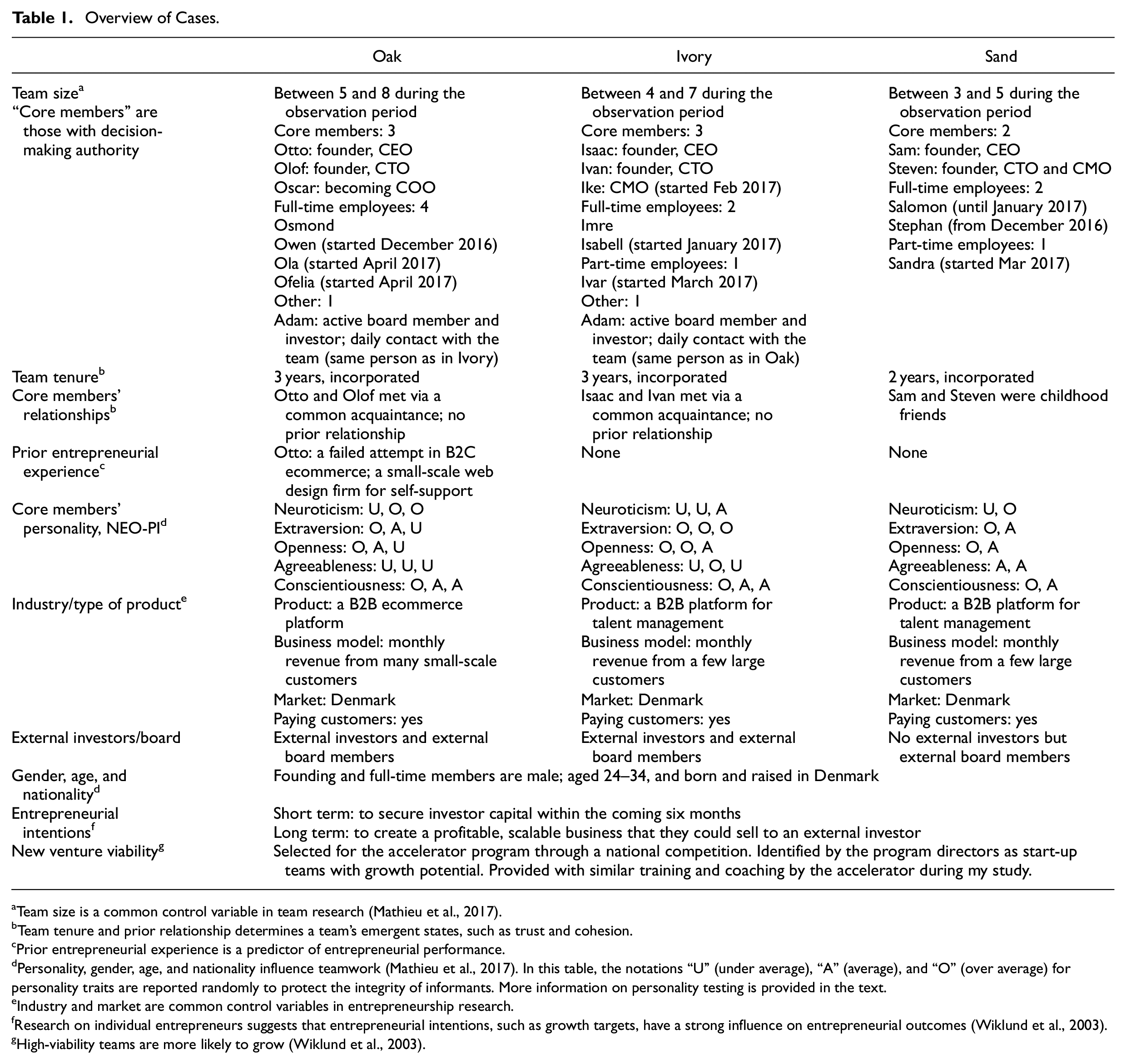
All three teams—Oak, Ivory, and Sand—that were accepted into the accelerator program from the information and communications technology sector agreed to participate in my study. All names in this study are pseudonyms. In other words, these three teams constituted the entire program cohort. I regarded three teams as a reasonable number of cases, given that I was looking to engage in a substantive data collection effort over 6 months. I followed Oak, Ivory, and Sand for as long as they took part in the program (mid-November 2016 to mid-May 2017), and I conducted follow-up interviews at 6 months and at 1 year afterward. An overview of the three cases is presented in Table 1.
Overview of Cases.
Team size is a common control variable in team research (Mathieu et al., 2017).
Team tenure and prior relationship determines a team’s emergent states, such as trust and cohesion.
Prior entrepreneurial experience is a predictor of entrepreneurial performance.
Personality, gender, age, and nationality influence teamwork (Mathieu et al., 2017). In this table, the notations “U” (under average), “A” (average), and “O” (over average) for personality traits are reported randomly to protect the integrity of informants. More information on personality testing is provided in the text.
Industry and market are common control variables in entrepreneurship research.
Research on individual entrepreneurs suggests that entrepreneurial intentions, such as growth targets, have a strong influence on entrepreneurial outcomes (Wiklund et al., 2003).
High-viability teams are more likely to grow (Wiklund et al., 2003).
Data Collection
An overview of data is provided in Supplemental Appendix Table 1.
Interviews
I conducted 64 interviews, of which 56 were carried out during the 6 months when the teams participated in the accelerator program (i.e., November 2016–May 2017). During this time, I met the teams at intervals of 2–5 weeks. The remaining eight interviews were conducted in October 2017 and October 2018 as follow-up interviews on the teams’ development. Core team members—that is, founding members or team members with a central role or responsibility—were interviewed more frequently. I also held regular interviews with the teams’ coaches from the accelerator program: Dan, the coach for Oak and Sand; Peter, who coached Ivory until December 2016; and Karl, who coached Ivory from December 2016 onward. The coaches met with the teams every 2 weeks, offering them advice on how they should develop their businesses. I used a semi-structured interview protocol, including questions about critical events, issues, and actions in the team and members’ perceptions of teamwork, as well as their thoughts and their emotions. The interview protocol is shown in Supplemental Appendix. If the informant had brought up a specific topic or event in an initial interview, I followed it up in the next. As a result, the interview protocol became increasingly case-specific during the course of the study. Interviews lasted between 20 and 90 minutes.
Videotaped Observations
Each time I visited the teams, I made participant observations of team interactions, such as internal team meetings, meetings with customers, meetings with the accelerator coach, and day-to-day interaction in the office space, as well as more informal conversations over lunch or coffee. Over 40 hours of such observations were videotaped. Supplemental Appendix Tables 2–4 provide overviews of the quantity and content of such video footage—see left column (the right column summarizes observations, further elaborated below). In Section “Findings,”Table 5, I also provide illustrative examples from video footage. All informants were briefed about the purpose of my study and gave their consent to be filmed.
Personality Test
Because personality composition influences how individuals work together (Costa & MacCrae, 1992), I asked all core team members to take a personality test: the NEO Personal Inventory. The test was conducted in the informants’ primary language and administered by a trained psychologist: a member of my research group who had no other involvement with the three teams or with this study. As illustrated in Table 1, the team personality compositions were comparable in dimensions critical for conflicts, such as neuroticism and agreeableness. In the end, the personality test did not constitute an important part of my analysis, but it lends support to the idea that differences between cases cannot be simply reduced to personality traits.
Documents and Online Chat Conversations
I had access to between 5 and 9 documents for all teams, such as their “lean canvas” (i.e., an overview of their business plan), internal presentations, and evaluations made by investors and the accelerator coaches.
Analysis
Step 1: Identifying the Opportunity to Study Task Re-Allocation
I first engaged in an open coding of observation notes and interview statements in chronological order (Eisenhardt, 2021). In line with the broader focus that my research first had, this coding captured statements that related to teamwork and new venture development. To organize these codes, I created an Excel spreadsheet (following the practice of Brattström & Faems, 2020). For each statement, I listed the date, the informant, and whether the statement was linked to teamwork, the new venture, or both. I also wrote a summary for each statement (i.e., a first-order code). The use of a spreadsheet was important, as it allowed me to sort and filter the codes according to the team, time, informant, and so on. After creating over 100 such first-order codes, I had a systematic overview of how teamwork and the new venture evolved in each case.
From the open coding, I learned that all three teams struggled with making task re-allocations and that this process was closely tied to conflict. I found these struggles and conflicts interesting for two reasons. First, it was interesting that task re-allocation presented such a challenge to all teams, given that they all implemented substantial adjustments in other aspects of their new ventures, such as their product offering, business model, and go-to-market strategy. Second, it was interesting that task re-allocation was the only issue that provoked really intense conflict between team members. In all three teams, I observed intense conflict (i.e., conflict causing tension, anger, and animosity) only in association with task re-allocation.
Based on open coding, I also realized that my case study design was advantageous for theory building on task re-allocation because it allowed a meaningful comparison across cases (Eisenhardt & Graebner, 2007). Not only did the three teams face similar initial conditions (which was part of my ex-ante sampling design)—they also had a similar initial task allocation structure. All three teams were founded by two people who had teamed up because of their complementary experiences. Their initial task allocation encompassed a division between product-related responsibilities, assigned to the founder with tech-related competence (programming, product development, etc.), and business-related responsibilities, assigned to the founder with experience in sales or management (sales, customer interactions, managing investor relationships, etc.). When my study was initiated, this broad division of tasks prevailed. Moreover, the teams faced similar developmental events during the observation period (they all faced lower-than-expected sales figures or onboarding or exiting of team members), making task re-allocations meaningful for all three teams. Thus, the research design I employed and the data I collected presented an unusual opportunity to study how three comparable new venture teams, facing comparable developmental milestones, navigated the task re-allocation process and its associated conflicts. I, therefore, decided to focus my analysis on this phenomenon, on which there is little prior theory.
Step 2: A Focused Coding of How the Teams Navigated the Task Re-Allocation Process and its Associated Conflicts
Given this refined focus, I returned to my data to engage in a more focused coding to capture interview statements that described the emergence, unfolding, and consequences of task re-allocation conflict. In this process, I used established research on team conflict in a sensitizing way, as suggested by Miles and Huberman (1994). In particular, I benefited from established insights on process conflict (De Wit et al., 2012; Jehn, 1997), conflict expressions (Gelfand et al., 2008; Weingart et al., 2015), and conflict and affect (Jiang et al., 2013; Thiel et al., 2019; Yang & Mossholder, 2004), as described in Section “Studying Task Re-Allocation Through a Conflict Lens.” During this coding process, the list of first-order codes was expanded, leading to a total of 213 first-order codes. I was also careful to note the chronological order of my observations to be able to study not only what happened in the three teams but also how it unfolded over time. I used the Excel spreadsheet that I had created to keep track of codes and to help produce a systematic within- and cross-case analysis. To make sense of my data, I also wrote detailed case narratives, focusing on how the teams navigated task re-allocation processes and the role of conflict, affect, and expressions, and I tried to capture these narratives in visual figures.
By comparing and clustering codes within and across cases, two broad themes emerged. The first was related to how members of the three teams managed task re-allocation issues. This theme involved three subcategories, eventually summarized into second-order concepts, see below. (1) How members expressed task re-allocation issues between them. (2) How they focused their collective attention in relation to developmental milestones, ranging from a focus on task allocation (who does what) to task execution (what to do). (3) The task re-allocations they eventually implemented, ranging from substantial (alterations of task responsibilities in a way that substantially influenced the operations of the new venture) to more symbolic (alterations of task responsibilities with little practical influence on the operations of the new venture).
The second coding theme related to how members of the three teams enacted negative affect. This theme also involved three subcategories. The first two were closely linked to established insights on expressions and affect in team conflict research, described in Section “Studying Task Re-Allocation Through a Conflict Lens.” They encompassed (1) The extent to which negative affect was evident or latent between members. (2) How members processed negative affect, ranging from acting it out to tempering it. The third subcategory, however, emerged purely from inductive coding. (3) Team-level, shared expectations regarding the intensity of expressions and the unfolding of negative affect in the context of the new venture team. In all teams, members highlighted the importance of such shared expectations for their management of task re-allocation conflict and affect. For example, Oak members—who expressed task re-allocation oppositions in very intense ways, displaying both anger and animosity—emphasized that this was generally how they expected conversations to unfold in all discussions and interactions in the context of their team. Conversely, Ivory and Sand members—who mildly expressed their task re-allocation oppositions and tried to temper their negative affect—said that this was in line with their expectations about how to communicate in the context of their teams. 2
These analytical themes and their subcategories were all manifested at the team level of analysis. This means that when members described how they dealt with conflict or affect, they referred to shared and generalized ways within their team. For example, they used terms such as “we don’t hold a grudge,”“in this team…,” or “we have learned that….” Moreover, by comparing within and across cases, it was also clear that the main point of variation occurred between teams, not between individuals within the different teams.
Analysis of Videotaped Observations
Since expressions and expectations in relation to affect emerged as a salient theme, I decided to code videotaped recordings with special attention to how affect and expressions manifested in this data. In this way, the videotaped recordings became an important source for triangulating members’ statements about how they expected to behave in the context of their team with their actual behavior, although it is important to note that I was not able to capture the specific expressions of task re-allocation conflicts in videos.
When analyzing video recordings, I followed the recommendations of Jarrett and Liu (2018). I started by “zooming out” (Jarrett & Liu, 2018) to capture broader patterns. I watched every video, sometimes at a higher speed than normal, to get an overall impression of affect and expressions. Given the extent of this data, I did not identify every instance of affect and expressions but focused more on capturing general impressions, using memo writing to organize my findings. Summary notes of these observations are provided in Supplemental Appendix Tables 2–4 (see right-hand column).
I moved on by “zooming in” (Jarrett & Liu, 2018), meaning that I transcribed micro-episodes of dialogue from videotaped observations. In Section “Findings,”Table 5, I provide examples of such transcriptions and my coding of them. From each observation, I purposefully selected at least one micro-episode in which members engaged in more intensive conversations and displayed affect, such as in association with debates. These episodes were 3–20 minutes long and were transcribed in detail, including the exact timing of members’ verbal, bodily, and facial expressions. I carefully analyzed these micro-episodes and systematically coded them in terms of expressions that elicited or indicated affect. In this coding, I made a broad distinction between “positive” and “negative” affective expressions but did not code particular emotions. For example, I used codes such as “smile” and “laugh” to capture expressions of positive affect and codes such as “frown” or “irritated grunt” to capture expressions of negative affect. This means I followed qualitative, inductive practices when analyzing videotaped data, staying close to first-order observations instead of pre-designed coding schemes. 3 To lend confidence to my interpretations of video data, I sent representative examples of transcribed micro-episodes and the corresponding videotapes to a colleague. She also studied new venture teams using qualitative methods but was not involved in my specific research project. After she made an independent assessment of affective expressions in the three teams, it was clear that our interpretations converged, and she supported the conceptualization I suggested.
Step 3: Second-Order Analysis and Development of a Theoretical Model
After having identified the two core empirical themes and their underlying categories, as well as triangulating these observations with analysis of videotaped recordings, I started to move toward a more abstract conceptualization of my findings. To do so, I worked intensively with visual figures, seeking to capture the development of task re-allocation conflict in each case as well as to identify similarities and differences across cases (Eisenhardt & Graebner, 2007). In this process, I also sought second-order concepts that could capture my empirical observations in more abstract terms. I tried to stay as close to established terms as possible, turning to the literature on conflict expressions and affect to identify relevant concepts. For example, I used Weingart et al.’s (2015) term “intense/tempered conflict expressions” to capture observations of how conflicts were expressed. When I could not find established concepts that could capture empirical findings, I worked creatively to derive new concepts from data. In particular, I developed the notion of negative affect expectations to conceptually capture observations of team-level, shared expectations regarding the intensity of expressions and the unfolding of negative affect in the context of the new venture team, described above. This process was highly iterative and evolved numerous attempts to develop a data structure (see Figure 1) and a model (Figure 2) that stays true to my empirical observations yet offers meaningful generalizable insights.
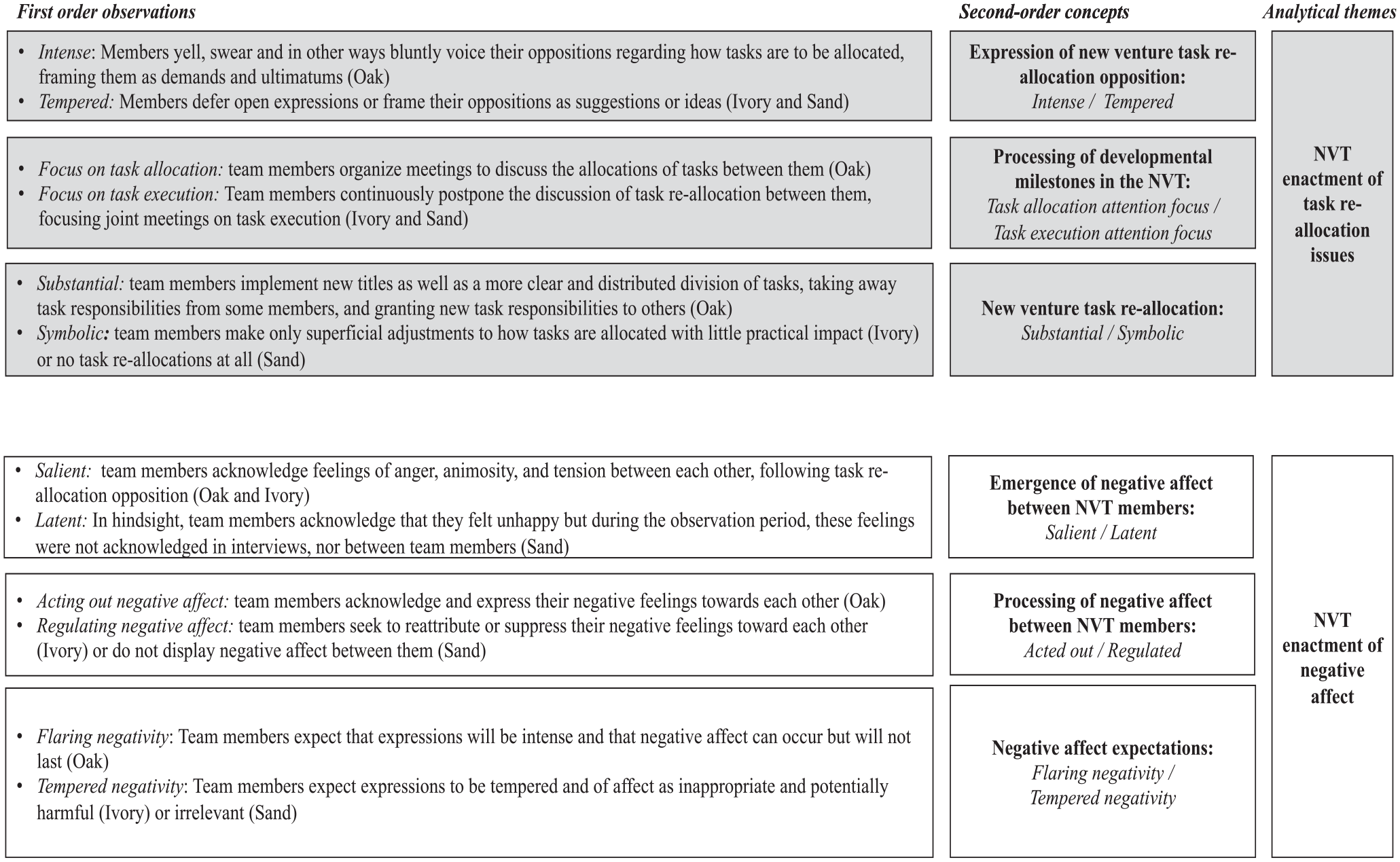
Data structure linking first-order observations to second-order concepts and analytical themes.
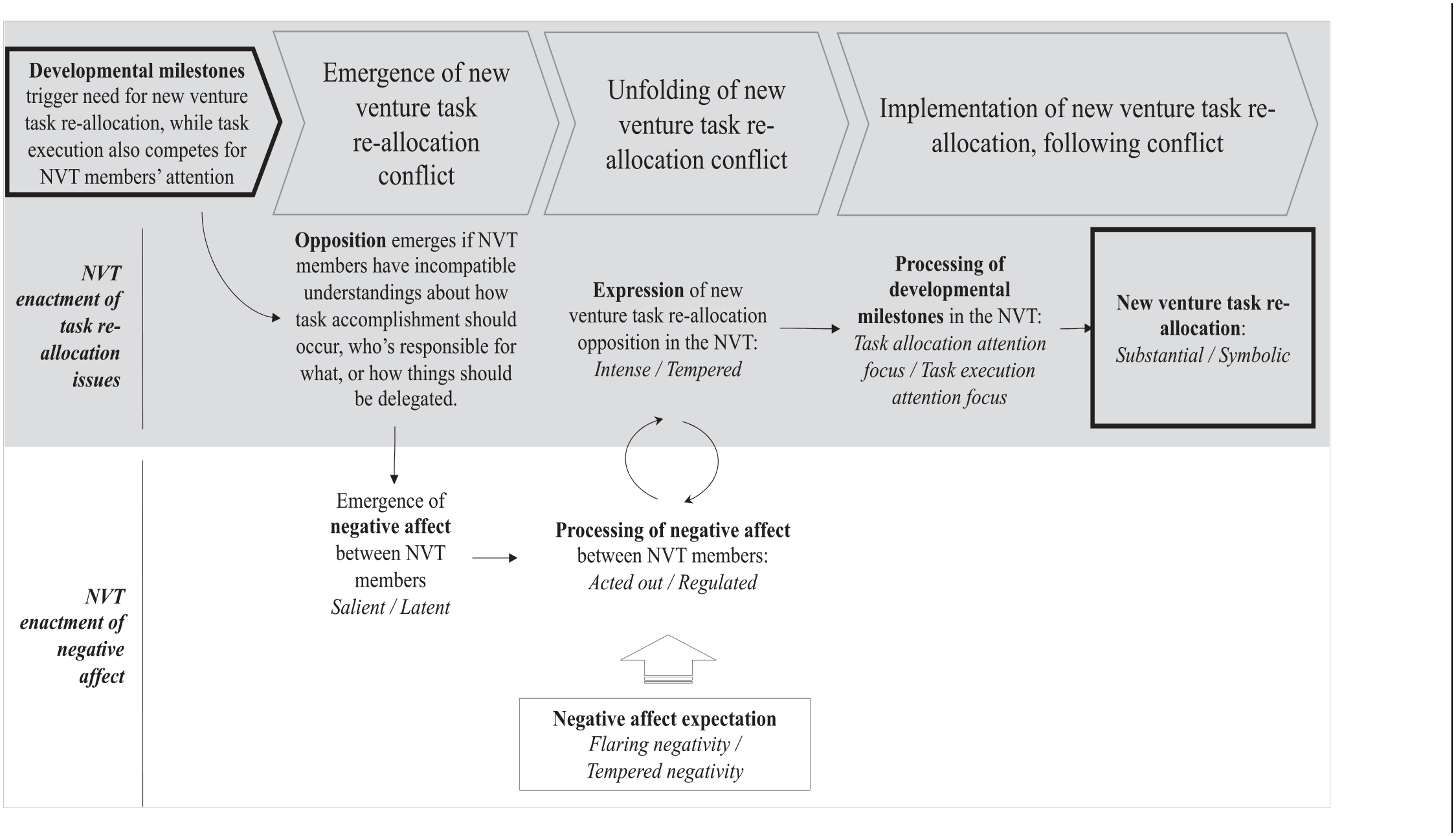
A model of task re-allocation conflict.
Findings
The Emergence of Task Re-Allocation Conflict
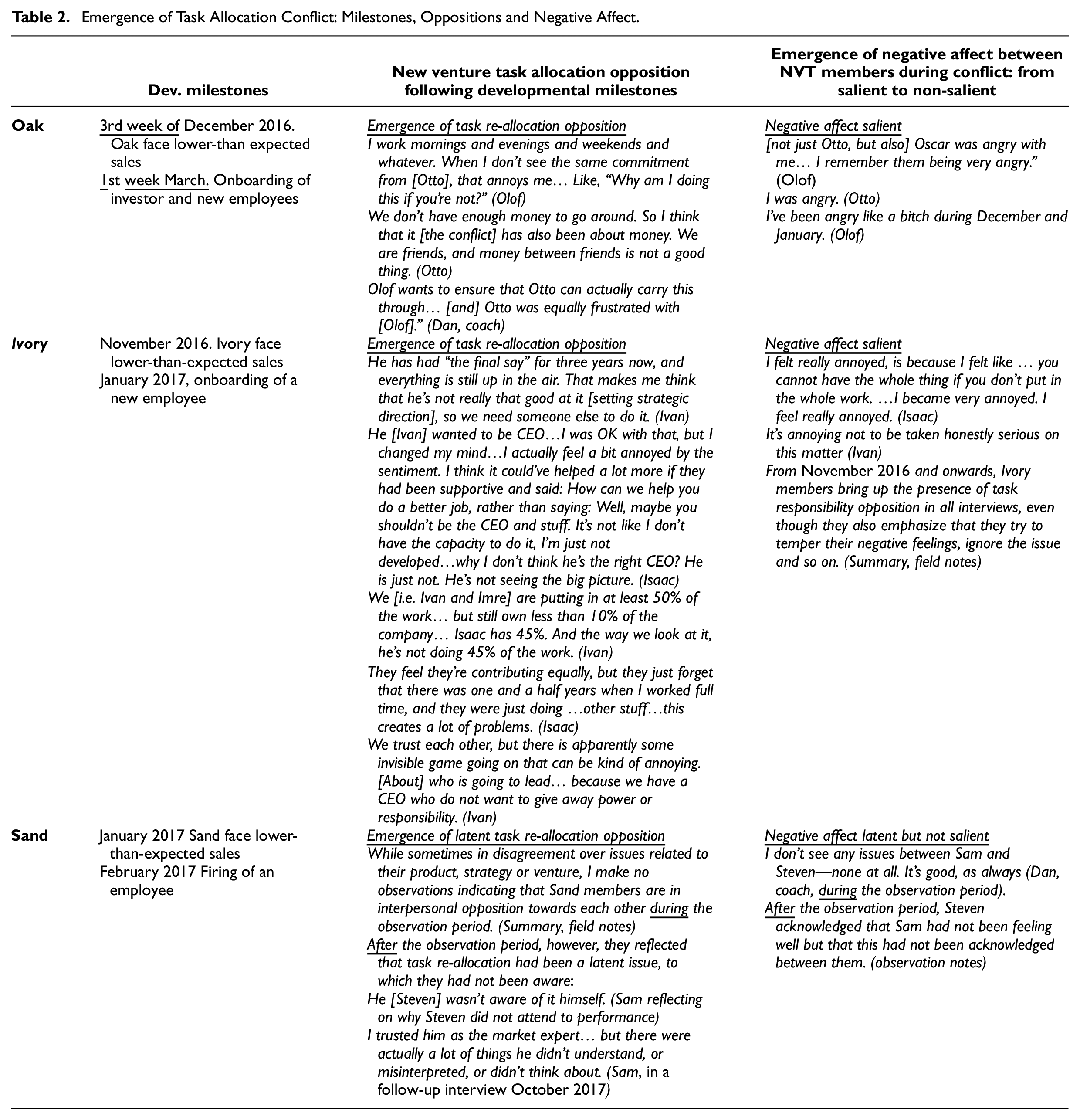
Table 2 provides an overview of observations of emergence of task re-allocation conflict, detailing developmental milestones, task re-allocation oppositions, and the negative affect that emerged from such oppositions.
Emergence of Task Allocation Conflict: Milestones, Oppositions and Negative Affect.
Developmental Milestones Trigger the Emergence of Task Re-Allocation Oppositions
As illustrated in Table 2, the three teams faced comparable developmental milestones during the observation period: their sales turned out to be lower than expected, and they all onboarded or fired employees and investors. For Oak and Ivory, these milestones triggered open task re-allocation oppositions, meaning that members disagreed about how task accomplishment should occur in the new venture team, who should be responsible for what, and how things should be delegated.
Under normal conditions, team members focused primarily on their own tasks, not overthinking the performance of other team members. After developmental milestones, however, they started to scrutinize and question each other’s performance and task responsibilities. For example, the Chief Technology Officer (CTOs) in both teams (Olof and Ivan) questioned their respective CEOs (Otto and Isaac): their ability to lead and structure work tasks, their commitment to the venture, and their ability to make “the right” strategic decisions. In interviews, they said:
Otto is definitely not a structured guy. He is really bad at looking at it [sales] from an analytical point of view … [to] make a plan, divide it into smaller steps and follow through… I’m not really sure, after three years, that he’ll ever be the right guy to fix this problem. (Olof, reflecting on lagging sales performance in Oak) Isaac is like: ‘I talked with the CEO of [company name] and it was amazing!’‘He wants to do this’ and ‘he’s amazed by Ivory,’ and so on. And I’m like: ‘I don’t care if it’s the CEO. It could be their f-ing cleaning lady if she can write on some paper that she is paying money for it.’… It made me see that the problem is, we have a guy [Isaac] going around trying to sell something, but he doesn’t know whom he sells to. (Ivan, reflecting on lagging sales performance in Ivory)
Questioning performance, the two CTOs started to demand more influence over strategic leadership tasks, or even that the CEO should be replaced. These ideas were strongly refuted by the CEOs:
4
I told him [Otto] that we would need a new CEO… You can tell that he doesn’t want to give that up… [But] I am inclined to get a new guy to run the entire company. (Olof) All of the major things on the project have come because I have created them … but now he [Ivan] wants to be involved in that and he doesn’t, in my opinion, really have the capacity to do so. (Isaac)
In Sand, task re-allocation oppositions were latent but not openly expressed during the observation period. Even though Sand reached similar milestones to the other two teams (lagging sales performance, onboarding of new team members, discussions with potential investors), this did not lead members to scrutinize each other’s performances or task responsibilities. In hindsight, however, 6 months after they had terminated the venture as unsuccessful, they acknowledged that this lack of attention to and opposition about task performance and responsibilities had been a mistake:
I trusted him [Steven] as the market expert … but there were a lot of things he didn’t understand, misinterpreted, or didn’t think about. (Sam)
The Emergence of Negative Affect
In both Oak and Ivory, task re-allocation oppositions triggered negative affect among team members. The CEOs, Otto and Isaac, had founded the venture and invested time, money, and emotions into it for over 3 years. Giving up strategy or leadership tasks was unthinkable, seen as a personal accusation and as something that made them angry, annoyed, and irritated with their teammates. In Oak, Olof concluded that “[not just Otto, but also] Oscar was angry with me [for bringing this up]… I remember them being very angry.” Adam, the investor who interacted with the team every week, similarly confirmed:
Olof had started voicing his concern that not enough was happening in sales. He wanted to have a meeting about that, where they were supposed to outline what were they doing … [being questioned] Otto was defensive … he doesn’t like being measured. He really, really hates being measured… Especially if he’s confronted with not achieving his goals. Which was what happened in the beginning of this year. (Adam)
In Ivory, Isaac said: “I feel really annoyed … I’m looking at him [Ivan] and I became very annoyed.” Adam
5
, who was an investor also in Ivory, further recalled:
Well, the idea was that I was to be the CEO. Isaac would go to a more operational role… He said, crying, actually, to me, that he didn’t want to give up the role because he didn’t want to go down on the status of not having a leadership role. (Adam)
In Sand, however, animosity, or annoyance was not expressed openly during the observation period, in relation to task allocation or any other matters. Instead, their coach, Dan, reflected: “things here are good, as always.” Only in hindsight did members acknowledge the presence of negative affect: Steven had been feeling increasingly demotivated and weary, wanting to leave the venture, although these negative feelings were not spoken about:
He [Steven] was concerned about my reactions, so he wouldn’t state his honest opinion. (Sam)
The Unfolding of Task Re-Allocation Conflict
Processing of Negative Affect and Expressions of Oppositions
Table 3 provides an overview of observations of unfolding of task re-allocation conflict, detailing how members in Oak, Ivory, and Sand processed negative affect and how they expressed oppositions.
Unfolding of Task Re-Allocation Conflict: Processing of Affect and Expressions of Oppositions.
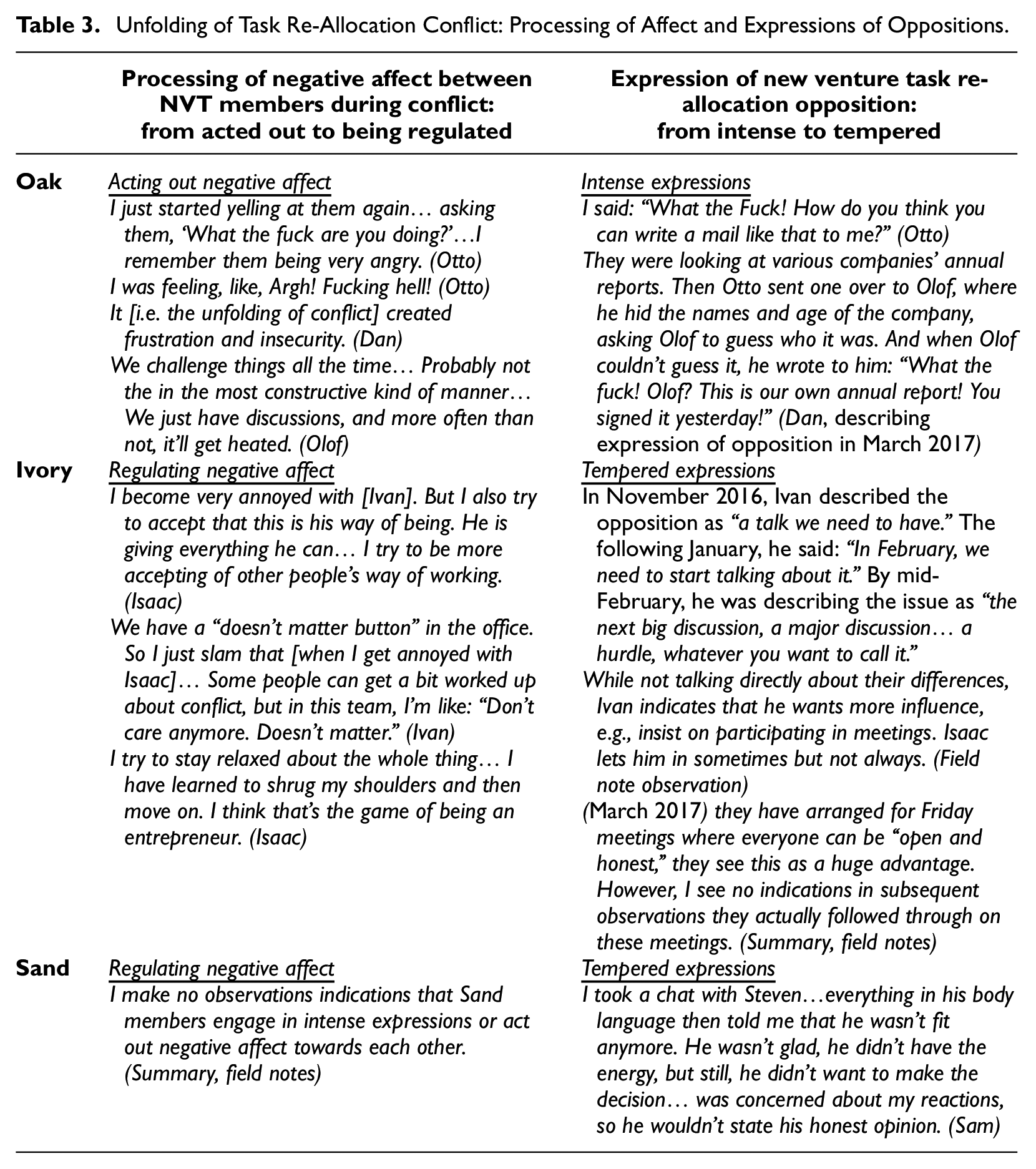
As negative affect emerged among team members in Ivory, they tried in different ways to regulate it. For example, they attempted to reappraise their emotions, thinking that the frustration and anger “is part of the game of being an entrepreneur” (Isaac) or by “trying to be more acceptive” (Isaac). Ivan also tried to take out his frustration on a “doesn’t matter button” in the office: a physical toy button that he would slam instead of working himself up. In similar ways, Ivory members also sought to express their oppositions in a tempered manner. This means that, for several months, they mostly deferred the expression of oppositions (even though they often mentioned them to me in individual interviews). Thinking that their negative feelings were not so important and fearing the idea of provoking more animosity, they kept referring to the expression of oppositions as “a talk we need to have [just not now]” (Ivan). Or, when they decided to voice their opinions, they expressed them mildly, framing them as suggestions, as illustrated by quotes in Table 3.
These observations stood in stark contrast to those made in Oak, where members intensively expressed their oppositions and acted out their negative affect. For example, in December 2016—the day before Otto was going away for a much-longed-for Christmas vacation with his partner—Olof bluntly told Otto that there must be a CEO replacement or he would leave the venture. Being confronted and threatened in this way made Otto angry and upset. As he elegantly put it: “I was feeling like fucking hell.” Immediately after returning from vacation, he acted out on these feelings, storming into the office. He yelled and swore at his teammates, demanding a meeting to discuss task responsibilities. Not surprisingly, such yelling triggered additional animosity between Olof and Otto, anger that rubbed off also on Oscar (an employee who at this point was working on administrative tasks and customer support) as well as on Adam, the investor who shared office space with the team and was involved in working activities on a weekly basis. 6
In Sand, where conflict remained latent throughout the observation period, I did not observe acting out of negative affect. When I once asked them if they were ever angry with each other, they just “laughed and shook their heads” (observation notes).
Negative Affect Expectation and its Role in the Unfolding of Task Re-Allocation Conflict
When reflecting on these different displays of affect and expressions, members of all three teams referred to their negative affect expectations: shared expectations regarding the intensity of expressions and the unfolding of negative affect in the context of the new venture team. Table 4 provides an overview of these negative affect expectations.
Negative Affect Expectations: Shared Expectations Regarding the Intensity of Expressions and the Unfolding of Negative Affect in the Context of the New Venture Team.
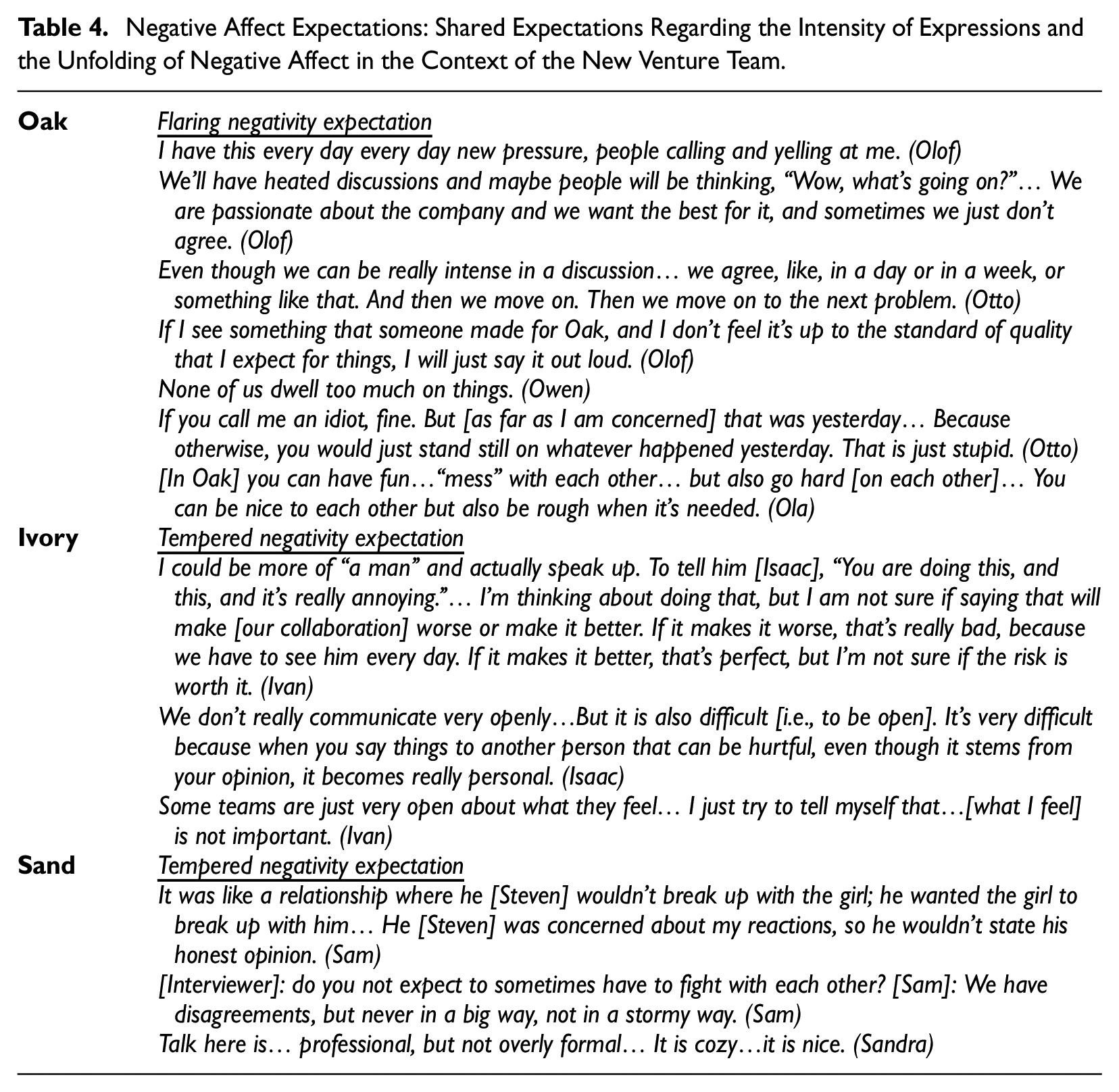
In Oak, members shared expectations that issues—big or small—would be intensively expressed between them and that negative affect would occur as a result. At the same time, however, they also expected such negative affect to be short-lived. Olof, for instance, explained: “We’ll have heated discussions, and maybe people will be thinking, ‘Wow, what’s going on?’… We are passionate about the company, and we want the best for it; sometimes we just don’t agree” (Olof). While Otto emphasized: “Tell me I’m a douche and then let’s get over it… We don’t hold grudges. None of us” (Otto). Conceptually, I refer to this as a flaring negative affect expectation.
In Ivory and Sand, members instead expected their team members to temper their expressions and negative affect, expecting unleashed negative affect to be long-lasting (Ivory) or something that would provoke concern, stress, or worries in other team members (Sand). In Ivory, Isaac, for example, said: “When you say things to another person that can be hurtful, even though it stems from your opinion, it becomes really personal.” Ivan similarly emphasized: “Some teams are just very open about what they feel … in this team, I just try to tell myself that … [what I feel] is not important.” In Sand, Sam reflected on the unspoken negative affect as: “It was like a relationship where he wouldn’t break up with the girl; he wanted the girl to break up with him.” During the observation period, Steven also said: “We don’t expect these situations where we’re actually fighting about something. We try to
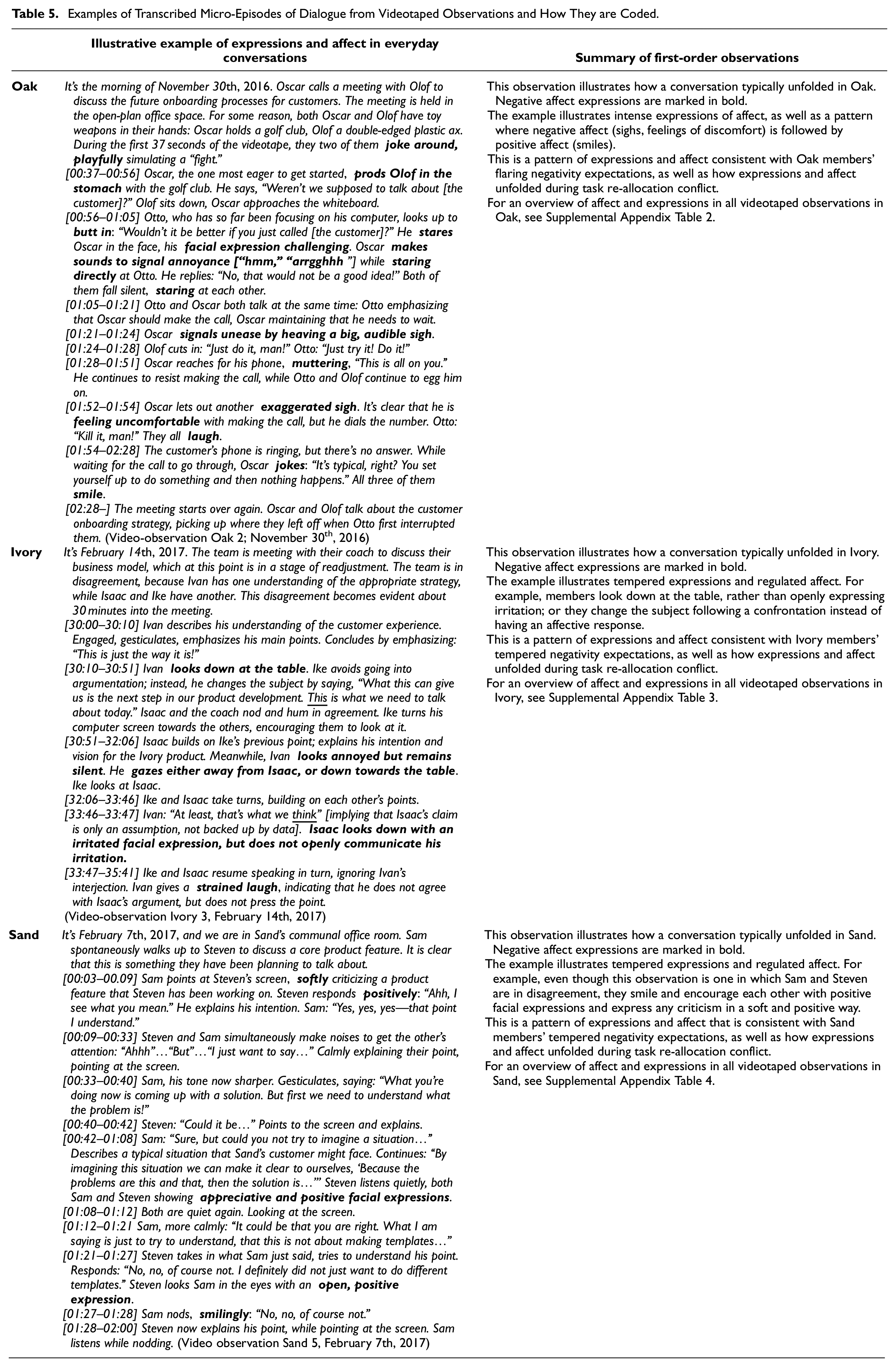
These different negative affect expectations did not reflect individual differences among team members. Instead, members described them as a shared feature of their teams. Something that had developed over time, as they had been working together. Rather than being built in the heated moment of conflict, these expectations had emerged through their daily conversations, in which they had come to develop expectations regarding how negative affect would unfold between them. In Oak, Oscar, for instance, described the flaring negative affect expectations as something that differed from what he expected in other contexts but that he had learned to appreciate: “In the beginning, I hated it … but I grew into it. That just happened” (Oscar). In Ivory, Ivan described the tempered negative affect expectations as something that had been established over time, saying: “It used to be that he [Isaac] would come [and make suggestions], and I would say, like, ‘Arghh! Screw that!’… But now, I try not to care anymore. It doesn’t matter” (Ivan). Team members’ descriptions of negative affect expectations also reflected my own observations and were evident in many of the videotaped observations that I made. To illustrate, Table 5 provides examples of transcribed micro-episodes of dialogue from videotaped observations, illustrating affective expressions during everyday conversations.
Examples of Transcribed Micro-Episodes of Dialogue from Videotaped Observations and How They are Coded.
When task re-allocation conflict emerged, the different negative affect expectations fed into the processing of affect and expression of oppositions, leading to differences in how conflicts unfolded. In Oak, where members had flaring negative affect expectations, members did not think of yelling, swearing, and similar intense expressions as strange or harmful. Instead, they emphasized that this was something they expected to blow over, even though they acknowledged that they found it uncomfortable while it occurred. They said that because the team had come to develop an expectation that, on the other side of this conflict, there would be better times, they also felt confident that speaking up would not be harmful:
Even though we’re pushed out of our comfort zone [in conflict situations], we seek it out because we know that on the other side of it, there will be development and better times. (Oscar) It’s kind of a balance. To be able to have a really hilarious environment on the one hand, and then serious, difficult talks on the other… Because we are so extreme in one direction, we can have the extreme in the other. (Olof)
In Ivory, the tempered negative affect expectations instead implied a fear that intense expressions and acting out negative affect would make the collaboration “worse” (Ivan), something that would be taken as “personal” (Isaac) and something that they would be able to “get over” (Isaac). Against this expectation, they hesitated to speak up about task re-allocation needs and tried in different ways to temper their negative affect. Ivan, for instance, said that he was not sure “if saying that will make [our collaboration] worse or make it better… I’m not sure if the risk is worth it.” Isaac laconically concluded that the feeling of annoyance and disappointment with his team members’ performance was something he needed to accept instead of acting out: “I think this is the game of being an entrepreneur” (Isaac).
In Sand, where tempered negative affect expectations were also present, members thought of task re-allocation as something that did not warrant explicit discussion. In the follow-up interview, 6 months after the observation period, they acknowledged that this had been a significant problem. At this point, the venture had been terminated. Sam then concluded that they could have saved themselves 6 months of time and money—if only they had dared to deal with task re-allocations sooner. However, their tempered negative affect expectations had hindered them from voicing concerns:
Had we been different, I think the outcome would have been the same [i.e., a termination of the new venture] … but we would have terminated the company sooner. (Sam)
Implementation of New Venture Task Re-Allocation, Following Conflict
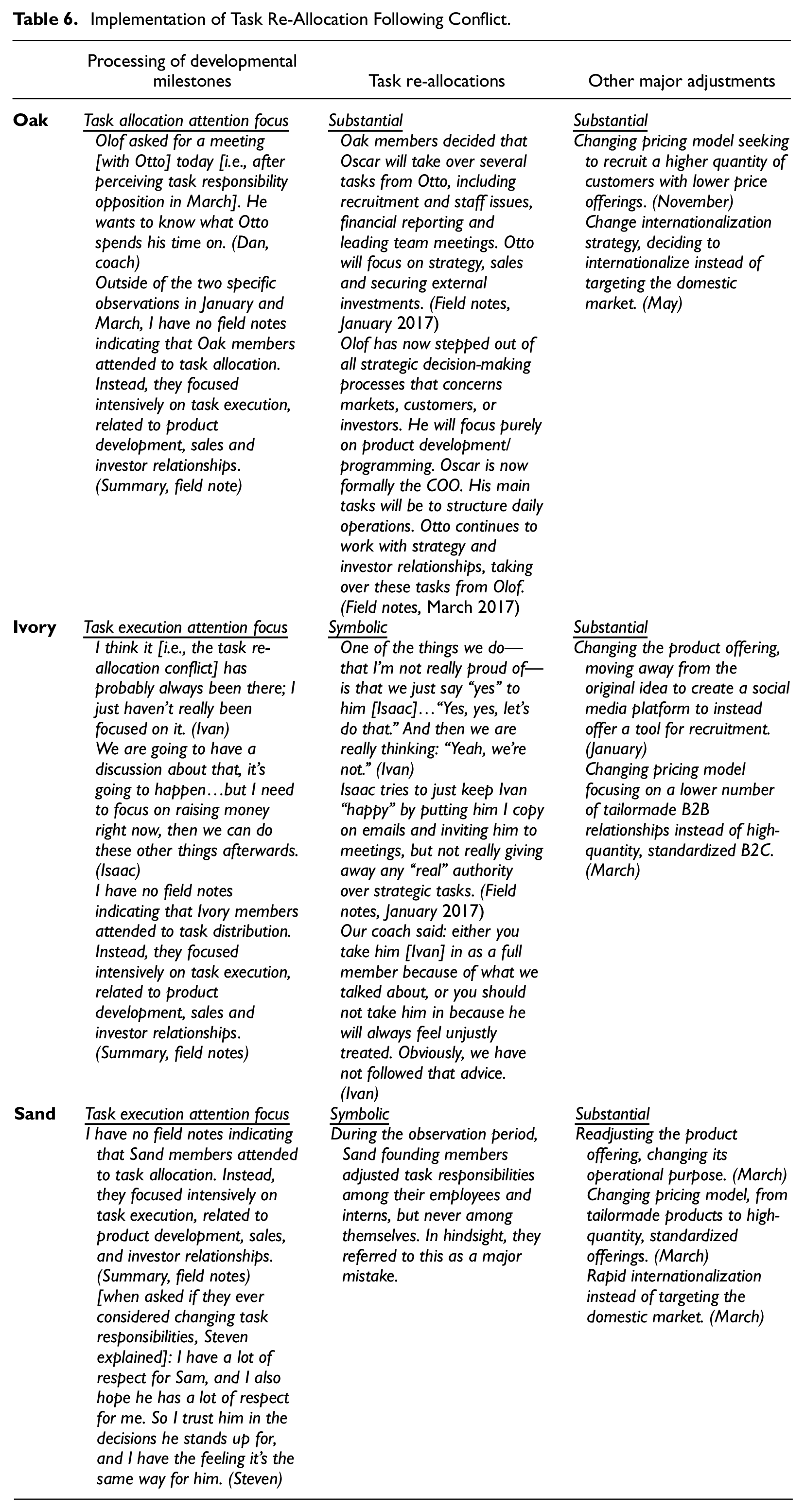
Table 6 provides an overview of observations in relation to the consequences of task re-allocation conflict, detailing observations of how team members processed developmental milestones and the task re-allocations they engaged in. As a point of comparison, Table 6 also summarizes observations about other major adjustments the teams implemented in relation to their ventures.
Implementation of Task Re-Allocation Following Conflict.
Attention and Processing of Developmental Milestones in the New Venture Team
In Oak, after each outburst of intense expressions and negative affect, task re-allocation became a shared focus of attention among team members. This was clear in interviews during conflict episodes: a connection between anger, expressions, and task re-allocation needs was brought up by all informants, and they kept coming back to it, even when I tried to steer the conversation in other directions. As a point of comparison, task re-allocation was hardly brought up at all during other periods, unless I explicitly asked about it. Shared attention to task re-allocation was also evident in observations. After each outburst of task re-allocation conflict, Oak members organized meetings with the specific purpose of discussing task re-allocation issues. Notably, the only time Oak members held such meetings was in association with intense eruptions of task re-allocation conflict. Reflecting on this, members described the focus on task re-allocation as inevitable—in the state of anger and yelling, it was impossible for them to focus on anything else. For example, Otto described how, when his teammates first hesitated to discuss task re-allocations, he demanded their attention through yelling and swearing, resulting in a meeting held only 2 days after:
I invited everyone to a meeting, saying, ‘Can everybody come on Friday… We need to talk about this.’… They were like, ‘No, we can’t meet until Thursday [the week after].’ I said, ‘What the fuck!? This isn’t important to you?’ (Otto)
Ivory and Sand members, on the other hand, did not focus their shared attention on task re-allocation. In Ivory, this means that even though the oppositions were present, well known to everyone on the team, and provoked anger and animosity between team members, they nevertheless went on for several months without really focusing their collective attention on the core of this opposition—task re-allocation (who does what). Instead, they focused on task execution (what to do), something they perceived to be more urgent. For example, they had meetings about their product-market fit, go-to-market strategy, first customer, business model, investor strategy, etc. Still, they avoided the more sensitive issue of who was responsible for what. Explaining this, Ivory members emphasized that they regarded task re-allocation to be less urgent than task execution. Fearing that engaging in open conflict would take up too much of their energy, they regulated their emotions, tempered their expressions, and acknowledged that this allowed them to: “just focus on other stuff [than the conflict]” (Ivan). Isaac, for example, said:
We were very close to saying, okay, we are going to find someone else [to do Ivan’s job], but ultimately, we decided that there were just too many things flying around right now that we wanted to spend more energy on. (Isaac)
In Sand, members similarly ignored task re-allocations while focusing on task execution. In the meetings that I observed, Sam and Steven spent much time discussing and debating core aspects of their business: their go-to-market strategy, product offering, customer profile, marketing, and so forth. Not once, however, did I observe them focus their attention on the re-allocation of tasks between them. Reflecting on this, Steven said it was not necessary: “I trust him [Sam] in the decisions he stands up for, and I have the feeling it’s the same way for him” (Steven). In the follow-up interview, after the venture had been terminated, they acknowledged this as a significant problem. According to Sam, tempered negative affect expectations had created a “flow of false positives” that hindered them from expressing task re-allocation needs:
Our friendship meant that we weren’t professional… I trusted Steven as a friend… but that just gave a flow of false positives. (Sam)
Implementation of Task Re-Allocation
Of the three teams, only Oak managed to implement substantial task re-allocations during the observation period. Following the focus on task re-allocation, Oak members decided to take strategic task responsibilities (aspects of leadership, organization, and budgeting) out of the hands of Otto and instead assign them to Oscar, who had joined the team in September the year before. In addition, Olof, the CTO, agreed to step out of strategic decision-making processes related to investor relationships and strategic forecasting, leaving those in the hands of Otto. These issues had initially been a source of anger between Oak members, whereby Otto had felt “hurt” by being questioned in his leadership capacity. However, after the unfolding of conflict and implementation of task re-allocations, all team members saw the changes as an improvement, they considered the conflict solved, and they no longer felt the tension, animosity, or annoyance with each other. Olof, for instance, said:
I can [sometimes] feel that he doesn’t contribute as much as I do … but if I really think about it, he does a lot of things—he really does. I just take it for granted because he doesn’t bother me with it. (Olof)
In the other two teams, task re-allocations were implemented too, but they were symbolic, meaning they had little practical impact on the operations of the new venture. For example, Isaac started to copy Ivan in on emails and invite him to meetings to give the impression that Ivan was involved in strategic decision-making. At the same time, he admitted that he did not truly take Ivan’s opinion into account. Ivan similarly started to agree to suggestions Isaac made regarding the content of tasks. However, he never followed through on those suggestions but emphasized: “we just say yes to him.” In Sand, task re-allocations were also symbolic. Team members shifted around some responsibilities, such as assigning Sam specific responsibilities of initiating conversations with investors and Steven to oversee product development, but nothing that had a substantial impact on the operations of the venture.
As a result of these symbolic task re-allocations, Ivory members described task re-allocation conflict as a latent issue that continued to be unresolved. For example, they referred to task re-allocation conflicts as something that had created animosity between them “for the last couple of months” (Isaac) and something taking up “much energy” (Ivan). In March, Isaac laconically concluded: “I think it’s like it continues, unfortunately.” This triggered a negative spiral in Ivory. Members continued to regulate their emotions, focusing on getting stuff done but failing to make substantial re-allocations in the distribution of task responsibilities. In the follow-up interviews, this was identified as a significant mistake. At this point, Adam—their investor—had bought up the intellectual property rights of Ivory, fired the team, and put an entirely new team in its place. According to Adam, there was nothing wrong with the product or team members per se. However, their inability to effectively organize the division of tasks and handle conflict had stalled them, hindering them from performing effectively together. He concluded:
You should be in the meetings we have now [i.e., with the new team]… Oh man, we’ve had some really, really rough discussions. (Adam)
A Model of How New Venture Teams Navigate Task Re-Allocation Through Conflict
Figure 2 integrates the inductive findings into an abstract model of how new venture teams can navigate task re-allocation through conflict.
Emergence of Task Re-Allocation Conflict
Observations suggest that task re-allocation can trigger conflict between members of the new venture team. Moreover, because such conflicts are tied to feelings of justice, influence, and power, they can provoke anger and animosity among team members, who often have made substantial emotional investments into their venture and the tasks they are engaged in (Breugst & Shepherd, 2017; Cardon et al., 2009).
Unfolding of Task Re-Allocation Conflict
When members of a new venture team encounter opposition and negative affect, they somehow need to process this. The model in Figure 2 illustrates two alternative paths through which such processing can occur. The first relies on acting out of negative affect and intensively expressing opposition. The second on regulating negative affect and tempering conflict expressions. Which path a team takes is anchored in the team’s negative affect expectations: shared expectations regarding the intensity of expressions and the unfolding of negative affect in the context of the new venture team. I position negative affect expectation as a team-level construct, grounded in the affective experiences new venture team members make in their everyday conversations. I propose that teams who have developed flaring negative affect expectations are more likely to act out task re-allocation conflict, whereas teams that have developed lingering negative affect expectations are more likely to temper it.
Implementation of Task Re-Allocation Following Conflict
Finally, the model illustrates two alternative attention foci by which new venture team members process developmental milestones they encounter. The first—observed in the team that acted out conflict—implies a shared attention focus on the core of the conflict—task re-allocation—leading to the collective processing of task re-allocation issues and, ultimately, substantial task re-allocations being implemented. The second—observed in the two teams that tempered conflict—implies attention to task execution instead of task re-allocation. Ultimately, such bracketing out of task re-allocation issues resulted in symbolic re-allocations being made. In all, these findings show that acting out task re-allocation conflicts can be an important trigger of collective attention to task allocation issues.
Alternative Explanations
To challenge my model, I considered alternative explanations. In team conflict research, scholars have linked constructive solving of conflict to positive team emergent states, in particular psychological safety (Bradley et al., 2012), trust, and cohesion (Ensley et al., 2002). 7 These states, however, cannot explain the observed differences across the three cases. Both Oak and Sand were teams characterized by high trust and psychological safety. On both teams, members enjoyed personal friendships (Sam and Steven had been friends since high school; Oscar and Otto sometimes went on vacation together and used to share the same apartment). They often spoke about their trust in each other and described their teams as a safe context in which they could take personal risks. Oscar, for instance, described Oak as: “Our [team] is more relationship-based, based on emotions … we are all friends, like good friends … we all sit at the same table. So, it is pretty family-like” (Oscar). Despite these similarities, however, the two teams differed in the emergence, unfolding, and consequences of task re-allocation conflict. Thus, neither trust nor psychological safety can explain observed differences. The same can be said about cohesion. All three teams faced strong cohesion yet differed in their behavior. In Ivory, for example, members were highly motivated to perform well and they efficiently coordinated their different activities. Members worked long hours and invested time and personal wealth into their ventures. The problem in this team was not a lack of cohesion, but that they got trapped in a negative spiral of regulated emotions, tempered expressions, and unresolved task re-allocation conflict.
I also considered if the teams’ different affective climates could explain observations instead of their negative affect expectations, a concept inductively developed from data. The two concepts, however, describe different aspects of shared affect in a team. Affective climate captures shared affective experiences within a group (Gamero et al., 2008, p. 49). In prior research, the affective climate has been considered an outcome of team conflict. For example, Gamero et al. (2008) examined how conflict shapes the affective climate of a team, showing that relationship conflict leads to shared negative affect among team members. Negative affect expectations capture shared expectations in a group. As such, it is future oriented, capturing team members’ expectations about affect rather than what they experience at a specific point in time. As depicted in Figure 2, this makes negative affect expectations an input to the unfolding of task re-allocation conflict rather than being an outcome of it.
In research on personality, scholars have suggested that individuals who score low on altruism and compliance are seen as more conflict prone (Costa & MacCrae, 1992). In my cases, however, personality composition would not fully explain the differences across cases since both Ivory and Oak had members who scored below average on altruism and compliance (see Table 1). Because teams with a history of conflict are more likely to experience future conflict (Greer et al., 2008), I also asked all informants to recall any prior conflicts. Whereas Sand members could not recall any major conflicts, both Oak and Ivory had previous experience of task re-allocation conflicts. Olof, for instance, reflected that “we have had that conflict for a long time.” This suggests that it was not the presence of prior conflicts, but instead how those previous conflicts had been enacted, that explained differences in outcomes.
Implications
My analysis comes with important implications for two bodies of research, which have previously not been considered in tandem: (1) research on task (re-) allocation, professionalization, and structural imprinting in new ventures, and (2) research on team conflict.
Research on Task (re-) Allocation, Professionalization, and Structural Imprinting in New Ventures
Reframing Task Re-Allocation as a Conflict-Laden Process
It remains well established that many new venture teams struggle with changing the initial configuration of task responsibilities (Beckman & Burton, 2008; DeSantola et al., 2022; Hannan & Freeman, 1984; Stinchcombe, 1963). Yet, because prior research has focused on the initial task allocation (e.g., Clarysse & Moray, 2004; Jung et al., 2017; Katila et al., 2017), or task re-allocation through founder replacement (e.g., Boeker & Wiltbank, 2005; Grillitsch & Schubert, 2021; Hendricks et al., 2019), we still know little about what might contribute to these struggles. A core insight from this study is that task re-allocation in stable new venture teams is difficult because of its potential association with task re-allocation conflict, a specific form of process conflict that involves affect-laden opposition about how task accomplishment should happen, who should be responsible for what, and how things should be delegated. Process conflict has not received much attention in prior research on new venture teams (Knight et al., 2020). My observations of task re-allocation conflicts, however, aligns with those made on process conflict more broadly, suggesting that this is a particularly difficult and disruptive form of conflict (De Wit et al., 2012), which is tied to issues of status, equity, and power (Greer et al., 2011), and often triggers anger and animosity between members of a team (Greer & Jehn, 2007; Jehn, 1997).
Of particular relevance to our understanding of task re-allocation, the analysis points to (1) negative affect and (2) attention as two critical mechanisms associated with task re-allocation conflicts and which therefore also shape task re-allocation processes in stable new venture teams. Specifically, my analysis demonstrates that negative affect between team members easily emerges in association with task re-allocation processes, that negative affect shapes the attention focus of team members, and therefore also the extent to which they are able to make substantial task re-allocations instead of symbolic ones.
Even so, both affect and attention remains overlooked in prior research on task allocation and task re-allocation. The implicit assumption being that task re-allocation will be attended to by external investors who perceive a need for founder replacements as the new venture grows or meets developmental milestones (DeSantola & Gulati, 2017; DeSantola et al., 2022). My analysis, however, reveals that this assumption might not be valid in self-managed new venture teams. This is because, in the development phase of a new venture, attention is a scarce resource. Not only task re-allocation (who does what) but also task execution (what to do) compete for the attention of new venture team members (Patzelt et al., 2021). As my observations show, it can be tempting for new venture team members in this busy phase to focus their attention solely on task execution, such as selling, maintaining customer relationships, or developing their product—while more or less deliberately ignoring the issue of task re-allocation. First and foremost, this is because task execution is urgent: being short of time and money, it is tempting to focus on issues with an immediate effect on profit and loss. Second, more subtly, my findings reveal that new venture teams can be hesitant to bring up task re-allocation issues as they fear that it will unleash negative affect between team members. Fearing that such negative affect will overwhelm the team and disrupt the team and their work, there is a risk that team members bracket it out, thinking that this is an issue that is less urgent or can be solved later. As also demonstrated, however, not attending to task re-allocation is most likely a mistake as it risks the team making only symbolic task re-allocations instead of substantial ones.
Broader Implications for Research on New Venture Professionalization and Structural Imprinting
At a broader level, these insights offer a starting point for further exploring how conflict, affect, and attention, manifested at the level of the new venture team, shape formal structures, manifested at the level of the new venture. As Patzelt et al. (2021, pp. 1119–1120) note, such insights are needed because “prior studies have often omitted … teams’ dynamic developments during different phases of venture development. Such an omission can result in a sorely incomplete theoretical understanding of entrepreneurial teams, their members, and their impact on venture development.” This study answers their call.
For example, research on new venture professionalization describes a modal process, where new ventures gradually develop task structures that mimic those of established organizations as the venture grows (Fisher et al., 2016; Phelps et al., 2007; Sine et al., 2006) or attains developmental milestones (DeSantola & Gulati, 2017; Hellmann & Puri, 2002; Wasserman, 2003). Reframing task re-allocation as a conflict-laden process implies that we can expect a more heterogenous and complex pattern. As demonstrated here, professionalization is not only triggered by external and “objective” factors such as growth or milestones. It is also intertwined with team-specific, subjective mechanisms, such as team members’ perceptions of what is fair and just or their internal competition for power and influence. As a result of these team-specific, subjective mechanisms, we can likely expect that the speed and nature by which new venture teams professionalize into new organizations will differ widely across ventures, instead of following a modal pattern. In all, this points to a promising avenue for future research to further explore linkages between team processes and new venture development, unraveling a more heterogenous pattern of venture professionalization than implied by the extant theory.
Relatedly, my analysis opens the way for novel insights into imprinting in new ventures. In prior research, imprinting is understood as a phenomenon that originates in initial structural configurations, meaning that new ventures at their foundation develop characteristics appropriate to their environment and purpose, and these characteristics persist even as initial conditions change (Beckman & Burton, 2008; DeSantola et al., 2022; Hannan & Freeman, 1984; Stinchcombe, 1963). For example, DeSantola et al. (2022) demonstrated that the market conditions facing a new venture at its inception have long-term implications for how functional roles develop over time, whereas Beckman and Burton (2008) demonstrated how the initial configuration of task structures tend to persist in new ventures, even as they reach the IPO phase.
This study goes beyond. It demonstrates how imprinting of task allocation structures also emerges from the expectations, habits, and taken-for-granted assumptions that team members form when they interact with each other throughout the life cycle of their new venture team—not only from the structural configurations they make at the time of venture inception. In particular, my analysis points to the role of negative affect expectations—a concept derived from data—as something that team members develop over time, while working together in the context of their team, and which can have a substantial implication for the team’s capacity to make task re-allocations during its development phase. A central insight is that without understanding the expectations new venture team members form as they work together (in addition to their initial configurations at the time of inception), we cannot understand their capacity for change and adaptation over time.
This is important, since it is not only task re-allocation structures that are notoriously difficult for new ventures to change, but also other configurations, such as partnerships or resourcing (Schoonhoven et al., 1990). Future research might therefore build on my insights into how a new venture forms negative affect expectations during seemingly mundane, everyday conversations and how such affect expectations feed into critical entrepreneurial processes. For example, how affect expectations—positive or negative—feed into other entrepreneurial processes, such as opportunity development or idea pivoting. Similarly, future research could turn to affect expectations to further understand critical aspects of new venture organization, such as work processes or entry and exit of founders and employees.
Implications for Research on New Venture Team Conflict
A Novel Perspective on Negative Affect in Conflict Situations
My model of task re-allocation conflict in new venture teams also expands our understanding of negative affect in team conflict situations. Predominantly, prior research assumes that intense expression and acting out of negative affect in conflict situations will trigger a dysfunctional spiral of escalating conflict, ultimately hampering a team’s ability to reach constructive outcomes. For example, Greer and Dannals (2017, p. 333) conclude: “when conflicts … can be discussed without engaging personal feelings, and thus remaining less emotional, conflicts are more likely to benefit team outcomes… Relatedly, conflicts that are inherently personal and emotional in nature … will always harm team outcomes.” This assumption prevails also in the context of new venture teams, where scholars have demonstrated how animosity and annoyance in association with conflict increase the likelihood of negative collaborative spirals (Boone et al., 2020; Breugst et al., 2015; Breugst & Shepherd, 2017), undermine venture performance (Ensley & Hmieleski, 2005), and lead to team member exit (Vanaelst et al., 2006). The advice is that disputants should try to act in a way that prevents intense negative affect (e.g., De Dreu & Van Vianen, 2001; Greer & Dannals, 2017; Jehn et al., 2013), such as through affect regulation (e.g., Jiang et al., 2013; Thiel et al., 2019; Yang & Mossholder, 2004) or tempered expression of oppositions (Weingart et al., 2015).
My observations point to an alternative path. I advance the idea that negative affect expectations can enable members of a team to act out negative affect, without being overwhelmed by it. A core implication is that conflicts can be productive even if they trigger tension, animosity, and annoyance—in so far as a team has developed negative affect expectations that enable it not to let negativity linger. Conversely, tempered expressions and regulation of negative affect can lead to a prolonged state of conflict that undermines collaboration. For future conflict research, within and outside of the new venture team context, this analysis opens up a different way of theorizing the role of expression and affect in conflict situations. Instead of thinking of expressions as needing to be tempered and negative affect as something that ought to be regulated, future research could investigate how teams can build negative affect expectations that enable them to “fight forward” to achieve collective action, instead of “giving in” and letting suppressed opposition linger among team members.
How Negative Affect Expectations Interact with Cognitive States for Conflict Resolution
The analysis of negative affect expectations also extends our understanding of positive emergent states, such as trust, psychological safety, or cohesion for the constructive solving of conflict. Trust, psychological safety, and cohesion are cognitive emergent states that operate through shared cognitions or shared thoughts about cognitions. Negative affect expectations, in contrast, describe a condition that operates through shared thoughts about feelings. Based on past affective experiences in the context of the new venture team, negative affect expectations are future-oriented, focusing on team members’ expectations about their future affective states.
In prior research, trust, cohesion, and psychological safety have been identified as helpful for attenuating dysfunctional conflict escalation (e.g., Boone et al., 2020; Bradley et al., 2012; Ensley et al., 2002). This study goes beyond that. It illustrates that such positive emergent states might prevent task re-allocation conflict from emerging in the first place. While this might lead to a pleasant collaborative climate, where members interact without much friction, it can also prevent them from tackling an inherently difficult issue, in this case a pressing need for task re-allocation. Moving forward, my analysis thus points to the possibility that positive emergent states are most beneficial when they are combined with flaring negativity expectations. By highlighting this interdependency between cognitive emergent states and affect expectations, the analysis paves the way for a new research avenue on the complex interplay between affect and cognition in conflict situations, a theme that continues to spur interest among team conflict scholars within (Breugst & Shepherd, 2017; Knight et al., 2020) and outside (Shah et al., 2021) the entrepreneurial context.
Practical Implications
For the many founders who stay with their team instead of being replaced by professional managers, understanding how to navigate task re-allocation is a topic of importance. The analysis shows that task re-allocation is an issue that is easily overlooked by the team. Instead of focusing on the long-term issue of “who does what,” team members get occupied by the more immediate concern of “what to do.” Findings presented here imply, however, that new venture teams must find ways to collectively process task re-allocation—even if this can mean getting involved in a heated conflict that triggers animosity in the team. Yet, for a new venture team in the development phase, engaging in such conflicts might be a lesser evil than tempering them or ignoring them altogether. Notably, the study also offers some practical suggestions on how navigating task re-allocation conflicts can be done. In particular, it illuminates that building expectations of negative affect as short-lived can be crucial. Such expectations are not created in a heated moment of conflict. Instead, the findings presented here highlight the relevance of everyday conversation in a new venture team, suggesting that the tone of seemingly mundane conversations shapes expectations about affect. In all, this implies that negative affect constitutes an important aspect of the entrepreneurial process, encouraging new venture teams to think of their feelings as an essential aspect of how they work together.
Limitations
The analysis presented here is based on rich, longitudinal data from three specific cases. Whereas such a sample is suitable for theory building, it remains for future research to extend and test the findings in other contexts or types of teams (see, for example, Scheidgen & Brattström, 2023). For future research, it will also be important to consider whether new venture teams can implement task re-allocations without engaging in conflict at all. Of course, this is a possibility that I do not rule out. I conclude, however, that in this particular sample task re-allocations were never discussed or implemented without involving conflict that triggered tension, animosity, and annoyance. It is also noteworthy that all three teams made substantial adjustments in other elements related to their venture (see Table 6) without engaging in conflict. These observations suggest that the link between task re-allocation and conflict is relevant enough to warrant empirical investigation, and I hope the model developed here can stimulate additional research into how new venture teams implement task re-allocations during their venture’s development phase without replacing core team members.
It also needs to be emphasized that engaging in intense expressions and acting out negative affect can have dysfunctional consequences (Brattström, 2022; Brattström & Wennberg, 2022). It is even possible that this type of behavior can become toxic and escalate into outright harassment. Even though this was not evident in my data, I strongly encourage future research to develop these findings further. New venture development presents a complex process: behavior that can have positive implications for specific outcomes (in this case, task re-allocation) can have dysfunctional impacts in other dimensions (e.g., team member satisfaction or mental health) (Brattström & Wennberg, 2022; Shepherd et al., 2019). Exploring such alternative outcomes would be an important avenue for future research.
Findings from this study indicate that negative affect expectations emerge from the tone of everyday conversations in new venture teams. However, since I could not follow the teams from the start, my data do not offer in-depth insights into how these expectations emerged. I therefore hope that the analysis will stimulate additional research into how seemingly mundane, everyday interactions help to shape negative affect expectations, detailing novel links between how members think, feel, and act in a new venture team and the implications for their expectations about how they can work together in the future. New venture teams do not only imagine and develop novel business opportunities, but also imagine and develop novel organizations. How new organizations emerge from social interactions in new venture teams continues to be a fascinating topic, to which this study contributes.
Conclusions
This study contributes a novel perspective on how new venture teams navigate the task re-allocation process during the development phase of their new venture. It highlights the relevance of task re-allocation conflict, illuminating that task re-allocation can be a sensitive issue that strains relationships between team members. Moreover, it contributes a novel understanding of how negative affect expectations shape the unfolding of task re-allocation conflict and how they can enable new venture teams to make substantial task re-allocations instead of symbolic ones. The broader implication of this analysis is an understanding of new venture creation as a process. It does not only unfold as a consequence of team members’ prior relationships (Ruef et al., 2003), the team’s compositional characteristics (Jin et al., 2017), or the decisions made in the venture’s inception phase (Ferguson et al., 2016). In addition, it requires an in-depth understanding of the experiences and expectations that team members develop as they work together. I hope that the rich, qualitative evidence presented will stimulate research on the complexities and nuances of teamwork in this intricate phase, where new venture teams move from inception to new venture development.
Supplemental Material
sj-docx-1-etp-10.1177_10422587231154505 – Supplemental material for Task Re-allocation in New Venture Teams: A Team Conflict Perspective
Supplemental material, sj-docx-1-etp-10.1177_10422587231154505 for Task Re-allocation in New Venture Teams: A Team Conflict Perspective by Anna Brattström in Entrepreneurship Theory and Practice
Footnotes
Declaration of Conflicting Interests
The author(s) declared no potential conflicts of interest with respect to the research, authorship, and/or publication of this article.
Funding
The author(s) disclosed receipt of the following financial support for the research, authorship, and/or publication of this article: The author gratefully acknowledges funding from the Ragnar Foundation and from Riksbankens Jubileumsfond, P22-0651.

Supplemental Material
Supplemental material for this article is available online.
Notes
Author Biography
Anna Brattström is a Senior Lecturer at Lund University, Sweden. Her research centers on innovation, entrepreneurship, and social dynamics: how people come together and work together to pursue new business opportunities or create new organizations and the influence of social context in such processes.
References
Supplementary Material
Please find the following supplemental material available below.
For Open Access articles published under a Creative Commons License, all supplemental material carries the same license as the article it is associated with.
For non-Open Access articles published, all supplemental material carries a non-exclusive license, and permission requests for re-use of supplemental material or any part of supplemental material shall be sent directly to the copyright owner as specified in the copyright notice associated with the article.
