



Abstract
Drawing on emotion regulation theory, this study investigates if and how emotion suppression informs relationship viability within new venture teams (NVTs) when such teams face obstacles. In particular, we use a dyadic approach to examine the suppressor’s authenticity and team members’ perceptions of appropriateness as mediators in the link between emotion suppression and relationship viability. A round-robin study with 93 respondents nested in 37 NVTs, which generated 167 observations, provides empirical support for the theoretically derived model by showing that both authenticity and appropriateness fully mediate the relationship between emotion suppression and relationship viability. In particular, the findings show that the negative indirect effect of emotion suppression on relationship viability via authenticity is larger than the positive indirect effect via appropriateness. A follow-up study after two years indicates that relationship viability and emotion suppression significantly predict venture survival. Together, these findings make ample contributions to the literature and provide interesting opportunities for further research.
Keywords
Introduction
Approximately 80% of new ventures are created by teams rather than solo entrepreneurs (Aldrich et al., 2004; Lechler, 2001; Ruef, 2010). Viable interpersonal relationships between members of new venture teams (NVTs) are essential, yet not easy, as the frequency of team members’ dissatisfaction, turnover, and dissolution within five years of launching a venture demonstrates (Timmons, 1979; Ucbasaran et al., 2003). For interpersonal relationships within NVTs to be viable, team members must be satisfied and willing to continue working with each other (Hackman, 1987). Thus, relationship viability reflects both an affective component (Barrick et al., 1998) and a cognitive temporal inference about the relationship’s future (Bell and Marentette, 2011; Marks et al., 2001; Mohammed and Nadkarni, 2014). Maintaining relationship viability is particularly difficult during the first years of new venture creation. Team members typically face intensive negative experiences induced by unexpected obstacles, conflicting goals, and unattainable aspirations (Morris et al., 2012). Jointly undergoing such experiences warrants the use of emotion suppression as a regulatory response by individuals (English et al., 2017; Szczygieł and Baryła, 2019), but if and how emotion suppression influences the viability of interpersonal relationships remains unknown. Therefore, this study examines how emotion suppression (Butler et al., 2007; Gross and John, 2003) affects the viability of interpersonal relationships within NVTs (Forbes et al., 2006; Lim et al., 2013). Understanding this effect is important because having viable interpersonal relationships has far-reaching implications for venture success (Alvarez et al., 2007; Powell and Baker, 2017) and for entrepreneurs’ health and well-being (Stephan, 2018).
Within the growing body of entrepreneurial team literature (for reviews and research agendas on entrepreneurial teams, see Bolzani et al., 2019; de Mol et al., 2015; Klotz et al., 2014; Knight et al., 2020; Lazar et al., 2020; Patzelt et al., 2020), research on NVTs is limited to studying aggregate team-level characteristics like the demographic composition of team members (e.g., Amason et al., 2006; Jin et al., 2017) or individual-level characteristics like leadership (de Jong et al., 2013; Hmieleski and Ensley, 2007). By contrast, little attention has been directed to dyadic-level interpersonal relationships (Eftekhari and Timmermans, 2021). Evidence suggests that positive pre-existing relationships between individuals (e.g., friendship, prior working relationships, or family ties) are essential antecedents of NVT formation (Beckman, 2006; Ruef, 2010). However, this literature does not reveal how the venture creation experience itself influences interpersonal relationships among team members (Patzelt et al., 2020). Experiencing adverse events in the new venture creation process (Morris et al., 2012) can compromise interpersonal relationships (Boone et al., 2020; Khan et al., 2015) and potentially harm new venture survival (Shepherd et al., 2000).
Recently, scholars have begun to consider how individuals can regulate their responses to such negative experiences to achieve positive outcomes (Griffin and Grote, 2020). When facing obstacles and disruptions that threaten the survival of a new venture, NVT members can become dissatisfied, fall out and disperse, or they can regulate their responses to form even stronger and more lasting bonds (Patzelt et al., 2020). Drawing on emotion regulation theory (Gross, 1998, 2002), we focus on emotion suppression as a commonly applied strategy for regulating emotional responses in negative experiences (Butler et al., 2007; Gross and John, 2003). Emotion suppression allows team members to appear calm, cool, and collected on the outside, while experiencing emotional activation on the inside (Richards and Gross, 1999). As such, suppression serves a social communication function (Butler and Gross, 2009; English et al., 2017) and may be a suitable strategy to maintain viable interpersonal relationships within the NVT. However, individual judgments regarding relationship viability in NVTs with more than two members may vary substantially. This variation originates from the complexity and ambiguity of tasks and roles (Blatt, 2009) as well as the experience of interpersonal uncertainty (Federl and Breugst, 2019). It is therefore important to study the implications of emotion suppression for relationship viability in dyads even if the NVT consists of more than two members.
Grounded in emotion regulation theory, this study proposes that the association between emotion suppression and relationship viability is mediated by two factors. On the one hand, the suppressing individuals may feel less authentic because they feel a sense of detachment between their true emotional experience and the self they present to other team members (Gross and John, 2003). Such intrapersonal authenticity may therefore be one factor through which emotion suppression exerts a negative influence on relationship viability (Impett et al., 2014; Wang and Groth, 2014). On the other hand, when a new venture goes through difficult times, other NVT members may perceive suppression as an appropriate emotion regulation strategy (Kalokerinos et al., 2017) because it allows individual team members to focus on overcoming pressing obstacles (De Cock et al., 2019). Team members’ perceptions of appropriateness may therefore be another factor through which emotion suppression exerts a positive influence on relationship viability (Tackman and Srivastava, 2016; Wang and Groth, 2014).
To test the importance of authenticity and appropriateness as mediators in the association between emotion suppression and relationship viability, we conduct a round-robin field survey with 93 respondents nested in 37 NVTs, generating 167 individual observations of each dyadic relationship within NVTs. Through a generalized structural equation model (GSEM), we estimate whether and how the link between emotion suppression and relationship viability is mediated by authenticity, as reported by the suppressing individual, and others’ perceptions of appropriateness, as reported by each team member. Our findings reveal a negative indirect effect of emotion suppression on relationship viability through a decrease in authenticity. At the same time, we find a positive indirect effect of emotion suppression on relationship viability through an increase in appropriateness. These two opposing indirect effects cancel each other out, resulting in a negligible total effect of emotion suppression on relationship viability. However, the results also show that the negative indirect effect via authenticity is larger than the positive indirect effect via appropriateness. A follow-up study after two years among 35 of these NVTs indicates that both relationship viability and emotion suppression significantly predict venture survival.
Together, our findings contribute to research on interpersonal relationships within NVTs, emotions in entrepreneurship, and emotion regulation. First, our study contributes to the entrepreneurial team literature by shedding new light on the antecedents of viable interpersonal relationships within NVTs (Kamm et al., 1990) that survive despite experiences of obstacles and threats during the early stages of new venture creation (Patzelt et al., 2020). Second, we extend emotion research in entrepreneurship (Baron, 2008) by disentangling intrapersonal experiences (e.g., Engel et al., 2021; Fang He et al., 2018) and social perceptions (e.g., Breugst and Shepherd, 2017; Goss, 2005) associated with emotional responses (Gross and John, 2003). Furthermore, we corroborate previous findings that emotion suppression positively influences venture survival (De Cock et al., 2019). Third, our study contributes to emotion regulation theory by providing empirical evidence for an emergent trend that emphasizes the importance of capturing emotion regulation in the context in which emotions are experienced and regulated (Colombo et al., 2020). In addition, by simultaneously testing the mediating effects of authenticity and appropriateness of suppression, we are among the first to show that intrapersonal implications of suppression exert a stronger mediating effect than social perceptions of suppression.
Theoretical Background
Relationship Viability in NVTs
An NVT is a “group of individuals that is chiefly responsible for the strategic decision making and ongoing operations of a new venture” (Klotz et al., 2014, p. 227). The viability of each dyadic interpersonal relationship within NVTs can be defined as the satisfaction, participation, and willingness of those in the relationship to continue working with each other (Hackman, 1987). As an interpersonal phenomenon, relationship viability is truly captured in the dyad, which is “the fundamental unit of interpersonal interaction and interpersonal relations” (Kenny et al., 2006, p. 1) and the building block of teams (Joshi and Knight, 2015). Relationship viability is an affect-laden construct (Barrick et al., 1998) that is based on cognitive temporal inferences with regard to the continuation of a working relationship (Bell and Marentette, 2011; Marks et al., 2001; Mohammed and Nadkarni, 2014). It is well established that the interpersonal relationships among NVT members contribute to the success or failure of a new venture (Knight et al., 2020), and having viable relationships with their team members is also important for individual entrepreneurs. With the increase in serial and portfolio entrepreneurs (Sarasvathy et al., 2013; Westhead et al., 2005), viable relationships among entrepreneurs in an NVT could provide more sources of inspiration (Souitaris et al., 2007) and increase the likelihood that entrepreneurs create multiple ventures together (Eftekhari and Timmermans, 2021). Moreover, whereas a team exists until the new venture becomes a mature business or fails (Patzelt et al., 2020), separate dyadic relationships developed within the team can remain active even after the team disbands (Eftekhari and Timmermans, 2021; Maloney et al., 2019).
Although relationship viability is expected to have a positive effect on ventures and entrepreneurs, past research suggests that dissatisfaction, conflict and a diminished willingness to continue working together prevail in early-stage new venture creation (Breugst and Shepherd, 2017; Foo, 2011a) and drive team members to leave the venture (Klotz et al., 2014; Vanaelst et al., 2006). Several conditions of the new venture creation process pose challenges for NVT members attempting to build satisfying and lasting relationships with their team members (Blatt, 2009). First, early-stage new venture creation is characterized by novelty and uncertainty (Amason et al., 2006), including interpersonal uncertainty (Federl and Breugst, 2019), which, in combination with a lack of established organizational rules, values, and norms (Ko et al., 2021; Zimmerman and Zeitz, 2002), suggests that NVTs have little structured guidance about what constitutes appropriate teamwork behavior (Gartner et al., 2020). Second, NVT members often have pre-existing relationships established in an entirely different context, for example, family members (Brannon et al., 2013; Ko et al., 2021), romantic partners (Dahl et al., 2016), or friends (Francis and Sandberg, 2000; Vissa and Chacar, 2009). The quality of these pre-existing relationships is an essential driver of team formation and explains why people select each other to initiate new venture creation (Forbes et al., 2006; Francis and Sandberg, 2000). However, individuals may behave differently in different contexts, which may create damaging discrepancies between individuals’ behavior and others’ perceptions of their behavior once the new venture gets rolling (Berscheid and Ammazzalorso, 2001). Third, the emotional rollercoaster experienced through the ups and downs of new venture creation (De Cock et al., 2019) can quickly escalate into several negative affective outcomes that may deteriorate interpersonal relationship viability, ranging from stress and low well-being for individuals (Wach et al., 2020) to conflicts and hostility between members of the NVT (Breugst and Shepherd, 2017).
The viability of interpersonal relationships within a team depends on many factors, such as individuals’ communication styles (Foo et al., 2006), equity distribution (Breugst et al., 2015; Dibbern et al., 2018), interpersonal conflict (Schoss et al., 2020), and friendship (Francis and Sandberg, 2000). Previous research has shown that emotionally intense events and associated affective mechanisms are particularly influential building blocks of individuals’ satisfaction with their working relationships and their intentions to continue these relationships (Costa et al., 2015). The new venture creation process is riddled with emotionally intense events ranging from daily problems to major obstacles threatening the success of the venture (Engel et al., 2021; Funken et al., 2020; Kollmann et al., 2017), such as difficulties with sales, quality problems with products, and pressure from stakeholders (Morris et al., 2012). These events give rise to affective experiences and responses that accumulate over time and impact interpersonal relations in the long term (Weiss and Cropanzano, 1996). As affective responses are the critical link between obstacles during new venture creation and subsequent interpersonal outcomes (Weiss and Cropanzano, 1996), response-focused emotion regulation is likely to impact NVT members’ satisfaction with their working relationships and thus their desire to continue working together (Beal et al., 2006).
Suppression as Emotion Regulation Strategy
Emotion regulation refers to how people deal with their emotional experiences and responses (Gross, 1998). Literature on the use of emotion regulation in entrepreneurship is scarce and generally focuses on juxtaposing two of the most well-established and researched strategies of emotion regulation: the antecedent-focused strategy of reappraisal and the response-focused strategy of suppression (De Cock et al., 2019; Sirén et al., 2020). Unlike suppression, which targets the expressive component of the emotional response, reappraisal targets the experiential component of the emotional response. It thus occurs earlier in the emotion regulation process by changing how people view upcoming emotional events (Gross, 1998, 2001).
Research on the antecedents of emotion regulation strategy selection (Sheppes et al., 2014) finds that in situations where an imminent obstacle is uncontrollable (Gross, 1998, 2015; Gross and John, 2003; Lazarus, 1991) and the associated emotional experience is highly stressful and threatening (Diefendorff et al., 2008; Grandey et al., 2004; Szczygieł and Baryła, 2019), as in the experience of threats to venture survival, people are more likely to adopt emotion suppression. In these situations, it may be difficult for entrepreneurs to anticipate and accurately judge the emotional impact of future events, thereby making it very difficult to use antecedent-focused strategies for emotion regulation (De Cock et al., 2019). Findings across several disciplines provide preliminary support for this argument. For example, emotion regulation research found a significant positive influence of stressful experiences (Mohiyeddini et al., 2014) and anxiety (Lee et al., 2016), including the COVID-19 pandemic (Trougakos et al., 2020), on the use of suppression-based regulation. Furthermore, suppression is more frequently adopted when other people are present in the environment, such as the other members of the NVT (English et al., 2017). This tendency occurs because suppression serves communication and impression management functions, which are particularly important in social contexts (Butler and Gross, 2009). Overall, we follow theoretical arguments and empirical findings that indicate that the experience of a threatening situation in ventures founded by teams (unlike solo founders) is an antecedent of emotion suppression.
Furthermore, research on the consequences of emotion regulation shows that suppression is a reliable predictor of interpersonal outcomes (Butler et al., 2007; Webb et al., 2012). Studies show that suppression, and suppression alone, inhibits relationship formation (Butler et al., 2003) by affecting both the person engaged in emotion suppression as well as their partners. In contrast, reappraisal is not consistently found to relate to social outcomes (English and John, 2013). Compared to suppression, the consequences of reappraisal are less well-established and often include null findings (for a meta-analysis, see Hülsheger and Schewe, 2011). Along these lines, there have been calls to move beyond the “suppression versus reappraisal” framework in studying emotion regulation (Diefendorff et al., 2008). Similarly, previous research has found that suppression, as opposed to reappraisal, positively predicts venture survival under low performance conditions (De Cock et al., 2019). Therefore, in this study, we focus on suppression given the consistent evidence that suppression is the emotion regulation strategy that most likely influences relational outcomes, as well as preliminary evidence that suppression in poorly performing ventures informs the likelihood of venture survival.
Suppression is defined as a regulation strategy that involves inhibition of the expressive behavioral component of an emotion (e.g., facial, gestural, or verbal) after an emotional response has been elicited (Gross, 1998; Srivastava et al., 2009). It does not refer to the complete denial of negative feelings, but rather to the control and management of the expression of such feelings (Jiang et al., 2013). Thus, suppression leads to a discrepancy between an emotion’s internal experience and external communication. For the person suppressing their emotional response, this discrepancy can lead to fatigue, depression, and the feeling of being less authentic (Cameron and Overall, 2018). For those who observe and communicate with the suppressing individual, the suppression of the verbal and nonverbal components of emotional expression is critical for human interaction and provides the foundation of their perceptions (Hareli and Hess, 2012; Keltner and Kring, 1998; Kennedy-Moore and Watson, 2001).
Some studies found suppression to be costly in interpersonal relationships as it may lower social support, impair interpersonal closeness, reduce relationship satisfaction (English and John, 2013; Gross and John, 2003; Srivastava et al., 2009), and lead to poor communication and understanding (Butler et al., 2003). However, more recent research highlights the positive effects of suppression, such as an increase in relationship quality (Burns et al., 2016; Le and Impett, 2013; Martini and Busseri, 2012). These latter studies are usually conducted within the context of close personal relationships, such as those between romantic couples or parents and children, when suppression potentially fulfills individuals’ expectations of the appropriateness of their partners’ emotional response (Berger and Wagner, 2017).
In this study, we aim to disentangle these negative and positive effects of suppression on interpersonal relationships in the context of NVTs by proposing two mediating paths in the relationship between suppression and relationship viability. Namely, we consider an intrapersonal path that leads to lower relationship viability through a decrease in an individual’s self-report of authenticity and a social perception path that leads to higher relationship viability through an increase in others’ perceptions of the appropriateness of an individual’s emotional response. We focus on these mediating paths, although emotion regulation research suggests a direct link between some emotion regulation strategies and social outcomes, such as relationship viability (English and John, 2013). This is because the direct path is often conceptualized in terms of the emotional contagion effect (Barsade, 2002; Pugh, 2001). While contagion effects are possible with some emotion regulation strategies, such as surface acting or amplification (i.e., faking or increasing an emotional display) (Hubner et al., 2020), they are unlikely to explain the effect of suppression (English and John, 2013; Wang and Groth, 2014) as suppression is characterized by inhibition of the behavioral component of an emotion. This inhibition prevents spontaneous facial mimicry and emotional contagion effects in social interactions (Schneider et al., 2013).
Furthermore, evidence suggests that the interpersonal outcomes of suppression are more likely to occur through a conscious process of judgment and interpretation of a lack of emotional cues than through an unconscious emotional contagion process (Brown and Lam, 2008; Hennig-Thurau et al., 2006). This conscious interpretation process is captured by the two mediating paths in our proposed model (see Figure 1). We argue that intrapersonal authenticity and social perceptions of appropriateness fully mediate the association between emotion suppression and NVT members’ relationship viability. Conceptual model.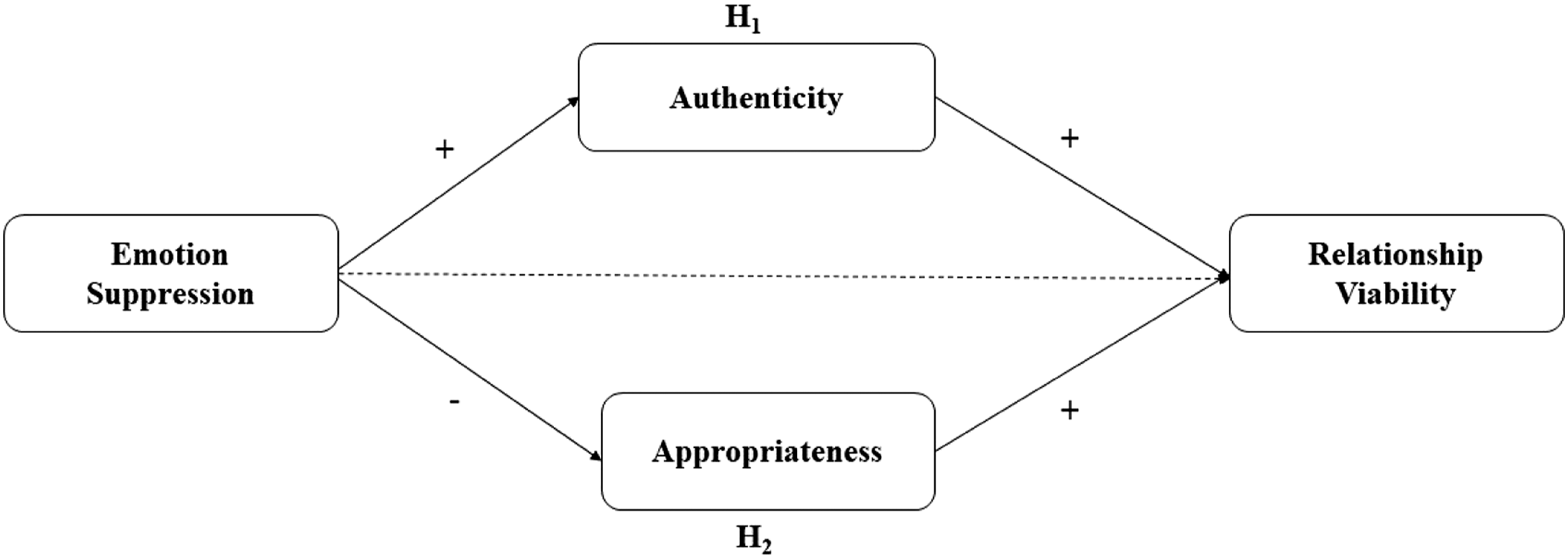
Hypothesis Development
Intrapersonal Path of Authenticity in the Relationship Between Emotion Suppression and NVT Members’ Relationship Viability
When people suppress their emotional expressions, they exert effort to reduce the expression but not the experience of the emotion (Tackman and Srivastava, 2016; Impett et al., 2014; Le and Impett, 2013). Individuals actively engaged in such self-regulatory efforts tend to monitor themselves throughout the regulatory episodes (Carver, 2004). By monitoring themselves, individuals observe and interpret a discrepancy between inner emotional activation and their outer expression (English and John, 2013). This discrepancy may create feelings of reduced authenticity (i.e., feeling “fake” and not being “true to my real self”) (Le and Impett, 2013, 2016). Considering that the level of emotional connection between NVT members and their new venture is comparable to the relationship between parents and a child (Cardon et al., 2005), any situation that threatens venture survival will likely create intense negative emotional experiences (Kollmann et al., 2017). Under these circumstances, the more often NVT members suppress their emotional expressions, the more aware they become of the discrepancy between their outer expressions vis-a-vis their actual inner experience of how fearful, worrying, and anxiety-inducing a given situation might be (English and John, 2013). As a result, they are more likely to feel less authentic when they suppress their emotional responses.
Extant conceptualizations of authenticity distinguish between felt and perceived authenticity and propose both as mediators in the relationship between emotion regulation strategies and interpersonal outcomes (Gardner et al., 2009), such as relationship viability. Perceived authenticity can be observed in emotion regulation strategies such as surface acting, which modifies the emotional response by altering the emotion (e.g., expressing hope when feeling fear in the face of a threat). Gardner et al. (2009) propose that in surface acting, perceivers can recognize sincere from fake emotional expressions, which informs their perceptions of authenticity (Wang et al., 2017). In the case of suppression, the suppressor does not fake an emotion. Instead, they control the emotion by not showing it. As the emotional display in suppression is reduced, so is the relevant information used to judge one’s authenticity of emotional display. Therefore, in the case of suppression, perceivers are less able (because of limited information) to make inferences about the authenticity of the suppressor. Hence, we argue that suppression influences one’s own felt authenticity (hereafter referred to as authenticity) more than the perceptions of authenticity by others in the NVT.
Prior research has found consistent evidence that authenticity mediates the link between suppression and relational outcomes (English and John, 2013). Consistent with previous research on romantic couples, which are similar to NVTs in that they share the experience of obstacles and goal-threatening events (Brunell et al., 2007; Mirgain and Cordova, 2007), greater emotional disclosure improves intimacy and constructive behaviors by one partner, which enhances the perceived relationship viability of the other. In particular, people who feel they are being authentic tend to engage in more constructive relationship behaviors, such as self-disclosure, trust, and accommodation, which in turn predict higher relationship quality with their partners (Brunell et al., 2010; Rusbult and Van Lange, 2003). In contrast, authenticity interferes with reciprocal self-disclosure and self-verification and invites misunderstandings or even conflict in the other partner, leading to interpersonal distance, lower social satisfaction, and decreased social support (Brunell et al., 2010; Sheldon et al., 1997; Swann and Pelham, 2002). Therefore, we propose that the incongruence between inner emotional experience and outward emotional expression reduces feelings of authenticity in suppressing NVT members, which decreases the viability of their relationships with other NVT members. Formally, we hypothesize the following:
Emotion suppression has a negative indirect effect on NVT relationship viability through a decrease in authenticity.
Social Perception Path of Perceived Appropriateness in the Relationship Between Emotion Suppression and NVT Members’ Relationship Viability
When others see someone suppress their emotional responses in times of intense negative events, they interpret that individual’s behavior in order to form perceptions about them (Tackman and Srivastava, 2016). Previous research shows that suppression informs a range of others’ perceptions, from stable personality traits (Tackman and Srivastava, 2016) to context-specific likability (Schall et al., 2016) and social standing (Greenaway et al., 2018). A recent review by Cheshin (2020) argues that perceptions of the appropriateness of emotional expression and suppression (Warner and Shields, 2009) are key to interpersonal consequences. Others can interpret an individual’s lack of emotional expression as more or less appropriate depending on the degree to which it fits their expectations (Warner and Shields, 2009). This fit is codified by display rules, that is, culturally or organizationally shared rules or norms about the appropriate emotional response in a specific context.
Considering the lack of established rules and social norms among NVT members (Ko et al., 2021), we can arrive at two opposing arguments about the appropriate emotional response in the context of venture-threatening obstacles. On the one hand, emotion suppression may be perceived as inappropriate because it interferes with the role of emotion as a credible signal of commitment (Reed et al., 2014) and personal interest in venture success. Hence, NVT members suppressing their emotions when facing threats may give inappropriate signals of lack of commitment and concern. On the other hand, NVT members might expect team members to remain calm, cool, and collected to successfully overcome obstacles (Barrett et al., 2001). In this case, emotion suppression would be interpreted as a sign of adopting a goal orientation appropriate for overcoming venture threats. By inhibiting emotional shocks and related negative emotions from spreading among the team, suppression may be considered an effective way to keep the venture focused and able to survive (De Cock et al., 2019).
Furthermore, as suppression reduces outbursts of negative emotions provoked by a threatening event, it reduces the expression of offensive words and behaviors toward others and prevents the situation from deteriorating into a contentious, hostile exchange. Therefore, suppression is likely to prevent escalations of conflict (Gamero et al., 2008). Prior evidence from organizational research suggests that display norms, most commonly applied in work circumstances, call for greater suppression during negative emotional experiences (Glikson and Erez, 2013). Considering the negative emotional experiences associated with obstacles and problems during new venture creation (Engel et al., 2021; Kollmann et al., 2017), we also postulate that NVT members are likely to perceive suppression as the appropriate and expected emotion regulation strategy.
The perceived appropriateness of emotional responses has important implications for impression formation and management (Diefendorff and Richard, 2003; Johnson et al., 2016) and informs interpersonal outcomes (Johnson et al., 2016). Emotional responses that are deemed appropriate are more likely to elicit favorable responses from perceivers (Cheshin, 2020) in terms of interpretations of other persons’ mental state (Thoits, 2003), personality, and likeability (Butler et al., 2003). Perceived appropriateness informs satisfaction in social interactions (Cheshin et al., 2018). It indicates social competencies (Onyekwere et al., 1991) and emotional intelligence (Ashkanasy and Daus, 2002; Brackett et al., 2011). Such social competencies, including appropriate emotional expression, are important predictors of entrepreneurs’ effectiveness in securing positive relationships with stakeholders and resource providers (Ingram et al., 2019).
In summary, we expect that NVT members who perceive their team members as responding to obstacles in emotionally appropriate ways are more likely to deem them socially and emotionally skilled. Thus, they experience higher satisfaction with and a greater willingness to continue their relationships. Specifically, we propose that in the context of venture-threatening obstacles, emotion suppression is likely to be perceived as an appropriate response by NVT members, thus increasing NVT members’ relationship viability. Formally, we hypothesize the following:
Emotion suppression has a positive indirect effect on NVT relationship viability through an increase in appropriateness.
Method
Participants
We obtained a sample of NVT members located in entrepreneurship centers and incubators in a large German metropolitan area to ensure that all ventures were in the early stage of creation (Uy et al., 2015). We identified potential participants by reviewing the web pages of the centers and incubators in this area. This approach resulted in a list of 97 ventures participating in an entrepreneurship program at the time of data collection. Between March and June 2018, we visited all teams in person to ask them to participate. We received responses from 106 participants in 43 NVTs (for a response rate of 44% from the initial 97 ventures identified), similar to other studies drawing on the same population, such as Breugst and Shepherd (2017). Such a sample size is common for team-based research and round-robin survey designs (Gerpott et al., 2019). In four of the 43 ventures, only one person per venture completed the questionnaire. These four cases were removed, leaving 39 ventures in the sample of which all team members had answered the questionnaire. The size of the 39 NVTs was as follows: 25 ventures had two team members, eight ventures had three team members, five ventures had four team members, and one venture had six team members.
The NVT members were identified using three criteria based on Klotz et al. (2014), Ensley et al. (2006), and Ucbasaran et al. (2003): (1) the participants confirmed that they were responsible for the strategic decision making and ongoing operations of their venture (“Are you primarily responsible for the strategic decision making and ongoing operations of this venture?”); (2) the participants were identified by the other NVT members as being responsible for the strategic decision making and ongoing operations of the venture (“Please enter below the names of the other people (excluding yourself) who are also primarily responsible for the strategic decision making and ongoing operations of this venture”); and (3) the participants indicated that they would own part of the venture once it was operational (“Once this venture is operational, will you personally own all, part, or none of this venture?”). We removed two participants from the sample because they did not meet any of these three criteria to qualify as a member of the NVT. Finally, in two ventures, one of the two team members did not answer items asking for perceptions of their team members, which generated missing data across all team members. Even though the other person on the team completed the entire questionnaire, both ventures were removed because of general structural equation model (GSEM) listwise deletion of missing values within each equation. Our final sample for data analysis without missing observations included 93 participants in 37 ventures, generating 167 individual observations of dyadic relationships within the NVTs.
The average age of the 93 participants was 30 years (SD = 4.76), and 13% were women. Most participants’ highest education was a master’s degree (63%), followed by a bachelor’s degree (23%) or doctoral degree (10%). The remaining participants had a high school diploma or professional qualification (4%). In terms of educational background, participants came from a variety of disciplines: business administration and law (31%), engineering and construction (26%), information and communication technologies (27%), science and mathematics (11%), arts and humanities (3%), and social sciences (2%).
Data Collection Procedure
During our visits to their offices, participants completed an online questionnaire in person. After stating their name and the name of their ventures, participants answered questions regarding their status as a member of the NVT and listed the names of their team members. The rest of the questionnaire consisted of three parts. In the first part, each participant was asked to rate the viability of their interpersonal relationship with other NVT members separately. In the second part, each participant was asked to recall negative events, that is, obstacles faced by their ventures (for detailed instructions, see Appendix A). In the third part, the respondents were instructed to think about all the obstacles they had listed in the previous part and then provide self-reports of their emotion suppression and authenticity and their perceptions of the appropriateness of their team members’ emotional reactions. The questionnaire was designed to capture the perceptions of the three closest team members to prevent respondent fatigue over multiple repeated scales in larger teams.
Measurements
We used a round-robin study design (McClean et al., 2018). We asked every participant to provide self-reports of their emotion suppression and authenticity when faced with negative events, their perceptions of their team members’ emotional appropriateness, and the viability of their relationships with each of their NVT members. Thus, every participant was both a suppressor (providing data on suppression and authenticity) and a receiver (providing data on their NVT members’ appropriateness and relationship viability).
Means (M), Standard Deviations (SD), and Pearson Correlations.
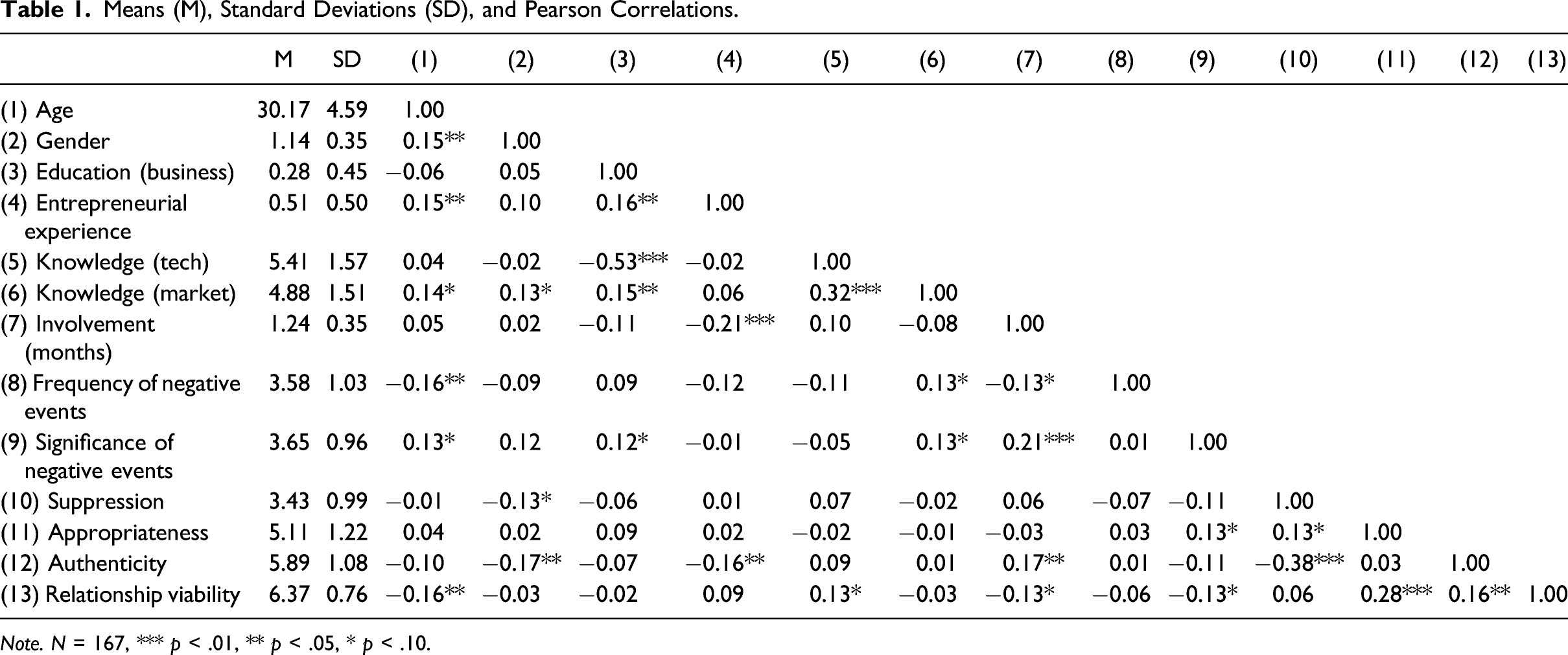
Note. N = 167, *** p < .01, ** p < .05, * p < .10.
Results
Common Method Bias
To avoid any potential common method bias, we used multiple key informants. Information on the dependent variable (relationship viability) was collected from a different source than the independent variable (suppression) (Chang et al., 2010). In addition, we conducted three confirmatory factor analyses (CFAs) to test for common method bias (Podsakoff et al., 2003; Zapkau et al., 2015). All reported results from the CFA are based on robust standard errors clustered at the team-level. First, all items were loaded onto one common factor (χ2 (77) = 351.26, p < .001; RMSEA = 0.54; CFI = 0.73; SRMR = 0.13). Second, items were loaded onto their theoretically assigned variables using the variance standardization method for the single indicator variables and correlated residuals (χ2 (72) = 108.211, p < .01; RMSEA = 0.06; CFI = 0.97; SRMR = 0.08). Third, items were loaded onto their theoretically assigned variables and onto a common method latent factor with constraint item loadings (χ2 (66) = 97.11, p < .01; RMSEA = 0.05; CFI = 0.97; SRMR = 0.07). A chi-square difference test suggested that including the common latent factor did not lead to a significant improvement in the model fit (∆χ2 = 11.10, ∆df = 6, p = .10).
Model Choice and Analytical Procedure
Our data have a nested structure with individuals nested in teams at the venture level (with only one team per venture, team level equates to venture level), and judgments of relationship viability nested in individuals if the team consists of more than two members. The first step in investigating data with nested structure is to determine whether there is meaningful variance in the dependent variables due to the nesting at higher levels (individuals and ventures) (Shumski Thomas et al., 2018). The respective interclass correlation coefficient (ICC) of relationship viability per individual within a venture was 0.11, whereas the isolated ICC of individual-level variance in relationship viability was 0.02. In addition, the ICC values of the remaining variables of interest are 0.02 and 0.09 for venture- and individual-level variance in perceived appropriateness, respectively, and 0.10 for venture-level variance in authenticity. The ICC values indicate that approximately 10% of the variance in relationship viability and authenticity is accounted for by venture-level effects, while approximately 2% of the variance in relationship viability is accounted for by individual-level effects. The likely reason for the small ICC values at the venture level is the narrow, homogenous nature of the sample; small ICC values at the individual level are attenuated by the small number of observations nested in individuals (M = 1.8) as most teams have only two members.
Reported ICC values suggest that the data should not be aggregated (Bliese, 2000) even though research using round-robin design commonly follows an aggregation approach (Gerpott et al., 2019). Based on the ICC values, we decided to keep the data at the lowest level of observation, that is, at the level of judgments of relationship viability made by one individual team member with respect to another individual team member, instead of aggregating these data. Each participant was rated by a different number of team members owing to the varying NVT sizes (with an average of 1.8 team members). Therefore, if we were to aggregate judgments of all within-individual relationships, we would assign small groups and large groups equal weight in determining parameter estimates. At the same time, we would produce effects that confound individual perceptions of a dyadic relationship (in a team of two) and average team perceptions of all relationships of one individual (in teams larger than two). Sample size reduction from 167 individual observations to 37 NVTs also discourages the use of aggregation (Preacher et al., 2010).
The reported ICC values also do not warrant the use of a hierarchical linear model (HLM) (Bliese, 2000; Glick, 1985; Shumski Thomas et al., 2018). However, we adopted an analytical approach that generates estimates that accurately reflect the process by which data were collected and their nested structure (McNeish et al., 2017). In particular, we applied a GSEM in STATA 16 to account for the nested structure of our non-aggregated data and obtain unbiased and efficient coefficients for our model with two mediators (Ahmadi et al., 2021; Goerdeler et al., 2015; Mao et al., 2019; Weck et al., 2021). The GSEM is a technique that simultaneously considers direct and indirect effects of several factors and is optimal for addressing hypotheses with nested data (Lombardi et al., 2017; Preacher et al., 2010). A GSEM is also superior to alternative random-effects models, since it captures more features and requires fewer assumptions, thus optimizing the capability to detect statistically significant effects, even with a small sample size like ours (Ang et al., 2016).
GSEM Results.
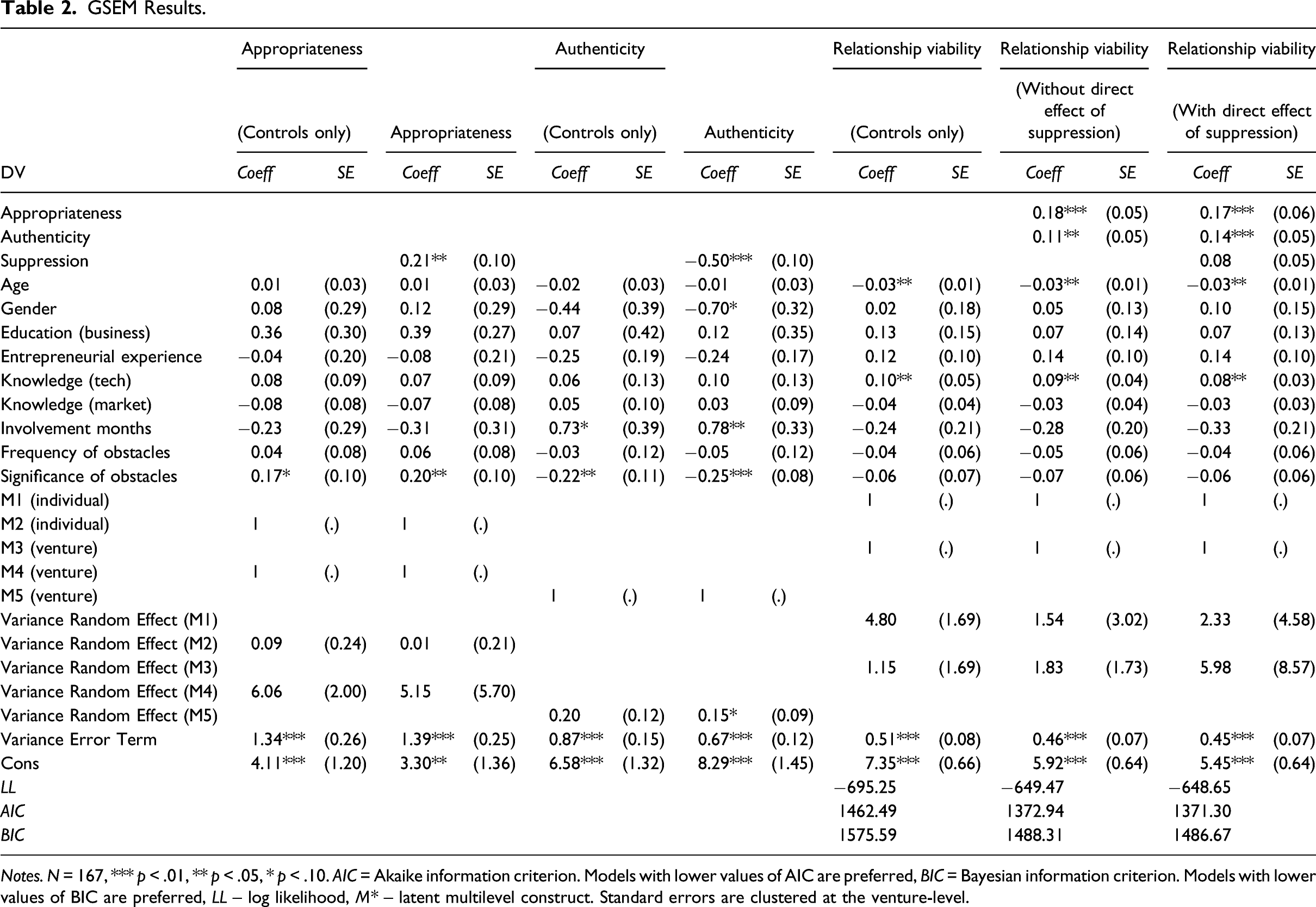
Notes. N = 167, *** p < .01, ** p < .05, * p < .10. AIC = Akaike information criterion. Models with lower values of AIC are preferred, BIC = Bayesian information criterion. Models with lower values of BIC are preferred, LL – log likelihood, M* – latent multilevel construct. Standard errors are clustered at the venture-level.
We allowed for covariance in the error terms of authenticity and appropriateness to be correlated. The model was estimated using full information maximum likelihood. After generating the model with GSEM, we estimated the indirect effects with a product-of-coefficients test using the nlcom (nonlinear combination of estimators) command, which assesses the magnitude of the indirect effects in relation to the standard error of the indirect effects (Hayes, 2009).
Hypothesis Testing
Table 1 shows the means, standard deviations, and correlations of all variables based on the observation at the level of the dyadic relationship (N = 167). The correlations are generally low to moderate, suggesting a low risk of collinearity issues or redundancies. This result is supported by analyzing the variance inflation factor (VIF) values. The maximum value is 1.37, below the conservative cut-off of two, indicating that collinearity between predictors does not significantly influence parameter estimates (Hair et al., 2006).
Table 2 shows our GSEM results. As expected, suppression has a direct negative effect on authenticity (β = −0.50, p < .01). Furthermore, authenticity has a positive relationship with relationship viability reported by team members (β = 0.14, p < .01). Increasing authenticity by one SD increases the viability of each relationship that the NVT member has by 0.14 points on the scale. We also find a negative indirect effect of suppression on relationship viability via authenticity (indirect effect = −0.07, p < .05, 95% CI [-0.12 to −.02]). This finding supports Hypothesis 1.
The results further show that suppression has a positive effect on the appropriateness of emotional responses (β = 0.21, p < .05) and that appropriateness is positively associated with relationship viability (β = 0.17, p < .001). A one-SD increase in appropriateness increases relationship viability by 0.17 points on the scale. Thus, in support of Hypothesis 2, there is a positive indirect effect of suppression via appropriateness on relationship viability. This effect is significant at the 0.10 level (indirect effect = 0.04, p = .08, 90% CI [0.01 to 0.07]).
To compare the effects of the two mediators, we calculated the contrast of the indirect effects of authenticity and appropriateness (Preacher and Hayes, 2008). The contrast indicated that the indirect effect via authenticity was significantly stronger than the indirect effect via appropriateness (point estimate of the contrast = −0.11 (95% CI: −0.17, −0.04; SE = 0.03), p < .01).
The total effect of suppression on relationship viability is a combination of the direct effect of suppression (b = 0.08; p = .19), the negative indirect effect through authenticity (indirect effect = −0.07; p < .05; 95% CI [-0.12 to −0.02]) and the positive indirect effect through appropriateness (indirect effect = 0.04; p = .08; 90% CI [0.01 to 0.07]). The two opposing indirect effects result in a negligible total effect of suppression on relationship viability (total effect = 0.04, p = .36 CI [-0.05 to 0.13]).
Robustness Checks
We conducted further robustness checks by estimating fixed and random effects OLS models. The fixed effects specification is rejected as a suitable alternative based on the results of a Hausman test (Hausman, 1978). The results for the random effects OLS provide support for Hypothesis 1 as suppression has a negative significant indirect effect on relationship viability via authenticity (indirect effect = −0.07, SE = 0.03, p < .05) and support for Hypothesis 2 as suppression has a positive significant indirect effect on relationship viability via appropriateness (indirect effect = 0.03, SE = 0.02, p = .06). We also estimated an HLM with random effects at both the venture and individual levels. The HLM also produces results in support of our hypotheses: we find a negative and significant indirect effect of suppression on relationship viability via authenticity (indirect effect = −0.07, SE = 0.03, p < .05) and a positive and significant indirect effect of suppression on relationship viability via appropriateness (indirect effect = 0.03, SE = 0.02, p = .06). Thus, the results produced by the GSEM are similar to those obtained by estimating a random effects OLS and an HLM models. The full results of the robustness checks are available upon request.
Results of the Follow-up Study
From October to November 2020, two years after the initial data collection, we revisited the participants to assess new venture survival. The aim of this follow-up was twofold: to establish the predictive validity of our dependent variable (relationship viability) and to replicate the findings from previous research by De Cock et al. (2019) that suppression has a positive effect on new venture survival. To gather follow-up information, we used a combination of information available through the ventures’ websites, social media platforms (e.g., Twitter accounts), press announcements, and company registration and the LinkedIn profiles of participating NVT members, as well as information gathered through interviews conducted online due to social distancing restrictions in the fall of 2020.
First, we searched for all initially approached 43 ventures on the internet. We did not restrict the follow-up data collection to the 37 ventures from the initial analysis because we did not want to limit ourselves to sampling only ventures with more than one respondent (i.e., the criterion that led us to remove four ventures from the initial sample of 43). From this search, we found that 29 of the 43 ventures were still active based on existing websites and active social media pages, founders’ LinkedIn profiles, and press releases associated with activities performed by the venture. We could not find conclusive information about four ventures. For the remaining 10 cases, we concluded that they had terminated based on the lack of any current information about the venture as well as LinkedIn profiles of founders showing different affiliations.
Second, we tried to contact at least one representative per venture via email, telephone, or LinkedIn. These efforts led to direct online interviews with one of the NVT members in 17 ventures (of which 15 were with members of surviving ventures and two were with members of terminated ventures). The information collected on the survival/termination status of the ventures from the interviews aligned with the information gathered through secondary sources. The data from the follow-up study were added to the data from our main study, leaving us with a sample of 35 ventures for which we have complete data available: all team members were surveyed in our first study, and we had a reliable indication of the survival of the venture two years later. Of these 35 ventures, 26 were still operational, and nine had terminated. Although the data for the follow-up study were collected during the COVID-19 pandemic, only one interviewee mentioned the pandemic. This interviewee explicitly mentioned that “the most important reason our company no longer exists is Corona.”
Using a binary variable for survival as a dependent variable (1 if the venture had survived and 0 if it had not), we applied binary logistic regression at the venture level. All independent variables in the model, that is, suppression and relationship viability, were aggregated to the venture level. Following sample size recommendations of a minimum of 10 observations per independent variable in logistic regressions (Peduzzi et al., 1996), we included only the frequency and significance of the obstacles aggregated at the venture level as control variables.
Binary Logistic Regression Predicting Venture Survival.
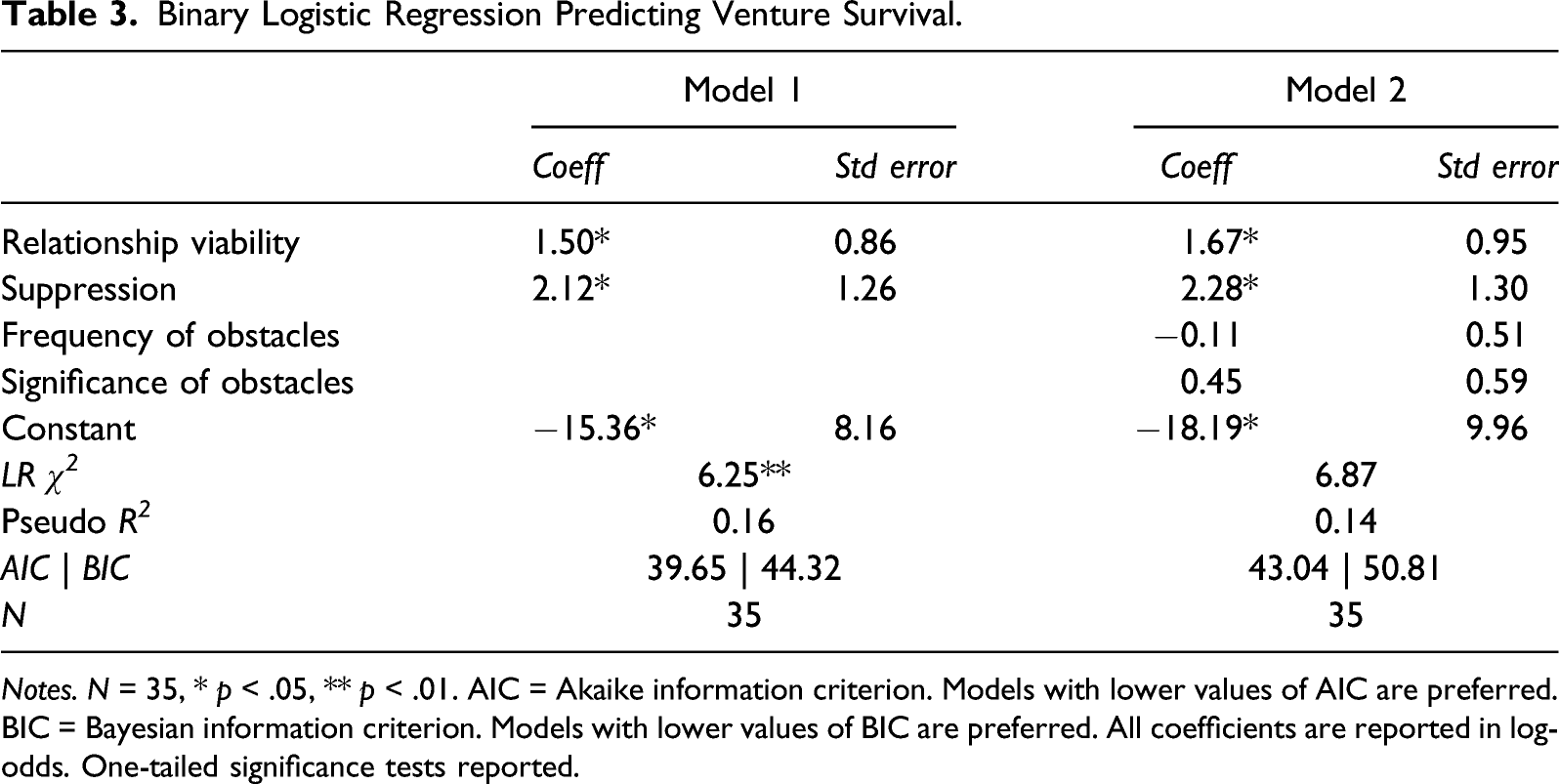
Notes. N = 35, * p < .05, ** p < .01. AIC = Akaike information criterion. Models with lower values of AIC are preferred. BIC = Bayesian information criterion. Models with lower values of BIC are preferred. All coefficients are reported in log-odds. One-tailed significance tests reported.
Furthermore, we found a positive effect of suppression on venture survival, and this effect was significant at the 0.05 level. This result indicates that ventures in which individual members were more likely to suppress their emotional expressions were more than eight times more likely to survive two years later (β = 2.12; Exp(B) = 8.33; p < .05, one-tailed). Overall, our results from the follow-up study suggest that both relationship viability and emotion suppression play a key role in predicting venture survival, supporting the overall predictive validity of our initial findings.
Discussion
Theoretical implications
First and foremost, this study has implications for the entrepreneurial team literature (e.g., Klotz et al., 2014; Lazar et al., 2020). Namely, we extend this stream of literature by accounting for the viability of interpersonal dyadic relationships within NVTs in the early stages of venture development. Relationships between individual members of NVTs are rather distinct from organizational groups (Davidsson, 2016) as they have characteristics of personal (e.g., friend, romantic, and family) and work (e.g., colleague) relationships (Brannon et al., 2013; Klotz et al., 2014; Ko et al., 2021; Schjoedt et al., 2013). At the same time, relationships between individual members of NVTs are similar to other organizational settings like leader-follower, mentor-protégé, and coworker-coworker because interactions between individual team members in NVTs take place within dyads (Liden et al., 2016). Given the complex nature of NVTs, it is not surprising that the viability of relationships within NVTs is (indirectly) informed by emotional responses that foster intimacy and self-disclosure (Kernis, 2003) and, at the same time, adhere to commonly applied organizational rules of appropriateness (Smollan, 2006; Liu et al., 2010). Furthermore, our study provides evidence that relationship viability predicts venture survival, which extends prior research that established the importance of pre-existing relationships on team formation and venture inception (Lazar et al., 2020).
In addition, our study provides novel evidence that authenticity is a more important component of the emotion-driven relational process in NVTs than appropriateness. Having low authenticity in one’s emotional responses can thus damage relationships in NVTs. Authenticity is relatively unexplored in the entrepreneurship literature (Conger et al., 2018; O’Neil et al., 2020), and current conceptualizations mostly rely on identity verification perspectives (O’Neil et al., 2020; Powell and Baker, 2014, 2017). We extend this literature with another perspective on authenticity that is important for founders of new ventures, namely, consistency between internal emotional experiences and external emotional responses. At the same time, our findings suggest that the appropriateness of emotional responses as perceived by one’s team members is also a positive predictor of relationship viability within NVTs. During intense emotional events, members of NVTs need to suppress their emotions to ensure the appropriate display to an array of stakeholders (Ingram et al., 2019). Hence, the appropriateness of suppression as emotional response regulation positively affects NVT members’ relationship viability.
With this study’s evidence that suppression indirectly affects interpersonal outcomes in new venture creation and directly impacts venture survival, we also contribute to the literature on emotions in entrepreneurship (Baron, 2008) by disentangling the individual’s intrapersonal authenticity from team members’ perceptions of appropriateness associated with emotion suppression in the face of obstacles. Studies have started to examine how emotions influence intrapersonal processes related to judgments of opportunities and decision-making (Foo, 2011b; Ivanova et al., 2018; Podoynitsyna et al., 2012; Welpe et al., 2012), entrepreneurs’ venturing efforts and behaviors (Foo et al., 2009; Hatak and Snellman, 2017), and entrepreneurs’ attitudes toward exit (Shepherd et al., 2009). Our study contributes to this literature by showing that emotion suppression as a regulation strategy connects the internal experiences of emotions with the social world. Response-focused strategies, such as expressing positive emotions (e.g., hope, optimism, and passion), have well-established social benefits for founders of new ventures (Anglin et al., 2018; Hubner et al., 2020; Li et al., 2017). Other strategies, such as suppression, are far less understood. By including suppression in the emotion-laden social interactions in NVTs (Brundin et al., 2008), we now better understand how entrepreneurs can best regulate their emotional responses in the face of negative events to initiate and sustain viable relationships with significant others (Tamir, 2016; Zott and Huy, 2007).
In addition to demonstrating indirect interpersonal outcomes associated with emotion suppression, we show a positive direct effect on new venture survival. At the aggregate level, emotion suppression more closely represents the organizational or team climate (Grandey et al., 2013) and a collective team norm (Jiang et al., 2013). Hence, aggregate-level suppression’s positive influences on venture survival may relate more to establishing a norm or a climate of reduced emotional interactions in tough times to focus on overcoming obstacles (De Cock et al., 2019) and less to lower-level factors that influence the viability of interpersonal relationships within the NVT. The positive effect of suppression on venture survival supports findings by De Cock et al. (2019), who report that the emotion suppression of the lead founder is positively related to venture survival under conditions of low performance. Both ours and De Cock et al.’s (2019) study seem to suggest that when a venture experiences difficulty and its performance is challenged, founding members of the NVT should hold back their emotional responses to ensure that these difficulties are overcome and the venture survives. Since emotion suppression is a form of self-regulation (Gross and John, 2003), these results also align with other research on self-regulation in entrepreneurs (Bryant, 2009; Nambisan and Baron, 2013; O’Shea et al., 2017). The reported positive direct effect of suppression on venture survival and the indirect effect on relationship viability confirm previous findings that in response to threatening obstacles, entrepreneurs would be wise to regulate their social-sphere emotional responses (Lerner, 2016).
Last, our results contribute to emotion regulation theory, supporting emergent trends emphasizing the importance of capturing emotion regulation in contexts where emotions are experienced and regulated (Colombo et al., 2020). Our study explores the consequences of suppressing emotional responses when NVTs face obstacles and threats during new venture creation. In this context, we shed light on the process of suppression, uncovering context-specific negative (authenticity) and positive (appropriateness) effects. By disentangling these opposite implications of suppression in ventures facing obstacles, we challenge the dominant view that suppression is a poor strategy for emotion regulation (Tackman and Srivastava, 2016). Additionally, we test the two mediators of the effect of suppression simultaneously to determine the relative magnitudes of their indirect effects, which generate novel evidence that the intrapersonal implication of suppression exerts a stronger mediating effect in comparison to the social perceptions of suppression. Overall, our findings of the consequences of suppression and the importance of contextual factors affirm the complex, dynamic and situational nature of emotion regulation phenomena (Aldao, 2013).
Limitations and recommendations for future research
This study has limitations that provide opportunities for future research. First, our study solely focused on emotion suppression as an emotion regulation strategy for the reasons outlined in the Theoretical background section. However, other self-regulatory strategies are also employed to respond to negative events, including cognitive regulation strategies like blame, catastrophizing, and perspective-taking (Garnefski et al., 2001) or emotion regulation strategies like reappraisal or amplification (Gross, 2002). These strategies may exert additional influence on the interpersonal relationships within NVTs. Cognitive reappraisal, as the most commonly examined regulation strategy (De Cock et al., 2019; Sirén et al., 2020), could be of particular relevance for future research. By reinterpreting negative venture-threatening events through a positive lens (English & John, 2013), reappraising individuals are inclined to reduce negative emotions, increase positive emotions (Richards et al., 2003) and improve resilience (Tugade and Fredrickson, 2006). Therefore, cognitive reappraisal may also have a role in how entrepreneurs overcome obstacles. Whether this role extends to the viability of interpersonal relationships within NVTs remains an open question and therefore a fruitful avenue for future research. It would also be promising to investigate how entrepreneurs make emotion regulation strategy choices in particular contexts (Sheppes et al., 2014) because entrepreneurs might prefer different strategies under different circumstances.
Another limitation is the study’s relatively small sample size. Sample size is a critical issue in GSEM (Snijders, 2005). An adequate sample size is needed to obtain unbiased estimates of parameters and ensure sufficient statistical power at all model levels. Simulation studies have shown that for multilevel models, sample sizes of 50 (ideally 100) are needed to obtain unbiased estimates (Maas and Hox, 2005). Our sample of 37 NVTs is similar to samples in other studies using a round-robin design, such as Gerpott et al. (2019). Furthermore, we do not test any venture-level effects in our GSEM and instead ensure a sufficient sample size of 167 at the level of the effects being tested (Snijders, 2005). For researchers with a substantive interest in viability as a team-level (Foo et al., 2006) rather than a dyadic-level construct, an increased sample size of teams consisting of more than two team members could provide opportunities to test our conceptual model at higher levels of analysis.
Furthermore, although we found a unique significant effect of emotion suppression on venture survival and corroborated findings by De Cock et al. (2019), we did not explore the factors that drive this positive effect. Hence, future research could examine potential affective, cognitive, and interpersonal drivers of this relationship. For example, emotion suppression may indirectly lead to higher chances of survival because it allows suppressing entrepreneurs to focus on tackling obstacles and threats instead of focusing on the negative emotions experienced in difficult times. In addition, suppression may positively affect the way stakeholders, resource providers, and employees, who play essential roles in venture survival, perceive entrepreneurs (Huy and Zott, 2019), similar to the positive appropriateness perceptions by team members reported in our study. In line with this, the statistical mediation effects in our study do not necessarily imply mediation in a causal sense (Imai et al., 2010). Therefore, future research could address this causality issue by adopting a longitudinal or experimental approach to investigate NVT relationships in the dual-path model.
Finally, we acknowledge constraints on generalizability in our work (Simons et al., 2017). Given recent discussions about a generalizability crisis, which is distinct but related to the replicability or reproducibility crisis (Yarkoni, 2020), we deem it important to add some thoughts on the constraints on generality in our study (Simons et al., 2017). Our target population consists of NVTs who self-select to exploit entrepreneurial opportunities. Hence, we can assume that our results generalize to other domains in which individuals self-select into a working team to achieve a common goal, for example, research teams working on a breakthrough project or ideation teams generating radical new product ideas. At the same time, in terms of generalizing our results beyond individuals self-selecting into teams with a common goal, our results regarding the mediating effects of authenticity and the appropriateness in the relationship between suppression and relationship viability are not (entirely) generalizable. We specifically examined the suppression of negative emotional experiences when the NVT faces obstacles to their goal achievement. Hence, appropriateness of suppression might not hold in circumstances of positive emotional experience, for example, when celebrating success in goal achievement such as product development, customer acquisition, or attracting financing. We encourage replication of our study (Brandt et al., 2014) across different (positive and negative) emotional experiences and in other cultural settings.
Practical implications
This study has several practical implications. First, there are implications for NVT members seeking to establish satisfying and lasting relationships in the early stages of new venture creation. To ensure the viability of their relationships, NVT members should pay close attention to the way they respond to emotionally charged events. As their venture will inevitably face obstacles, NVT members need to remain authentic to their true selves and appropriate concerning other members’ social expectations to forge strong bonds. Establishing shared display rules about appropriate emotional expressions in the NVT could compensate for the burden of engaging in less authentic emotion regulation strategies. Furthermore, sharing negative emotional experiences could benefit team members’ relationships because “shared pain is half the pain” (Van Kleef and Fischer, 2016, p. 8). To facilitate sharing, NVTs could benefit from dedicating space and time for expressing their negative emotional experiences without judgment rather than suppressing these emotions.
Second, this study offers practical directions for entrepreneurship educators and supporters who design interventions for NVTs. There are many resources in the start-up world to help NVTs deal with the financial and legal aspects of venturing. NVTs can also draw on toolboxes and solutions for assisting decision-making and action-taking. However, little of the available knowledge and support is dedicated to the emotional aspect of entrepreneurship and the importance of NVT members’ relationships. As a result, it has become increasingly common for NVT members to attend couples counseling to learn how to maintain their relationships (Nowell, 2017). Couples counselors should pay close attention to negative emotional events and the resulting NVT members’ behaviors and perceptions that affect relationship viability and venture survival.
Finally, our findings have implications associated with the COVID-19 pandemic. As the data for our main study were collected prior to the pandemic, the reported effects of emotion suppression are in response to the experience of obstacles that threaten the success of the venture entirely unrelated to COVID-19. In the context of online communication, forced by lockdown and social distancing rules that are likely to remain after the resolution of COVID-19 (Fiedler, 2020), emotion suppression would additionally be induced by technology restrictions, for example, the availability of high-quality technology and pre-scheduled interactions that limit spontaneous interactions. We expect that individual-level tendencies to suppress would be higher in such settings that encourage online communication. A recent study by Trougakos et al. (2020) provides empirical support that the COVID-19 pandemic has prompted individuals to suppress their emotions. This would likely increase the reported effect sizes in our study; however, we expect the direction and overall interpretation of the effects to remain similar. Regarding the follow-up study, the data were collected during the COVID-19 pandemic, which has potentially intensified the importance of suppression for venture survival in times of obstacles as COVID-19 is an extreme case of an unexpected obstacle. The experience of COVID-19 after its resolution will hopefully demonstrate to new ventures the value of keeping calm, cool, and collected.
Conclusion
The question of what drives interpersonal relationship viability within NVTs has long been of interest, but there is little empirical evidence. Our study shows that emotion suppression in the face of obstacles during the venture creation process impacts the viability of interpersonal relationships between members of the NVT through decreased authenticity and increased appropriateness. In addition, we provide evidence that emotion suppression and relationship viability are meaningful predictors of venture survival after 2 years. We hope our results stimulate future research on emotional drivers, underlying processes, and contextual conditions influencing relationship viability in NVTs and venture survival.
We sincerely thank Carina Raizner and Florentina Enders for their help with data collection. We are also grateful to our editor Jeffrey Pollack and two anonymous reviewers for their constructive and insightful comments throughout the review process.
Footnotes
Declaration of Conflicting Interests
The author(s) declared no potential conflicts of interest with respect to the research, authorship, and/or publication of this article.
Funding
The author(s) received no financial support for the research, authorship, and/or publication of this article.

Note
Data Collection Instructions to Participants
“New ventures, such as yours, are frequently confronted with obstacles that threaten their success, competitive advantage, and survival. Please try to recall obstacles faced by your venture that made you fear its success, competitive advantage or survival. By obstacles, we mean significant negative changes as compared to previous situations, resulting from external problems outside your control. For example, required financial resources are no longer available, the demand for your product/service drops sharply, or you lose support from your social environment. Please list as many of these obstacles as you can recall. In the next questions, we will ask you to go back to your recollections of these obstacles and answer some questions.”
Multi-item Study Variables
Variable
Items
Relationship viability
I really enjoy working with (name of team member)
I get along with (name of team member)
I feel like I get a lot out of working with (name of team member)
I am very happy that I am working with (name of team member)
I would not hesitate to work in another venture with (name of team member)
If I could have changed (name of team member) and worked with someone else I would have (reversed item)
If given the choice, I would not have chosen to work with (name of team member) (reversed item)
Emotion suppression
I controlled my emotions by not expressing them
I tried not to express my negative emotions
I down-played my emotional reactions
I tried not to express my positive emotions
I kept my emotions to myself