



Abstract
In this paper, we address recent calls to increase the societal relevance of entrepreneurship research. We explore how entrepreneurship researchers and practitioners work together in the formulation of a research problem for impact. Leveraging process-tracing, we analyzed six entrepreneurship research projects, from early conceptualization to publication, all part of the Journal of Business Venturing Insights’ Entrepreneurship Rapid Response Research Initiative. We made two discoveries, as it pertains to the formulation of problems in entrepreneurship research. First, we found four critical change dimensions, along which a problem evolves throughout the research process: worthiness, divisibility, centrality, and specificity. Second, we found two equifinal problem formulation pathways in impact-oriented entrepreneurship research: inward-looking iterative and outward-looking joint problem formulation. These are marked by drivers of the research project, timing of involvement of the practitioner, and interactions between researchers and practitioners, which influence the sequence of the four change dimensions in problem formulation. Our study contributes by theorizing problem formulation as a process, not a point in time, and hence intertwined with solutions, making the process consequential. We also offer concrete implications for entrepreneurship scholars wanting to engage in research that impacts practice.
Keywords
Introduction
“If I had only one hour to save the world, I would spend fifty-five minutes defining the problem, and only five minutes finding the solutions.” (Albert Einstein)
The impact of research beyond academia is increasingly a key concern for entrepreneurship scholars (Wiklund et al., 2019; Van Gelderen et al., 2021; Williamson et al., 2021; Bartunek, 2003; Cunliffe & Scaratti, 2017; George, 2016; MacIntosh et al., 2017; Van de Ven, 2002). Significant progress has been made to understand what counts as scholarly impact and how to reach external audience once the research output is produced. Yet, herein lies a complication. The alignment between entrepreneurship research and the (real-life) problems that research may solve is only explored post hoc, once the research outcomes are at hand. This approach to scholarly impact is problematic, akin to trying to build a bridge starting from one end with no consideration of where the other endpoint is located. The construction can begin, and a bridge can eventually be built. However, if the endpoints are not aligned, the bridge will not perform as intended, or the construction will stop because the project becomes unviable.
If research impact is the solution to problems of practice, research cannot be separated from the problem it can potentially solve. This is a challenge for entrepreneurship researchers interested in conducting impact-oriented research. They have a robust toolkit at their disposal to formulate research questions, which can be skillfully crafted for theoretical contributions. However, problems of practice are different from research questions (Van de Ven, 2007), as the former deal with technical norms and the latter examine propositions about relationships (Niiniluoto, 1993). The approach to formulating a research question is not the same as one for problem formulation.
When a few scholars have talked about problem formulation for impact, these discussions are centered around static characteristics, such as formulating problems with “high practical value” (Avenier & Cajaiba, 2012), “relevance” (Gulati, 2007), or “real-world” problems (Lawrence, 1992). As a result, the insights informing problem formulation are either too general (e.g., Gulati, 2007) or focused primarily on the process followed by the researcher without fully considering the role played by practitioners, such as in Van de Ven’s (2007) detailed explanation of formulating a problem for engaged scholarship. There is an important omission here. If impact beyond academia is a desired aim, problem formulation needs to be thought of as a collective inquiry between researchers and those who own and experience the problem, that is, the problem owner. Addressing this omission can bring us closer to producing entrepreneurship knowledge that creates impact on practice and society more broadly. Further, by including a problem owner, we may be able to rethink our current ways of conducting research, which are fraught with long time periods and often inefficient collaboration processes within the research team.
Hence, we ask: how do entrepreneurship researchers and practitioners together formulate a problem for impact? In answering this question, we examine how problem definition evolves in impact-oriented research process and how it affects the solutions being developed by a research team. Using process-tracing methodology (Beach & Pedersen, 2013), we explored the development of six entrepreneurship research projects from inception to publication and dissemination, which were published under the Journal of Business Venturing Insights’ Entrepreneurship Rapid Response Research initiative (ER3). The ER3 invites researchers to work with practitioners or policymakers (called problem owners in this paper) in the joint exploration of problems relevant to entrepreneurship practice and the co-development of impact-oriented research solutions. Process-tracing is a case-based method aimed at tracing mechanisms within specific processes (Collier, 2011). It allows for observing and analyzing trajectories of change, specifically the sequences of and interactions between events leading to the production of an outcome.
We made two discoveries. First, we found four critical change dimensions, along which a research problem evolves throughout the research process, as the solution begins to materialize: problem worthiness, divisibility, centrality, and specificity. These dimensions were not static, but rather ebbed and flowed throughout the process as a result of the interactions between researchers and problem owners. Second, based on these dimensions, we found and theorized two equifinal problem formulation pathways in impact-oriented entrepreneurship research: inward-looking, iterative, and outward-looking joint problem formulation. To do so, we leveraged process-tracing’s inferential procedures to elaborate causal mechanisms explaining how research projects can, in the process of problem (re)formulation, move distinctively from (X) research problems to (Y) knowledge solutions conducive to impact. The process of problem (re)formulation was marked by drivers of the research project (i.e., inward- or outward-looking concerns), the timing of involvement of the problem owner, interactions between actors involved (iterative or joint), which, combined, influence the sequence of appearance of the four change dimensions in the problem formulation process. These two pathways had implications for the development of solutions with different expressions of rigor, relevance, and timeliness.
Our study makes three contributions. First, we contribute to the debate on the relevance of entrepreneurship research (Wiklund et al., 2019) by empirically showing how entrepreneurship as a research field can engage with external audiences and achieve societal relevance. Most notably, we offer two alternative pathways that can be integrated into the methodological toolkit of entrepreneurship researchers. These two pathways complement Shepherd et al.’s (2021) inward-looking approach, whereby entrepreneurship researchers should frame agendas for impact by engaging with one’s personal experiences, what they call “me-search.” Second, our study contributes to the literature on research impact (Kieser et al., 2015) by describing problem formulation as processual and collaborative. Whereas prior research focuses on the static attributes of a relevant problem or singularly focuses on the role of researchers in defining such problem (Avenier & Cajaiba, 2012; Van de Ven, 2007), we describe problem formulation as a process of continuous interaction between researchers and practitioners. Finally, we contribute by addressing the calls for more problem-oriented research (Howard-Grenville et al., 2019; Sarewitz, 2016; Watts, 2017) by providing concrete implications for researchers, reviewers, and journal editors interested in fostering impact of research on practice.
Literature Review
Entrepreneurship, and management research, more broadly, is facing a relevance crisis (Rynes et al., 2018). The calls to solve this crisis continue to grow (Beech & Anseel, 2020; Kieser et al., 2015; Wiklund et al., 2019), urging researchers to conduct research with business and society instead of about business and society. Wells and Nieuwenhuis (2017) perceive scholarship of societal relevance as multiple, cumulative interactions between academia and external organizations. The COVID crisis has further shown that management researchers, who arguably must be closest to practice compared to other social scientists, are standing by the sidelines (Bapuji, de Bakker et al., 2020; Bapuji, Patel et al., 2020).
Commentators have identified many reasons why research has largely failed to impact practice, including divergent interests of researchers and practitioners, researchers’ career progression that encourages siloed work, disciplinary traditions, and institutional incentives that do not support engagement with practice (Bartunek & Rynes, 2014).
One of the primary reasons, and relevant for our study, is the incoherency problem (Howard-Grenville et al., 2019; Watts, 2017), where management research struggles to answer questions of practice because we are unable to build a coherent body of work. Watts (2017), speaking of social scientists in general, recalls in his essay his inability to answer when his colleagues from physics and computer science asked, “What is the social science perspective on X?” There is no coherent perspective on “X” because management research has been on a quest for “what is interesting” (Davis, 1971) rather than “what is important” (Tihanyi, 2020) or “useful” (Pollack et al., 2020). To get published, we look for counterintuitive findings and facts, often driven by incoherence in theories (Tourish, 2020), which erode rather than build a body of work. Thus, our focus is less on relevant problems, and more on finding and challenging counterintuitive assumptions in our theories (Pillutla & Thau, 2013).
Problem-Driven Research in Entrepreneurship
To address these concerns, there has been a shift toward “problem-driven research.” We use this term as an umbrella concept to include related ideas such as solutions-oriented research (Watts, 2017), phenomenon-driven empirical inquiry (Bamberger, 2018), and question-driven research (Graebner et al., 2022). Problem-driven research is about asking questions of societal relevance such as “How can corporate innovations improve or save lives? How can managers improve working conditions for their employees?” (Tihanyi, 2020: 331) rather than simply questions derived from puzzles or gaps in theory. A few scholars argue that problem-driven research is not only about providing solutions to business managers but rather “problem-driven work is distinguished by its orientation toward explaining events in the world - starting with the question ‘why is it that…?’” (Davis & Marquis, 2005: 334). Events and issues of practice are not the context of research, as in traditional research inquiry, rather they are the focus. Instead of contradicting theoretical assumptions, we look for contradicting facts, “the interestingness comes about from describing a problematic state that demands explanation” (Pillutla & Thau, 2013: 189). Academic journals such as the Academy of Management Discoveries (Bamberger, 2018), and Special Issues in journals such as Strategic Management Journal (Graebner et al., 2022) are examples of the increasing attention of management scholars toward problem-driven research.
Problem-driven research has many benefits. It provides insights and solutions to issues and problems of practice, countering what Sarewitz (2016) called the “beautiful lie of free play of free intellects” away from societal influences, and instead, bringing academics “carefully and appropriately, into a direct, open, and intimate relationship with those influences” (p. 5). Problem-driven research can also advance academic inquiry (Watts, 2017): building a coherent body of work, fostering multidisciplinary work that encourages researchers to address incoherency in their discipline, and attracting funding that can be larger than what is the norm for management research. Importantly, problem-driven research is not to be confounded with a particular methodology, that is, researchers following both qualitative and quantitative approaches can motivate and conduct their research in the context of addressing a problem of practice, which requires that researchers fully understand the problem before they embark on studying it.
In entrepreneurship, problem-driven research addresses one of the challenges to relevance mentioned by Wiklund et al. (2019), that is, the lack of interactions between researchers and research subjects, which are “extremely valuable” (p. 427). It answers calls to produce practical knowledge that is useful to entrepreneurs, policymakers, educators, and scholars (Kenworthy & McMullan, 2013), and to advance research in ways that move beyond conventional inductive theory-building (Van Burg et al., 2020).
Research Opportunity
Despite the potential of problem-driven research, we know little about how problems can be formulated. In general, methods training in PhD programs prepares management scholars to define research questions that offer theoretically novel answers rather than solutions to problems of societal relevance. To add to the challenge, Rittel and Webber (1973) remind us that “one of the most intractable problems is one of defining problems…and of locating [where] problems [lie in a system]” (p. 159). This is not a trivial issue but an important lacuna. The problems that researchers define are deeply intertwined with the solutions they provide (Van de Ven, 2007), and hence knowing how to define a problem of relevance is important.
This gap in knowing how to define a problem of relevance is filled by advice from scholars, albeit still focusing on research questions instead of problems of practice. Most of this advice is normative and generic, such as asking researchers to formulate “research questions with high potential academic and practical value” (Avenier & Cajaiba, 2012, p. 201); ask questions “of importance to managers” (Shapiro et al., 2007), or questions that have “sizzle” and thus warranting study” (Gulati, 2007, p. 780). In other words, problems addressed by research questions are considered as given, that problems have static attributes, such that researchers’ work is to discover the most relevant problem with the right attributes, juxtapose it with current theoretical insights to formulate a research question and answer the question using rigorous methods.
However, no problem is given. Rather, problems are constructed (Van de Ven, 2007). Researchers may think that they understand the problem, but as Van de Ven (2007) reminds us, often it is a “pseudo-understanding” that is not grounded in reality.
Hence, a few researchers advocate that to define a problem of practice, instead of a research question, researchers must interact with managers and others who face the problem. The diversity of values and interests around an issue requires a dialogue with those connected to the problem (Rittel & Webber, 1973). For example, Avenier and Cajaiba (2012) offer a three-step model: jointly define the problem in dialogue with practitioners; conduct a survey of academic and practitioner literature; examine whether the literature offers insights into the problem, and include practitioners to decide whether the insights from the literature can solve the problem (and hence test the insights) or warrant exploratory research. Gulati (2007) points to a similar dialogic model, implying that the “discovery” of problems is interactive; sometimes, practitioners might not know how to best articulate the problem, and hence both researchers and managers play a role in clearly defining the problem. Others (e.g., Briner et al., 2009; Sharma & Bansal, 2020a; Shotter, 2010) have similarly alluded to the collaborative nature of problem definition in seeking to generate solutions of relevance. Van de Ven (2007) argues for situating a problem in reality through “exploratory study into the nature, context, and what is known about the problem domain” (p. 78). Researchers use existing models and theories to diagnose the specific nature of the problem. Here is also where breakdowns of existing theories foster a new understanding of the problem. Van de Ven goes on to explain how data aggregation, heuristic matching of problem and solution, and such are some of the tools that the researcher can use to define the problem.
These insights offer concrete ways for the researcher to define a problem but largely focus on the researcher. The role of those facing the problem is explained in broad terms as a “dialogue” or “interaction” that researchers must have with the practitioners to ground the problem. It still does not tell us the “how” of such interactions, that is, it simply scratches the surface of problem definition as a social inquiry (Dewey, 1938). As well, the current understanding of collaborative problem definition falls short of identifying the consequences of such interactions between researchers and practitioners, that is, what are the implications for attributes such as “relevance” and “concreteness” of such collaborative problem definition process. Finally, if the problem definition delineates the solution space (Van de Ven, 2007), a process in which the problem definition emerges must also have consequences for the emergence of the solutions. But we do not know the consequence of problem definition for solution formation. To address these omissions, we ask: how do researchers and practitioners together formulate a problem for impact?
Methods and Data
Research Context and Sample
Our study focuses on the research projects developed under the Entrepreneurship Rapid Response Research initiative (ER3), which consists of impact-oriented scholarly contributions deployed quickly to inform those facing crises or pressing issues that affect, can be affected by, or otherwise relate to entrepreneurial phenomena. This initiative was launched by the Journal of Business Venturing Insights in late 2019, in response to the inadequacy of current research to answer entrepreneurship problems requiring urgent attention and action. While answers can be found in the form of theory, they may seem unintelligible, inadequate, or insufficiently curated collections of insights, findings, or constructions in the face of practical challenges. Entrepreneurship Rapid Response Research initiative projects leverage translational science (Rubio et al., 2010) and rapid response research.
Translation science is the process of turning observations in the laboratory, clinic, and community into interventions that improve the health of individuals and the public—from diagnostics and therapeutics to medical procedures and behavioral changes. The translational science spectrum (also known as T1-T4) shows each stage of research along the path from the biological basis of health and disease to interventions that improve the health of individuals and the public. Each stage builds upon and informs the others. Patient involvement is a critical feature of all stages in translation. 1 Rapid Response Research, the other pillar of ER3, consists of projects and scholarly interventions that are quickly deployed in times of crisis. In rapid response projects, teams of researchers and practitioners can pool their skills and knowledge to inform solutions and make fast contributions through well-grounded scholarship. 2
Combined, translational science and rapid response research enable thematic convergence between scholars and practitioners in terms of what they consider interesting, important, and urgent, as well as the use of basic research to solve practical problems. Such a new form of entrepreneurship scholarship is geared toward relevance, timeliness, and responsiveness of research.
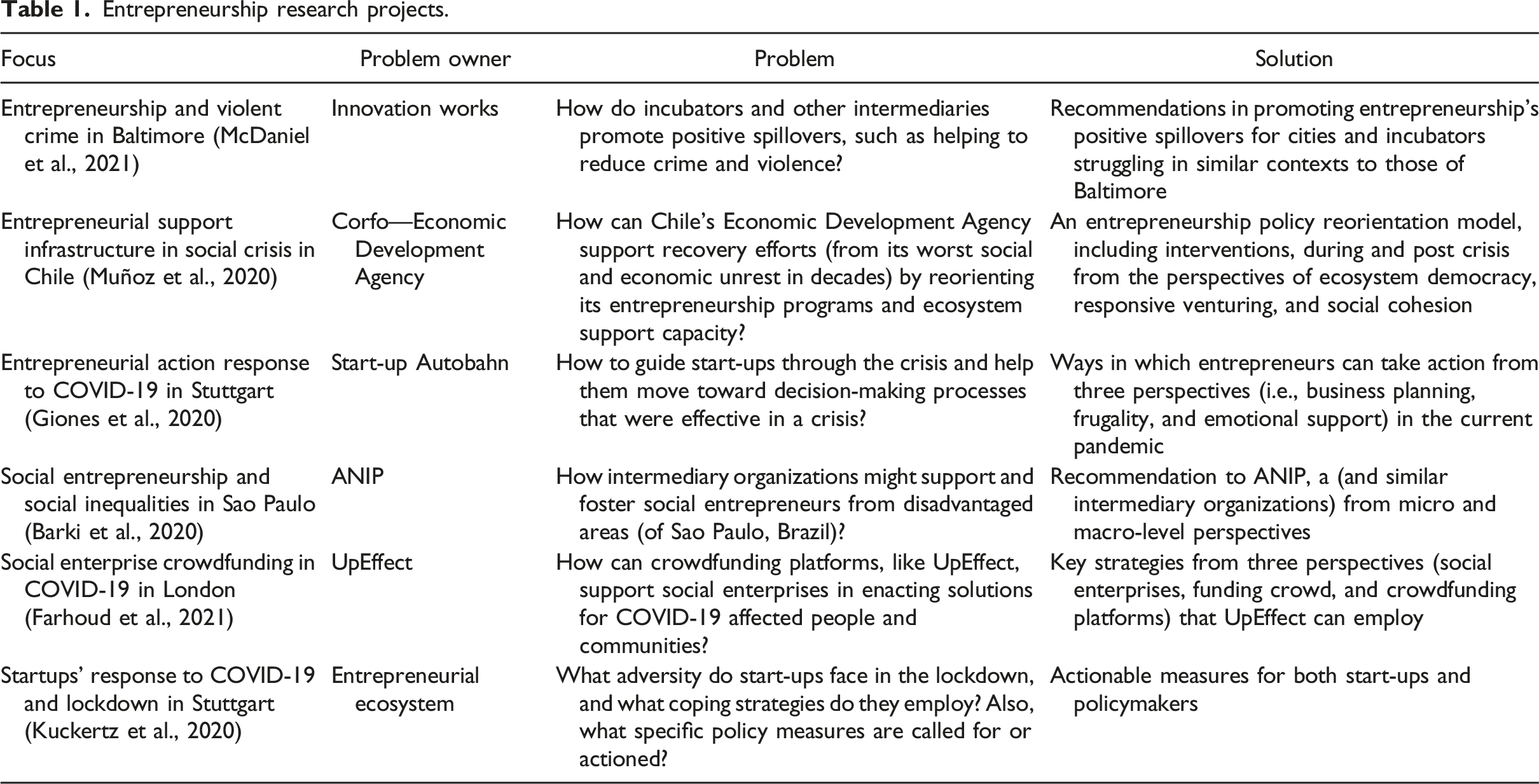
Each ER3 project comprised a lead author who was interested in a specific issue, such as crime and entrepreneurship. In this study, we use the term “ER3 project” instead of ER3 paper since our focus is on the entire project that is put together to fit the ER3 publication format. The lead author assembled an interdisciplinary team of academic collaborators, reflecting the systemic nature of the issue. For example, in a paper on crime and entrepreneurship (McDaniel et al., 2021), the team comprised academics from management (McDaniel, Sutter, Webb), race and inequality (Parker), and epidemiology (Elgar). Importantly, ER3 projects included a “problem owner” in the research team. A problem owner was a practitioner who identified the issue as relevant to her/his practice. For example, for the ER3 project on crime and entrepreneurship, the problem owner was the President and CEO Jay Nwachu of an incubator called Innovation Works in Baltimore, a city facing high crime.
Entrepreneurship research projects.
Data Collection
We collected various types of data from the six research projects. First, we conducted semi-structured interviews with the lead authors, subject experts, problem owners, and JBVI editors. We developed interview protocols 3 for each group, examining challenges, problem definition, processes, interactions, and solution development. The interviews lasted 62 mins on average, resulting in 499 pages of text.
We also had access to unique data, including communications within the ER3 project teams (e.g., between researchers and problem owners), all documentation produced during the review process (submission files, decision letters, and response letters), and informal communications between researchers and the editorial team. In addition, we participated in two workshops along with ∼200 other participants, where each ER3 lead researcher shared lessons learned during project development. The seminars were recorded and transcribed. The answers from the ER3 project researchers during the Q&A provided us with deeper insights into the processes followed by each project and the commonalities across them.
Post data analysis, we engaged in another round of data collection. We returned to our six cases to collect evidence of impact (between one and 2 years after publication), focusing on effects, changes, or benefits produced by the papers beyond academia. We also interviewed the lead authors of two new ER3 projects, with papers submitted to the journal at the end of 2021. Using these data, we were able to corroborate, calibrate, and strengthen our inferences regarding distinct problem formulation processes and the impact of the research projects.
Data Analysis
Our data analysis draws on an inductive multi-stage process-tracing methodology (Collier, 2011; Beach & Pedersen, 2013), which is a case-based method aimed at tracing mechanisms within historical processes (Mahoney, 2000). We adopted this methodological approach for two reasons. First, PT allowed us to study trajectories of change and the unfolding of events occurring in the life of the ER3 projects. Thereby, we were able to understand the mechanisms through which changes in problem formulation led to particular knowledge solutions (conducive to impact) and the key parts of the process (e.g., interactions with the problem owner) connecting the two. Using PT, we sought to identify and elaborate on a systematic and relatively simple mechanism(s) that contribute to producing knowledge solutions across our cases, that is, ER3 projects.
Our data analysis proceeded in stages, utilizing process coding and three of process tracing’s analytical tools: development of descriptive inferences within cases, identification of empirical regularities across cases, and elaboration of causal inferences (Bengtsson & Ruonavaara, 2016; Muñoz et al., 2018).
Within-case coding of timelines
Process tracing begins not with observing patterns of change directly, but rather with taking snapshots of a series of specific moments (Collier, 2011). Using interviews and secondary data, in the first stage, we chronologically structured the projects, from initial conception to publication, and developed visual timelines, which we divided into three parts—early conceptualization, paper development, and paper revision. Given the emphasis on rapidness and the use of translational research (Rubio et al., 2010), ER3 projects were normally shorter than conventional research projects and publication timeframe, ranging from 32 to 244 days. In line with our research question, our coding of timelines focused on key instances where the project’s problem formulation changed. Using the visual timelines, we paid attention to discreet stages (early conceptualization, paper development, review process), interactions within the research team, between the researchers and problem owners, between the researchers and the editors, 4 and turning points in the development of the research project, where problem formulation changed.
A key unit of analysis was the problem statement affecting the problem owner and tackled by the research team, which was operationalized as “entrepreneurship issues requiring urgent attention and knowledge-based solutions.” The problems were formulated collaboratively between researchers and problem owners during the ER3 projects, thus conveying what is collectively considered interesting, important, and urgent. In this sense, we also identified points at which the problem and solution under development were refined. Solutions published in the ER3 papers could be a framework, a table of practices, or a similar output. Solutions were prescriptive but varied in terms of the degree of concreteness in the prescriptions.
Process-tracing emphasizes the unfolding of events over time, thus we collectively coded each of these instances using in-process descriptive coding, focusing on when the problem formulation was changing, the interactions leading to that change, and the consequences thereof at the level of the solution and the change in the problem definition itself. It is worth noting that the coding procedure in process-tracing differs from the traditional content-based coding. Although codes were developed inductively, the specific codes are not meant to be representative words that summarize the meaning of a particular piece of text, rather these are inferential codes of the instances exhibiting a change in problem formulation (Muñoz et al., 2018). In the case of the Corfo project, for example, we coded change in “worthiness” the instance when the research lead and problem owner realized that a change in problem formulation would allow the research team to develop a knowledge solution through which policymakers could tackle inequality whilst supporting entrepreneurs affected by the social crisis. This was deemed as more worthy of pursuing than the mere redesign of a funding program. We marked the recurring codes of such instances, which led us to discover four critical change dimensions in problem formulation: worthiness, divisibility, centrality, and specificity. 5
Descriptive inferences
In the second stage, we explored patterns within the timelines. We explored sequences of codes within timelines to identify patterns in the interlocking instances of change in problem definition, showing empirical regularities within cases. We discovered that each time a research team interacted with a problem owner, the problem was refined in a way that it was closer to the core of the problem (i.e., problem gained in centrality), and then researchers and practitioners turned to make the problem concrete (problem gained in specificity). On the contrary, when a research team interacted with the editors or kept the conversation within the research team, the problem was decomposed into parts and their interactions (problem gained in divisibility). This reinforced the common belief that practitioners simplify and academics complexify reality, yet we observed that the two could co-exist and interact with each other as the project moved forward, which seemed to be facilitated by changes in how important the problem was for making a real-world impact (problem gained in worthiness) along with other change dimensions such as specificity. We also noticed changes at the level of solutions as the problem statement was being reformulated.
Identification of empirical regularities
Drawing on these patterns, in a third stage, we looked across timelines and stages, in search of empirical regularities (e.g., Muñoz et al., 2018). We focused on recurring interactions, changes, and patterns in sequences of the four critical change dimensions and noticed sequences of critical events, which were shared by the ER3 projects. Here, the ordered sequences, and patterns thereof, are central to the identification of alternative processes of problem formulation. We paid attention to and built our inferences around sequences of changes across the lifetime of the projects, not just the appearance of change dimensions in isolation. In this sense, for example, although divisibility appears in stage 1 in five of the six projects, in only three of them (UpEffect, Autobahn, and ANIP), it follows from worthiness and is followed by centrality, marking a pattern in sequence (worthiness > divisibility > centrality). Process-tracing centers its attention on identifying regularities in the process, identified as central in the production of the outcome we seek to explain. From here, we discovered two problem formulation pathways comprising three ER3 projects each. These are marked by the drivers of the research project (i.e., inward- or outward-looking concerns), the timing of involvement of the problem owner, and the interactions between actors involved (iterative or joint), which, when combined, influence the sequence of appearance of the four critical change dimensions underlying problem formulation. Figure 1 shows the two pathways, with the coding of change dimensions and empirical regularities. Empirical regularities*.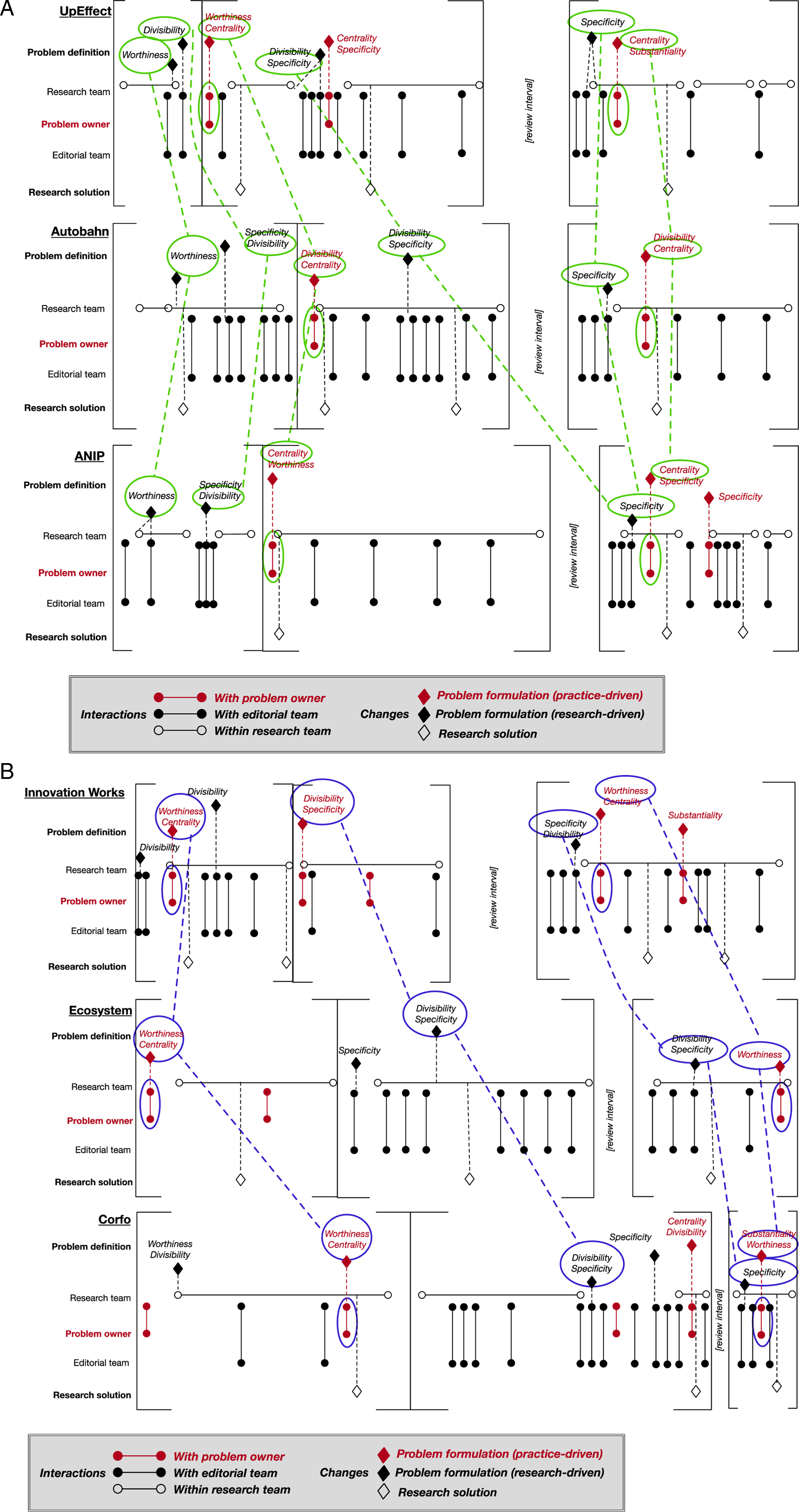
Further, we found that pathways matter. They explained: how interactions between project actors affected the formulation of problems, how solutions were intertwined with problem formulation and hence were reshaped as problems changed, and how rigor, relevance, and timeliness materialized in solutions.
Toward problem formulation pathways in impact-oriented research
Problem formulation for impact: Conceptualization of causal mechanisms.
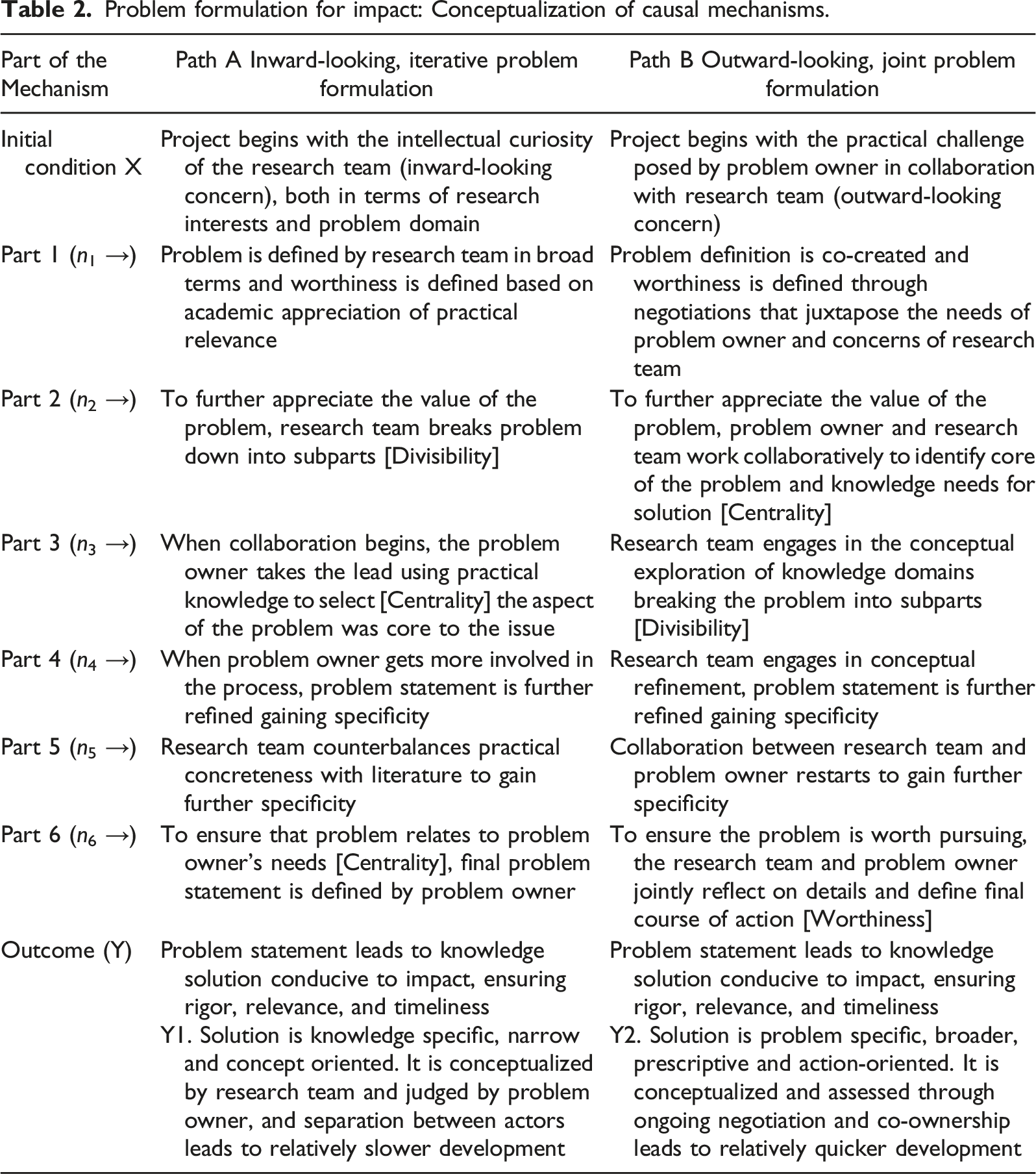
In the following, we present our two key findings in detail that build on our inferential work. We first introduce the four critical change dimensions underlying problem formulation, and then the two pathways (change trajectories) for impact-oriented research.
Findings
Four Critical Change Dimensions in Problem Formulation
We found four critical change dimensions in problem formulation, along which problems evolve, namely worthiness, divisibility, centrality, and specificity. These dimensions are not attributes of the problem, but rather activities that research teams and problem owners engage in and through which problem statements appear to evolve. They co-existed and were used recurrently throughout the research process, as the knowledge solution began to materialize. These dimensions emerged through interactions between various actors.
Worthiness is the value of the problem at hand. The research team and problem owner reflected on how important it was to solve the problem, and how relevant it was for practice, knowledge, and society more broadly. Thus, gains in worthiness, achieved via problem reformulation, increased the sense that the problem was sufficiently important and deserved to be pursued and solved. For example, the Start-up Autobahn project changed the problem formulation from “how to re-organize and adapt activities of an accelerator/platform during a crisis” to “how-to guide start-ups through the crisis and help them move toward decision-making processes that were effective in a crisis.” While both involve start-up support, the research team decided that the latter problem statement was more important as they saw that the problem could significantly contribute to knowledge in the field of study. In the Entrepreneurial Ecosystem project, the team investigated the adversities that start-ups faced during the COVID-19 lockdown and their coping strategies. For the research team, worthiness increased as the problem included “protecting the economy under lockdown,” along with entrepreneurial coping. Worthiness in the problem definition moved the project toward impact by creating commitment to the problem’s resolution and solutions. For example, by reflecting on the worthiness of the problem, the Corfo research team realized that entrepreneurship funding, needed to support struggling SMEs, was also part of the problem as government funding had historically contributed to increasing inequality gaps. The problem was reformulated accordingly to include issues such as democracy, voluntary action, and social cohesion. This change in problem formulation, which also yielded a change in the solution, proved central to the solution’s translation into a new policy proposal.
Divisibility refers to parts of the problem and the interactions between various parts. The team engaged in splitting the problem statement apart, by decomposing the original problem statement into smaller (sub) problem statements. Divisibility allowed the research teams and problem owners to identify “what parts” of the problem were relevant and understand how relationships between such parts can change the problem statement. It also enabled prioritization and narrowing down the scope of the problem statement. Thus, gains in divisibility improved the team’s understanding of the parts of the larger issue, and the relationships between the parts. For example, the Corfo project and the Innovation Works project dealt with complex social and economic issues. The former examined entrepreneurial support infrastructure in the Chilean social crisis, while the latter explored entrepreneurship and violent crime in Baltimore. Both teams managed to break down the problems, via interactions with the editors and within the research team, into different facets—ecosystem, business venturing, and social cohesion in the Corfo project, and sociology, psychology, and entrepreneurship in the Innovation Works project. Such an in-depth understanding of the problem in terms of sub-parts helped the lead author in each project to identify the relevant literature and experts who could join the research team. The Corfo team realized that helping entrepreneurs during a social crisis was not so much about changes in funding, but about changes across multiple levels of support involving a much more complex entrepreneurial support infrastructure, which was affected by more enduring issues such as extreme inequality in the country and the fact that entrepreneurship policies were part of the problem. In this way, changes in divisibility helped move the project toward impact, revealing the interdisciplinary nature of the problem and putting together a team of interdisciplinary experts who could bring the relevant expertise to the table.
Centrality refers to the core part of the problem at hand. The team engaged in narrowing down the problem statement by prioritizing the most essential out of many possibilities of problem formulation. Centrality generally worked in conjunction with divisibility, since the latter opens the space for selection in the former. They are, however, different, as centrality allowed the teams to zoom into the core, as opposed to zooming out and seeing the interactions between parts, which divisibility entailed. Centrality also differed from worthiness since worthiness referred to an assessment of the value and importance of the problem, rather than identifying the core of a problem. Although the central part of the problem can be identified, it does not mean that it is worth pursuing by a research team. Because the problems were usually complex, reformulating the problem around the core proved essential. As such gains in centrality, achieved via problem reformulation, reduced the degree of problem complexity, which tends to negatively affect the capacity of acting upon them. For example, in the Innovation Works project, the research team investigated how incubators can help increase entrepreneurs’ access to funding in Baltimore but then realized that funding was not the central issue facing problem owners. Behind funding, there was a more central issue which was how Innovation Works and other ecosystem members could help the City of Baltimore address crime. To reflect this shift, their problem statement changed from “How can incubators help entrepreneurs increase their access to funding in large cities suffering from high crime rates and low-income levels?” to “How incubators and other intermediaries promote positive spillovers such as helping to reduce crime and violence?” Therefore, by rightly locating the core among a myriad of options, the research team could produce solutions that tackled the root cause of the problem, akin to putting out a fire by cutting off the oxygen. Simply stated, changes in centrality contributed to impact by narrowing the focus to the problem owner’s core issue.
Summary of critical change dimensions in problem formulation.
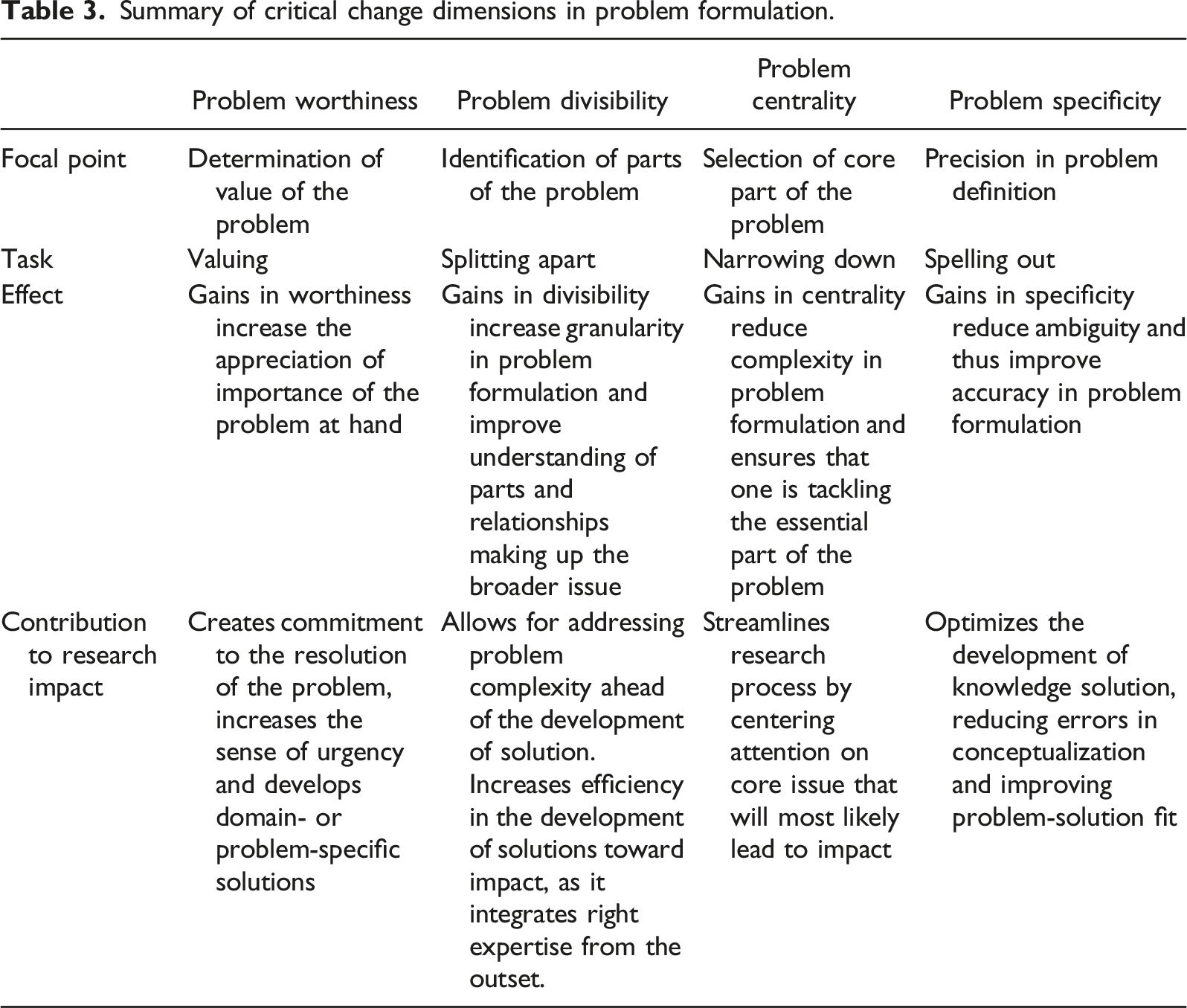
Arguably, the change dimensions could be seen as sequential. Worthiness is a general agreement on the value and urgency of the problem; divisibility is breaking the problem into parts and seeing the parts interact with each other; centrality is about identifying the core of the issue faced by the problem owner, and specificity is describing the problem clearly and precisely. However, we found that these change dimensions were emergent such that they did not follow an intuitive sequence; instead ebbed and flowed throughout the project, often trading off each other. In the next section, we explain this flow.
Two Problem Formulation Pathways in Impact-Oriented Entrepreneurship Research
In looking across the timelines, we discovered two equifinal problem formulation pathways in impact-oriented entrepreneurship research. Both pathways begin with (X) problems to be solved through research and finish with (Y) knowledge solutions conducive to impact, showing alternative expressions of rigor, relevance, and timeliness. However, how pathways move from X to Y differed. Changes in how problems are formulated and lead to knowledge solutions were marked by: (1) the drivers of the research project (i.e., inward- or outward-looking concerns), (2) the timing of involvement of the problem owner, and (3) the types of interactions between the actors involved (iterative or joint formulation). These three, combined, influence (4) the sequence of critical change dimensions in the problem formulation. In the following, we leverage the conceptualization of causal mechanisms inferred in Table 2 to explain the two pathways in detail.
Path A: Inward-looking, iterative problem formulation in impact-oriented research
The problem definition on this path changed along the sequence of worthiness—>divisibility—>centrality—>specificity—>[further]specificity—>centrality (see Table 2). The project began with inward-looking concerns and intellectual curiosity of the research team, both in terms of research interests and problem domain. For example, the lead author of ANIP had been involved in organizations supporting social entrepreneurs in Sao Paulo, Brazil. He was broadly interested in how the lack of multiple types of capital can influence entrepreneurship and saw that an examination of the latter can eventually help micro-entrepreneurs living in the Favelas. In the conceptualization stage of this project, there was no involvement of a problem owner, so it was the lead author’s knowledge of entrepreneurship, curiosity, and concern about neglected entrepreneurs pushing the research efforts forward, which led to the first problem statement in the project: “How to develop an appropriate ecosystem to support entrepreneurs at the periphery, with consideration of the extant social, economic, and human capitals?”
As a result, in the first stage of the project, the problem tended to be broad, and its pertinence to practice was evaluated solely by the academics on the research team. The problem was refined for the first time when the research team reflected on why the problem requires a solution and concluded that the issues underlying the problem were urgent and relevant to practice (worthiness emerges, see Table 2). Further, worthiness was related to divisibility, that is, breaking the problem into subparts and finding the interrelations between the parts. For example, in the case of Start-up Autobahn, to select a problem “worth pursuing,” the research team broke down the problem into parts (divisibility), moving from the problem of “lack of guidance on entrepreneurial response” to breaking the concept of “guidance” in terms of business planning, frugality, and emotional support. While doing so, the research team engaged in a conceptual exploration of the problem space to further refine the problem. In this sense, worthiness and divisibility changed in tandem. The lead author of Start-up Autobahn reflects on this process: There are assumptions that we tend to make [regarding] what is relevant for practice, what are the managerial problems… sometimes those assumptions are not built on correct foundations or not on accurate observations. … And it can be a very isolated problem.
Further, on this path, problem owners joined the research team during paper development, (stage 2) and played a prominent role in further changing the problem definition. Based on his/her needs and experience, the problem owner helped select which aspect of the problem was core to the issue and could be tackled (centrality). For example, in the UpEffect project, the research team regarded the problem owner as “the compass in the project,” especially in the case of disagreements within the research team. There was once a challenging time when the research team had disagreements on which angle to take as there were many different perspectives from multiple academics on the research team. The project was stuck for several weeks and could not move forward. But then the research team realized that “it was the problem owner whose needs should be put first,” and the lead author started to examine each possible angle bearing in mind the fundamental need of the problem owner. In the end, the research team achieved agreement and chose three perspectives that were most relevant and useful to the problem owner—the social enterprise perspective, the crowdfunding perspective, and the crowdfunding platform perspective. The problem owner then encouraged the research team to further refine the problem, such that the problem statement was sufficiently concrete (specificity) from both a practical and a research standpoint.
In this sense, not involving a problem owner from the beginning had consequences for the development of the projects, in terms of both problem formulation and crafting of the solution. This is because the role of the problem owner was one of selecting and prioritizing aspects of the problem once the research team had already made headway on the problem formulation. The lead author of UpEffect reflected: So, she’s (problem owner) filtering the things that are not relevant and also maybe redirect the [project]...She’s the compass.
In the final stage of the project, the research team and problem owner worked together to bring more concreteness and conceptual refinement to problem definition, mostly leveraging the research team’s knowledge of the literature and the problem domain (specificity). However, the research team asked the problem owner to select the final course of action, modifying the problem one last time (centrality), and in turn, the solution. As the lead author in the ANIP project commented: The final solution was quite different from the first one … so the partnership [with the problem owner] was more than just calling out [a practitioner for member check]. … It really improved the article, the ideas.
Path B: Outward-looking, joint problem formulation in impact-oriented research
The problem definition on this path changed along the sequence of worthiness—>centrality—>divisibility—>specificity—>[further]specificity—>worthiness (see Table 2).
This path was driven by outward-looking concerns, that is, a challenge posed by the problem owner and negotiated with the research team. Here, the problem’s worthiness was co-created from the start. For example, after the 2019 social crisis in Chile, the head of seed investment at Chile’s Economic Development Agency approached Corfo’s lead author for research-based answers to support entrepreneurs during the crisis, given the lead author’s experience in studying post-crisis entrepreneurship. The problem owner was deeply involved in the first stage of the project, that is, it was the problem owner’s specific needs that moved the research efforts forward. Problem owner with the Economic Development Agency commented in this regard: The original challenge, back in October 2019, was a social crisis. So [we] started in January 2020 to explore this idea of how we can reorient the entrepreneurship policy to help these entrepreneurs after the social crisis. The first goal was [to resolve] what [will be] the role of entrepreneurship after this crisis, specifically. The next step [was] how to lead [entrepreneurs] with a good policy.
The problem faced by the problem owner seemed simple on the surface, yet the situation was unique, and convoluted since there was a tension in trying to help people with policy tools that were deemed to be at the core of the problem triggering the crisis. This led the research team to focus on research from multiple disciplines, each dealing with a different level of analysis. As a result, the problem definition was refined collaboratively with the problem owner (i.e., worthiness). Importantly, while worthiness was evident in the early stages (same as Path A), in Path B worthiness was achieved as the needs of the problem owner met the concerns of the research team.
Furthermore, instead of engaging singularly in conceptual exploration (as in Path A), the co-ownership of the problem with the problem owner at this initial stage led the research team and problem owner to identify the core of the problem and the boundaries of the knowledge needed to articulate a solution (centrality). Unlike Path A, the problem owner here played an important role in framing and conceptualizing the problem. For example, in the case of Innovation Works, before meeting the problem owner, the research team understood the problem and what should be done. However, through the discussion, they realized that “the incubator has already done lots of the things we were about to suggest.” As a result, the research team had to change course and identify the problem in collaboration with the problem owner. As the lead author explained: The incubator did a great job of helping us tone down our speech…We kept calling Baltimore the most violent city in America, and he said stop doing that, it labels. And we're trying to do the opposite we're trying to make it attractive….
Similarly, in the case of the Entrepreneurial Ecosystem project, the problem owner played a central role in the delineation of the problem. The lead author explained: The research idea was triggered by Germany’s Federal Minister for Economic Affairs and Energy [he said] “absolutely no measures will be excluded to protect the economy”…his strong policy announcement indicated a serious crisis that deserves research [attention].
The collaboration between the research team and problem owner continued into stage 2 (paper development), although the research team played a more dominant role, as compared to stage 1. The research team engaged in the conceptual exploration of possible knowledge domains breaking the problem into subparts (divisibility), which happened in conjunction with conceptual refinement (specificity). For instance, in the Corfo project, the research team broke down the problem into challenges occurring in multiple levels of analysis to then prioritize three: the failure of policy in promoting equality within ecosystems, the lack of consideration of spontaneous venturing, and the neglect of social cohesion in the design of policy responses.
In the last stage, the problem owner re-engaged to work hand in hand with the research team, and the editor asked the research team to further specify the problem details (specificity). As the research team and problem owner jointly reflected on the details, they could once again identify the elements in the problem worth pursuing (worthiness), thus also changing the solution. For example, during the final review round in the Innovation Works project, after reflecting on how Baltimore is representative of similar situations across the United States, the research team repositioned the paper with the city of Baltimore as the problem owner/context and Innovation Works as part of the solution. Therefore, the worthiness of the problem goes beyond Baltimore, and their proposed solution could be replicated in other cities that are suffering from the same issue.
Implications for solution development
As the teams refined the problems, we discovered that solutions also changed. While this is not particularly novel, since answers tend to change when questions change, what is interesting here is that solutions changed in the process after the interactions with the problem owner.
Rigor, relevance, and timeliness—essential criteria to assess research impact—were achieved in the solutions of both paths, but they materialized in slightly different ways. In terms of rigor, Path A solutions were knowledge-specific, thus narrower in conceptual scope but deeper in conceptual elaboration. Whereas Path B solutions were problem-specific, thus broader in scope, and more prescriptive. 6 As a result, Path A solutions gravitated towards conceptual contributions and Path B towards practical contributions. In terms of relevance, Path A solutions were conceptualized within the research team and then judged by the problem owner, whereas Path B solutions were forged through ongoing negotiations with the problem owner. Finally, in terms of timeliness, Path B projects moved faster (90 days on average, vs. 188 days for Path A) where the problem owner and research team had co-ownership of the problem. This is counterintuitive since the active involvement of practitioners in research processes is thought to be a potential source of delay. However, even with the negotiation and reflection periods in Path B, the process did not slow down.
As a result of the above patterns, we observe differences in the presentation and communication of solutions. Path A solutions were formal and concept-laden. Representation of the solutions in the published papers emphasized systematizing knowledge and showing linkages between various elements and concepts. Whereas Path B solutions were less concept-laden and more prescriptive, providing practical guidance and concrete calls to action (see Appendix C).
Research impact
Impact evidence of the entrepreneurship research projects.
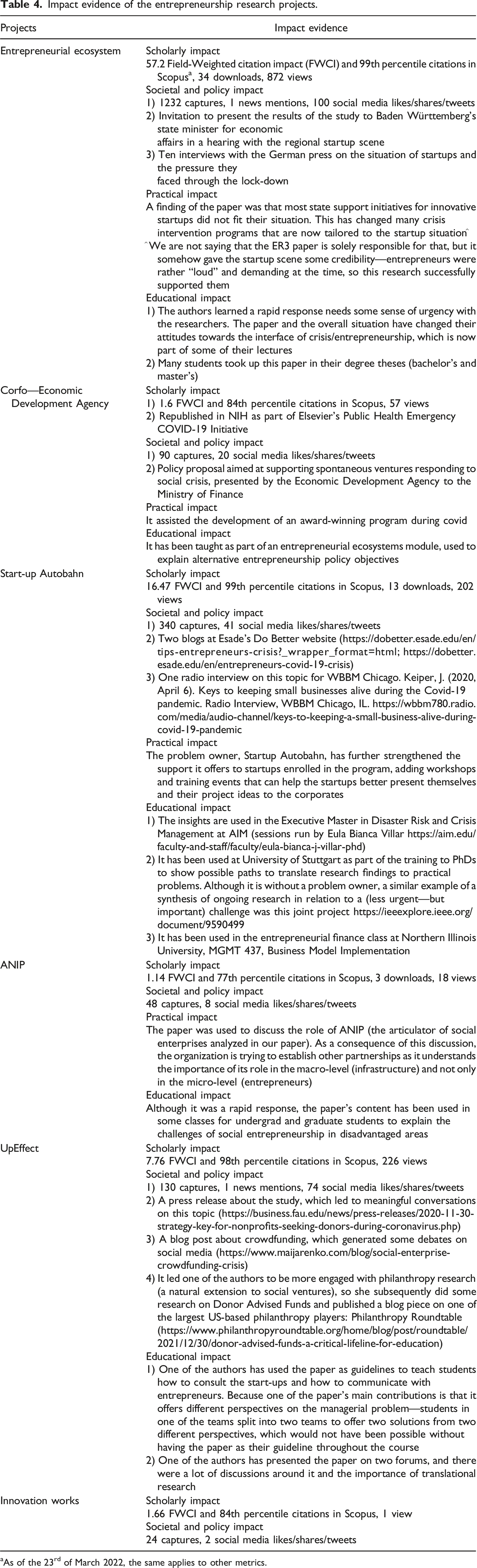
aAs of the 23rd of March 2022, the same applies to other metrics.
In terms of societal and policy impact, the authors of these projects participated in several interviews with the media (such as the Entrepreneurial ecosystem project and Start-Up Autobahn project), wrote blog posts (for instance UpEffect project and Start-Up Autobahn project), and were invited to engage with the public in sharing the insights from their study. The Entrepreneurial ecosystem paper is illustrative of this kind of impact. The lead author had ten interviews with the German press on the topic of start-ups, and the pressure they experience in a lockdown. He described, “in the very early phases of the lockdown, I was asked to present results of the study to Baden Württemberg’s state minister for economic affairs in a hearing with the regional startup scene.” Additionally, in the Corfo project, the authors also made a policy proposal aimed at supporting spontaneous ventures responding to the social crisis. The Economic Development Agency head, who was the problem owner in the project, made the presentation to the Ministry of Finance. Along the same lines, in the UpEffect project, one of the authors became engaged with philanthropy research (a natural extension to social ventures, which was the topic of the ER3 project). She subsequently published a blog piece on Donor Advised Funds and one of the largest US-based philanthropy players: Philanthropy Roundtable.
Such societal and policy impact can be attributed to the topic—lockdown during covid—and the media’s attention on the topic. However, for several papers, the impact was beyond topical interest, especially seen in educational impact. Many from the author team described using the article in their business school courses. Others described the enriching experience that the ER3 process had in how they approached the topic and research in general. One lead author expressed, “I learned [that] rapid response needs some sense of urgency...the paper and the overall situation has...changed my attitude towards the interface of crisis/entrepreneurship, and this is now part of some [of my] lectures.” Others provided specific examples of specific courses. One lead author shared that the process of rapid response and translation research is “part of the training to PhDs to show possible paths to translate research findings to practical problems.” Further, one of the authors used the findings in the paper to teach students how to consult with start-ups and communicate with entrepreneurs.
In terms of academic impact, all six papers have been collectively viewed 1376 times with an average of 14.3 Field-Weighted citation impact (FWCI). Table 4 provides other metrics. Although these metrics are imperfect indicators of impact on the field of entrepreneurship research, especially given that the earliest paper is less than 2 years old since publication, they are positive indicators of potential for ER3 papers to impact the field.
Practical impact is central to the ER3 efforts, and yet, often the most elusive to achieve and describe. We found evidence of positive changes in the problem owners’ organizational practices. For example, the lead author of the entrepreneurial ecosystem project described how the German government began to pay attention, and state-supported initiatives began to consider how to avert crisis for startups. At the same time, the authors acknowledged that drawing a line of sight from the ER3 paper to this shift in state-supported initiatives for startups is challenging, at best. Others described the ER3 paper as one, albeit very important, step toward the hard work of institutional building. For example, the problem owner for the Corfo project described, “we are in the right direction with this first publication… now we have the paper, then you have to start to share, you know the findings or the ideas with different stakeholders and try to figure out if this makes sense for them…my plan is to keep providing evidence, providing research [to] policymakers…to at least ask good questions about our future.”
For one team, the problem owner hesitated to endorse and only peripherally used the findings because the findings did not align with the problem owners’ interests. For another, the problem owner was just one audience out of many such that urgency and rapidness took a different flavor. Urgency, and hence impact, was anchored in the issue and not specifically in how problem owner changed their practice. For example, the lead author of the Innovation Works project described, “it wasn’t the paper, I thought it was going to be like here’s all of our brilliant wisdom as a gift to you, you know we’re going to save you. It was more like you guys are doing a great job here’s a couple of things you can do better” and yet the paper provided implications for the broader entrepreneurial ecosystem in Baltimore and other crime-ridden cities, that was beyond changing the concrete practices of one organization. Change and urgency, in this way, were different in different cases, such that the urgency that a paper on lockdowns and startups (i.e., the entrepreneurial ecosystem project) could address was different from changing the entrepreneurial ecosystem in Baltimore to address crime.
Discussion
Many scholars argue that research impact entails defining a relevant question that research can answer. A relevant research question, when answered, will yield research insights useful to practice (Gulati, 2007; Shapiro et al., 2007). However, a research question is different from a problem of practice such that there is little guidance on how one may define problems relevant to practice, and even less so on how the process of problem formulation influences the solutions to the problem. One insight from prior work that can serve as a point of departure is that defining a problem that impacts practice requires interactions with those facing the problem (Van de Ven, 2007).
Summary of problem formulation pathways: Roles, drivers, and actions.
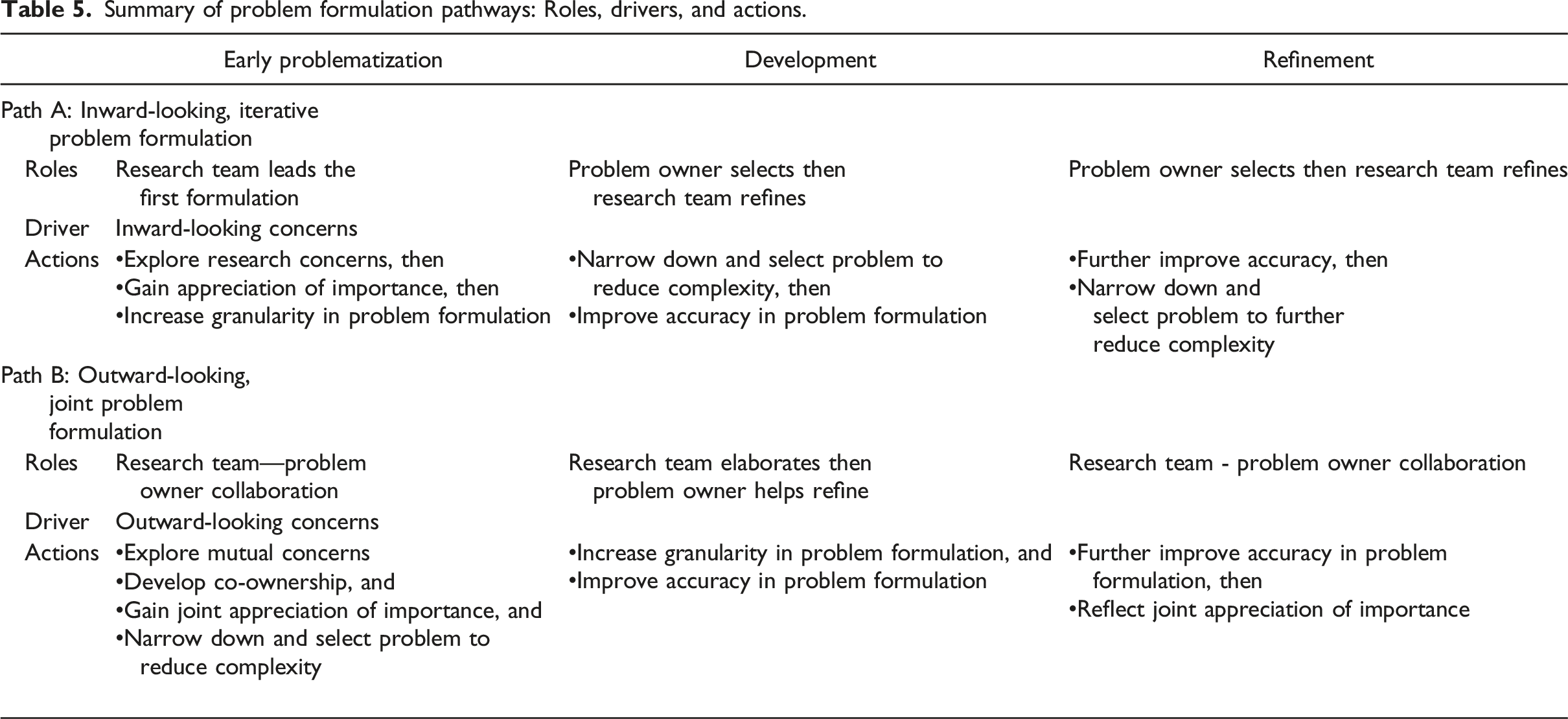
Importantly, these pathways are integral to impact-oriented research, that is, both produce solutions that are timely, rigorous, and relevant, albeit in different ways. Hence, we open the black box to show that there are many ways to conduct impact-oriented research, but the choices made in the research process, such as when to involve the problem owner, are consequential for the solutions produced. Importantly, one path was not better than the other. Below, we describe the implications of these insights for entrepreneurship scholarship, the literature on research impact, and the practice of conducting impact-oriented research.
Contributions
Relevance in entrepreneurship research
We contribute to the scholarly focus on the relevance and impact of entrepreneurship research (Wiklund et al., 2019) in several ways. First, we contribute by showing how entrepreneurship researchers can develop problem-centered questions in conjunction with practitioners to maximize the impact a project can have. Most notably, we offer two alternative pathways of how entrepreneurship researchers can engage in collaborative, problem formulation. The inward-looking iterative path began with the researcher’s focus on an issue or concern. The problem owner entered the process later. The problem owner’s work with the researchers was characterized by prioritizing and choosing elements of a problem and solution, rather than negotiation and joint reflection. The problem evolved along the critical change dimensions accordingly, and the solution produced was knowledge- and domain-specific. In contrast, the outward-looking joint pathway began with the involvement of the problem owner right from the start. The early stages of any research project are fraught with uncertainty. Hence involving problem owners implied a fair amount of negotiation (e.g., Amabile et al., 2001) and co-ownership of the problem. Such co-ownership between the research team and the problem owner continued throughout the project such that the solution produced was issue-specific and prescriptive. Importantly, both paths produced knowledge-based solutions that were rigorous, relevant, and timely, albeit varying in how rigor, relevance, and timeliness manifested. In other words, solutions emerging from both pathways had elements of analytical and practical, but they were privileged differently.
These two collaborative pathways complement Shepherd et al.’s (2021) inward-looking approach, whereby entrepreneurship researchers should frame agendas for impact by engaging with a ‘me-search', that is, “scholarly attention on the future based on one’s personal experiences” (p. 956). The problem formulation pathway we label as “inward-looking” aligns with this take on research opportunities based on the personal interests and experience of the researcher. We complement this insight by offering another pathway, which we call an “outward-looking, joint” pathway, one that is driven by a mutual examination of the practical challenges faced by a problem owner, because the problem owner is invited to weigh in. In this way, we not only complement Shepherd and colleagues’ insights, but our findings could directly address the problems they identify, such as the balance between personal and universal (and hence generalizable) experience, which in our case could be addressed because of the diversity of researchers and importantly a problem owner on the team.
Implications for doing impact-oriented research
The two pathways of problem formulation offer practical implications for researchers interested in the impact of their research on entrepreneurial practice. The pathways can be fully integrated into the methodological repertoire of entrepreneurship researchers aiming to achieve impact. Commentators have identified that entrepreneurship doctoral studies can benefit from connection to practice (e.g., Brush et al., 2003). Below, we offer a few implications for entrepreneurship researchers that can be integrated into doctoral studies and beyond on conducting impact-oriented entrepreneurship research.
We found that when a problem owner enters the research process is significant for change in problem definition, and hence the solution. Specifically, in the inward-looking formulation, the problem owner does not enter until later in the research process, and hence worthiness of the problem was defined primarily by the researchers. It helps in conceptually understanding the intricacies of the problem. However, researchers cannot get to the core of the problem (centrality) until the problem owner enters the research process. In contrast, in the outward-looking joint formulation, both worthiness and centrality are evident from the start because researchers and problem owners were working hand in hand. However, this gain comes at the expense of the divisibility of problem definition, which does not emerge until the later stage. In other words, defining a problem for impact is not only about whether a problem owner is included or not but also when s/he enters the research process, and at which stage is s/he most involved.
As well, each interaction with the problem owner, irrespective of the path, yielded a change in the problem definition. Figure 1 shows that the involvement of the problem owner was consequential. Sometimes the change in problem definition happened right after the interaction. Other times the researchers interacted with each other before changing the problem. Interestingly, this pattern was steady across both paths. This insight further underscores the significance of involving practitioners in the research process (Mohrman et al., 2001).
Further, the path an entrepreneurship researcher follows is consequential for the solution that s/he produces. Others have argued that a research problem demarcates the boundaries of prior research insights that the researcher can build from (Avenier & Cajaiba, 2012), and hence delineates the boundaries of the solution space (Van de Ven, 2007). We also found that within a similar solution space characterized by rigor, relevance, and timeliness, even slight changes in the research process, such as focusing on the divisibility of the problem before its centrality, can yield solutions that vary in terms of their abstraction and concrete prescriptions for practice. In leveraging this insight, entrepreneurship researchers can orchestrate the research process for the right degree of abstraction in the solutions for impact.
To provide more concrete implications for entrepreneurship researchers interested in impact-oriented research similar to ER3, we asked ER3 authors to reflect on what helped them navigate the process. They underscored the importance of team structure, drawing on what you know, and avoiding a generic and empty set of recommendations for practice, which we explain below.
Team structure varied across ER3 projects, some with more centralization (e.g., Entrepreneurial Ecosystem) and some with less so (e.g., Innovation Works). However, they shared one similarity. All projects worked with rapidness. Some of the ensuing practices were working in parallel instead of sequentially (Entrepreneurial Ecosystem), discussion amongst co-authors but lead author taking the final decision (Start-Up Autobahn), when possible, physically co-locating with co-authors and problem owners for quick sense and response (ANIP). Relatedly, each team was a mix of early career and senior researchers, such that early career researchers were supported in pursuing impact while not facing the challenges that early-career scholars may face (e.g., Friesike et al., 2022).
It was also important to leverage the existing expertise of the research team and not introduce new methods or theories that would take time. Rigor came from years that the research team spent mastering the topic. ER3’s focus was on translating what one knows and synthesizing it with what co-authors and problem owner know on the topic.
Finally, and central to ER3 was that the papers presented recommendations for practice. However, often recommendations could be generic and empty such as “be ready to change” or “look for support early”, especially since researchers seldom hold the skills to present recommendations. Involving problem owners was useful in this task (Innovation Works). As well, identifying the boundary conditions and tensions between the recommendations (e.g., “when do our recommendations stop working”, or “what are the inconsistencies between the recommendations”) was useful to shift from generic to relevant.
Finally, insights from this paper have implications for the practice of journal publishing. ER3 is a model that is outside of mainstream academic publishing, and yet can be a prototype for editors and reviewers who care about the impact of research on practice. More concretely, the editor in the ER3 process emphasized to the researchers that the problem must be defined in collaboration with the problem owner. Researchers cannot imagine their way into a problem definition. It was evident in the process we laid out that the problem definition changed, and that change was because of engagement with the problem owner. Others have pointed to the importance of involving practitioners in say writing the implications section of a paper (Bartunek & Rynes, 2010, 2014). ER3 shows us that formalizing this process can move the research toward greater relevance to practice. Reviewers, similarly, have an important role to play. ER3 reviewers were authors of published ER3 papers. They had experienced and understood the value of quick turnarounds, and more importantly, organizing frameworks, tables, etc., in a way that speaks directly to practice. Reviewers in other journals could take it upon themselves to ask the authors not only “what’s interesting” but also “what’s useful” and important to address (Tihanyi, 2020).
Contribution to the literature on research impact
Our work has important implications for the literature on research impact. It develops a novel understanding of problem formulation as a process and explains the relationship between time and research impact.
Problem formulation is a process
Defining research problems that can impact practice is largely a black box in prior literature. The available guidance focuses on the researcher, and what s/he can do to ensure that the practitioner’s inputs are included (Gulati, 2007; Howard-Grenville et al., 2019; Van de Ven, 2007). We contribute by providing empirically grounded pathways for defining a research problem for impact. We show that problem definition is not a snapshot, rather it is a process, and it is collaborative. The change dimensions of the problem that we identify—centrality, divisibility, worthiness, and specificity—are not static attributes, as alluded to in prior literature, rather they ebb and flow throughout the research process, and often trade one for the other based on the interaction across various actors. For example, in the inward-looking, iterative problem formulation path, worthiness can drive divisibility, which fades to the background when the problem definition gains centrality, but can come to the foreground again later in the process. With each change, the problem definition changes. Importantly, such changes happen because of interactions between researchers and problem owners. In other words, we provide an understanding of problem definition that is continuous, and deeply social. Such understanding can foster the growth in problem-oriented research for impact (Watts, 2017).
Time and research impact
Time is one reason for the failure of research to impact practice. Researchers and practitioners (problem owners) have different temporal horizons (Bartunek & Rynes, 2014). Because research is decoupled from practice, and researchers are encouraged to be “free intellects” (Sarewitz, 2016), this difference in time horizons further exacerbates the gap between research and practice. Urgent issues such as the COVID-19 crisis, or escalating crime in a city, require immediate solutions, but the temporalities of research and practice knowledge systems make it challenging for researchers to provide quick solutions (Dykes, 2021). A range of special issues on COVID-19 are appearing in 2022, offering in-depth explanations of what already happened. While relevant, the timing seems inconvenient for practice as governments are rolling back support and entrepreneurs are gearing up for the next crisis. In this context, our study contributes by offering one way in which researchers can provide evidence-based solutions for practice in a short time frame. In our study, there were many ways to circumvent the differences in time between research and practice. On the one hand, both researchers and problem owners drew on their expertise and experience to create solutions. Translation research (Rubio et al., 2010) allowed researchers to leverage the years of expertise they had developed to begin developing solutions, shortening the time horizon. At the same time, problem owners could look beyond their immediate organizational problem and focus on addressing the larger issue underlying the problem, extending their temporal horizon. Such contracting (researchers) and stretching (problem owners) of the temporal horizons was one way for both to work together and navigate the differences in their time horizons. On the other hand, the urgency of the issue was reflected in the timelines of the projects. The projects lasted from a few weeks to a few months, significantly shorter than the timeline of an entrepreneurship journal publication process, which could easily last years (Elangovan & Hoffman, 2019). By intentionally creating a shorter timeline, the urgency of the issue was baked into the research process. Both researchers and problem owners stepped up to the timeline. They had the freedom to define the length of the project and yet knew that the ER3 format is fast-paced. Therefore, the difference in time horizons was replaced by a common, albeit temporary, timeline agreed upon by both researchers and problem owners.
Implications for Practice
Our insights also have implications for practice. They offer ways in which entrepreneurs (problem owners) can collaborate with researchers to produce relevant and rigorous knowledge. Most often than not, practical implications are an afterthought for researchers arguably because practitioners do not have an opportunity to weigh in on the research insights published in our journals (Bartunek & Rynes, 2010). Further, given the differences in how researchers and practitioners define and solve problems, a research setting often means that practitioners take a backseat, that they trust the researchers to follow the research process, often participating passively in collaborative projects and hence refraining from adding meaningful insights (e.g., Sharma & Bansal, 2020b).
Our empirical insights offer concrete ways in which entrepreneurs can engage with researchers as knowledge partners. Entrepreneurship researchers and entrepreneurs can design collaborative projects with these insights as decision points for the practitioner’s involvement.
Specifically, it is important for the problem owners involved in such projects to shift their gaze from “what is in it for me” to how can I contribute my insights to find solutions to an important problem experienced by similar others. It is not an easy task, given the demands on an entrepreneurs’ time, but it is an important shift for such projects to be successful. A problem owner can play many roles in a project such as ER3 such as asking critical questions (ANIP project); challenging the researcher on the less than useful generic recommendations, abstract frameworks, or incorrect language (Innovation Works project); fostering connections between researchers and others in the entrepreneurial ecosystem (Entrepreneurial ecosystem project), and being a change agent who shares the research insights with peers (Corfo project). It is important that the role that the problem owner takes on is in line with the skills s/he brings to the table and her interests.
Boundary Conditions and Future Research
Our study followed six ER3 projects. ER3 can be seen as an outlier in how the traditional journal publishing process works. Rarely do practitioners play a role in concert with researchers and editors. This extreme case (Pratt, 2009) offered us a chance for rich theorizing, and yet future research must interrogate this question across a wider sample, that is, within similar context—journal publishing, and actors—researchers, practitioners, editors, and reviewers. However, given the current state of academic publishing, this opportunity may not present itself soon.
As well, there are other boundary conditions to our research, urgency inherent in the topics being one of them. ER3 projects are rapid response projects, so an obvious question is whether certain topics are more conducive to ER3. For example, Covid-19 provided an opportunity for researchers and problem owners to come together around a shared experience. It also introduced an unprecedented sense of urgency for solutions. It is possible that problem owners may not experience a similar motivation to collaborate, once crisis events such as Covid-19 are behind us. Relatedly, researchers may look for “hot topics” (e.g., Lee, 2001) that inevitably fade away such that the knowledge produced does not remain relevant. It is here that returning to the notion of working together to define a problem becomes relevant. It is this deeply collaborative process that can help avoid chasing hot topics that do not yield useful knowledge for the long term. Yet, it remains an empirical question, and future research must ask whether our insights are contingent on certain topics that are salient at the moment, and not otherwise. Further, future research must also critically interrogate our context of study, that is, are entrepreneurship researchers more entrepreneurial than other academics (Shepherd, 2015; Dimov et al., 2021), and hence more open to walking into an unchartered territory such as the ER3 project? Along the same lines, are entrepreneurs or problem owners, in our case, more entrepreneurial to walk with researchers on this path? Our insights have theoretical generalizability (e.g., Lee & Baskerville, 2003), and at the same time, an important question to ask will be whether our empirical insights hold in other contexts, and what could other contexts contribute to the problem formulation pathways we have theorized.
Conclusion
Entrepreneurship scholars have much to offer by answering questions of societal relevance, but we continue to struggle to leverage research as a lever for change. This struggle becomes even more relevant in light of the recent AACSB 2020 accreditation standards, such as Standard 8, which explicitly examine a business school’s intellectual contributions for societal impact. Arguably, such institutionalization asks researchers to move beyond a cursory section on “managerial implications” in academic articles. We show one way for moving forward. The insights from our study can inform the ongoing conversation on research impact from the specific angle of problem formulation. We hope that entrepreneurship researchers derive inspiration and concrete guidance from our paper to leverage the potential in problem (re)formulation for solutions that make a positive change.
Supplemental Material
sj-pdf-1-etp-10.1177_10422587221111736 – Supplemental Material for In Pursuit of Impact: From Research Questions to Problem Formulation in Entrepreneurship Research
Supplemental Material sj-pdf-1-etp-10.1177_10422587221111736 for In Pursuit of Impact: From Research Questions to Problem Formulation in Entrepreneurship Research by Suwen Chen, Garima Sharma and Pablo Muñoz in Entrepreneurship Theory and Practice
Footnotes
Acknowledgement
The authors would like to thank Jeffrey Pollack, ETP Associate Editor, and three anonymous reviewers for their encouragement and guidace throughout the review process.
Declaration of Conflicting Interests
The author(s) declared no potential conflicts of interest with respect to the research, authorship, and/or publication of this article.
Funding
The author(s) received no financial support for the research, authorship, and/or publication of this article.

Supplemental Material
Supplemental material for this article is available online.
Notes
Author Biographies
References
Supplementary Material
Please find the following supplemental material available below.
For Open Access articles published under a Creative Commons License, all supplemental material carries the same license as the article it is associated with.
For non-Open Access articles published, all supplemental material carries a non-exclusive license, and permission requests for re-use of supplemental material or any part of supplemental material shall be sent directly to the copyright owner as specified in the copyright notice associated with the article.
