



Abstract
While academics increasingly point to the value of engaged scholarship, we describe a more extreme form which we label as “deep partnering”—a long-term, holistic, and dynamic collaboration between academics and practitioners to achieve shared goals. Deep partnering involves interdependent and evolving interactions between academics and practitioners over an extended time period. While such relationships enable generative impact on important issues, these relationships remain challenging as academics spend time in the practitioners’ complex worlds, surfacing paradoxes due to the partners’ conflicting roles, time horizons, and goals, as well as uncertainty in the partnership’s evolution. In this essay, we reflect on our experiences working closely with practitioners on a program of research over more than a decade in order to expand on a deep partnering approach, including the paradoxes and emotional discomfort it surfaces, and we identify practices to navigate these paradoxes.
Keywords
Sustainability crises such as the climate crisis, poverty, and inequality continue to take an enormous toll on people and communities around the world. These urgent issues lead management scholars to increasingly call for scholarship that addresses our grand challenges—the complex societal problems that require highly innovative and collaborative solutions (Bacq et al., 2022; Ferraro et al., 2015; George et al., 2016). Recognizing the need for more impactful and efficient solutions, Williams and Whiteman (2021: 526) implore management scholars “to vigorously embrace a research agenda on sustainability focusing on deep engagement with practitioners to address grand challenges.” To do so, scholars often draw on engaged scholarship to conduct research “on the ground” where these problems are directly experienced (Ergene et al., 2021: 1329), and alongside the people who implement that knowledge (Hoffman, 2021; Shotter, 2006; Van de Ven, 2007).
In this essay, we identify an extreme form of engaged scholarship that emerged through a decade-long journey partnering with Shorefast. This nonprofit organization seeks to foster economic and cultural resilience on Fogo Island, an island community in Newfoundland on the East Coast of Canada. Fogo Island faced a downward spiral of devitalization after the collapse of the cod industry in the North Atlantic Ocean. Many residents moved away and those who stayed faced limited economic opportunity. Shorefast sought to support community revitalization efforts by creating employment and economic opportunities while honoring Fogo Island’s culture, history, and traditions (Slawinski et al., 2021).
Our partnership with Shorefast evolved and intensified over time. Our research team began partnering with Shorefast to study and codify the organization’s approach to community development. Over time, we worked together toward generating problem statements (Chen et al., 2022), co-creating insights and solutions (Langley, 2021; Shotter, 2006; Williams and Whiteman, 2021), and collaborating on knowledge dissemination and implementation (Slawinski et al., 2023a). To advance the goals of our partnership, our research team lived for months at a time on Fogo Island while the Shorefast team spent time engaging with academic activities including presenting in our university classes, conducting research with us, co-writing or reviewing book chapters and academic articles, and co-organizing workshops. The work was intense, interdependent, and often highly emotional as scholars embraced the messy, uncertain practitioner’s world.
To unpack the unique nature of this relationship, we introduce the concept of deep partnering. Deep partnering is an extreme form of engaged scholarship that involves highly interdependent and evolving interactions between partners over an extended time period. Doing so accelerates impact as scholars and practitioners seek robust, practical solutions to core challenges (Reinecke et al., 2022) while also questioning long-standing academic assumptions (Hoffman, 2021; Sharma and Bansal, 2020) and resulting in significant benefits for community leaders and academics. Yet deep partnering remains challenging. In general, engaged scholarship involves complex relational and processual dynamics (e.g. Jarzabkowski et al., 2023; Wegener et al., 2024) that demand building trust and aligning goals. Doing so surfaces paradoxical tensions such as between field proximity and objective distance (Langley and Klag, 2019), rigorous scholarship and relevant outcomes (Sharma and Bansal, 2020), and short-term pressures and long-term demands (Bartunek and Rynes, 2014), as these contradictory elements are also interrelated and persistent (Schad et al., 2016; Smith and Lewis, 2011). Deep partnering involves an extreme form of these dynamics, requiring both academics and practitioners to develop strong relationships, build trust, and address ongoing uncertainty to enable evolution and collectively respond to the underlying paradoxes. It also requires a significant investment of time and emotional vulnerability.
In this essay, we draw on our partnership with Shorefast to unpack deep partnering—clarifying definitions, surfacing core paradoxes, and identifying navigational practices. Our collaboration surfaced three paradoxes of deep partnering, namely, maintaining professional distance while benefiting from personal involvement, engaging in both long and short time horizons, and honoring research goals and Shorefast’s goals. We identify core practices to navigate these paradoxical challenges, including finding comfort with the discomfort, taking a patient approach, and allowing vulnerability. We conclude by suggesting that while challenging, deep partnering offers both significant impact and personal satisfaction.
Deep partnering
Our ongoing partnership with Shorefast reflects what we define as deep partnering—a long-term, holistic, and dynamic collaboration between academics and practitioners to address shared goals. Our efforts began with a chance encounter and intensified over time through continued interactions and joint projects. In 2011, the lead author met Zita Cobb at a conference in St. John’s, NL. Cobb presented the vision for Shorefast, the nonprofit organization she founded in 2006 with two of her brothers. Shorefast leveraged and honored the assets of Fogo Island, including its culture and traditions, in their work to build cultural and economic resilience for Fogo Island. Later, Shorefast expanded its mission to share insights from its work on Fogo Island with other communities around the world. In 2013, they launched the Fogo Island Inn, the first of several social enterprises whose profits were reinvested into Shorefast’s mission. With its unique architecture that blended modern Scandinavian design with inspiration from traditional Fogo Island built structures, the Inn attracted discerning global travelers looking for unique place-based experiences, and was the economic engine for the project.
Cobb and her team relied on partnerships with various groups, including artists, chefs, and others whose knowledge would advance their goals. They wanted to partner with academics who could help Shorefast achieve its goals and mission, including studying and codifying their place-based approach to social entrepreneurship and community economic development. Initially drawn by Cobb’s paradoxical approach and both/and thinking (Smith and Lewis, 2011), the first author approached Cobb with interest to learn more. Cobb and the first author began to collaborate in 2012, studying Shorefast’s approach to community revitalization. As a first project, members of our research team worked with the Shorefast team to write two teaching case studies. Doing so helped us to learn more about the research site, demonstrate a commitment to Shorefast, and address their goal of disseminating insights about their approach.
Developing the teaching cases opened new possibilities for collaborative knowledge generation and dissemination. In partnership, the research team worked together with Shorefast members to scope out core research questions, collect and analyze data, and generate valuable outcomes. We further worked together to apply for grants to support the research. Over time, the research team expanded to include academics and graduate students from various disciplines, including organizational behavior, entrepreneurship, strategy, marketing, and sociology, as well as to include Shorefast’s chief financial officer Diane Hodgins, Shorefast’s director of programs and engagement Amy Rowsell, and other members of the Shorefast team. Members of our team continued to spend intense time collecting data on Fogo Island. The lead author spent several months living on Fogo Island in 2014 and 2016 and a graduate student spent almost a year living on Fogo Island collecting ethnographic data in 2016 and 2017.
In 2018, our research team again deepened our partnership with Shorefast to collaboratively deliver an annual workshop for community leaders from across the province to disseminate knowledge, share best practices, and expand their networks (Brenton and Slawinski, 2023). The academics and practitioners worked together to generate insights from the experiences at Shorefast, which came to be known as the PLACE Framework, and delivered these insights in workshops known as the PLACE Dialogues (Slawinski et al., 2023a). These dialogues eventually inspired an edited volume of chapters co-written with practitioners about the practices of social enterprises and community leaders to revitalize their communities (Slawinski et al., 2023b).
As the partnership deepened over time, the goals of the research, research questions, team members, and knowledge dissemination activities evolved, generating insights and outcomes with our shared overarching joint goal of helping communities around the world to revitalize and better understand how social enterprises navigate the paradoxes of revitalization. Our program of research to date has yielded several academic articles, one edited volume, and countless invited presentations to both academic and practitioner audiences, along with research grants, teaching case studies, videos, op-eds, blogs, media interviews, and yearly PLACE Dialogues workshops. While the partnership began serendipitously, from the beginning our research team and the Shorefast team shared an understanding and desire for the research to be conducted in partnership and for broader impact, despite the uncertainty of not knowing how the partnership and its impacts would evolve.
Navigating the paradoxes of deep partnering: vignettes
Over the more than 10 years our research team has partnered with Shorefast to create impactful research, our relationship has evolved and become increasingly interdependent as our distinct yet related work became joint work that yielded benefits for a variety of stakeholders. Yet these efforts remained challenging, surfacing three deep partnering paradoxes: professional distance and personal involvement; long and short time horizons; and research and practice goals. Our research team faced a paradox between professional distance to achieve more objectivity and personal involvement with Shorefast to better understand the issues they faced. We also confronted a paradoxical tension between taking a longer time horizon to conduct research and looking for ways to help Shorefast with the immediate problems they faced. And finally, we faced a paradox between our goal to publish our generalizable insights in academic journals and helping Shorefast with their need to find specific solutions to the challenges they faced.
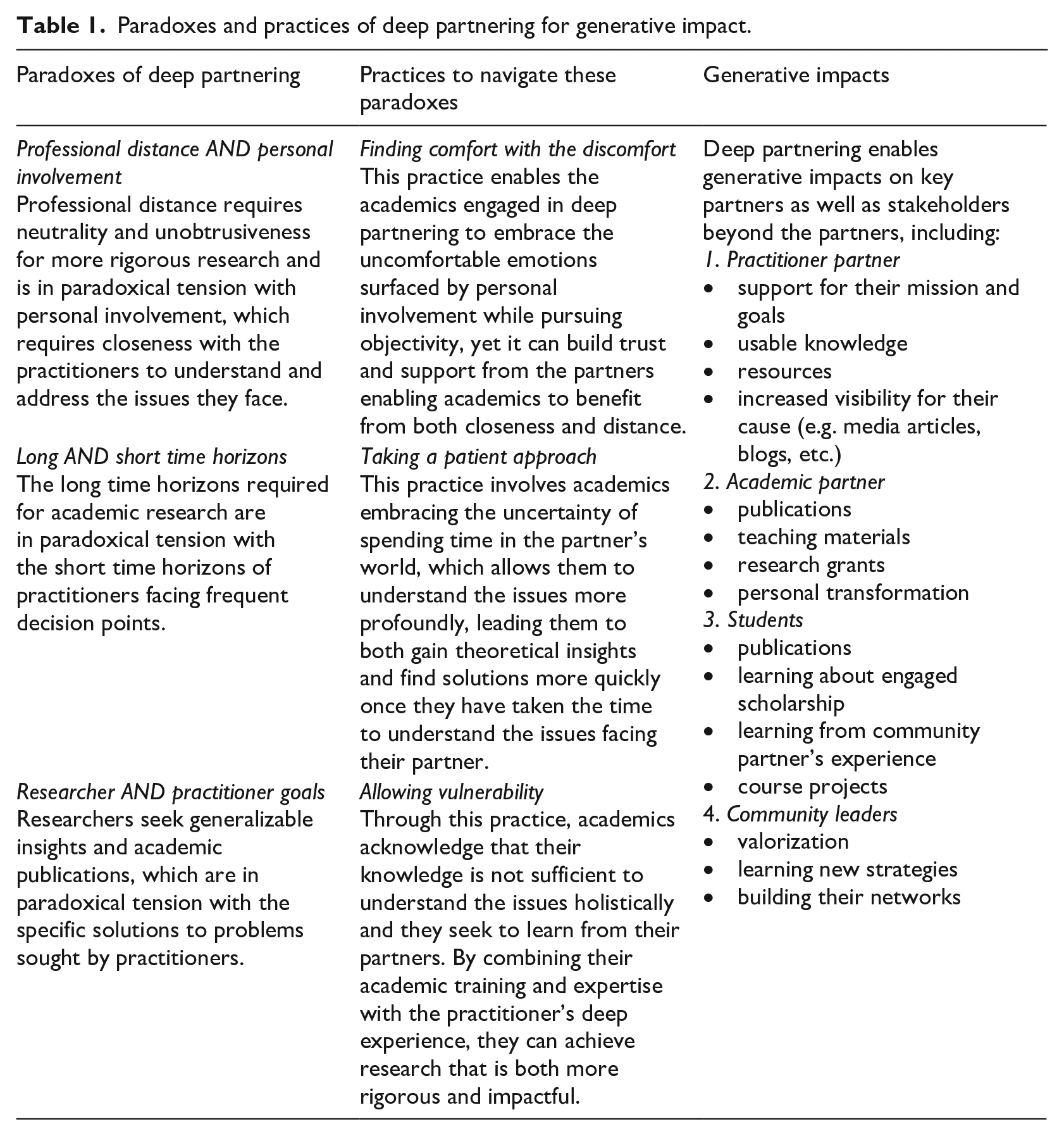
Throughout the partnership, these paradoxes of deep partnering were ongoing, and required continuous navigation. Our team adopted three key practices to navigate each of these paradoxes of deep partnering. To navigate the first paradox we found comfort with the discomfort; to address the second, we took a patient approach; and to navigate the third paradox, we allowed vulnerability (see Table 1). The two vignettes below illustrate how these paradoxes of deep partnering manifested in practice, our approach to navigating them, and their generative impacts. The first vignette shows these paradoxes and practices in the early stages of the partnership, while the second vignette shows them in the later stages of the partnership as our relationship deepened. In the next and final part of this essay, we reflect on the three practices that enable the generative impacts from deep partnering.
Paradoxes and practices of deep partnering for generative impact.
Vignette 1: early partnering paradoxes
In March 2012, Shorefast invited the lead author and a graduate student to try out their new “winter experience,” a day-trip opportunity they were developing for Inn guests to experience Fogo Island’s culture and natural environment amid the long, cold North Atlantic winters. This was an enticing invitation as it would enable us to collect data for case studies, while also providing Shorefast with relevant and useful feedback as they developed the guest experiences that would economically support their organization. However, the lead author was not tenured at the time, and the pressure to publish continued to loom large in the back of her mind, surfacing a paradoxical tension between Shorefast’s and the research team’s goals. Nevertheless, the lead author felt compelled by Shorefast’s ambitious goals and made the 7-hour journey to Fogo Island, which extreme winter weather could easily interrupt. She and the graduate student arrived on Fogo Island on a cold winter’s day and set out over frozen ponds and barrens until they arrived at a local couple’s cabin to learn about local traditions, or what Shorefast called “ways of knowing.” Despite being out of her element, the lead author was grateful for this invitation to experience and learn about Shorefast’s world [Allowing vulnerability]. Upon arrival, we were greeted with fish stew cooked over an outdoor fire and Newfoundland folk music. We were also guided through a drawing exercise to inspire us to slow down and reconnect with ourselves and the world around us. In this way, we were immersed in the experiences Shorefast was trying to create for its guests, allowing us to better understand Shorefast’s values as an organization and their vision for the community of Fogo Island.
While experiencing the winter excursion, we also worked on the teaching case studies, began to identify points of interdependence, and invited Shorefast members into our academic world as guest speakers in our business classes to engage with students. These opportunities helped to bridge their goals and ours. On one occasion, Zita and Alan Cobb came to the lead author’s class and presented Shorefast’s unique approach to business that served community. Later that evening, the lead author hosted them at her house for dinner, which deepened the personal involvement between the researchers and practitioners while surfacing the paradoxical tension with professional distance. Earlier that day, she had a call with Zita before the class to discuss the guest lecture. Zita expressed her concern for the author, knowing she would have a full day of teaching and would also be hosting the dinner, and offered to make alternate dinner arrangements for the group. The author was touched by the compassion and understanding Zita extended to her in that moment, and though she was feeling tired and anxious about her ability to properly host members of the Shorefast team, she wanted to reciprocate the kind of hospitality they had shown her during her visits to Fogo Island. Spending extended periods of time with Shorefast had created an opportunity where members of Shorefast’s team and the research team could connect on a deeper, more human level. They had developed a more intimate understanding of each other’s realities and needs which allowed their partnership to deepen [Finding comfort in the discomfort].
That evening, as they sat around the dining room table, the topic of conducting an in-depth research study on Shorefast’s paradoxical approach to social enterprise and community development came up. The lead researcher had been slowly learning about their organization for over 2 years through visits, writing case studies and building a research team [Taking a patient approach]. Now, she felt ready to dive deeper to understand their approach to engaging with paradoxes, something she had noticed while gathering insights for the case studies. The Shorefast team had many questions about the study. Which part of the organization did she want to study? What would be the focus of the study? The researcher explained to them the paradox literature and the opportunity to advance that theory. The Shorefast team was intrigued by the theory and expressed interest in how the community would benefit from this research. Unsure what that would entail, the researcher asked them what they meant, but they offered no clear boundaries or examples. Instead of a definitive answer, they shared one of Shorefast’s core principles: “business should serve society, and not the other way around.” They mentioned that when visitors came and stayed on Fogo Island, they should bring new ideas and contribute to the economy.
Our research team took from this exchange that we should serve the community of Fogo Island rather than simply taking data to publish in academic outlets. Having given us access to conduct research on their organization, we had Shorefast’s trust that we would produce something of value to them. This was both a gift and a burden. It meant that less time would be spent writing academic papers, which took a long and sustained commitment, and more time would be spent in the short-run on helping them reach their immediate goals, which felt a bit daunting and surfaced a paradoxical tension between the researchers’ long time horizons and Shorefast’s more immediate needs. Would we do justice to their work? Would we be accepted into the community? Would we remain as outsiders? Could we contribute something of value back to Fogo Island? It seemed that all our research team could do at this point was to embrace the uncertainty and keep immersing ourselves in Shorefast’s world [Taking a patient approach]. At the same time, we were aware of our need to maintain some professional distance from the research site to ensure the objectivity of the research, which surfaced the paradox of professional distance and personal involvement. Our team was forced to grapple with the uncertainty of the road ahead while carrying the weight of Shorefast’s trust and expectations. With the trust they showed us, however, we were able to forge ahead [Finding comfort with the discomfort].
Generative impacts
While the lead researcher’s initial intention was to start a possible research project by writing teaching case studies, the biggest impact appeared to be on students, which in turn supported Shorefast’s goals and the research teams objectives also. First, a master’s student had the opportunity to visit Fogo Island, experience Shorefast’s approach to hosting, and co-author a case study. Second, undergraduate and MBA students benefited not only from learning from the case study but also from interacting with the Shorefast team. On one occasion, inspired by the Shorefast story, three MBA students decided to write business plans for Shorefast as part of their coursework. At Shorefast’s invitation, the lead researcher took them to Fogo Island on a 3-day field trip to learn more about Shorefast’s unique place-centric approach to running the Fogo Island Inn. Later, Shorefast received the students’ completed business plans, which fostered ideas for possible new ventures. Following the trip to test their “winter experience,” Shorefast also received feedback from the research team that allowed them to improve their guest offerings. Finally, the research team benefited from teaching material and access to study Shorefast’s paradoxical approach to community revitalization.
Vignette 2: evolving partnership and intensifying paradoxes of deep partnering
After 5 years of data collection and ongoing analysis, the research team felt ready to share the study’s findings more broadly, and we began engaging more frequently with Shorefast’s leadership team to determine how best to proceed. These meetings were often challenging as the academic insights were not always easy to translate into usable lessons for Shorefast, which again surfaced a paradoxical tension between researcher and practitioner goals. In addition, members of the Shorefast team at times wondered out loud why academic research took so long to materialize and questioned its use to practitioners, which reminded us that our academic knowledge was not sufficient to understand the issues facing Shorefast. We had much to learn from them [Allowing vulnerability]. Meanwhile, they were in need of rapid solutions because, as they often reminded us, Fogo Island’s population continued to decline, yet our timelines were much longer. They were also keen to disseminate the lessons learned from Shorefast to communities in need of revitalization around the world so we decided to yet again put our publishing goals aside [Taking a patient approach] and focus on how to translate our insights into usable knowledge to be shared with a wider audience.
Together with the Shorefast team, we considered the idea of making a film and pursued the idea until we realized we did not have the expertise and that a film would only enable one-way communication. It became clearer over time that the lessons generated through the research would be better offered to community leaders through dialogue to unpack their nuance and generalizability. Despite pressures to provide rapid solutions, we took the time to figure out what would best serve Shorefast’s goals [Taking a patient approach]. We therefore changed course and started planning a workshop, prompting a long discussion with the Shorefast team about how to structure the workshop, who to invite, and where to hold it. While this initiative met their need for relevance, we (the academics) worried it would take time away from publishing the research, again surfacing the paradoxes of deep partnering. We agreed with Shorefast that it would be more meaningful to hold the workshop on Fogo Island instead of in St John’s, the capital city of the province and the location of the university. This decision led to a significant increase in both the planning time and complexity, which meant less time to write academic manuscripts. Yet, as it turned out, we gained more meaningful research and practice insights from hosting these conversations about community resilience on the ground in a place that was facing the very challenges participants were gathering to discuss.
We also found ways to bring our disparate goals together. For example, we invited members of Shorefast’s leadership to Memorial University to discuss the data analysis and how to translate these for community leaders, as well as plan the workshop. Despite concerns that our findings were too theoretical to be useful, we presented our findings to two Shorefast members who joined the meeting [Allowing vulnerability]. Much to our relief, they engaged wholeheartedly in discussions about the data, offering their insights, and asked many questions. They were keen to help us analyze our data and derive useful lessons for communities to share at the workshop, which we named “Strengthening Newfoundland and Labrador: Building Social Enterprises for Rural Community Development.” The main goal of the workshop was to support Shorefast’s goal of sharing the lessons learned from the research with leaders from other communities in the province while also learning from these same community leaders. We therefore tried to create a space where community leaders felt safe and empowered to share their thoughts and ideas on community development by selecting community spaces that were familiar to them such as the town hall, rather than formal spaces used for academic conferences. While planning this sort of event took us out of our comfort zones, we were supported by the Shorefast team who understood well the target audience [Finding comfort with the discomfort]. At the same time, we used this opportunity to validate our research findings, which although more time consuming than simply scheduling meetings with research participants, would allow for both validation and knowledge dissemination [Taking a patient approach].
Although we had everything planned down to the last detail, stormy weather with hurricane-force winds and blinding snow interrupted our plans. While we considered canceling the event for fear that postponing would lead to poor participation, Shorefast members encouraged us to deliver the event a day later [Finding comfort with the discomfort]. Not wanting to let the Shorefast team down, we went ahead with the event [Allowing vulnerability] and to our surprise most of the registered participants braved the weather and made it to the workshop despite the stormy weather, including a participant who was bringing his spouse and their 1-month-old baby. Together, the members of the research and Shorefast teams navigated the power outages and logistical challenges created by the storm. The Shorefast team supported the participants, including the research team, as they continued to work in the darkening town hall, and worked with the caterers to ensure meals were delivered despite the disruptions. While we had hoped to create a space to allow for knowledge sharing and dissemination, workshop participants ended up connecting with each other on a deeper level than our organizing team expected through many of the unplanned experiences. A participant noted how the workshop was “equalizing” in that it helped them to feel less intimidated by other participants’ accomplishments or titles. Sharing a meal by candlelight in the middle of a power outage or helping someone push their car out of deep snow resulted in conditions that brought participants closer together. These challenges helped to foster an atmosphere of collaboration and comradery [Finding comfort with the discomfort]. The event was more memorable and impactful than the research and Shorefast teams had anticipated. At the end of the event, a participant from another community offered to host the workshop the following year. And so the PLACE Dialogues, as an annual event, was born.
During the workshop, our research team presented the five core findings from our research and got feedback in real-time about the generalizability of these lessons from the workshop participants. With this feedback, our team further refined these lessons and assembled them into what we called the PLACE Framework, with each letter representing a core principle of community revitalization: Promote community leaders; Link divergent perspectives; Amplify local capacities and assets; Convey compelling stories; Engage both/and thinking. This framework was used in later PLACE Dialogues, was the subject of blog posts and media interviews, and became the organizing framework for an edited volume of case studies co-written by academics and practitioners called Revitalizing PLACE through Social Enterprise (Slawinski et al., 2023b). The Dialogues also fostered new research partnerships and sites, leading to another research grant to expand the research into a multi-case study.
Generative impacts
While our research team’s intention was to collect data that could also serve Shorefast, in the end, the biggest impact appeared to be on community leaders across the province. These leaders benefited from the PLACE Dialogues by gathering together to share their stories, being valorized by each other and the research team, learning new strategies to strengthen their community revitalization work, and building their networks, including with funders and other community leaders. Shorefast’s mission, by this time, had expanded to include “promote community well-being by building and sharing new models of economic development,” and the Dialogues helped with this intention. Impacts also accrued to the research team through publications and the development of a new research project, made possible by a grant whose success was the result of the outputs from the research with Shorefast. Finally, the lead author observed her own personal transformation through reflections in her field diary as she increasingly learned to confront her fears of engaging in such a deep partnership and entering Shorefast’s complex and paradoxical world of community revitalization work [Allowing vulnerability]. Over time, she came to see her role as more of a “learner” than an “expert.” She began to see that taking an expanded view of her role enabled deeper learning from Shorefast and community members, which in turn could allow the research team to contribute more meaningfully to Shorefast’s mission. While the workshop was designed to disseminate findings from the research to other communities, it quickly also became a generative space for collective learning, as the community leaders and researchers not only learned from each other, but in turn used those learnings to continue to generate further benefits, such as happened when the research team expanded its research to support and learn from other community leaders, including Joan Cranston from Norris Point, on the west coast of Newfoundland, who hosted the PLACE Dialogues and has used the PLACE Framework in her social enterprise work (Lowery et al., 2023).
Reflections on the practices that enable generative impacts
The grand challenges of rising inequality, poverty, political instability, and climate change demand that researchers become more active in addressing them (Ferraro et al., 2015; George et al., 2016; Kramer and Pfitzer, 2016), including through partnering with practitioners to co-create solutions (Hoffman, 2021; Sharma and Bansal, 2020; Van de Ven, 2007). Our experience of partnering with Shorefast over more than a decade surfaced deep partnering, an extreme approach to engaged scholarship that is long-term, holistic, and dynamic. Through deep partnering, the partners work together over time to generate problem statements, co-create insights and solutions, and collaborate on knowledge dissemination and implementation. Doing so ensures broader impacts benefiting a variety of stakeholders (see also Jarzabkowski et al., 2024). While deep partnering offers the promise of societal benefits, it also presents a number of challenges and paradoxical tensions that researchers must address. Engaging with these paradoxes can yield generative impacts that bring unexpected benefits to a wide range of stakeholders. We reflect on the practices that researchers can enact to navigate these paradoxes in order to foster the long-term, dynamic, and holistic research–practitioner relationships that are needed for generative impacts across a wide range of stakeholders.
The first practice encourages researchers to find comfort with the discomfort. When academics engage with the difficult emotions that arise when faced with paradoxes, such as between professional distance and personal involvement, they can either ignore or suppress these emotions, or they can embrace them. Embracing them, however, relies on finding comfort during these difficult moments (Lewis and Smith, 2022). By allowing for closeness with the partner and the research site (e.g. by living in the partner’s world), researchers may find comfort from their practitioner partner to navigate the discomfort, as trust and support build up. This practice highlights the need for researchers to allow themselves to both feel discomfort and allow closeness and trust with their partner, which fuels support and comfort to navigate the discomfort. For example, in our partnering with Shorefast, we allowed ourselves to develop close ties with some of their team members, which helped us better understand the research context and how to assist them with their mission of advancing Fogo Island’s well-being. When necessary, we also kept our professional distance, such as when we codified the research using academic literature, and then shared the resultant generalizable lessons with other community leaders, through the PLACE Framework and the PLACE Dialogues.
The second practice involves taking a patient approach to make time to learn about the partner’s world and their core mission and challenges. Our research team members took the time to deeply immerse ourselves in Shorefast’s reality, allowing us to understand the issues facing our partner. This patient approach also enabled us to navigate the paradoxes of deep partnering, including between disparate time horizons (Bartunek and Rynes, 2014). Academics tend to have longer time horizons than practitioners and tend to seek rigor above relevance, while practitioners look for rapid solutions to their problems. Shorefast leaders sought immediate insights to address their most pressing problems, which often conflicted with the more in-depth, time-demanding processes of conducting rigorous research. A patient approach enabled us as researchers to spend time in Shorefast’s world such that we could both gain theoretical insights and engage in rapid problem formulation whereby we took small steps to address facets of Shorefast’s overarching mission, leading to solutions that deepened our understanding of the societal issue they sought to address (Slawinski et al., 2023a). For example, we started by writing teaching case studies that helped us and Shorefast dig deeper into the issues, especially when presenting these ideas to students and receiving their questions and reactions. It is worth noting, however, that not all partnerships will develop in this way. Researchers must also acknowledge that some partners may not be willing to take a long-term patient approach to partnering or be able to engage in this deep way at first. Researchers must therefore ensure that they create spaces and opportunities to engage in their partner’s world so that they can offer more nuanced and helpful insights to their partner.
The third practice consists of allowing vulnerability. As academics, it takes vulnerability to acknowledge that, despite our intensive training and deep expertise, we do not have a complete understanding of the issues practitioners are trying to solve. Practitioners have specific expertise that can deepen our insights and complement our ways of knowing. Allowing vulnerability requires letting go of ego, which can enable researchers to view their role as more of a “learner” than an “expert” while also drawing on academic expertise as needed. In our case, we learned to question our assumptions about the value of our academic knowledge, and over time engaged with more humility as we recognized that our partner’s knowledge was invaluable to solving the issues. We became more curious and reflexive about the issues facing Shorefast and about their approach to studying and addressing them. This suggests that a key aspect of combining management research with impact to address grand challenges may require scholars to be open to changing their perspectives and challenging their assumptions. Societal impact from engaged research requires a degree of humility, which can feel quite vulnerable to academics, to enable shifting away from being the expert and toward being a learner, which, in turn, may allow for more fruitful knowledge exchange with the partner and other stakeholders, thus providing greater benefits to the stakeholders and the scholar. In other words, as scholars allow themselves to be vulnerable, they may gain self-awareness and humility in the field, and this personal growth can lead to more scholarship that seeks to address the world’s grand challenges.
Our engaged research approach of deep partnering allowed us to witness the complexities and uncertainty of grand challenges close up (Ferraro et al., 2015), which surfaced uncomfortable tensions and paradoxes. On Fogo Island, we experienced firsthand how our global economic system, with its attendant economic, social, and ecological crises, has been contributing to the devitalization of communities around the world (e.g. Kim and Kim, 2022; McKeever et al., 2015). Given opportunities to live in a place facing these crises, while studying and contributing to Shorefast’s interventions, was often uncomfortable, yet also profoundly revelatory. If we as academics are going to contribute impactful solutions to our world’s problems, we need to engage in the discomfort that deep partnering entails. Deep partnering requires us to challenge the academic norms we take for granted and to question whether our theories and knowledge are useful or if they are contributing to the very problems we are trying to solve (Ghoshal and Moran, 1996). Doing so requires us to honor rather than dismiss the knowledge and expertise of our practitioner partners. Through this vulnerability, we can find the courage to engage deeply in the messy, uncertain societal problems our partners face and earn their trust so that we can work together on solutions to our world’s grand challenges.
Conclusion
Engaged research enables scholars to address society’s complex challenges by studying problems up close and in partnership with the practitioners experiencing them while creating positive impacts for a variety of stakeholders from the insights. Deep partnering enables a highly engaged and impactful, though often challenging, approach to engaged scholarship. We hope that our experiences and reflections inspire other scholars to pursue deep partnerships with practitioners, recognizing that these relationships can offer important insights into, and solutions to, our world’s grand challenges. As researchers gain a stronger understanding of their partner’s needs and their own interconnectedness with their partners, they can offer more generative and impactful benefits to a greater number of stakeholders.
Footnotes
Funding
The author(s) disclosed receipt of the following financial support for the research, authorship, and/or publication of this article: This work was supported by the Social Sciences and Humanities Research Council of Canada (Grant No. 890-2015-0099) and by Future Ocean and Coastal Infrastructures (FOCI), an Ocean Frontier Institute project funded by the Canada First Research Excellence Fund.
