




Abstract
In this paper, we draw insights from a 15-year qualitative research program exploring catastrophe insurance and gaps in insurance protection as risks escalate within a world impacted by a climate emergency. We suggest that the ebb-and-flow of our research team's composition and activities through time was inextricably linked with our ability to have a sustained impact on such a large-scale societal issue. The essay situates itself within the research impact and team literature, narrates the trajectory of our research program and team development, and develops a framework for effectively managing impact-oriented qualitative research teams over time. Our framework illustrates key aspects of this process including team (re)forming, building team and individual stickability, performing, and managing team flux. We also present 10 practical takeaways for how these aspects can be managed effectively to produce long-term impact work to address grand challenges.
Introduction
Grand challenges encompass large-scale phenomena that transcend geographical and institutional boundaries, requiring impact work across diverse cases, organizational contexts, global locations, and different timeframes (Gray & Purdy, 2018; Waddock et al., 2015). This scale makes collaboration crucial (Jarzabkowski et al., 2015a) with qualitative research teams playing a key role in expanding the breadth and depth of data inclusion and distributing the workload of large-scale projects (Bikker et al., 2017; Price, 1973; Rankl et al., 2021). Furthermore, delivering impact through qualitative research on the “grand challenges” of our time often requires longitudinal research programs that play out across multiple projects (Hoon & Baluch, 2023; Jarzabkowski et al., 2019). Given the scale and duration of such programs of research, balancing continuity and renewal within research teams is critical for delivering impact on grand challenges.
Despite their ubiquity in practice, there remains a surprising dearth of literature in management and organizational studies on qualitative research teams (Pettigrew, 1990). In our previous experiences of writing about qualitative research teams (Jarzabkowski et al., 2015a), we necessarily drew mainly from texts outside our field (e.g. Barryet al., 1999; Bresler et al., 1996; Creese et al., 2008; Mauthner & Doucet, 2008; Mountz et al., 2003; Wasser & Bresler, 1996), albeit rare exceptions existed then (Price, 1973; Rix-Lièvre & Lièvre, 2010) and have grown since (Piqueiras et al., 2023). More specifically, the intricacies of how research teams achieve sustained research impact through time across multiple projects that investigate different aspects of a grand challenge remain underexplored. Thus, in this paper, we explore the ebb-and-flow in the activities and membership of qualitative research teams over time and how this can be managed to produce a stream of impact work to address grand challenges.
We reflect on our own experience as a team (12 researchers) that delivers impact (e.g. Jarzabkowski et al., 2018; Jarzabkowski et al., 2022c) over the long term (15 years and ongoing). Our program of research has been focused on the grand challenge of insuring catastrophes—such as hurricanes, earthquakes, floods, and wildfires—during a time of increasing risk (e.g. Jarzabkowski et al., 2022a; Jarzabkowski et al., 2019). In particular, over these 15 years, we have seen an escalating climate emergency making insurance increasingly unavailable and leaving more and more people unprotected (Jarzabkowski et al., 2023; Kousky, 2022). The problem of how to make insurance available so that it can provide capital to pay for post-disaster response, recovery, and reconstruction is now a large-scale societal challenge. Delivering impact was central to our work and resulted in many varied instances and outputs of impact (Wickert et al., 2021). As we pondered our program of research, a realization emerged that motivates this essay: any impact we had is inextricably linked to the long-term engagement of a shifting and evolving research team.
We first situate this essay in the existing literature on research impact and research teams. We then discuss the evolution of our research program and the research team, before presenting a framework for managing an impactful team investigating a grand challenge over time. We hope to offer actionable guidance for researchers seeking to make a significant difference through their work by contributing to the sparse discussion about qualitative research teams.
Research Impact in the Study of Grand Challenges: Continuity via Teamwork
Impact Over Time
The term “research impact” is widely used to indicate research moving beyond academic contributions to influence practice (Jarzabkowski et al., 2010; Kieser et al., 2015) and “contribute concretely” to the economy, society, and environment (Williams & Whiteman, 2021, p. 527). There have been increasing calls within management and organizational studies for research impact on grand societal challenges to “make the world a better place” (George et al., 2016; Harley & Fleming, 2021, p.133). The consensus is that our field still falls short in this regard (Banks et al., 2016; Cummings & Cummings, 2020; Harley & Fleming, 2021). Reasons for this include institutional barriers (e.g. Schwarz et al., 2017), research–practitioner knowledge translation challenges (e.g. Bartunek & Rynes, 2010), and researcher–practitioner knowledge production challenges (e.g. Sharma & Bansal, 2020).
Related to these challenges are the long timescales needed for impact to take place (e.g. Chen et al., 2023; Sharma & Bansal, 2020; Williams & Whiteman, 2021). It often takes years to develop an understanding of complex societal challenges (Hoon & Baluch, 2023; Jarzabkowski et al., 2019) and deliver impact in relation to them. For example, in qualitative research, sustained (and, ideally, transformational) engagement with stakeholders or a particular field is often crucial for achieving impact (Antonacopoulou, 2022; Antonacopoulou et al., 2011; Sharma & Bansal, 2020). This entails developing expertise in a given area and establishing trusting relationships with participants over time (Sharma et al., 2022). Additionally, solutions generated through research can sometimes lay dormant for years, until the need for, or political interest in, that solution arises (Feldman, 1989; Jarzabkowski et al., 2022a).
This demand for long timescales presents or exacerbates several difficulties for scholars in delivering impact. Delivering impact often requires timelines longer than the typical evaluation cycle of universities (Reinecke et al., 2022). This can create issues, particularly for early-career researchers (ECRs) (Bartunek & Rynes, 2014; Chen et al., 2023; Williams & Whiteman, 2021). Namely, focusing on delivering impact might clash with their, and their senior faculty's, expectations and identity (Baudoin et al., 2022; Empson, 2013). In addition, while universities measure the quality of academic research relatively homogeneously, for example, via the number and quality of publications, we have a far less clearly defined set of criteria for assessing impact. Thus, researchers interested in delivering impact need to not only invest in developing expertise in the various ways of doing impact (e.g. Bansal & Sharma, 2022) and the forms that impact takes (e.g. Wickert et al., 2021) but also develop imaginative ways to capture impact so that it is valued by their universities. We position this essay within the context of these challenges and explore the potential of research teams as a pathway to address them.
Qualitative Research Teams, Impact, and Continuity
There is growing recognition of the importance of large-scale, long-term research programs in addressing grand challenges (Gray & Purdy, 2018; Waddock et al., 2015). Qualitative research teams play a crucial role in expanding the breadth and depth of data inclusion and distributing the workload of large-scale projects (Bikker et al., 2017; Price, 1973; Rankl et al., 2021). For example, multi-country teamwork in qualitative research has gained recognition as an effective approach for addressing global health issues and broader global problems (Milford et al., 2017). And there has been much discussion about how interdisciplinary teamwork can enhance understanding of larger-scale societal issues to generate meaningful impact on them (Barry et al., 1999; Bednarek, 2021b; Spiller et al., 2015; Wasser & Bresler, 1996). In short, collaborative endeavors within research teams provide a powerful mechanism for driving research impact and effectively addressing the multifaceted nature of grand challenges (Jarzabkowski et al., 2015a; Milford et al., 2017; Moyi Okwaro & Geissler, 2015). There is, however, accompanying acknowledgment of the challenges qualitative research teams can encounter (e.g. Barry et al., 1999; Bikker et al., 2017; Mountz et al., 2003), such as strict delineations of labor that prevent sharing and reflexivity (Jarzabkowski et al., 2015; Mauthner & Doucet, 2008).
Despite this, there is little literature on the practicalities of working in and managing qualitative research teams that deliver impact, despite the unique challenges impact work can pose for researchers. In a rare exception, Rankl et al. (2021) briefly reflect on the challenge of balancing the differing perspectives of team members, with some emphasizing publication in academic journals while others advocated for an applied approach through close collaboration with hospitals. Ultimately, they collectively felt a clear responsibility to disseminate their findings widely to drive positive changes in policy and practice. Yet, how this responsibility is fostered and nurtured over time within research teams of individuals with different personal aspirations and career trajectories remains underexplored.
The longitudinal aspects of managing teams to deliver impact across projects in long-term research programs have received even less attention, despite its centrality. Building impact over the long term requires managing and working within the ebb-and-flow of team members, enabling them to engage in impact activities and the research program in ways that mesh with their own interests and competencies. For instance, maintaining a long-term team able to deliver impact means allowing for movement in and out of both the field and the team. From the team's perspective, this movement, wisely managed, enables renewal of team interests while preserving sufficient continuity to maintain an ongoing engagement with the research domain. For the members involved, particularly ECRs, it enables attending to the multiple demands of academic life across research, teaching, and service and thus allows the crafting of meaningful career trajectories. In short, an “impact team” is not a static and clearly boundarized group of researchers but one that continuously evolves. Against the background of the recent preoccupation with rapid teams and teamwork in crises, such as global pandemics (Beebe, 2014; Deom et al., 2023; Kumpunen & Vindrola-Padros, 2022; Rankl et al., 2021), we instead emphasize the importance of reflecting upon the little-understood dynamic nature of research teams for achieving impact through time. We tease out how to achieve this in our reflections on our own practice below.
Building Continuity Through Teamwork: A Case Study of Delivering Research Impact
The growing frequency and severity of disasters make insurance ever more crucial, while at the same time threatening traditional insurance models. Our research program, from which we derive our insights, has explored disaster insurance as a global practice (Jarzabkowski et al., 2015b) as well as the efforts of governments, the insurance industry, development banks, donors, and humanitarian organizations to establish workable disaster insurance systems in developed and developing countries (Jarzabkowski et al., 2023).
Research impact was always a central focus of this team and has only grown over time. For example, alongside academic publications, the team has produced a range of different types of impact (Wickert et al., 2021): teaching (e.g. masterclasses for practitioners [Global Reinsurance Masterclass Series ,2013]), policy (e.g. contributing to policy documents [e.g. Australian Terrorism Insurance Act, 2018; European Commission, Study on the insurance, private and financial markets in the field of nuclear third-party liability, 2020]), practical (e.g. practitioner reports, such as Jarzabkowski et al., 2018, keynote presentations, individual company reports, and feedback workshops), and societal (including our work being picked up by mainstream media, such as the Financial Times, The Economist, and BBC, and books for both practitioner and academic audiences (e.g. Jarzabkowski et al., 2023).
The team has run since 2009, with 12 researchers—the team leader (TL), ECRs, and mid-career researchers (MCRs)—with members joining (often as postdoctoral research fellows), leaving, and changing their engagement level with the team over time. For instance, four team members have moved on to focus on their own projects, and four former postdocs currently remain active as part of the team, while six team members that started with the team as postdocs now have faculty positions (with positions ranging from lecturer to professor). We now explore how we managed the ebb-and-flow of participation in a way that enabled us to renew the focus of the team while maintaining a continued engagement with the grand challenge of insuring disasters across the world during a time of escalating risk. We will do so by incorporating the experiences of ECRs, MCRs, and the TL to develop an overarching depiction of managing teams through time to deliver impact (Figure 1).
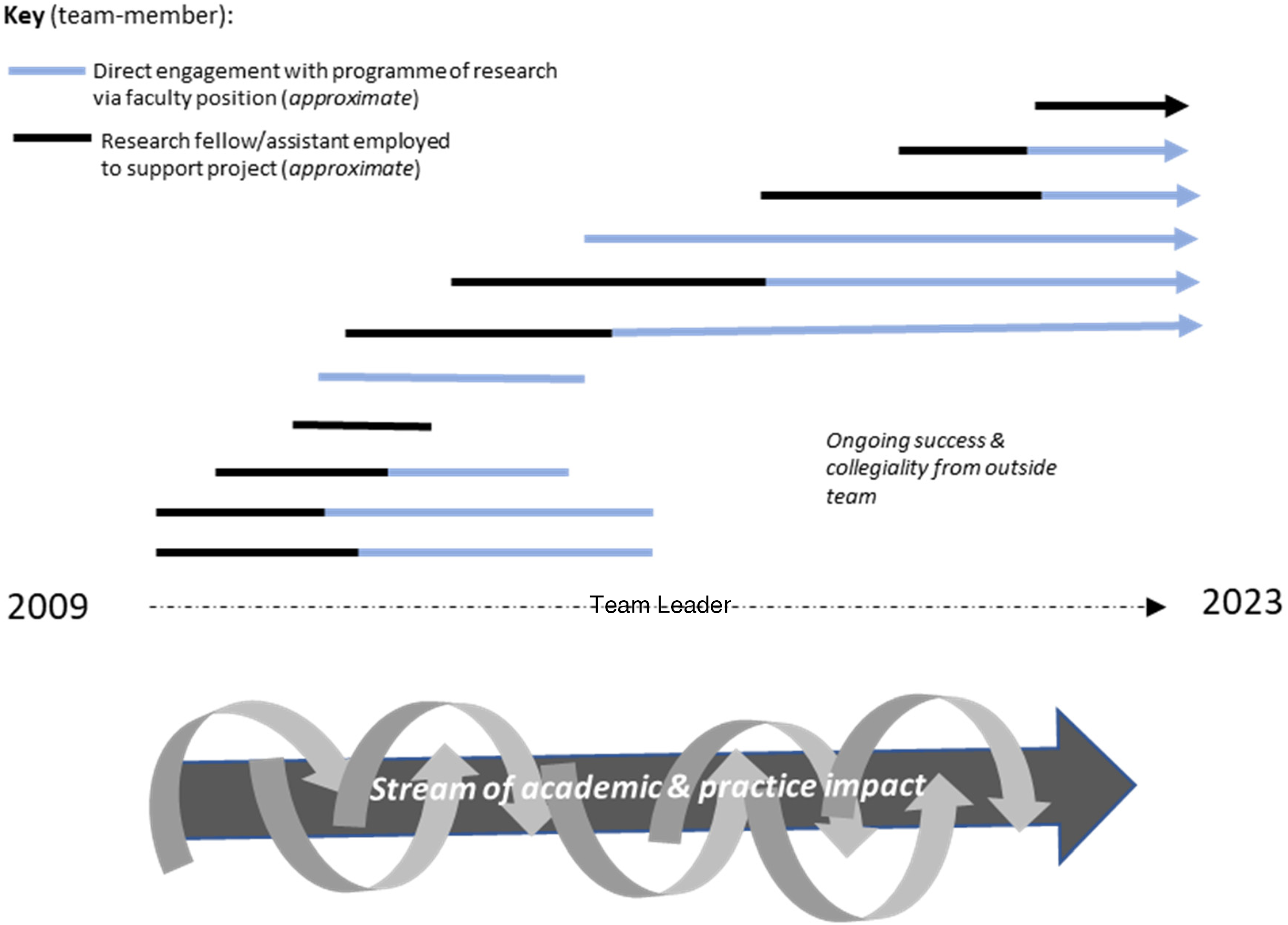
Team members through time.
Delivering Impact Through Research Teams Over Time: Reflecting on Lessons Learned
A Processual Framework
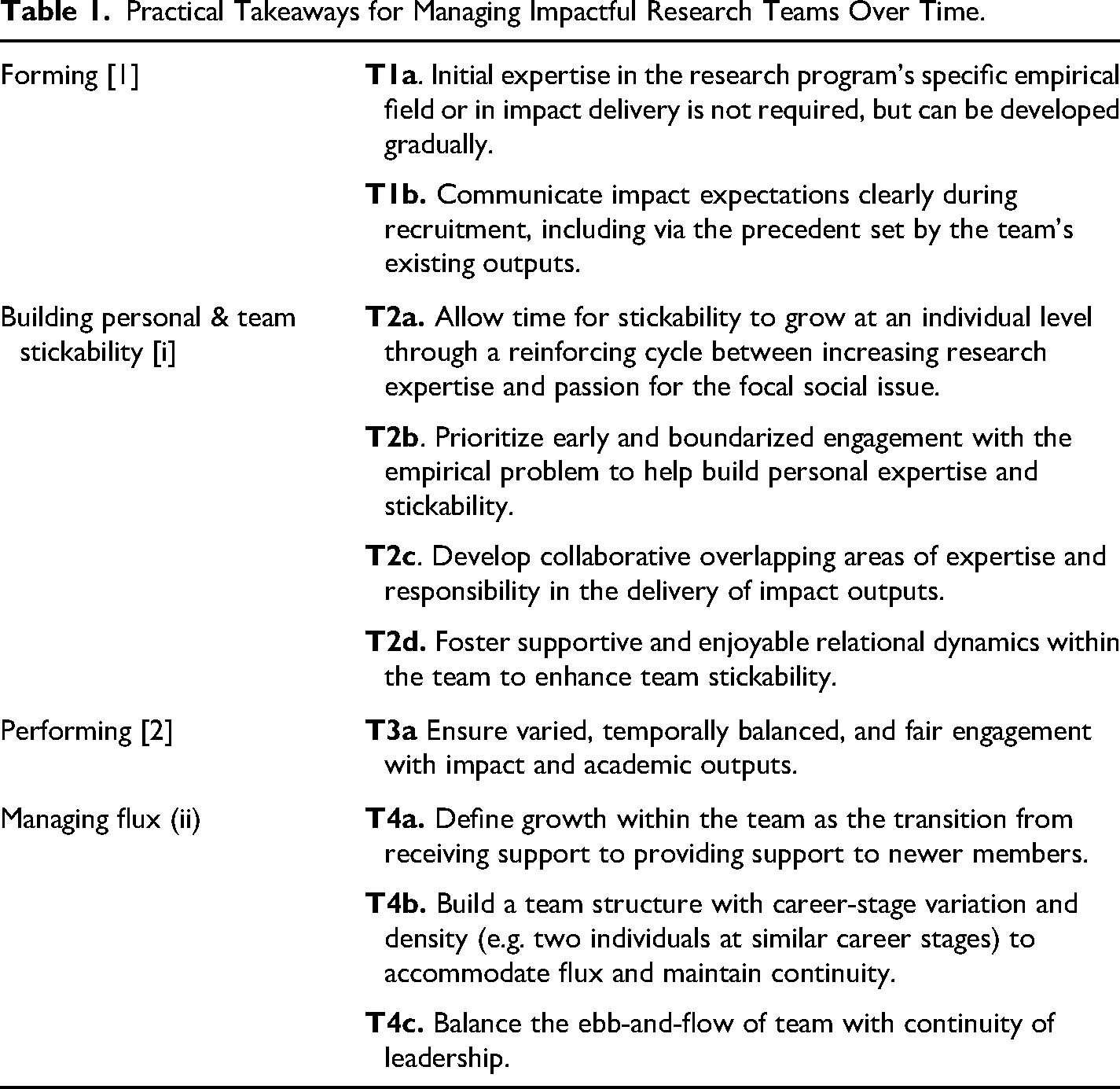
We develop a process framework depicting how to manage teams to deliver impact in relation to grand challenges over time. We will first introduce the reader to the framework (Figure 2) before zooming into its constitutive elements to provide practical takeaways (Table 1).
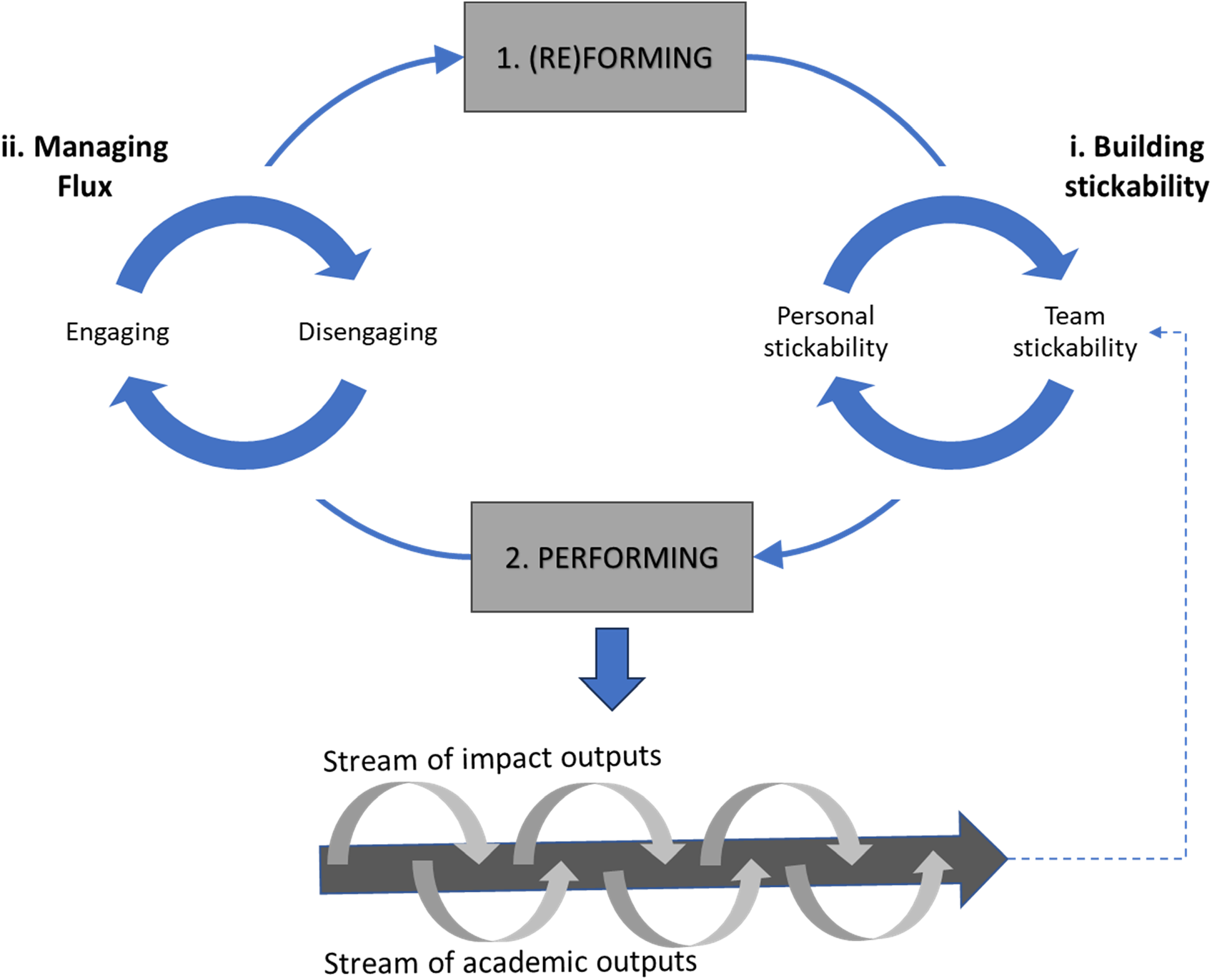
Process framework of delivering impact via research teams over time.
Practical Takeaways for Managing Impactful Research Teams Over Time.
First, the process of forming the team is highlighted as the starting point of recruiting and onboarding team members to deliver impact (Figure 2: 1). Second, as the new team members engage with the work and the other team members, stickability—defined as a form of long-term, flexible connection among team members in relation to the grand challenge being investigated—is developed (Figure 2: i). Stickability is the crucial element that enables both the renewal and continuity in team membership necessary to accommodate the timescales of impact in grand challenges. Individual researchers need to stay with the impact work in the long term (personal stickability). This is only possible if working with the team leads to individual researchers developing passion and expertise for the research context and delivering impact in relation to it, while also meshing with their own research interests and career concerns. This, in turn, feeds into building a long-term team that does sustained impact work (team stickability), as the team becomes the conduit for that individual engagement and ability to deliver impact and other outputs. This reinforcing dynamic between individual and team stickability enables the team to perform by producing a stream of practice outputs as well as academic outputs (Figure 2: 2). Finally, while the team has built stickability to enable it to perform impact work, the team is always in flux with members engaging with and disengaging with the team (Figure 2: ii). This leads to an ongoing process of reforming the team (Figure 2: 1) to allow for renewal as new members join, with new interests and skills, and existing members change their roles or even move on.
Generating Practical Takeaways
We now illustrate this process in greater depth via our team's reflections on our case, developing some tangible, practical takeaways (see Table 1).
Forming: Recruiting a Team That Delivers Impact Work (Figure 2: 1)
We start with forming—assembling and recruiting—a team to deliver impact. Given the flux of a team through time, this is ongoing work as new projects are developed within the research program, rather than something that is done once and for all. The dynamic nature of this process is captured in the cyclical notion of forming and reforming the team (see Figure 2).
Throughout our collaboration, team members have developed shared interest in and passion for delivering impact. Yet, initially, the decision to join the team was often primarily transactional: it allowed us to earn a salary and gain professional development opportunities in exchange for our labor and expertise. Especially as ECRs, this instrumentality was often entangled with the “publish or perish” incentives of academic careers (De Rond & Miller, 2005; Rankl et al., 2021; Schwarz & Stensaker, 2014), with impact seen as an intriguing add-on rather than being an important focus (Baudoin et al., 2022; Empson, 2013).
Furthermore, none of us had a previous interest in the specific grand challenge that the team was working on (insuring losses from disasters). Thus, we initially joined the team primarily because there was an opportunity to “work with a team of expert qualitative researchers who have an excellent track record of publishing in high-quality academic journals” (Team Member 2) or to “build a strong dataset that would enable us to publish academic papers” (Team Member 3). This of course varied, with impact more foregrounded for some team members than others. For example, Team Member 4 was motivated by the team's track record of combining research excellence with practical impact given that they “always wanted to be a researcher with close industry links and have practical impact of sorts.” Team members who joined mid-career had similar motivations: to re-energize their paper pipeline and develop impact. Entering the team was thus about completing and strengthening their research profile and constructing areas of intersection between the team and their own research interests, as well as further developing their ability to interact with industry.
Thus, forming a team devoted to impact did not necessarily begin with recruiting people with a particular passion for delivering impact in a particular area. Rather, it was a matter of recruiting people with an interest in research and the potential for carrying it out in a team context and, from this basis, gradually building passion for the value of this work. Thus, team members often ended up wanting to “do impact.” This is an important take away for any TL interested in impact—it is necessary to be realistic about the starting expertise and motivations of most people joining a team and the gradual process through which desire to produce impact develops. Similarly, it is important for ECRs to be aware that impact can develop naturally out of research interests in the longer term, in a way that allows them to pursue a successful, fulfilling, and multidimensional career.
While the trajectory of developing interest in impact work is of long term, there are some trade-offs in the short term. Thus, it is important that team leaders ensure that those who are recruited are open to making the accommodations required. For example, the centrality of impact to the team should be explicitly and implicitly communicated. Explicit communication includes detailing this focus in job adverts and the interview process itself as part of the “transactional exchange” being entered. It should be clear that producing impact outputs is part of the “job” being “signed up” for. Team Member 3 remembers the job advert and interview itself highlighting the importance of engaging with and producing outputs for insurance industry practitioners. As they reflect, It was clear that initially my postdoc would be focused on developing some practitioner outputs. My focus was to build an academic career, but the upside was that due to having previously worked as a consultant I was very comfortable with engaging with the industry stakeholders the team was working with at the time.
This focus on impact can be implicitly reinforced and communicated through the recruitment process. For example, since 2010, existing practitioner–industry reports were a main entry point into the team during the recruitment process (e.g. Jarzabkowski et al., 2012; Jarzabkowski et al., 2018; Jarzabkowski et al., 2010). All of us authoring this paper, aside from the TL, remember reading one of the team's prior industry reports before joining the team. Other examples include holding the actual recruitment interviews at one of our practitioner participants’ offices (rather than a university), chatting about impact outputs with a job candidate as we walked to the interview room and potential new team members attending industry events organized by the team as their first exposure to the work of the team. In this way, anyone joining will do so with eyes wide open regarding impact being part of “the job,” which is important while the interest in impact work and an understanding of how it can fit with research develops.
From Forming to Performing: Enabling Stickability for Continuity (Figure 2: i)
After a team is formed, continuity is critical to accommodate the timescales of impact work for grand challenges. We describe this as the process of building sustained connection to delivering impact within the team.
Personal stickability. Doing research in a particular field over time builds stickability as researchers’ growing expertise regarding the grand challenge becomes entangled with their passion for having impact upon it (see Figure 2).
Our experience is that, as you embed yourself in the field and your understanding of what is at stake grows, you become increasingly passionate about “having impact.” When we started in the team, most of us were novices in disaster insurance and therefore far away from being able to deliver impact. But as we each deeply immersed ourselves in the respective research project(s) and related impact activities, we started developing expertise in the empirical context. In turn, as we became experts in the relevance and difficulty of the grand challenge, we developed a growing passion for the topic, the field, and the stakeholders and their dynamics. As the TL notes, “I always promise new team members that they will be surprised to find themselves fascinated by disaster insurance and the effects its presence or absence has upon people's lives.” Team Member 2 recalls that when conducting interviews with small business owners in the UK during the COVID-19 pandemic disaster, “these people were desperate, and insurance could actually offer them some kind of solution.” After her engagement with the field, Team Member 1 moved away from her aspiration to study issues of healthcare to focus on financial exclusion and inequality for people that are not insured. Over time, as each of us kept building expertise on the studied grand challenge, our motivation became not purely academic, but also a passion for being part of something that can make a difference through impact work. Simultaneously, this growing passion fed our motivation to build yet more expertise on the grand challenge as the years and our careers progressed.
This reinforcing cycle between expertise and passion thus drives a personal stickability that is both pragmatic (the path dependency arising from expertise that has grown in an area) and fulfilling (due to the passion that accompanies and grows alongside expertise).
Beyond allowing time for this reinforcing cycle to unfold, personal stickability can be supported by prioritizing activities that engaged individual team members with the empirical problem. This enables team members to get immersed in the phenomena of the grand challenge as quickly as possible. Consider the difference in learning when the introduction to the team is analyzing data or writing literature reviews, versus contributing to developing and delivering masterclasses or meeting with practitioners and conducting fieldwork. As Team Member 6 remembers: My first job was to learn about reinsurance. I had a few weeks before I was on the plane to meet reinsurance industry practitioners prior to conducting fieldwork. With my PhD training, I was less worried about the practicalities of data collection and more concerned about getting up to speed as quickly as possible with who these people were and what their industry was all about.
In short, the type of activities they engage in focuses team members’ learning about and within the empirical context, laying the foundation for impact and passion for that grand challenge.
To make them more effective, these activities should be boundarized (Jarzabkowski et al., 2015a; Mauthner & Doucet, 2008). This allows individual team members to build expertise with enough depth, rather than finding themselves spread too thin and overwhelmed by different aspects on which they gain only superficial knowledge. The depth of expertise allowed by such focus is also conducive to a sense of agency about delivering impact on particular areas, as the team expert in that area. For example, each one of us fostered and “owned” relationships with different practitioners. For example, during one project, Team Members 5 and 6 each, respectively, led the engagement with different countries, as the “face” of our team there, while Team Member 3 led engagement with one case. We also fostered and “owned” particular subject matters within our wider program of research. For example, Team Members 2 and 4 focused on issues regarding pandemic risk, collaborating with industry practitioners and engaging with businesses on this topic. While the TL does some of the heavy lifting on impact work, we all take responsibility to lead impact activities via these pockets of expertise. And this focus allows expertise and passion to be built more quickly.
Linking Personal with Team Stickability. There are multiple ways a researcher can leverage this growing expertise and passion outside the focal team. ECRs can and do leave the team to develop their own research agendas, teams, and/or work with others in exploring different research interests. However, most stayed with the team after their postdoc, and some remain integral parts of the team as established academics. Why do these individuals stick with a team to deliver impact over the long term? Our collective reflection revealed that personal stickability in building expertise and passion feeds into team stickability. The ability to deliver impact and high-quality academic outputs is experienced as a collective effort. It would have been impossible for each of us as individual researchers, or by building new teams, to produce the quantity and quality of outputs that we have produced as a team over the years. In this way, individual and team stickability becomes reinforcing as the team delivers impact in areas of increasing individual expertise and passion.
To help build this team stickability, we ground impact work in collaboration. While we built individual pockets of expertise, visibility, recognition, and accountability to the field and each other, we also needed to learn and share knowledge about how to deliver impact (Barry et al., 1999; Mauthner & Doucet, 2008). To achieve this, we adopted a very specific division of labor when it came to impact (Jarzabkowski et al., 2015a) whereby we specialized in areas of impact delivery but also created overlaps in expertise and in terms of co-delivery of any impact output. For instance, while someone might be an expert in the “Swiss Case,” two others conducted some data collection and engaged in meetings with the team, with the eventual tailored impact output (a report) and associated presentations for that part of the world being a collaborative effort (Jarzabkowski et al., 2022b). The fact that our impact outputs were a product of teamwork, via these deep overlapping relations of labor and practice, allowed us to deliver better outputs than if we had created a strictly economical “divide and conquer” mentality, particularly in allowing us to learn from each other in the process of delivering impact.
To build this team stickability, we needed to move beyond just supporting each other in doing impact work to creating a broader foundation of a thriving supportive and enjoyable team environment. The team dynamics need to be supportive in the most basic sense. Our argument is that this is not simply “nice to have” but a foundational aspect of building the continuity required to deliver meaningful high-quality impact. Conscious efforts to build this dynamic—such as the TL organizing an online Christmas party with a wildlife sanctuary during the pandemic, supporting each other through personal loss and illness, meeting for walks or dinner when one of us had a personal or professional setback, and receiving a mass of celebratory messages on birthdays and other special occasions—reinforced that we are in this impact effort together. Being in the team in this way becomes entangled with producing outputs in an area of increasing personal expertise and passion and also in having a source of support, in what might otherwise be an often lonely academic path (Barry et al., 1999). Importantly, conscious attention to fostering such relational dynamics, and the frequency and depth of communication they enable between team members, is a foundation to sharing of knowledge and support regarding delivering impact. For example, Team Member 6 remembers long lunches with the TL where they worked out the different needs of current practitioners they were engaging with. Such lunches, and the relationships being forged between us during them, were essential for transmitting and sharing of knowledge regarding delivering impact within that specific organizational context. Supportive relational dynamics are thus directly and foundationally linked to delivering impact via research teams, both through building the stickability to the team through time and increasing the quality of the impact produced via sharing of knowledge.
Performing impact work: Delivering streams of research and impact outputs (Figure 2: 2)
“Stickability” both results in and is reinforced by a stream of academic and impact outputs. As illustrated in Figure 2, the interplay between personal and team stickability over time builds impact in the form of a stream of practical, societal, and policy outputs and high-quality academic impact in the form of scholarly and educational outputs (see Wickert et al., 2021). As the TL explained, impact and academic outputs are tied together, “I feel confident that our passion will also provide outputs in terms of the publications that will be necessary for the team members to gain faculty positions; to have sound careers by following their passion and deepening their expertise.” And good academic outputs with their associated theorizing are also impactful in supporting further research into the complexities of grand challenges (Reinecke et al., 2022; Wickert et al., 2021); in this, we are undoubtedly aided by the fact that academia itself is increasingly interested in papers addressing grand challenges. We label this entanglement of academic and impact outputs the “performing” of impact work. This ongoing, interactive stream of impact and academic outputs, fostered through teamwork over time, attracts and sustains the team, fueling the dynamic interplay between personal and team stickability to build continuity. But how does a team build and manage a stream of academic and impact outputs?
First, there needs to be equitable and varied access to these outputs. The TL appreciates that for ECRs or MCRs to remain with a team long enough to have impact, they must also be employable in academia. This means equipping them with mainstream academic outputs, alongside inspiring a passion for impact. The best foundation for this is to ensure that each individual in the team is engaged in a variety of activities that are both impact- and academic-related. For instance, within her first 6 months as part of the team, Team Member 6 was involved in ethnographic data collection, report writing, supporting industry presentations, data analysis, and submitting an extended abstract to an academic conference. Necessarily, this also means ensuring a fair and accountable approach among team members, to gain outputs from the work they have been engaged in, and to commit to the outputs of others. Our team's relational dynamics assist here. We meet weekly when any project is in an active cycle of impact work and the dynamic is free-flowing and challenging, as people take responsibility and ownership of different elements of the program of research and the impact. As outputs emerge from the data, author order is negotiated, depending on skill, ownership over the data, and the time that each member must commit to those papers and reports, depending on their state of engagement with the team during those meetings. Our ability to have meaningful impact via a research team through time was assisted by not considering such issues trivial but rather managing them consciously and well.
It is also important to pay attention to the timing of these outputs: balancing more immediate versus longer-term outputs for team members. An ECR might be involved in collecting data with and for the team. This could eventually lead to a top-tier research publication but years away and after their postdoc contract has finished. As part of the discussion about outputs, we would therefore ensure this team member also had opportunities to contribute to more immediate outputs. Impact outputs like reports or practitioner articles can be more immediate allowing ECRs to support their research storytelling. For instance, Team Member 2 remembers: When I was working on the pandemic project, I quickly realized that getting our work into top-tier journals wasn’t going to happen overnight. As I was about to step into the job market, I won’t lie—it was a bit stressful thinking about that. But then, having the chance to contribute to a practitioner report and another article aimed at professionals was a real boost for me. It gave me something solid to talk about during job interviews, showing not only my involvement in a major project but also highlighting the promise of our research program and the publications we were gearing up for.
In this way, balance and fairness involves attention to the timing of outputs. Indeed, the often different timescales of impact and academic outputs can be helpful in this regard.
From Performing to Reforming: Managing Team Flux Overtime to Deliver Impact (Figure 2: ii)
We now turn to the issue of team members engaging and disengaging from the team. This demands attention to transitions and handovers with the notion of “forming” being a constant “reforming” within our framework (see Figure 2: 1). Even when members stay with the team, they often move into different roles in the team: team continuity does not mean stasis as individuals grow professionally and into different roles within the team. This individual growth requires flexibility in our role within the team to allow it to evolve. Even where members did not disengage from the team, their type and level of engagement have changed, and the team needs to be ready for such shifts. The question is: how do teams manage this inevitable flux?
First, we connected flux to an ethos and team norm of movement from being supported to supporting. The authors of this paper have moved from being supported to supporting a new team member who followed us: from receiving training and onboarding to then later supporting new team members in the same way to enable continuity. As Team Member 3 stated, I knew I didn’t have the hours to devote to the new round of data collection as I had my teaching and other faculty commitments. But what I could do was support the new postdoc with training in our coding structure and be there when the TL couldn’t meet with industry practitioners. Also, I have been employed by the project for a number of years. I felt a huge amount of pride when I was able to contribute, via an internal research grant, to helping fund that work of the post doc.
This model of “growth” means existing team members provide the necessary support to new team members which not only helps new members in building the necessary expertise in delivering impact but also existing members in growing within the team.
Second, we have structured our team to support flux in the team over time. We have developed a team that has varied levels of seniority and usually tried to maintain overlaps at each of these levels, for instance, having more than one ECR or MCR involved in different projects. This shifting configuration creates balance, ensuring that there is always experience and expertise combined with fresh ideas and “labor.” It has also enabled us to maintain continuity even when individual team members move on to other projects. For example, when an MCR transitions out, there is another experienced team member now at the MCR level ready to step in. This structure also facilitates managing variations in engagement levels within the team itself. Due to other commitments or life events, a team member might need to assume a more peripheral role for a while or be less involved in a particular project in the research program. At times, one team member might lead a research or impact activity while another plays a supportive role, depending on the different stages of our professional and personal lives. For instance, when a team member starts a new academic post that requires developing teaching materials, they may have to slightly disengage taking on a more supportive role for a while. However, the team's variation and density allow others with similar levels of experience to step in and manage the various projects within the wider research program, effectively handling team flux. This way, team members can experience active and less active periods of engagement or even non-involvement in specific areas of impact.
Finally, we emphasize the key role that team leaders play in making possible this ebb-and-flow of commitment and the growth of a research program out of multiple projects over time. The individual-level fluctuations in engagement are possible through team-level continuity of engagement but also by the TL being the linchpin across projects. For example, a postdoc working on a pandemic risk project while some other members of the team were not involved in this aspect of the project is counterbalanced by the TL engaging with every aspect of this broad research program through time. As with Jarzabkowski et al.'s (2015a) explanation that a TL needs at least some connection to all ‘sites’ being investigated in a multi-sited ethnography, this also holds true for the longitudinal nature of teams delivering impact through time and across multiple interconnected projects. The TL's oversight of the program is essential for delivering impact on grand challenges and developing an ever-increasing understanding of their complexity and multiple facets. It is also important in terms of being the individual “face” of the team with industry, with long-term unbroken engagement with that grand challenge generally, as well as with specific practitioners. Further, as we write this, some team members have now been part of the team for over a decade. Thus, others can grow into similar leadership positions, and this source of continuity may be held by more than one senior individual over time depending on the team and individuals involved. This essay celebrates teamwork, but we end with this recognition of the crucial role of continuity of leadership.
Conclusion
Continuity of engagement with an ever-evolving field is critical to delivering impact in relation to grand challenges (Chen et al., 2023; Ferraro et al., 2015; Sharma & Bansal, 2020; Williams & Whiteman, 2021). Our case discusses teamwork as central to enabling continuity alongside the ebb-and-flow of research teams over such long timescales. We provide takeaways on how teams can be developed and managed over time to deliver such impact. This helps to shed light on the dynamics of qualitative research teams, an underexplored element within organizational research methods (Pettigrew, 1990). Addressing this gap is important, given the increasingly important role they play in delivering impact on grand challenges. Our reflective focus on how to build a long-term research team to deliver impact over time begins to address this issue.
Our paper also adds to existing discussions of research impact in the field of management and organization studies. Impact is fueled by deep human connections and the momentum that “interactions between partners create” (Antonacopoulou, 2022; Antonacopoulou et al., 2011; Sharma & Bansal, 2020, p. 402). This literature is primarily focused on partner relationships between researchers and practitioners. While these relationships are crucial, we shift the focus to relationships within the research team. We argue that careful attention to recruiting and renewing a team and the capacity to build stickability within the team, based on building passion and expertise, even as there is team flux in terms of members’ engagement, builds the continuity upon which impact depends. We thus explore a relatively neglected aspect of how impact is achieved.
There are of course some boundary conditions to our exposition and reflection on research teams. First, our research team is not interdisciplinary. Yet, interdisciplinary research is crucially important in delivering impact via understanding and addressing grand challenges (Aldrich, 2014; Baudoin et al., 2022; Bednarek et al., 2021b). Interdisciplinary collaborations, however, bring their own set of challenges that merit further investigation (Bednarek et al., 2021a; Spiller et al., 2015). Second, more research into the challenges of more globally diverse research teams is required (Rankl et al., 2021). While our team has been culturally and ethnically diverse, it is worth noting that team members have all been situated in economically privileged Western institutions and specifically working in Anglo-Saxon countries while engaged in our program of research. How to manage teams when members come from more economically and culturally diverse institutions is an important area for future investigation. Third, to gain a more comprehensive understanding of different types of research teams as a route to delivering impactful results, it is crucial to examine the role of practitioners as full members of research teams. That is, the ebb-and-flow of co-creation with practitioners as part of research teams (Sharma & Bansal, 2020) could be further incorporated into and foregrounded in our framework.
Footnotes
Acknowledgments
We thank our dear colleagues and collaborators who have been part of this 15-year program of research: Adrianna Allocato, Gary Burke, Laure Cabantous, Michael Smets, and Paul Spee. We would also like to thank our editor Gavin Schwarz.
Declaration of Conflicting Interests
The authors declared no potential conflicts of interest with respect to the research, authorship, and/or publication of this article.
Funding
The authors received no financial support for the research, authorship, and/or publication of this article.
