



Abstract
This paper examines forced migrants who fled their homeland due to conflict and later returned to undertake entrepreneurial activity. Drawing on qualitative interviews with returnees to Bosnia & Herzegovina and Kosovo, we contribute to the process-oriented view of entrepreneurship by showing how forced migration leads to historical bonds to the homeland which influence resultant entrepreneurial activity. We extend literature on institutional voids by demonstrating that they can be enabling, with formal voids substituted by informal networks. Returnees rely on informal ties due to mistrust of formal ties, and these are strengthened by shared experiences of conflict and lead to activities which satisfy non-monetary gains rather than profit.
Introduction
People are moving across international borders more than ever before (United Nations, 2020), yet not all migration is out of choice and in search of new opportunities (Bizri, 2017). Individuals also move to escape poverty, conflict and persecution (UNHCR, 2020), with some later returning to their homelands. The phenomenon of our study is intriguing: returnee entrepreneurship among previously forced migrants in post-conflict homelands characterised by institutional voids, and contrasts to much of the extant literature which focuses on opportunity related migration and return of highly skilled internationally mobile entrepreneurs.
We define returnee entrepreneurs as individuals who have studied and/or worked in foreign countries for at least two years and then returned to their home countries to start up new ventures (Lin et al., 2018). They are distinct from the diaspora who have moved away but kept a relationship with the home country (Chrysostome and Nkongolo-Bakenda, 2018) and are a distinct form of entrepreneurs as they have been exposed to different institutional environments in both the home and host country (Lin et al., 2018).
The majority of the returnee entrepreneurship literature treats the process as implicit, often focusing on the facilitation of return in enabling institutional contexts, rather than the process between leaving the homeland and return (see, for example, Liu, Lu, Filatotchev, Buck & Wright, 2010; Lin et al., 2018). In addition, there have been calls for research to understand diverse aspects of uncertainty with regard to usage of networks where voids are present (Sydow et al., 2022), including following an institutional path break due to conflict (Williams & Vorley, 2017).
Based on the above, we pose two research questions: How do post-conflict settings with institutional voids shape returnee entrepreneurship in the homeland? How does the process of returnee entrepreneurship influence the mobilisation of networks in the homeland? We build on abduction whereby understanding of the investigated phenomenon, namely, returnee entrepreneurship in post-conflict economies derives from ‘genuine doubt’ associated with counterintuitive findings that depart from the initial theoretical framing of this study and from a continuous dialogue between theoretical frameworks, data sources and analysis (Tavory & Timmermans, 2014).
We conduct qualitative interviews with 34 returnee entrepreneurs to post-conflict economies and engage in contextualised explanation (Welch et al., 2011) as we believe it is ideally suited to explain returnee entrepreneurship in the setting of post-conflict economies. We echo Welter et al. (2019) who challenge the common view of entrepreneurial contexts as stable, taken for granted and offering numerous entrepreneurial opportunities. In response, we focus on contexts where entrepreneurship is constrained due to institutional voids, namely, Bosnia & Herzegovina (hereafter B&H) and Kosovo, and consider context as an opportunity instead of a hindrance to theorising (Welch et al., 2011). The break-up of Yugoslavia and ethnic wars of the 1990s caused many people to flee their homelands, settling in other countries around the world. In our study, the two homelands are post-conflict economies with significant institutional voids 1 (Williams, 2018).
Our qualitative findings extend the literature on returnee entrepreneurship in a threefold manner. First, our study responds to calls for more process-oriented research in entrepreneurship (Moroz & Hindle, 2012; Burg van, 2020) and for greater consideration of long-term perspectives on international entrepreneurship (Reuber et al. (2018). There is a research gap in understanding critical incidents in process-oriented studies (Davidsson & Gruenhagen, 2020). We contribute to filling this gap by examining the mechanisms that trigger the process, starting with the critical incident of conflict in B&H and Kosovo which has led to long-term historical bonds with the homeland being created. We then monitor the process to identify that while the homeland can be characterised by institutional voids, return takes place out of a desire to help. We show that the entrepreneurial process is shaped by multi-layered contexts at the macro-level of national institutions, the meso-level of family, friends and co-ethnic ties and the micro-level of the individual entrepreneur. These inter-twinned layers of context have agency as they shape the process of returnee entrepreneurship over time (cf. Pettigrew, 1997).
Second, we extend literature on institutional voids (Webb et al., 2020) by demonstrating how returnee entrepreneurs can substitute for formal voids by drawing on informal networks of family, friends and co-ethnic ties. We offer counterintuitive evidence showing that voids can be enabling, which would have been difficult to predict given that virtually all research on voids focuses on them as constraints (Doh, Rodrigues Saka-Helmhout & Makhija, 2017). Previous research has shown how migrant entrepreneurs can leave home countries due to institutional voids and be reluctant to return (McCarthy and Puffer, 2016), and as such there is a gap in understanding when return occurs. Research on returnee networks has focused on fast-growing economies with effective institutions, and there is little understanding of how networks theoretically relevant to the pursuit of opportunity vary contextually (Reuber et al., 2018), and a gap in examining return in post-conflict economies. Our paper shows that informal networks that lie dormant are reconnected and prioritised on return to post-conflict economies to substitute for formal institutional voids and thus contrasts with research that has shown that voids will incentivise greater political ties (Ge et al., 2019). We show that political ties are undesirable in post-conflict contexts due to a lack of trust in government; thus, returnee entrepreneurs mobilise a subset of network ties while avoiding others.
Third, we show how the presence of voids and activation of informal ties reflect on the objectives of the returnee entrepreneurs. In doing so, we respond to calls for research to consider the importance that shared meanings can have for social identities and entrepreneurial activity across borders (Welter et al., 2017). We show that returnee entrepreneurship in post-conflict economies can be enabled through emotional connection to the homeland and that forced migrants have a different relationship with the homeland than other forms of migrant due to the historical bonds created by adversity. Webb et al. (2020) have shown that voids can shape the objectives of activity, but there is a gap in understanding how this occurs in internationally mobile entrepreneurs. We find that returnees in B&H and Kosovo were driven by a moral obligation and non-monetary gains which is the result of the shared experiences of conflict, and do not draw on the knowledge and experience gained in the host country. This contrasts with research which emphasises skills gained in the host country (Qin et al., 2017) and that profit opportunities in the homeland are the key drivers of return (Lin et al., 2018). There is a tension here with the desire of policy makers to enable returnees to enhance economic growth. The returnee entrepreneurs in our sample are not concerned with growth; rather, they seek to provide opportunities for employment for family, friends and co-ethnic ties. This activity may not enhance growth but can improve informal institutions in the home country as more people are influenced by the actions of returnee entrepreneurship at home. Viewed in this light, we contribute to calls for research to consider the process dimension of entrepreneurship where individual action shapes context and contributes to changing a context (Welter et al., 2019).
The structure of the paper is as follows. First, we set out the key theories that the study contributes to, namely, institutional voids and network theory. We then discuss the context of the study before setting out the methods used. The findings are then presented, before we discuss the contributions that the study makes in taking forward theory.
Theoretical Background
In this section, we set out the theoretical background to our study. We initially framed our study using network theory and returnee entrepreneurship literature. As we dug deeper into our findings, a process-oriented view of returnee entrepreneurship was gradually crystallised. Our abductive thinking was triggered by counterintuitive evidence that pointed us to institutional voids as an appropriate theoretical lens for examining the process associated with return to post-conflict economies. This led to refinement of our research questions and allowed us to find counterintuitive insights related to how voids can enable returnee entrepreneurial activity through the usage of networks.
Entrepreneurship and Institutional Voids
Institutional voids can be defined ‘as a lack or a failure of existing institutions’ to support efficient entrepreneurial activity (Webb et al., 2020, p. 504). While institutional voids are well-established in the literature, research is required to highlight varieties of context in terms of institutional voids and entrepreneurial action, and to examine whether voids can be enabling rather than constraining, which has not been empirically examined in the institutional voids literature (Doh et al., 2017).
Scholars have typically examined the influence of formal institutional voids (Puffer et al., 2010), such as when a government’s political, economic, and legal/regulatory institutions fail to provide the basic systems of governance, property rights protection, infrastructure and/or rule of law (Ge et al., 2019). However, informal institutional voids are also important and can be defined as the norms, values and beliefs born from family, religion, tradition and other social considerations that overly constrain the productive use of resources and a lack of trust in society that limits individuals’ willingness to take risks (Webb et al., 2020). The dominant view suggests that formal and informal institutions interact in two key ways: institutional arrangements are complementary where formal institutions both reinforce and are reinforced by informal institutions thereby enhancing their mutual effectiveness, and conversely, institutional arrangements are substitutive where informal institutions compete with and undermine weak formal institutions (i.e. not embedded or enforced) or prevail where there is a void in formal institutions (Estrin & Prevezer, 2011). Formal institutional voids can often be overcome by informal institutions in the form of building networks with key stakeholders, including government and industry (Bruton et al., 2010; Puffer et al., 2010). However, a reliance on informal institutions poses risks especially in the longer term due to the lack for formal support, and as such a well-balanced institutional environment is needed to foster entrepreneurship (Bruton et al., 2010).
The dynamics of institutional voids in post-conflict economies offer important theorising opportunities. Post-conflict economies are distinct from other post-socialist transition economies as they have experienced a path break associated with the demise of previous institutional structures and creation of new institutional frameworks (Williams & Vorley, 2017). Thus, overcoming voids in such economies poses a particular challenge. There are immediate issues associated with embedding and enforcing newly established formal institutions, while the extension of prevailing informal institutions simultaneously serves to undermine these reforms due to the substitutive effect. Where the social fabric has been damaged, the level of trust is low and people are unwilling to share knowledge which can further stymie entrepreneurial activity (Efendic et al., 2015). In addition, conflicts can undermine the rule of law which is a critical element of institutions (Estrin et al., 2016) and are likely to leave a legacy of institutional voids (Efendic et al., 2015).
The economies in this study have seen a ‘path break’ in institutions through the break-up of the former Yugoslavia and formation of new independent states (Williams & Vorley, 2017), and continuation of significant institutional voids over time. As Ahlstrom & Bruton (2010) have stated, researchers typically examine a single point in time and argue that the findings have wider application, yet there is little research on how responses to voids change over time. Theories of context need to pay attention to temporal and historical aspects in order to avoid oversimplifications across contexts (Welter and Baker, 2021). In our study, given the path break in institutions and subsequent returnee entrepreneurial activity, we are able to examine how the processes associated with return evolve.
With regard to context, it is important that theories are able to integrate top-down effects of context on entrepreneurship and bottom-up processes influencing context (Welter, 2011), including studies of institutional voids. In addition, more research is required to explain multi-layered embeddedness perspectives which are combined with individual perspectives that take into account the adaptability and learning behaviour of entrepreneurs, thus drawing attention to the process dimension of entrepreneurship where individual action impacts context and contributes to changing a context (Welter, 2011). Previous studies have recommended a micro–meso–macro-framework, where meso refers to change or the ‘dynamic building blocks of an economic system’ (Dopfer et al., 2004, p. 268). In this way, it is important to note that context has multiple dimensions, including the overall institutional framework, but also, for example, geographical environments, communities and social networks including family and ethnicity (Welter et al., 2019).
In examining context, previous research has shown how institutional voids can influence the productivity of entrepreneurial activities by shaping the forms of entrepreneurial activity as well as the objectives underlying this activity (Webb et al., 2020). In this study, we seek to shed light on how the experience of conflict shapes returnee entrepreneurial activity in terms of both form and objective. Within this we examine shared meanings and understanding, such as social identities across borders, which are important for contextual theory development (Welter et al., 2017). Given our focus we recognise how social identities form as a result of conflict. Our approach takes into account the mixed embeddedness (Kloosterman, 2010) of migrant entrepreneurs and their usage of networks, and seeks to contextualise them within broader social, political and economic spaces (Vershinin et al., 2011). For returnee entrepreneurs, embeddedness in the homeland can drive action (Elo & Dana, 2019), even in post-conflict economies with institutional voids. In fast-growing economies, returnees can utilise their experience to launch entrepreneurial activities in growing markets in the home country where profit opportunities are abundant (Qin et al., 2017). In this sense, individuals are able to see the contextual fit of choices and their consequences and can possess historical insight that connects the past to the future.
The Process of Returnee Entrepreneurship and the Role of Networks
Returnee entrepreneurs are often treated as a unit of analysis typically compared with local counterparts (Liu et al., 2010), yet they are heterogeneous in many aspects such as the embeddedness of home country networks (Lin et al., 2018). Process studies have emphasised the importance of networks, given their role in resource acquisition and venture success (Elo & Minto-Coy, 2018). Such research examines the development of networks and relates it to the sub-process of shifting requirements at different points of the overall new venture creation process (Davidsson & Gruenhagen, 2020). The predominant theoretical lenses used in the returnee entrepreneurship literature are network theory and knowledge spillovers (see, for example, Liu et al., 2010; Qin et al., 2017; Lin et al., 2018) while the process of return is often implicit. How ties are used implies that activation of them is a recurrent process that is subject to learning, revision and correction; however, research is required to understand activation patterns over time (Smith et al., 2012). While networks are important in the pursuit of international opportunities, we have little understanding of how aspects of how networks and entrepreneurship vary contextually (Reuber et al., 2018). Furthermore, there is limited understanding of ‘home country network embeddedness in different contexts and … its influences on exploiting entrepreneurial opportunities’ (Lin et al., 2018, p. 12) and ‘how entrepreneur networks form within societies characterized by institutional voids’ (Webb et al., 2020: 520).
Previous research has tended to focus on networks in close proximity. Yet more recent studies have extended understanding of networks across borders and geographically distant ties (Oettl & Agrawal, 2008; Lin et al., 2018). The accumulation of local ties before going abroad and new ties developed upon return are important in entrepreneurial activity (Lin et al., 2018). However, examination of those who were forced to move and thus experience a network break, and the impact that this has on usage of network ties, is currently under-researched. Forced migration implies a break in networks, although ties may not be forgotten (Lin et al., 2018; Williams & Krasniqi, 2018). Network theory suggests that while ties generally decay over time, some strong ties create permanent connections (Lin et al., 2018). Yet ties may also remain dormant until they are considered to be useful or valuable again (Levin et al., 2011). We define dormant ties as former ties, which individuals become out of touch with, but can be reconnected with. As Jack (2005) states, ties can remain latent and dormant until re-activated, although inactive ties remain within the network as latent knowledge and resources. Dormant ties have previously been examined in relation to skilled migrant return and reconnection where government support for return is strong (Qin & Estrin, 2015). There is a lack of research on reactivation of dormant ties in contexts with institutional voids.
Extant research has shown that entrepreneurs will choose networking strategies to cope with voids and weigh the potential benefits and costs of government and informal ties (Ge et al., 2019). Actors mobilise or selectively use only a subset of all potential ties (Parker et al., 2019). It is not the entire network that is important but the mobilised network and includes the option not to mobilise (avoid) actors because they might hamper activity (Smith et al., 2012). The predominant literature focuses on returnee usage and/or benefits from formal networks, defined as banks, accountants, lawyers and government support programmes (Lin et al., 2018). However, informal networks of family, friends and co-ethnic ties (Birley, 1985) at home mean that returnee entrepreneurial activity can be supported, as local constituents provide understanding of social, cultural and institutional changes (Li, et al., 2012).
Akin to research on the diaspora, returnee entrepreneurs may be naturally inclined to collaborate and engage within close circles, particularly family and ethnic ties (Vershinina et al., 2011; Discua Cruz & Fromm, 2019). Such interpersonal relationships are seen as important as they can ensure shared values, within-group trust, historical reciprocity and bounded solidarity (Harris & Wheeler, 2005; Anderson et al., 2012). In contexts where institutional voids are present, there may be greater reliance on interpersonal trust and usage of informal networks (Doh et al., 2017). This can lead to substitution where private information is used to bridge the information void for better investment decisions, with entrepreneurs substituting their informal networks for formal institutional voids (Ge et al., 2019). Furthermore, research is needed to examine institutional voids and networks where exclusion of certain groups exists (Webb et al., 2020). This may be particularly strong in cases of forced migration, as ethnicity-based conflict is a key cause of displacement and continued tensions within the homeland (UNHCR, 2020).
Research Setting
Understanding of context as a set of circumstances and conditions that enable or constrain entrepreneurial activities has evolved in entrepreneurship research (Welter et al., 2019). Studies have emphasised the need to move away from a simple focus on high-growth, technology-driven and venture-capital backed models to better understand the multiplicity and multidimensionality of context (Welter, 2011). We add to this by focusing on returnee entrepreneurs in post-conflict economies and showing how they interact with different layers of context that emerged from our qualitative study. An iteration of relevant literature and data from returnee entrepreneurs pointed us to three interconnected layers of context, namely, the macro-level, meso-level and micro-level that shape entrepreneurial activities (Welter, 2011).
Our study focuses on Bosnia and Herzegovina (B&H) and Kosovo, two countries which have seen significant outward migration because of conflict and are now attempting to attract the diaspora home (Williams, 2018). The breakdown of the communist regime in the early 1990s was the beginning of the end of ‘old Yugoslavia’, and the ethnic wars during the 1990s lead to the creation of a number of newly independent states, with B&H independence conferred through a referendum in 1992 and Kosovo unilaterally declaring independence in 2008. The Bosnian War of 1992–1995 and the Kosovo War of 1998–1999 both resulted in large-scale outward migration as people sought to avoid conflict. Kosovo saw widespread migration and the legacy of war has been continued political and ethnic tensions (Williams & Krasniqi, 2018), while within B&H, displacement revived traditional local and ethnic identities (Halilovich, 2012), and the country was divided into the Bosnian Federation and the Serb-dominated Republika Srpska meaning that there are multi-layered national level institutions. In common with many post-conflict economies (Aldairany et al., 2018), since the end of war, economic and institutional development in B&H and Kosovo has been slow (Krasniqi & Mustafa, 2016; Williams & Efendic, 2019). While reforms have aimed to encourage entrepreneurship, much of the post-conflict economic activity has been associated with foreign direct investment from large multinational corporations and governments (Williams & Vorley, 2017). This, combined with institutional voids (Efendic et al., 2015), can crowd out entrepreneurial activity.
While both countries can be characterised as having formal institutional voids (Williams & Vorley, 2017; Williams & Efendic, 2019), the meso-level context of social and ethnic ties (Welter et al., 2019) has been important in creating bonds between people due to the shared experience of conflict. At the meso-level, there are strong ethnic communities in both countries, although there are lasting ethnic divisions (Williams, 2018), and at the micro-level there is respect for individual entrepreneurs, especially in Kosovo which has a positive enterprise culture despite formal institutional voids (Williams & Vorley, 2017).
B&H’s diaspora is estimated at approximately 2 million, equivalent to over 50% of the current population (Williams, 2018). After the war, flows of remittances home became increasingly important to the economy with the value estimated at over 10% of the country’s GDP (Kolesa, 2018). Kosovo’s diaspora is estimated at approximately 700,000 people, equivalent to 40% of the resident population (UNDP, 2014). During the conflict, remittances to Kosovo from emigrants accounted for 45 percent of annual domestic revenues (Demmers, 2007), and was in part used to support the war effort, with the Kosovo Liberation Army establishing a ‘Homeland Calling’ fund (Adamson, 2006). In addition, a ‘3% fund’ was used so that migrants contributed not only to the war but also to support government spending on schools and hospitals (Hockenos, 2003). In the aftermath of the conflict, Kosovo became partially dependent on the international aid and remittances from Kosovar emigrants (Loxha, 2012). Around a quarter of Kosovo Albanian households receive remittances (Kosovo Agency for Statistics, 2013), totalling approximately 17% of GDP, making Kosovo one of the top 15 recipients of remittances worldwide relative to the size of the domestic economy (UNDP, 2012). Both countries have seen an increase in remittances during the COVID-19 pandemic to support family and friends who have faced wage cuts and job insecurity (IOM, 2020; OECD, 2021). Over time, B&H and Kosovo have introduced a number of policies to attract the diaspora home (Williams, 2018). The policies are being driven by acute economic, social and demographic challenges in the countries as they require greater levels of entrepreneurship and innovation to create jobs for current and future generations (Domm, 2011).
Methods
Sampling and Data Collection
While entrepreneurship research has been dominated by quantitative approaches, there is a growing body of qualitative research that demonstrates insight into the entrepreneur and the environment in which they operate (Jack & Anderson, 2002; Jennings et al., 2015). Following calls for more qualitative approaches in entrepreneurship (Burg van et al., 2020; Mäkelä & Turcan, 2007) and returnee entrepreneurship research (Qin et al., 2017), this paper utilises in-depth interviews with returnee entrepreneurs. Our approach can be described as contextualised explanation (Welch et al., 2011) as we consider returnee entrepreneurship being inseparable from the contextual fabric of post-conflict economies. In so doing, the investigated phenomenon cannot be explained away-from context, which adds to understanding of entrepreneurship beyond standard models (Welter et al., 2019). We further draw on abduction (Tavory & Timmermans, 2014) by allowing theory to inform from the beginning our study. We entered the field with a deep appreciation of returnee entrepreneurship literature and network theory; however, in the course of the study, these theoretical lenses were revisited and complemented by institutional voids literature (Dubois & Gadde, 2002).
Our sampling combined theoretical and snowballing strategies (McKeever et al., 2015) and sought for information-rich examples likely to yield substantive information for our research questions (Singh et al., 2015). Our selection of respondents was both theory and phenomenon-driven (Fletcher et al., 2018). In line with Charmaz’s (2006) view of theoretical sampling, we opted for returnee entrepreneurs who had been forced to migrate from their homeland as a result of the conflicts in B&H and Kosovo and had since returned to undertake entrepreneurial activity. We accommodated diversity in our sample (e.g. sectors of economic activity of entrepreneurs; gender) so as to enrich our theorising with different experiences of the returnee entrepreneurial activity, forced migration, usage of networks, objectives, and international exposure. As the first step, contact with businesses was developed with the assistance of Bosnian and Kosovo Chambers of Commerce, as well as private and third sector organisations working with returnees. A database was developed through which the returnees were contacted, asked if had moved due to conflict and since returned to start a business.
Mindful of the aforementioned criteria, we also used snowball sampling to identify participants ‘from people who know people …who know what cases are information-rich, that is, good examples for study, good interview subjects’ (Patton, 2015, p. 182). Snowball sampling was also useful as it allowed the study of geographically dispersed informants who possess social capital across international borders (i.e. network of returnee entrepreneurs) and were willing to share it with the researchers to illuminate the phenomenon of returnee entrepreneurship (Fletcher et al., 2018). The choice of new respondents was driven by insights gleaned from the field and allowed us to contribute to emerging theory (Alvesson & Sköldberg, 2000) filling in gaps of the entrepreneurial journey of returnee entrepreneurs.
Profile of interviewees.
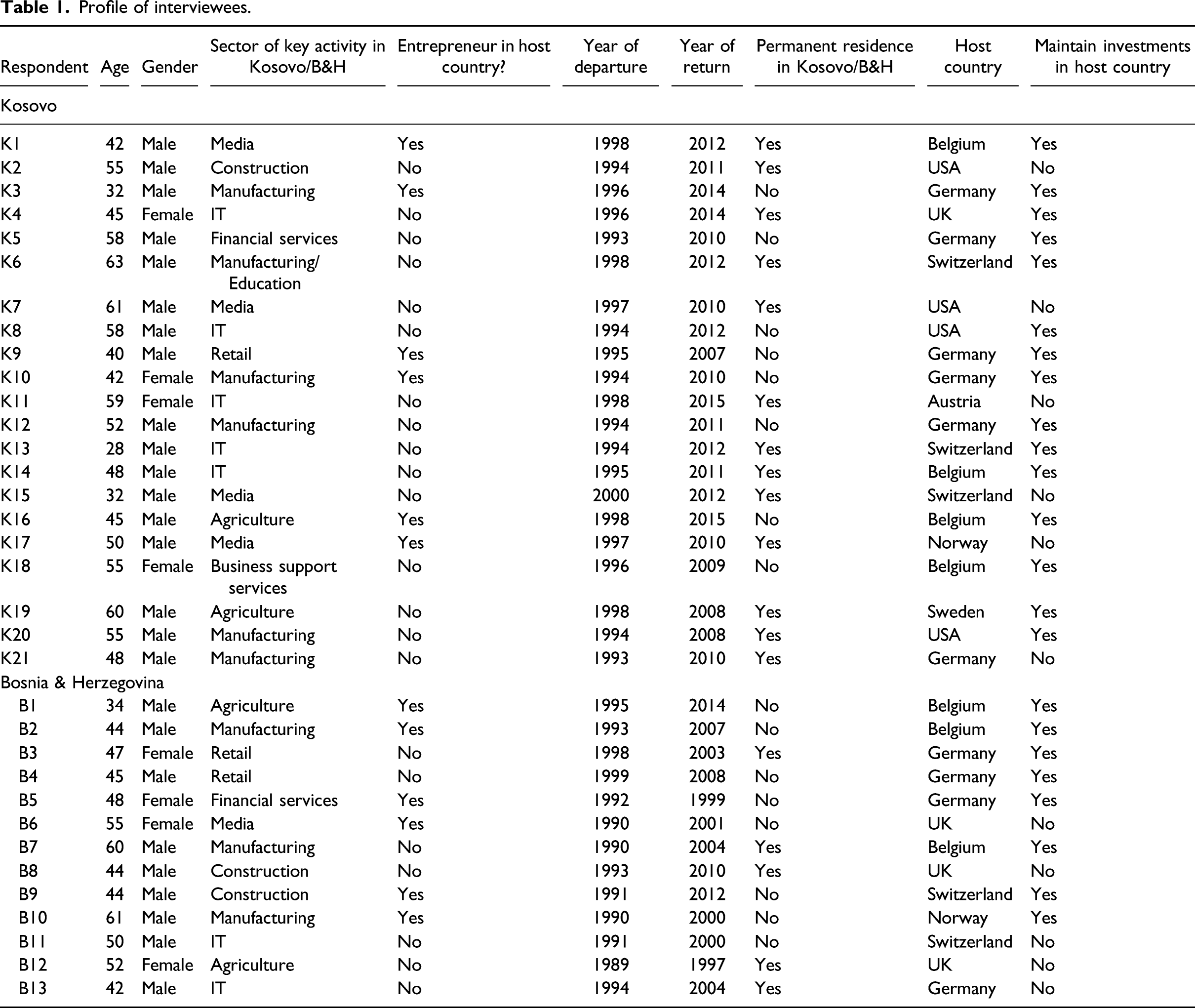
Many had experience of working for a large multinational business in the host country, as opposed to being entrepreneurs in their host country (12 out of 34 were entrepreneurs in the host country). However, the level of skills and experience gained within these multinational companies was varied, with some having managerial roles, while others had less skilled roles such as, for example, security, cleaning and general administration. The majority of entrepreneurs in our sample had been engaged in low skilled jobs or entrepreneurial activity in the host country. The average time spent away from the home country (between leaving and returning to live and/or start a business) was 14 years.
The majority of interviews took place in the capitals of B&H and Kosovo, Sarajevo and Prishtina – as one co-author was locally embedded and able to set up the interviews – as well as in Brussels (3 interviews) and Berlin (5 interviews). Similar to Elo and Dana (2019), a multi-lingual team including a native speaker of Albanian and Bosnian and a native speaker of English conducted the interviews in Albanian, Bosnian and English, respectively. The interviews lasted one hour and 15 minutes on average and were recorded with the respondent’s consent and transcribed. Interviews in Albanian and Bosnian were translated following recommendations by Chidlow et al. (2014).
In line with Alvesson and Sköldberg (2000), we adopted a reflexive approach to interviews in that we made conscious efforts to embrace the different perspectives of our respondents without imposing or privileging our own beliefs, judgements and theoretical assumptions. Our interview protocol was open-ended allowing for ‘unanticipated statements and stories to emerge’ (Charmaz, 2006, p. 27). We invited the participants to share their story of forced migration and on completion of the narrative, if any part of the story was unclear, the researchers asked clarifying questions. Such questions further probed activities in the host country; objectives associated with returning home; initiation of the business home and use of networks on return. We expanded beyond the interview protocol to explore issues raised by respondents, for example, how they sought to promote connections to the homeland in their children who were born and live outside of their parents’ homeland (Frank & Landström, 2016). The interviews were also devised to explore before and after experiences and narratives of forced migration and how these influenced objectives associated with return and subsequent returnee activity.
Data Analysis
We employed thematic analysis and temporal bracketing to systematically combine and confront empirical evidence with theory (Dubois & Gadde, 2002). We draw on abductive reasoning that rests on the identification of counterintuitive findings as motors in the discovery of plausible explanations (Golden-Biddle, 2020; Saetre and Van de Ven, 2021). In line with abduction which highlights the familiarity of the researcher with the relevant literature, we framed our study using the theoretical lenses of returnee entrepreneurship and networks.
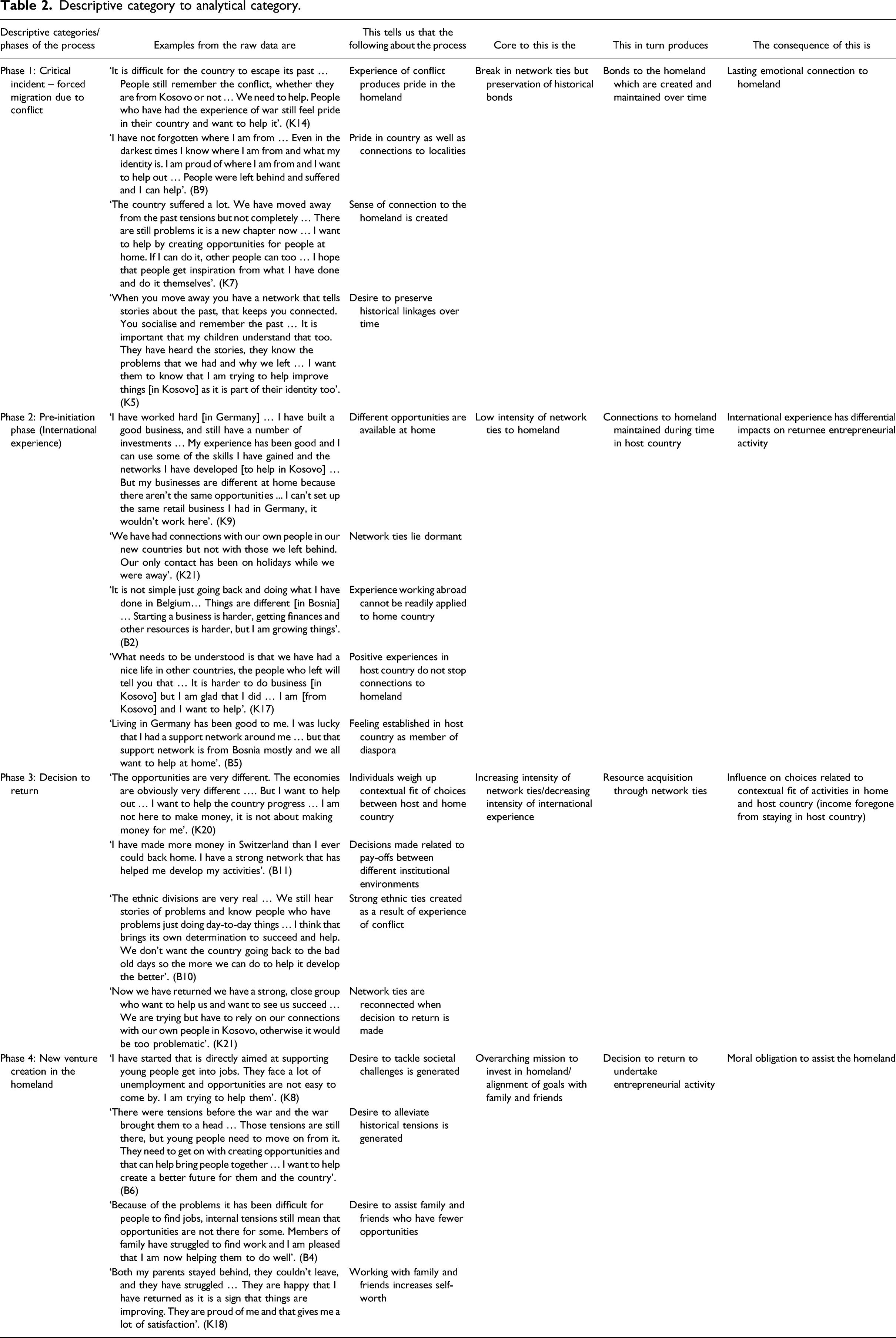
The first step of thematic analysis allowed us to familiarise ourselves with the data. We used both in-vivo and theory-driven codes (Kreiner, 2016; Locke et al., 2008) and coded the data using NVivo to keep track of emerging themes and categories. Interview transcripts were analysed independently and jointly by at least two co-authors of the study. Our codes captured all instances of the utilisation of networks and objectives of returnee entrepreneurs, from the initial outward migration to return. They demonstrated that the usage of informal networks were prevalent, and the desire to assist the home country as a key motivation. The observation that institutional voids facilitate entrepreneurial activities in B&H and Kosovo was counterintuitive, creating a ‘genuine doubt’ (Tavory & Timmermans, 2014) that triggered abduction. Given that our initial theoretical underpinnings could not explain this finding, we sought alternative theoretical lenses and turned to institutional voids literature. Thematic analysis also enabled us to identify critical incidents and milestones of the entrepreneurial journey which we further explored in the second phase of the data analysis. As noted by Pettigrew (1997: 338), ‘exposing processes requires a process vocabulary’ and we draw on the notion of critical incidents (Davidsson & Gruenhagen, 2020) to examine the entrepreneurial journey in terms of the initial critical incident and how networks are accessed over time.
Descriptive category to analytical category.
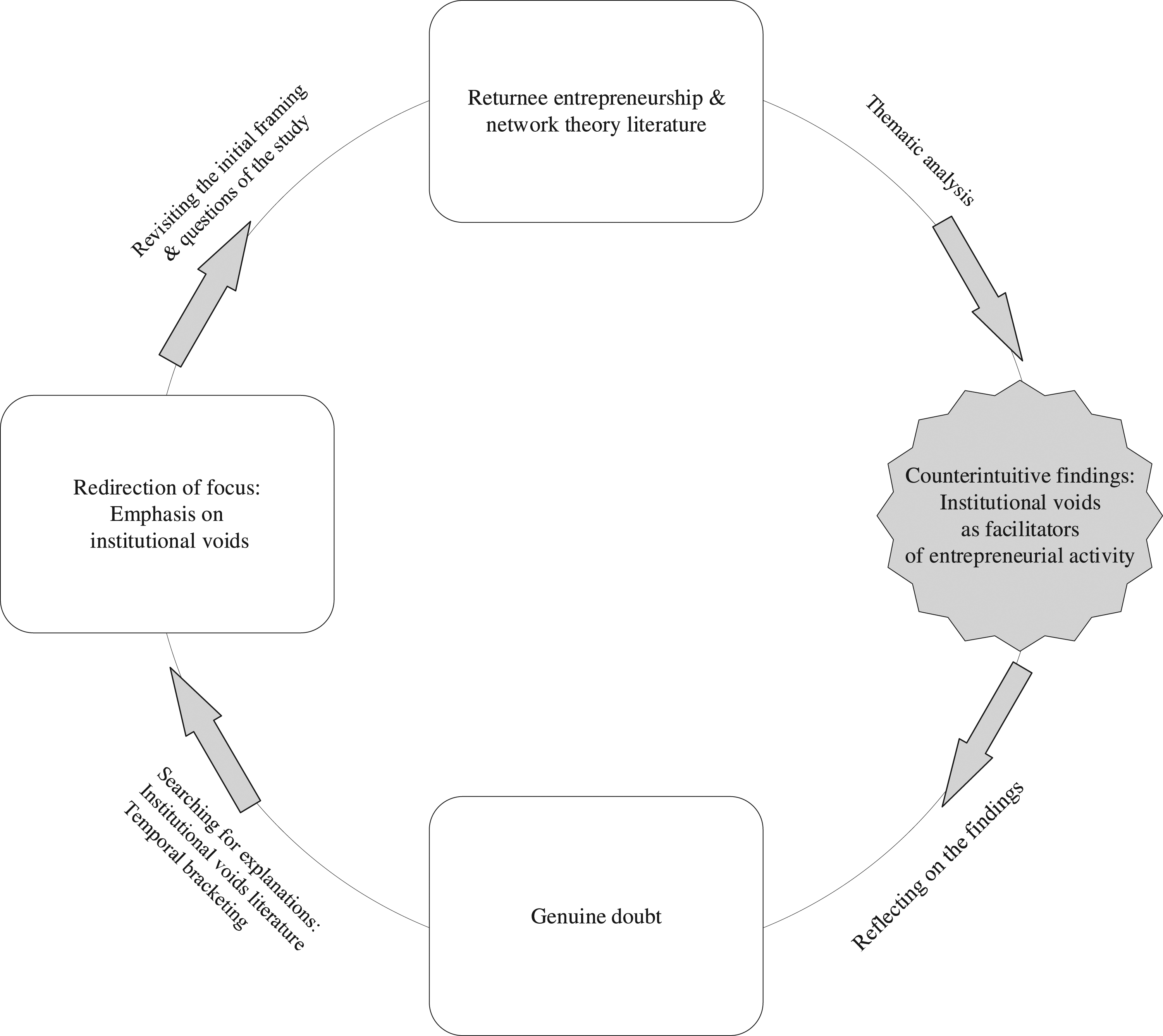
Sequence of abductive steps.
In ensuring the quality of our study, we considered the criteria of trustworthiness, credibility and confirmability (Lincoln & Guba, 1985; Welch & Piekkari, 2017). Following Cuervo-Cazurra, Andersson, Brannen, and NielsenReuber (2016), we sought to establish trustworthiness by discussing and justifying our methodological decisions about context, research design and data analysis. We employed purposeful selection to identify returnee entrepreneurs and discuss the data analysis of interview transcripts. Additional steps were taken to enhance the credibility of the interviews (Lincoln & Guba, 1985), namely, use of a theory in the development of the interview guide as per Dubois & Gadde (2002); treatment of language issues in the interview situation (Chidlow et al., 2014); verification by the investigated returnee entrepreneurs of interview write-ups, authors’ iterative discussions of the interpretations of the findings and discussion of the process model with three academic experts in the areas of entrepreneurship and returnee entrepreneurship. To establish the confirmability criterion (Lincoln & Guba, 1985), we worked both independently and as team to explore, organise and analyse the qualitative interviews and iterate theory and data to formulate themes and categories. We cross-checked our interpretations to improve our data structure and crystallise the aggregate dimensions of our analysis.
Findings
Summary of the Process
In this section, we set out the findings of our study. We unpack the process of returnee entrepreneurship in terms of its initial critical incident and subsequent journey and discuss it in its embedding contexts. This is constituted from different, intertwined layers including the macro-level of institutions which evolve over time and causally interact with the meso- and micro-levels. Figure 2 provides a visual representation of the dynamic process of forced migration and returnee entrepreneurship in post-conflict settings and its overlapping phases. Like any process it can only be envisaged through and not separated from its multiple contexts of macro-, meso- and micro-layers. The figure highlights the initial critical incident of forced migration and nonexistence of the venture (Phase 1) through to living in the host country (Phase 2), the decision to return (Phase 3), to new venture creation in the homeland (Phase 4). These phases allow us to examine the characters and plot of the process (Shepherd & Suddaby, 2017) and answer our research questions of how institutional voids shape returnee entrepreneurial activity and how the process of returnee entrepreneurship is influenced by network mobilisation. The figure shows the key characteristics of each phase, and how sub-processes associated with entrepreneurial experience, networks, historical bonds and contextual fit of choices build and interact over the duration of the process. The process of forced migration and returnee entrepreneurship in B&H and Kosovo.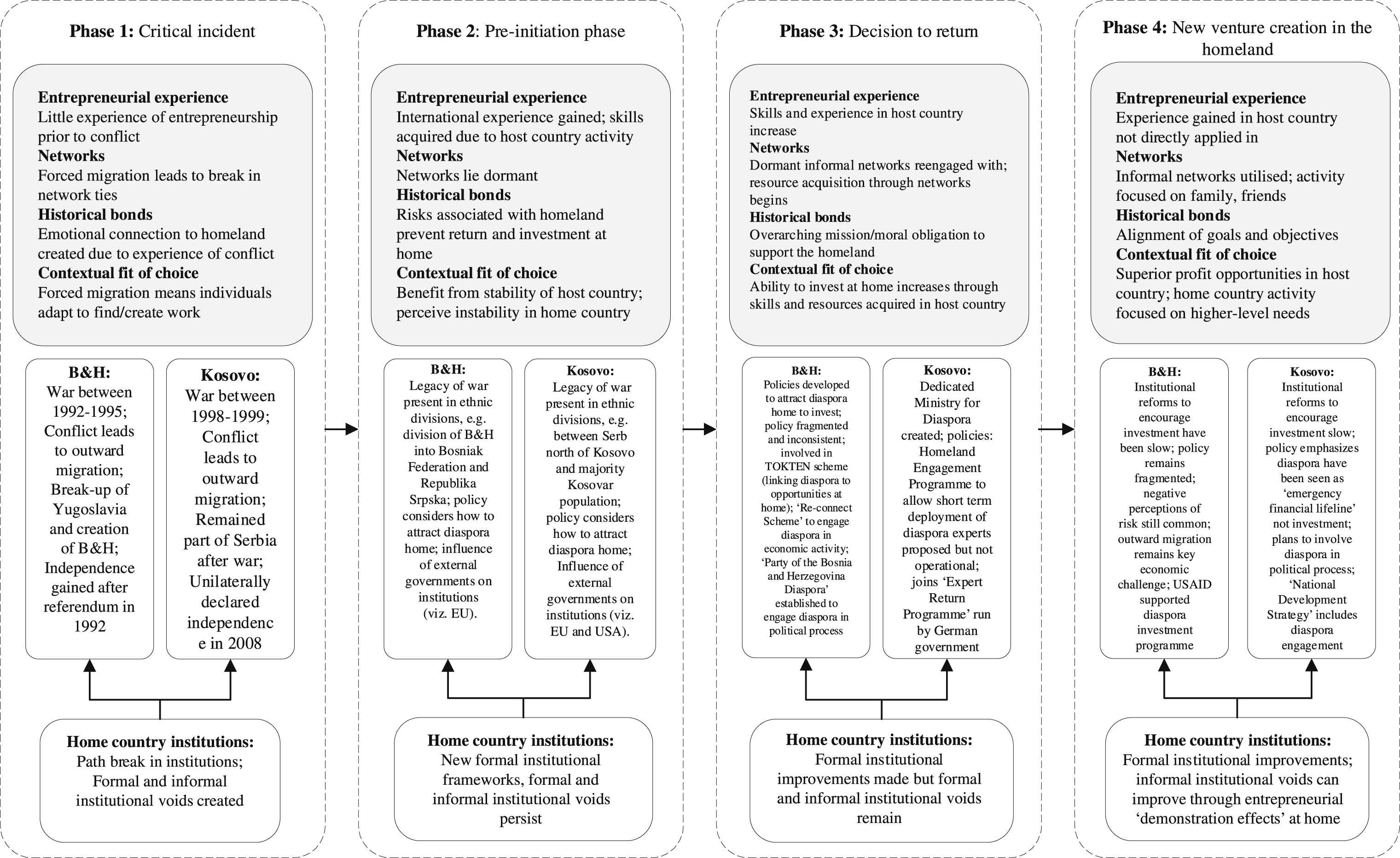
Phase 1: The Forced Nature of Migration
In our study, the forced nature of migration triggered by conflict means that livelihoods were left behind, with businesses and homes abandoned. Interviewees stated for example, ‘we left quickly, leaving everything behind’ (K11); ‘we left overnight, crossing the mountains to escape’ (K17) and ‘we left our home, our business, our life’ (B8). There was thus an extreme break with the homeland. Institutional voids are created at this phase, due to the path break associated with dissolution of the former Yugoslavia and creation of the new countries of B&H and Kosovo. 2 This early period was chaotic with B&H divided up by the Dayton Accords of 1995, and having to develop new institutions, while Kosovo developed new institutions under the influence of the USA and EU while it moved towards independence. This period of turbulence at home corresponds with the pre-initiation phase spent in the host country. In both countries, legal frameworks related to property rights, bankruptcy, contracts and taxes were largely appropriated from western economies, but implementing and enforcing these was a primary challenge meaning that institutional voids were created. The immediate post-war period was seen by the respondents to be something of a relief as conflict had ended, but with a realisation that significant economic challenges were to come. As one respondent stated: ‘We could see from afar that there were problems, the ethnic tensions were not solved, we had new governments with little experience of policy making’ (B11). The respondents stated that some entrepreneurs had returned in this early period but had had their ‘fingers burnt … because the economy wasn’t ready, the rules weren’t followed or understood’ (K19) and thus many left again.
A historical bond with the homeland is established at this phase, and this persists over time due to the shared experience of the forced migrants with those who remained at home. Phrases such as ‘we’ve all been through the same things’ (K7), ‘we all know what it was like, how we suffered’ (B13) and ‘all of our families were affected’ (B3) were used to convey the immediate impact of conflict and forced migration, but also the shared memory that binds people together. Historical roots are shared with other family members as a way of securing the bond with the homeland. The interviewees stated that they gained pride by telling their children of their lives in their home country; for example, ‘My children know their roots, they … are partly Kosovar, but also feel German… [They] don’t want to come back, but they are proud to see what I am doing’ (K5); and ‘[We] pass on stories about the past to our children … [they] feel a connection to it’ (B7).
Although historical bonds are forged, the nature of forced migration also implies a break in networks. During this phase, networks are not utilised for economic purposes such as developing entrepreneurial opportunities. However, given the historical, emotional bonds that are created, a highly motivated network is ready to be reconnected later in the process when the decision to return is made. The first phase of the process influences subsequent phases as historical bonds last over time and the emotional connection can be utilised upon return.
Phase 2: The Pre-Initiation Phase in the Host Country
Phase 2 highlights the experience of living in the host country. During this time, there is a break in network ties at home, but international experience is built up either through employment or establishing entrepreneurial ventures in the host country. This international experience plays an important role during the time in the host country and triggers the pre-initiation phase. During this time, the respondents benefit from the stable institutional environments of their host country, while at home, the economies of B&H and Kosovo were struggling to develop effective institutions that could enable their countries to grow, while also tackling significant challenges such as corruption.
We found evidence that the role of international experience lessens as the entrepreneurial process develops, as returnees cannot simply implant their international experiences to the homeland. While some of the interviewees were highly skilled, for example, having experience in senior roles in multinational enterprises in the host country (K12 and B10), most had chiefly been engaged in low skilled employment. Of those who had engaged in their own entrepreneurial endeavours this tended to be highly localised and often chiefly served their own ethnic community, for example, restaurants and cafes. These activities solidified their historical bonds to the homeland, as they shared stories with other members of their community about the past and what they might do to help if they returned. As one respondent stated: ‘We used to talk about what we would do if we went back, how we would be Prime Minister and change everything, get rid of corruption … but we knew going back wasn’t easy’ (K16).
We found a higher-level of skills and experience among those who have not moved back permanently. They are often more embedded in host country labour markets. While they are motivated to start businesses in the homeland, they often stay resident in the host country to maintain links with a wider business network. The international experience gained in Phase 2 thus has implications for how the process develops. Our interviews found that returning to a post-conflict economy can mean that returnee entrepreneurial activity often takes place outside the individuals’ circle of experience or competencies. For those with high skills and experience, many felt that their experience was not applicable in the homeland. As two of the respondents explained: ‘I worked for Siemens for years … I learnt a lot … but a lot of the experience does not fit here, there are different ways of working’ (K12); ‘It is very different [working in Norway] …. The ways of working are different, the management of things is different’ (B10). As a result, while the returnees are still motivated to start businesses in their homeland, as they develop their entrepreneurial ideas for the homeland, they will be on a small scale and outside of their international experience.
Phase 3: Decision to Return
Phase 3 occurs when the decision to return to undertake entrepreneurial activity begins to form. The decision itself is a key milestone in the process. During this phase, individuals draw on their international experience to examine the contextual fit of their choices, comparing the relative stability of the host country to the institutional voids of the home country. In this phase, there is more stability in the home institutional environments, as policy makers sought to tackle corruption and support more entrepreneurship by improving rules. Thus, regulations which govern activity become more embedded and recognised; however, significant voids remain. The respondents stated that both countries had young, optimistic populations which wanted to create a better future for themselves (thus informal institutions were evolving) but significant formal institutional voids remained, particularly in terms of protecting property rights and tackling corruption.
Our data shows that as they consider return the interviewees perceive the homeland environment as intrinsically challenging. Responses such as ‘there are still multiple problems at home … [with lots of] corruption’ (K8); and ‘things have improved but not much … it is still a very difficult place to do business’ (B7) were used to describe the generally weaker economic environments at home. To overcome the institutional voids, a key factor in considering return is the reconnection of social networks at home. These ties have been dormant but can be readily reconnected, and the utilisation of networks intensifies through Phase 3 to Phase 4. For the interviewees, the reconnection with networks at home occurs despite the presence of institutional voids, and thus, they do not constrain return.
For all the respondents, family members were left behind at the time of the individuals’ migration: ‘some of [my] family are still there, ready to help me’ (B6), ‘My parents didn’t leave, they stayed and have helped me when I went back’ (K20). These dormant ties can be reconnected when it becomes beneficial for the development of entrepreneurial activity. The presence of institutional voids led to the mobilisation of family, friends and ethnic networks which provide an impetus for return. This meso-level of context makes it easier to plan for entry into B&H and Kosovo markets, as well as making it easier to identify and develop opportunities, because their informal networks ‘know the landscape’ (K12) and ‘they understand how things work’ (B3). This can provide returnee entrepreneurs with an advantage over other foreign investors as they can use the knowledge provided by informal networks to develop their own opportunities. These networks have current knowledge of the institutional challenges which means they can provide returnees with knowledge which enables them to navigate the voids. For example, one respondent, who was an entrepreneur in the host country, stated: ‘I wasn’t an entrepreneur before I left so I didn’t know how to set things up at home, but I have received lots of help to guide me through all the processes’ (K3). Another respondent stated: ‘without that help, it wouldn’t have been possible’ (K9). This help is often specific, for example, providing advice on how to gain licences to operate and to file tax returns, both of which were cited as being problematic features of the institutional voids in B&H and Kosovo.
Another important element of Phase 3 is the objectives which evolve through the phases, connecting the initial critical incident to the final phase of entrepreneurial activity. When describing their objectives associated with return, the interviewees clearly attributed the decision to invest at home to non-monetary gains. The returnee entrepreneurs in our sample met their own needs by acting through their connections to family and friends at home, which bind networks together through shared experience of the conflict. The intimacy of close relationships with family and friends provided the returnee entrepreneurs with a personal sense of satisfaction, and allow them to overcome formal institutional voids. For many of the interviewees, having friends and family present in their home country provided them with a desire to start businesses there, so that opportunities could be provided for them. An overarching mission to help the homeland through feeling a moral obligation is developed over time. As one respondent explained: ‘it is important to remember that we didn’t want to leave, we were forced to go … so I have always wanted to go back and help out those who stayed’ (B6).
In describing the differential advantages of home and the host country, the interviewees suggested that the decision to return did not occur because of the entrepreneurial opportunities available at home, often explaining this in terms such as ‘things are easier and clearer in the UK’ (B8); ‘Austria is safe and stable’ (K11) and ‘there are more opportunities in Germany, it is easier to make money there’ (K12). As such, although returnee entrepreneurial activity occurs, institutional voids in B&H and Kosovo act to limit total entrepreneurial activity. The responses also demonstrate how the decision to return means that income is foregone as a result of the moral obligation to the homeland. All respondents stated that they could make more money in the host country. Return home means that they utilise financial resources which could have generated higher returns by staying in the host country.
Phase 4: New Venture Creation in the Homeland
Phase 4 highlights the entrepreneurial activity that is undertaken upon return, and how this return is a culmination of the previous phases, influenced by the usage of informal networks and the objectives of returnees which are triggered by the institutional voids. At this stage, the institutional frameworks in B&H and Kosovo have improved, meaning perceptions of risk are reduced and leads to new venture creation. However, significant institutional voids remain. Gaining licences to operate, protecting property rights and ensuring that corruption can be avoided were seen as key challenges by the respondents.
As discussed in Phase 2, the international experience gained in the host country can influences the activities undertaken at home. We found that the experience of starting or working in small-scale entrepreneurial ventures abroad provided little advantage on returning to start new ventures at home due to the presence of voids. As one interviewee observed: ‘You think you have the experience, but starting a business in the UK is very different than doing it in Kosovo … it doesn’t really prepare you’ (K4). In cases where there is a mismatch in experience and lack of applicability at home, the returnee entrepreneurs are motivated to start enterprises outside their own area of expertise but in opportunities they felt would have a broad impact on society. For example, one respondent stated: ‘I want to have a knock-on effect … it’s like the Kosovar footballers playing for Switzerland. It influences others to take up the sport. I want people here to see that they have job opportunities and can be entrepreneurs’ (K21). Starting businesses outside their own experience emphasises how the moral obligation to assist the homeland is translated into action and is heightened in B&H and Kosovo due to experience of conflict. Yet at the same time this activity can serve to influence others to act entrepreneurially as the returnees demonstrate what can be achieved despite institutional voids, and can improve informal institutional voids.
For some of the interviewees (K6, K16, K19, B5, B7 and B12), their new venture creation in B&H and Kosovo allowed them to employ members of their family that were previously unemployed or in search of better opportunities, or to give confidence to family members that the country was improving. For example, one respondent stated that ‘my brother was in and out of jobs and I wanted to give him secure work and something that he could really contribute to’ (K6); while another said ‘Most of my family is still here. My mother is here … I want her to see that her country is getting better’ (K16).
Upon return some of the interviewees stated that they had reconnected with ethnic networks at home. Our findings show that ethnic ties are more pronounced given the post-conflict status of the countries studied. 3 The respondents stated that ethnic divisions have not been improved by institutional reforms, with voids highlighting different rules, for example, when comparing Republika Srpska with the Bosnian Federation, or the difficulties associated with operating in Serb-dominated parts of Kosovo. Ethnic networks were pronounced in the dataset and were utilised as a way of assisting those at home who are perceived to have been previously persecuted, rather than because they can provide entrepreneurial advantages. Ethnic ties are strong in B&H and Kosovo and act to enable returnees to overcome voids. Similar to ties to family and friends, ethnic ties provide a valuable resource for reconnection. The interviewees were able to access a wider ethnic-based network outside of their family which would be highly motivated to support them. As such, the legacy of conflict has a unique impact on the reconnection of network ties.
Evidence of the use of ethnic ties upon return was found in both countries, yet with some different outcomes when the countries are compared. In Kosovo, the northern district of Mitrovica is dominated by Serbs and experiences irregular ethnic clashes. In our interviews, ethnic Albanians were found to avoid Mitrovica, while in B&H, Bosniaks avoid Serb-dominated Republika Srpska. For these ethnic groups, which are in the overall majority in the homelands but the minority in Repblika Srpska and Mitrovica, there are significantly greater barriers to doing business in these locations, as well as a lack of networks: ‘It is not an option, there is too much tension still there’ (K5); ‘They will only support Serb-run firms there. If you are not a Serb then you will face lots of complications’ (B7). For Kosovars, it is not an option to operate in Mitrovica due to ethnic tensions, and it represents a small market so is not worth pursuing. The bigger challenge is tension with Serbia, which still does not recognise Kosovo’s independence, means that the largest neighbouring market is closed off for trade. For Bosniaks, the opportunity to operate in Republika Srpska would be welcomed as it is a relatively large market and tensions are not as severe; however, they remain excluded and discriminated against: ‘preferential treatment is given to Serb owned businesses and it would just be too difficult for us’ (B10).
The returnees in our sample often focus start-up activity in the periphery. Some do not invest in the economic centres of Kosovo and B&H, such as the capitals Prishtina and Sarajevo, but rather invest in their home town/village or instead a town/village that they have a family connection to. A side effect of this was that returnee entrepreneurs could avoid political attention. Many interviewees corresponded with the view that ‘it is easier to operate away from the capital where corruption and political attention is much lower’ (K18). We found that start-up activity in the periphery was more pronounced among those who have not moved permanently to their home country (16 out of 34 interviewees). These respondents exhibited a more incremental approach to re-entry to the home country, and part of the strategy to do so is the diversification of their portfolio while at the same time minimising risk. On return, the respondents seek to avoid formal networks instigated or influenced by government: ‘I don’t want to get involved in government schemes, it is not worth it’ (B2); ‘I’d rather stay out of politics, there are too many risks involved’ (K5). Instead, the returnee entrepreneurs rely on the continuity of their informal networks which were present prior to migration, meaning that informal ties substitute for formal institutional voids.
In examining the objectives of returnee entrepreneurs upon return, our data finds that non-monetary gains were much more prevalent as a motivation than a desire for profit in both B&H and Kosovo. In part, this is because of the presence of institutional voids which limit total entrepreneurial activity, but also due to the usage of informal networks to overcome voids. Working with family, friends and ethnic ties remits non-monetary gains to the returnee. Emotional responses to return included ‘I am helping out my people, my village … it suffered a lot’ (B9); ‘We suffered a lot in the war, and after it … I am in a position to help so I want to do that’ (K20). The findings show that returnee entrepreneurs in B&H and Kosovo are driven by higher-level needs associated with social contribution. Making money was often a secondary consideration for the returnee entrepreneurs. For example, one respondent stated, ‘I haven’t made a single euro from my investments in Kosovo, I don’t invest here to make money’ (K6); while another stated that ‘I make money, but not much … I have enough from my businesses abroad that I can invest in interesting projects at home but I am not concerned about profit’ (B7).
The interviews demonstrate how the objectives of returnee entrepreneurial activity are influenced by the presence of voids. The desire to invest in socially beneficial activities is a key element in trying to achieve non-monetary gains. In order to achieve these gains, investments were often focused on trying to solve particular demographic challenges, particularly youth unemployment and ethnic divisions at home. Many of the Kosovo interviewees stated that the country had a young population and high rates of youth employment, as well as a weak education system. This means that activities can be focused on educational outcomes of the young. For example, one respondent (K8) had established an IT business in Gjakova in Kosovo which had seen significant fighting during the war. The business provided training for recently graduated school students, with a requirement that 60% of training places were filled by females, so that their educational outcomes, which had been negatively impacted by the conflict, were supported. Another respondent (B6) had provided internships for University students in their media company based in Zenica (B&H) while others stated that they had recruitment policies to provide opportunities to young people from areas which had been significantly impacted by the wars (K6, K7, K17, K19, B3, B5 and B11).
A focus on education was often expressed through a desire for historical understanding so that ethnic divisions could be overcome and informal institutions can be improved. As one respondent stated: ‘The danger is that ethnic divisions just become more entrenched over time, so we need to tackle that … we can help bring people together’ (B10). This respondent stated that they had contributed to roadshows in the north of B&H to showcase the investments they had made and how they employed young people from different ethnic groups, with the hope of lessening feelings of division among young people. Another respondent had contributed to a University-led EU funded grant to provide case studies of work they were doing to break down barriers between ethnic groups (K8).
It is important to note that the objectives of the returnee entrepreneurs are not entirely altruistic. The new ventures they create are still profit-making businesses and not, for example, social enterprises. There are in fact multiple objectives at play, and profit should not be dismissed. However, our interviews strongly emphasised a moral obligation and desire to help the homeland, so that making profits is balanced with improving the welfare of others.
Discussion
The study is the first of its kind to systematically examine the role of forced migration in influencing the process of returnee entrepreneurship, detailing the journey from nonexistence to existence of new economic activities, rather than an event (Vogel, 2017). There is a gap in understanding how networks are utilised in contexts with institutional voids (Webb et al., 2020) and we contribute to this by showing how informal ties substitute for formal institutional voids. As such, institutional voids offer a counterintuitive source of entrepreneurial opportunities as returnees are able to exploit opportunities by drawing on historical networks. In answering our research questions, we show that institutional voids can enable returnee entrepreneurship and that the presence of institutional voids triggers the usage of informal networks and influences the objectives of the returnee entrepreneurs.
Our study offers a process-oriented examination of the entrepreneurial journey in B&H and Kosovo demonstrating how a critical incident leads to historical bonds being created which ultimately influences returnee activity. Research on the entrepreneurial process has lacked consideration of critical incidents which impact the process, as well as lacking consideration of alternative spatial contexts (Davidsson & Gruenhagen, 2020). While in more developed economies, individuals will return after institutional improvements through policy and increased indigenous entrepreneurship (Kenney et al., 2013), our data demonstrates that forced migrants can engage in returnee entrepreneurship despite the presence of institutional voids as returnees are able to draw on their informal networks to overcome voids. Despite the duration of the process (the average time between leaving and returning to start a business was 14 years), the economies of B&H and Kosovo are still characterised by institutional challenges, corruption and a lack of trust in government (Williams, 2018). We thus offer new implications when compared to existing research as we show that return can occur even without improvements through policy. Our study shows that voids can be enabling rather than constraining when historical bonds with the homeland are strong and informal networks can be utilised.
In examining the characters and plot of the process (Shepherd & Suddaby, 2017), we show that conflict and forced migration in Phase 1 leads to a break in ties which lie dormant during Phase 2. This can be reconnected during the decision to return in Phase 3 and start of new ventures in the homeland in Phase 4. We show that these networks are often informal and provide the returnee entrepreneurs with low costs associated with foreignness (Nkongolo-Bakenda & Chrysostome, 2013). In this way, informal networks are used to substitute for formal institutional voids. We demonstrate that returnee entrepreneurs use a subset of all potential ties; thus, it is not the entire network that is important but the mobilised network. Individuals in our study weigh the potential benefits and costs associated with networks, with informal ties providing the ‘eyes and ears on the ground’.
In contrast to research on institutional voids which states the importance of political ties (Ge et al., 2019), we show that government is avoided due to a lack of trust. Our returnee entrepreneurs fashion alterative practices to cope with the formal institutional voids. They choose networking strategies to cope with voids, rather than avoiding them altogether. The findings emphasise the role of family and ethnic ties (Discua Cruz & Fromm, 2019; Vershinina et al., 2019), by showing that returnee entrepreneurs in Kosovo and B&H utilise their relational embeddedness (Kloosterman, 2010) to overcome many of the challenges associated with institutional voids. Reconnection with dormant ties provides access to knowledge and resources (Jack, 2005; Levin et al., 2011), which in our study enables returnees to navigate the institutional voids in B&H and Kosovo. This moves understanding on from research which focuses on formal network ties and return to high-growth economies (Wright et al., 2008; Lin et al., 2018) and process studies which tend to focus on Western Europe and North America (Davidsson & Gruenhagen, 2020).
Our study also demonstrates the importance of studying objectives of entrepreneurs where voids are present (Webb et al., 2020), as returnees to post-conflict economies can be driven by higher-level needs rather than profit. Objectives are influenced when the contextual choice for entrepreneurial activity is between a relatively stable host country and a relatively complex, post-conflict home country. As Sydow et al. (2022) state, research is required to extend understanding of institutional uncertainty where voids exist and hybridised goals in the case of entrepreneurs running more than a single venture. In our study, 23 out of 34 respondents maintain investments in the host country and there are different objectives associated with these activities. There are superior profit opportunities in the host country as institutions are developed and respected compared to the home country, and entrepreneurial activities at home are focused on supporting family, friends and co-ethic ties rather than making profit. As such, institutional voids at home directly influence objectives. Our findings also show that these choices mean that income can be foregone, which has previously been considered in process-oriented research (Kim et al., 2006). We build on this by showing that income foregone on return results from lost opportunities for profit associated with host country entrepreneurial activity, although this can be partially offset by maintaining investments in the host country.
The interviewees achieve non-monetary gains through objectives which are a product of the emotional connections to the home country born out of adversity (in our case, conflict). These historical roots mean that returnee entrepreneurs have strong bonds with those they are working with (Discua Cruz et al., 2013), and a sense of mutual obligation and goal alignment between themselves and those in the homeland. This highlights how shared meanings and social identities (Welter et al., 2017) can lead to returnee entrepreneurial activity where voids are present. Furthermore, the application of embeddedness through social networks describes how change is not driven by purely economically rational individuals but recognises varied social norms and values (McKeever et al., 2015). We further propose that the usage of informal network ties influences the objectives of returnee entrepreneurs in such a way that a sense of duty and moral obligation is prioritised through support for family, friends and ethnic ties. This contrasts with previous research on institutional voids which has shown that different objectives can lead to growth, lifestyle or subsistence-oriented ventures (Webb et al., 2020). In our study, none of these are priorities. The returnees start profit-making businesses but with the intention of providing employment opportunities for their family, friends and co-ethnic ties. This will impact on the growth potential of the businesses, although they do act to improve informal institutional voids by signalling to those within the country what new opportunities can be created. There is thus a ‘demonstration effect’ (Williams, 2018) as entrepreneurial activity among those within the country is influenced. Over time, a feedback loop can be generated which means that returnee entrepreneurs can contribute to changing the context (Welter, 2011), with informal institutional voids being lessened as more people view entrepreneurship positively.
Our findings show that returnee entrepreneurship in post-conflict economies is often directed towards social outcomes, which means that the potential impacts of entrepreneurship such as job creation are reduced. In contrast to Qin et al. (2017), who find that a returnee founder can leverage their experience with foreign resources and technological knowhow, we find that international experience plays a reduced role in post-conflict environments. Instead of identifying opportunities which build on the returnees’ significant international experience, investments are made outside of their technological knowhow, and are often directed at social outcomes. In addition, however, the prevailing research on migrant and returnee entrepreneurship predominantly examines skilled individuals (Li et al., 2012; Qin & Estrin, 2015). In contrast, our interviews found that experience gained in the host country was more difficult to apply in the homeland due to the institutional voids present.
An emerging research stream has analysed the role of returnees in filling entrepreneurial gaps in emerging economies (Qin and Estrin, 2015). In our study, returnee entrepreneurs are not filling gaps of innovation, as Li et al. (2012) find among returnees to fast-growing China. Rather, returnee entrepreneurs share capital and expectations of how business should be conducted with family and friends (Williams, 2018). Although the transfer of innovation may be thus reduced, transfers of knowledge will mean that over time, entrepreneurial outcomes in challenging institutional contexts can improve.
Conclusions
This paper addresses two important questions, namely, how returnee entrepreneurs overcome institutional voids, and how the process shapes the utilisation of networks and objectives of returnee entrepreneurs in post-conflict economies. Our empirical analysis advances understanding of critical incidents and historical roots on the process of returnee entrepreneurship, and how this impacts the outcomes of entrepreneurial activities undertaken at home. With our examination of phases, some of the conceptual benefits that process models offer can be combined with a realistic view of how new venture creation processes unfold (Davidsson and Gruenhagen, 2020).
The paper contributes to a more nuanced theory of returnee entrepreneurial activity by setting out the processual nature of return. The critical incident of conflict leads to a historical connection to the homeland of forced migrants, as well as institutional voids which can enable returnee entrepreneurship. This contrasts with the prevailing research on institutional voids which focuses on them as constraints (Doh et al., 2017). We find that institutional voids can trigger the usage of informal networks and ultimately influence the objectives of returnee entrepreneurs. The pre-initiation phase allows individuals to develop skills and knowledge of other institutional environments, but the historical legacy will influence activity more than this experience. Rather than activity reflecting international experience (Li et al., 2012; Qin & Estrin, 2015), we find that it reflects a desire to assist the homeland. Networks of family, friends and ethnic ties are reconnected with on return, and we show that a key objective is the moral obligation to the homeland which is created through the critical incident of conflict which is not lost despite the different phases of the process. We contribute to network theory by showing how ties can lie dormant (Jack, 2005) but that reconnection is enabled by historical bonds born through adversity. We also contribute to theory on institutional voids in showing that informal networks substitute for formal institutional voids, and that this can have a positive influence on informal institutional voids through the demonstration effect as more people within the economies see entrepreneurship as an option.
Given that forced migration is a phenomenon that is not likely to desist, governments will be increasingly required to consider the potential of return. Policy focused on returnees has the potential to contribute significantly to development, especially given that the diaspora may be driven to invest through emotional ties (Elo, 2016). Our study provides a number of implications for policy making. We contend that policy cannot be simply appropriated from other contexts such as fast-growing economies, which have seen an expansion of returnee-focused policies (Gamlen et al., 2019). At the most fundamental level, post-conflict economies must seek to improve the institutional environment, such that it is supportive of entrepreneurship, tackles corruption and engenders trust in government so that investment will be encouraged. While the returnees in our study have often sought to avoid government attention, policy makers should seek to build trust with the diaspora so that when they return they can be supported. In examining institutional voids, it is important that policy making does not simply seek to prioritise the improvement of formal institutions without an understanding of how informal institutional voids can continue to limit the realisation of benefits that can be gained from formal institutional reforms (Webb et al., 2020). In addition, given that our processual approach suggests that key objectives are to support family, friends and ethnic groups, this may have implications on innovation and growth. Policy makers should seek to support widening of activities which can enhance growth. This can be done by learning from successful policy in other countries (Xheneti & Kitching, 2011) which seeks to link returnees with entrepreneurs at home, particularly where these policies are aimed at filling gaps in knowledge or expertise in the home country.
We acknowledge that there are some limitations to our sample composition. Our study suffers from survivor bias as only those who have successfully navigated (i.e. not failed) the institutional environment were interviewed (Mueller & Shepherd, 2014). However, there are significant strengths in terms of the depth of data we were able to obtain which mitigate this, and there is much this study suggests for future research. First, future studies should examine different forms of critical incidents, for example, due to natural disasters or economic decline, and how these may influence different stages of the process, including utilisation of resources and how these influence objectives. Second, studies could consider the length of time away from the homeland and the influence that this has on returnee entrepreneur activity. Third, there is scope for richer contextualisation of returnee entrepreneurship, and as such broader contexts of migration should be studied. The context of our study means that theoretically informed judgements can be made about other, similar contexts, for example, in Central America which has seen migration to the USA and return, and the recent forced migration in Afghanistan, but also processes of migration associated with economies which have seen forced migration for other reasons, including natural disasters and/or poverty. Studies of these contexts would lead to greater theoretical and practical understanding of this important phenomenon.
Footnotes
Acknowledgements
The authors are grateful for valuable insights on earlier versions of these ideas from Tamer Cavusgil, Gary Knight and Becky Reuber. The authors are also grateful to the editor and three anonymous reviewers for guidance and valuable comments throughout the review process.
Declaration of Conflicting Interests
The author(s) declared no potential conflicts of interest with respect to the research, authorship, and/or publication of this article.
Funding
The authors disclosed receipt of the following financial support for the research, authorship, and/or publication of this article: The authors received financial support from the Leverhulme Trust Research Fellowship scheme (grant no. RF-2016-297) in order to undertake the research for this article.