




Abstract
How does corruption take root inside organizations that are outwardly legitimate and explicitly “zero tolerance?” Drawing on 9 years of co-constructed autoethnographic research from within an international NGO operating in coastal Bangladesh, we examine how entrepreneurial competencies can be redeployed for corrupt ends through the exploitation—and active production—of institutional and organizational voids. We extend Cavotta and Phillips’ model of corrupt entrepreneurship by developing a multi-level account that links macro-level institutional voids to meso-level organizational voids (gaps in oversight, accountability, and communication) and to micro-level entrepreneurial action. Integrating Mars’ workplace crime typology, we show how a strategically positioned insider (akin to Mars’ “Hawk” archetype) built a sophisticated “parasitic enterprise” within its NGO “host,” using a portfolio of illicit “products,” dual accounting systems, and a hub-and-spoke structure to extract value while maintaining legitimacy and avoiding scrutiny. These dynamics generate a recursive feedback loop in which individual-level practices widen organizational voids and, in turn, reproduce the very institutional conditions that enable corruption to persist. Methodologically, the study demonstrates how autoethnography can surface the covert, processual, and emotionally charged mechanisms through which corrupt entrepreneurship unfolds—processes rarely accessible via conventional research designs. Practically, we derive actionable insights for addressing entrenched corruption within organizations, highlighting how “dark” entrepreneurial capabilities can be redirected toward ethical ends through adaptive—not purely punitive—controls, including the replacement of easily gamified performance indicators with substantive ones and the deliberate embedding of “outsiderness” into management structures.
Keywords
Corruption, broadly defined as the misuse of entrusted power for private gain, is widely recognized as one of society’s grand challenges (George et al., 2016). While extensive research documents its pervasive and detrimental impacts on both business and society, existing scholarship predominantly focuses on corruption within the public sector (e.g., Rose-Ackerman & Palifka, 2016). Research on corruption within the private sector remains underdeveloped, prompting calls for deeper investigation into its unique dynamics (see Castro et al., 2020; Cavotta & Phillips, 2023). Castro et al., (2020, p. 938) introduced the term corporate corruption, defining it as “the misuse of formal power by a corporate representative for personal and/or organizational benefit,” arguing that it differs fundamentally from its public-sector counterpart, and encouraging further scholarship on this topic and nascent field of study.
To advance this agenda, Cavotta and Phillips (2023) highlight the important yet neglected intersection between corruption and entrepreneurship, a gap also echoed by Castro et al. (2020). Within this intersection, most studies relegate corruption to an external (macro-level) “context” that influences firms, thus largely neglecting how firms themselves come to actively perpetuate and shape corrupt practices. For example, using the World Bank’s control of corruption index, Anokhin and Schulze (2009) reveal the detrimental effects of national-level corruption on domestic entrepreneurial and innovation activities. Studies that do focus on individual firms often conceptualize corruption as a deliberate organizational (meso-level) “choice,” also using relatively reductionist proxies to measure it, and overstating the degree of agency that firms possess. While these “context-oriented” and “choice-oriented” studies provide valuable insights into whether corruption enhances or harms entrepreneurial outcomes, there remains an urgent need to explore beyond this binary “grease” versus “sand” in the wheels debate. 1
Rather than relegating corruption solely to an external “context” or characterizing it as a firm- or individual-level “choice,” our conceptualization of entrepreneurship bridges these extremes. We define the intersection of corruption and entrepreneurship as the domain in which entrepreneurial activities are simultaneously shaped by—and act to reshape—corrupt contexts. At this intersection, entrepreneurship operates as a dynamic mechanism through which individual-level entrepreneurial competencies and practices are influenced by meso- and macro-level settings and contexts (such as organizational and institutional voids), 2 and in turn work to exploit, reproduce, and extend these enabling settings and contexts. Thus, rather than conceptualizing entrepreneurship as a type of actor (e.g., a “bad apple” among entrepreneurs) or context (e.g., a “bad barrel” among organizational settings), this perspective foregrounds the emergence of corrupt entrepreneurs and their corrupt enterprises through a recursive interplay among multi-level factors.
To this end, we draw on Cavotta and Phillips’ (2023) theoretical model of corrupt entrepreneurship—an outside-in perspective that outlines how corruption can emerge from and fill institutional voids—and complement it with an inductively derived inside-out perspective that foregrounds how corruption can originate and become embedded from within organizations. Using Mars’ (1982) workplace crime framework to help bridge these dynamics, we undertake an autoethnographic examination of how an international NGO (hereafter, the NGO) operating in Bangladesh became deeply corrupted. Our choice of setting is partly driven by the availability of an unusually rich dataset on managerial experience with corruption, but also because this setting holds theoretical and practical relevance for the study of business and society. In terms of theory, as with other organizational forms, NGOs must engage in entrepreneurialism to function effectively. To achieve their missions, employees and managers in these organizations are required to navigate institutional voids, manage uncertainty, and mobilize scarce resources (Hussain et al., 2023; Manning & Vavilov, 2023). NGOs additionally function as “experimenters,” testing new ideas to assess their viability and marketability—behaviors that embody an entrepreneurial logic (Ngo et al., 2024). Moreover, typically positioned at the intersection between the public and private sectors, NGOs must maintain close relationships with an array of stakeholders, including government agencies where corruption often emerges and evolves (Castro et al., 2020; Cavotta & Phillips, 2023). Turning to practical relevance, it also makes normative sense to study NGOs because these and other socially-oriented organizations (including social enterprises) are widely recognized as important drivers of social and economic development (Ahmed et al., 2023), especially in emerging markets home to a majority of the world’s underprivileged (Vassallo et al., 2019, 2023).
Drawing on 9 years of autoethnographic data and qualitative thematic analysis within this Global South setting, we reveal how—rather than merely “surviving” in corrupt contexts—entrepreneurial individuals come to exploit and shape them, utilizing an entrepreneurial skillset to further entrench and expand corruption. Specifically, we document how an entrepreneurial individual established and managed a “parasitic” enterprise within an NGO “host.” This individual embodied the defining features of corrupt entrepreneurship identified by Cavotta and Phillips (2023), combining traditional, institutional, and cultural entrepreneurial competencies and practices to exploit institutional and organizational voids. Moreover, building upon Malik and Froese’s (2022) recent depiction of corruption as “dark” or “perverse” innovation, we also reveal the extent to which navigating the criminal dimensions of corrupt activity demands a form of entrepreneurial behavior that is even more complex, risky, and inventive than that required for more legitimate ventures.
Accordingly, our study contributes to the emerging literature on corrupt entrepreneurship both theoretically and methodologically. Contributing theoretically, we extend Cavotta and Phillips’ (2023) framework by developing a multi-level understanding of how corrupt entrepreneurship unfolds. Drawing on Mars’ (1982) typology of workplace crime, we reveal how institutional (macro-) and organizational (meso-) level enablers interact with individual (micro-) level actions to create conditions under which corruption can take root inside an otherwise untainted organization. Cavotta and Phillips’ (2023) original framework demonstrates how the activities of traditional, institutional, and cultural entrepreneurship drive corrupt entrepreneurship in response to institutional voids. This outside-in perspective does not unpack the inner workings of organizations or the individual actors who perpetuate corruption from within them. We extend their framework via an inside-out perspective that begins within an organizational context—capturing Mars’ (1982) emphasis on how specific occupational settings enable deviant behavior—and tracing how an array of entrepreneurial competencies and practices interact recursively with structural and contextual enablers to generate and sustain corruption. In doing so, we reveal that institutional voids are mirrored by organizational voids—internal gaps in oversight, accountability, and communication—that can be strategically exploited and widened by entrepreneurial actors, thereby allowing corruption to emerge and proliferate from within otherwise legitimate organizational structures. Through this extension, we respond to Cavotta and Phillips’ (2023) call to explain why and how corrupt entrepreneurs emerge and succeed.
Contributing methodologically, we demonstrate how autoethnographic inquiry can illuminate the covert, processual, and emotionally charged dimensions of corporate corruption that are typically inaccessible to conventional research designs. By situating the researcher within the social system under study over an extended period, our co-constructed autoethnography offers longitudinal, insider access to organizational realities that external observers rarely capture. Through iterative cycles of reflection, narrative reconstruction, and triangulation across multiple data sources, this approach ensures analytical rigor while maintaining ethical reflexivity regarding power, representation, and positionality. In doing so, it exposes the lived mechanisms through which entrepreneurial competencies—ordinarily celebrated as drivers of innovation and growth—can also enable sophisticated forms of organizational corruption. This revelatory “double-edged sword” perspective invites a critical reassessment of anti-corruption strategies in contexts where entrepreneurial activity and institutional fragility coexist, highlighting how well-intentioned reforms may inadvertently reproduce the very conditions that allow corruption to thrive.
Corruption and Entrepreneurship—An Overlooked Intersection
Research on entrepreneurship traditionally celebrates innovation and value creation, yet a growing literature highlights a “dark side” where entrepreneurial activities intertwine with corruption (e.g., Anokhin & Schulze, 2009; Cavotta & Phillips, 2023). Corruption can impede legitimate entrepreneurship by undermining institutional trust and deterring investment in new ventures (Castro et al., 2020). However, entrepreneurs are not only victims of corrupt environments; they may also actively perpetrate corruption, and in fact “entrepreneurship is often highly corrosive of the institutions that support fair and regulated markets” (Castro et al., 2020, p. 958). Rather than spurring innovation, corrupt entrepreneurs arguably exploit institutional voids and weak governance (Castro et al., 2020). This paradoxical role of entrepreneurship—as both victim of and contributor to corruption—remains largely overlooked in mainstream entrepreneurship research and has only recently received scholarly attention (Castro et al., 2020; Cavotta & Phillips, 2023).
In response, a nascent stream of research examines how entrepreneurs behave as active agents of corruption (Cavotta & Phillips, 2023; Webb et al., 2009). We next outline two theoretical frameworks that illuminate this intersection, specifically Cavotta and Phillips’ (2023) corrupt entrepreneurship model and Mars’ (1982) occupational crime typology. Together, these perspectives set the stage for enriching our understanding of the multi-level enactment of entrepreneurship’s dark side that is developed in later sections.
The Dark Side of Entrepreneurship
Institutional Voids and Three Dimensions of Corrupt Entrepreneurship
Not all entrepreneurship is socially beneficial—a point classically made by Baumol’s (1996) distinction between productive, unproductive, and destructive entrepreneurship. Productive entrepreneurship drives wealth creation and innovation, whereas unproductive entrepreneurship involves rent-seeking and manipulating the system for private gain (Baumol, 1996). In extreme cases, entrepreneurs engage in destructive activities that actively harm societal welfare, including organized crime or corruption. Corrupt entrepreneurship can be understood as a subset of unproductive entrepreneurship in which individuals or ventures innovate by exploiting illicit opportunities, subverting rules, and brokering power through bribery, fraud, or collusion. Such actors display hallmark entrepreneurial competencies, for example, resourcefulness and opportunity recognition, but channel these abilities into illicit avenues.
Institutional voids represent situations where frameworks required for efficient market operations are either weak or missing (Khanna & Palepu, 1997). These voids include deficiencies in structures such as constitutions, laws, property rights, and regulatory frameworks, as well as shortcomings in informal institutions like cultural norms, traditions, and religious practices (Mair et al., 2012). Institutional voids simultaneously impede and stimulate entrepreneurship (Doh et al., 2017; Mair & Marti, 2009). On one hand, such institutional shortcomings force entrepreneurs to seek alternative strategies to manage these constraints (Gao et al., 2017; Sutter et al., 2013). These voids can also stimulate entrepreneurial ingenuity, enabling entrepreneurs to discover and capitalize on emerging opportunities (Doh et al., 2017; Mair & Marti, 2009). Such opportunities can also extend to involvement in illegitimate entrepreneurial activities (Cavotta & Phillips, 2023).
Cavotta and Phillips (2023) suggest that corrupt entrepreneurs emerge in response to these same institutional voids. The corrupt are not simply opportunistic offenders but combine elements of traditional, institutional, and cultural entrepreneurship to initiate and sustain illicit enterprises by exploiting, creating, and preserving such institutional deficiencies. First, through opportunity exploitation, corrupt entrepreneurs resemble traditional entrepreneurs by identifying and capitalizing on institutional voids—such as regulatory gaps or enforcement failures—for profit (Mayer et al., 2018). Such entrepreneurs swiftly move into illicit markets, meeting demands for illegal goods or services, effectively mirroring the market-seeking behavior of legitimate entrepreneurs but within an unlawful context. Second, these entrepreneurs actively engage in institutional manipulation, acting as institutional entrepreneurs who deliberately create or perpetuate institutional weaknesses favorable to their illicit activities (Hardy & Maguire, 2008). They actively re-engineer the institutional environment through bribery, coercion, or political influence. Such strategic manipulation maintains or expands institutional voids, sustaining conditions conducive to illegal enterprise growth. Third, corrupt entrepreneurs undertake cultural legitimization, adopting the role of cultural entrepreneurs by crafting narratives and identities within local communities (Lounsbury & Glynn, 2019) improving their social license to operate. This cultural legitimation reduces societal resistance, enabling illicit enterprises to endure.
Using the example of organized crime syndicates that flourished during an Italian resource boom marked by rising demand and prices for citrus fruits, Cavotta and Phillips (2023) illustrate that corrupt entrepreneurs are multifaceted, sophisticated actors. They exploit governance-related voids while simultaneously garnering community support by positioning themselves as providers of order and assistance. Their model emphasizes that a corrupt entrepreneur’s success hinges on their ability to identify profitable opportunities, strategically manipulate institutional frameworks, and cultivate cultural legitimacy within local communities.
While this offers a valuable perspective on how corrupt entrepreneurship can emerge in response to (macro-level) institutional voids, it remains silent on how corrupt entrepreneurship may emerge from within (meso-level) organizational settings, given organizational voids that can encourage individual (micro-level) corruption that, in turn, reinforce macro-level voids. To bridge this gap, a complementary perspective can be found in Mars’ (1982) anthropological examination of occupations and workplace crime.
Workplace Crime Typology—The “Hawk” Archetype
Mars’ (1982) ethnographic work provides a framework illuminating how entrepreneurial competencies manifest in corrupt behavior among employees and small proprietors within organizational settings. Mars drew on Mary Douglas’ cultural theory (1970) to develop a typology of occupations based on two dimensions: social regulation (grid) and social integration (group). In Douglas’ framework, grid refers to the strength of hierarchical control—particularly the relationship between leaders and subordinates—while group captures the degree of social cohesion among employees within a collective. Mars extended this theory by identifying four levels along each dimension, enabling a precise placement of occupations within the grid-group schema. Among these, he characterized the Hawk as the most entrepreneurial occupation type. Hawk roles exhibit both low grid and low group characteristics, meaning individuals operate with minimal bureaucratic constraint and limited peer oversight. Mars’ analysis highlights how occupational structures—whether in Hawk roles or others—afford individuals varying degrees of agency to supplement their income through what he termed “the fiddle” (loosely, corrupt behavior) or to exercise agency for the sake of exercising agency, the pleasure of self-determination. In this respect, his work unconsciously echoes Schumpeter’s view of entrepreneurial motivation as “the joy of creation, and the dream and will to found a private kingdom” (Goss, 2005, p. 208). Hawks take the looseness of certain occupations to extremes, treating their work as if it were their own business, “taking ownership” in other words, and taking initiative to maximize gains, even illicitly. Thus, Mars’ Hawk shows how an employer’s structural conditions could breed an entrepreneurial offender, someone who uses ingenuity, proactiveness, and risk tolerance to achieve personal gain outside formal rules. Although Mars’ Hawk alludes to a behavioral micro-foundation explanation for corrupt entrepreneurship by linking a (meso-level) organizational setting with a (micro-level) entrepreneurial skillset, this archetype has yet to be applied to the corporate corruption literature. It offers a useful bridge between classic workplace deviance research and modern discussions of corrupt entrepreneurship by highlighting a continuum from petty workplace fiddling to more ambitious corrupt ventures, while acknowledging “voids” at various levels.
In sum, by challenging the view that entrepreneurship is inherently positive, the emerging literature at the intersection of corruption and entrepreneurship calls for more nuanced insights, particularly into the context-dependent nature of these “dark” practices. To illuminate how entrepreneurial energy may readily manifest in corrupt practices, our autoethnographic analysis shows how a corrupt entrepreneur and their parasitic enterprise came to thrive within an NGO on a social mission to address the country’s institutional voids pertaining to education.
Methodology
This ethnographic case study investigated how individuals within an NGO operating in the coastal char region of Bangladesh (see Figure 1) navigated deeply embedded corruption that formed the organization’s external context and acted to exploit and shape existing external and internal voids. This inductive approach was relevant for gathering the experiences, perspectives, and social processes of the NGO’s members and employees. Moreover, this case study approach was ideally suited for its ability to provide insights into specific contexts that can then be examined from a broader theoretical perspective to enable generalizable theory building, particularly in contemporary entrepreneurship-focused domains (Dobbins & Plows, 2023; Thomsen et al., 2020).
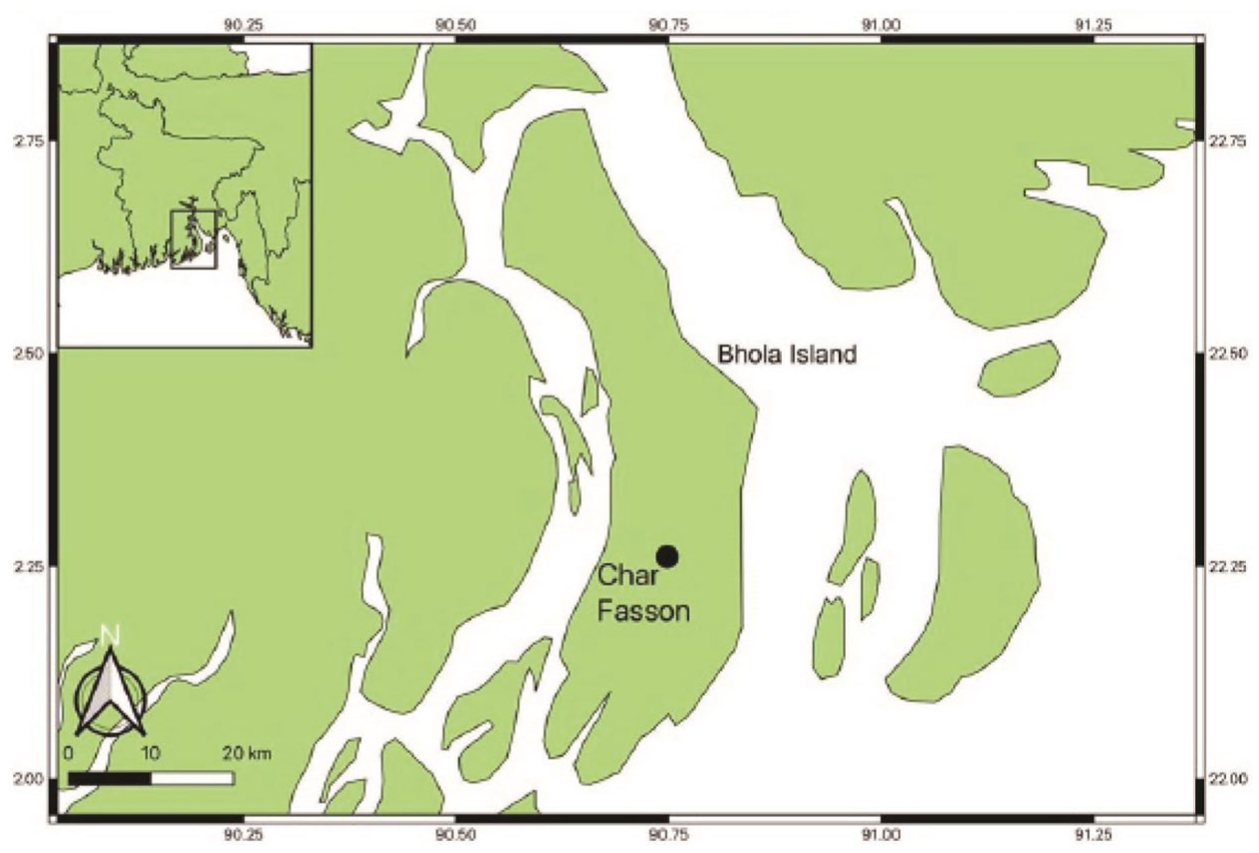
Map of NGO Operations in Coastal Bangladesh.
Given the first author’s extensive involvement leading the NGO as Head of Country (HOC), this study takes the methodological position of autoethnography. Autoethnography is ideally suited for its ability to provide strongly reflexive first-hand accounts for assessing change over long periods of time (Chang, 2016; Thomas & Pugh, 2020). It was chosen to capture how such temporal dynamics and nuanced sociocultural influences unfolded to shape organizational behavior within our setting (Chang, 2016; Dobbins & Plows, 2023). As outlined by Pelly (2017), to build theory, autoethnography often employs colloquial, and even gritty language that adds realism and conveys rich emotional sensemaking for readers, differentiating it from more conventional academic research. Given the way autoethnography is conducted and written, it has also been described as an antidote to the conventional scientific method by explicating highly complex and contested social dynamics through rich description (Sambrook, 2024).
At the same time, some scholars remain critical of autoethnography as it embraces a more subjective view of research. It can be heavily reliant on the personal experiences of the researcher and less so on more positivist approaches (Tarisayi, 2023; Winkler, 2018). As a narrative approach, the researcher’s experiences are privileged to “thickly” describe complex situations from an embedded perspective. Thus, potential issues may arise, including narrative bias and power asymmetries (Tarisayi, 2023). Narrative bias concerns how “thick” descriptions are constructed and interpreted, where an academic researcher risks appropriating the knowledges of interlocutors or misrepresenting their actions or words. It is therefore critical to remain reflexive about the “academic gaze”—the researcher’s privileged position and interpretive authority—which can unintentionally reproduce hierarchies of power or distort participants’ realities. Acknowledging and critically examining this gaze is an ethical responsibility (Dauphinee, 2010), so researchers must account for their positionality and take care to represent their field experiences accurately and respectfully to avoid subjectifying their interlocutors (Morrow & Kettle, 2024). 3
Data Sources
Writing autoethnographically can take a variety of forms (Sambrook, 2024). In our case, the extensive dataset, comprising secondary material and first-person accounts, provided a longitudinal perspective that would be difficult to achieve through primary data collection alone (Sandelowski, 2000).
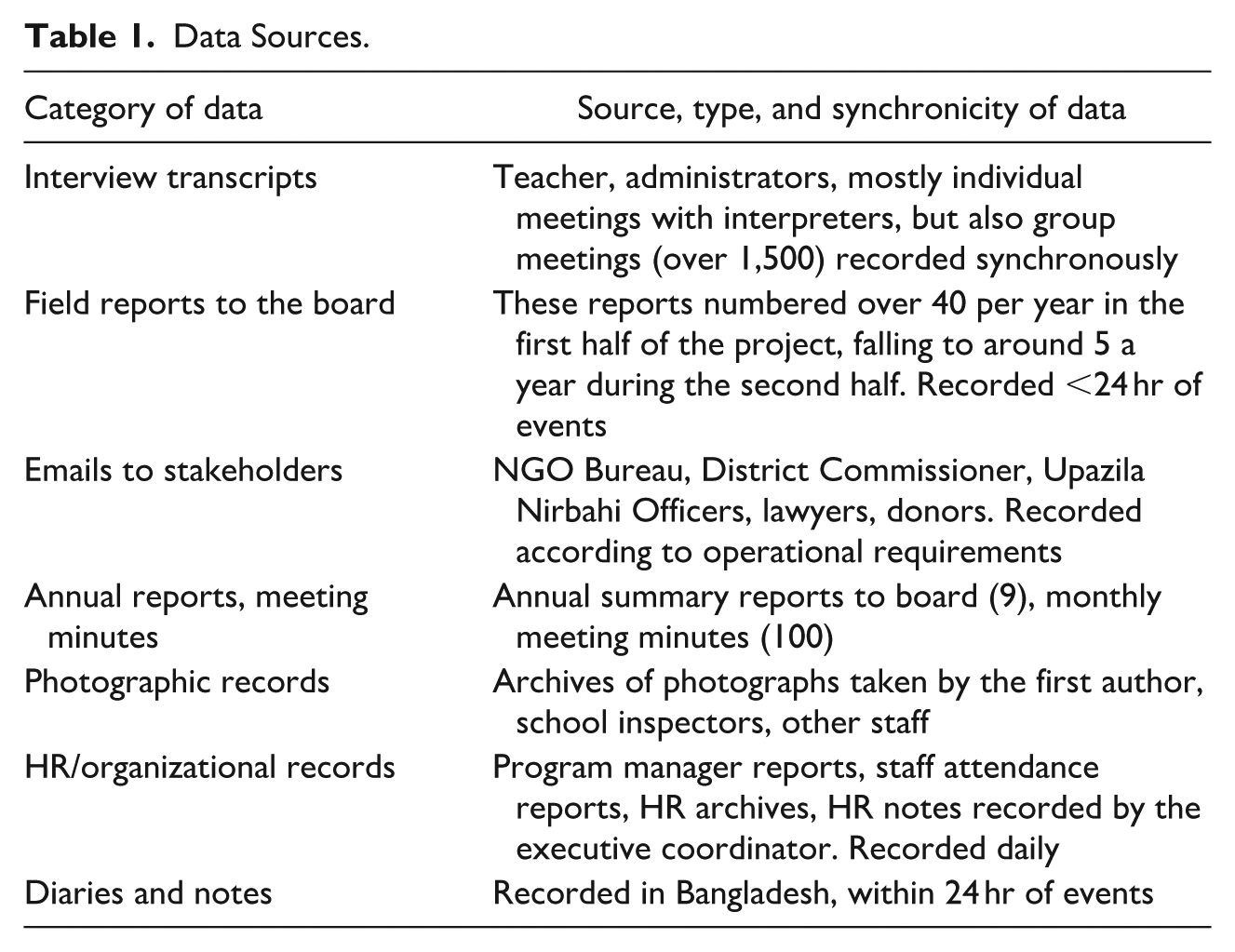
More specifically, data collection methods included extensive participant observation, archival research, informal interviews (over 1,500 of them), performance appraisals, email communications, board correspondence, personal reflections, field notes, and institutional reports (Table 1). As the first author was the primary data collector and an “academic practitioner” (Vo & Kelemen, 2017), triangulation occurred via cross-verification with employees, community members, and archival records, which are mainstream ethnographic methods (see Thomsen et al., 2020). Data authenticity was supported by immediate and contemporaneous transcriptions and daily note-taking.
Data Sources.
Approach to Analysis
Having made the case for utilizing an autoethnographic study, we will briefly outline the method of co-constructed autoethnography (Ellis & Bochner, 2000; Kempster & Stewart, 2010) used in this study. Foregrounding the first author’s experiences within the NGO’s organizational culture over a particularly critical 9-year period (i.e., 2010–2018), he engaged in reflective writing to explore personal experiences within broader sociocultural contexts, allowing him to understand his own role as a participant and interpreter of events (Reed-Danahay, 1997). By using self-reflective, episodic narratives, he critically interrogated the dynamics of corruption as personally encountered and navigated. This iterative narrative construction provided deeper insight into how the first author negotiated corruption as an insider, offering a comprehensive portrayal of individual and relational dimensions within organizational corruption.
To mitigate the potential influence of an academic gaze and preserve the authenticity of the lived experience, the study adopted a co-constructed interpretive process that brought multiple voices into dialogue with the first author’s narratives. Central to our analytical approach was this continuous, theoretically informed collaboration, drawing on concepts from corrupt entrepreneurship (Cavotta & Phillips, 2023), corporate corruption (Castro et al., 2020), and the Hawk archetype (Mars, 1982). Through this collective reflexivity, the research team engaged in multiple cycles of critical reflection, narrative reconstruction, and thematic refinement with the first author until narrative saturation and robust insights into corrupt entrepreneurship emerged clearly. This structured yet iterative approach ensured narrative rigor, credibility, and resonance, allowing a nuanced exploration of corrupt entrepreneurial dynamics in the studied NGO. For additional detail on the triangulation of data sources and analytic procedure, see the Appendix.
Ethical Considerations
This project received approval from the first author’s university ethics committee. 4 The application was assessed by two independent assessors, and approved under the National Statement on Ethical Conduct in Human Research (hereafter, National Statement). Ethical risks in Australia are judged as a tradeoff between ethical and other risks offset by benefits. Research on criminal conduct is normally considered high risk, however in this case, reviewers took into account that the study drew exclusively on pre-existing organizational records, correspondence, and field notes produced during the author’s managerial role within the NGO, which had begun well prior to his role as researcher. It is likely that the ethics committee’s decision was also informed by a recognition that high quality, contemporaneous human resource data on corruption is relatively difficult to obtain, and hence the insights gained from analysis would substantially enrich the literature.
All potential information identifying particular individuals have been removed. Some composite characterization, and minor chronological adjustments have been made to minimize the possibility of re-identification. The NGO’s management committee also reviewed the project and endorsed the anonymized use of organizational materials. Consistent with the National Statement, ethical reflection was ongoing throughout the research, particularly regarding the author’s dual role as both manager and researcher and the attendant power asymmetries in interpretation.
The analysis was guided by the principles of beneficence, respect for persons, justice, and research integrity outlined in the National Statement. Particular attention was given to ensuring that individuals and communities were not exposed to additional risk other than that attendant with their existing behavior, and that findings were represented accurately and respectfully. A more detailed account of our ethical strategy and research integrity safeguards is provided in the Appendix.
The following section details the first author’s background and approach to account for his subjectivity and identity in the research, a common and expected reflexive contribution in autoethnographic research (e.g., Pelly, 2017; Sambrook, 2024).
The First Author’s Story
I began volunteering for this NGO while working as a rural Australian journalist, reporting on local politics; this NGO, founded locally, was one of my early stories. I took on “odd jobs” roles for the organization in the 1990s, then joined the board of management and in 2000 was elected chair, a position I’ve held ever since, bar a period caring for my terminally ill partner. Journalism, particularly in a small high-pressure newspaper context, builds the ability to type while you talk—a skill that, more than any other, underwrites the quality of data used for this study. No doubt, this period also refined my ability to interview people from many different walks of life, gain their trust, and draw maps of hidden political alliances, real or imagined. I own that I may see the world through the slightly twisted lens of a small-town politics reporter.
During the second half of the 9 years covered here, in addition to chair, I held the role of HOC, Bangladesh. I meanwhile had gained a PhD and held increasingly senior university roles, latterly as research-focused associate and then full professor. The majority of time I spent in Bangladesh overlapped with my annual leave from my one paid role, as an academic. I wove research projects into my time in Bangladesh, tackling topics salient to the islands in which I worked, notably arsenic toxicity in the water, low birth-weight infants, and the great cyclone that decimated the region in 1970.
When I first visited Bangladesh, I experienced what most people experience when they first visit: a delirious kind of culture shock. Everything seemed literally fantastic to someone whose idea of the countryside was grounded in the often drought-stricken, Australian inland. Here there were “streams” the size of rivers in Australia, rivers so wide you couldn’t see one bank from the other, and jackfruit so large, they were a two-person lift.
Corruption folded my academic and my NGO worlds together: my day job in social innovation introduced me to the concept of wicked problems, problems that are inherently social and intractable—and my “night job” applied the theory. However, as to which came first, my knowledge of wicked problems in theory, and my work with wicked problems in practice, there is no question: it was practice first, theory second. So, I didn’t “see” corruption because I was looking for trouble; I didn’t have a “wicked problem” schema in the back of my mind. In fact, I didn’t see corruption at all when I first visited Bangladesh. It was after that naïve first visit that an informant made corruption allegations, and on my second visit, I went expecting to find “it” and yet I didn’t. Repeat visits built local trust—a common theme in autoethnography (e.g., Newmahr & Hannem, 2018).
Every year I visited, I spoke to every single staff member face-to-face, as part of the corruption-proofing process, as well as hosting dozens of meetings with stakeholders including upazila (sub-district) and zila (district) level officials, landowners, and officials from other NGOs. Thus, each year, well over 200 individual meetings were compressed into 6 weeks. Because I was always desperately short of time, and because I came into academic work as a journalist, it was natural for me to take prolific notes during these interviews—there are photos of me with my laptop perched on a pile of hay, or crouching in the mud tapping away at my notes. It was not just the depth of the data on the transition from “corrupt” to “clean” that was unusual. Because of the time pressure I was under, I was accumulating this data in an unusual manner, “live,” and in situ. There was no time (to quote the poet Wordsworth) for the moment to be “recollected in tranquility.”
I was, if anything, helped by not being able to speak much Bengali. I worked with an interpreter. Interpreting interrupts one’s access to linguistic content subtly, but has the advantage of buying time to write/type, and enhances one’s ability to observe body language. These were not “stakeholder interviews” or “focus groups”: these were recordings of real human resources and management meetings, recorded and to a significant extent transcribed synchronously. While the autoethnographer is encouraged to record contemporaneously (Jones et al., 2016), the data for this study rely even less on the rearview mirror than most.
The data were also not recorded as an autoethnographer, per se. I was thinking as a manager, not as a researcher; indeed, I was on a “holiday” from my role as a researcher. Nevertheless, for the period under analysis here I was a researcher, so it is possible that there was no point at which I “began” thinking about my NGO work as a researcher. As a manager, you are more an experimenter than an investigator of the unknown. Your role is not just to observe and record, but to observe, record, act, and observe; action research, where your data will be triangulated by what happens next. As a manager, if I made a mistake in interpreting data, it resulted in physical threats or repeat meetings where I literally stood corrected.
Setting the Scene
When established in 1991, the organization was one of the first 100 registered NGOs operating in the new nation of Bangladesh. In many ways, it was a pioneer for the large nonprofit sector that exists parallel to the public and private sector in Bangladesh today. There are now believed to be over 45,000 NGOs nationwide, with just over 2,600 officially registered with the NGO Affairs Bureau (Bonik Barta, 2024; IDLC, 2024). However, this one is unusual in that it did not draw on typical institutional funding sources including government grants and instead relied on small donors, and, because of its remote location, there was relatively little day-to-day interaction with government bodies. It has also maintained—ironically, considering our focal topic—an explicitly stated zero tolerance policy toward corruption. There was even a sign in the office, faded and dusty but on display, declaring the policy and stating that “those who bribe are just as guilty as recipients.”
In 2014, the 94-year-old founder announced his retirement, having recently been nominated for Senior Australian of the Year. He had established operations on Bhola Island, the site of the devastating 1970 cyclone, ranking it as the single worst environmental disaster in recorded history (Muurlink, 2022). From its humble beginnings—funded at first by the founder and a sequence of “garage sales”—the NGO expanded significantly, eventually establishing dozens of schools across islands accessible primarily by motorbike. Built inexpensively on donated lands elevated on mud platforms above tidal levels, these rudimentary schools operated in shifts to accommodate different age groups.
At the time of the founder’s retirement, the first author had limited direct oversight of field operations in Bangladesh. The founder, deeply tied to the organization’s identity, resisted relinquishing control. However, expatriate Bangladeshi board members began noticing hints of internal corruption. When the founder reversed his decision to retire, the first author chose to investigate the matter personally in his new capacity as HOC, bringing an external interpreter rather than relying on bilingual NGO insiders.
Findings
Theme 1: A Company Inside a Company
What emerged was that an organized criminal operation, which we will refer to as the parasitic enterprise, had formed inside the NGO. This was a “company” with a “chief executive” (referred to hereafter as the Kingpin, who doubled as the official chief administrator of the NGO itself) with an “executive team” of enforcers in the office, and regional representatives (all headmasters) based at a geographically dispersed range of schools. The structure was not dissimilar to a franchise hub-and-spoke model, with the regional “spokes” keeping an eye out for risks and opportunities, and all spokes feeding funds to, and relying on coordination and “products” generated, by the hub. The structure was entirely different, however, to the formal structure of the NGO.
To loosen the control of the employing organization (to borrow Mars’ approach) was not difficult; the sole auditor of the project during the period when the syndicate was established (the founder) was elderly, deaf, and did not speak the local language. As the founder attempted to eke the maximum value out of donor funds, he avoided employing interpreters, instead relying on internal yet corrupt staff to literally and figuratively interpret the reality of the organization to him.
The founder was also absent for around half the year, enabling the Kingpin to create a corrupt venture that was stable, well-managed, and highly profitable. The Kingpin was someone the founder had known since childhood. He was orphaned by the 1970 cyclone, and found by rescue workers secured to a coconut tree. He grew up in the Char Fasson orphanage, which still exists to this day, where he met the founder, who at the time was a consultant to an international charity working on the island. He gained his English skills and learnt book-keeping from the founder.
What is remarkable about the Kingpin, as a Hawk, however, was that his parasitic “business” had a formal structure: it had a separate set of books, it had its own phone number (in the possession of the Kingpin), and it had its own hierarchy of staff. The hawks described by Mars followed a relatively intimate “small business” model, but the Kingpin ran a “big business.” The tentacles of the syndicate had wrapped itself around every element of the NGO where power was exercised. He partly borrowed an existing “high grid” workplace, where the vast majority of staff taught to a curriculum, a class schedule, and work hours established and monitored by the head office. Purchases, promotions, transfers from one school to another, the release of exam results, the distribution of textbooks and stationery, the distribution of salaries (done, during these years, dangerously, in cash—since banking infrastructure was, and remains quite rudimentary in these regions) had all become an opportunity to extract a corrupt tax.
To give an example, teachers might be living conveniently close to a school, in a region where public transport is scarce and unreliable, and commuting difficult. For such teachers, being transferred to another, more remote school would be more than an inconvenience; it might lead them to have to leave their family and take up lodgings near the new location, or resign. To avoid this fate, they paid a “tax”—often equivalent to several months of salary. The regional “heads” within the hub-and-spoke model were well-positioned to scope out staff vulnerable to extortion, or local families with means to purchase jobs from those insufficiently well-resourced to keep them. A “sacking” could be engineered by fabricating a misdemeanor on the part of the incumbent or exaggerating an infraction. These business operations required coordination between parties. The regional “heads,” while powerful, were powerless (except perhaps in low-grade pilfering) without the coordination and control of the Kingpin.
However, other “taxes” were invisible to the staff—they paid them without even knowing they had paid, such was the high grid nature of their roles.
The Eid festival bonus has definitely been rorted. Smart, thoughtful teachers are wrinkling their heads when I ask them the last time they got paid. They didn’t even know there had been an Eid bonus; it wasn’t announced, simply taken from them. 400 taka multiplied by every teacher. Big money. [HOC, report to board, 2015]
Curiously, the corruption that was present was largely confined to internal parties (staff and students) between people who in theory worked in the same organization, side by side. The chief exception was a significant revenue stream gained by “selling” jobs to “applicants.” Strikingly, donors’ funds had not been misappropriated. The money that was being generated by criminal means was sourced from teachers, pupils, parents and job candidates.
Corruption has been frequently defined in ways that lock out practices that occur “purely” in the private sector (Jancsics, 2014). There were in fact only two overlaps between the NGO and the government. The collection of free primary school textbooks from the government was one rare corruption-free aspect of the organization’s annual cycle of bureaucratic contact. The other key moment was getting the annual budget approved by the NGO Bureau in Dhaka. Without budget approval, funds cannot be remitted to Bangladesh, and salaries cannot be paid. This pinch point is a classic generator of “speed money” bribes (Chakravorty, 2023).
Turning to the NGO Bureau budget problem, when I began worrying aloud about it, [staff member] surprisingly said “This is a Bangladeshi situation, you know it well, corruption is everywhere. They expect some money . . . through back door.” He revealed on questioning that we had been paying between 10,000 and 15,000 taka a year to get the budget through, without [the founder’s] knowledge. [HOC, email to board, 2017]
Theme 2: Mismanagement Is Still Management
Hence, there were two parallel “companies” operating; as chief administrator, the Kingpin had to manage them both. Both had a degree of formality to them. The Kingpin kept meticulous records for both the formal and informal organization and while “staff” was theoretically singular he was talking to them about two different enterprises—a task simplified somewhat by having one phone that was “corrupt” and the other that was “clean.”
The Kingpin’s role was not simply to extract maximum profit—which in a sense is every corporate manager’s baseline task—but to create a system in which he could do so. One key task was keeping staff who were not benefiting from the scheme silent. One means was threat: My interpreter in a low voice over breakfast said that one of the teachers had said to [syndicate member] as if he was joking, but he wasn’t, “the torture you have inflicted on all the teachers for the last 20 years is at last going to stop.” [HOC, notes, 2015]
This “torture” did not need to be directly felt to be effective: This teacher said very quietly: “In relation to the situation in [head office], if you can maintain good relations with the people in [the syndicate], that is wise, otherwise there will be trouble, problems will arise. This I can say from experience over the years.” When we softly encouraged him to say more, he added that he dare not, just in case they were to read my notebook or open my computer at the office. I assured them no-one could read my handwriting, or know the password of my computer . . . and besides I kept it locked up. He still declined to speak further. “People here can for no reason suddenly lose their jobs.” [HOC, notes, 2015]
Threats alone can be a somewhat brittle foundation on which to build a stable structure, however not all threats required the implication of violence or other disadvantage to a particular individual. “If he becomes aware of this, he will close the whole operation” was how one teacher described the concern about the founder discovering the extent of the corruption. Everyone was implicated in that threat.
Shepherd et al. (2021), when discussing the Indian context, talk of clusters of corrupt individuals operating “autonomously” and secretively within organizations to seal off their “venture” from oversight. Such secretiveness is only necessary under certain circumstances. As noted earlier, the Kingpin had the advantage of being in control of the narrative, interpreting the local language for the founder. If someone broke cover and reported corruption directly to the founder, he would go to “investigate” with a syndicate member serving as interpreter.
In addition to threats either individually or collectively targeted, there were rewards that were more or less equitably distributed: So [name redacted] has got into trouble trying to photograph school records being doctored showing that our schools, instead of the usual 15 days off for Eid, instead took 33 days off. . . .The headmaster I met in the town confirmed this . . . [HOC, notes, 2016]
Holidays were one “reward” that could be distributed to those outside the inner circle, without personal cost to the Kingpin or indeed the syndicate. It was not the only significant non-monetary reward however: He says inspectors are not visiting the schools. They visit one and then fill out the forms inspection forms to indicate they’ve visited three. [HOC, email to board, 2015]
The school inspectors were significant in the syndicate’s operation, visiting all schools, and thus able to monitor not just the operations of the teachers but also check on the performance of the regional syndicate heads. Smaller monetary rewards of corruption were distributed, to some degree, to almost all members of staff. The following issue was raised by a staff member almost inadvertently. She clearly did not see this as a major issue of corruption and brought it up almost as an aside: She said, “even today the headmistress is collecting 10 taka from each student when distributing schoolbooks and for exam fees from every student.” At this stage, the blood drained from my face. I said, let’s get this straight, students are PAYING for schoolbooks [which are given free by the government] and exams? Yes. I turned to [staff member], and asked, “how many schools is this happening at.” She said, quite emphatically, “every school.” . . . Apparently, this money gets collected by the headmaster and then distributed to the teachers at the school, and when [school inspector] brought this up [with the Kingpin], he was told, “well they do not get paid very much so . . .” Apparently, headmasters get a disproportionate share of the takings. [HOC, report to board, 2015]
As well as an additional administrative load, there is an extra layer of human resource management complexity to the managerial workload. The Kingpin displayed considerable emotional intelligence and soft skills in carrying out his role. During the 2014 to 2015 period, he would have been aware that investigations were underway, despite the HOC’s attempts to conceal the fact, as some corruption allegations began to emerge in front of junior members of the syndicate. They would have reported back to him. During this time, he remained at least superficially calm, and on the front foot, calling meetings of staff to “address” (manage) issues of concern, as if he had no stake in the truth being revealed: One of the things that was odd about the staff meeting yesterday was that when I mentioned a comprehensive school visit, everyone seemed thoroughly thrilled about it, saying it had been too many years . . . and that many schools had never been visited. Either the corruption allegations are untrue . . . or the management is very confident that the teachers will remain silent. [HOC, email to board, 2014]
Where did this confidence come from?
Xu et al. (2018) refer to the process of “psychological kidnapping,” a stepped process of co-opting colleagues into corruption, either as insiders to share in the spoils, or outsiders who are pressed to remain silent. He had not simply worked with a group of insiders, but he had recruited the insiders, picked people with certain characteristics (including corruptibility) to his inner circle. The Kingpin had clearly mastered the “kidnapping” process. In addition to distributing rewards of significant value (additional days off) and punishments that carried severe well-being implications in a very impoverished region, he managed to create an aura of considerable local respect. Godinez et al. (2024) in a recent study of private sector family firms, show how social connection can induce individuals to participate in corruption, and how social capital can be drawn on to develop corrupt networks.
It was observed by the HOC and confirmed by sources that the Kingpin rarely left the office, trusting his syndicate. He was a very regular attendee, however, at the local mosque, and on the rare occasions he walked freely in the nearby town in the company of the HOC, showed little fear of raising public resentment. He was generally quietly spoken, somberly dressed, and showed little ostentation. Xu et al. (2018) in their study of corruption in China refer to the “soft menace” with which managers manage corrupt systems, and the Kingpin was an illustration of this, living calmly, corrupt in plain sight. He continues to live within the community, just a few hundred meters from the headquarters of the NGO he co-opted.
Managing a corrupt enterprise is not incompatible, then, with “good” management skills. After the syndicate had been purged, the HOC sat down with an elderly gentleman, a former government officer who had taken a largely ceremonial role within the NGO, his age and government connections adding gravitas to the team. Only now that investigations were complete, he conceded that corruption had been rampant. He had been silent, yes, when perhaps he should have spoken, but the organization was “running well.” That phrase was used repeatedly, “running well.”
Theme 3: Being Corrupt Is Not Easy
While “retail” corruption, involving simply buying or selling a single product outside the formal setting, is relatively simple, “wholesale” corruption of the kind described in the previous two sections is not. Corrupt “management” mimics and extends many of the key tasks and norms of management, requiring significant organization and emotional intelligence. To traverse both formal and informal sector management in a single role is additionally complex. Compared with moonlighting, where the manager might earn extra money through extra effort after work hours, the manager holding a dual role in a corrupt enterprise needs to do two jobs in parallel, one without being detected, and both jobs “well.”
There is workload as well as complexity aspects at play. An honest manager operating the study organization would have been required to make entries for three or four purchases per working day and handle 160-staff payroll calculations each month. As it was, the manager would have had to, at the very least, spend double the time. He had a broader “product list” to market, more entries in the informal books than in the formal books. Unlike other staff, he rarely had time for a cup of tea or conversation. The degree to which he had been kept busy by his work was clarified after his departure: the phone calls to the office dropped dramatically, and the extent of the “real” office administrative workload was revealed to be surprisingly light.
When the [corrupt] system was intact, [the Kingpin] always had his two phones beside him, and when he wasn’t recording something in the ledgers, he was on the phone quietly listening. After the sackings the “official” phone, ostensibly for teachers to contact head office, went silent, as if the only teachers who had been contacting the head office were those who were inside the system. [HOC, notes, 2015]
The corrupt are clearly “forced” to undertake additional administrative load (Brzezińska et al., 2018). As an example of the cognitive workload that corruption placed on the Kingpin, the HOC found a letter tucked inside an exercise book in 2016 stating: I regrettably inform you that as from today’s date, 14th May 2015, your services as Headmaster of [school name redacted] are terminated. The management of [NGO] wish you success in your future. Regretfully yours.
The letter was signed by the founder, but never sent. The headmaster had been dismissed by the founder, not the Kingpin. In making a decision not to sack a teacher (who no doubt had paid for his job, and hence, more or less, “owned it” now), the Kingpin had to make a calculation about the probability that the act, or absence of act, would be ever noted. He had to keep two “realities” in mind, instead of merely one.
I sacked the same man, eleven months later. In other words, [the founder] sacked him, [the Kingpin] withheld the letter [and didn’t sack him], and I sacked him again, this time with effect. [HOC, report to board, 2017]
Scholars have for some time noted the high cognitive load required to engage in deception (Sporer, 2016). Furthermore, to successfully amass wealth from an organization undetected requires self-control; too blatant a grab for wealth would be noticed. Self-control also places a high demand on cognitive facilities (Hofmann & Van Dillen, 2012). Trust is also not absent from the business of corruption. The corrupt manager has to take the measure of each person encountered in the setting up and maintenance of a corrupt system, rewards and threats calibrated to the case. They also need to know, or assess whether, as Uslaner (2004) puts it, their partners in corruption will deliver the “products” that they promise.
Corruption, Krastev (1999) argues, is a hidden form of protectionism, which introduces inefficiencies into the “free” market. Compared with “normal” markets of goods and services, he argues, corrupted markets place a very high value on local knowledge. “In order to corrupt public officials, one cannot rely simply on offering the biggest bribe in the biggest brown-paper bag,” he adds (1999, p. 57). “Corrupt individuals need to offer their services in certain ways,” Tajaddini and Gholipour (2018, p. 615) note. “It is not possible to spread such pieces of information via public advertising, media or recommendations.” The need for discretion makes “marketing” of the “product” by managers such as the Kingpin significantly more difficult than traditional marketing.
In summary, corruption is not just a crime; it is a set of competencies, one that requires high levels of organizational skills, financial skills, emotional intelligence, and networking skills (also see Jancsics, 2014) and risk-taking. This suite of competencies has significant overlap with the competencies of an entrepreneur.
In fact, the ability of the corrupt to cut across formal rules and create new rules and relationships is matched in the field of entrepreneurship, where informal routines play a large part in the day-to-day running of firms. Similarly, the personalized and family ties that shape the nature of employment contracts and management in entrepreneurial firms (Roberts et al., 1992), and in turn characterize corrupt networks, are not “easier” to engage in than following standardized routines.
We have detailed how a set of competencies that match conventional competencies except in their purpose, are required to succeed as an informal “businessperson” within a formal work context—what Mars called a Hawk. Corrupt human resources, corrupt administration, corrupt management all have non-corrupt analogues, but as the evidence shows, they are not exact analogues. The corrupt manager has more products to sell, more variables to monitor, and less fixed systems to rely on in arriving at answers to management problems.
Theme 4: Corrupt Behaviors Can Have Incidental Non-Corrupt Benefits
The company that had formed inside the NGO generated large profits, with the Kingpin as “owner” of the syndicate deriving the most significant benefit: [The Kingpin] has accumulated so much wealth, his son is working in Singapore, and his daughter . . .. held a wedding reception in Gulshan, the Dhaka equivalent of Mayfair, and has bought a job at Customs, one of the most lucrative arms of the Bangladeshi government . . . [HOC, report to board, 2015]
A penniless, homeless orphan had risen to the upper middle class of Bangladeshi society through enterprise. While working for the organization, he had quietly purchased a large parcel of land down the street from the head office of the organization he was exploiting. While managing his syndicate, he lived with his family next door to the office in a modest company-provided building, all the while quietly building a comparative palace down the road.
A single instance such as this of an individual who uses his or her wiles to rise through the layers of society is not overwhelming evidence that upward mobility is commonly achieved through skill at corruption.
However, this correlation between entrepreneurship and corruption could also be observed at a school level. The HOC visited each school each year, recording issues such as the quality of upkeep of the mud floors, the planting of school gardens, or the installation of improvements by the “community,” such as brick stairs, electricity, and fans. As the regional hubs of the corrupt system were identified and analyzed, it became obvious that there was a positive correlation between corruption and the quality of schools: schools headed by syndicate members were generally the best run, with the headmasters using their skills or possibly some of their profits to gain community support for their schools. This may not speak to the entrepreneurial skills of these headmasters but rather a corrupt form of marketing, using part of their ill-gotten gains to curry continuing favor with the community.
Thus, when the NGO dismissed the ringleaders, many “good” staff were lost, and in many cases, the quality of the schools suffered. In other words, the kind of enterprise, innovation, determination and guile required to be corrupt appeared to also be valuable in running a school.
This issue was also observed in staff attraction and attrition. Every year the NGO holds exam sessions whereby all applicants for jobs with the school get an equal chance to “win” a right to sit for an interview. Success at the interview results in short-listing for jobs. Analysis of annual exam records over the last 10 years shows that each year, top performing candidates at the exams and interviews are far more likely to get a job working in a government school than worse-performing staff members, and less likely to remain at the NGO.
While this does illustrate a merit-based order, there is a corrupt catch. The government exam system is merit-based, but the final stage, the “interview” involves corruption; a bribe must be paid. The system thus mandates two skills: the typical intellectual capacity to pass entrance exams, and the atypical ability to negotiate a corrupt transaction. A candidate needs to be able to raise that money, regardless of their skill. Some of the “best” teachers observed by the HOC over the years not only worked hard at school but after hours showed additional entrepreneurial zeal moonlighting, setting up shops in the local markets or growing vegetables and raising chickens. With the accumulated wealth of honest work, they were able to eventually pay the substantial bribes required to secure better-paid government teaching roles. Others negotiated loans with loan sharks or family members to make the transition to a coveted government position. “There is a virtual pricelist for government jobs, but the prices are not advertised or fixed,” the HOC’s interpreter, who had spent his adult life working in the non-government sector told him. Thus, the attrition of high quality, driven employees continues.
The beneficiary is not however the organization that these employees transition to: the government school system does not benefit from having the “brightest” or most determined staff. Government jobs are highly valued for a number of reasons in addition to higher pay and greater benefits (e.g., retirement benefits; Rahman & Al-Hasan, 2019) that are not widely discussed in the literature. Firstly, these jobs are truly safe: since you purchased the job, the job is “yours” and this safety in turn leads to lower performance expectations; primary school teachers in government posts commonly simply do not turn up for work on most working days, moonlighting in broad daylight. It was not unusual for the HOC to meet government teachers, former staff at the NGO schools who have “won” a government role, in the markets mid-school-week, happily and publicly in dereliction of their duties.
The janitor opens up the gates in the morning and closes them in the evening. They organize a roster so that at least one teacher is present at the schools. It’s somewhat depressing. It’s not surprising our children top the high school entry exams year after year, even though we don’t have the best staff; at least our staff are at work. [HOC, notes, 2018]
The consequences of this rampant absenteeism, at least in these remote parts of Bangladesh, are measurable: as the above quote illustrates the NGO’s students consistently outperform the students emerging from government schools with more highly trained and qualified staff, working with better teaching resources—despite the NGO building schools in the most vulnerable regions. Meanwhile, the “best” teachers are skimmed off the NGO sector, into a life of relative leisure in the government sector.
Theme 5: Pervasiveness and Inescapability
A 2018 report by the Centre for Policy Dialogue in Dhaka declared that corruption in Bangladesh “most prevalent” in the primary education sector, pointing to the predominance of bribery and nepotism/favoritism in recruitment, transfer, and promotion of staff in the sector (Bhattacharya et al., 2018). The mandatory bribe to get a teaching role is illustrative of how individuals are inducted into corruption: teachers have to pay bribes to get their roles. This cannot be avoided. However, then they have the choice of whether to continue with corrupt behavior, though freedom to choose may be limited. The bribe to gain a government job commonly equates to multiples of the annual salary, and these bills have to be paid.
Encounters with other NGOs suggested that there is less freedom to “just say no” to corruption than might appear: I also overheard the orphanage chief, telling [a visitor] that he was forced to pay bribes in [the district capital of] Bhola, because there were interminable delays . . . he’d been forced to wait five hours in an office to meet an official, and then he refused to do what was asked, and said come back later, and so on and so forth. [HOC, notes, 2016]
In a sense then, corruption becomes banal. It seems that everyone has to do it in order to fully participate in public life, and then having done so, the question becomes, does what Mars (1982) calls “the fiddle” and also a “potent drug” (p. 46) become addictive? It is hypothetically possible to farm or fish in this region, sell one’s produce on the local market, and never encounter the need to engage in corruption, but should one need to engage with government—for example to obtain a motorbike license, or engage with the healthcare sector—one will either need to be extremely patient (if that is possible) or in an albeit minor sense, partake in the corrupt economy.
The Multi-Level Dynamics of Corrupt Entrepreneurship
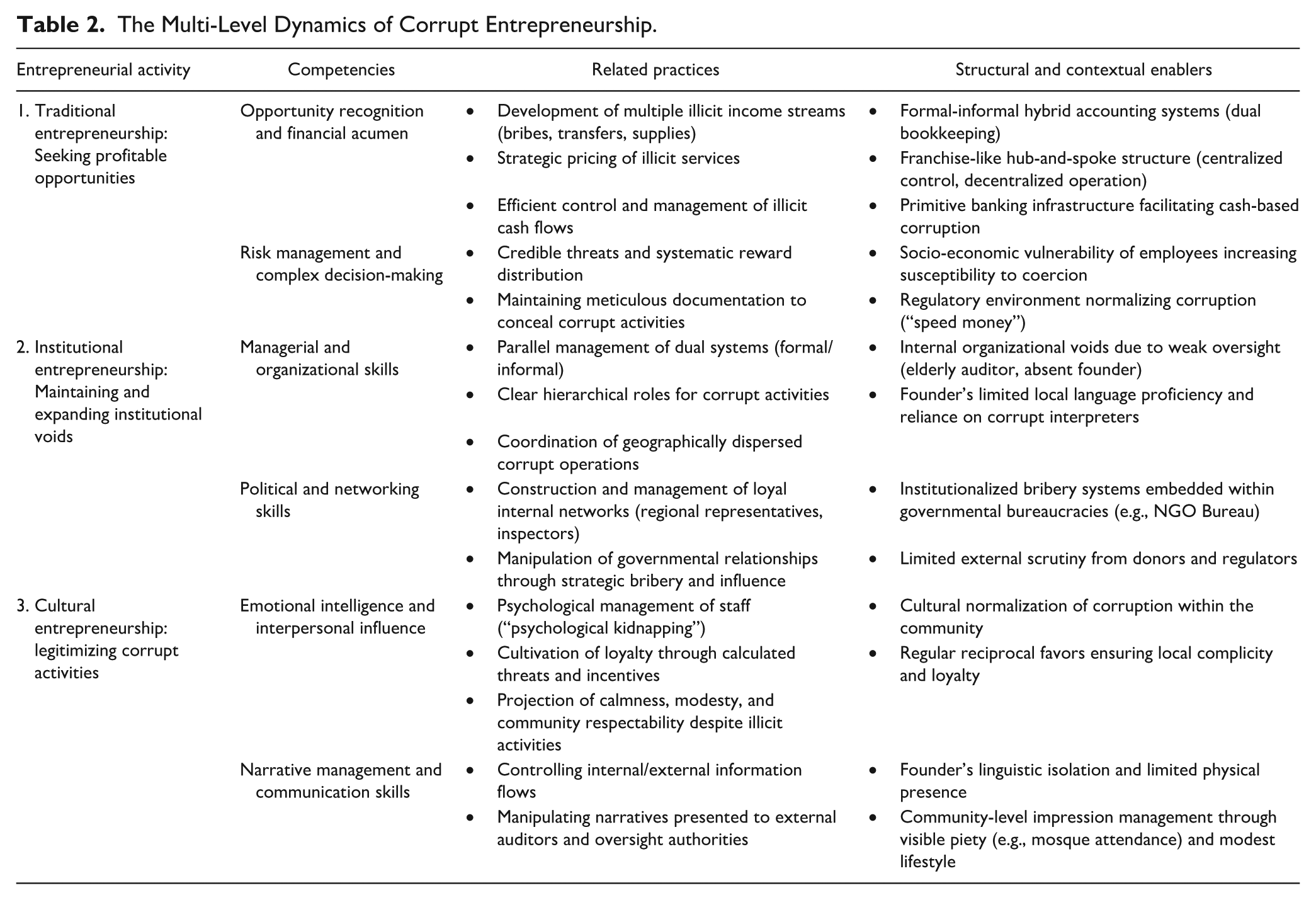
This co-constructed autoethnography explores how individuals—particularly employees and managers—navigate deeply embedded corruption that forms an organization’s external context and also act to exploit and shape this context through their choices and behaviors. Autoethnography is particularly suited to studying corrupt entrepreneurship—a phenomenon within the field of corporate corruption that is otherwise difficult to access, ethically sensitive, and typically hidden from researchers engaged in conventional methods. Instead, autoethnography facilitates rich, detailed descriptions by positioning the researcher within the social context itself, blurring the boundaries between self and others, and supporting robust sensemaking in which the researcher can re-interpret past experiences in light of their current understanding (Pelly, 2017). Accordingly, the first author (hereafter referred to as “we”) identified a rich array of entrepreneurial competencies and related practices, as well as structures and other contextual enablers that facilitated corrupt entrepreneurship within our international NGO setting.
For example, we reveal the importance of the Kingpin’s cognitive capacity to simultaneously navigate dual organizational realities (a micro-level, individual competency), his practice of meticulously managing separate accounting systems—official versus informal—to mask corrupt financial flows (a micro-level practice), and the franchise-style “hub-and-spoke” structure that decentralized corruption across geographically dispersed local units (a meso-level structural enabler). Moreover, we address the founder’s linguistic isolation and prolonged absences, which created internal organizational voids ripe for exploitation (a meso-level contextual enabler). Finally, these dynamics were further sustained by institutionalized bribery systems embedded within governmental bureaucracies (a macro-level contextual enabler).
Table 2 summarizes the multi-level dynamics of corrupt entrepreneurship with entrepreneurial competencies, related practices, and structures and other contextual enablers identified within the five emergent themes covered above.
The Multi-Level Dynamics of Corrupt Entrepreneurship.
Cavotta and Phillips (2023, p. 353) depict corrupt entrepreneurs as engaging in three distinct activities: they act as (a) traditional entrepreneurs by seeking out and exploiting profitable opportunities in institutional voids; as (b) institutional entrepreneurs by seeking to maintain or even expand institutional voids; and as (c) cultural entrepreneurs by seeking to construct narratives to legitimize their activities by drawing on local culture. To illustrate how corrupt entrepreneurship “works” via these three activities, the authors present an in-depth case study of a thoroughly corrupted criminal group: the Sicilian Mafia that emerged in response to an institutional void, then thrived by profiting from that void, sustaining that void, and legitimizing themselves with the community through constructed narratives. In contrast, Azim and Kluvers (2019) present an in-depth case study of a steadfastly clean organization: the Grameen Bank—another NGO operating within Bangladesh—as an entity that successfully resisted corruption despite its corrosive intrusion into what the authors describe as “virtually every level of both private and public institutions” (2019, p. 593). 5
These two cases from the corporate corruption literature—the thoroughly corrupt (e.g., the Mafia) versus the steadfastly clean (e.g., the Grameen Bank)—represent polar extremes. Reflecting on them together with our findings reveals a notable theoretical gap that our study helps to fill. Extant research at the intersection of corporate corruption and entrepreneurship has overlooked organizations occupying the “missing middle” between these extremes, specifically, how corrupt entrepreneurship works within outwardly legitimate and respected organizations: the emergence of concealed, parasitic ventures from within.
Our study reveals how a corrupt entrepreneur established and maintained a concealed, parasitic enterprise—an elaborate hub-and-spoke model—within a seemingly untainted NGO, remaining undetected over many years. By highlighting the concept of organizational voids as the meso-level analogy of macro-level institutional voids, we show that corrupt entrepreneurs do not merely react to and shape voids in the external environment (as implied by Cavotta & Phillips, 2023); they can also actively create and widen voids within their organizations, for example, by undermining oversight mechanisms, monopolizing critical communications, or installing loyalists to hollow out checks and balances. In so doing, we reveal the complex multi-level dynamics of corrupt entrepreneurship: specifically (a) how a normalized culture of corruption that fills external institutional voids can permeate organizations and create conditions conducive to corrupt entrepreneurship (a macro-to-meso influence); and (b) how internal organizational voids—gaps in oversight, governance, and communication—enable entrepreneurial actors to establish and sustain corruption (a meso-to-micro influence). Importantly, these individual-level behaviors then reinforce and widen organizational and institutional voids, creating a recursive micro–meso–macro feedback loop. This micro-to-macro (and vice-versa) dynamic between internal and external voids that is mediated by corrupt entrepreneurship introduces a fertile area for future research, and supports an “open-systems” perspective of corruption and its governance that emphasizes the interdependencies between organizations and their environments (e.g., Schembera et al., 2023).
Next, we present our findings and offer novel insights that can inform corrupt entrepreneurship theorizing.
Seeking Profitable Opportunities Within Institutional Voids (Traditional Entrepreneurship)
The Kingpin exhibited the classic opportunity-seeking behavior of a traditional entrepreneur (Cavotta & Phillips, 2023). He leveraged intimate institutional knowledge to craft a portfolio of illicit “products” that yielded substantial revenues. As summarized in Table 2, these schemes included monetizing organizational processes that are normally free (e.g., promotions, staff transfers, exam results, distribution of school supplies, and even salaries) and carefully balancing rewards and sanctions across his network. This approach mirrors a market-seeking entrepreneurial logic repurposed for unlawful gain. Moreover, the Kingpin practiced selective opportunism. Unlike Cavotta and Phillips’ Mafia (2023), which brazenly exploited institutional voids often through open coercion, he avoided high-visibility targets (such as donor funds) and focused on low-profile, lower-risk revenue streams within the NGO. This calculated focus underscores his entrepreneurial acumen and risk management, hallmarks of traditional entrepreneurship.
Seeking to Maintain and Expand Institutional Voids (Institutional Entrepreneurship)
The organization founded to remedy voids in a dysfunctional educational system ironically became the Kingpin’s platform to deepen those very voids. Whereas the Mafia’s institutional entrepreneurship was overt and spanned multiple sectors, the Kingpin’s was discreet and largely contained within the NGO. As summarized in Table 2, instead of using overt violence, he manipulated power structures and relationships, using the lure of employment and the threat of losing employment, for example, swaying the founder’s decisions and installing loyal school inspectors to embed corruption within legitimate operations. He also used strategic bribery to shield his enterprise, regularly paying “speed money” to officials ensured government compliance and minimal external scrutiny. Through these maneuvers, the Kingpin systematically deepened and normalized the institutional and organizational voids that his illicit enterprise needed to survive and grow.
Seeking to Construct Legitimizing Narratives (Cultural Entrepreneurship)
Consistent with Cavotta and Phillips’ (2023) model, the Kingpin engaged in cultural entrepreneurship, drawing on the local cultural knowledge to craft narratives and a personal image that legitimized his activities in the community. Whereas the Mafia openly portrayed itself as a benevolent alternative to a weak state; by contrast, the Kingpin’s legitimacy work was far more understated. As summarized in Table 2, he cultivated a pious, community-oriented persona aligned with local cultural expectations. He attended the mosque regularly, maintained a modest public lifestyle (while quietly amassing illicit wealth), and visibly upheld community norms. This carefully managed image provided significant symbolic capital, masking his misconduct behind a façade of moral leadership and respectability. Notably, schools led by his co-conspirators often ranked among the best performers, as these headmasters reinvested some of their illicit gains into school improvements. Such reinvestments fostered goodwill among villagers and even earned praise from the NGO’s senior leadership—further legitimizing the corrupt enterprise. While the Mafia’s public benevolence is conspicuous, the Kingpin’s cultural interventions remained subtle and woven into everyday operations. This low-profile strategy won local support and averted scrutiny, enabling his corrupt venture to endure over time.
Integrating the “Hawk” Archetype Into Corrupt Entrepreneurship
Our findings also reveal that the corruption observed in our NGO setting closely aligns with Mars’ (1982) Hawk archetype in his seminal work on workplace crime. This insight reveals the potential for Mars’ workplace crime typology to inform corruption studies that challenge overly optimistic portrayals of entrepreneurship, and exposes its multifaceted “dark side.” In particular, Mars’ typology provides an accessible framework for linking organizational context with deviant behavior, allowing for the contextualized and culturally informed analyses of corporate corruption.
Mars’ typology classifies occupations along two dimensions: grid (the degree of formal rules and role constraints) and group (the strength of group cohesion and peer oversight). The Hawk quadrant—characterized by weak grid and weak group—denotes an environment of minimal bureaucracy and loose peer integration. In such settings, individuals enjoy high autonomy and face few checks on their actions (Figure 2). Mars observed that roles falling in this quadrant tend to breed opportunistic, entrepreneurial misconduct. The freedom to transact on one’s own terms is highly valued, and workers take initiative to maximize gains, even if it means breaking rules. In essence, a weakly structured context provides a fertile ground for what we might call the intrapreneur-turned-deviant. The Hawk archetype thus captures the micro-level behavioral foundation of corrupt entrepreneurship within an organizational setting: it is the person who exploits structural looseness, by manipulating and exploiting institutional and organizational voids, to run an illicit, covert venture for personal gain.
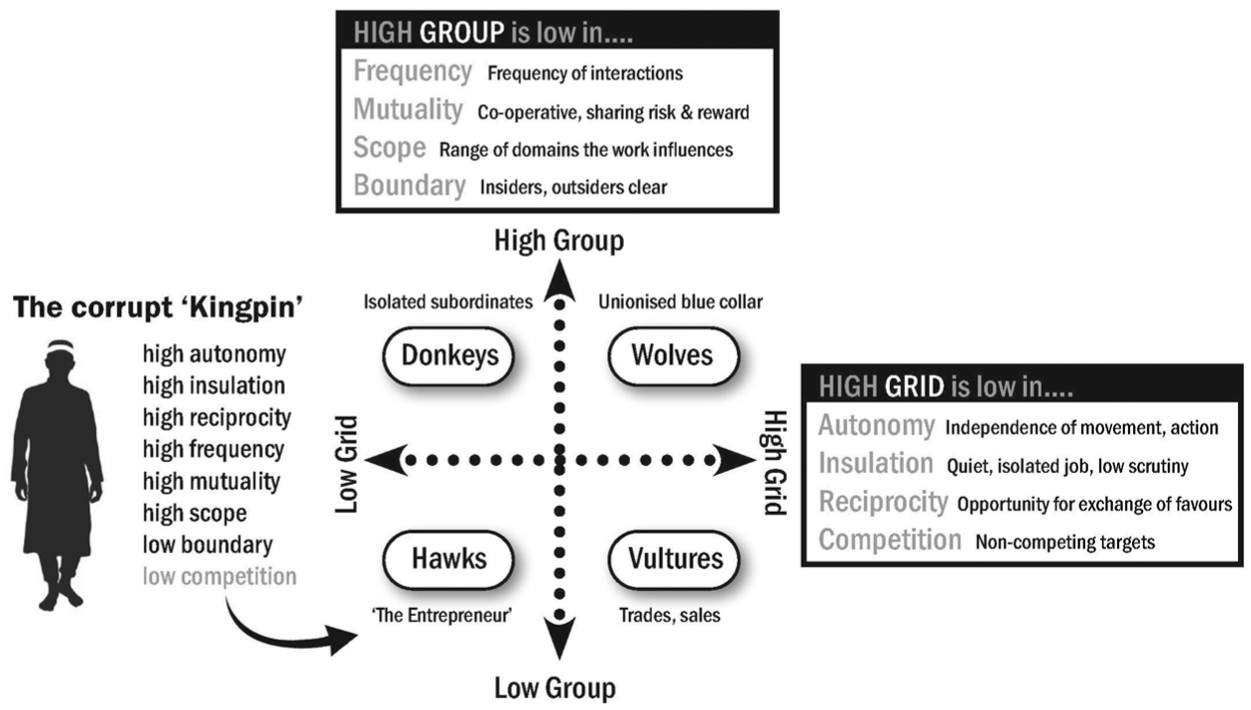
Mars’ Workplace Crime Typology (Grid-Group) Adapted.
Such an individual can indeed “circumvent complex bureaucracies” and “bend the rules to suit themselves” (Thornthwaite & McGraw, 2012, p. 37). The Kingpin adeptly exploited conditions of high autonomy, insulation from oversight, and weak peer cohesion. The founder’s inability to speak the local language, his heavy reliance on intermediaries, and his role as sole auditor insulated the Kingpin, creating organizational voids ripe for exploitation. Further, the Kingpin capitalized on low group cohesion—aligning with the weak-group dimension—leveraging his freedom to strategically manipulate these internal organizational voids. He actively fostered ambiguity in roles and responsibilities, controlling communication channels, and placed loyalists in key oversight positions. These calculated moves enabled him to surreptitiously establish and maintain a parasitic enterprise. This highlights how structural looseness and low peer oversight provided precisely the fertile ground Mars described for intrapreneurial deviance. Our study thus supports and extends Castro et al.’s (2020) argument that corruption emerges not merely from individual flaws (“bad apples”) or external environments (“bad barrels”), but from a confluence of unique internal organizational structures and norms that are then shaped by entrepreneurial actors who deliberately exploit and shape them.
Our integration of Mars’ cultural typology into the study of corrupt entrepreneurship also opens up a novel analytical perspective. It suggests that different structural–cultural environments within organizations (e.g., high-grid/high-group bureaucracies vs. low-grid/low-group ventures) may give rise to qualitatively different forms of corrupt entrepreneurship and potentially point to different countermeasures. The Hawk is one archetype prevalent in loosely governed settings; other quadrants (“Donkeys,” “Wolves,” “Vultures” in Mars’ schema) might correspond to other patterns of misconduct under different constraints. Future research can build on this idea to map how various organizational settings inherently influence the type of corrupt entrepreneurship that can emerge.
In summary, our study advances understanding of corrupt entrepreneurship by extending the frameworks of Cavotta and Phillips (2023) and Mars (1982). Cavotta and Phillips (2023) conceptualize corrupt entrepreneurs as actors who exploit, maintain, and culturally legitimize institutional voids, yet their model treats organizations largely as black boxes. We extend this view by showing that corrupt entrepreneurs not only respond to external voids but also reproduce and reinforce them internally through their entrepreneurial skillset—creating parasitic enterprises, illicit ventures embedded within otherwise legitimate organizations. Unlike the overt and coercive practices exemplified by the Sicilian Mafia, the parasitic enterprise uncovered here operated through subtlety, concealment, and co-optation: the Kingpin relied on relational manipulation—offering jobs, controlling information, and cultivating moral legitimacy—to sustain loyalty and avoid scrutiny. This low-visibility, symbiotic form of corruption thrived within legitimate structures, feeding on organizational resources and reputation while remaining largely undetected.
We also extend Mars’ (1982) typology by shifting the analytical focus from deviance to entrepreneurship. Whereas Mars portrayed the Hawk as an opportunist exploiting organizational looseness, our findings show how such an actor can evolve into a corrupt entrepreneur, systematically constructing and sustaining an illicit enterprise from within. By linking the Hawk’s grid-group environment to the creation and exploitation of organizational voids, we demonstrate how specific structural and contextual conditions enable distinct forms of corrupt entrepreneurship. Together, these insights yield a multi-level theory of corrupt entrepreneurship that conceptualizes corruption as an emergent property of interconnected institutional, organizational, and individual dynamics.
Limitations and Future Research
Despite its novel contributions, our study is subject to several limitations that reveal future research opportunities. First, the contextual specificity of focusing on a unique NGO operating in coastal Bangladesh may restrict how far our conclusions extend to other cultural or institutional settings. The case study NGO is atypical in having no paid expatriate staff. There is a general perception that the presence of expatriate staff reduces corruption (Khoda, 2020), but as Mukasa (1999) has pointed out, their presence can weaken capacity development in local staff. In societies where corruption is normative, NGOs may be tempted to “import” key staff from cultures where corruption is non-normative. Is this an effective—let alone cost-effective—strategy? Hawks’ parasitic enterprises such as the one described here can exist in Bangladesh almost in plain sight, particularly in cases where there are linguistic, geographical, and cultural barriers that prevent independent auditors from understanding flows of information and power. Future scholars should examine such parasitic enterprises within an array of different organizational settings, industries, or societal contexts to determine which of our insights are context-dependent and which might hold more universally.
Related to these questions, the epistemological positioning of our autoethnography—privileging reflexive insider insight into ethically sensitive, hidden organizational realities—provides deep contextual understanding but also naturally limits the study’s generalizability. However, the lens of this study, despite being based on rich “insider” data, is still that of an “outsider” to the context in which corruption was observed. It continues to privilege postcolonial viewpoints—albeit of a context heavily imbued with the residue of colonial structures. Future research could adopt complementary approaches (e.g., experimental designs or event studies inspired by our findings) to test the broader prevalence and applicability of the patterns we observed. For example, scholars could engage in multi-level event studies (e.g., Vassallo et al., 2025) that shift the focus to how discrete events allow internal organizational voids emerge, how these relate to external institutional voids, and how entrepreneurial agents create, exploit, and sustain these voids.
Practical Implications and Conclusion: Responding to Entrenched Corruption
Our work builds on evidence that corrupt entrepreneurship weaves together an array of entrepreneurial competencies and presents a case where the corrupt entrepreneur both exploited and shaped institutional and organizational voids, cloaking his operation in the legitimacy of the host NGO to create a parasitic “enterprise.” Thus, the NGO paradoxically founded to remedy institutional deficiencies became a mirror of those deficiencies, while still delivering on its core purpose. By revealing these dynamics, our study reinforces the notion that the binary grease/sand-in-the-wheels-of-enterprise debate is overly simplistic.
Our findings respond to Cavotta and Phillips’ (2023, p. 362) call for more theorizing into how corrupt entrepreneurs exploit, and indeed erode, the institutional structures needed for society to flourish, and conversely how they actively perpetuate and construct institutional voids that undermine societal well-being. Institutional voids simultaneously impede and stimulate entrepreneurship (Doh et al., 2017; Mair & Marti, 2009). We show that they do so in a corrupt sense as well, and the side effects of this stimulation are not always negative. Mars’ work focused on the characteristics of occupations that lend themselves to “the fiddle,” and like Mars we observe that corrupt behaviors can sometimes be incidentally of benefit to the host institution.
Mars (1982) describes the first steps of this process as follows: For the employed Hawk to operate across the boundaries of the official and hidden economies he needs first to loosen the control of his employing organization . . . running in parallel “a business within a business.” (Mars, 1982, p. 45)
Such an entrepreneur may actively craft or perpetuate institutional weaknesses to further their illicit enterprise (Hardy & Maguire, 2008), but at the same time by recognizing that the survival of the host is necessary for their own survival as parasites, engage in a combination of legitimate and illegitimate behaviors to keep the host alive.
Our findings underscore that in developing contexts—where formal institutions are weak and enforcement uneven—anti-corruption policies should move beyond “zero tolerance” or purely punitive measures to address the underlying incentive structures and skill asymmetries that allow corrupt entrepreneurship to flourish. Managers and policymakers should recognize that entrepreneurial capabilities such as opportunity recognition, resource mobilization, and strategic networking can be redirected toward positive ends when embedded within strong governance arrangements and ethical cultures. Strengthening mid-level accountability mechanisms, improving transparency in recruitment and procurement, and designing training programs that reward ethical innovation can help convert “dark” entrepreneurial energy into productive social outcomes.
Importantly, anti-corruption strategies in such contexts must be adaptive rather than purely compliance-driven, and attuned to the informal logics through which organizations operate on a day-to-day basis. Our findings show that corruption is often sustained not by the absence of rules, but by the ease with which performance metrics can be strategically manipulated for private gain. To incentivize genuine innovation and organizational performance—rather than behaviors that merely mimic success for corrupt rewards—managers must therefore design systems that measure substantive outcomes rather than easily gamed proxies. In the present case, for example, rewarding “school attendance” created incentives for headcounts to be inflated without improving educational outcomes. By contrast, where outcomes can be measured in ways that are more resistant to manipulation, these measures can be credibly linked to rewards, thereby interrupting corrupt incentive structures and restoring a positive performance feedback cycle.
Previous research has highlighted the role of transparency mechanisms in preventing the resurgence of corruption (e.g., Muurlink & Macht, 2020). More typically, international NGOs try to reinforce non-corrupt governance and practice by placing highly paid “outsiders” in key roles, and there is empirical evidence that this diversity in leadership does reduce the likelihood of corporate corruption (Ramirez, 2003). In Bangladesh, this logic underpins the routine rotation of senior regional officials (e.g., upazila heads or government bank managers) every 2 to 3 years, on the assumption that disrupting long-standing local ties helps curb entrenched corruption. Yet such strategies face important constraints: evidence suggests that posting senior staff to remote regions is commonly met with resistance (e.g., Durga et al., 2022) and that geographically remote regions remain more susceptible to corruption (Bhattacharya et al., 2018). While it is almost axiomatic to assume that digitization reduces corruption (Addo & Senyo, 2020), our findings suggest that what may matter more is its capacity to facilitate sustained exposure to diverse, outsider perspectives that disrupt closed informational and social loops. In this regard, the use of digital tools to embed “outsiderness” into management and oversight structures—for example, through regular, remote participation in decision-making—represents a promising but underexplored avenue for future research.
In conclusion, our findings offer practical insights for those implementing anti-corruption strategies within NGOs. In particular, we foreground a talent management paradox that is challenging to resolve. The very competencies that make employees valuable—resourcefulness, risk-taking, and strategic acumen—are precisely those that increase vulnerability to corruption, presenting NGOs with a paradoxical talent retention dilemma. Organizations must strike a careful balance, creating robust internal checks and cultivating ethical organizational cultures to harness these valuable competencies without inadvertently fostering conditions conducive to corruption.
Footnotes
Appendix
Acknowledgements
We are grateful to Armando Castro (our Special Issue editor) and the three anonymous reviewers for their thoughtful, constructive, and generous feedback, which greatly strengthened this manuscript.
Declaration of Conflicting Interests
The authors declared no potential conflicts of interest with respect to the research, authorship, and/or publication of this article.
Funding
The authors received no financial support for the research, authorship, and/or publication of this article.
Ethics Approval
Ethics approval was gained from Central Queensland University’s Human Research Ethics Committee, Approval Number 0000021037.
