



Abstract
We induce a first-person conceptualization of entrepreneurial resilience. Our seven-year, two-study ethnography shows that entrepreneurs enact resilience as a four-step process of managing vulnerability: they richly experience episodes of adversity, self-monitor across episodes, reassess personal thresholds and reconcile challenges with coping skills. Entrepreneurs manage vulnerability by (1) modifying (stretching and shrinking) objective time and (2) changing their subjective experience of time as working with or against the clock through temporal resourcing or temporal resisting. We extend the theory and practice of entrepreneurial resilience by elaborating the interplay of objective and subjective time in managing vulnerability in recurrent and unprecedented crises.
Introduction
Entrepreneurs survive economic and political crises, conflict, war and displacement, as well as natural and man-made disasters (Welter, 2011). A dedicated handbook (Powley et al., 2020), cross-disciplinary reviews (Fisher et al., 2019; Korber & McNaughton, 2018; Oleakalns et al., 2020; Williams et al., 2017), special issues (e.g. Doern et al., 2019) and calls for papers (Hällgren et al., 2018; van der Vegt et al., 2015) document entrepreneurial resilience not only in response to single adverse events (Shepherd & Williams, 2020; Williams & Shepherd, 2021), but also during endemic, chronic, unfair or oppressive adversity Daou et al., 2019; Shepherd et al., 2020a, 2020b, 2021). Entrepreneurial resilience has been understood as actors thriving under extreme uncertainty (Branzei & Abdelnour, 2010), persisting despite constant danger (Bullough & Renko, 2017; Doern et al., 2019) and resourcefully adapting to recurrent strife (Shepherd et al., 2020a, 2020b).
Studies of resilience in general (Southwick et al., 2014), and recent explorations of entrepreneurial resilience, focused on outcomes measurable, comparable and observable by third parties. Entrepreneurs are deemed more resilient if they bounce back faster from crises to resume pre-adversity selves, intentions, careers and/or portfolios (van der Vegt et al., 2015; Williams et al., 2017). Policies and interventions focus on, and favour, the more resilient (Doern et al., 2019).
Entrepreneurs also self-define as resilient between volcanic eruptions (Muñoz et al., 2019), after hurricanes (Torres et al., 2018), floods (Simpson et al., 2015), earthquakes (Williams & Shepherd, 2016a, 2021) or bushfires (Shepherd & Williams, 2014; Williams & Shepherd, 2016b). Stories of entrepreneurs being resilient over time come from a variety of contexts: war-stricken Afghanistan (Bullough et al., 2014; Bullough & Renko, 2017), violence-riven Columbia (Hiatt & Sine, 2014), terrorist-attacked US (Ferrer & Conley, 2015) and politically active Chile (Muñoz et al., 2020). Yet entrepreneurs’ own experience of being resilient (Neville et al., 2020) and doing resilience remains under-researched (Caza et al., 2020). We know more about the effects of social capabilities and networks (Muñoz, et al., 2019; Shepherd et al., 2020a, 2020b) and emergent response groups (Majchrzak et al., 2007; Williams & Shepherd, 2021) than about emotional self-regulation (Shrira et al., 2010) and evolution of entrepreneurs’ roles and identities (Powell & Baker, 2014).
Most studies acknowledge the inherently temporal nature of the being and the doing of resilience: the resilient actor ‘builds and uses its capability endowments to interact with the environment in a way that positively adjusts and maintains functioning prior to, during, and following adversity’ (Williams et al., 2017: 742). We adopt the definition of resilience as ‘the process by which individuals are able to positively adapt to substantial difficulties, adversity, or hardship’ (Fisher et al., 2019: 592).
As a process, resilience unfolds over time (Barton & Kahn, 2019). The majority of studies examine resilience in the immediate aftermath of traumatic events (e.g. Williams & Shepherd, 2016a, 2016b). However, entrepreneurs also work through chronic crises (Khoury & Parasad, 2016; Powell & Baker, 2014; Shepherd et al., 2021; Williams & Shepherd, 2016a). Healing the trauma accompanying extreme events often takes decades (Ferrer & Conley, 2015; Torres et al., 2018). The handful of studies that follow trajectories of resilience over time (Williams & Shepherd, 2021) treat time as fixed and uniform. Studies of preparedness (Muñoz et al., 2019) and anticipation (Powley et al., 2020) before, regulation within (Kay & Merlo, 2020) and transference between adverse events (Pettersen & Schulman, 2019) relax temporal boundaries, yet ignore the role of time itself.
We ask ‘how do entrepreneurs enact resilience over time?’ Our exploratory approach complements third party and comparative accounts of resilient actorhood by foregrounding the first-person experience of entrepreneurial resilience as it unfolds in objective and subjective time. We contribute by inductively specifying the respective roles of objective and subjective time, and especially their interplay, in how entrepreneurs are being resilient during different types of crises.
Literature Review
To explore how resilience unfolds over time, we focus on the ‘when’ aspect of resilience (Caza et al., 2020). The question of ‘when’ draws attention to the temporal dimensions (Fisher et al., 2019; Langley, 1999; Strauss, 1993) of resilience (Williams & Shepherd, 2021).
Objective or Subjective?
Although studies of resilience treat objective time as given, it is rarely fixed or uniform. Actors distort and modify objective time, negotiate new temporal structures (Reinecke & Ansari, 2015) or revise their temporal schemas (Shipp & Richardson, 2021). Crises distort perceptions of objective time, especially when they arouse extreme emotions (Slaughter et al., 2021). Objective time is recently understood as culturally embedded, materially anchored (Hernes et al., 2021) and physically emplaced (Kim et al., 2019). Studies draw attention to how actors modify objective time, rather than take it for granted.
Actors also experience time subjectively. The ‘other’ time (Shipp & Jansen, 2021) flows idiosyncratically because it hinges on the interpretations, and the temporal work actors engage in (Kaplan & Orlikowski, 2013). Subjective time depends on actors orientation towards time (Amato et al., 2019), with recent reviews differentiating between trait-like temporal concepts that exhibit stability within individual and state-like temporal concepts that are inherently unstable (Tang et al., 2020). Individuals perceive different urgency and control over time, have different temporal preferences and vary in their ability to reflect, shift and coordinate multiple temporalities. Shipp and Jansen (2021) reveal different ways in which individuals engage with subjective time, by attending, preparing and comprehending. Each of these mechanisms includes multiple processes. For example, preparing includes temporal projection, allocation, awareness and construal. As temporal constructs and processes proliferate, we gain appreciation for how differently individuals experience, and work with, subjective time.
Research on resilience underspecifies the role of subjective time (Barton & Kahn, 2019; van der Vegt et al., 2015). Bringing subjective time to the fore draws attention to how actors enact resilience (Caza et al., 2020) not only during (Shepherd & Williams, 2014; Williams et al., 2017), but also before (Muñoz et al., 2019), and beyond (Doern, 2016) adverse events. It also draws attention to the sacrifices and suffering often accompany the prototypical bounce back effect (Torres et al., 2018), that is, the dark sides of resilience, that remain under reported and under researched (Bullough et al., 2014; Bullough & Renko, 2017; Shepherd et al., 2020a, 2020b).
Actors can discipline their subjective experiences of time. Time can be compressed (Flaherty & Meer, 1994) or expanded (Fisher et al., 2019), accelerated or decelerated (Cockain, 2018; Torres, 2016), served by (Johnsen et al., 2019) or serving the protagonist (Fraenkel, 2020). Lived time can be re-designed everyday (Hauge, 2016) or held fast to rebel against constraints imposed by time regimes and temporal structures. Clocks and calendars constrain, yet do not fully predetermine the flow of subjective time.
Resilience unfolds in both objective and subjective time (Britt et al., 2016; Kossek & Perrigino, 2016). Responses are tallied in objective time; yet entrepreneurs enact resilience in subjective time (Caza et al., 2020; McCluney et al., 2020). Although objective and subjective time are often studied on their own, Shipp and Jansen (2021: 315) underscore they are ‘intertwined in practice: the lesser-known aspects of subjective time augment the better-known aspects of objective time’. During crises, subjective time can obscure or reveal objective time (Reinecke & Ansari, 2015). Objective time can also alter the subjective experience of time (Powell & Baker, 2014). Following actors over time allows us to appreciate how the interplay of objective and subjective time influences their first-person experience of resilience.
Objective and Subjective Time in Entrepreneurship
Entrepreneurial projects are explored and enacted in subjective time (Shipp & Fried, 2014: 2): ‘a psychological and flowing property of consciousness that may be influenced by personality, societal and cultural time-related norms, as well as clock time’. Entrepreneurs appreciate ‘the right and opportune moment’. Their choices are chronologically ordered and compared (Wood et al., 2021). Entrepreneurs have traditionally been described as rushing through time, evaluating time as a precious resource, and engaging in mental accounting processes for the time they used, or wasted (Lévesque & Stephan, 2020; Miller & Sardais, 2015). Entrepreneurs develop temporal frames (Bluedorn & Martin, 2008). Distinct temporal orientations, foci and perspectives (Tang et al., 2020) shift how entrepreneurs experience and adapt to adversity (Davis & Cernas Ortiz, 2017; Shipp et al., 2009; Sonnentag et al., 2014).
Modifying objective time
Entrepreneurial resilience is always temporally situated. Events do not merely happen to entrepreneurs. Rather, they are edited in, and out of, entrepreneurs’ lived experience and narratives to suit specific motives and sustain meaning, and well-being, over time. Entrepreneurs choose how they respond to adversity, for example, by pivoting (Berends et al., 2021), experimenting with new ways of venturing, even revamping themselves (Powell & Baker, 2014; Shepherd et al., 2020a, 2020b). Entrepreneurs can enact resilience through a resource conservation mindset to manage the present (Hobfoll, 2002) or a resource investment approach that shifts their attention to future opportunities (Shepherd & Williams, 2014; Williams & Shepherd, 2016b). Entrepreneurs can be resourceful (Shepherd & Williams, 2014) or merely resist the passing of time (Shipp & Richardson, 2021), especially during chronic crises (Powell & Baker, 2014; Shepherd et al., 2020a, 2020b).
Changing subjective time
Time as a resource is often (narratively) mobilized by entrepreneurs (Fisher et al., 2019). They develop elaborate narrative accounts of time (Johnsen & Holt, 2021; Wood et al., 2021). Entrepreneurs facing chronic adversity asked, ‘What’s going on here?’ and ‘What do I do next?’ (Powell & Baker, 2014). Some shared narrative of surrender: accepting the status quo (Powell & Baker, 2014), resigning in the face of future events which they thought to be inevitable. Others skillfully deployed temporal mechanisms, stopping or delaying their venturing efforts for a while, then doubling or rushing to respond (Davidsson & Gordon, 2016). Common narratives of ‘going the distance’ and ‘making it through’ have been credited with improved chances of business survival and personal resilience during the first lockdown (Doern, 2021; Thorgren & Williams, 2020). During the early stage of the current crisis, one of the most common response was to defer or deny investments and radically reduce costs (Doern, 2021; Thorgren & Williams, 2020) to ‘buy some time’, that is, the ‘wait and see’ approach. Shifting interpretations can alter the course of events (Caza et al., 2020) through processes of temporal influence and comparison (Hussenot et al., 2020: 52; Shipp & Jansen, 2011: 78–79). Appreciating the importance of timing, pacing, duration and other functional aspects of temporal restructuring draws our collective attention to how entrepreneurs generally, and resourcefully, work with time (Michaelis et al., 2020). Accounts of resourcefulness in entrepreneurial settings have recently underscored the malleability and controllability of time commitments (Berends et al., 2021: 106): ‘to persevere, entrepreneurs position actions as continuation of the past, extend timelines and complexify temporal ordering.’ Entrepreneurs can also leverage temporal irregularities and mediate across temporal regimes (Storms & Verschraegen, 2019). Such temporal intermediation relies on, and requires, figuring out the temporal constraints and reconfiguring various exchanges of resources. Because entrepreneurs experience the passing of time subjectively and agentically (Eldor et al., 2017), they can edit (Jansen & Shipp, 2019), even escape (de Rond & Lok, 2016; van Wijk, 2016) temporal constraints.
Methods
Context
To understand ‘how entrepreneurs enact resilience over time’, we chose a unique setting (Bamberger & Pratt, 2010) where ventures had been historically rived by multiple types of crises (BBC profile, 2020 1 ) and one of the authors’ networks enabled first-person, real-time access. When our research project began in 2013, Lebanese-based entrepreneurs had been described as ‘able to function under extremely challenging circumstances’. 2 To ensure comparability among the studied entrepreneurs, we sampled from hospitality sector, which then accounted for a fifth of the Lebanese economy. All the protagonists 3 in our sample were portfolio entrepreneurs. Their ventures ranged from early stage start-ups to long-established brands and chains with up to 300 employees (Online, Supplementary Table 1). We use pseudonyms and disguise critical details to protect the anonymity of our protagonists.
Data
We followed 15 entrepreneurs, from June 2013, when Syria’s civil war began fueling unrest in Lebanon, including five incidences of car bombings and two suicide attempts, until October 2020, through COVID-19 and the aftermath of the August 4 explosion, the largest non-nuclear blast on record. Our two-study inductive process spanned a five-year period of recurrent crises (2013–2017) and a two-year period of unprecedented crises (2019–2020). The Online Supplement lists key episodes of adversity (Supplementary Appendix A) and summarizes their impact on our chosen context, the Lebanese hospitality sector (Supplementary Appendix B). We followed our protagonists’ accounts of resilience during a 7 year period, combining 46 in-depth interviews (2–4 for each of the 15 entrepreneurs) with in-situ and online observation and 208 archival sources. Eight of the 15 ventures were multi-generational family businesses. Only 1 of the 8 (Omar) had joined the family business before having experienced any adversity first-hand. Only two of the 7 non-family businesses had not yet led their portfolios through episodes of adversity before our study began.
Study 1
Because we sought first-person accounts of entrepreneurial resilience over different types of crises, our ideal informant would self-describe, and would also be described by third parties, as resilient in the face of multiple episodes of adversity. We conducted four waves of interviews, respectively, in 2013, 2015, 2016 and 2017. During the first of these four field trips, one of the authors, native to Lebanon and fluent in Arabic, French and English, participated as an observer in four national forums convening the hospitality sector. He then contacted the Lebanese Chamber of Commerce, the Lebanese Franchising Association and the Syndicate of Owners of Restaurants, Cafes, Night Clubs & Pastries in Lebanon, debriefed five industry experts and conducted a comprehensive search of local and global public media to identify potential participants. Of the 34 entrepreneurs who agreed to be interviewed (62 times) in our larger research project between 2013 and 2017, in Study 1 includes 15, whom we had interviewed 31 times. All interviews were conducted in protagonists’ language of choice, recorded verbatim and subsequently professionally translated in English. The interviews lasted on average 51 minutes, ranging from 21 to 84 minutes. The 15 in-take interviews, which elicited personal and professional histories with different types of crises, ranged between 45 and 84 minutes, averaging 61 minutes. Follow-up interviews averaged ranged between 21 and 60 minutes, averaging 40 minutes. Study 1 generated 384 pages of single-spaced interview transcripts, accompanied by 421 relevant excerpts from 178 secondary sources. For these 15 protagonists, we carefully triangulated their primary accounts of their resilience with public interviews published in articles and media interviews (e.g. magazines, newspapers and TV stations), trade publications, case studies, speeches, websites and social media activity (e.g. entrepreneurs’ Facebook posts, Twitter feeds and online blogs). We developed case-by-case narratives to document each protagonist’s actions in response to each episode of adversity that affected their venture decisions and/or portfolios. The impact of the many crises our protagonists faced between 2013 and 2017 ranged from ‘painful’ (Kamal, 2015) and ‘horrible’ (Kamal, 2016) to ‘unbearable’ (Serge, 2016). Yet they adamantly declared themselves ‘resilient’.
Study 2
As one of the authors was based in Lebanon since 2017, we continued to follow closely the impact of the wildfires, tax reforms, revolution and government resignation in 2019, then the effects of the global pandemic and the August 4 explosion in 2020. We conducted a fifth and last wave of follow-up interviews with all 15 protagonists in the fall of 2020. Our protocol asked protagonists to describe the impact of different crises on their venture decisions and portfolios, reflect on any changes in their resilience and illustrate key differences in how they were managing vulnerability during the unprecedented crises of 2019 and 2020, especially in comparison with the recurrent crises they had survived from 2013 to 2017. The 15 follow-up interviews were conducted by both authors in English via Zoom or Skype, and recorded verbatim. The interviews averaged 42 minutes, ranging from 22 to 81 minutes, and generated 156 single-spaced pages of transcription. We complemented these interviews with 30 publicly available sources (traditional and/or social media, self- and citizen-made documentaries) that also captured some of our protagonists’ accounts. Together, these resulted in 75 additional single-spaced pages, comprising text-based archives, transcripts of transcriptions of third-party sources available to the public (audio and video interviews and documentaries) and our own custom transcriptions of self-made public accounts (e.g. micro-recordings posted by the entrepreneurs themselves in public-facing communication and crowdfunding platforms). In Study 2, all our 15 protagonists contested the very concept of resilience, which they described ‘as a double-edge sword’ (Maggie, 2020). Omar explained that ‘It is not a question of resilience anymore. It is really a question of life and death’ (Omar, 2020).
Analysis
We began analyzing the data as it was being collected in the summer of 2013 using a fully collaborative process. The two co-authors met weekly throughout the full duration of Study 1.
The first five in-take interviews conducted in 2013 were separately shared, read and theme-coded by both authors as soon as possible after they had been recorded, professionally translated in English and transcribed, usually within 1 week from the date of the interview. Emerging themes were discussed the following week, and tentative insights were incorporated into subsequent interviews. Following the completion of the first field trip in 2013, both authors used line-by-line coding for these five interviews in 2013, independently checking for the prevalence of the themes memoed during the field trip and the presence of new themes. After wave 1, we converged on protagonists’ explanation of their resilience as a process of managing vulnerability, reached full agreement on the ten first-order themes and iterated between our data and the literature available at that time to group them into the reported four second-order themes (Online Supplementary Table 2a).
Before returning to the field in 2015 for the next eight in-take interviews, we significantly revised the initial interview protocol to elicit further reflections on the processes by which entrepreneurs managed their vulnerability. Sensitized to entrepreneurs’ repeated reference to spatial and temporal markers, we became curious about the spatial (Fathallah et al., 2018) and temporal mechanisms explaining entrepreneurial resilience. Based on the literature available then, we narrowed our research question to focus more precisely on the role of objective time. Fixed, clock time continues to be understood until today as a key dimension against which decision-makers assess their return to pre-crisis levels (Shepherd & Williams, 2019; Williams & Shepherd, 2021). Wave 2 surprised us both by revealing that entrepreneurs almost never took objective time as fixed. Instead, they actively modified it, repeatedly shortening and lengthening the time at their discretion to match the most critical survival needs of their ventures. We repeated the same analytical approach as in wave 1 in the summer of 2015, holding weekly debriefs of the completed interviews and forward-feeding emerging insights into the remaining interviews. At the end of the second wave of data collection, we independently line-by-line coded each of the eight interviews conducted in the summer of 2015 and also re-coded the original set of five. In addition to our weekly meetings, we held 24 coding meetings to discuss first-order themes, separated those that increase from those that decreased discretionary time, and jointly defined these two second-order themes as modifying (stretching or shrinking) objective time. After wave 2, we prepared, and peer-presented, a tentative explanation of entrepreneurial resilience as a process of modifying objective time to manage vulnerability in recurrent crises. We received questions, and proceeded to probe further, into the difference between entrepreneurs’ efforts to modify objective time and their subjective experience of time. Heeding other colleagues’ insights on emerging concepts for ‘the other time’ (Shipp & Jansen, 2021) as they were becoming available in the literature, especially temporal perspectives (Lévesque & Stephan, 2020; Tang et al., 2020), temporal schemas (Shipp & Richardson, 2021) and temporal work (Kaplan & Orlikowski, 2013), we developed a new protocol. We collected our last two in-take interviews in 2016, and no new themes emerged.
In the 2016 field trip, we also proceeded to conduct our first set of 8 follow-up interviews. Following the identical analytical approach as in the prior two waves, we took note of entrepreneurs’ native appreciation of working with time, consistently underscoring time as the most important resource for their survival. In 2016, we induced the construct of temporal resourcing to explain how entrepreneurs kept struggling on despite repeated set-backs (Fathallah & Branzei, 2017). We repeated the same analytical approach one last time in 2017. In addition to our weekly meetings, we held 14 more coding meetings in 2016 and 2017. The 2017 follow-ups replicated the first- and second-order codes induced in 2016. No new themes emerged.
Before the end of Study 1, we had followed up once with 8 protagonists (2 interviews) and twice with 4 (3 interviews). We only interviewed 3 of the 15 protagonists once. Before completing Study 1, we also engaged in longitudinal analyses. We developed, then compared, case-by-case narratives for each one of our 15 protagonists (one longitudinal coding meeting per entrepreneur). Within-entrepreneur analyses drew our attention to emotions and commitments. We inductively derived two contingencies, categorization of emotions and revision of commitments. We met five more times to systematically check the separate and joint impact of these two contingencies.
After one of the authors returned to Lebanon in 2017, we continued to read the rapidly growing literature and iteratively refine our intended contribution by carefully specifying the connections among our constructs. We held, and recorded, 22 meetings via zoom in the following 2 years, averaging one meeting a month. In between meetings, we took turns writing and visualizing the findings and obtained several additional rounds of peer feedback.
When adversity befell Lebanon again in 2019, resilience resumed its popularity, leveraged across different media to describe entrepreneurs’ ability to continue against all odds. One of the authors’ field immersion allowed us to witness in real-time how entrepreneurs kept managing their vulnerability as adversity culminated during the national lockdown in response to COVID-19, and peaked again with the August 4, 2020, explosion. The unprecedented nature of the 2019–2020 crises contrasted with the recurrent nature of the 2013–2017 crises. We fast-tracked, and received ethics approval, on a third iteration of our protocol to probe further into our original research question, ‘how entrepreneurs enacted resilience over time’. To address this special issue’s call for papers, we asked entrepreneurs to contrast the impact of, and their responses to, different types of crises.
We resumed our regular meetings via Zoom, meeting twice each week between August 4, 2020, and December 19, 2020. Because we conducted the interviews virtually, together, and in English, we were able to debrief immediately after. Each of us memoed, usually before the end of the same day, convergence and/or divergence from prior themes. We then scheduled separate meetings dedicated to reviewing our earlier codes (we held, and recorded, 15 additional coding meetings during Study 2). We quickly agreed that Study 2 closely replicated two of the core constructs (managing vulnerability and modifying objective time) we had induced in Study 1. The entrepreneurs also kept referring to their subjective experience of time. However, in contrast to emphasis on their ability to work with time noted in Study 1, in Study 2 they clarified they were working against time. We met 6 times to iterate between the native conceptualization and our previous codes to inductively specify the difference between temporal resourcing and temporal resisting. Emotions and commitments remained central in accounts of their decisions and actions in both studies. However, they had different effects on our protagonists’ subjective experience of time. We needed 4 coding meetings to inductively specify the differences in each contingency between Study 1 and Study 2, and 7 additional meetings to systematically map our protagonists.
After we clarified the construct of subjective time and specified the influence of the two contingencies in response to both recurrent versus unprecedented crises, we held another 13 meetings via Zoom to finalize, theorize, visualize and illustrate our process model.
Two-study inductive process
We combined two types of multimodal ethnographies (longitudinal and rapid) to compare and contrast how entrepreneurs enacted resilience over time in different types of crisis. Multiple iterations between data and emerging theory enabled us to induce three core theoretical constructs and two key contingencies that robustly capture the first-person experience of entrepreneurial resilience as managing vulnerability in response to adversity episodes. Our two-study approach also revealed, and explained, nuances in how entrepreneurs manage vulnerability by showing how their distinct subjective experience of time mediated similar efforts to modify objective time.
Figure 1 maps our data collection, analytic steps, inductive insights and types of evidence. A two-study inductive process.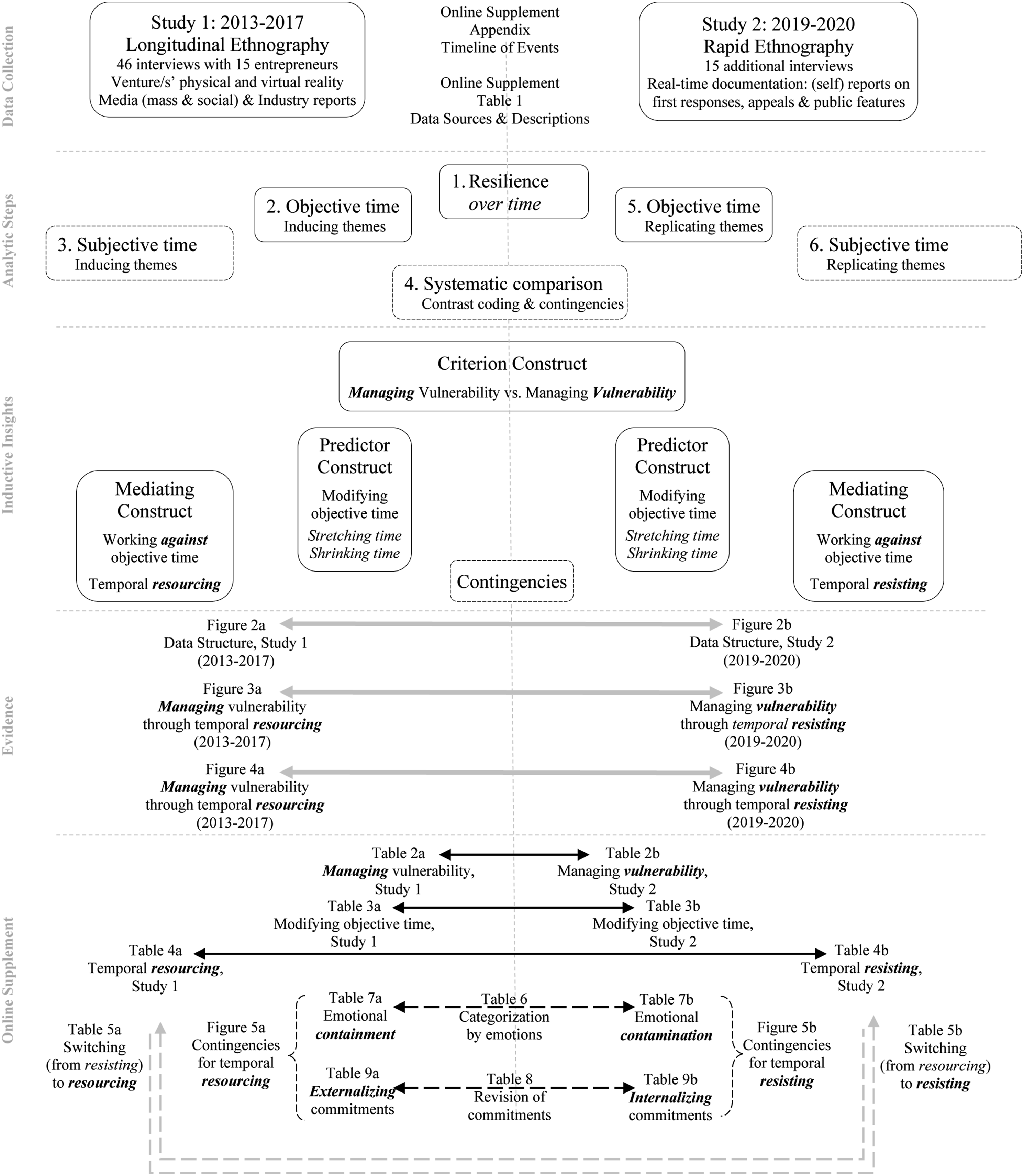
Findings
When our research project began in 2013, the 15 entrepreneurs included in Study 1, were frequently described across a variety of private and public media, and adamantly self-described, as resilient. When we returned to the field in 2019 for Study 2, third parties publicly acclaimed their resilience, yet our protagonists privately questioned it. ‘What does resilience mean? […] is a lie that no one believed but us’ (Amer, 2020). Their first-person experience of resilience had fundamentally changed. ‘I am telling you about our resilience. […] They try again to make efforts to convince you this is it, this is the struggle, this is the game, and you must fight it. No, I do not want to fight it [anymore]’ (Gaby, 2020). Our two-study inductive approach showed that entrepreneurs consistently enacted resilience over time by managing vulnerability. However, they focused more on managing than vulnerability during the recurrent crises between 2013 and 2017 (Figure 2(a)). They focused more on vulnerability than managing from 2019 to 2020 (Figure 2(b)). ‘We found out that we are all vulnerable. […] Can you imagine our vulnerability? […] If I were to tell you that I am managing it, that is a big word to say that I am managing it. I am surviving it. It depends on the month and what we have. There will be a lockdown; I do not know how we will get to the end of this month’ (Gaby, 2020). (a, b) Data structure.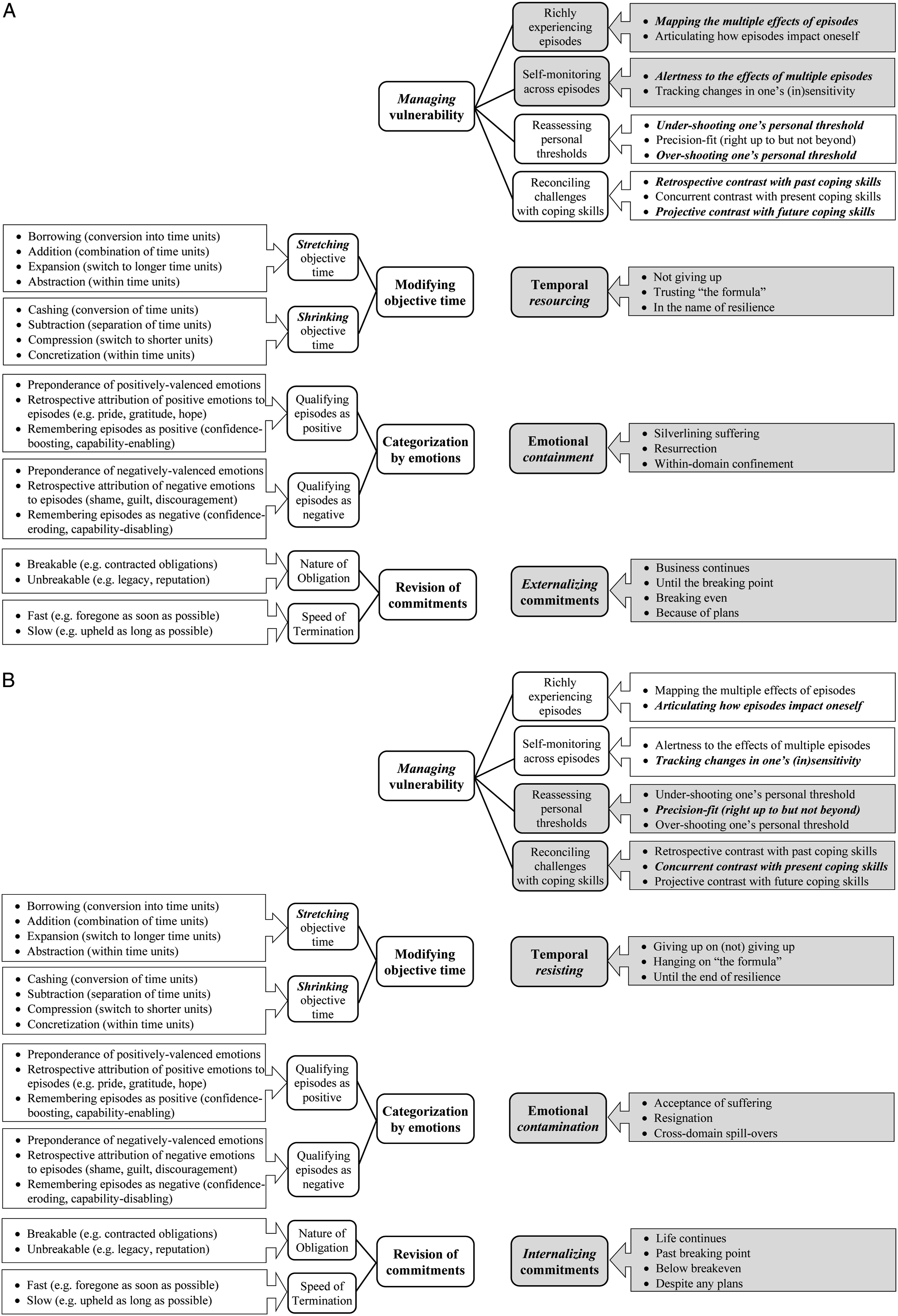
Managing Vulnerability
All our protagonists had grown up in a hostile context. Claude told us: ‘We have been living in times of war since we were kids. We are used to this type of life’ (Claude, 2015). Before our study began in 2013, all but three had already been in charge of the fate of their organization during adverse events (Online Supplementary Table 1). In our in-take interviews, they described in detail how their venture decisions and portfolios had been impacted, compared and contrasted their experiences across different adverse events, figured out their coping thresholds and reconciled challenges by continuously updating their resources (Online Supplementary Tables 2a and 2b).
In Study 2, our protagonists remained alert to the relative ups and downs in their operations: ‘I was aware of every step of the way. Awareness is key. And then the knowledge and self-belief that you can get out of it when it’s down and also capitalize on it when it is up’ (Zach, 2020). However, entrepreneurs’ actions referenced their heightened sensitivity, rather than the operational damages incurred. ‘The event was extreme. […] My priority now is that my children leave the country because I do not want them to say what I am saying now’ (Amer, 2020).
You first call me ‘’resilient’’, okay. I am happy. The second time you call me resilient, it means that I am stupid. Third time, I do not know. We keep on calling ourselves ‘resilient’. It is stupidity. Everybody deserves a life, and we come once to this life, not to stay resilient all the way. It is not written on our foreheads ‘we are here to live a life that is full of challenges, and we need to have an immunity against it every time’. No. I do not think this way, and I do not like to be [this way]. Okay, in a certain period, you take it as a challenge. But why would it be a continuous challenge? What kind of life is it? What kind of a lifestyle is it? (Gaby, 2020)
While protagonists focused on managing their vulnerability during recurrent crises, in Study 1 they experienced episodes of adversity richly and self-monitored closely, repeatedly mapping, and staying alert to, multiple effects. ‘Sometimes you closed your eyes to what’s not working, and you say “oh, but it will work,” “it seems to be working,” you even lie sometimes to yourself to keep it going, keep it going’ (Kamal, 2015). Recognizing their vulnerability during unprecedented crises, in Study 2 called for repeated reassessments of personal thresholds and most entrepreneurs found their coping skills were no longer sufficient given the challenges they faced. I will tell you what. One of the main conclusions after that is the story of the (rising) Phoenix should be stopped. […] As long as we are sticking to the idea of being resilient and fighting, we spend all our lives fighting and not living; for what? You fight to achieve something because then, you either live as a loser or a winner. But when you only live in a war, when the war or the battle becomes the target, there is a problem. It is a mean and not a target. So, the Phoenix should die. We have to be resilient when we need to be resilient, but we are beyond that in Lebanon! It is not a question of resilience anymore. It is really a question of life and death. (Omar, 2020)
Modifying Objective Time
In both studies, entrepreneurs enacted resilience by modifying objective time. ‘Since 2005, and until today, […] conditions are not normal. Survival does not happen when days are normal. It happens in non-normal days’ (Selim, 2016). In Study 1, our protagonists stretched the clock (Supplementary Table 3a) when they liked, and wanted to improve, their odds of survival. ‘You wait for the miracle which never happens’ (Kamal, 2015). When they felt the odds of survival were turning against them, they shrunk time. ‘We cannot live waiting for better days’ (Gaby, 2016). We identified four distinct practices by which entrepreneurs increased available time: borrowing, addition, expansion and abstraction. They relied on four oppositional practices (cashing, subtraction, compression and concretization) to decrease remaining time. In Study 2, our protagonists combined stretching and shrinking to even their odds (Supplementary Table 3b).
Stretching
The four practices by which entrepreneurs increased available time were similar in their consequences: they afforded additional time units (seconds, minutes, days, weeks, months or years) during which operations could be adjusted to fix the top and/or bottom line. They differed however in the mechanisms by which entrepreneurs gained clock time.
Entrepreneurs
Entrepreneurs
Entrepreneurs
Entrepreneurs
Shrinking
The four practices by which entrepreneurs decreased remaining time had the identical effect of hastening the end, but they had distinct effects on the time units.
Entrepreneurs
Entrepreneurs
Entrepreneurs
Entrepreneurs
In Study 1, entrepreneurs either stretched or shrunk objective time, alternating between sets of practices that borrowed, added, expanded and/or abstracted time and sets of practices that cashed, subtracted, compressed and/or concretized time. ‘Yes, I expanded [the venture portfolio] more and made [the ventures] stronger. Because […] you can give more time to this other business, and put more efforts into its activities. When you give it more time, and it will generate more revenues’ (Selim, 2016). ‘That was a question a TV reporter asked me once. Let’s say the businesses in Lebanon went really bad, and your establishment in Lebanon is losing money and it is draining you. Then what would you do? Well, you have to close. […] If you took a final decision that this country is not a place where you can establish, you can’t change your mind later. It has to be a final plan. This is my last option in life. There are stages in the business and stages in life […]. There are things that can’t have second and third options. If you were to take this decision, it has to be final in your life’ (Selim, 2016). In Study 2, entrepreneurs both stretched and shrunk objective time: ‘Today, after 1 month from the explosion, we are rebuilding everything, we hope to reopen the terrace within few days. […] 45 days, we still have two apartments of employees to finish. We are operating on the terrace of [port branch]. […] We are getting there, slowly. The road is still long’ (Maggie, 2020). The logically oppositional pairs of practices by which entrepreneurs had modified objective time during recurrent crises, that is, borrow-cash, add-subtract, expand-compress, abstract-concretize, were almost always deployed together during unprecedented crises. Our protagonists clarified a subtle difference in how they experienced these modifications: until 2017 they felt they were working with time, bending the clock depending on whether they needed more or less time for their venture decisions or actions. From 2019 they felt they were working against time, running down the clock until they could get through the adversity. These native codes revealed a distinct experience of subjective time in different types of crises. Modifying objective time was necessary, but not sufficient, to enact resilience in either recurrent or unprecedented crises. First-person entrepreneurial resilience hinged on the nature of subjective time.
Subjective Time
We contrast-coded the Study 1 and Study 2 interviews to explain how our protagonists experienced time subjectively during recurrent versus unprecedented crises (Figure 1). We queried the case-by-case narratives to induce: (1) how entrepreneurs differentiated between objective and subjective time; (2) how entrepreneurs experienced subjective time; (3) how entrepreneurs’ subjective experience of time influenced their enacting of resilience over time. We began with the native distinctions entrepreneurs drew between working with or against time. When entrepreneurs worked with time, they repeatedly referred to objective time as a resource they could adapt to their will. However, when entrepreneurs worked against time, they unwillingly resisted objective time, What a vicious circle it is […] I tell everybody ‘You resisted and did so many things, and you still, but should be related to your kids? And until when you keep on resisting? And why would you pass it on to your children?’ You need to find a solution. Nobody enjoys a vicious cycle of resilience. This is stupidity. You strive to achieve results with a plan. If you could not accomplish the plan, you declare surrender. You need to find something else. It is enough. It is enough, whether it is right, wrong or whatever, why are living in this life of continuous-continuous-continuous hard challenges. We are used to it. No, I do not want that. This is the first time I say that it is enough and that it will continue like that because nobody wants solutions. So, it is enough. Let us find our own solution. (Gaby, 2020)
Temporal resourcing
When entrepreneurs experienced time subjectively as resourcing, they pursued, sought to prove, and took pride in their resilience: ‘To be psychologically resilient and operationally resilient […] you should not give in, you should find a way of continuing. You should always try to find that internal motivation to continue and do what you can do’ (Zach, 2015). Supplementary Table 4a in our Online Supplement illustrates our three contrast codes for temporal resourcing (
Temporal resisting
When entrepreneurs experienced time subjectively as resisting, they emphasized the toll it took to repeatedly enact resilience: ‘When someone is being hit several times, he will become numb. Effectively. So, to feel the pain of it and take the conclusions out of it you need time to feel the pain because you are not feeling the pain’ (Omar, 2020). They were running out of resources: ‘I am stuck and I cannot do anything else. […] This year, I am a hostage and imprisoned. A hostage of financial, banking, suppliers, social and behavioral obligations towards my workforce’ (Amer, 2020). They felt their only choice was to outlast the period of adversity. Giving up was no longer an option. Nor did they have the latitude to experiment. They were staying the course until the end of resilience. Supplementary Table 4b in our Online Supplement illustrates our three contrast codes for temporal resisting (
Oscillations
Over time, all our protagonists experienced both temporal resourcing and temporal resisting. In Study 1, both public and private narratives featured resilient entrepreneurs only as temporally resourcing. In Study 2, public narratives continued to credit entrepreneurs’ resilience to resourcing (not giving up and trusting ‘the formula’ in the name of resilience). In private, however, entrepreneurs explained they were resisting, rather than resourcing (giving up on ‘not giving up’ and hanging on ‘the formula’ until the end of resilience).
Triangulating public and private accounts on a case-by-case basis, we noticed that our protagonists switched back and forth between resourcing and resisting in Study 2. Amer resisted: ‘I endured three bad years without exaggerations. I endured three years. The operation was not making money. It was not healthy It was not going bankrupt, but it was not healthy. There’s no way I can keep money aside because the income, the profit is very tight for years now. We don’t have the luxury of taking a certain percentage of the income and keep it aside for emergencies. […] The wisdom might mean to give up’ (Amer, 2020). Then resourced: ‘This is why I am restarting to defend what I have done. […] At least I should be committed so that in the end, people do not say that I am not committed’ (Amer, 2020). Omar resourced, then resisted: ‘But, now what? You reach a level where you are fighting and fighting and fighting and fighting. […] Effectively, we reached a level where we ask now what? We could not do anything. In 2020, we have been trying to resolve the issue, but I reached a level of wondering how I can get back on track’ (Omar, 2020). Supplementary Tables 5a and 5b in our Online Supplement illustrate Samer, Omar, Zach and Amer switching back and forth between temporal resourcing and temporal resisting during the 2 years of Study 2, even though they, as all our protagonists, had consistently experienced subjective time as temporal resourcing during the five years of Study 1.
Maggie’s journey contrasts the stability of temporal resourcing during the recurrent crises of 2013–2017 (Figure 3(a)) with its instability during the unprecedented crises of 2019–2020 (Figure 3(b)). In three separate interviews in Study 1 Maggie referred to her ‘survival mode’. This was ‘the hard way’ (Maggie, 2017), yet Maggie kept describing herself as a ‘fighter’. The adversity taught her to ‘be aggressive, to take what we want, not to wait to be given’ (Maggie, 2017); ‘this is what makes us survivors’ (Maggie, 2013). She ‘walked the ups and the downs and ups and you have to be flexible so you can [walk through the fire] and still survive’ (Maggie, 2013), ‘being quick enough to grab opportunity or to stay away from a catastrophe’ (Maggie, 2017). (a) Managing vulnerability through temporal resourcing (b) Managing vulnerability through temporal resisting.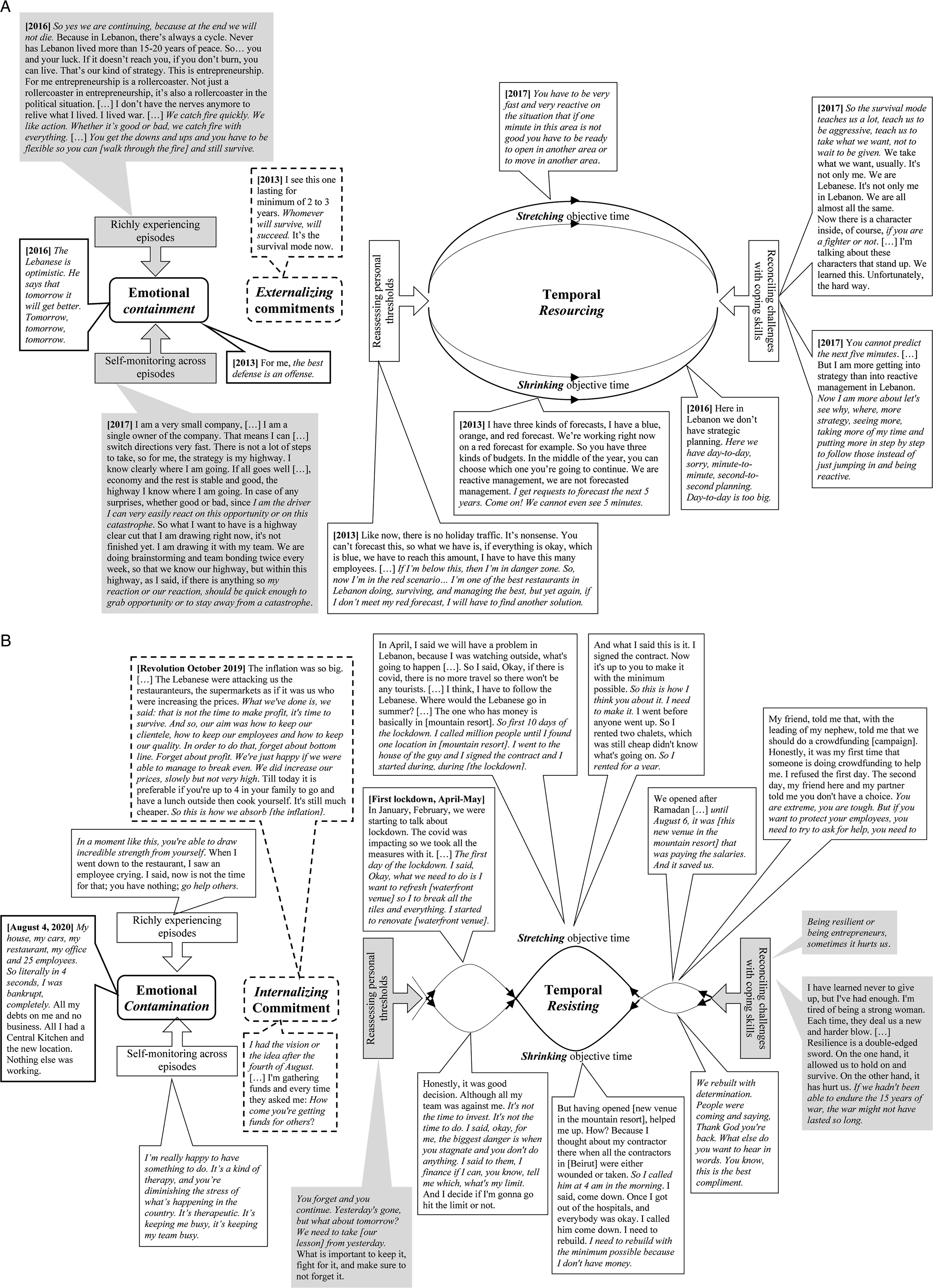
In Study 2, Maggie had managed to refurbish her prior locations and opened a new concept during the COVID-19 national lockdown. Seconds after the August 4th explosion, however, Maggie was literally bankrupt. The blast levelled her port location, severely injured her executive team, and left most of her staff homeless. ‘In a moment like this, you're able to draw incredible strength from yourself. When I went down to the restaurant, I saw an employee crying. I said, now is not the time for that; you have nothing [wrong with you]; go help others’ (Maggie, 2020). In the immediate aftermath, her responses were heroic. First-aid, camp-making Maggie repurposed restaurants as shelters for the displaced families of her staff; she found a way to feed her own by cooking meals for thousand others; and reopened her kitchen and her terrace for business in 23 days since the blast. She overcame her reluctance ‘to try to ask for help [and] to accept help’ (Maggie, 2020) so she could continue to help others. She was ‘really happy to have something to do. It’s a kind of therapy, and you’re diminishing the stress of what’s happening in the country. It’s therapeutic. It’s keeping me busy. It’s keeping my team busy’ (Maggie, 2020). She rebuilt with determination, and reopened the blasted location in record time. By any account, Maggie had been more resilient than ever during the unprecedented crises of 2019–2020, but she had learned that ‘being resilient sometimes hurts us’ and ‘resilience is a double-edged sword’ (Maggie, 2020).
Maggie’s story underscores that the first-person experience of entrepreneurial resilience was fundamentally different depending on whether our protagonists resourced (Figure 3(a)) or resisted (Figure 3(b)) subjective time. Specifically, stability in temporal resourcing (not giving up and trusting ‘the formula’ in the name of resilience) reinforces entrepreneurs’ ability to manage vulnerability. When temporal resourcing is interrupted by even brief experiences of subjective time as temporal resisting (giving up on ‘not giving up’ and hanging on ‘the formula’ until the end of resilience) foregrounds vulnerability, making our protagonists overtly question whether they can, or even want to, continue to manage it anymore.
Contingencies
In addition to entrepreneurs’ modification of objective time and experience of subjective time, first-person accounts of resilience were laden with emotions and commitments.
Emotions
Entrepreneurs categorized adverse events/episodes (Williams & Shepherd, 2016a, 2016b) by the emotions they had felt at the time, experienced while dealing with the immediate aftermath, or recalled years later. Supplementary Table 6 in our Online Supplement illustrates our first- and second-order codes for emotion categorization. Entrepreneurs emotionally categorized adverse events in both studies. Not surprisingly, entrepreneurs qualified some adverse events using negative emotions. Yet many adversity episodes were often categorized by positive emotions, including moral emotions like hope, pride and gratitude (Muňoz et al., 2020).
We contrast coded our two studies to clarify the relationship between emotional categorization and objective time. In Study 1, when entrepreneurs had felt, attributed and remembered adverse events as positive they stretched objective time. Yasser recalled how he carried on through the war: ‘at 7:00 am I would open the café, and people came, had their coffees and talked…so I would take notes, and when I finished, I would go home and blog. I did this for 33 days’ (Yasser, 2015). ‘Wow! I did this. I survived this incident, and I survived it well. Therefore, seriously, I am very good. You become confident’ (Yasser, 2015). Entrepreneurs shrunk objective time when their feelings, attributions and memories evoked negative emotions. ‘You get sick, you get tired. Enough, enough!’ (Yasser, 2015). If emotions changed, for a given event, entrepreneurs cycled between stretching to shrinking. Amplification in either positive or negative emotions accelerated stretching, respectively, shrinking. Entrepreneurs’ renewed efforts to modify objective time sustained their experience of subjective time as temporal resourcing. In Study 2, however, when entrepreneurs categorized adverse events by both negative and positive emotions, they simultaneously engaged in stretching and shrinking. If they re-categorized events, by associating, attributing or remembering preponderantly positive emotions, they paused shrinking and double down stretching. If they re-categorized events as predominantly negative, they paused stretching and focused on shrinking. Across the two studies, emotional categorization proved to be robustly associated with directional modifications of objective time.
The relationship between emotional categorization and entrepreneurs’ experience of subjective time as resourcing or resisting was, however, specific to the type of crisis entrepreneurs were confronting. In Study 1, entrepreneurs contained their emotions by focussing on the silver linings, rather than the suffering, resurrecting positive emotions and confining their negative emotions to the domain of venturing (Supplementary Table 7a Online Supplement). ‘I put my energy at work during the day and when I get home, I put my energy on my family. When we finish the interview, I will go see my children and spend quality time with them. This is where I like to put my energy’ (Claude, 2015). In Study 2, emotions contaminated entrepreneurs’ subjective experience of time. They spoke poignantly of their suffering, resigned over positive emotions and let negative emotions spill over beyond venturing to affect one’s health, family and faith (Supplementary Table 7b, Online Supplement): ‘Every time, there is something worse. There is always something worse, unfortunately. The worst is yet to come’ (Amer, 2020).
Emotional containment
During the recurrent crises of 2013–2017, entrepreneurs used more positive than negative emotions to categorize adversity. ‘We used to say that it is going to become bad, and things would get bad, and we will leave. But look, we are still here. This is the glass half full’ (Amer, 2015). They acknowledged the suffering, but focused on, the silverlinings: Trauma changes you, you can go through that, as an entrepreneur doing your business. You can have tons of people counting on you, then you become a different person when you come out the end of it, you know. Some people don’t come out the other end, but, you know, most entrepreneurs say that they manage the damages. So, it certainly changed me, you know. It gives you deeper perspective into everything. You experience a lot […] you learn a lot more when things aren’t going right than when they are going right. So it makes you more aware, to understand what you need to do, clarifies your next move after you come out the end of it and it, you know, I guess changes you as a person, as well, sometimes towards the better, sometimes towards the worse. But I would have to say for me it changed me to the better. […] So, there is a silver lining to it. (Zach, 2017)
Even when they were traversing undeniable set-backs, entrepreneurs found reasons and ways to resurrect their positivity by shifting attention away from losses and towards possible gains. ‘It was a bittersweet moment to shut down one venue and open another at almost the same time. As that business was failing, we were working on the French concept second branch, the opening of which saved us psychologically. But the second we opened, and that was four years and a few months this day, it’s been fantastic, like the results were really good. So that was kind of like the phoenix out of the ashes moment, when it came down to it’ (Zach, 2017). Omar and Samer, appreciated their better standing relative to competitors. Amer renewed his hope through prayer. Entrepreneurs also tried to confine negative emotions to work locations and hours, giving themselves a chance to rest and relax so they could better shoulder the next challenge. Zach noted ‘You also have to have the wins outside work’ (Zach, 2016). Amer believed in divine protection of his company (Amer, 2017). Although entrepreneurs tried to buffer the negative and boost the positive, most bounced between the two extremes. Maggie claimed, for example, ‘For me, the best defense is an offense’ (Maggie, 2013). Yet she recalled a moment of reckoning: ‘I had 48 employees. Damn, how am I going to pay their salaries? So I felt what my father used to feel’ (Maggie). During the five years of our first study, our 15 protagonists engaged in emotional containment to a different extent (Supplementary Figure 5a, Online Supplement). Samer’s and Amer’s accounts showed low levels of emotional containment. Maggie and Omar approximated our sample’s average. Zach exhibited the highest emotional containment.
Emotional contamination
During the unprecedented crises of 2019–2020, entrepreneurs used more negative than positive emotions to categorize adversity. ‘We are building hope and disappointment. Both come together. Hope and disappointment are sides of the same coin’ (Omar, 2020). Their suffering was unmitigated. Amer described the situation as ‘tragic’. ‘They say we are going to hell, I say that hell is not here yet and hell is way uglier than what we are experiencing nowadays’ (Samer, 2020). He expected ‘that everything will be put on hold’ and underscored that ‘no one is able to survive like this’ (Samer, 2020). Entrepreneurs had also resigned to suffer. Amer predicted that adversity will ‘persist for two or three years’ (Amer, 2020). Samer complained about ‘but not enjoying the business in this country’ (Samer, 2020). The negative emotions were intense and spread to multiple aspects of entrepreneurs’ life. Zach declared that ‘Lebanon is a land that kills dreams and hopes and for anyone who values their potential in life must make it their mission to live’ (Zach, 2020). ‘It’s the stress that comes with the location of the business, it’s the part of the world that has no potential’ (Samer, 2020). Across the three themes, negativity crowed out the positivity. Amer told us ‘There is only the negativity. Excuse me because I am showing you a lot of pessimism’, because ‘I do not have any sign unless a miracle happens. I do not have any optimistic signs. I do not have any signs. We can talk as much as you want about how Lebanese are strong. But scientifically speaking, there is no sign of positivity at all’ (Amer, 2020).
During the 2 years of our second study, our 15 protagonists engaged in emotional contamination to a different extent (Supplementary Figure 5b, Online Supplement). Maggie’s levels were the lowest in our sample, notwithstanding her harrowing experiences. Contamination was also low for Samer, average for Omar, but high for Amer and Zach.
Following protagonists over time offers a much more nuanced understanding of the first-person experience of entrepreneurial resilience. Zach contained his emotions during the recurrent crises, but contaminated them during the unprecedented crises. In both studies, Zach closed down one location, yet expanded the model, the brand and the location. He temporally resourced until the August 4, 2020 explosion when he switched to temporal resisting. Maggie self-described her emotions as a rollercoaster during the recurrent crises in Study 1, but would not let the negative contaminate the positive during the unprecedented crises in Study 2. In 2013–2017, she was flexible and ‘quick enough to grab opportunity or to stay away from a catastrophe’ (Maggie, 2017); in 2019–2021, she remained ‘tough’ (Maggie, 2020) in the midst of the catastrophe.
In our inductive models, emotional categorization was an important contingency for first-person entrepreneurial resilience: it altered entrepreneurs’ rich experiencing of, and self-monitoring across, episodes of adversity. In Study 1, emotional containment made vulnerability more manageable by helping entrepreneurs emotionally categorize adverse events as more positive than negative (Figure 4a). In Study 2, emotional contamination made vulnerability less manageable as negative emotions crowded out positive ones (Figure 4b). (a) Managing vulnerability through temporal resourcing (b) Managing vulnerability through temporal resisting.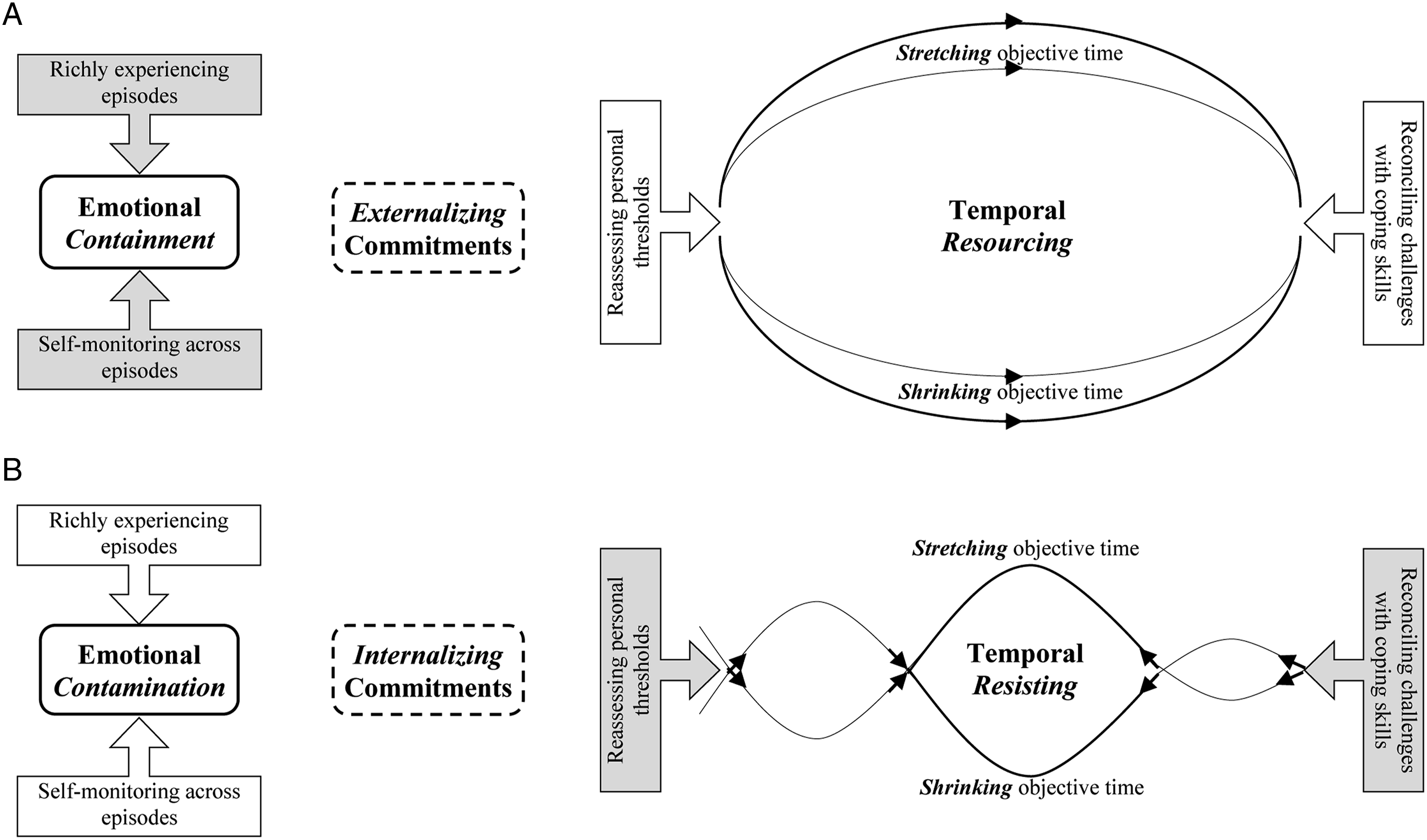
Commitments
Entrepreneurs also revised their commitments. Supplementary Table 8 in our Online Supplement illustrates our first- and second-order codes for revision of commitments. Entrepreneurs considered both the nature of obligations (breakable or unbreakable) and the speed of termination (fast or slow). Fast breakable obligations were quickly converted into time units through borrowing to stretch objective time. In both studies, all our protagonists stretched objective time through borrowing to continue fulfilling unbreakable commitments. Borrowed time units were redirected towards two critical uses: to sustain employees and their families and long-standing stakeholder relationships on which entrepreneurs had built their reputation and legacy. The latter commitment loomed particularly important to the seven multigenerational family businesses included in our sample, some of which also shared, and therefore strived to preserve, our protagonists’ family name and history. ‘The name of the game is not about losing or making money. The name of the game is your credibility and your name. Your name is priceless. So a lot of times, you pay money to keep your name and we do that’ (Samer, 2013). ‘It’s a family business, we’ve fought for it, we’ve built around it and so we’re here to stay. […] Even if the business is losing money, we will always pump money into it. […] We had to reduce our rates a lot. We save the money for something bad that might happen, to avoid getting under debt and loans from banks etc.’ (Serge, 2015). For some of the family businesses, the two kinds of commitments were inseparable: ‘I seriously thought of closing down the business here. If I didn’t have people working in the factory since my father’s reign, I would have closed down the factory long ago. I cannot tell our employee [by first name], who has been with us for 40 years, ‘Sorry we are closing down the factory.’ If I didn’t have this obstacle, I would have closed it for sure’ (Claude, 2015).
We contrast coded our two studies to clarify the relationship between revision of commitments and objective time in different types of crises. In Study 1, when entrepreneurs decided they could not break commitments they stretched objective time by borrowing. Some also stretched time to keep honouring commitments that they could break but chose not to break for as long as they could afford. In Study 1, our protagonists also shrunk objective time by choosing to accelerate the liquidation of commitments. For example, Zach closed a location he had dreamed about for years so he could honour a very large payment to his investors. Whether, as well as how, entrepreneurs stretched or shrunk objective time depended on the revision of commitments.
Contrast coding replicated the same associations between revision of commitments and modifications of objective time in Study 2, revealing one nuance. All our protagonists instantly paused all non-critical commitments during the unprecedented crises of 2019–2020, even if they could have honoured some of them, at least temporarily or partially. Fees for banking and governmental services, even taxes were delayed. They did so to further stretch the objective time window of honouring critical relationships. In Study 2, employees’ salaries were unanimously prioritized ahead of all other commitments. The trade-offs were significant. Zach, for example, permanently closed down one location but kept the staff employed by transferring them to another, up until this location was destroyed by the August 4, 2020 blast. Our protagonists explained that, to them, such trade-offs were much more dramatic compared to decisions and actions they had undertaken during the recurrent crises of 2013–2017, when many of them had relocated staff abroad to continue employing them. The sacrifices loomed larger in Study 2 because entrepreneurs had to undertake much higher personal risks by how they stretched time. Maggie, for example, maxed her loans, then took out new loans, then asked their peers to invest and eventually accepted crowdfunding to be able to look after her employees. Breakthroughs also stood out more in Study 2. Entrepreneurs stretched time by opening radically new models (e.g. Zach’s cloud delivery venture, Maggie’s boutique venture in a mountain resort catering to domestic customers isolating during the national lockdown). Our protagonists credited these models with saving them: ‘Until August 6, it was [this new venture in the mountain resort] that was paying the salaries. And it saved us’ (Maggie, 2020). Appreciation for whether, when, why and how our protagonists revised their commitments also validated and explained our earlier realization that entrepreneurs simultaneously stretched and shrunk objective time in Study 2, rather than sequentially iterating between stretching and shrinking as we had observed in Study 1.
The relationship between revision of commitments and entrepreneurs’ experience of subjective time as resourcing or resisting hinged on the type of crisis. In Study 1, entrepreneurs focused on externalizing commitments to ensure that business continues, until the breaking point, and kept breaking even by constantly adjusting their plans (Supplementary Table 9a, Online Supplement). ‘I do not want to go bankrupt. I have an obsession in my life. I don’t want to go bankrupt. […] I’m trying everything’ (Amer, 2017). In Study 2, entrepreneurs focused on internalizing commitments they deemed most critical, accepting that life continues, past the breaking point, and kept operating below break-even as prior plans proved no longer feasible (Supplementary Table 9b, Online Supplement). ‘Forget about the buildings. All people’s houses were damaged. The two houses of my children were destroyed. […] The material damages were huge. But I thank God millions of times and every time for the safety’ (Amer, 2020).
Externalizing commitments
During the recurrent crises of 2013–2017, all protagonists in our sample did ‘the best he could’ (Amer, 2017) as prior commitments ‘became emotional, humanitarian and moral’ (Amer, 2015). ‘Now we are selling the products that we have. Of course, it is not even considered a decent selling process, but at least, thank God, we are selling as much as the country can handle. […] You say it is ok. It is ok. It is fine. Because I have those people, they work for me. What will they do if I close the business?’ (Amer, 2017). However, externalizing some of their prior commitments was ‘the right thing to do’ (Claude, 2015). ‘It is sad to shut down a good restaurant in a beautiful location but the decision is the correct one for us. I feel more confident now with my network, my business skills that I can do this pretty much in any city now. I moved once and I can do it again’ (Zach, 2016).
During the recurrent crises of 2013–2017,
During the five years of our first study, our 15 protagonists externalized their commitments to a different extent (Supplementary Figure 5a, Online Supplement). Maggie was lowest in externalizing commitments in our sample, as she managed to honour almost all of her outstanding contracts, without terminating employees thanks to multiple reconfigurations and relocations of her ventures. Samer’s and Omar’s were also low; they waited as long as they could until eventually declining a few of their commitments. Zach and Amer were about average in our sample. The comparison should not overlook that all our protagonists kept as many of their commitments for as long as they could and at significant, irrecoverable costs. Oscar explained that adverse events eventually ‘made the decision of closing down on [his] behalf’: ‘Your staff and customers left. The business closed. You shut down. […] ‘We were massacred. Twice. Twice is too much. Total loss: $2 million’ Oscar tallied (Oscar, 2015). ‘So, finally, when it collapses, you’d have lost much more that you would have if you let it collapse at the beginning’ (Kamal, 2016).
Internalizing commitments
During the unprecedented crises of 2019–2020, our protagonists acknowledged, first, with relief and gratitude, that
During the 2 years of our second study, our 15 protagonists internalized their commitments to a different extent (Supplementary Figure 5b, Online Supplement). Maggie’s level of internalization was the highest in our sample as she assumed heroic commitments in the aftermath of the August 4, 2020 explosion: she took it upon herself to house all her employees’ families displaced by the blast and crowdsource to feed thousands of others. So was Amer’s: ‘I have obligations. I have a reputation. I have to pay all loans in the banks. I have to pay the suppliers for their products. I have to pay for the salaries of the employees. This is sacred’ (Amer, 2020). Zach and Omar were average in our sample: revising commitments was no longer enough to keep up with set-backs. ‘You are dealing with things that are beyond your control’ (Zach, 2020). Samer’s level of internalization was among the lowest in our sample, with the important caveat that all 15 protagonists made significant sacrifices to honour as many of the commitments they could internalize during the unprecedented crises.
Following protagonists’ commitments over time offers a much more nuanced understanding of the first-person experience of entrepreneurial resilience. Maggie was the most ‘extreme’ (Maggie, 2020): she chose to honour, rather than externalize, her old commitments during the recurrent crises, and internalized many new commitments during the unprecedented crises. For Maggie, the revision of commitments conditioned how she managed vulnerability: ‘You know how strong you are, crazy you are, or resilient you are, passionate, whatever. If you don't have cash, you don’t have cash. You can have a lot of cash and not have this, nothing will happen. But you can have all this and not have the cash, nothing will happen’ (Maggie, 2020). To underscore how much harder it had become to manage vulnerability in Lebanon, Zach contrasted his first-person experience there and elsewhere: ‘I do feel vulnerable. In Dubai, I am as vulnerable as everyone else who has a business. Vulnerability comes from customers, trends, other businesses and COVID. It has stabilized. You know, the normal vulnerability. Not [like here where adversity] comes at you from every angle’ (Zach, 2020). ‘Some people might prefer to be bankrupt. No. This is not how things are done’ (Omar, 2020).
Our inductive models clarify how revision of commitments influences first-person entrepreneurial resilience over time, by enabling entrepreneurs to reassess their personal thresholds and reconcile challenges with coping skills. In Study 1, externalizing commitments made vulnerability more manageable by allowing entrepreneurs to repeatedly adjust course to keep their business going (Figure 4a). ‘When you go through all of this and you have half a dozen investors and shareholders and you have employees and you have a family and they see exactly what’s happening and, you know, perhaps maybe half of them won’t have the belief that it’s possible to even come out of there. And then once you succeed, suddenly that also changes the dynamics between employees, shareholders, investors, between your family. You know, you prove yourself and it gives you credibility, gives you an accolade, gives you the confidence to get a lot more support after that, a lot more respect. And that is something very important that comes out of coming out of a difficult part and leading the business’ (Zach, 2017). In Study 2, internalizing commitments made vulnerability less manageable as entrepreneurs shifted their focus from investing in the continuance of business to ensuring the continuance of life (Figure 4b). ‘Vulnerability plays the biggest part because you can never feel secure in Lebanon even if you have a couple of good months or years. You know all [good] is temporary. You can’t rest or feel comfortable even if you are doing well’ (Zach, 2020).
Emotions and commitments
Entrepreneurs managed vulnerability by revising both their emotions and their commitments. For example, in Study 1, both Maggie and Zach underscored how they managed by containing their emotions without externalizing their commitments. In Study 2, Maggie leaned into vulnerability by internalizing commitments; Zach attributed his heightened vulnerability to the contamination of his emotions. Our inductive model of first-person entrepreneurial resilience explains our protagonists experienced and engaged with adversity differently over time.
Discussion
We explain how entrepreneurs enact resilience when they face different types of crises. Our inductive insights complement third person conceptualization of resilience as the bounce back to the old normal, with first-person conceptualizations of resilience as bouncing forward to a new normal. Recent reviews of entrepreneurial resilience (Shepherd & Williams, 2020; Williams et al., 2017) and recent empirical studies of entrepreneurial resilience during recurrent adversity such as refugee camps (Shepherd et al., 2021) and Bangladeshi slums (Shepherd et al., 2020a,b) and unprecedented crises (Williams & Shepherd, 2021) underscore that entrepreneurs enact resilience over time. Our seven-year, two-study ethnography complements these studies by inducing a first-person concept of entrepreneurial resilience as managing vulnerability. We also explain how entrepreneurs manage vulnerability by modifying objective time as well as switching between different subjective experiences of time. We extend entrepreneurship theory and practice by adding previously missing temporal dimensions to the concept of entrepreneurial resilience.
Implications for Theory
By refocusing the resilience literature on actors’ first-person experience of managing vulnerability over time we reorient the current research agenda: (1) from the bright to the dark sides of entrepreneurial resilience, by drawing attention to key boundary conditions; (2) from the bounce back to the bounce forward, by specifying how entrepreneurs navigate different types of crises; and (3) from temporal constraint to temporal latitude, by showing the interplay of objective and subjective time.
Dark side
We are not the first to draw attention to the dark side of resilience (Caza et al., 2020; Williams & Shepherd, 2016a), even if the vulnerability side of the resilience story still remains largely untold (for exceptions, see Bullough et al., 2014; Grube & Storr, 2018; Martinelli et al., 2018; Shrira et al., 2010; Subbaraman et al., 2014). We are the first, however, to inductively show how entrepreneurs balance the bright and the dark sides of resilience over time. We also explain why the bright sides appear brighter during recurrent crises and the dark sides darker during unprecedented crises. While resilient entrepreneurs always manage their vulnerability, they place greater emphasis on managing when they experience time subjectively as a resource at their discretion; they underscore their vulnerability when they experience time as a burden.
Our first-person conceptualization of entrepreneurial resilience honours entrepreneurs’ self-assessment of vulnerability. It is also applicable across different types of crises. By appreciating the emphasis one places on managing versus vulnerability, entrepreneurs themselves can become more mindful of the dark side. Future research can translate our four-step inductive process of managing vulnerability into assessments and self-help tools. We are also hopeful that our study will encourage resilient entrepreneurs to self-disclose vulnerability: ‘Because resilience for an entrepreneur is, as I said, you forget and you continue. Yesterday’s gone, but what about tomorrow? What is important is to keep it, fight for it, and make sure to not forget it. We have to tell. We have to keep on talking, giving [advice] to the others’ (Maggie, 2020).
Bounce forward
Prior literature determines an entrepreneur is more resilient if they bounce back faster to the pre-crisis baseline. The bounce back effects holds true in many different types of crises, from Katrina hurricane (Torres et al., 2018), the Black Saturday fires (Shepherd & Williams, 2018), the Haiti earthquake (Williams & Shepherd, 2016a, 2016b, 2021), the 2011 Brisbane floods (Simpson et al., 2015), to the Ebola outbreak (Wright et al., 2021). However, when crises recur (Muñoz et al., 2019), ecosystems are permanently disrupted, or devastation is relived and remembered over subsequent decades as is the case with economic crises (Doern et al., 2019), 9/11 (Korber & McNaughton, 2018), the Boston marathon (Ferrer & Conley, 2015) and the COVID-19 pandemic (Doern, 2020), returning to the old normal is less sensible. Our conceptualizing of entrepreneurial resilience as a first-person experience offers a bounce forward alternative, which allows us to follow how entrepreneurs pursue a new normal instead.
Temporal latitude
We broaden the perspective of the time-constrained (Wood et al., 2021) and time-conscious entrepreneur (Lévesque & Stephan, 2020) by showing how entrepreneurs work both with and against time to overcome adversity. Although time has always been a key factor in many entrepreneurial processes (Bluedorn & Martin, 2008), most studies of entrepreneurial resilience have ignored, or fixed, objective time. However, several researchers have argued (Shipp & Jansen, 2021) and shown (Reinecke & Ansari, 2015; Kim et al., 2019) that there is significant flexibility in objective time (Tang et al., 2020). Furthermore, actors can and do change their temporal structures (Shipp & Jansen, 2021) and temporal schemas (Shipp & Richardson, 2021) through temporal work (Kaplan & Orlikowski, 2013). We find that entrepreneurs are not captive to clock time, but rather agents who repeatedly add or subtract time from the clock depending on their immediate priorities. We show how entrepreneurs repeatedly stretch available time and shrink remaining time. Our study reveals a set of practices by which entrepreneurs modify objective time. Future studies can use longitudinal designs that combine surveys and diaries to prospectively track entrepreneurs’ efforts to stretch or shrink time in the aftermath of the global pandemic by operationalizing these practices. We also encourage field studies that compare the differential effects of future crises on entrepreneurs who skillfully modify objective time versus entrepreneurs that accept the clock as fixed. Working the clock might also become a new type of resourcefulness as entrepreneurs brace for the long-term aftermath of COVID-19 (Michaelis et al., 2020).
Our protagonists also have some latitude over their subjective experience of time. When their actions predictably prolong or shorten the window of objective time according to their priorities, entrepreneurs begin to feel they can control time rather than being controlled by it; and they subjectively experience time as a resource. When they run harder and harder just to stay in the same place, however, they subjectively experience time as a burden. By being conscious about the difference, entrepreneurs can switch, as our protagonists do, between subjective experiences. Appreciating one’s subjective experience of time may be a critical mechanism to manage well-being, especially during crises like the global pandemic with multiple waves of lockdowns. In our study, pausing resourcing is critical when the circumstances are dire. But so is resuming resourcing, as soon as the worst has passed. Future studies can follow entrepreneurs’ ups and downs to show how subjective experiences of time influence their venture decisions and actions.
Our findings also draw attention to the multiplicity of temporalities in entrepreneurship (Johnsen & Holt, 2021) and the extent to which previously taken for granted temporalities can become personable, controllable, and malleable (Amato et al., 2019). We believe working with time will become increasingly important for entrepreneurs facing different types of adversity. Several studies have demonstrated how modifications of objective time and changes in subjective time can resolve conflicts among multiple temporalities, create temporal truces among previously oppositional temporal schemas, and craft new temporal structures (Shipp & Jansen, 2021; Jansen & Shipp, 2019; Eldor et al., 2017). Equipping entrepreneurs with such temporal skills can prepare them for a range of scenarios, from spontaneously responding to disasters (Shepherd & Williams, 2018), to rapidly convening emergent response groups (Williams & Shepherd, 2021) to coordinating schedules during endemic crises (Shepherd et al., 2020a, 2020b).
Implications for Practice
The contrast between third party acclaim of our protagonists’ resilience and their first person doubts honours both sides of previously single story. In a post-pandemic world, some of the entrepreneurs who best manage may also be feeling particularly vulnerable. Although our study is context specific and offers only a few direct insights about entrepreneurs responses to the effects of COVID, the candor of their longitudinal stories breaks the taboo of not feeling resilient, especially when the whole world is watching.
Our first-person conceptualization of resilience dispels the myth of heroic entrepreneur, pointing out their awareness of the limits of their resilience. The protagonists in our study experienced resilience as a double-edge sword, which helps but also hurts them. The pervasiveness of resilience language and the pressure to prove one’s resilience risk pushing entrepreneurs past their coping thresholds, and their ventures past the breaking, not just, the break-even point. Our model warns about the significant, and prolonged, distress resilient entrepreneurs may experience.
We believe that a first-person conceptualization of entrepreneurial resilience is sorely needed in, and well suited to, our post-pandemic world. During COVID-19, entrepreneurs have been facing unprecedented set-backs. They grappled with extreme levels of vulnerability (Doern, 2021; Thorgren & Williams, 2020). They experience extreme emotions (Slaughter et al., 2021), in human time (Johnsen & Holt, 2021). Yet given the abnormality of the global pandemic, bouncing back to pre-crisis level is no longer an option. Our study also previews skills and solutions, by showing how entrepreneurs can bounce forward: by categorizing their emotions, revising their commitments, modifying objective time and changing subjective time.
Conclusion
Our seven-year, two-study ethnography shows ‘how entrepreneurs enact resilience over time’. We induce a first-person experience of entrepreneurial resilience as managing vulnerability that complements third-party assessments of resilience as bouncing back to pre-crisis levels of performance. Instead of taking objective time as fixed, we show that entrepreneurs modify objective time by stretching available time and/or shrinking remaining time. We also foreground entrepreneurs’ experience of time as subjective by distinguishing between temporal resourcing (working with time by not giving up and trusting ‘the formula’ in the name of resilience) and temporal resisting (working against time by giving up on ‘not giving up’ and hanging on ‘the formula’ until the end of resilience). By following entrepreneurs through a five-year period of recurrent crises and a two-year period of unprecedented crises, we underscore the ubiquity, and robustness, of objective time modifications: entrepreneurs consistently enact resilience by stretching and shrinking time. We also explain when and why entrepreneurs switch from experiencing time subjectively as resourcing or resisting.
Supplemental Material
sj-pdf-1-etp-10.1177_10422587211053809 – Supplemental Material for The End of Resilience? Managing Vulnerability Through Temporal Resourcing and Resisting
Supplemental Material, sj-pdf-1-etp-10.1177_10422587211053809 for The End of Resilience? Managing Vulnerability Through Temporal Resourcing and Resisting by Oana Branzei and Ramzi Fathallah in Entrepreneurship Theory and Practice
Footnotes
Declaration of Conflicting Interests
The author(s) declared no potential conflicts of interest with respect to the research, authorship, and/or publication of this article.
Funding
The author(s) received no financial support for the research, authorship, and/or publication of this article.

Supplementary Material
Supplementary Material for this article is available online.
Notes
References
Supplementary Material
Please find the following supplemental material available below.
For Open Access articles published under a Creative Commons License, all supplemental material carries the same license as the article it is associated with.
For non-Open Access articles published, all supplemental material carries a non-exclusive license, and permission requests for re-use of supplemental material or any part of supplemental material shall be sent directly to the copyright owner as specified in the copyright notice associated with the article.
