



Abstract
History is increasingly recognized as a distinctive source of competitive advantage for family businesses. Taking a rhetorical history perspective, we study how a family business leveraged the family’s three generations long history of entrepreneurship to sustain profitable growth over 16 years. Through our analysis, we identify three history scripting strategies—embedding, elaborating, and building family history—that created important sources of competitive advantage for the family business, facilitating acceptance by broader communities, building a reputation of continuity, and inspiring innovation through tradition. These findings advance the history-informed understanding of family firms’ idiosyncratic sources of superior performance.
Introduction
“Who controls the past controls the future; who controls the present controls the past.” George Orwell, 1984
Recognizing family businesses as a particularly history-dense organizational context (Colli & Rose, 2003), scholars have started paying growing attention to the role of history in family firms (Argyres et al., 2020; Suddaby et al., 2021). This research stream suggests that the family’s history can influence, shape, constrain, and envision family firm behavior (e.g., Sasaki et al., 2020; Suddaby & Foster, 2017), pervading business practices, producing and reinforcing shared values, norms, and beliefs over time, and creating a close link between the present and the past (Zellweger et al., 2012). Studies show that history in families can be skillfully reinterpreted to deal with core managerial issues such as innovation and leadership (Suddaby & Jaskiewicz, 2020). The history of entrepreneurial families is thus recognized as an important idiosyncrasy (Neubaum, 2018) and a potential source of competitive advantage for businesses (Suddaby et al., 2010; Foster et al., 2017; Labaki et al., 2019).
While prior research has highlighted the strategic potential of history in family businesses, the mechanisms linking family history to the creation of competitive advantage have not been sufficiently investigated yet. We start to do so by recognizing that entrepreneurship is constructed through “narrative and dramatic processes” (Downing, 2005, p. 185) and appreciating the importance of taking a critical view of historical assumptions in management research (Wadhwani et al., 2020). Such “historical consciousness” (Suddaby et al., 2016) focuses on a critical and purposeful use of the past, which is seen as constructed and narrated, partly idealized, as opposed to a past reality based on historical facts (Popp & Fellman, 2017). Thus, history can be understood in the form of a “rhetorical” narration and regarded as the “strategic use of the past as a persuasive strategy to manage key stakeholders of the firm” (Suddaby et al., 2010: 157). Research has shown that the narrated histories of organizations are an important means to create a constructed view of the past, aimed at obtaining strategic advantages for the business and key stakeholders (Foster et al., 2017; Oertel & Thommes, 2018; Suddaby et al., 2010; Vaara & Lamberg, 2016).
Building on these ideas, we develop an in-depth case study of a family business established by the members of a family with a lengthy history of entrepreneurship. The research question guiding our study is: how can a family’s entrepreneurial history be strategically narrated, and why does it contribute to creating competitive advantages for the family business? We focus specifically on publicly told or published histories because they have a particularly important and enduring role in influencing external audiences, including but not limited to direct customers (Foster et al., 2011, 2017). Narrations of the family’s history can be particularly useful to understand the links between history and competitive advantage, yet few studies address this issue explicitly. We conceive the entrepreneurial family’s history as the family’s entrepreneurial past as narrated by the current leaders of a family business, which is made accessible to external stakeholders via various media, for example, stories in books, on websites, social media, tv-shows, and the news. Seeing history as malleable and purposefully retold (Suddaby et al., 2010; Wadhwani et al., 2020), we sought to understand “when the knowledge of the past is referenced and the reasons why it is strategically communicated” (Foster et al., 2017, p. 1176). In so doing, we do not aim to discern the reality of the past (Bruner, 1990), but to understand the functions of such narrated history (Burke, 1969), and how such narrations contribute to achieving competitive advantages (Suddaby et al., 2010; Balogun et al., 2014). This research, thus, draws together previous sporadic research that has acknowledged the strategic use of history in family business (e.g., see Labaki et al., 2019), considering both oral (e.g., Jaskiewicz et al., 2015) and written (e.g., Hjorth & Dawson, 2016; Sasaki et al., 2020) histories, and focusing specifically on their links to competitive advantage creation.
Our case is Sweet Mandarin, a family business established by the members of a family with an entrepreneurial family’s history dating back three generations. Interestingly, even if this was a newly established family business (i.e., the liability of newness; Singh et al., 1986), it could leverage the history of the entrepreneurial family to create competitive advantages. Thus, our case study provides an extreme and ideal research setting, offering a rare opportunity to explore how and why a family’s entrepreneurial history can be strategically narrated across family businesses and over time (e.g., Discua Crus et al., 2013; Ramírez-Pasillas et al., 2021; Steier, 2001). This case is particularly insightful due to the family members’ extensive (and successful) use of history through narrations recorded in a variety of forms. This provided us a rare opportunity to observe and describe a specific type of strategic use of history, namely scripted history, which is persuasive in nature and targeted at external stakeholders, which we found to be particularly conductive to creating sustainable competitive advantages for the family business.
Our findings led us to theorize how family businesses can strategically use history through three specific history scripting strategies: embedding, elaborating, and building family history. Moreover, we explain why those strategies were successful by unpacking the theoretical mechanisms linking each history scripting strategy to specific sources of competitive advantages for the family business, namely, facilitating acceptance by broader communities, building a reputation of continuity, and inspiring innovation through tradition. We build on these findings to explain the links between the family’s history, the history scripting strategies used by the family business, and the creation of competitive advantages.
Our study makes important contributions to the literature at the intersection of family business, history, and entrepreneurship. First, our findings place history as a key driver of transgenerational entrepreneurship in family firms (e.g., Zellweger et al., 2012). Specifically, our study suggests that history serves as the fil rouge linking the entrepreneurial initiatives undertaken by entrepreneurial families across generations and businesses, and that such history can provide concrete strategic advantages for any new businesses launched by the family. These insights serve as a springboard for taking history into greater account in family business and entrepreneurship research, especially from a family-centric and narrative perspective. Second, our findings complement prior studies focused on uses of history as a compass guiding entrepreneurial behavior or strategic change initiatives in family firms (e.g., Jaskiewicz et al., 2015; Sasaki et al., 2020), by providing a history-informed understanding of the mechanisms through which the family can leverage its history to create competitive advantages even beyond the boundaries of the initial family business. Finally, our study offers new methodological insights regarding the value of secondary data in family business research in order to advance theory about history-based sources of competitive advantage in family firms. In this vein, we hope that our study will stimulate scholars to use secondary sources like published descriptions of past events, geographic regions, groups, individuals, and organizations to provide history-informed examinations of entrepreneurial phenomena.
Theoretical Background
History and Competitive Advantage
History is recognized as an important asset for any business (Barney, 1991). Due to its socially embedded, difficult to imitate (Foster et al., 2011), and manipulable nature (Suddaby et al., 2010), history can generate competitive advantages that positively affect internal and external stakeholders (Foster et al., 2017). In advancing the “historic turn” in organization studies, scholars have increasingly criticized the traditional view of history as static and passive, as it does not reflect the real use of history in organizations (Suddaby et al., 2010). Organization scholars have mainly used history in two ways: “history to theory” and “history in theory” (Kipping & Üsdiken, 2014). In the former, history is used as a contextual factor and plays a supporting role in theory development, in the latter, scholars reflect critically on the role of history in theory development (Kipping & Üsdiken, 2014). Following the second approach, we join a recent research tradition that sees history as a concept and a source of data, calling for a more critical understanding of the strategic uses to achieve the desired organizational outcomes, such as a firm’s competitive advantage, survival, or growth (Argyres et al., 2019).
History in organizations is more than a straightforward representation of the reality, it is constructed and reconstructed for strategic use—“a social and rhetorical construction that can be shaped and manipulated to motivate, persuade, and frame action, both within and outside an organization” (Suddaby et al., 2010, p. 147). It is embedded in the socially constructed narrative and can benefit from adopting a rhetorical perspective as “strategic tools to achieve specific organizational outcomes” (Foster et al., 2017, p. 1184). Following this rhetorical perspective of history narratives, Oertel and Thommes (2018) show that organizations engage in the active construction of identity by reconstructing and creating a history that is suitable for both present and future uses. Similarly, Suddaby and Greenwood (2005) find that even profound institutional changes can be legitimized via historical theorization, providing a sense of continuity and emotional attractiveness. Consequently, the use of history in organizations goes beyond a simple artifact, a source of research, and is actively crafted toward specific organizational goals. In addition, every interpretation of past events, including the rhetorical approach, is by definition retroactive. Yet, the rhetorical approach to understanding history highlights the importance of acknowledging the narrators’ agency in constructing their version of history (Kipping & Üsdiken, 2014). This approach highlights the need to read the narratives critically (Balogun et al., 2014) so as to understand the narrator’s purpose (Suddaby et al., 2020). This implies going beyond the written history for strategic purposes, as unwritten or forgotten parts of history also play an important role in helping organizations reorient their preferred identity (Nissley & Casey, 2002).
Unfortunately, these insights have thus far not taken root in family business research where studies on the use of history are still scarce. In this paper, we advance this literature by recognizing the need to approach history-related narrations from a critical perspective, the rhetorical history perspective (Suddaby et al., 2010), to understand and elaborate their historical assumptions (Wadhwani et al., 2020). Establishing “historical consciousness” (Suddaby et al., 2016) and drawing on established research in the organizational field offers important opportunities to advance knowledge on the use of history. In this vein, we focus on the strategic use of history in family business, starting from the notion that history can be a potential source of distinctive competitive advantage, aiming to further current understanding of the narrative mechanisms that support these links.
Strategic Uses of History in Family Business
The recognition that language has a “performative” function is quite recent in management and entrepreneurship research (Downing, 2005). Scholars are beginning to understand the different uses of history (as facts or constructed) and the impact on entrepreneurial processes (Wadhwani et al., 2020). An entrepreneurial story, for example, might follow different storylines, including the perspectives of the first-generation, second-generation, or family business (Smith, 2014).
In the family business literature, research has often treated history as stories negotiated between the family and the business (Hjorth & Dawson, 2016). While the term history is less mentioned, family business research acknowledges that narrations of the past play an important role in family business strategies (Hamilton et al., 2017; Suddaby & Jaskiewicz, 2020). For example, studies have shown that the stories narrated across generations can ensure business continuity (Konopaski et al., 2015). Studies have also explored how the narrated stories in auto/biographies can be used to legitimize succession (Dalpiaz et al., 2014), manage transformative change and stakeholder endorsements (Dalpiaz & Di Stefano, 2018), influence the business’s innovative behaviors (Kammerlander et al., 2015), and support changes in strategic direction (Sasaki et al., 2020; Sinha et al., 2020). Research indicates that a family’s history can be used to communicate with external stakeholders (Astrachan et al., 2019), as a tool to gain external empathy by sharing stories from a personal perspective (Hjorth & Dawson, 2016). Botero et al. (2013) show that family firms often communicate their family firm identity on their official websites. Other recent studies show that signaling the business’ “family” trait triggers social judgments among key stakeholders, such as investors (Lude & Prügl, 2019) and customers (Schellong et al., 2019).
Collectively, these studies provide resounding support for the idea that narrations of the past play a vital strategic role in family businesses (Labaki et al., 2019). Broadly speaking, family business narrations of the past are synergistic stories combining the family’s past and the business’s history. Family business myths, a type of family business story, can be used strategically to create and maintain homeostasis, competitive advantage, identity, legitimacy, and entrepreneurship (Labaki et al., 2019). Generational entrepreneurs can write their family business stories to “celebrate and honor the collective achievement of the whole family” (Smith, 2014, p. 162). However, a stricter analysis of narrated histories and the various assumptions of the uses of history (Suddaby & Foster, 2017) has not been fully undertaken in family business research. For example, for Sasaki et al. (2020), narrated history is more malleable in supporting strategic changes in the family, while for Jaskiewicz et al. (2015), entrepreneurial legacy is understood as “easily recalled narratives” (p. 36). Similarly, Dalpiaz et al. (2014) find that successors strategically employ history to gain legitimacy. Other studies treat history as an objective entity to be either included or excluded in a family business branding strategy (Lude & Prügl, 2018). Thus, a critical treatment of historical assumptions on “how to understand history,” especially the agency embedded in the use of history, is needed in the family business field (Suddaby & Jaskiewicz, 2020). One notable exception is the study of Dalpiaz and Di Stefano (2018) on strategy-makers in Alessi who actively crafted a transformative change in the main production activity and generated endorsements from the target audience, showing both the power and agency of strategy-makers’ stories.
A more complete understanding of the different uses of history in family businesses also entails methodological reflections. Specifically, it requires deepening our knowledge of the source of narratives (of history) in research, so as to fully incorporate them in theory building (Kipping & Üsdiken, 2014). History can be used externally to create competitive advantages (Foster et al., 2017). Narrations and stories are different when used for internal or external purposes (Cramton, 1993). Building on the narrator’s agency in told history, it is questionable whether stories heard by researchers are the “true” histories of the family (e.g., in Jaskiewicz et al., 2015) or if there are any missing voices and characters who played important roles in the researched process (e.g., Hamilton, 2006). Further development in terms of the researchers’ declaration in the sources is needed. A further distinction can be made between written (e.g., Hjorth & Dawson, 2016; Sasaki et al., 2020) and oral stories (e.g., Jaskiewicz et al., 2015), as the latter is more malleable due to its dependence on the narrators’ memory and agency, whereas the former entails a stronger commitment to the history as it is told, and a stronger judgment by external stakeholders.
Adopting a rhetorical history perspective, we specifically focus on family businesses’ narrated life stories, looking for their clear specific strategic purposes of acting as a means of persuasion targeted at external stakeholders (Foster et al., 2017). Due to their in-depth details, these life stories provide unusually vivid descriptions embedded in the rich and idiosyncratic histories of entrepreneurial families, often going beyond the business. They are thus particularly suited to address our research question: how can a family’s entrepreneurial history be strategically narrated, and why does it contribute to creating competitive advantages for the family business?
Methodology
We conducted an exploratory case study (Yin, 1994), which is particularly suitable for answering how and why questions, using a rhetorical history perspective (Suddaby et al., 2010), specifically following the interpretivist tradition (Leppäaho et al., 2016). Addressing our research question required access to rich empirical accounts collected from publicly accessible sources, well-suited to the purpose of revealing the persuasive aims of scripted history. By its very nature, qualitative research follows the social actors’ meaning-making artifacts to understand and analyze their behaviors and objects (Fletcher et al., 2016).
We focus on the single Sweet Mandarin case to explore our research question. The case is “rare and unique,” and appropriate for “theoretical sampling” purposes (Eisenhardt, 1989). Indeed, Sweet Mandarin is a family business reflecting the culmination of a family’s successful history of entrepreneurship spanning three generations, and well-presented publicly as a business with a rich entrepreneurial family’s history. Despite that the business itself is only 16 years old, the family entrepreneurs strategically scripted the previous two generations’ history into their own. In the family business literature, numerous scholars have called for a family-centric view of family businesses with a deeper examination of the family (Chrisman et al., 2005; Jaskiewicz et al., 2017). Following Handler’s (1992) definition, Sweet Mandarin is a family business set up and managed by the third generation, but its relationship to the business dates back to previous family generations. Important to note is that this case departs from the traditional understanding of first-generation family businesses (Miller et al., 2011), highlighting the historical aspect of family embeddedness (Aldrich & Cliff, 2003), placing greater emphasis on the history of past generations and its bearing on current decisions. For example, our preliminary analysis of the case indicated that the previous generations had a major influence on the family entrepreneurs’ decision to set up the family business in the first place. Thus, while the previous generations are not physically present, their past plays an important role in the family business (Ramírez-Pasillas et al., 2020). In addition, one of the authors of this study is from the same cultural background as the entrepreneurial family, hence well-positioned to provide “theoretical structured introspection” (Fiske, 1990, p. 85). This type of autoethnographic insight is particularly important for a critical historical view and in-depth understanding (Karra & Phillips, 2008).
Consistent with the case study approach, our methodology involved several rounds of coding, referring to the literature, theming, and triangulating the data (Yin, 2009). We adopt a strict historical research method, including thick descriptions (Geertz, 1973), clear categories (Grodal et al., 2020), and a critical analysis of the source “with the intention to provide a contextualized explanation and interpretation of the phenomenon of interest” (Argyres et al., 2019, p. 2).
Case Study Background
Case Study Timeline.

Over the years, Sweet Mandarin has become a well-recognized name both domestically and internationally. It has received numerous awards and accolades and has extended to a theater play, multiple books, and an entire range of patented sauces. Lisa and Helen’s culinary skills were recognized by the then UK Prime Minister (David Cameron), the Queen, the President of China, and expert chefs like Ken Hom and Gordon Ramsay. The Sweet Mandarin sauces, honed from the family’s cooking experience, were the world’s first range of gluten-free oriental sauces, so authentic and well-made that they even enjoy success in the domestic Chinese market. Lisa and Helen were awarded the Queen’s MBE for services to the food and drink sector in 2014.
While we do not argue that Sweet Mandarin’s competitive advantages are solely built on the use of their family history, our preliminary analysis of the case study clearly revealed that history contributed to increasing the value of the good food and service in the eyes of the consumers, and it was highly instrumental to creating customer loyalty in a highly crowded and dynamic market (cf., Kirzner, 1973). Thus, through our case study analysis, we sought to understand how Sweet Mandarin created competitive advantages beyond’s having good food and service, standing out among the many comparable Chinese restaurants operating in the Manchester area at the time of our analysis.
Case Contextualization
In analyzing and consulting a wide variety of historical sources, we first interpret them “in the social, cultural, and historical contexts in which they were produced” (Kipping et al., 2014, p. 320) to develop an in-depth contextual understanding of the time periods described in the Sweet Mandarin family’s history. Our research team also benefitted from one of the author’s in-depth understanding of the social, cultural, and historical periods mentioned in the Sweet Mandarin publications (Karra & Phillips, 2008). Our case contextualization includes the business, its historical periods, and its social context.
To re-contextualize the business, we searched broadly in the social sciences disciplines for the cooking and general food culture in China and western countries, and for immigrants to the UK, especially Chinese. Food is particularly important in immigrant communities for both cultural and economic reasons (Abarca & Colby, 2016). Food practices are found to cross the family and business boundaries, creating a rich setting for intergenerational stories (Knight et al., 2014). To re-contextualize the historical periods mentioned in the data source, we followed the suggestions of Maynes et al. (2012) to understand the case context (historical, social, and cultural) by referring to various data sources including census data 2 , history books 3 , and TV programs 4 to grasp the dynamics of the more objective past and compare these with the narratives of Sweet Mandarin’s scripted history. To ensure the correct re-contextualization of the social context, we conducted an extensive web search of Sweet Mandarin and its entrepreneurial family and looked at other similar forms of business (restaurants) in Manchester. This informed us of their social embeddedness and proved an important source for data triangulation.
Data Collection
Family life stories
We researched the scripted history through the family’s published family life stories. According to prior studies, family and business narratives are difficult to separate (Hamilton, 2006; Labaki et al., 2019). However, in the case of Sweet Mandarin, telling the life stories of the family is telling the history of the business. The extraneous purpose (meaning) of narrating history reveals important information for organizational research, where stories go beyond the “truthful” reflection of “real” historical events (Boje, 2008). In family business scholarship, life stories about families have been investigated to understand not only the families but also the businesses (e.g., Jaskiewicz et al., 2015).
Furthermore, we identified a wealth of life stories in published documents (books) used strategically to create competitive advantages. Although documents are an important source of studying life stories in the social sciences (Harrison, 2009), family business scholars have only recently started to use archival and other documentary sources (e.g., Colli & Perez, 2020; Hjorth & Dawson, 2016). The published family history is a narrated image of the family in business with important and persuasive purposes. Hence, considering the “narrative and dramatic processes” (Downing, 2005) offers important insights.
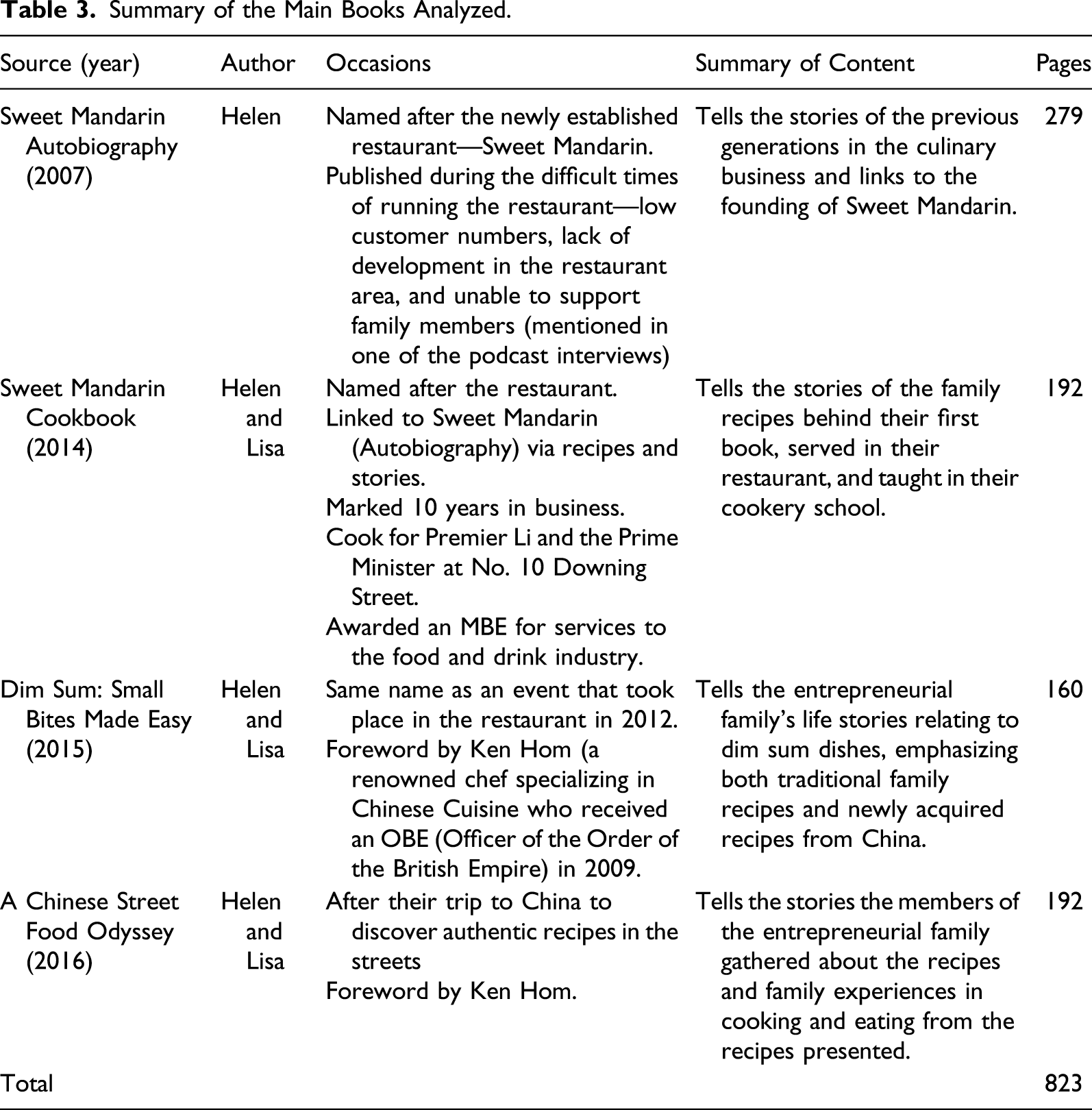
In addition, when we established our case timeline, we found that Sweet Mandarin’s publications (of life stories) are highly strategic (see Table 1). Lisa and Helen initially experienced difficulties after founding the restaurant in 2004. Helen then published an autobiographical account of the family history that became a Times Best Seller. Shortly thereafter, the business started gaining a reputation. Their subsequent publications—cookbooks—were more closely related to the business, combining the narrations of their own life stories. These cookbooks are also prestigious in their own right as written documents, with endorsements from celebrities. Indeed, one was nominated for the Gourmand award (the “Oscars” of cookbooks), while the other two also became Times Best Sellers.
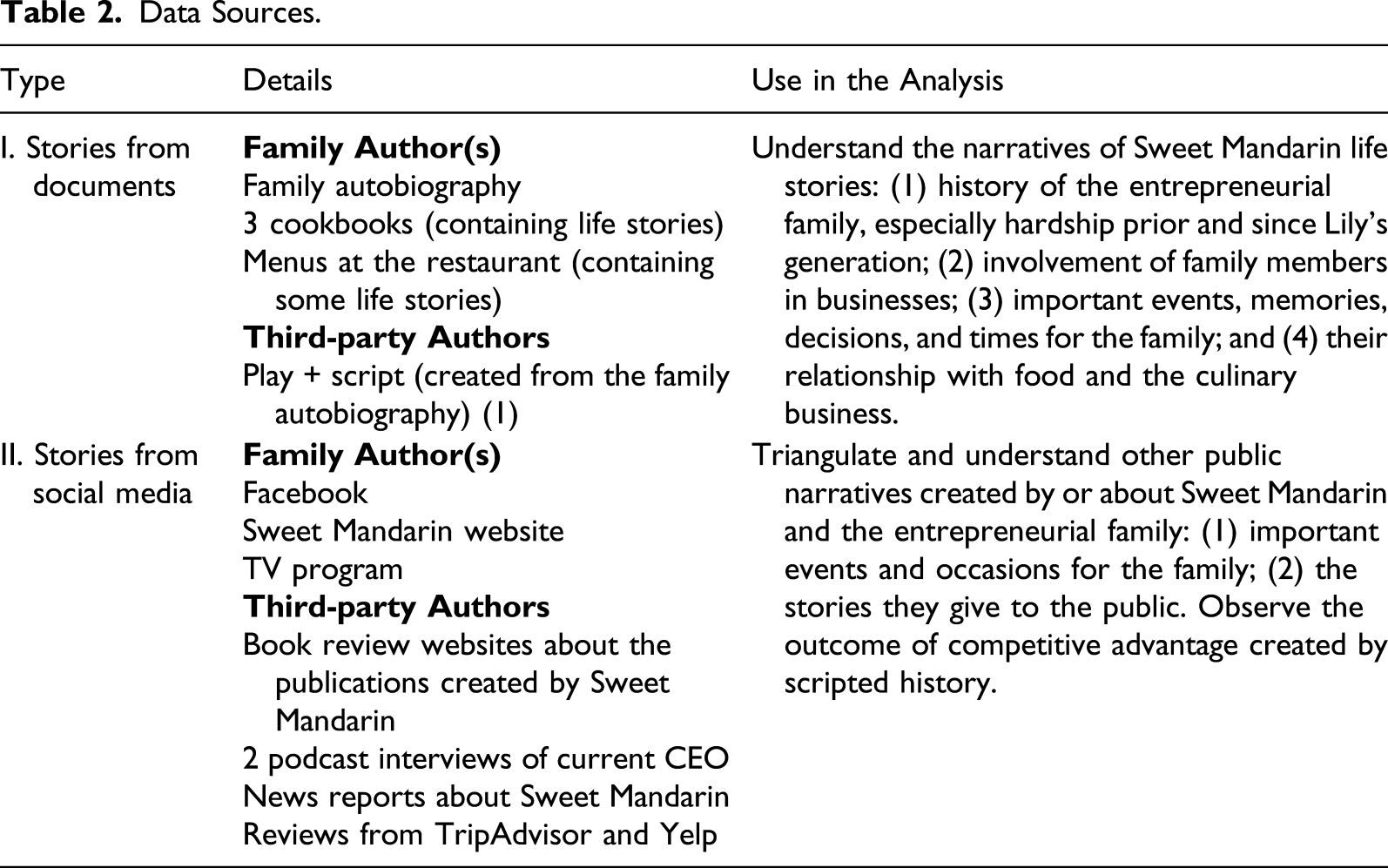
Data Sources.
Summary of the Main Books Analyzed.
Proxies of competitive advantage
To document the specific sources of competitive advantages attained by Sweet Mandarin through the use of the entrepreneurial family’s history, we focused on the main accomplishments observed throughout the case timeline (Table 1), drawing on multiple data from secondary sources to form a full account of the main drivers of superior performance and success. Through this process, we identified secondary data sources including Sweet Mandarin’s stories from social media (see Table 2), Sweet Mandarin’s financial data (from company house), customer feedback (from TripAdvisor and Yelp), and several other performance indicators.
Data Analysis
Our data analysis covered two stages. We paid particular attention to reflecting on matching the research question and data and went through several rounds of comparing and categorizing the concepts and themes (Grodal et al., 2020).
Stage 1. Case-focused data analysis
Our unit of analysis is the published Sweet Mandarin family life stories, coded at the paragraph level. In particular, our analysis focused on two main sources—the cookbooks and the family autobiography titled “Sweet Mandarin: The Courageous True Story of Three Generations of Chinese Women and Their Journey from East to West.” Autobiographies are a distinct source of retrospective sense-giving to past events, containing rich context “for the study of subjectivity, meaning, motivation and individual agency” (Maynes et al., 2012, p. 76). Smith (2014) deems family biographies an important source of family business stories. Although Helen calls it an autobiography, it is strictly speaking a combination of Helen’s narrated historical accounts of her grandmother and mother, and a short autobiography of Helen’s generation. These sources provided significant insights on the authors’ purpose (Morgan, 1996) in terms of story selection and presentation (Wadhwani et al., 2020). The cookbooks are more than recipes and instructions, as they include a collection of life stories of Helen and Lisa’s daily family life. The selectively presented stories highlight the authors’ agency in their narration, indicating the rhetorical nature of the texts.
We proceeded by actively categorizing the data with a focus on our research question (Grodal et al., 2020). To understand the purpose of Sweet Mandarin’s scripted history, we first read and then created a timeline to understand the interrelations among the family members and generations. We then started noticing recurring patterns of stories referring to specific time periods and/or social elements. This later led us to categorize the observed history scripting strategies based on the level of history referred to—institutional, firm, and individual.
In keeping with qualitative data analysis guidelines (De Massis & Kotlar, 2014; Grodal et al., 2020), we identified different strategies in writing the Sweet Mandarin life stories by coding each story first by its meaning (1st- and 2nd-order codes) and then its persuasive purposes (history scripting strategies). In this way, we were able to unpack the aims and goals of the family entrepreneurs in scripting their history. To code the meaning of telling the life stories, we re-read the life stories in each category to abstractly understand different themes (Bruner, 1991). We abstracted the general storylines for each level, for example, whether the story talks about different experiences related to the place of residence (e.g., China, Hong Kong, or the UK), which formed our 1st-order codes. Here, we positioned ourselves as loyal readers or targeted external stakeholders who come to know about Sweet Mandarin through the family’s life stories. We further abstracted our 1st-order codes into scripting tactics (2nd-order codes) to determine how these stories help customers understand and appreciate the business, thereby contributing to the competitive advantage of the family business. These scripting tactics show the ways the family life stories were scripted on a more abstract level. We believe these also hold practical implications as toolkits for family businesses seeking to script their histories.
Lastly, we developed a more abstract classification of categories (history scripting strategies) that capture the purpose of applying the different tactics at different levels, namely embedding, elaborating, and building family history. We then positioned ourselves as critical readers of the texts (Vaara & Lamberg, 2016) from a rhetorical history perspective to identify the authors’ purpose in telling these stories and how they differ in each level. These scripting tactics show the power of strategic narratives in promoting views (Vaara, 2010). Through this process, we captured their persuasive nature, interpreted their purpose, and elucidated how they ultimately allow creating competitive advantages (Suddaby et al., 2010), namely, sources of competitive advantage. Identifying specific competitive advantages associated with each history scripting strategy enabled us to develop our theoretical explanation for our research question.
Stage 2. Examining the inferential links between history scripting strategies and competitive advantage
Drawing on the multiple secondary data sources described in the data collection, guided by a rhetorical history perspective, our analysis of the case study provided us with a basis to establish inferential links between Sweet Mandarin’s scripted history and the family firm’s competitive advantages to understand the role that history scripting strategies played in creating these competitive advantages. We record these performance indicators as observed proxies of competitive advantages. Through this process, we were able to interpret and go beyond firm-level measures of (financial) performance commonly used as proxies of competitive advantage in business research (e.g., Maury, 2018). Furthermore, we obtained a fine-grained understanding of the specific advantages that Sweet Mandarin attained (e.g., customer trust and innovation through tradition) and their links to the family’s history. Overall, Sweet Mandarin’s financial data, customer feedback, and several other performance indicators allowed us to build inferential links between Sweet Mandarin’s strategic use of history and the competitive advantages attained over time, thereby providing the basis for our theory development.
Findings
Through reading the life stories in the autobiographies and cookbooks, we discovered a long, affective, and capable multi-generational entrepreneurial family in the culinary business that has its roots in China, and through generational efforts and endeavors, thrives in the UK. Helen and Lisa’s stories always connect family life with their family business, since “You cannot separate business and family in Chinese culture, one feeds into the other and they’re both dependent on each other” (Autobiography, p. 239).
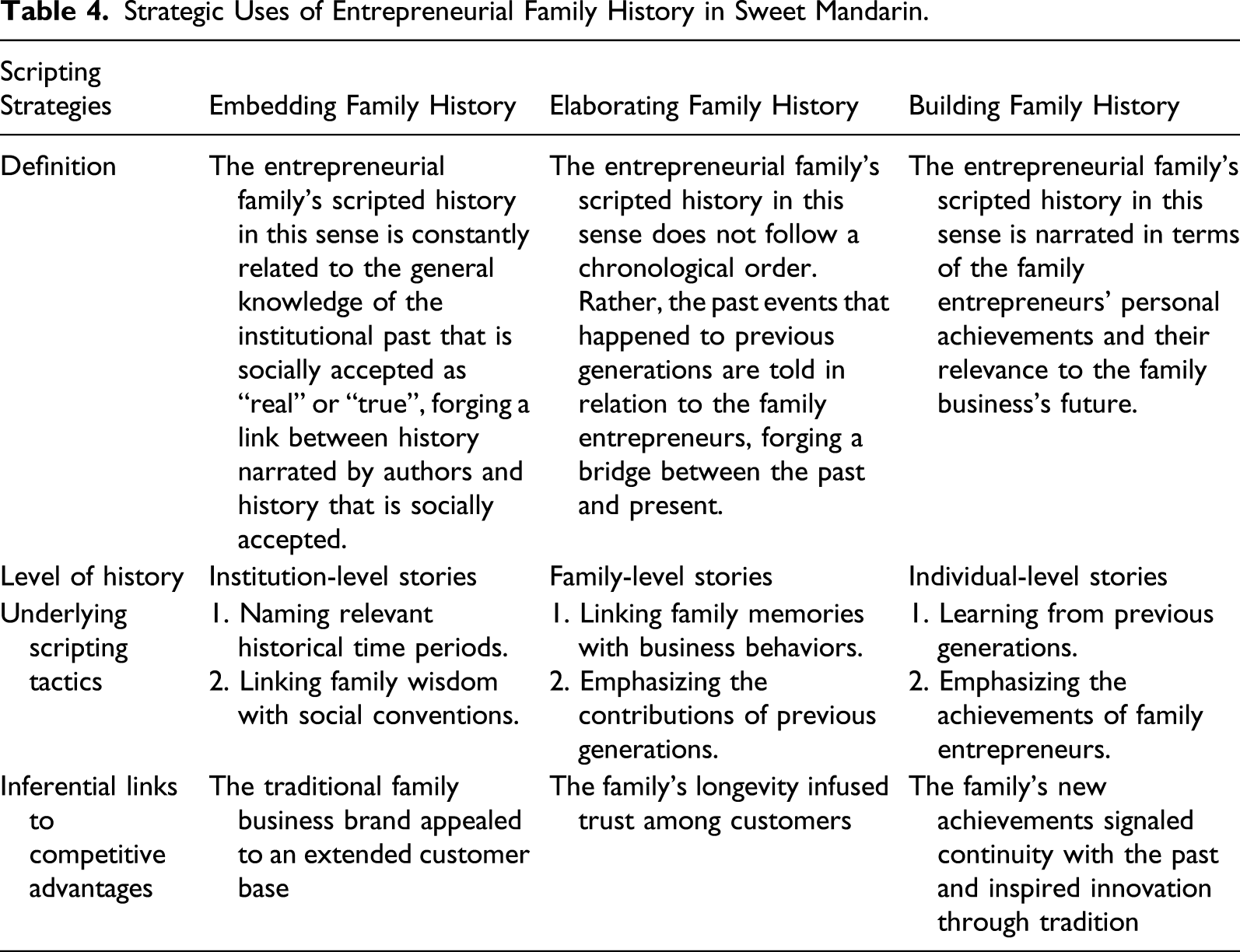
Strategic Uses of Entrepreneurial Family History in Sweet Mandarin.
Embedding Family History
The first strategic use of history we identified is embedding family history
The scripted history of the entrepreneurial family constantly relates to general knowledge of the institutional past that is socially accepted as “real” or “true,” forging a link between the history narrated by the authors and the history that is socially accepted. This scripting strategy allows the family business to become embedded in the communities of the entrepreneurial family’s generational past. In particular, two types of “real” historical and social accounts are recalled most frequently: historical events that influenced the family’s fate and social knowledge that the family could relate to. Through this, individual family members are re-contextualized and re-rooted in different communities—immigrants, Chinese (in Guangzhou, Hong Kong, and the UK), BBC (British born Chinese), and local British, creating a sense of affinity with readers from these communities and highly instrumental in ensuring the extended customer base’s acceptance of the restaurant. Indeed, the entrepreneurial family provides various reference points for the current generation family members to position their newly established family business.
Naming relevant historical time periods
These events embed the family business within the entrepreneurial family’s historical context. By combining the description of the historical time periods that are socially accepted as “true,” readers are more likely to believe in the rest of the stories, especially the entrepreneurial family members’ endeavor to make ends meet in those times. In these stories, Helen and Lisa adopt a formal writing style, presenting “historian-like” (historian-written) stories rather than in the form of a granddaughter re-narrating her life stories. For example, regarding the time when Lily migrated from China, Helen wrote: “By the end of the nineteenth century enough sailors had settled in London to form the original ‘Chinatown’ in the Limehouse district, huddled round the docks. Emigration to the north began in earnest in 1948, when the British Nationality Act gave New Commonwealth citizens the right to live and work in the U.K. Nearly 50,000 Chinese people came to the U.K. in the 1950s, usually gathering in the great ports of London, Cardiff, Liverpool and later, cities like Manchester.” (Autobiography, p. 181–182)
The details in the formal writing add to the truthfulness of the business and allow the family members to embed their business back into the entrepreneurial family’s history. Their family becomes part of the history, creating sympathy with two types of customers: those in communities that experienced the same historical events and those in communities that witnessed these times. Overall, creating such empathy in various groups of customers was key to the success of the family business.
Linking family wisdom with (Chinese) social conventions
Because the entrepreneurial family members are portrayed as multi-generational restaurateurs specializing in Chinese cooking, it is essential for them to demonstrate good knowledge of this cuisine. Helen and Lisa, through their cookbooks and autobiography, seek to demonstrate these connections. Knowledge of Chinese cooking is linked with the entrepreneurial family through stories transmitted over generations and stories directly learned via experiences.
The part of the entrepreneurial family’s wisdom that originated from China was passed on through stories related to cooking. For example, regarding the function of sesame seeds: “The secret ingredient was the sesame seed: ‘Just because they are small, don’t under estimate these’, she’d lecture, waving her fat finger at us. These sesame seeds can save lives - they are rich in minerals ... like zinc, iron, calcium and potassium - so be generous. Your mum needs an extra dose.’” (A Chinese Street Food Odyssey, p. 62)
This story contains three important messages: (1) sesame is a traditionally valued ingredient (the “dietary therapy” concept in the ancient Chinese philosophy of food); (2) taking care of the family is extremely important (the concept of how to treat the elderly in the Chinese philosophy of family relations); and (3) food plays an essential role in the Sweet Mandarin family (the concept of the importance of food in the Chinese philosophy of life). These types of stories and wisdom in cooking are used many times in the autobiography and cookbooks, creating links between the business and its origin—Chinese cooking. These scripted histories pass on messages and information that are key to reinforce a sense of affinity with the communities that share these values.
Elaborating Family History
The second strategic use of history we identified is elaborating family history. Scripted history in this sense does not follow a chronological order. Rather, the past events that the previous generations experienced are told in relation to the present generations, forging a bridge between the past and the present. This strategy allows the family business to extend its roots to a more distant abstract past, highlighting its longer heritage from previous generations. History is elaborated via two tactics: linking past memories with present behaviors and emphasizing the contributions of previous generations. This use of history—strategically extending the horizontal history of Sweet Mandarin’s entrepreneurial family—creates a sense of longevity, which serves as a distinctive source of competitive advantage in an industry characterized by very short business life cycles. Sweet Mandarin was established by the third generation who did not inherit a family restaurant spanning three generations. Therefore, having an elaborated history that extends its past created a competitive advantage for Sweet Mandarin, helping to distinguish it from other newly established Chinese restaurants. Moreover, the entrepreneurial family’s existence provides details of the family’s business lives, allowing it to display its generational heritage.
Linking family memories with business behaviors
Using this rhetorical tactic, Helen and Lisa lead readers to revisit the entrepreneurial family members’ past in their historical context, and by relating these to themselves, they show the links between the past and present generations, especially in relation to their businesses—the sauces and restaurant. These stories are completed with the reconstruction of rich details of the past linked to the present.
For example, all the chapters in the autobiography have food-related titles, and where possible, these stories are included in the menu in the Sweet Mandarin restaurant. For example, Chapter 6 “[Lily’s] Chicken Curry – Somerset and Manchester, UK 1950s” tells the stories of Lily starting her restaurant and how her signature dish (chicken curry) was created, Chapter 7 “Claypot Chicken – Manchester 1959–1974” describes Mabel’s journey to the west and how claypot chicken relates to Mabel’s experience. Through retelling the past generation’s life stories behind the recipes, readers can relate to Sweet Mandarin on a personal level: “This book lives and breathes our family’s culinary tale and we hope that one day our paths may cross at Sweet Mandarin in Manchester, UK. We promise that you’ll be enveloped by the sights and smells of a wonderful Chinese restaurant and enjoy totally unique dishes like Lily’s curry and Mabel’s clay pot chicken.” (Sweet Mandarin Cookbook, preface)
Emphasizing the contributions of previous generations
In many stories, Helen and Lisa present the previous generations’ achievements as the entrepreneurial family’s key heritage. Working in the culinary business is portrayed as both their fate and the talent in the bloodline.
Lily (the grandmother) came to the UK from Hong Kong and started working as a maid to support her family. She then worked her way into the kitchen and gained recognition as an excellent cook. On perfecting her cooking skills, she set up one of the first Chinese restaurants in the UK. The story of Lily’s signature dish is repeatedly told in the books and features on the menus: “Our grandmother (…) came to the UK in the 1950s. The ship took 35 days to sail from Hong Kong to Liverpool, taking in Singapore, Penang, Ceylon, Bombay, the Suez Canal, Gibraltar, and Southampton along the way. It was on this journey that Lily perfected her curry recipes, which wooed the local community in Manchester on her arrival. Elements of the dish were learned in Singapore, where Lily stopped off to visit her sister (who had relocated there with her husband) and the secret blend of spices was perfected in Bombay.” (Sweet Mandarin Cookbook, p. 147)
Mabel (second generation) was brought to the UK in her teens. She sought refuge in the family-owned restaurant on experiencing racism and bullying at school. Mabel was instrumental in instilling many Chinese traditions in Helen and Lisa. Many of Mabel’s lessons to her daughters used food metaphors: “This is one of our sweetest childhood memories. We were not good at waking up and tried to sleep for as long as we could – so much so that one night we wore our school uniforms (ties included) to bed so we could just get up and go. When Mum found out, she shook her head and taught us we couldn’t take shortcuts in life: anything worthwhile would take time and patience. She used a dish as an example. The custard was smooth and sweet, perfect every time. One day, while we were eating, she demonstrated how it would be if made in haste – and it was bobbly, rough and unappetizing. After that day, we tried our best to get up in time to dress properly rather than rushing. I confess I still find it hard to wake up early, but when I eat this dish I remember us standing there in our crumpled uniforms with mum shaking her head. This dish is dedicated to our mum.” (A Chinese Street Food Odyssey, p. 156)
In sum, by endorsing the contributions of the previous generation, Helen and Lisa strategically backdated their business and business acumen from 2004 to 1950, creating a sense of longevity that transcended their own experiences.
Building Family History
The third strategic use of history we identified is building family history. Scripted history is narrated in terms of the family entrepreneurs’ personal achievements and their relevance to the family business’s future. This strategy complements the previous two by emphasizing the credentials of the family business’s entrepreneurs. It involves telling stories of the family entrepreneurs to confirm and highlight the entrepreneurial family’s influence—their expertise in the culinary business, their devotion, and their personal stances on the dishes and the restaurant—to advance the business. Compared to the elaborating family history strategy where stories about previous generations are told to provide a longitudinal view of the entrepreneurial family’s presence in the business, creating a sense of longevity, building family history focuses on the family entrepreneurs to provide a heightened view of their individual contributions, signaling continuity with the past while inspiring innovation. In particular, two tactics are used when retelling the stories: learning from previous generations (sources of past knowledge) and personal endorsements of their own achievements (sources of future direction). The presence of the entrepreneurial family, especially the family entrepreneurs as owner-managers, provides various points of personalization for the business, distinguishing it both from non-family and other family businesses.
Learning from previous generations
Helen and Lisa explain in detail how their culinary knowledge evolved. They emphasize their embedded learning from previous generations while they grew up and describe the past with commentary or comparisons (between the past and the present), which adds emotions to history and leads readers to a point when the past and present generations are presented at the same time in the story. Moreover, these sections are appealing to readers, as the authors themselves rediscover past events together with the reader. These scripted histories emphasize the personal element of the business by reconstructing empathy between the entrepreneurial family’s generations. For example, Mabel’s nostalgia for home emerges clearly when retelling her stories about settling in the UK to start helping Lily with her restaurant business, Helen added: “Once I wondered out loud if … the 1960s was all that much worse than the slums of Wan Chai, aside from the weather. She [Mabel] paused for a moment then explained, ‘I didn’t think England would look like this. I thought all the English people were millionaires… ‘I got that wrong.’ Sometimes I think she has never really settled here.” (Autobiography, p. 205)
This brings a level of warm-heartedness and empathy into the business from the previous generation’s decisions. Personal stories such as these can also help legitimize the business’s origin and the family entrepreneurs’ ethos. For example, through their stories, Helen subtly unpacked the reasoning for leaving their successful jobs and returning to the family business. “I was taught a great deal of what it is to be a Chinese woman in the kitchen at my mother and grandmother’s sides. Cooking is at the heart of the Chinese family and for a Chinese woman it is at the very core of her identity” (Autobiography, p. 269). And quoting a famous Chinese proverb: “Each generation will reap what the previous generation has sown” (Autobiography, p. 263).
To show that different generations have similar experiences, the links between the past and present are repeatedly highlighted with leaps through time, from past to similar, more current experiences. For example, following the description of the ritual of Tai Chi in Lily’s time, she “was always amazed at the beauty and grace of the movements as the whole group shifted as one…” (Autobiography, p. 37). Helen mentioned that she took Tai Chi when she was in Hong Kong and compared their encounters with Tai Chi. This occurred shortly before the sisters decided on opening a restaurant following in the previous generations’ footsteps. The purpose is to make the links between the entrepreneurial family’s past and present generations explicit, taking stock of the previous generations’ intangible resources, such as knowledge of the industry.
Emphasizing the achievements of family entrepreneurs
In these stories, Lisa and Helen highlight their own achievements, including personal takes of the business, accreditation from people of importance, and endorsements from masters of the line of business. This use of scripted history is essential, as it shows how they will carry on from this point forward. Not only did Helen and Lisa achieve recognition during their time in the business, they also became competent family business leaders setting the next steps for Sweet Mandarin: “We served these dumplings during the cook-off stages of the F-Word Best Local Chinese Restaurant competition with Gordon Ramsay in 2009. We beat 10,000 other Chinese restaurants to be crowned the winner of Best Local Chinese Restaurant in the UK.” (Dim Sum, p. 44)
In short, the extent of their personal experiences distinguishes them from previous generations, while the breadth of the contributions from the previous generations distinguishes them from other Chinese restaurants in the market. As the current entrepreneurs in the business, it is important to build credibility for their present and future business endeavors. Emphasizing their achievements is therefore a source of credibility. Since then, they have undertaken many new business activities including publishing books, producing a range of sauces, amongst others (for further examples and evidence on the strategic use of history see Supplementary Table 5 in the supplemental document that is available online).
Linking Scripted History and Sources of Competitive Advantage
In our study, we found that the history scripting strategies that Helen and Lisa adopted leveraged the family’s entrepreneurial history to build several tangible sources of competitive advantage, that added to the quality of the family business’ products and service in a way that enabled superior growth and performance compared to other competitors, as shown in the Sweet Mandarin Timeline (Table 1). The main strategic outcomes achieved are a clear indication that Sweet Mandarin stood out among the numerous competitors (Chinese restaurants), many of which provide likewise excellent food and service. Compared to the UK national statistics indicating that restaurants have on average a life span of 5 years, and 90% fail within the first year of operations, building a long-lived restaurant that has grown and thrived for more than 16 years, receiving public recognition such as the four award-wining books (family bio/autobiography and three cookbooks), participation in three TV show (Gordon Ramsey’s The ‘F’ Word, Dragon’s Den, and The Best of British Takeaways), and the creation of an innovative gluten-free sauce factory can all be viewed as observable proxies of competitive advantage vis-à-vis the competitors. At the personal level, Lisa and Helen were awarded the title of Member of the Order of the British Empire (MBEs), invited to cook for the Chinese Prime Minister at the official residence of the British Prime Minister (No. 10 Downing Street), and created a successful theater play on their history (Mountains: The Dreams of Lily Kwok, UK’s first major mid-scale tour of a British East Asian play). The attainment of sustained competitive advantages was ultimately reflected in the family business’ financial data that show a sustained stream of profits and positive cash flow: the profits have been positive since 2010 (£5554) and on a steady increase until 2018 (£129,289). Moreover, the profits were constantly reinvested in the business, generating a compound annual growth rate of current assets of 60% from 2005 to 2018, a remarkable trend in a mature industry such as the restaurant business. Overall, these data provide a strong indication that the business has been very profitable, well above average industry levels, since 2010.
In addition to documenting the continued success of Sweet Mandarin that underscores the remarkable performance over a 16-year period, our data provide further insights that help clarify the links between the family history, the history scripting strategies used, and the competitive advantages that Sweet Mandarin attained. Figure 1 provides an overview of these links and illustrates the role, inferred from our data, that the observed history scripting strategies have played in turning the family history into important sources of competitive advantage for the family business. Scripted history strategies and competitive advantages: Data structure and theoretical model.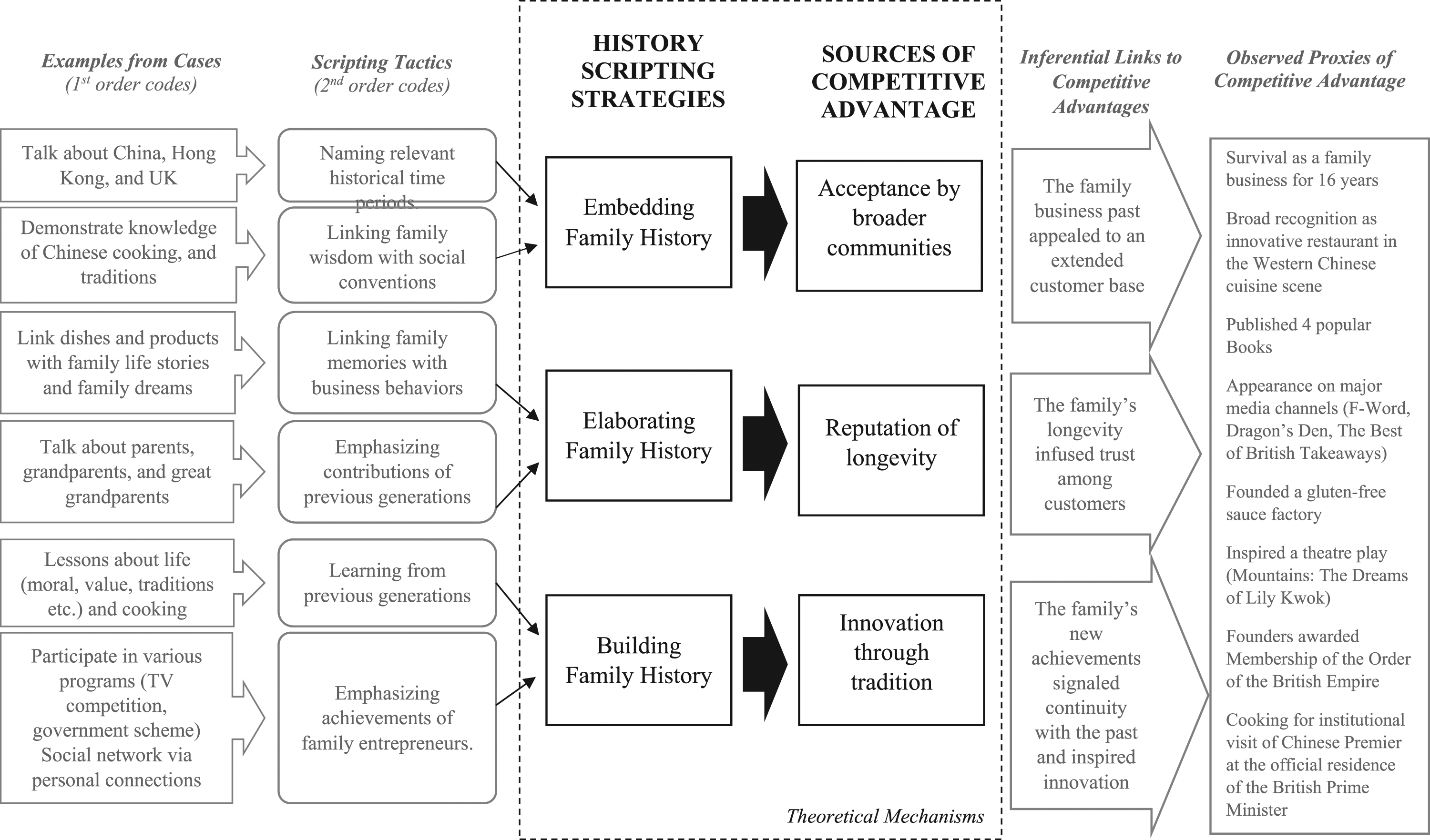
Despite the publishing of the auto/biography and being increasingly known for the good food and service, Sweet Mandarin became famous when it won its first award for “the Best Local Chinese Restaurant” on The ‘F’ Word (2009). Lisa described 7 it as a period of really hard time with little businesses: “2004 to 2009—so about five years later was when we broke through big-time.” This is also reflected in their Profit and Loss account as the figure turned positive from 2010. Gordon Ramsey’s endorsement is seen as the highest compliment for UK restaurateurs. When giving the reason for choosing Sweet Mandarin out of 10,000 other Chinese restaurants in the UK, Jean Baptiste (one of the judges) said “I think this is really what will bring this place altogether, the fact it is a family-run business, the fact we can see the passion behind and all the drive, to provide such a good experience for the customers.” It is thus clear that the entrepreneurial family’s history behind Sweet Mandarin played a key role, besides good food and services. After the episode was aired, Sweet Mandarin became a landmark for locals and attracted many visitors to Manchester. Examining customer feedback, 95 out of 778 reviews on TripAdvisor, and 13 out of 33 reviews on Yelps specifically mention Gordon Ramsey’s The ‘F’ Word. One reviewer commented “Good enough for Gordon Ramsey, good enough for me,” indicating strong customer trust; another reviewer noted in 2010 that the restaurant is “A very busy local restaurant, you will need to book—it is busy and crowded.” 8
On Dragon’s Den in 2011 where Lisa and Helen secured a £50,000 investment, Helen started her pitch with “Dragons, let me introduce you to my grandmother Lily Kwok. She set up one of the first Chinese restaurants in Manchester where she served these wonderful sauces and we still serve them today at Sweet Mandarin. Lisa is so proud of these sauces, as the head chef, that she even put her face on them.” 9 This historical link was highly important as it enabled the business to signal innovation within tradition, enabling the business to go beyond the original industry and supply sauces to supermarkets (e.g., Sainsbury’s and Wing Yip—a large Chinese grocery chain in the UK—ordered 50 cases of the sauces per week before the program) with a £250,000 profit. This outcome highlights that embedding family history is key to ensuring broader customer reach beyond the traditional Chinese restaurant industry, creating customer trust, and innovating in original and unexpected ways by leveraging the family’s idiosyncratic tradition. According to a podcast interview, Buckingham Palace also placed orders for the sauce. In 2013, Lisa was among the 120 business delegations that visited China with David Cameron. The BBC covered this event commenting that, interestingly, the business was successful in selling Chinese sauces produced in the UK to China, emphasizing the history of Sweet Mandarin.
The most recent example of the scripted history of Sweet Mandarin, which created a wide-acceptance by a broader audience, is shown in the “Mountains,” a theater play in 2017 which was adapted from Helen’s family auto/biography by award-winning playwright In-Sook Chappell, and co-produced by Yellow Earth Theatre, known for showing British Asian culture. As the UK’s first major mid-scale tour of a British East Asian play, it toured 11 cities, including Manchester, Stratford, Suffolk, Poole, Peterborough, Margate, Derby, Watford, Sheffield, Northumberland, and Coventry. When it was first performed in Manchester, Helen and Lisa hosted street food stalls in the foyer post-show, also selling Sweet Mandarin merchandise, including the books. One of the authors attended the play in Coventry where the theater was full, and most members of the audience bought the script. It was noted that the majority of the audience was western. A few audience members even wept during the show. On chatting with the audience during the break and after the play, many expressed a strong interest in the restaurant especially due to the unique history behind it.
The entrepreneurial family’s history has been repeatedly narrated in different forms and disseminated through various media: books, TV-shows, news, and the play. From numerous visits to Sweet Mandarin, it was clear that, in addition to the quality of the food and services, the business put much emphasis on telling the entrepreneurial family history, with several artifacts narrating the generational efforts (and challenges) and stories of the family business across generations, for example, the menus where the recipes are presented along with historical narrations featuring past generation family members. This evidence supports our argument that even though good food and service provide a foundation for the competitive advantage, the scripting strategies differentiated Sweet Mandarin by adding values and emotions that captured the interest and imagination of the customers.
Discussion
Our findings have a number of implications that advance our understanding of the strategic use of history in family business, informing both theory and practice. First, our empirical observations offer an opportunity to theorize the role of history as a source of competitive advantage in family firms by highlighting the role of history scripting strategies as an important mechanism explaining how and why Sweet Mandarin is successful in attaining significant strategic benefits from their history. Second, our findings have practical implications that can inspire and guide family firms to appreciate and leverage the strategic value of history to enhance and sustain business performance over time.
Scripted History and Competitive Advantage in Family Businesses
The core insight of our study is that the strategic use of the entrepreneurial family’s history can create concrete sources of competitive advantage for family businesses. We define this type of strategic use of history as scripted history: the strategic narrations of the entrepreneurial family’s history, persuasive in nature and targeted at external stakeholders. Based on our analysis and interpretation, we theorize how and why the use of scripted history can be an important mechanism for competitive advantage in family firms. Specifically, our study suggests that a deep understanding of the value of history as a strategic resource for family businesses can be achieved through interpreting the scripted histories, which requires acknowledging their retrospective agency (Kipping & Üsdiken, 2014), and the active interpretation of the narrators’ purpose (Suddaby et al., 2020). From our case, we infer new theoretical insights that help explain how the entrepreneurial family’s history and the different scripting strategies used concurred to create distinctive and sustainable sources of competitive advantage for Sweet Mandarin. Thus, we advance the idea that scripted history can play a key part in strategy-making appropriated from the social-historical context (Vaara & Lamberg, 2016). Foster et al. (2017) point out that historical narratives can have a strategic use in attracting new customers. Our study adds to this idea by documenting and theorizing specific mechanisms, namely history scripting strategies, that enable qualifying the narratives and understanding them within the organization’s social context.
In addition, building on the family-embeddedness perspective (Aldrich & Cliff, 2003), our study reveals that history is an important yet largely overlooked strategic resource embedded in, and available to, an entrepreneurial family, whose benefits extend across generations and businesses. Our findings show that an entrepreneurial family’s history can play a key role in creating competitive advantages, even in a newly founded business led by family members. In this respect, our study highlights the role of family ties, and more importantly, family history, as a distinctive source of competitiveness for a family business (e.g., Bird & Zellweger, 2018; Steier, 2007). Moreover, our findings suggest that these benefits are sticky, hard to imitate or substitute by other competitors, giving rise to sustained advantages over time (in our case, at least 16 years of operation, a remarkable result in the restaurant industry). In this regard, the history scripting strategies documented in our study provide an important contribution to the current understanding of how family firms can create distinctive competitive advantages that are sustainable over time.
Embedding Family History
Through embedding family history, Sweet Mandarin forged a link between the family’s history narrated by the family entrepreneurs and the history that is socially accepted. In so doing, the family created a social background to their business that allowed building affinity with various communities, attracting new customers beyond the conventional Chinese restaurant industry.
Our findings suggest that this history scripting strategy helped Sweet Mandarin obtain social recognition from a broader audience, for example, the endorsement from Gordon Ramsey as “the best local Chinese restaurant.” This aligns with the notion that a business can become the site of memory enabling social remembering of the past (Rowlinson et al., 2010). Ravasi et al. (2018), for example, find that established organizations use corporate museums to attract broader communities and link the business to their personal experience(s). On the other hand, businesses, especially newcomers, can gain community acceptance by linking and exploring institutional qualities (e.g., Marie Cappelen & Strandgaard Pedersen, 2020; Oertel & Thommes, 2018).
In our study, we observed that embedding family history revolves around the role of family members in past events and different socio-historical contexts connecting them with wider communities. Through embedding family history, Lisa and Helen created and extended this sense of affinity to other less related communities—the local British community, for example—by strategically embedding the family’s story in the socio-historical past and thereby linking it to the history of a broader community. Also, embedding family history enabled accessing new communities, for example, customers who (had families that) used to dine at Lily’s restaurant. Therefore, through embedding family history, the family business created a sense of affinity and was thereby accepted in broader communities, above and beyond traditional Chinese cuisine lovers. These observations also suggest that Sweet Mandarin benefited from having “family-members-as-actors” in the entrepreneurial family’s history. Potential customers—who have their own family members, shared history, and become aware of this past—may empathize with this aspect of the family business in a way that would not be possible with a non-family business not embedded in the broader entrepreneurial family’s history. Overall, this has been key to distinguishing Sweet Mandarin from stereotypical Chinese restaurants, and allowed considerably expanding the customer base.
Elaborating Family History
Sweet Mandarin also created competitive advantages by narrating a longer history of the entrepreneurial family beyond the current business. This strategy mainly uses family-level stories to build connections between the past, present, and future, thus building reputation and gaining trust from customers. New businesses often face the challenge of legitimacy as part of an (often established) industry, and the need to familiarize and develop ties with customers (Stinchcombe, 1965). Customers are more attracted to businesses with a past (Foster et al., 2017). Indeed, prior research suggests that established businesses often use elaborating family history to rediscover and reinterpret their past to build customer trust.
In our study, we observed that scripted history is used to represent the heritage of previous generations to build trust with current and potential customers. In Sweet Mandarin, Lisa and Helen created an elaborated history by scripting the family’s past entrepreneurial efforts and accomplishments. They present an elaborated history that includes thick descriptions of familial behaviors in the past related to the present business(es), extending the past and heritage of the new family business. By demonstrating the generational efforts and early involvement of the entrepreneurial family in the business, the family members depict an extended past long before the business was established. This creates customers’ perception of Sweet Mandarin as a three-generation business rather than a new business established in 2004. These observations suggest that Sweet Mandarin (and other family businesses with a multi-generational history) benefit from having an entrepreneurial family history with a heritage—the business passed down from generation to generation—perceived as valuable by customers.
Our findings suggest that through their histories, entrepreneurial families provide a family business with various forms of recognition and social ties (Miller et al., 2016). These findings resonate with prior research indicating that family status in business branding attracts the loyalty and trust of customers (Astrachan et al., 2019). Our study illustrates that this value can be captured through the elaborating family history scripting strategy, which provides a sense of business longevity that ultimately gives the family business a past. This has led to a competitive advantage for Sweet Mandarin, allowing it to overcome the liability of newness, and be instead perceived as a long-standing and experienced (rather than new) business. Scripted history thus creates a reputation of longevity, which in turn enables building customer trust, thus contributing to Sweet Mandarin’s competitive advantage.
Building Family History
Finally, our findings suggest that through building family history, Sweet Mandarin wrote a new chapter of the family’s history in which the family entrepreneurs take prominence, thus enabling a balance between tradition and innovation. This strategy mainly uses individual-level stories to build the credibility of the family entrepreneurs. Tradition, from a rhetorical history perspective, can be an enabling tool to link the past with the present and future (Suddaby & Jaskiewicz, 2020). Our study suggests that such tradition is highly salient because it provides the family entrepreneurs with a point of departure between the past and the present (and future), enabling what we refer to as innovation through tradition. Sweet Mandarin created a sense of distinctiveness compared to competitors, but at the same time, was perceived as credible in the eyes of customers. In other words, scripting history contributed to creating a sense of optimal distinctiveness (Zhao et al., 2017), distinguishing the business from other Chinese restaurants in the market and bringing to the fore their personal credentials and abilities to create a sense of business longevity (and hence, mastery). Some scholars have emphasized family firms’ ability to leverage tradition to innovate (De Massis et al., 2016). Based on our findings, we conclude that innovation within tradition provided Sweet Mandarin clear advantages in maintaining a level of newness and modernity for the present and the future while capturing value from the past (e.g., Erdogan et al., 2020). Indeed, it is remarkable that Sweet Mandarin—a young family business—adopted several innovative ways to deal with tradition: maintaining a high public profile in books, television shows, podcasts, competitions, and new dishes specifically developed from traditional recipes in the family’s history. Overall, these efforts allow customers to appreciate Sweet Mandarin as a distinctive family firm.
Building family history allowed Lisa and Helen to establish their own legitimacy as leaders of the family business, thereby taking ownership of the family history. In family businesses, previous generations often cast a long shadow over the coming generation, making it challenging to legitimize and establish an image of their own (Dalpiaz et al., 2014). Discursive strategies are found to be especially useful in dealing with and redirecting strategies (Sasaki et al., 2020; Sinha et al., 2020). Moreover, entrepreneurs use this type of narration to change the story focus to fit with the needs of successive generations in family businesses (Smith, 2018). In our study, scripted history enabled Lisa and Helen to not only relate to the past but also strategically envision the present and future by legitimizing themselves as competent leaders, taking ownership of the past, and providing a lead for future development, thereby becoming an integral part of the living history of Sweet Mandarin.
In sum, this history scripting strategy highlights the family entrepreneurs’ expertise and devotion to the business, allowing the current entrepreneurs to open new chapters and create a strong link between their personal family history and the family business. In so doing, they legitimized their decision-making capabilities, especially concerning innovation and change, and their ability to take the business forward (De Massis et al., 2019; Kotlar & Chrisman, 2019). Thus, the emphasis on innovation within the family’s tradition created through scripted history made Sweet Mandarin’s products hard to imitate by competitors who do not share the same history, thus constituting a distinctive source of competitive advantage.
Theoretical Implications and Contributions
Our research has explored an especially interesting case of a family business established by the family members but rooted in an extended entrepreneurial family’s history, providing a valuable opportunity to study how and why an entrepreneurial family’s history can serve as a resource to create competitive advantages. Therefore, our study opens new avenues for understanding the “how” and “why” underpinning the strategic use of history in family business. Specifically, our findings establish the importance of recognizing the role history played in the path-dependence and continuity of entrepreneurship beyond the boundaries of one specific family business and across generations. It suggests that taking the family as a unit of analysis (Handler, 1989) is very promising in this regard, especially when combined with a historical perspective, thus opening up many research opportunities to study entrepreneurial phenomena as they unfold across generations and businesses over time. Our study suggests that scripted history (i.e., strategic narrations of the family’s history) can be an effective strategy for family businesses to leverage their entrepreneurial heritage and overcome their inherent liabilities (Miller et al., 2016).
These insights offer two important contributions to the literature. First, we advance knowledge on the role of history in current theory and research on strategy and entrepreneurship in family firms (e.g., Colli, 2012; Sasaki et al., 2020; Zellweger et al., 2012). We advance this growing literature with new insights on how family firms can skillfully use their history through documenting and explaining how and why specific scripting strategies—namely, embedding, elaborating, and building family history—have important and distinct effects on the family firm’s competitive advantage, specifically, fostering acceptance by broader communities, building reputation and customer trust, and innovating through tradition. These outcomes were instrumental for Sweet Mandarin to appeal to broader communities, instill trust, and present itself as an innovative company within an established tradition (Chinese cuisine).
While we observed that each history scripting strategy provides these sources of competitive advantage, leading to remarkable and sustainable performance over time, we also note that each strategy enables and reinforces the others. For example, creating connections with diverse communities through embedding family history is reinforced by elaborating family history, which allows customers to understand and trust the family business. Likewise, building family history allows the family entrepreneurs to benefit from the entrepreneurial family’s history while also highlighting its own innovativeness, thereby overcoming the risk of being shadowed by the previous generations’ entrepreneurial track record (e.g., Davis & Harveston, 1999).
Even if we cannot conclude from our single case study that these are the only strategic uses of history linked to competitive advantages, the three strategies observed in our exploratory research appear analytically generalizable (e.g., Eisenhardt, 1989) to other family businesses, and therefore contribute important—albeit initial—insights on this topic. As the three strategies observed in our study act upon histories defined at different levels—institutional, family, and individual—and complement each other, they jointly outline a systematic use of history in family businesses that emphasizes the socio-historical past (embedding family history), the previous generations’ entrepreneurial efforts (elaborating family history), and family entrepreneurs’ credentials and visions (building family history). These insights inform the broader question of how and why history can be a source of competitive advantage in family firms, and act as a springboard to take history into greater account in existing family entrepreneurship theory as it unfolds over time and generations.
Second, our study extends prior research focused on internal uses of history as a way to encourage entrepreneurial behavior or manage strategic change in family firms (e.g., Jaskiewicz et al., 2015; Sasaki et al., 2020). A history-informed understanding of the mechanisms through which family entrepreneurs can use history externally provides the means to create sources of competitive advantage specifically centered on customer perceptions of the business and its products. While family business research has started paying attention to history, existing studies seldom distinguish between internal and external uses of history, in other words, whether the stories were scripted for internal or external use, and for what purposes. For example, through their in-depth qualitative research of the narratives of Alessi, Dalpiaz et al. (2014, 2018) find they are used strategically to legitimize succession processes and facilitate the acceptance of the new family leader. Our research extends these findings by highlighting that members of an entrepreneurial family can also use their family’s history externally to legitimize themselves and build trust among customers. The rhetorical approach used in our analysis highlights scripted history as an important concept that allows a better understanding of the persuasive nature of stories bearing the agency of their authors to the target audience. Such subjectivity is less noted in the current family business literature. Based on our findings, we argue that embracing the potential of history in family business requires rigorous evaluation of the objectives of those who narrate histories and the target of these stories (see Suddaby et al., 2010; Wadhwani et al., 2020).
Based on our findings, a joint examination of internal and external uses of history emerges as an important direction for future research. To obtain high-quality qualitative data on family businesses, researchers have been repeatedly encouraged to become accepted into the family to become privy to inside stories (Handler, 1989). Our study suggests that such endeavors will benefit greatly from making use of externally-oriented documents, texts, and communications. Therefore, we advocate a methodological advancement in family business research by revealing the valuable insights that can be generated from autobiographies and different forms of documentation. While the use of documentation is widely accepted in the social sciences where research on life stories originated (Harrison, 2009), it is still too rare in family business research. This would be beneficial from both a theoretical—texts are often regarded as an important material extension of rhetoric (Ravasi et al., 2018; Wadhwani et al., 2020)—and a practical perspective—life stories in the form of auto/biographies are commonly used by family businesses. Documentation provides a deeper epistemological reflection and is an important form of narrative. While a better understanding of history requires researchers to go further back in time, reviewing all types of documentation, a family-centric view of the business leads to life story narratives, most popularly in the form of autobiographies. As narrative discourses (Vaara, 2010), autobiographies can indicate important family issues, such as conflicts.
For example, our findings on the strategic uses of history and consequences on competitive advantage, combined with prior research documenting competing stories being told about the same family business (e.g., Hjorth & Dawson, 2016), raise the question of how similar and different history scripting strategies might coexist and interact in shaping internal decision-making processes, external stakeholder perceptions and appraisals. More broadly, we believe that future family business research will benefit greatly from embracing more critical “historical consciousness” (Suddaby, 2016) when studying entrepreneurial families in relation to both internal and external audiences, thereby advancing our understanding of how history can contribute to the creation of a transgenerational entrepreneurial legacy (Jaskiewicz et al., 2015), sustaining innovation (Kammerlander et al., 2015), and managing strategic change (Sasaki et al., 2020), amongst other behaviors and outcomes.
In addition, while much of our discussion focuses on the implications of scripted history for family business research, the concept of scripted history, and specifically the way it is used in family business contexts, has broader implications for rhetorical history in organization studies. For example, the scripting strategy embedding family history extends the concept of “re-membering” (Suddaby et al., 2016) in rhetorical history, that is “the process by which actors use both rhetoric and history to socially construct membership with an organization” (p. 298). Scripted history is important as it emphasizes the breadth of history that can be used as scripting material, ranging from the personal and the family’s past to institutional stories. More broadly, while our findings thus unpack distinctive sources of competitive advantage associated with using scripted history in a family firm, future research could productively apply these insights in other contexts, possibly expanding the scope of history scripting strategies observed in our study, as well as the range of related competitive outcomes.
Practical Implications
Our research encourages entrepreneurial families and family business to be aware of the role that history can play in creating competitive advantages, and specifically the role of history scripting strategies to attain sustainable advantages, vis-à-vis competitors. Against the general perception that the origin of a business is when it was first registered, family businesses can use scripted history to backdate. Family entrepreneurs striving for a longer (and richer) history can explain and combine their entrepreneurial family’s history using a well-designed scripting strategy. Moreover, as family business owners and leaders are often torn between tradition and innovation, and between the previous generation’s vision and the new leaders’ direction (Suddaby & Jaskiewicz, 2020), the uses of scripted history that we have identified offer a practical way to balance both sides. In an era when storytelling is increasingly recognized as a key activity in corporate practice, our study’s findings provide practitioners with indications on how retold histories of the entrepreneurial family can be strategically leveraged across generations in external communications to achieve competitive advantage. In sum, our findings, especially regarding the level of stories and scripting tactics, provide practical toolkits for practitioners interested in exploring ways to use scripted history.
Limitations and Future Research Directions
While we believe that this study takes a step forward, we see multiple ways to develop this research line. First, we analyzed the scripted history of one entrepreneurial family business. While the observed strategies and tactics might have general applicability, we recognize the need for future work to enrich and corroborate our findings. For instance, we encourage future scholars to examine more diverse cases of family businesses and ideally conduct large-scale studies to extend our emerging theory with a greater appreciation of family firms’ heterogeneity and the ensuing diversity in their uses of history. Drawing on our approach, these studies could focus on different types of family firms, including entrepreneurial families, established family businesses, business families more broadly, and non-family organizations, and compare the evidence emerging from different settings.
Moreover, we believe that the use of documentary data is important and still underdeveloped in the family business and entrepreneurship fields. Indeed, non-traditional texts (e.g., social media posts) might be useful to capture histories and narrations analyzed with the help of web scraping and crawling techniques. As such, it would be interesting to see if the strategic narrations of histories through traditional texts and books differ from modern (social media) scripted texts, and if so, in what ways.
Lastly, we provide one interpretation of data, through the rhetorical history perspective, that focuses on how and why scripted history can contribute to building competitive advantage in a family business. While we have demonstrated inferential links between scripting strategies and proxies of competitive advantage, we do not claim this is the only way to interpret this case. Future research can further extend our insights, for example, through greater integration of the branding literature to further explore the links between history scripting strategies and branding strategies as two concomitant mechanisms leading to the creation of sustainable competitive advantage.
Conclusion
History is an important source of competitive advantage for family businesses. In this study, we have introduced and developed the concept of scripted history by adopting a rhetorical history perspective, revealing different history scripting strategies that explain the strategic uses of history to achieve sustainable competitive advantage. We do not claim that this study provides an exhaustive list of the competitive advantages ensuing from an entrepreneurial family’s history. Rather, we hope that our research offers theoretical indications to further advance knowledge on the strategic use of history in family businesses and beyond.
Supplemental Material
sj-pdf-1-etp-10.1177_10422587211046547 – Supplemental Material for Mining the Past: History Scripting Strategies and Competitive Advantage in a Family Business
Supplemental Material, sj-pdf-1-etp-10.1177_10422587211046547 for Mining the Past: History Scripting Strategies and Competitive Advantage in a Family Business by Bingbing Ge, Alfredo De Massis and Josip Kotlar in Entrepreneurship Theory and Practice
Footnotes
Acknowledgements
We would like to thank Giovanna Campopiano and Eleanor Hamilton for their helpful comments on prior versions of this article. We also wish to express our gratitude to the colleagues at Free University of Bozen-Bolzano, Lancaster University Management School and Politecnico di Milano for the comments received in research seminars and other occasions.
Declaration of Conflicting Interests
The author(s) declared no potential conflicts of interest with respect to the research, authorship, and/or publication of this article.
Funding
The author(s) disclosed receipt of the following financial support for the research, authorship, and/or publication of this article: The authors acknowledge the financial support received from the Research and Development Management Association (RADMA).

Supplementary Material
Supplementary Material for this article is available online.
Notes
Author Biographies
References
Supplementary Material
Please find the following supplemental material available below.
For Open Access articles published under a Creative Commons License, all supplemental material carries the same license as the article it is associated with.
For non-Open Access articles published, all supplemental material carries a non-exclusive license, and permission requests for re-use of supplemental material or any part of supplemental material shall be sent directly to the copyright owner as specified in the copyright notice associated with the article.
