



Abstract
While research on entrepreneurial teams has flourished over the past two decades, it has mainly taken a static perspective, neglecting the developments both teams and their ventures undergo over time. To address this issue, we develop a “double life cycle framework” covering entrepreneurial teams’ formation, collaboration, and dissolution phases as well as potential nonlinear sequences of these phases. While this team life cycle is embedded in the venture life cycle, both life cycles can progress independently. We offer research suggestions on entrepreneurial team formation, collaboration, and dissolution in each venture phase, highlighting the role of entrepreneurial teams in advancing their ventures.
Keywords
Research on entrepreneurial teams—that is, “two or more individuals who pursue a new business idea, are involved in its subsequent management, and share ownership” (Lazar et al., 2020, p. 29)—has grown substantially over the last two decades. This stream of research has considerably advanced our understanding of how entrepreneurial teams’ characteristics and processes generate entrepreneurial outcomes at the individual, team, and venture levels (Bolzani et al., 2019; de Mol et al., 2015; Klotz et al., 2014; Knight et al., 2020; Lazar et al., 2020).
However, despite the substantial advances in research on entrepreneurial teams, one key shortcoming is that this research has mainly taken a rather static perspective, thus neglecting not only the fact that entrepreneurial teams’ ventures mature over time (Fisher et al., 2016; Phelps et al., 2007) but also that entrepreneurial teams may undergo a life cycle themselves—namely, these teams are born, mature, and eventually dissolve. As a result, prior studies have often omitted cofounders’ joint activities before venture foundation as well as teams’ dynamic developments during different phases of venture development. Such an omission can result in a sorely incomplete theoretical understanding of entrepreneurial teams, their members, and their impact on venture development. For example, during their early journey, entrepreneurial teams may benefit from the contributions of members who later decide against an entrepreneurial career once a venture is started. Further, after a cofounder exit, some ventures may still be young and “entrepreneurial” but may be run by externally hired managers, who typically have different and less attached relationships with ventures than founders (Wasserman, 2003). Finally, some entrepreneurial team characteristics, activities, and processes may be more or less critical during venture inception (e.g., recognizing an opportunity), venture development (e.g., growing the venture), and venture decline (e.g., managing downsizing).
Therefore, the purpose of this article is to offer a framework for future entrepreneurial team research that captures cofounders’ joint entrepreneurial journey and dynamic team developments. Inspired by a life cycle perspective (Phelps et al., 2007), we first develop a theoretical framework covering the formation, collaboration, and dissolution phases of entrepreneurial teams as well as any potential nonlinear sequences within these phases. Importantly, the framework also acknowledges that while the entrepreneurial team life cycle is embedded in the venture life cycle, it is still independent of it—that is, entrepreneurial team formation, collaboration, and dissolution can each occur within the inception, development, or decline phase of a venture. Based on this “double life cycle framework” of entrepreneurial teams and their ventures, we offer an agenda for future research on entrepreneurial teams. Specifically, we articulate potential research questions that could enhance our understanding of the entrepreneurial team life cycle within each development phase of a venture. Moreover, we offer a number of theoretical perspectives and concepts as well as empirical approaches that may help address these questions.
With this work, we hope to make three primary contributions. First, we extend current reviews on entrepreneurial team processes (Bolzani et al., 2019; de Mol et al., 2015; Klotz et al., 2014) not only by explicitly considering the formation, collaboration, and dissolution phases of entrepreneurial teams but also by adding the life cycle of ventures. This perspective allows us to identify novel research opportunities that consider the dynamic nature of an entrepreneurial team’s actors and activities in the early and later phases of the entrepreneurial team’s and its venture’s lives.
Second, while existing entrepreneurial team research has highlighted the important role of the teams leading new ventures (Bolzani et al., 2019; de Mol et al., 2015; Klotz et al., 2014), our double life cycle framework helps clarify how team members and their relationships with a given venture change over time. Therefore, we contextualize entrepreneurial team research by offering a framework that embeds entrepreneurial teams within the specific phases of their own and their ventures’ lives. This framework will help scholars better compare the samples and contexts explored in existing entrepreneurial team studies, and it advocates a more explicit consideration of time in future research (Lévesque & Stephan, 2020).
Third, by considering the dynamism of the entrepreneurial team life cycle and its interconnectedness with new venture development, we open up interesting avenues not only for entrepreneurial team research but also for entrepreneurship research more broadly. We explicitly incorporate the “team character” of entrepreneurial actors in several important literature streams, including, for example, research on entrepreneurial exit (Wennberg & DeTienne, 2014), entrepreneurial failure (Shepherd, Wiklund, et al., 2009), and stakeholder interactions (Grimes, 2018). These insights extend prior work by acknowledging the additional complexity arising through intrateam interactions and their consequences. Thus, our research agenda offers novel suggestions as to how infusing different streams of entrepreneurship research with concepts based on team research, such as team charters (Courtright et al., 2017; Mathieu & Rapp, 2009), team learning (Bresman & Zellmer-Bruhn, 2013; LePine, 2003), and newcomer adaptation (Bauer et al., 2007), could be fruitful for developing the field.
A Double Life Cycle Framework of Entrepreneurial Teams and Their Ventures
The Venture Life Cycle
Extant models of the venture life cycle typically start with the venture’s conception and end with a phase of either organizational maturity or decline (Phelps et al., 2007). While these models differ in the number of phases described, in this article, we follow prior research suggesting that three phases provide a sufficient level of detail for capturing the venture life cycle (Wang & Singh, 2014).
First, following others (Fisher et al., 2016; Jawahar & Mclaughlin, 2001; Kazanjian, 1988; Smith et al., 1985; Wang & Singh, 2014), we conceptualize the initial phase as the venture inception phase. During this phase, the first ideas for a new venture surface, these ideas are developed into a more specific product or service, and the first resources are assembled, often without any kind of formal structure or organization in place (Fisher et al., 2016; Smith et al., 1985). Next, typically after formal incorporation, the venture development phase occurs, which captures the commercial exploitation of the product or service, some or even substantial venture growth, and emerging firm structures and formalization (Fisher et al., 2016; Phelps et al., 2007; Smith et al., 1985). One possible outcome of the venture development phase is a mature organization that focuses on consolidating diverse offerings, gaining efficiencies, and updating existing structures (Phelps et al., 2007; Smith et al., 1985). However, these mature organizations are no longer entrepreneurial ventures and are thus not part of our framework. Finally, the end of the life cycle entails the venture decline phase. In this phase, firm performance declines because the demand for the firm’s offerings decreases and its resource base shrinks (Jawahar & Mclaughlin, 2001; Phelps et al., 2007; Wang & Singh, 2014), which can ultimately result in firm failure.
The Entrepreneurial Team Life Cycle
While the life cycle perspective has inspired an impressive stream of literature on new ventures (Phelps et al., 2007; Wang & Singh, 2014), thus far, it has not been used to gain a greater understanding of the evolution of entrepreneurial teams. We propose that a life cycle perspective can yield significant new insights for entrepreneurial team research. Importantly, as we argue below, entrepreneurial teams can form, collaborate, and dissolve at any point in time within the venture life cycle such that the entrepreneurial team life cycle is independent of (but embedded in) the venture life cycle. We posit that the entrepreneurial team life cycle consists of three phases that often proceed one after another, but teams can also move through these phases in a nonlinear way. Figure 1 provides an overview of these life cycle phases and how they interrelate.
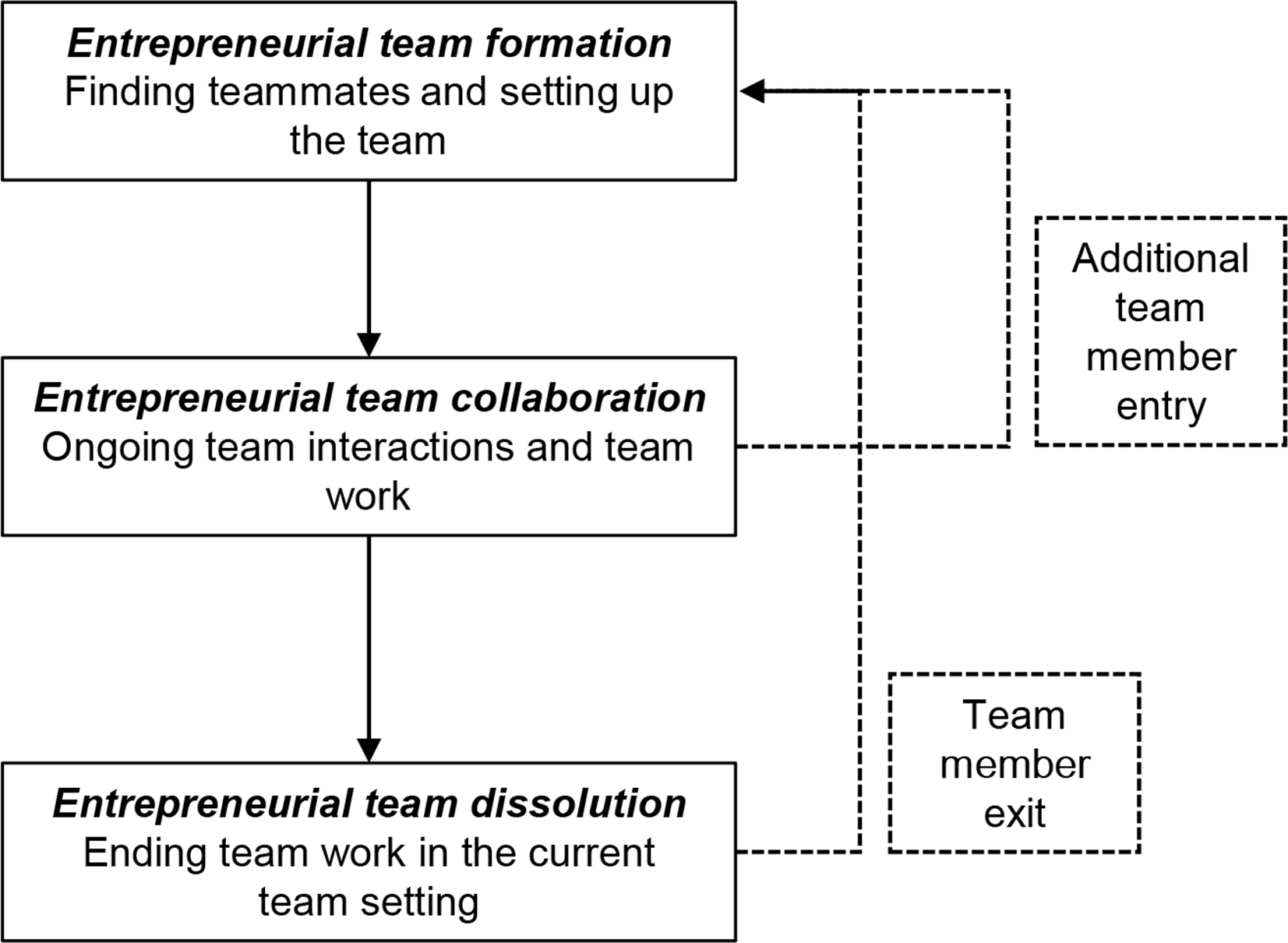
The entrepreneurial team life cycle.
The life of an entrepreneurial team starts either when an individual with a business idea tries to acquire cofounders or when a group of individuals starts to develop an entrepreneurial opportunity (Lazar et al., 2020). The team formation phase is the time period during which cofounders find each other, agree to form an entrepreneurial team, and set up the team’s structure to start a venture. The process of entrepreneurial team formation is, to a large extent, guided by the self-selection of team members (Lazar et al., 2020) and is hardly defined by existing (organizational) culture or routines (Blatt, 2009). In this phase, entrepreneurial teams might decide to incorporate their ventures legally, but they also can continue to work on their business ideas without any kind of legal formalization (Lazar et al., 2020). The formation phase ends once a formed team starts working on its venture and has a rather stable team structure.
Once an entrepreneurial team has formed, it enters the collaboration phase. The collaboration phase is the time period during which an entrepreneurial team, based on its current composition and structure, interacts to develop a venture. During the collaboration phase, entrepreneurial team members’ key tasks include, for example, finding customers, attracting investors, and building relationships with other important stakeholders (Zott & Huy, 2007). Team members need to coordinate and monitor their activities, establish effective and efficient decision-making processes, and develop and update their team thinking and feelings toward the team itself, all of which can have important implications for how team members work together (e.g., Boone et al., 2020; Preller et al., 2020).
Finally, cofounders often exit a venture after a given time period (Guenther et al., 2016; Wennberg & DeTienne, 2014), an event that triggers an entrepreneurial team’s dissolution phase. The dissolution phase is the time period during which one, several, or all team members leave an entrepreneurial team such that the team discontinues its joint work on the venture. The dissolution of an entrepreneurial team can take place within a short period of time, for example, when all entrepreneurial team members stop working on the venture because it has failed. However, complete dissolution often has several phases that take place over a number of years (Guenther et al., 2016) and runs until all but one team member has left the venture. Dissolution can be voluntary or initiated by others from within or outside the venture, such as investors who try to “professionalize” the team by replacing founders with hired managers (Hellmann & Puri, 2002).
Importantly, as Figure 1 illustrates, entrepreneurial teams do not necessarily pass through these life cycle phases in a linear fashion; they can also return to an earlier phase. In particular, changes in a team’s composition can result in the team returning to the formation phase. For example, a team might realize during the collaboration phase that its activities require new competencies and resources such that it seeks, hires, and integrates a new member. Thus, the team needs to adapt its structures, roles, and processes. Similarly, when a team experiences the exit of one or several team members, the remaining team will reenter the formation phase until the team has made all necessary changes to continue working on its (adapted) venture. 1
The Entrepreneurial Team/Venture Double Life Cycle Framework
While we argue that the life cycles of entrepreneurial teams and their ventures can proceed independently of each other, teams work on their ventures in order to advance them along the venture life cycle. Specifically, we suggest that the phases of the entrepreneurial team life cycle are embedded in the venture life cycle such that all team life cycle phases can occur in each venture life cycle phase. This combination of both life cycles results in the double life cycle framework shown in Figure 2. From a conventional view, entrepreneurial teams and their ventures develop along parallel trajectories (bold path in Figure 2). As such, the team formation phase takes place at venture inception such that an entrepreneur or an entrepreneurial team develops a first idea, turns it into a product or service, and starts a venture. During the venture development phase, the entrepreneurial team nurtures the venture and tries to push it toward success. The team continues working together until the venture becomes a mature and established company. Moreover, the team can also experience the end of the venture life cycle and move into a phase of decline and ultimately failure.
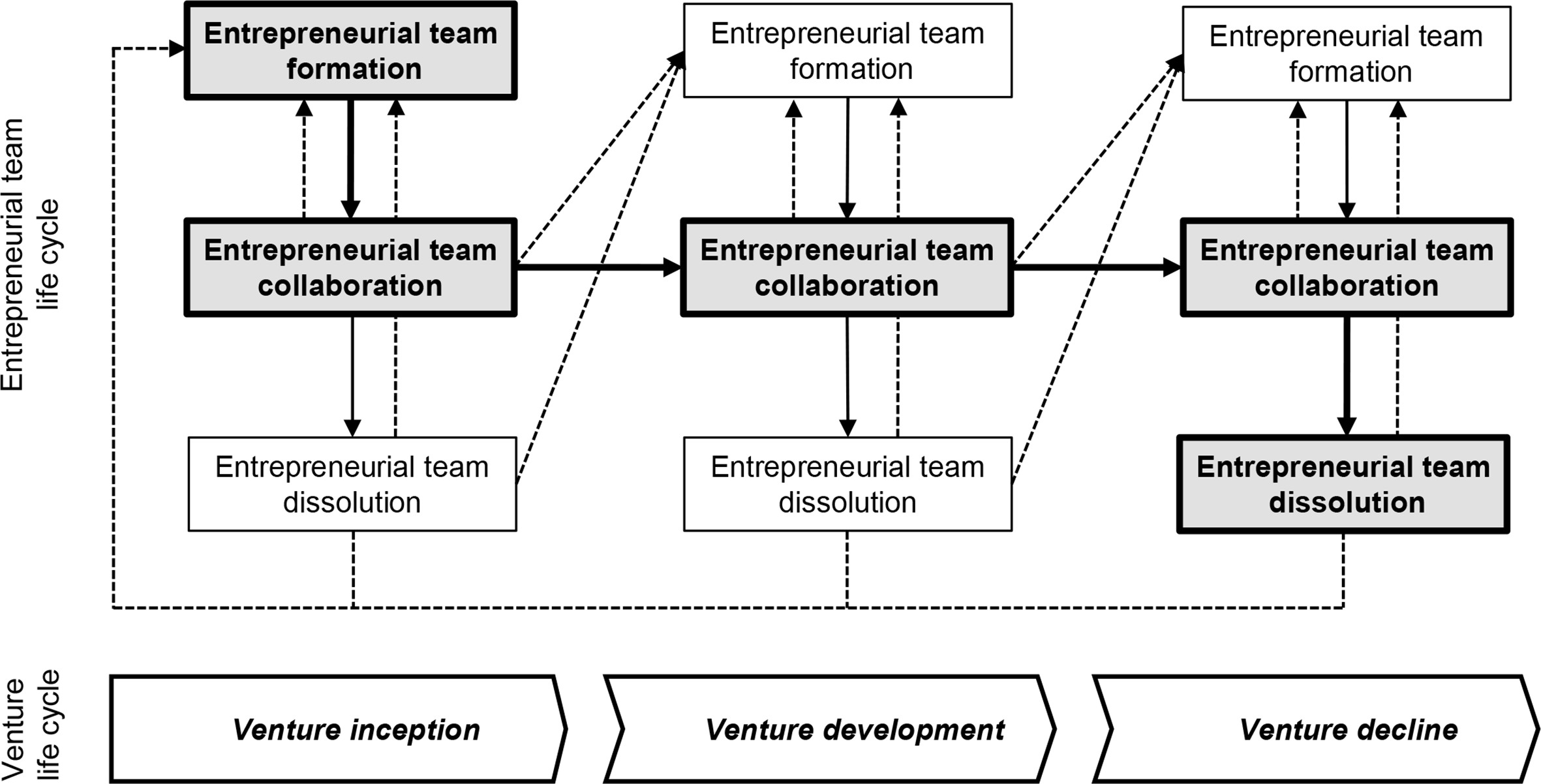
The double life cycle framework of entrepreneurial teams and their ventures.
However, the double life cycle framework also opens up implications beyond these parallel trajectories of entrepreneurial teams and their ventures. Specifically, the framework suggests nonparallel developments of entrepreneurial teams and their ventures; that is, teams can form, collaborate, and dissolve in each phase of the venture life cycle. Therefore, the framework has important repercussions for our understanding of entrepreneurial team formation, collaboration, and dissolution as a team’s tasks, responsibilities, and challenges change along the different phases of the venture life cycle. It is joint teamwork that helps a venture move from one phase to the next, and these venture transitions are sometimes accompanied by changes in team composition.
Next, we analyze how entrepreneurial teams form, collaborate, and dissolve in each phase of the venture life cycle. In doing so, we pay particular attention to identifying blind spots (i.e., combinations of team and venture life cycle phases neglected by prior research) in our understanding of entrepreneurial teams and their evolution. By introducing potential topics, perspectives, and empirical approaches within some venture/team life cycle phases but not others, we do not suggest that these points are irrelevant in the other phases; rather, we introduce them because we believe they are most helpful in addressing the blind spots in these specific phases.
A Research Agenda Based on the Double Life Cycle Framework
The Entrepreneurial Team Life Cycle During the Venture Inception Phase
During the venture inception phase, entrepreneurs develop their first ideas for new products or services and their first business models. During this phase, entrepreneurs need to collect, solicit, process, and implement feedback from early customers and experts (Grimes, 2018; Seyb et al., 2019). They also need to assemble resources to work on their ventures, such as potential cofounders, funding, business partners, and first employees (Fisher et al., 2016; Jawahar & Mclaughlin, 2001). Further, venture ownership is generally not formalized by this point; instead, team members anticipate being granted ownership once the venture is formally established. As there are typically no formal structures in place during this phase, many decisions are based on entrepreneurs’ personal judgment rather than on detailed strategic planning (Smith et al., 1985). These tasks and conditions of the venture inception phase result in specific challenges for entrepreneurial teams.
Entrepreneurial Team Formation in the Venture Inception Phase
As illustrated in Figure 2, the entrepreneurial team life cycle can start with or after the venture life cycle. Teams can develop an idea for a venture together (“group origin” of entrepreneurial ventures; Lazar et al., 2020). Alternatively, one entrepreneur can develop an idea alone, so a venture might already be in its inception phase before the entrepreneur selects teammates to realize his or her idea (“lead entrepreneur origin” of entrepreneurial ventures; Lazar et al., 2020). Combinations of these origins are also possible, such as a smaller team developing an idea and searching for teammates who can further progress the idea. These different types of team formation open up various research questions, to which we now turn.
Initial Entrepreneurial Team Creation
At the individual level, the entrepreneurship literature has explored the formation of opportunity beliefs—future-focused “mental images or ‘theories’ about the potential reward for a particular action versus the cost of that action” (Wood, McKelvie, et al., 2014, p. 253)—as a key trigger of entrepreneurial action (McMullen & Shepherd, 2006). However, if a team forms at venture inception, how does the team collectively come up with a belief in an opportunity? For example, do these teams experience a process similar to that of individuals for whom third-person opportunities (i.e., an opportunity for someone/a team in general) evolve into first-person opportunities (i.e., an opportunity for oneself/one’s team in particular; McMullen & Shepherd, 2006)? That is, when and under what conditions does a team actually become an entrepreneurial team pursuing an opportunity (see the definition by Lazar et al., 2020) as compared to any other team tied together by a shared interest and/or friendship? Do all team members tend to experience this process similarly and simultaneously, realizing that the considered opportunity is right for the team? Alternatively, do some team members realize that an opportunity is right for themselves but not for the (entire) team? Extending research on opportunity belief formation to the team level appears to be of central importance when addressing these questions and understanding the emergence of “group origin ventures” (Lazar et al., 2020).
In contrast, if an individual lead entrepreneur develops an opportunity for a venture, an important part of his or her initial resource assembly during venture inception is recruiting teammates. While prior work has described different approaches to team member selection, such as interpersonal attraction, resource seeking, and hybrid strategies (Lazar et al., 2020), we still do not know how entrepreneurs balance the ambition to get ahead with their teams and the wish to get along with their teams. How do entrepreneurs or entrepreneurial teams approach the search for team members? Even if they mainly conduct their search in their direct and personal environments, some selection is likely to take place. In the constrained pool of their personal environments, is selection mainly based on liking others or on others’ competencies? If entrepreneurs search outside this pool—that is, take a resource-seeking approach—how do they request information about potential teammates, what role do recommendations from the entrepreneurs’ personal and professional networks play, and how do first conversations develop? One promising future research approach could be to study matching events at entrepreneurship centers where team member selection can be observed while it happens. Sometimes educators and mentors take a more active role as “matchmakers” and bring potential cofounders together to form a team. In these cases, another question arises: do these “strategically casted” teams function differently from self-selected teams, and if so, how?
Early Entrepreneurial Team Contracting
The formation of an entrepreneurial team also involves agreeing on formal and informal rules outlining how the team wants to work together. Existing literature has identified several advantages for entrepreneurial teams that agree on a contract that clearly states the boundaries of their collaboration: an appropriate contract can help team members define a venture’s ownership structure, protect intellectual property, and prepare for potential challenges related to teamwork and composition changes (Hellmann & Thiele, 2015). Such a contract can also help build relational capital within an entrepreneurial team (Blatt, 2009). To date, most contract-related work on entrepreneurial teams has focused on equity distribution contracts (Breugst et al., 2015; Hellmann & Thiele, 2015; Hellmann & Wasserman, 2017), which entail important consequences with respect to financial rewards and team members’ power, control, and status. However, many aspects around equity distribution are still not sufficiently understood. For example, how do different team members (e.g., based on their personalities or prior career achievements) react to different equity distributions in terms of motivation, effort, and venture commitment? How does the cultural context of an entrepreneurial team (e.g., individualism vs. collectivism; Laspita et al., 2012) impact these relationships and team members’ justice perceptions of equity distribution? Further, given that recommendations from practice often involve time- or milestone-based vesting terms to specify dynamic equity distributions (Wasserman, 2012), how can these terms best be structured based on ventures’ progress and industry?
Moreover, informal contracts specifying team members’ roles, expectations, and processes have so far been largely ignored in entrepreneurial team research. However, research outside the entrepreneurship context highlights the importance of team charters—that is, “codified plans for how the team will manage teamwork activities” (Mathieu & Rapp, 2009, p. 91)—for team performance (Courtright et al., 2017; Mathieu & Rapp, 2009). Given their high operational task load (Wasserman, 2012), entrepreneurial teams might feel that they do not have sufficient time to develop such a team charter or any cofounder agreement. Future research could explore how developing cofounder agreements competes with other entrepreneurial tasks and whether the associated investments of time and effort pay off in the long run for teams and their ventures. Moreover, under which conditions are well-developed cofounder agreements particularly valuable for entrepreneurial teams? For example, perhaps teams based on weak prior ties benefit more compared to teams based on strong prior ties. Thus, studying how an entrepreneurial team’s interactions with the outside world (including investors and mentors) influence team formation opens up interesting avenues for future research that is highly relevant for both theory and practice.
Initial Entrepreneurial Team Task Allocation
Another important element of setting up an entrepreneurial team is allocating the initial tasks between members. Team members need to find ways to work together efficiently and ensure that each person contributes to building the venture using his or her strengths. While tasks might still vary in the early days of a venture, role formalization and functional specialization within an entrepreneurial team are associated with higher levels of venture performance (Sine et al., 2006). Moreover, a team also needs to decide who represents them as the CEO to the outside. Initial studies have indicated that the CEO role is often given to the person with the venture idea (Wasserman, 2012), but this role is also granted based on team members’ status and expertise (Jung et al., 2017). While these insights are important, many task-related aspects around the entrepreneurial team setup are not sufficiently understood. Specifically, to what extent do team members envision a specific internal team structure when they select teammates? Do search processes differ when team members try to find a CEO compared to candidates to fill other roles? For example, if a technology-oriented founder with a promising idea meets a potential cofounder who has substantial management experience and knows the targeted industry well, what additional cues are needed for the founder to ask this potential cofounder to join his or her venture? How will roles be allocated in such a case, and how do these considerations affect teamwork within a venture? Addressing these questions could yield a better understanding of the entrepreneurial team formation process from team member selection to team setup.
Entrepreneurial Team Collaboration During the Venture Inception Phase
During the venture inception phase, entrepreneurial teams engage in the important tasks of opportunity recognition and evaluation. Although these tasks are at the core of entrepreneurship (Shane & Venkataraman, 2000; Wood & Williams, 2014), prior research investigating the role entrepreneurial teams play in these tasks is limited. Consistent with work at the individual level (Foo, 2011; Grégoire et al., 2010), we highlight the importance of team cognitive and affective processes for these two tasks. Moreover, given the social complexities within teams, interactions between entrepreneurial team members are bound to play an important role during entrepreneurial team opportunity recognition and evaluation.
Opportunity-Related Team Cognition
Work on the role of entrepreneurial teams’ human capital demonstrates how team members’ experiences shape the opportunities their teams recognize (e.g., Gruber et al., 2012, 2013). However, we do not sufficiently understand how teams integrate their individual members’ experiences. How do team members combine different perspectives to form a bigger picture of their potential opportunity and venture? As opportunity recognition has been described as individuals’ ability to “connect the dots” (Baron, 2004, p. 104) of their prior experiences, an entrepreneurial team’s transactive memory system—that is, “a team-level cognitive process [to] effectively and efficiently integrate knowledge and skills among founding team members” (Zheng, 2012, p. 578)—might help integrate team members’ individual experiences for collective opportunity recognition.
Moreover, we need to understand how teams connect and transform their members’ unrelated ideas into a new and bigger picture. For example, one team member might mainly focus on the features of a new technology, such as a robot that can complete numerous tasks and easily lift heavy weights, whereas another team member might be aware of a market need, such as a shortage of healthcare workers and the challenges associated with taking care of overweight patients. In intense discussions, the team might come up with the idea of a robot nurse. However, only when the team accepts feedback from experts—for example, that the robot must look kind and trustworthy—will it be able to develop a successful product. How does this “creative synthesis,” as described by group creativity scholars (Harvey, 2014), unfold in the early phases of a venture, and how do entrepreneurial teams find ways to include external perspectives, such as from customers or experts, into this process?
Team cognition also likely plays an important role during opportunity evaluation, which has been defined at the level of the individual entrepreneur as “judgments and beliefs regarding the degree to which events, situations and circumstances construed as an entrepreneurial opportunity represent a personally desirable and feasible action path” (Wood & McKelvie, 2015, p. 256). Opportunity evaluation in an entrepreneurial team thus involves moving from individual team members’ judgments and beliefs to a collective judgment and belief. How do team members integrate their different individual judgments and opinions to form a collective judgment and opportunity belief? Specifically, how do entrepreneurial team members combine the different sets of information they hold—for example, based on their idiosyncratic education and experience—to find the best opportunity in a given set (Gruber et al., 2008)? Perhaps, prior work on hidden profile scenarios (e.g., Breugst et al., 2018) can inspire future research on how entrepreneurial teams develop shared mental models (i.e., collectively shared mental representations; Converse et al., 1993) of entrepreneurial opportunities.
Opportunity-Related Team Affect
Perry-Smith and Coff (2011) study how mood influences opportunity recognition and evaluation and find that different moods facilitate and inhibit these different tasks. Thus, entrepreneurial team affect likely plays a complex and multifaceted role in the venture inception phase. Indeed, as this phase is shrouded in uncertainty (McKelvie et al., 2011; McMullen & Shepherd, 2006) and therefore often highly emotional (Baron, 2008), we call for studies on entrepreneurial team collaboration during venture inception to include team affect more explicitly. For example, work at the individual level has suggested that idea generation is driven by a complex interplay of negative and positive affect, specifically an affective shift from negative to positive (Bledow et al., 2013), but we do not know if entrepreneurial team opportunity recognition is also connected to an affective shift. Does this shift need to be experienced by the entire team, or is one team member’s affective shift sufficient to trigger opportunity recognition? Moreover, research could focus on the effect of emotional contagion in opportunity evaluation (Barsade, 2002)—for example, by investigating the contagion of excitement for (elements of) an opportunity between entrepreneurial team members. Finally, inspired by Perry-Smith and Coff (2011), who rely on a hypothetical setting to distinguish between opportunity recognition and evaluation, future research could focus on the role of entrepreneurial team affect in the iterative process of opportunity development. For example, such research could analyze how opportunity development is shaped by (and in turn shapes) intraindividual and interindividual changes in affect within entrepreneurial teams.
Opportunity-Related Interpersonal Team Processes
Beyond collective cognitive and affective processes, interpersonal processes also likely play an important role in opportunity recognition and evaluation. Team members are likely to have individual preferences that need to be negotiated and aligned within the team. Thus, it would be interesting to better understand the role of trust, communication, and coalition building in this context (Brodt & Thompson, 2001). For example, in an entrepreneurial team with high trust, members might be more likely to agree to a teammate’s opportunity judgment even if it contradicts their own judgment because they can be sure that the teammate has the team’s best interest in mind. Moreover, research could explore how members communicate within a team to persuade their teammates that selecting a specific opportunity is the right (or wrong) choice and whether the persuasion process that team members use among themselves differs from that used with external venture stakeholders. Specifically, how does the content, style, and frequency of communication in a team impact opportunity evaluation? To understand these microlevel processes within entrepreneurial teams, behavioral data based on video-recorded team meetings might be particularly helpful. Such a methodological approach could help shed light on how team members react to each other and reveal behavioral interdependencies (Lehmann-Willenbrock & Allen, 2014).
Initial Entrepreneurial Team Uncertainty Management
In the venture inception phase, entrepreneurial teams are confronted with high levels of uncertainty related to their customers, markets, products, and technologies (McKelvie et al., 2011). Moreover, uncertainty is likely to arise within an entrepreneurial team itself because roles and structures are yet to be developed (Blatt, 2009; Sine et al., 2006) and team members might doubt whether their teammates are the right people to jointly work on the venture with—that is, they may experience interpersonal uncertainty (Federl & Breugst, 2019). Managing these different types of uncertainty is likely to be critical for entrepreneurial teams as uncertainty has been linked to lower individual job performance (Colquitt et al., 2012), team performance (Cordery et al., 2010; Faraj & Yan, 2009), and venture performance (Hmieleski & Ensley, 2007; Sine et al., 2006).
However, to date, we know very little about how entrepreneurial teams can manage this arising uncertainty during the venture inception phase. For example, how do teams (try to) reduce the different types of uncertainty they face? What is the role of a team’s efforts to reach out to others to reduce uncertainty in terms of boundary spanning and advice seeking (Alexiev et al., 2010; Faraj & Yan, 2009)? Also, how do these activities interact with intrateam processes, such as information processing and team reflection (Breugst et al., 2018; Nederveen Pieterse et al., 2011)? Moreover, how can teams benefit from information that might be uncertain in itself, and how can teams combine numerous pieces of information from individual team members, particularly pieces that contradict each other?
Finally, our understanding of the consequences of high uncertainty for entrepreneurial teams during venture inception would be more complete if researchers also considered potential positive consequences (Griffin & Grote, in press). For example, uncertainty may serve as an excuse for a given teammate’s aggressive behavior and thus reduce the negative emotional consequences of conflict (Breugst & Shepherd, 2017). Alternatively, interpersonal uncertainty among teammates could trigger a clearer understanding of the structures and contracts within an entrepreneurial team (Blatt, 2009; Federl & Breugst, 2019), which may pay off when interpersonal problems arise within the team. Thus, we suggest that research on how entrepreneurial teams manage different types of uncertainty during the venture inception phase also pays attention to the potentially positive consequences of (different types of) uncertainty.
Entrepreneurial Team Identity Formation
Consistent with the growing body of research on entrepreneurial identity at the individual level (e.g., Fauchart & Gruber, 2011; Grimes, 2018; Mathias & Williams, 2017), we suggest that entrepreneurial teams also need to build a specific team identity (e.g., the collective perception that team members interdependently build up a venture as an entrepreneurial team) during the venture inception phase. However, insights into entrepreneurial team identity are rather limited. As an exception, Powell and Baker (2017) focus on nine emerging ventures and analyze how entrepreneurial team members’ identities flow into a prototype of a collective identity that in-groups enforce over time to form a collective identity, which in turn shapes team and venture development. However, the entrepreneurial team members and ventures in this sample all have a community-oriented purpose. Future research could complement these insights by exploring how individual entrepreneurial team members from a variety of backgrounds and in different types of ventures manage to build up a shared identity for their respective entrepreneurial team—that is, how “individual cognitions about identity (‘I think’) facilitate the emergence of shared cognitions (‘we think’)” (Ashforth et al., 2011, p. 1146). In a next step, research could reveal how an entrepreneurial team identity (or multiple entrepreneurial team identities) impacts the early development of a venture. For example, how does an entrepreneurial team identity link to the development of an emerging venture’s organizational identity (members’ understanding of “who we are as an organization”; e.g., Domurath et al., 2020)? Finally, the concept of entrepreneurial passion—defined as “consciously accessible, intense positive feelings experienced by engagement in entrepreneurial activities associated with … the self-identity of the entrepreneur” (Cardon et al., 2009, p. 517)—is related to entrepreneurial team identity. While initial studies have highlighted the importance of entrepreneurial passion at the team level (Boone et al., 2020; de Mol et al., 2020; Santos & Cardon, 2019), we know little about how team entrepreneurial passion influences the tasks associated with the early life of a venture during the inception phase, such as opportunity recognition and evaluation. Moreover, while we know that passion can be contagious for employees in entrepreneurial ventures (Breugst et al., 2012), we do not know how a team member’s entrepreneurial passion influences his or her teammates’ passion.
Entrepreneurial Team Dissolution During the Venture Inception Phase
Although their ventures may be on the verge of forming, some team members decide to leave their teams during the inception phase. For example, a team’s first exits might occur before the focal venture is incorporated because some early team members are excited about developing new ideas and/or inventing solutions to different problems instead of moving the current venture forward (Cardon et al., 2009), whereas other team members are ready to turn their part-time fun project into an actual firm that they spend (most of) their working time on. Team member exits are particularly difficult to study in this early venture period because formal team membership typically does not exist at this point. Indeed, these early departed team members often get forgotten. (Who remembers Apple’s third cofounder Ron Wayne?)
Early Team Member Exits
Although cofounders may leave an entrepreneurial team early, they might still shape the team’s creative phase and thus early venture development. It would be interesting to accompany young entrepreneurial teams to learn more about these early departures. Why do some team member exits but not others stop a team and its venture before the venture has even reached full speed? Does it make a difference if the idea owner (Gray et al., 2020) or someone else exits early? While prior work has focused on team member selection in the sense of adding members to teams (Lazar et al., 2020), we do not know how these young teams coordinate their composition in the sense of potential members who they do not want to include. Further, although part-time entrepreneurship and moonlighting have been studied at the level of individual entrepreneurs (Folta et al., 2010), we do not know if and how team members with different time commitments manage to work together in the early venture phase. How do entrepreneurial teams dissolve into subgroups working at different speeds and different levels of commitment during venture inception?
Impact of Early Team Member Exits
Finally, although some team member exits occur early in ventures’ lives and most likely before formal incorporation, theories of imprinting (Marquis & Tilcsik, 2013) and path dependence (Mahoney, 2000) suggest that they can have a potentially long-lasting effect on future venture development (Baron et al., 1999). Thus, it would be interesting to study the impact of team member exits in the venture inception phase on future team formation and collaboration. For example, after an exit, does the remaining team search for a replacement for the departed team member? If so, is the team likely to select a person with a profile similar to that of the departed cofounder, or will the team adapt its search to meet the updated needs of the emerging venture? How does experiencing early exits shape later contracting practices within teams, including the distribution of equity? Perhaps entrepreneurial teams that experience the early exit of a team member are more likely to incorporate dynamic equity split arrangements in their venture contracts as a safeguard for future exits. Further, how do early departures impact team members’ attitudes toward their teams (e.g., team satisfaction and viability; Foo et al., 2006)? Are team members who have experienced the early exit of a teammate less likely to consider themselves and other team members irreplaceable as their venture matures, thus yielding higher rates of future team member exit and entry?
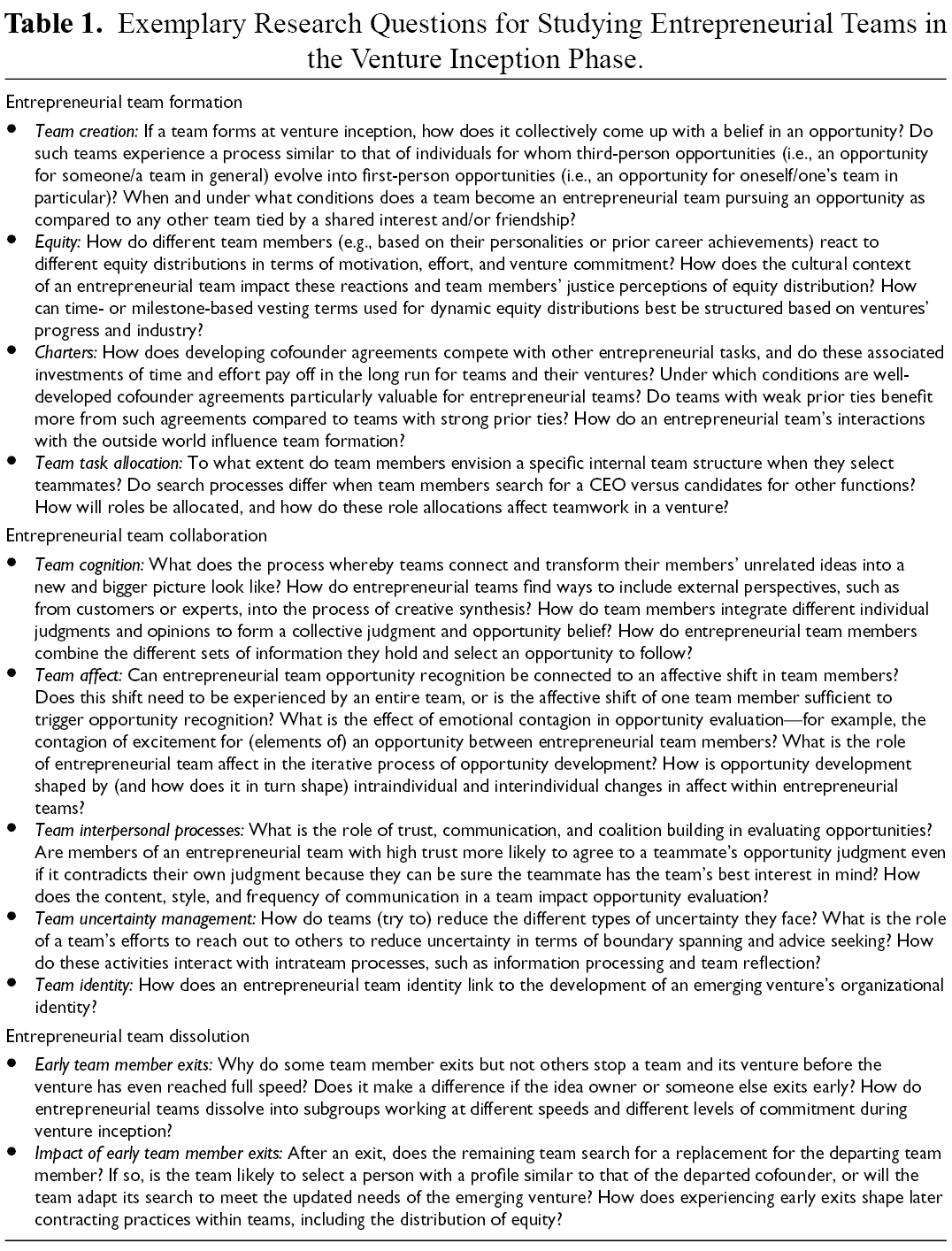
In sum, our discussion highlights many open questions in our understanding of entrepreneurial teams in the inception phase of new ventures. In Table 1, we summarize exemplary questions discussed in this section.
Exemplary Research Questions for Studying Entrepreneurial Teams in the Venture Inception Phase.
The Entrepreneurial Team Life Cycle During the Venture Development Phase
During the venture development phase, a venture’s organizational structure becomes more formal (Smith et al., 1985). While experimentation is important during venture inception, during the development phase, a venture’s business model is now more robust, its products are well developed, and its market is clearly defined, allowing the venture to make its first sales. Thus, objective performance data help reduce uncertainty around the nature and feasibility of a venture’s proposed business model (Fisher et al., 2016). The generation of revenues also opens up avenues for venture growth (Fisher et al., 2016; Phelps et al., 2007; Smith et al., 1985). As such, in this phase, entrepreneurial teams need to implement more formal structures and professionalize their decision making, manage their (growing) firms, integrate new employees, generate revenues, and search for additional or expand existing opportunities.
Entrepreneurial Team Formation During the Venture Development Phase
Teams of Founders and Early Joiners
As a venture starts growing more substantially, its entrepreneurial team often experiences changes in composition, with new members joining to replace early departers (see above) or to take over areas of responsibility that the extant team cannot cover (Chandler et al., 2005; Hellmann & Puri, 2002; Roach & Sauermann, 2015). While these newcomers are highly important for venture development, we do not sufficiently understand whether this re-formation of an entrepreneurial team follows similar patterns to original team development. For example, how do mixed teams composed of founders and newly hired managers form contracts? How do different constellations of team members (e.g., subgroups of initial members and joiners) influence their feelings of venture ownership and commitment (Gray et al., 2020)? How do newcomers adapt to an existing team, including its existing cognitive processes and attitudes? Further, do certain forms of team cognition or team learning make it easier for new members to integrate into a team, and when is integration more difficult?
Studies addressing the above and related questions might draw on the substantial literature on newcomer socialization in the workplace (see the meta-analysis by Bauer et al., 2007). This literature suggests that over time, newcomers to an organization adjust their preferences and norms to those that are prevalent within the organization, thus enhancing their commitment. However, how can such socialization be effective in entrepreneurial teams’ quickly changing environments? While research on newcomer socialization (Bauer et al., 2007) has proposed that it is mainly the joiners who need to adapt, in the context of entrepreneurial teams, incumbent teams may also need to make changes. For example, when adding team members, teams might also decide to refine and reallocate team roles, such as splitting the responsibilities for sales and strategic development. Consequently, the question arises of how incumbent members adapt to this new situation (e.g., are they willing to give up responsibilities). How does an entire team redefine its structure and roles and set clear responsibilities? Studies exploring these issues could not only advance the literature on founder replacement (e.g., Wasserman, 2003) but could also extend our perspective on how founding teams can be “professionalized” (Hellmann & Puri, 2002) as ventures grow.
Entrepreneurial Team Collaboration During the Venture Development Phase
Throughout the venture development phase, an entrepreneurial team needs to collaborate successfully to advance its venture. The growing number of challenges that teams face necessitates that team members engage in learning as well as planning and professionalization. Moreover, throughout the growth process, team members’ roles need to change from more operational roles to leadership positions (Reid et al., 2018).
Entrepreneurial Team Learning to Advance Ventures
Changes within their ventures and the many “firsts” in entrepreneurial teams’ collaboration, such as dealing with first customers, negotiating with first investors, adding first external managers to the team, and hiring first employees, push entrepreneurial teams to engage in efficient and effective learning. While numerous studies at the individual level have highlighted the importance of entrepreneurial learning for achieving high venture performance (for a review, see Wang & Chugh, 2014), we do not have a sufficient understanding of how entrepreneurial teams learn about their tasks and about themselves. The few studies focusing on learning in entrepreneurial teams have suggested that such learning is facilitated by a spirit promoting the accumulation of new experiences and reflection (Rauter et al., 2018; Sardana & Scott-Kemmis, 2010). However, researchers should also investigate how entrepreneurial teams learn more explicitly and what conditions facilitate such team learning. For example, future studies could explore how team members learn from each other (e.g., through vicarious learning; Bandura, 1965) and thereby maximize the benefits of entrepreneurial team diversity. What types of “learning from others” (e.g., exchanging information, observing each other) help entrepreneurial teams and in what form (e.g., role allocation, team rituals, routines, team climate)? Moreover, it would be insightful to understand how entrepreneurial teams balance internal and external team learning (Bresman & Zellmer-Bruhn, 2013). Specifically, how do individual team members gather information from their networks and then make this information available to their teammates? Finally, research on teams in other settings, such as military (Smith-Jentsch et al., 2008) and surgical teams (Vashdi et al., 2013), has suggested that teams can learn a lot from their own activities by engaging in debriefing sessions after completing important tasks. Researchers could study entrepreneurial teams’ likelihood to engage in debriefing sessions and other means of sharing knowledge after events, such as conversations with investors or important business partners. Further, intervention studies could randomly select teams to engage in structured debriefing sessions and compare these teams to a control group with respect to important entrepreneurial outcomes.
Entrepreneurial Team Professionalization
During the development phase, a venture becomes more formal and stable, which requires its team to establish clear structures, work together in a more structured way, and develop more elaborate plans. During this phase, entrepreneurial teams need to “grow up” and introduce a certain level of professionalism into their ventures—that is, “clear internal structures, processes, and routines for both day-to-day business as well as unforeseen events” (Preller et al., 2020, p. 19). This professionalism also involves a certain level of planning, which becomes more feasible when uncertainty has started to decrease. So far, entrepreneurship research has devoted significant attention to the important topic of business planning for the development of entrepreneurial ventures (Brinckmann et al., 2010). It might be particularly crucial for entrepreneurial teams to engage in teamwork planning—that is, “the development of alternative courses of action for mission accomplishment” (Marks et al., 2001, p. 365). Indeed, teams that discuss responsibilities and coordinate which member should contribute which input to overall team tasks have been found to show higher levels of team performance (Fisher, 2014). Although it seems likely that entrepreneurial teams need to professionalize and plan during the venture development phase, it is still unclear how they can achieve this. Is the process of team planning and professionalization easier for some teams than for others? What role do a team member’s individual experiences as well as an entire team’s prior experiences play in this process? How can outsiders, such as investors or mentors, support the professionalization of entrepreneurial teams? Do high levels of professionalism and planning diminish the excitement and fun that entrepreneurial teams experience in the early days of their collaboration? How can they introduce a certain structure without experiencing rigidity and losing flexibility, thus thwarting their entrepreneurial spirit?
Importantly, the very act of collaborating alters entrepreneurial teams’ work context. Thus, they need to deal with a highly dynamic situation in which requirements keep changing. As such, entrepreneurial teams need to deal with this new dynamism and the associated challenges. One potentially interesting construct that might help entrepreneurial teams deal with these challenges is team adaptation—that is, “reactive and nonscripted adjustments to a team’s system of member roles that contribute to team effectiveness” (LePine, 2003, p. 28). In addition, entrepreneurial team flexibility, defined as “the extent to which team members can and do substitute for one another in the performance of team tasks,” might be an interesting construct to study in future research (van der Vegt et al., 2010, p. 1172). Such future studies might rely on a longitudinal design, tracking the changes that teams initiate and how they react and adjust to those changes. Not only would it be interesting to study how entrepreneurial team adaptation and flexibility enable teams to deal with substantially changing tasks more effectively, but entrepreneurial teams also represent an ideal context within which to study the development of team adaptation as well as whether a highly dynamic and volatile environment can trigger higher levels of adaptation and flexibility.
Finally, we do not sufficiently understand how entrepreneurial teams include elements of timing when collaborating. To successfully develop their ventures, entrepreneurial teams probably need to rely on shared temporal cognition—that is, a “common understanding of the time-related aspects of executing collective tasks” (Mohammed & Nadkarni, 2014, p. 405). Studying entrepreneurial teams’ shared temporal cognition is highly relevant because it would allow us to understand if and how team members form a joint venture development pace. In particular, an entrepreneurial team might find it difficult to work on common goals if members have a different sense of urgency about which tasks should be completed next and when the venture should take its next step, such as hiring employees, entering a market, or entering a next investment round. A lack of shared temporal cognition is likely to result in team members prioritizing tasks differently, potentially leading to conflict and reduced satisfaction with the team and venture progress. However, a team may benefit from team members working on several tasks in parallel as different members may feel that their specific tasks are most urgent. Thus, analyzing shared temporal cognition has the potential not only to advance entrepreneurial team research but also to help entrepreneurship educators and mentors support entrepreneurial teams.
Entrepreneurial Team Leadership
As first employees typically join in the venture development phase, entrepreneurs also need to take on a leadership role within their ventures during this period—a topic that has not been investigated to a great degree in the entrepreneurship context to date (Reid et al., 2018). A venture’s growing workforce, however, can result in challenges that an entrepreneurial team needs to manage jointly. First, while hierarchies are normally flat (or even nonexistent) during venture inception, during the venture development phase, entrepreneurial teams need to determine their internal structure and decide how much power to assign to certain roles, including the CEO role. These decisions have important implications for an entrepreneurial team, such as how future decisions will be made and how the team is represented to external stakeholders. Indeed, entrepreneurial teams are extreme cases of self-managing teams with the “freedom and discretion . . . and ability to organize [their] internal work and structure to best accomplish goals” (Langfred, 2007, p. 885). In this context, how much power do teammates grant their leaders? Is this power granted based on the entire team’s understanding of what is best for the team and the venture or on certain cues, such as status or ownership? Consistent with recent work in the area of emergent leadership in self-managing teams (Gerpott et al., 2019), we suggest that coding different leadership behaviors (e.g., based on recordings of interactions between entrepreneurial team members) can contribute to a finer-grained understanding of the development of leadership structures in entrepreneurial teams.
Second, each member of an entrepreneurial team is likely to take on a leadership role within his or her own area of responsibility. As different areas might need different levels of support at different points in time (e.g., technological development might be more urgent than, or a prerequisite to intensive sales efforts), subdepartments within a venture can grow at different paces. Thus, one entrepreneurial team member might have to manage several employees, whereas other team members might still be working by themselves. This emerging situation necessitates careful communication and coordination between entrepreneurial team members: is the entire team responsible for these employees, or is the head of a specific area exclusively responsible? How should communication within a team be adapted if area heads need to be located with their employees and not the entrepreneurial team? How are more general tasks spread across teams and their employees?
Further, if a venture continues growing and entrepreneurial team members are responsible for several employees in their own departments, research questions at the intersection of entrepreneurship, leadership, and human resource management start to surface. For example, to what extent should entrepreneurial team members align their leadership styles? How much exchange between teammates is needed when they are each faced with the challenge of becoming a leader? To what degree of openness should departments be organized, and how can fault lines between departments and, thus, entrepreneurial team members be avoided? Entrepreneurial teams also need to agree on incentive structures for their employees, which has implications for the team members’ own income and/or equity shares. For example, using a natural experiment, future research could explore how recent changes in the regulations for employee stock options are implemented in new European ventures. Specifically, how do these changes in equity distribution affect teams and their ventures? These research questions echo Reid et al.’s (2018) assertion that much can be gained by establishing a deeper connection between the literature on leadership and entrepreneurship, including that on entrepreneurial teams.
Entrepreneurial Team Dissolution During the Venture Development Phase
Previous research has identified antecedents to team member exits during venture development at the individual (Chandler et al., 2005; Ucbasaran et al., 2003) and team levels (Chandler et al., 2005; Vanaelst et al., 2006). Venture-level outcomes have also been studied, but the associated findings are ambiguous. On the one hand, studies on the positive consequences of team member exits have argued that underperforming members are generally those who exit entrepreneurial teams, which allows the remaining team members to work together more effectively (Boeker & Karichalil, 2002; Busenitz et al., 2004; Chandler et al., 2005). On the other hand, studies finding a negative relationship between team member exits and venture performance have highlighted the loss of resources connected to exits and the need to build up new structures within teams after exits (Bamford et al., 2006). Guenther et al. (2016) provide a more nuanced perspective by taking into account venture age as an important contingency and showing that the negative performance implications of team member exits are weaker for older ventures.
However, the complexities of team member exits have not been thoroughly researched yet. In particular, hardly any insights exist into how teams and individual team members experience the exit process in the venture development phase. As such, it would likely prove fruitful to accompany entrepreneurial teams for longer time spans to better understand the entire team member exit process from origin to outcome and to utilize a more microlevel perspective to explore team members’ cognitive and affective processes as well as their behavior during the exit process.
Entrepreneurial Team Member Exits
From the perspective of departing team members, future research can study how these individuals disengage from their ventures (Rouse, 2016) in the venture development phase. In particular, researchers could try to understand how team members’ exit intentions and their decisions to leave emerge and how they involve their teammates. For example, what team behavior or decisions trigger a team member’s de-identification with his or her venture or team (e.g., affective conflict; Ensley et al., 2002) and thus a subsequent exit? Do the motives and nature of the exit process trigger a departing team member’s future entrepreneurial intentions and decision to form a new entrepreneurial team pursuing another idea? Perhaps a smooth, mutually agreed upon exit process and perceptions of a fair contract (e.g., fair compensation for shares) positively influence a departing founder’s entrepreneurial intentions, while conflicts during the exit process diminish these intentions. It appears that a process perspective (Langley, 1999) and the literature on procedural fairness (Roberson & Williamson, 2012) can help address these questions and yield novel insights into how departing entrepreneurial team members experience the exit process and its consequences.
Impact on Remaining Teams and Venture Development
Likewise, remaining teams’ perspective is highly interesting. For example, a team member’s communication of his or her exit decision could shape the remaining teammates’ reactions and the future development of the entrepreneurial team and venture. On the one hand, a departing team member who carefully and repeatedly indicates that he or she is considering an attractive job opportunity outside the venture might help the remaining team understand his or her exit decision and thus make it easier for the team to continue its collaboration until and even after the team member’s actual exit. In contrast, a team member who suddenly discloses that he or she wants to leave the venture because of a sudden new idea for a different promising venture might harm relationships within the team and might provoke a much harsher reaction from the remaining team, potentially damaging the venture. Further, if a subgroup of an entrepreneurial team is dissatisfied with one or some of the teammates, fault lines may arise, and the team might conclude that it is best to continue the venture without the respective member(s). How should the remaining team communicate and interact, both internally and with the departing team member(s)? Additionally, the role of investors requires more attention since investors can trigger an exit (Breugst et al., 2015). However, investors can also provide (legal) support while the exit process is ongoing, drawing on their prior experience dissolving entrepreneurial teams (Hellmann & Puri, 2002).
Importantly, any team member exit would shift the team from the dissolution phase back to the team formation phase, so it would be insightful to focus on these remaining teams and understand their reactions to exit. For example, how does a team’s attachment to its venture change after a cofounder exit? Perhaps attachment increases as the remaining team might feel higher levels of responsibility for the venture. Alternatively, attachment could decrease because team members have seen their team dissolve and realize that individual founders (including themselves) are replaceable. Further, the way both the legal and operational sides of the exit process are handled might be important for understanding the prior equivocal findings on the consequences of team member exits. For example, an entrepreneurial team member exit implies a change in a venture’s ownership structure. As most studies have focused on team member exits as isolated events and have not considered specific conditions and individual- and team-level consequences, our understanding of the outcomes of entrepreneurial team member exits for remaining teams remains severely underdeveloped.
Entire Team Exits
Another important route of entrepreneurial team dissolution in the venture development phase is the exit of an entire entrepreneurial team when said team sells its venture and leaves, such as after a trade sale or an initial public offering. These harvest sales by entrepreneurial teams are particularly common in high-tech ventures (Wennberg & DeTienne, 2014). However, to date, we know little about the role teams play in this process, how they plan joint exits, and what activities (if any) they engage in after selling their ventures or filing for initial public offerings. Do all members in a team envision a joint exit when first starting out (Preller et al., 2020)? When do they decide the time is ripe, and how are the exit conditions negotiated within the team beyond negotiations with a potential buyer? To what extent do team members consider the exit to be a dissolution of their team? Specifically, do they discuss staying on as part of the firm as managers or consider new joint projects (thus, potentially moving the team into the team formation phase of venture inception)?
Some earlier research has investigated ventures shortly before or after staging an initial public offering (e.g., Kroll et al., 2007), labeling these teams top management teams in new ventures (or similar terms). These teams differ from entrepreneurial teams in that one, some, or all team members were not present at the time of venture founding but joined their respective teams later as externally hired managers. Studying the evolution of teams from an entrepreneurial team to a top management team is an interesting avenue for research (for a first step in this direction, see Ferguson et al., 2016). For example, to date, it is unclear how entrepreneurial team members cope with a situation in which they repeatedly lose equity and control over their venture and how collaboration among entrepreneurial team members evolves if further parties, such as investors or hired managers, become involved (for a theoretical paper examining fault lines between founders and investors, see Lim et al., 2013). We also have little insight into what constitutes a shift from an entrepreneurial team to a top management team. Interestingly, from a practical point of view, entrepreneurial teams of newly founded ventures often receive significant support from accelerators/incubators (Cohen et al., 2019) and mentoring programs (Radu Lefebvre & Redien‐Collot, 2013). However, support for entrepreneurial teams in managing the journey toward a large-scale established organization and its associated challenges is rare and mainly comprises advice from investors (Hellmann & Puri, 2002). Thus, future research on the evolution of teams might be helpful for developing adequate support mechanisms for this important transition phase accompanying venture growth.
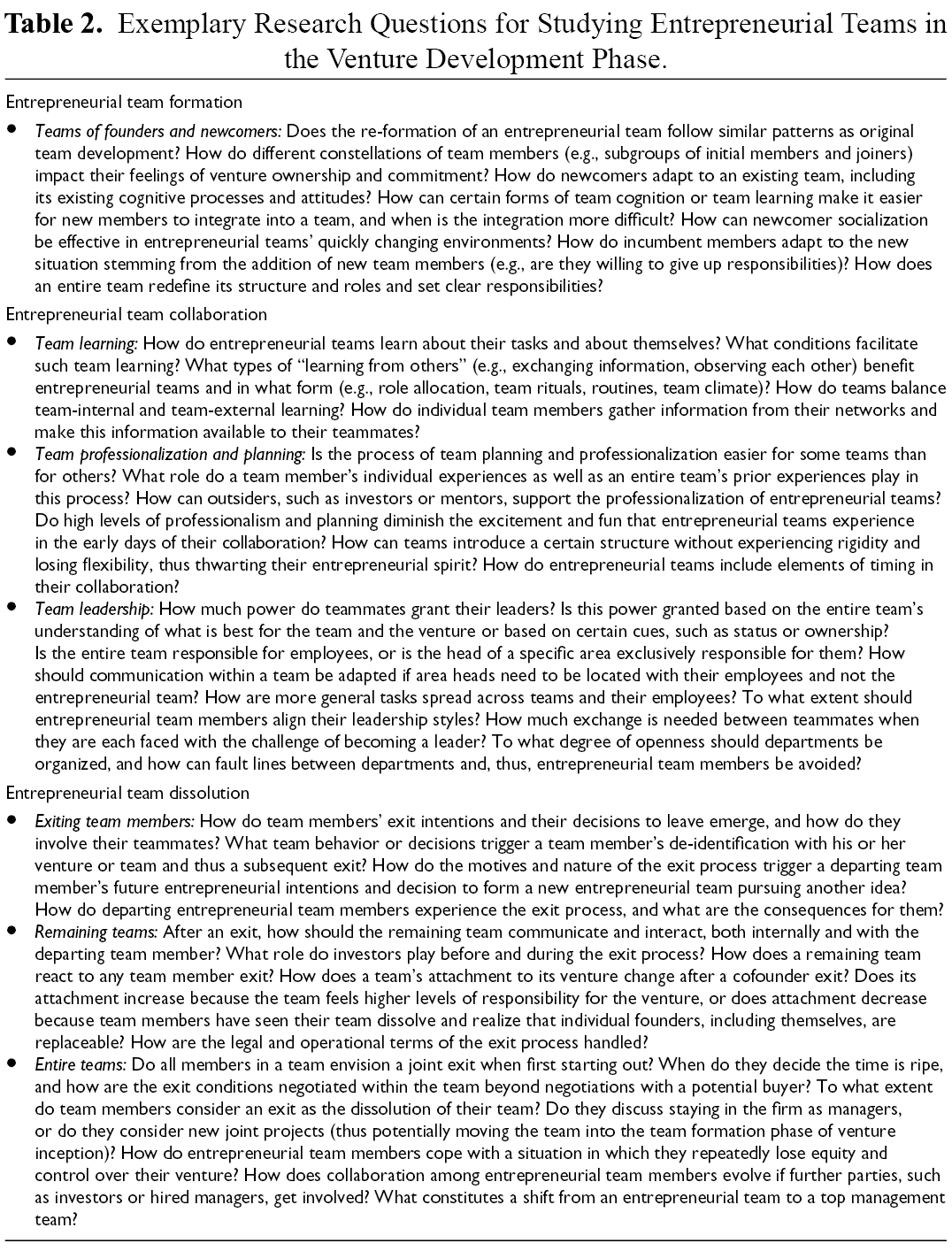
Taken together, the double life cycle framework suggests numerous important ideas to advance research on entrepreneurial teams during the venture development phase. We summarize some of the key ideas introduced in Table 2.
Exemplary Research Questions for Studying Entrepreneurial Teams in the Venture Development Phase.
The Entrepreneurial Team Life Cycle During the Venture Decline Phase
In the venture life cycle of our framework, the last phase is characterized by venture decline—that is, a decrease in venture performance and ultimately venture failure (Jawahar & Mclaughlin, 2001; Wang & Singh, 2014). A venture’s potential for a stable or successful future fades away. Typically, sales numbers and stakeholder interest in the venture diminish; profitability goes down substantially; and, as a consequence, the venture’s resource base evaporates (Jawahar & Mclaughlin, 2001; Wang & Singh, 2014). Entrepreneurial teams are likely to engage in activities that might prevent this decline, and they might search for opportunities to revive their ventures. However, if they are not successful, they need to think about downsizing their ventures, closing them down, or filing for insolvency. Thus, this phase is characterized by tough decisions and negative emotions, such as grief, fear, and guilt (Shepherd, 2003; Singh et al., 2015; Ucbasaran et al., 2013).
Entrepreneurial Team Formation During the Venture Decline Phase
Even if a venture is in the process of shrinking or even dissolving, its entrepreneurial team might reenter the team formation phase. Teams need to decide not only how to downsize their ventures and which employees need to be laid off (first) but also which team members should stay and who is able to tackle the tasks that emerge during venture decline. Most likely, responsibilities and tasks need to be reallocated within these (remaining) entrepreneurial teams, which might also be shrinking due to members leaving.
Entrepreneurial Teams Tackling Venture Decline
Many tasks associated with venture decline are hardly enjoyable, yet team members must accomplish them. How do entrepreneurial teams distribute these tasks among their members? For example, teams need to decide who will negotiate with investors, banks, or business partners and what the ideal outcome of this negotiation would be, such as liquidation or trade/asset sale. Moreover, who communicates with venture employees? Should a team jointly tell employees that the venture has become less successful and cannot be rescued, or is it better to have one team member deliver the bad news, absorbing all the blame and potential negative reactions from employees? Which team member is best suited for delivering bad news (e.g., based on position, personality, experience)? How can a team organize managing employees’ emotions (e.g., Shepherd et al., 2014) when the venture is nearing the end of its lifespan? Finally, team members need to reach out to suppliers and customers to find solutions to somehow fulfill expectations (at least partially). To what extent can teams capitalize on the views of outsiders, such as mentors and consultants, and integrate them into these tough decisions and difficult processes? We expect that most entrepreneurial teams are reluctant to reveal detailed information about these sensitive issues and processes to researchers, representing a challenge for future scholarship. For such research, deep and trusted connections between researchers and entrepreneurial teams would be a valuable asset.
Implications of Contracts During Venture Decline
While we discussed the central role of contracting during the venture inception phase, many of its implications for entrepreneurial teams, their ventures, and their stakeholders typically surface during the venture dissolution phase. However, these implications have not been studied to date. In particular, the distribution of equity may not only impact the likelihood of venture success (Hellmann & Wasserman, 2017) but may also have key implications for team formation during venture decline. For example, if equity is split unequally among the members of a team, the loss each member experiences when the venture fails also differs. Whereas minority owners (who might not have much to lose) may favor a quick shutdown of the venture to pursue alternative careers, more is at stake for majority owners. These team members may favor a slow process when it comes to venture decline as they either hope to get the venture back on track or because they want to find and negotiate the best conditions for a potential trade or asset sale. In the case of an equal equity split, the decline process might also be rather slow because no team member may really want to make the call to close down the venture. Moreover, if the number of team members is even, teams might experience deadlocks during which they cannot obtain a majority vote on the tough decisions they face. Consequently, the far-reaching consequences of equity distribution might only become obvious at a time when distributing the pie is less appealing. Still, each team member needs to find ways to cope with these (and other) implications of ownership agreements during venture decline.
Dissolution of Entrepreneurial Team Member Relationships
The prior section already indicated that there is a lot of potential for disagreement and conflict between entrepreneurial team members during venture decline. For example, many ventures are started by teams of friends or family members (Ruef et al., 2003), but how does the difficult time period of venture decline impact team members’ friendships or family relationships? Also, how do team member friendships impact decisions about communication structures and role and task distribution during decline? Indeed, a vicious spiral (Shepherd et al., 2010) might develop whereby the decline of a venture diminishes friendships within a team and the diminished friendships further accelerate the venture’s decline. How are such spirals initiated, perpetuated, and (importantly) stopped? Further, perhaps teams of friends or family members tend to make decisions in a way that minimizes their common financial and emotional losses (Shepherd, Wiklund, et al., 2009), whereas team members with purely professional prior relationships try to minimize their individual losses, potentially at the cost of their teammates. Overall, the dynamic developments of personal relationships as well as entrepreneurial team members’ roles and tasks during venture decline seem to be a promising research topic. Moreover, considering teams’ potential interactions with outsiders (e.g., employees, investors, suppliers, customers, and mentors) during venture decline would add an important layer of complexity to entrepreneurial team research and entrepreneurial failure research that has been neglected in most studies so far.
Entrepreneurial Team Collaboration During the Venture Decline Phase
While research on venture failure is highly prolific at the individual level (Jenkins et al., 2014; Shepherd & Haynie, 2011; Singh et al., 2015), we hardly have any insights into entrepreneurial teams’ collective experience of venture decline and failure. However, an entrepreneurial team and its interactions are likely to play a crucial role in evaluating venture performance, taking action to revive the venture, and coping with decline and failure.
Acknowledging Poor Venture Performance Within Entrepreneurial Teams
Teams that are unable to coordinate their tasks and responsibilities (Sine et al., 2006), integrate and utilize team members’ knowledge (Dai et al., 2016), and resolve their intrateam conflicts (e.g., de Jong et al., 2013) are likely to experience lower levels of venture performance. However, the start of the venture decline phase is unlikely to be completely evident, and individual team members might assess a venture’s situation differently. How do team members develop a shared belief that a venture is declining and potentially failing? For example, perhaps one team member is concerned about venture performance before his or her teammates are. When and how will this team member speak up about these concerns? Further, what is the role of team climate (e.g., Anderson & West, 1998) in supporting or inhibiting team members’ attempts to address performance-related issues? Perhaps the literature on voice—that is, individuals raising concerns or addressing challenges in a group with the intention to improve a situation (for a review, see Morrison, 2014)—could be helpful to understand the first steps team members take to share their concerns about a venture’s performance. This literature stream distinguishes between a “group voice climate” and a “climate of silence” and highlights how these differences shape the likelihood of team members raising concerns. Further, the literature on psychological safety—“a shared belief held by members of a team that the team is safe for interpersonal risk taking” (Edmondson, 1999, p. 530)—could inform our understanding of when team members are more willing to discuss the possibility of venture underperformance and future failure.
Teams Reviving Their Ventures
Team members eventually need to agree on their assessments of venture performance and then decide what to do next. On a positive note, when confronted with low venture performance, team members might develop hope for reviving the venture and inspire each other to invest more effort into the venture (Breugst et al., 2020). On a negative note, they might also show a certain skepticism about their teammates’ performance and engage in monitoring behaviors, which are likely to undermine trust in the team as well as team performance in the long run (De Jong & Dirks, 2012). Although some studies have explored individual entrepreneurs’ decisions and reactions to threats and firm underperformance (DeTienne et al., 2008; Shepherd et al., 2013), more research is needed to understand how entrepreneurial teams deal with performance threats. How can these teams still work together in a productive and functional way while seeing the rewards of their efforts (i.e., their ventures) evaporate? Why are some teams better able to deal with venture underperformance than others? What can teams do to turn their ventures around? We suggest that the emerging literature on work team resilience (Stoverink et al., 2020) and resilience in innovation contexts (Todt et al., 2018) can serve as a basis for such investigations.
Entrepreneurial Teams Coping With Their Failing Ventures
Finally, when failure appears to be unavoidable, entrepreneurial teams need to agree on the conditions for exiting their ventures, such as distress sales, liquidation, or insolvency, as well as the timing of their exits. While some team members might find it easier to achieve closure and terminate a venture, others might find it more difficult and might delay the process, resulting in an experience of “creeping death” (Shepherd et al., 2014). Future research could explore how teams balance individual team members’ needs to deal with failure, learn from it, and move on.
Moreover, understanding the emotions entrepreneurial team members experience has the potential to extend prior research on solo entrepreneurs’ emotions (Jenkins et al., 2014; Shepherd & Haynie, 2011; Singh et al., 2015). Specifically, social psychology has pointed to the phenomenon of “cutting off reflected failure” after team malperformance—that is, team members behave in ways “to make it appear unlikely (or less likely) that [they are] associated with a group that has failed” (Snyder et al., 1986, p. 383). Thus, team members might distance themselves from their entrepreneurial team and cast blame on one another. However, team members who identify strongly with their team have also been found to make even more intense contributions to the team after failure (De Cremer & van Dijk, 2002). Shedding light on the different implications of experiencing failure within an entrepreneurial team will certainly help answer the important question of why some entrepreneurs start another venture (perhaps successfully) after experiencing failure while other do not (Ucbasaran et al., 2013).
Entrepreneurial Team Dissolution During the Venture Decline Phase
During the venture decline phase, the likelihood of entrepreneurial team dissolution increases, and full team dissolution is a typical part of the final period of this phase. Importantly, teams need to decide how and when they want to dissolve. When venture performance starts to decrease substantially, some team members might start to look for alternative career options and eventually leave a venture.
Team Exit Narratives
Entrepreneurial team member exits early in the venture decline phase might represent the final blow for a venture if skilled members leave, representing a massive outflow of expertise and manpower. Alternatively, it might also be the case that a subgroup of an entrepreneurial team blames one or more teammates for a venture’s underperformance and wants to push the respective teammate(s) out of the venture. In both cases, it would be interesting to understand how entrepreneurial teams develop “exit narratives” (that might or might not have been coordinated with departing teammates) that they communicate to external venture stakeholders, such as investors, partners, or customers. Narratives are “temporally sequenced accounts of interrelated events or actions undertaken by characters” (Martens et al., 2007, p. 1108) and play an important role in understanding how individuals experience entrepreneurial failure (Byrne & Shepherd, 2015; Singh et al., 2015). After a team member exit, the remaining team might use the exit as an opportunity to restructure the venture and revive it, or they might accept it as a trigger to begin the exit process for themselves. Consequently, the remaining team is likely to construct a narrative to explain the exit, such as by describing an irresistible opportunity for the departing teammate, turning the departing team member into a scapegoat, or portraying the exit as a joint decision to abandon the venture. However, if the departing team member does not agree to the constructed narrative, external stakeholders might receive contradicting signals, further reducing their trust in the declining venture.
Entrepreneurial Team Downsizing
In the case of longer or more dramatic venture underperformance, an entrepreneurial team might also need to make a decision about downsizing the team itself. This decision is likely to involve a discussion regarding who is most indispensable for the venture but also more emotional reasons for team members to stay vs. leave. For example, idea givers and founding team members might insist that they stay on for as long as possible because they might find it hardest to disengage psychologically from their ventures (Rouse, 2016). Finding a good solution for all team members might be particularly beneficial during the venture decline phase because remaining teams (or individual members) are more likely to receive support from departed teammates if they believe that the exit process was fair.
Joint Entrepreneurial Team Dissolution
An entrepreneurial team could also stay together until venture liquidation. When this is the case, a team needs to decide how both the team and the venture should be dissolved. For example, the team needs to think about potential assets still connected to the venture. Some entrepreneurial teams might have legal contracts providing guidance, but many need to find compromises to avoid destroying the limited value still hidden within the failing venture. How are such compromises negotiated? The team might also want to think about certain rituals that could help members deal with the loss as a team. For example, research on entrepreneurial projects has suggested that rituals, such as a venture funeral, as well as social support facilitate the grief recovery process for those involved (Shepherd, Covin, et al., 2009). As such, how can entrepreneurial teams best cope with the negative effects involved with dissolving their ventures, for example, by supporting each other emotionally?
As the above discussion illustrates, an understanding of entrepreneurial teams during the venture decline phase is just beginning to emerge. In Table 3, we summarize important research questions emerging from this discussion and hope future studies will address them.
Exemplary Research Questions for Studying Entrepreneurial Teams in the Venture Decline Phase.
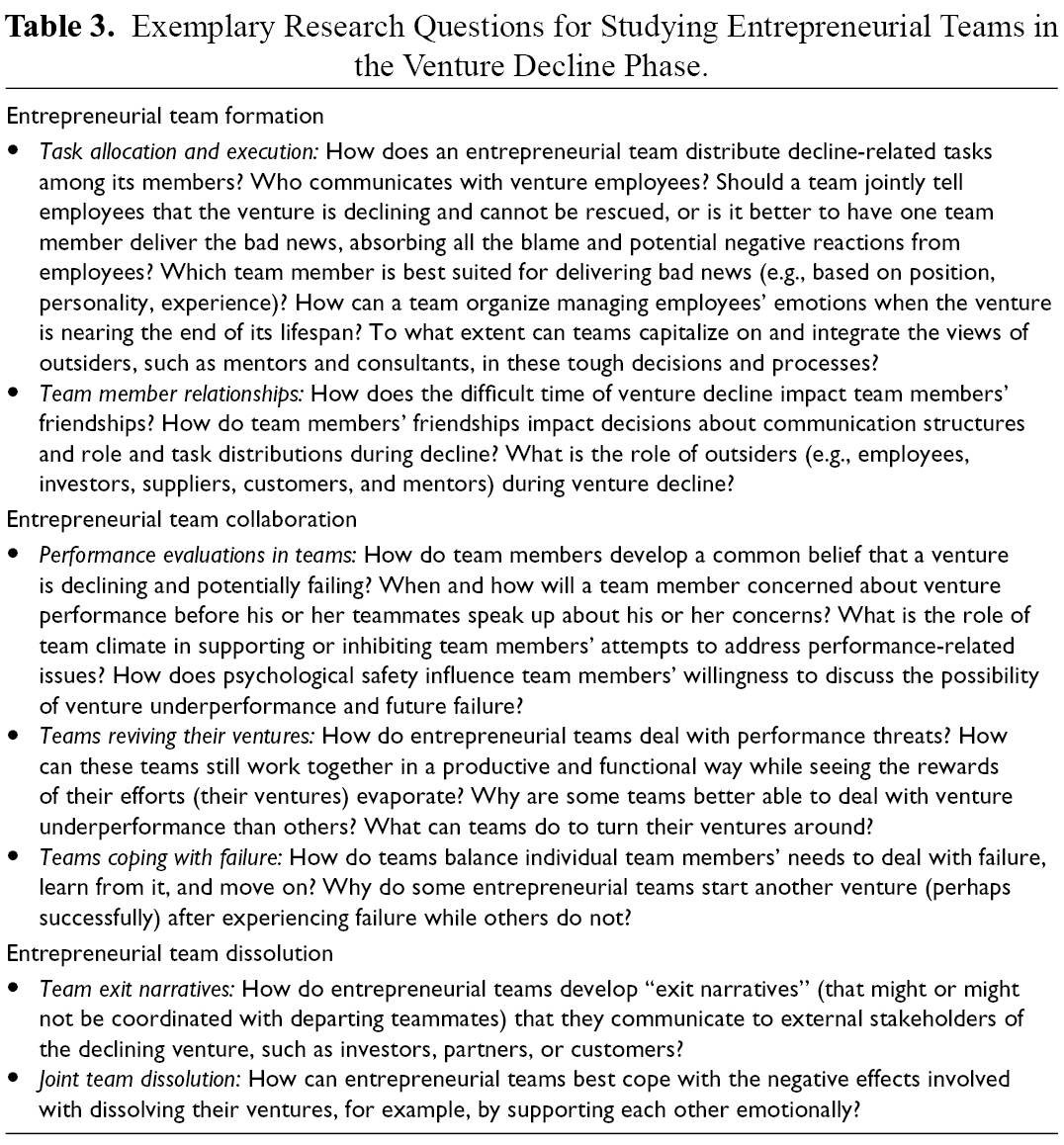
Nonlinear Transitions in the Double Life Cycle Framework
Implicitly, the concept of a life cycle suggests a certain linearity such that a specific entity moves from one phase to the next automatically: over time, entities come into existence, develop, and mature until they eventually vanish (Phelps et al., 2007). By offering the entrepreneurial team/venture double life cycle framework, we advance the idea of nonlinear transitions within and between the team and venture life cycle phases. Moreover, we offer some ideas for future research on how entrepreneurial teams can play a proactive role in shaping both life cycles.
From Team Dissolution During Venture Inception to Team Formation During Venture Inception
First, entrepreneurial teams could realize early in the venture inception phase that their ideas are not as promising as they initially appeared. Thus, a team might abandon an idea, collectively develop a new idea, and reenter entrepreneurial team formation by defining team members’ roles and responsibilities for this new potential venture. While this team formation process is fully consistent with the group origin of entrepreneurial ventures (Lazar et al., 2020), it would be interesting to understand in what ways subsequent team formation differs from first-time team formation. In subsequent team formation, entrepreneurial team members know each other better than during initial formation and are more familiar with each other’s complex and nonobservable characteristics, such as each other’s values, time horizons, and commitment to the joint venture (Wasserman, 2012). Moreover, equity distribution might be negotiated differently, not only because of team members’ experience with legal clauses, financing options, and tax considerations but also because team members know how other members have acted in prior equity negotiations (e.g., assessing perceived fairness; Breugst et al., 2015). Thus, in which parts of the early venturing journey, such as agreeing to contracts, do subsequent teams form and act more quickly than first-time entrepreneurial teams, and which parts of the journey remain similar or become more difficult (e.g., role allocation)? To what extent do team members use a first venture as a “blueprint” for team behavior in a new venture? Answering these questions will enhance our understanding of the emergence and functioning of serial and habitual entrepreneurial teams.
From Team Dissolution During Venture Development to Team Formation During Venture Inception
Entrepreneurial teams can exit their ventures in the development phase because, for example, investors replace them with more experienced managers or because they decide to sell their ventures. If team members decide to restart with a new venture idea with (some teammates from) their initial team, they are likely to benefit from the experiences they had in their prior joint venture. Thus, studies on entrepreneurial team reentries may inspire research on habitual and serial entrepreneurs (e.g., Parker, 2013; Toft-Kehler et al., 2014) by including a social component. Beyond looking at experiences related to entrepreneurial processes, these studies would also shed light on team members’ experiences from jointly collaborating within a given entrepreneurial team. Further, an entrepreneurial team’s prior history can affect its heterogeneity and thus the outcomes of a new venture (Jin et al., 2017). Are teams with a shared history more aligned in their cognitive processes compared to teams without such a history? What are the consequences of this potential alignment? Perhaps these teams are more focused in their decision making but are less likely to recognize opportunities and threats outside their field of focus (West, 2007). Moreover, while studies on imprinting try to understand “the impact of founding conditions on organizations” (Johnson, 2007, p. 101), it appears that the conditions under which an entrepreneurial team has worked together previously can also substantially shape the development of a future venture founded by the team. Thus, studies on serial entrepreneurial teams might extend insights from the effect of imprinting within one venture (Burton & Beckman, 2007) to effects across several ventures.
From Team Dissolution During Venture Decline to Team Formation During Venture Inception
Entrepreneurial teams or some members of a team might decide to embark on a new entrepreneurial journey after experiencing venture failure. While this decision to start a new venture after failure is less surprising for cofounders who have strong personal ties (e.g., spouses or family members; Brannon et al., 2013; Discua Cruz et al., 2013), entrepreneurial team members without these strong ties might still feel they are part of a strong team. It would be interesting to understand how entrepreneurial teams start working together again after failure and if they have different ways of coping with failure collectively. As self-efficacy plays an important role in individuals’ reentry into entrepreneurship (Hsu et al., 2017), future research could analyze the influence of collective efficacy on entrepreneurial teams’ (joint) reentry.
Conclusion
In this article, we combined the entrepreneurial team life cycle with the venture life cycle. We drew on the idea that transitions between venture and team life cycle phases are not automatic but that it is the team that pushes itself and its venture proactively from one phase to another. Based on this double life cycle framework, we identified research questions along the three phases of entrepreneurial team formation, collaboration, and dissolution embedded within the three phases of venture inception, development, and decline. By acknowledging that transitions between these life cycle phases can be nonlinear, we have opened up an exciting research agenda that integrates processual aspects that have largely been neglected in extant work but are essential for better understanding entrepreneurial teams and their highly dynamic journeys.
Footnotes
Acknowledgments
The authors thank editor Johan Wiklund and three anonymous reviewers for their constructive and valuable feedback.
Declaration of Conflicting Interests
The author(s) declared no potential conflicts of interest with respect to the research, authorship, and/or publication of this article.
Funding
FundingThe author(s) disclosed receipt of the following financial support for the research, authorship, and/or publication of this article: We appreciate support by the German Research Foundation (Deutsche Forschungsgemeinschaft, DFG, BR 3889/2-1). We also appreciate support from the Joachim Herz Foundation.
