



Abstract
Entrepreneurial affect has emerged as a burgeoning area of study, with a wealth of articles demonstrating that affect, broadly conceptualized, plays an important part in entrepreneurial life. While a few affective phenomena, such as passion and positive and negative affect, are primarily driving the affective revolution in entrepreneurship, a wide range of additional forms of affect, from momentary feelings to enduring affective dispositions, have been found to influence entrepreneurs’ judgments, decision-making, attitudes, and behaviors in distinct parts of the entrepreneurial process. Moreover, entrepreneurs’ affective experiences and displays of these experiences influence entrepreneurial behaviors and investors’ decision-making. Although this is an exciting time for work on entrepreneurial affect, several theoretical and empirical inconsistencies impede further knowledge accumulation. To assess how and why affect is critical to entrepreneurship, to clarify the theoretical inconsistencies, and to provide an integrative framework, we conduct a systematic review of 276 published empirical and conceptual articles on entrepreneurial affect. In doing so, we analyze how various affective phenomena (e.g., emotions, moods, sentiments), along with their discrete forms (e.g., anger, grief, happiness), influence and are influenced by specific stages of the entrepreneurial process. We conclude that while this body of research confirms that entrepreneurship is an emotional endeavor, the collective approach has thus far obscured a more detailed and useful understanding of affect in each stage of the entrepreneurial process. We examine the theoretical and empirical approaches taken to date and lay out an agenda for future scholars, thus bolstering the affective revolution in entrepreneurship.
Keywords
Entrepreneurship is undergoing an affective revolution. Scholars now recognize affect as a fundamental component of the entrepreneurial process, noting that entrepreneurs continuously experience emotional events, from the empathy sparking opportunity recognition (Packard & Burnham, 2021) and the excitement of seizing an opportunity (Klaukien, Shepherd, & Patzelt, 2013) to the moods driving entrepreneurial effort (Foo, Uy, & Baron, 2009) and the grief that ensues from a venture’s failure (Shepherd, 2003). Indeed, the many events that hinder or promote the achievement of venture goals are perceived as affective events (Weiss & Cropanzano, 1996) by entrepreneurs, which in turn shape emotional reactions that influence entrepreneurs’ creativity, judgment, decision-making, cognition, and behaviors (e.g., Engel Ramesh, & Steiner, 2020; Neneh, 2019). Moreover, major global changes, including climate change and advances in artificial intelligence, pose additional challenges and opportunities to entrepreneurs, making the role of affect in entrepreneurship even more salient in today’s environment. Given that entrepreneurship is an affective journey, scholars have developed a deep interest in understanding the affective dynamics that guide entrepreneurial intentions, decisions, and behaviors (Baron, 2008; Cardon, Foo, Shepherd, & Wiklund, 2012; Delgado Garcia, De Quevedo Puente, & Blanco Mazagatos, 2015; Javadian, Gupta, Foo, Batra, & Gupta, 2022).
Although this growing body of work has validated the notion that entrepreneurship is an affective journey, the failure to clearly differentiate among affective constructs has rendered it “inadequate” (Locke & Golden-Biddle, 1997: 1047) in at least two ways that hinder our ability to understand and explain how affect matters to entrepreneurship. From a theoretical standpoint, we find that scholars in the entrepreneurial affect literature often use affect-related terms, such as affect, feeling, emotion, sentiment, and mood, interchangeably. In so doing, they do not consistently align with the foundational work in the affective sciences in which these concepts were defined (e.g., Frijda, 1994) and clarified (e.g., Scherer, 2005). This lack of precision has, in turn, undermined the accumulation of knowledge about how different forms and types of affect shape the entrepreneurial journey (Ashkanasy & Humphrey, 2011). From an empirical standpoint, we find that scholars often fail to align their theories and methods tightly. For example, due to its widespread use, the positive and negative affect schedule (PANAS; Watson, Clark, & Tellegen, 1988) has been used to operationalize several different constructs (e.g., affective traits, general affect, feelings, and moods) rather than establish scales and methods that capture the nuances associated with specific forms and types of affect (Ekkekakis, 2013). This loose application of the scale magnifies the inconsistencies in terminology. Further, it confounds our ability to make connections across studies in a way that aids knowledge accumulation to move the field forward.
While existing review articles have pointed to some of these theoretical and empirical inconsistencies (e.g., Delgado Garcia et al., 2015; Javadian et al., 2022; Williamson, Drencheva, & Wolfe, 2022), they could go further in clarifying them and thereby providing direction for future research. In terms of the affective phenomena examined, the existing reviews and meta-analyses have focused on a subset of the affective characteristics, such as the valence dimension only (e.g., Fodor & Pintea, 2017); valence and activations (Huang, Foo, Murnieks, & Uy, 2020); or valence, arousal, and appraisal tendencies (Delgado Garcia et al., 2015). Their focus on these broad-based characteristics did not allow them to review the influence of specific affective forms. Most recently, Javadian et al. (2022) seek to identify the antecedents and outcomes of feelings, emotions, and emotional competencies in entrepreneurship. However, their inclusion of all affective phenomena in these three broad categories limits the degree to which they can inform readers about the distinct effects associated with more specific types of affect. In response, a host of scholars have conducted reviews on entrepreneurial passion (e.g., Lee & Hermann, 2021; Newman, Obschonka, Moeller, & Chandan, 2021; Schwarte, Song, Hunt, & Lohrke, 2023; Zhao & Liu, 2023) and negative emotions (Williamson et al., 2022). While their foci enable a richer understanding of these specific forms of affect, their decision to go narrow and deep nevertheless limits a more holistic understanding of the role affective phenomena in general play in entrepreneurship.
Given the previous challenges in understanding and explaining how specific forms and types of affect relate to entrepreneurship, this study aims to guide the continued growth of this vital area of research by providing a comprehensive theoretical and empirical assessment of the unique roles distinct affective phenomena play in entrepreneurship. Following rigorous methodological guidelines (Simsek et al., 2024), we conduct a systematic review of the literature across various fields (e.g., entrepreneurship, management, psychology), identifying 276 published articles that have examined affect as a focal construct in the context of entrepreneurship. We present a comprehensive framework of entrepreneurial affect and provide a host of suggestions for future research.
In undertaking this agenda, our review makes at least four contributions to the literature. First, we provide a theoretical foundation for important distinctions among affective phenomena that have been used rather haphazardly to date in the entrepreneurship literature. By grounding the conceptual bases in the affective sciences (e.g., Ekkekakis, 2013; Frijda et al., 1991; Lazarus, 1991, 1994; Scherer, 2005), we clarify the essential nuances among these constructs (Post, Sarala, Gatrell, & Prescott, Post 2020) to posit the specific role each form and type of affect ought to play in entrepreneurship. Second, by developing an empirical categorization of entrepreneurial affect, we provide a much more pointed assessment of affect’s actual influence in the context of entrepreneurship than has been provided to date. In so doing, our categorization can guide entrepreneurial affect scholars seeking more precision in their research. Third, by adopting a comprehensive system as a unit of analysis (Post et al., 2020), we provide a rich understanding of how affect shapes and is shaped by the entrepreneur and the entrepreneurial process. By integrating both the characteristics of the entrepreneur and the steps in the entrepreneurial process, our framework helps clarify what we know and do not know about entrepreneurial affect. Fourth, we offer directions for future research for scholars interested in this area of inquiry based on a synthetic and integrative assessment of the insights gleaned from both our categorization and framework. We believe that such a research agenda can refine, advance, and grow (Post et al., 2020) research on entrepreneurial affect.
The Affective Domain in Entrepreneurship
Entrepreneurship refers to “how, by whom, and with what effects opportunities to create future goods and services are discovered, evaluated, and exploited” (Shane & Venkataraman, 2000: 218). Thus, entrepreneurship research includes studies on the “sources of opportunities; the processes of discovery, evaluation, and exploitation of opportunities; and the set of individuals who discover, evaluate, and exploit them” (Shane & Venkataraman, 2000: 218). As multifaceted as entrepreneurship is, many distinct types of affective experiences exist. In this section, we introduce early conceptualizations of entrepreneurial affect and lay a new foundation for future work by conceptually mapping entrepreneurial affect to existing construct definitions from affective science.
As can be expected in new and rapidly developing areas of study like entrepreneurial affect, some theoretical inconsistencies and empirical gaps have emerged (Delgado Garcia et al., 2015). Baron’s (2008) theoretical article broke new ground in the area by suggesting several mechanisms linking affect to entrepreneurial cognition and behavior. Although it initiated interest in a new trajectory for entrepreneurial inquiry, the inconsistent use of terminology and lack of definitional consistency left room for misunderstanding and confusion. For example, Baron (2008) defines affect both as feelings and moods, and as feelings and emotions, without ever defining the constructs themselves. While such a lack of clarity is not uncommon in paradigm-shifting articles on new topics, the time has come to build our understanding of entrepreneurial affect around established definitions used in scholarly research (e.g., Davidson, 1991; Ekkekakis, 2013; Frijda, 1994; Scherer, 2005).
Affect is an umbrella term for the positive (pleasant) and negative (unpleasant) reactions that people experience (Barsade & Gibson, 2007), including but not limited to emotions, moods, and affective dispositions (e.g., Gross, 1998; Weiss, 2002, Weiss & Cropanzano, 1996). The study of affect and its different forms, processes, and consequences has coalesced over time into the field of affective science (Gross & Barrett, 2013). The simplest way to delineate the constructs in this area is by distinguishing between affective states and dispositions, which reflect the duration or temporality of affective phenomena. On the one hand, affective states refer to temporary or transient phenomena, occurring mainly at the episodic or event level (Beal, Weiss, Barros, & MacDermid, 2005; Weiss & Cropanzano, 1996). On the other hand, affective dispositions are relatively stable differences across individuals (Scherer, 2005). Consequently, affective dispositions are more likely to impact long-term outcomes, such as behavioral patterns and enduring well-being, whereas affective states are more likely to influence entrepreneurs’ daily actions (Cropanzano, Dasborough, & Weiss, 2017). For example, fear experienced and displayed during a short-term event will likely lead to a different outcome, operating through a different mechanism, than fear experienced over the long term (Cacciotti, Hayton, Mitchell, & Giazitzoglu, 2016). The temporality of affective constructs is a relevant point to develop further given that research in entrepreneurship has continuously used operationalizations of affective states and dispositions interchangeably (Delgado Garcia et al., 2015).
Consider the following illustrative example. An entrepreneur, who is generally very upbeat, is distressed about an upcoming meeting with an angel investor due to her limited funding alternatives. This state of distress has reduced her expectations of securing funding. However, in telling the story of her product’s origin, she was able to authentically feel and display passion during her pitch, and the investor offered 60% of the amount the entrepreneur was hoping to get. The investor hesitated to fund 100% of the ask, due in part to the lack of a preexisting relationship (i.e., affective connection) between them. The entrepreneur, who usually is very passionate about her business idea and has worked tirelessly to get to this point, initially felt angry. However, on her way home, she talked to friends and realized that getting 60% of what she expected was a pretty good outcome. As a result, her initial disappointment transformed into joy, happiness, and hope for the future of her business.
This example illustrates how different forms of affect influence entrepreneurial events. Specifically, the meeting between the entrepreneur and angel investor represents an affective event, and the time between her distress about the upcoming meeting and her experience of hope after the meeting is an emotional episode. The ebb and flow of the distinct feelings the entrepreneur experiences throughout this episode demonstrates why it is imperative for scholars to distinguish among them in their research. With the goal of clarification in mind, we draw upon affective science research to differentiate commonly studied forms of affect (i.e., emotions, moods, sentiments, traits) based on their specific features: duration, event focus, appraisal driven, response synchronization, rapidity of change, intensity, behavioral impact, and identity centrality (see Table 1).
Design Feature of Different Forms of Affect
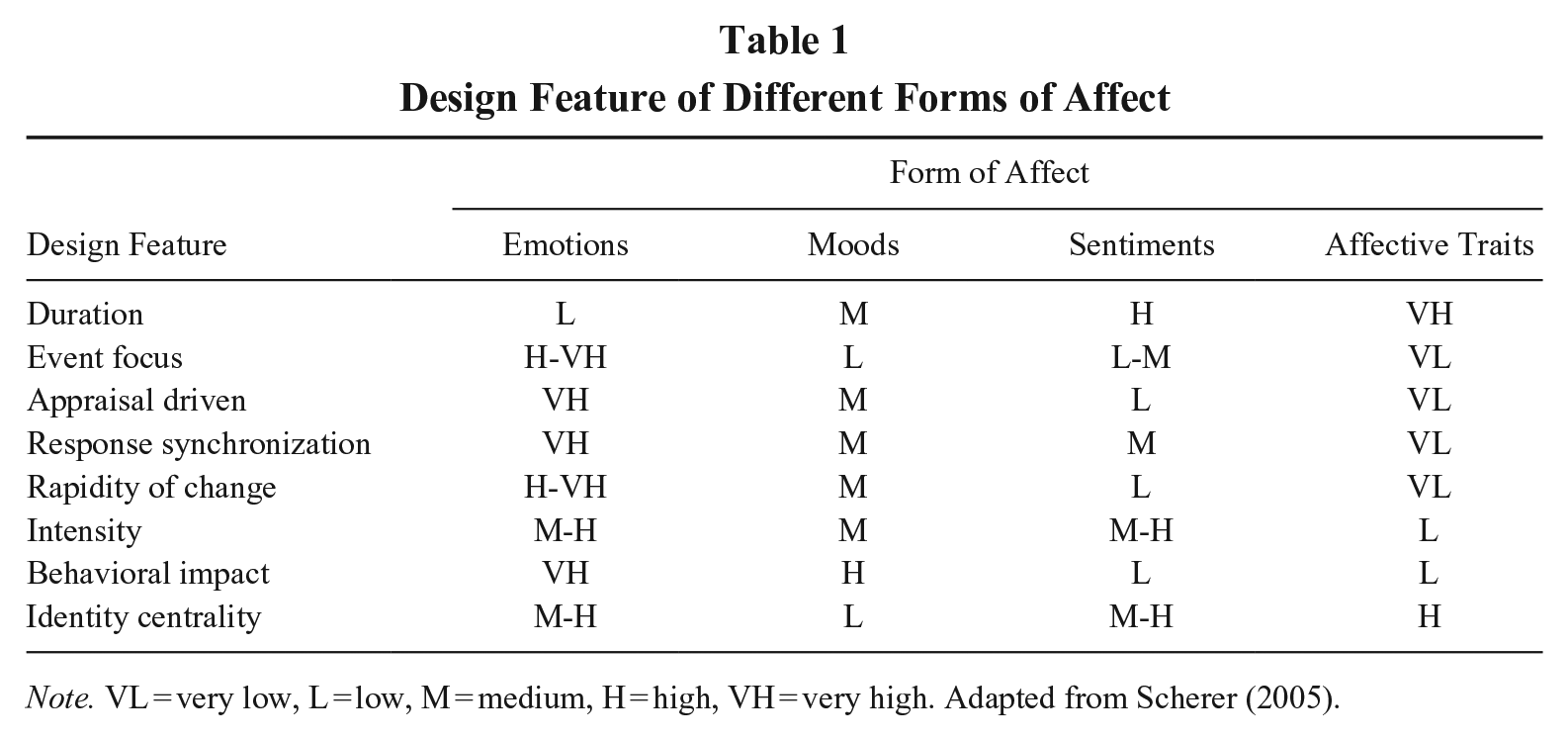
Note. VL = very low, L = low, M = medium, H = high, VH = very high. Adapted from Scherer (2005).
Emotions
Emotions are short-term episodes involving feelings, cognitive appraisals, motivational action tendencies, motor expressions, and physiological changes that occur in synchronicity as a reaction to significant events (e.g., Frijda et al., 1991; Scherer, 2005). As recognized in the broader management literature (Weiss & Cropanzano, 1996), an event is significant when perceived as influencing one’s well-being or goal achievement (Frijda et al., 1991; Lazarus, 1994). Feelings, a component of emotions, reflect the individual’s visceral experience of emotions, embodied in arousal, expressions, and behaviors (James, 1884; Laird & Lacasse, 2014). The appraisal component refers to the cognitive evaluation of the significance of events and objects. Emotions are appraisal-driven; different emotions are generated by a sequence of cumulative appraisals or evaluations (Ellsworth & Scherer, 2003; Lazarus, 1994). The motor expression component of emotions (e.g., facial and vocal expression) communicates our emotional reaction and behavioral intention. A fourth component is psychophysiological, or changes in bodily symptoms, such as heart rate (Feldman Barrett, Quigley, Bliss-Moreau, & Aronson, 2004). The final component is motivational, referring to specific changes in action tendencies or goal states (Fontaine, Scherer, & Soriano, 2013). Given the primacy of motor expression reactions and motivational action tendencies, emotions have a strong and synchronized effect on behaviors. Although most emotion scholars agree on emotions comprising the five elements described, they disagree on how emotions are internally structured, which emotions are shared across human existence (i.e., basic emotions), and which specific criteria should be used to identify and distinguish emotions (e.g., Ekkekakis, 2013; Moors, 2009). Independently of their theoretical camp, emotion scholars would agree that emotions are a central phenomenon influencing entrepreneurs’ evaluations, motivations, and behaviors before, during, and after the experience of affective events (e.g., Forgas & Eich, 2012; Frijda, 1986, 2007, 2009; Lench, Flores, & Bench, 2011; Weiss & Cropanzano, 1996).
Among all emotions, passion has received the most attention in entrepreneurship research over the past decade and has become one of the most important areas of research within entrepreneurial affect (Cardon, Post, & Forster, 2017; Cardon, Wincent, Singh, & Drnovsek, 2009; Cardon, Zietsma, Saparito, Matherne, & Davis, 2005; Delgado Garcia et al., 2015). Passion is defined as the experience of intense, pleasant feelings of engaging in activities and achieving goals that are meaningful (Frijda et al., 1991) to the entrepreneur’s identity (Cardon et al., 2009). Although most of the scholarly work on entrepreneurial passion to date has focused on enduring passion (described later), passion may be experienced in a specific situation and can even be regulated from moment to moment (Cardon et al., 2009; Murnieks, Cardon, Sudek, White, & Brooks, 2016).
Consider our hypothetical running example. At the emotional level, the entrepreneur activated momentary feelings of passion while telling her product’s origin story, but then she experienced disappointment because her funding expectations were not met. After the entrepreneur talks to friends about the outcome of the meeting and realizes that she is closer to her funding goal (a reappraisal of the event), her disappointment dissipates, and the emotion of joy emerges. Moreover, she also experiences hope, which might influence the entrepreneur’s subsequent behaviors. The feelings changed during this emotional episode, illustrating the transitory nature of this affective construct and the multifaceted nature of emotions beyond valence.
Moods
Another important, widely studied affective state is mood, which, in contrast to emotions, are generally less intense, ever-present, and are not context-driven. Moods constitute “the larger background of one’s life, which feels either troubled or trouble-free, negative or positive” (Lazarus, 1994: 117). Individuals always are in some mood that is consistently and unconsciously influencing how they engage with the world. Moods persist over longer time spans than emotions (Ekman, 1984). Two commonly studied moods are positive affect, which reflects the extent to which a person feels enthusiastic, active, and alert, and negative affect, which reflects an aversive state of distress and unpleasantness (Watson et al., 1988). It is important to note that moods, relative to personality, are subject to short-term change. Individuals of all personality types can and do have times of positive, joyful, happy moods and times of negative, irritable, and depressive moods. Importantly, moods serve as an important mechanism affecting information-processing priorities and changing the way information is processed (Davidson et al., 2002). In our hypothetical example, the entrepreneur’s mood going into the meeting is somewhat unpleasant and agitated, which was not driven by a particular appraisal or event and may have lasted for a few days before the meeting. Her mood led her to approach the meeting somewhat concerned about the potential funding opportunity, reducing her expectation of good outcomes. Had she been in a positive mood, she may have approached it more enthusiastically and hoped for better outcomes.
Sentiments
Sentiments are moderately stable (i.e., dispositional), individual tendencies, specifically in relation to an object or context (Frijda, 1994; Frijda, Mesquita, Sonnemans, & Van Goozen, 1991). Sentiments “are usually referred to as ‘likes’ and ‘dislikes’ [and are] acquired on the basis of previous experience or social learning” (Frijda, 1994: 64). From this perspective, scholars have argued that any emotion can develop into a sentiment when it becomes temporally extended, across interactions with the object or context (Giner-Sorolla & Fischer, 2017). For this reason, sentiments are often referred to as enduring, chronic, or persistent emotions (Fehr, Fulmer, Awtrey, & Miller, 2017; Ford, Wang, Jin, & Eisenberger, 2018) in a particular context or toward a specific object (Deonna & Teroni, 2012; Gervais & Fessler, 2017). For example, love is widely understood as a prototypal sentiment (Frijda, 2007; Gervais & Fessler, 2017). In the entrepreneurial context, some entrepreneurs can be strongly attached to and care for their ventures, similar to parental love (Cardon et al., 2005; Halko, Lahti, Hytönen, & Jääskeläinen, 2017). In organizational contexts, employees might experience sentiments of pride (Gouthier, 2011) and gratitude toward the organization (e.g., Fehr et al., 2017). Sentiments serve as important categorizations of the attachments entrepreneurs have, predisposing them when interacting with the agents of those relationships (e.g., employees, investors), the objects of those attachments (e.g., entrepreneurial ventures, ideas), or specific contexts (e.g., evaluation, founding) but having a less direct and synchronized behavioral impact than emotions.
Because passion is experienced around personally meaningful activities that are central to the entrepreneur’s identity, the foundations of passion are part of the long-term narrative of the entrepreneur’s life and can ebb and flow in intensity. The experience of enduring passion around certain domains, like inventing, founding, and developing (Cardon, Gregoire, Stevens, & Patel, 2013), and the product (Warnick, Murnieks, McMullen, & Brooks, 2018) can therefore be enduring. Indeed, a large body of foundational work on entrepreneurial passion treats passion as more lasting than a situationally cued emotion and identifies and measures intense positive feelings and identity centrality as two key dimensions (Cardon et al., 2013).
In our hypothetical example, we note that the entrepreneur experiences a sentiment of passion toward her venture. For example, she may feel particularly passionate about inventing new products and founding new organizations, which are central to her identity. Her enduring passion is consciously accessible and may become activated during her meeting with the angel investor (Zhu, Young, & Bauman, 2024). The entrepreneur can also develop sentiments (e.g., gratitude) toward the investor during the course of their interactions.
Affective Traits
Affective traits are the tendency of an individual to react with particular emotions (e.g., joy, pride, gratitude, anger, envy) and to experience certain moods (e.g., being gloomy, depressed, cheerful) regularly across contexts (Scherer, 2005). As opposed to sentiments that are tied to an object or a context, affective traits represent individuals’ overall predispositions across contexts and objects. Affective traits are low in intensity and capture long-term affective tendencies that can influence behavioral patterns over time, as opposed to specific behaviors arising from episodes or events. In our hypothetical example, the entrepreneur is described as generally upbeat, so she may have high levels of trait positive affect.
Method
Consistent with recent qualitative systematic reviews in the field (Javadian et al., 2022; Williamson et al., 2022), we adopted a narrative synthesis approach (Macpherson & Jones, 2010). We followed advice for conducting broad, bold, rigorous reviews in entrepreneurship (Bacq, Drover, & Kim, 2021; Simsek et al., 2024) and included 276 papers that examined any form of affect as a focal construct in entrepreneurship.
Search Strategy
To cast as wide a net as possible, we began by searching for articles containing the following affect-related terms in their abstracts: (affect*, emotion*, feeling*, mood*, passion*, OR sentiment*) AND entrepreneur*. Note, although there have been recent review articles on entrepreneurial passion (e.g., Newman et al., 2021; Zhao & Liu, 2023), we included passion in our search as it is the most widely studied form of affect in entrepreneurship. After a preliminary review of the results of this search, we added the following terms to the above list of affect-related terms to ensure that we captured as many potentially relevant articles as possible: compassion*, regret*, fear, anger, grief, hope*, envy, sad*, shame, OR pride. Given that entrepreneurial affect is generally studied within the larger management and psychology disciplines, we conducted our search in EBSCO, using the most important databases for both fields: Academic Search Complete, Business Source Complete, PsycARTICLES, and PsycINFO. In order to further maximize the breadth of our initial sample, we implemented a footnote-chasing process of reviews on entrepreneurial affect (e.g., Javadian et al., 2022) and entrepreneurial passion (e.g., Newman et al., 2021) to identify additional potentially relevant articles. The results of our search, conducted through April 20th, 2024, yielded 10,898 results. Our search provided such a large initial number of results due to the widespread use of the word “affect” as a verb to describe causal relationships (as opposed to our interest in this word’s use as a noun).
Inclusion and Exclusion Criteria
We read the abstracts of each of the 10,898 articles and included all articles (conceptual and empirical) that met the following criteria: (1) published in academic journals, (2) written in English, (3) examined any form or type of affect as a focal construct, and (4) explored the role of affect in the context of entrepreneurship. For the 343 articles that met our inclusion criteria, we then conducted a full-text review and applied these four inclusion criteria, as well as the following exclusion criteria.
First, we excluded papers that only examined personality traits in the Five Factor Model (FFM) (Digman, 1990) or emotional intelligence (EI) (Petrides, Frederickson, & Furnham, 2004). While some traits in the FFM are affective in nature (e.g., extraversion, emotional stability; Judge & Larsen, 2001), two previous meta-analytic reviews have examined the relationship between personality traits in the FFM and entrepreneurship (Zhao & Seibert, 2006; Zhao, Seibert, & Lumpkin, 2010). Second, we excluded articles on trait EI, which is not specifically a form of affect but a constellation of dispositions to process and use emotion-laden information (Petrides et al., 2004: 278), which has also been reviewed in relation to entrepreneurship (Allen, Stevenson, O’Boyle, & Seibert, 2021; Miao, Humphrey, Qian, & Pollack, 2018). Therefore, we only included articles on affective traits that are not part of the FFM of personality or EI, such as trait positive affect, trait negative affect, trait anger, or trait envy. Third, we excluded articles that used samples that were comprised of students, with the exception of studies examining entrepreneurial intention, given the prospective nature of that stage of the process. Fourth, given our focus on understanding the role of affect in the entrepreneurial process, we excluded papers theorizing about or testing for differences in the levels of affect-related constructs (e.g., passion) between different types of entrepreneurs (e.g., social vs. commercial). After excluding 79 articles based on our inclusion and exclusion criteria, we retained 264 articles.
Finally, in order to reduce the likelihood of missing relevant articles from high-impact journals, we also conducted individual searches in each of the Financial Times Top-50 journals in which the articles we had retained to this point in the sampling process had been published: Academy of Management Journal, Academy of Management Review, Administrative Science Quarterly, Entrepreneurship Theory and Practice, Human Relations, Journal of Applied Psychology, Journal of Business Ethics, Journal of Business Venturing, Journal of International Business Studies, Journal of Management, Journal of Management Studies, and Strategic Entrepreneurship Journal. Through this additional search, we identified 29 articles that were omitted in our previous steps. Applying the same inclusion and exclusion criteria described previously to these articles, we retained 12 of them, resulting in a final sample of 276 articles on entrepreneurial affect.
Coding Procedure
To ensure accuracy and consistency in our coding, we used multiple coders and a double-coding procedure. As a first step, four researchers coded five randomly selected articles before comparing their results, resolving discrepancies, agreeing on final codes, clarifying coding definitions, and refining the coding guide. This process was repeated two more times (for a total of 15 articles) until all four coders agreed on the coding procedure, at which point two authors coded 161 articles. The few discrepancies that emerged were resolved in discussion among the coders. The remaining 115 articles were coded by one author each. Finally, the team of authors conducted six working sessions to ensure consistency across our final codes. We provide the details of each of the 276 papers included in our review as an online appendix.
Preliminary Findings
The field of entrepreneurship is clearly undergoing an affective revolution. Research on entrepreneurial affect has grown tremendously in the last two decades, leading us to include 276 published papers. This evidence indicates rapidly growing and sustained interest in entrepreneurial affect and, thus, the importance of the present review. In this section, we begin by presenting the general characteristics of the articles included in our sample, which we summarize in Table 2, and then categorize which types and forms of affect these studies have explored in Figure 1.
General Characteristics of Entrepreneurial Affect Research
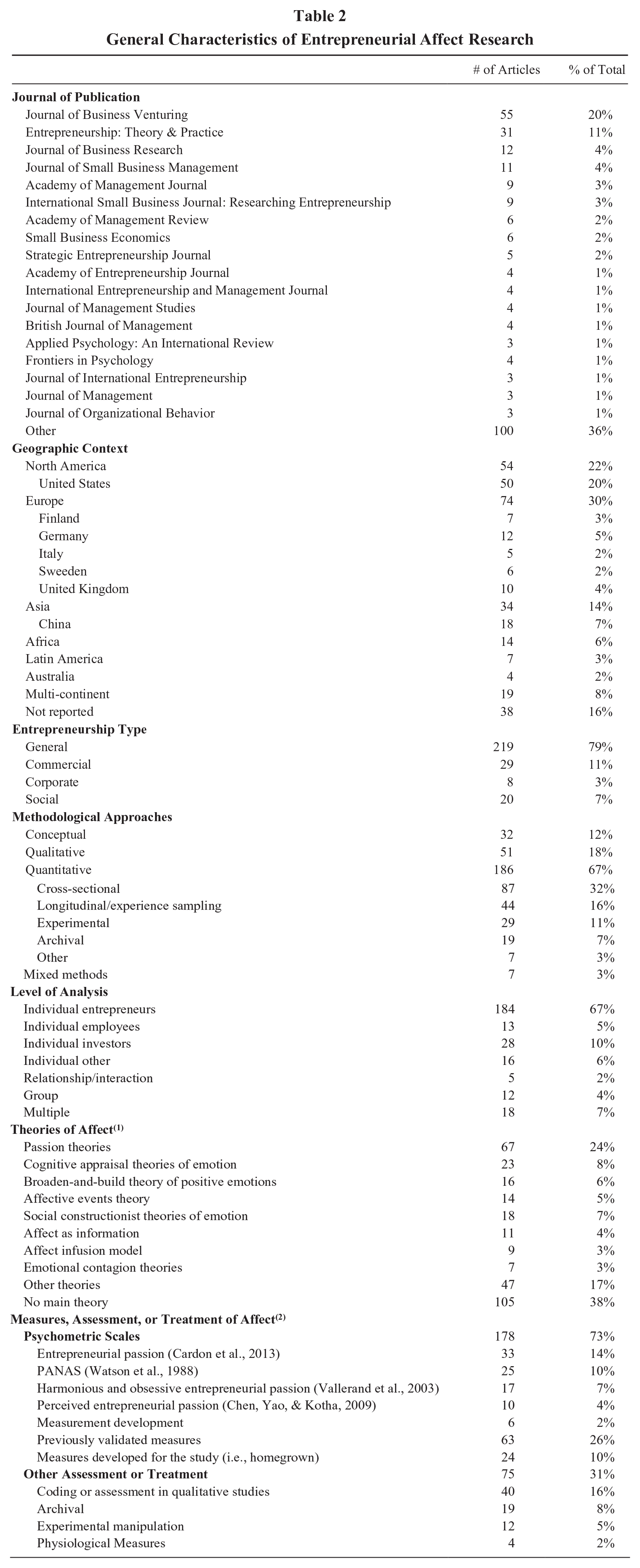
(1) Up to three theories per paper.
(2) Some papers used more than one measure, assessment, and/or treatment of affect.
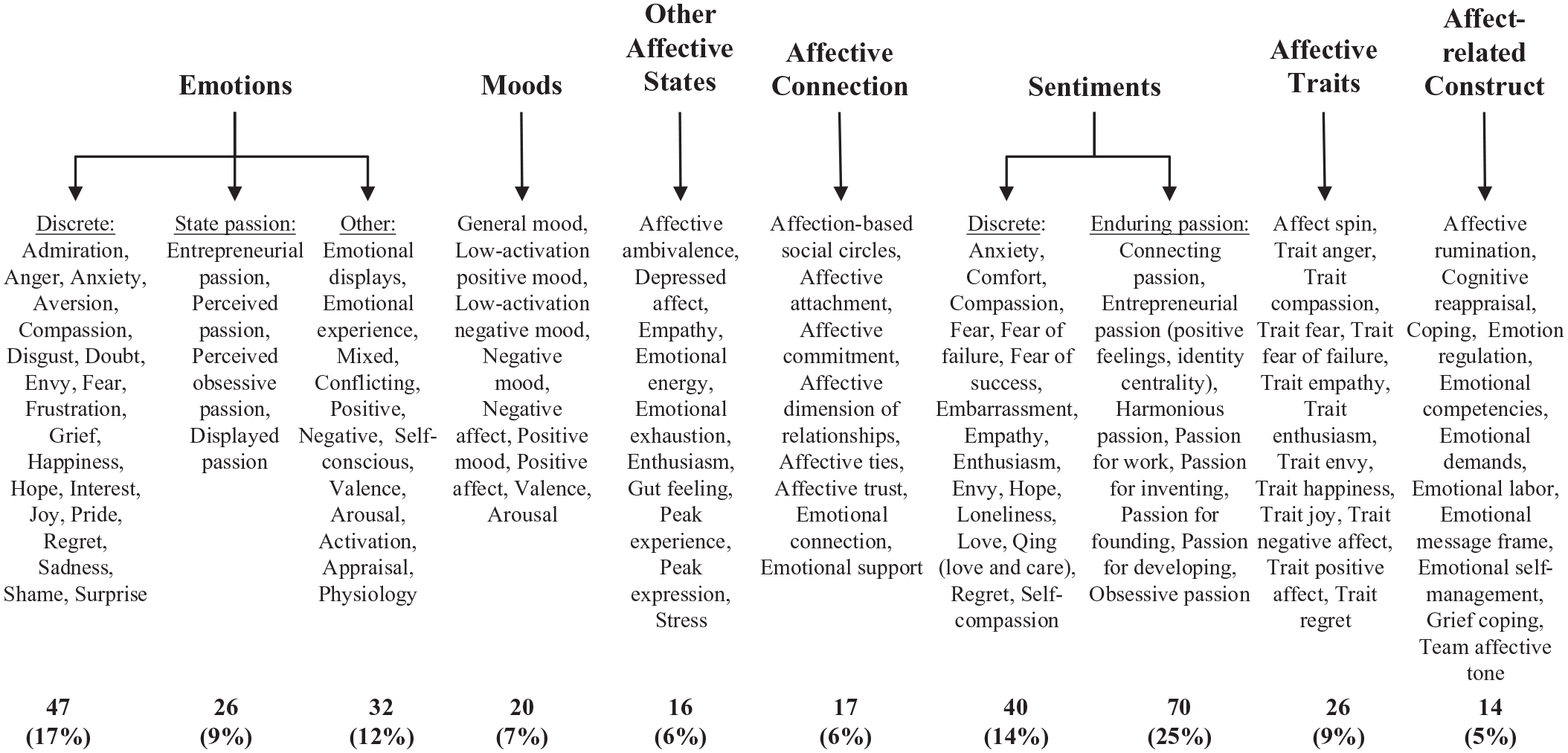
Categorization of Entrepreneurial Affect
General Characteristics of Entrepreneurial Affect Research
A variety of academic journals in various fields have published research on entrepreneurial affect (see Table 2). Specifically, of the 18 different journals that have published at least three articles on the topic (representing 176 articles or 64% of our sample), nine are from entrepreneurship (128 articles, 46%), six are from general management (38 articles, 14%), and three are from psychology (10 articles, 4%). Despite this distribution, the top two entrepreneurship journals, Journal of Business Venturing and Entrepreneurship Theory and Practice, have published a combined 86 articles, representing almost one-third of the articles included in our review.
Regarding the geographic context, 133 (54%) of the 245 empirical articles in the sample analyzed data from Western countries, 50 of which relied on samples in the United States. Only 34 articles (14%) used data from Asian countries, and 25 (11%) from the Southern Hemisphere (Africa, Australia, and Latin America). Most surprisingly, 38 (16%) articles did not disclose the geographical context of their research. As for the entrepreneurial context, only 57 (21%) explicitly state the context for their study or theory, with 29 (10%) focusing on commercial entrepreneurship, 20 (7%) on social entrepreneurship, and 8 (3%) on corporate entrepreneurship. Shockingly, 220 (79%) do not specify what type of entrepreneurship is being researched.
Concerning the methodological approach, while the majority of articles in our sample (186, or 68%) are quantitative, there are also several qualitative (51, or 18%), conceptual (32, or 12%), and mixed-methods (7, or 3%) papers as well. Moreover, among the quantitative studies, 87 employ cross-sectional techniques while 44 employ longitudinal/experience sampling and 29 employ experimental methods. With respect to the level of analysis, almost all of the articles in our sample (242, or 87%) focus on affect at the individual level of analysis. Among these articles, 185 focus exclusively on the entrepreneur, while 57 focus on other individuals, such as investors and employees. Finally, only 17 (6%) focus on the dyadic or group level, and 18 (6%) focus on multiple levels of analysis.
The articles included in our review build on more than 40 different theories of affect. Passion theories are the most widely used (67, or 24%; e.g., Cardon et al., 2009; Vallerand et al., 2003), followed by cognitive appraisal theories of emotions (23, or 8%; e.g., Lazarus, 1991), social constructionist theories of emotion (18, or 6%; e.g., Fineman, 1993), broaden-and-build theory of positive emotions (16, or 6%; e.g., Fredrickson, 2001, 2004), affective events theory (14, or 5%; Weiss & Cropanzano, 1996), and affect as information (11, or 4%; e.g., Schwarz & Clore, 1983). However, to our surprise, we find that 105 (38%) articles included in the review do not use any theory of affect or emotions.
Regarding the scales used to measure affect, we find three measures of passion widely used in the field: entrepreneurial passion (Cardon et al., 2013), harmonious and obsessive passion (Vallerand et al., 2003), and perceived entrepreneurial passion (Chen et al., 2009). Researchers have also relied extensively on the positive and negative affect schedule (PANAS; Watson et al., 1988). In addition to using scales to measure affect, researchers have also assessed affect in other non-psychometric ways: 40 researchers used qualitative coding (e.g., Farny, Kibler, Hai, & Landoni, 2019), 19 constructed proxies using archival data (e.g., Franzoni & Tenca, 2023), 12 implemented experimental manipulations (e.g., Fu, Tietz, & Delmar, 2022), and 4 used physiological assessments (e.g., Halko et al., 2017). Notably, some empirical studies contain a mismatch between the conceptualized affect and the measured affect. Finally, many empirical articles measure affect without providing a clear rationale for their scale or item selection.
Categorizing Entrepreneurial Affect
As part of the integrative objective of our review (Rousseau, Manning, & Denyer, 2008), we have categorized affective constructs in entrepreneurship (see Figure 1) based on the types of affect that have been studied in our sample. To do so, we took an inductive approach (Gioia, Corley, & Hamilton, 2013) to expand and refine the theoretical categories of affect highlighted in the theory section presented in Table 1. As a result, we created three additional categories of affective phenomena that were not included in our initial typology but that we identified in the sample of articles. The first category, “affective connection,” emerged from articles examining affective constructs related to social bonds or relationships (e.g., affective trust, emotional connection). The second category, “other affective states,” includes a variety of unrelated affective states (e.g., stress, gut feeling, emotional energy), each of which was examined in one or two studies only. The third category, “affect-related constructs,” incorporates phenomena related to affect but that cannot be classified into an affective form (e.g., emotional competencies, coping, emotion regulation, emotional labor).
In addition, we refined the categorization by creating subcategories for two affective phenomena: emotions and sentiments. In the case of emotions, we identified three distinct sets of constructs: discrete emotions, state passion, and other emotional phenomena. Discrete emotions refer to specific or distinct responses to affective events with a unique phenomenology, such as anger, disgust, joy, pride, or shame. As such, each discrete emotion tells a “different story of a person’s ongoing adaptational struggles” (Lazarus & Cohen-Charash, 2001; 49). State passion refers to the temporary, intense experience of pleasant emotions or feelings that are directed toward a specific activity. The last subcategory, other emotional phenomena, incorporates three sets of constructs that reflect generic emotional displays or experiences; reflect groups of discrete emotions (e.g., conflicting emotions, positive emotions); and examine specific dimensions or components of emotions, such as valence, arousal, and cognitive appraisal. Of special note, while all the groupings in the other emotional phenomena subcategory characterize discrete emotions, each can be studied independently of any discrete emotion. In the case of sentiments, we identified two sets of constructs: (a) discrete sentiments (e.g., compassion, empathy, envy) and (b) enduring passion (e.g., passion for inventing, harmonious entrepreneurial passion).
At the highest level of categorization of entrepreneurial affect, researchers have relied on emotions (105 articles, or 38%) and sentiments (110 articles, or 39%) the most. However, passion is the main type of affect being studied (97 articles, or 25%), with 70 papers exploring enduring forms of passion and 26 state forms of passion. Noteworthy, almost all the studies on state passion examined others’ perceptions of passion, with only two exceptions that examined how entrepreneurs’ own experience of passion ebbs and flows over time (Gielnik, Uy, Funken, & Bischoff, 2017; Stevenson, Guarana, Lee, Conder, Arvate, & Bonani, 2023). Many articles (47, or 17%) also examined the role of discrete emotions on entrepreneurship, including anger (8, or 3%), fear (12, or 4%), grief (9, or 3%), and regret (6, or 2%). In addition, discrete sentiments have also received considerable attention (40 articles, or 14%), including 17 (6%) articles that explored different conceptualizations of fear (e.g., fear of failure) and 9 (3%) that have examined compassion. Affective traits have been studied in 26 (9%) papers, including 12 (4%) papers focusing on trait positive affect and 8 (3%) on trait negative affect. Finally, moods have been examined in 20 (7%) papers, affective connections in 17 (6%) papers, other affective states (e.g., gut feeling, emotional energy) in 16 (6%) articles, and other affect-related constructs (e.g., emotion regulation, emotional labor) in 14 (5%) manuscripts.
A Framework of Entrepreneurial Affect
Building on the categorization in Figure 1, we present a framework illustrating the role of affect in the entrepreneurial process in Figure 2. To develop our framework, we built directly on Shane and Venkataraman’s (2000: 218) foundational definition of entrepreneurship as “how, by whom, and with what effects opportunities to create future goods and services are discovered, evaluated, and exploited.” Specifically, we disaggregate the entrepreneurial process to examine how affect influences the entrepreneur (i.e., whom) and the actions they take in pursuing opportunities (i.e., discovery, evaluation, exploitation). In addition, we present the effects of the entrepreneur’s characteristics and actions on their affective experience. After categorizing the findings of each empirical article into each of the four meta-constructs in our framework (whom, discovery, evaluation, exploitation), we clustered the findings according to the entrepreneurial construct that affect was found to influence or be influenced by following an inductive approach (Gioia et al., 2013; Jeon & Maula, 2022). For example, in the whom portion of the framework, we clustered constructs such as risk preferences and self-efficacy into a higher-order construct, which we labeled positive psychological characteristics. We also identified and categorized instances in which affect was used to moderate the relationships in our framework. Importantly, we only included empirical findings regarding forms or categories of affect that have been supported in multiple articles. For example, as Figure 2 shows, several discrete emotions influence the entrepreneur’s positive psychological characteristics: anxiety, fear, and shame have a negative relationship, whereas empathy and enthusiasm have a positive relationship with this outcome. Finally, we did not include findings that examined relationships between affective forms or that compared different types of entrepreneurs. In the following subsections, we describe each of the meta-constructs in our framework, summarize key findings, and highlight rigorous exemplar studies.
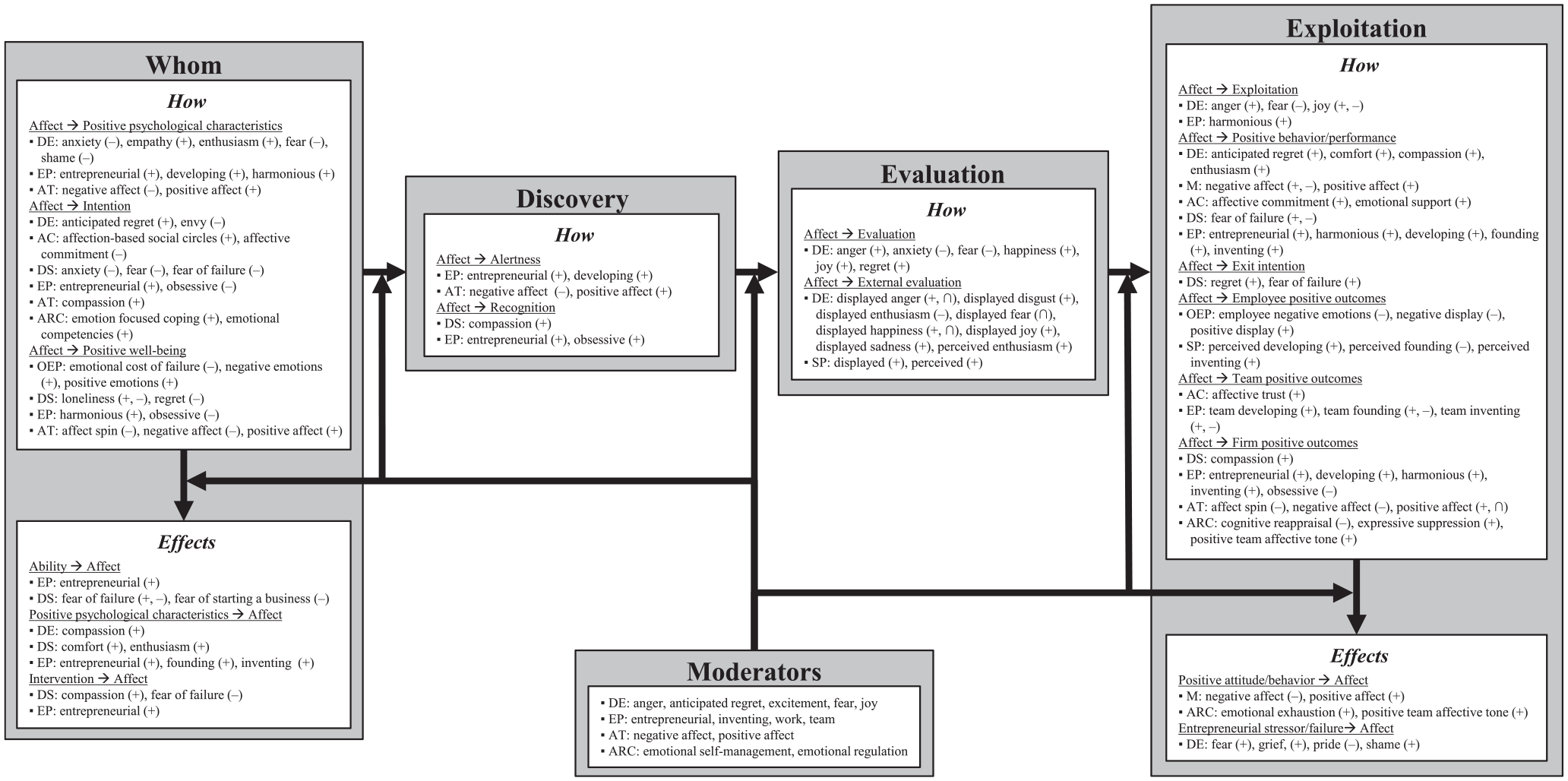
Framework of Entrepreneurial Affect
Whom
This meta-construct represents the entrepreneurs and their characteristics. The first subset of 86 articles (12 conceptual) in the whom portion of our framework studies how affect influences positive psychological characteristics, intention, and positive well-being. Another subset of 26 articles explores the effects of entrepreneurs’ ability and positive psychological characteristics, as well as interventions targeting the entrepreneur, on their affective experience.
How
Articles that examine positive psychological characteristics of the entrepreneur have looked at how affect influences individual constructs, such as self-efficacy, risk preference, cognition, and creativity. Overall, pleasant, discrete emotions (e.g., empathy, enthusiasm), enduring passion (e.g., entrepreneurial, developing, harmonious), and trait positive affect are positively related, whereas unpleasant discrete emotions (e.g., anxiety, fear) and trait negative affect are negatively related to these entrepreneurial outcomes. These findings are consistent with broaden-and-build theory, indicating that positive affect broadens the scope of attention and thought-action repertoires, whereas negative affect narrows them (Fredrickson, 2004; Fredrickson & Branigan, 2005), as well as affect-as-information theory, indicating that affect serves as informational signals and increases the availability of affect-congruent information (Schwarz & Clore, 1983). For example, several studies found a positive relationship between different forms of enduring passion and self-efficacy (e.g., Bacq & Alt, 2018; Murnieks, Mosakowski, & Cardon, 2014; Huyghe, Knockaert, & Obschonka, 2016). In another example, Baron and Tang (2011) found that trait positive affect among founding entrepreneurs is positively related to their creative behavior.
Another set of articles has examined how affect influences intention, which refers to entrepreneurs’ “states of mind that direct attention, experience, and action toward a business concept” (Bird, 1988: 442). The majority of the studies have found that enduring forms of affect, including anxiety, fear, fear of failure, obsessive passion, and affective commitment, are negatively related to entrepreneurial intention, whereas affection-based social circles, entrepreneurial passion, and trait compassion are positively related to entrepreneurial intention. These findings demonstrate that affective states direct attention and prioritize behaviors, a position put forward by social functional theories of emotions (e.g., Keltner & Haidt, 1999). For example, research has found that the level of entrepreneurial passion among business students (Dheer & Castrogiovanni, 2023) and homebrewers (Biraglia & Kadile, 2017) is positively related to their intentions to start a commercial business. In another study, Rieger, Gründler, Winkler, Tschauner, and Engelen (2021) found that trait compassion is positively related to the intention to become a social entrepreneur.
The last set of articles explored how the entrepreneurs’ affect influences their positive well-being or the presence of indicators of psychological adjustment, such as life or job satisfaction and recovery from failure, and the absence of indicators of psychological maladjustment, such as burnout (Houben, Van Den Noortgate, & Kuppens, 2015). Overall, positive forms of affect, including pleasant emotions, harmonious passion, and trait positive affect, are positively associated with entrepreneurial well-being, while negative forms of affect, including the emotional cost of failure, regret, and trait negative affect, are negatively related to well-being. These findings contribute to our understanding of the entrepreneur’s well-being, which is useful because disciplinary findings on different aspects of well-being paint a complex picture; they show that positive and negative aspects of well-being are conceptually distinct from each other and can have different predictors (Houben et al., 2015; Portocarrero, Gonzalez, & Ekema-Agbaw, 2020). For example, de Mol, Ho, and Pollack (2018) found that obsessive (harmonious) passion is negatively (positively) related to burnout. Interestingly, some studies in this area have revealed counterintuitive findings that break with the pattern described previously, such as Cardon and Arwine (2024), who found that loneliness can be both beneficial and detrimental to the well-being of the entrepreneur.
Effects
Turning our attention to the effects of entrepreneurs’ characteristics, the first subset of articles examined how entrepreneurs’ abilities and knowledge influence their affect. The only consistent finding shows that entrepreneurs’ abilities (e.g., cognitive adaptability, work competence) are positively related to their enduring sense of entrepreneurial passion (e.g., Dheer & Castrogiovanni, 2023). Interestingly, when researchers attach a different context to the sentiment of entrepreneurial fear, the influence of their abilities differs: knowledge is negatively related to both the fear of starting a business and the fear of failure, whereas prior experience of failure is positively related to fear of failure (Qian & Miao, 2016; Sepúlveda & Bonilla, 2014).
Consistent with the idea that positive emotions signal and therefore go hand in hand with overall psychological well-being (Diener, Sandvik, & Pavot, 2009), another set of findings shows that entrepreneurs’ positive psychological characteristics (e.g., self-efficacy, optimism) are positively related to pleasant emotions and sentiments, as well as enduring forms of passion. For example, entrepreneurial self-efficacy is positively related to positive feelings (of passion) in the short term and is positively related to identity centrality (of passion) in the longer term (Lex, Gielnik, Spitzmuller, Jacob, & Frese, 2022). Finally, the last set of findings in this portion of the framework suggests that interventions or training programs targeting the entrepreneur enhance discrete sentiments and enduring passion. For example, loving-kindness meditation mitigates entrepreneurs’ fear of failure, mediated by enhanced self-compassion (Engel, Noordijk, Spoelder, & van Gelderen, 2021). These findings align with research on wise interventions, which suggest that when an intervention manages to alter individuals’ perceptions of themselves (e.g., entrepreneurial fear, enduring passion), downstream consequences can follow (Brockner & Sherman, 2019; Portocarrero & Burbano, 2024).
Discovery
This meta-construct represents an entrepreneur’s discovery of opportunities, which in the context of our sample includes findings related to both alertness and recognition (Kirzner, 2009). The only set of 19 articles (3 conceptual) in the discovery portion of our framework studies how affect influences entrepreneurial alertness and opportunity recognition. Of note is that none of the papers included in our review examined the effect of discovering opportunities on entrepreneurs’ affective experience.
How
The first set of papers found that enduring forms of passion and affective traits are positively related to entrepreneurial alertness or “an attitude of receptiveness to available (but hitherto overlooked) opportunities” (Kirzner, 1997: 72). For example, Tang, Kacmar, and Busenitz (2012) found that trait positive affect is positively related to the three dimensions of alertness (i.e., search, association, and evaluation), while trait negative affect is negatively related to each dimension. The fact that positive forms of affect are related to expansive exploration is representative of what we know about affect as directing cognition (Frijda, 2017). As suggested by Fredrickson (2004), pleasant affect signals that the environment is safe to explore and build resources for the future, whereas unpleasant forms of affect signals that there is a problem and focus is needed. The second set of papers shows that discrete sentiments and enduring forms of passion are positively associated with opportunity recognition, or “the process through which ideas for potentially profitable new business ventures are identified by specific persons” (Baron & Ensley, 2006). For example, self-compassion and other-regarding compassion are positively related to prosocial opportunity recognition via both reflexivity and imprinting (Yitshaki, Kropp, & Honig, 2022).
Evaluation
This meta-construct represents the evaluation or the assessment of the feasibility and desirability (Haynie, Shepherd, & McMullen, 2009) of opportunities. The only set of 45 articles (4 conceptual) in the evaluation portion of our framework studies how affect influences the evaluation conducted by entrepreneurs and investors. Similar to the discovery portion of the framework, none of the findings examined the effect of evaluating opportunities on entrepreneurs’ affective experience.
How
In the set of papers where the entrepreneur is the evaluator, all the findings suggest that entrepreneurs’ pleasant (unpleasant) discrete emotions are positively (negatively) related to their assessment of the feasibility and desirability of entrepreneurial opportunities. For example, Grichnik, Smeja, and Welpe (2010) found that joy is positively related to entrepreneurs’ opportunity evaluation. In another example, Kollmann, Stöckmann, and Kensbock (2017) found that fear of failure mediates the negative relationship between the entrepreneur’s perception of obstacles and opportunity evaluation. These findings correspond with the larger dialogue in affective science on emotions and risk assessment (Lerner & Keltner, 2001).
In the second set of papers, researchers have examined how the emotions of the entrepreneur influence investors’ assessments or funding decisions, that is, how perceivers respond to emotional cues. Indeed, according to the emotions as social information (EASI; van Kleef & Cote, 2022) perspective, emotions can spark observers’ cognitive inferences as well as affective responses. Several papers found a positive association between displayed or perceived passion and funding potential or performance. For example, Mitteness, Sudek, and Cardon (2012) found that perceived passion significantly influences the funding potential of angel investors. Warnick et al. (2018) found that both venture capitalists’ and angel investors’ perceptions of entrepreneurs’ passion are positively related to probability of investment; the effect is stronger when investors also perceive entrepreneurs’ as open to feedback. Shane, Drover, Clingingsmith, and Cerf (2020) found that founders’ displayed passion increases informal investor neural engagement measured through fMRI and interest in the venture. Finally, aside from state passion, other papers examined complex relationships (i.e., positive, negative, and curvilinear) between entrepreneurs’ discrete emotions and investors’ assessments or funding decisions. For example, Jiang, Yin, and Liu (2019) found that excessive displays of positively-valenced affect can have a negative impact on crowdfunding decisions, such that an excessive duration of displayed joy in pitches has an inverted U-shaped relationship with funding performance. Warnick, Davis, Allison, and Anglin (2021) found a positive relationship to frequency of change in entrepreneurs’ facial expression on emotion on crowdfunding performance, and an inverted U-shaped relationship for the influence of frequency of happiness, anger, and fear on funding performance.
Exploitation
This meta-construct represents the exploitation of entrepreneurial opportunities or the “building [of] efficient, full-scale operations for products or services created by, or derived from, a business opportunity” (Choi, Levesque, & Shepherd, 2008). The first subset of 103 articles (5 conceptual) in the exploitation portion of our framework studies how affect influences the entrepreneurs’ exploitation activities, behavior or performance, and exit intentions, as well as employee-, team-, and firm-level outcomes. Another subset of 32 articles (3 conceptual) explores the effects of entrepreneurs’ attitudes, behaviors, stressors, and failure on their affective experience.
How
A large set of papers examined how affect influences the individual entrepreneur during the exploitation process. The first construct evaluated by these papers is generic exploitation activities, and it has only been studied in relation to discrete emotions and enduring passion. Interestingly, researchers have found that pleasant and unpleasant emotions can have both positive and negative effects on exploitation. Because exploitation entails different activities, it is natural that there are mixed results when comparing the effect of emotional states—that is, emotions direct attention in different ways, and therefore, no emotion dominates others across tasks (Elfenbein, 2007). Specifically, Welpe, Spörrle, Grichnik, Michl, and Audretsch (2012) and Grichnik et al. (2010) find that fear is negatively related to exploitation, but they arrive at mixed findings regarding joy, with the former finding a positive relationship and the latter finding a negative relationship.
The second set of constructs has examined how several forms of affect influence entrepreneurs’ positive behaviors and individual performance. With two exceptions, researchers exploring these relationships have consistently found that pleasant discrete emotions, affective connections, and enduring forms of passion have a positive effect on individual-level entrepreneurial behaviors and performance. Building on the tenets of affective events theory, these findings are aligned with work on emotions in organizations, demonstrating that emotions and other forms of affect can influence performance (Weiss & Cropanzano, 1996). For example, Yitshaki et al. (2022) find that self-compassion and other-regarding compassion are positively related to prosocial action via reflexivity and imprinting and Valéau, Gabay-Mariani, and Paillé (2024) find that entrepreneurs’ persistence draws on initial and long-term affective commitment. Interestingly, Morris, Kuratko, Santos, and Soleimanof (2024) find that a liability of poorness contributes to both a fear of failure and a fear of success; whereas fear of failure can lead the entrepreneur to both manage a venture more conservatively and be more driven, tenacious, and resilient, fear of success can lead to procrastination, avoidance, self-sabotage, and failing to act. Finally, researchers have also found that unpleasant discrete emotions are positively associated with entrepreneurs’ intention to exit. For example, the intention to exit is positively related to both group fear (Huang, Souitaris, & Barsade, 2019) and fear of failure (Shahid, Mei, & Battisti, 2024).
Researchers have also explored how entrepreneurs’ affects influence the attitudes and behavior of employees in entrepreneurial ventures. Consistent with leader-member exchange theory (Dansereau, Graen, & Haga, 1975), leader and subordinate interactions—and, in particular, leader emotions—can dynamically shape employee outcomes (Cropanzano et al., 2017). For example, employees’ perceptions of the entrepreneurs’ unpleasant (pleasant) emotions are negatively (positively) related to employees’ attitudes and behaviors (e.g., Brundin, Patzelt, & Shepherd, 2008). In addition, Breugst, Domurath, Patzelt, and Klaukien (2012) found that employees’ perceptions of entrepreneurs’ passion for inventing and developing enhance their commitment to entrepreneurial ventures, while employees’ perception of passion for founding reduces their commitment. Furthermore, two papers (Patzelt, Gartzia, Wolfe, & Shepherd, 2021; Shepherd, Patzelt, & Wolfe, 2011) conclude that employees’ own unpleasant emotions are negatively related to their attitudes and performance.
Regarding team-level outcomes, affective connection and team-level passion are related to team performance. While researchers have found a positive effect of affective trust on team performance (e.g., Eva, Newman, Miao, Cooper, & Herbert, 2018), team passion has different effects on team performance depending on the foci of passion. For example, team entrepreneurial passion for inventing is positively related to team performance for mono-focal TEP teams and complete poly-focal TEP teams but is negatively related to performance for incomplete poly-focal TEP teams (Santos & Cardon, 2019). Other findings indicate that average team passion is not related to venture performance, but passion focus variety is negatively related to venture performance (de Mol, Cardon, de Jong, Khapova, & Elfring, 2020). These findings contribute to the larger dialogue on shared group affect, which has focused on group member contagion and homogeneity of experiences (Barsade & Knight, 2015).
The final set of papers in this category examines how different forms of affect influence firm-level outcomes, including venture growth, innovation, performance, and survival. On the one hand, we know that entrepreneurs’ pleasant discrete sentiments (compassion) and enduring forms of passion, with the exception of obsessive passion, have positive relationships with firm outcomes. These findings parallel upper echelons theory in organizational research showing that top managers’ characteristics are associated with organizational outcomes (Neely et al., 2020). For example, Ho and Pollack (2014) find that harmonious passion is positively related to out-degree centrality, and obsessive passion is negatively related to out-degree centrality, which is positively related to business income by way of referral income. On the other hand, affective traits and affect-related constructs have less straightforward relationships with firm outcomes. For example, Uy, Sun, and Foo (2017) found that entrepreneurs’ affect spin—or a person’s reactivity to emotional events—is negatively related to venture goal progress, and Baron et al. (2011) found that trait positive affect has a curvilinear relationship with product innovation and sales growth rate.
Effects
The final set of papers in our framework explores the effects of entrepreneurs’ attitudes, behaviors, stressors, and failure on their affective experience. Just as employees make sense of their work environment and create subjective meaning and affective responses (Weick, Sutcliffe, & Obstfeld, 2005), so do entrepreneurs’ perceptions and behaviors affect their emotional experiences. Researchers have found that work engagement is positively related to positive affect while workaholism is positively related to negative affect (Gorgievski, Moriano, & Bakker, 2014), that managing responsibility is positively related to the sense of achievement and to emotional exhaustion (Wei, Cang, & Hisrich, 2015), and that shared authentic leadership behavior of new venture top management teams’ is positively related to positive team affective tone (Hmieleski, Cole, & Baron, 2012). Entrepreneurial stressors, including venture failure, positively (negatively) influence unpleasant (pleasant) discrete emotions. Consistent with appraisal theories of emotions, emotions arise from interpretations of significant events or stimuli in one’s environment (Ellsworth & Scherer, 2003). For example, failure has been found to be positively related to grief (Cope, 2011; Jenkins, Wiklund, & Brundin, 2014), while daily entrepreneurial stressors (e.g., workload and financial stressors) are negatively related to pride (Xu, Kellermanns, & Jin, 2022).
Moderators
Several scholars have explored how affect influences several relationships in the entrepreneurial process. Discrete emotions and enduring forms of passion are the two categories of affect that have been examined most as moderators of entrepreneurial relationships. Specifically, researchers have explored how anticipated regret (Jiatong, Murad, Bajun, Syed, & Munir, 2022; Neneh, 2019), enduring forms of passion (Costa, Santos, Wach, & Caetano, 2018; De Clercq, Honig, & Martin, 2013; Su, Luo, Lau, & de Jong, 2024; Warnick et al., 2021), and fear (Vesci, Crudele, Feola, & Parente, 2023; Welpe et al., 2012) influence relationships such as the effects of entrepreneurial intention on behavior and the effects of entrepreneurial training on opportunity recognition.
An Agenda for Future Research on Entrepreneurial Affect
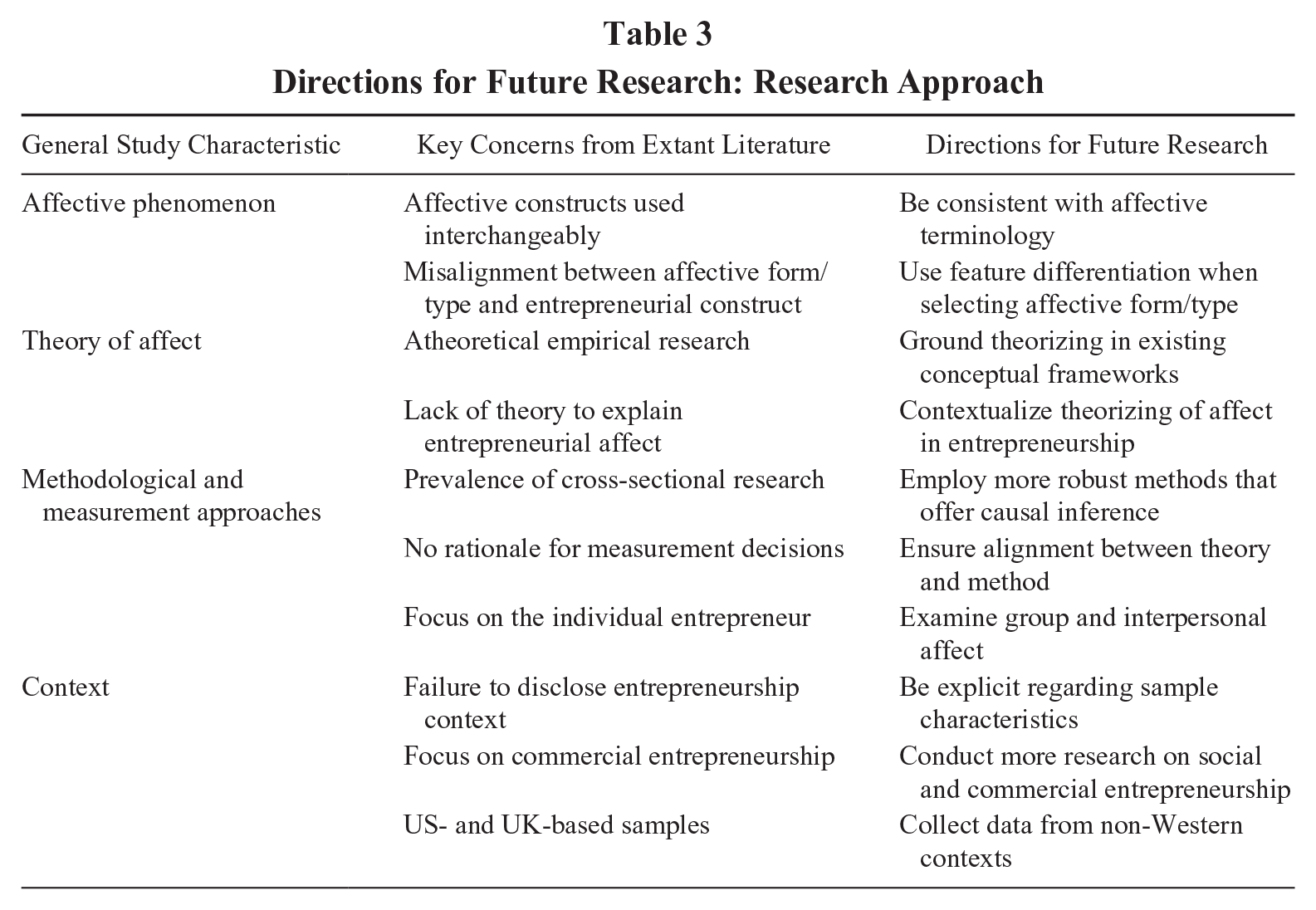
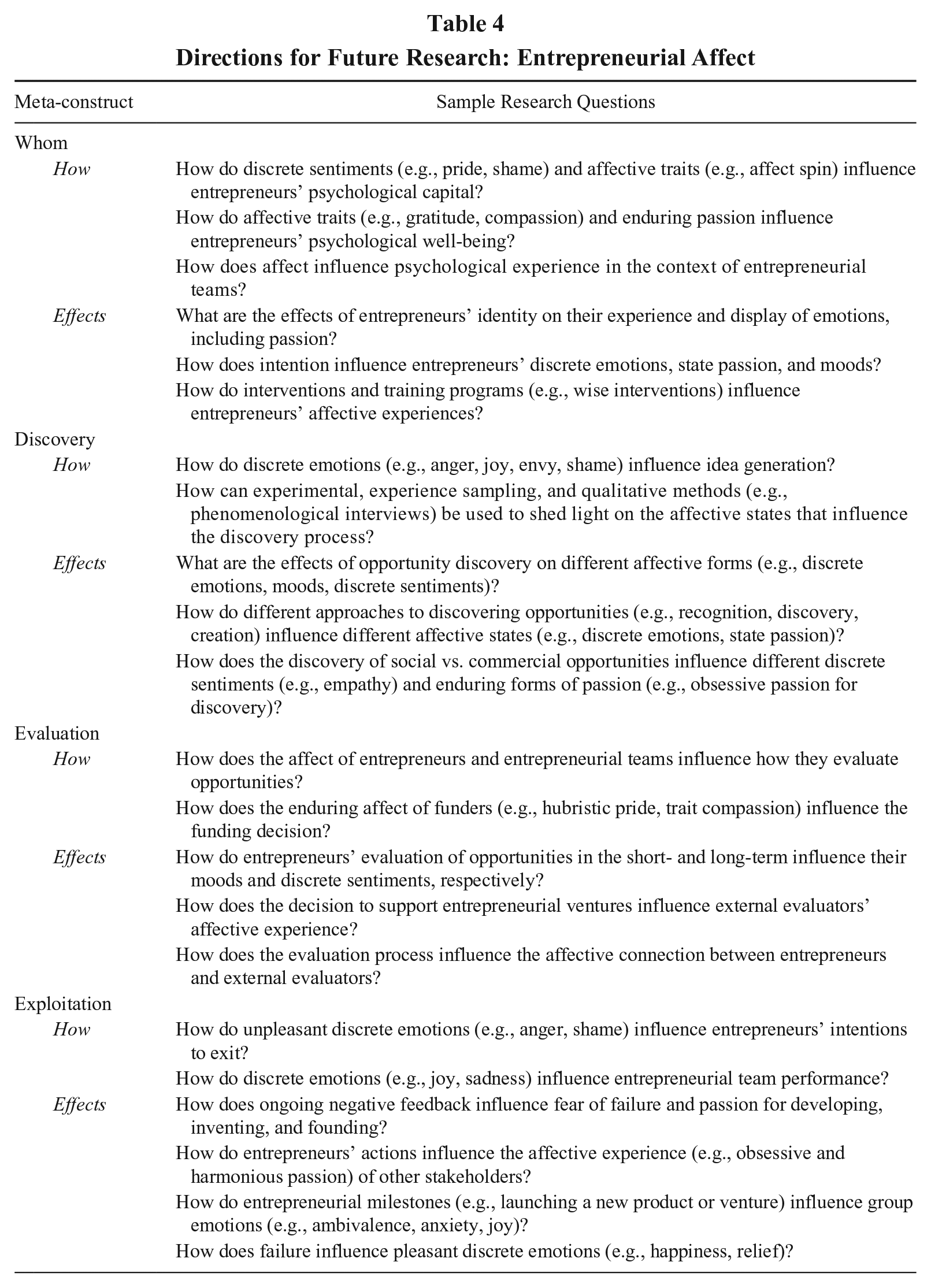
This review seeks to shine a brighter light on how distinct forms of affect are related to entrepreneurship. To do so, we first build on affective sciences to categorize the myriad of affective constructs in entrepreneurship. We then leverage our categorization to develop a comprehensive framework of entrepreneurial affect that describes the current state of the literature. Based on our insights from these findings, we outline in the sections below an agenda for scholars interested in extending the entrepreneurial affect literature going forward. To do so, we begin by presenting opportunities to improve the overall rigor of research on entrepreneurial affect by leveraging the insights gleaned from both our findings about the general characteristics of the articles in our review and our categorization of the affective constructs they have examined (see Table 3). We then present theoretical opportunities for future research related to each meta-construct in our framework, with particular attention to how future scholars can add to what we know about how affect influences entrepreneurship as well as the effects of entrepreneurship on affect (see Table 4).
Directions for Future Research: Research Approach
Directions for Future Research: Entrepreneurial Affect
Research Approach
Affective phenomena
Researchers examining entrepreneurial affect frequently use the terms affect, feeling, emotion, sentiment, and mood interchangeably. As we have highlighted in the theory section and through the categorization of entrepreneurial affect, this practice lags behind the foundational work in affective sciences, where these concepts have been distinctly defined (e.g., Frijda, 1994) and clarified (e.g., Scherer, 2005). Consequently, this lack of precision has hindered the development of a coherent understanding of how various forms and types of affect influence the entrepreneurial journey (Ashkanasy & Humphrey, 2011). Thus, we urge scholars to state the form and type of affect they will examine, to define the construct clearly, and to be consistent with their terminology throughout their manuscript.
While scholars have come to realize the importance of affect in entrepreneurship, they do not always fully consider the specific characteristics of the form and type of affect they adopt in their research. This results in a lack of precision in not only which affective constructs are chosen for investigation but also how they influence and are influenced by entrepreneurship. Take the case of emotions and moods, which represent within-person affective phenomena, in the form of states. These states are bound by time and can emerge or change rapidly after individuals or groups encounter emotional events (Weiss & Cropanzano, 1996). An entrepreneur might be momentarily happy after a successful meeting with an angel investor or might be angry at an employee for a preventable mistake. Those feelings will dissipate at the end of the emotional episode. Therefore, research on emotions should focus on entrepreneurial events or episodes and not on longer-term operationalization of entrepreneurial outcomes. Conversely, for the study of longer-term operationalizations of entrepreneurial outcomes, such as some forms of performance, success, and survival, appropriate affective concepts to be used as predictors would be more stable forms of affect (i.e., affective dispositions), which allow researchers to study phenomena focusing on between-person variations (Beal et al., 2005). Therefore, in selecting their affective constructs, we urge scholars to use Scherer’s (2005) feature differentiation approach to understand better and identify the form and type of affect that best fits their research question (see Table 1). As we discussed in the theory section, researchers can analyze if a specific affective form is event focused (i.e., elicited by an event) or appraisal driven (i.e., driven by evaluative processes) or varies based on the intensity, rapidity of change, response synchronization (i.e., different intra-personal systems reacting in synchronicity), behavioral impact, or centrality to the entrepreneurs’ identity.
Theoretical foundation
It is important to point out that the findings of our review suggest that scholars are employing a wide range of theories to inform their research. However, one-third of the papers included in our review do not reference any theory of affect. Because of this lack of theorizing, it is difficult to determine precisely how affect relates to entrepreneurial phenomena. We, therefore, urge researchers to ground their theorizing and hypothesis development in existing conceptual frameworks (Sparrowe & Mayer, 2011).
Importantly, the majority of theories of affect in the paper in our sample come from the affective sciences, with a limited number of theories developed to explain the affective experience of entrepreneurs in particular—specifically, around passion (e.g., Cardon et al., 2009, 2017), funding (Ashta, 2019; L. Huang & Knight, 2017), and grief (e.g., D. A. Shepherd, 2003). While informative, these studies only begin to scratch the surface of the complex dynamics that define the entrepreneurial context. Accordingly, we urge scholars to engage in more contextual theorizing (e.g., Welter & Baker, 2021) in order to better inform research on entrepreneurial affect and to “give back” to the larger field of affective sciences.
Methodological rigor and transparency
While researchers have used a healthy mix of methodological approaches, the findings suggest that a broader approach to quantitative research is needed. That nearly half of the quantitative studies on entrepreneurial affect analyze cross-sectional data is concerning as such a design, while useful in establishing the presence, absence, and nature of relationships, can nevertheless neither test causal processes nor establish change (Bono & McNamara, 2011). Coupled with the biases associated with common method, social desirability, and self-reports (e.g., Donaldson & Grant-Vallone, 2002), we encourage scholars to conduct more rigorous quantitative research, such as longitudinal, experimental, physiological assessments, or experience sampling so that they can generate richer insights and better assess causal effects for readers. For example, randomized experiments are considered the gold standard for testing causal relationships and ruling out alternative explanations (Bolinger, Josefy, Stevenson, & Hitt, 2022; R. M. Stevenson, Josefy, McMullen, & Shepherd, 2020), but our review indicates that this method is currently underused. By inducing affects that differ across experimental conditions, researchers can examine their effects on discovery, evaluation, and exploitation of entrepreneurial opportunities. While randomized experiment in a controlled setting prioritizes internal validity, researchers concerned with external validity are encouraged to consider quasi-experiment, natural environment, field experiment, or combining a lab experiment with a field study to offer complementary evidence in terms of internal and external validity (R. M. Stevenson & Josefy, 2019).
While researchers have used a variety of measures, assessments, and treatments of affect, they often fail to provide a rationale for their decisions. Each measure was originally developed around specific conceptual foundations and researchers working on entrepreneurial affect should take into account these diverse conceptual foundations for measure selection. For example, one of the most widely used affective measures in our review, PANAS (Watson et al., 1988), has several issues that are often neglected. On the one hand, the items used represent different affective categories, including emotions and moods (Larsen & Diener, 1992), which is likely a consequence of the developers not being sufficiently concerned with the distinction among different affective states over 30 years ago. On the other hand, although several researchers use the PANAS to capture the entire pleasantness dimension of the affective domain, it only represents a part of it (i.e., the highly activating states)—not including moderately activating states, such as happy and glad or sad and miserable (Larsen & Diener, 1992). Thus, we urge scholars to disclose their rationale for and validity of the measure, assessment, or treatment of affect—whether new or established—in each study, and to ensure that the approach used matches the theoretical construct they are examining.
Finally, regarding the level of analysis of affect, current research on entrepreneurial affect offers valuable insight from the perspective of the individual entrepreneur. However, with the exception of the stream of research exploring investors in the evaluation stage, it often ignores other agents and interpersonal dynamics that are essential to the entrepreneurial process. Specifically, this heavy skew toward the individual is problematic, given the evidence that most ventures are founded by teams (Gartner, Shaver, Gatewood, & Katz, 1994) and that entrepreneurship occurring within existing organizations often involves teams (Corbett, Covin, O’Connor, & Tucci, 2013). As such, we suggest researchers to further explore group affect (e.g., Boone, Andries, & Clarysse, 2020) and affect from a dyadic and interpersonal perspective (e.g., L. Huang & Knight, 2017). In addition, more researchers should explore affect from multiple levels of analysis (e.g., Mantere, Aula, Schildt, & Vaara, 2013), as the emotional displays of one individual, such as a managing entrepreneur, can have critical effects on groups of employees, customers, or other stakeholders involved in the venturing process (Van Kleef, 2016).
Context
Although the overwhelming majority of papers in our review did not disclose the type of entrepreneur being studied, it is implicit that they are studying commercial entrepreneurs, leaving only a small minority of papers focused on corporate and social entrepreneurship combined. The omission of studies on these latter domains is surprising due to the increased attention given to context, both from a theoretical (e.g., Bruton, Zahra, Van de Ven, & Hitt, 2021; Welter & Baker, 2021) and empirical (e.g., Newbert, Kher, & Yang, 2022) perspective. Although different types of entrepreneurs and entrepreneurial processes have similarities, they also differ in substantial ways. For example, social entrepreneurs are striving to create social value as well as a sustainable financial income and manage tensions between these potentially contradicting objectives (Lehner & Kansikas, 2012). Thus, perseverance and tolerance to the frustration inherent in the pursuit of their hybrid mission are important characteristics for social entrepreneurs, which may make entrepreneurial events even more emotional in this context. Furthermore, commercial, corporate, and social entrepreneurs differ in the degree of risk they tend to take (Mair & Martí, 2006; Peredo & McLean, 2006); corporate entrepreneurship may be perceived by entrepreneurs as the least risky context, and social entrepreneurship as the riskiest, since creating sustainable social change is a highly complex and uncertain goal. In light of the nuances, we encourage future research on entrepreneurial affect to both explicitly specify the types of entrepreneurs and entrepreneurial contexts to which their research is generalizable and, more importantly, explore the role of affect in the contexts of social and commercial entrepreneurship. Finally, entrepreneurship researchers have begun to explore marginalized entrepreneurs and entrepreneurship in challenging contexts, including necessity entrepreneurs (e.g., O’Donnell, Leger, O’Gorman, & Clinton, 2024) and entrepreneurs with mental disorders (e.g., Freeman, Lerner, & Rauch, 2024; Johnson, Madole, & Freeman, 2018; Yu, Wiklund, & Pérez-Luño, 2021). To the extent that affect may play important roles in explaining how these entrepreneurs’ unique experiences promote or inhibit their pursuits of entrepreneurial opportunities, we encourage research in this area.
Regarding the geographic context, Europe and the United States are important contexts for the study of entrepreneurial affect given that they have some of the highest rates of entrepreneurship in the world (Marcotte, 2013). However, this focus on the West creates a gap in our knowledge of how affect influences and is influenced by the entrepreneurial process in other geographic contexts. Culture shapes not only how people experience affective events and express emotions (e.g., Lazarus, 1994; Markus & Kitayama, 1991; Tsai, 2021) but also how people evaluate innovative ideas and pursue entrepreneurial opportunities (Stephan, 2022). Given these cultural differences and the resource constraints characterizing emerging economies (e.g., Rawhouser, Sutter, Holzaepfel, Conger, & Newbert, in press), we suggest that researchers explore non-Western entrepreneurial contexts to expand our understanding of entrepreneurial affect.
Whom
How
There is ample room for researchers to explore how specific forms of affect influence several relevant characteristics of the entrepreneur. Despite the important role of psychological capital in the entrepreneurial process (e.g., Chatterjee, Shepherd, & Wincent, 2022), most research on this topic has focused on entrepreneurial self-efficacy (e.g., Dalborg & Wincent, 2015; Markman et al., 2005; Shahriar & Shepherd, 2019; Stroe, Parida, & Wincent, 2018). Thus, one direction is to examine how affect influences the other dimensions of entrepreneurs’ psychological capital (i.e., optimism, resilience, and hope; Yu, Zhu, Foo, & Wiklund, 2022). Due to the relatively stable nature of entrepreneurs’ psychological characteristics, we encourage future research on temporally consistent types of affect, such as discrete sentiment (e.g., pride, shame) and affective traits (e.g., affect spin). Another avenue for research is expanding our understanding of how affect influences entrepreneurs’ psychological well-being, a critical component of entrepreneur’s well-being. Psychological well-being refers to an entrepreneur’s positive adjustment or functioning and includes six components: self-acceptance, autonomy, environmental mastery, purpose in life, personal growth, and positive relations with others (Ryff, 1989). Building on research from personality psychology examining the association of traits with psychological well-being (e.g., Portocarrero et al., 2020), we recommend scholars consider the influence of more stable forms of affect, including affective traits (e.g., gratitude, compassion) and enduring passion, on this important indicator of well-being. Given the small but growing body of research exploring how affect influences the psychological experience of the entrepreneur (e.g., Marshall, Meek, Swab, & Markin, 2020; Uy et al., 2017), we encourage an explicit focus on entrepreneurial teams, which have received little attention from researchers in this area.
Effects
Our review indicates that most studies in this area focus on enduring forms of affect. Although this work has shed light on the role of stable characteristics of the entrepreneur on their affective experience, more research is needed to understand how more ephemeral forms and types of affect are influenced by the entrepreneur. Given that identity centrality, or the “relative importance that an individual places upon a focal identity compared to other identities” (Murnieks et al., 2014), is a core feature of discrete emotions (see Table 1), coupled with the sizable literature on identity in the entrepreneurship field (e.g., Crosina, 2024; Hoang & Gimeno, 2010; Oo, Allison, Sahaym, & Juasrikul, 2019; Shepherd & Haynie, 2009), we recommend that more scholars explore the effect of entrepreneurial identity on the experience and display of emotions, including passion (e.g., Murnieks, Cardon, & Haynie, 2020). In addition, although a significant amount of research hypothesizes and empirically tests the influence of affect on entrepreneurial intention, no articles in our sample have explored the impact of intention on affect. Given that affect is a critical motivator of behavior and intention is a core antecedent of entrepreneurial action, we encourage scholars to examine affect’s role as a potential mechanism linking intention to downstream entrepreneurial phenomena. Because discrete emotions, state passion, and moods are high on behavioral impact (see Table 1), we call on researchers to study whether and to what extent they are influenced by intention. Finally, given the promising effects of interventions on entrepreneurial attitudes and behavior (e.g., Stevenson et al., 2023), we suggest scholars explore the effects of several types of interventions and training programs (e.g., wise interventions) on different forms of affect.
Discovery
How
Given the small number of studies in this category, coupled with the importance of discovery to the overall entrepreneurial process (Shane, 2000), we urge scholars to ramp up research on how the discovery phase is informed by entrepreneurial affect. To date, most of the attention has been on alertness and recognition; however, there are other essential parts of the discovery process, such as effectuation (Stroe et al., 2018) and idea generation (Envick, 2014), that are influenced by the affect of the entrepreneur and, yet, have received only scant attention. Of course, because of the fleeting nature of entrepreneurial opportunities (Dimov, 2011), and the ephemeral forms of affect that are likely to lead to them, they are inherently difficult to study with traditional cross-sectional analysis. Therefore, we urge scholars to adopt experimental methods to explore how entrepreneurs induced to experience discrete emotions (e.g., anger, joy, envy, shame) react to environmental cues that allow for idea generation as well as experience sampling techniques to identify which affective states may influence when and how individuals effectuate opportunities in relevant contexts, such as entrepreneurship courses or early-stage incubators (see Lévesque & Stephan, 2020, for more insight on these and related methods). Scholars could also triangulate their findings by conducting qualitative research, such as phenomenological interviews (e.g., Discua Cruz & Hamilton, 2022; Gordon, Hamilton, & Jack, 2012; McKeever, Anderson, & Jack, 2014), to dig deeper into how entrepreneurs discover opportunities and the emotions and moods that are involved in the process.
Effects
Given the sole focus on affect as an antecedent to discovery, we encourage researchers to study how different forms of affect may be influenced by this process. For example, given the emotional costs associated with the pursuit of entrepreneurial opportunities (Kibler, Sirén, Maresch, Salmivaara, & Fink, 2024), scholars may explore the pleasant discrete emotions that are likely to result from the identification of a viable opportunity as well as the negative moods, or even discrete sentiments, that are likely to result from ongoing fruitless attempts to do so. Moreover, we encourage researchers to examine how different approaches to discovering opportunities (e.g., recognition, discovery, creation; Sarasvathy, Dew, Velamuri, & Venkataraman, 2010) can lead to different affective states, including discrete emotions and state passion. For example, given the surprise associated with “pushing back the boundaries of sheer ignorance” that enables entrepreneurs to become alert to pre-existing opportunities (Kirzner, 1997: 62), perhaps the opportunity recognition process is associated with joy and excitement, whereas the endogenous process of enactment that is central to the creation process (Alvarez, Barney, & Anderson, 2013) results in pride and state passion. Furthermore, given the contrasting goals between social versus commercial entrepreneurs (Pache & Santos, 2013), the discovery of each type of opportunity may also lead to distinct types of affect. Thus, it may be worthwhile to explore whether the discovery of social opportunities can help infuse entrepreneurs with empathy, while the discovery of commercial opportunities can lead to a stronger sense of obsessive entrepreneurial passion for discovery.
Evaluation
How
The articles included in this area collectively highlight the influence of discrete emotions and state passion on opportunity evaluation. Although this stream of research sheds important light on the influence of affective states in the event-focused portions of the evaluation stage, the overwhelming focus has been on external evaluators (e.g., crowdfunders, angel investors, experts). Thus, we urge scholars to examine how the affect of entrepreneurs and entrepreneurial teams influences how they evaluate opportunities, particularly with respect to situations in which they make specific decisions about whether or not to pursue them (e.g., Dimov, 2007; McMullen & Shepherd, 2006). In addition, it is surprising to find no research on enduring forms of affect or affective dispositions (e.g., entrepreneurial passion, trait negative affect, trait positive affect) as they could delineate boundary conditions of the influence of states on entrepreneurs’ evaluation processes (Ciarrochi & Forgas, 1999). Given the propensity of funders to invest in specific areas or industries (Ryu, Bae, & Brush, in press), we recommend scholars explore how enduring forms of affect influence funders’ decisions to fund a venture. For example, researchers could examine if crowdfunders high on trait compassion are more inclined to fund ventures seeking to maximize social impact, or whether angel investors high on hubristic pride are more inclined to fund ventures seeking to maximize financial returns.
Effects
As is the case with the discovery stage, no research has examined the influence of evaluation on entrepreneurs’ affective experiences. Given that evaluation is argued to be an empathic process requiring the entrepreneur to match another’s emotive state (McMullen, 2015), we encourage scholars to examine how situations in which entrepreneurs evaluate opportunities in the moment influence their own affective states, as well as how the longer-term evaluation process influences entrepreneurs’ enduring forms of affect. For example, scholars could explore the negative moods that result from unfavorable assessments of specific venture ideas or the discrete sentiments that emerge from lengthy due diligence processes. In addition, investors’ emotional involvement with an entrepreneurial project has been shown to lead to escalation of commitment over time (Devigne, Manigart, & Wright, 2016). Thus, we encourage researchers to study how external evaluators’ affective reactions may influence their decisions to support (or not) an entrepreneurial venture, both at the time of the initial pitch as well as in subsequent rounds, as well as the affective connections that develop between entrepreneurs and funders as part of that ongoing evaluation process (L. Huang & Knight, 2017).
Exploitation
How
While research on this part of the entrepreneurial process has shed light on how affect influences decisions to exploit opportunities as well as the attitudes and actions of entrepreneurs when exploiting them (e.g., effort, innovative behavior, persistence), we know little about how affective states that are high on behavioral impact and response synchronization (see Table 1) influence entrepreneurs’ intentions to exit. Similar to the unfolding model of turnover (T. W. Lee & Mitchell, 1994), which suggests that negative “shocks” (e.g., receiving an alternative job offer; being pressured by a supervisor to commit unethical behavior) prompt employees to leave a firm, we suspect that specific events may result in emotional responses by entrepreneurs and their teams that cause them to psychologically or physically disengage with the venture (Rouse, 2016). Thus, we urge researchers to examine exploitation in the context of major exogenous events. For example, individual events such as the death of a loved one, organizational events such as the loss of a prominent client, or societal events such as the COVID pandemic may trigger strong unpleasant discrete emotions (e.g., anger, shame, anxiety; Nguyen, Tran, Stephan, Van, & Anh, 2024), which in turn may infuse entrepreneurs with a desire to exit.
In addition, while some studies in our review have focused on team-level outcomes, all have examined the influence of enduring forms of affect. However, as Morris, Kuratko, Schindehutte, and Spivack (2012: 11) argue, “Entrepreneurship represents a cumulative series of interdependent events that takes on properties rooted in affect and emotion.” Thus, we urge scholars to explore how affective states, specifically discrete emotions such as joy or sadness, determine how entrepreneurial teams perform in the short term. Finally, most studies on firm-level outcomes have focused on traditional performance measures, such as survival and venture growth (e.g., Doern & Goss, 2014; Stenholm & Renko, 2016). While relevant for many firms, particularly those pursuing commercial goals, they are less relevant for those pursuing social impact (Rawhouser, Cummings, & Newbert, 2019). As such, we urge scholars to examine how different forms of affect are related to additional outcomes such as organizational learning (e.g., Zuzul & Edmondson, 2017), corporate environmental performance (e.g., Portocarrero, Winkler, & Pearce, 2023), and positive social change (e.g., Stephan, Patterson, Kelly, & Mair, 2016).
Effects
The research that examines the effects of exploitation activities has mainly focused on the affective states of the entrepreneur. However, ongoing negative feedback in this context represents a significant operational challenge for entrepreneurs (Burnell, Stevenson, & Fisher, 2023) and is, in turn, likely to shape fear of failure as well as passion for developing, inventing, and founding. Therefore, we suggest that scholars explore how engaging in exploitation over time may influence these enduring forms of affect. Furthermore, given that to exploit opportunities, entrepreneurs need to work with other agents (Rawhouser, Villanueva, & Newbert, 2017), researchers could examine how event-focused actions by entrepreneurs influence the affective experience of other stakeholders involved in the venturing process. For example, building on emotions as social information (Van Kleef, 2009), researchers can examine how the type of leadership displayed by entrepreneurs’ influences the obsessive and harmonious passion of their employees. In conducting this research, we suggest more studies on group emotions, both pleasant and unpleasant, given the prevalence of opportunities exploited by teams (de Mol et al., 2020). For example, scholars can study whether launching a new venture or product triggers pleasant (e.g., joy, enthusiasm) or unpleasant (e.g., anxiety, fear) emotions or an ambivalent emotional experience by groups. Finally, researchers suggest that failure is a process highly infused with mostly negative affective states (e.g., grief, fear, guilt, regret) for the entrepreneur, often associated with the loss of self-esteem and financial stability. However, to the extent that failure, particularly after a prolonged period of anticipatory grief (Amankwah-Amoah, Boso, & Antwi-Agyei, 2018), may also trigger positive discrete emotions, such as relief or even happiness, we urge scholars to explore the impact of failure on these and similar affective states.
Conclusion
It is an exciting time for research at the intersection of entrepreneurship and affect. Today, the study of affect and emotions reflects much more controversy than consensus (Ekkekakis, 2013), which presents rich opportunities (and challenges) for theoretical development and empirical examination of entrepreneurial affect. By categorizing the different affective constructs, we have endeavored to assess how affect has been examined in entrepreneurship research to date. By proposing an integrative and organizing framework, we have sought to provide value to both academics and practitioners alike. For scholars, our framework facilitates a theoretical understanding of how affect shapes and is shaped by both the entrepreneur and the entrepreneurial process. By leveraging the insights from our review, we have attempted to present a fruitful research agenda for scholars looking to improve the rigor of their research on entrepreneurial affect going forward. For entrepreneurs, our framework helps them understand how their own affect is intrinsically related to not only their attitudes, efforts, and behaviors but also those of employees, team members, funders, and other stakeholders involved in the entrepreneurial process.
Despite our efforts to comprehensively review this stream of research, our findings may be mitigated by the following limitations. First, notwithstanding our nuanced and careful literature search process, our approach might have resulted in the exclusion of some potentially relevant papers. For example, due to the enormity of the number of articles returned from our initial search (10,898), it is possible (if not likely) that at least some relevant articles were inadvertently omitted from our sample due to human error. However, it is important to note that our objective is not to capture the full population of articles on entrepreneurial affect, but more simply a representative sample. Due to the comprehensive nature of our search process, we believe we have achieved this objective and that, in turn, our review both accurately assesses past work and offers useful avenues for future work in this area. Second, some constructs in the entrepreneurial affect realm (e.g., passion) have non-affective dimensions or components (e.g., identity centrality). Although we opted to include such articles in our review as they are critical to understanding the full breadth of affect’s role in the entrepreneurial process, we recognize that other authors may have chosen otherwise. As such, we caution readers to interpret our findings and framework with this decision in mind. Finally, our suggestions for future research are intended to be neither exhaustive nor absolute; rather, they are offered in an attempt to stimulate thought and discussion regarding past research on entrepreneurial affect and future directions for rigorously testing relevant phenomena. Thus, we admit that there are likely many other fruitful avenues for scholarship at the nexus of affect and entrepreneurship in addition to those offered herein, and we, therefore, encourage authors to consider additional questions that may contribute to our understanding of this area.
Notwithstanding these potential limitations, we believe that our findings shed new light on entrepreneurial affect. By examining the past, present, and future of research on entrepreneurial affect, we hope to have contributed to the refinement, advancement, and vitality (Post et al., 2020) of the literature on entrepreneurial affect. It is our hope, therefore, that scholars continue to conduct research in this area that is reflective of, though not necessarily limited to, the suggested directions provided previously so that we may broaden and deepen our understanding of entrepreneurial affect in the years to come.
Supplemental Material
sj-xlsx-1-jom-10.1177_01492063241303101 – Supplemental material for The Affective Revolution in Entrepreneurship: An Integrative Conceptual Review and Guidelines for Future Investigation
Supplemental material, sj-xlsx-1-jom-10.1177_01492063241303101 for The Affective Revolution in Entrepreneurship: An Integrative Conceptual Review and Guidelines for Future Investigation by Florencio F. Portocarrero, Scott L. Newbert, Maia J. Young and Lily Yuxuan Zhu in Journal of Management
Footnotes

References
Supplementary Material
Please find the following supplemental material available below.
For Open Access articles published under a Creative Commons License, all supplemental material carries the same license as the article it is associated with.
For non-Open Access articles published, all supplemental material carries a non-exclusive license, and permission requests for re-use of supplemental material or any part of supplemental material shall be sent directly to the copyright owner as specified in the copyright notice associated with the article.
