




Abstract
This study develops an understanding of the role of emotional connectivity for volunteer retention in prosocial business venturing. By embedding it in organizational ambivalence theory, our analysis of four volunteer-dependent community ventures reveals two mechanisms through which entrepreneurs strengthen volunteers’ emotional connectivity. We first identify emotion-focused practices that form volunteers’ emotional attachment to the venture, and then demonstrate how duality-focused practices, in the form of managing inherent organizational duality, complement emotion-focused practices to foster volunteers’ emotional loyalty to the venture. Theorizing from our findings, we introduce a model of managing volunteers’ emotional connectivity, and conclude by discussing its implications for prosocial venture research on volunteerism and affective commitment.
Keywords
Previous entrepreneurship research has emphasized that the social mission of prosocial ventures is an important means of attracting volunteers (Austin, Stevenson, & Wei-Skillern, 2006; Doherty, Haugh, & Lyon, 2014), whom we define as people who give their time, effort, and talent to a cause without profiting financially (Garner & Garner, 2011; Stirling, Kilpatrick, & Orpin, 2011). At the same time, entrepreneurship scholars have pointed towards the complex challenge of retaining volunteers (Haugh, 2007; Katre & Salipante, 2012) because, unlike paid employees, volunteers are free to withdraw their labor at any time (Doherty et al., 2014; Thompson, Alvy, & Lees, 2000) and tend to serve out of the goodness of their heart instead of financial remuneration by the organization (Studer & von Schnurbein, 2013; Wilson, 2012). To date, a variety of lenses—including identity (e.g., Wry & York, 2017), legitimacy (e.g., O’Neil & Ucbasaran, 2016), and logics (e.g., York, Hargrave, & Pacheco, 2016)—have been applied to explain prosocial ventures’ practices in reconciling social and economic value orientations so as to win the approval of important stakeholders (Battilana & Lee, 2014; Battilana, Sengul, Pache, & Model, 2015). However, we know surprisingly little about how entrepreneurs’ specific practices help to support volunteer retention. This dearth in our knowledge is striking, given that volunteer retention is a priority for the survival and growth of many prosocial ventures (Doherty et al., 2014; Markman, Russo, Lumpkin, Jennings, & Mair, 2016).
Against this backdrop, the current research addresses the question: how do entrepreneurs manage volunteer retention in prosocial business venturing? In our search for an answer we theoretically sampled revelatory cases (Neergaard, 2007) on four successful community enterprises operating in cosmopolitan areas in developed economies (France, Germany, Italy and Spain) either in the food or energy industries. Data were collected from 40 interviews, 39 days of participant observation, and a variety of secondary sources. It is our understanding that community enterprises “include democratic governance structures which allow members of the community or constituency they serve to participate in the management of the organisation” (Tracey, Phillips, & Haugh, 2005, p. 328) and, therefore, continuous tensions emerge in positioning a volunteer workforce as both beneficiaries and workers (Boone & Özcan, 2014; Somerville & McElwee, 2011).
Inspired by the theory of organizational ambivalence (Ashforth, Rogers, Pratt, & Pradies, 2014), we conducted an inductive–abductive analysis (Gioia, Corley, & Hamilton, 2013; Shepherd & Suddaby, 2017) to understand how entrepreneurs manage organizational duality—comprising conflicting idealistic and pragmatic orientations—inherent in the design of the venture and the volunteer members’ experiences of, and responses to, such organizational duality. Recursively working back and forth between theory and data (Gioia et al., 2013; Huy, Corley, & Kraatz, 2014), our analysis discovers three emotion-focused practices that entrepreneurs apply in order to address volunteers’ affective responses to organizational dualities, thereby helping them to form and sustain volunteers’ emotional attachment to their venture. Further, we identify three duality-focused practices that manage organizational duality inherent in the design of a prosocial venture, and we demonstrate how they complement emotion-focused practices to foster volunteers’ emotional loyalty to the venture.
Building on our findings, we generate several contributions to prosocial venturing research. First, we expand theoretical work on prosocial ventures’ management of volunteer retention (Austin et al., 2006; Doherty et al., 2014; Markman et al., 2016; Shepherd, 2015) by introducing a double-loop model that presents different sets of practices that entrepreneurs apply so as to strengthen volunteers’ emotional connectivity to the prosocial venture. Second, we advance research on affective commitments of venture members (Breugst, Domurath, Patzelt, & Klaukien, 2012; Rauch & Hatak, 2016; Renko, 2013) by explaining how volunteering members’ emotional connectivity is determined by two forms of affective commitment: emotional attachment and emotional loyalty. Finally, we expand the practice typology outlined in the theory of organizational ambivalence (Ashforth & Reingen, 2014; Ashforth et al., 2014) by showing that emotion-focused practices complement the duality-focused practices to manage a volunteer workforce.
Theoretical Background
Entrepreneurship research has increasingly emphasized the role of volunteerism in prosocial business venturing (Austin et al., 2006; Borzaga & Defourny, 2001; Doherty et al., 2014), particularly by stressing a venture’s social mission as an important source for attracting volunteers (Haugh, 2007; Thompson et al., 2000). Commonly unable to offer competitive salaries (Di Domenico, Haugh, & Tracey, 2010), prosocial ventures often rely upon unpaid members’ volunteering to serve key functions (e.g., fundraising, customer service, roles as board members) and, therefore, strongly depend on preserving their commitment (Markman et al., 2016; Renko, 2013). Since this requires entrepreneurs’ skills at offering nonfinancial incentives that help motivate and retain a diverse volunteering membership base (Katre & Salipante, 2012), the managing of volunteer retention can be very challenging indeed for prosocial ventures (Austin et al., 2006; Borzaga & Defourny, 2001); and this is a phenomenon that entrepreneurship researchers have not yet sufficiently scrutinized (Doherty et al., 2014).
The broader management literature on workforce retention has long addressed the retention of workers as a critical, strategic source of venture performance (Allen, Bryant, & Vardaman, 2010; Bidwell, 2011). Successful retention has been commonly subjected to analyses of the role of organizational culture (Sheridan, 1992), financial rewards (Campbell, Ganco, Franco, & Agarwal, 2012), organizational tenure (Chen, Ployhart, Thomas, Anderson, & Bliese, 2011), and the legal enforcement of intellectual property (Agarwal, Ganco, & Ziedonis, 2009). Recent retention studies have complemented these efforts by demonstrating that workers’ voluntary engagement in corporate social initiatives helps increase, or maintain, retention rates in business ventures (Bode, Singh, & Rogan, 2015; Carnahan, Kryscynksi, & Olson, 2017). Therefore, management research has begun to highlight the attraction of pro-bono activities across firms (Carnahan et al., 2017) and the need to better understand the relationship between corporate social initiatives and workforce retention (Bode et al., 2015; Grant, 2012).
In the specific context of volunteer workforce retention, a recent review of the volunteerism literature suggests that “volunteers constitute a unique resource (distinctive from paid staff), which requires the organization to make strategic decisions in specifying how to relate to this resource, [and] how to develop it” (Studer & von Schnurbein, 2013, p. 429). In a similar vein, volunteer retention studies point towards the need to carefully manage the trade-offs and conflicts between volunteers and paid staff in order to avoid organizational ambiguity and integrate volunteers into the broader picture of an organization (Garner & Garner, 2011; Kreutzer & Jäger, 2011; Wilson, 2012). This becomes a complex challenge for entrepreneurs because, while paid employees are expected to comply with managerial demands, volunteers are free to abruptly withdraw their labor, for instance when strategic decisions of the organization conflict with their own preferences (Eckstein, 2001; Royce, 2007). Concomitantly, Kulik (2007) shows that organizational ambiguity with regard to work tasks and work requirements can stress volunteers and reduce their commitment. In their reflections upon this management challenge for prosocial ventures in the UK retail sector, Liu and Ko (2012) find that workforce turnover rates are higher when both employees and volunteers are present, instead of cases including only employees.
In managing a venture’s volunteer membership base, prior volunteerism research suggests that entrepreneurs are required to apply personalized (instead of formalized) management styles that are protective rather than bureaucratic in nature (Haski-Leventhal & Bargal, 2008; Hustinx & Handy, 2009; Stirling et al., 2011). These studies argue that volunteers tend to expect the core qualification for voluntary work to be an intrinsic, and often idealistic, desire to help, rather than being evaluated on the basis of formal organizational criteria (Haski-Leventhal & Cnaan, 2009; Schlesinger, Egli, & Nagel, 2013). As a consequence, scholars have raised the importance of volunteers’ personal experiences by suggesting that organizations which are able to foster feelings of recognition and appreciation are likely to increase their volunteers’ commitment (Kreutzer & Jäger, 2011; Studer & von Schnurbein, 2013). Despite these important findings, however, volunteer retention studies have also noted that the experience of volunteering as such remains rather neglected (Wilson, 2012). We still know little about how entrepreneurs are able to create “volunteers’ attachment to a multipurpose and multi-branch organisation to understand volunteer retention and recruitment in complex organisations” (Hustinx & Handy, 2009, p. 202), such as in the case of prosocial yet for-profit enterprises (Battilana & Lee, 2014).
In this study, we draw on the theory of organizational ambivalence to emphasize tailored management practices that help mitigate negative experiences of ambivalence (Ashforth & Reingen, 2014; Ashforth et al., 2014; Pratt, 2000). The theory suggests that experiences of ambivalence are manifest in the form of organizational dualities; a term that refers to the oppositional orientations (either pragmatic or idealistic) of a venture’s design, mission, vision, strategy, activities, and relationships (Ashforth et al., 2014). These organizational dualities often lead to tensions which emerge from the simultaneous injunction to do both A and its opposite, non-A (Ashforth & Reingen, 2014). However, a simple elimination of ambivalence is often neither possible nor desirable. Sonenshein, Decelles, and Dutton (2014) have noted that individuals usually not only have a strong motivation to resolve ambivalence (e.g., Pratt, 2000) but also use seemingly contradictory beliefs as a foundation for wisdom when they see no need to resolve ambivalence (e.g., Margolis & Walsh, 2003). Following this, different practices are needed that are able to influence volunteers’ unintentional and nonconscious defence mechanisms to enable them to cope with ambivalence (Lazarus, 2006). For instance, volunteers who have a simultaneous orientation on both duality poles may require a compromise that maintains ambivalence, rather than privileging one orientation over another in order to tackle and eradicate ambivalence (Ashforth et al., 2014). It follows that a prosocial venture’s management of organizational duality reflects a critical, yet underexplored, challenge in the context of volunteerism.
Methodology
Research Design and Theoretical Sampling
The study of managing volunteerism in prosocial ventures is still in its infancy. Therefore, we chose an inductive grounded-theory design to permit the data itself to guide us towards the most salient themes and to generate a deep understanding of the phenomenon at hand (Corbin & Strauss, 2008; Gioia et al., 2013; Langley & Abdallah, 2011; Shepherd & Suddaby, 2017). Specifically, we selected multiple enterprises to investigate how entrepreneurs achieve volunteer retention through the management of organizational dualities (Ashforth & Reingen, 2014; Ashforth et al., 2014; Battilana et al., 2015) and members’ emotional reactions to them (Breugst & Shepherd, 2017; Jasper, 2011).
Our theoretical sampling of organizations was based on four specific criteria that serve to ascertain the presence of volunteerism and a prosocial nature, as well as the presence of organizational dualities. First, each enterprise had to create economic and social/ecological value to ensure the presence of organizational duality by design. Second, the prosocial venture had to offer a radical alternative in the form of a product or service challenging current market structures. Third, it had to have operated successfully for at least 3 years (but not longer than 10 years) in order to enable an examination of sustained venture success and survival. Fourth, the prosocial venture was to be heavily dependent on a large volunteering community membership base. These criteria restricted the population of prosocial ventures to those that emphasize an integrated organizational design and culture (Battilana & Lee, 2014; Doherty et al., 2014), most strongly present in cooperatives and community enterprises (Boone & Özcan, 2014; Muñoz, Cacciotti, & Cohen, 2018; Somerville & McElwee, 2011), which therefore represent a fruitful context for investigating the potential challenges involved in the management of a diverse volunteering membership base (Ashforth & Reingen, 2014).
Description of Cases and Data Collection.
Data Collection
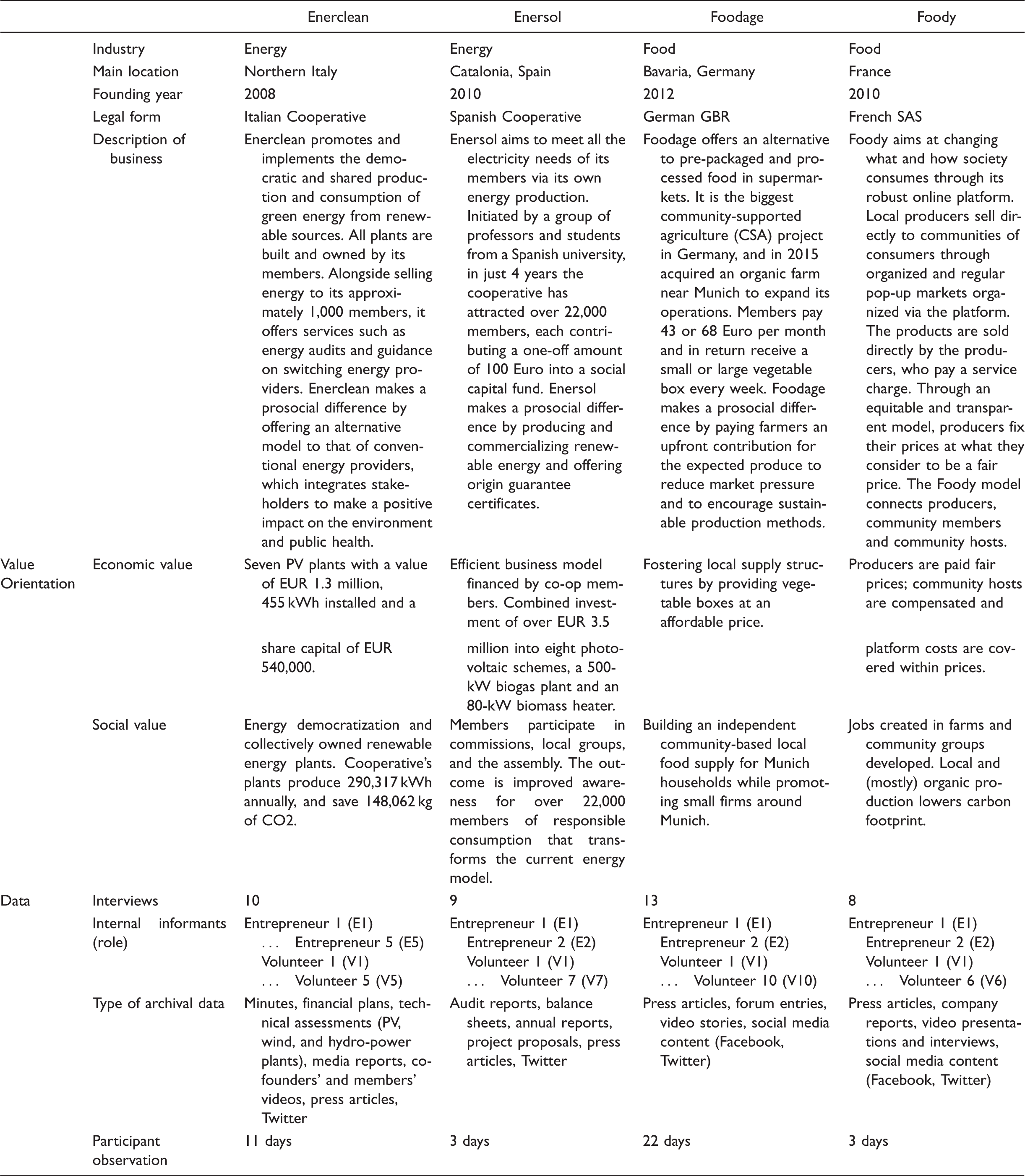
The entire database for the current study was created between January 2013 and December 2016 1 as part of an EU-FP7 project. Table 1 provides an overview of the data for each venture case, comprising a description of the ventures’ activities and mission. Interviews and ethnographic field data form the bedrock for our empirical analysis. One author collected data for two venture cases (Enersol, Foody), while data on the Enerclean and Foodage cases were each collected by a different researcher. Each of the authors also collected secondary data from multiple sources (e.g., project documents, email correspondence, government reports, media coverage, and the venture’s social media activity) to triangulate our primary data from each case and thus reduce recall bias.
Primary Data
We conducted a total of 40 interviews. We interviewed all founders of the four enterprises, as they are the key actors in the management of organizational duality. Hence, we interviewed between two and five entrepreneurs per venture case. The Italian case Enerclean follows the traditional cooperative structure and therefore has five founding members. In contrast, the German, Spanish, and French cases were each initiated and are currently steered by two entrepreneurs, all of whom we interviewed. In the German and Italian cases, we succeeded in joining the enterprise for an extensive period of time, which enabled several informal conversations with the entrepreneurs, in addition to the semistructured 90-min interviews we conducted with all entrepreneurs for the project.
The second important group of informants was volunteer members of the venture who are engaged in its development. Volunteers constitute the backbone of operations in all four enterprises. For instance, Enersol’s founders initially pitched their idea in a university course, and afterwards asked students to develop the business plan and desk research models implemented in other countries, and eventually pay EUR 100 to become members. This would provide motivated members with an opportunity to implement sustainability ideas by volunteering for Enersol. In the German case, by signing up for Foodage’s shift system we were given the chance to spend several hours jointly gardening and harvesting with individual volunteers and conduct situational interviews. In this particular case, volunteers would sometimes receive a compensation of up to around EUR 400 per month, often taking on key responsibilities that demanded a weekly commitment (Garner & Garner, 2011). This still qualifies them as volunteers for our purposes, because the remuneration remains significantly below subsistence level.
Furthermore, the current study reports ethnographic insight into operational activities, tensions, and member engagement across the enterprises. In total, we spent 39 days in the field. Our privileged access for Enerclean and Foodage resulted in joining both enterprises for several months, leading us to spend, respectively, 11 days and 22 days in the field. Like this we were able to participate in a wide range of different activities, from working with other volunteers in the gardens, harvesting produce, packaging and delivering vegetable crates, to regular volunteer meetings, the annual enterprise party and board meetings. While all these meetings helped us to build a trusting relationship with the volunteers to such a degree that they would be willing to share personal insight with outsiders, they also demonstrated organizational inefficiencies and the concomitant frustrations of being a volunteer. Therefore, the emotional insights captured through individual narratives from the interviews (Lazarus, 2006) were substantiated and triangulated through recording emotional expressions during our field observations (Massa, Helms, Voronov, & Wang, 2017), sometimes by reflecting on our own expectations and feelings during field work.
Secondary Data
We further triangulated the information gathered in the interviews and during the fieldwork with organizational documents, published articles, reports, and multimedia material. Social media and internal fora facilitate a significant amount of communication between members. Hence, we extracted the entire Twitter history from each venture (1,625, 3,264, 2,215, and 4,105 individual tweets, respectively). The secondary data material was important to further contextualize and verify the reliability of the recorded material gathered from informants. On average, we analyzed about 200 single-spaced A4 pages per case (e.g., for Foodage: 69p. interview transcripts, 27p. field notes, 78p. internal correspondence/ documentation, 105 p. (social) media articles). The type of data and the descriptive information on the secondary data are collated in Table 1.
Data Analysis
In this study, we present a qualitative data analysis as an alternative to the dominant survey-based studies of emotions in entrepreneurship (Cardon, Foo, Shepherd, & Wiklund, 2012; Jennings, Edwards, Devereaux Jennings, & Delbridge, 2015). Our data analysis followed procedures for inductive–abductive theory-building research, going back and forth between the data and emerging theoretical accounts (Gioia et al., 2013; Huy et al., 2014; Williams & Shepherd, 2016). Initially, we developed a descriptive narrative of approximately 20 pages per case. Those narratives served to establish a logical sequence of major events and the chronological development of the venture and its mission. Subsequently, we applied a three-step systematic analysis of the data to ensure the trustworthiness of the findings. Building on the grounded theory of Corbin and Strauss (2008), our analysis worked recursively between emerging themes and data, in that we separated first-order codes, second-order themes, and third-order theoretical categories (Gioia et al., 2013). By establishing a research framework, thorough pattern-matching, and data and theory triangulation, we further substantially reduced the risk of internal validity issues (Gibbert, Ruigrok, & Wicki, 2008; Langley & Abdallah, 2011).
Step 1: Identifying Organizational Dualities
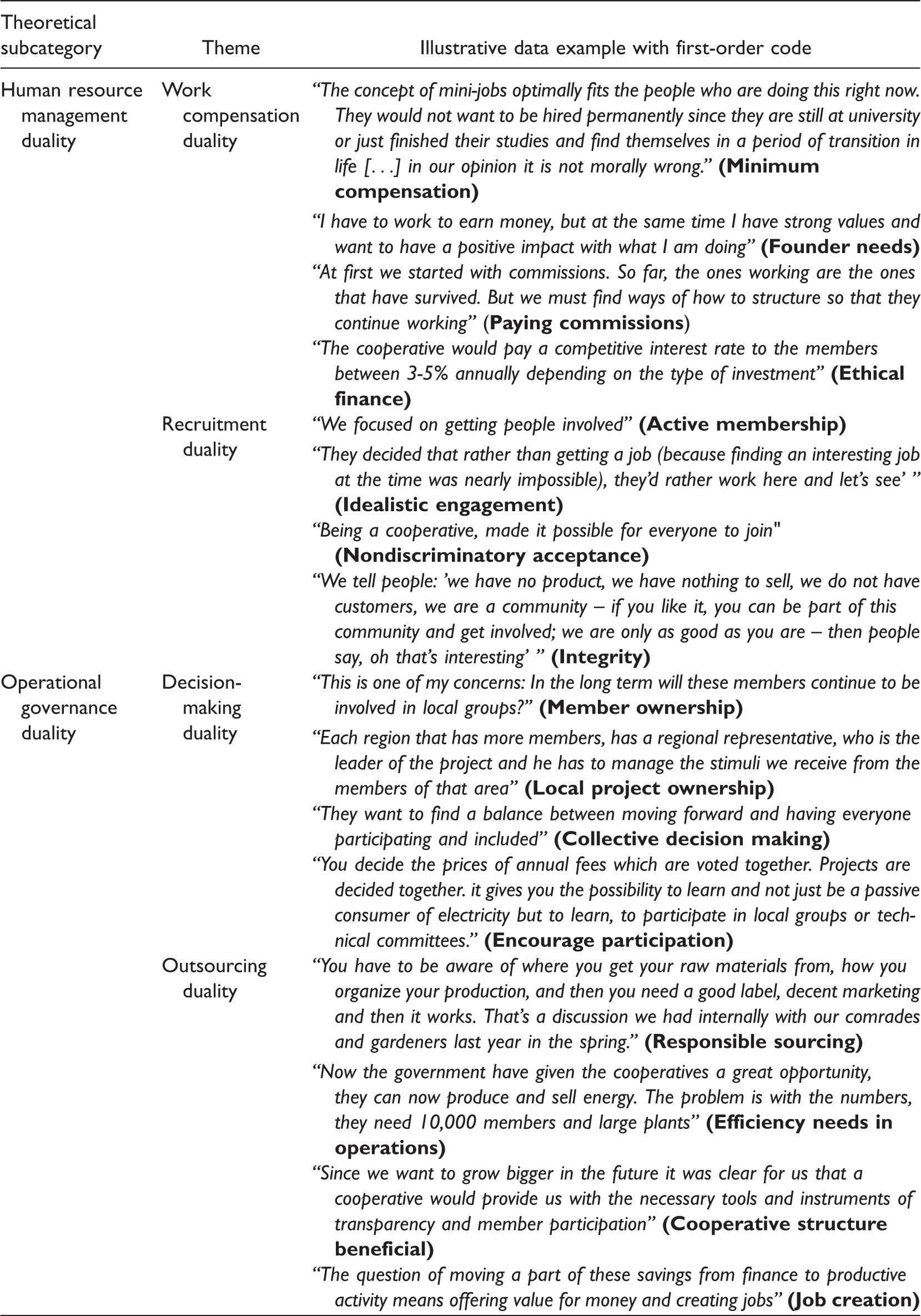
First, we focused on examining organizational dualities. We inductively identified first-order codes and unearthed recurring topics, such as for instance collective decision making and the protection of natural resources, which were part of the prosocial ventures’ duality. This was done separately for each case and resulted in a set of individual codes. Aggregating these into second-order categories (Gioia et al., 2013) and discussing them within the research team succeeded to highlight several organizational dualities relating to the management of the ventures’ volunteering membership base.
We realized that Battilana and Lee’s (2014) dimensions on governance, workforce composition, and organizational activities warrant greater attention, particularly because those categories are linked to (volunteer) member engagement—the main thrust of this study. Loosely following the authors’ hybrid organizing framework, we then looked for organizational dualities in the data which showed the greatest internal harmony, and we discarded those with internal inconsistencies, as they seemed idiosyncratic and tied to the specific context of a particular case. In this way we identified four distinct organizational dualities (second-order themes) emerging from our data: work compensation, recruitment, decision making, and outsourcing duality. The work compensation duality refers to the establishment of a fair-reward system for entrepreneurs and volunteer members. For instance, one of the co-founders of Foodage notes that this duality creates a recurrent tension: “What is more important, 100% of our salary or a team assistant? You would not think like that in a conventional company as a manager.” The recruitment duality describes the need for professional skills and simultaneously the nondiscriminatory acceptance of volunteers. For instance, the acceptance of every single application from volunteers to a prosocial venture can dilute the active engagement of other members, as the entrepreneur at Enersol confirms: “We have grown in terms of members; but I would say the level of active participants is the same.” The decision-making duality captures an inclusive yet efficient form of decision making, exemplified by the second co-founder of Foodage: “We could be voted out by you at any time…we decided to take that risk, hoping it will not happen.” Finally, the outsourcing duality refers to the performance of in-house activities versus collaboration with, and sometimes outsourcing to, suitable partners: “[At Enersol] we have intense debates among volunteer members that do not all go in the right direction…. We still buy together with other companies and we have now switched to a buying group of cooperatives.”
Illustrative Data for Organizational Dualities.
Step 2: Tracing Experiences of Organizational Duality
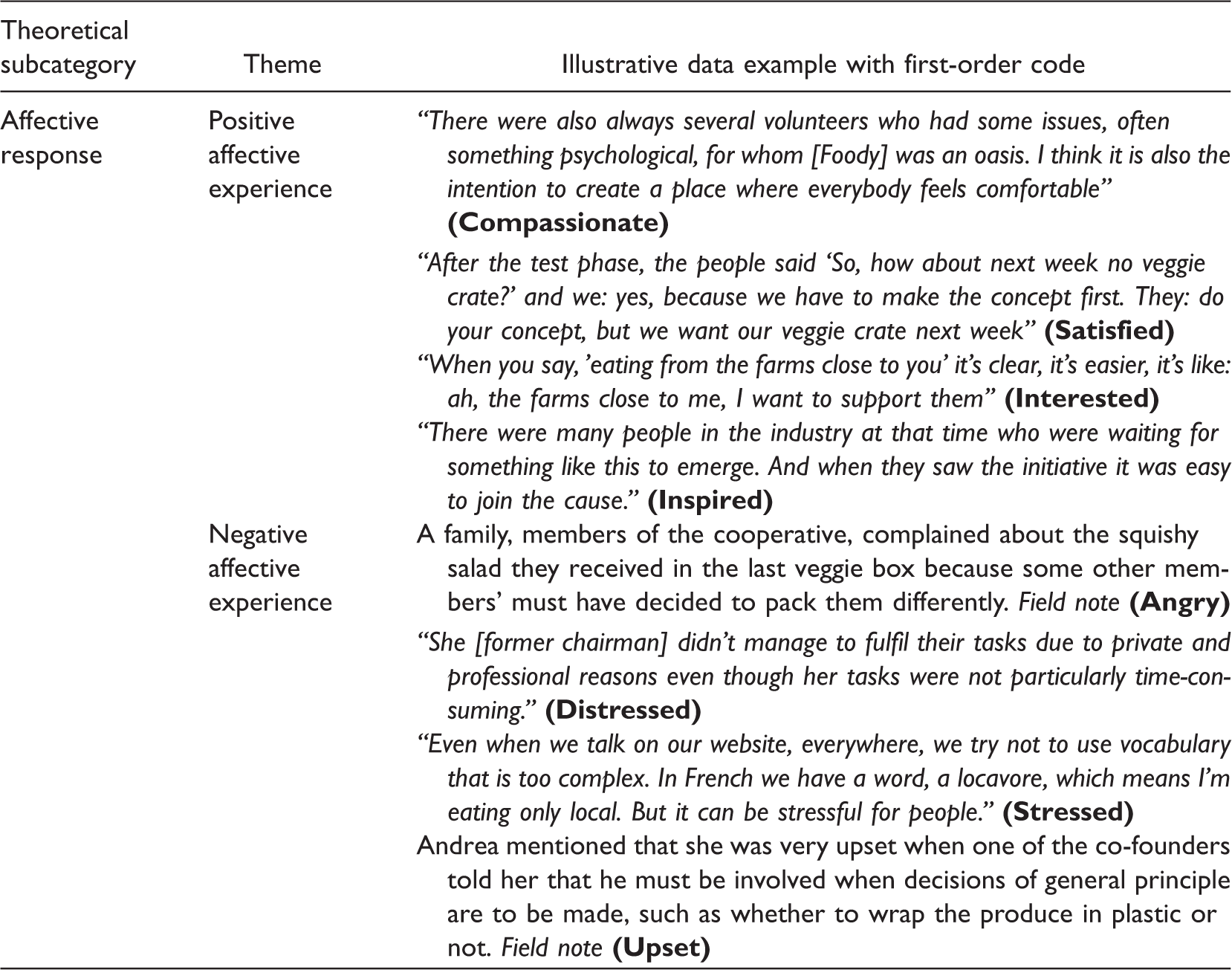
In the second analytical step, we first inductively coded for volunteers’ experiences of the integration of complementary, and sometimes conflicting, organizational duality orientations (Ashforth et al., 2014). We separately applied open and axial coding to identify first-order codes and second-order themes on a case-by-case basis. These were then discussed internally and compared to the literature (e.g., Breugst & Shepherd, 2017) to find similarities across the data and attribute the volunteers’ experiences we had identified. This analytical process revealed that volunteers’ affective responses are the most relevant theoretical subcategory for understanding volunteers’ experiences of organizational duality.
Affective responses describe a cognitive process that occurs so as to interpret and give meaning to an emotional experience of pleasure or displeasure (Russell & Feldman Barrett, 1999). Positive affective responses can spur individuals to engage with their environment and take action; in contrast, negative ones signal slower progress towards a certain goal (Breugst & Shepherd, 2017; Shepherd, 2015). We identified volunteers’ positive affective responses in our fieldwork through observations or by hearing them expressed directly in conversations. In our analysis, we identified expressions such as, “when you are part of this start-up, everything else seems trivial” and, “this is one of the best projects ever” to be evidence of an emotional reaction reflecting pleasure (Foo, Uy, & Baron, 2009). Expressions such as, “you still live in the old structures, but they no longer fit the big picture” and, “personally I am just very unhappy” were coded as evidence of affective responses indicating displeasure (Russell & Feldman Barrett, 1999).
Illustrative Data for Volunteering Experiences.
Step 3: Identifying Practices to Manage Organizational Dualities and Experiences of Them
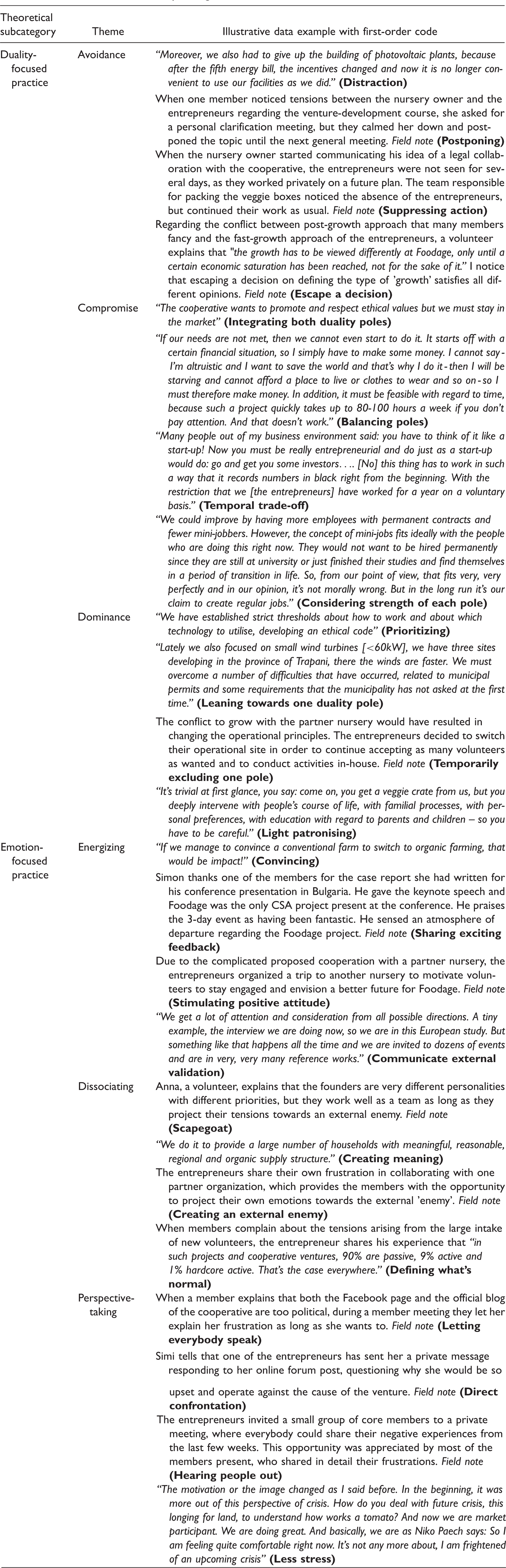
In the third analytical step, we explored which practices entrepreneurs employ to manage both organizational dualities, revealed in the first analytical step, and experiences of organizational dualities, revealed in the second analytical step. The work of Ashforth et al. (2014) informed this phase of the analysis by providing a set of specific practices applied to manage organizational ambivalence. Hence, we deductively coded for avoidance, compromise, domination, and holism. In our analysis we realized that holism and compromise differ in their intensity level yet tend to refer to the same practice, in that they balance a medium-to-high orientation towards both duality poles. Because these were difficult to distinguish empirically, we decided to unite them under the more intuitive label of compromise. We call this first type duality-focused practices, that is, entrepreneurs’ practices which focus on resolving inherent organizational duality problems that cause negative experiences for volunteers.
Illustrative Data for Duality-Management Practices.
The three analytical steps resulted in the coding structure illustrated in Figure 1, enabling empirical-based theorizing on managing volunteer retention in prosocial venturing. Utilizing computer-based qualitative analysis software (NVivo 11), we organized the data around emerging codes and second-order themes, which we aggregated into distinct theoretical subcategories and categories, treating the enterprises as one stylized, generic case in order to build the analytical framework (Gioia et al., 2013; Langley & Abdallah, 2011; Williams & Shepherd, 2016). The inductive–abductive analytical process permitted the researchers to reduce the number of codes to a manageable amount (n = 95). It was after two rounds of coding and repeated comparison that our theoretical orientation shifted towards the theory of organizational ambivalence. In total, we re-coded the data in their entirety three times, before we could theorize on the relationship between the core theoretical constructs we had identified: organizational dualities inherent in the venture, volunteers’ experiences of such organizational dualities, and the entrepreneurs’ duality-management practices.
Data structure.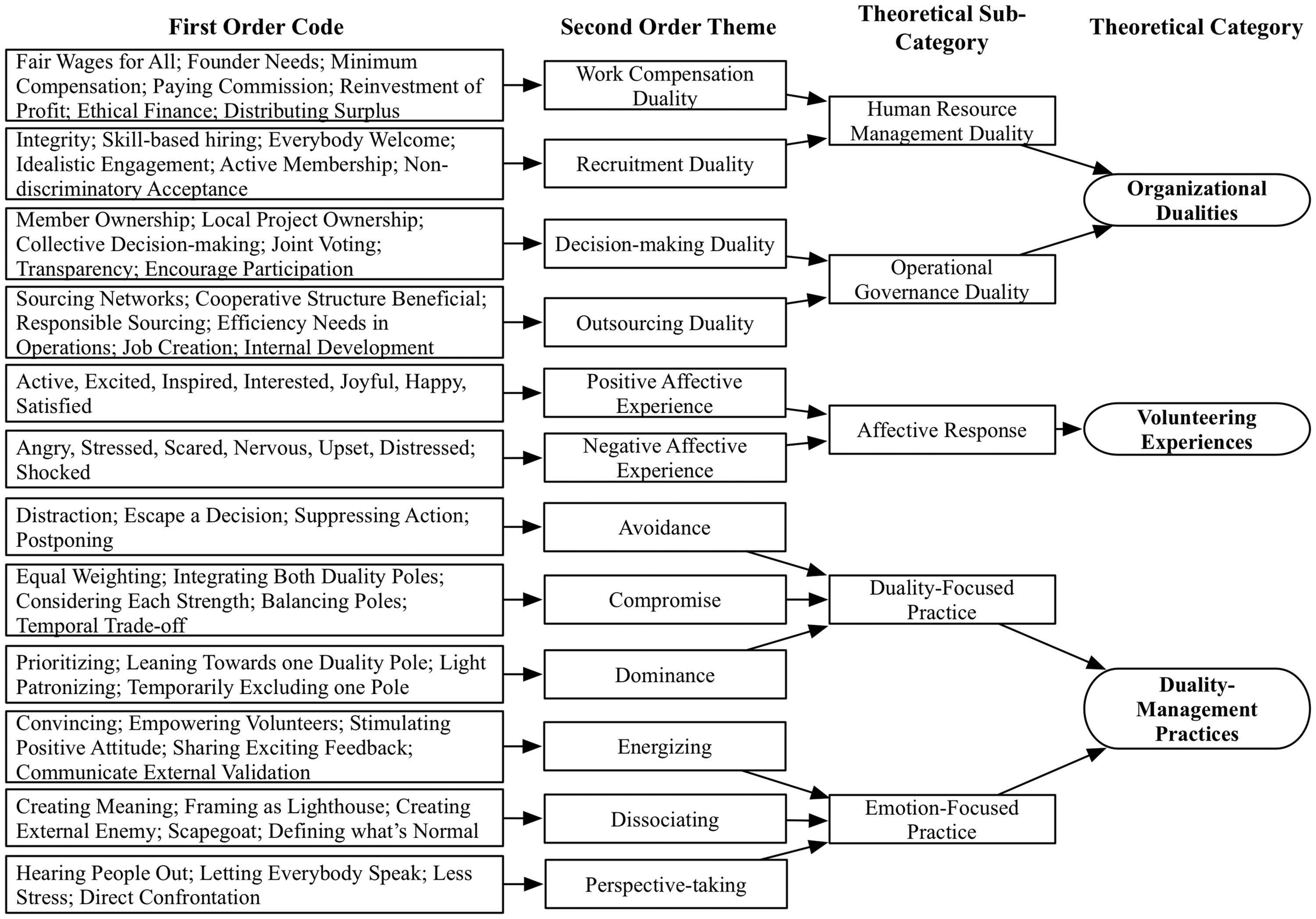
Building on our analysis, the following section on our findings shows how entrepreneurs apply practices in order to manage volunteers’ experiences of organizational duality and subsequently build and maintain volunteers’ emotional connectivity to the venture. We add two ethnographic vignettes (Jennings et al., 2015; Van Maanen, 2011) to substantiate our main findings, suggesting that entrepreneurs’ practices that are able to increase the emotional connectivity of volunteers do in fact foster their ventures’ volunteer retention.
Findings
Our findings suggest that building the emotional connectivity of volunteers to a prosocial venture is decisive for achieving volunteer retention. Our analysis demonstrates that emotional connectivity depends on the practices entrepreneurs undertake to manage conflicting organizational duality orientations and volunteers’ experiences thereof. A first set of practices identified in our analysis refers to emotion-focused practices. Emotion-focused practices address affective responses to conflicting duality poles and are intended to alleviate negative experiences in order to support the development and maintenance of an individual volunteer’s basic emotional connectivity to a venture. In contrast, the second set of practices focuses on resolving a conflict or problem inherent in opposing duality orientations, which we refer to as duality-focused practices. These practices aim to resolve tensions and conflicts as they arise in order to develop complementarities and create positive volunteering experiences. Duality-focused practices have the potential to foster a stronger emotional connectivity between volunteers and the venture, because such practices align personal motivations with the venture’s mission, thus turning personal issues into collective, shared concerns.
Emotion-Focused Practices Strengthening Volunteers’ Attachment
Our analysis identifies three emotion-focused practices to be highly relevant for the management of volunteer experiences: energizing, dissociating and perspective-taking. All four prosocial enterprises in our study demonstrated organizational ambivalence—that is, the simultaneous pursuit of economic, social, and ecological value creation—to be desirable to the extent that opposing orientations are complementary rather than contradictory. However, our findings show also that it is challenging for prosocial ventures to implement their operational governance and human resource management processes in a complementary manner, as for instance illustrated by one of Foodage’s co-founders when explaining tensions that emerge from the initial volunteer demographic: We have 30- to 40-year-old university graduates with good jobs. This is our main audience in [Foodage], but we do not have any migrants yet. But they should be there as we want a cross section of the population to have a healthy community and not for it to be an elitist thing. (Foodage-Entrepreneur #1 [henceforth E1]) You have to motivate core volunteer members of the community because they are going to help the community a lot, they are going to support it, they are going to participate in community activities, and once the community is there, there are more and more activities together, like visits to farms, special events, and special produce tastings. So, it’s starting to be like a community place in a neighbourhood but an easy one without too many constraints. (Foody-E2) Clearly we were intrigued by the idea of starting something totally new… we wanted more than just a photovoltaic plant, and instead a new energy management system. This decision represented a step forward from the idea of simply producing energy from renewable sources… always trying to use methods respecting things, people and the environment, with an ethical approach. (Enerclean-E1)
In turn, dissociating refers to practices that transfer conflicting attributes or feelings into a repository of aversive feelings (Lazarus, 2006) which arise from experiencing organizational duality. Owing to venture goal plurality, a member experiencing displeasure is a recurrent threat, for instance, when a democratic vote overrules a volunteer’s opinion. For example, Foodage’s inability to source all produce from one particular local farmer—that is, a situation reflecting an outsourcing duality—caused severe displeasure among volunteers. “The initial euphoria had faded… I noticed for myself that I simply felt that responsible sourcing is such a huge challenge, and perhaps it would be better for Foodage and myself to take different routes, because it feels so energy-sapping” (Foodage-V7). This required the entrepreneurs to dissociate the negative feelings of some of the volunteers by creating greater social meaning: You have to look out where you get your raw materials from, how you organise your production … That’s a discussion we had internally with our comrades [volunteers] and gardeners last year in spring. They said: ‘hey guys, the way you are doing it, that’s not really good because, from the gardeners’ perspective, you don't cover 100 per cent of their needs’. And then we said: ‘yes, that’s correct, we don’t do that in order to have community-supported agriculture and to have a nursery. We do it to provide a large number of households with a meaningful, regional, organic supply structure, and we start with vegetables!’ (Foodage-E1) Having a bottom-up model in which all members have the right to vote helps a lot. We have taken a niche of extremely demanding shareholders who have no problem if you tell them ‘look this year we will give you very low interest rates’ or ‘this year we do not have the option to remunerate the capital’. But if you promote projects that are not up to their standards they don’t forgive you and you seriously risk losing them. (Enerclean-V2) I am quite angry because sometimes our entrepreneurs have a mind-set like ‘I give the money to the cooperative and then I will eventually get a return of capital’, but to me it is important that my savings are used for ethical activities, that’s why I joined the enterprise. Just recently, we had an internal discussion and afterwards I felt that they do listen and are willing to take account of our voices; so that’s good. (Enerclean-V3)
Vignette I: Perspective-Taking and Dissociating Practice to Manage Affective Experiences at Enerclean
Marco, one of the co-founders of Enerclean, invites me to a member’s meeting that he expects to be tense. The meeting is about a proposal to build a 260-kW photovoltaic (PV) plant that is cost-effective and easy to deploy, something he believes would be a good investment. “If one person alone cannot build his own plant, maybe creating a group of people interested in producing energy from PV systems enables each one to hit the target,” he says. This was the philosophy that had initially led him to co-found the Enerclean cooperative in 2007. At that time, the cooperative established democratic decision-making principles, which require Marco to present convincing arguments in order to collect member votes on any proposal. As I enter the meeting, I can feel the emotional energy and tension provoked by this topic.
Many members are upset about building the PV plant directly on the designated land, “especially in their area where the soil is virgin and very fertile.” A member gets up and expresses his anger: “This is not what I signed up for when joining Enerclean!” Some members argue that the cooperative’s philosophy involves only the construction of small plants (on roofs), because large plants compete with food production. The proponents argue that an installation capable of producing 260 kW is a medium-sized plant, a situation which is consistent with the philosophy of the cooperative: “this system would allow the cooperative more breathing space in terms of financial sustainability.”
Marco is concerned about the negative atmosphere developing in the room and shifts the attention towards members’ emotions. He allows everybody to speak up, which serves to release some of the emotional tension. Aware that a plant can be developed in several different ways, and more or less in alignment with members’ ethical considerations, he emphasizes Enerclean’s values. By the time that the discussion with the cooperative’s members ends, Enerclean has committed to a Code of Ethics that states, among other principles, that “Enerclean does not believe in photovoltaic systems placed on the ground because they deprive the soil of trees or other crops” (Paragraph 3) and, “Enerclean does not believe in big renewable-energy installations that foster the concentration of energy and that are potentially the most impactful on the environment” (Paragraph 5).
Marco’s emotion-focused practices have resulted in a Code of Ethics charter, which strengthens members’ emotional attachment to the cooperative. Simultaneously, it works as a projection screen for hopes and dreams, and in tense situations it helps volunteers to dissociate from the actual problem and direct their anger and frustration towards a scapegoat. For instance, Elena, who favors preserving the environment, mentions that she feels relieved and happy to be part of such an ethical, democratic organization. Nevertheless, the tension arising from the decision-making duality—that of a few expert members versus all members deciding—has not been addressed. In fact, the same tension reappears later, when the opportunity to build a wind energy plant in Puglia arises. Again, some members are in favor, for financial reasons, and others are against the plant because “in that area there’s already been too much speculation and the impact on the environment would be too high.”
Duality-Focused Practices Strengthening Volunteers’ Loyalty
Regarding the management of conflicting orientations of organizational duality, our analysis provides evidence for three duality-focused practices: avoidance, compromise, and dominance. Avoidance refers to practices that move away from a particular duality, equating to a reduced focus on each duality orientation (Ashforth et al., 2014). A volunteer at Foodage mentions that she only became aware of a conflict in the decision-making process over the proposal to change the enterprise’s partner nursery after she became an employee, because the founders had avoided to clearly state their opinion on the matter: “I was shocked, because I did not know the entire story before…. These issues are not discussed and communicated in the online forum. In my opinion, they perhaps should be, so that everyone is informed, because you do not want to scare off people when they find that there are so many conflicts in the process to take-over another nursery” (Foodage-V7). The founders chose to entirely avoid addressing the decision-making duality and, as a result, a revolt by volunteers was pre-empted, as noted later by a volunteer herself, because “most volunteers trust them [the entrepreneurs] blindly, and don’t question anything” (Foodage-V4). Under such circumstances, avoidance helps to prevent an escalation.
The second duality-focused practice is that of compromise, which refers to practices that combine and integrate a particular duality, resembling equally moderate or strong focus on each duality orientation (Ashforth et al., 2014). Compromise appears to be the most common practice, and often chosen in order to avoid losing volunteers. An entrepreneur explains: “The cooperative wants to promote and respect ethical values but we must stay in the market” (Enerclean-E2). Another says: “We do have to remain market participants, we must operate economically for our cooperative households; but also we want to somehow be a movement that makes things different and that has the potential to think of things that are radically different” (Foody-E2). It follows that for reasons of productivity, Foody cannot easily outsource activities to partners. In sum, compromising offers a socially acceptable middle-ground approach to resolving organizational duality tensions.
The most deliberate and decisive duality practice is dominance. Dominance refers to practices that prioritize one duality orientation over another, and therefore resembles instigating a different approach to each duality orientation (Ashforth et al., 2014). Our findings reveal the presence of dominance when the entrepreneurs of Foodage chose to prioritize strengthening the enterprise’s prosocial mission over its economic returns: Last year we failed and somehow missed the opportunity to create a common image and a common picture of the Foodage project. That led to conflicts here and there. We recaptured the ground lost by running through a very structured professional mission statement process with the help of our chairman, who contributes his incredible knowledge on a voluntary basis. And everybody was involved in this process and now we adopted this common image. (Foodage-E2) This mission-statement process we conducted internally last year was not quite free from conflict. It was very difficult and consumed very, very much energy. Out of that there arose some sensitivities and consequences that don’t make it easier. I can feel a change among the dedicated members right now, but this is something typical that can be observed in many projects. (Foodage-E1)
Vignette II: Compromise Practice Helps Resolve HR-Duality Tension at Enersol
“@Enersol and activism for renewables” was a tweet that caught our attention. In my first Enersol meeting, I immediately feel that I am surrounded by energy activists: from homemade patchwork t-shirts and the design of the cooperative’s logo, to members defining themselves as part of a movement of civil disobedience. People even tell me that every member is frustrated with the energy system in Spain and feel that by joining Enersol they can actively contribute to societal change. “The relationship between government and big business is too cosy, which leads to decisions that are not in the interests of the country but in the interest of some of the big businesses, and we want this to stop,” Gijsbert, the founder, explains to me. Nuri, the other co-founder, adds that “we are past 15,000 members; our social capital is around EUR 1.5 million”; but despite the large volunteering base, Enersol relies on contracts with experts in producing electricity and trading with the national grid.
The same meeting also sees a small team in charge of operations, all members of which receive a moderate salary, launch into debate with members of the large, unpaid volunteer base on how to add members without taking a large financial risk. When I quiz a volunteer standing nearby on his experiences, he says: “I’d rather work here…and let’s see if my volunteer work can be turned into a paid job after a while.” This particular volunteer enthusiastically explains that when unemployed he enjoys spending his time on doing something worthwhile. Dolor, a member of the governing council, tells me that the cooperative feels they are exploiting the formula for volunteer work to its utmost: “Members are eager to participate and learn…space needs to be made for each person to pursue their capacities and that space needs to be flexible. As the cooperative and the groups grow we’ll need to start strengthening the structure but not impeding it.”
In response to managing the organizational duality of hiring experts and integrating volunteers regardless of their skills, Enersol has developed a system where projects are initiated and managed in local groups. The entrepreneurs compromise in order to “focus on getting people involved” (Nuri) while occasionally hiring volunteers, which happened to the recently employed volunteer I had just talked to, “getting an interesting job at the time was nearly impossible…in the end we were able to hire [him]” (Gijsbert). The compromise of having local, autonomous groups, from which volunteering members are occasionally hired to join the expert team, became part of the organizational structure.
The local-group system allows members to feel that they are part of a community of like-minded individuals, one in which every person contributes whatever they can. It is a system that strengthens the members’ emotional loyalty to their peers, as well as to the organization as a whole. This is exemplified by a group of empowered volunteers who have built a portable solar panel with outlet plugs. The group attends concerts, festivals, and outdoor activities that offer free power to anyone who needs to charge their electronic devices; at the same time it raises awareness of Enersol. A volunteer explains: “The idea of collaboration of local groups, volunteers and committees was a thing that many people in the industry with a great deal of knowledge had never successfully implemented before.”
Discussion
Our study clarifies the role of emotional connectivity for developing an understanding of volunteer retention in prosocial business venturing. Our analysis shows that entrepreneurs strengthen the emotional connectivity of volunteers by managing both the organizational dualities inherent in a prosocial venture’s design and the volunteering members’ experiences of the tensions that emerge from those dualities. In particular, we demonstrate how three emotion-focused practices—energizing, dissociating, and perspective-taking—help entrepreneurs to foster an emotional attachment to the venture among volunteers. Further, we provide novel evidence on how Ashforth et al.’s (2014) three duality-focused practices—avoidance, compromise, and domination—complement emotion-focused practices in sustaining volunteers’ deeper emotional loyalty to a prosocial venture. Theorizing from our findings, we propose a double-loop model that explains entrepreneurs’ emotion- and duality-focused practices that help to establish and enhance the emotional connectivity necessary to sustain volunteer retention (Figure 2).
Double-loop model of managing volunteers’ emotional connectivity in prosocial venturing.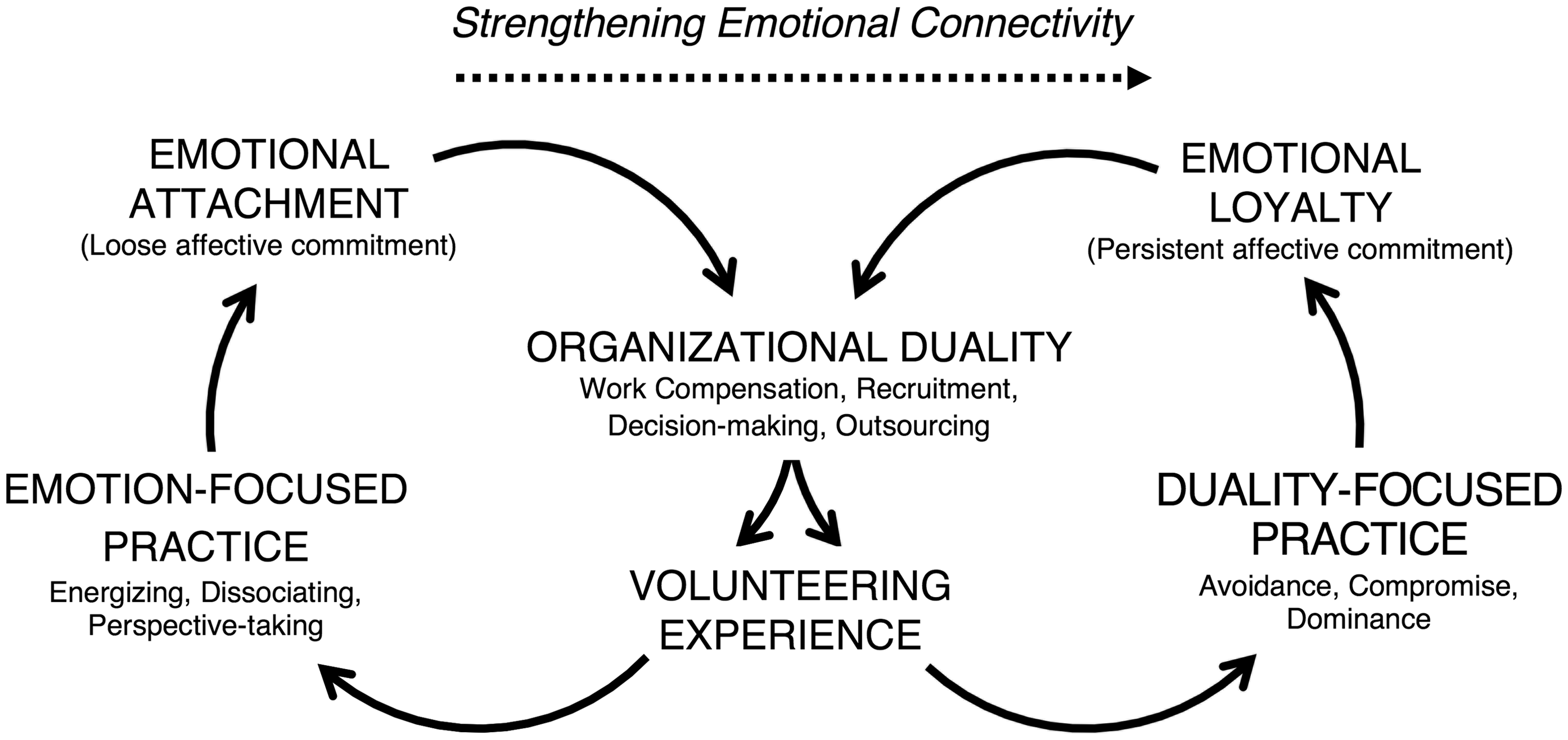
Our first proposed loop rationalizes those practices of an entrepreneur that are intended to address the affective responses of volunteers, and thus to alleviate the tension they experience. In this loop, entrepreneurs do not yet address the situational problem which emerges from the conflicting organizational dualities inherent in prosocial ventures. Instead, through energizing, dissociating, and perspective-taking, the entrepreneurs emphasize a feel-good atmosphere, that in turn develops and maintains the volunteers’ emotional attachment to the venture and its existing organizational structures and operations. The importance of members’ positive affective experiences is accentuated in previous research which suggests that displeasure signals slow progress and thereby endangers the implementation of a joint mission (Breugst & Shepherd, 2017; Foo et al., 2009). In contrast, members who experience a pleasurable emotion are more likely to engage in or sustain collective action (Gooty, Gavin, & Ashkanasy, 2009; Russell & Feldman Barrett, 1999). Emotional attachment implies a basic emotional connectivity between volunteering members and the venture, reflecting a loose affective commitment that minimizes the risk that volunteers withdraw their labor. Through the application of emotion-focused practices, the initial excitement that motivates volunteer engagement is turned into a loose affective commitment (Jasper, 2011) describing volunteers’ feelings of belonging to a prosocial venture (Jones & Massa, 2013) in such a way that “people simply trust that it will work sooner or later” (Enersol-E1). Hence, our study concludes that emotional attachment constitutes an important reason for volunteering members to remain committed to, and to actively engage with, the venture.
Our findings further demonstrate that forming an emotional attachment, that is, an attachment resulting from the active management of the volunteering experience, enables entrepreneurs to successfully apply duality-focused practices to induce a deeper emotional connectivity between volunteers and the enterprise. We suggest that emotional attachment fosters a loose affective commitment required to make a subsequent application of duality-focused practices more effective. This is because volunteers feel a sense of belonging in relation to the venture, which encourages them to have fewer reservations about fundamental adjustments to the venture’s design and operations, and not to be more demanding. Therefore, the second proposed loop explains an entrepreneur’s practices which are adopted with the intention of solving the actual problem that emerges from combining opposing orientations in the organizational design (Ashforth et al., 2014).
Duality-focused practices, in the form of balancing conflicting organizational dualities, complement emotion-focused practices to help develop volunteers’ emotional loyalty to the enterprise. Emotional loyalty implies a deeper emotional connectivity based on a more persistent affective commitment with a prosocial venture, its practices and its members. Emotional loyalty has been defined as “relatively stable feelings, positive or negative, about others or about objects, such as love and hate, liking and disliking” (Jasper, 2011, p. 287). In the case of volunteer management in prosocial venturing, we propose that emotional loyalty builds on a long-term synchronization of personal and enterprise development plans, resulting in a strong identification with, and willingness to continue, volunteering for the venture: “after you have been part of a project where so many have put their heart and soul into it. You simply realise that you won’t find this elsewhere” (Foodage-V8). The strength of such identification becomes most evident when “volunteering members speak of ‘we’ when they talk about the cooperative” (Enersol-E1). Hence, we suggest that emotional loyalty is a persistent affective commitment that serves as the connective tissue of members’ strong identification with a prosocial enterprise. This study concludes that building up emotional loyalty is desirable and ultimately necessary in order to secure volunteer retention over a longer period of time.
Implications
To the best of our knowledge, the current research is the first empirical study of prosocial business venturing to draw on the theory of organizational ambivalence (Ashforth et al., 2014) in order to advance our understanding of how prosocial entrepreneurs manage volunteer retention. The theory has been used to conceptualize duality-focused practices as representing an organization’s management of organizational dualities, which are inherent in a venture’s design, so as to minimize a workforce’s negative experience arising from conflicting organizational dualities (Ashforth & Reingen, 2014). The main rationale is that duality-focused practices differ in terms of whether they constitute a low focus on each organizational duality orientation (avoidance), an equal or moderate (compromise) or a high focus (holism) on each duality orientation, or whether they prioritize one duality orientation over another (dominance). Accordingly, duality-focused practices offer important clues to grasping how organizations manage experiences of ambivalence by addressing organizational duality orientations inherent in the design of the venture. However, duality-practices do not tell us how situational affective experiences of ambivalence are addressed prior to the ability of an organization to implement an adjustment of opposing structures in their design and operations. Our findings clarify the role of relevant emotion-focused practices designed purely to manage individuals’ negative affective responses to conflicting organizational dualities, and they demonstrate how duality- and emotion-focused practices complement each other even while differing in the outcomes that are produced. While emotion-focused practices are important for maintaining emotional attachment among members, duality-focused practices build on that emotional attachment and are crucial in prolonging the type of member engagement that is characterized by a strong emotional loyalty to the organization. Building on our findings, we generate implications for at least two important research domains in the prosocial venture literature, as explained in the following.
Implications for Research on Volunteerism in Prosocial Venturing
A key contribution of the prosocial venturing literature is to illustrate ventures’ dual pursuit of social and economic orientations (O’Neil & Ucbasaran, 2016) and their management of the challenges stemming from stakeholder groups’ prioritization of one goal, logic or value orientation (Battilana & Lee, 2014; Wry & York, 2017). Situated within this literature, our study focused on developing our understanding of an important yet under-explored stakeholder group: a prosocial venture’s volunteering members (Austin et al., 2006; Doherty et al., 2014). It is commonly true that prosocial ventures cannot offer competitive salaries and therefore often require volunteers in order to compete in the social economy (Battilana & Dorado, 2010; Di Domenico et al., 2010). So far, however, entrepreneurship research has solely addressed the role of a venture’s social mission in attracting volunteers (Austin et al., 2006; Haugh, 2007; Katre & Salipante, 2012; Markman et al., 2016) and falls short in explaining entrepreneurs’ management of nonfinancial incentives which help to retain a diverse volunteering membership base (Doherty et al., 2014).
Against this backdrop, our study moves the focus from volunteer attraction to practices that support volunteer retention by offering novel evidence of how prosocial ventures manage both a hybrid venture design and volunteering experiences for the development of volunteers’ emotional connectivity to the venture. In particular, we introduce a double-loop model comprising two sets of entrepreneurs’ practices that strengthen the emotional connectivity of volunteers. First, we identify emotion-focused practices—energizing, dissociating and perspective-taking—that form volunteers’ emotional attachment to the venture by addressing volunteers’ negative affective responses to organizational duality. Second, we identify duality-focused practices, in the form of managing inherent organizational duality, which complement emotion-focused practices to foster volunteers’ emotional loyalty to the venture. Accordingly, our study emphasizes the importance of commitment-enhancing practices (Rauch & Hatak, 2016) to support volunteer retention.
Moreover, our study informs the broader volunteer retention literature (Studer & von Schnurbein, 2013; Wilson, 2012) by developing the understanding of informal management practices that help address volunteer experiences in multi-purpose organizations (Hustinx & Handy, 2009; Schlesinger et al., 2013). Prior volunteer retention research has suggested that volunteers usually expect the core qualification for voluntary work to be their intrinsic desire to help (Haski-Leventhal & Cnaan, 2009; Kreutzer & Jäger, 2011) and that organizations therefore require skilful actors to manage personal experiences of a diverse volunteer membership base (Garner & Garner, 2011; Studer & von Schnurbein, 2013; Wilson, 2012). Our study expands that knowledge by defining different emotion-focused practices that entrepreneurs can apply to manage volunteers’ affective responses and, through that, foster their emotional attachment to a prosocial venture. We suggest that these emotion-focused practices are important yet under-explored personalized management practices in the context of volunteer retention (Haski-Leventhal & Bargal, 2008; Stirling et al., 2011). They help to create an emotional attachment of volunteers, which serves as the foundation for effective, formalized management practices to foster volunteers’ emotional loyalty to the organization. In conclusion, our study emphasizes the complex managerial challenges faced by prosocial businesses, which stem from the fact that unpaid volunteers have high ethical demands that must be met in order for such businesses to deserve their sustained engagement (Eckstein, 2001; Royce, 2007).
Nevertheless, we are aware that our study is but a first step towards developing the understanding of volunteer retention in prosocial business ventures. One way to expand our knowledge of the effectiveness of management practices would be to undertake a comparative analysis of practices addressing the plurality of perceptions and different emphases of social and economic value orientations among volunteer members. Such research could draw on the findings of O’Neil and Ucbasaran (2016) and proceed to examine how prosocial entrepreneurs succeed but also fail in acquiring and maintaining internal legitimacy, and what role the building of emotional connectivity plays in this process. It might well be that as members develop their emotional connectivity to the venture, they increasingly appreciate what it is that matters to the core entrepreneurial group. In the context of practices that enhance members’ emotional loyalty, we would argue that entrepreneurs and their endeavors are increasingly taken for granted and, thereby, gradually acquire stronger internal legitimacy in the eyes of emotionally loyal members. In a similar vein, we suggest that combining our findings with insights from identity research (Fauchart & Gruber, 2011; Wry & York, 2017; York, O’Neil, & Sarasvathy, 2016) proffers another productive way to explore prosocial entrepreneurs’ dominant identity type (e.g., Communitarians, Darwinians, or Missionaries) and its impact on the effectiveness of practices underpinning members’ emotional connectivity. A further, intriguing line of inquiry lies in learning how entrepreneurs’ practices motivate some volunteers more than others, and whether certain volunteering experiences can encourage (or discourage) volunteers to develop a strong entrepreneurial identity and, eventually, lead them to start (or, conversely, prevent them from starting) their own venture. In the course of the current research, we encountered numerous volunteers who considered taking the route to entrepreneurship themselves.
Implications for Researching Affective Commitment in Prosocial Venturing
Our study introduces the notion of emotional connectivity among members who voluntarily contribute to a prosocial venturing pursuit. We explain emotional connectivity based on two forms of affective commitment, which reflect volunteering members’ emotional attachment—a form of loose affective commitment—and emotional loyalty—a form of persistent affective commitment to the venture. Affective commitment is commonly defined as feelings of belonging to an organization (e.g., love, pride, and admiration) (Bogaert, Boone, & van Witteloostuijn, 2012; Grant, 2007; Jasper, 2011) and therefore emphasized as an important source of venture engagement for both entrepreneurs and employees (Breugst et al., 2012; Cardon, Post, & Forster, 2017; Shepherd, Patzelt, & Wolfe, 2011). To date, research on prosocial ventures has largely focused on entrepreneurs’ affective commitment to their venture without specifying the role of affective commitment among venture members (Renko, 2013). Hence, we expand the investigative focus to include the affective commitment of a venture’s members by showing how volunteers become affectively committed through direct exposure to the practices of prosocial entrepreneurs. In particular, our findings suggest that emotionally attached volunteer members are likely to critically evaluate the prosocial venture’s activities in light of their own intrinsic ethical motives for engagement. In contrast, volunteers who exhibit emotional loyalty question the venture’s practices to a lesser extent, because they are already emotionally vested and, thus, no longer search for reasons that could legitimize their unpaid engagement. Following from this significant insight, we conclude that members with loose affective commitment more readily withdraw their labor than do members with persistent affective commitment, even when cases arise in which personal and venture objectives begin to deviate.
Building on our insights, we see several ways in which to advance the emerging line of research on members’ affective commitment to a prosocial venture. First, we identify a need to complement our current understanding of emotional connectivity as a positive emotional construct with an investigation of negative affective commitments. Such negative affective commitments might include “shame” as a feeling of a general, moral inadequacy (e.g., poverty or hunger) and not just as a reflex emotion in response to, for instance, physical intimidation in a venturing situation. Another fruitful avenue of exploration involves studying members’ emotional loyalty to a subgroup in a prosocial venture; and how various group climates strengthen or clash with other members’ emotional connectivity. A friendship that may motivate a person’s sustained engagement could at the same time hinder initiatives designed to broaden participation (Jasper, 2011) and decrease the effectiveness of general commitment-enhancing practices (Rauch & Hatak, 2016). Finally, insight could be gleaned from knowing more about the intersection of a persistent affective commitment and the collective identification processes of members with an organization. In social movements, the emergence of a collective identification has been attributed to members’ acquisition of emotional loyalty to a particular group (Polletta & Jasper, 2001)—a dynamic that may or may not occur similarly in a venturing context.
Concluding Remarks
Prior entrepreneurship research emphasizes the importance of attracting volunteers for prosocial ventures. Despite some existing conceptual work on volunteer attraction, we know very little about how prosocial ventures manage volunteer retention. By embedding the current research in the theory of organizational ambivalence, we tackle this dearth by examining entrepreneurs’ practices in managing relationships with volunteering members. Our analysis identifies critical organizational dualities—competing orientations that arise from venture design—and demonstrates how those duality challenges require both duality-focused practices that address inherent organizational duality as well as emotion-focused practices that involve addressing volunteering experiences in strengthening the emotional connectivity of volunteers to the venture. Building on our findings, we introduce a double-loop model which suggests that emotion-focused practices foster members’ emotional attachment; and, moreover, that duality-focused practices help transform emotional attachment into a persistent affective commitment, thereby resulting in the development of members’ emotional loyalty to the venture. In conclusion, we believe that this work will prompt further scholarly scrutiny of the role of emotional connectivity in the context of prosocial ventures and, more generally, of how entrepreneurs sustain active participation among volunteer members in prosocial ventures.
Footnotes
Acknowledgments
We would like to thank Tim Barnett and two anonymous reviewers for their support and developmental comments. We would also like to thank Frank-Martin Belz, Julia Binder, Marianne Kreissig, Arne Kröger, and Elena Perondi for their valuable assistance and comments.
Declaration of Conflicting Interests
The author(s) declared no potential conflicts of interest with respect to the research, authorship, and/or publication of this article.
Funding
The author(s) disclosed receipt of the following financial support for the research, authorship, and/or publication of this article: This research has received funding from the European Union's 7th Framework Programme under grant agreement number 613194: “Sustainable Lifestyles 2.0: End User Integration, Innovation and Entrepreneurship (EU-InnovatE)”.