



Abstract
In the context of the humanitarian refugee crisis in Germany, we conducted an 8-month qualitative study of prosocial ventures that emerged during this crisis to build a theory of motivation in prosocial venturing. We identified two venturing paths driven by founders’ distinct motivations. Founders motivated by others’ suffering focused on rescuing refugees, following an execution-oriented approach, and scaling their activities to meet victims’ short-run needs. Founders motivated by entrepreneurial aspirations focused on building an organization, following a foundation-oriented approach, and customizing activities to meet victims’ long-run needs. This study contributes to prosocial venturing and crisis research.
Humanitarian crises threaten the lives of many and cause severe suffering for millions of people worldwide (Bundy et al., 2017; Drabek & McEntire, 2003; Quarantelli, 1993; Williams et al., 2017). In these contexts, new prosocial ventures often emerge to alleviate the suffering of those affected (Farny et al., 2019; Majchrzak et al., 2007; Shepherd & Williams, 2014; Williams & Shepherd, 2016a, 2016b). In a crisis context, these prosocial ventures are “collectives of individuals who use non-routine resources and activities to apply to non-routine domains and tasks, using non-routine organizational arrangements” (Majchrzak et al., 2007, p. 150) to help those in need. By improvising, taking initiative, and launching new activities that address victims’ needs, these prosocial ventures provide victims with access to urgently needed resources (Bigley & Roberts, 2001; Drabek & McEntire, 2002, 2003). Research has found that founders’ prosocial motivations and, in particular, their compassion toward those in need, are important drivers of prosocial venture foundation (Bacq & Alt, 2018; Dees, 2007; Grimes et al., 2013; Miller et al., 2012). For example, Shepherd and Williams (2014) demonstrated that compassion played a key role in the emergence of prosocial ventures in the aftermath of a natural disaster, and Bacq and Alt (2018) found that individuals who have greater empathy toward others tend to have higher intentions to found prosocial ventures.
However, although these studies have suggested that prosocial motivations can trigger founders’ intentions to engage in prosocial venturing, a theoretical debate has emerged as to whether extant work on individuals’ motivations for starting prosocial ventures has sufficiently considered the role of founders’ self-interest. Although compassion serves as a motivational driver for prosocial venturing, scholars argue that founders may be motivated by prosocial and pro-self interests (Austin et al., 2006; Miller et al., 2012; Peredo & McLean, 2006). Such founders may either balance both motivations when creating a new venture (Peredo & McLean, 2006) or prioritize one type of motivation over the other (Austin et al., 2006). As this discussion indicates, to date, we do not fully understand how founders’ different motivations shape the initiation and emergence of prosocial ventures (Arend, 2013). For example, differences in founders’ motivations could shape both the early venturing processes, and whether and how venture founders seek to develop their ventures further. Therefore, a better understanding of prosocial venture founders’ motivations may provide important theoretical insights into prosocial venture creation and how this process unfolds to effectively address the needs arising from humanitarian crises. Thus, in this study, we explore the following research question: How do founders’ motivations shape prosocial venturing in crisis contexts?
To address this question, we applied a longitudinal qualitative approach to explore 13 prosocial ventures that emerged to alleviate refugees’ suffering in Germany. Over the last decade, millions of people have left their home countries and immigrated to Europe to avoid war, persecution, terrorism, abuse, and poverty. The situation escalated in 2014 when hundreds of thousands of people attempted to cross the Mediterranean Sea to reach Europe (Seher, 2014), a situation that was termed the European refugee crisis. The refugee crisis was projected to be a long-term phenomenon and required novel solutions to integrate the refugees into society, thereby transforming society itself. This situation was different from other crises, such as natural disasters, because the ultimate goal was not to return to the pre-crisis status quo. Therefore, the refugee crisis triggered the emergence of many different prosocial ventures to alleviate the multiple, heterogeneous, and ongoing needs of refugees. Over 8 months, we collected a substantial dataset, including data from 103 interviews with founders, volunteers, and refugees, as well as substantial observational and secondary data. Our inductive theorizing from the data resulted in a theoretical framework explaining how founders’ distinct motivations shape different approaches to prosocial venturing to alleviate suffering.
With our theorizing and resulting model, we provide three primary theoretical implications for entrepreneurship research focusing on crisis contexts, particularly in regard to how founders’ motivations shape prosocial venturing, including prosocial ventures’ purposes, initiation, and organizing. First, we help clarify the role of founders’ distinct motivations in the prosocial venturing process (Arend, 2013; Austin et al., 2006; Miller et al., 2012; Peredo & McLean, 2006). In particular, we illustrate that founders’ motivations channel their efforts into different prosocial venturing purposes, which leads them to take different approaches to venture initiation and organizing and, ultimately, to address different types of victim needs. Second, although we know that prosocial motivations increase individuals’ intentions to engage in prosocial venturing (Bacq & Alt, 2018; Miller et al., 2012) and how they respond to negative events that threaten their legitimacy (Mittermaier et al., 2021), our study shows that founders’ motivations also impact the nature of the prosocial ventures they found and the process whereby those ventures emerge. These findings imply that the impact of founders’ motivations on the prosocial venturing process is more prominent and complex than triggering prosocial entrepreneurial intentions and different from how these motivations influence entrepreneurial responses to post-founding adverse events. Finally, we contribute to research on resource providers for prosocial venturing. While prior research has emphasized the general importance of resource providers for prosocial ventures (Austin et al., 2006; Santos, 2012), our work suggests that the value of (different types of) resource providers differs for distinct prosocial venturing approaches.
Theoretical Grounding
Crises, Human Suffering, and the Emergence of Prosocial Ventures
Suffering can occur as physical pain, the experience of a loss, or psychological misery (Kahn & Steeves, 1986) and is particularly prevalent during (and after) humanitarian crises resulting from war, terrorism, natural disasters, poverty, and/or resource scarcity (George et al., 2016). Since victims of humanitarian crises typically face multiple challenges, including psychological, physical, and financial impairments (Shepherd & Williams, 2014), opportunities to alleviate suffering are abundant in such environments. As a result, new prosocial ventures often emerge after such crises (Drabek & McEntire, 2002; Drabek, 1986; Dynes, 1983; Majchrzak et al., 2007; Shepherd & Williams, 2014; Tierney, 2001) to alleviate the suffering of those affected (Bigley & Roberts, 2001; Kreps, 1984). Specifically, the emergence of such prosocial ventures is “stimulated by the perception that a problem or issue is not recognized or acknowledged by others” (Stallings & Quarantelli, 1985, p. 98). Prosocial ventures take action to meet victims’ needs resulting from disasters or crises by improvising, taking initiative, and engaging in new activities (Drabek & McEntire, 2002, 2003). These ventures are especially important (Majchrzak et al., 2007; Tierney, 2001) when the well-established infrastructures and resources of existing organizations (e.g., government organizations, nongovernment organizations, corporations) struggle to address the pressing needs of those directly experiencing crises or disasters (Chamlee-Wright & Storr, 2008; Drabek & McEntire, 2003). Moreover, since crisis response occurs under high uncertainty and time compression (Olshansky et al., 2012), dedicated response organizations may be slow to act with customized solutions to address local victims’ needs (Shepherd & Williams, 2014).
Prior research on prosocial venturing in crises contexts has examined responses to disasters (Dynes et al., 1972), social action during disaster periods (Kreps & Bosworth, 1993), the role of local communities in managing disasters (Quarantelli, 1997), and the internal management of prosocial ventures (Majchrzak et al., 2007). More recently, research has focused on how founders create new ventures to offer compassionate responses to alleviate others’ suffering in the aftermath of disasters. For example, Shepherd and Williams (2014) explored ventures that emerged to alleviate suffering after the devastating Black Saturday bushfire in Victoria, Australia, in 2009. The authors found that prosocial venturing was facilitated by victims’ local knowledge, which made prosocial ventures highly effective in alleviating suffering after the bushfire (Shepherd & Williams, 2014). Similarly, Williams and Shepherd (2016a) investigated how local Haitians engaged in compassion venturing after the Haiti earthquake in 2010 to build resilience to adversity. Additionally, in their study of prosocial venturing in the aftermath of the super typhoon Haiyan in the Philippines, Chandra and Paras (2020) found that prosocial founders’ approaches varied over time; those who ventured in the immediate aftermath of the disaster engaged in a more extreme form of effectuation than those who ventured later. Finally, Mittermaier et al. (2021) explored how compassion ventures’ initial resource mobilization helped explain different pathways in appraising and responding to threats to maintain access to resources.
In sum, extant studies have provided a good understanding of prosocial ventures’ characteristics, planning, early activities, and initial acquisition of necessary resources. However, we still lack insights into how these ventures’ internal processes emerge (Majchrzak et al., 2007; Williams & Shepherd, 2016a) for effective suffering alleviation. Therefore, investigating founders’ motivations in the early venturing phase is likely to reveal new insights into how and why founders establish particular processes within their prosocial ventures (Miller et al., 2012).
Motivations of Prosocial Venture Founders
Both the organizational perspective (Dutton et al., 2006) and the prosocial venturing literature (Bacq & Alt, 2018; Miller et al., 2012) assume that compassion is the key motivational trigger that increases individuals’ likelihood of taking action to alleviate others’ suffering. Compassion refers to “the feeling that arises in witnessing another’s suffering, and that motivates a subsequent desire to help” (Goetz et al., 2010, p. 351). According to the organizational perspective, individuals often start organizing activities to alleviate suffering by noticing, feeling, and responding compassionately to others’ needs (Dutton et al., 2006; Frost, 1999). Therefore, compassion involves feelings that can lead to action. For example, within existing organizations, compassionate individuals may realign and redeploy the existing infrastructure—routines, systems, and resources—in a way that minimizes organizational members’ suffering (Dutton et al., 2006; Lilius et al., 2008, 2011; Rynes et al., 2012). Complementing work on compassion organizing, the prosocial venturing literature has revealed that founders’ compassion can drive the emergence of prosocial ventures to alleviate the suffering of those outside the focal organization (Drabek & McEntire, 2002).
However, scholars have also acknowledged that there is some ambiguity regarding motivations in the prosocial venturing process (Miller et al., 2012). Specifically, it is not yet clear how and why founders eventually decide to start a prosocial venture and whether compassion provides a sufficient motivation to initiate the venturing process (Arend, 2013). Furthermore, there are limited insights into how founders’ motivations impact their prosocial ventures’ nature and functioning (Austin et al., 2006; Miller et al., 2012; Peredo & McLean, 2006; Shepherd, 2015). Additionally, Grant (2008) revealed the importance of intrinsic motivations to intensify and sustain employees’ prosocial motivations for enhanced performance, persistence, and productivity. Thus, motivations other than prosocial motivations stemming from concern for others could play an important role in the emergence of new ventures to alleviate victims’ suffering. Indeed, although studies have highlighted the importance of prosocial motivations for triggering prosocial venturing intentions (Bacq & Alt, 2018; Miller et al., 2012), they do not explain the heterogeneous nature of the resulting prosocial ventures. Thus, in this study, we explore how founders’ motivations shape prosocial venturing in the context of one of the most prevalent humanitarian crises of our time—the forced migration to Europe.
Methodology
Research Setting
One of the current grand societal challenges is the migration of people who need to flee their home countries (e.g., Syria or Afghanistan) due to war (e.g., the Syrian civil war), poverty, or hunger (George et al., 2016). Indeed, about 1.3 million people migrated to Europe to seek asylum in 2015. The governments and existing organizations, including nonprofit organizations, struggled with responding to arriving refugees’ multiple needs. The precarious circumstances in refugee accommodations, the lack of basic equipment like fresh clothes, and the severe traumas that many of the arriving refugees suffered (Hauschild, 2015) are only a few examples of the challenges the refugees needed help to overcome. Educating the public about these extreme challenges, the media continuously reported on the harsh conditions the refugees had faced in their home countries, their difficult journey to Europe, and the many sources of their current suffering.
Early in the crisis, we noticed that many Germans reacted compassionately toward the arriving refugees and engaged substantially in helping them (Kamann, 2015). Specifically, a considerable number of Germans created new ventures to alleviate refugees’ suffering. Witnessing the creation of multiple ventures to alleviate refugees’ suffering in the area of our research institution, we realized this was a great chance to study the emergence of prosocial ventures in the context of a crisis. Thus, we started to identify and study these ventures.
Sampling
We sampled purposefully by defining three key characteristics that our sample ventures had to possess (Lincoln et al., 1985). First, because of our interest in studying early venturing processes, we only approached ventures that were newly created. Second, we only searched for ventures that were created solely to address arriving refugees’ needs—that is, we were not interested in existing organizations that also engaged in addressing refugees’ needs (i.e., de novo versus de alio ventures). Finally, we searched for ventures that were located near the first author because early on in the crisis, this location became one of the focal points for arriving refugees in Germany and because data collection would require intensive and continuous communication with the newly created ventures. We reached out to 19 ventures that met the above criteria. Consistent with the snowballing procedure (Lincoln et al., 1985), we identified eight additional potentially relevant ventures based on recommendations from the founders of our prior sample ventures. Out of those 27 prosocial ventures, 13 consented to take part in our study and formed our sample.
Data Sources
We collected data over 8 months and used multiple data sources (Denzin & Lincoln, 2011; Lincoln et al., 1985). We sorted data from the various sources into cases representing each new venture. In Figure 1, we illustrate our data collection approach and the ventures’ initial starting points (represented by the dots on the timeline).
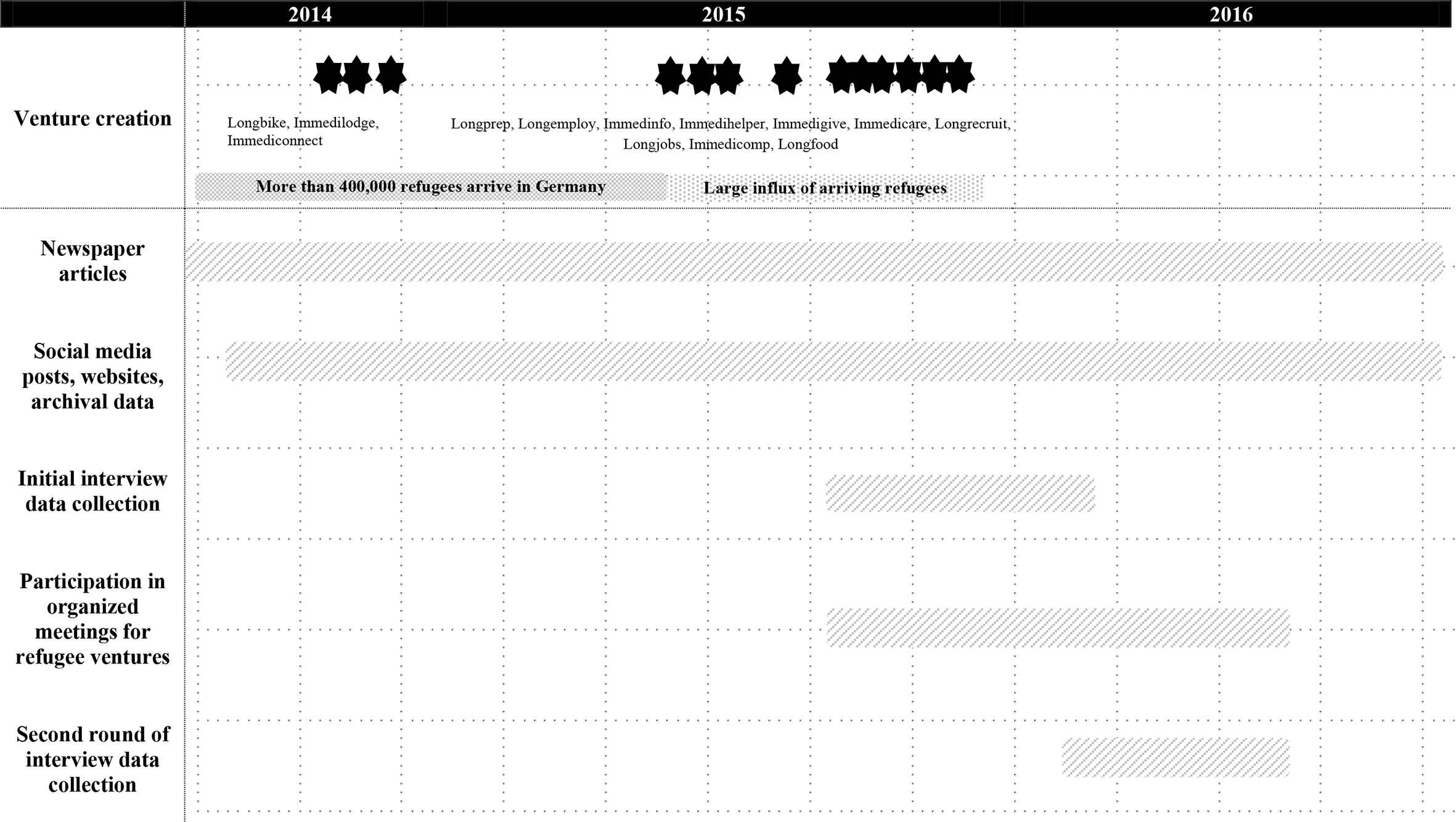
Data collection approach.
Interviews
We conducted semistructured interviews, which formed our primary data source. We interviewed different individuals from each venture to gain a holistic understanding of how and why the founders (and potential stakeholders) created the venture. The sample consisted of 70 informants and included founders (30), team members (five), a facilitator (one), volunteers (26), and refugees (eight). Typically, we conducted the interviews at the ventures’ locations and in German; however, we conducted interviews in English when the interviewees’ mother tongue was English or the interviewees were neither native German nor native English speakers but nevertheless spoke English fluently. We also conducted interviews with refugees who participated in the ventures’ operations; these interviews took place at either the refugees’ accommodations or the institute where the first author is located. Language was not a barrier for these interviews, as the refugees had either already learned German (back in their home countries or upon their arrival in Germany) or spoke English. We recorded every interview and prepared transcripts for each.
The interviews contained seven segments capturing background information on the interviewees and the ventures. We were also interested in the ventures’ evolution and the purpose with which they were started. Additionally, we asked how the venture founders identified and developed their opportunities and requested further information on the ventures’ foundation, the teams involved in the ventures, and the specific venturing activities. Moreover, we wanted to learn more about the venture founders’ short- and long-term time and monetary commitments. Finally, we asked the interviewees about their assessments of the ventures’ outlook as well as the impact of the ventures’ environment. For the interviews with the refugees, we also included questions on how they collaborated with the ventures, what they thought about the ventures’ operations, and whether they would share their individual story of fleeing their home country and arriving in Germany.
In total, we conducted 103 interviews over two rounds with individuals directly involved in the ventures. Specifically, we conducted 60 interviews in the initial interview round and 43 interviews in the second round. Of the second-round interviews, 34 were follow-up interviews with the same individuals as in the first round, and nine were interviews with additional interviewees who were not available during the first interview round. Altogether, these interviews lasted 61 hrs. The first-round interviews lasted from 15 min (brief recorded chats with the cofounders of Immedinfo about their press event) to 90 min with an average of 42 min (median = 42 min; standard deviation = 13 min). In the second round, the interviews ranged from 10 min (a quick follow-up interview over the phone as the interviewee could not offer more time) to 70 min with an average of 28 min (median = 26 min; standard deviation = 11 min). For six interviews in the first round and five interviews in the second round, the interviewees offered to participate but only had a limited amount of time; thus, we covered each section of our interview guide by asking only one key question. Interview transcriptions resulted in 1165 single-spaced pages.
Field Notes
Before and after we conducted the interviews, we also observed the founders, venturing teams, and additional stakeholders in their workplaces. For example, for 20 interviews, the first author visited the interviewees at their homes and was invited to stay for coffee and a chat after the interviews. Usually, these chats were related to the interview topics, offering the first author more in-depth insights into the interviewees’ thoughts and their ventures’ operations. Additionally, the first author met four interviewees at their workplaces. Before or after these interviews, she and the focal interviewee discussed the refugee situation in general or additional topics related to the interview questions. Moreover, the first author attended one venture’s press event, where she engaged in informal talks with additional venture members, journalists, and donors, enabling her to understand the venture’s processes and operations better. After completing the visits, she recorded the observations in detailed field notes. The first author also distributed clothes for one of the sample ventures on multiple occasions, during which she engaged in informal conversations with interviewees and additional venture members, experienced the venture’s operations herself, observed the venture’s emerging structure (and how it changed), and immersed herself in its ongoing operations. The first author also participated in several events to alleviate refugees’ suffering (e.g., hackathons, pitch events, etc.) to better understand the ventures’ challenges and the founders’ intentions for establishing these ventures as well as to connect with potential study participants. She took extensive field notes on the different topics, multiple discussions, and impressions (subjective to the researcher) immediately after these events. These field notes helped triangulate the interview data, thereby enabling a deeper understanding of the ventures’ processes and development. Altogether, the field notes resulted in 87 single-spaced pages of text.
Secondary Data
As the refugees’ migration and associated suffering gained increasing media exposure, we collected substantial secondary data, such as newspaper and news magazine articles, television broadcasts (recorded), and information from the ventures’ websites and social media pages (if available). We also collected data generated by the new ventures, including reports, marketing materials, PowerPoint presentations, and so on, and we collected email exchanges between the research team and the interviewees. Through the secondary data, we gained additional insights into the emergence and development of the new ventures. These data amounted to 1784 single-spaced pages of text. Table 1 details our data sources.
Case Description and Data Sources for Cases.
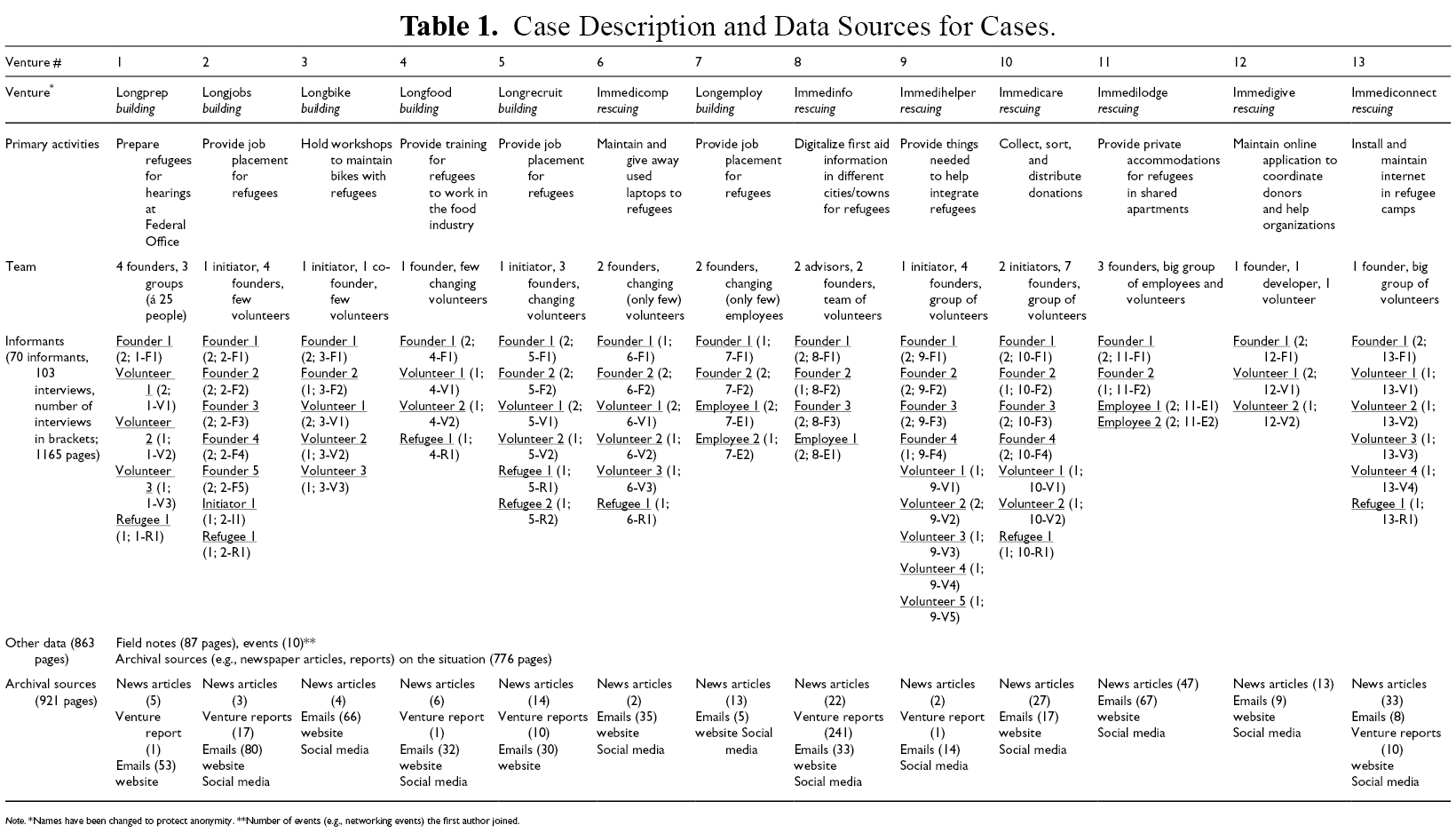
Note. *Names have been changed to protect anonymity. **Number of events (e.g., networking events) the first author joined.
Analytic Approach
After systematically transcribing our collected data, we analyzed them in subsequent but iterative phases, consistent with, for example, Langley and Abdallah (2011). These phases included sorting, mapping, and sequencing our data within and across cases and going back and forth between the data and emerging theory (Langley, 1999) to develop a theoretical framework. Specifically, in coding and analyzing the data, we proceeded iteratively through the following three stages.
Segmenting Data Into First-Order Codes
We started sorting our collected data into smaller segments and interpreting their meaning by assigning them to first-order codes (Strauss & Corbin, 1998). Creating a database using the software NVivo 10 enabled us to iteratively segment our data into initial (first-order) codes. We coded openly (Strauss & Corbin, 1998) and centered our analysis broadly on the topics and issues our interviewees shared with us—for instance, how the founders explained their motivations for starting their prosocial ventures; how they made use of external resource providers; and how they set up their organizations, including their processes and structures. We stopped this process when we were unable to identify new first-order codes and could classify each data segment into at least one of the already existing first-order codes. This process led to 65 initial first-order codes. Thus, in this initial step, we categorized and labeled our data. Then, we compared the emerging codes iteratively to merge, discard, and create codes to develop our final first-order code structure (Glaser & Strauss, 1967). For example, we coded for the challenges and problems associated with accessing resources, resource providers’ motivations to join the ventures, and the importance of external resource providers. We eventually merged these topics into the final first-order code “amplifying the resource provider base.” As another example, we coded for how the venture founders identified their opportunities to help, which we eventually split into the first-order codes “identifying an opportunity to help others immediately” and “identifying an opportunity to build an organization.” Finally, we also initially coded for the importance and role of the media (reporting on the ventures). However, we realized that this topic was no longer important for our analysis, which led us to discard this code. Eventually, we identified 12 first-order codes.
Identifying Variation Across Cases and Merging First-Order Codes Into Theoretical Themes
In the second step, we merged the first-order codes into theoretical themes by mapping similarities and differences across cases (Miles & Huberman, 1994). We identified substantial differences across cases, particularly regarding the venture founders’ motivations. Based on these key differences, we identified specific patterns and clustered our cases into two categories of motivations—those triggered primarily by other-oriented prosocial venturing opportunities (i.e., feelings of compassion, empathy, etc.) and those triggered primarily by founders’ self-oriented prosocial venturing opportunities (i.e., the personal aspiration of creating and building an organization). We recognized specific patterns across these two groups throughout the data, which led us to identify two distinct prosocial venturing approaches across our cases. For example, the data revealed differences in the purposes of the ventures established to alleviate refugees’ suffering. The group of founders who were primarily motivated by their concern for others identified opportunities to immediately rescue refugees from their adversity. In contrast, the other group of founders who were motivated by their opportunities for themselves—that is, by their personal entrepreneurial aspirations—identified a set of potential opportunities to build a sustainable organization that would help refugees in the long run. Thus, we grouped the two respective first-order codes into either “rescuing purpose” or “building purpose.” We continued to cluster and group our first-order codes (Strauss & Corbin, 1998) into six theoretical themes according to the variation we identified in this second step of the analysis.
Sequencing Themes and Aggregating Them Into Overarching Dimensions
Finally, we conducted a detailed analysis across the ventures and time to sequence the theoretical themes and merge them into aggregate dimensions (Langley, 1999). This step allowed us to understand how the founders’ motivations shaped the prosocial venturing process to alleviate suffering. In doing so, we matched patterns that emerged from our within-case and across-case analyzes, triangulated primary data with secondary data, and compared our data with prior research to establish the validity of the constructs captured by our theoretical model (Langley & Abdallah, 2011). For example, we included the compassionate act of rescuing refugees from their suffering by some of our sample ventures in “identifying an opportunity to help” because these venture founders recognized the refugees’ suffering, understood the universality of suffering, connected emotionally to it, tolerated the uncomfortable emotions triggered by the refugees’ suffering, and were motivated to act to alleviate the refugees’ suffering (Strauss et al., 2016).
Specifically, we started to abstract from the contrasting theoretical themes to merge them into aggregate dimensions. For example, while we identified that the initiation of one group of ventures was rather execution oriented, the second group’s initiation was more oriented toward founding the ventures, which we merged into the overarching dimension of initial venturing. Second, we sequenced these aggregate dimensions to develop our theoretical framework (Langley, 1999) of how prosocial venture founders’ motivations shape the prosocial venturing process. These temporal sequences captured when the founders experienced their initial triggers for engaging in prosocial venturing to help refugees, began to manage resource providers, composed their founding teams, started to access resources, and set up their ventures’ structures. In sum, we clustered our theoretical themes into three final aggregate dimensions to capture the temporal sequences of how the founders’ distinct motivations triggered different initial organizing of their prosocial ventures. For example, we found that the founders’ motivations to engage in prosocial venturing (i.e., primarily motivated by concern for others vs. primarily motivated by aspirations for oneself to build an organization) led the founders to pursue distinct venturing purposes.
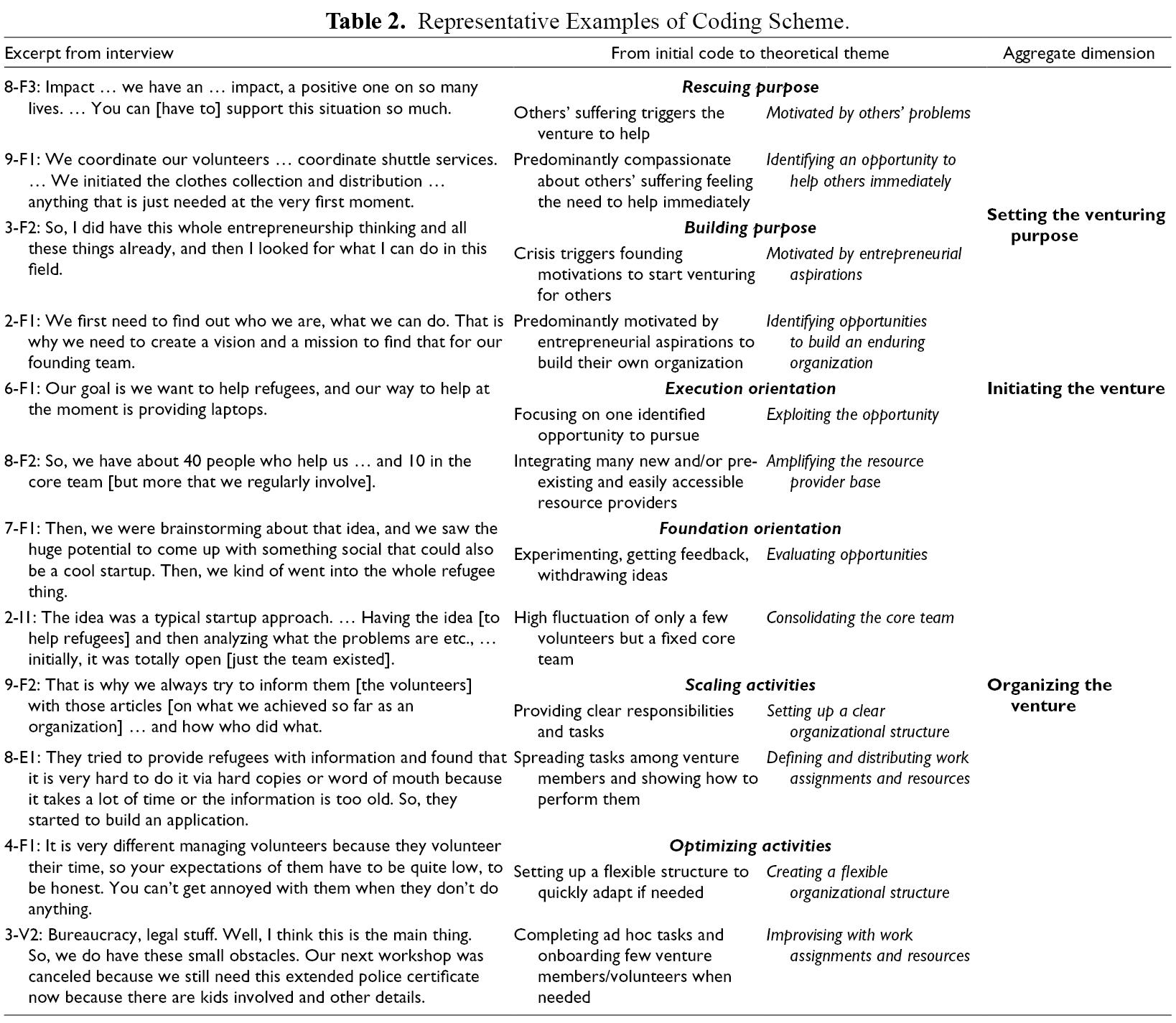
Figure 2 shows the data structure that emerged from our analysis. Table 2 provides a detailed overview of the coding process, delineating how we labeled excerpts from our data into initial and final first-order codes and merged them into theoretical themes and eventually into aggregate dimensions.
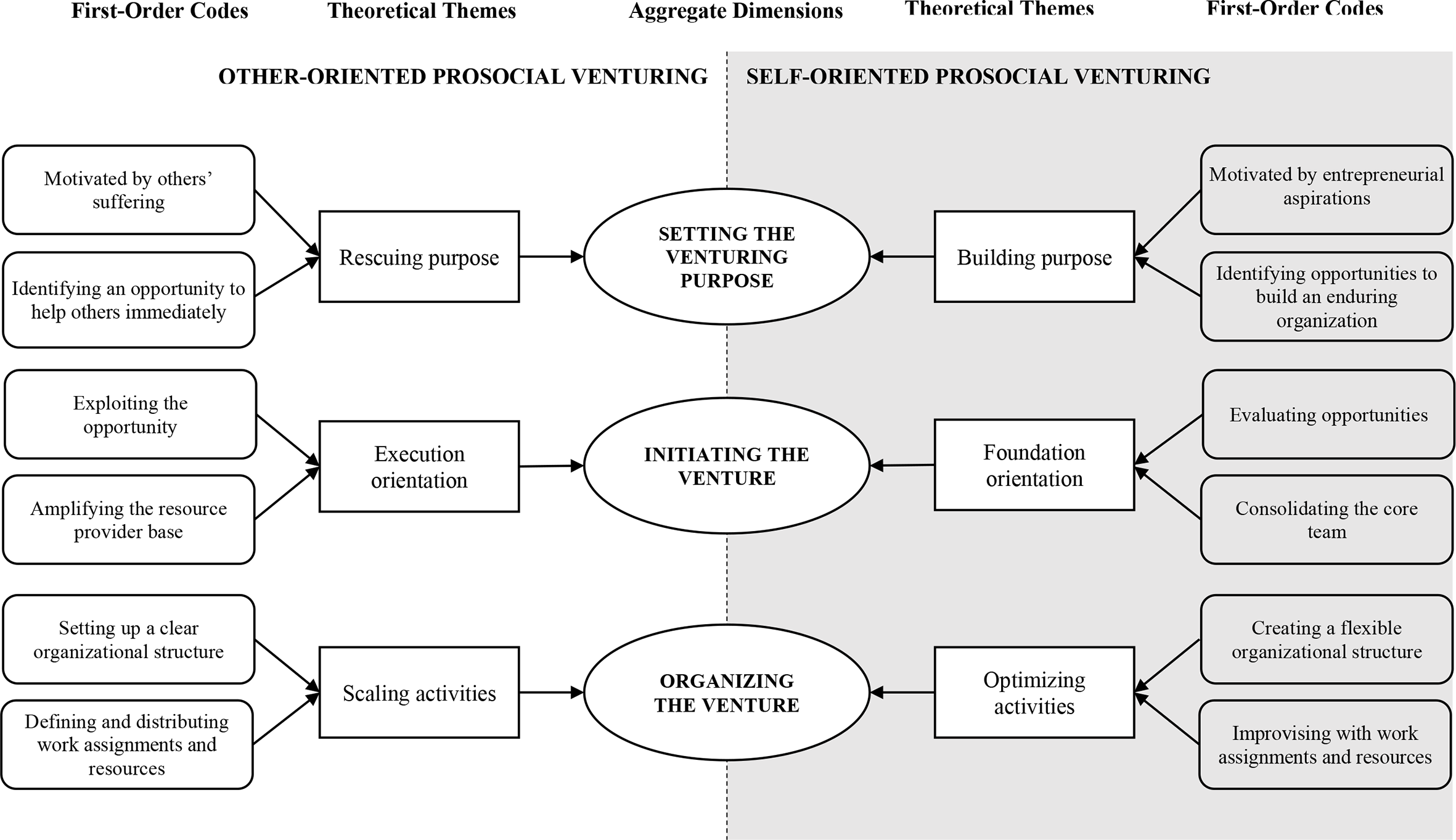
Data structure.
Representative Examples of Coding Scheme.
Motivating Prosocial Venturing in Response to the Refugee Crisis in Germany
Consistent with prior work (Miller et al., 2012), our analysis revealed that all the venture founders felt compassionate about refugees’ suffering. For example, an Immediconnect founder mentioned,
There were many people here from Afghanistan … and every time, my heart hurt when I saw, for example, a 10-year-old jumping around without heels because he stepped on a stupid mine. But these people are here; they are safe now … and for them, a new life begins now, and we just have to try to help them a little. (13-F1) 1
Similarly, an Immedicomp founder explained that the only thing he wanted to do is “help … if there is the war in Syria and the refugees are coming here, we should try to do something to avoid the situation” (6-F1). An Immedihelper founder also told us about his compassionate experience when seeing arriving refugees:
The pictures of refugees, be it the water routes … when you see them and their destinies, when you see the pictures from the Balkans or Hungary, when you see the pictures of war, so when you see what these people have been through, and they arrive here and have nothing, and we have everything. (9-F4)
Also, a Longrecruit founder explained that “the initial trigger, of course, was actively helping in the refugee crisis” (5-F1), and another Longrecruit founder told us that “it is still my goal to help these refugees, but also the German society to really integrate the refugees” (5-F2). Finally, a Longjobs founder told us about her fear that the German government is not able to cope with the situation and that she wanted to contribute. She said, “I’ve seen that it is a big issue in Germany right now and that the government cannot cope with it, that it lacks capacity, and so I said that I wanted to do something to help” (2-F4).
Due to the primacy of their compassion-based reactions, some founders (i.e., Immediconnect, Immedicomp, and Immedihelper) experienced the desire to immediately alleviate arriving refugees’ problems, leading them to engage in other-oriented prosocial venturing.
Setting the Venturing Purpose
When analyzing our data, we noticed that two distinct motivations drove the founders to engage in prosocial venturing. First, for one group of founders, their reactions to refugees’ suffering activated an inherent desire to help others. From this combination of concern for others and an underlying prosocial motivation emerged the desire to engage in prosocial venturing to alleviate refugees’ most urgent problems. In contrast, the second group of founders identified potential opportunities for themselves from the refugee crisis that could fulfill their personal aspirations to create and run their own organization (and, in doing so, also do some good by helping others). These two distinct motivations initiated different prosocial venturing approaches, which we label other-oriented prosocial venturing and self-oriented prosocial venturing, respectively.
As an example of other-oriented prosocial venturing, an Immedilodge founder, who had already been volunteering at various established nonprofit organizations (NPOs [e.g., at an NPO that supports higher education in crises regions]), explained how the venture quickly acted to help refugees: “We saw it in the media, specifically the topic of how to accommodate refugees, and then we said we need to do something about it and started with our own room [in their own shared apartment]” (11-F1). In contrast, as an example of self-oriented prosocial venturing, a Longemploy founder emphasized his entrepreneurial aspirations as an important motivation to start the prosocial venture. He said,
It was more personal, but not necessarily the social motive that one would maybe expect. I said I want to create something because I was really keen to create something, like, intrinsically motivated to found my own company. Then, we’re, like, brainstorming ideas, and I said I would like to do something social, but not necessarily social, but it would be nice to have something social. Then, we were coming up with the refugee crisis, and you might maybe do a lot there. (7-F1)
Given their distinct motivations, the venture founders of both groups set different venturing purposes. While the first group of founders decided to rescue refugees from their suffering immediately, the second group of founders decided to build an organization that would continue to help refugees in the long run. In the following, we provide further explanations of the founders’ purposes to engage in prosocial venturing.
Rescuing Victims as the Purpose of Other-Oriented Prosocial Venturing
Because this group of founders was motivated by concern over the problems arriving refugees faced (and their resulting suffering), their venturing purpose was to rescue refugees from the immediate sources of suffering. Through this other-oriented prosocial venturing, the venture founders engaged with refugees by providing them offline first aid information in different cities (Immedinfo), supplying essential goods and services to welcome refugees and link them with their local community (Immedihelper), collecting and distributing fresh clothes (Immedicare), providing private accommodations in shared apartments instead of big refugee camps (Immedilodge), maintaining and distributing pre-owned laptops to refugees (Immedicomp), installing and maintaining internet access in refugee camps (Immediconnect), and providing an online application to coordinate donor and help organizations (Immedigive).
Specifically, the Immediconnect founder explained that he had an emotional reaction to refugees’ fate and the terrible circumstances from which they had escaped. He said,
I’ve heard hundreds of stories of people who escaped through the desert with 15 people on a jeep, and some just fell off the jeep. The jeep did not stop to help them get back on the jeep. They just died in the desert … . These are things that I initially, well, I am a very compassionate person, so I really got a lump in my throat [and want to help those who arrive here and have gone through terrible things like these]. (13-F1)
Similarly, an Immedinfo founder explained that the venture team felt morally obliged to help when they could, telling us, “The basic idea [for the venture] is idealistic. We want to help [arriving refugees who are in need]” (8-F3). At Immedihelper, a prosocial venture that emerged in the middle of a small community and became the local hotspot for arriving refugees, the founders experienced refugees’ immediate suffering firsthand. One founder told us, “And because we have everything, and then when you see them [refugees], they arrive here, and they need help, and we really can do something [about their problems]” (9-F4). Finally, one Immedicomp founder explained,
If there is a war in Syria and the refugees are coming here, we should try to do something to avoid the situation. So basically, since I believe this, on the one side, I try to immediately help people. So, I am trying to give relief to refugees here and also to friends and families. And that is the main motivation for me. (6-F1)
To accomplish the purpose of rescuing refugees from their adverse situation, these founders focused on identifying opportunities to help refugees immediately. For example, an Immediconnect founder explained how his venture’s purpose of rescuing refugees led him to recognize an opportunity to quickly help refugees access the internet:
Initially, my idea was to look at the map where I live … and see what I can do here for logistic reasons … . Then I got in touch with a communal accommodation [just next to my home town] … and because no one else cares about access to the internet for refugees and those people who want to or have to stay here, they have to integrate themselves, and everyone living in the modern civilization should for just one second imagine how to do that with no access to the internet … and then I said that I really like the idea [to provide internet to refugees]. (13-F1)
At Immedilodge, the founders were shocked by the pictures and stories from the big communal refugee accommodations and immediately started developing a platform to match arriving refugees with rooms in private accommodations. One employee explained, “Our main task is—we also do some crowdfunding for it … is to provide people who fled from their home countries with private housing space in Germany” (11-E1). The Immedicare and Immedihelper founders witnessed the arrival of many refugees in their local villages, which led them to recognize opportunities to collect donations and distribute them among refugees. An Immedicare founder explained, “Our main focus is to collect donations—namely, clothes—which is the first set [of fresh clothes] that we want to give them there [refugees in the camp]” (10-F1). Similarly, an Immedihelper founder reported, “We have the goal to help those who are here [in our town] in different areas [mainly to provide arriving refugees with clothes and supplies they need immediately]” (9-F1). The Immedinfo founders’ attention centered around refugees’ informational needs, which led them to identify gathering local information as an opportunity for immediate help. As one founder said, “The project emerged … first to provide a brochure for first steps in Germany … with everyday questions for asylum seekers … and we [quickly] decided to digitalize it” (8-F1). Finally, the Immedicomp founders wanted refugees to quickly return to a more “normal” life. As part of this process, they recognized that providing laptops would be an opportunity for quick help. A founder told us,
So, our initial thoughts were … to satisfy basic needs, so they need a house or roof over their heads and etc., and need to clarify their status. But until then and in the meantime, it is the question of how to get back to normality and … we thought that having a laptop is part of that. (6-F2)
Building an Organization as the Purpose of Self-Oriented Prosocial Venturing
In contrast to the founders driven primarily by their concern for others, the founders of Longprep, Longjobs, Longbike, Longfood, Longrecruit, and Longemploy were primarily motivated to engage in prosocial venturing as a means for pursuing opportunities for themselves to fulfill their personal entrepreneurial aspirations. They saw the crisis as an opportunity to establish a venture. Although these founders also felt compassion for refugees, our data revealed that their strong self-interest to fulfill the aspiration of building their own organization was the main motivator for their prosocial venturing. These founders pursued the purpose of helping refugees in the long run as a means of creating and building an organization. Specifically, these prosocial ventures engaged in preparing refugees for hearings at the Federal Office to gain asylum status (Longprep) and finding jobs (Longjobs, Longrecruit, and Longemploy) and providing workshops for refugees so they could maintain bikes for mobility (Longbike) and work in the food industry (Longfood).
Through creating their own ventures, these founders aimed to gain (additional) entrepreneurial experience and/or independence by being their own boss (for personal growth) while simultaneously doing some good by alleviating refugees’ suffering. For example, one Longprep founder, who was on a gap year (between high school and university) and was looking for opportunities he could engage in, explained, “I wanted to do something meaningful … but not as a volunteer … . All systems [helping arriving refugees] were over-challenged, and I had the feeling I couldn’t really do something there” (1-F1). Similarly, a Longjobs founder, who was in an entrepreneurship program at a university, mentioned that he was primarily motivated by “these experiences to have a startup because I definitely am very interested in … this process firsthand” (2-F2). The Longfood founder, who previously worked as a project manager for a company but was currently unemployed, said her primary motivation “personally for me is being able to deliver a successful project as well and being able to be [my] own boss and make my own decisions” (4-F1). The Longrecruit founders were also interested in gaining founding experience while doing something good; one founder said,
I find this venture really nice. There is a lot of personal fulfillment in it. Starting a venture, doing work that makes sense, freedom … that just brings pure joy … and with all the stress that is involved in doing that and what you get back from it materially, being honest, it was really important to me to get something back personally. So, it was important to me to have that CEO title because this will be a door opener for something that we’ll do in like two or five years. (5-F1)
As a basis for building a venture through helping refugees, these founders focused their attention on identifying opportunities to help refugees over an extended period. For example, the Longprep founder explained that the venture team aimed to identify a form of help that no one else could deliver such that they could find their niche. He said,
She [an acquaintance] just told me how important it is to prepare those people [prepare refugees for their asylum-seeking process] … and it turned out that it is not done systematically but is only done in those tough cases, and this was the original impulse to do that. But after that, we looked at it systematically and said, okay, this was then one of many ideas, and in the end, it turned out to be, okay, this might be a very useful one [idea]. And we should focus on it and develop an offer. (1-F1)
Further, a Longprep volunteer explained that the venture aimed to find out how to facilitate the sustainable integration of refugees into German society; she reported, “We prepare refugees for their hearings at the Federal Office … . Refugees don’t even know what this all includes” (1-V1). Similarly, one Longjobs founder explained that her venture wanted to aid refugees’ sustainable and long-term integration into German society. This founder said, “We want to foster refugees’ integration … by providing a platform for companies where they can reach out to refugees directly … [regarding] when refugees are allowed to work [in Germany]” (2-F5). Another Longjobs founder added,
And the idea was, in the beginning, very broad. We could have done anything from [improving] living [conditions] to education to work … . And then, at some point, we thought to go in the direction of work placements or to register their skills and then give them to organizations. (2-F4)
Since Longjobs’ approach to opportunity identification implied that companies would pay for assistance in hiring qualified refugees if the refugees entered into regular working contracts, the founders expected the venture to reach financial sustainability in the long run. The same was true for Longrecruit, which pursued a similar business model, as one founder explained:
And in the future, we want to become a venture that not only cares about job placements because that’s not everything … . I am a big fan of education … and I’d love to do something in that direction … to have such multipliers in the country, people who not only translate language but also translate culture and integrate language into our processes that help refugees learn German and that also help Germans mediate between both sides. That would be my vision. (5-F2)
With their bike repair workshops, the Longbike founders wanted to enable refugees to help themselves and to provide them with mobility to care for themselves. One volunteer summarized the venture’s activities the following way: “We repair bikes together with refugees at their camps for their own use to provide them with mobility” (3-V2). By establishing their workshop format, the founders believed they could create an organization that would be sustainable in the long run, could scale the business model to many camps, and could eventually hand off management to refugees themselves. As one volunteer said, “But one goal is fixed, and that is to create a sustainable project … How long should it [the organization] last? Of course, as long as possible” (3-V1).
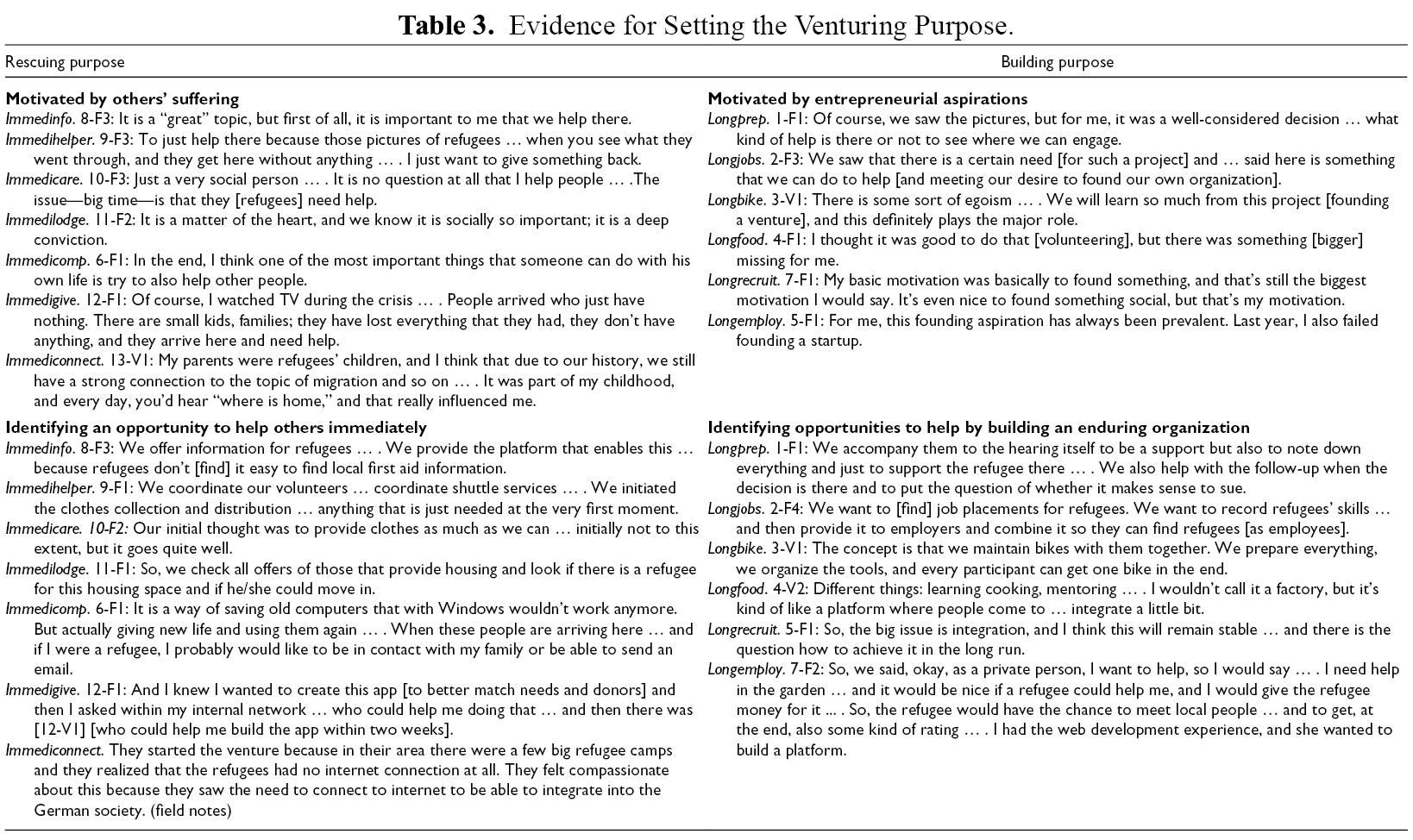
In sum, our data suggested that all the venture founders experienced some form of emotional reaction and feelings of compassion toward refugees, yet the founders had different motivations for their prosocial venturing. For one group of founders, their concern for others was the primary trigger for their prosocial venturing to immediately address refugees’ most urgent sources of suffering. This motivation drove these founders (and their ventures) to rescue refugees from their current situation by identifying opportunities to address the refugees’ immediate needs. In contrast, the second group of venture founders aspired to create and build their own organization, so they identified opportunities to help address refugees’ long-term needs. In Table 3, we provide further evidence of these findings.
Evidence for Setting the Venturing Purpose.
Initiating a Prosocial Venture
Given their distinct purposes, the founders differed in how they initiated their prosocial ventures. By initiating a prosocial venture, we refer to the first activities founders engage in to realize their prosocial venturing purposes. The founders engaging in other-oriented prosocial venturing focused on rescuing refugees and quickly executing their identified opportunities to help refugees. In contrast, the founders engaging in self-oriented prosocial venturing focused on creating venture fit—namely, finding opportunities to help that fit the founders’ skills and long-term perspective. These founders concentrated on setting up and maintaining an organization and thus pursued an orientation toward developing their ventures’ underlying capabilities for delivering refugees value in the long run.
Other-Oriented Prosocial Venturing Toward Focusing on Execution
Driven by their purpose of rescuing refugees from suffering, these founders initiated prosocial venturing to execute tasks necessary to alleviate refugees’ immediate suffering. For example, an Immedicomp founder explained how the venture team realized that refugees would urgently need access to a computer to connect with their families and friends, engage in online learning, etc. She told us that “the goal was still to rescue refugees … to provide open-source software and laptops for refugees and to make their lives easier” (6-F2). Thus, the venture members quickly started to focus all their activities on collecting used laptops, maintaining and installing easy-to-use software on them, and then distributing them to refugees. Similarly, Immedihelper and Immedicare started their venturing activities by executing their identified opportunities to meet the most urgent needs of refugees arriving in their local villages. Immedihelper’s members engaged in distributing fresh clothes; as many arriving refugees lacked fresh and warm enough clothes, one founder said, “We have the goal to help those who are here [in our town] in different areas [mainly to provide arriving refugees with clothes and supplies they need immediately]” (9-F1). The venture members also provided essential care packages to families with babies and small children (field notes). Additionally, an Immedicare founder told us, “Our initial thought was to provide clothes as much as we can … initially not to this extent, but it goes quite well” (10-F2).
Because these ventures focused on rescuing refugees from a source of suffering, they pursued an execution-oriented approach that involved activities to exploit their identified opportunities immediately and amplify their resource provider bases to alleviate refugees’ suffering on a large scale. For example, an Immedicare founder told us how she and her co-founder met at a refugee camp and that same day decided to exploit the opportunity to help refugees by initiating an onsite venture to provide fresh clothes as this was not done at the camp yet. She said,
We saw each other; it worked. That day, we got to know each other, and on that day, we said, okay, let’s collect a few clothes, and [we] needed help. And, then, it just was created, and we said, okay, yes, an association. We did the statute on that day, we had the founding meeting in the evening [on a day] in October, and then we had the association. (10-F2)
In a similar vein, another Immedicare founder added, “I wouldn’t have gone somewhere to look for the opportunity and do it … I didn’t say I’ll do it; it is rather that the situation was there, and I was in the middle of it, and this is how I am and what I do” (10-F1). An employee at Immedinfo also explained that given their focus on refugees’ urgent information needs, the founders quickly started programming a mobile application that would provide information to refugees more easily than existing printed documents, which needed to be updated often. The employee said, “They [the founders] tried to provide refugees with information and found that it is very hard to do it via hard copies or word of mouth because it takes a lot of time or the information is too old. So, they started to build an application” (8-E1). Similarly, the Immedigive founder explained how his focus on refugees’ urgent needs led him to quickly implement his idea to connect helping organizations with potential donors by developing an application that contained information on what refugees need the most. He reflected,
So, this is just a side project … and I haven’t really thought about doing anything [business] oriented … . About 3 months ago … I had the idea for the helping app that coordinates donors and help organizations, so you can provide information on which donations are needed in which areas right now … and this was done quickly. Two weeks later, we had the application, and that was really good that we were so quick in doing this. (12-F1)
Eventually, the Immediconnect founder remembered that he first started to look at existing response organizations to volunteer there but quickly realized that his skills were different than what these organizations needed to address refugees’ needs. Instead, after noticing there was no internet at the camps he visited, he quickly changed this situation. He told us,
I talked to all these different organizations … and there, they offered me tasks … that went in the wrong direction … things that needed to be done but nothing that matched my real skills. [The camps did not have internet connections] and I knew about the internet, wireless LAN, hotspots, and everything and how to install it … so this was what I then decided to do [from that day on]. (13-F1)
These prosocial ventures’ execution orientation implied that they needed to amplify their resource provider bases; that is, they needed to engage many volunteers and collect more financial and material donations. To achieve these goals, the founders increased their ventures’ visibility by engaging in activities to quickly inform many people about the ventures, their intended activities, and refugees’ specific needs. Some ventures used social media for this purpose. For example, an Immedicare founder told us how they used Facebook to identify additional potential helpers and inform these potential helpers about refugees’ immediate and specific needs. She said,
And then we posted it on Facebook. We found helpers there very quickly … . Definitely from the very beginning, we made use of Facebook, but also, we had the event [an information session in their local town] … and we were also present in the local media, and so some got curious to get to know the camp … and so some of them stayed [with the venture and helped]. (10-F1)
Immedihelper and Immedicomp also pursued a social media-driven approach to enhance their visibility among potential resource providers who possessed relevant knowledge to address refugees’ specific needs quickly. As one Immedihelper founder explained,
We sent emails to everyone [in their personal and local networks], we are on the town’s website, and we also reached out via Facebook and Whatsapp. Thus, we tried to contact rather big groups. We tried to find people through these groups who also wanted to help with specific activities. (9-F2)
Similarly, Immedicomp’s primary social media channel was Facebook, as one founder reported:
On Facebook. We were quite surprised. I think [my co-founder] did a little bit of … not spam mail… he posted the [venture’s] group in another two or three groups online. So, in a matter of a few days, there were already 50 people who signed up. And so, all the communication in the beginning was through the Facebook group. Also, now, it is quite important. Maybe it is the main communication point. (6-F1)
Additionally, these ventures took more classical approaches to amplify their resource provider bases for quick opportunity exploitation. For example, an Immedilodge employee told us that the venture was always looking for new helpers with potential social work or volunteering experience. He said, “Basically, it [joining the venture] is open to anyone, but we always have a phone interview and ask for information. Of course, there are no-gos, and we say okay, if someone is obviously discriminatory, racist, … then we say no” (11-E1). Immedilodge posted job announcements via social media and attracted potential employees or volunteers via the founders’ personal networks. Immediconnect also used direct contacts to grow its circle of resource providers quickly, as the founder explained:
For each organization in each helping circle [which served as the contact for the camp where the internet needed to be installed], we have one to two people. For a hundred accommodations, that would be 200 people who have helped us at least once. The core team, I’d say … is about 15 people [who engage with the venture on a daily basis]. (13-F1)
Finally, Immedigive’s approach to access volunteers quickly was particularly notable because it made participating in the venture possible independent of time and location. Specifically, the founders made the code of their application open source, so any potential volunteer could help develop and improve the application at any time and in any place. One volunteer told us,
But I told him [the founder of Immedigive] that since we are not getting money and we are kind of helping people, let’s work, like, open source. Well basically, all our source code is there in Github on the internet. And basically, anyone can … if he wants … participate in the development, and surprise, surprise, there were many guys who, like, participated in this development. So, there was one hackathon in Berlin, as I mentioned, and there was some, like, random guy, I don’t know how he found us, or there were maybe many HelpHelp2 like was mentioned … in many German newspapers. (12-V1)
Self-Oriented Prosocial Venturing Toward Establishing an Organizational Foundation
In contrast to the founders who pursued prosocial venturing to rescue refugees, those who engaged in self-oriented prosocial venturing focused on processes that would enable them to establish a strong foundation upon which to build an organization. By a foundation orientation, we mean that these founders deliberately chose an opportunity from a set of potential opportunities based on their respective team’s capabilities to exploit it (Boeker & Wiltbank, 2005), and this match between the potential opportunity and the team’s capabilities represented the foundation for an enduring organization. Rather than helping quickly, these founders allocated their attention to evaluating multiple opportunities to help refugees over the long run and forming a venture around a core team that would develop and maintain an organization to exploit the opportunity they ended up pursuing. Importantly, the differences between other-oriented and self-oriented prosocial venturing did not seem to be driven by the founders’ different qualifications; however, we found differences in the founders’ venturing processes, to which we now turn. 2
The first key process these ventures (with a foundation orientation) focused on was generating and evaluating potential opportunities based on a distinctive advantage from which to build an enduring organization. These founders experimented with different opportunities, obtained feedback on these potential opportunities from a community of inquiry, and withdrew from those potential opportunities that did not show long-term promise to start from scratch again. For example, a Longprep founder explained that the venture team went through a couple of iterations and a lengthy process in which they considered many ideas about how they could help refugees. During this process, the team acquired knowledge on arriving refugees’ multiple needs to develop a broader portfolio of potential opportunities from which to select the best one to pursue. The founder said, “So, for example with the refugee counsel … we talked to many organizations within that area and got feedback, and again we built the concept. We always challenged it until we got the concept that we have” (1-F1). Similarly, a Longjobs founder explained that the venture team was initially not very focused on what they wanted to do but instead attempted to acquire knowledge about the entrepreneurial process in general and the team’s strength and capabilities to identify an opportunity that fit the team. He told us, “We first needed to find out who we were, what we could do; that is why we needed to create a vision and a mission to find that for our founding team” (2-F1), and he went on to explain, “And we didn’t know anything in the beginning. We didn’t know what it should become, what it will become. Then we looked at different things for two months, we talked to people, to refugees and companies, to associations” (2-F1).
Additionally, a Longbike volunteer explained that the venture team had to consider different opportunities to create a venture with a long-term perspective because many rather obvious opportunities addressed immediate needs but were not the basis for building an enduring organization. He said, “The goal won’t stay the same; that’s for sure. It really is a moving target … We won’t be able to define it” (3-V1). The Longemploy founders went through a long ideation phase in which they withdrew from several ideas after they received negative feedback from different sources. One founder explained,
We developed that idea and then came to another idea for doing a Facebook [group] for refugee helpers, and I think that was for two months. In November, then, we had a different idea because the other idea didn’t work, and then, we wanted to do an online booking platform like Thumbtack or Star Service where private people can book refugees for housework. So, they can say, “Oh my garden has to be cut …” [and] then, you can say “Okay, I need someone,” and then, you give them a reference. That was kind of the idea that a refugee can earn some money beside the integration courses, etc., and get smaller job references, but that turned out to be very, very complicated on a regulatory basis. So, in the beginning of January, we found that the only way to realize that project was to hire the refugees directly and then lend them out to private people, but then we thought, … that makes no financial sense anymore. We have to go to bigger companies, and that’s kind of how we went to the temporary employment thing. We said that’s a much bigger impact for the refugees as well … Since then, we kind of worked on the project, challenged our project with different stakeholders, so with a lot of refugees. We had interviews with a lot of companies but also with the job agencies here, like the unemployment agencies here. (7-F1)
While evaluating multiple potential opportunities, these founders also consolidated their core teams to match their ventures’ emerging concepts. Specifically, the founders focused on building relatively small teams with some general entrepreneurial and managerial knowledge to facilitate the early venturing process and the development of their ventures’ concepts rather than recruiting team members with specific opportunity-related knowledge. For example, Longbike consisted of “seven to eight people right now” (3-F2) all of whom were students active in a large global social entrepreneurship program. Similarly, the Longjobs team “consisted of founders who were part of a large entrepreneurship scholarship program, which focused on hands-on entrepreneurship teaching and selected students who were highly interested in entrepreneurship activities and wanted to become founders themselves” (field notes). The team of Longprep “consisted of four individuals who led the venture and for whom it was important to incorporate management and entrepreneurial experience” (field notes). Indeed, one Longprep founder mentioned, “We also understand ourselves as entrepreneurially thinking and acting people … and I think this is also what differentiates us from others [other prosocial association teams or organizations]” (1-F1). A Longrecruit founder explained that they were purposefully building a small core team and were not willing to rely on too many volunteers who would not commit to the venture strongly enough. He said,
I always thought the responsibility was missing [when engaging volunteers] and being able to plan things … It should be intrinsically motivated people, and when I give it to a volunteer, well, they are not here with us in our office, so we do want to have a real [core] team. (5-F1)
Finally, a Longemploy founder also told us that it was somewhat challenging to consolidate a core team because the right mindset and entrepreneurial spirit were important for her. She told us the following:
She’s just not the one I would … found a company with because … she’s very risk averse. She’s not really familiar with the whole entrepreneurial business and is very inexperienced at that. So that’s kind of a huge barrier—to find the right timing, to get partners on board, into the boat. (7-F1)
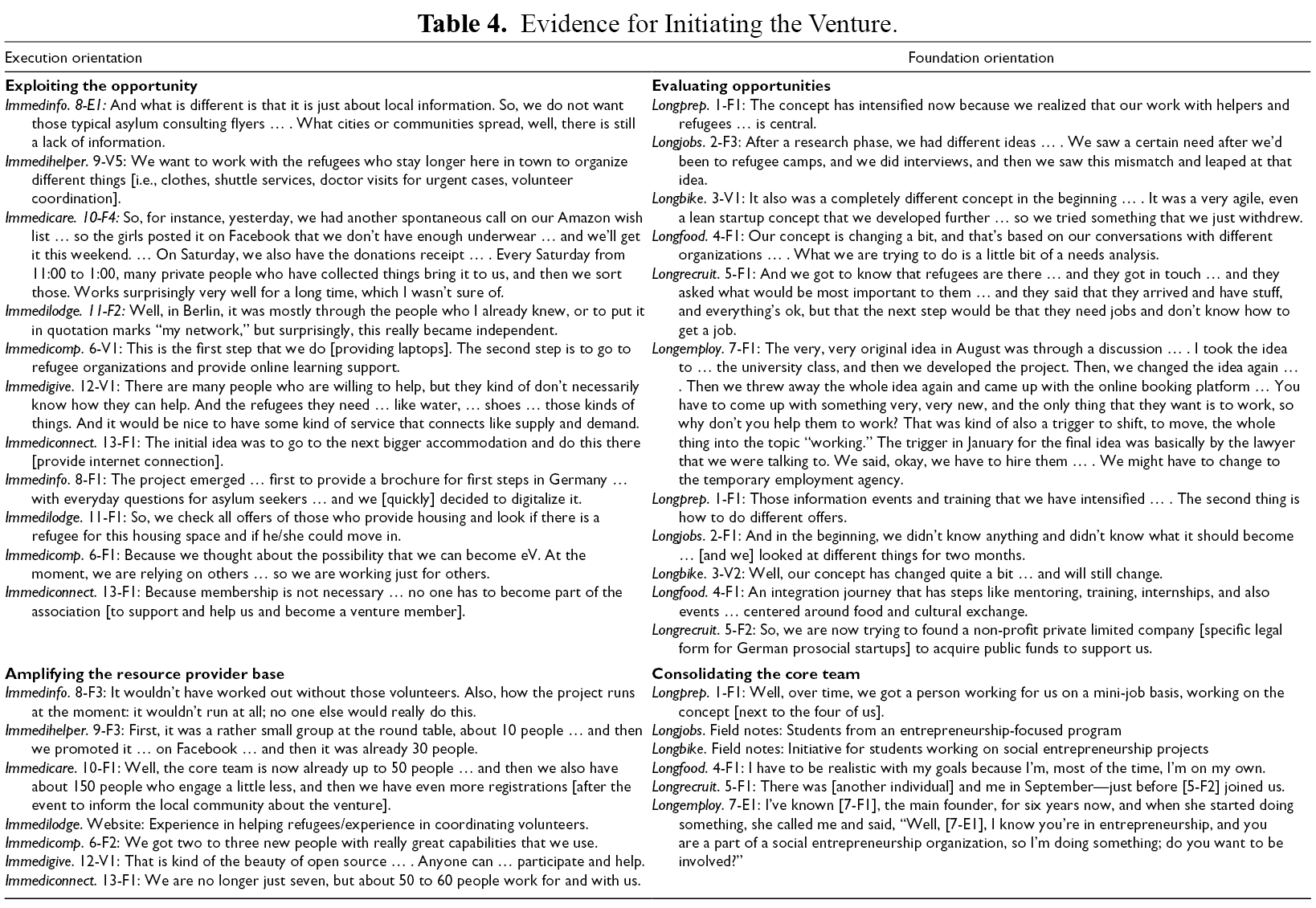
In sum, our data suggested that the group of founders engaged in other-oriented prosocial venturing focused on understanding refugees’ needs and addressing them quickly on a large scale (if possible). These ventures were oriented toward execution to quickly start exploiting their identified opportunities and amplify their resource provider bases. In contrast, the venture founders who engaged in self-oriented prosocial venturing focused on ensuring the fit between their ventures and their opportunities so they could ultimately create and build an enduring organization. For each of these ventures, this focus triggered the consolidation of a small core team with the knowledge and skills to evaluate multiple opportunities and crystallize the venture’s distinctive competence. Table 4 further illustrates exemplary evidence for these findings.
Evidence for Initiating the Venture.
Organizing a Prosocial Venture
The different orientations for initiating the prosocial ventures required distinct approaches to organizing. Organizing refers to the coordination of effort and the distribution of essential resources and tasks (March & Simon, 1993) for ongoing operations. Because the purpose of other-oriented prosocial venturing founders was to rescue refugees from their suffering and provide for their immediate needs, the venture founders with this purpose worked toward standardizing their processes to scale their activities efficiently. In contrast, because the purpose of self-oriented prosocial venturing founders was to address refugees’ needs as a means to build an enduring organization, the venture founders with this purpose worked toward optimizing their products and services to address refugees’ long-term needs. Specifically, these ventures developed more individualized offerings.
Other-Oriented Prosocial Venturing and Organizing to Scale Activities
Building on their execution orientation, these ventures focused on scaling their activities to address many more refugees’ needs and thus worked to standardize their internal processes to replicate them when and where needed. For example, Immedinfo established a successful process to grow its venture community, including volunteer helpers. One founder mentioned that this process had grown a large venture community within a short time as a means of helping even more refugees. He told us the following:
Since then [the venture’s start], we have been in touch with 80 local communities [to scale our activities outside of the community where we started providing first aid information]. We got more and more people, well, I don’t know [exactly], but I’d say the number [of people working on the core project] has tripled since we started. (8-F3)
This recognition of the importance of scaling to rescue refugees encouraged the venture to extend its help services. As one co-founder recalled, “And we said that we could then also offer training or consulting” (8-F1). This emphasis on scaling also helped the venture to overcome the hurdles of keeping its volunteers engaged. In particular, the venture overcame temporary dips in the volunteers’ motivation based on higher standardization of work tasks. One founder described the consequences of scaling for volunteers as follows: “who wants to continue doing it [the tasks] when there is less and less creativity involved but a very strict process? … and this is something very interesting that we maybe can and have to ask ourselves” (8-F2). By communicating the benefits of standardization and scaling, the venture was able to keep its volunteers engaged.
Similarly, given their emphasis on organizing for scaling their activities, the Immedilodge team thought of extending their offer from providing living space to providing additional services in other areas in Germany to help refugees in additional locations. One founder said, “We will definitely extend our offer … maybe from living also having some areas like working, learning German, etc.” (11-F2). Moreover, the Immedigive founder developed his mobile application to help even more refugees than in the venture’s early phase; he told us that when it came to scaling, there was “potential, we have lots of information about the help organizations in this app [and] we have a lot of users. We can use that to expand it to include even more services” (12-F1). This required these ventures to standardize their internal processes to scale their activities and reach a larger number of refugees. To do so, they set up clear organizational structures and defined and distributed work assignments and resources accordingly, to which we now turn.
Early in the venturing process, these founders set up organizational structures with clearly defined roles and responsibilities. For example, to integrate its growing number of volunteers into its operations, Immedinfo introduced specific information software tools. One founder explained,
It was tough. I can’t tell others “Hey, fill in this Excel spreadsheet” a thousand times and things like that … .You always have to try it somehow, and then I tried different things and found a good method for getting resource providers to do those things. With volunteers, it’s even tougher to motivate them. And then, I realized that we need a good organization with important tools, so we switched to working with Salesforce and Slack [to clearly organize our tasks]. (8-F1)
The Immedilodge founders tried to facilitate scaling by defining the central tasks required to provide shared living space in private apartments. Based on their understanding of the potential problems associated with finding both this space and local people willing to take refugees into their homes, the founders broke down the overall tasks into roles for themselves and their resource providers. With this distribution of responsibilities, the resource providers came to understand what was expected of them and could engage with the venture quickly. For example, the founders coordinated volunteers and matched volunteers with people who wanted to provide shared space in apartments. The volunteers were then responsible for placing refugees in spared space and coordinating this placement process. One founder summarized, “We established very quickly more and more a structure for volunteers, and at some point, we already had more than 50 people who supported us on a volunteer basis” (11-F2).
Similarly, the Immedicomp founders realized that they needed to better allocate tasks to counteract barriers to scaling their activities. One Immedicomp volunteer told us that initially, “we wanted to be a group of equals. But then we became so big that there is a need … to have responsibilities” (6-V4). Thus, the founders decided to set their structure by splitting the venture team into those who would work on the laptops’ technical aspects and those who would work on administrative or distribution tasks. This assignment of subteams helped the venture effectively share information internally. One volunteer explained, “We always split so that everyone gets all information needed based on the topic they work on. I, for example, always care about technical things” (6-V3).
Furthermore, for some ventures, scaling their activities also included finding the appropriate structure. Specifically, the Immedicare founders described how their resource provider base had grown quickly. One founder said,
From nothing to full throttle, I would say … . The [official ministry] with 80 soldiers, the Red Cross with 80 soldiers and 30 employees, and then us [Immedicare] with 350 active volunteers—then this is from nothing to full throttle within four to five months. That makes us extremely proud. (10-F1)
Another Immedicare founder added, “We had very quick and big success with the willingness to donate goods. We were even surprised—be it financial donations or goods donations … this was an incredible amount” (10-F4). As a result, Immedicare founders had to search for a structure that would enable the venture to effectively manage the large resource provider base needed to collect and distribute clothes to refugees quickly. Although the founders had also considered alternate structures, such as a social corporation, given the quick action required and the large number of varying resource providers involved, they chose the structure most appropriate for scaling, as one founder explained:
And in the beginning of October, we founded our association because even then … we knew that we can’t just collect pants in this area but that we’ll need financial resources; we need big firms [as cooperation partners] … . And that is then just different when you found an association. You can acquire financial donations and use them, etc. … you are independent from others and use your money freely … and you give it a name. And that’s why we all rather quickly said that we need an association. (10-F1)
The chosen structure allowed the venture to flexibly create individual units within the organization with different responsibilities. Hence, team members and resource providers knew about the different roles and responsibilities and how to coordinate them. For example, one unit was responsible for coordinating the weekly donation collections and sorting these donations, while another unit took care of distributing clothes to refugees.
Through organizing for scaling by establishing structures with clear responsibilities, these ventures defined and distributed work assignments and resources for all team members to help as many refugees as possible. For example, the Immedihelper founders learned that any first aid information available was extremely important for refugees to adjust to their new local environment. Thus, the venture founders set up different units for all the tasks they wanted to accomplish and distributed work assignments and resources accordingly. One volunteer told us, “We want to work with the refugees who stay longer here in town to organize different things [i.e., clothes, shuttle services, doctor visits for urgent cases, volunteer coordination]” (9-V5). For example, one task included collecting donations, while another task was to take care of the venture’s social media page. Indeed, one founder explained, “the bureaucracy became a real obstacle, as all these responsibilities became so obscure … and it initially became tough to find out who is responsible for what” (9 .F3). Defining tasks and responsibilities, such as communication and coordination with administrative district offices, set the rules and boundary conditions for the work with arriving refugees and enabled the venture to overcome bureaucratic challenges that would otherwise slow the scaling of their activities. Immedinfo also defined specific tasks for its team and resource providers to accomplish. These tasks included, for example, building the online platform, connecting with potential cities where they could offer the platform, and translating the information into different languages. The founders were then able to define work assignments they could allocate to their resource providers. One founder said, “And then we also have that PR/media topic … performed by one volunteer … and then we have the graphic design team … where we want to print T-shirts including our logo” (8-F1).
Similarly, Immedilodge clearly defined tasks and distributed resources to provide shared living space in private apartments on a larger scale. For example, obtaining shared living space in private apartments required the venture founders to identify potential landlords and engage translators, volunteers, and potential employees who took care of administrative tasks and connected landlords with refugees in need. As one founder described,
The tasks are very clearly defined, and mostly, they don’t even require a specific skill. We do have some tasks that are performed by volunteers that require a specific skill. For example, we have two translators on our team who, whenever we need a text in English, then I ask them whether they could do it. We have two developers who support us on the technical side on a voluntary basis. (11-F1)
A final example is Immedicomp, which approached scaling by documenting required tasks and resources. As one founder explained, “I cared about the topic of forming an organization … . So, with one person, I went through the installation routine … for when we receive a laptop and what we have to do then, so I started to write an operational handbook” (6-F2).
Self-Oriented Prosocial Venturing and Organizing to Optimize Activities
Those engaged in self-oriented prosocial venturing focused on developing sophisticated and flexible venture concepts that would allow them to develop their opportunities to help others in a way that established the best foundation upon which to build an enduring organization. Toward this end, these founders needed to individualize their assistance for refugees; that is, they needed to identify ways to provide assistance that helps the refugees in the best possible way. This helped the ventures to optimize their services in a way that would meet refugees’ long-term needs. Therefore, these ventures created flexible organizational structures and improvised with work assignments and resources to “find” the best structural foundation.
For example, Longfood started an initial kitchen training workshop for a few refugees with one potential customer (field notes). This workshop served as a basis to further develop the venture’s training program and assign clear responsibilities. As the Longfood founder explained, “Our concept is changing a bit, and that’s based on our conversations with different organizations … . What we are trying to do is a little bit of a needs analysis … . And also trying to establish bonds [with potential partners]” (4-F1). To accommodate potential changes to its concept, Longfood created a flexible structure that promoted learning to enable the venture to optimize its offering in a way that best addressed refugees’ long-term needs. For example, this prosocial venture offered an initial prototype workshop (in which the first author participated) to determine specific tasks venture members needed to accomplish and to define initial working tasks. After the workshop, the venture asked participants to give feedback on the event. This approach also enabled the Longfood founder to cope with bureaucratic hurdles that were mounting up and constantly changing in the face of the escalating crisis. One founder told us “they [the employment agency] take like four weeks to answer emails. So … you just have to go with the pace … even if you are going faster you just have to deal with the system … follow all the regulations and the rules are changing from one week to another” (4-F1). Their flexible structure and dynamic task allocation enabled the venture to allocate their volunteers to take the changing regulations and bureaucratic requirements into account, including the varying need for action on behalf of the venture.
Similarly, a Longbike founder explained that the venture team couldn’t implement a final management structure because they were still trying to work out how they wanted to help refugees and because they were unsure about their resource providers, especially the volunteers whose work they were meant to organize. This founder said,
It is all spare time, and you cannot expect people to commit so much time. You cannot be angry with them if they say, “No, I can’t make it today.” You need to handle that you cannot plan very well. Also, one girl texted me that she’d be on vacation for four weeks. This is, well, it is very last-minute, and it is all students, which means it is really a minor point to them. (3-F1)
The venture team started by offering only a small number of workshops in one specific refugee camp to learn about and optimize their concept to potentially build an enduring organization which the venture founders wanted to establish. This activity enabled them to discover how their service best helped refugees gain mobility and learn to help themselves in the long run (e.g., by repairing their own bikes, possibly starting their own workshops, and/or finding work at bike-repair businesses). The founders also started to analyze and adjust elements of their workshop setup. For example, some workshop participants initially did not lock their bikes, so they were stolen quickly. These refugees soon needed a new bike and participated in the workshop again to obtain another bike. Individualizing their assistance for the refugees meant that the venture started to include a deposit system for bikes—namely, refugees had to pay a small deposit fee for the bikes they received after the workshops to increase the perceived worth of the bikes to the refugees. The deposit was a small amount of money, yet it still represented an extra effort the refugees had to make, so they took better care of the bikes.
Finally, Longrecruit and Longjobs, both of which matched refugees with potential employers, found that optimizing the matching process required individualized assistance for refugees. One Longrecruit founder told us how the venture initially assisted refugees at one camp in the job-matching phase. She said,
Our daily business now is that we accompany refugees in that camp … and we try to support them in joining the job market, so we search for jobs for them, we contact the companies, … we match the fitting candidate, we help them create their resumes, we get to know them on a very personal basis and then try to organize job talks. (5-F2)
Similarly, one Longjobs founder described how the process of understanding the specific needs of refugees and employers resulted in different tasks popping up. He explained,
We work at a moment’s notice, so when we notice that now is the time to talk to refugees, then we notice this now and want to do it tomorrow … . So, if we want to have a concept at one point, then we have to talk to refugees before … and then we quickly start how we can talk to refugees. (2-F2)
Therefore, both ventures found that effectively matching refugees and employers required individualization. First, each refugee’s situation and skills were highly specific. Second, employers had specific needs regarding potential future employees. To ensure such individualized assistance, the founders implemented flexible organizational structures. As one Longrecruit founder explained, “We still work in the same mode [as in the beginning of the venture]—that is, we do what we think makes most sense [at that time] … so everyone does what he or she thinks is best.” (5-F1). This approach helped these ventures identify refugees’ specific job-search needs and how they could best help them find jobs. The approach involved identifying different pain points in the matching process and coming up with individualized solutions depending on, for example, the refugees’ status. The Longrecruit founders also realized that this flexibility would help them build a long-term vision for the venture because they were able “to achieve the more strategic orientation of our future organization” (5-E1).
Flexible organizational structures allowed these founders to improvise with work assignments and resource allocation to adapt to refugees’ emerging and changing long-term needs and to build an enduring and long-lasting venture. For example, by experimenting with various ideas to build an enduring organization, the Longprep founders recognized that refugees suffered in the long run from poor job prospects. To approach this rather complex problem systematically, the founders needed to determine which industries they wanted to focus on, the types of companies or types of jobs to include, and so on. After they solved these issues one after another, the founders were able to define and assign tasks to venture members. For example, early in the venturing process, venture members could interview refugees to better understand their professional and personal backgrounds, needs, and so on. After Longprep decided on their target industries, however, venture members were assigned to target and communicate with potential employers. After these members initiated collaborations with potential employees, other members could establish long-term cooperation with corporate partners. During this emerging organizing process, the Longprep team recognized that refugees were often unable to effectively prepare for their court hearings because they lacked knowledge of German bureaucratic standards and the German language and because they were exhausted from their long journey to their new lives. As there was no other institution offering such services, the founders identified this as an opportunity to build an enduring organization, and they decided that one person needed to accompany refugees to their court hearings, as one founder explained:
We accompany them to the hearing itself to be a support but also to note down everything and just to support the refugee there … We also help with the follow-up when the decision is there and to put the question of whether it makes sense to sue. (1-F1)
Overall, these examples demonstrate Longprep’s flexible allocation of work tasks and human resources to the changing task environment during the organizing process, which enabled the venture founders to build a venture that had the potential to be sustainable over time.
Similarly, only after the Longfood founder specified how she wanted to help refugees find jobs in the foodservice industry and what type of specialized training refugees would need for a career in this industry, she could create tasks and allocate responsibilities to the venture’s core team to optimize their assistance to refugees. However, even then, these tasks changed, thereby requiring the venture members to be highly flexible. The founder described the multiplicity of the team members’ tasks as follows:
There is [Mark], who will probably be one of our mentors on the project, and he has helped out on the video, put the crowdfunding campaign together, brainstormed ideas to make it appealing and interesting to other people. Then there is [Anja]. She is an art therapist, so she will be getting more involved in the whole training component in the future, and she has helped a lot with the crowdfunding campaign as well, and she has done a lot of video editing for us and these kinds of things and … . [Paul], he is a student at the moment. He comes from Yemen, and he has kind of reached out to a few organizations operating in this space and helped with, you know, photography and the crowdfunding campaign as well, doing interviews, things like that … . [Mary] has recently started helping us, so she is like the social media guru. She, like, tells me how to write, how to do a proper tweet, and all these things that I am so bad at, I can’t, so she is helping me out with that kind of stuff and, like, how I should do marketing to make it appealing to people. (4-F1)
Given this flexible task allocation, the Longfood founder was able to identify which tasks would come up soon and match these with individuals who could help her with these tasks. For example, some refugees had experience in the food or hospitality industry but needed to learn about the German system and achieve relevant certification. Thus, the Longfood founder created a rather flexible venture structure to make the most out of her small team’s skills and capabilities to provide individualized assistance to refugees as a basis for building a sustainable venture.
In sum, our data suggested that the founders’ motivations to address refugees’ most urgent needs triggered a path of prosocial venturing focused on developing processes to scale their ventures’ products and services to help refugees. These founders approached organizing their prosocial ventures by setting up clear organizational structures and defining and distributing work assignments and resources accordingly. This approach allowed them to alleviate refugees’ suffering quickly and at a relatively large scale. This approach differed from the path of self-oriented prosocial venturing, whereby these founders optimized their ventures’ assistance to provide individualized offerings and build an enduring organization based on meeting refugees’ long-term needs. Thus, these founders engaged in creating flexible organizational structures and improvising with work assignments and resources. In Table 5, we include additional evidence of these findings.
Evidence for Organizing the Venture.
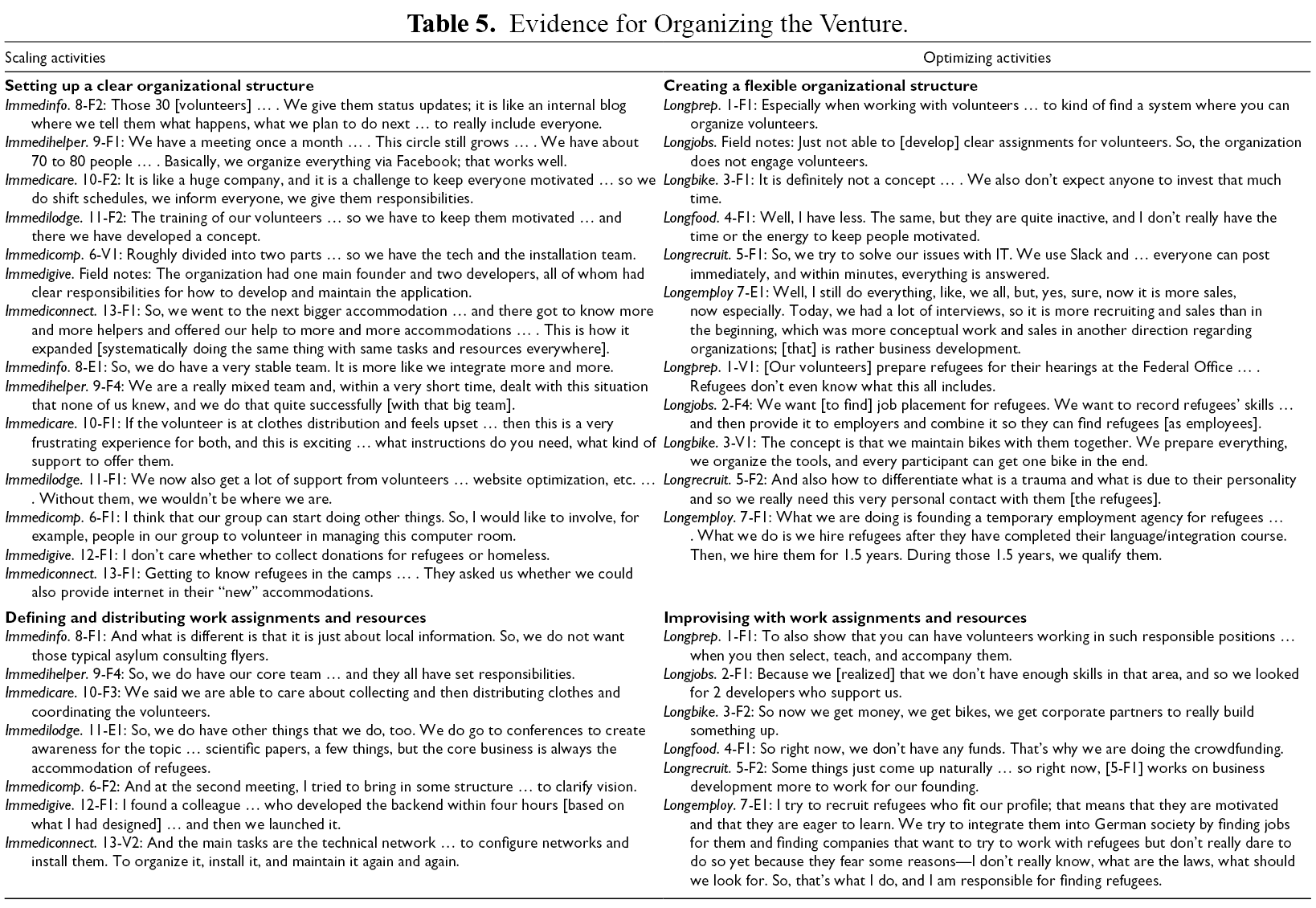
A Motivation-Driven Model of Prosocial Venturing in Response to a Humanitarian Crisis
In Figure 3, induced from the data, we depict a motivation-driven model of prosocial venturing in response to a humanitarian crisis. This figure illustrates how founders’ distinct motivations can trigger diverging paths of prosocial venturing to alleviate suffering. For our cases, while all the founders expressed concern for refugees’ suffering, we identified that this concern for others was not the primary motivator for some of the founders to engage in prosocial venturing. Specifically, while some founders were motivated to pursue opportunities for others to help immediately, leading to the “other-oriented prosocial venturing” path, other founders were motivated to pursue opportunities for themselves to create and build their own organization to help refugees, leading to the “self-oriented prosocial venturing” path. This motivation to pursue an opportunity for oneself comprises a challenging goal a person strives to achieve that will lead to personal growth (Van de Ven et al., 2007), which, in the case of our sample ventures, involved the founders’ entrepreneurial aspirations to create and build an organization.
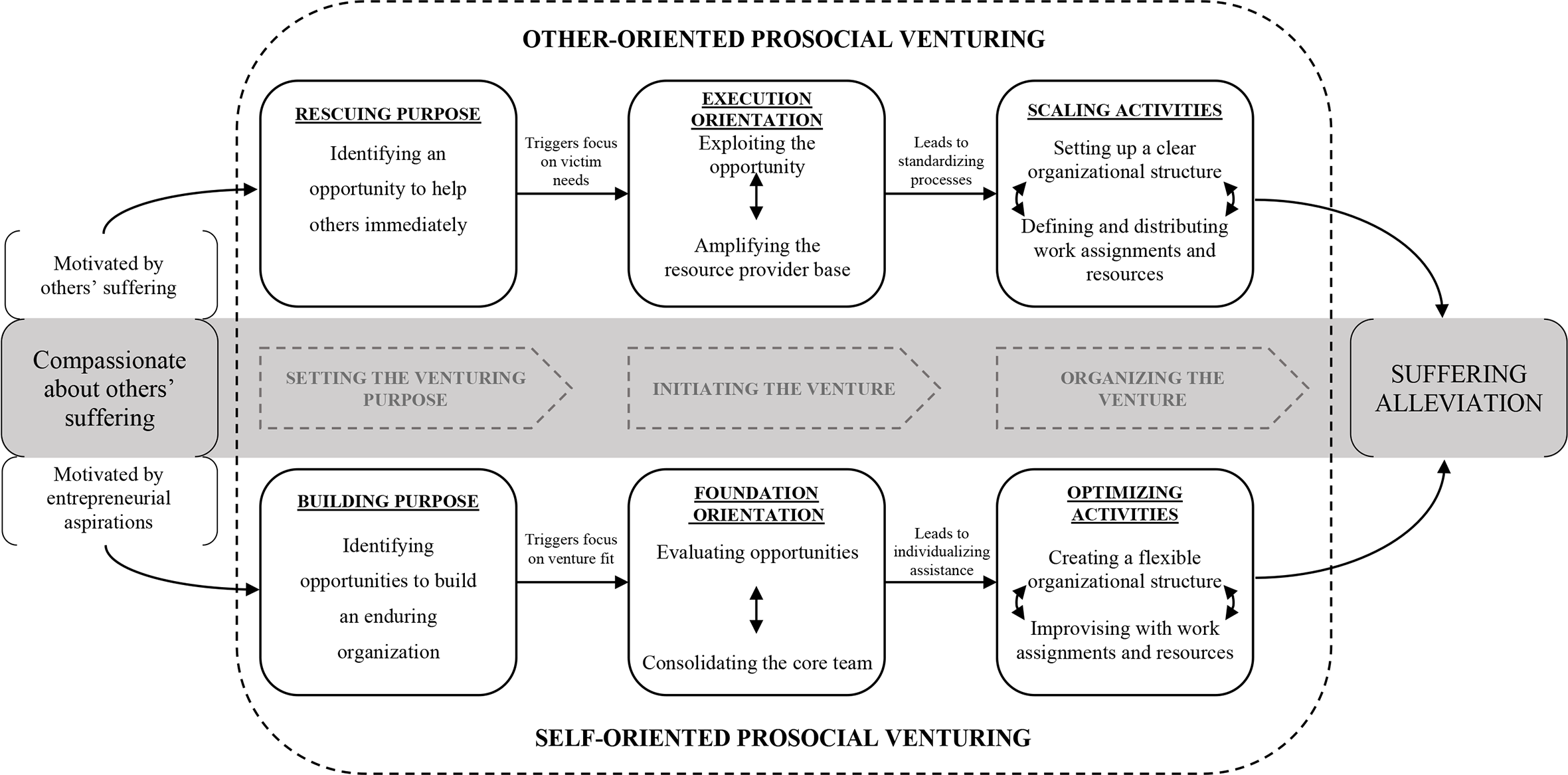
A prosocial venturing model of responding to a humanitarian crisis.
We also recognized that these distinct motivational mechanisms led the founders to set different purposes for the prosocial ventures (rescuing vs. building), which triggered the identification of different opportunities to help refugees. Based on the focus of addressing refugees’ immediate needs or of establishing their own organization, the founders took different approaches to their initial venturing efforts (execution orientation vs. foundation orientation). As a result, the founders primarily motivated to engage in other-oriented prosocial venturing organized their ventures by standardizing processes to scale their suffering-alleviation activities quickly. In contrast, the founders primarily motivated to engage in self-oriented prosocial venturing based on their personal aspirations to build an organization (and, in doing so, to help victims) organized their ventures by individualizing assistance to optimize their suffering-alleviation activities in the long run.
Discussion
The purpose of our study was to shed light on how founders’ motivations shape prosocial venturing to alleviate suffering during humanitarian crises. Therefore, our theoretical model explains how founders’ motivations shape prosocial venturing to respond to the unprecedented needs emerging from humanitarian crises.
Theoretical Implications
Our study contributes to research on prosocial venturing, particularly in crisis contexts, by shedding more light on the role of founders’ different motivations for engaging in prosocial venturing. Previous studies have investigated how prosocial motivations can trigger prosocial venturing. For example, Miller et al. (2012) proposed that compassion triggers prosocial venturing through the mechanisms of integrative thinking, prosocial cost-benefit analysis, and commitment to alleviating others’ suffering. Similarly, Bacq and Alt (2018) showed that empathy, as a prosocial motivation, can increase prosocial venturing intentions through perceptions of social worth and social entrepreneurial self-efficacy. However, although some prior studies have acknowledged the potential self-interested motivations of prosocial venture founders (Austin et al., 2006; Miller et al., 2012; Peredo & McLean, 2006), they have argued that founders either need to balance their motivations to help others with their motivations to help themselves (Peredo & McLean, 2006) or prioritize one type of motivation over the other (Austin et al., 2006). Our study provides a different explanation because it indicates that others’ problems and suffering can activate founders’ self-interested motivations to engage in prosocial venturing, particularly the desire to found one’s own organization that also helps victims (of a humanitarian crisis; i.e., self-oriented prosocial venturing). Although an opportunity to advance oneself does not seem necessary to engage in prosocial venturing (cf. the path of other-oriented prosocial venturing), it appears to help address the long-run needs of those requiring help.
Second, our model reveals how founders’ different motivations unfold into distinct prosocial venturing approaches to alleviate suffering. Prior research has focused on how motivations, in particular compassion and empathy, can trigger intentions to found a prosocial venture (Bacq & Alt, 2018; Miller et al., 2012). However, this research has not fully captured how motivations shape the ongoing venturing process and the nature of the prosocial ventures created. By identifying two different prosocial venturing approaches emerging from founders’ distinct motivations, we extend our understanding of how victims’ problems and suffering (founders’ primary or secondary motivation) can trigger the creation of different ventures that satisfy different victim needs (immediate vs. long term).
Third, prior studies have emphasized the importance of motivations in opportunity recognition (Shane et al., 2003). In particular, founders’ prosocial motivations are important for their ability to recognize and act on opportunities to help others (Austin et al., 2006; Miller et al., 2012) and their resource mobilization efforts (Mittermaier et al., 2021), but their self-interested motivations can also be important triggers for prosocial venturing (Peredo & McLean, 2006). However, we do not yet understand how these distinct motivations eventually shape the opportunity recognition process. By illustrating how distinct primary motivations can trigger different purposes for prosocial venturing that guide founders’ attention toward opportunities that address either immediate or long-term needs, we offer novel explanations for how prosocial venture founders recognize opportunities in crisis contexts and why they recognize and pursue different types of opportunities to help victims of humanitarian crises.
Finally, prior research on prosocial venturing has often highlighted the importance of external resource providers as prosocial ventures are constrained by limited resources (Austin et al., 2006; Santos, 2012). Although emerging ventures differ in how they assess (Williams & Shepherd, 2016a), combine (Shepherd & Williams, 2014), and manage (Majchrzak et al., 2007; Mittermaier et al., 2021) available resources to address suffering, the predominant view in the literature is that suffering alleviation requires ventures to provide those in need with customized resources that are delivered quickly and on a large scale (Shepherd & Williams, 2014). However, our study sheds light on different venturing processes to alleviate victims’ suffering. While other-oriented prosocial venturing focuses on quickly amplifying a venture’s resource provider base to scale its activities, self-oriented prosocial venturing focuses on forming a core team to sustainably manage long-term needs. Ventures that take the latter approach tend to be highly selective of resource providers and may even reject offers to help so they can build an enduring organization. Thus, we contribute to current knowledge on resources/resource providers for prosocial venturing by linking different venturing purposes caused by founders’ distinct motivations to different resource mobilization approaches for suffering alleviation. Indeed, some founders fulfill the function of prosocial venturing to deliver a compassionate response quickly, while others are slower to do so but, as a result, provide solutions that are more effective in alleviating suffering in the long run. Therefore, perhaps the notion that an effective compassionate response to a humanitarian crisis must be rapid applies in the aggregate (someone acts quickly), but overall suffering alleviation is likely enhanced when some founders are less motivated to rescue victims immediately and are more motivated to build an enduring organization that helps victims in the long run.
Practical Implications
Our study illustrates that understanding one’s motivation to engage in prosocial venturing may help a founder identify an appropriate opportunity for him- or herself (i.e., an opportunity to reduce victims’ suffering vs. an opportunity to create and build an enduring organization), and it exemplifies the steps that can help realize this focal opportunity. Specifically, we recommend that founders motivated to engage in other-oriented prosocial venturing (1) start early to create a broad base of resource providers and leverage it by (2) setting up a clear organizational structure with defined tasks and resources. In contrast, we recommend that founders motivated to engage in self-oriented prosocial venturing (1) take some time to generate and thoroughly evaluate a set of potential opportunities from which they can select the potential opportunity that best fits with a carefully selected core team and (2) create a more flexible structure that helps optimize activities to address victims’ long-term needs. As our data illustrate, for each specific path of prosocial venturing, the prosocial venturing steps can help founders overcome potential challenges by, for example, communicating with government offices effectively, keeping up volunteer motivation (other-oriented prosocial venturing), dealing with the changing bureaucratic requirements of the crisis, and establishing a shared long-term vision for the venture (self-oriented prosocial venturing).
Moreover, social entrepreneurship educators often admit participants to their programs based on prosocial motivations—at least, it is often assumed that social entrepreneurship students are primarily and strongly motivated to help others (Bacq & Alt, 2018). Our study suggests that educators may need to acknowledge the potential benefits of students’ self-interested motivations in prosocial venturing when selecting candidates for their programs. These students appear to build enduring ventures that address more long-term social problems. Additionally, educators may outline different potential opportunities for these potential founders to engage in prosocial venturing to help and highlight how distinct motivations enable different types of suffering alleviation. This educational approach may encourage those with a strong desire to create and build their own venture to consider prosocial venturing, which could benefit society.
Avenues for Future Research
Our study suggests several avenues for future research. First, although we identified distinct motivations that shape prosocial venturing in crisis contexts, motivations and the nature of crises may change over time. Perhaps changes in founders’ motivations may lead them to pivot their prosocial ventures or drive founders to exit. For example, over time, individuals can develop compassion fatigue (Bolino & Grant, 2016; Grant & Schwartz, 2011), which might have important consequences for their prosocial venturing efforts—for example, it could lead to mission drift (Grimes et al., 2019), cause founders to become discontinued, or lead founders to harm those they are trying to help (Claus et al., 2020). We hope future studies explore dynamic motivations impacting prosocial venturing.
Second, future research on prosocial venturing could study how individual and contextual characteristics interact with founders’ motivations to facilitate prosocial venturing, specifically in terms of recognizing third- and first-person opportunities (Shepherd & Patzelt, 2011). For example, entrepreneurs’ social embeddedness (Larson & Starr, 1993), education (Clark et al., 1984), health (Shepherd & Patzelt, 2015), and individual beliefs or values (Busenitz & Lau, 1996) as well as the conditions of fulfilling basic needs (Dencker et al., 2021) in the aftermath of natural disasters might have important implications for how (potential) founders’ motivations shape prosocial venturing. Thus, we hope future research explores the antecedents and contextual moderators of our model.
Finally, our data do not capture information on the long-term survival effects of pursuing prosocial ventures with an other-oriented vs. a self-oriented motivation. For example, one might assume that ventures driven by others-oriented motivations might be more short-lived than ventures driven by self-oriented motivations because the former are likely to dissolve when a crisis’ most urgent needs have been addressed. We note, however, that the refugee crisis is an enduring phenomenon and that, for example, environmental decline and ongoing wars in Africa are still triggering substantial migration to Europe. Therefore, even years after we conducted the current study, there is still the need to provide immediate help to arriving refugees (albeit to a lesser extent). Future research on prosocial venture creation in the context of enduring crises can explore how other-oriented versus self-interested motivations influence the persistence of prosocial ventures and their social impact over time.
Conclusion
Worldwide, humanitarian crises threaten the well-being of millions of people. Research on prosocial venturing in response to these crises is necessary to provide solutions to address the needs of those who suffer. In particular, this study sheds light on how founders’ motivations shape their prosocial venturing to address victims’ needs. We explain the distinct motivations of founders’ prosocial venturing and how these distinct motivations lead to different approaches to initiating and organizing these ventures. We hope our study inspires future research on the important topic of prosocial venturing to address the grand challenges and crises facing society.
Footnotes
Acknowledgements
The authors thank their editor Karl Wennberg and three anonymous expert reviewers for their developmental feedback throughout the review process; Ali Ferguson for her copywriting expertise; and the prosocial ventures participating in this study for their openness, continuous willingness to collaborate, and trust to share their insights. All errors remain ours.
Declaration of Conflicting Interests
The author(s) declared no potential conflicts of interest with respect to the research, authorship, and/or publication of this article.
Funding
The author(s) received no financial support for the research, authorship, and/or publication of this article.

Notes
Author Biographies