




Abstract
We develop theory about how and when digital technologies enable new venture creation processes. We identify two fundamental properties of digital technologies—specificity and relationality—and develop propositions that link these properties to six enabling mechanisms: compression, conservation, expansion, substitution, combination, and generation. We use the linked properties and mechanisms to determine how and when in the venture creation process—from prospecting to developing to exploiting—digital technologies have enabled start-ups in the IT hardware sector and develop stage-dependent propositions about their sector-level effects. We conclude our theorizing by discussing its implications beyond digital technologies and the IT hardware sector.
Keywords
Researchers increasingly call for research on the objective, actor-independent factors that enable entrepreneurial activity (Davidsson, 2015; Nambisan, 2016; Ramoglou & Tsang, 2016; Shane, 2012). Nambisan (2016) highlighted digital technologies as one such objective factor that has profound effects on entrepreneurial processes. Nambisan noted that existing entrepreneurship research has largely neglected digital technologies’ role and challenged the field to start “theorizing the role of specific aspects of digital technologies in shaping entrepreneurial opportunities, decisions, actions, and outcomes” (p. 2).
In this conceptual paper we take on this challenge. Using the IT hardware sector and its recent surge of start-up activity (Billings, 2015; Diresta, 2015) as our context, our central research question is “Are there effective ways of conceptualizing digital technologies’ influence on the venture creation process?” Answering this question contributes to a broader scholarly understanding of objective, actor-independent factors in venture creation.
Our theorizing begins with the observation that despite the IT hardware sector’s reputation for high entry barriers, such as high resource intensity, low flexibility, slow process speeds, and high external dependencies (e.g., Heirman & Clarysse, 2007; Loderer, Stulz, & Waelchli, 2016; Marion, Eddleston, Friar, & Deeds, 2015), there has been a recent surge in independent IT hardware start-ups (Billings, 2015; Diresta, 2015; The Economist, 2014). These developments encouraged us to engage in thought experiments to explain this real-world phenomenon (Alvesson & Kärreman, 2007; Byron & Thatcher, 2016; Weick, 1989), particularly around the role of digital technologies, which arguably play a prominent role in the IT hardware sector’s current entrepreneurial activity (e.g., Billings, 2015). In pursuing our research question within this context, we combine and extend five conceptual tools: Davidsson’s (2015) notion of external enablers as a workable basis for theorizing the enabling role of digital technologies; Nambisan’s (2016) distinction between boundaries and agency as a perspective on digital technologies’ influence on venture creation; the analytical construct of mechanisms to add precision to digital technologies’ enabling roles; Bakker and Shepherd’s (2017) three-stage process model (prospecting, developing, exploiting) to situate digital technologies and the mechanisms they provide in the venture creation process; and the literature on the attention focus of decision-makers (Ocasio, 1997; Read, 2004) to theorize the effects of enabling certain stages of that process. Building on these tools, we construct new theory that describes six enabling mechanisms of digital technologies and root these mechanisms within two properties that characterize the digital technologies themselves: specificity and relationality. We use this theory to analyze the enablement of entrepreneurial activity in the IT hardware sector across the stages of the venture creation process and develop sector-level propositions that are applicable to other industry contexts.
Given our context and focus, we contribute to three major themes in contemporary entrepreneurship research. First, we theorize the roles of digital technologies as external enablers in entrepreneurial processes, identifying specificity and relationality as two salient properties that can be used to describe any existing and future digital technologies and developing propositions about how these properties influence the type of enabling mechanisms that digital technologies afford. In so doing, we help to clarify why and how digital technologies are key objective, actor-independent factors that influence venture creation processes.
Second, we extend Davidsson’s (2015) theorizing about external enablers by identifying their enabling mechanisms. In doing so, we observe the process nature of venture creation (McMullen & Dimov, 2013; Shane & Venkataraman, 2000; Zahra & Wright, 2011) and develop propositions about how the effects of enablers on start-up activity are contingent on which process stages are being enabled. This contribution outlines an approach to theorizing the influence of external, actor-independent factors without getting entangled in the problematic notion of “opportunities” (cf. Davidsson, 2015; Dimov, 2011; Kitching & Rouse, 2017).
Third, we recognize the importance of context in management and entrepreneurship (e.g., Welter, 2011; Zahra & Wright, 2011; Zahra, Wright, & Abdelgawad, 2014). Focusing on the IT hardware sector allows us to determine how a set of digital technologies has provided different enabling mechanisms at different stages of IT hardware start-ups’ development. The result is a clearer explanation for recent developments in this globally significant sector than a supposedly “context-free” alternative could have offered. Moreover, we assess the generalizability of central aspects of our theorizing, especially their applicability to other sectors, thereby demonstrating how a narrow context can facilitate theorizing about industry-specific entrepreneurship that is of value to the focal context and beyond it.
We proceed as follows: first, we conceptualize two salient properties of digital technologies as external enablers. Then we identify six enabling mechanisms that digital technologies provide and develop propositions about how digital technologies’ properties influence which enabling mechanisms they afford. Next, we illustrate how enabling technologies and their mechanisms map onto Bakker and Shepherd’s (2017) start-up development stages in the IT hardware sector and develop propositions about how the effect of enabling mechanisms on a sector’s start-up activity depends on which stage(s) are enabled. We conclude with a discussion of our theory development’s contributions and implications.
Theory Development: External Enablers, Mechanisms, and the Venture creation Process
Digital Technologies as External Enablers of Entrepreneurial Activity
Davidsson (2015) introduced external enablers as a more workable way to theorize about what had previously been portrayed as objective, preexisting, and actor-independent “opportunities” (Eckhardt & Shane, 2003, cf. 2010; Shane, 2012). External enablers are distinct, external circumstances like political and regulatory changes, demographic and social shifts, and new technologies that can play essential roles in engendering and/or enabling start-ups (Davidsson, 2015). Thus, an external enabler is an aggregate-level construct, where the enabling nature follows from the assumption that any disequilibrating force will create room for some new economic activities to establish themselves, although exactly which activities is unknowable a priori (Davidsson, 2015; Ramoglou & Tsang, 2016; Shane, 2012).
We focus on digital technologies as one important type of external enabler. Digital technologies have a potentially paradigm-shifting role in entrepreneurship because they make boundaries more fluid and agency more dispersed in venture creation processes (Nambisan, 2016). Our theorizing focuses on how these effects occur.
Digital technologies are “products or services that are either embodied in information and communication technologies or enabled by them” (Lyytinen, Yoo, & Boland, 2016, p. 49). They exist as digital tools and infrastructure (e.g., Aldrich, 2014), digital platforms (e.g., Tiwana, Konsynski, & Bush, 2010), or artifacts with digitized components, applications, or media content (e.g., Ekbia, 2009). Common to all types of digital technology is the decoupling of digital information from the physical form of the material device and the separation of semiotic functional logic from the physical embodiment that executes it (Yoo, Henfridsson, & Lyytinen, 2010).
Digital technologies have been characterized in several ways (e.g., Ekbia, 2009; Kallinikos, Aaltonen, & Marton, 2013; Nambisan, 2016), but common to these portrayals is a focus on their ambivalent ontology (Garud, Jain, & Tuertscher, 2008; Kallinikos et al., 2013). Because they embody digital capabilities, digital technologies can become malleable, editable, self-referential, and interactive (Garud et al., 2008; Kallinikos et al., 2013; Nambisan, Lyytinen, Majchrzak, & Song, 2017), traits that allow them to evolve continuously even after implementation and use and to generate new forms of agency, both within and across processes.
To describe digital technologies and explain how they act as external enablers of entrepreneurial activity, we build on Nambisan’s (2016) distinction between agency and boundaries as two important attributes of entrepreneurial processes and outcomes. Thus, we acknowledge digital technologies’ ambivalent ontology and conform to the assumptions of the external enabler construct.
As a perspective on their agency, we focus on the specificity of digital technologies by describing their control over actions and interactions. 1 Digital technologies unfold their value by enabling some actor’s actions, thereby altering the nature of the actor’s work. As such, digital technologies perform a mediating role that gives them control over inputs, outputs, and their transformations. In other words, digital technologies can determine what kind of resources actors can provide as inputs and how these resources are transformed into and provided as outputs. Hence, specificity relates to what DeSanctis and Poole (1994) referred to as restrictiveness (the set of possible actions that can be performed) vis-a-vis comprehensiveness (the variety of features a technology offers). However, specificity also includes a focus on adaptivity 2 (a technology’s degree of task optimization) that is central to digital technologies. The more specific a technology is, the more bounded is the set of controlled actions and interactions that it enables.
The degree of digital technologies’ specificity is important because it indicates their adaptability and malleability (Ekbia, 2009; Kallinikos et al., 2013; Zittrain, 2006). Digital technologies are, in principle, adaptable and malleable because their logic is separated from their embodiment and their information is separated from their function (Yoo et al., 2010): they can be updated. However, highly specific digital technologies are typically comparatively rigid because their specialization and restrictiveness limits their ability to be reprogammed to different functions. In contrast, digital technologies with low specificity are adaptable and malleable because they are less restrictive: they can be appropriated and modified to facilitate new functions.
A digital technology’s inherent capacity for specificity can vary. At one extreme are digital technologies with a high degree of specificity that deterministically transform a predefined set of specific inputs into specific outputs. At the other extreme are digital technologies with a low degree of specificity that accept a multitude of ill-defined or indeterminate inputs and let other actors decide how inputs are transformed into and provided as outputs. For instance, 3D printers are optimized to enable the creation of physical objects from scratch, which is a comparatively specific and restrictive task, as both input and output formats are tightly controlled. In contrast, social media can enable a variety of tasks, such as creating, managing, and distributing various types of content, establishing conversations and relationships between content providers, and providing content providers opportunities for self-promotion. These digital technologies’ control over input and output is inherently low.
As a perspective on process boundaries, we focus on the relationality of digital technologies, which describes their structural connections. Relationality is based on the assumption that digital technologies are to some degree distinct from and responsive to other actors (Orton & Weick, 1990), which makes them interactive (Kallinikos et al., 2013). Digital technologies are fundamentally interdependent, and they are reliant on at least one interaction with other actors to enact their agency. Moreover, because of their capacity to become self-referential (Yoo et al., 2010), digital technologies can entertain relationships and interact with social and other technological actors.
The relationships between digital technologies and other actors form channels through which resources flow (Podolny, 2001) such that more relationships mean potentially more access to the resources that are inherent in these relationships. Digital technologies’ central position in their webs of relationships allows them to channel resource flows and to accumulate resources that flow through them. Thus, relationality refers to the set of relationships with other actors that digital technologies can leverage to facilitate their functionality (Kallinikos et al., 2013). By influencing which and how many actors can participate in the processes that digital technologies enable, relationality influences the boundaries of venture creation processes.
Much like specificity, a digital technology’s inherent capacity for relationality can vary. At one extreme are digital technologies with a low degree of relationality, which entertain a single connection with a single type of actor at a time. For example, a typical 3D printer has a low degree of relationality, as it usually interacts with only one actor via one operating device at a time to perform a print job. At the other extreme are digital technologies with a high degree of relationality, which connect with large numbers of potentially diverse actors. For example, social media has a high degree of relationality, as it can entertain diverse connections with large numbers of content-creating users simultaneously.
Focusing on variations of the specificity and relationality of digital technologies allows us to evaluate the enabling potential of any digital technology, regardless of whether it already exists or might emerge in the future. Any type of digital technology can manifest in multiple variations in terms of its features, functionalities, and so forth, so variants of one type of digital technology can exhibit varying degrees of specificity and relationality and, thus, influence venture creation processes differently.
The Enabling Mechanisms Digital Technologies Provide
To describe the role that digital technologies play as external enablers of venture creation, we draw on the analytical construct of mechanisms. Since mechanisms describe the processes that underlie relationships between causes and effects (Gross, 2009), mechanism-based theorizing is particularly appropriate for process-oriented, phenomenon-driven, field-level research in the context of economic change that involves technology (e.g., Davis & Marquis, 2005; Henfridsson & Bygstad, 2013; Henfridsson & Yoo, 2014), which applies to our setting.
We make two assumptions in our use of mechanisms (Hedström & Swedberg, 1998; Stinchcombe, 1998; Tilly, 2001). 3 First, we assume that mechanisms are not necessarily directly observable and thus, we describe them through their effects. Therefore, our description of and explanations about mechanisms selectively isolate the central elements that produce essential aspects of the effects under investigation while excluding nonessential details (Gross, 2009; Hedström & Ylikoski, 2010). Second, we assume that mechanisms are hierarchical and are compositions of lower-level mechanisms—that is, that mechanisms coexist with other potentially interrelated mechanisms that together form higher-level mechanisms (Hedström & Ylikoski, 2010). Consequently, while we identify mechanisms in terms of the specific primary effects they produce, mechanisms can also produce secondary effects through interaction with other mechanisms. For example, time savings are often but not always associated with cost savings.
Mechanisms and Their Definitions
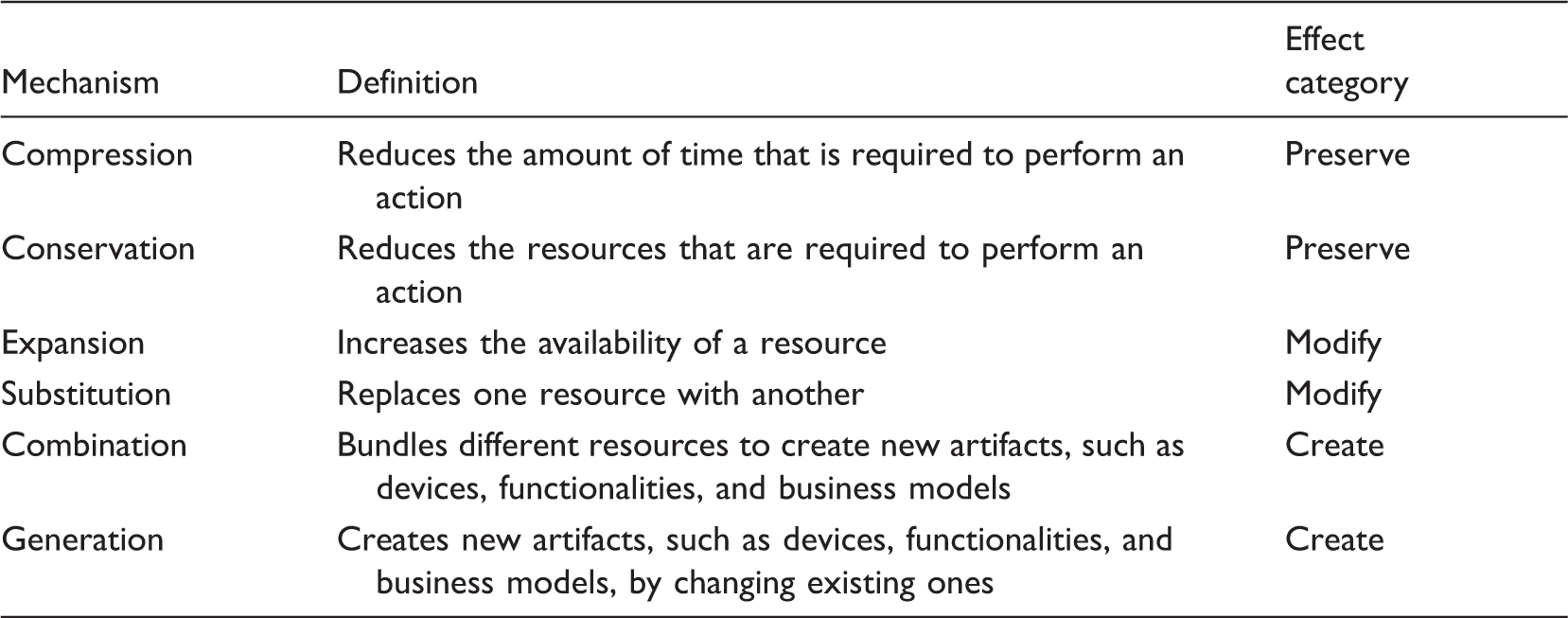
Note. “Effect category” refers to Malone et al.’s (1999) generic types of effects.
Compression and Conservation Mechanisms
Compression mechanisms reduce the amount of time that is required to perform an action, whereas conservation mechanisms reduce the resources that are required to perform an action. Digital technologies’ degree of specificity largely influences their potential to enable compression and/or conservation mechanisms during venture creation. The more specific a set of actions is the more a digital technology can control and optimize those actions’ execution because the technology is dealing with a more predictable and narrow set of inputs, transformations, and outputs. A more efficient execution of actions goes hand in hand with a reduced amount of time and/or resources. Hence, high specificity allows a digital technology to automate the execution of specific actions and improve their efficiency, freeing actors and resources that would normally be required to perform these actions to do other things (Leonardi, 2011). For example, a stable set of inputs and outputs reduces coordination efforts, transaction costs (Baldwin & Woodard, 2009), and variations in quality, allowing digital technologies to channel resources more efficiently (Faraj, Jarvenpaa, & Majchrzak, 2011). As specificity decreases, the potential fragmentation of inputs and outputs increases, preventing automated transformations and reducing the overall efficiency of a digital technology’s transformations. For example, increasing input variety can negatively affect input and output quality (Wareham, Fox, & Giner, 2014), which increases transaction costs and coordination needs (Wolter & Portuguesa, 2008) and undermines a digital technology’s ability to provide compression and/or conservation mechanisms.
Consider cloud computing, which exists in Infrastructure-as-a-Service (IaaS) and Software-as-a-Service (SaaS) formats. IaaS, which is less specific than SaaS, gives users access to virtual computing resources for a variety of tasks, whereas SaaS provides users access only to certain software applications. IaaS has less potential to enable compression and conservation mechanisms than SaaS because IaaS can improve only the efficiency of physical infrastructure management, whereas SaaS can also automate installation and maintenance of applications because of the more bounded set of actions it enables.
Relationality moderates the capacity of digital technologies to enable compression and/or conservation mechanisms. Highly specific digital technologies can enable compression and conservation mechanisms independent of their relationality, but increasing relationality can amplify their ability to do so. Digital technologies with low relationality exchange resources with a small number of homogeneous actors, which allows the technologies to adapt to the idiosyncratic interaction requirements of these actors and, thus, to improve coordination efficiency and the speed of resource flows (Roberts & Grover, 2012). As digital technologies’ relationality increases, the number and diversity of actors with which they can interact increase. While more interactions with more diverse actors increases digital technologies’ potential to access and channel resources that flow through them, the potentially increasing homogeneity of inputs and outputs also risks increasing coordination efforts and can negatively affect the speed of resource flows. High specificity can ensure the consistency of inputs and outputs even with an increasingly large and heterogeneous set of actors, so increasing relationality can positively influence the volume of resources that a highly specific digital technology can channel efficiently. For compression mechanisms, relationality can have this amplifying effect if a digital technology connects with more actors on the supply side because relationality allows the technology to pool the resources that are required to perform the set of actions. For conservation mechanisms, relationality can have an amplifying effect if a digital technology connects with more actors on the demand side because it allows the technology to distribute among these actors the expenditures involved in performing the set of actions.
As an example, consider 3D printers, which compress the time that is required to transform virtual 3D models into physical objects and conserve the resources that are required to do so. A typical desktop 3D printer is highly specific to this one task and can perform the task only for a single user at any one time. However, if this 3D printer becomes more relational by connecting and coordinating with other 3D printers to form a 3D printing cluster, compression mechanisms can be amplified, as the cluster can print faster than the single printer can. Similarly, if the printer (or the cluster) becomes more relational by allowing multiple users to use it, conservation mechanisms can be amplified, as the costs of purchasing, maintaining, and upgrading the printer can be distributed among users.
Expansion and Substitution Mechanisms
Expansion mechanisms increase the availability of a particular resource, whereas substitution mechanisms replace one resource with another. Digital technologies’ potential to enable expansion and/or substitution mechanisms during venture creation is largely contingent on their relationality. To enable expansion mechanisms, digital technologies must accumulate resources, which they can do if they can access and channel resources among multiple actors. With increasing relationality, the number of actors and the volume of resources that digital technologies can access increases, thereby providing expansion mechanisms. Digital technologies’ potential to enable substitution mechanisms also increases with their relationality. More interactions with diverse actors mean more access to resources that are provided by these relationships. The higher the number of complementary actors that can provide close substitutes for resources, the greater the technologies’ potential to replace these resources and the actors that provide them.
As an example, consider online repositories like GrabCAD, NIH 3D Print Exchange, and Thingiverse. These social media platforms enable expansion mechanisms because their high level of relationality allows them to expand 3D design knowledge by attracting and connecting large numbers of users who contribute and comment on 3D design files. The high levels of relationality in crowdfunding platforms like Indiegogo, Kickstarter, and Selfstarter also gives them the capacity to substitute traditional sources of funding and market research through the number of users who back campaigns and comment on them.
Specificity moderates digital technologies’ ability to enable expansion and/or substitution mechanisms. Digital technologies that have high levels of relationality have high potential for enabling expansion and substitution mechanisms independent of their specificity, but increasing specificity can amplify their ability to do so. This is because specificity reflects the tension between controlled and autonomous actions. High specificity and its control over actions leads to more predictable inputs, which allow a digital technology to reduce the variance in outputs. Hence, digital technologies with high specificity can focus on efficiently accumulating resources for one or a few actions and ensure that they provide a consistent output. On the other hand, low specificity and its autonomy of actions foster input and output variance, stimulating the breadth of output. Hence, digital technologies with low specificity can accumulate a more diverse set of resources to enable multiple types of actions. In other words, specificity influences the potential efficiency and range of expansion and/or substitution, rather than the inherent capacity to enable expansion and/or substitution mechanisms per se.
For example, crowdfunding platforms provide substitution mechanisms through their capacity to replace money and feedback from traditional investors and market research, respectively, with money and feedback from crowds of potentially unknown and geographically dispersed actors. If the platforms would be less specific, they would give actors the possibility to provide a broader set of resources, not just money and feedback. For example, online charity platforms allow people to donate a variety of resources, such as furniture, clothes, other goods, and money. The less specific the online charity platform, the more diverse the resources they can collect and the actors they can replace, but they will be less efficient in replacing specific resources.
Combination and Generation Mechanisms
Combination mechanisms create new artifacts like devices and functionalities by bundling resources, whereas generation mechanisms create new artifacts by changing existing ones. Digital technologies’ potential to enable combination and/or generation mechanisms during venture creation is contingent on both the technologies’ specificity and their relationality. Digital technologies’ specificity is inversely related to their potential to enable combination and generation mechanisms because increasing specificity means that digital technologies tighten their control over the set of actions and interactions that can be performed with them, reducing their potential to be appropriated in new, perhaps unanticipated ways to create new functionality. Hence, whereas increasing specificity allows digital technologies to increase their efficiency by reducing the variance in inputs and outputs, the same effect constrains technologies’ potential to enable combination and generation mechanisms. As a result, digital technologies with high specificity can only enable third parties (e.g., their users) to appropriate existing functionality and create new functionality if these technologies loosen their control over actions (Boudreau, 2010). In doing so, a digital technology can shift the locus of value creation to third parties (Parker, Alstyne, & Jiang, 2017), who can then adapt the digital technology to a range of new actions. By loosening control over actions, digital technologies also distribute control over interactions among actors, as less control over interactions enables the actors that are connected via a digital technology to interact autonomously and nondeterministically. In other words, relaxing control over actions and interactions fosters digital technologies’ capacity to enable unprompted and uncoordinated change (Zittrain, 2006): the less specific a digital technology is and the more it can be appropriated for different actions and interactions, the higher its potential to enable combination and generation mechanisms.
To enable combination mechanisms, digital technologies must connect with at least one actor that provides access to complementary resources, which the technology can then bundle with its own resources to create new artifacts, such as new functionalities. As the number and diversity of complementary actors with which digital technologies can connect increases, the technologies’ potential to enable the creation of new resource combinations increases, as does their potential to stimulate dynamic and collective resource modification through these actors and, thus, their potential to enable generation mechanisms (Zittrain, 2006).
As an example, consider traditional mobile phones compared to smartphones. Both have relatively high relationality vested in their structural features (e.g., 4G, Bluetooth, and Wi-Fi connectivity) that, in theory, allows them to connect with many complementary digital devices, such as activity trackers, speakers, and smart door locks. However, traditional mobile phones’ operating systems typically have relatively high specificity that constrains the set of possible actions and interactions that can be performed with them alone or in connection with other devices. Hence, traditional phones’ structural features can lead only to limited new functionality. In contrast, smartphones typically have relatively low specificity, which manifests, for example, as shared, complementary digital platforms and generic application programming interfaces (APIs) that allow third parties to amend the set of actions and interactions they can perform (Tiwana, Konsynski, & Bush, 2010). Hence, third parties can leverage smartphones’ structural features to create new functionalities.
Digital Technologies as Enablers of Venture Creation in the IT Hardware Sector
The IT hardware sector is a particularly suitable context in which to explain how our theorizing about digital technologies and mechanisms can be used to analyze entrepreneurial activity on the sector level. The IT hardware sector is a high-tech manufacturing sector in which firms use similar inputs and technologies to produce various digital devices (i.e., physical devices that are either embodied in or enabled by digital technologies). Examples of such digital devices are drones, home automation devices, robots, smart kitchen appliances, and wearables. The IT hardware sector has traditionally been characterized by a number of entry barriers, including a high resource intensity, low flexibility, slow process speeds, and high external dependencies (e.g., Heirman & Clarysse, 2007; Loderer et al., 2016; Marion et al., 2015). Despite these entry barriers, there has been a recent surge in independent IT hardware start-ups (Billings, 2015; Diresta, 2015; The Economist, 2014) in which advances in digital technology have arguably played a prominent role (e.g., Billings, 2015). Therefore, the IT hardware sector is a prime candidate for our theorizing to provide insights into what would be required to create similar surges in other sectors.
In such theorizing, we must consider not only how but also when in the process digital technologies enable entrepreneurial activity in the IT hardware sector. Prior research on the influence of external enablers on new venture creation (Davidsson, 2015) has paid little attention to what stage of the venture creation process (McMullen & Dimov, 2013; Zahra & Wright, 2011) is being enabled. We apply Bakker and Shepherd’s (2017) process model, which was developed in the similarly resource-intensive and slow-process-speed context of mining and which has a granularity of process that is suitable for our purposes. Their model revolves around three distinct stages: prospecting, developing, and exploiting. However, in line with Nambisan’s (2016) argument that digital technologies make entrepreneurial processes more fluid and open-ended, we re-interpret these stages as sometimes referring to individual activities, rather than necessarily pertaining to the entire venture. This adapted view regards venture creation as consisting of multiple elements that are gradually brought together over time (cf. Dimov, 2007).
The Role of Digital Technologies and Enabling Mechanisms Across the Stages of the Venture Creation Process in IT Hardware
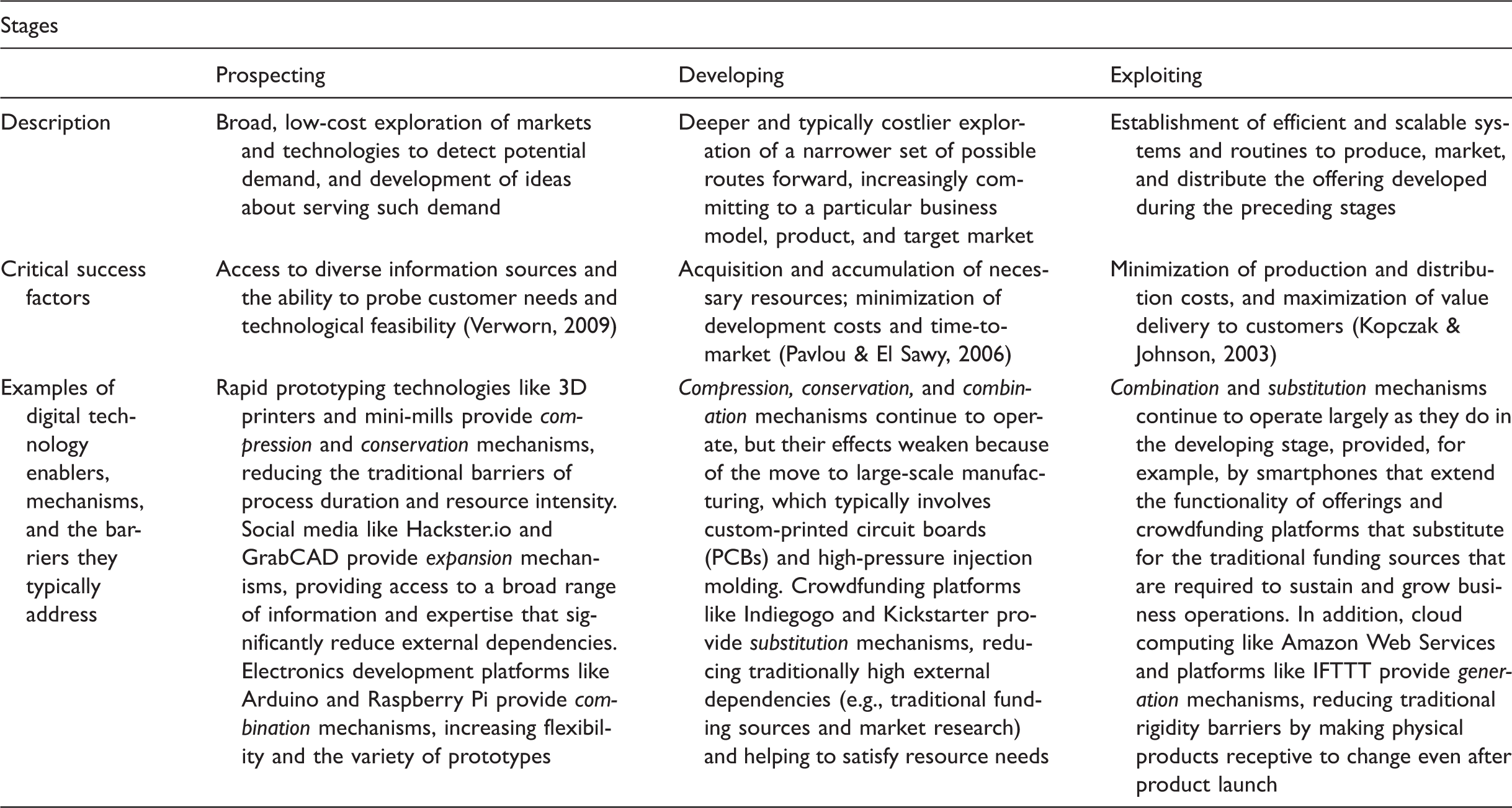
The observation that the enablement particular digital technologies provides pertains to particular stages of venture development gives reason to probe more deeply into how the effects of these technologies on the start-up activity in a sector are contingent on what stage or stages are being enabled. We use as our theoretical basis Ocasio’s (1997) attention-based view of the firm (ABV), which builds on Simon’s (1996) insights on bounded rationality. In developing ABV, Ocasio elaborated on three principles that govern decision-makers’ attention: a focus of attention on a limited set of items at the expense of others; a situated attention, such that the focus of attention is geared toward the demands of the situation in which decision-makers find themselves; and a structural distribution of attention according to the rules, controls, and identity of the decision-makers’ organizations. While other studies have paid at least tangential attention to temporal issues (Barnett, 2008), Ocasio did not, so we draw on the literature on intertemporal choice and decision-making (Read, 2004; Weber & Huettel, 2008) to supplement the standard ABV arguments. Based on both normative economic theory and psychological experiments with human and animal participants, this literature suggests that benefits that are temporally proximal weigh more heavily in decisions than do those that occur at a later time, so “the future is less important than the present” (Hardisty & Weber, 2009).
On this basis, we perform thought experiments regarding the effects of a given extent of enablement that pertains to a single stage in Bakker and Shepherd’s (2017) model. If a digital technology enables prospecting, those whose focused attention includes new technology and/or the possibility of engaging in start-ups will see immediate benefits. ABV’s situated attention principle and the temporal proximity principle both work in favor of acting on the benefit the digital technology offers. At the same time, remaining obstacles to successful completion of the process that pertain to later stages are temporally distant and, therefore, cognitively undervalued. While decision-makers in incumbent firms should also be positively influenced by the immediacy of the benefit, the situated attention and structural distribution principles make them less likely to pay attention to and/or act on prospecting enablement in the first place (Barnett, 2008) and more likely to weigh it against anticipated hurdles that pertain to exploiting. Thus, enablement of prospecting is likely to trigger a particularly strong response in the number of independent attempts at venture creation.
A digital technology that provides a corresponding extent of enablement of only developing should trigger fewer attempts at venture creation because the temporal distance from the perceived benefit discounts its perceived value. However, for start-ups that are in or approaching the developing stage, enabling mechanisms in the developing stage are both temporally proximal and prime candidates for situated focus. Hence, the primary effect of enablement of this stage should be an increase in the proportion of ongoing start-ups that survive the “valley of death” (Barr, Baker, Markham, & Kingon, 2009, p. 371) that is traditionally associated with this stage.
Increased start-up activity that is stimulated by enablement of the early stages of prospecting and developing does not necessarily translate to a significant increase in the number of independent ventures that are successfully established in a sector. Although more founders are attracted to entering and/or staying longer in the process they will encounter the traditional barriers at later process stages that are not enabled—or even worse barriers because of the stiffer competition for resources and customers in the later stages. The heightened later-stage barriers force many to give up or consider alternative modes of exploitation, such as licensing or outright sale of the venture to an incumbent, when they approach the exploiting stage (Shane & Venkataraman, 2000). The latter scenario is likely to bring the product or service to the market and bestow the founders with financial reward, but it will not increase the inflow of new, independent businesses in the sector.
For these reasons, enablement of the early prospecting and developing stages is unlikely to produce a surge in successfully established new ventures of the kind currently witnessed in the IT hardware sector, nor is a similar extent of enablement solely of the exploiting stage likely to have such a profound effect. Some increase is likely because ongoing start-up attempts in or near the exploiting stage have the requisite temporal proximity and situated attention to attend to and act on an enabler whose mechanisms facilitate this stage, but such enablement is even more temporally distant than is enablement of the developing stage for actors who have not yet begun the start-up process. As a result, enablement of exploiting is unlikely to trigger a strong response in the number of independent start-up attempts in a sector. In fact, based on the structural distribution of attention principle, incumbent firms whose main interest lies in the optimization of established production and distribution activities may be more prone to let enablement of the exploiting stage trigger initiatives toward new market offerings (cf. Naldi & Davidsson, 2014). Therefore, we conclude that a considerable increase in the number of successfully established new ventures in a sector is likely to require the simultaneous enablement of prospecting, developing, and exploiting.
For individual start-ups, a range of factors, such as entrepreneurial experience and expertise (Cook & Yamamoto, 2011), team composition (Amason, Shrader, & Tompson, 2006), a high level of conscientiousness (Zhao, Seibert, & Lumpkin, 2010), individual differences in time preferences (Chapman, 2005), and/or the systematic use of business planning (Chwolka & Raith, 2012), might moderate or alter the tendencies discussed above. However, on the sector level, such individual differences should largely cancel out, leaving the main effects derived from ABV and the intertemporal choice literature to predominate. Therefore, we make three propositions ceteris paribus:
Proposition 7 is based primarily on the temporal proximity principle, with additional support from ABV principles that suggest differences in the focus of attention between prospective founders and incumbents. Proposition 8 reflects that an increase in the volume of start-up attempts that are triggered by enablement of prospecting may increase the entry barriers that pertain to later stages, while enablement of later stages has limited power as process trigger because of the temporal distance putting it outside the focus of attention of those who are entering the process. Proposition 9 establishes an important lesson from the IT hardware sector, where significant barriers are present in all three development stages. Consequently, although other factors may also have contributed to the recent surge in successfully established, independent IT hardware start-ups, the surge is unlikely to have been possible had digital technologies not provided enabling mechanisms in each stage of the venture creation process. In sum, our theorizing suggests that all process stages and the combined effects of multiple enabling technologies should be considered when one assesses their influence on sector-level start-up activity.
Discussion
Our theory development started with conceptualizing how digital technologies enable venture creation processes. We identified two conceptual dimensions that characterize digital technologies and linked them to six mechanisms that describe how digital technologies enable venture creation processes. Taking the IT hardware sector as a particularly suitable context, we then looked into when in the venture creation process digital technologies’ enabling mechanisms come into play and developed stage-specific propositions about the influence of enabling digital technologies on sector-level start-up activity.
This theorizing about the enabling mechanisms of digital technologies has implications for three major themes in contemporary entrepreneurship research: the transformational effects of digital technology on entrepreneurship; the role of objective, actor-independent factors in venture creation processes; and the importance of context for entrepreneurship practice and research. We discuss each in turn.
Implications for Research on the Transformational Effects of Digital Technology in Entrepreneurship
Our theorizing heeds Nambisan’s (2016) call for theorizing the roles of digital technologies in venture creation. We do so in three ways. First, we identify two dimensions—specificity and relationality—along which digital technologies can be characterized. Using these two dimensions, we can describe any digital technology—whether it already exists or might emerge in the future—based on its potential to influence the agency and boundaries of venture creation. Our conceptualization is situated within existing characterizations of digital technologies, objects, and artifacts (e.g., DeSanctis & Poole, 1994; Ekbia, 2009; Kallinikos et al., 2013; Yoo, 2010) but bound to our purpose of viewing digital technologies as external enablers of entrepreneurial processes. To the best of our knowledge, it is the first conceptualization of this kind. The two-dimensional conceptualization of digital technologies provides an important foundation for future research on entrepreneurship and the role that digital technologies play as enablers and change agents of venture creation. However, we do not believe our conceptualization is exhaustive; future work may expand on these two dimensions and add others.
Second, we identify six particular enabling mechanisms of digital technologies—compression, conservation, expansion, substitution, combination, and generation—and link them to digital technologies’ manifestations of specificity and relationality. The mechanisms may not represent an entirely new discovery, but discussing them in depth jointly with the properties of digital technologies that influence them has significant theoretical and practical value. Future research can apply our resulting theory of digital technology enablement to the venture, sector, and country levels to provide insights for research, policy-making, and regulations that propose to stimulate start-ups. For example, our theory can serve as the foundation for configurational approaches (Misangyi et al., 2017) that determine whether digital technologies with certain properties make some start-ups more successful than others, how the availability of different digital technology configurations gives rise to start-up activity in certain sectors, and in what stage of the venture creation process certain kinds of digital technologies provide the most value.
Third, we develop formal propositions about how variations in the properties of digital technologies along the two dimensions of specificity and relationality relate to the mechanisms they provide. Future research can build on these propositions to investigate the sociotechnical processes to which digital technologies and their mechanisms give rise. That is, in order for the enabling mechanisms of digital technologies to unfold, human and/or technological actors must use them. This means that the mechanisms that describe their potential actions are situated within the relationship between these technologies and the human actors who interact with them (Leonardi, 2011; Majchrzak & Malhotra, 2013). For example, while social media can provide expansion mechanisms to new ventures on a sectoral level, such media may not afford these mechanisms to entrepreneurs who lack the desire to search for information, the ability to develop trust with potential competitors who could provide advice, or the creativity to appropriate available knowledge for their own purposes (e.g., Kuhn & Galloway, 2015). These are ideas for future research to test and develop both within and beyond the IT hardware sector, such as in other sectors or entrepreneurial ecosystems (Autio, Nambisan, Thomas, & Wright, 2017).
Overall, our theorizing contributes to entrepreneurship research and beyond by providing a much-desired integrative perspective that draws together research on entrepreneurship and information systems (Del Giudice & Straub, 2011; Huang, Henfridsson, Liu, & Newell, 2017; Nambisan, 2016). This integrative perspective has the potential to give new impetus to research on the nature and effects of digital technologies in entrepreneurship and in related contexts, such as technology and innovation management (Nambisan et al., 2017).
Implications for Research on the Role of Objective, Actor-Independent Factors in New Venture Creation
The “Individual-Opportunity Nexus” view of new venture creation launched by Shane and Venkataraman (2000) and later recast as “Discovery Theory” by Alvarez and Barney (2007) gives considerable weight to objective, actor-independent factors in new venture creation. MIT’s 3D printing technology is a prime example (Shane, 2000). However, apart from cognition-focused, experimental research on “opportunity recognition” (e.g., Grégoire & Shepherd, 2012; Wood, McKelvie, & Haynie, 2014), theoretical and empirical progress has been limited (Shane, 2012). This is at least in part because objective, actor-independent factors have been cast as preexisting “entrepreneurial opportunities,” a notion that has proven to be elusive and problematic (Dimov, 2011; Kitching & Rouse, 2017; Klein, 2008).
To avoid the conceptual confusion and stalled theoretical development around the entrepreneurial opportunities construct, Davidsson (2015) suggested external enabler as a more workable construct. Our theorizing supports the usefulness of the external enabler construct and indicates its potential beyond our focus on digital technologies.
We extend Davidsson’s (2015) arguments about external enablers in three important ways. First, Davidsson (2015) envisioned research that focuses on one or two enablers, but such a restricted focus would probably have exaggerated the importance of the focal enabler in our case, and caused us to miss the basis for our sector-level propositions that relate to process stages. In addition, different types of enablers can combine to enhance the facilitating mechanisms, as in the case of 3D printers and online repositories for 3D print files, where the two technologies feed each other. The importance of analyzing multiple enablers simultaneously is well worth considering in future research.
Second, we identify a number of mechanisms by which external enablers influence start-up processes. These mechanisms can be used to describe external enablers and “increase [the] specificity of the[ir] assumed effects” (Davidsson, 2015, p. 689). Our compression, conservation, expansion, substitution, combination, and generation mechanisms can help in formulating and answering questions concerning what enabling mechanisms external enabler X can provide, at what stage of the process external enabler Y would be of help, what mechanism we should be looking for in development stage Z, and what digital technology can offer mechanism P, which venture Q will likely need in the development stage it is about to enter. Extension to other types of enablers may require the identification of other mechanisms, but the questions they can answer remain.
Third, our approach also introduces a way to integrate consideration of technologies and other objective, actor-independent factors into process-oriented theorizing, where systematic attention to such factors has been lacking (Alvarez, Barney, & Anderson, 2013; Wood & McKinley, 2010). We found that the Bakker-Shepherd (2017) process model and its prospecting, developing, and exploiting stages works well in addressing process issues in our context and allowed us to identify external enablers and mechanisms that vary by stage of development. While advocates have promoted a process perspective on new venture creation (McMullen & Dimov, 2013; Shane & Venkataraman, 2000; Zahra & Wright, 2011) they have also voiced doubts about the feasibility of broad process studies based on observational data. We believe that the combination of the Bakker-Shepherd model’s conceptualization of stages and the enabling mechanisms we identified makes such studies feasible, and that future research that applies these tools will be able to test ideas about the associations among the stages of development, the presence of external enablers and their mechanisms, and outcomes.
In closing this section we note that much of our theorizing about enabling mechanisms may be valid for other technologies and for other types of external enablers that may operate in part through the same and other mechanisms than those discussed here. At the very least, the sector-level Propositions 7–9, while derived from the context of digital technologies and the IT hardware sector, are likely to apply to other sectors and other types of enablers.
Contributions Regarding the Role of Context in Entrepreneurship and Entrepreneurship Research
We have responded in two ways to the multiple calls for the entrepreneurship research to pay more attention to the role of context (e.g., Welter, 2011; Zahra & Wright, 2011; Zahra et al., 2014). First, we theorized in context. Our analysis of the IT hardware sector should provide insights that are more valid for that sector and for similar industries than would insights that emanate from an attempt at “contextless” theorization. We thus support Nambisan’s (2016) and Zahra and Wright’s (2011, p. 73) contention that this type of focus can be fruitful. Our application, combination, and extension of a set of theoretical tools allowed us to provide a detailed portrayal of start-up activities in the IT hardware sector. For example, per Proposition 9, the combination of these enablers and their mechanisms across all three stages of new venture creation arguably provides a major part of the explanation for the recent surge in start-up activity in the IT hardware sector.
Second, we show how focusing on a particular context—IT hardware and digital technologies—can facilitate theorizing that has value beyond that context (e.g., Bakker & Shepherd, 2017; Ozcan & Eisenhardt, 2009; Vissa & Bhagvatula, 2012). Just as the structure and simplification of good theory can safeguard against being dazzled by the complexity of the social realities one studies (Bacharach, 1989), a specified context can provide a sound setting for developing theoretical ideas in the first place. The choice of the IT hardware sector, with its traditionally high barriers, made the enablers and their mechanisms more visible; identifying them and locating them in the process might have been an insurmountable challenge without a focus on a particular setting, not least because enablers and stage markers manifest themselves differently across different contexts.
That said, in the context of this special issue and with a set of mechanisms at the center of our theorizing, the implications of our theorizing for industry-specific entrepreneurship across sectors is worthy of further elaboration. The traditionally high resource intensity and slow process speed of IT hardware make it likely that compression, conservation, and expansion mechanisms are particularly important in increasing independent start-up activity in this sector. The provision of substitution mechanisms is similarly important in IT hardware because providing alternatives to complementary assets and their providers reduces or eliminates the external dependencies that traditionally characterize the sector. Finally, the IT hardware sector faces rigidity challenges, so digital technologies that provide combination and generation mechanisms that increase the flexibility of the products offered can be disproportionately important for start-up activity in this sector.
These mechanism-based insights may apply to a considerable extent to other industry sectors that share similar characteristics, such as most medium- and high-tech manufacturing sectors, where start-up processes tend to be complex and of long duration. In the biotech sector, for instance, new gene-sequencing technologies offer conservation mechanisms, and big data technologies offer compression mechanisms that significantly reduce the costs and time that are required to discover new compounds. However, neither of these industries appears to have benefitted from a combination of enablers and mechanisms across stages to the same degree that the IT hardware sector has. Our Proposition 9 suggests that it would take simultaneous enablement across stages to give rise to a similar surge in independent start-up activity in these other industries.
Comparison of the IT Hardware Sector with Other Medium- and High-Tech Manufacturing Sectors
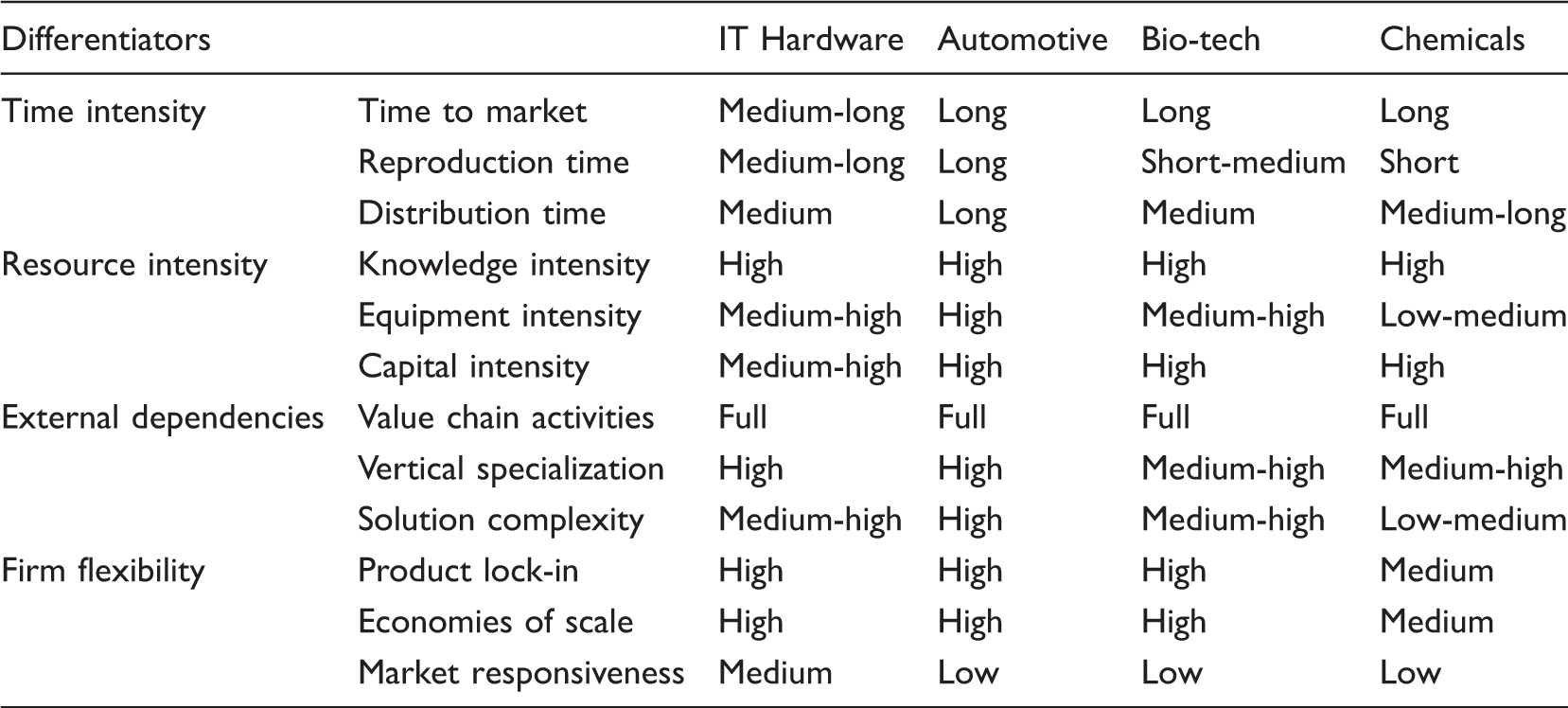
The associations between mechanisms and the stage of venture creation observed in the context of the IT hardware sector (Table 2) may or may not be generalizable to other sectors. However, our propositions (7–9) about stage-specific enablement and sector-level start-up activity should not be limited to IT hardware and digital technologies but should apply also to other sectors and types of enablers. In all, the assessment clearly suggests that our theorizing has value well beyond understanding recent developments in the IT hardware sector.
Besides its implications for research on industry-specific entrepreneurship, our theorizing has the potential to provide impetus for emerging research on entrepreneurial ecosystems. Entrepreneurial ecosystems are industry clusters that are influenced by spatial proximity and the availability of digital technologies (Autio et al., 2017). While the IT hardware sector is not subject to spatial proximity or delineated by spatial boundaries, our analysis suggests that digital technologies have played an important role in enabling entrepreneurial activity in the sector. Moreover, while startups in the IT hardware sector use similar inputs and technologies to create their market offerings, the offerings themselves typically transcend traditional industry and market boundaries by evolving around generic business model innovation, so they are similar to the offerings created by startups in entrepreneurial ecosystems (Autio et al., 2017). For these reasons, we expect that both the associations between digital technology characteristics and mechanisms (1–6) and the sector-level propositions (7–9) we propose can also serve future research on entrepreneurial ecosystems.
Conclusion
In this paper we developed an effective way of theorizing the role of digital technologies as objective, actor-independent factors within a process view of new venture creation. We combined five conceptual tools—the external enabler construct, the distinction between boundaries and agency as a perspective on digital technologies, the analytical construct of mechanisms, the Bakker-Shepherd process model, and literatures on decision-makers’ focus of attention—using the IT hardware sector to provide inspiration, direction, and focus for our conceptual development. The result is theoretical tools for analyzing how digital technologies enable new venture creation.
If, as we hope, our theorizing stimulates future research on entrepreneurship, flaws and omissions in our theorizing will doubtless be revealed. However, such studies will provide empirical evidence and conceptual extensions along the same path that will serve business and teaching practice and the scholarly community well by providing useful and validated tools.
Footnotes
Declaration of Conflicting Interests
The author(s) declared no potential conflicts of interest with respect to the research, authorship, and/or publication of this article.
Funding
The author(s) disclosed receipt of the following financial support for the research, authorship, and/or publication of this article: The authors were supported by a grant from the Institute for Future Environments (IFE) at Queensland University of Technology (QUT). The IFE also kindly sponsored the open access fees to make this article freely available. In addition, Dr Recker’s contributions were partially supported by a grant from the Australian Research Council (DP160103407).