




Abstract
Crises act as critical episodes for entrepreneurs, bringing about unexpected changes and heightened uncertainty. Yet crises can also have an enabling impact, creating new opportunities. This study explores how the COVID-19 pandemic enabled new opportunities for 30 Finnish and 34 Californian food and beverage ventures. We demonstrate how the pandemic enabled the ventures’ crisis responses through various different types of mechanisms in various pairings and with different logics of enablement. Our findings suggest that the crisis profile and entrepreneurial action interact to shape the impact of the crisis and the ability of ventures to leverage its enabling effect. The enabler mechanisms can result straightforwardly from changes not only in resources and demand, but also in a more complex manner due to the ideological shifts arising from crises. Also, the mechanisms pair with each other to enable ventures’ actions, either working concurrently or consecutively. Oftentimes, the creative manner in which the ventures leverage these pairings resembles bricolage. Better awareness of how the crisis-induced enabler mechanisms operate and interact can lead to more effective and resilient crisis responses.
Introduction
The COVID-19 pandemic has been an intriguing case of an external disequilibrating force that shaped how entrepreneurs pursue opportunities (Davidsson et al., 2021). Impacting all areas of our societies through social distancing measures, health interventions and border closures (Kuckertz et al., 2020), this unprecedented crisis has prompted research endeavours to capture ways to navigate such adversity (Donthu and Gustafsson, 2020).
Several researchers have looked at the pandemic in the light of resilience (Acciarini et al., 2021; Beninger and Francis, 2022) or innovation (Bivona and Cruz, 2021; Kuckertz et al., 2020), demonstrating many adaptive responses. Such works focus on the agents, the entrepreneurs and their purposeful actions – a perspective that has dominated entrepreneurship research (Shane, 2000; Welter, 2011). Yet, the agents’ actions could not occur without the external environment (Davidsson et al., 2020, 2021; Kimjeon and Davidsson, 2022). Due to overemphasis on the agents, past research has largely failed to understand the mechanisms through which the enablement comes about (Davidsson et al., 2021). Encouragingly, there has been emerging interest in adopting a more ‘balanced theorising across agents and their external environment’ (Davidsson et al., 2021: 218).
Acknowledging the need to extend analysis from the entrepreneurs to their environment, we focus on exploring the enabling impact of the COVID-19 crisis in two analogous venture ecosystems in California and Finland, by applying the external enabler framework of Davidsson et al. (2020). Both regions have active food innovation scenes where entrepreneurs leverage technological developments and combine different food cultures. The pandemic altered these scenes in both regions by shifting demand and disrupting operations, necessitating responses from the ventures. Using a thematic literature-based analysis, we explore the enabling stimuli of the pandemic and the ventures’ responses by answering the question ‘how did the COVID-19-induced enabler mechanisms develop and interact with each other to enable Californian and Finnish ventures to pursue new opportunities?’ Furthermore, we investigate whether the enabling impact of the pandemic differed between the two regions hit similarly by the pandemic, yet different in terms of market size and centrality of location.
The contributions of this article are threefold: First, we illustrate the existence of both the enabling external mechanisms and the actions of the entrepreneurial agents, highlighting their multifaceted, even reciprocal, relationships. Second, we provide empirical evidence of how the enabler mechanisms of the pandemic enabled the ventures’ crisis responses in the case of ideological shifts. Third, we examine the pairings of different enabler mechanisms, shedding light on the intersection of multiple external forces and agentic action.
In the following sections, we first review theory on external contexts in entrepreneurship, with a particular focus on studies applying Davidsson's framework. Next, we describe our study context and methodology, and present the findings. Finally, we discuss the theoretical contributions of our study to Davidsson's framework and entrepreneurship research.
Literature review
According to Welter (2011), entrepreneurial contexts are instrumental in creating opportunities and setting boundaries for entrepreneurs’ actions. The ‘where, when, and how’ circumstances, situations, and environments significantly influence entrepreneurial pursuits (Fletcher and Selden, 2016; Welter et al., 2019). The pioneering work by Aldrich and collaborators (e.g. Aldrich and Fiol, 1994; Aldrich and Zimmer, 1986) has highlighted the constraining and enabling impact of social and institutional contexts on venture creation and industry emergence. Despite these early efforts, the decontextualised standard model of entrepreneurship, the Silicon Valley model of high-growth, technology-driven and venture capital-backed entrepreneurs, still reigned the research until Welter called for contextualising entrepreneurship (Welter, 2011).
The decontextualised standard model has been challenged in various ways (e.g. Fletcher and Selden, 2016; Welter and Gartner, 2016) with researchers exploring various entrepreneurial context such as emerging economies instead of the western countries (e.g. Shepherd et al., 2020), rural contexts rather than high-technology industries (e.g. Burnett and Danson, 2022), and entrepreneurs financed by informal institutions instead of venture capitalists (e.g. Bettinelli et al., 2014). More recent work paints a more dynamic picture of contexts, also acknowledging entrepreneurs’ roles in constructing and enacting them (e.g. Welter and Gartner, 2016). These studies have examined ‘how changing configurations of contexts are interrelated to the specific spatio-temporal characteristics of real-time entrepreneurial activity’ (Fletcher and Selden, 2016: 80), conceptualising entrepreneurs as embedded in their local contexts as well as influenced by the macro level social, institutional and spatial contexts (Fletcher and Selden, 2016; Welter and Gartner, 2016). Examples include Burnett and Danson's (2022) study of Scottish rural entrepreneurs who draw from their remote contexts and communities to build resilience, and Simba et al.'s (2021) study of small entrepreneurs in emerging economies who, through bricolage, engage in constant interaction with the environment to mobilise available resources. However, as Kimjeon and Davidsson (2022) point out, studies covering external changes in dynamic and process-oriented fashion are still limited.
The interest in contextualising entrepreneurship has resulted in a multitude of studies describing in detail their specific context (e.g. refugee entrepreneurs, family entrepreneurs). However, there is a need to ‘find ways to weave some of these differences together’ (Welter et al., 2019: 320) to allow for discussion and comparison across studies. Furthermore, as Kimjeon and Davidsson (2022) point out in their systematic review of literature studying the impact of external changes on new venture creation, the relevant research is ‘dispersed across disciplines, nominal types of change, and theoretical approaches’ (643). Davidsson's EE framework (Davidsson, 2015; Davidsson et al., 2020) addresses this need with an omnibus contextual lens (Welter, 2011) that conceptualises the role of the environment in eliciting entrepreneurial pursuits across a variety of contexts.
According to Davidsson et al. (2020), EEs are macro-level phenomena, such as regulatory changes or technological breakthroughs, that can enable entrepreneurial pursuits. The impact of EEs is described through (1) the characteristics that depict the features of the disequilibrating change, the EE, in terms of scope and onset, (2) the mechanisms that refer to the specific ways in which the EE can facilitate ventures’ actions and (3) the roles that situate the enabling impact of the EE at different stages of the venture creation process (Figure 1). These external forces have the potential to allow new entrepreneurial opportunities, but do not ensure them – deliberate agentic action on part of the entrepreneur is still needed (Davidsson, 2015; Davidsson et al., 2020).
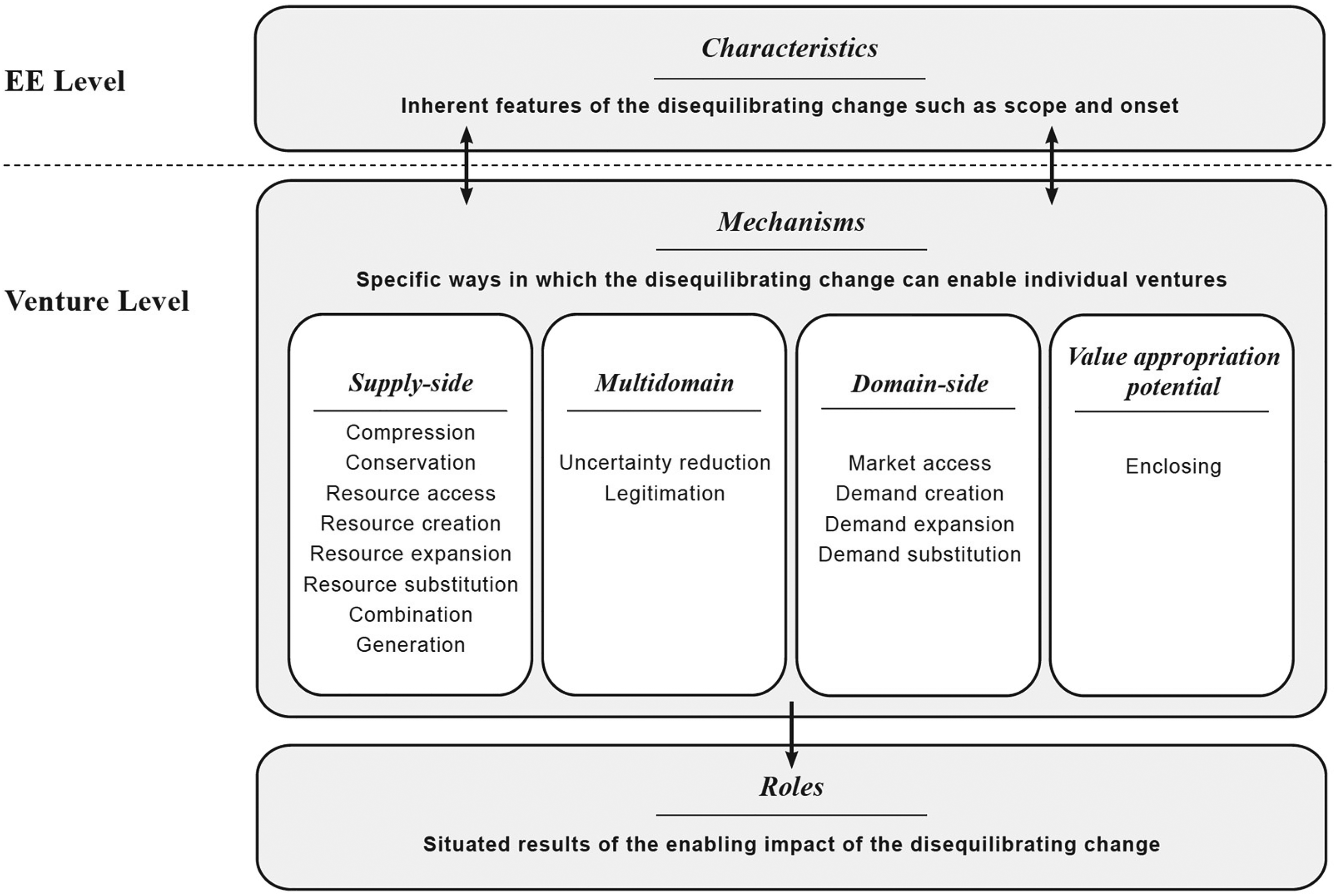
Depiction of the external enabler framework adapted from Kimjeon and Davidsson (2022).
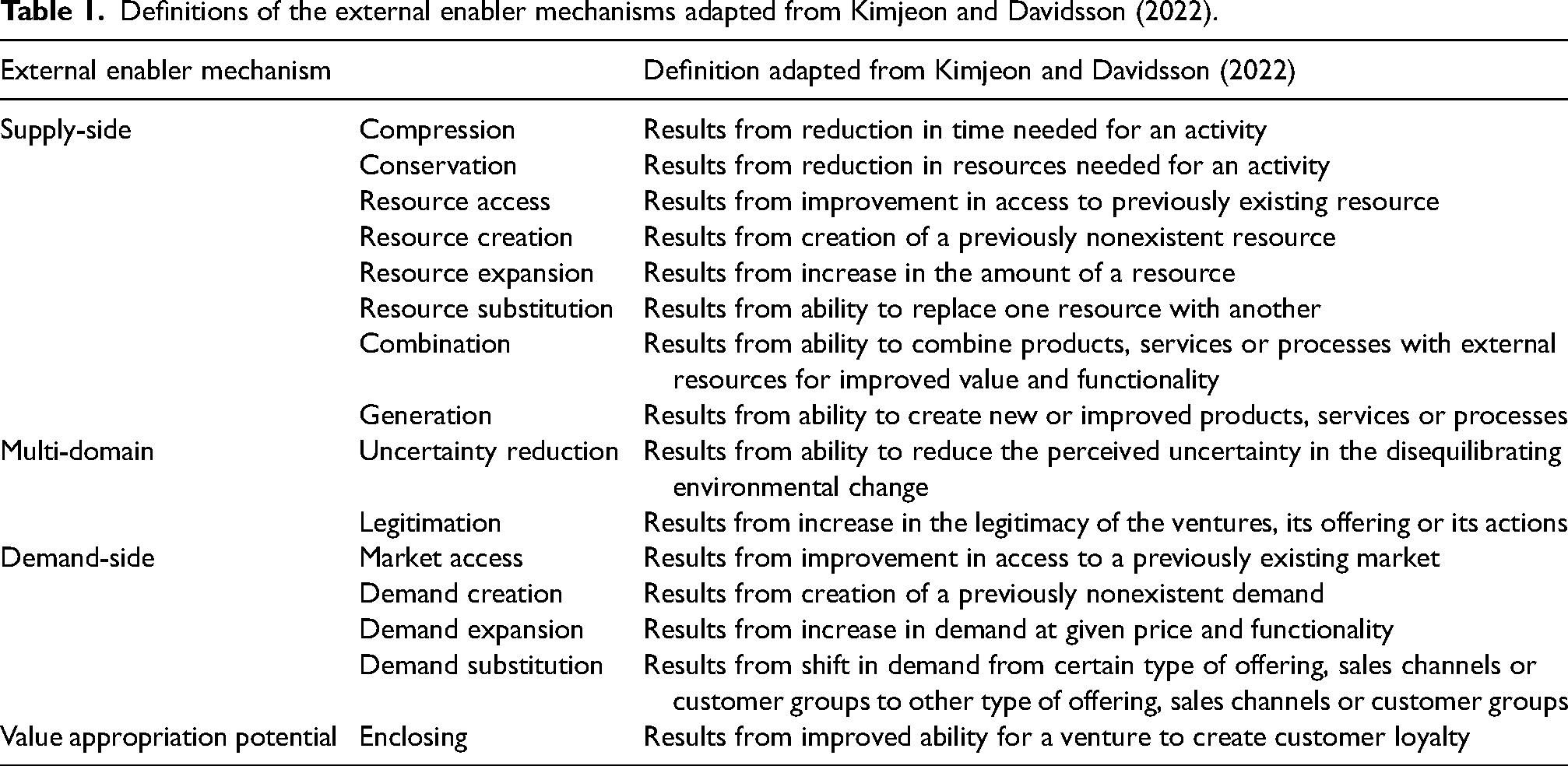
The COVID-19 pandemic is painted as a disequilibrating force in multiple studies (e.g. Bivona and Cruz, 2021; Kuckertz et al., 2020) and special issues (e.g. Belitski et al., 2022; Pattinson and Cunningham, 2022) that explore how entrepreneurs navigate the crisis. Yet, these studies mostly focus on the entrepreneurial agents, leaving the nuanced nature of the crisis as an EE unexplored. Our research adopts the EE perspective to study the pandemic and its impact on small ventures. More specifically, we focus on the EE mechanisms that Kimjeon and Davidsson (2022), in the most recent presentation of the EE framework, classify into eight supply-side mechanisms, four demand-side mechanisms, one mechanism addressing improved value appropriation potential, and two mechanisms applying across multiple domains (see Table 1 for definitions). We believe that the mechanisms operating at the intersection of the external elements and the entrepreneurial agents provide means to understand causal relationships between external stimuli and venture actions.
Definitions of the external enabler mechanisms adapted from Kimjeon and Davidsson (2022).
Looking at the previous applications of the EE framework, a variety of phenomena are explored as EEs and can be categorised into three major types, in order from micro to macro level impact: natural disasters, technological developments, and societal changes. A localised natural hazard elicits only demand-side mechanisms (Mahieu, 2021), and new digital technologies create opportunities mainly via supply-side mechanisms (Chalmers et al., 2019; Semenova et al., 2023). In comparison, a large-scale societal change, the sustainability ethos, invokes supply, demand and multidomain mechanisms in succession of one another (Hinderer and Kuckertz, 2022), and an ecological shift cascades through regulatory shift and anchor tenants to enable the emergence of an entrepreneurial ecosystem (Juma et al., 2023). However, the micro-level EEs display some complexity in that the demand effects in the natural hazard are both immediate and lagged (Mahieu, 2021), and the technological developments include larger ideological shifts and not only enable the entrepreneurs but are also shaped by them (Chalmers et al., 2019; Semenova et al., 2023). Nevertheless, all these studies still apply the agent-focused perspective. Furthermore, scant attention is given to the EE mechanisms as quantitative variables or as guiding themes for qualitative coding. Thus, there is a need to focus on the external more discernibly and to apply the EE framework to its full potential.
Only a few studies have specifically used the EE framework to examine the impact of the pandemic on entrepreneurial pursuits, and most of these include the framework from a theoretical perspective rather than in their empirical analysis (Klyver and Nielsen, 2021; McGee and Terry, 2022). Davidsson et al. (2021) combine a conceptual examination of the pandemic as an EE with limited empirical data from crisis responses of a group of Europe-based ventures. They argue that demand creation and demand expansion, as well as a combination of the two, are the most prevalent enablers of the ventures’ responses. However, the study does not dissect the interplay of these mechanisms. Cestino et al. (2023) are among the first to extend the framework to empirical data using incumbent companies to examine how eight US-based news companies adapted their operations during the pandemic with entrepreneurial action emerging in the incumbents from existing resources and activities. As such, these two studies show several different pandemic-induced EE mechanisms at play, but still leave the nuances of their dynamics and interplay unexplored. Furthermore, the context of existing ventures, between incumbents and new ventures, remains largely unexplored.
Despite these pioneering studies, there is room for in-depth studies that can illuminate the nuanced nature of the pandemic as an EE. Examining the crisis responses of 64 Finnish and Californian packaged food and beverage ventures, we addressed the research question of ‘how the COVID-19-induced enabler mechanisms developed and interacted with each other to enable new opportunity pursuit for ventures’. We contribute to understanding of the role of the external environment in enabling entrepreneurial pursuits, with a specific focus on generating a more nuanced view of the EE mechanisms.
Methodology
Study context and participants
The current study focuses on packaged food and beverage ventures from Finland in Northern Europe and California in the United States. Despite the significant geographic distance between the regions, previous research has revealed similarities in their food venture cultures (Jung et al., 2021; Perttunen et al., 2021). Both regions have active food innovation scenes where ventures leverage the newest food trends and different food cultures (Björklund et al., 2020; Marston, 2023). Furthermore, as both regions lack a strong local cuisine, they are open to exploring and adopting new foods. Additionally, the ventures collaborate closely with their stakeholders to stay on top and ahead of demand trends (Bivona and Cruz, 2021; Jung et al., 2021; Perttunen et al., 2021). Compared to large food manufacturers in both regions, the ventures can provide high-quality products that cater to novel and niche needs (Björklund et al., 2020; Marston, 2023).
This industry provides an interesting context to study the impact of the pandemic as it is an industry thoroughly disrupted by the crisis: the immediate health crisis spiked the demand for various anti-inflammatory products, the restriction measures impaired the operations of the industry players by disrupting value chains, closing down important sales venues and changing consumer behaviour in unexpected ways, and the resulting financial crisis threatened the traditionally low profit margins within the industry (e.g. Ali et al., 2021; Chenarides et al., 2021). When restaurants closed down, small ventures had a new source of demand from homebound consumers. Moreover, without strong traditional and rigid food cultures, the impact of the pandemic might be more pronounced in these two regions. In face of these challenges, the resource-restricted small ventures were forced to explore new opportunities. The COVID-19 waves and restrictions were relatively similar (see Appendix 1 for COVID-19 timelines of both regions) in both regions, making the two regions comparable.
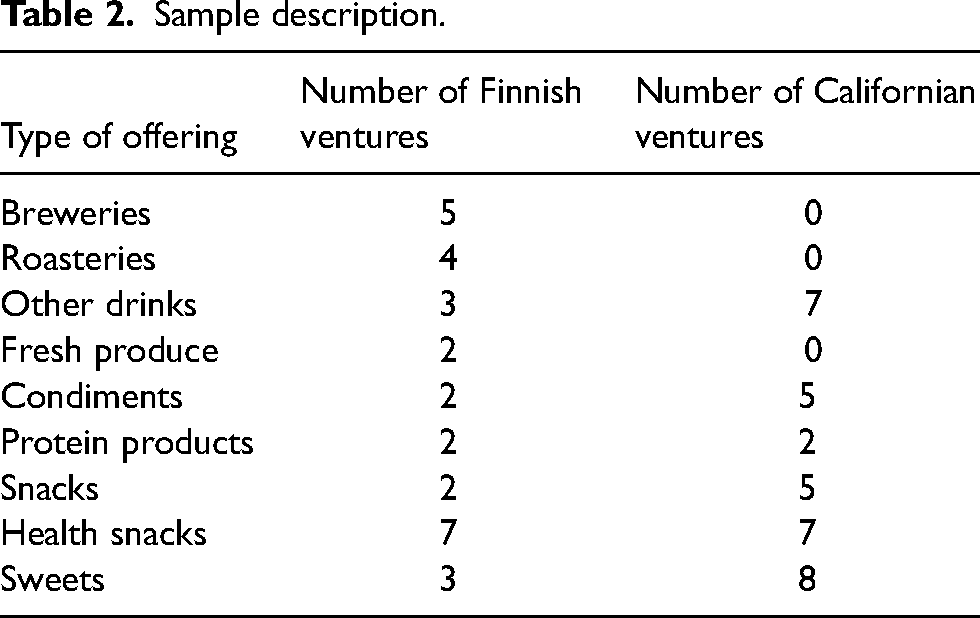
The data on the interviewed Finnish ventures was a continuation of a larger research project. The Californian data, in turn, was collected for the current study. The resulting sample consisted of 41 interviews with founders of 30 Finnish ventures and 34 interviews with founders of 34 Californian ventures (Table 2; see Appendix 2 for more information on the sample).
Sample description.
Data collection and analysis
The participating ventures were found either via the snowballing technique (Parker et al., 2019) with the initial participants originating from the authors’ personal networks or through social media. Snowball sampling is often the method of choice when targeting samples that are difficult to access through conventional means. The technique was particularly useful in the context of consumer-packaged goods food startups, which lacked extensive digital records of contacts or company information. However, the close-knit nature of these communities played a pivotal role in the effectiveness of snowball sampling, with initial contacts connecting the authors to further contacts.
The ventures were contacted via email, and the data collection was done via teleconferencing platforms, phone calls or face-to-face interviews, in compliance with regional COVID-19 restrictions at the time of data collection. In Finland, the data was collected from March 2020 to April 2021, whereas in the US, the timeframe spanned from July 2020 to March 2021. The semi-structured interviews applied a critical incident-based thematic approach (Chell, 2004; Flanagan, 1954), prompting the interviewees to discuss meaningful events, motivations and behaviours regarding their reaction to the crisis (Danson et al., 2015; Zighan et al., 2022). The interviews were conducted either in Finnish or English, depending on the mother tongue of the interviewee and lasted from 20 to 90 min, the average length being approximately an hour. The interviews were audio-recorded and transcribed verbatim for analysis. Finnish excerpts included in the article have been translated into English by an author fluent in both languages.
We used two existing frameworks in the analysis: the EE framework by Davidsson et al. (2020) as the main theoretical framework to model the enabling mechanisms of the pandemic and the business model innovation (BMI) framework by Spieth and Schneider (2016) as a supplemental analytical tool to categorise the ventures’ crisis responses. From the EE framework, we focused specifically on the mechanisms describing the cause–effect relationships between the EE and the ventures’ responses. We used the most recent rendition by Kimjeon and Davidsson (2022), which defines 15 mechanisms (see Table 1). Since Davidsson et al. (2020) developed their framework in the context of venture creation, the roles part of the framework depict outcomes relevant to new ventures. However, as Davidsson et al. (2020) state, the framework should not be limited to the context of venture creation, but be applied to ventures more generally, like the current study. As we felt that the original roles part of the framework was inadequate for our purposes to achieve the desired level of depth and detail in the analysis, we used the BMI framework to structure the ventures’ crisis responses. Previous research has also successfully paired the EE framework with other theoretical ideas such as business model canvas (Gómez García and Alba Cabañas, 2022) and dynamic capabilities framework (Semenova et al., 2023). The BMI framework describes how business model innovations fall into three core dimensions: value offering (comprising product and service offering, target customers and positioning), value creation architecture (comprising core competencies and resources, internal value creation, external value creation and distribution) and revenue model (comprising logic of revenues and logic of costs) (Spieth and Schneider, 2016).
With these two frameworks guiding our coding, we first identified all crisis responses taken by the ventures during the pandemic. Altogether there were 193 responses, 116 in the Finnish data and 77 in the US data. Then, we applied the BMI framework and the EE framework to categorise the responses according to the business model dimension they targeted and to identify the EE mechanisms of the pandemic through which each response was elicited. Appendix 3 demonstrates the flow of our thematic coding.
As a final step, we investigated the nature, patterns and dynamics of the EE mechanisms and the opportunities that they enabled. For example, what type of logic of operation was behind each EE mechanism, whether specific EE mechanisms were working together to enable the ventures, and what dynamics these EE mechanism pairings exhibited. Additionally, we compared findings between California and Finland to explore similarities and differences. As the BMI framework served mostly the role of an analytical tool to structure the data, we interpreted the results mainly from the perspective of the EE framework.
Results
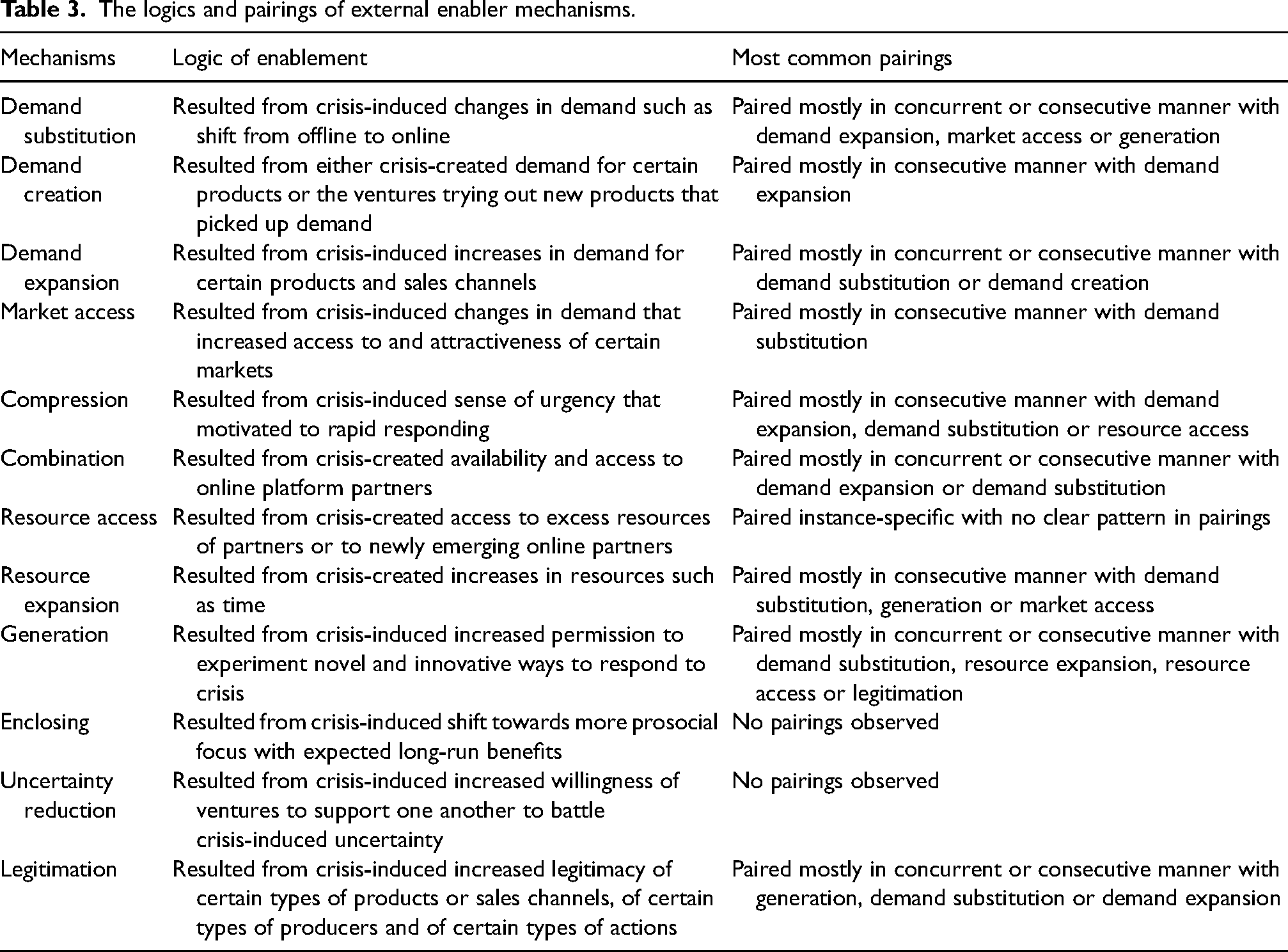
Examining the crisis actions of the Californian and Finnish food and beverage ventures, the majority were enabled through demand-side mechanisms, particularly demand expansion, demand substitution, and demand creation. Some supply-side mechanisms were at play in both regions, but the other mechanisms were mainly observed in Finland (see Appendix 4 for a detailed categorisation of the ventures’ responses). Only 3 mechanisms out of the 15 of Kimjeon and Davidsson (2022) were not observed in either region: conservation, resource creation and resource substitution. Moreover, the mechanisms stemmed from the COVID-19 crisis in various ways, often working with each other in concurrent or consecutive manner (Table 3).
The logics and pairings of external enabler mechanisms.
The impact of the demand-side mechanisms
Demand substitution
The demand-side mechanisms were the most common mechanism amidst both the Finnish and Californian ventures, and demand substitution was the most prevalent. This mechanism resulted from crisis-induced changes in consumer behaviour, shifting demand from brick-and-mortar to online, both in terms of products and distribution channels. Demand substitution often worked in tandem with demand expansion – the demand both shifted to and increased online. Most of the ventures’ crisis responses enabled by this duo of mechanisms targeted the value creation architecture, particularly distribution. Almost all the ventures were encouraged by the pandemic-induced demand changes to either improve existing web stores or develop new ones and to increase their social media presence. A Californian snacks venture remarked how the demand shift increased their focus online: ‘So, we are unable to do in-person demos or sampling anymore. That has definitely affected our physical presence in that sense. But that's why I think the online piece becomes more important to convey that and access’. Although the longevity of the demand shift beyond the crisis was unclear, many of the ventures were planning on maintaining their increased online presence.
Demand substitution also operated with the supply-side generation mechanism when the ventures leveraged the pandemic-induced ‘permission to experiment’ to address the demand shifts in an innovative manner. The Californian ventures tried new ways to test their products since farmer's markets, their traditional channels, were closed. The Finnish ventures, in turn, leveraged the pairing of demand substitution and generation in experimenting with new distribution channels such as a distillery adopting a long-drink motorbike to reach socially distancing customers. In both countries, demand substitution was also followed by market access. In California, the ventures targeted less affected states, whereas the Finnish ventures leveraged the improved market access created by the online shift to enter international markets.
Demand creation
The demand creation mechanism was more prevalent in Finland and emerged in two ways: firstly, demand was created (and increased) by the crisis and related restriction measures for various products and services, such as hand sanitizers and home deliveries. A Finnish distillery described how their hand sanitizer led to other opportunities: ‘We established a hand sanitizer kiosk at our premises where we would also sell some of our mild booze. The sales have been surprisingly large’. Alternatively, the ventures influenced the demand impact by creating new demand themselves. For example, a Finnish roastery created a service for employees to order employer-sponsored coffee to their homes for remote workdays, and a Finnish protein products venture shipped their samples to international buyers organising virtual meetings with them for the sampling.
Demand expansion
The restriction measures also increased demand for certain products (e.g. products by local small producers, comfort foods) and certain channels (e.g. web stores, brewery and roastery stores). Demand expansion operated often together with either demand substitution or demand creation. In the former case, the mechanisms often manifested in tandem, whereas, in the latter, demand creation preceded demand expansion in that the demand only increased whilst the products that the demand had emerged for started to be offered. An example of the latter case was a Finnish sweets venture and their themed sweets boxes: ‘After the first successful box [COVID-19 box], we created a First of May box. It was easier and faster to do as we could model it after the first one. Then we made a Mother's Day box, and now in fact we are planning on having a seasonal box in our assortment all the time’.
Although demand changes were often rapid, the planned longevity of the ventures’ responses varied largely. Most of the responses targeting value offering were done reactively, with limited resource commitment to grasp the increased demand. The Finnish ventures leveraging the increased demand for products from small local producers demonstrated opportunistic and short-lived responses. For instance, a brewery creating customised branded beers that companies could buy to support the venture. Sometimes the supply-side compression mechanism was also in play here, motivating the rapid responses through a crisis-induced sense of urgency. The value creation architecture responses, in turn, although often done with limited resource commitment and in response to the online demand shift, were more strategic in that the ventures were expecting to benefit from them also beyond the crisis. Particularly, the increased focus on web stores and online interactions with customers were things the ventures were expecting to maintain.
Market access
All the ventures’ observed crisis responses enabled by the market access mechanism targeted their value-creation architecture. Furthermore, market access followed from demand substitution, in that demand shifts entailed improved access to new markets either nationally or internationally. Although market access was present in both countries, the markets it opened differed. In California, the shifts in demand to online and the disproportionate impact of the pandemic on different states enabled the ventures to access and enter the less impacted states via online channels. For example, a Californian condiment venture remarked about the disproportionate impact of the crisis in different states: ‘[…] it's kind of a regional thing. We’re keeping an eye on different markets and how different states are handling things’. The Finnish ventures increased access via online to international markets, like a Finnish health snacks venture that was able to partner with various European online distributors.
The impact of the supply-side mechanisms
Compression
The compression mechanism came into play through the urgency to grasp the rapidly shifting demand changes and find new sources of revenue to avoid bankruptcy. As such, compression stemmed from either demand expansion or demand substitution when a change in demand created time pressures to address it or resource access when newly available resources created pressure to leverage them quickly. Also, in some cases, inadvertent events created a sense of urgency that the ventures were able to mould into an opportunity. A Californian condiments venture improved its production capability when it had to reorganise their manufacturing due to COVID-induced disruptions.
However, this reactive side of compression-enabled crisis responses was only part of the story. The sense of urgency also motivated the ventures to engage in some long-planned actions, especially actions related to establishing online-based value creation architecture. For example, a Finnish roastery was finally energised to organise nation-wide home delivery for their web store orders, and a Finnish brewery speeded up their merger with another brewery, remarking: ‘We haven’t really entered into new distribution channels, but the pandemic did speed up the merger of our brewery with [another brewery]’.
Combination
The combination mechanism operated in enabling value creation architecture-focused responses in both regions and was always paired with either demand expansion or demand substitution. The changes in customer behaviour increased the number of online platform providers, and the ventures were leveraging these online platforms for their purposes. For example, a Californian health snacks venture leveraged a newly created platform for virtual customer engagement and a Finnish functional beverage venture partnered with a yoga school for product visibility in their online platform: ‘We have partnered with them [yoga school] and are shown in their [online] channels. It would be awesome to be able to be visible on the platform and be able to provide samples to all the viewers’.
Resource access
The resource access enabled crisis responses of the ventures differed between the two regions, with responses targeting only value offering in Finland and only value creation architecture in California. The Finnish ventures gained access to excess resources of their partners, with, for example, a Finnish snacks venture receiving excess ingredients from a chef whose restaurant was closed by the restrictions. The Californian ventures, in turn, experienced increased access to partners and online-based resources and improved access to retail store shelf space since the crisis had forced many competitors to downsize. For example, a Californian condiment entrepreneur was able to find more new value-aligned partners during the crisis. Another Californian condiment venture reported: ‘What also happened is there's been a bit of a seismic shift on the shelves in different places. I’ve launched in three or four different supermarkets, big chains, during this time’.
Resource expansion
Resource expansion was more prevalent in enabling the Finnish ventures than the Californian ones. The resource that expanded was most often the entrepreneurs’ time, freed up due to the disruptions the pandemic caused. The ventures used this time to try new value offerings or value-creation architecture activities. For example, a Californian snacks venture described using their freed-up time for an action that had been long in the planning: ‘We’ve done a lot of things…. the [YouTube] videos were something we’ve wanted to do for a long time, but never had the time to do. It's been a lot of exploring lately’. Oftentimes, the value creation architecture-focused responses enabled by resource expansion were also enabled by demand substitution, in that the ventures used the freed-up time to develop activities that would capture the shifted demand. In Finland, the ventures also benefited from the governmental COVID-19 support funding as an increased financial resource. They used this funding either to grasp the demand changes or, also leveraging the generation mechanism, to experiment with novel solutions, such as a health snacks venture starting to develop products of a new category.
Generation
The generation mechanism stemmed from the crisis-induced permission to experiment with new and innovative crisis responses. Indeed, this mechanism had probably the most multifaceted pairings with other mechanisms. Motivated by the demand-side mechanisms, generation enabled the ventures to address the demand changes creatively, such as a Finnish brewery using a beer van to sell beer outside to socially distancing customers. The Californian ventures, in turn, attempted to find new ways to sample their products, since the farmer's markets were closed. For example, a Californian protein product venture described pandemic-elicited changes in their product range: ‘We were almost exclusively in grocery stores because the fruit and vegetable bars require refrigeration. […] Since the protein line came out and it doesn’t need to be refrigerated for safety, we’ve opened up our online sales on our website and on Amazon. […] That's definitely picked up and I think that's become far more profitable than the in-store sales have been’. Regarding other mechanism pairings, generation often worked with other resource-side mechanisms (resource expansion and resource access) when the ventures were using the newly available or increased resources for creative and experimentative purposes. Many Finnish ventures received governmental crisis funding and used it to try out more experimentative solutions in both their value offering and value creation architecture.
Two generation-related phenomena that were largely specific to Finland were the pairing of generation with the multidomain legitimation mechanism and generation-enabling responses without connecting to other mechanisms. Generation and legitimation were combined when the ventures leveraged the ‘support your local’ trend and the increased permission for experimentation in their crisis responses, such as a brewery collaborating with a local flower store to bundle their products. The ventures enjoyed the culture of experimentation and the regenerative chaos of the crisis, such as a Finnish health snacks venture that started podcasting. Overall, the ventures leveraging generation were encouraging a spirit of experimentation rather than risk-aversiveness.
The impact of the value appropriation potential mechanism
Enclosing
The enclosing mechanism was observed to enable venture responses only amidst the Finnish ventures. The mechanism was not combined with other mechanisms, and the enabled venture responses all targeted value offerings. Enclosing captured the crisis-induced shift towards prosocial actions and the long-term expectation of increased customer loyalty resulting from philanthropy during the crisis. For example, a Finnish condiment venture gave their products for free, and a Finnish roastery sold coffee at a discount to their struggling restaurant customers during the crisis, with both ventures expecting to reap benefits in increased purchases and loyalty when the restaurants got back onto their feet. The enclosing-enabled value-offering responses, unlike most other value-offering responses, were clearly strategic and expected to offer benefits only in the long-run as the Finnish condiment venture explained: ‘When the restaurants were struggling and forced to close, we sold our products to them almost for free. Now that they are open again, many have ordered from us again since they remember our good deed’.
The impact of the multidomain mechanisms
Uncertainty reduction
Uncertainty reduction was mainly seen to enable value-creation architecture responses for the Finnish ventures. The crisis significantly increased overall uncertainty, with an unpredictable spread of the disease as well as changing governmental restriction measures. Therefore, the ventures, particularly the Finnish microbreweries and microroasteries, were deciding to work together to manage and reduce uncertainty. They advised each other and openly shared information on their successes and failures with their peers. For instance, the Finnish brewer who had adopted a van as a new sales channel recalled: ‘We got a lot of calls regarding the beer van from other breweries. I think I have talked with about 20 other entrepreneurs. Sharing advice and support is very important to not be alone with challenges’.
Legitimation
The legitimation mechanism mostly enabled the Finnish ventures and worked in four different ways. The first way was leveraging the increased legitimacy of online operations in their crisis responses. When legitimation was interpreted this way, it often operated together either with generation or one of the demand-side mechanisms. The second and third types of legitimation revolved around increased legitimacy to support specific groups: at-risk groups and frontline workers, as well as small and local producers. The ventures in both regions donated products to hospitals and food banks. Especially the Finnish ventures leveraged the increased legitimacy of small producers in their value-offering focused responses. For example, they were bundling their offering with other local small producers or choosing to use ingredients only from local small producers. A Finnish coffee roastery described: ‘We were very swift in the launch… we developed a sort of small producer bundle during spring which is still being sold now before Christmas. […] The bundle provided revenue also for others [the small producers included in the package]’.
Finally, the fourth way, specific to Finland, that legitimation operated was using humour. The ventures leveraged the crisis in funny ways in product branding, marketing and communications. The interviews suggest the crisis was such a shock that it was seen as legitimate to make fun of it, attempting to find positives amidst the negative. Examples of these responses included a ‘state of emergency’ labelled beer by a brewery, a quarantine chocolate box by a sweets venture and a marketing campaign during a lockdown of the Finnish capital region to send coffee to friends inside the lockdown. These responses were sometimes also enabled by demand expansion, as there was an increase in demand for products by small local producers. For instance, a Finnish coffee roastery remarked: ‘During the Covid spring, we noticed how people had started to spend more time outdoors, myself included. We created a coffee perfect for outdoors and meant to be enjoyed at a bonfire. It has been very popular!’
Discussion
Contributions
Our goal was to provide insight into how the pandemic enabled the ventures to pursue new opportunities. Leveraging the EE framework, we focused specifically on the pandemic-induced enabling mechanisms, their logic, dynamics, and interplay, in eliciting the ventures’ crisis responses. Our findings highlight the multifaceted nature of the enabling impact of the crisis; we identify 12 out of the 15 EE mechanisms of Kimjeon and Davidsson (2022) at play in various pairings and with diverse enabling logic influencing the ventures’ crisis responses and, reciprocally, being influenced by the ventures. The most prevalent EE mechanisms in both regions were the same (mostly demand-side mechanisms), but the Finnish ventures were leveraging a more diverse range of mechanisms. Similarly, the Finnish ventures’ responses targeted more BMI dimensions, whereas the Californian ventures’ responses mainly focused on improving and increasing their value creation architecture. We interpret these differences to result from the different market characteristics – the Californian ventures had a larger market in terms of population and easier access to markets in neighbouring states where they could leverage the demand-side effect of the pandemic and access customers and sales channels, whereas, due to a smaller market, the Finnish ventures were required to leverage more mechanisms for their crisis responses as well as change their business models more with the crisis responses.
Altogether, our study offers an empirical application of the EE framework, extending it from venture creation into the context of existing ventures. We contribute to research on the dynamics between external factors and entrepreneurial crisis responses in three ways: showcasing bidirectionality between EEs and entrepreneurial actions, illuminating the mechanisms through which ideological shifts triggered by external conditions can translate to enablement, and uncovering pairing interactions across different mechanisms.
First, the study suggests complex, bidirectional dynamics across EEs and crisis responses. The multifaceted and society-spanning nature of the COVID-19 crisis was highlighted in how the different mechanisms came about. The crisis itself consisted of multiple parts: the health crisis, the restriction measures, the demand changes caused by the restrictions and the ideological changes. Most of the demand-side and supply-side mechanisms resulted from changes in demand or available resources due to the disrupting and behaviour-altering restrictions rather than the pandemic directly. Extant EE research largely suggests that demand and supply mechanisms stem from such straightforward demand and resource changes resulting from an EE (Davidsson et al., 2021; Mahieu, 2021). However, we find more complex dynamics, as the ventures’ actions also influenced these mechanisms. Similarly, the increased legitimacy of certain types of actors and actions partly emerged from the actors taking the actions, again suggesting a bidirectional relationship between actor responses and EEs (in line with the legitimacy findings of Chalmers et al., 2019). We extend findings on the bidirectional nature of entrepreneurs’ actions and the enablers (e.g. Chalmers et al., 2019; Semenova et al., 2023) to apply also for unpredictable and rapid impacting EEs such as the pandemic. Furthermore, aligning with Semenova et al. (2023) and Gómez García and Alba Cabañas (2022), our findings show how combining the EE framework with the BMI allows us to combine actor-independent level of the crisis-induced enabling mechanisms with actor-dependent level of entrepreneurs’ crisis responses, suggesting that combining frameworks of different levels can depict the relationship of ‘changing configurations of contexts’ with ‘the specific spatio-temporal characteristics of real-time entrepreneurial activity’ (Fletcher and Selden, 2016).
Second, we show how some of the more ideological facets of crises can translate into enabled responses. Previous studies have also noted ideological components of EEs, with the emergence of blockchain technology accompanied with ideological changes (Chalmers et al., 2019; Semenova et al., 2023) and the rise of the sustainability movement transmitted both as changes in resources as well as ideology (Hinderer and Kuckertz, 2022). However, none distinguish the EE mechanisms that convey such ideological shifts into opportunities. We identify these mechanisms to be compression, generation, enclosing, uncertainty reduction and legitimation in the case of the pandemic. Out of these, compression and generation resulted from the state of emergency that created both an urgency and a permission to engage in more experimentative responses. We hypothesise that the rapid and innovative crisis responses identified in previous pandemic research (e.g. Bivona and Cruz, 2021; Kuckertz et al., 2020) could have been conveyed through these two mechanisms. Indeed, our findings show how real-time innovative entrepreneurial pursuits can emerge from other mechanisms in addition to the demand-side ones that previous studies of natural disasters have demonstrated (e.g. Mahieu, 2021). Furthermore, taking advantage of such rapid ideological contextual changes requires both deliberate agentic action by entrepreneurs (Davidsson et al., 2020) and flexibility of business model (Bivona and Cruz, 2021; Spieth and Schneider, 2016).
Enclosing and uncertainty reduction, in turn, resulted from increased prosocial sentiment and willingness for informal collaborations. The benefits of these mechanisms depended on other actors (customers or competitors). Thus, the EE mechanisms are relational constructs in connecting external elements and individual entrepreneurial agents (Kimjeon and Davidsson, 2022), and the enablement derived by one agent depends on the actions of others. These two mechanisms might be key to explaining the success of entrepreneurial ecosystems (Juma et al., 2023) and resilience of entrepreneurs embedded in their communities (Burnett and Danson, 2022; Shepherd et al., 2020), contexts in which working with others matters. Finally, the logic of legitimation differed largely between the two regions – in California, it resulted from increased legitimacy of restriction-complying products and sales channels, whereas in Finland, legitimacy increased also for certain types of actors and actions – indicating high context-dependency of this mechanism. Previous studies featuring legitimation align with our findings of its multifaceted (Cestino et al., 2023) and context-dependent (Hinderer and Kuckertz, 2022) nature, suggesting nuanced mechanisms warranting further research attention. Taken together, legitimation in particular might be a key mechanism in (re)interpreting a disrupting environmental change as a legitimate opportunity and, consequently, benefitting from the opportunity. Relating this back to general contextualisation research, legitimation might be a way for entrepreneurs to (re)construct and (re)enact their constraining contextual factors in the macro environment to be more favourable for entrepreneurial pursuits (Welter, 2011; Welter and Gartner, 2016).
Finally, the current study sheds light on how different EE mechanisms interact with one another. Previous studies have only brushed on how different mechanisms pair, suggesting that demand-side mechanisms are likely to work together (Davidsson et al., 2021) and that different types of mechanisms might follow each other (Hinderer and Kuckertz, 2022). We demonstrate a variety of different pairings and different ways that the pairings function. Our findings align with Davidsson et al. (2021) in showcasing the prevalence and pairing of the demand-side mechanisms with one another amidst the pandemic. However, we expand their work by illustrating the different ways that these mechanisms are paired: working simultaneously (demand expansion and demand substitution occurring simultaneously) or consecutively (demand substitution and market access following one another). Furthermore, when paired with other types of mechanisms, the demand-side mechanisms take the role of predecessors or even motivators to leverage the other mechanisms to address and benefit from the demand changes, both augmenting the ventures’ value offering and value creation architecture. This connection to demand mechanisms was observed across supply-side mechanisms and the multidomain legitimation mechanism. Generation, in contrast, paired widely with both supply- and demand-side mechanisms as well as the multidomain legitimation mechanism, indicating that the ventures were able to draw from a variety of resource, demand and legitimacy shifts for generative purposes. This drawing from whatever is available parallels the process of bricolage (Simba et al., 2021) indicating that the pairing of the mechanisms can be a creative and opportunistic process. Furthermore, the variety of mechanism pairing shows that, in addition to influencing entrepreneurs embedded within contexts, the changing configurations of contexts influence each other, indicating great complexity on how contexts constrain and enable entrepreneurs (Fletcher and Selden, 2016; Welter et al., 2019).
Limitations and directions for future research
Our study has limitations that also offer opportunities for future research. First, although our sample is large and rich in detail, it is still cross-sectional. Longitudinal data would offer better illumination to study the lagged effects of the pandemic as well as the longevity of the opportunities pursued by the ventures. Furthermore, similar to most previous studies using the EE framework (e.g. Gómez García and Alba Cabañas, 2022; Semenova et al., 2023), we complement it with another framework, the BMI, to adjust it for existing ventures. Further developing the roles part of the framework could better account for the perspective of existing ventures in addition to venture creation. Nevertheless, we find the EE framework a promising new perspective in terms of theoretical development and practical application. The suggested connections across mechanisms in particular warrant further longitudinal examination to better understand the dynamics of the enabling effects of crises. For example, future studies could dig deeper into the consecutive connections between mechanisms exploring potential causality between them.
Second, while the current study spanned across two regions the findings are still not generalisable – more studies in different regions, industries and disequilibrating forces are needed. For example, Davidsson et al. (2020) featured two additional relational qualities of mechanisms, opacity and agency intensity, that depicts how easily identifiable a mechanism is and how much effort is required to leverage it. Although we did not specifically study these, opacity differed between the two regions: the Finnish ventures were leveraging more mechanisms in terms of number and diversity than their Californian counterparts. Similarly, different types of legitimation were observed across Finland and California, and some dynamics were contingent on other actors’ reactions to initial responses. Such differences could indicate differences in the ability of the entrepreneurial ecosystems to benefit from external disequilibrating forces. This opens up further promising avenues for future research for understanding the collective dynamics of entrepreneurial action through the EE framework.
Conclusion
The COVID-19 pandemic has been a disequilibrating external force, creating challenges and opportunities for ventures. Our findings on the dynamics across and between enabler mechanisms and crisis responses of Finnish and Californian packaged food and beverage ventures highlight multifaceted interconnections, with bidirectional, locally varied and concurrent or consecutive patterns. Enabler mechanisms arose from pandemic-induced changes in demand and resources as well as shifts in ideology, sometimes pairing with each other to enable the ventures to pursue new opportunities. Furthermore, the pandemic was not merely enabling the ventures, but the impact of the crisis was also shaped by the ventures indicating that even high-impact unpredictable external disequilibrators are not beyond influence.
Supplemental Material
sj-docx-1-iei-10.1177_14657503241235812 - Supplemental material for Opportunities from adversity: The enabling impact of the COVID-19 pandemic for the actions of Finnish and Californian food and beverage ventures
Supplemental material, sj-docx-1-iei-10.1177_14657503241235812 for Opportunities from adversity: The enabling impact of the COVID-19 pandemic for the actions of Finnish and Californian food and beverage ventures by Erika Perttunen, Summer D Jung, Maria Talvinko, and Tua A Björklund in The International Journal of Entrepreneurship and Innovation
Footnotes
Acknowledgements
The authors would like to thank the interviewed ventures who supported this research with their time under difficult conditions as well as the current and former members of the DesignBites and the Stanford Food Design Lab research teams. From the DesignBites research team, we would specifically like to thank Hanna Huhtonen who contributed to data collection and Anna Kuukka who helped in visualisation.
Authors' contribution
Erika Perttunen contributed to conceptualization, methodology, formal analysis, investigation, visualisation, writing – original draft preparation, writing – review and editing, and funding acquisition. Summer D. Jung contributed to conceptualization, methodology, formal analysis, investigation, visualisation, writing – original draft preparation, writing – review and editing, and funding acquisition. Maria Talvinko contributed to conceptualization, methodology, investigation, writing – review and editing, and funding acquisition. Tua Björklund contributed to conceptualization, methodology, writing – review and editing, and funding acquisition.
Declaration of conflicting interests
The author(s) declared no potential conflicts of interest with respect to the research, authorship, and/or publication of this article.
Funding
The author(s) disclosed receipt of the following financial support for the research, authorship, and/or publication of this article: This work was supported by Business Finland (grant 211822) and Jenny and Antti Wihuri Foundation; and the Stanford Center at the Icheon Global Campus (SCIGC) funded by the Ministry of Trade, Industry, and Energy of the Republic of Korea and managed by the Incheon Free Economic Zone Authority.

Supplemental material
Supplemental material for this article is available online.
References
Supplementary Material
Please find the following supplemental material available below.
For Open Access articles published under a Creative Commons License, all supplemental material carries the same license as the article it is associated with.
For non-Open Access articles published, all supplemental material carries a non-exclusive license, and permission requests for re-use of supplemental material or any part of supplemental material shall be sent directly to the copyright owner as specified in the copyright notice associated with the article.
