



Abstract
Congenital malformations are a highly diverse group of conditions reported in both humans and animals, characterized by defects in morphogenesis observed at birth. Although most cases are idiopathic, genetic and environmental factors may be involved. The frequency of such conditions varies with species, geographic regions, and the specific malformation involved. In polymelia, supernumerary limbs are attached to different parts of the body. Gastrointestinal duplications are described less frequently and can be associated with polymelia. Cloacal atresia is among the least-reported malformations in avian species, described only once in a kiwi. Here we describe a case with these 3 malformations in a single broiler chick (Gallus gallus domesticus) and provide a literature review about the occurrence of these malformations in birds. The 3-d-old chick also had an unidentified structure projecting from the pygostyle region. We performed clinical, radiographic, and postmortem examinations. The intestinal duplication was identified only during the postmortem evaluation. Detailed descriptions of avian congenital malformations are scarce. Although similar cases have been reported, we retrieved no cases of concurrent polymelia, intestinal duplication, and cloacal atresia in broiler chickens in our literature search, suggesting that the simultaneous occurrence of these conditions has not been reported previously in this species.
Congenital malformations encompass a wide range of morphologic abnormalities, originating from errors in the embryogenic process. 24 They impact neonatal viability and often lead to death or euthanasia. 32 Most malformations are easily identifiable when affecting external structures, but are frequently unnoticed when they occur internally. 30 The causes are generally idiopathic, but genetic predisposition, environmental contamination, high incubation temperatures, and maternal diseases have been implicated as possible predisposing factors.12,28,39 Despite the documentation of a few cases,4,35,43 there is a lack of detailed descriptions of avian congenital malformations in Brazil.
Polymelia is a developmental anomaly in which extra limbs may be attached to different parts of the body. 24 Gastrointestinal duplication is reported less often than polymelia, possibly due to its challenging detection in live animals, 30 and cloacal atresia is among the least-reported avian malformations, with only a single documented case. 3 Here we describe a case involving the simultaneous presence of these 3 congenital malformations in a broiler chicken (Gallus gallus domesticus) and provide a concise literature review on avian malformations.
A 3-d-old male backyard broiler chicken raised on a farm in the city of Areia, state of Paraiba, northeastern Brazil, was brought to the Veterinary Hospital of the Federal University of Paraiba (UFPB; Areia, Paraiba, Brazil) because of 2 additional limbs attached to the pelvic region and an unidentified structure with a triangular shape partially covered by feathers attached to the pygostyle region (Fig. 1). According to the owner, the mobility of the chick was reduced, compared to its mates. The bird had mild dyspnea, distension of the celomic cavity, and poor nutritional condition. Clinical evaluation also revealed cloacal atresia.
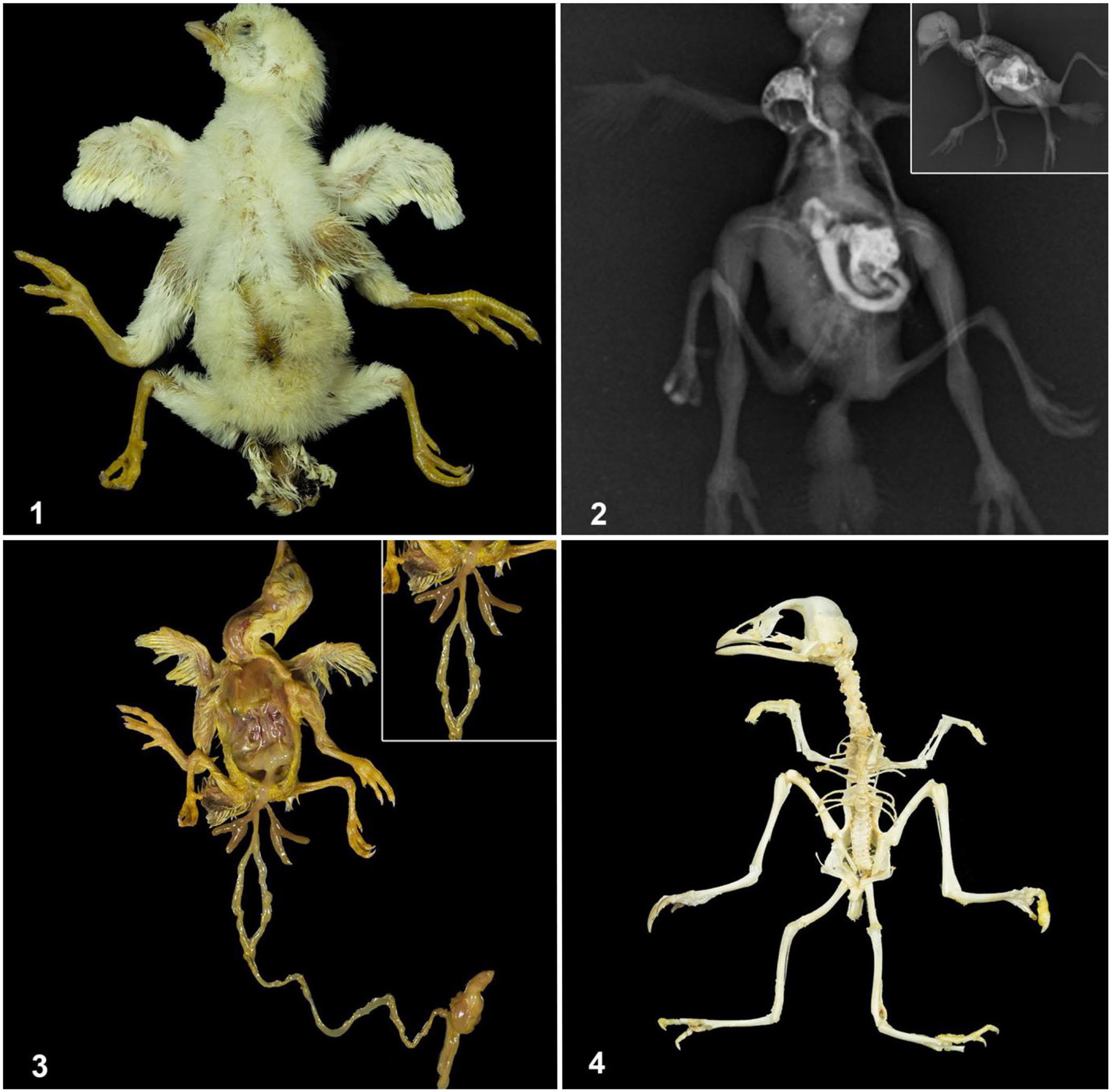
Polymelia, intestinal duplication, and cloacal atresia in a backyard broiler chick.
Despite the presence of the usual bones and muscles, the supernumerary limbs were notably smaller than the normal limbs. They lacked sensitivity and mobility and were in an inverted position; in the extra limbs, the joints connecting the tibiotarsus and the tarsometatarsal bones were positioned toward the cranial side, whereas in the normal limbs, these joints were inclined towards the caudal aspect of the body (Figs. 1, 2). The left supernumerary limb also lacked the fourth digit.
Radiographic evaluation revealed that the supernumerary limbs had well-defined bones with adequate mineralization. Contrast-enhanced radiography revealed displacement of the intestinal loops in a dorsocranial direction and contrast retention in the lower intestinal tract for more than 2 h after administration (Fig. 2). Despite receiving supportive treatment, the bird died 6 h after clinical examination. During autopsy, we observed duplication of the ileum and paired-cecal segments (Fig. 3) as well as the absence of a functional cloacal opening, leading to the accumulation of gastrointestinal content and luminal distension of the rectum and cloaca. There was a yolk sac remnant and an unhealed navel inside the celomic cavity, without gross signs of inflammation, infection, or hemorrhage.
We collected samples of liver, spleen, lungs, heart, gastrointestinal and urogenital tracts, brain, bursa, and thymus, fixed in 10% neutral-buffered formalin, processed routinely, and 4-µm sections were stained with H&E for microscopic evaluation. Additionally, we placed the animal’s carcass in a glass container containing dermestid beetles for 1 wk for better evaluation of the skeleton (Fig. 4). Microscopically, we found no differences between the normal and duplicated intestinal segments of the intestinal tract. The diagnoses of polymelia, intestinal duplication, and cloacal atresia were established based on the gross findings.
Establishing the prevalence of congenital malformations in birds is challenging because most cases are described as individual reports, and the frequency of these conditions in retrospective studies varies significantly. We also believe that the true frequency of these conditions is underestimated, especially in commercial broiler chicks, where such defects often lead to euthanasia of the affected animals without further investigation. In one report, 3 cases of congenital malformations were documented among 35,000 chickens (0.008%); 15 in another report, 40 cases were diagnosed among 2,687 chickens submitted to autopsy (1.5%), 6 a frequency nearly 200 times higher than the former study. In non-domestic birds, 36 cases were found among 1,005 postmortem examinations of captive, free-range, and sanctuary kiwis (Apteryx spp.) from New Zealand, a frequency of 3.6%. 16 In Brazil, only 1 case was found among 381 autopsies of free-range birds of various species, a frequency of 0.2%. 8 In Brazil, peer-reviewed reports of congenital malformations affecting birds include a case of unilateral renal agenesis in a Chilean flamingo (Phoenicopterus chilensis), 35 a case of polymelia and tarsal-metatarsal duplication in a wild great rhea (Rhea americana), 43 and a case of thoracic limb, vertebral column, tracheal, and esophageal duplication in an ostrich embryo (Struthio camelus). 18
Variation in the reports of the frequency of congenital malformations might be related to the origin of the birds studied, the availability of more precise diagnostic tools in recent years, and the number of birds included in different studies. Also, malformations may be more likely to be detected in young birds under human care. 17 Regarding malformations reported in kiwis, 16 the risk of inbreeding in reduced populations can be considered as a predisposing factor. 20 The occurrence of inbreeding and outbreeding in kiwis has been a subject of debate, 42 but it is accepted that all kiwi lineages have experienced population bottlenecks and that kiwi species have the lowest autosome-wide heterozygosity among ratites, 45 which is associated with the occurrence of inbreeding in other species. 26
Congenital malformations are more frequent in the limbs than other tissues, probably because of the relative autonomy and higher sensitivity of the limb bud to genetic and environmental disturbances during embryogenesis. 27 Cases of polymelia have been documented in Passeriformes, 12 Galliformes, 24 Anseriformes, 19 Struthioniformes, 18 Columbiformes, 10 Accipitriformes, 36 and Ciconiiformes. 29 These cases can be categorized according to the site of attachment of the extra limbs as cephalomelia (head), notomelia (vertebral column), thoracomelia (thorax), or pygomelia (pelvis). 12 In our case, we applied the last classification.
Defects in the morphology of supernumerary limbs, such as different positioning, smaller size, and digit abnormalities, are common.17,24,33 These limbs typically lack mobility or responsiveness, but partial functionality of supernumerary hindlimbs has been described in an ostrich 18 and a chick (G. gallus domesticus). 17
Although the cause of the anomalies in our case remains unknown, it is known that the development of supernumerary limbs may be caused by embryonic disturbances involving 2 critical structures of the limb bud: the apical ectodermal ridge (AER) and the zone of polarizing activity (ZPA). 17 During embryogenesis, limb development is regulated by interactions among multiple signaling molecules, and their overregulation or downregulation can lead to malformations. 48 The AER is a major signaling center in the limb bud, maintaining the proliferative activity of the developing limb through the expression of fibroblast growth factors (FGFs), such as FGF8 and FGF4. 48 Experimentally, removal of the AER 37 or inactivation of FGF8 in the early limb ectoderm 22 leads to a significant reduction in limb size; application of FGF8 to the flank induces the development of additional limbs in chick embryos, 44 suggesting that the AER may play a role in the development of supernumerary limbs. The ZPA is responsible for guiding limb orientation along the cranial–caudal axis during development, 23 and issues in this structure can cause the inverse position of supernumerary limbs as observed in our case, and proposed by other authors in similar cases. 17
Among birds, gastrointestinal duplication has been reported exclusively in Galliformes, often associated with skeletal anomalies such as polymelia and polydactyly.14,17,24 A potential correlation between skeletal abnormalities and gastrointestinal congenital defects has been proposed considering causes related to embryogenic defects at the Hensen node, responsible for the development of both hindlimbs and gastrointestinal structures. 24 Investigation of skeletal anomalies increases the probability of detecting internal malformations. In our case, the chick’s owner had the bird examined by a veterinarian due to the limb malformations, and the identification of the intestinal duplication only occurred during the autopsy, which may not have been conducted if the supernumerary limbs were absent.
Birds with concurrent polymelia and congenital intestinal duplication can survive for >10 wk without the surgical removal of the supernumerary limbs or duplicated intestinal segments13,24 and typically the duplicated portions of the gastrointestinal tract are not significantly different from the original portions. 14 In our case, the cloacal atresia, rather than the polymelia or intestinal duplication, was responsible for the poor prognosis and subsequent death of the bird.
In birds, the cloaca is a complex structure that comprises 3 compartments (coprodeum, urodeum, proctodeum) that serve as the sole opening for the digestive, urinary, and reproductive tracts. The term “cloacal atresia” is used in the human medical literature to refer to a wide spectrum of defects creating a common channel between the urogenital and gastrointestinal tracts21,31 and should not be confused with cases of cloacal atresia of birds and reptiles, in which the cloaca is a normal anatomic structure.
Cloacal atresia in birds is the equivalent of atresia ani in mammals and one of the less frequently reported congenital anomalies in birds, with only one peer-reviewed report of a case in a kiwi (Apteryx mantelli) from New Zealand. 3 In that case, however, a functional cloacal orifice existed and the obstruction was caused by a fibrous membrane that partitioned the urodeum and proctodeum, which differs from our case in which no external orifice (vent) was present.
Although similar cases can be found,1,5,7,14,17,33 we retrieved no cases of the occurrence of limb anomalies and cloacal atresia in broiler chickens in a search of Google, PubMed, CAB Direct, Web of Science, and Scopus, using search terms “congenital malformations”, “polymelia”, “intestinal duplication”, and “cloacal atresia”, suggesting that these specific conditions have not yet been concurrently reported in these birds. Cases of polymelia and atresia ani have been reported in calves,2,34 but a correlation between these anomalies has not been established. In humans, the statistically non-random simultaneous occurrence of a collection of congenital malformations, including anal atresia and limb defects, has been grouped under the initialism VACTERL (vertebral, anorectal, cardiac, tracheoesophageal, renal, and limb anomalies), and theories involving disruptions in blastogenesis have been proposed, 40 but there is no conclusive evidence of a definitive cause for these malformations. Among the possible causes of development of the malformations described in our case, incomplete twinning should also be considered, as suggested in a case of polymelia in a passerine. 12
Although surgical correction of atresia ani is a relatively simple procedure in mammals, performing a surgical correction for cloacal atresia in a small bird such as a 3-d-old broiler chick, presents complex challenges, conferring an unfavorable prognosis, as well as lacking economic feasibility. The patient’s small size and the physiologic differences of birds impose the utilization of microsurgical instrumentation with adequate magnification, as well as precise anesthetic protocols. 9
It is more likely that predisposing factors in our case are related to genetic reasons and not to environmental contamination, given that the chick originated from a region with a low risk of toxic exposure or other harmful environmental factors, reducing the chances that their parents have been exposed to toxic substances during the breeding season. The temperature during incubation significantly influences the development of avian embryos.11,38,41 Although embryonic thermotolerance varies among different commercial broiler strains, 46 incubation temperatures of 37.5–37.8°C are considered optimal for chickens in general.25,47 Increases in these temperatures have been associated with the risk of malformations in chickens,28,39 but in our case, temperature does not appear to have influenced the outcome given that the chick underwent natural incubation.
Our case demonstrates the critical importance of autopsy for the diagnosis of congenital malformations, regardless of the species involved. The supernumerary limbs were the only observable malformation, but the clinical examination revealed the cloacal atresia, and the autopsy revealed the intestinal duplication. It is reasonable to presume that, in cases in which the postmortem examination is omitted, additional malformations may go undetected.
Footnotes
Acknowledgements
We thank CAPES (Brazilian Federal Agency for Support and Evaluation of Graduate Education) for the scholarship of 3 of the authors of this study: Hodias S. Oliveira Filho, José L. C. Duarte, and Gabriel F. Paranhos.
Declaration of conflicting interests
The authors declared no potential conflicts of interest with respect to the research, authorship, and/or publication of this article.
Funding
The authors declared that they received no financial support for their research and/or authorship of this article.
