




Abstract
We determined reference intervals (RIs) for concentrations of trace minerals and toxic elements based on liver samples from 122 apparently healthy horses at 2 slaughter facilities in the Netherlands. Samples were collected during the spring and fall of 2021, and the sex and age of the horses were registered upon sampling. Concentrations of arsenic, cadmium, chromium, cobalt, copper, iron, lead, manganese, molybdenum, nickel, selenium, vanadium, and zinc were measured in liver samples using inductively coupled plasma–mass spectrometry (ICP-MS) after nitric acid digestion. RIs were calculated using Reference Value Advisor software. The concentrations of most elements were not significantly different between sexes or in different seasons. Cadmium concentrations were higher than the European maximum residue limit of 2 mg/kg DW in 89% of livers. Positive significant correlations were observed between some elements (iron, molybdenum, lead, vanadium), and significant negative correlations between others (manganese, iron).
Several trace elements that are found in the mineral fraction of tissues are essential nutrients. The tissue concentrations of these essential trace elements need to be within an acceptable range for normal body maintenance and functions, such as reproduction, growth, and performance of work. 9 Not all elements that occur in the mineral fraction of tissues are essential. Heavy metals can have toxic effects if present in tissues at concentrations that are too high for adaptive mechanisms to neutralize their toxic effects. Toxic concentrations of heavy metals are also of concern for consumers of contaminated animal tissues. 4 Evaluation of tissue mineral status in horses, particularly of essential trace elements and potentially toxic heavy metals, is therefore useful to achieve and maintain optimal health and performance of horses, and to help ensure the safety of consumers of horse tissues.
Efficient evaluation of the mineral status of animals requires RIs for mineral concentrations in tissues that serve as indicators of body mineral status. The liver serves as temporary storage and buffering tissue for a range of trace minerals and reflects the balance of uptake, storage, and elimination of minerals. 6 Liver is therefore the preferred tissue for investigation of the mineral status in horses presented for autopsy at Royal GD in the Netherlands. The number of horses presented for autopsy at Royal GD without any clinical disease was, however, insufficient to calculate liver mineral RIs for clinically healthy horses. Therefore, we calculated mineral RIs based on liver samples collected from apparently healthy horses at 2 Dutch slaughter facilities. Our report is a continuation of a study including data published previously 11 in which mane hair and liver samples were analyzed to determine correlations between mineral concentrations in liver and hair.
Materials and methods
We obtained samples from routinely inspected and apparently healthy horses presented for slaughter in 2021 at 2 facilities in the Netherlands that received horses from all regions of the country. Records for each sample included the sex and age of the horse and the season of sampling.
Liver sampling and analysis were performed as described previously. 11 Briefly, liver samples (≥ 100 g) were taken from the right lobe, transported to the laboratory on ice, and then stored at −20°C until analysis. Samples were homogenized, dry weights (DWs) were determined, and samples were prepared for analysis by nitric acid digestion in a microwave oven system. Analysis was done using inductively coupled plasma–mass spectrometry (ICP-MS; Agilent) for arsenic (As), cadmium (Cd), chromium (Cr), cobalt (Co), copper (Cu), iron (Fe), lead (Pb), manganese (Mn), molybdenum (Mo), nickel (Ni), selenium (Se), vanadium (V), and zinc (Zn).
Data exploration and statistical analyses were performed using SigmaPlot for Windows (v.11.0, build 11.2.0.5; Systat) for liver trace element and heavy metal concentrations, age and sex of the sampled horses, and season of sampling. Analyses included descriptive statistics, Pearson product-moment correlations (PPMC), and one-way ANOVA on ranks (pairwise multiple comparison with 95% confidence). Correlations and differences were regarded as statistically significant at p ≤ 0.05. Correlation coefficients were regarded as potentially relevant at values > 0.3. For statistical calculations, concentrations below the limits of quantification (LOQs) were assigned the LOQ value. Arsenic was excluded from the statistical analyses because all values were below the LOQ.
RIs were calculated using Reference Value Advisor (v.2.1; Biostatistiques), using the nonparametric method. RIs were calculated according to a nonparametric method with 90% CIs using a purpose-designed set of spreadsheet macroinstructions. 5
Results
Summary statistics and RIs were calculated for mineral concentrations in horse livers (Table 1). There were more females (n = 75) presented for slaughter than males (n = 47). Age distribution was bimodal, with a peak at < 5 y, and another peak at 15–20 y (Fig. 1). The age peaks were influenced by sex, with males peaking at <5 y, and females peaking at 15–20 y.
Summary statistics and RIs for liver mineral concentrations of 122 horses in the Netherlands.
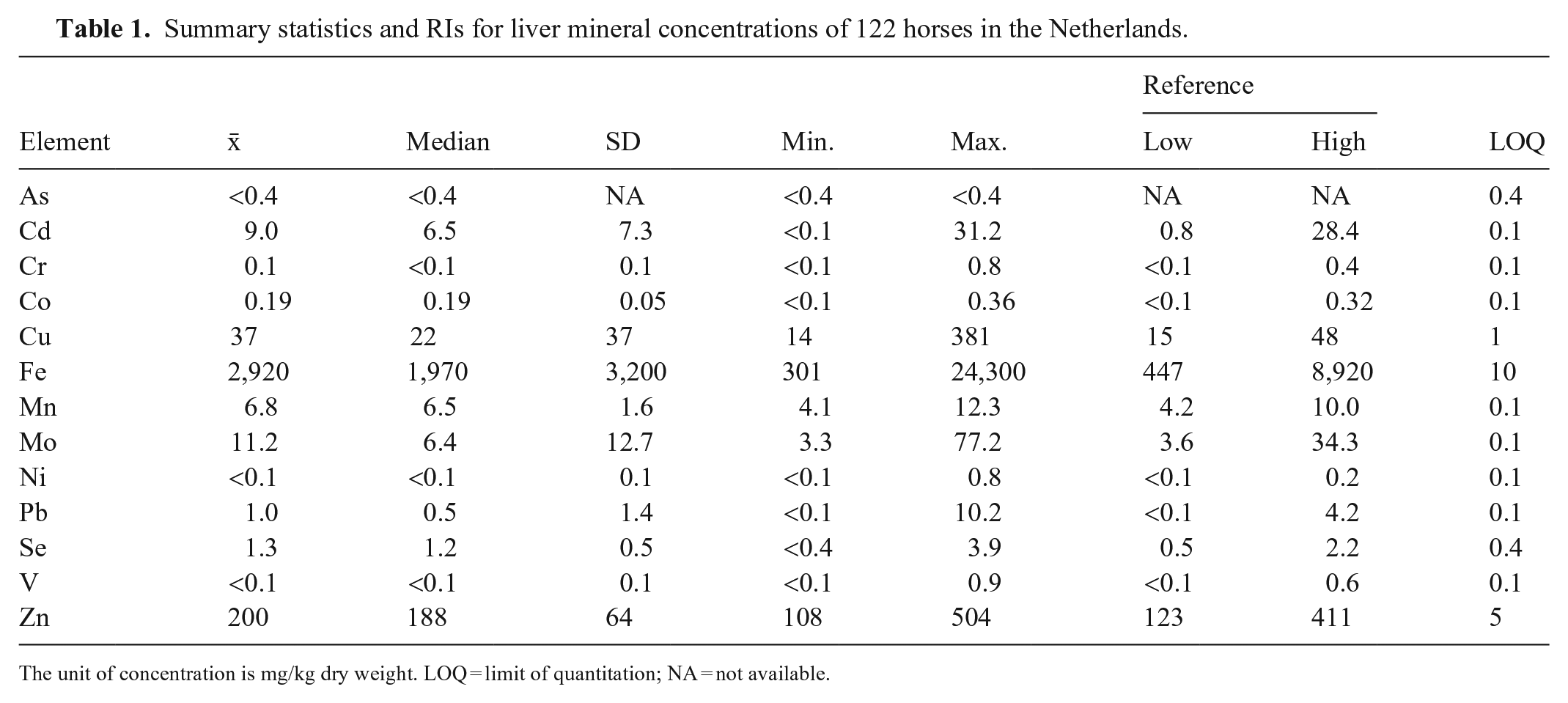
The unit of concentration is mg/kg dry weight. LOQ = limit of quantitation; NA = not available.
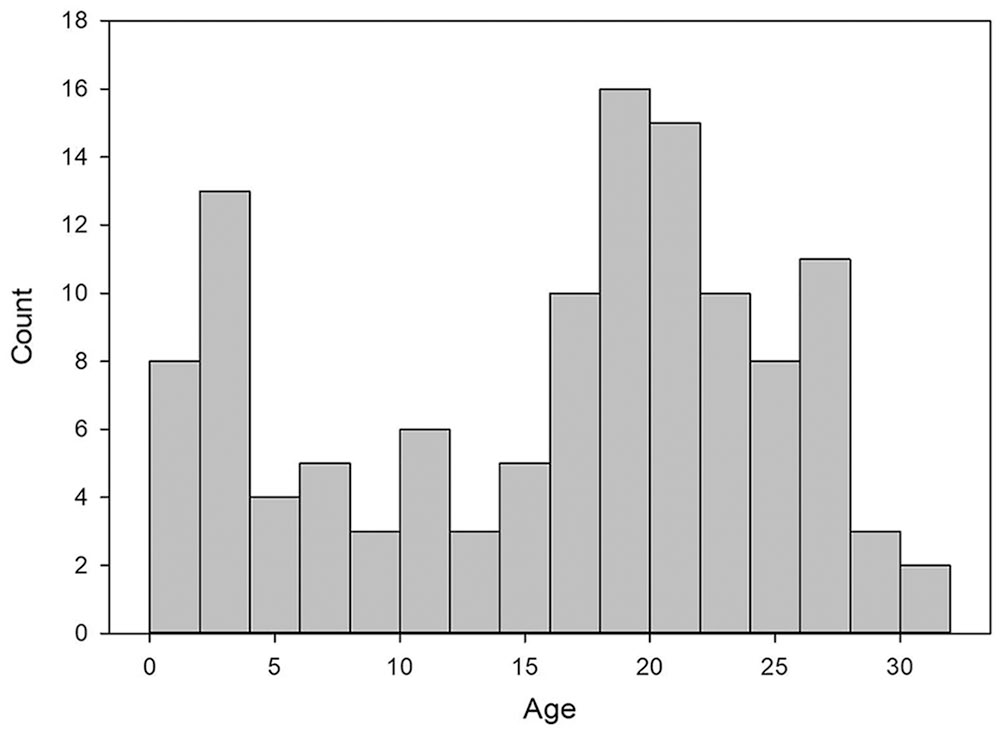
The age distribution of 122 horses slaughtered in 2021 at 2 facilities in the Netherlands.
Fe and Mo were positively correlated (Table 2) with age (p < 0.05); Mn was negatively correlated with age (p < 0.05). Cr was positively correlated with Mo and V (p < 0.05). Fe was positively correlated with Mo, Pb, and V (p < 0.05), but was negatively correlated with Mn (p < 0.05). Mo was correlated with Pb (p < 0.05). ANOVA on ranks did not indicate statistically significant differences in liver mineral concentrations between sexes or seasons. Cd concentrations were higher than the European maximum residue limit (MRL) of 2 mg/kg DW in 108 of 122 (89%) livers. 1
Pearson product-moment correlation (PPMC) coefficients and p-values for trace element and heavy metal concentrations in liver samples from 122 horses in the Netherlands.
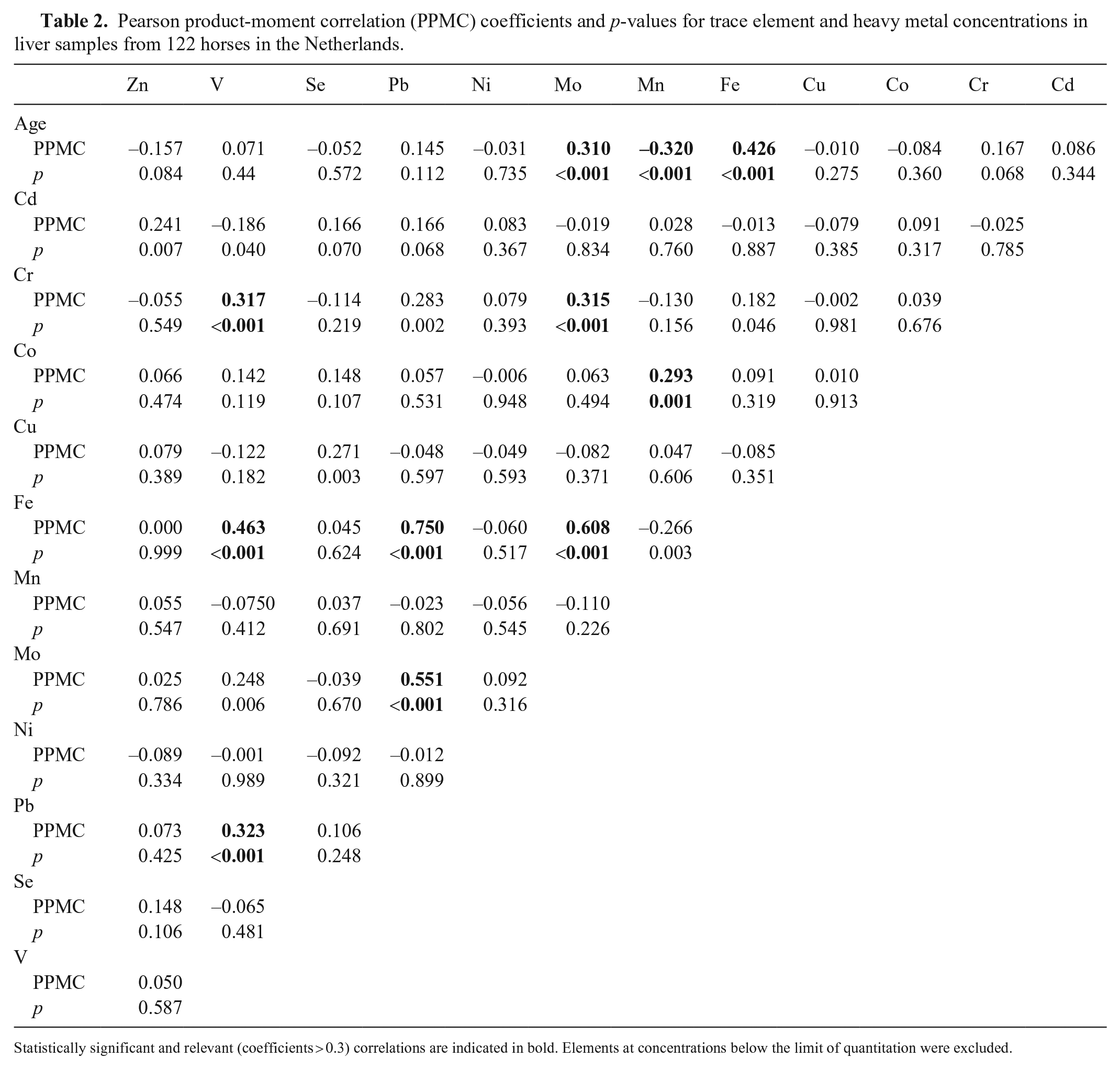
Statistically significant and relevant (coefficients > 0.3) correlations are indicated in bold. Elements at concentrations below the limit of quantitation were excluded.
Discussion
Sample selection and analytical methodology are important factors in the quality of calculated RIs. Although we collected samples from only 2 slaughterhouses, horses were presented to the slaughter facilities from all regions of the Netherlands because of the scarcity of slaughter facilities that accommodate horses in the Netherlands. Horses presented for slaughter are inspected by a veterinarian to ensure that only apparently healthy animals are slaughtered. We, therefore, assumed that all 122 samples included in the study were obtained from healthy horses and represented the normal variation in the population. All samples were uniformly processed and analyzed using standardized methods, which reduces the potential impact of variations in processing and analysis methods on the calculated RIs.
Although most of the analyzed elements are of nutritional and/or toxicologic significance in horses, some elements in the panel are not known to be of nutritional or toxicologic importance in horses (e.g., Ni, V), but were included because they form part of the routine mineral analysis panel used for various animal species at Royal GD. Although these elements are not known to be directly important for horse health, elements such as Ni and V may be indicative of environmental contamination if present in liver samples at abnormally high concentrations, and they could be viewed as relevant from this perspective.
The lower limits of the RIs were below the LOQs for several elements, including Cr, Co, Ni, Pb, and V. Concentrations of these elements below their respective LOQs can therefore not be interpreted as either abnormally low or as normal. However, interpretations for these elements as normal or high are still possible at concentrations above the LOQ.
A RI for As could not be calculated because all sample concentrations were below the LOQ (< 0.4 mg/kg DW). Detection of any concentration above this level could therefore be interpreted as unusually high for horses in the Netherlands.
Fe and Mo concentrations were positively correlated with age. Increased Fe in liver tissue with increasing age is linked to age-related deposition of non-heme Fe. 9 Although the likelihood of higher concentrations increased with age, there was still a continued occurrence of horses with low concentrations of these elements in all age groups. This suggests that factors such as local environmental conditions or variations in iron uptake from the feed may be important contributors to the likelihood of accumulation in the liver over time.
The scientific literature regarding mineral concentrations in horse liver is sparse. However, reported concentrations are generally comparable with those that we found in horses in the Netherlands. In Canadian yearling horses that were fed a range of rations, the lowest and highest average liver concentrations of Cu, Mn, and Zn in the different feeding groups were 17–21, 7.1–7.7, and 180–190 mg/kg DW, respectively, The average concentrations in different groups were related to dietary differences. 3 These averages fell within the RIs for liver trace mineral concentrations that we found for horses in the Netherlands. Horse liver mineral concentrations in Germany were reported for a relatively small number (21) of horses. Median values, converted to DW estimates by assuming 80% liver water content, were reported for Cd (3.2 mg/kg DW), Cu (17 mg/kg DW), Zn (86 mg/kg DW), Mn (4.7 mg/kg DW), Cr (0.5 mg/kg DW), Se (0.5 mg/kg DW), and Pb (3.3 mg/kg DW). 7 These median concentrations fell within our calculated RIs for the Netherlands, except for Zn, which had a median concentration 30% below the low end of the RI in the Netherlands, and Cr, which had a median concentration slightly higher than the high end of the RI in the Netherlands. In another Canadian study, which was done in slaughtered horses, the mean liver concentration of Zn was within the RI calculated for horses in the Netherlands, at an average of 269 mg/kg DW, and Cd was also within the Dutch range, at 12.4 mg/kg DW. 10 From a widely used source of mineral reference values for liver tissue, 8 RIs for As, Cd, Cu, and Fe concentrations in horse liver were similar to our RIs. The high end of the liver RIs from the former reference 8 are higher for Mn (24 mg/kg DW) and Se (4 mg/kg DW) and slightly higher for Pb (5.2 mg/kg DW) and Zn (500 mg/kg DW) compared with our RIs for Dutch horses.
The toxic range for Fe has been stated as 2,400–4,000 mg/kg DW. 8 In livers that we obtained from the apparently healthy horses with macroscopically normal livers in the Netherlands, 38% had Fe concentrations > 2,400 mg/kg DW, and 23% had Fe concentrations > 4,000 mg/kg DW. The relatively high Fe concentrations in liver samples from horses in the Netherlands may be the result of generally high iron levels in surface waters associated with the flood plains that are characteristic of large areas of the Netherlands. 12 The discrepancy between Fe thresholds associated with poisoning, 8 and the common occurrence of Fe levels above those thresholds in apparently normal horses in the Netherlands, may be explained by the nature of the exposure, which is chronic rather than acute. However, it could also be that some cases of chronic Fe poisoning remain subclinical and that effects are not apparent on macroscopic examination of affected organs.
Liver concentrations of Cd from horses slaughtered in Italy were reported in the context of human exposure risk following the use of different horse tissues as food. The concentrations were grouped into age classes and countries of origin. Most horses originated from outside Italy, specifically from Poland, Lithuania, and Hungary. 1 The average and median Cd concentrations for all liver samples (9.84 and 8.4 mg/kg DW, respectively) were within the RI in the Netherlands, and the average and median Cd concentrations in horse livers in the Netherlands were comparable (9.0 and 6.5 mg/kg DW, respectively). Country of origin and age group were significantly associated with liver Cd concentrations in the Italian study. We did not find a similar age association in the Netherlands. An important consideration in the use of horse tissues as food in Europe is the MRL for Cd of 2 mg/kg DW in horse liver. 2 It is therefore noteworthy that 89% of the livers that we analyzed had Cd concentrations above this threshold.
The liver mineral concentrations that we observed in horses in the Netherlands were generally consistent with concentrations in horse livers from other regions as reported in the scientific literature.1,3,7,8,10 Two elements are noteworthy given their relatively high concentrations in Dutch horse livers: Cd, because in a large fraction of liver samples, the concentration exceeded the European MRL, and Fe, because in a large fraction of liver samples, the concentration exceeded thresholds that have been associated with iron poisoning. The cause(s) of the apparent lack of reports on clinical Fe poisoning in the Netherlands compared with expectations based on published toxic thresholds deserves further investigation. RIs calculated from healthy populations have some limitations in clinical applications because they do not provide data on concentrations associated with specific health conditions. Nevertheless, our findings on trace mineral and toxic element concentrations in liver tissue of healthy horses may provide useful information for veterinary practitioners, horse owners, horse feed producers, and the meat industry.
Footnotes
Declaration of conflicting interests
The authors declared no potential conflicts of interest with respect to research, authorship, and/or publication of this article.
Funding
The authors disclosed receipt of the following financial support for the research, authorship, and/or publication of this article: Funding was provided by Royal GD and Pavo Horse Feeds.
