



Abstract
We investigated the effect of age and sex on canine glycated hemoglobin (HbA1c) using a validated capillary electrophoresis assay. Aliquots of EDTA blood samples collected for routine health checks were used. HbA1c was measured using the Capillarys 2 flex-piercing system (Sebia). We included 58 clinically and hematologically healthy, normoglycemic dogs (29 males, 29 females), allocated to 3 age groups: young (14 dogs <1-y-old), adult (31 dogs 1–7.9-y-old), and senior (13 dogs ≥8-y-old). The mean (± SD) HbA1c was not significantly different (p = 0.428) between the age groups (young: 1.68 ± 0.54%; adult: 1.59 ± 0.41%; senior: 1.80 ± 0.57%). The HbA1c was not significantly correlated with age (rho = 0.144, p = 0.280). The median (range) HbA1c was not significantly different (p = 0.391) between male [1.7% (0.5–2.5%)] and female [1.5% (1.0–2.7%)] dogs. Age and sex do not appear to affect canine HbA1c; however, a study of geriatric dogs would be needed to fully exclude an effect of age on HbA1c.
The major fraction of glycated hemoglobin (HbA1c) is a glycated derivative of hemoglobin A, which is the result of the irreversible, nonenzymatic, insulin-independent binding of glucose to the N-terminal valine residue of the β globin chain.11,15 Measurement of HbA1c is recommended for the diagnosis and monitoring of diabetes mellitus in humans, 1 and has gained a particular interest in canine medicine.5,7,8,12,16
HbA1c is not affected by common clinicopathologic abnormalities that interfere with fructosamine measurement (e.g., hypoalbuminemia, hyperlipidemia [unless very severe], and azotemia). 19 However, it can be affected by anemia in dogs, although the results are contradictory; both negative5,9 and positive effects6,17 have been reported. Interestingly, all of the aforementioned studies used different assays to measure HbA1c, which might suggest that the effect of non-glycemic variables may be assay-dependent in dogs. The effect of several non-glycemic factors on HbA1c has been evaluated in humans; among them, age and sex have been shown to potentially affect HbA1c. 3 Knowledge of the effect of various demographic factors is a prerequisite for the use of a new biomarker in clinical practice. Nonetheless, to our knowledge, the effect of age and sex on canine HbA1c has only been investigated in 2 studies, which employed immunologic assays to determine the HbA1c levels and used different age classification schemes.8,14
Our objective was to investigate the effect of age and sex on HbA1c in a sample of healthy dogs using a validated automated capillary electrophoresis assay. 16 We used aliquots of canine blood samples that had been collected for routine health checks in a veterinary teaching hospital between September 2015 and July 2017. The blood samples were collected by jugular venipuncture into K3-EDTA tubes (Deltalab). A complete blood count (CBC) was performed within 2 h of blood collection (Advia 120; Siemens). The HbA1c was measured within 4 h of blood collection (Capillarys 2 flex-piercing system; Sebia) and was expressed as a percentage (%) of the total hemoglobin measured with the Advia 120. This capillary electrophoresis assay had been validated by our team for the measurement of canine HbA1c, has excellent overlap performance (the ability to differentiate diabetic dogs from healthy dogs) for the diagnosis of diabetes mellitus, and has an inter-assay CV of 7.0%. 16 Routine maintenance, preparation, adjustment, assay, and quality control (QC) procedures were performed as defined in the analyzer and reagent manuals. The QC material provided by the manufacturer was comprised of pooled human blood samples with stabilizers and preservatives. The QC rule used was 12s (control limits are mean ± 2SD) during the study period.
Dogs were selected by applying strict inclusion criteria: up-to-date vaccination and deworming status, no history of illness or medication during the preceding month, unremarkable physical examination, unremarkable CBC results according to age-specific RIs, and fasting serum glucose concentration within the respective age-specific RIs. We did not include any well-controlled diabetic patients. Our subjects were allocated to 3 age groups, by adopting, after a slight modification, a classification scheme used for the study of the effect of age on clinicopathologic analytes in dogs 18 : young (<1-y-old), adult (1–7.9-y-old), and senior (≥8-y-old).
Sample size was calculated for a desired significance of 0.05 and power 0.8, assuming that the difference in mean HBA1c between male and female dogs and between the 3 age groups would be 0.5% and all mean values would be within the previously established RI. 16 The SD of HbA1c was set to 0.5% according to our previous study. 16 The Shapiro–Wilk test was used to assess data distribution. Mean comparisons between 2 or more groups were performed with the Welch 2-sample t-test or ANOVA, respectively. Post-hoc tests with the Tukey honestly significant difference procedure were employed to define which groups had statistically significant differences in ANOVA analysis. The Wilcoxon rank sum test was used for comparisons of medians between 2 groups. The correlation between 2 variables was performed using the Pearson correlation coefficient. R statistical language (v.4.1.2, https://www.r-project.org/) was used for the statistical analysis.
According to our initial power analysis, 17 dogs were required in each sex group and 11 dogs were required in each age group. The results are presented as mean ± SD unless otherwise specified. Fifty-eight dogs (29 intact males and 29 intact females, 36 purebred and 22 mixed-breed dogs) were enrolled in our study: 14 young dogs (24.1%), 31 adult dogs (53.4%), and 13 senior dogs (22.4%). The median (range) age was 0.5 (0.2–0.8) y for young, 4.0 (1.5–7.0) y for adult, and 10.0 (8.0–15.0) y for senior dogs. Young dogs had significantly lower hemoglobin concentration (127 ± 23 g/L) compared to both adult (163 ± 18 g/L) and senior dogs (151 ± 15 g/L; p < 0.001). The HbA1c was not significantly different (p = 0.428) between the different age groups (young dogs: 1.68 ± 0.54%; adult dogs: 1.59 ± 0.41%; senior dogs: 1.80 ± 0.57%; Fig. 1). The HbA1c was not significantly correlated with age (rho = 0.144, p = 0.280). The hemoglobin concentration was not significantly different (p = 0.607) between male (152 ± 22 g/L) and female (152 ± 26 g/L) dogs. The median (range) HbA1c was not significantly different (p = 0.391) between male [1.7% (0.5–2.5%)] and female [1.5% (1.0–2.7%)] dogs (Fig. 2).
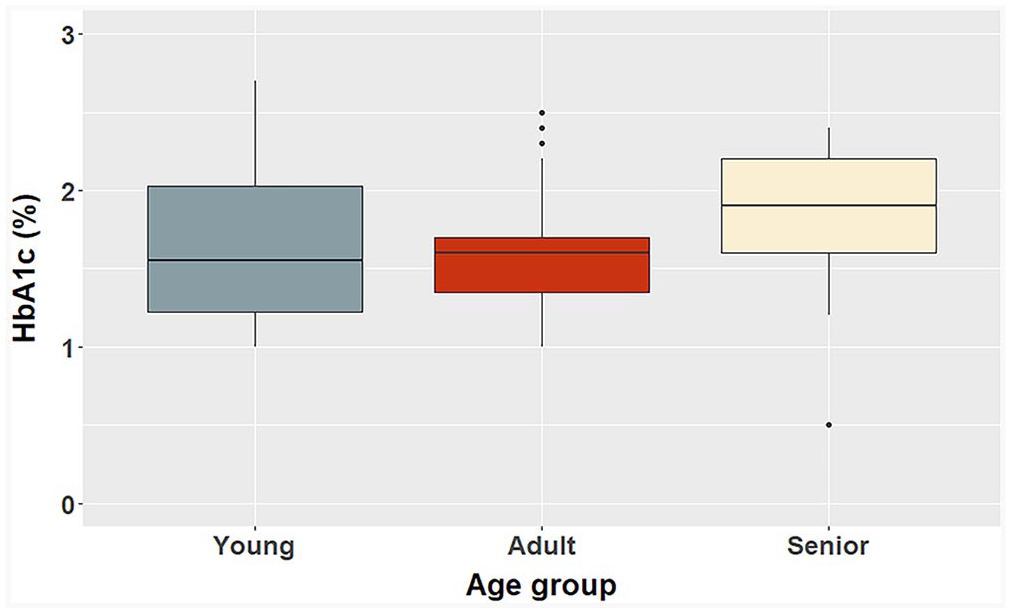
Boxplots of the major fraction of glycated hemoglobin (HbA1c) values of 14 young dogs (<1-y-old), 31 adult dogs (1–7.9-y-old), and 13 senior dogs (≥8-y-old). The colored boxes represent the interquartile range of the data; the bisecting line is the mean value. The mean (± SD) HbA1c was not significantly different (p = 0.428) between the different age groups (young dogs: 1.68 ± 0.54%; adult dogs: 1.59 ± 0.41%; senior dogs: 1.80 ± 0.57%).
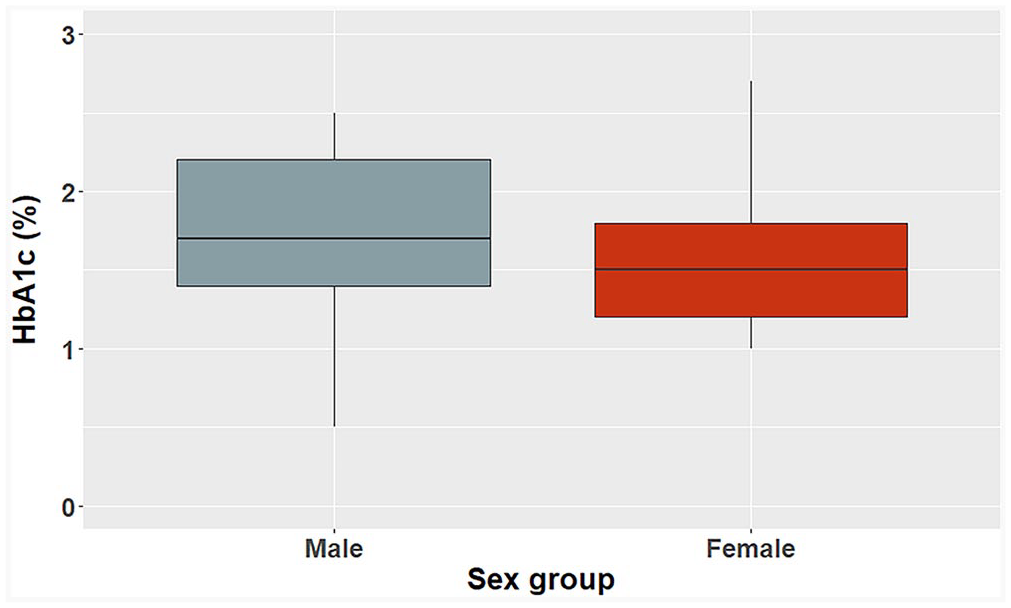
Boxplots of the major fraction of glycated hemoglobin (HbA1c) values of 29 male and 29 female dogs. The colored boxes represent the interquartile range of the data; the bisecting line is the median value. The median (range) HbA1c was not significantly different (p = 0.391) between male [1.7% (0.5–2.5%)] and female [1.5% (1.0–2.7%)] dogs.
To our knowledge, very few other studies have investigated the effect of age and sex on canine HbA1c, and none has used a capillary electrophoresis assay. Our results suggest that neither age nor sex affect the HbA1c levels in healthy dogs.
No significant differences were observed in the mean HbA1c values for the 3 age groups of our study, even though hemoglobin concentration was significantly lower in young dogs compared to the adult and senior dogs. The lower mean in young dogs was an expected finding given that hemoglobin concentration has been shown to be lower in puppies than in adult dogs. 20 A decreasing trend in RBC mass as a result of iron-restricted erythropoiesis has been reported in geriatric dogs 18 ; however, the mean hemoglobin concentration was not significantly lower in the senior dogs in our study. Additionally, HbA1c was not correlated significantly with the age of dogs. Our findings agree with previous veterinary studies.8,14 These studies used immunologic assays to determine the HbA1c levels, and they applied 2 different age classification schemes. One of them included only adult dogs and allocated them into 2 age groups using 5 y as a cutoff 8 ; the second study included 4 age groups, namely <1 y, 1–3 y, 3–6 y, and >6 y. 14 We adopted, after a slight modification, a previously used classification scheme, 18 and we allocated the dogs to 3 groups: young dogs (<1-y-old), adult dogs (1–7.9-y-old), and senior dogs (≥8-y-old). The rationale for the adoption of this classification scheme was that it had been used to study the effect of age on various clinicopathologic analytes in dogs, and it allowed us to include a group of young as well as senior dogs, which is clinically relevant. The effect of age and sex on canine HbA1c by using a capillary electrophoresis assay has not been reported previously, to our knowledge. Studies on the effect of anemia on canine HbA1c using different assays yielded different results,5,6,9,17 suggesting that the effect of non-glycemic variables may be assay-dependent. Taking into consideration the results of the published studies8,14 and those of our study, it appears that age has no significant effect on canine HbA1c independent of the classification scheme and the assay employed. This contrasts with the results of several human studies that reported increasing HbA1c values with age.2,4,10,13,21,22 The magnitude of the increase in HbA1c varies between studies, but clinical implications appear plausible in middle-aged or elderly people. Proposed underlying mechanisms include a gradual decrease of pancreatic islet function, tissue sensitivity to insulin, and activity of insulin receptor and signaling, as well as reduced consumption of glucose as a result of loss of muscle mass with age. 13 The senior dogs in our study did not have a statistically significantly higher mean HbA1c value than younger dogs.
HbA1c was not significantly different between the male and female dogs in our study, in agreement with the veterinary literature.8,14 In human medicine, lower HbA1c values have been observed in women compared to men.2,13,22 This difference has been attributed to the increased erythrocyte turnover associated with menstruation in women.13,22 Given the absence of menstruation in female dogs, our finding was expected.
A noteworthy limitation of our study is the low number of geriatric dogs, which precluded the inclusion of a separate geriatric age group. However, the inclusion of a large sample of healthy geriatric dogs was an inherently difficult task, given our strict inclusion criteria. A study including a higher number of geriatric dogs may be warranted to fully exclude a possible effect of old age on canine HbA1c. The low numbers of dogs that were included in each of our study groups is another limitation. Although the sample size had been calculated prospectively, the initial assumptions used to determine the sample size were not fulfilled based on our results. Therefore, the true power of our study is considered suboptimal.
Footnotes
Declaration of conflicting interests
The authors declared no potential conflicts of interest with respect to the research, authorship, and/or publication of this article.
Funding
The authors declared that they received no financial support for their research and/or authorship of this article.
