




Abstract
Since 2007, the Autonomous Province of Bolzano–South Tyrol (Italy) has carried out a compulsory eradication program against caprine arthritis encephalitis virus (CAEV) in goats. A drastic seroprevalence reduction was achieved during the initial phase (2007–2011); however, a tailing phenomenon has been observed during the latest years, hampering the achievement of the final goal. CAEV belongs to a group of lentiviruses, called small ruminant lentiviruses (SRLVs), which are antigenically related and can infect both goats and sheep. We investigated the possible link between the tailing phenomenon in goats and the role of sheep as a virus reservoir by comparing serologic results between multispecies farms (where goats and sheep coexist) and monospecies farms (goats only). Goats on multispecies farms had a higher prevalence and seroconversion rate (even if to a rather moderate extent), higher antibody titers, and a higher probability of conclusive results in the genotyping analysis, with more frequent identification of SRLV genotype A (sheep-related) infections. Sheep can serve as a SRLV reservoir, thus contributing to scattered positive tests in goats, causing the tailing phenomenon.
Small ruminant lentiviruses (SRLVs) include caprine arthritis encephalitis virus (CAEV) and visna-maedi virus (VMV) in family Retroviridae; in the past, these were referred to as species-specific pathogens of goats and sheep, respectively; today they are considered to represent a genetic continuum.2,5 SRLVs have been characterized in 5 different genotypes (A–E). Given that genotypes A–C have been shown to cross the species barrier,4,5,7,13,16 –18 the role of sheep as a viral reservoir has started to be investigated. 11 SRLV B is the most pathogenic genotype for goats, whereas SRLV A is the principal cause of disease in sheep. 2 SRLV A strains are considered attenuated for goats, although the infecting genotype needs continuous and precise monitoring. 6
In 1998, Switzerland started a mandatory control program against CAEV, based on the use of conventional serologic tools that were more effective at detecting goats infected with classical CAEV strains (SRLV B), but performed poorly when applied to SLRV A–infected goats. 4 This approach most likely favored the spread of SRLV A, which is now believed to be the dominant infecting genotype in goats. 20 A similar mandatory program was initiated in 2007 in the neighboring Italian province of Bolzano–South Tyrol. 19 In Switzerland (since 2012), 20 as well as in South Tyrol (as of the 2014–2015 campaign), eradication measures are restricted to SRLV B–infected goats, identified by means of indirect genotyping ELISAs, which are the in-house SU5 ELISA (Switzerland) 12 and the Eradikit SRLV genotyping kit (In3Diagnostics) used in our study in South Tyrol.
After a marked reduction of antibody prevalence, both countries have experienced a tailing phenomenon, consisting of erratic seroconversions in the conventional ELISAs.19,20 In South Tyrol, during the first campaign (2007–2008), the prevalence was 13.9% at the individual level; as of the 2010–2011 campaign, the prevalence ranged between 1% and 0.3%. 19 The absence of universal protocols able to detect all viral genotypes8,10,14 and the irregular serologic results in SRLV A infections 4 can be considered as the possible causes of this variability. Cross-species transmission between sheep and goats may be particularly relevant in the context of multispecies farming systems1,3,4; 38% of the farms sampled during the 2016–2017 program in South Tyrol were multispecies farms. We evaluated the data from the 2016–2017 campaign to achieve a better understanding of the role of sheep as a source of infection for goats in the tailing phase of the control program.
The CAEV control and eradication program in South Tyrol has been described previously. 19 Briefly, each year the campaign is launched in November and ends the following April; during the campaign, all goats > 6 mo old are sampled. On average, 20,000 goats, held on ~ 2,000 farms, are tested. A link between test tube and animal identification code is established at sample collection by means of a palmtop computer. SRLV B–infected goats must be culled within 30 d of receipt of the laboratory results. Blood samples collected between November 2016 and April 2017 were tested for antibodies using the IDvet screening ELISA (ID Screen MVV/CAEV indirect screening test; IDvet Innovative Diagnostics). If one or more samples tested positive, all goats within the tested farm were tested with the IN3 screening ELISA (Eradikit SRLV screening kit; IN3Diagnostics). All positive samples from each or both previous ELISAs were tested with the IDEXX screening ELISA (MVV/CAEV p28 Ab screening test; IDEXX Laboratories) and, in order to detect the infecting genotype, with the IN3 genotyping ELISA (Eradikit SRLV genotyping kit; IN3Diagnostics).
For screening ELISAs, results and sample-to-positive (S/P) ratios were calculated according to the manufacturer’s instructions. Doubtful results were considered as positive. All kits used are suitable for detecting SRLV antibodies in the blood of sheep and goats. Based on available information, differences in SRLV genotypes and/or proteins used as antigen in the ELISAs can be assumed to exist. According to the manufacturers, specificity values are high (> 99% for all kits). Good sensitivity values, of > 90% and 100%, are provided in the validation data report of the kits. However, given the lack of a “gold standard,” the assessment of their performances is very difficult, 2 and published figures (particularly for sensitivity) should be interpreted with caution.
The IN3 genotyping ELISA is based on plates coated, on separate strips, with specific antigens for genotypes A, B, and E, against which the samples are simultaneously tested for genotype-specific antibodies. Results were given as not conclusive (NC), positive for 1 (A, B, E) or > 1 (e.g., AB) genotype.
The association between type of farming system (multispecies or monospecies) and the results of the tests was evaluated by means of a chi-squared test. Nonparametric tests were used for the analysis of farm size and S/P value distribution based on the departure from normality assessed by the Shapiro–Francia test. After the assessment of statistical difference between variances of the 2 types of farming systems, the nonparametric k-sample test for the equality of medians was adopted to compare median values in the 2 farming systems (Levene test statistic for equality of variances). Median and interquartile range (IQR) were used to summarize the data. The nonparametric k-sample test was carried out to evaluate differences in farm size between positive and negative farms. The possible effect of the interaction between farming system and farm size on the test results was checked using quantile regression analysis, stratified by positive and negative farms, and focused on the estimation of the median and 90th percentile of farm size. The agreement between the 2 screening ELISAs was measured by means of the Cohen kappa index. All statistical analyses were performed using Stata v.12.1 (StataCorp).
Briefly, during the 2016–2017 campaign, 22,445 goats on 2,029 farms were tested with the IDvet screening ELISA; positive goats (240) were found more frequently (1.4% vs. 0.9%, p < 0.001) on multispecies than on monospecies farms (Table 1). Positive farms (171) were significantly larger (p < 0.001) than negative ones, but their percentage as well as their size did not significantly differ between mono- and multispecies farms (Table 1). Reactors were extremely scattered given that, in most cases, only one positive goat was found per farm; the strength of reaction was higher (p < 0.001) in positive goats on multispecies (median S/P = 1.18) than on monospecies (median S/P = 0.79) farms (Table 2). Most goats (5,363 of 5,855) sampled in the IDvet screening ELISA–positive farms were tested with the IN3 screening ELISA; agreement between the 2 ELISAs was fair (Table 3), but the percentage of goats positive with the IN3 screening ELISA was higher on multispecies farms for both IDvet screening ELISA positive (p < 0.001) and negative (p = 0.003) goats (Table 4). Most samples positive in the IDvet screening ELISA (223 of 240) as well as most samples positive in the IN3 screening ELISA (331 of 344) were tested with the IDEXX screening ELISA used in the previous campaigns (before the 2015–2016 campaign); only a minority of them were confirmed positive in the IDEXX ELISA, but for both kits this occurred more frequently (p < 0.001) in samples from multispecies than from monospecies farms (Table 5). Of the 511 goats positive in the IDvet and/or IN3 screening ELISA (Table 3), almost all (509) were submitted for indirect genotyping by the IN3 genotyping ELISA; the probability of nonconclusive results was higher (p = 0.029) in samples from monospecies than from multispecies farms; SRLV A infections (A or AB) occur more frequently (p < 0.001) on multispecies than on monospecies farms (Table 6). Of particular interest are the 271 samples that tested IDvet screening ELISA–negative and IN3 screening ELISA–positive (Table 3) because these samples could have eluded the first screening test. IN3 genotyping ELISA conferred a conclusive result in 161 samples (59.4%), showing mainly a B (70 samples) or AB (60 samples) profile. We also compared the IDvet screening ELISA data from the 2016–2017 and 2015–2016 prevention campaigns, based on the individual identification code of each animal; 16,047 goats that were negative in the 2015–2016 campaign were tested in the following campaign. The seroconversion rate was lower (p < 0.001) in goats on monospecies (70 of 9,961; 0.7%) than on multispecies (82 of 6,086; 1.3%) farms.
Prevalence of caprine arthritis encephalitis virus antibodies in goats in the province of Bolzano, Italy.
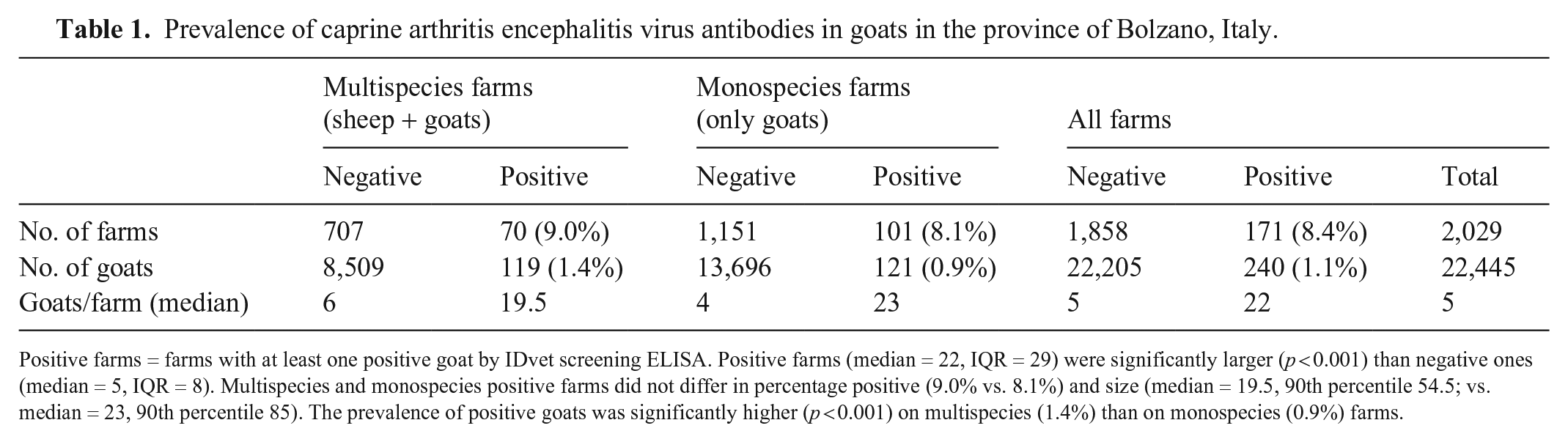
Positive farms = farms with at least one positive goat by IDvet screening ELISA. Positive farms (median = 22, IQR = 29) were significantly larger (p < 0.001) than negative ones (median = 5, IQR = 8). Multispecies and monospecies positive farms did not differ in percentage positive (9.0% vs. 8.1%) and size (median = 19.5, 90th percentile 54.5; vs. median = 23, 90th percentile 85). The prevalence of positive goats was significantly higher (p < 0.001) on multispecies (1.4%) than on monospecies (0.9%) farms.
Distribution and reactivity of the IDvet screening ELISA–positive goats.
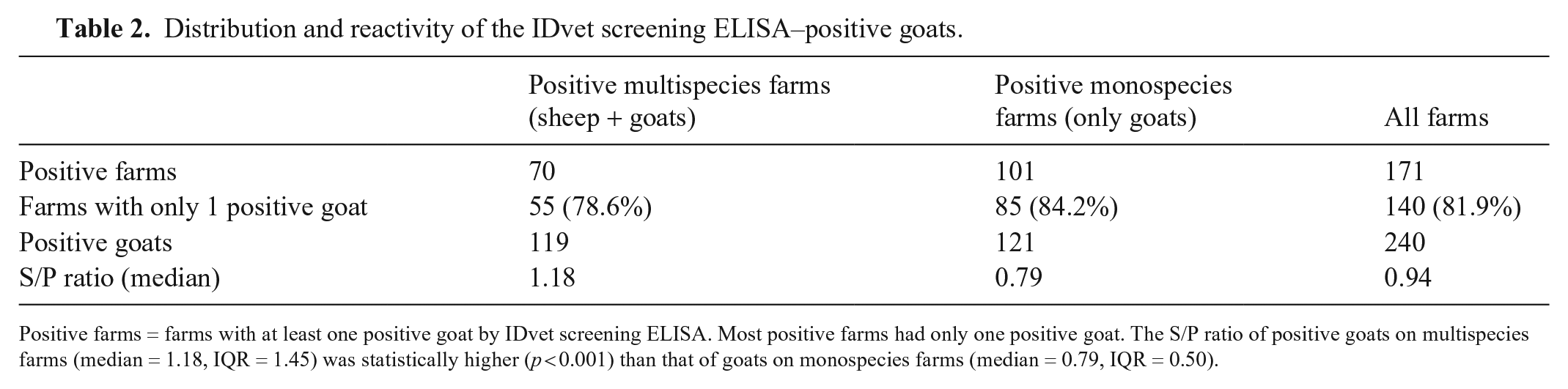
Positive farms = farms with at least one positive goat by IDvet screening ELISA. Most positive farms had only one positive goat. The S/P ratio of positive goats on multispecies farms (median = 1.18, IQR = 1.45) was statistically higher (p < 0.001) than that of goats on monospecies farms (median = 0.79, IQR = 0.50).
Agreement between IDvet and IN3 screening ELISAs in goat samples from positive farms.
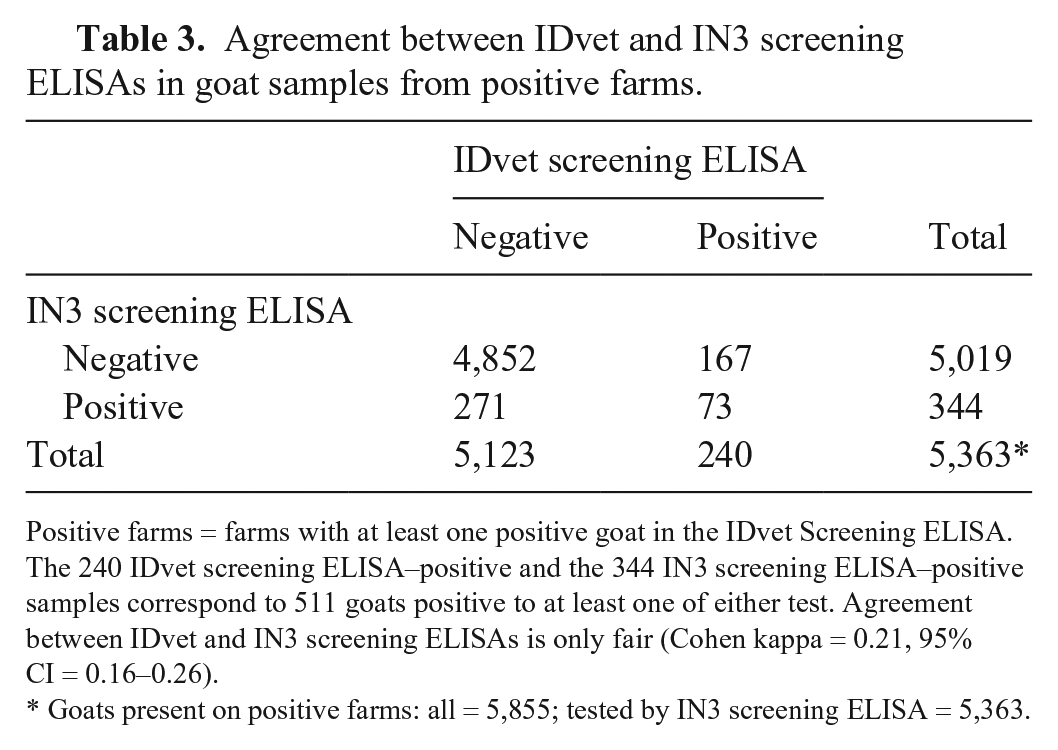
Positive farms = farms with at least one positive goat in the IDvet Screening ELISA. The 240 IDvet screening ELISA–positive and the 344 IN3 screening ELISA–positive samples correspond to 511 goats positive to at least one of either test. Agreement between IDvet and IN3 screening ELISAs is only fair (Cohen kappa = 0.21, 95% CI = 0.16–0.26).
Goats present on positive farms: all = 5,855; tested by IN3 screening ELISA = 5,363.
Results of IN3 screening ELISA performed on goats on positive farms.
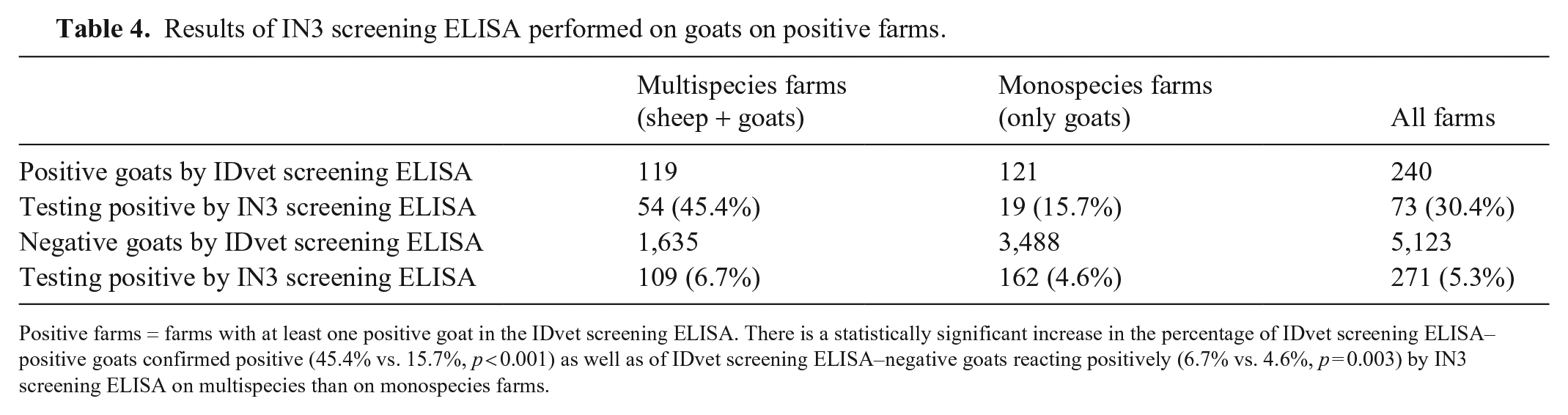
Positive farms = farms with at least one positive goat in the IDvet screening ELISA. There is a statistically significant increase in the percentage of IDvet screening ELISA–positive goats confirmed positive (45.4% vs. 15.7%, p < 0.001) as well as of IDvet screening ELISA–negative goats reacting positively (6.7% vs. 4.6%, p = 0.003) by IN3 screening ELISA on multispecies than on monospecies farms.
Results of IDEXX screening ELISA performed on positive goats.
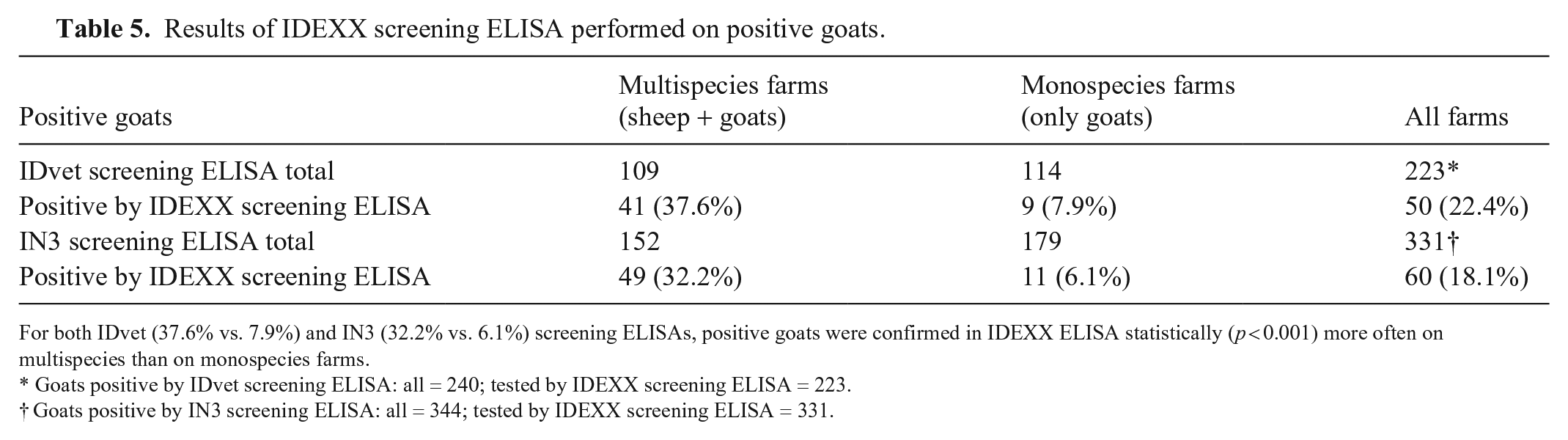
For both IDvet (37.6% vs. 7.9%) and IN3 (32.2% vs. 6.1%) screening ELISAs, positive goats were confirmed in IDEXX ELISA statistically (p < 0.001) more often on multispecies than on monospecies farms.
Goats positive by IDvet screening ELISA: all = 240; tested by IDEXX screening ELISA = 223.
Goats positive by IN3 screening ELISA: all = 344; tested by IDEXX screening ELISA = 331.
Results of genotyping ELISA performed on positive farms.
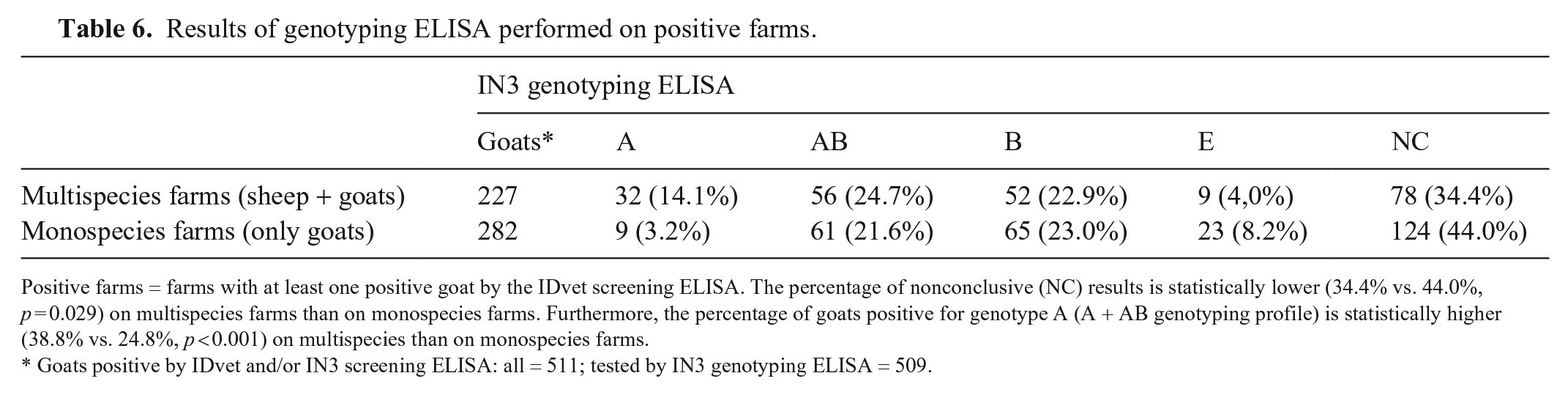
Positive farms = farms with at least one positive goat by the IDvet screening ELISA. The percentage of nonconclusive (NC) results is statistically lower (34.4% vs. 44.0%, p = 0.029) on multispecies farms than on monospecies farms. Furthermore, the percentage of goats positive for genotype A (A + AB genotyping profile) is statistically higher (38.8% vs. 24.8%, p < 0.001) on multispecies than on monospecies farms.
Goats positive by IDvet and/or IN3 screening ELISA: all = 511; tested by IN3 genotyping ELISA = 509.
Substantial data on the SRLV prevalence in the provincial sheep population are not available because, according to the program, sheep are monitored only on multispecies farms that have positive goats. During the 2016–2017 campaign, 900 sheep were sampled on 41 multispecies farms (of the 70 positive ones), with 59 (6.6%) positive sheep on 11 farms (26.8%). When evaluating the positive goats on farms with or without positive sheep, a noteworthy variation in their genotyping profiles was observed. When positive sheep were present, the genotyping profiles of the 26 positive goats were A (11), AB (3), B (3), and NC (9); when no positive sheep were present, of the 59 positive goats, A (5), AB (24), B (15), and NC (15) profiles were identified. These figures could suggest a link between serologic status of sheep and relative ratio of SRLV A to B infection in goats, but the limited dataset prevents drawing a statistically significant inference.
The tailing phenomenon could also have occurred as a consequence of nonspecific reactions: if compared to the total number of samples tested (22,445), the 240 IDvet screening ELISA–positive goats are close to the expected number of 123 false-positive reactions, based on the 99.45% specificity of the kit, as given by the manufacturer. Unfortunately, it is not always possible to achieve a conclusive result because of the lack of a confirmatory test capable of settling ambiguous results. For instance, western blot (WB), by many considered the gold standard of SRLV serology, has been shown to perform poorly both in goats and sheep infected by some SRLV A strains. 4
In order to interpret our findings, farm size must be taken into consideration; it may act as a proxy for other risk factors (including the probability of having false-positive reactions). When considering the farms sampled, positive farms (median = 22) are actually much larger (p < 0.001) than negative farms (median = 5); the size of the positive farms, however, does not differ between mono- (median = 23) and multispecies farms (median = 19.5; Table 1). Thus, farm size (with related risk factors) and the presence of sheep do not appear to have any statistically significant link.
Our data point to a potential role of SRLV horizontal transmission between sheep and goats, especially in the boosting of their antiviral antibody response. This conclusion agrees with a previous suggestion made after a pilot eradication program in sheep and was confirmed by experimentally exposing goats to naturally infected sheep.1,15 The drastic decrease in prevalence achieved in the initial phase of the South Tyrolean program along with the disappearance of clinical cases confirms that the main source of infection in South Tyrol was initially related to SRLV B–infected goats. 9 However, in this later phase, the described data confirm that, on multispecies farms, sheep may serve as a source of SRLV infections in goats. The fact that IDvet-negative/IN3-positive screening ELISA samples have a distinct profile in the genotyping ELISA suggests pitfalls in the sensitivity of the IN3 screening ELISA.
The tailing phenomenon can therefore be ascribed to at least 3 contributing causes:
false-positive reactions, which cannot always be clarified by serial testing;
infection and immunologic boosting by contact with sheep; and
false-negative reactions in infected animals that can further spread the infection.
Assuming that, as suggested by the Swiss CAEV eradication program previously mentioned, the control of CAEV means the sole control of SRLV B strains, it is of utmost importance to select a testing tool able to detect antibodies against a wide panel of SRLV B strains for initial screening. The parallel testing of all goats on positive farms with a second ELISA further increases overall sensitivity. The use of an indirect genotyping ELISA is mandatory in order to identify the infecting genotype.
Footnotes
Acknowledgements
We thank all veterinarians involved in the sampling schedule for their excellent cooperation as well as Dr. E. Stifter (Veterinary Service of the Autonomous Province of Bolzano) for managing the CAEV control program.
Declaration of conflicting interests
The authors declared no potential conflicts of interest with respect to the research, authorship, and/or publication of this article.
Funding
This study was granted by the Italian Ministry of Health (Progetto di Ricerca Corrente IZS VE 14/14).
