



Abstract
In contrast to conventional commercial poultry, which are raised primarily in controlled indoor environments, backyard poultry are typically raised in less restricted settings, potentially exposing them to a greater variety of ingestible substances, including multiple types of forage. Consequently, problems such as gastrointestinal impactions caused by ingesta have been noted in backyard poultry. To determine the prevalence of these impactions in backyard poultry, we performed a retrospective database search for autopsy submissions to the California Animal Health and Food Safety laboratory system and found that gastrointestinal impaction was associated with the death of 42 backyard poultry cases (40 chickens, 1 turkey, and 1 goose) from January 2013 to July 2018. In 32 of these 42 (76%) cases, the impaction was caused by fibrous plant material, 7 (17%) by compacted feed, and 3 (7%) by miscellaneous ingesta (tortilla, plastic, and wood shavings). The large proportion of grass impactions indicate that foraging is the predominant source of impaction material in backyard poultry, and that long grasses may be a significant health hazard for poultry. Backyard, pasture-raised, and free-range poultry producers are advised to maintain short pastures, avoid feeds that may expand in the gastrointestinal tract, and provide adequate grit to prevent impactions.
Keywords
The popularity of raising backyard poultry has significantly increased, along with the public’s growing interest in local food production and less intensive rearing systems.1,10 Given differences in husbandry, these emerging backyard poultry owners face new and unique difficulties that are typically not encountered in conventional systems. Conventional poultry producers keep large flocks of birds confined within poultry houses or barns. This allows these producers to have strict control with regard to the types of material the birds may consume and to regulate other important aspects of poultry husbandry, such as temperature, humidity, and biosecurity. In contrast, backyard poultry owners typically have small flocks comprised of <10 birds and follow practices closer to that of free-range poultry, in which birds have access to an outdoor environment and forage material during the day. Although many diseases such as salpingitis and Marek’s disease can be seen in all poultry-rearing systems,3,4,6 exposure to the outdoor environment often puts backyard poultry at greater risk for predation and transmissible diseases.
In free-range pastured poultry, gastrointestinal impactions caused specifically by ingested roughage (e.g., grass impactions) have been noted occasionally in the literature (Ruhnke I, et al. Gut impaction in free-range hens. Proc 26th Aust Poultry Sci Symp; 2015; Sydney, New South Wales. Available from: https://www.researchgate.net/publication/289515590_Gut_impaction_in_free_range_hens).1,2,5,6,14 In conventional poultry production, grass impactions are not a concern because flocks do not have access to forage. However, gastrointestinal impactions resulting from ingestion of other materials such as feathers by caged layers, 9 bale net wrap by laying hen pullets, 13 and litter material by broiler breeders 12 have been reported. Such ingestion of non-feed material may be attributed to stress, overcrowding, nutritional deficiencies, and boredom, and are not exclusive to commercial poultry. 12 In contrast, grass impactions are unique in that they are not the result of abnormal behavior, but can be attributed to an overconsumption of forage, consumption of forage that is excessive in length, sudden access to fibrous vegetation, or hydrophilic fiber sources (Ruhnke I, et al., 2015) . Gastrointestinal impactions may be exacerbated by an underlying gastrointestinal or neurologic condition. We documented the prevalence of gastrointestinal impactions as a cause of mortality in backyard poultry in California, evaluated the risk factors contributing to impactions, and identified preventive husbandry practices for owners.
Data were compiled from backyard poultry autopsy cases seen at the California Animal Health and Food Safety (CAHFS) laboratory system between January 1, 2013 and July 17, 2018. A retrospective accession search was performed using the laboratory database search engine (STARLIMS 10.5.111) to find any autopsy cases of backyard poultry matching the diagnosis key words of “crop impaction”, “intestinal obstruction”, “intestinal stasis”, “crop stasis”, “crop obstruction”, “duodenal impaction”, “proventricular impaction”, “ventricular impaction”, “grass impaction”, “foreign body impaction”, “linear foreign body impaction”, and/or “intestinal impaction”. Case coordinators of 42 of 6,779 (0.6%) submissions found the primary cause of death to be gastrointestinal impaction specifically caused by ingested material. Gastrointestinal impaction cases secondary to neoplasia (Marek’s disease lymphomas or carcinomatosis), other gastrointestinal conditions (necrotizing enteritis, ventriculitis, etc.), or secondary to lead exposure (n = 57) were not included in our case study. Case coordinators of the 42 cases with impactions caused by ingesta did not indicate underlying or concurrent conditions causing gastrointestinal stasis, including microscopic neuropathology often associated with Marek’s disease, thus these 42 cases were evaluated for the purposes of our study.
The 42 gastrointestinal impaction autopsy reports were analyzed to determine the material causing the impaction, of which grass forage material was determined to be the most common cause of impaction followed by compact feed (either dry, doughy, or pasty in texture), then miscellaneous food and non-food material (Table 1). Overall, grass impactions made up 32 (0.5%) of all 6,779 backyard poultry autopsy cases submitted to the CAHFS laboratories during the study period. Of the 32 grass impaction cases, 5 (16%) of the cases noted impactions that occurred only in the crop, 2 (5%) only in the gizzard, 16 (50%) only in the small intestine, and 9 (29%) in multiple sections of the gastrointestinal tract. In one of the aforementioned cases, grass impaction was found only in the gizzard, but was exacerbated by a long piece of string extending from the tongue through to the gizzard.
Ingested material causing impactions in backyard poultry.
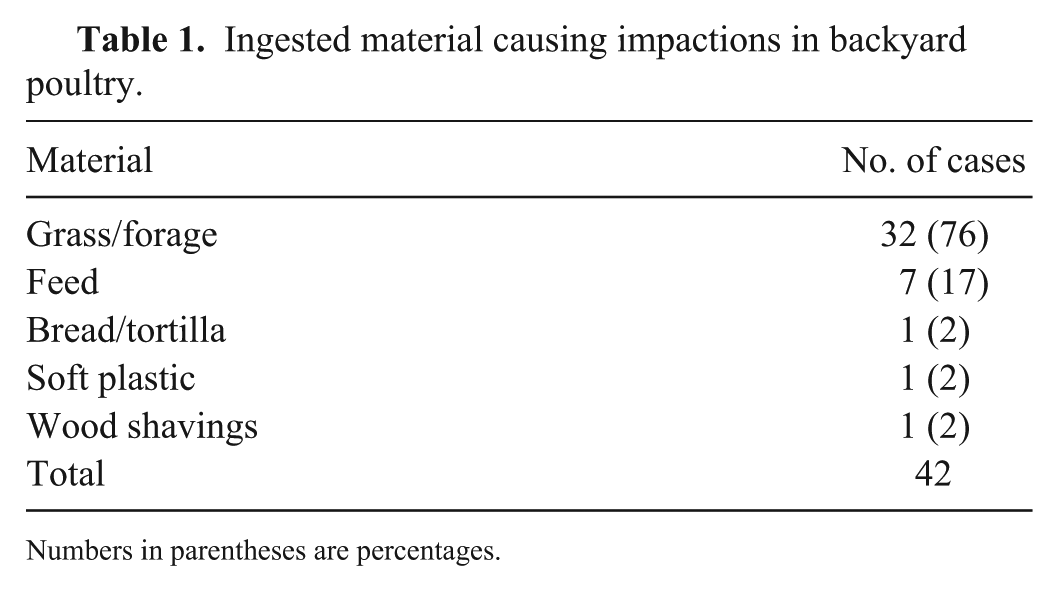
Numbers in parentheses are percentages.
Information regarding clinical signs, grit content, and body condition score were also summarized from the 42 ingesta-related gastrointestinal impaction cases. Clinical signs noted in the autopsy reports were anorexia (n = 6), lethargy (n = 11), seclusion (n = 1), coming off lay (n = 1), ataxia (n = 1), cyanotic combs (n = 1), diarrhea (n = 1), constipation (n = 1), and/or labored breathing (n = 1). Four birds had no clinical signs noted before sudden death. Clinical signs leading to the death of the birds ranged from 0 d (i.e., signs were noted the day of death) to 60 d, lasting an average of 7.3 d. The amount of grit found during autopsy was only noted in 16 case reports: 5 cases without any grit content, 9 with minimal grit content, and 2 with moderate grit content. Of the reports indicating the body condition of the birds, the majority were in poor/emaciated (n = 18) condition and the rest were in moderate (n = 15) condition. Of the 5 cases in which the housing of the birds was specified, all were free-ranged (n = 3) or pastured (n = 2). However, “free-range” is a broad term that can encompass pastured poultry as well, so it is not clear if all of these free-range birds had access to forage; we assume that at least 2 birds were pastured given that mortality as a result of grass impaction was recorded. The ages of the birds ranged from <1-wk-old to 6 y in the 28 impaction cases in which age was noted, with the average age of birds of 1.4 y, and the median age of 1 y.
Of the ingesta-related gastrointestinal impaction cases, 40 occurred in chickens, 1 in a goose, and 1 in a turkey. The impactions in the goose and turkey were caused by fibrous plant material, with the impaction affecting the small intestine in the goose, and both the gizzard and small intestine in the turkey. Breeds that were specified on the autopsy reports included Ameraucana (n = 4), Araucana (n = 1), Plymouth Barred Rock (n = 2), Rhode Island Red (n = 2), Black Slate Turkey (n = 1), Chinese Goose (n = 1), Cuckoo Maran (n = 1), Dominique (n = 1), Easter Egger (n = 1), Leghorn (n = 1), Lohmann Brown (n = 1), Nankin (n = 1), Swedish Flower (n = 1), and Wyandotte (n = 1). Different genetics affect the average forage intake of a bird, 14 therefore it is possible that there are certain breeds that are more likely to develop impactions, but a breed predilection could not be determined in our study given the wide variety of breeds affected and the lack of a controlled study to assess breed differences. In addition, the cases described are limited to the population of poultry cases that were submitted to the CAHFS laboratory system, and not all autopsy reports specified the breed.
The consumption of long forage material is more likely to lead to impaction in the gizzard or small intestine, whereas the over-consumption of forage is more likely to lead to impactions in the crop. 2 This is the result, in part, of the function of the avian crop and gizzard, which function primarily for storage and mechanical breakdown of ingesta, respectively. In order to break down less digestible material (e.g., grass) into smaller particle sizes, the gizzard utilizes grit and retains the material for a longer period. Given the storage of ingesta by the crop, over-consumption of forage can lead to accumulation of material in the crop, which increases the risk of impaction. 1 The majority of the autopsy cases analyzed at CAHFS had impactions in the small intestines as opposed to the crop or gizzard, which may suggest that the management of the available forage is a more significant problem in backyard poultry systems rather than the amount of forage. Therefore, maintaining a mowed forage area to minimize exposure of the birds to long strands of grass, or considering preventing birds from foraging altogether, should be considered (Ruhnke I, et al. 2015).
Grit also has the potential to help prevent impactions, 7 although too few autopsy reports specified the grit content for us to make an association between grit content and impactions. If grit is not supplemented by owners, backyard poultry will consume grit naturally available in their foraging area, such as small pebbles. However, this natural grit may not be beneficial to help break down grass and may actually hinder the process, because the surface texture, size, and quantity of grit is crucial to its ability to assist with grass breakdown. 7 Grit should be rough in texture and small (e.g., 1–1.6 mm quartzite particles) to have the highest surface area-to-volume ratio, and must be supplemented in enough quantity to allow for an adequate grit-to-grass ratio in the gizzard. 7 It must also be noted that grit has been found to aid only in the breakdown of grass that is already in small or narrow pieces, 7 thus the maintenance of forage length is still crucial. Although impactions in the small intestine are not affected by supplementing grit, 2 in the case of forage accumulation in the crop or gizzard, supplementing grit may be sufficient to break down the ingesta and prevent impactions.
As noted in our study, ingesta such as compacted feedstuff, bread or tortilla pieces, soft plastic, and wood shavings can also cause obstructions and impactions. Therefore, it is also important for owners to practice proper husbandry methods to prevent or minimize these exposures. Certain types of ingesta such as dried grain and doughy feed such as bread or tortilla tend to expand in the gastrointestinal tract, especially if feed consumption is followed soon after by water consumption. 9 Owners may choose to provide grit as described above to help hens process these feeds and/or consider soaking these feeds before feeding to prevent expansion in the gastrointestinal tract, or avoid them altogether. The consumption of inedible material (e.g., wood shavings) is often a result of stress, thus birds that are placed in novel environments or otherwise stressful situations are more prone to eating non-feed substances. 12 For this reason, owners should mitigate stressful situations for their flock as well as ensure that there are no easily consumed and accessible small objects to minimize the potential of ingesting materials that can lead to impactions.
In addition to management of forage and feed, backyard poultry owners are encouraged to monitor for potential impactions in birds by observing for signs of impaction such as anorexia and lethargy, as well as palpating crop contents periodically to ensure that the crop is not swelling. 5 If potential impactions are found, owners may try to decrease the pH of the diet to help pass compacted material through the gastrointestinal tract (Ruhnke I, et al. 2015) or supplement the diet with magnesium sulfate (Epsom salt) and molasses to create a laxative effect. 2 However, it should be noted that surgical intervention may be required to remove impactions. 8 To reduce the chances of gastrointestinal impactions being induced by underlying lesions of Marek’s disease, owners should also strongly consider obtaining birds that are vaccinated against Marek’s disease. 11 As pastured and free-range poultry become more common, both commercially and in backyard settings, optimizing foraging conditions to mitigate gastrointestinal impactions is an important and unique husbandry consideration. In addition, a greater understanding of poultry genetics, forage selection, and welfare (e.g., alternative enrichments) may help mitigate gastrointestinal impactions.
Footnotes
Acknowledgements
We thank Lucy Gomes for her help in the accession search, and the pathologists who performed the autopsies on these cases.
Declaration of conflicting interests
The authors declared no potential conflicts of interest with respect to the research, authorship, and/or publication of this article.
Funding
The authors received no financial support for the research, authorship, and/or publication of this article.