




Abstract
The objective of our study was to determine the clade affiliation of 116 contemporary equine Influenza A virus (EIV) isolates using pyrosequencing. The EIV isolates originated from horses with clinical signs of equine influenza and laboratory confirmation of EIV by real-time quantitative PCR (qPCR) in nasal secretions. Clade affiliation was performed on the basis of a single nucleotide polymorphism at 2 positions of the hemagglutinin 1 gene. Pyrosequencing was able to clearly classify EIV Florida sublineage prototype A/equine/Ohio/1/2003 and prototype A/equine/Richmond/1/2007 as clade 1 and 2, respectively. Out of the 116 EIV qPCR-positive samples, 113 (97.4%) were classified as belonging to clade 1 Florida sublineage, whereas 3 (2.6%) were classified as clade 2. All clade 1 EIV strains were detected in domestic horses, whereas the 3 clade 2 EIV strains originated from horses recently imported to the United States. Although clade 1 EIV strains are endemic in the United States, international transportation of horses represents a real risk in introducing clade 2 EIV strains into North America.
Two distinct subtypes of equine Influenza A virus (EIV) have been isolated from horses since 1956. 6 These subtypes are represented by the following prototype strains: influenza A/equine/Prague/56 (H7N7) and influenza A/equine/Miami/63 (H3N8). The equine H3N8 influenza viruses diverged into the Eurasian and American lineages in the late 1980s, with the American lineage diverging further into the Kentucky, South American, and Florida sublineage. Further evolution of the Florida sublineage EIV has resulted in 2 genetically divergent groups referred as clades 1 and 2. 8 EIV surveillance data has shown that Florida sublineage viruses from both clades 1 and 2 circulate in Europe, whereas clade 1 viruses have been primarily reported from North America (Office International des Epizooties, 2014, Conclusions and recommendations from the Expert Surveillance Panel on Equine Influenza Vaccines. Available at: http://goo.gl/aC1ng0).2,3 A previous report documented an equine influenza case caused by EIV clade 2 in an imported horse in the United States. 13 This case illustrates the threat of international transportation of horses in the introduction of new EIV strains of various clades into the United States. Although this case represents the only documented clade 2 EIV in the United States, clade affiliation cannot be determined via routine diagnostic using real-time quantitative PCR (qPCR). Clade classification has in the past been performed using standard DNA sequencing technique, which includes various steps such as nucleic acid purification, complementary (c)DNA synthesis, and labeling using the chain termination method with dye-labeled dideoxynucleotides (ddNTP), capillary electrophoresis, and fluorescence detection. Next-generation DNA sequencing technologies that permit massive sequencing with a much higher throughput than conventional methods have become recently available. One of these next-generation sequencing technology is pyro-sequencing. Pyrosequencing is less complex than conventional sequencing techniques, involves fewer steps, has superior limit of detection, is quantifiable, and has the ability to discriminate between viruses related by a similar mutation. Pyrosequencing is a sequencing-by-synthesis method that involves a combination of conventional PCR and chemiluminescence. Pyrosequencing relies on light generation after nucleotides are incorporated into a growing chain of DNA. This approach requires no gels, fluorescent dyes, or ddNTP.5,9 The objective of our study was to determine the clade affiliation of 116 contemporary EIV isolates using pyrosequencing.
One hundred sixteen EIV qPCR-positive nasal secretions were available from the Real-time PCR Research and Diagnostic Core Facility, School of Veterinary Medicine, University of California at Davis for pyrosequencing. The samples originated from horses across the United States with upper respiratory tract infection submitted to the laboratory for routine qPCR detection for common infectious viruses. The study samples had been submitted from March 2012 to May 2015 (18 samples in 2012; 38 samples in 2013; 24 samples in 2014; 36 samples in 2015). For each of the 116 EIV qPCR-positive cases, banked nucleic acid (genomic and complementary DNA) at −80°C was available for further molecular work-up.
Following alignment of the hemagglutinin 1 (HA1) gene of previously characterized clade 1 and clade 2 EIV strains, only 2 candidate sites with a single nucleotide polymorphism (SNP) were identified (position 281 for SNP1 and position 524 for SNP2 of the HA1 gene). To improve the analytical specificity of the pyrosequencing, the study focused on 2 instead of only 1 SNP. Two sets of primers flanking the 2 regions of interest were used for pyrosequencing in order to generate a 58-bp and a 75-bp PCR product for HA1 SNP1 and HA1 SNP2, respectively. In brief, conventional PCR using a commercial kit a was performed with the following primers: HA1 SNP1 forward primer (5′-CAATGCTAGGAGACCCCCACT-3′) and biotinylated reverse primer (5′-AAGAGGTCCCAATTCTCATA-3′), and HA1 SNP2 forward primer (5′-CCGACTGAATTGGCTAACAAA-3′) and biotinylated reverse primer (5′-ATTGTTAGGCATTGTCACATTCA-3′). Each PCR reaction was carried out following the manufacturer’s instructions. Eight microliters of each of the biotinilated PCR products (2 products for each sample) was captured with streptavidin-coated agarose beads b in a mixture containing binding buffer. c The mixture was agitated for 15 min at room temperature at 1,400 rpm. Following the binding step, a PCR plate d was filled with 22.5 µL of annealing buffer e and 2.5 µL of respective sequencing primer (5′-AGGAGACCCCCACTG-3′ for HA1 SNP1 and 5′-TGAATTGGCTAACAAAATC-3′ for HA1 SNP2) at a concentration of 0.3 pM. After the DNA capture, the streptavidin beads were washed using the commercial vacuum workstation f following the manufacturer’s instructions. The beads were released into the wells of the plate d by releasing the vacuum. The plate with the samples was heated at 80°C for 2 min, and then allowed to slowly cool down at room temperature for 10 min. Both the plate with the DNA and the dispensing unit g loaded with enzyme, substrate, and nucleotides h were positioned in the PCR instrument i for the run. Initial validation of the pyrosequencing was performed using nucleic acid from prototype strains (clade 1 A/equine/Ohio/1/2003; clade 2 A/equine/Richmond/1/2007). Clade affiliation for the study samples was determined based on the SNP at position 281 and 524 of the HA1 gene.
Prototype A/equine/Ohio/1/2003 was classified as clade 1 based on the detection of C at position 281 and G at position 524 of the HA1 gene of EIV, whereas prototype A/equine/Richmond/1/2007 was classified as clade 2 based on the detection of T and A at the corresponding positions (Table 1). The C/T variation for HA1 SNP1 and G/A variation for HA1 SNP2 was 0–4% and related to nonspecific sequencing primer binding. The variation was successfully eliminated following purification of the PCR product using a purification column. j Out of the 116 EIV qPCR-positive samples, 113 (97.4%) were classified as clade 1, whereas 3 (2.6%) were classified as clade 2. All EIV clade 1 Florida sublineage strains were from domestic horses, whereas the 3 clade 2 Florida sublineage strains were from horses recently imported from Europe (2 horses from Germany and 1 horse from France). Two of these horses originated from the same location in southern California and were diagnosed with equine influenza in March 2012, whereas the third horse was located in Virginia at the time it was diagnosed with EIV (October 2014).
Single nucleotide polymorphism (SNP) at position 281 and 524 of the hemagglutinin 1 (HA1) gene of equine Influenza A virus (EIV) used to determine clade affiliation.
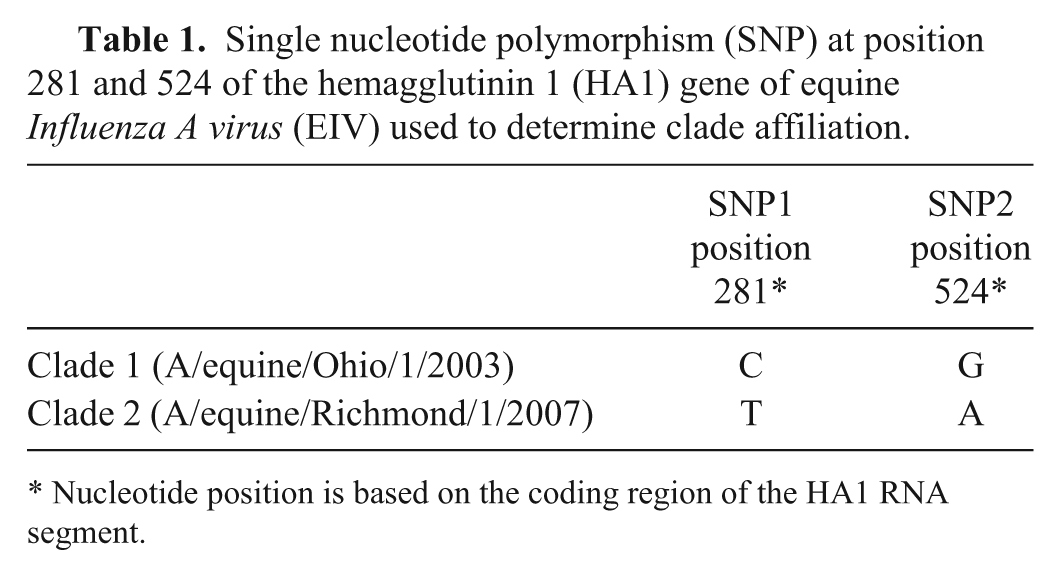
Nucleotide position is based on the coding region of the HA1 RNA segment.
Pyrosequencing relies on a cascade of enzymatic reaction and is based on the detection of released pyrophosphate during DNA synthesis. The initial nucleic acid polymerization reaction leads to the release of inorganic pyrophosphate during the nucleotide incorporation. The released pyrophosphate is subsequently converted to ATP by ATP sulfurylase, which provides the energy to luciferase to oxidize luciferin and generate light. The amount of generated light is proportional to the number of incorporated nucleotides. 10 Because the added nucleotide is known, the sequence of the template can be determined. Pyrosequencing has many advantages when compared to dideoxy sequencing methods. This simple technology is applicable to both DNA and RNA and is fast and cost-effective. 9 As a result of these advantages, pyro-sequencing has become a flexible method for microbial typing, antimicrobial resistance genotyping, and sequence identification. Pyroseqencing of viral nucleic acids in clinical specimens enabled the diagnosis of H5N1 avian influenza as well as the detection of other viruses such as hantaviruses and herpes simplex virus.1,7,12 Our study focused on the ability to distinguish between contemporary clade 1 and clade 2 EIV Florida sublineage strains, knowing that clade 2 EIV strains have not yet been reported in domestic horses in North America and that the international transportation of horses represents a real threat to the introduction of clade 2 EIV strains in nonendemic regions.
To improve the overall accuracy, 2 SNPs of the HA1 gene were selected based on known sequences of both clade 1 and 2 EIV strains of the Florida sublineage. The accuracy of the 2 different sequenced PCR products was determined using well-established and characterized prototype strains. The EIV Florida sublineage prototypes A/equine/Ohio/1/2003 and A/equine/Richmond/1/2007 were accurately classified as clade 1 and clade 2, respectively, based on the appropriate nucleotides at each of the 2 SNPs of the HA1 gene. The World Organization for Animal Health (OIE) expert surveillance panel reported that EIVs isolated and/or characterized in 2013 from outbreaks in the United States were all genetically characterized as clade 1 viruses (OIE, http://goo.gl/aC1ng0). Our results are in agreement with the OIE report, showing that 113 of 116 of the EIV strains characterized from domestic horses belonged to clade 1. However, a small number of EIV strains (3/116) were characterized as clade 2 EIV of the Florida sublineage. The only previously documented clade 2 EIV reported from the United States originated from a 4-year-old Warmblood mare imported from Germany. 13 Genetic characterization of the EIV identified in the imported mare displayed 99.1% nucleotide homology of the HA1 gene to the prototype Florida sublineage clade 2 isolate A/equine/Richmond/1/2007. 13 Similar to the mare previously reported in the literature, the 3 clade 2 EIV strains originated from adult horses with a recent import history from European countries, where both clade 1 and clade 2 EIVs are endemic. The risk of transmission of EIV from the 3 imported horses to the United States cannot be determined at this time. It appears, however, because of the lack of reported EIV cases with temporal- and geographic-association to any of the 3 clade 2 EIV positive cases, that transmission to domestic horses did not likely occur.
Introduction of horses that travel from one horse population to another has been repeatedly shown to be the major inciting incident for equine influenza epidemics.4,14 As horses do not become persistently infected with EIV, animals with acute infection or asymptomatic shedders are critical for the introduction of virus into susceptible populations. The most important aspect of preventing equine influenza is to minimize the likelihood of direct or indirect contact between infected and susceptible horses. Given the ubiquitous nature of EIV, it is challenging to prevent all exposure, but frequent high-risk contact increases the risk of introducing highly contagious strains. This emphasizes the importance of control measures such as stringent biosecurity measures and isolation of horses moved from one population to another. Although vaccination against EIV is the most effective method of prophylaxis against equine influenza, recent work has shown that even vaccinated horses can transmit EIV to sentinel horses up to 6 days post-challenge under experimental conditions. 11 Furthermore, Florida clade 1 EIV vaccine strains may not provide optimal protection against heterologous Florida clade 2 EIV strains. 2 Therefore, the OIE expert panel on equine influenza vaccines supports the inclusion of both Florida clade 1 and clade 2 EIV isolates in order to optimize the chance of preventing failure of vaccine efficacy (OIE, http://goo.gl/aC1ng0).
Although clade 1 EIV strains are endemic in the United States, international transportation of horses represents a real risk in introducing clade 2 EIV strains into North America. The risk is supported by the observation that 3 EIV isolates from recently imported horses were characterized as clade 2. As recommended by the OIE expert surveillance panel on EIV, commercial killed and inactivated EIV vaccines should contain epidemiologically relevant viruses and should be updated in a timely manner to confer optimal protection.
Footnotes
Acknowledgements
We thank Dr. Thomas Chambers from the Gluck Equine Research Center, University of Kentucky, Lexington, Kentucky, for providing the EIV clade 1 and clade 2 prototype strains.
Authors’ contributions
PN Bernardino contributed to design of the study; contributed to analysis and interpretation of data; and drafted the manuscript. SM Mapes and R Corbin contributed to design of the study, and contributed to acquisition and interpretation of data. N Pusterla contributed to conception and design of the study; contributed to interpretation of data; and drafted the manuscript. All authors critically revised the manuscript; gave final approval; and agreed to be accountable for all aspects of the work in ensuring that questions relating to the accuracy or integrity of any part of the work are appropriately investigated and resolved.
a.
Pyromark PCR kit, Qiagen Inc., Valencia, CA.
b.
Sepharose beads, GE Healthcare Bio-Sciences AB, Uppsala, Sweden.
c.
Pyromark binding buffer, Qiagen Inc., Valencia, CA.
d.
Pyromark Q24 plate, Qiagen Inc., Valencia, CA.
e.
Pyromark annealing buffer, Qiagen Inc., Valencia, CA.
f.
Pyromark Q24 vacuum workstation, Qiagen Inc., Valencia, CA.
g.
Pyromark Q24 cartridge, Qiagen Inc., Valencia, CA.
h.
Pyromark Gold Q24 reagents, Qiagen Inc., Valencia, CA.
i.
Pyromark Q24, Qiagen Inc., Valencia, CA.
j.
QIAquick PCR purification kit, Qiagen Inc., Valencia, CA.
Declaration of conflicting interests
The author(s) declared no potential conflicts of interest with respect to the research, authorship, and/or publication of this article.
Funding
The author(s) disclosed receipt of the following financial support for the research, authorship, and/or publication of this article: This study was supported by Boehringer Ingelheim Vetmedica.