




Abstract
Sensitive detection of Porcine circovirus-2 (PCV-2) is very important for surveillance of postweaning multisystemic wasting syndrome. Droplet digital polymerase chain reaction (ddPCR) is novel PCR method that can achieve high precision. Our study aimed to develop a sensitive assay utilizing ddPCR to detect PCV-2. Specificity of the assay was confirmed by the failure of amplification of DNA of other relevant viruses. The detection limit for ddPCR was 25 copies/μL, a 4-fold greater sensitivity than TaqMan real-time PCR. Both methods showed a high degree of linearity (R2 = ~1), although TaqMan real-time PCR showed less sensitivity than ddPCR for clinical detection. Our findings indicate that ddPCR might represent a promising platform for detecting PCV-2 viral loads.
The agent thought to cause postweaning multisystemic wasting syndrome (PMWS) is Porcine circovirus-2 (PCV-2; family Circoviridae, genus Circovirus), a porcine circovirus strain that was first recognized in 1991 in Saskatchewan, Canada (Clark E. Post-weaning multisystemic wasting syndrome. In: Proceedings of the 28th Annual Meeting of American Association of Swine Practitioners. Quebec City, Quebec, 1997:499–50). Typically, late nursery and fattening pigs are susceptible to PMWS, which is characterized by weight loss, dyspnea, enlarged lymph nodes, and occasional jaundice and diarrhea. 1 PMWS has been reported to increase the mortality of pigs by 2–30%. 13 Accurate and rapid detection of PCV-2 could serve to control its spread and reduce economic losses in the pig industry.
The development of a molecular technique, TaqMan real-time polymerase chain reaction (PCR), has advanced epidemiological studies of PMWS. 1 The determination of viral loads by TaqMan real-time PCR is dependent on the relationship of the quantification cycle (Cq) to the standard calibration curve. 2 This assay has several intrinsic limitations. First, sensitivity to PCR inhibitors can affect the accuracy of quantification. Additionally, the preparation of a calibration curve is required, which can be a laborious and time-consuming process. 7 Ultimately, quantification relies on the Cq values, which can lead to error amplification and limit its usefulness. 9
Droplet digital PCR (ddPCR) is a novel PCR technology. 11 The assay is an endpoint measurement that enables the quantification of nucleic acids without using a standard curve and without being dependent on the reaction efficiency. Because absolute quantification and enhanced detection sensitivity can be achieved, ddPCR has been used in various research applications, such as in microorganism detection 12 and biomedical research. 3 In our study, a specific and sensitive diagnostic method based on ddPCR for the detection of PCV-2 was established.
We obtained serum samples from 107 pigs that had tested positive by enzyme-linked immunosorbent assay (ELISA) for PCV-2. The pigs were 30–60 days of age from a herd in the southern Sichuan Province. The herd had not been immunized against PCV-2, and some pigs showed signs of PMWS. Some pigs that had died had macroscopic lesions consistent with PMWS infection, including lymphadenopathy and pulmonasry infiltrates. PMWS infection was confirmed by immunohistochemical testing and PCR sequencing. The serum samples were stored at −70°C prior to extraction of total DNA using a commercial kit, a according to the manufacturer’s instructions. Extracts were then stored at −20°C.
Field isolates of Porcine circovirus-1 (PCV-1), porcine parvovirus (PPV), Suid herpesvirus 1 (porcine pseudorabies virus [PRV]), Classical swine fever virus (CSFV), and Porcine respiratory and reproductive syndrome virus (PRRSV) were identified by conventional PCR (or reverse transcription PCR) and sequencing. Positive reference DNA (or complementary DNA) and negative DNA isolated from specific pathogen–free pigs were obtained from Key Laboratory of Animal Disease and Human Health of Sichuan Province and stored at −70°C.
The primers and probe were designed for PCV-2 TaqMan real-time PCR and ddPCR using commercial software b based on the nucleotide sequences of ORF2 (open reading frame 2) that was retrieved from GenBank (KC823059.1) and represented sequences of isolates from China (ZJG1103). The primer and probe sequences were as follows: F1 (5′-GCTGGAGAAGGAAAAATGG-3′); R1 (5′-TTGACAGTATATCCGAAGGT-3′); and probe (FAM-5′-TTCAAC ACCCGCCTCTCCCG-3′-BHQ).
The complete PCV-2 sequence was PCR amplified using the primers F2 (5′-TTTCCGCGGGCTGGCTGAACTTTTGAAAGT-3′) and R2 (5′-AGCCCGCGGAAATTTCTGACAAACGTTACA-3′). The plasmid standard was constructed by inserting the complete sequence of PCV-2 into a commercial vector, c according to the manufacturer’s instructions, and was then transformed into Escherichia coli DH5α cells. A nanophotometer d was used to quantify the concentration of purified recombinant plasmid (48.5 ng/μL), which was then serially diluted. Dilutions and plasmids were stored at −20°C and −70°C, respectively.
Real-time PCR was carried out using a real-time PCR system. e The procedure was optimized with regard to the concentrations of reagents and the annealing temperature. For each amplification step, the best reaction mixtures consisted of 10 μL of 2× PCR master mix, f 2 μL of template, and the primer and probe at final concentrations of 750 nM and 500 nM, respectively, in a 20-μL final volume. Amplification programs were as follows: 95°C for 30 sec, followed by 40 cycles of 95°C for 5 sec, and 56°C for 60 sec.
The same real-time PCR primers and probe were used in the ddPCR system. g According to the manufacturer’s instructions, the optimized ddPCR reaction mixtures included 10 μL of 2× ddPCR master mix, h 2 μL of template, and the primer and probe at final concentrations of 900 nM and 250 nM, respectively, in a 20-μL final volume. All reaction mixtures were loaded into a disposable plastic cartridge i along with 70 μL of commercial oil, j and then were placed onto a droplet generator g that partitioned each sample into 20,000 water-in-oil, nanoliter-sized droplets. Droplets were transferred into a 96-well plate k for PCR. The cycling conditions were as follows: 95°C for 10 min, followed by 40 cycles of 94°C for 30 sec and 52°C for 60 sec, 1 cycle of 98°C for 10 min, and ending at 12°C. Finally, plates containing the droplets were placed into a droplet reader, g and data were analyzed using commercial software. l
Correlation and regression analyses of standard curves from TaqMan real-time PCR and ddPCR were performed with commercial software. m For ddPCR, Poisson statistics were used to measure the initial template concentration using commercial software. l Kappa statistics were used to determine the agreement between ddPCR and TaqMan real-time PCR. n To avoid generating false-positive results, we monitored for potential contamination throughout the study.
Selection of an optimal annealing temperature is one of the most critical parameters for the specificity of a reaction. Setting an annealing temperature too low can lead to the amplification of nonspecific PCR products, and a temperature that is too high can reduce the yield. Therefore, plasmid (9,830 copies/μL) was annealed at the following temperatures: 61, 60.4, 59.3, 57.3, 54.9, 53, 51.7, and 51°C. Based on the FAM (6-carboxyfluorescein) signals that we displayed as rain plots (Fig. 1), 52°C was selected as the annealing temperature, which resulted in the greatest fluorescence amplitude difference between the positive (gray) and negative (blue) controls.
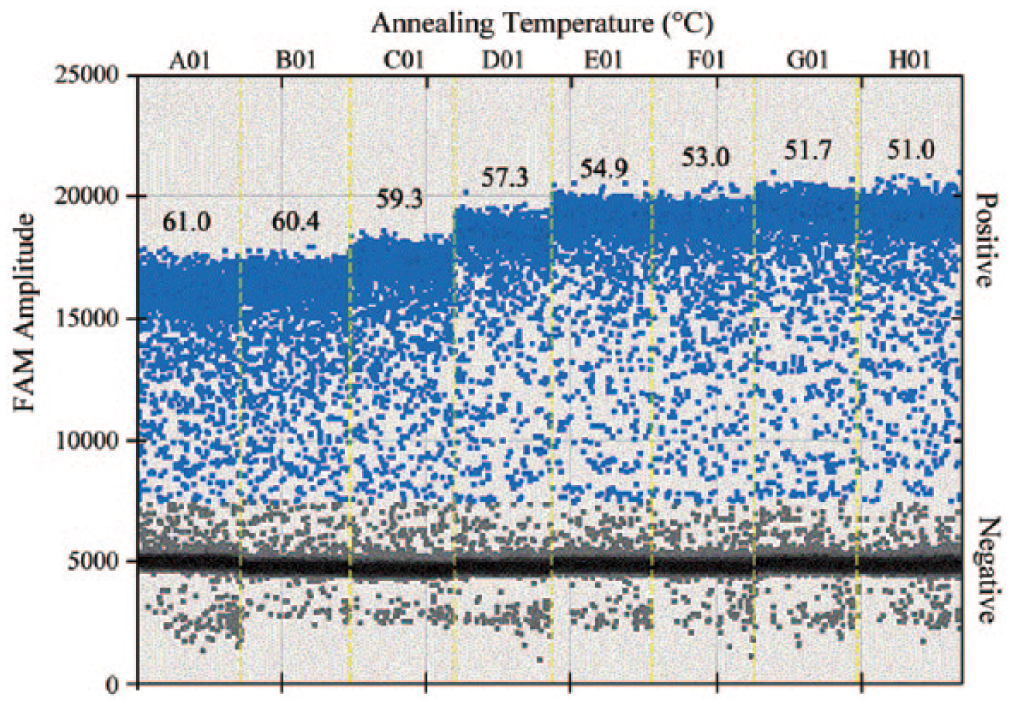
FAM (6-carboxyfluorescein) fluorescence amplitude of different annealing temperatures. The assay was conducted across an annealing temperature gradient: 61.0, 60.4, 59.3, 57.3, 54.9, 53, 51.7, and 51°C.
No FAM fluorescence signal was observed in either the negative control, or in PCV-1, PPV, PRV, CSFV, or PRRSV samples (Supplementary Fig. 1 available at http://vdi.sagepub.com/content/by/supplemental-data). The modified ddPCR developed in the current study was able to detect PCV-2.
Standards with different copy numbers were used to evaluate the robustness and reproducibility of the ddPCR assay. For each sample, samples were tested in triplicate to evaluate intra- and interassay reproducibility. The intra- and interassay coefficient of variation (%) for concentration (copies/μL) ranged from 1.30% to 2.70% and from 0.67% to 2.50%, respectively (Table 1).
Robustness and reproducibility of droplet digital polymerase chain reaction.*
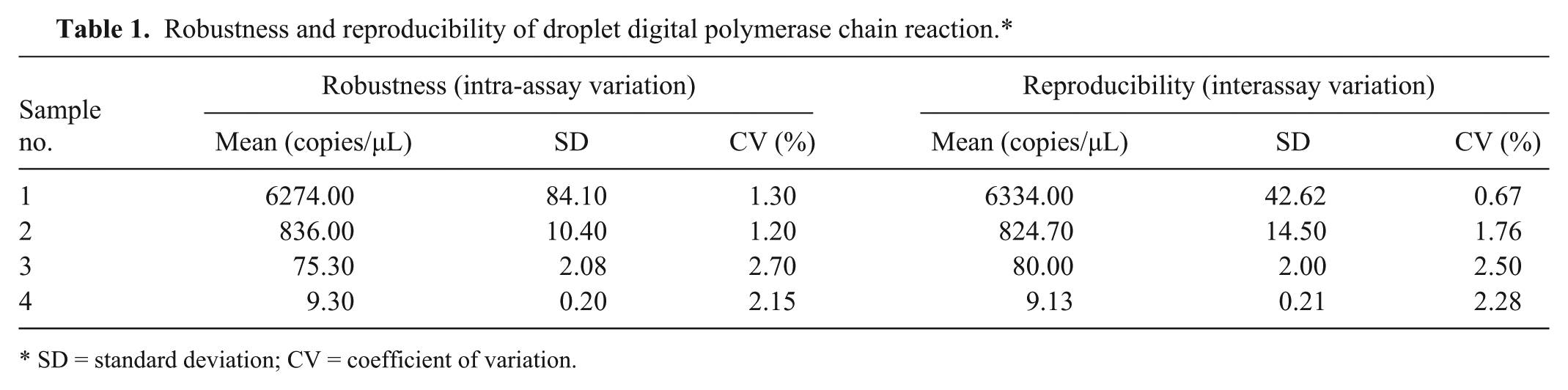
SD = standard deviation; CV = coefficient of variation.
Serially diluted PCV-2 plasmids were prepared in triplicate, and then standard curves of PCV-2 were constructed using ddPCR and TaqMan real-time PCR to compare the limitations, linearity, and efficiency of quantification (Fig. 2; Table 2). We found that ddPCR and TaqMan real-time PCR exhibited good linearity, with R2 values of 0.9964 and 0.9998, respectively. For ddPCR, the slope value was 1.043, which was equivalent to a PCR efficiency of 104.3%. The slope value in TaqMan real-time PCR was −3.582, which was equivalent to a PCR efficiency of 90.2%. The ddPCR detected fewer plasmid copies than was expected from the calculation. The limit of detection by ddPCR was ~25 copies/μL. In contrast, by TaqMan real-time PCR, it was ~98.3 copies/μL, when using a cutoff detection limit of 40 cycles. Therefore, ddPCR was more sensitive than TaqMan real-time PCR.
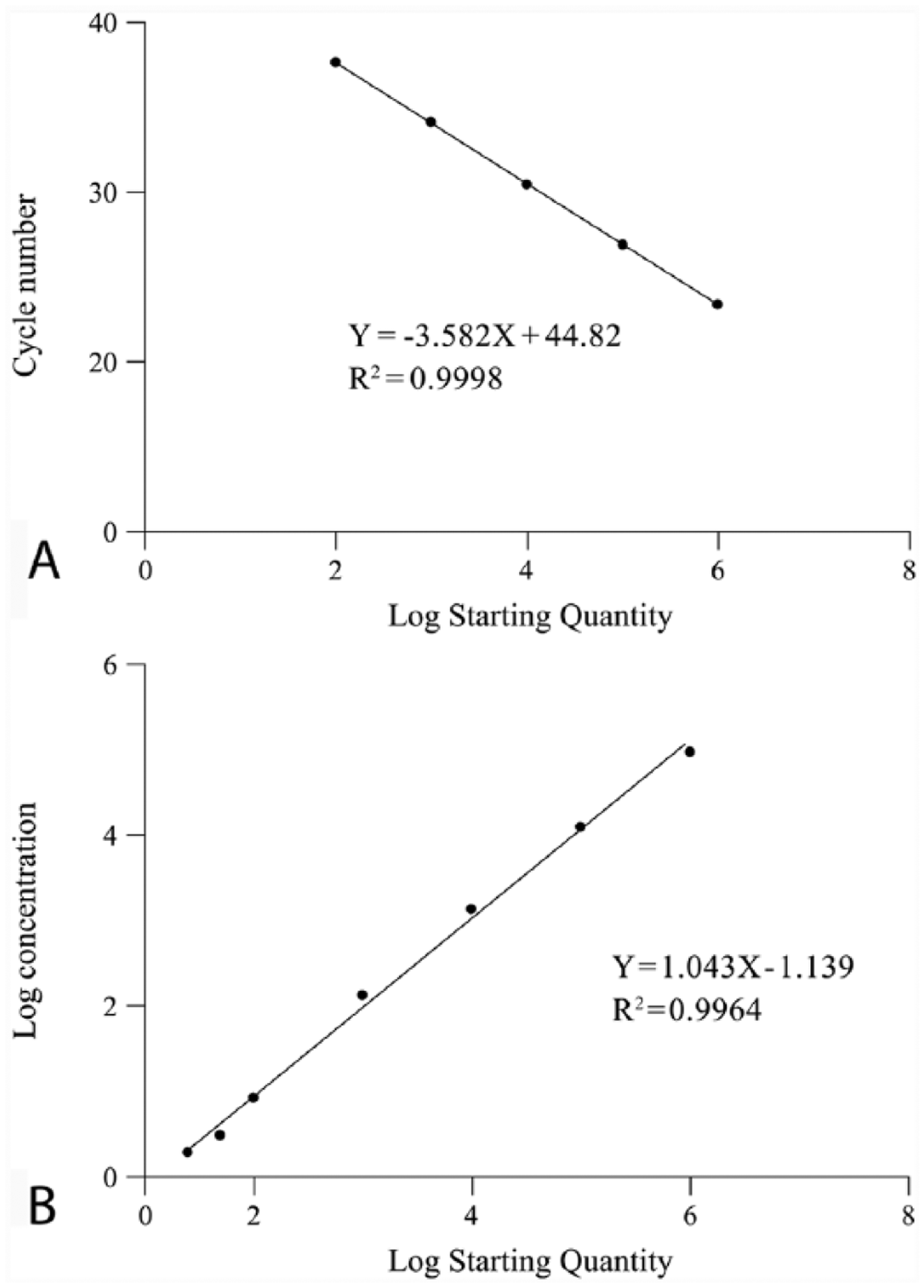
Standard curves of Porcine circovirus-2 plasmids constructed by TaqMan real-time polymerase chain reaction (PCR; A) and droplet digital PCR (B).
Comparison of TaqMan real-time polymerase chain reaction (PCR) and droplet digital (dd)PCR using serially diluted Porcine circovirus-2 (PCV-2) plasmids.*
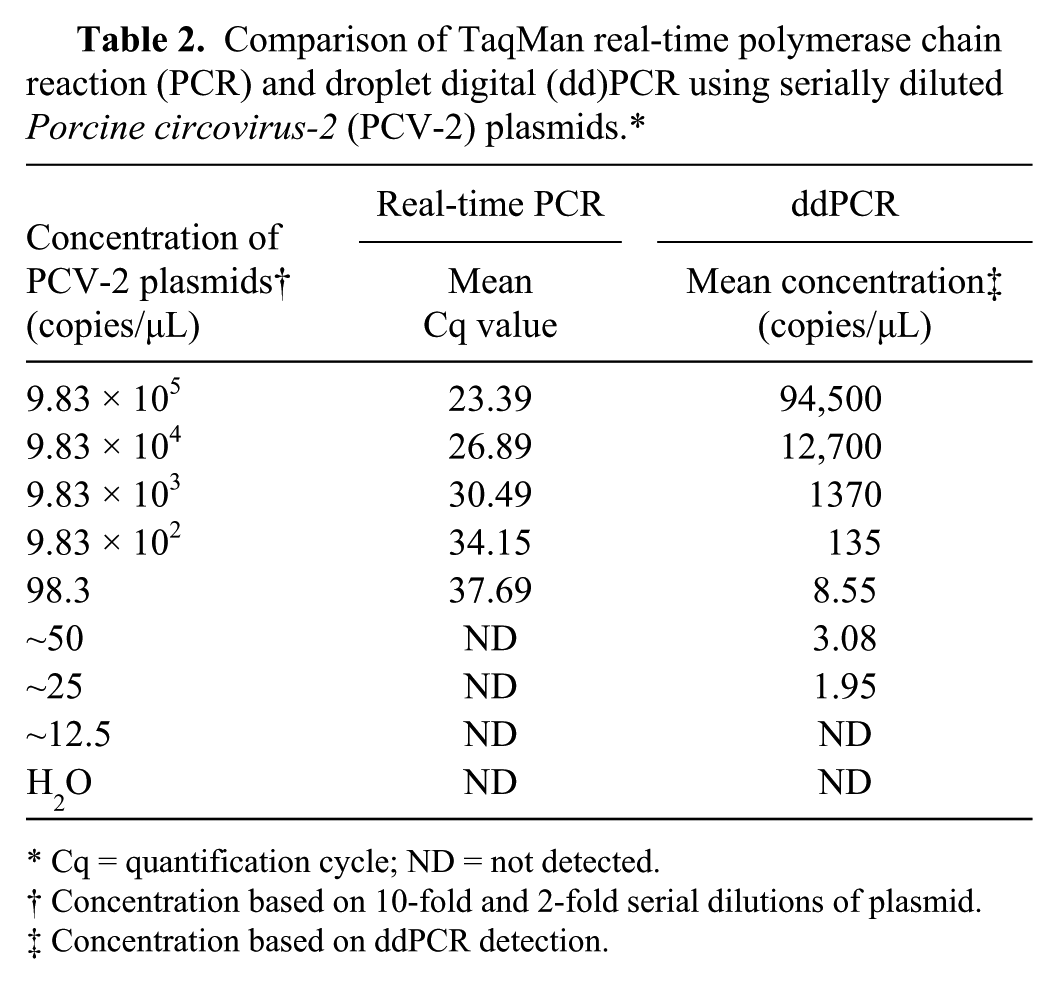
Cq = quantification cycle; ND = not detected.
Concentration based on 10-fold and 2-fold serial dilutions of plasmid.
Concentration based on ddPCR detection.
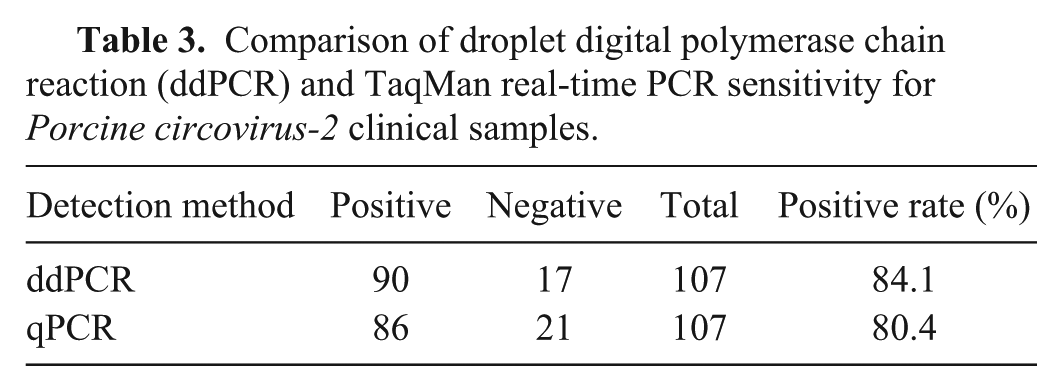
The 107 PCV-2 antibody-positive serum samples were used to compare the detection sensitivities of the ddPCR and the TaqMan real-time PCR (Table 3). The former correctly identified 90 of the samples (84.1%), the latter 86 (80.4%). All of the samples correctly identified by TaqMan real-time PCR were also detected by ddPCR (Supplementary Fig. 2 available at http://vdi.sagepub.com/content/by/supplemental-data). The kappa statistic was 0.87 (standard error: 0.06, with 95% confidence intervals), indicating almost perfect agreement between ddPCR and TaqMan real-time PCR.
Comparison of droplet digital polymerase chain reaction (ddPCR) and TaqMan real-time PCR sensitivity for Porcine circovirus-2 clinical samples.
The ddPCR, the latest version of digital PCR, 14 partitions each sample into thousands of droplets; PCR amplification is carried out within each droplet. After the reaction endpoint, Poisson statistics are used to measure the initial template concentration by determining the fraction of positive (containing an amplified target) and negative (no amplified target) droplets. 4 Compared with TaqMan real-time PCR, ddPCR has been confirmed to have some of the following advantages: it is more sensitive for low copy number quantification, 6 is better at identifying single nucleotide polymorphisms, 10 is less susceptible to PCR inhibitors, and can detect target DNA in complex environments. 5 All of these features make ddPCR a promising detection technique and a practical method for clinical diagnosis. However, a limitation of ddPCR compared with TaqMan real-time PCR is that target samples should be present at <100,000 copies because high starting concentrations can result in nonlinear results. 8
The ddPCR assay, using a preprocessed mixture, allows for absolute quantification to be achieved. Detection over a wide dynamic range of concentrations by ddPCR allows for the measurement of viral ranges in animals, which can exhibit various levels of infection. 16 In the present study, the linear regression correlation coefficients were measured using either ddPCR or TaqMan real-time PCR showed good R2 values that were ~1 (Fig. 2). Furthermore, when standard plasmids were diluted below 108-fold, there was no amplification detected by TaqMan real-time PCR, even though the mixture contained positive droplets that could be detected by ddPCR. Indeed, based on the detection limit of ddPCR, it was 4-fold more sensitive than TaqMan real-time PCR. As indicated by clinical detection assays, there were 4 samples that tested negative by TaqMan real-time PCR, but positive by ddPCR. This more sensitive method could provide an effective method for detecting latent infections in pigs and a more accurate quarantine could be put into effect during an outbreak. Notably, ddPCR detected fewer virus copies than were expected by the calculation (Table 2). This might have occurred because the number of standard input copies was low overall, and ddPCR could be used to calculate the exact copy numbers of target DNA, in accord with other studies. 15
Footnotes
Authors’ note
Shan Zhao and Hua Lin contributed equally to this work.
Authors’ contributions
S Zhao contributed to conception and design of the study, and to acquisition, analysis, and interpretation of data, and drafted manuscript. H Lin contributed to conception and design of the study, and acquisition of data. Q Yan contributed to conception of the study and analysis of data. Y Yan, Y Sun, and J Hu contributed to acquisition of data. S Chen contributed to acquisition and analysis of data. M Yang contributed to acquisition and interpretation of data. Z Chen, and L Xi contributed to analysis of data. Z Hao contributed to analysis and interpretation of data. C Wen contributed to interpretation of data. All authors gave final approval and agree to be accountable for all aspects of the work in ensuring that questions relating to the accuracy or integrity of any part of the work are appropriately investigated and resolved.
a.
DNeasy tissue kit, Qiagen GmbH, Dusseldorf, Germany.
b.
Oligo Primer Analysis software, Molecular Biology Insights Inc., Colorado Springs, CO.
c.
pMD19-T simple vector, TaKaRa, Dalian, China.
d.
NanoPhotometer P-Class, Implen GmbH, Munich, Germany.
e.
CFX96 Real-Time PCR system, Bio-Rad Laboratories, Hercules, CA.
f.
Premix Ex Taq, TaKaRa, Dalian, China.
g.
QX100 Droplet Digital PCR System, Bio-Rad Laboratories, Hercules, CA.
h.
ddPCR Super Mix for probes, Bio-Rad Laboratories, Hercules, CA.
i.
DG8 cartridges, Bio-Rad Laboratories, Hercules, CA.
j.
Droplet generation oil, Bio-Rad Laboratories, Hercules, CA.
k.
Eppendorf AG, Hamburg, Germany.
l.
QuantaSoft software, Bio-Rad Laboratories, Hercules, CA.
m.
GraphPad Prism, GraphPad Software Inc., La Jolla, CA.
n.
SPSS Statistic 22, IBM Corp., Chicago, IL.
Declaration of conflicting interests
The author(s) declared no potential conflicts of interest with respect to the research, authorship, and/or publication of this article.
Funding
The author(s) disclosed receipt of the following financial support for the research, authorship, and/or publication of this article: This work was supported by the Program for Changjiang Scholars and Innovative Research Team in University, China (IRT0848), and Research Project from the Sichuan Entry-Exit Inspection and Quarantine Bureau (SK201403).