




Abstract
The availability of the fetal goat tongue cell line ZZ-R 127 for the isolation of Foot-and-mouth disease virus (FMDV) has not been evaluated using clinical samples other than epithelial suspensions. Therefore, in the current study, the availability of ZZ-R 127 cells for the isolation of FMDV was evaluated using clinical samples (e.g., sera, nasal swabs, saliva, feces, and oropharyngeal fluids) collected from animals experimentally infected with an FMDV isolate. Virus isolation rates for the ZZ-R 127 cells were statistically higher than those for the porcine kidney cell line (IB-RS-2) in experimental infections using cattle, goats, and pigs (P < 0.01). Virus titers in the ZZ-R 127 cells were also statistically higher than those in the IB-RS-2 cells. The availability of ZZ-R 127 cells for the isolation of FMDV not only from epithelial suspensions but also from other clinical samples was confirmed in the current study.
Foot-and-mouth disease (FMD), a highly contagious disease of cloven-hoofed animals that occurs endemically or sporadically in numerous countries around the world, is caused by Foot-and-mouth disease virus (FMDV; genus Aphthovirus, family Picornaviridae) and FMDV is divided into 7 serotypes (O, A, C, Asia1, SAT1, SAT2, and SAT3). The World Organization for Animal Health (OIE) recommends that primary bovine thyroid (BTY) cells should be used for diagnostic tests on FMD because they are the most sensitive for the isolation of FMDV from clinical samples as described in the OIE Manual of Diagnostic Tests and Vaccines for Terrestrial Animals 2012 (http://www.oie.int/fileadmin/Home/eng/Health_standards/tahm/2.01.05_FMD.pdf). However, because BTY cells cannot be passaged and easily frozen without impairing their sensitivity,2,8 ensuring that there is always a fresh and suitable batch of the BTY cells available for diagnostic tests is quite laborious and expensive. 5 Therefore, most diagnostic laboratories routinely use other cells that are less susceptible to FMDV infection but more convenient to handle, such as other primary cells of bovine, ovine, and porcine origins1,7 and permanent cell lines such as baby hamster kidney (BHK-21),4,10 porcine kidney (IB-RS-2 3 and SK-6 9 ), and porcine kidney epithelial (PK-15) cells. At the National Institute of Animal Health, Japan (NIAH), primary bovine kidney cells and IB-RS-2 cells are routinely used for diagnostic tests for FMD.6,12
A previous study 2 reported that the fetal goat tongue cell line ZZ-R 127 was highly sensitive for the isolation of FMDV. The study evaluated its availability for FMDV isolation using cell culture supernatants and epithelial suspensions of various FMDV strains. However, it is generally difficult to collect fresh epithelial and vesicular materials in the field. For the reasons mentioned above, the availability of the cell line for FMDV isolation was evaluated using clinical samples other than epithelial suspensions (e.g., sera, nasal swabs, saliva, feces, and oropharyngeal fluids) collected from animals experimentally infected with an FMDV.
The IB-RS-2 cells were maintained using a commercial medium
a
supplemented with 2.4 g/l of tryptose phosphate broth, 1% of 7.5% NaHCO3, 1% of 2.92%
The FMDV isolate used in the experimental infections in the current study was isolated in the 2010 epidemic in Japan (isolate O/JPN/2010-1/14C). 6 Two 6-month-old cattle were inoculated intradermolingually with approximately 106 TCID50 (50% tissue culture infective dose) of the isolate. The day when the cattle were inoculated with the isolate was designated as 0 days postinoculation (dpi). Two 6-month-old cattle cohabited with the inoculated cattle at 1 dpi and were housed in the same cubicle for approximately 1 month. Two 4-month-old goats were inoculated intradermally with approximately 106 TCID50 of the isolate at the coronary bands of the heels. Two 4-month-old goats cohabited with the inoculated goats at 1 dpi and were housed in the same cubicle for approximately 1 month. Three 2-month-old pigs were inoculated intranasally with approximately 106 TCID50 of the isolate. They were housed in the same cubicle for approximately 2 weeks. All experimental infections were performed in a high containment facility at the NIAH. The Animal Care and Use Committee of the NIAH approved all animal procedures prior to initiation of the experimental infections. Sera were collected from cervical veins. Nasal swabs were collected from nasal cavities using a cotton swab. Saliva was collected from oral cavities using a roll-shaped synthetic saliva collector d and disposable tweezers. Feces were collected from anuses. Oropharyngeal fluids were collected using a probang cup. The clinical samples were collected daily until 10 dpi and at 3–4-day intervals after that.
Virus isolation was performed according to the aforementioned OIE Manual Freshly prepared confluent monolayers in 24-well plates were washed once and incubated with 150 μl of samples for 1 hr at 37°C. Afterward, the monolayers were washed and added to fresh medium; the cultures were incubated for 72 hr at 37°C in 5% CO2. A commercial medium
a
supplemented with 2.4 g/l of tryptose phosphate broth, 1% of 7.5% NaHCO3, 1% of 2.92%
Viral RNA was extracted from the clinical samples using a commercial kit. f The FMDV-specific gene was detected by the aforementioned RT-PCR assay. 12
Pearson chi-square test and Student’s t-test were used for analyzing the statistical significance of the differences in virus isolation rates between the ZZ-R 127 and the IB-RS-2 cells and in virus titers in the ZZ-R 127 and the IB-RS-2 cells, respectively.
Table 1 displays the detection rates of viral genes for the RT-PCR assay and the virus isolation rates for both of the cells. A total of 272 samples were collected from the experimental infected cattle. Viral genes were detected in 80 (29.4%) of the 272 samples by the RT-PCR assay. Viruses were isolated from 63 (23.2%) of the samples by the ZZ-R 127 cells. Sixty-two of the 63 samples were part of the 80 RT-PCR–positive samples. In contrast, viruses were isolated from only 30 (11.0%) of the 80 RT-PCR–positive samples by the IB-RS-2 cells. Viruses were isolated from oropharyngeal fluids by the ZZ-R 127 cells; however, they were not isolated by the IB-RS-2 cells. The virus isolation rate from saliva samples and the total virus isolation rate achieved by the ZZ-R 127 cells were statistically higher than those achieved by the IB-RS-2 cells (P < 0.01).
Comparison of detection rates of viral genes obtained by reverse transcription polymerase chain reaction (RT-PCR) assay and virus isolation rates obtained by the ZZ-R 127 and IB-RS-2 cell lines.
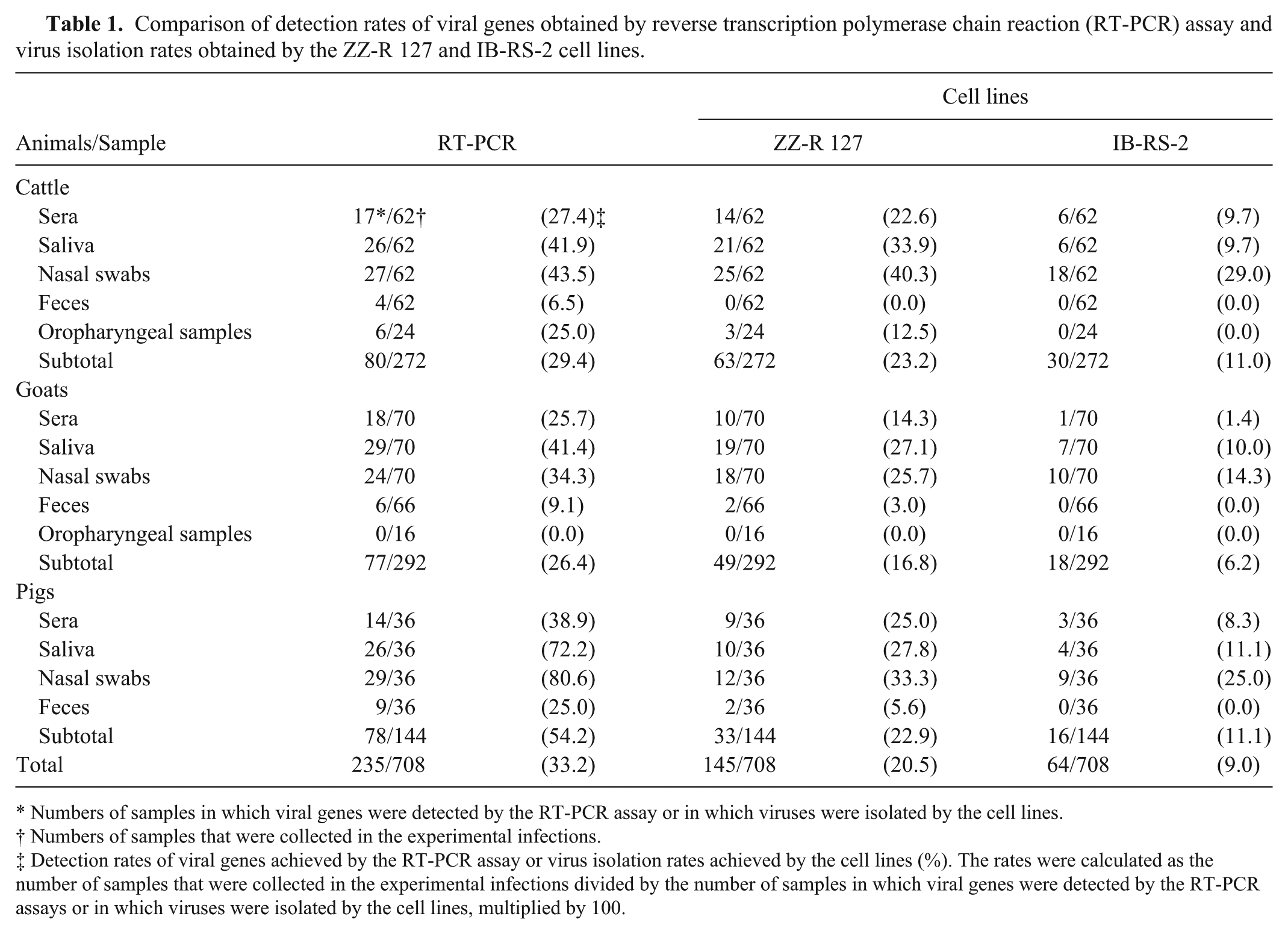
Numbers of samples in which viral genes were detected by the RT-PCR assay or in which viruses were isolated by the cell lines.
Numbers of samples that were collected in the experimental infections.
Detection rates of viral genes achieved by the RT-PCR assay or virus isolation rates achieved by the cell lines (%). The rates were calculated as the number of samples that were collected in the experimental infections divided by the number of samples in which viral genes were detected by the RT-PCR assays or in which viruses were isolated by the cell lines, multiplied by 100.
In total, 292 and 144 samples were collected from the experimentally infected goats and pigs, respectively. As with the experimental infection using cattle, viruses were isolated from more samples by the ZZ-R 127 cells than by the IB-RS-2 cells. All of the samples from which the viruses were isolated were part of RT-PCR–positive samples. In addition, viruses were isolated from fecal samples by the ZZ-R 127 cells; however, they were not isolated by the IB-RS-2 cells. In the experimental infection using goats, the virus isolation rates from serum and saliva samples and the total virus isolation rate achieved by the ZZ-R 127 cells were statistically higher than those achieved by the IB-RS-2 cells (P < 0.01). In contrast, in the experimental infection using pigs, the total virus isolation rate achieved by the ZZ-R 127 cells was statistically higher than that achieved by the IB-RS-2 cells (P < 0.01).
In total, the virus isolation rate (20.5%) achieved by the ZZ-R 127 cells was 2.3 times higher than that (9.0%) obtained by the IB-RS-2 cells. The former was statistically higher than the latter (P < 0.01).
In addition, virus titers of the samples collected from the experimental infections were compared using the ZZ-R 127 and IB-RS-2 cells (Fig. 1). Figure 1 shows scatter plots made by virus titers of each sample in both cell types. The scatter plots show that virus titers in the ZZ-R 127 cells were higher than those in the IB-RS-2 cells. The differences of virus titers between the 2 cell types were 100.5–104.5 TCID50, 100.5–106.0 TCID50, and 101.3–104.0 TCID50 in cattle, goats, and pigs, respectively. In total, the virus titers in the ZZ-R 127 cells were statistically higher than those in the IB-RS-2 cells (P < 0.01).
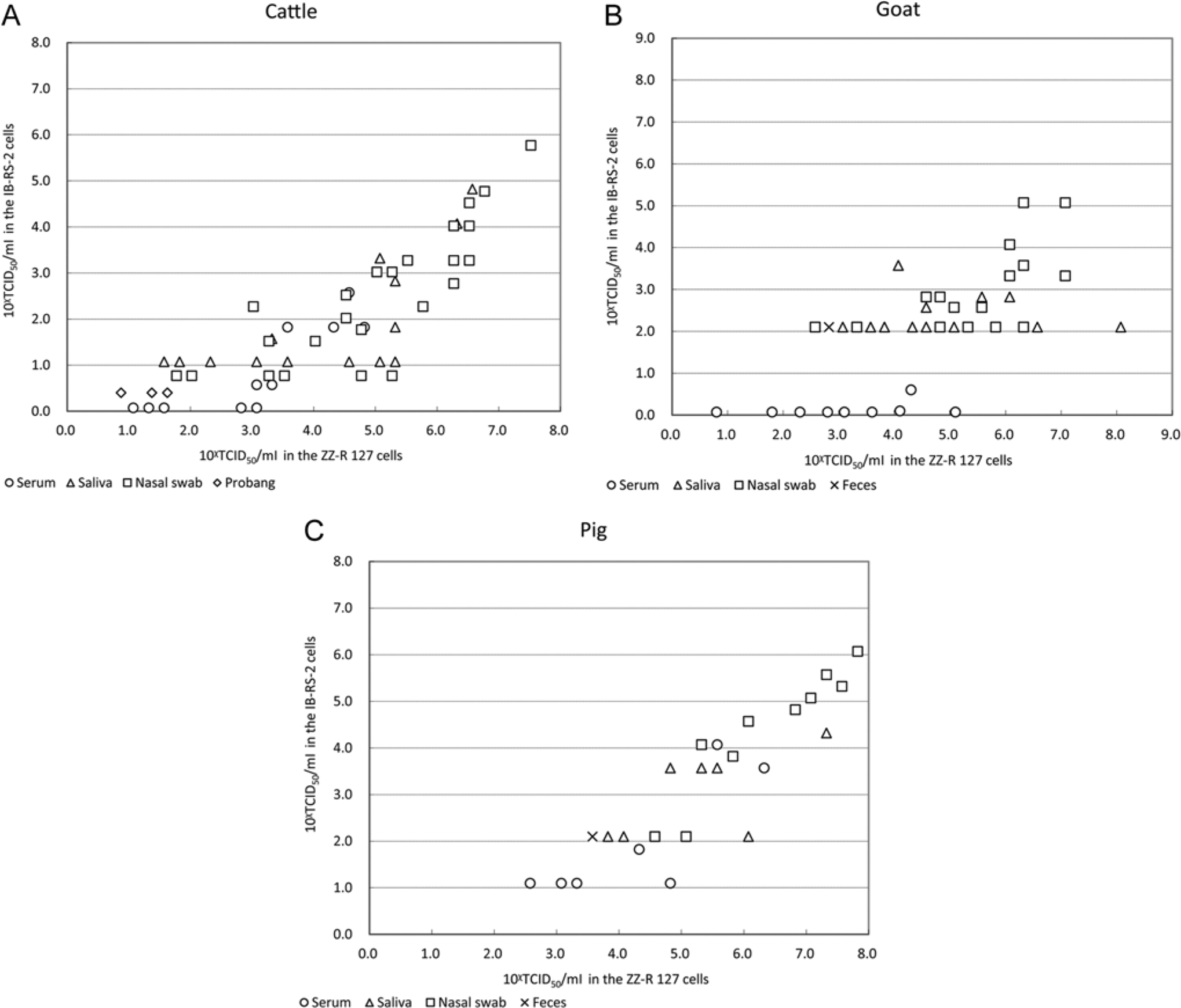
Scatter plots made by virus titers of each sample collected from cattle (
In general, the detection rates of viral genes obtained by a RT-PCR assay and a real-time RT-PCR assay are higher than the virus isolation rates obtained by any FMDV-susceptible cells as shown in Table 1. However, it is essential for diagnostic tests on FMD to involve virus isolation because procedures for vaccine strain selection require the isolation of the FMDV strain causing an outbreak. In a previous study, 2 the CPE on the ZZ-R 127 cells was observed more rapidly than those on the IB-RS-2 and BHK-21 cells in all 7 serotype FMDV strains. Virus titers in the ZZ-R 127 cells were higher than those in the IB-RS-2 and BHK-21 cells in all 7 serotype FMDV strains. Therefore, sensitivity to all 7 serotype FMDV strains of the ZZ-R 127 cells would be higher than those of the IB-RS-2 and BHK-21 cells.
In contrast, the previous study 2 did not evaluate the availability of the ZZ-R 127 cells to achieve FMDV isolation using clinical samples except for epithelial suspensions. In the current study, the availability of the ZZ-R 127 cells for FMDV isolation was evaluated using other clinical samples. In total, the virus isolation rate (20.5%) achieved by the ZZ-R 127 cells was 2.3 times higher than that (9.0%) achieved by the IB-RS-2 cells (Table 1). In addition, virus titers in the ZZ-R 127 cells were statistically higher than those in the IB-RS-2 cells (Fig. 1). Therefore, the ZZ-R 127 cells would be useful for FMDV isolation, not only from epithelial suspensions but also from other clinical samples. However, the ZZ-R 127 cells are not susceptible to swine vesicular disease virus, which can cause similar clinical signs to FMD. 2 In addition, porcinophilic FMDV strains do not grow well in the ZZ-R 127 cells. 2 Furthermore, the ZZ-R 127 cells have the disadvantage of undergoing slow growth. Therefore, it is essential to use both ZZ-R 127 and IB-RS-2 cells for efficient diagnostic tests on FMD.
Various primary cells and established cell lines have been shown to propagate FMDV, but none have the extreme sensitivity for the detection of different FMDV strains that the BTY cells exhibit.8,13 Because the population of FMDV-insensitive fibroblasts in the BTY cell monolayer rapidly outnumbers the sensitive epithelial cells on cell culture passage, 5 a regular supply of thyroid glands from which to prepare the BTY cells is essential. However, government legislation introduced in the past 10 years to improve the standards of operation of slaughterhouses in response to bovine spongiform encephalopathy has resulted in increasing difficulties in sourcing any organs to maintain a regular supply for the preparation of primary cell culture. Because overseas laboratories face similar supply problems, attempts have been made to cryopreserve BTY cells and to resuscitate them as required for diagnosis in an effort to reduce the frequency of thyroid gland collection and processing. 5 However, this approach was generally unsuccessful. Therefore, it is definitely essential to obtain any cells that can replace BTY cells. Moreover, it is very convenient if the “cells” are not primary cells and are any established cell lines for the aforementioned reasons.
A previous study 2 confirmed the availability of ZZ-R 127 cells for FMDV isolation using cell culture supernatants and epithelial suspensions. In the current study, the availability was precisely confirmed using samples not evaluated previously. 2 In conclusion, diagnosing FMD will be improved by replacing BTY cells with ZZ-R 127 cells.
Footnotes
Acknowledgements
The authors are grateful to Dr. Matthias Lenk (Friedrich-Loeffler-Institute Collection of Cell Lines in Veterinary Medicine, Greifswald-Insel Riems, Germany) for the supply of ZZ-R 127 cells, and Dr. Gerelmaa Ulziibat (State Central Veterinary Laboratory, Mongolia) and Dr. Akiko Tomiyasu (Animal Quarantine Service, Japan) for technical assistance. The authors would also like to thank Mr. Hiroki Kimura, Mr. Masayuki Kanda, Mr. Shinya Sato, Mr. Kenichi Ishii, Mr. Tatsuo Nakamura, and Mr. Shigeo Mizumura for care of the animals.
a.
Eagle’s minimum essential medium, Nissui Pharmaceutical, Tokyo, Japan.
b.
Friedrich-Loeffler-Institute Collection of Cell Lines in Veterinary Medicine, Greifswald-Insel Riems, Germany.
c.
Dulbecco’s modified Eagle medium: nutrient mixture F-12, Life Technologies, Carlsbad, CA.
d.
Salivette, Sarstedt KK, Tokyo, Japan.
e.
Indirect sandwich enzyme-linked immunosorbent assay for detection of antigens of foot-and-mouth disease virus and swine vesicular disease virus, Biological Diagnostic Supplies Ltd., Ayrshire, UK.
f.
High pure viral RNA kit, Roche Diagnostics, Basel, Switzerland.
Declaration of conflicting interests
The author(s) declared no potential conflicts of interest with respect to the research, authorship, and/or publication of this article.
Funding
The author(s) disclosed receipt of the following financial support for the research, authorship, and/or publication of this article: This study was supported by Grants-in-Aid for Scientific Research from the Foot-and-Mouth Disease Control Project of the Ministry of Agriculture, Forestry and Fisheries of Japan.