




Abstract
A manual method (Thrombo-TIC; Bioanalytic GmbH, Umkirch/Freiburg, Germany) was advertised to disaggregate platelet clumps and to make human platelets spherical to improve platelet enumeration. The current study’s hypothesis was that this method would perform better than current methods for feline blood anticoagulated with ethylenediamine tetra-acetic acid (EDTA), which often contains platelet aggregates. Platelet concentrations (PLTs) were determined in 21 feline blood samples by 3 methods. Thrombo-TIC was compared to the manual method (Leucoplate; Sobioda, Montbonnot-Saint-Martin, France) currently used in the authors’ laboratory along with an ADVIA 2120 (Siemens AG, Eschborn, Germany) optical platelet concentration. Feline blood samples often contained platelet aggregates. ADVIA flagged for platelet aggregates in 11 of the 21 feline blood samples, and examination of blood smear revealed platelet aggregates in 14 of the 21 samples. The hemocytometers displayed more platelet aggregates with the Thrombo-TIC method than with Leucoplate. The method giving the greatest PLT was considered most accurate. The Leucoplate median PLT (238 × 109/1) was greater than Thrombo-TIC (202 × 109/1) or ADVIA (157 × 109/1). Intra-assay precision was determined for the 3 methods using the 21 feline blood samples. Median Thrombo-TIC and Leucoplate precision (7.4% and 7.3% coefficient of variation [CV], respectively) were similar and not much worse than ADVIA (5.9% CV). The Thrombo-TIC method did not appear to perform better than the current manual method (Leucoplate). Leucoplate appeared least affected by platelet aggregation in feline blood. The ADVIA automated PLT appeared to be most negatively affected by platelet aggregation. The Thrombo-TIC method did not appear to prevent platelet aggregation in feline EDTA blood samples and, thus, is not recommended for such use.
Obtaining an accurate feline platelet concentration (PLT) is hampered by the frequent formation of platelet aggregates in routinely collected ethylenediamine tetra-acetic acid (EDTA) patient blood samples.4-6,8 Laboratories processing feline blood samples are challenged daily with deciding what to do with these samples. A manual method and diluent for enumeration of PLT (Thrombo-TIC) a has been advertised to improve manual counting of human platelets by causing platelets in clumps to disaggregate and make them spherical in shape to improve identification in a hemocytometer. The hypothesis of the current study was that use of Thrombo-TIC would result in more accurate feline platelet enumeration than the current manual method (Leucoplate b ). Both manual methods were compared to the ADVIA 2120 hematology system c PLT, which has an optical platelet counting method that identifies platelets by both optical density and size, up to 60 femtoliters. A second hypothesis was that the ADVIA optical PLT would be the most accurate method of the 3 techniques. Because platelet aggregation causes pseudothrombocytopenia (false low PLT), it was anticipated that the most accurate method would have the highest PLT.
Fresh blood samples needed for routine care were obtained from 21 feline patients at the University Animal Hospital (Universitetsdjursjukhuset) of the Swedish University of Agricultural Sciences (Sveriges lantbruksuniversitet; Uppsala, Sweden). Blood was collected into 2.0-ml K3–EDTA prepared tubes. d Twenty-one blood samples were selected without any criteria other than the samples were fresh, were feline, and had no visible clots. Blood was stored at room temperature until tested; all analyses were performed within 4 hr of collection. Blood samples were mechanically mixed for at least 10 min. A blood smear was made from each sample and stained with May–Grünwald–Giemsa stain. Platelet aggregates seen in the hemocytometers with the manual platelet methods and on the feathered edge of blood smears were subjectively recorded by size and number. A final classification from 0 (none) to 4+ (maximum aggregation) was made to summarize all observations on platelet aggregation with each blood sample.
Two manual hemocytometer PLTs were performed. For the Thrombo-TIC method, EDTA-blood was diluted 1:100 in a vial of Thrombo-TIC with ThromboCount solution. a A Neubauer hemocytometer e was used for the Thrombo-TIC method, as recommended by the manufacturer. The authors’ routine laboratory manual method used a Leucoplate stainb in which EDTA-blood was diluted 1:20 with Leucoplate stain and platelets were counted with a Bürker hemocytometer. f
Automated PLTs were performed with the ADVIA 2120 c with feline settings. The number of samples with an ADVIA flag (PLTCLM) for aggregates was noted. The samples were usually analyzed in duplicates to allow estimation of intra-assay variation; however, blood volume was not sufficient in 6 of 21 samples. In those 6 samples, the 2 manual methods were performed in duplicate but the ADVIA analysis was performed only once. The volume of blood with feline patient samples was insufficient to perform an interassay precision study in which 1 sample was analyzed 10 times with all 3 methods. Therefore, 1 EDTA-blood sample from a canine patient with normal hematological results and without platelet aggregates seen in its blood smear was selected and analyzed 10 consecutive times with all 3 methods. Precision was measured as coefficient of variation (CV%), and was calculated as (standard deviation/mean) × 100.
The greatest PLT results were generally found with the Leucoplate manual method, and the lowest PLT concentrations were usually with the ADVIA system (Table 1; Fig. 1). The greatest disagreement in PLT concentrations occurred at the lowest ADVIA PLT results (Fig. 1). The ADVIA 2120 flagged for platelet aggregates (PLTCLM) in 11 of the 21 samples. The microscopic examination of platelet aggregates along the feather edge of the blood smears revealed platelet aggregates in 14 of the 21 samples, including 10 of the samples flagged by ADVIA 2120. The median ADVIA PLT results decreased as the severity of platelet aggregation increased from 0 to 4+ (Table 2). The median Leucoplate and Thrombo-TIC PLT results did not appear to be as consistently decreased with increasing severity of platelet aggregation. However, median PLT was highest with all 3 methods when no aggregates were seen.
Comparison of results of platelet concentrations of 21 cats determined by 3 methods.*
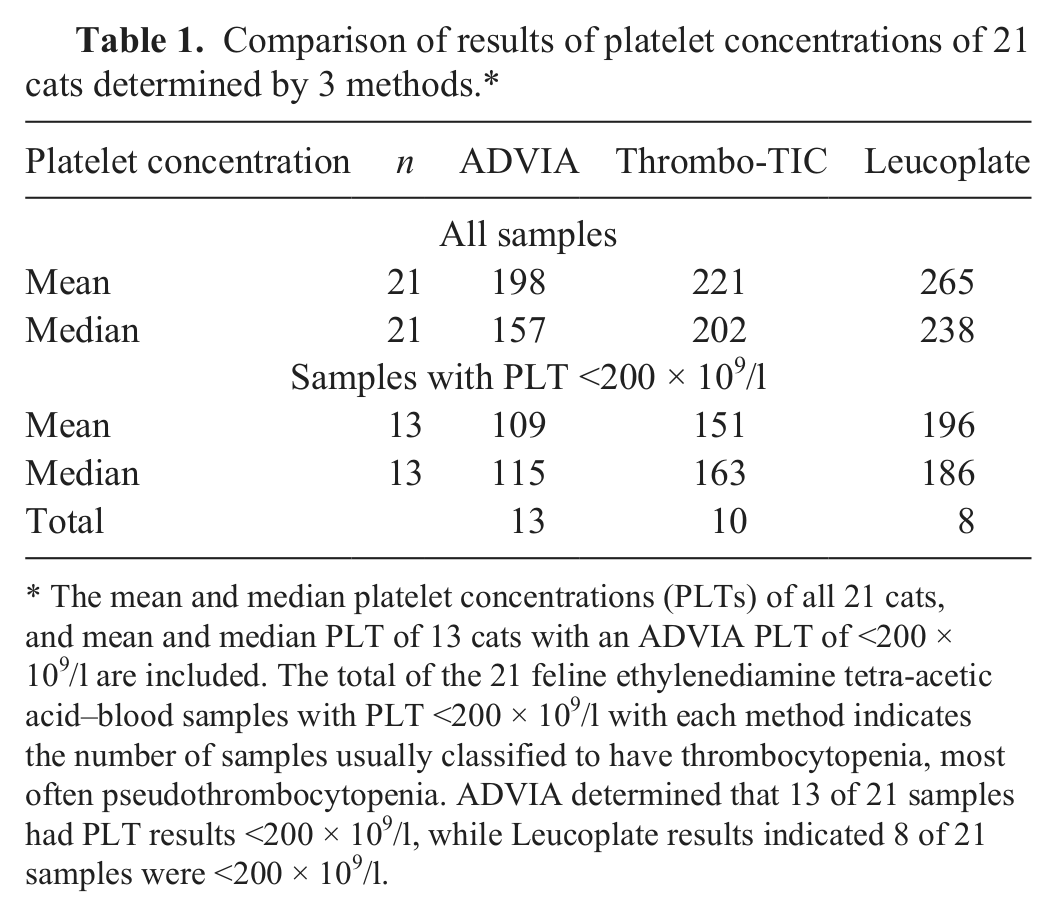
The mean and median platelet concentrations (PLTs) of all 21 cats, and mean and median PLT of 13 cats with an ADVIA PLT of <200 × 109/1 are included. The total of the 21 feline ethylenediamine tetra-acetic acid–blood samples with PLT <200 × 109/1 with each method indicates the number of samples usually classified to have thrombocytopenia, most often pseudothrombocytopenia. ADVIA determined that 13 of 21 samples had PLT results <200 × 109/1, while Leucoplate results indicated 8 of 21 samples were <200 × 109/1.
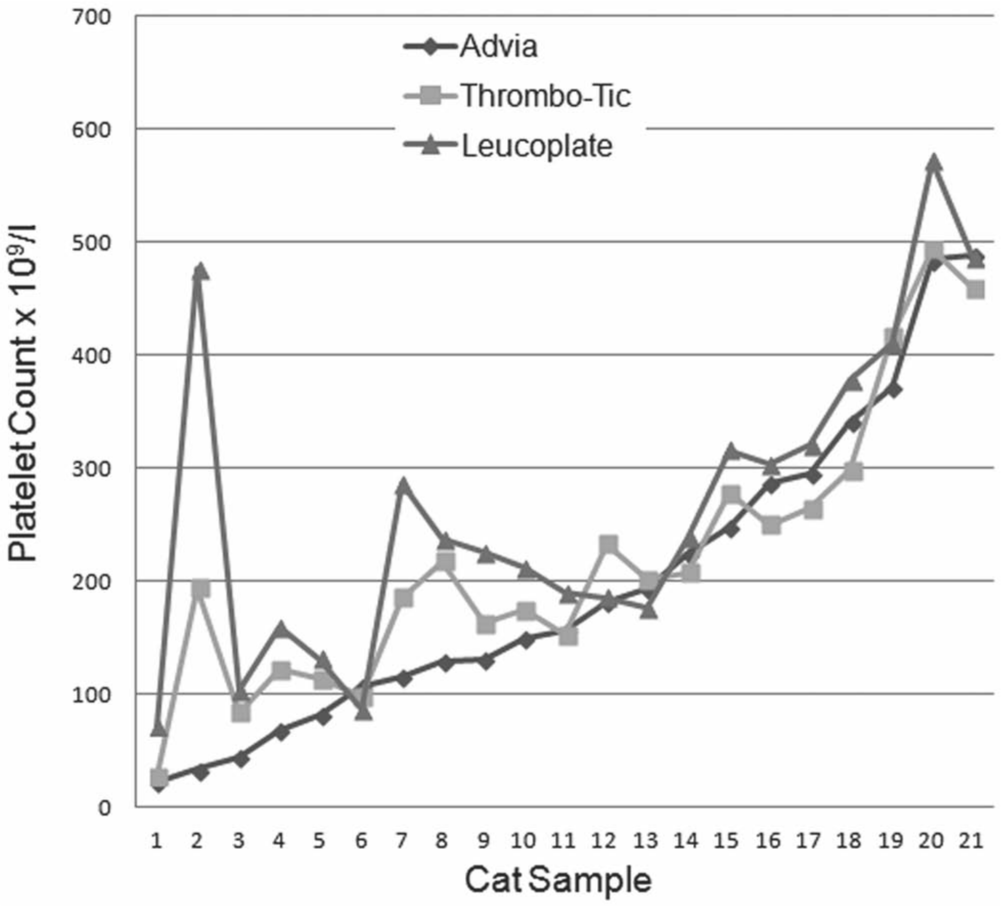
Platelet concentrations (PLTs) in 21 feline ethylenediamine tetra-acetic acid (EDTA)-blood samples were determined by 3 methods. Leucoplate (triangles) and Thrombo-TIC (squares) were manual methods. The ADVIA 2120 (diamonds) is an automated optical method. The cat PLT results are arranged from lowest to highest according to ADVIA PLT. Most variation between methods occurred at the lower ADVIA PLT results where pseudothrombocytopenia and more severe platelet aggregation were more likely. The manual method PLT results were usually greater than ADVIA PLT in this area (ADVIA PLT < 150 × 109/1). The Leucoplate method usually gave the highest PLT among the 3 methods.
Median platelet concentrations (× 109/1) determined by 3 methods and classified by the severity of platelet aggregation on the blood smears from 0 (no aggregates seen) to 4+ (most aggregates seen).*
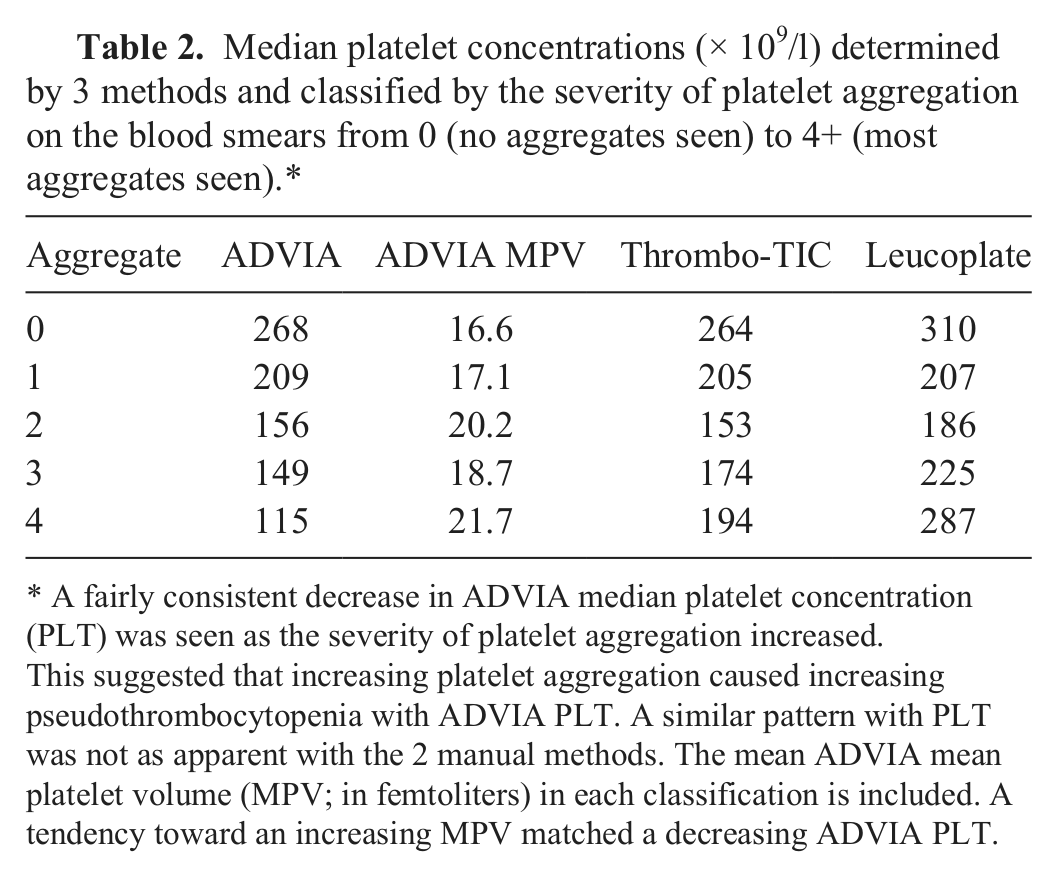
A fairly consistent decrease in ADVIA median platelet concentration (PLT) was seen as the severity of platelet aggregation increased. This suggested that increasing platelet aggregation caused increasing pseudothrombocytopenia with ADVIA PLT. A similar pattern with PLT was not as apparent with the 2 manual methods. The mean ADVIA mean platelet volume (MPV; in femtoliters) in each classification is included. A tendency toward an increasing MPV matched a decreasing ADVIA PLT.
Determination of the number and size of platelet aggregates in the hemocytometers indicated that the Thrombo-TIC method had more frequent and larger platelet aggregates than the Leucoplate method. The Thrombo-TIC had more aggregates than Leucoplate in 8 of 21 samples. In 13 cats, there were similar numbers of aggregates in hemocytometers with both manual methods, and in no sample were more aggregates seen in the Leucoplate hemocytometer. One cat’s blood (shown in Fig. 2) had the most extreme variation in results of the 3 methods, with a PLT of 477, 194, and 33 × 109/1 with Leucoplate, Thrombo-TIC, and ADVIA, respectively. Several medium to large aggregates were seen in the hemocytometer with Thrombo-TIC, but, with Leucoplate, platelets were mainly individualized and seldom seen in small aggregates (Fig. 2). The aforementioned blood sample in Figure 2 had large numbers of small platelet aggregates in its blood smear.
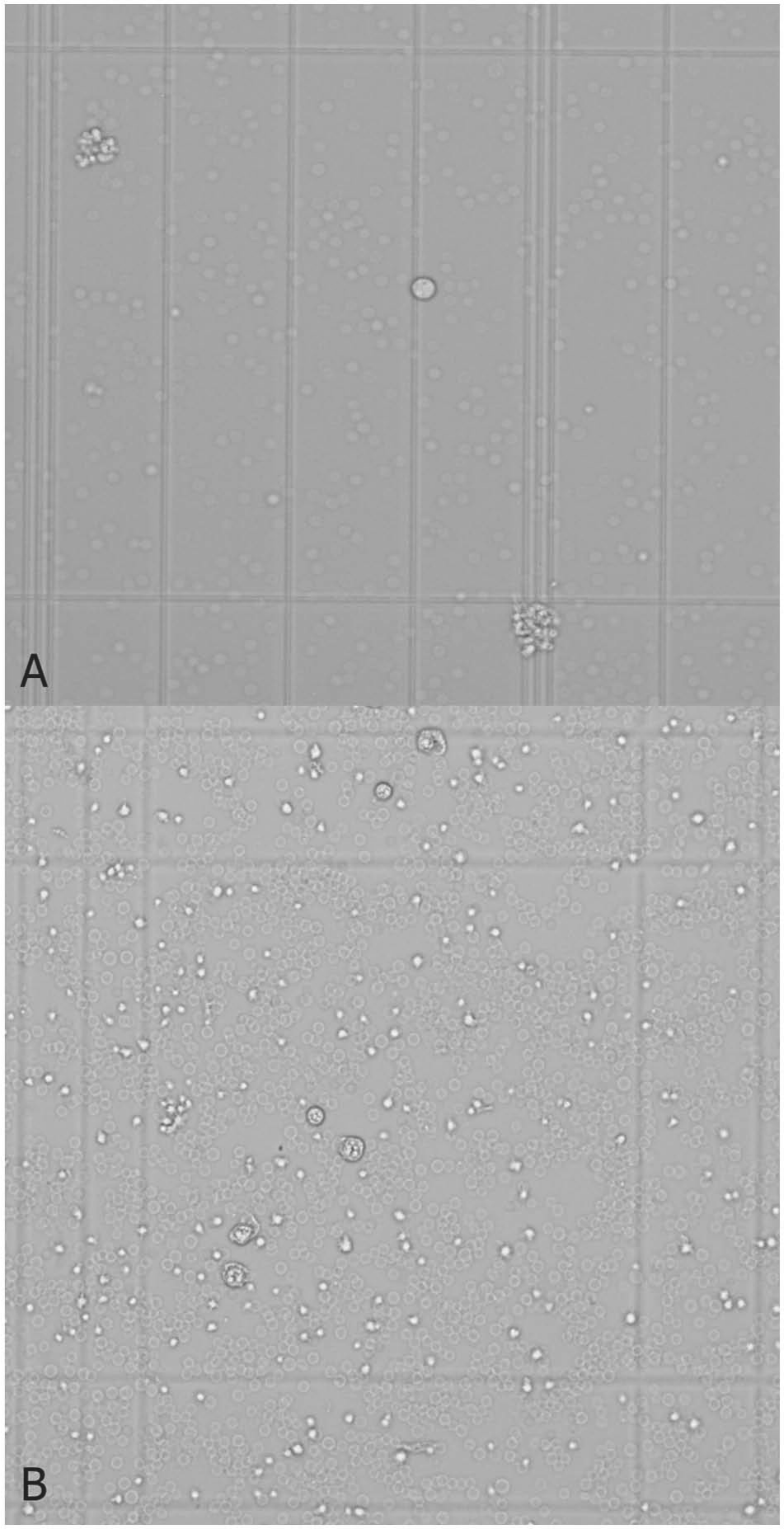
Composite of 2 photomicrographs of 2 counting chambers containing the same cat’s blood diluted with either Thrombo-TIC solution (
Median intra-assay precision CV% based on duplicate analysis of the 21 feline blood samples for ADVIA, Thrombo-TIC, and Leucoplate was 5.9, 7.4, and 7.3, respectively. There was great variation in CV among samples. Precision of the ADVIA system appeared to be only slightly better than the manual methods in those samples. The 2 manual methods had similar precision. In contrast, intra-assay precision results with 1 canine blood without platelet aggregates analyzed 10 consecutive times indicated that the ADVIA PLT was clearly most precise and detected more platelets than the 2 manual methods. The CV% for ADVIA, Thrombo-TIC, and Leucoplate was 3.1, 7.4, and 8.5, respectively. Mean PLT values for ADVIA, Thrombo-TIC, and Leucoplate in the canine sample were 352, 287, and 245 × 109/1, respectively.
Both of the hypotheses proposed in the current study were incorrect. The Thrombo-TIC method did not appear to disassociate feline platelet aggregates completely or better than the current manual method (Leucoplate). Thrombo-TIC did not give the highest PLT of the 3 methods. Leucoplate appeared to give the greatest PLT concentration most often and had fewer and smaller aggregates in its hemocytometer than the Thrombo-TIC method. However, this result does not indicate that the Leucoplate method PLT with feline blood samples is more accurate in the presence of many platelet aggregates. Eight of 21 cats had PLT <200 × 109/1 with the Leucoplate method. A PLT value of <200 × 109/1 was used to indicate thrombocytopenia. Thus, 8–13 of the 21 cats were classified as having thrombocytopenia based on results of the 3 methods. True thrombocytopenia is uncommon in feline patients (1.2% of feline blood samples) 3 and, therefore, it was likely that many of those 8–13 cats had pseudothrombocytopenia. Because Leucoplate often gave a higher PLT than with the other 2 methods, it appeared to be more accurate in the presence of this preanalytic error. Dilution of blood was 1:100 with Thrombo-TIC and 1:20 with Leucoplate; therefore, it was not a larger volume of dilution that made Leucoplate better. It may be that the diluent with Leucoplate dissociated platelet aggregates better than diluents with Thrombo-TIC or ADVIA.
The ADVIA 2120 had the lowest PLT concentrations and, therefore, probably more frequent pseudothrombocytopenia than the manual methods. ADVIA is considered to have one of the best PLT methods because it identifies platelets by both size and optical density and detects platelets up to 60 femtoliters, which are larger than many feline erythrocytes. 8 However, ADVIA appeared to be adversely affected by platelet aggregates in feline EDTA-blood. The mean and median ADVIA PLT were the lowest of the 3 methods, and median ADVIA PLT decreased as the severity of platelet aggregation seen on blood smear increased.
Though ADVIA can detect platelets up to 60 femtoliters in size, feline blood may have platelets even too large for ADVIA to detect. Very large platelets can be seen in hemocytometers and should be included in a manual PLT. Thus, a failure to detect the largest platelets may be a second reason for falsely lower feline ADVIA PLTs than manual PLT in some feline samples. The mean platelet volume tended to increase with decreasing ADVIA PLT, which could indicate that those blood samples with a false low ADVIA PLT had the largest platelets. Mean platelet volume has been noted to increase as PLT decreases, a basic biological pattern common to various diseases and species. 7
It was unexpected that the manual methods would perform better than the automated method with routine collected EDTA samples from feline patients. No method is accurate if there are many and/or large platelet aggregates, but if an automated feline PLT is low it may be worth performing a manual PLT. If the subsequent manual PLT is within the reference values or much nearer the lower reference value, then the feline patient is less likely to have true thrombocytopenia.
Precision is expected to be better with an automated hematology analyzer than manual cell enumeration. ADVIA 2120 within run precision with 1 canine EDTA blood sample without platelet aggregates had a CV of 3.1%, which is similar to that reported with human PLT and the ADVIA 2120 (CV: 2.1–2.8%).1,2 Precision of the 2 manual methods (CV: 7.4% and 8.5% for Thrombo-TIC and Leucoplate, respectively) with the canine blood was very good compared to textbook reports of 10–25% for manual PLT.
The detection of enough platelet aggregates to affect feline PLT has been reported to be at least 50%, 56%, and 67% of samples.4-6,8 In the current study, the ADVIA flagged for platelet aggregates in 52% of the feline blood samples, and examination of blood smear revealed platelet aggregates in 66% of samples. The subjective grading of an increase in the number and size of platelet aggregates was reflected by decreasing ADVIA PLT numbers and slightly worse precision. Platelet aggregation in feline blood samples is common and adversely affects PLT. A more accurate PLT may be achieved with feline blood if platelet aggregation is inhibited with prostaglandin E1. 6 The hypothesis that the Thrombo-TIC method would allow improved accuracy for feline platelet counting was incorrect. The ADVIA method performed worse than expected with feline EDTA blood samples, apparently due at least in part to the presence of platelet aggregates. In conclusion, the Leucoplate manual method performed the best out of the 3 methods; however, neither method consistently gave accurate results when a feline blood sample had prominent platelet aggregation.
Footnotes
Acknowledgements
The project was part of the degree requirements for J. Ljusner in medical technology (biomedical analysis) at Uppsala University, and a report of the project will be recorded in the Uppsala University Library.
Declaration of conflicting interests
The author(s) declare they have no conflict of interest with respect to the research, authorship, or publication of this article.
Funding
The author(s) disclosed receipt of the following financial support for the research, authorship, and/or publication of this article: The study was partly financed by Agria and SKK Foundation for research (N2011-0050). The Thrombo-TIC reagents were provided by Bioanalytic GmbH, Umkirch/Freiburg, Germany.
a.
Thrombo-TIC, Bioanalytic GmbH, Umkirch/Freiburg, Germany.
b.
Leucoplate, Sobioda, Montbonnot-Saint-Martin, France.
c.
ADVIA 2120, Siemens AG, Eschborn, Germany.
d.
Vacuette, Greiner Bio-one International AG, Frickenhausen, Austria.
e.
Neubuer haemacytometer, Weber Scientific International, Teddington, United Kingdom.
f.
Bürker hemocytometer, Glaswarenfabrik Karl Hecht GmbH & Co KG, Sondheim, Germany.